
Oswald Spengler (1880–1936)
Author of The Decline of the West : An Abridged Edition
About the Author
German historian and philosopher Oswald Spengler studied at the universities of Munich, Berlin, and Halle. Although originally trained in the natural sciences and mathematics, he read widely in history, philosophy, and literature. In 1918, Spengler published the first volume of his two-volume show more master work, The Decline of the West (1918--1922). Written during World War I, when Spengler was living in extreme poverty in Munich, the work has as its theme the rise and decline of civilization. Spengler, who believed that present occidental civilization had reached its period of decadence and was about to be conquered by the Mongolian people of Asia, revised his work in the period of despair following the war, and the 1923 edition brought him wealth and fame. Because of his dislike of "non-Aryan" peoples and his belief in the ideal of obedience to the state he was popular with the Nazis when they first sought power. But when he refused to participate in their anti-Semitic activities, he was ostracized. Although allowed to stay in Germany and to keep his property, the last years of his life were spent under the cloud of official disfavor. (Bowker Author Biography) show less
Image credit: Bundesarchiv, Bild 183-R06610, Fotograf: o.Ang.
Series
Works by Oswald Spengler
Pessimismus? 2 copies
Urfragen 2 copies
Prusianismo y socialismo 1 copy
Πρωσσισμός & Σοσιαλισμός 1 copy
Neubau des deutshen Reiches 1 copy
Briefe, 1913-1936 1 copy
Preusseri och socialism 1 copy
Η παρακμή της Δύσης Β - Περιγράμματα μιας μορφολογίας της παγκόσμιας ιστορίας, Δεύτερος τόμος :… 1 copy, 1 review
Neubau des Deutschen Reiches 1 copy
Briefe 1 copy
Años decisivos 1 copy
Der Untergang des Abendlandes. Umrisse einer Morphologie der Weltgeschichte. Gekürzte Ausgabe (1959) 1 copy
O Homem e a Técnica 1 copy
Associated Works
Fifty Years: Being a Retrospective Collection of Novels, Novellas, Tales, Drama, Poetry, and Reportage and Essays: All Drawn from Volumes Issued during the Last Half-Century by… (1965) — Contributor — 55 copies
The intellectual tradition of modern Germany : A collection of writings from the eighteenth to the twentieth century (1973) — Contributor — 3 copies
Tagged
Common Knowledge
- Legal name
- Spengler, Oswald Manuel Arnold Gottfried
- Birthdate
- 1880-05-29
- Date of death
- 1936-05-08
- Gender
- male
- Education
- University of Munich
University of Halle
University of Berlin - Occupations
- historian
philosopher - Nationality
- Germany
- Birthplace
- Blankenburg, Germany
- Places of residence
- Munich, Bavaria, Germany (death)
Blankenburg am Harz, Germany (birth) - Place of death
- München, Germany
- Associated Place (for map)
- Germany
Members
Discussions
Is Spengler worth reading? in Non-Fiction Readers (May 2013)
Reviews

An important look at the history of Western civlization written in 1917. An incredibly probing look into the meanins of culture, philosophy, etc. from a mascroscopic, pan-historical view. Very heavy, I can scarcely handle five pages a day. Now, I am over half-way through volume II. The reading here gets near impenetrable, though some sections like Nobles and The Priesthood are thick with deep thoughts worth considering. I finally finished this after months of effort. I have read no finer show more work of historic and pan-cultural study. Here on the eve of WWI, Spengler predicted the Cold War, American apathy with a corrupt political system and much more show less

Luin tämän lopulta loppuun. Kirja olisi kaivannut kovasti editoria, mutta ajatukset sinänsä olivat mielenkiintoisia.
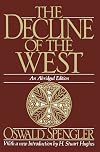
I'm under the impression that this book was once held in quite high esteem, but today it's hard to find anything of value in it. The author thinks he can trace and predict the course of human history by studying the history of art. That's all you need to know.

1931: Spengler mette a punto la sua visione della relazione sostanziale tra uomo e tecnica, il destino della nostra folle impresa di asservimento della natura e le organizzazioni sociali che questo impeto ha generato. Fondamentale.
Lists
Awards


You May Also Like


Associated Authors
Statistics
- Works
- 64
- Also by
- 6
- Members
- 2,712
- Popularity
- #9,470
- Rating
- 3.9
- Reviews
- 32
- ISBNs
- 216
- Languages
- 19
- Favorited
- 18

