
Works by James Fallon
The Psychopath Inside: A Neuroscientist's Personal Journey into the Dark Side of the Brain (2013) 360 copies, 7 reviews
Alannah, Lorcan and The Wolf 2 copies
Tagged
Common Knowledge
- Gender
- male
- Occupations
- Neuroscientist
- Nationality
- USA
- Associated Place (for map)
- USA
Members
Reviews
The Psychopath Inside: A Neuroscientist's Personal Journey into the Dark Side of the Brain by James Fallon

Non-fiction memoir from a research neuroscientist who inadvertently discovered his brain scan is similar to that of the psychopathic killers he had been studying. Fallon is married, has a family, and does not show a history of violence; however, he admits he possesses many of the traits of a psychopath, such as lack of empathy and remorse, unreliability, impulsivity, putting loved ones in danger for the thrill of it, lying, manipulation, and narcissism. He provides plenty of examples from show more his life that demonstrate these traits. Fallon considers himself a “pro-social” (non-violent) psychopath, which he also refers to as “Psychopath Lite.”
In his words, “Love me or hate me, I was not a criminal. My brain may have looked a lot like those of the murderers I’d been studying, but I had never killed or ruthlessly assaulted anyone. I had never fantasized about committing violence or doing harm to another individual. I was a successful, happily married father of three—a pretty normal guy.”
I found the title intriguing. Ever since I had an extremely unpleasant encounter with a psychopath years ago, I have been occasionally reading about brain science, how psychopaths operate, and how to identify and avoid them. Many people with only a passing idea of psychopathy believe these people are hard-boiled killers, but what some may not realize is that a certain percentage of the population carries every negative trait of a psychopath except the violent criminal behavior. They lack empathy, and can be cold, calculating, superficial, and manipulative. They can also be glib and charming. Fallon estimates two percent of the population are psychopathic. I have read other books that put this figure as high as four percent.
If you are just starting down the path of reading up on brain science, I recommend starting elsewhere to get the basics down before tackling this book for a couple of reasons. 1) Fallon engages in an abundance of scientific analysis and uses jargon unfamiliar to many people. He speaks of chemical neurotransmitters, brain anatomy, psychotropic medications, epigenetic tagging, and similar related concepts, which merit a basic understanding in order to follow his train of thought. 2) He makes a few outlandish claims, which I don’t think anyone without at least a basic knowledge of these concepts would be able to refute, or even know they should be refuted.
Although he tries to remain objective, I do not think he succeeds. He spends a good amount of time excusing and rationalizing his actions. He argues that psychopaths are beneficial to society. In my opinion, his logic is flawed. Of course, I’m not a research scientist, but much of my reading does not lead to the same interpretations. He includes a plethora of personal information, some of which is unnecessary and repetitive, and as should come as no surprise, much of it sounds grandiose. Several chapters read like a thesis.
I found this book a very good guide on how a “pro-social” psychopath thinks. The last few chapters, in particular, are very telling. For example, he states, “But the inherent problem I could not shake is that, try as I may, I really just don’t care. There it is again. I do have some desire to keep the people around me happy, but that’s mostly because it makes my own life easier and more pleasant.” At any rate, it is an interesting memoir, providing you do not accept his conclusions at face value. show less
In his words, “Love me or hate me, I was not a criminal. My brain may have looked a lot like those of the murderers I’d been studying, but I had never killed or ruthlessly assaulted anyone. I had never fantasized about committing violence or doing harm to another individual. I was a successful, happily married father of three—a pretty normal guy.”
I found the title intriguing. Ever since I had an extremely unpleasant encounter with a psychopath years ago, I have been occasionally reading about brain science, how psychopaths operate, and how to identify and avoid them. Many people with only a passing idea of psychopathy believe these people are hard-boiled killers, but what some may not realize is that a certain percentage of the population carries every negative trait of a psychopath except the violent criminal behavior. They lack empathy, and can be cold, calculating, superficial, and manipulative. They can also be glib and charming. Fallon estimates two percent of the population are psychopathic. I have read other books that put this figure as high as four percent.
If you are just starting down the path of reading up on brain science, I recommend starting elsewhere to get the basics down before tackling this book for a couple of reasons. 1) Fallon engages in an abundance of scientific analysis and uses jargon unfamiliar to many people. He speaks of chemical neurotransmitters, brain anatomy, psychotropic medications, epigenetic tagging, and similar related concepts, which merit a basic understanding in order to follow his train of thought. 2) He makes a few outlandish claims, which I don’t think anyone without at least a basic knowledge of these concepts would be able to refute, or even know they should be refuted.
Although he tries to remain objective, I do not think he succeeds. He spends a good amount of time excusing and rationalizing his actions. He argues that psychopaths are beneficial to society. In my opinion, his logic is flawed. Of course, I’m not a research scientist, but much of my reading does not lead to the same interpretations. He includes a plethora of personal information, some of which is unnecessary and repetitive, and as should come as no surprise, much of it sounds grandiose. Several chapters read like a thesis.
I found this book a very good guide on how a “pro-social” psychopath thinks. The last few chapters, in particular, are very telling. For example, he states, “But the inherent problem I could not shake is that, try as I may, I really just don’t care. There it is again. I do have some desire to keep the people around me happy, but that’s mostly because it makes my own life easier and more pleasant.” At any rate, it is an interesting memoir, providing you do not accept his conclusions at face value. show less
The Psychopath Inside: A Neuroscientist's Personal Journey into the Dark Side of the Brain by James Fallon
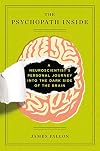
Short, not particularly helpful book that veers from a ton of anatomy terms listing parts of the brain and functions generally associated with them to the author’s personal story, which is that his brain scans show many of the physical signs associated with people (men) who’ve committed terrible crimes and have no remorse for them. But Fallon identifies as a prosocial psychopath because, although he drinks and flirts (and possibly does more) too much, he’s a productive scholar and a show more generally helpful, though manipulative, person. Only at the end of the book does he reveal that, along with the brain scans, he also has many of the behavior patterns of a person with a behavior disorder. Also, he’s a libertarian who doesn’t believe in government assistance for poor people (though he will take grants as long as he’s not the primary researcher, because he’s practical), because failure is a matter of personal choice/characteristics—despite his own claim that nurture made the difference between him and criminal psychopaths, who generally have histories of early childhood abuse. The most notable thing about the book is that it seems to be getting generally respectful treatment in the popular press, despite being pretty noticeably less thoughtful and less honest than an equally troubling book about being a psychopath/sociopath published less than a year ago. http://rivkat.livejournal.com/393115.html What’s the difference? I can’t help thinking that at least part of the difference comes from the gender of the authors—his behavior is “boys will be boys”; hers is not. show less
The Psychopath Inside: A Neuroscientist's Personal Journey into the Dark Side of the Brain by James Fallon
Fascinating info-- five stars for the book and the info
The Psychopath Inside: A Neuroscientist's Personal Journey into the Dark Side of the Brain by James Fallon
Nature vs. nurture... Fascinating discussion re genetics and brain chemistry.
Lists
You May Also Like


Statistics
- Works
- 4
- Members
- 367
- Popularity
- #65,578
- Rating
- 3.4
- Reviews
- 7
- ISBNs
- 15
- Languages
- 4