
Martha Stout
Author of The Sociopath Next Door
About the Author
Martha Stout, Ph.D., served on the faculty in psychology in the department of psychiatry at Harvard Medical School for more than twenty-five years and was a clinical associate at the Massachusetts General Hospital in Boston. She practiced as a clinical psychologist specializing in recovery from show more psychological trauma and PTSD. Dr. Stout has taught psychology at the graduate faculty of the New School for Social Research in New York, the Massachusetts School of Professional Psychology, and Wellesley College. She is the author of, among numerous other publications, The Sociopath Next Door, The Paranoia Switch, and The Myth of Sanity. show less
Works by Martha Stout
The Paranoia Switch: How Terror Rewires Our Brains and Reshapes Our Behavior and How We Can Reclaim Our Courage (2007) 86 copies, 1 review
Outsmarting the Sociopath Next Door: How to Protect Yourself Against a Ruthless Manipulator (2020) 75 copies, 2 reviews
Tagged
Common Knowledge
- Canonical name
- Stout, Martha
- Legal name
- Stout, Martha
- Birthdate
- 1953
- Gender
- female
- Education
- McClean Psychiatric Hospital (Residency)
- Occupations
- clinical psychologist
- Organizations
- Harvard Medical School
Massachusetts General Hospital
National Institute for Mental Health
Wellesley College
The New School for Social Research
Massachusetts School of Professional Psychology - Awards and honors
- Books for a Better Life Award (2006)
- Agent
- Susan Lee Cohen
- Short biography
- Martha Stout, Ph.D., is a clinical psychologist and award-winning author, whose books have been acclaimed in the United States and translated for audiences throughout the world. Her work has startled the audiences of National Public Radio, NBC, CNN, Larry King Live, and Good Morning America, and the readers of publications ranging from the Boston Globe to the Oprah Magazine. The year after it was published, Dr. Stout’s best-selling book The Sociopath Next Door won the Books for a Better Life Award, in recognition of the many lives she has touched through her work on the psychological nature of conscience and the crucial nature of conscience in human life.
Dr. Stout served on the clinical faculty of the Harvard Medical School for more than twenty-five years, through the McLean Hospital in Belmont, Massachusetts, and the Massachusetts General Hospital in Boston, and has taught on the Graduate Faculty of the New School for Social Research and the psychology faculty of Wellesley College.
Dr. Stout lives with her family on Cape Ann, in Massachusetts.
http://www.actionablebooks.com/author... - Nationality
- USA
- Places of residence
- Cape Ann, Massachusetts, USA
Boston, Massachusetts, USA - Associated Place (for map)
- Massachusetts, USA
Members
Reviews
Outsmarting the Sociopath Next Door: How to Protect Yourself Against a Ruthless Manipulator by Martha Stout

A chilling but ultimately very helpful manual for dealing with sociopaths. The author presents a number of instructive case studies which both provide a guide for spotting a sociopath as well as explicit tips for surviving your encounter with one. She provides step-by-step instructions for waging war against ones you meet in the workplace as well as strategies for those who are related to one by either blood or marriage.
Although these stories are terrifying, they provide a rare practical show more tool for negotiating this most treacherous of social interaction. The author delves quite a bit into the nature of evil and quantifying sociopathic behavior and how it is distinguished from narcissistic behavior. A truly fascinating and cautionary read. show less
Although these stories are terrifying, they provide a rare practical show more tool for negotiating this most treacherous of social interaction. The author delves quite a bit into the nature of evil and quantifying sociopathic behavior and how it is distinguished from narcissistic behavior. A truly fascinating and cautionary read. show less
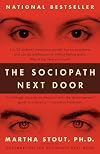
I think about this book ALL the time...especially when dealing with people that I believe lie ALL the time.
I had never thought about my tendency to date guys that I pity until I read this book.
Down on their luck bad boy types...you know the ones...yes...I'm that good girl in Tom Petty songs that always falls for the bad boy with a streak of bad luck.
Dr. Stout points out that in order to protect yourself from sociopaths, you must examine & avoid the "pity play".
When we pity someone that show more we think we love...we will do almost anything for that person.
Per Dr. Stout:
"After listening for almost twenty-five years to the stories my patients tell me about sociopaths who have invaded and injured their lives, when I am asked, “How can I tell whom not to trust?” the answer I give usually surprises people. The natural expectation is that I will describe some sinister-sounding detail of behavior or snippet of body language or threatening use of language that is the subtle giveaway. Instead, I take people aback by assuring them that the tip-off is none of these things, for none of these things is reliably present. Rather, the best clue is, of all things, the pity play. The most reliable sign, the most universal behavior of unscrupulous people is not directed, as one might imagine, or our fearfulness. It is, perversely, an appeal to our sympathy …
More than admiration — more even than fear — pity from good people is carte blanche. When we pity, we are, at least for the moment, defenseless, and like so many of the essentially positive human characteristics that bind us together in groups … our emotional vulnerability when we pity is used against us by those who have no conscience."
This book taught me important questions to ask myself before dating a guy:
Do I respect him or do I feel sorry for him & want to help him?
If I can handle my shit & pay my bills & stay employed...why can't he & why would I date someone that is unable/unwilling to do the same & is perfectly ok with sitting back while I do all the work?
Do I feel like I am constantly playing a game with this person?
Do I feel like I am being manipulated?
Do I experience cognitive dissonance in my conversations/interactions with this person?
Is my loyalty blinding me to his negative traits?
Is my loyalty, sympathy, empathy & tendency to pity being taken advantage of by him?
Excellent interview with Stout:
http://www.interviewmagazine.com/cult... show less
I had never thought about my tendency to date guys that I pity until I read this book.
Down on their luck bad boy types...you know the ones...yes...I'm that good girl in Tom Petty songs that always falls for the bad boy with a streak of bad luck.
Dr. Stout points out that in order to protect yourself from sociopaths, you must examine & avoid the "pity play".
When we pity someone that show more we think we love...we will do almost anything for that person.
Per Dr. Stout:
"After listening for almost twenty-five years to the stories my patients tell me about sociopaths who have invaded and injured their lives, when I am asked, “How can I tell whom not to trust?” the answer I give usually surprises people. The natural expectation is that I will describe some sinister-sounding detail of behavior or snippet of body language or threatening use of language that is the subtle giveaway. Instead, I take people aback by assuring them that the tip-off is none of these things, for none of these things is reliably present. Rather, the best clue is, of all things, the pity play. The most reliable sign, the most universal behavior of unscrupulous people is not directed, as one might imagine, or our fearfulness. It is, perversely, an appeal to our sympathy …
More than admiration — more even than fear — pity from good people is carte blanche. When we pity, we are, at least for the moment, defenseless, and like so many of the essentially positive human characteristics that bind us together in groups … our emotional vulnerability when we pity is used against us by those who have no conscience."
This book taught me important questions to ask myself before dating a guy:
Do I respect him or do I feel sorry for him & want to help him?
If I can handle my shit & pay my bills & stay employed...why can't he & why would I date someone that is unable/unwilling to do the same & is perfectly ok with sitting back while I do all the work?
Do I feel like I am constantly playing a game with this person?
Do I feel like I am being manipulated?
Do I experience cognitive dissonance in my conversations/interactions with this person?
Is my loyalty blinding me to his negative traits?
Is my loyalty, sympathy, empathy & tendency to pity being taken advantage of by him?
Excellent interview with Stout:
http://www.interviewmagazine.com/cult... show less

Thoroughly chilling. I can't help but approach the world as an optimist, but the gritty truth about sociopaths from Martha Stout's book put my normally agreeable outlook on high alert. 1 in 25. That's the statistical rate of sociopaths in everyday life, and it's significant. Chances are decent you know of one yourself. For comparison, Cancer is about 3 in 1,000. Autism is about 1 in 2,000.
The case studies found here in The Sociopath Next Door are going to get under your skin. It's show more unsettling to think you're playing the game of life alongside individuals who feel neither the compulsion to abide by its rules nor any remorse when breaking them.
On a related note, this book has muddled my lifelong love of Charles Dickens' A Christmas Carol. After all, Scrooge needs to have a conscious for the story to work at all, let alone be as powerful as it is. Were it not fiction, Scrooge would probably have been a Grade A sociopath incapable of reform. The implication of that is a shame. show less
The case studies found here in The Sociopath Next Door are going to get under your skin. It's show more unsettling to think you're playing the game of life alongside individuals who feel neither the compulsion to abide by its rules nor any remorse when breaking them.
On a related note, this book has muddled my lifelong love of Charles Dickens' A Christmas Carol. After all, Scrooge needs to have a conscious for the story to work at all, let alone be as powerful as it is. Were it not fiction, Scrooge would probably have been a Grade A sociopath incapable of reform. The implication of that is a shame. show less
Let's just say this book confirmed what I had long suspected about certain family members! Well written for a lay audience. I recommend buying a copy and then passing it around to all your friends. The author makes the compelling argument that we are willfully blind to the sociopaths among us, and it is in our own best interests to be able to identify them. Basically, if you ever feel that someone is abusing you or using you for their own pleasure- especially if it's in subtle ways that show more would sound crazy if you tried to explain it to someone- you are the target of a sociopath. Or possibly a narcissist- this book also details the difference between the two personality disorders. I put this book in the category of READ IT NOW!! show less
Lists
You May Also Like


Associated Authors
Statistics
- Works
- 5
- Members
- 2,672
- Popularity
- #9,606
- Rating
- 3.6
- Reviews
- 116
- ISBNs
- 38
- Languages
- 7
- Favorited
- 1