
James Lincoln Collier
Author of My Brother Sam is Dead
About the Author
James Lincoln Collier was born in 1928. He graduated from Hamilton College in 1950 and served in the infantry during the Korean War. After college, Collier worked first for six years as a magazine editor, writing in his spare time. In 1958, he quit to work free-lance, and has since then published show more over six hundred magazine articles for periodicals such as, Playboy, Esquire, the New York Times Magazine and the Village Voice. Collier has also published a half dozen books for adults, the most recent being The Making of Jazz, which was nominated for an American Book Award, was named to the London Observer's Books of the Year List for 1979, and has been published in English, French, German, and Russian editions. Collier also published twenty-three children's books, five in collaboration with his brother, Christopher Collier. These have been published in seven languages, and have won the Child Study Association Book Award, a Newbery Honor Medal, a Jane Addams Peace Prize, and a National Book Award nomination. Many of them have appeared on the ALA Notable Book List, and others on the New York Public Library's recommended book list. Collier is also a professional trombonist, and writes fiction and nonfiction on the subject of music. His book, Rock Star, won an award from the Child Study Children's Book Committee at Bank Street College. My Brother Sam Is Dead was a Newbery Honor Book in 1975 and was designated a Notable Book by the American Library Association as well as being nominated for a National Book Award in 1975. Jump Ship to Freedom was named a Notable Trade Book in the Field of Social Studies in 1981 by a joint committee of the National Council for the Social Studies and the Children's Book Council. War Comes to Willy Freeman is a companion book to the novel. (Bowker Author Biography) show less
Image credit: EMS Author Photos
Series
Works by James Lincoln Collier
Lost Treasures #3: The Teddy Bear Habit or How I Became a Winner (Special Promotion): Lost Treasures: The Teddy Bear Habit - Book #3 (1967) 108 copies, 3 reviews
Jamestown's American Portraits: Corn Raid: A Story of the Jamestown Settlement (Jamestown's American Portraits) (2000) 61 copies, 1 review
The United States Enters the World Stage: From Alaska Purchase Through World War I, 1867-1919 (Drama of American History) (1991) 13 copies
Jug bands and handmade music: A creative approach to music theory and the instruments (A Thistle book) (1973) 6 copies
Danny goes to the hospital 2 copies
The steam engine 1 copy
Associated Works
Brother Sam & All That: Historical Context and Literary Analysis of the Novels of James and Christopher Colli (1999) — Contributor — 4 copies
Tagged
Common Knowledge
- Birthdate
- 1928-06-27
- Gender
- male
- Education
- Hamilton College (1950)
- Occupations
- jazz musician
journalist - Relationships
- Collier, Edmund (father)
Collier, Christopher (brother) - Nationality
- USA
- Birthplace
- New York, New York, USA
- Associated Place (for map)
- New York, USA
Members
Reviews

James Lincoln Collier calls himself a jazz historian, but he does not have much to say about particular performances or recordings, and he mostly ignores jazz after the mid-1950s. Nonetheless, his method of excavating and interpreting primary sources provokes a reconsideration of much that is taken for granted about jazz history to the mid-20th century, so his books are worthwhile as background to some of the most interesting controversies in the jazz bibliography.
In The Reception of Jazz in show more America (1988), Collier investigates two myths which he believes have misrepresented the evolution of jazz and its place in American culture. (His subtitle—"A New View”—may be ironic, since his critique takes aim at works published 30 years previous). The first myth is that the American people disdained and ignored jazz for decades, relegating it to the margins of public consciousness; the second myth is that jazz was first taken seriously by Europeans. These myths have been perpetuated in the jazz bibliography by the likes of Whitney Balliett, Rudi Blesh, Marshall Stearns, John Hammond and Eric Hobsbawm—all people who should have known better, in Collier’s opinion.
Writers before Collier (James Weldon Johnson, Ralph Ellison) have situated jazz and black music in general in the mainstream of American culture across the 20th century, but the point bears reiteration. Black performers had been attracting white audiences since the end of the Civil War, in minstrel shows, variety shows and vaudeville. Blacks were producing shows for Broadway in the 1890s, and by the early 20th century ‘black-composed music was part of an accepted national song style.’ After 1910 or so, black musicians took a major role in supplying dance music for whites, from New Orleans to the west coast and in towns along the Mississippi up to Chicago. (James Weldon Johnson wrote a newspaper column in 1915 explaining the phenomenon to a disgruntled white musician). By 1917, says Collier, publications including Variety, Billboard, Literary Digest, and Popular Mechanics were reporting on the jazz ‘craze’ sweeping the nation; ‘by the 1920s, jazz music and jazz dancing…were known and accepted by the public at large.’
As for the question of the reception of jazz in Europe, Collier notes that the 1919 performance in England by the Original Dixieland Jazz Band (which made the first jazz record in 1917, in New York) was a flop, and that no ‘important’ American groups visited Europe between the ODJB’s tour in 1919 and Louis Armstrong’s appearance in 1932. A decade after jazz broke through to public consciousness in the U.S., there was little popular interest in jazz in Europe; no cabarets featured jazz full time, the press ignored jazz almost totally, there was no jazz on the radio, and only a small number of ‘real’ jazz records were issued until the end of the 1920s. ‘Record reviewers in European specialty magazines only slowly came to recognize the difference between “hot” music and ordinary dance music.’ Musicians acknowledged as jazz masters in the U.S. met with indifference in Europe: Armstrong’s performances in 1932 and Duke Ellington’s in 1933 did not attract the kinds of large audiences that would have enabled them to work there regularly. Jazz became popular in Europe only during World War Two, says Collier, mostly because the Nazis ‘anathematized jazz as black and Jewish, and going to concerts became a political act.’
Collier’s research into primary sources effectively undermines the myths of American indifference to and European celebration of jazz in the first half of the 20th century, but his critique also raises the question as to why such myths were proffered, believed and perpetuated. His view is that many mid-century jazz critics and commentators were influenced by a ‘leftist’ political agenda which aimed to portray the U.S. as negligent in its devotion to democracy and racial equality. According to Collier, such commentators intended to contrast America’s mistreatment of its own black population, as evidenced by its ignorant dismissal of jazz, with Europeans’ enlightened racial views and embrace of jazz as an art form. The Reception of Jazz in America undercuts that dichotomy, but the problematique is muddier than Collier acknowledges. For instance, the Europeans Robert Goffin and Hugues Panassié are often presented as early authorities on jazz by later writers, but Collier draws attention to the ignorance and prejudice that afflicted both, and cites the low opinions of Goffin and Panassié held by their American contemporaries Otis Ferguson, E. Simms Campbell and Franklin Marshall Davis (each of whom held complicated political views that would take Collier several additional chapters to adequately unpack). Goffin viewed American blacks through a primitivist lens, but he also wrote of the U.S. as a symbol of freedom and democracy for Europeans, and of the genius of jazz as a reflection of the American spirit. Panassié, according to John Gennari, had a bit of a reactionary streak. That jazz can be discussed at all in ideological terms, though, says much about the influence of cultural and sociological conditions on the music (and vice versa), and about the evolution of the writing and thinking about jazz since the first decades of the 20th century. And Collier’s concern with the ideological contents of jazz history also carries contemporary resonance, as the debate about jazz and race flared anew in the 1980s and 90s.
. show less
In The Reception of Jazz in show more America (1988), Collier investigates two myths which he believes have misrepresented the evolution of jazz and its place in American culture. (His subtitle—"A New View”—may be ironic, since his critique takes aim at works published 30 years previous). The first myth is that the American people disdained and ignored jazz for decades, relegating it to the margins of public consciousness; the second myth is that jazz was first taken seriously by Europeans. These myths have been perpetuated in the jazz bibliography by the likes of Whitney Balliett, Rudi Blesh, Marshall Stearns, John Hammond and Eric Hobsbawm—all people who should have known better, in Collier’s opinion.
Writers before Collier (James Weldon Johnson, Ralph Ellison) have situated jazz and black music in general in the mainstream of American culture across the 20th century, but the point bears reiteration. Black performers had been attracting white audiences since the end of the Civil War, in minstrel shows, variety shows and vaudeville. Blacks were producing shows for Broadway in the 1890s, and by the early 20th century ‘black-composed music was part of an accepted national song style.’ After 1910 or so, black musicians took a major role in supplying dance music for whites, from New Orleans to the west coast and in towns along the Mississippi up to Chicago. (James Weldon Johnson wrote a newspaper column in 1915 explaining the phenomenon to a disgruntled white musician). By 1917, says Collier, publications including Variety, Billboard, Literary Digest, and Popular Mechanics were reporting on the jazz ‘craze’ sweeping the nation; ‘by the 1920s, jazz music and jazz dancing…were known and accepted by the public at large.’
As for the question of the reception of jazz in Europe, Collier notes that the 1919 performance in England by the Original Dixieland Jazz Band (which made the first jazz record in 1917, in New York) was a flop, and that no ‘important’ American groups visited Europe between the ODJB’s tour in 1919 and Louis Armstrong’s appearance in 1932. A decade after jazz broke through to public consciousness in the U.S., there was little popular interest in jazz in Europe; no cabarets featured jazz full time, the press ignored jazz almost totally, there was no jazz on the radio, and only a small number of ‘real’ jazz records were issued until the end of the 1920s. ‘Record reviewers in European specialty magazines only slowly came to recognize the difference between “hot” music and ordinary dance music.’ Musicians acknowledged as jazz masters in the U.S. met with indifference in Europe: Armstrong’s performances in 1932 and Duke Ellington’s in 1933 did not attract the kinds of large audiences that would have enabled them to work there regularly. Jazz became popular in Europe only during World War Two, says Collier, mostly because the Nazis ‘anathematized jazz as black and Jewish, and going to concerts became a political act.’
Collier’s research into primary sources effectively undermines the myths of American indifference to and European celebration of jazz in the first half of the 20th century, but his critique also raises the question as to why such myths were proffered, believed and perpetuated. His view is that many mid-century jazz critics and commentators were influenced by a ‘leftist’ political agenda which aimed to portray the U.S. as negligent in its devotion to democracy and racial equality. According to Collier, such commentators intended to contrast America’s mistreatment of its own black population, as evidenced by its ignorant dismissal of jazz, with Europeans’ enlightened racial views and embrace of jazz as an art form. The Reception of Jazz in America undercuts that dichotomy, but the problematique is muddier than Collier acknowledges. For instance, the Europeans Robert Goffin and Hugues Panassié are often presented as early authorities on jazz by later writers, but Collier draws attention to the ignorance and prejudice that afflicted both, and cites the low opinions of Goffin and Panassié held by their American contemporaries Otis Ferguson, E. Simms Campbell and Franklin Marshall Davis (each of whom held complicated political views that would take Collier several additional chapters to adequately unpack). Goffin viewed American blacks through a primitivist lens, but he also wrote of the U.S. as a symbol of freedom and democracy for Europeans, and of the genius of jazz as a reflection of the American spirit. Panassié, according to John Gennari, had a bit of a reactionary streak. That jazz can be discussed at all in ideological terms, though, says much about the influence of cultural and sociological conditions on the music (and vice versa), and about the evolution of the writing and thinking about jazz since the first decades of the 20th century. And Collier’s concern with the ideological contents of jazz history also carries contemporary resonance, as the debate about jazz and race flared anew in the 1980s and 90s.
. show less

[The Making of Jazz: A Comprehensive History] by James Lincoln Collier
This book has been on my bookshelves a long time, since 1984 in fact. Most of my books are second hand and this one looks second hand and so as usual I turned to the front-piece to see if anybody had written anything in it. They had, but I was amazed to find it was a dedication to me and so the book would have been bought new, it had been bought by my girlfriend at the time. I don't know what has happened to her, but I show more have finally got round to reading the book she bought me and what an excellent book it is.
Originally published in 1981, Collier in his final chapter looks forward to the future of jazz music. He says that the future of jazz is in the past:
"Jazz needs, at the moment, a respite from experiments. It needs time to consolidate it's gains, to go back and re-examine what is there. There is enough work undone to last many lifetimes."
How prophetic, because this is exactly what has happened. Back in 1981 the avant-garde or free jazz movement had run it's course and critics and commentators were wondering where the music was heading next due to it's history of seismic shifts. The answer has been an examination of the past with lines now becoming increasingly blurred between rock, classical, experimental and jazz music. This blurring of lines however may upset Collier a little because in his book he is clear to make a distinction between jazz and other music, he would find it more difficult today.
A comprehensive history of a musical form covering a period of some 80 years in 500 pages is a tall order, but Collier gets it all down with ease. His theme is the development of the music and the important musicians who have made this possible, but he goes further and relates this to the social context in America. Jazz is an American music phenomenon and essentially it was a black man's music and the struggles for civil rights since the second world war have been part of that music. I refrained from finding out about Mr Collier until I had finished the book, but my conclusions that he is a white professional musician proved to be correct.
Collier has written a chronological history and he starts with the roots of jazz; African rhythms and blues field hollers and how this influenced the first period of classic jazz that originated from New Orleans. The legendary cornet player Buddy Bolden is represented by a photograph from 1895, but that is all we have, because he was too early to be recorded. The first jazz recording was made in 1917 (by five white musicians from New Orleans) this was no way representative of the music at the time, but it just happened by chance that the Original Dixieland Jass Band got to make the first record. The book from this moment gets into its stride with Collier providing pen pictures of the real movers and shakers amongst the musicians that made up this first explosion of the music. Sidney Bechet, Jelly Roll Morton, Louis Armstrong and Bessie Smith along with many others who followed in their wake. There is a chapter on the white influx, because bands were segregated in those days and so the music developed in a sort of parallel world: some space is therefore given to Jack Teagarden, Pee Wee Russell, Benny Goodman and Bix Beiderbeck.
The first of those seismic shifts came with the evolution into swing music and the introduction of the big jazz bands, but Collier is also careful not to lose sight of other developments particularly in piano music and in the splinter groups that formed out of the big bands. The period before the second world war saw the gradual integration of black and white musicians, but it was a relatively slow process and presented difficulties for those involved. At the end of the war the first Bebop groups started making records and the music loving public had to learn almost a whole new language to appreciate what the new younger musicians were doing. Collier explains why this was so from a musical point of view and also puts it in a social context. A drugs culture that had always been present in Jazz music seemed to become a veritable plague amongst the Beboppers with heroin the drug of choice. There are many stories of musicians succumbing to addiction and Collier mentions these without straying too far away from the music that was being made. In the early fifties there was a reaction against the bebop from the traditional jazz revivalists and the cool jazz practitioners from the west coast. Collier charts the progress of these various musical strands highlighting those musicians that were comfortable in moving across the musical boundaries. The late fifties early sixties was the time for the free jazz practitioners to take the music in another direction again and the final chapter of the book features John Coltrane with Collier wondering if the musician was going to be considered the new jazz messiah, by future generations.
Throughout the book the musicians that impress Collier most are those that have the ability to move away from what he terms as the ground beat; the true practitioners of jazz in his opinion and he goes into some detail explaining how this effect is achieved. Collier describes the music they played and points out in his opinion the best examples of their work. He also attempts a musical analysis of some of the main trends which might not be easily understood by non musicians, but it is not in too much detail and would still give a flavour of what was happening with the music. He is of course impressed by musical expertise, but is quite clear that a limited technical ability has not been a hindrance to many jazz musicians. I think he treads this difficult line with real insight. The limited space available makes it difficult to chart the progress of jazz music around the world and during the period of recorded music that Collier covers 1917 to the late 1960's most of the innovations happened in America. There is a perfunctory chapter on European jazz, which might concern some readers, but is probably appropriate.
Collier provides a discography of over 300 recordings covering the period that he critiques in his book and would serve as an excellent guide for those people wanting to hear just what he is talking about. I have been listening to jazz since the late 1960's and have a fairly good knowledge of the music since the second world war and so based on what I know I am happy to let Collier guide me through the gaps in my knowledge of the earlier period of jazz. He also provides a decent bibliography, but I have a feeling it may be a little white author centred, for example there is only one book listed by Leroi Jones.
This really is a comprehensive book on the making of jazz and quite an achievement in itself. I have a couple of criticisms which did not get in the way of my enjoyment of the book. Collier spends some time in a search for the holy grail; that is the perfect improvised jazz solo and his analysis of some musicians efforts can feel a little academic. My other criticism is that the book is obviously written by a white author and his subject is an essentially black music (historically at least): now I am not saying that white people cannot write about black music which is almost as stupid as saying white musicians can't play jazz, but maybe Collier places undue emphasis on some white musicians role in the history of the music. He acknowledges that some black musicians also took the civil rights movement into the concert halls and jazz clubs and while there is no overt criticism of this stance I get the feeling that he would rather they just get on and play the music.
There is no doubting Colliers love and feeling for the music and this shines through his text. It is a considered and carefully thought through love, that is not without criticism of some of the music. It is going to be an expensive book for me as I have made a list of recordings that I want to hear: fortunately these days, jazz reissues of earlier music can be had for little money. A five star read that comes with an unqualified recommendation. show less
This book has been on my bookshelves a long time, since 1984 in fact. Most of my books are second hand and this one looks second hand and so as usual I turned to the front-piece to see if anybody had written anything in it. They had, but I was amazed to find it was a dedication to me and so the book would have been bought new, it had been bought by my girlfriend at the time. I don't know what has happened to her, but I show more have finally got round to reading the book she bought me and what an excellent book it is.
Originally published in 1981, Collier in his final chapter looks forward to the future of jazz music. He says that the future of jazz is in the past:
"Jazz needs, at the moment, a respite from experiments. It needs time to consolidate it's gains, to go back and re-examine what is there. There is enough work undone to last many lifetimes."
How prophetic, because this is exactly what has happened. Back in 1981 the avant-garde or free jazz movement had run it's course and critics and commentators were wondering where the music was heading next due to it's history of seismic shifts. The answer has been an examination of the past with lines now becoming increasingly blurred between rock, classical, experimental and jazz music. This blurring of lines however may upset Collier a little because in his book he is clear to make a distinction between jazz and other music, he would find it more difficult today.
A comprehensive history of a musical form covering a period of some 80 years in 500 pages is a tall order, but Collier gets it all down with ease. His theme is the development of the music and the important musicians who have made this possible, but he goes further and relates this to the social context in America. Jazz is an American music phenomenon and essentially it was a black man's music and the struggles for civil rights since the second world war have been part of that music. I refrained from finding out about Mr Collier until I had finished the book, but my conclusions that he is a white professional musician proved to be correct.
Collier has written a chronological history and he starts with the roots of jazz; African rhythms and blues field hollers and how this influenced the first period of classic jazz that originated from New Orleans. The legendary cornet player Buddy Bolden is represented by a photograph from 1895, but that is all we have, because he was too early to be recorded. The first jazz recording was made in 1917 (by five white musicians from New Orleans) this was no way representative of the music at the time, but it just happened by chance that the Original Dixieland Jass Band got to make the first record. The book from this moment gets into its stride with Collier providing pen pictures of the real movers and shakers amongst the musicians that made up this first explosion of the music. Sidney Bechet, Jelly Roll Morton, Louis Armstrong and Bessie Smith along with many others who followed in their wake. There is a chapter on the white influx, because bands were segregated in those days and so the music developed in a sort of parallel world: some space is therefore given to Jack Teagarden, Pee Wee Russell, Benny Goodman and Bix Beiderbeck.
The first of those seismic shifts came with the evolution into swing music and the introduction of the big jazz bands, but Collier is also careful not to lose sight of other developments particularly in piano music and in the splinter groups that formed out of the big bands. The period before the second world war saw the gradual integration of black and white musicians, but it was a relatively slow process and presented difficulties for those involved. At the end of the war the first Bebop groups started making records and the music loving public had to learn almost a whole new language to appreciate what the new younger musicians were doing. Collier explains why this was so from a musical point of view and also puts it in a social context. A drugs culture that had always been present in Jazz music seemed to become a veritable plague amongst the Beboppers with heroin the drug of choice. There are many stories of musicians succumbing to addiction and Collier mentions these without straying too far away from the music that was being made. In the early fifties there was a reaction against the bebop from the traditional jazz revivalists and the cool jazz practitioners from the west coast. Collier charts the progress of these various musical strands highlighting those musicians that were comfortable in moving across the musical boundaries. The late fifties early sixties was the time for the free jazz practitioners to take the music in another direction again and the final chapter of the book features John Coltrane with Collier wondering if the musician was going to be considered the new jazz messiah, by future generations.
Throughout the book the musicians that impress Collier most are those that have the ability to move away from what he terms as the ground beat; the true practitioners of jazz in his opinion and he goes into some detail explaining how this effect is achieved. Collier describes the music they played and points out in his opinion the best examples of their work. He also attempts a musical analysis of some of the main trends which might not be easily understood by non musicians, but it is not in too much detail and would still give a flavour of what was happening with the music. He is of course impressed by musical expertise, but is quite clear that a limited technical ability has not been a hindrance to many jazz musicians. I think he treads this difficult line with real insight. The limited space available makes it difficult to chart the progress of jazz music around the world and during the period of recorded music that Collier covers 1917 to the late 1960's most of the innovations happened in America. There is a perfunctory chapter on European jazz, which might concern some readers, but is probably appropriate.
Collier provides a discography of over 300 recordings covering the period that he critiques in his book and would serve as an excellent guide for those people wanting to hear just what he is talking about. I have been listening to jazz since the late 1960's and have a fairly good knowledge of the music since the second world war and so based on what I know I am happy to let Collier guide me through the gaps in my knowledge of the earlier period of jazz. He also provides a decent bibliography, but I have a feeling it may be a little white author centred, for example there is only one book listed by Leroi Jones.
This really is a comprehensive book on the making of jazz and quite an achievement in itself. I have a couple of criticisms which did not get in the way of my enjoyment of the book. Collier spends some time in a search for the holy grail; that is the perfect improvised jazz solo and his analysis of some musicians efforts can feel a little academic. My other criticism is that the book is obviously written by a white author and his subject is an essentially black music (historically at least): now I am not saying that white people cannot write about black music which is almost as stupid as saying white musicians can't play jazz, but maybe Collier places undue emphasis on some white musicians role in the history of the music. He acknowledges that some black musicians also took the civil rights movement into the concert halls and jazz clubs and while there is no overt criticism of this stance I get the feeling that he would rather they just get on and play the music.
There is no doubting Colliers love and feeling for the music and this shines through his text. It is a considered and carefully thought through love, that is not without criticism of some of the music. It is going to be an expensive book for me as I have made a list of recordings that I want to hear: fortunately these days, jazz reissues of earlier music can be had for little money. A five star read that comes with an unqualified recommendation. show less
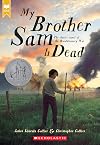
First sentence: It was April, and outside in the dark the rain whipped against the windows of our tavern, making a sound like muffled drums.
Premise/plot: My Brother Sam is Dead is historical fiction for middle grade (and/or upper elementary grades). It is set during the American Revolution. The narrator, Timmy Meeker, spends the duration of the book confused by the complexities of war. He isn't really in favor or support of either side. He wants things to go back to normal. He hates that his show more brother Sam has been kicked out of the family for his "rebel" views and joining up with the Patriots. He knows his dad leans more towards being a Tory or Royalist. But also at the same time his dad has ALL THE OPINIONS that war is the worst thing on the planet.
My thoughts: This was my first time to read My Brother Sam is Dead. When I started it, I thought I would like it more than I did.
I picked up on the anti-war sentiment from the start. That didn't surprise me. I didn't expect war to be glamorized or idolized. I expected the view point to be war is UGLY, war is MESSY, war is TRAUMATIC, war is HORRIBLE. Many if not most books about war--any war--touch upon this ugliness, this trauma, this raw pain, this sorrow.
My Brother Sam Is Dead was written and published towards the end of the Vietnam War. Anti-war sentiment was high. America was also a few years away from celebrating the bicentennial. I don't know if either of these facts had any impact at all on the story these brothers were telling, were sharing. But it doesn't escape my attention that they might have wanted to remind readers that just because the war happened two hundred years ago, doesn't make it any less ugly, horrifying, terrifying, gross, disgusting, revolting, traumatizing. The "cause" they were fighting for did not negate the reality of war being what it fundamentally is.
I guess what surprised me, and probably shouldn't have, is the way Tim loses his father and his brother. Not the fact that both died--or either died. BUT the how. It isn't so much that Sam Meeker dies in the novel. It is the how and why. The father's death was sad and unnecessary, but it was the brother's death that turns the novel about.
I do think that adult readers may read the book differently perhaps. I'm not sure. I do know that this is a book that I never would have picked up as a kid or teen.
As an adult, I was seeing things not so much through Tim's eyes but through the eyes of his parents. show less
Premise/plot: My Brother Sam is Dead is historical fiction for middle grade (and/or upper elementary grades). It is set during the American Revolution. The narrator, Timmy Meeker, spends the duration of the book confused by the complexities of war. He isn't really in favor or support of either side. He wants things to go back to normal. He hates that his show more brother Sam has been kicked out of the family for his "rebel" views and joining up with the Patriots. He knows his dad leans more towards being a Tory or Royalist. But also at the same time his dad has ALL THE OPINIONS that war is the worst thing on the planet.
My thoughts: This was my first time to read My Brother Sam is Dead. When I started it, I thought I would like it more than I did.
I picked up on the anti-war sentiment from the start. That didn't surprise me. I didn't expect war to be glamorized or idolized. I expected the view point to be war is UGLY, war is MESSY, war is TRAUMATIC, war is HORRIBLE. Many if not most books about war--any war--touch upon this ugliness, this trauma, this raw pain, this sorrow.
My Brother Sam Is Dead was written and published towards the end of the Vietnam War. Anti-war sentiment was high. America was also a few years away from celebrating the bicentennial. I don't know if either of these facts had any impact at all on the story these brothers were telling, were sharing. But it doesn't escape my attention that they might have wanted to remind readers that just because the war happened two hundred years ago, doesn't make it any less ugly, horrifying, terrifying, gross, disgusting, revolting, traumatizing. The "cause" they were fighting for did not negate the reality of war being what it fundamentally is.
I guess what surprised me, and probably shouldn't have, is the way Tim loses his father and his brother. Not the fact that both died--or either died. BUT the how. It isn't so much that Sam Meeker dies in the novel. It is the how and why. The father's death was sad and unnecessary, but it was the brother's death that turns the novel about.
I do think that adult readers may read the book differently perhaps. I'm not sure. I do know that this is a book that I never would have picked up as a kid or teen.
As an adult, I was seeing things not so much through Tim's eyes but through the eyes of his parents. show less

Jazz: The American Theme Song (1993) is a collection of ten essays that probe some of the key controversies in jazz historiography. Collier writes with a keen historical sense and a penchant for provocative polemic.
The Inevitability of Jazz
Collier argues that the emergence of jazz in the U.S. was ‘inevitable,’ given the unique set of social, economic, and intellectual conditions prevailing at the time. He says that jazz emerged in an intellectual and cultural milieu marked by modernism show more and the revolt against Victorian Age constraints. Urbanization, immigration, and a concomitant shift in attitudes and behavior made pleasure-seeking increasingly acceptable, and entrepreneurs leapt to provide entertainment, drink and dance to a public straining against ‘regimentation and regularity.’ In the name of limiting crime and maintaining order, local authorities in most major American cities established semi-formal vice districts centered on brothels and saloons. A boom in social dancing sparked by the popularity of black entertainment troupes encouraged the establishment of cabarets and dancehalls, and profits from the sale of booze enabled proprietors to hire more and more musicians. Nightlife in the vice districts and in ordinary black enclaves fostered the mixing of classes and races, says Collier. ‘Black and tans’ were saloons and cabarets with black entertainment, black waiters and bartenders, designed to draw a substantial white clientele, which had more money to spend. The ‘midnight ramble’ was a special performance in a black theatre or club presented after hours for a white audience. The embrace of black music and dance in the black and tans and the midnight rambles was a manifestation of the interest that white Americans had taken in the black subculture—which came to affect all of American culture.
Jazz was enmeshed in the fabric of American society. It could not have existed without this elaborate context, or it would have gone on as a specialized folk music in a hidden subculture of New Orleans. It could not have become what it did without the new dances, the proliferating entertainment industry that gave it a format in which to be exposed, the technology that produced the phonograph and the big city in which the new show business was possible.
Jazz and Commercialism
Collier also challenges the presumed opposition between jazz and commercialism, claiming that jazz has always been a part of show business, and that the music evolved as it did through the interplay of musicians and audience—up to a point. While the distinctive musical idiom that developed into jazz may have originated among non-professional musicians, ‘as soon as black musicians started playing for white audiences, the line between folk music and professional entertainment was crossed.’ Jazz began as part of show business; in New Orleans, at the beginning of the 20th century, black musicians played in white night clubs, at the picnic grounds by Lake Ponchartrain, and even at private dances in wealthy white homes. Collier uncovers evidence of proto-jazz bands on the West Coast as early as 1907 and in Chicago on the eve of WWI, and those musicians migrated not to play for their own people, but for white audiences. Jazz was being played in cabarets and black and tans in most major cities before 1920.
Commercially-sponsored radio broadcasts brought jazz into homes across the U.S. (Fletcher Henderson made his first broadcast performance in 1921). By 1924, writes Collier, virtually every one of the best jazz musicians of the time—Louis Armstrong, Coleman Hawkins, Bubber Miley, Sidney Bechet, Bix Beiderbecke, Jelly Roll Morton, King Oliver—were in show business, in cabarets and ballrooms and on radio and records. Commercial calculation moved Fletcher Henderson to recruit Armstrong for his band’s run at the Roseland Ballroom, where the audience wanted to hear more ‘hot’ music; Armstrong’s Hot Five recordings were the consequence of Okeh’s strategy to carve out a niche in the black record market.
In the 1920s and 30s, jazz and its audience evolved together, says Collier. Musicians, influenced by what audiences wanted to hear—and by entrepreneurs in pursuit of public favor—developed ideas about how the music ought to be played. Collier uncovers the story of Art Hickman and Ferde Grofé in San Francisco, who developed the recipe for the large dance band by incorporating a saxophone section and the ‘raggy’ techniques of itinerant New Orleans musicians. As popular tastes shifted from Dixieland combos to large dance bands, Paul Whiteman hired Grofé as an arranger and launched a new phenomenon; in the wake of Whiteman’s success, black bands led by Henderson, Armstrong, Duke Ellington and King Oliver adopted the ‘symphonic’ jazz style. Ellington honed his craft at the Cotton Club in Harlem in front of white audiences, in collaboration with the music publisher Irving Mills, who needed a band to perform his company’s songs and push sales of sheet music. The regimen of radio broadcasts from the Cotton Club forced Ellington to produce new music on a regular basis. In the 1930s, big-band jazz (‘swing’) was pop music; ‘songwriters had to produce songs that swing bands would play, swing bands had to play what audiences wanted.’ Most people, says Collier, thought of jazz as entertainment, as a wing of show business. Setting jazz in opposition to commerce obscures the point that ‘jazz musicians began as manipulators of human feelings, choosing themes, devices and procedures to build suspense, inspire awe or pity, produce tears and laughter.’ They had to emotionally engage and provide pleasure for the dancers and cabaret patrons upon whom their livelihoods depended. Jazz was supposed to be fun, and you can’t dance to art.
Jazz gets serious
The popularity of orchestral jazz and the big dance bands in the 1930s presaged the dissolution of the jazz world into contending camps. Enthusiasts debated which qualities actually constituted ‘authentic’ jazz, as critics and commentators argued the merits of different jazz styles. Implicit in such discussions was the notion that jazz was more than mere entertainment, that jazz was a topic worthy of serious consideration and interpretation. The first serious studies of jazz developed from the passion for hot record collecting, says Collier. ‘Hot clubs’ and hobbyists compared early jazz recordings and compiled discographies, sometimes sponsoring the reissue of old and rare items to save them from oblivion. In the late 1930s, periodicals and books appeared that treated jazz seriously, though analysis and expertise were informal and subjective.
The first scholarly treatments appeared in the late 1940s, and by the mid-1950s jazz festivals and conferences and State Department-sponsored tours signaled the arrival of jazz in the vicinity of serious art. Some jazz musicians discovered that they could earn a living playing concerts rather than working in restaurants, night clubs and dance halls. Jazz was ‘no longer hedged in by show business,’ says Collier, and musicians began to experiment and to deliberately intellectualize their music, separating jazz from its mass audience. A new generation of critics and commentators hailed the arrival of jazz as an art form.
Here Collier’s devotion to pre-bop styles leads him to collapse and confuse the timeline. He has no real explanation for (or interest in?) how and why jazz changed in the 1940s and after. Because he has little to say about particular musicians, or much willingness to let them speak for themselves, he is unable to develop a robust account of the evolution of the jazz aesthetic. Collier pivots from the social and economic factors behind the emergence of jazz early in the 20th century—factors still necessary to fully understand changes in the music—to an emphasis on the mid-century intellectual winds that turned jazz away from its broad audience, claiming for writers like himself an exaggerated role in the shifting fortunes of the music. He does not engage in any meaningful way with ‘modern’ jazz (Bebop and after), and the academic homogeneity that he decries was more germane to the so-called neo-traditionalists of the 1980s (who irritated Collier, with their own narrow version of jazz history).
…and the critics
Collier seems ambivalent about the evolution of jazz into something worthy of serious study, and his chapter on the history of jazz criticism muddles the issue further, by arguing that jazz writing and commentary should be more scholarly. The first generation of jazz critics came from outside the jazz world, with broad interests in culture generally, but with little familiarity with cabarets, musicians, club owners or the practicalities of the jazz life. (Roger Pryor Dodge first reviewed the earliest jazz commentators in Jazzmen). Second-generation critics were jazz fans interested in historical and discographic research, and brought a sense of mission to the work; it was this group, writes Collier, that ‘force[d] on American society the idea that jazz was an important element in the culture…something that should be taken seriously.’ (He does not provide analysis of or evidence for the cultural power wielded by jazz critics, so this sounds like hyperbole). These critics formed friendships with musicians, wrote songs and liner notes, produced records and arranged concerts; the whole system became ‘hopelessly compromised’ by a passionate lack of objectivity. (Does jazz, or music in general, permit of such objectivity?) The third generation of critics (Collier’s contemporaries) came to jazz in the swing and bop eras and grew up reading jazz periodicals and the books produced by the second generation. This third group, in Collier’s view, maintained the ‘fan approach’ to jazz writing while concentrating on journalistic essays guided by gut feelings rather than careful study. Generally lacking in musical training, and concerned less with discovering facts than with promoting their own sensibilities, third-generation critics achieved unprecedented influence over the interpretation and presentation of jazz before the public. It is the pretense to authority on the part of critics with so little devotion to intellectual rigor that leads Collier to wish for more scholarship among those writing on jazz. Despite a tendency to conflate the discourse with the thing itself, his review of the fallacies and foibles of some of the most prominent names in jazz criticism since the 1950s is the most entertaining part of Jazz: The American Theme Song. show less
The Inevitability of Jazz
Collier argues that the emergence of jazz in the U.S. was ‘inevitable,’ given the unique set of social, economic, and intellectual conditions prevailing at the time. He says that jazz emerged in an intellectual and cultural milieu marked by modernism show more and the revolt against Victorian Age constraints. Urbanization, immigration, and a concomitant shift in attitudes and behavior made pleasure-seeking increasingly acceptable, and entrepreneurs leapt to provide entertainment, drink and dance to a public straining against ‘regimentation and regularity.’ In the name of limiting crime and maintaining order, local authorities in most major American cities established semi-formal vice districts centered on brothels and saloons. A boom in social dancing sparked by the popularity of black entertainment troupes encouraged the establishment of cabarets and dancehalls, and profits from the sale of booze enabled proprietors to hire more and more musicians. Nightlife in the vice districts and in ordinary black enclaves fostered the mixing of classes and races, says Collier. ‘Black and tans’ were saloons and cabarets with black entertainment, black waiters and bartenders, designed to draw a substantial white clientele, which had more money to spend. The ‘midnight ramble’ was a special performance in a black theatre or club presented after hours for a white audience. The embrace of black music and dance in the black and tans and the midnight rambles was a manifestation of the interest that white Americans had taken in the black subculture—which came to affect all of American culture.
Jazz was enmeshed in the fabric of American society. It could not have existed without this elaborate context, or it would have gone on as a specialized folk music in a hidden subculture of New Orleans. It could not have become what it did without the new dances, the proliferating entertainment industry that gave it a format in which to be exposed, the technology that produced the phonograph and the big city in which the new show business was possible.
Jazz and Commercialism
Collier also challenges the presumed opposition between jazz and commercialism, claiming that jazz has always been a part of show business, and that the music evolved as it did through the interplay of musicians and audience—up to a point. While the distinctive musical idiom that developed into jazz may have originated among non-professional musicians, ‘as soon as black musicians started playing for white audiences, the line between folk music and professional entertainment was crossed.’ Jazz began as part of show business; in New Orleans, at the beginning of the 20th century, black musicians played in white night clubs, at the picnic grounds by Lake Ponchartrain, and even at private dances in wealthy white homes. Collier uncovers evidence of proto-jazz bands on the West Coast as early as 1907 and in Chicago on the eve of WWI, and those musicians migrated not to play for their own people, but for white audiences. Jazz was being played in cabarets and black and tans in most major cities before 1920.
Commercially-sponsored radio broadcasts brought jazz into homes across the U.S. (Fletcher Henderson made his first broadcast performance in 1921). By 1924, writes Collier, virtually every one of the best jazz musicians of the time—Louis Armstrong, Coleman Hawkins, Bubber Miley, Sidney Bechet, Bix Beiderbecke, Jelly Roll Morton, King Oliver—were in show business, in cabarets and ballrooms and on radio and records. Commercial calculation moved Fletcher Henderson to recruit Armstrong for his band’s run at the Roseland Ballroom, where the audience wanted to hear more ‘hot’ music; Armstrong’s Hot Five recordings were the consequence of Okeh’s strategy to carve out a niche in the black record market.
In the 1920s and 30s, jazz and its audience evolved together, says Collier. Musicians, influenced by what audiences wanted to hear—and by entrepreneurs in pursuit of public favor—developed ideas about how the music ought to be played. Collier uncovers the story of Art Hickman and Ferde Grofé in San Francisco, who developed the recipe for the large dance band by incorporating a saxophone section and the ‘raggy’ techniques of itinerant New Orleans musicians. As popular tastes shifted from Dixieland combos to large dance bands, Paul Whiteman hired Grofé as an arranger and launched a new phenomenon; in the wake of Whiteman’s success, black bands led by Henderson, Armstrong, Duke Ellington and King Oliver adopted the ‘symphonic’ jazz style. Ellington honed his craft at the Cotton Club in Harlem in front of white audiences, in collaboration with the music publisher Irving Mills, who needed a band to perform his company’s songs and push sales of sheet music. The regimen of radio broadcasts from the Cotton Club forced Ellington to produce new music on a regular basis. In the 1930s, big-band jazz (‘swing’) was pop music; ‘songwriters had to produce songs that swing bands would play, swing bands had to play what audiences wanted.’ Most people, says Collier, thought of jazz as entertainment, as a wing of show business. Setting jazz in opposition to commerce obscures the point that ‘jazz musicians began as manipulators of human feelings, choosing themes, devices and procedures to build suspense, inspire awe or pity, produce tears and laughter.’ They had to emotionally engage and provide pleasure for the dancers and cabaret patrons upon whom their livelihoods depended. Jazz was supposed to be fun, and you can’t dance to art.
Jazz gets serious
The popularity of orchestral jazz and the big dance bands in the 1930s presaged the dissolution of the jazz world into contending camps. Enthusiasts debated which qualities actually constituted ‘authentic’ jazz, as critics and commentators argued the merits of different jazz styles. Implicit in such discussions was the notion that jazz was more than mere entertainment, that jazz was a topic worthy of serious consideration and interpretation. The first serious studies of jazz developed from the passion for hot record collecting, says Collier. ‘Hot clubs’ and hobbyists compared early jazz recordings and compiled discographies, sometimes sponsoring the reissue of old and rare items to save them from oblivion. In the late 1930s, periodicals and books appeared that treated jazz seriously, though analysis and expertise were informal and subjective.
The first scholarly treatments appeared in the late 1940s, and by the mid-1950s jazz festivals and conferences and State Department-sponsored tours signaled the arrival of jazz in the vicinity of serious art. Some jazz musicians discovered that they could earn a living playing concerts rather than working in restaurants, night clubs and dance halls. Jazz was ‘no longer hedged in by show business,’ says Collier, and musicians began to experiment and to deliberately intellectualize their music, separating jazz from its mass audience. A new generation of critics and commentators hailed the arrival of jazz as an art form.
Here Collier’s devotion to pre-bop styles leads him to collapse and confuse the timeline. He has no real explanation for (or interest in?) how and why jazz changed in the 1940s and after. Because he has little to say about particular musicians, or much willingness to let them speak for themselves, he is unable to develop a robust account of the evolution of the jazz aesthetic. Collier pivots from the social and economic factors behind the emergence of jazz early in the 20th century—factors still necessary to fully understand changes in the music—to an emphasis on the mid-century intellectual winds that turned jazz away from its broad audience, claiming for writers like himself an exaggerated role in the shifting fortunes of the music. He does not engage in any meaningful way with ‘modern’ jazz (Bebop and after), and the academic homogeneity that he decries was more germane to the so-called neo-traditionalists of the 1980s (who irritated Collier, with their own narrow version of jazz history).
…and the critics
Collier seems ambivalent about the evolution of jazz into something worthy of serious study, and his chapter on the history of jazz criticism muddles the issue further, by arguing that jazz writing and commentary should be more scholarly. The first generation of jazz critics came from outside the jazz world, with broad interests in culture generally, but with little familiarity with cabarets, musicians, club owners or the practicalities of the jazz life. (Roger Pryor Dodge first reviewed the earliest jazz commentators in Jazzmen). Second-generation critics were jazz fans interested in historical and discographic research, and brought a sense of mission to the work; it was this group, writes Collier, that ‘force[d] on American society the idea that jazz was an important element in the culture…something that should be taken seriously.’ (He does not provide analysis of or evidence for the cultural power wielded by jazz critics, so this sounds like hyperbole). These critics formed friendships with musicians, wrote songs and liner notes, produced records and arranged concerts; the whole system became ‘hopelessly compromised’ by a passionate lack of objectivity. (Does jazz, or music in general, permit of such objectivity?) The third generation of critics (Collier’s contemporaries) came to jazz in the swing and bop eras and grew up reading jazz periodicals and the books produced by the second generation. This third group, in Collier’s view, maintained the ‘fan approach’ to jazz writing while concentrating on journalistic essays guided by gut feelings rather than careful study. Generally lacking in musical training, and concerned less with discovering facts than with promoting their own sensibilities, third-generation critics achieved unprecedented influence over the interpretation and presentation of jazz before the public. It is the pretense to authority on the part of critics with so little devotion to intellectual rigor that leads Collier to wish for more scholarship among those writing on jazz. Despite a tendency to conflate the discourse with the thing itself, his review of the fallacies and foibles of some of the most prominent names in jazz criticism since the 1950s is the most entertaining part of Jazz: The American Theme Song. show less
Lists
Awards


Lost Treasures #3: The Teddy Bear Habit or How I Became a Winner (Special Promotion): Lost Treasures: The Teddy Bear Habit - Book #3 (Stories for Older Boys and Girls – 1967)
Lost Treasures #3: The Teddy Bear Habit or How I Became a Winner (Special Promotion): Lost Treasures: The Teddy Bear Habit - Book #3 (1964-1978)


You May Also Like


Associated Authors
Statistics
- Works
- 100
- Also by
- 2
- Members
- 8,765
- Popularity
- #2,728
- Rating
- 3.6
- Reviews
- 125
- ISBNs
- 550
- Languages
- 8
- Favorited
- 2