
E. Howard Hunt (1918–2007)
Author of House dick
About the Author
Disambiguation Notice:
P. S. Donoghue and Robert Dietrich are two of the pen names of E. Howard Hunt (of Watergate infamy), who wrote crime novels later in life. These names are combined into this author page. He also used the names Gordon Davis and David St. John; since there are other authors with those names the works are aliased to this page.
Series
Works by E. Howard Hunt
Associated Works
Tagged
Common Knowledge
- Canonical name
- Hunt, E. Howard
- Other names
- Dietrich, Robert
Donoghue, P. S.
St. John, David
Davis, Gordon
Baxter, John - Birthdate
- 1918-10-09
- Date of death
- 2007-01-23
- Gender
- male
- Education
- Brown University
- Occupations
- convicted Watergate burglar
CIA officer - Relationships
- St John Hunt (Son)
- Nationality
- USA
- Birthplace
- Hamburg, New York, USA
- Map Location
- USA
- Disambiguation notice
- P. S. Donoghue and Robert Dietrich are two of the pen names of E. Howard Hunt (of Watergate infamy), who wrote crime novels later in life. These names are combined into this author page. He also used the names Gordon Davis and David St. John; since there are other authors with those names the works are aliased to this page.
Members
Reviews
“Hell, in a three-hundred-and-forty-room hotel anything could happen.” A city within a city. The Nation’s Capital. “A city of overnight guests. The largest floating population in the country.”
And that’s why the Tilden needs Mr. Novak from House Security Service. “Another way of saying house dick.” There's a theft, murders, and infidelities going on in these rooms, and Novak has to sort through them all! It's a fast-paced story, that slows down a bit as it gets to the show more conclusion. I really enjoyed the first 100 pages or so! And it left me to wondering if hotels still have detectives? Or was that just in the olden times? Good entry in this Hard Case Crime series! show less
And that’s why the Tilden needs Mr. Novak from House Security Service. “Another way of saying house dick.” There's a theft, murders, and infidelities going on in these rooms, and Novak has to sort through them all! It's a fast-paced story, that slows down a bit as it gets to the show more conclusion. I really enjoyed the first 100 pages or so! And it left me to wondering if hotels still have detectives? Or was that just in the olden times? Good entry in this Hard Case Crime series! show less

I read The Mongol Mask upon deciding to dip into some old paperbacks I bought mostly for the pulpy covers. This cover is pure grade-A insanity—a chained man (with erect posture) surrounded by three nude women, one of whom… wow. The cover text promises “Atomic sex and a deadly game of overlove” while the back cover warns of “Ravenous Chinese Amazons” and “A Race Against Time Beneath the Polar Ice Cap”. So if you want to read a book with a pulp cover, The Mongol Mask is up show more there.
Unfortunately (fortunately?) for the reader, Dell Books would not have won any truth in advertising campaigns with this cover. After reading it, I still don’t know what “atomic sex” and “overlove” are. I will only wonder for the rest of my life if I am missing out on atomic sex. The “Amazons” make only a brief appearance, and nothing about Mongolian masks was featured as far as I can remember. The cover image, let’s say, is fairly conceptual.
The weirdest thing about this book, though, is how weird it isn’t. Given the cover image and text, the narrative is modest almost to an extreme. The book begins sort of in the same way a Bond film would, with an unrelated mission sequence to present the character. We are introduced to Peter Ward, who for a spy (according to the cover, a “CIA superstud”) is actually a relatively normal and restrained man. When he reports back to Washington, D.C., he boards with his sister’s family, takes his nephew fishing, and plays with his dog. He is a widower, but his feelings about what happened to his wife are only briefly touched on.
The mission Peter (codename Seraph, like the angels) is sent on is vague. A Chinese complex near the Gobi desert has “disappeared”, and he is sent to investigate. The main challenge is to infiltrate to the site all the way from Hong Kong, smack in the middle of the Chinese Cultural Revolution. To help with the travel, Peter recruits a fairly random Chinese woman, Mei-tang (she is the daughter of the brother of a man who his dead wife’s brother thought might be able to help, or something.) She isn’t trained as a spy or anything, but she is like four times as ruthless and five times the spy material that Peter is. Not only can she run over soldiers with a truck, on a whim, without batting an eyelash, she knows enough to throw some mud on the license plate afterwards. My kind of girl. But as cool as that sounds, the narrative is told in such a straightforward, stoic manner that the pulp elements don’t sizzle the way I would have liked.
Still, they are there, and that counts! (SPOILERS AHEAD) I understand that in actuality luck and chance play a huge role in covert operations. But when the “Chi-Coms” are transporting you to prison in an armed convoy, what are the chances that a band of pissed-off Mongolian widows are going to go guerrilla warfare on the army and annihilate your captors? Or that the Chinese officer you randomly decide to kill coming out of the mess hall has in his pocket a personal diary noting what he ate for lunch, that he misses his family, and, oh yeah, the launch dates for the super-secret underground missiles? And in what other book will you find a fat, force-fed, benevolent male Russian sex-slave to guide you on your way to saving the world?
There are a few severely awkward moments where you can tell the author didn’t know what to do with a particular character, so he just kills the character off. Hate to say it, but if you happen to get fatally shot from 200 yards away by the last surviving Chinese soldier (of an exploding compound) who is suffering from radiation burns to his face, it means the author has no clue what to do with you next.
Now, to the seriously bizarre: During my reading I became curious about the author and looked him up. It turns out that David St. John was a pen name for none other than E. Howard Hunt! If you aren’t familiar with Howard Hunt, he is infamous for being a member of Operation 40 (the early 1960s CIA black ops/assassination squad) and for bugging the DNC at Watergate. Knowing this actually took the reading experience to a new level of sublimation. It was disturbing. This guy Hunt is running around overthrowing Guatemalan presidents, having his name show up in connection to events surrounding JFK’s assassination, forging U.S. State department cables…and writing pulp books under the name of David St. John about the Chinese trying, as the crux of a global power grab, to melt all the ice in Greenland. Which is stranger, truth of fiction?
As disturbing as Hunt’s career was, and as crazy as the plot is on paper, The Mongol Mask is a surprisingly tame, straightforward read. Or maybe I read it on it’s own terms, and it just felt tame.
God help me, I halfway enjoyed reading The Mongol Mask, a book wherein E. Howard Hunt, the man who did almost three years on conspiracy charges stemming from Watergate, brings you the sentence: “Concealed between the sheepskins of Arslan’s bed he found a sizeable dildo and a short, sharp dagger.” show less
Unfortunately (fortunately?) for the reader, Dell Books would not have won any truth in advertising campaigns with this cover. After reading it, I still don’t know what “atomic sex” and “overlove” are. I will only wonder for the rest of my life if I am missing out on atomic sex. The “Amazons” make only a brief appearance, and nothing about Mongolian masks was featured as far as I can remember. The cover image, let’s say, is fairly conceptual.
The weirdest thing about this book, though, is how weird it isn’t. Given the cover image and text, the narrative is modest almost to an extreme. The book begins sort of in the same way a Bond film would, with an unrelated mission sequence to present the character. We are introduced to Peter Ward, who for a spy (according to the cover, a “CIA superstud”) is actually a relatively normal and restrained man. When he reports back to Washington, D.C., he boards with his sister’s family, takes his nephew fishing, and plays with his dog. He is a widower, but his feelings about what happened to his wife are only briefly touched on.
The mission Peter (codename Seraph, like the angels) is sent on is vague. A Chinese complex near the Gobi desert has “disappeared”, and he is sent to investigate. The main challenge is to infiltrate to the site all the way from Hong Kong, smack in the middle of the Chinese Cultural Revolution. To help with the travel, Peter recruits a fairly random Chinese woman, Mei-tang (she is the daughter of the brother of a man who his dead wife’s brother thought might be able to help, or something.) She isn’t trained as a spy or anything, but she is like four times as ruthless and five times the spy material that Peter is. Not only can she run over soldiers with a truck, on a whim, without batting an eyelash, she knows enough to throw some mud on the license plate afterwards. My kind of girl. But as cool as that sounds, the narrative is told in such a straightforward, stoic manner that the pulp elements don’t sizzle the way I would have liked.
Still, they are there, and that counts! (SPOILERS AHEAD) I understand that in actuality luck and chance play a huge role in covert operations. But when the “Chi-Coms” are transporting you to prison in an armed convoy, what are the chances that a band of pissed-off Mongolian widows are going to go guerrilla warfare on the army and annihilate your captors? Or that the Chinese officer you randomly decide to kill coming out of the mess hall has in his pocket a personal diary noting what he ate for lunch, that he misses his family, and, oh yeah, the launch dates for the super-secret underground missiles? And in what other book will you find a fat, force-fed, benevolent male Russian sex-slave to guide you on your way to saving the world?
There are a few severely awkward moments where you can tell the author didn’t know what to do with a particular character, so he just kills the character off. Hate to say it, but if you happen to get fatally shot from 200 yards away by the last surviving Chinese soldier (of an exploding compound) who is suffering from radiation burns to his face, it means the author has no clue what to do with you next.
Now, to the seriously bizarre: During my reading I became curious about the author and looked him up. It turns out that David St. John was a pen name for none other than E. Howard Hunt! If you aren’t familiar with Howard Hunt, he is infamous for being a member of Operation 40 (the early 1960s CIA black ops/assassination squad) and for bugging the DNC at Watergate. Knowing this actually took the reading experience to a new level of sublimation. It was disturbing. This guy Hunt is running around overthrowing Guatemalan presidents, having his name show up in connection to events surrounding JFK’s assassination, forging U.S. State department cables…and writing pulp books under the name of David St. John about the Chinese trying, as the crux of a global power grab, to melt all the ice in Greenland. Which is stranger, truth of fiction?
As disturbing as Hunt’s career was, and as crazy as the plot is on paper, The Mongol Mask is a surprisingly tame, straightforward read. Or maybe I read it on it’s own terms, and it just felt tame.
God help me, I halfway enjoyed reading The Mongol Mask, a book wherein E. Howard Hunt, the man who did almost three years on conspiracy charges stemming from Watergate, brings you the sentence: “Concealed between the sheepskins of Arslan’s bed he found a sizeable dildo and a short, sharp dagger.” show less
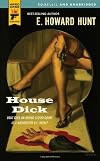
House Dick has, perhaps, the best blurb I've seen on a book for years. It is taken wildly out of context, coming from Richard Nixon, for whom E. Howard Hunt broke into the Watergate hotel. Unfortunately, I found the book unable to rise to such praise as indicated by Nixon. The protagonist has a large raft of annoying character traits and issues--more than I find tolerable, even for crime fiction. The action unrolls quickly, but the protagonist's stakes aren't very high. The Glen Orbik cover show more illustration for the Hard Case Crime edition is simple, but effective. show less
Next we will be reading books by G Gordon Liddy and Charles Colson. E Howard Hunt is best known as one of Dick Nixon's "plumbers," a secret team of operatives fixing leaks, which included breaking into Daniel Ellsberg's office and forging State Department cables designed to make JFK look bad. Hunt masterminded the first Watergate burglary and served nearly three years in prison for his role in the scandal. In addition to being a criminal, Hunt served for twenty years as a CIA operative and show more even a station chief. He was highly involved in the Bay of Pigs fiasco and, as he died in 2007, hinted that LBJ had been involved in the JFK assassination.
Strangely enough, Hunt wrote many novels. Beginning in the early forties, he penned a number of spy novels under his own name and under various pen names. His spy novels were informed by his experience in the CIA and are considered quite intriguing for that reason. All told, Hunt may have published as many as 41 fictional novels and 4 nonfiction books over the course of fifty years.
House Dick was originally published in 1961 under the pen name Gordon Davis and published by Gold Medal. It is, quite unbelievably I might add, a terrific hardboiled book that I highly recommend. It has recently been republished by Hard Case. It stands up quite well with other books of the era. It is a quick- reading story that I found hard to put down.
The protagonist, Peter Novack, is, as the title suggests, the House Detective, at a large 350-room Washington, D.C., hotel. He is grumpy, sour, and, although, on the surface a bit crooked and corrupt, a guy who ends up doing decent things. The tone throughout the book is dark. The story is about a "a girl in a platinum mink coat walking toward the reception desk." "The girl was an ash blonde" and "walked with her head thrown back, her heels making subdued clicking sounds on the marble floor of the lobby." "[H]er eyes were as grey as the furs she wore." This is Ms. Paula Norton, who is the femme fatale of this story. She has a very wealthy sugar daddy. She also has a mean mobster she was once married to and who has found her again. And, Novack, tough as he is, falls for, hook, line, and sinker. The story is about a wealthy couple who stays at the hotel and reports and then unreports missing jewels. Mrs. Boyd "was a tinted brunette in the mid-forties with bon-bon jowls and arms like rolls of biscuit dough. Her fleshly feet were jammed into pointed slippers two sizes too small and her face was heavily powdered to improve an uncertain complexion."
Hunt can write descriptive phrases like nobody's business. The dialogue, the scenery, the tone, all works and all feels like your typical hardboiled detective novel. You have your femme fatale, your gangsters, your police detectives, your murders, your kidnappings, your stolen jewels, and the story that flows quite well through all its twists and turns. And, Hunt can write fight scenes quite well too: "The man gurgled and his eyes went wild. From the hips up his body started to shake. Novak slapped the other cheek. Harder and a little lower. A drop of blood appeared on the man's upper lip. His face was scarlet now, jaw muscles working like a skein of worms."
I never thought I would read a hardboiled detective novel by one of the Watergate burglars or that the novel would have been written, not while the burglar was cooling his heels in prison, but years before. Nor would I have thought that it would be just as compelling as many of the other Gold Medal or Fawcett books published at that time. show less
Strangely enough, Hunt wrote many novels. Beginning in the early forties, he penned a number of spy novels under his own name and under various pen names. His spy novels were informed by his experience in the CIA and are considered quite intriguing for that reason. All told, Hunt may have published as many as 41 fictional novels and 4 nonfiction books over the course of fifty years.
House Dick was originally published in 1961 under the pen name Gordon Davis and published by Gold Medal. It is, quite unbelievably I might add, a terrific hardboiled book that I highly recommend. It has recently been republished by Hard Case. It stands up quite well with other books of the era. It is a quick- reading story that I found hard to put down.
The protagonist, Peter Novack, is, as the title suggests, the House Detective, at a large 350-room Washington, D.C., hotel. He is grumpy, sour, and, although, on the surface a bit crooked and corrupt, a guy who ends up doing decent things. The tone throughout the book is dark. The story is about a "a girl in a platinum mink coat walking toward the reception desk." "The girl was an ash blonde" and "walked with her head thrown back, her heels making subdued clicking sounds on the marble floor of the lobby." "[H]er eyes were as grey as the furs she wore." This is Ms. Paula Norton, who is the femme fatale of this story. She has a very wealthy sugar daddy. She also has a mean mobster she was once married to and who has found her again. And, Novack, tough as he is, falls for, hook, line, and sinker. The story is about a wealthy couple who stays at the hotel and reports and then unreports missing jewels. Mrs. Boyd "was a tinted brunette in the mid-forties with bon-bon jowls and arms like rolls of biscuit dough. Her fleshly feet were jammed into pointed slippers two sizes too small and her face was heavily powdered to improve an uncertain complexion."
Hunt can write descriptive phrases like nobody's business. The dialogue, the scenery, the tone, all works and all feels like your typical hardboiled detective novel. You have your femme fatale, your gangsters, your police detectives, your murders, your kidnappings, your stolen jewels, and the story that flows quite well through all its twists and turns. And, Hunt can write fight scenes quite well too: "The man gurgled and his eyes went wild. From the hips up his body started to shake. Novak slapped the other cheek. Harder and a little lower. A drop of blood appeared on the man's upper lip. His face was scarlet now, jaw muscles working like a skein of worms."
I never thought I would read a hardboiled detective novel by one of the Watergate burglars or that the novel would have been written, not while the burglar was cooling his heels in prison, but years before. Nor would I have thought that it would be just as compelling as many of the other Gold Medal or Fawcett books published at that time. show less
Lists
You May Also Like


Associated Authors
Statistics
- Works
- 68
- Also by
- 1
- Members
- 679
- Popularity
- #37,220
- Rating
- 3.3
- Reviews
- 12
- ISBNs
- 77
- Languages
- 2