
Joseph J. Rishel (1940–2020)
Author of Van Gogh Face to Face: The Portraits
About the Author
Works by Joseph J. Rishel
Masterpieces of Impressionism and Post Impressionism: The Annenberg Collection (1989) 159 copies, 1 review
Art in Rome in the eighteenth century (cat. exp., Philadelphia, Museum of Art, 16 Mars – 28 Mai 2000 ; Houston, The Museum of Fine Arts, 25 juin – 17 septembre 2000) (2000) — Editor — 65 copies
Goya, another look : an exhibition organized by the Philadelphia Museum of Art and the Palais des beaux-arts, Lille (1998) 12 copies
The Arts in Latin America 1492-1820 — Editor — 1 copy
Associated Works
Inventing Impressionism: Paul Durand-Ruel and the Modern Art Market (2015) — Contributor — 56 copies
Journeys to New Worlds: Spanish and Portuguese Colonial Art in the Roberta and Richard Huber Collection (2013) — Introduction — 13 copies
Tagged
Common Knowledge
- Canonical name
- Rishel, Joseph J.
- Birthdate
- 1940-05-15
- Date of death
- 2020-11-05
- Gender
- male
- Education
- University of Chicago (AM|1968)
Hobart and Smith Colleges (AB|1962) - Occupations
- museum curator
art historian - Organizations
- Philadelphia Museum of Art
Art Institute of Chicago - Awards and honors
- American Academy of Arts and Sciences (2002)
American Philosophical Society (2010)
Officier, l'Ordre des Arts et des Lettres (2002)
Chevalier, l'Ordre des Arts et des Lettres (1996) - Relationships
- D'Harnoncourt, Anne (spouse)
- Short biography
- Since arriving at the Philadelphia Museum of Art from the Art Institute of Chicago in 1971, Joseph J. Rishel had made his life's work the expansion and research of the museum's collections, the engagement with its international public, and the fulfillment of its potential to contribute to its immediate community. He served there as the Gisela and Dennis Alter Senior Curator of European Painting before 1900 and took a post at the National Gallery of Art as Samuel H. Kress Professor. Through a series of extraordinary exhibitions, including Cézanne (1995-96), The Splendor of 18th Century Rome (2000), Manet and the Sea (2003-04), The Arts in Latin America, 1492-1820 (2006-07), and Cézanne and Beyond (2009), this curator and diplomat has imagined new ways of presenting works both famous and unknown, and he has overcome immense obstacles in realizing these visions. Within the museum profession he is highly regarded for his dedication to the formation of a new generation of curators, and he has been particularly supportive of the combination of technical analysis with historical evidence in research. In Philadelphia he served as chairman of the Barnes Foundation Collection Assessment Advisory Committee. From Mexico City to London and Paris, he was held in the highest esteem as a colleague and convivial companion by artists and scholars alike. He received his M.A. from the University of Chicago in 1962 and is the author or coauthor of a number of works including Delacroix: The Late Work, (with E. Delacroix, et al 1998), Goya: Another Look (2006), and Cezanne and Beyond (with K. Sachs and a team of scholars 2009). He has been honored a number of times, including twice by the French Government, being named Chevalier, l'Ordre des Arts et des Lettres in 1996 and Officier dans l'Ordre des Arts et des Lettres in 2002. Rishel is a member of the American Academy of Arts & Sciences and was elected to membership in the American Philosophical Society in 2010. He died on November 5, 2020.
- Cause of death
- Parkinson's disease
- Nationality
- USA
- Birthplace
- Clifton Springs, New York, USA
- Places of residence
- Philadelphia, Pennsylvania, USA
- Place of death
- Philadelphia, Pennsylvania, USA
- Associated Place (for map)
- Pennsylvania, USA
Members
Reviews

It seems a little weird to me that before the exhibition hosted in 2000 by the Detroit Institute of Arts (and chronicled in this catalogue) that there had never before been a show dedicated to the portraits painted by Van Gogh, but I guess everyone has previously been focused on his landscapes, cafe scenes, and sunflowers. I definitely agree with the curators that Van Gogh’s portraits are worth a dedicated examination, even though “Starry Night” will always be my favourite of his show more pieces, since each piece shows the same dedication to his artistry that one would expect from one of the best painters. Careful brushstrokes, a unique sense of colouration, and vivid characterization are present throughout this collection, and I was pleased to discover some unexpected themes emerge from this curation. Portraits are a typical focus for many artists contemporary and historical as a means to earn a living prior to the photographic medium becoming more accessible, but I was surprised to discover that Van Gogh’s portraits eschewed this trend to focus on subjects of his own choosing and (when he ran out of subjects) self portraits. Even though some of his subjects were dressed in costume or given a fixed scope of depiction by the artist, Van Gogh’s preoccupation with character (unique or not is up to the viewer) is an interesting revelation, and gives a further depth than the base artistry portrayed by his technique. While I might not have liked, per se, each of the portraits herein, I appreciated the chronological act of collection for this exhibition, and in particular found the evolution of his technique away from the Dutch masters and into his own style to be excellently portrayed. The accompanying text was also well narrated (barring the missing chunks from my maligned thrifted copy…) by the curators, each having a unique voice that brought Van Gogh’s paintings together with their historical context well and illuminating the core themes of the exhibition. I’ll have to replace this volume at some point with a unmarred copy, since the previous owner did a great job of tearing out half pages and sections (seriously /rolls eyes), and peruse it again for a more in depth look into the many faces of Van Gogh. show less
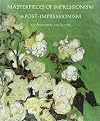
This book is the companion piece to the 1989 Philadelphia Museum of Art exhibition. There are 51 full page glorious prints of the paintings from Corot to to Matisse with Monet and Cezanne in between notable others. On the page(s) immediately following the illustrations is an informing concise but not overwhelming essay putting the artist and painting in context. The overall effect is to highlight these wonderful works and make them shine. The writing from the curators of the museum no matter show more how erudite or to the point or well presented is secondary.
Quotes: (page 7, Eugene Boudin's On the Beach 1865) “In this painting of 1865, a dense crowd is pulled up nearly to the water's edge at dusk. A few swimmers remain in the sea, although the bathing wagons are now pulled back from the tide. Two little girls play at the right, while the two women under parasols seem more caught up by their conversation than by the grand effects of the sky. But the crowd to the left, the man in profile setting the mood, seems to have fallen silent, staring out to the horizon as if in anticipation of the shift from yellow to red that is about to take place as the sun meets the sea---in an effect of temporal progress that, as Bauldelaire noted in 1859, Boudin had mastered completely...The heroic boldness of Courbert and the tonal subtleties of Whistler are not seen here, nor are the brilliant bravura brushstrokes of the young Monet. It is calmer, more tempered, and---for his railing against the participants---wondrously kind and sympathetic to a mutual participation in the moment.”
(page 70, Portrait of Uncle Dominique as a Monk c.1866) “Cezanne's early development was fraught with the passionate exploration for the means of realizing the ambitions he had discussed so earnestly with his childhood intimate in Aix, Emile Zola. Like Guillemet, Cezanne and Zola were determined to make their marks; Cezanne's means of doing this in the late 1850s and early 1860s was the execution of a group of intensely worked landscapes and figure subjects, often charged with a macabre obsession with violence and intense sexuality. During the summer of 1866---perhaps first in a landscape of the Seine at Bennecourt---he began experimenting with paintings in which he abandoned the brush all together, working as Courbet had in his landscapes and flower pictures (although never with figures) exclusively with a palette knife. This method, due to the necessity of swift execution and density of paint, helped him achieve a directness of execution and boldness of image...”
(page 98, The Bouquet c.1886) “In July 1886, Vincent's brother Theo van Gough wrote to their mother in Holland, reporting on the activities of Vincent, who had joined him in Paris earlier that spring: 'He is mainly painting flowers---with the object to put more lively color into his next pictures. He is also much more cheerful than in the past or they come to see him. He also has acquaintances who give him a collection of flowers every week which may serve him as models. If they are able to keep it up I think his difficult times are over and he will be able to make it by himself.'”d people like him here. show less
Quotes: (page 7, Eugene Boudin's On the Beach 1865) “In this painting of 1865, a dense crowd is pulled up nearly to the water's edge at dusk. A few swimmers remain in the sea, although the bathing wagons are now pulled back from the tide. Two little girls play at the right, while the two women under parasols seem more caught up by their conversation than by the grand effects of the sky. But the crowd to the left, the man in profile setting the mood, seems to have fallen silent, staring out to the horizon as if in anticipation of the shift from yellow to red that is about to take place as the sun meets the sea---in an effect of temporal progress that, as Bauldelaire noted in 1859, Boudin had mastered completely...The heroic boldness of Courbert and the tonal subtleties of Whistler are not seen here, nor are the brilliant bravura brushstrokes of the young Monet. It is calmer, more tempered, and---for his railing against the participants---wondrously kind and sympathetic to a mutual participation in the moment.”
(page 70, Portrait of Uncle Dominique as a Monk c.1866) “Cezanne's early development was fraught with the passionate exploration for the means of realizing the ambitions he had discussed so earnestly with his childhood intimate in Aix, Emile Zola. Like Guillemet, Cezanne and Zola were determined to make their marks; Cezanne's means of doing this in the late 1850s and early 1860s was the execution of a group of intensely worked landscapes and figure subjects, often charged with a macabre obsession with violence and intense sexuality. During the summer of 1866---perhaps first in a landscape of the Seine at Bennecourt---he began experimenting with paintings in which he abandoned the brush all together, working as Courbet had in his landscapes and flower pictures (although never with figures) exclusively with a palette knife. This method, due to the necessity of swift execution and density of paint, helped him achieve a directness of execution and boldness of image...”
(page 98, The Bouquet c.1886) “In July 1886, Vincent's brother Theo van Gough wrote to their mother in Holland, reporting on the activities of Vincent, who had joined him in Paris earlier that spring: 'He is mainly painting flowers---with the object to put more lively color into his next pictures. He is also much more cheerful than in the past or they come to see him. He also has acquaintances who give him a collection of flowers every week which may serve him as models. If they are able to keep it up I think his difficult times are over and he will be able to make it by himself.'”d people like him here. show less
Awards

You May Also Like


Associated Authors
Statistics
- Works
- 16
- Also by
- 7
- Members
- 715
- Popularity
- #35,475
- Rating
- 4.1
- Reviews
- 3
- ISBNs
- 40
- Languages
- 5