
Martin Seligman
Author of Learned Optimism: How to Change Your Mind and Your Life
About the Author
Martin e.p. Seligman, Ph.D., the Zellerbach Family Professor of Psychology at the University of Pennsylvania, works on positive psychology, learned helplessness, depression, ethnopolitical conflict, and optimism. Dr. Seligman's work has been supported by the National Institute of Mental Health, the show more National Science Foundation, the Guggenheim Foundation, the Mellon Foundation, and the MacArthur Foundation. show less
Image credit: Martin E.P. Seligman
Fox Leadership Professor of Psychology
Director, Positive Psychology Center
President, American Psychological Association, 1998
Fox Leadership Professor of Psychology
Director, Positive Psychology Center
President, American Psychological Association, 1998
Works by Martin Seligman
Authentic Happiness: Using the New Positive Psychology to Realize Your Potential for Lasting Fulfillment (2002) 1,333 copies, 16 reviews
What You Can Change and What You Can't: The Complete Guide to Successful Self-Improvement (1993) 456 copies, 4 reviews
The Optimistic Child: Proven Program to Safeguard Children from Depression & Build Lifelong Resilience (1995) 436 copies, 3 reviews
Helplessness: On Depression, Development, and Death (A Series of Books in Psychology) (1975) 107 copies
The Hope Circuit: A Psychologist's Journey from Helplessness to Optimism (2018) 95 copies, 2 reviews
HBR's 10 Must Reads on Mental Toughness, Updated and Expanded (featuring "How to Stop Worrying About What Other People Think of You" by Michael Gervais) (2025) — Author — 5 copies
Felicidade Autentica - Use a Psicologia Positiva Para Alcancar Todo Seu Potencial (Em Portugues do Brasil) (2019) 5 copies
El circuito de la esperanza : el viaje de un psicólogo de la desesperanza al optimismo (2018) 4 copies
Martin Seligman 3 Books Collection Set (The Optimistic Child, Learned Optimism, Flourish) (2019) 2 copies
No puedo ser más alto pero puedo ser mejor : el tratamiento más adecuado para cada trastorno (1995) 2 copies
Hulpeloosheid onderzoek naar de oorsprong van angst en depressie, suggestie voor preventie en behandeling (1979) 1 copy
Desamparado 1 copy
felicidade 1 copy
Associated Works
This Will Make You Smarter: New Scientific Concepts to Improve Your Thinking (Edge Question Series) (2012) — Contributor — 907 copies, 17 reviews
HBR's 10 Must Reads on Mental Toughness (with bonus interview "Post-Traumatic Growth and Building Resilience" with Martin Seligman) (HBR's 10 Must Reads) (2018) — Contributor — 183 copies, 2 reviews
Tagged
Common Knowledge
- Birthdate
- 1942-08-12
- Gender
- male
- Nationality
- USA
- Birthplace
- Albany, New York, USA
- Associated Place (for map)
- New York, USA
Members
Reviews

"What is crucial is what you think when you fail, using the power of 'non-negative thinking.' Changing the destructive things you say to yourself when you experience the setbacks that life deals all of us is the central skill of optimism." —this is my favorite quote from Seligman's Learned Optimism. And when I sum up the book for others I use a variation of this sentiment, saying something like, "When you experience failure or some form of life not going your way, what explanation do you show more give yourself? Not what you would say in front of others, but privately?" This is the foundation of your self-esteem, a way of knowing if you're more of an optimist or a pessimist.
Seligman's book reads like a textbook in parts which makes for some uneven reading, and at other times he shifts into memoir-mode, sharing events that shaped his career in psychology. Too much of this pulls the reader away from the core message. And that message, a powerful one that is described right in the title, is this: You need not be a passive observer to the events of your life. Most things that happen are out of your control, but your reaction to them can be very much in your control. And that's a skill to be learned and developed. show less
Seligman's book reads like a textbook in parts which makes for some uneven reading, and at other times he shifts into memoir-mode, sharing events that shaped his career in psychology. Too much of this pulls the reader away from the core message. And that message, a powerful one that is described right in the title, is this: You need not be a passive observer to the events of your life. Most things that happen are out of your control, but your reaction to them can be very much in your control. And that's a skill to be learned and developed. show less
Authentic Happiness: Using the New Positive Psychology to Realize Your Potential for Lasting Fulfillment by Martin E. P. Seligman
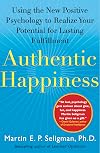
I'd known about Seligmman's work for quite some time. I first started taking questionnaires at his website back in 2008. The fact that three years later, I still haven't taken them all, should be a pretty good indicator that I've never been converted to a true believer. But I do keep coming back, so there are aspects of his work that I find interesting.
This book and the test center at his website are really tie-ins to each other. It was because my results kept saying "for more information, show more see the book," that I finally read the book. And while the book includes at least basic versions of all the tests, the book constantly refers you to the website to take the tests there. The website is nice in that it keeps track of all your results for you and records when you took each test.
I should back up. The intention of this book is to be a sort of handbook to the relatively new science of positive psychology. Of course, as you may have gathered from my review so far, it comes across as more of a guidebook to the current tests and surveys of the positive psychology movement. Which is, I suppose, a good place to start from, but I found myself wishing Seligman went a little further with it. Instead, each section introduced the concept behind some test, talked about why it was important, gave the test, discussed why certain answers were indicators of important behaviors/attitudes, and discussed the results. A few tips were given for "improvement" in that category, and then on to the next test!
Okay, so really, that only comprises the first half of the book. In the second half, Seligman deals with the concept of "signature strengths," which I am very interested in and was the tipping point for me to seek out the book in the first place. A group of researchers examined many of the cultures and religions of the world and came up with a list of 24 virtues or strengths that had near-universal appreciation. Their theory is, rather than dwelling on the virtues we are weakest in, true gratification and fulfillment comes from arranging our lives in such a way that we are using our signature strengths as much as possible.
This idea really appeals to me, and the last section of the book had some lovely suggestions on recognizing and supporting the strengths of our spouse and our children. There was some lip service given to using your strengths at work, but the "how" to do this seemed to be left a little vague.
The very last section on meaning and purpose was utterly fascinating as it referenced Asimov's "The Last Question," and fed directly into the future-focused theology I seem to be building into. Seligman and I have some philosophical differences that I found mildly irritating during a few points of the book, but this theory as a conclusion for the book was a very validating moment that greatly upped the chances that I'll pick up another work by Seligman in the future. show less
This book and the test center at his website are really tie-ins to each other. It was because my results kept saying "for more information, show more see the book," that I finally read the book. And while the book includes at least basic versions of all the tests, the book constantly refers you to the website to take the tests there. The website is nice in that it keeps track of all your results for you and records when you took each test.
I should back up. The intention of this book is to be a sort of handbook to the relatively new science of positive psychology. Of course, as you may have gathered from my review so far, it comes across as more of a guidebook to the current tests and surveys of the positive psychology movement. Which is, I suppose, a good place to start from, but I found myself wishing Seligman went a little further with it. Instead, each section introduced the concept behind some test, talked about why it was important, gave the test, discussed why certain answers were indicators of important behaviors/attitudes, and discussed the results. A few tips were given for "improvement" in that category, and then on to the next test!
Okay, so really, that only comprises the first half of the book. In the second half, Seligman deals with the concept of "signature strengths," which I am very interested in and was the tipping point for me to seek out the book in the first place. A group of researchers examined many of the cultures and religions of the world and came up with a list of 24 virtues or strengths that had near-universal appreciation. Their theory is, rather than dwelling on the virtues we are weakest in, true gratification and fulfillment comes from arranging our lives in such a way that we are using our signature strengths as much as possible.
This idea really appeals to me, and the last section of the book had some lovely suggestions on recognizing and supporting the strengths of our spouse and our children. There was some lip service given to using your strengths at work, but the "how" to do this seemed to be left a little vague.
The very last section on meaning and purpose was utterly fascinating as it referenced Asimov's "The Last Question," and fed directly into the future-focused theology I seem to be building into. Seligman and I have some philosophical differences that I found mildly irritating during a few points of the book, but this theory as a conclusion for the book was a very validating moment that greatly upped the chances that I'll pick up another work by Seligman in the future. show less
Authentic Happiness: Using the New Positive Psychology to Realize Your Potential for Lasting Fulfillment by Martin E. P. Seligman
An Aristotelian approach to psychology
The basic idea behind positive psychology is that, rather than solely treating mental disease and alleviating negative symptoms, the field of psychology should focus on defining mental health in positive terms and promoting positive emotions, character traits, and social institutions. But Seligman is even more ambitious than that: in the introduction, he writes that he seeks to overthrow what he calls the "rotten-to-the-core dogma", the oldest show more manifestation of which is the doctrine of original sin but which was dragged by Freud into twentieth-century secular psychology, which has since tended to regard happiness or any positive emotion as inauthentic.
This completely sold me on the book, and while it's far from perfect (I would take exception with Seligman on a number of points), it's general approach is very good. To a large extent, it's explicitly Aristotelian, and Seligman even argues for virtue ethics in the form of identifying and cultivating what he calls "signature strengths". He also draws on a lot of interesting recent research, including some of his own. His earlier book Learned Optimism and the more recent Flourish are also well worth reading.
http://www.amazon.com/review/R2Y0D3VC04WDNS show less
The basic idea behind positive psychology is that, rather than solely treating mental disease and alleviating negative symptoms, the field of psychology should focus on defining mental health in positive terms and promoting positive emotions, character traits, and social institutions. But Seligman is even more ambitious than that: in the introduction, he writes that he seeks to overthrow what he calls the "rotten-to-the-core dogma", the oldest show more manifestation of which is the doctrine of original sin but which was dragged by Freud into twentieth-century secular psychology, which has since tended to regard happiness or any positive emotion as inauthentic.
This completely sold me on the book, and while it's far from perfect (I would take exception with Seligman on a number of points), it's general approach is very good. To a large extent, it's explicitly Aristotelian, and Seligman even argues for virtue ethics in the form of identifying and cultivating what he calls "signature strengths". He also draws on a lot of interesting recent research, including some of his own. His earlier book Learned Optimism and the more recent Flourish are also well worth reading.
http://www.amazon.com/review/R2Y0D3VC04WDNS show less
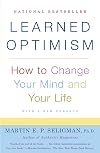
I learned, in reading this book, that I am a pessimist. This came as news to me, since I'd always thought of myself as an optimist. But optimism - at least not as Seligman defines it - is not a soft-focus view of the world, where you believe that if you just do the right thing, everything will work out in due time. (That's magical thinking - something Seligman addresses without naming it. I learned an expensive lesson in thinking this way in grad school.) I come from a family of pessimists, show more so I wasn't even aware I thought this way. It's amazing how unchallenged thoughts can guide a person's life.
But this book hit so many points for me: the churning, negative thoughts that never let me alone, the failures that haunt me at four o'clock in the morning, the way I can blow minor issues completely out of proportion, the way I can make the fear of failure a self-fulfilling prophesy, the way I can give up or collapse internally when things go wrong. Oh, and the way I internalize criticism and make it permanent inside me, like a stone. Oh, I've done all these things, and more, which makes me realize I'm a dyed-in-the-wool pessimist. (I'm now wincing at the amount of time I spent on a barstool in my twenties, regaling my problems to friends and anyone else who would listen. But it's nice to finally put a name to the feeling.)
These things are universal. Every adult goes through them. I've had to learn the hard way that a big factor in deciding whether you fail or succeed is how you talk to yourself, especially when things go wrong. This is a good book to read if you're one of those people who frequently needs friends and relatives to "talk you down from the ledge." You can build the skill of thinking optimistically yourself, without putting that burden on other people - AND without discounting some of the very real benefits of pessimism.
In other words, Seligman doesn't define optimism as high self-esteem, or the power of positive thinking, or any nonsense. It's really just correcting a disordered way of thinking - all of the negative beliefs a person can hold without challenging them. If it came from you, it must be true, right? WRONG. So wrong. Say you want to write a novel. If writing a novel seems shrouded in mystery, if you have a deep pessimism that you can never hold back the curtain in writing it, you'll fulfill that prophesy. You'll get the same results as if you really didn't have the ability. Either you'll give up somewhere along the way, or you'll write a crappy book.
Optimism is endurance. That's all. This book can give you some tools for retraining. show less
But this book hit so many points for me: the churning, negative thoughts that never let me alone, the failures that haunt me at four o'clock in the morning, the way I can blow minor issues completely out of proportion, the way I can make the fear of failure a self-fulfilling prophesy, the way I can give up or collapse internally when things go wrong. Oh, and the way I internalize criticism and make it permanent inside me, like a stone. Oh, I've done all these things, and more, which makes me realize I'm a dyed-in-the-wool pessimist. (I'm now wincing at the amount of time I spent on a barstool in my twenties, regaling my problems to friends and anyone else who would listen. But it's nice to finally put a name to the feeling.)
These things are universal. Every adult goes through them. I've had to learn the hard way that a big factor in deciding whether you fail or succeed is how you talk to yourself, especially when things go wrong. This is a good book to read if you're one of those people who frequently needs friends and relatives to "talk you down from the ledge." You can build the skill of thinking optimistically yourself, without putting that burden on other people - AND without discounting some of the very real benefits of pessimism.
In other words, Seligman doesn't define optimism as high self-esteem, or the power of positive thinking, or any nonsense. It's really just correcting a disordered way of thinking - all of the negative beliefs a person can hold without challenging them. If it came from you, it must be true, right? WRONG. So wrong. Say you want to write a novel. If writing a novel seems shrouded in mystery, if you have a deep pessimism that you can never hold back the curtain in writing it, you'll fulfill that prophesy. You'll get the same results as if you really didn't have the ability. Either you'll give up somewhere along the way, or you'll write a crappy book.
Optimism is endurance. That's all. This book can give you some tools for retraining. show less
Lists
Awards

You May Also Like


Associated Authors
Statistics
- Works
- 36
- Also by
- 4
- Members
- 5,675
- Popularity
- #4,359
- Rating
- 3.7
- Reviews
- 62
- ISBNs
- 194
- Languages
- 16
- Favorited
- 5