

Florence Marryat (1833–1899)
Author of The Blood of the Vampire
About the Author
Works by Florence Marryat
A Harvest of Wild Oats. A novel 2 copies
Crown of Shame 2 copies
My Sister the Actress 2 copies
A Broken Blossom 2 copies
At heart a rake, 2 copies
Petronel 2 copies
Mount Eden. A romance 1 copy
Een droom 1 copy
Love's conflict 1 copy
The Box with the Iron Clamps 1 copy
In This World, or the Next 1 copy
Temper, A novel 1 copy
Her Lord and Master 1 copy
The Beautiful Soul 1 copy
The dream that stayed 1 copy
My own Child. A novel 1 copy
The Risen Dead 1 copy
Too Good For Him 1 copy
No Intentions 1 copy
Associated Works
The Lifted Veil: The Book of Fantastic Literature by Women 1800-World War II (1806) — Contributor — 45 copies
Weird Women: Volume 2: 1840-1925: Classic Supernatural Fiction by Groundbreaking Female Writers (2021) — Contributor — 38 copies
Summoned to the Séance: Spirit Tales from Beyond the Veil: 56 (British Library Tales of the Weird) (2024) — Contributor — 27 copies
Tagged
Common Knowledge
- Other names
- Lean, Florence Marryat Church
Lean, Francis, Mrs.
Church, Ross, Mrs. - Birthdate
- 1833-07-09
- Date of death
- 1899-10-27
- Gender
- female
- Education
- governesses
- Occupations
- novelist
dramatist
singer
actor - Relationships
- Church, Thomas Ross (1st husband)
Lean, Colonel Francis (2nd husband)
Marryat, Frederick (father)
Marryat, Emilia (sister) - Short biography
- Florence Marryat was born in Brighton, England to Capt. Frederick Marryat, a Royal Navy officer and writer, and his wife Catherine. Her parents separated when she was a child, and she was educated at home by governesses and with the help of her father’s extensive library. In 1854, she married Thomas Ross Church and travelled throughout India with him. By 1860, she had suffered a breakdown and returned to England, pregnant, with her three older children. It was during this period of caring for her children alone that she wrote her first novel, Love’s Conflict. She published more than 70 works, including travel articles, and novels. She also acted with the D’Oyly Carte company in Gilbert and Sullivan operettas, and toured with George Grossmith in his revue Entre Nous. Her younger sister Emilia Marryat also became a writer.
- Nationality
- UK
- Birthplace
- Brighton, Sussex, England, UK
- Places of residence
- Brighton, Sussex, England, UK
India - Burial location
- Kensal Green Cemetery, London, England, UK
- Associated Place (for map)
- England, UK
Members
Reviews
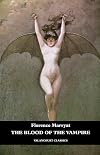
This is an interesting thing. Despite the title, it contains neither blood nor vampires. It's a melodrama, and certainly sensational, but it's a tidy package and tightly plotted.
Marryat was a huge success in her time, writing something like 70 best-selling novels, most of which most critics hated. We're familiar with writers like this today: we book snobs turn our noses up at them. There's apparently some sort of backlash wave happening for the Victorians, though, where these best-selling, show more unappreciated Victorian authors are being reexamined, and Marryat's undergoing a bit of a Renaissance. Based on this one book, I'd say it's deserved; Blood is deeper than it looks.
The vampirism in Blood is invisible. There's no biting here. The "vampire" isn't even consciously harming anyone. Since there's no possibility for proof, the idea that she's a vampire at all is completely circumstantial.
Blood is clearly a metaphorical book about The Woman Question. (And race, as well; Miss Brandt, a quadroon, is a direct descendant of Jane Eyre's Bertha Mason.) As Greta Depledge points out in an informative but wicked thesisy introduction, you can replace the word "vampire" with "hysteric" throughout the book and it still reads perfectly well. ("Hysteria" was the diagnosis for any woman who didn't rigidly conform to societal expectations, or showed a glimmer of libido, or did anything else men weren't crazy about.)
But its ambiguity, which must be intentional, allows for two opposite interpretations of the book. In the most obvious, the hysterical Brandt sucks the life out of people around her; in this reading, Marryat is a conservative.
But since, again, there's no proof whatsoever that Brandt is a vampire, the second reading is that she's an innocent free-thinker who's victimized and eventually murdered by patriarchal oppression. (Now I'm the one who sounds thesisy.) How do we even get the idea that she's a vampire? From a physician who decides that it's the best explanation for a now-dead baby she was fond of holding. That, obviously, is a ludicrous diagnosis, even for a Victorian doctor.
That second reading is tempting, but problematic for one reason: the physician predicts that if Brandt marries, her husband will die, and he obligingly does so.
Marryat was a huge success in her time, writing something like 70 best-selling novels, most of which most critics hated. We're familiar with writers like this today: we book snobs turn our noses up at them. There's apparently some sort of backlash wave happening for the Victorians, though, where these best-selling, show more unappreciated Victorian authors are being reexamined, and Marryat's undergoing a bit of a Renaissance. Based on this one book, I'd say it's deserved; Blood is deeper than it looks.
The vampirism in Blood is invisible. There's no biting here. The "vampire" isn't even consciously harming anyone. Since there's no possibility for proof, the idea that she's a vampire at all is completely circumstantial.
Blood is clearly a metaphorical book about The Woman Question. (And race, as well; Miss Brandt, a quadroon, is a direct descendant of Jane Eyre's Bertha Mason.) As Greta Depledge points out in an informative but wicked thesisy introduction, you can replace the word "vampire" with "hysteric" throughout the book and it still reads perfectly well. ("Hysteria" was the diagnosis for any woman who didn't rigidly conform to societal expectations, or showed a glimmer of libido, or did anything else men weren't crazy about.)
But its ambiguity, which must be intentional, allows for two opposite interpretations of the book. In the most obvious, the hysterical Brandt sucks the life out of people around her; in this reading, Marryat is a conservative.
But since, again, there's no proof whatsoever that Brandt is a vampire, the second reading is that she's an innocent free-thinker who's victimized and eventually murdered by patriarchal oppression. (Now I'm the one who sounds thesisy.) How do we even get the idea that she's a vampire? From a physician who decides that it's the best explanation for a now-dead baby she was fond of holding. That, obviously, is a ludicrous diagnosis, even for a Victorian doctor.
That second reading is tempting, but problematic for one reason: the physician predicts that if Brandt marries, her husband will die, and he obligingly does so.
Ok so this is the other 'vampire' book published the same year as Dracula. However ignore that cover, this is not a horror tale or even a thriller. It has more in common with the more drama based X-Men stories she's Rogue basically than Dracula.
But its a really intersting drama. I did keep thinking it might slip into thriller territory as the main character is a little bit of a psycho stalker, but only a wee bit.
The writing is not fantastic but the cast is different enough, lot of female show more characters. Its written NOTHING like dracula, and feels more like it was published in the 1920s/1930s than 1890s.
I have no idea which characters i was supposed to like or dislike. There's quite a bit of racism from good and bad characters, but also the reverse. Some people will probably hate how characters came and went from the plot, and it seemed like the story was falling apart near the middle but thats actually part of the best element.
I was completely unable to predict where the story was going next, combined with as i said being unsure who i was even supposed to be rooting for, led to an engaging reading experience.
Note: While he doesn't play as prominent a role there's a doctor character functionally similar to Van Helsing. Given this came out the same year as dracula that was a odd coincidence.
Until i remembered that the older pennydreadful Varney the Vampire had such a character, so presumably both books copied that guy. show less
But its a really intersting drama. I did keep thinking it might slip into thriller territory as the main character is a little bit of a psycho stalker, but only a wee bit.
The writing is not fantastic but the cast is different enough, lot of female show more characters. Its written NOTHING like dracula, and feels more like it was published in the 1920s/1930s than 1890s.
I have no idea which characters i was supposed to like or dislike. There's quite a bit of racism from good and bad characters, but also the reverse. Some people will probably hate how characters came and went from the plot, and it seemed like the story was falling apart near the middle but thats actually part of the best element.
I was completely unable to predict where the story was going next, combined with as i said being unsure who i was even supposed to be rooting for, led to an engaging reading experience.
Note: While he doesn't play as prominent a role there's a doctor character functionally similar to Van Helsing. Given this came out the same year as dracula that was a odd coincidence.
Until i remembered that the older pennydreadful Varney the Vampire had such a character, so presumably both books copied that guy. show less
A highly enjoyable ghost story that's far more entertaining than scary. A jilted woman, a newlywed bachelor, and a young wife form the key players in this drama. A terrific tale of promises broken, and of promises kept, even from beyond the grave.
Charlotte Cray is in love with Sigismund Braggett, and he uses this his advantage at his work place. When he marries another woman whom he does love, Charlotte sends a threatening note, saying she will meet his wife, face to face, something Braggett does not want to happen. She does carry out her threat, but in a most unusual way. Interesting ghost story with equally interesting characters.
Lists
Christmas Books (1)
You May Also Like


Associated Authors
Statistics
- Works
- 79
- Also by
- 11
- Members
- 344
- Popularity
- #69,364
- Rating
- 3.8
- Reviews
- 5
- ISBNs
- 85
- Languages
- 2
- Favorited
- 2