
Edward Maunde Thompson (1840–1929)
Author of An Introduction to Greek and Latin Palaeography
About the Author
Series
Works by Edward Maunde Thompson
Associated Works
Shakespeare's Hand in the Play of Sir Thomas More: Papers (Bol1 Pr English Literature) (2013) — Contributor — 5 copies
Tagged
Common Knowledge
- Legal name
- Thompson, Sir Edward Maunde
- Birthdate
- 1840
- Date of death
- 1929-09-14
- Gender
- male
- Occupations
- biblical scholar
palaeographer
Director and Principal Librarian of the British Museum (1888 to 1909) - Organizations
- British Academy (founding member, 1901)
British Academy (President 1907–09) - Awards and honors
- Knighthood (1895)
honorary fellow of University College, Oxford - Relationships
- McKenzie, Georgiana Susanna (wife)
- Nationality
- UK
- Burial location
- Brockwood Cemetery, Brockwood, Surrey, England, UK
- Map Location
- UK
Members
Reviews
"So -- what was your date like?"
No, that's not two teenage boys talking about the girls they just went out with. It's two paleographers comparing notes on a manuscript.
Paleography (paleo-graphy, [the study of] of writing) is the examination of manuscripts, usually old manuscripts, to try to determine where and when they were written, and by whom, and for what purpose. Odds are that you know at least a little about the subject yourself -- if you see a book with the "long s" that looks like an show more f, for instance, you know that it's old, and if it interchanges u/v and i/j, it's even older.
Paleography teaches much more than that. Early writings, in both Greek and Roman alphabets, were in "uncial" or upper-case letters; later they converted to lower-case (minuscule, cursive) styles, and then started to mix them. So just by looking at whether the letters are upper or lower case gives some idea of a manuscript's date. Some letters changed shape over the years. Others tended to add or lose serifs. Different locations developed different writing styles. Indeed, different types of books were written in different writing styles. All these clues could be used by a paleographer to date a book.
And E. Maunde Thompson was perhaps the greatest paleographer in British history. He is, for instance, the man responsible for the demonstration that parts of the manuscript play "Sir Thomas More" were written by Shakespeare. This book -- which covers Greek, Latin, and English hands -- is his master work. Indeed, it is still considered the standard reference in English.
This volume was, in its time, an amazing technical accomplishment -- it required a tremendous number of photos for the period. Sadly, because it is so old, it is starting to become dated. For instance, many of the most important recently-discovered manuscripts are papyri -- and papyrus (because it has a grain) requires a slightly different writing style than manuscripts written on vellum (animal skin). Thompson has few papyri, because relatively few were known in his time.
Also, the book makes its points almost entirely through manuscript photographs rather than charts and tables. Sometimes it would be easier to just have a nice chart showing, "Here is what an English 'a' would look like in the tenth, eleventh, twelfth, thirteenth, fourteenth century." You won't see much of that here. This is not a book for casual use. You're going to have to work. But if you're willing to do that work, this is a tremendously valuable volume. show less
No, that's not two teenage boys talking about the girls they just went out with. It's two paleographers comparing notes on a manuscript.
Paleography (paleo-graphy, [the study of] of writing) is the examination of manuscripts, usually old manuscripts, to try to determine where and when they were written, and by whom, and for what purpose. Odds are that you know at least a little about the subject yourself -- if you see a book with the "long s" that looks like an show more f, for instance, you know that it's old, and if it interchanges u/v and i/j, it's even older.
Paleography teaches much more than that. Early writings, in both Greek and Roman alphabets, were in "uncial" or upper-case letters; later they converted to lower-case (minuscule, cursive) styles, and then started to mix them. So just by looking at whether the letters are upper or lower case gives some idea of a manuscript's date. Some letters changed shape over the years. Others tended to add or lose serifs. Different locations developed different writing styles. Indeed, different types of books were written in different writing styles. All these clues could be used by a paleographer to date a book.
And E. Maunde Thompson was perhaps the greatest paleographer in British history. He is, for instance, the man responsible for the demonstration that parts of the manuscript play "Sir Thomas More" were written by Shakespeare. This book -- which covers Greek, Latin, and English hands -- is his master work. Indeed, it is still considered the standard reference in English.
This volume was, in its time, an amazing technical accomplishment -- it required a tremendous number of photos for the period. Sadly, because it is so old, it is starting to become dated. For instance, many of the most important recently-discovered manuscripts are papyri -- and papyrus (because it has a grain) requires a slightly different writing style than manuscripts written on vellum (animal skin). Thompson has few papyri, because relatively few were known in his time.
Also, the book makes its points almost entirely through manuscript photographs rather than charts and tables. Sometimes it would be easier to just have a nice chart showing, "Here is what an English 'a' would look like in the tenth, eleventh, twelfth, thirteenth, fourteenth century." You won't see much of that here. This is not a book for casual use. You're going to have to work. But if you're willing to do that work, this is a tremendously valuable volume. show less

http://nwhyte.livejournal.com/2142449.html
This is one of the classics of Shakespeariana and indeed of palæography, and you can now read it here. Sir Edward Maunde Thompson, one of the world's experts of his day, looked carefully at the six surviving signatures of William Shakespeare, and the three pages of the manuscript of Sir Thomas More which were written in a different hand to the others and sounded a bit Shakespearian; and concludes that they are by the same person. His description of show more how the letters are formed is meticulous, especially given that there are not that many letters in six signatures (one prefixed by the words "By me") to analyse. Scholars continue to debate whether or not Thomspon was right, and no doubt there is wishful thinking on both sides.
I dabbled in palæography myself in times past and can appreciate just how difficult it is to get one's eye in, and certainly don't feel I can challenge Thompson's verdict, which has made me all too aware of how little I know about the normal variation of individual handwriting around 1600. It's quite a short book and pretty lucid in explaining why Thompson comes to the judgement he did.
Of course, for those of who who think that Shakespeare actually wrote the plays that have his name attached to them, it doesn't really matter very much whether or not three more pages of a play that was not printed or performed for centuries after his death can be added to the list of his works. For those who are desperate to prove that the William Shakespeare of the documentary record, whose signature appears on four legal documents (a witness deposition, two property records and three on his will), was not the same bloke who wrote the plays, it is obviously problematic if that bloke actually did write three pages of a play. But they have bigger problems to contend with. show less
This is one of the classics of Shakespeariana and indeed of palæography, and you can now read it here. Sir Edward Maunde Thompson, one of the world's experts of his day, looked carefully at the six surviving signatures of William Shakespeare, and the three pages of the manuscript of Sir Thomas More which were written in a different hand to the others and sounded a bit Shakespearian; and concludes that they are by the same person. His description of show more how the letters are formed is meticulous, especially given that there are not that many letters in six signatures (one prefixed by the words "By me") to analyse. Scholars continue to debate whether or not Thomspon was right, and no doubt there is wishful thinking on both sides.
I dabbled in palæography myself in times past and can appreciate just how difficult it is to get one's eye in, and certainly don't feel I can challenge Thompson's verdict, which has made me all too aware of how little I know about the normal variation of individual handwriting around 1600. It's quite a short book and pretty lucid in explaining why Thompson comes to the judgement he did.
Of course, for those of who who think that Shakespeare actually wrote the plays that have his name attached to them, it doesn't really matter very much whether or not three more pages of a play that was not printed or performed for centuries after his death can be added to the list of his works. For those who are desperate to prove that the William Shakespeare of the documentary record, whose signature appears on four legal documents (a witness deposition, two property records and three on his will), was not the same bloke who wrote the plays, it is obviously problematic if that bloke actually did write three pages of a play. But they have bigger problems to contend with. show less

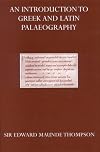
A classic in the subject of Latin and Greek palaeography. Still one of the best reference works on the subject. Fully illustrated with b&w images.
An introduction to Greek and Latin palaeography / by Edward Maunde Thompson by Edward Maunde Thompson
Special edition for Oxbow Books ...
You May Also Like


Associated Authors
Statistics
- Works
- 10
- Also by
- 1
- Members
- 188
- Popularity
- #115,782
- Rating
- 4.0
- Reviews
- 5
- ISBNs
- 25
- Languages
- 1