
S. Craig Watkins
Author of Hip Hop Matters: Politics, Pop Culture, and the Struggle for the Soul of a Movement
About the Author
S. Craig Watkins is the founding director of the Institute for Media Innovation and the incoming Ernest S. Sharpe Centennial Professor in the Moody College of Communication at the University of Texas at Austin. An internationally recognized expert in media, he is the author of six books exploring show more young people's engagement with technology, media, and pop culture. show less
Works by S. Craig Watkins
Hip Hop Matters: Politics, Pop Culture, and the Struggle for the Soul of a Movement (2005) 74 copies
The Young and the Digital: What the Migration to Social Network Sites, Games, and Anytime, Anywhere Media Means for Our Future (2009) 64 copies, 2 reviews
Don't Knock the Hustle: Young Creatives, Tech Ingenuity, and the Making of a New Innovation Economy (2019) 19 copies, 11 reviews
Tagged
Common Knowledge
- Gender
- male
Members
Reviews
Don't Knock the Hustle: Young Creatives, Tech Ingenuity, and the Making of a New Innovation Economy by S. Craig Watkins
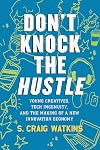
Summary: An investigation of the ways young entrepreneurs are combining tech savvy, hard work, and social capital to create the careers, with a special focus on the inclusion of under-represented populations in tech fields including women and people of color.
S. Craig Watkins uses the election of Alexandria Ocasio-Cortez to the House of Representatives, beating a supposedly unbeatable party insider in the primary election, to illustrate the basic premise of this book. Many younger millenials show more are using unconventional methods to build their own careers, often on a shoestring using readily available digital technologies, hard work ("hustle"), and social capital--one's real and virtual network of friends and sympathizers, including the communities of fellow entrepreneurs who help each other
Watkins lead off case study of Ocasio-Cortez sets a pattern for the book, where a particular tech entrepreneur illustrates some aspect of this "hustle" economy. For example, he profiles Prince Harvey, a rapper, who records his first album in an Apple store turning retail space into a studio.
For many, from rappers to game developers, what happens is they seek out cheap warehouse spaces, or at their best, accelerators, that become coworking spaces where resources like printers, wi-fi, phones and furniture are shared, as are ideas in what Watkins calls a "perpetual hackathon." Some become innovation hubs like Juegos Rancheros, a hub for indie game developers. Other young creatives learn everything they need to innovate in a just-in-time fashion on the internet.
At some point, start-ups, even "side hustles" supported by day jobs, need capital to ramp up. Accelerators can help with connections with investor "angels," but just as often, these creatives use crowd-sourced funding methods to secure financial capital.
The music industry is a big place for young creatives who have developed alternative models of making and distributing music. Watkins profiles the development of SoundCloud and how it has been adopted by creative podcasters, hip-hop artists, and audio producers. What SoundCloud has been to music, YouTube has been to video, launching the career of Issa Rae, whose videos of The Misadventures of Awkward Black Girl provided an a young black woman who the traditional video media industry would not give a second look. Justin Simien used Twitter to launch Dear White People.
The latter part of the book focuses on the inclusion in this creative economy of the under-represented: women and people of color. He describes the idea of Debbie Sterling that girls needed opportunities to build things with construction toys, and came up with a side hustle called GoldieBlox. He introduces us to Kimberly Bryant who created a nonprofit called Black Girls Code. He narrates the work of Qeyno Group, a group formed to foster design thinking and hackathons among underserved populations in Oakland. He chronicles the street activism and civic engagement that arose among young creatives following the police shooting of Michael Brown in Ferguson including Mapping Police Violence, the first comprehensive database of police-involved shootings, and the development of the Wiki-based Resistance Manual.
He concludes the book in Detroit, discussing how the new creative economy holds promise for the re-building of a rust-belt city. The challenge is moving the creative economy out of the downtown areas into the more ethnically diverse neighborhoods. One answer is Ponyride, combining a high commitment to diversity with a high commitment to education in bringing together young creatives.
This is an inspiring book. While it might be asked how many of these entrepreneurial efforts will be around in a decade, this could be applied to the efforts of previous generations. If anything, the "fail fast" and then build it better attitude suggests a far more resilient approach than the one that believed in jobs that would always be there, even passed along from parents to children. The narrative of innovation not dependent on large amounts of financial capital, but on social capital and ingenuity takes us back to an earlier time, as well as into a new era. I'm also struck by the leveraging of different forms of digital technology and online resources. Part of the "creative" is seeing how innovators combine and adapt technologies not built for what they are trying to do, ending up both changing the technology and creating new products.
I realize that at least part of the pushback against Alexandria Ocasio-Cortez is ideologically and politically motivated. But I can't help but wonder if part is that secretly, people are scared by the way she combined social capital, tech savvy, and just plain hustle and changed the rules of a game that other politicians thought they knew how to play. This book suggests that the rules are being re-written by young creatives in a variety of fields. Perhaps it is time to stop knocking the hustle and realize that this may be a new way of getting things done.
________________________________
Disclosure of Material Connection: I received this advanced review copy from the publisher via LibraryThing. I was not required to write a positive review. The opinions I have expressed are my own. show less
S. Craig Watkins uses the election of Alexandria Ocasio-Cortez to the House of Representatives, beating a supposedly unbeatable party insider in the primary election, to illustrate the basic premise of this book. Many younger millenials show more are using unconventional methods to build their own careers, often on a shoestring using readily available digital technologies, hard work ("hustle"), and social capital--one's real and virtual network of friends and sympathizers, including the communities of fellow entrepreneurs who help each other
Watkins lead off case study of Ocasio-Cortez sets a pattern for the book, where a particular tech entrepreneur illustrates some aspect of this "hustle" economy. For example, he profiles Prince Harvey, a rapper, who records his first album in an Apple store turning retail space into a studio.
For many, from rappers to game developers, what happens is they seek out cheap warehouse spaces, or at their best, accelerators, that become coworking spaces where resources like printers, wi-fi, phones and furniture are shared, as are ideas in what Watkins calls a "perpetual hackathon." Some become innovation hubs like Juegos Rancheros, a hub for indie game developers. Other young creatives learn everything they need to innovate in a just-in-time fashion on the internet.
At some point, start-ups, even "side hustles" supported by day jobs, need capital to ramp up. Accelerators can help with connections with investor "angels," but just as often, these creatives use crowd-sourced funding methods to secure financial capital.
The music industry is a big place for young creatives who have developed alternative models of making and distributing music. Watkins profiles the development of SoundCloud and how it has been adopted by creative podcasters, hip-hop artists, and audio producers. What SoundCloud has been to music, YouTube has been to video, launching the career of Issa Rae, whose videos of The Misadventures of Awkward Black Girl provided an a young black woman who the traditional video media industry would not give a second look. Justin Simien used Twitter to launch Dear White People.
The latter part of the book focuses on the inclusion in this creative economy of the under-represented: women and people of color. He describes the idea of Debbie Sterling that girls needed opportunities to build things with construction toys, and came up with a side hustle called GoldieBlox. He introduces us to Kimberly Bryant who created a nonprofit called Black Girls Code. He narrates the work of Qeyno Group, a group formed to foster design thinking and hackathons among underserved populations in Oakland. He chronicles the street activism and civic engagement that arose among young creatives following the police shooting of Michael Brown in Ferguson including Mapping Police Violence, the first comprehensive database of police-involved shootings, and the development of the Wiki-based Resistance Manual.
He concludes the book in Detroit, discussing how the new creative economy holds promise for the re-building of a rust-belt city. The challenge is moving the creative economy out of the downtown areas into the more ethnically diverse neighborhoods. One answer is Ponyride, combining a high commitment to diversity with a high commitment to education in bringing together young creatives.
This is an inspiring book. While it might be asked how many of these entrepreneurial efforts will be around in a decade, this could be applied to the efforts of previous generations. If anything, the "fail fast" and then build it better attitude suggests a far more resilient approach than the one that believed in jobs that would always be there, even passed along from parents to children. The narrative of innovation not dependent on large amounts of financial capital, but on social capital and ingenuity takes us back to an earlier time, as well as into a new era. I'm also struck by the leveraging of different forms of digital technology and online resources. Part of the "creative" is seeing how innovators combine and adapt technologies not built for what they are trying to do, ending up both changing the technology and creating new products.
I realize that at least part of the pushback against Alexandria Ocasio-Cortez is ideologically and politically motivated. But I can't help but wonder if part is that secretly, people are scared by the way she combined social capital, tech savvy, and just plain hustle and changed the rules of a game that other politicians thought they knew how to play. This book suggests that the rules are being re-written by young creatives in a variety of fields. Perhaps it is time to stop knocking the hustle and realize that this may be a new way of getting things done.
________________________________
Disclosure of Material Connection: I received this advanced review copy from the publisher via LibraryThing. I was not required to write a positive review. The opinions I have expressed are my own. show less
 This review was written for LibraryThing Early Reviewers.
Don't Knock the Hustle: Young Creatives, Tech Ingenuity, and the Making of a New Innovation Economy by S. Craig Watkins
It’s taken me a long time to review this one. I read the first couple of chapters right after I got it and thought— one-sided, maybe simplistic, selected case studies that drive straight ahead to prove a point without paying enough heed to other cases or possible explanations. So I put it aside for a while, but, mindful that I had chosen to receive this book to review, picked it up again and finished it. I’m glad I did. I might still raise some of the same objections, but the book show more makes you think, makes you look at things from an alternative viewpoint and that is always good. I now have a different vocabulary, people and companies to keep up with that I hadn’t heard of before, items to possibly purchase, and a more open mind about the positive relationship between technology and innovation and the “young creatives” he describes so well. show less
This review was written for LibraryThing Early Reviewers.Don't Knock the Hustle: Young Creatives, Tech Ingenuity, and the Making of a New Innovation Economy by S. Craig Watkins
I could not read this Early Reviewers selection. The author seems to think that the gig economy is brand new and only active in the tech industry. I have been in the gig industry for decades and not in the tech industry. Also, he repeats catch phrases over and over as if he is trying to "brand" them, but the tactic only succeeded in boring me. I wish the book had been about the mulitfaceted gig economy and how to use it well, but it is not.
This review was written for LibraryThing Early Reviewers.Don't Knock the Hustle: Young Creatives, Tech Ingenuity, and the Making of a New Innovation Economy by S. Craig Watkins
Starting with the positives. I appreciated learning about some of the creative efforts being made to include a broader spectrum of people in design and idea think tanks along with their useful creations. My problems with the book were primarily in the first half which was very repetitious and touted technology as the answer to everything. One aspect of the innovation economy that the author does not address is its impact upon the consumer. Often products are well designed but have poor show more quality control. Many of these products are applications or application controlled. When the consumer has a problem or there's been a system update they're very apt to discover the makers are no longer there. They've trotted off to pursue another idea. We've had this happen with two sound/mute, hearing enhancing ear buds of significant cost. show less
This review was written for LibraryThing Early Reviewers.You May Also Like


Statistics
- Works
- 6
- Members
- 183
- Popularity
- #118,258
- Rating
- 3.6
- Reviews
- 14
- ISBNs
- 16
