
Carolyn Croll
Author of Too Many Babas
Works by Carolyn Croll
Sam and Dan 1 copy
Associated Works
Switch On, Switch Off (Let's-Read-and-Find-Out Science 2) (1989) — Illustrator — 543 copies, 5 reviews
Tagged
Common Knowledge
- Gender
- female
Members
Reviews

Pavel the woodcutter and his wife Caterina long for a child in this picture book adaptation of a Russian folktale, a longing which becomes more intense during the Christmas season. When Pavel creates a snow girl one night, and she comes alive, it seems that their wish is granted, but this new daughter cannot live inside with them, nor enjoy the pleasure of warm food or warm embraces. When the holiday gift-giver Baboushka visits on Christmas Eve, Snowgirl knows what gift she will ask show more for...
According to the introductory note here, The Little Snowgirl is based upon a folktale entitled "The Little Daughter of Snow," which can be found in Arthur Ransome's 1916 collection, Old Peter's Russian Tales. The original had an unhappy ending, one in which the old couple lost their snow daughter when they wouldn't give the fox who rescued her a hen, in exchange for bringing her home from the forest. Here there is a happy ending, as the Snowgirl istransformed into a human child by Baboushka (who does not appear in the original). Apparently author/illustrator Carolyn Croll took the first half of the Ransome tale, and combined it with the apocryphal folktale concerning Baboushka, the old woman who missed her chance to visit the Christ child on the first Christmas, when the Three Wise Men visited her home. In this telling, she eventually became a Christmas gift-giver, similar to Old Befana in the Italian tradition. This is a similarity that Tomie dePaola, the creative director at Whitebird Books, makes in his introductory note.
The story of Baboushka has been retold many times in Anglophone children's literature, in titles such as Ruth Robbins and Nicolas Sidjakov's Caldecott Medal-winning Baboushka and the Three Kings, Charles Mikolaycak's Babushka: An Old Russian Folktale, Arthur Scholey and Helen Cann's Baboushka: A Christmas Folktale from Russia, Dawn Casey and Amanda Hall's Babushka: A Christmas Tale, and Elena Pasquali and Lucia Mongioj's The Tale of Baboushka: A Traditional Christmas Story. Unfortunately, although presented in the west as a traditional Russian folktale, it is nothing of the kind, and is actually a Russified version of similar tales from other traditions, coming from American author Edith M. Thomas' 1907 poem Babushka (A Russian Legend), taken from her collection, Children of Christmas.
Given this history, what is to be found in The Little Snowgirl is really an amalgamation of a traditional Russian tale ("The Little Daughter of Snow") with elements of another story that is attributed to Russian tradition, but does not in fact reflect their culture. This doesn't ruin the story for me, as I still found it and the artwork quite appealing, but I think folklore enthusiasts should be aware of the fact. show less
According to the introductory note here, The Little Snowgirl is based upon a folktale entitled "The Little Daughter of Snow," which can be found in Arthur Ransome's 1916 collection, Old Peter's Russian Tales. The original had an unhappy ending, one in which the old couple lost their snow daughter when they wouldn't give the fox who rescued her a hen, in exchange for bringing her home from the forest. Here there is a happy ending, as the Snowgirl is
The story of Baboushka has been retold many times in Anglophone children's literature, in titles such as Ruth Robbins and Nicolas Sidjakov's Caldecott Medal-winning Baboushka and the Three Kings, Charles Mikolaycak's Babushka: An Old Russian Folktale, Arthur Scholey and Helen Cann's Baboushka: A Christmas Folktale from Russia, Dawn Casey and Amanda Hall's Babushka: A Christmas Tale, and Elena Pasquali and Lucia Mongioj's The Tale of Baboushka: A Traditional Christmas Story. Unfortunately, although presented in the west as a traditional Russian folktale, it is nothing of the kind, and is actually a Russified version of similar tales from other traditions, coming from American author Edith M. Thomas' 1907 poem Babushka (A Russian Legend), taken from her collection, Children of Christmas.
Given this history, what is to be found in The Little Snowgirl is really an amalgamation of a traditional Russian tale ("The Little Daughter of Snow") with elements of another story that is attributed to Russian tradition, but does not in fact reflect their culture. This doesn't ruin the story for me, as I still found it and the artwork quite appealing, but I think folklore enthusiasts should be aware of the fact. show less

An old farmer with three sons debates to which he should leave his farm in this picture book retelling of a German folktale. Deciding upon a test, he tells them one day that the one who can fill the barn the best will be his heir. So begins the contest, as eldest son Gideon fills the barn with animals, and middle son Simon fills it with hay. When it is the turn of Amos, the youngest and smallest brother, his idea—to light a candle and fill the barn with light —is hailed as the best, and show more he is chosen as the winner. Fortunately, he has no desire to be the sole inheritor...
According to the introductory note here, written by Tomie dePaola, The Three Brothers is based upon a tale type found in both Germany and Latvia, although the German version of the tale is the one referenced in the sub-title. No further information as to specific sources is given, unfortunately, although dePaola does discuss the influence of the Pennsylvania Dutch (AKA German) folk art of Carolyn Croll's own native region of Pennsylvania on her illustrations. In any case, I found this an engaging little book, although the realist in me did wonder whether the happily ever after would last, once each son decided to marry. The artwork is lovely, much as in Croll's The Little Snowgirl, with deep, vivid colors and appealing folkloric figures. Recommended to young folklore enthusiasts. show less
According to the introductory note here, written by Tomie dePaola, The Three Brothers is based upon a tale type found in both Germany and Latvia, although the German version of the tale is the one referenced in the sub-title. No further information as to specific sources is given, unfortunately, although dePaola does discuss the influence of the Pennsylvania Dutch (AKA German) folk art of Carolyn Croll's own native region of Pennsylvania on her illustrations. In any case, I found this an engaging little book, although the realist in me did wonder whether the happily ever after would last, once each son decided to marry. The artwork is lovely, much as in Croll's The Little Snowgirl, with deep, vivid colors and appealing folkloric figures. Recommended to young folklore enthusiasts. show less
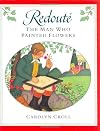
Carolyn Croll creates a fairy tale atmosphere in her picture book biography of Redoute. The book follows Redoute from his childhood of dreaming to be an artist to the revolution in France. He became the official flower painter for Marie Antoinette and Empress Josephine. The message this book gives out is a lesson on perseverance, as see by Redoute overcoming numerous obstacles. There is a glossary at the beginning of the book to help with pronunciation. The language is simple and easy to show more understand for younger readers. Like I said, it feels a bit like a fairy tale, but the art is very cute and the book itself is very informative! show less
This book is based on the French painter Pierre-Joseph Redoute. Throughout this book we get to see what his life was like through childhood, adolescence, and even into adulthood. The son of a famous painter, Pierre was always expected to be a painter. Unlike his family, he wanted to paint what he liked, flowers, and not what they expected out of him. Pierre eventually left his home to see what his life could be. He often found enough work to just be able to eat and sleep but then would also show more come into contact with out artists. After going to aid his brother in Paris, Pierre began to admire the flowers in the Kings garden and began to rekindle his love for painting real flowers. He soon was able to do what he loved and earn money with the help of a botanist who needed someone to illustrate his book. This sparked others interest for him and eventually went to work for Marie Antoinette and after Napoleon Bonaparte's wife Josephine. We are able to see his growth as an artist, painter, teacher, friend, and person through this book. I think that this book would be great for an art lesson or even a history lesson about this era. I think that students would enjoy getting to understand all the trials and hard times he had to go through to get to where he wanted to be. show less
Lists
Awards


You May Also Like


Associated Authors
Statistics
- Works
- 10
- Also by
- 22
- Members
- 574
- Popularity
- #43,645
- Rating
- 3.6
- Reviews
- 11
- ISBNs
- 18
- Languages
- 1