
Traci N. Todd
Author of Nina: A Story of Nina Simone
About the Author
Image credit: photo by Jacob Chabot
Works by Traci N. Todd
Make a Pretty Sound: A Story of Ella Jenkins--The First Lady of Children's Music (2025) 29 copies, 2 reviews
Henry's Parade — Author — 3 copies
Hello, Beautiful 1 copy
Tagged
Common Knowledge
- Gender
- female
- Education
- Northwestern University
- Birthplace
- Chicago, Illinois, USA
- Places of residence
- Queens, New York, New York, USA
- Associated Place (for map)
- USA
Members
Reviews
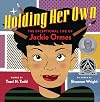
An effervescent tribute to Jackie Ormes, widely considered to be the first nationally syndicated Black woman cartoonist in the United States.
In a buoyant profile and then a more detailed afterword, Todd takes her scandalously little-known subject from an exuberant child who “fills every space she can find” with drawings to the successful creator of several pre– and post–World War II comic strips featuring strong-minded young Black characters—notably Patty-Jo and Torchy Brown—who show more confront prejudice and fear in “quiet, mighty ways.” Reflecting her prominence in Chicago’s African American community, Ormes cuts a stylish figure in the jazzy illustrations, and Wright slips in samples of Ormes’ work to capture its vitality as well as the “Jackie joy” that characterized it. “I was always fighting battles,” she said, and along with championing women’s rights to work (and play: One cartoon reproduced here has Patty-Jo, dressed in tatters and holding a football, indignantly telling her sister, “What’cha mean it’s no game for girls? We got feet too, ain’t we?”), she was active enough in social causes and the early civil rights movement to be investigated by the FBI. Rather than complete this picture of her life, the author and the illustrator leave a blank page to represent the decades between her retirement from comics and her death in 1985, but there’s enough here to keep readers marveling at her distinctive character and achievements…and likely wondering why it’s taken this long to discover them. (This book was reviewed digitally; this review has been updated for factual accuracy.)
Long-overdue but welcome recognition for a pioneering graphic artist. (artist’s note, bibliography, photos) (Picture-book biography. 7-10)
-Kirkus Review show less
In a buoyant profile and then a more detailed afterword, Todd takes her scandalously little-known subject from an exuberant child who “fills every space she can find” with drawings to the successful creator of several pre– and post–World War II comic strips featuring strong-minded young Black characters—notably Patty-Jo and Torchy Brown—who show more confront prejudice and fear in “quiet, mighty ways.” Reflecting her prominence in Chicago’s African American community, Ormes cuts a stylish figure in the jazzy illustrations, and Wright slips in samples of Ormes’ work to capture its vitality as well as the “Jackie joy” that characterized it. “I was always fighting battles,” she said, and along with championing women’s rights to work (and play: One cartoon reproduced here has Patty-Jo, dressed in tatters and holding a football, indignantly telling her sister, “What’cha mean it’s no game for girls? We got feet too, ain’t we?”), she was active enough in social causes and the early civil rights movement to be investigated by the FBI. Rather than complete this picture of her life, the author and the illustrator leave a blank page to represent the decades between her retirement from comics and her death in 1985, but there’s enough here to keep readers marveling at her distinctive character and achievements…and likely wondering why it’s taken this long to discover them. (This book was reviewed digitally; this review has been updated for factual accuracy.)
Long-overdue but welcome recognition for a pioneering graphic artist. (artist’s note, bibliography, photos) (Picture-book biography. 7-10)
-Kirkus Review show less
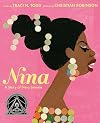
This biography of African American icon Nina Simone follows the development of her early musical talent to her popularity as a musician during the civil rights movement.
Born in North Carolina in 1933, Eunice Kathleen Waymon “sang before she could talk and found rhythm before she could walk.” Her mama, a minister, sang only church songs, and her daddy played the upright piano, teaching Eunice to play jazz when Mama was out. From the age of 3, Eunice played music at church while Mama show more preached. Eunice’s gift was undeniable, and the White woman Mama cleaned for during the week helped arrange music lessons, where Eunice learned classical piano, falling in love with Bach’s music. After high school, Eunice went to New York City to attend the Juilliard School of Music. But when she auditioned for a transfer to the Curtis Institute of Music in Philadelphia, she was not accepted, and she felt her dream of being a musician slipping away. When she took jobs in nightclubs, she performed as Nina Simone to keep her mother from discovering her secret. The narrative includes details of the love and support of family and community that gave Nina her early start, the disappointments and humiliations she suffered because of racism, and the determination and sheer love of music and of her people that carried her to success despite the setbacks. Todd’s musical prose allows readers into Nina’s perspective, and Robinson’s scenes and portraits absolutely sing with energy, keeping pace perfectly with the text as it expands beyond typical picture-book length. (This book was reviewed digitally.)
Do not miss this complex story of an American legend. (note) (Picture book/biography. 4-10)
-Kirkus Review show less
Born in North Carolina in 1933, Eunice Kathleen Waymon “sang before she could talk and found rhythm before she could walk.” Her mama, a minister, sang only church songs, and her daddy played the upright piano, teaching Eunice to play jazz when Mama was out. From the age of 3, Eunice played music at church while Mama show more preached. Eunice’s gift was undeniable, and the White woman Mama cleaned for during the week helped arrange music lessons, where Eunice learned classical piano, falling in love with Bach’s music. After high school, Eunice went to New York City to attend the Juilliard School of Music. But when she auditioned for a transfer to the Curtis Institute of Music in Philadelphia, she was not accepted, and she felt her dream of being a musician slipping away. When she took jobs in nightclubs, she performed as Nina Simone to keep her mother from discovering her secret. The narrative includes details of the love and support of family and community that gave Nina her early start, the disappointments and humiliations she suffered because of racism, and the determination and sheer love of music and of her people that carried her to success despite the setbacks. Todd’s musical prose allows readers into Nina’s perspective, and Robinson’s scenes and portraits absolutely sing with energy, keeping pace perfectly with the text as it expands beyond typical picture-book length. (This book was reviewed digitally.)
Do not miss this complex story of an American legend. (note) (Picture book/biography. 4-10)
-Kirkus Review show less
This does exactly what I want a children's biography to do: tell me why the person was important, and do it in a way that makes me want to learn more about them. I now know my music mix is woefully lacking in Nina Simone, and I'm working to rectify that ASAP.
It was a little odd that the end matter just retold the story of the picture book in five pages of text with fewer pictures and slightly more facts and names. I would have liked to seen the space used to offer a discography, recommended show more playlist (or Spotify QR code), and actual pictures of Nina Simone.
(Another project! I'm reading all the picture books and graphic novels from NPR's Books We Love 2021: Kids’ Books list.) show less
It was a little odd that the end matter just retold the story of the picture book in five pages of text with fewer pictures and slightly more facts and names. I would have liked to seen the space used to offer a discography, recommended show more playlist (or Spotify QR code), and actual pictures of Nina Simone.
(Another project! I'm reading all the picture books and graphic novels from NPR's Books We Love 2021: Kids’ Books list.) show less
First sentence: Amid the blare and bleat
of taxicabs,
the screech of high-up trains,
the tambourines that ring
as preachers preach
and choirs sing--
amid the pool hall-gritty
beat of the city
a little girl named
Ella whistles with
the birds.
Little girls
shouldn't
whistle,
her mother says.
But ella wants
to make
a prety
sound.
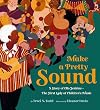
Premise/plot: Make a Pretty Sound is a picture book biography of Ella Jenkins. It is written as a narrative poem. The rhythm of it WORKS. (I love it when that happens.) When writing show more about musicians, it is almost essential that attention is given to the narrative style, to getting the rhythm just right. So this picture book is the story of her life and her work. She is best known for her children's music. (I, for one, remember her appearances on MISTER ROGERS' NEIGHBORHOOD.)
My thoughts: I would HIGHLY, HIGHLY, HIGHLY recommend that if you are going to take the time to read a picture book biography of a musician, in this case, Ella Jenkins, you take the time to introduce children to the MUSIC as well. Take time to listen to some of Ella Jenkins' albums, or songs at least.
I enjoyed the narrative text. I enjoyed the illustrations. I appreciated listening to her music. (YT for the win!) show less
of taxicabs,
the screech of high-up trains,
the tambourines that ring
as preachers preach
and choirs sing--
amid the pool hall-gritty
beat of the city
a little girl named
Ella whistles with
the birds.
Little girls
shouldn't
whistle,
her mother says.
But ella wants
to make
a prety
sound.
Premise/plot: Make a Pretty Sound is a picture book biography of Ella Jenkins. It is written as a narrative poem. The rhythm of it WORKS. (I love it when that happens.) When writing show more about musicians, it is almost essential that attention is given to the narrative style, to getting the rhythm just right. So this picture book is the story of her life and her work. She is best known for her children's music. (I, for one, remember her appearances on MISTER ROGERS' NEIGHBORHOOD.)
My thoughts: I would HIGHLY, HIGHLY, HIGHLY recommend that if you are going to take the time to read a picture book biography of a musician, in this case, Ella Jenkins, you take the time to introduce children to the MUSIC as well. Take time to listen to some of Ella Jenkins' albums, or songs at least.
I enjoyed the narrative text. I enjoyed the illustrations. I appreciated listening to her music. (YT for the win!) show less
Lists
Awards


You May Also Like


Associated Authors
Statistics
- Works
- 18
- Members
- 689
- Popularity
- #36,712
- Rating
- 4.0
- Reviews
- 31
- ISBNs
- 35
- Languages
- 3