

Jerome Bixby (1923–1998)
Author of Fantastic Voyage [Novelization]
About the Author
Series
Works by Jerome Bixby
Planet Stories 47, March 1951 — Editor — 3 copies
Midnite Movies Double Feature: The Monster That Challenged the World / It! The Terror from Beyond Space (2008) — Writer — 3 copies
Trace [short story] 3 copies
One Way Street 2 copies
Short Science Fiction Collection 075 2 copies
Short Science Fiction Collection 058 2 copies
Short Science Fiction Collection 053 2 copies
Vengeance On Mars 2 copies
Share alike 2 copies
Cargo To Callisto 2 copies
The Crowded Colony 2 copies
Tubemonkey 1 copy
The Young One 1 copy
The Jerome Bixby Minipack 1 copy
Symbolic Logic and 1 copy
Jerome Bixby's THE MAN FROM EARTH: The Author's Original Screenplay: Jerome Bixby's Science Fiction 1 copy
The Battle of the Bells 1 copy
Laboratory 1 copy
Little Boy 1 copy
Our Town 1 copy
(Autograph), ALS 1 copy
Two Complete Science-Adventure Books Spring 1951 — Editor — 1 copy
It's a Good Life: The Twilight Zone Radio Dramas — Author — 1 copy
Antologia scolastica n. 2 1 copy
Associated Works
The Science Fiction Hall of Fame, Volume One: The Greatest Science Fiction Stories of All Time (1970) — Contributor — 2,103 copies, 34 reviews
American Fantastic Tales : Terror and the Uncanny from the 1940's to Now (2009) — Contributor — 298 copies, 5 reviews
Isaac Asimov's Magical Worlds of Fantasy, Volume 8: Devils (1987) — Contributor — 107 copies, 2 reviews
Weird Vampire Tales: 30 Blood-Chilling Stories from the Weird Fiction Pulps (1992) — Contributor — 98 copies, 3 reviews
Ackermanthology: 65 Astonishing, Rediscovered Sci-Fi Shorts (1997) — Contributor — 97 copies, 1 review
The Science Fiction Megapack: 25 Classic Science Fiction Stories by Masters (2011) — Author — 65 copies, 3 reviews
Lovers & Other Monsters: A Collection of Amorous Tales of Fantasy, Old and New (1993) — Contributor — 64 copies, 1 review
Science Fiction Hall Of Fame Volume Two. The Greatest Science Fiction Stories Of All Time Chosen By The Members Of The Science Fiction Writers Of America (1970) — Contributor, some editions — 41 copies
The Wild Years 1946-1955 (Amazing Science Fiction Anthology Series) (1987) — Contributor — 27 copies
Van Jules Verne tot Isaac Asimov de vijftig beste science fiction verhalen (1981) — Contributor — 16 copies, 1 review
Fangoria Horror Magazine #25, February 1983 — Interview — 2 copies
Short Science Fiction Collection 045 2 copies
Den elektriske myre og andre science fiction-fortællinger (1984) — Author, some editions — 2 copies, 1 review
Tagged
Common Knowledge
- Legal name
- Bixby, Drexel Jerome Lewis
- Other names
- Lewis, B. D.
Neal, Harry
Russell, Albert
Russell, J.
St. Vivant, M.
Herrick, Thornecliff (show all 8)
Rome, Alger (with Algis Budrys)
Drexel, J. B. - Birthdate
- 1923-01-11
- Date of death
- 1998-04-28
- Gender
- male
- Occupations
- editor
screenwriter
short story writer - Organizations
- Planet Stories
- Nationality
- USA
- Birthplace
- Los Angeles County, California, USA
- Place of death
- San Bernardino, California, USA
- Associated Place (for map)
- California, USA
Members
Reviews

This is a “good” story, despite being horror, a genre I generally avoid. I was captivated by the unsettling fear, most which happens between the lines and in one's head (except for some brief but revolting cruelty to a rat). From the start, there are unsettling turns of phrase: “Anthony thought at it”, and even his own family aren’t safe around this small child with “a bright, wet, purple gaze”.
“Everything had to be good. Had to be fine just as it was, even if it wasn’t show more Always. Because any change might be worse. So terribly much worse.”
Image: What joy to have a tin of Campbells soup (Source)
This was written under the shadow of McCarthyism and the Cold War, and the 46 residents of the mysteriously isolated village live in existential dread of forces they don’t fully understand and cannot control. Whether at the mercy of a vengeful god, an authoritarian government, or an ungovernable toddler, positive thinking and appeasement are sometimes the only way to survive - but is the price too high?
Image: "This is fine" meme of a hatted doc happily sitting in a burning building (Source)
Short story club
I read this in Black Water 2: More Tales of the Fantastic, by Alberto Manguel, from which I’m reading one story a week with The Short Story Club, starting 24 March 2025.
You can read this story HERE.
You can join the group here. show less
“Everything had to be good. Had to be fine just as it was, even if it wasn’t show more Always. Because any change might be worse. So terribly much worse.”
Image: What joy to have a tin of Campbells soup (Source)
This was written under the shadow of McCarthyism and the Cold War, and the 46 residents of the mysteriously isolated village live in existential dread of forces they don’t fully understand and cannot control. Whether at the mercy of a vengeful god, an authoritarian government, or an ungovernable toddler, positive thinking and appeasement are sometimes the only way to survive - but is the price too high?
Image: "This is fine" meme of a hatted doc happily sitting in a burning building (Source)
Short story club
I read this in Black Water 2: More Tales of the Fantastic, by Alberto Manguel, from which I’m reading one story a week with The Short Story Club, starting 24 March 2025.
You can read this story HERE.
You can join the group here. show less
Another short story read with The Short Story Club group from the anthology Black Water 2: More Tales of the Fantastic.
I'm giving it 3 stars, but that's really not fair. It's my way of saying, "Yes, the author did a great job at what the story set it out to do, but dang, I really didn't enjoy it!"
So, imagine that a person can read thoughts of people, and animals too.
Then, imagine that person can control the actions of a person or animal via their thoughts.
Now, imagine that person is a show more child!
Yeah. The story is the horrors of a life under an all powerful child tyrant. Forgive me if at the moment I am especially repulsed by child tyrants, even if they are 78 year old ones. Cruelty and chaos reign to satisfy one immature person's idea of what a good (or, ahem, "GREAT") life is.
The Short Story Club is a GR group that reads one short story per week. It's my favorite group. You can join here: https://www.goodreads.com/group/show/1187035-the-short-story-club show less
I'm giving it 3 stars, but that's really not fair. It's my way of saying, "Yes, the author did a great job at what the story set it out to do, but dang, I really didn't enjoy it!"
So, imagine that a person can read thoughts of people, and animals too.
Then, imagine that person can control the actions of a person or animal via their thoughts.
Now, imagine that person is a show more child!
Yeah. The story is the horrors of a life under an all powerful child tyrant. Forgive me if at the moment I am especially repulsed by child tyrants, even if they are 78 year old ones. Cruelty and chaos reign to satisfy one immature person's idea of what a good (or, ahem, "GREAT") life is.
The Short Story Club is a GR group that reads one short story per week. It's my favorite group. You can join here: https://www.goodreads.com/group/show/1187035-the-short-story-club show less

A fun novelisation of the 1966 movie by Asimov, who does what he can within the scifi premise to include realistic science as problems to be solved by the crew of scientists and technicians, miniaturised in a nuclear-powered submarine and injected into the bloodstream of a defecting physicist with an inoperable brain tumour, to save his life and the knowledge he has in order to maintain a cold war stalemate.
Some nods to the Manhattan Project, deconstruction of super-spy tropes, critique of show more sexism in science (which Asimov then forgets), wrapped up in a neat race-against-time adventure. show less
Some nods to the Manhattan Project, deconstruction of super-spy tropes, critique of show more sexism in science (which Asimov then forgets), wrapped up in a neat race-against-time adventure. show less
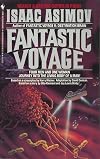
3 1/2 stars: Good.
----------
From the back cover: Four men and one woman reduced to a microscopic fraction of their original size, boarding a miniaturized atomic sub and being infected into a dying man's carotid artery. Fighting their way past giant antibodies, passing through the heart itself, entering the inner ear where even the slightest sound would destroy them, battling relentlessly into the cranium. Their objective--to reach a blood clot and destroy it with the piercing rays of a show more laser gun. At stake--the fate of the entire world.
-------------------
This was a solid "Good". A Page turner, fast read. It is certainly a cold war era book--they go on the journey to save the life of a Soviet defector who has scientific knowledge that can change the balance of power. And our five protagonists--of course, one is actually a secret agent who wants to defector to die before he can tell his secrets.
Typical Isaac Asimov, the characters are caricatures, particularly our female. I had a few eye rolls, but nothing I would go so far as to say offended by. Asimov is the Agatha Christie of Sci-Fi-- great plots, cardboard characters.
I did love the descriptions of the parts of the body they were running across in miniaturized form. In one sequence, three characters had to leave the sub, and one started getting attacked by antibodies. I wanted to hug one! :)
Here is a passage in the "antibody sequence" which shows what I mean, both about the descriptions and the caricatures:
"They had no brains, not even the most primitive, and it was wrong to think of them as monsters or predators...They were merely molecules with atoms so arranged as to make them cling to the surfaces that fit theirs through blind action of inter-atomic forces. ... He kept pulling at the fuzz [antibodies] on Cora's back. .. [Antibodies] clung and joined, spanning her shoulders and making their wooly pattern across her abdomen. They hesitated over the uneven three dimensional curve of her breasts as though they had not figured that out yet."
Seriously??? Antibodies that are in a constant microscopie 3D environment at all times can't deal with breasts? Grow up, Isaac!
I would have liked the book better if there had not been the secret agent aspect, but conversely I liked that there was never an issue of "will they be shrunk forever"? There was the time element--the shrinking would automatically expire and they might start growing and thus kill their patient, but it was never a question of whether they'd be shrunk forever. That would have been tedious.
A good, fun, fast read. You can finish it in a few hours.
Sending this to a friend's son. show less
----------
From the back cover: Four men and one woman reduced to a microscopic fraction of their original size, boarding a miniaturized atomic sub and being infected into a dying man's carotid artery. Fighting their way past giant antibodies, passing through the heart itself, entering the inner ear where even the slightest sound would destroy them, battling relentlessly into the cranium. Their objective--to reach a blood clot and destroy it with the piercing rays of a show more laser gun. At stake--the fate of the entire world.
-------------------
This was a solid "Good". A Page turner, fast read. It is certainly a cold war era book--they go on the journey to save the life of a Soviet defector who has scientific knowledge that can change the balance of power. And our five protagonists--of course, one is actually a secret agent who wants to defector to die before he can tell his secrets.
Typical Isaac Asimov, the characters are caricatures, particularly our female. I had a few eye rolls, but nothing I would go so far as to say offended by. Asimov is the Agatha Christie of Sci-Fi-- great plots, cardboard characters.
I did love the descriptions of the parts of the body they were running across in miniaturized form. In one sequence, three characters had to leave the sub, and one started getting attacked by antibodies. I wanted to hug one! :)
Here is a passage in the "antibody sequence" which shows what I mean, both about the descriptions and the caricatures:
"They had no brains, not even the most primitive, and it was wrong to think of them as monsters or predators...They were merely molecules with atoms so arranged as to make them cling to the surfaces that fit theirs through blind action of inter-atomic forces. ... He kept pulling at the fuzz [antibodies] on Cora's back. .. [Antibodies] clung and joined, spanning her shoulders and making their wooly pattern across her abdomen. They hesitated over the uneven three dimensional curve of her breasts as though they had not figured that out yet."
Seriously??? Antibodies that are in a constant microscopie 3D environment at all times can't deal with breasts? Grow up, Isaac!
I would have liked the book better if there had not been the secret agent aspect, but conversely I liked that there was never an issue of "will they be shrunk forever"? There was the time element--the shrinking would automatically expire and they might start growing and thus kill their patient, but it was never a question of whether they'd be shrunk forever. That would have been tedious.
A good, fun, fast read. You can finish it in a few hours.
Sending this to a friend's son. show less
Lists
Awards


You May Also Like


Associated Authors
Statistics
- Works
- 57
- Also by
- 58
- Members
- 3,364
- Popularity
- #7,583
- Rating
- 3.8
- Reviews
- 39
- ISBNs
- 74
- Languages
- 7
- Favorited
- 2