
N. Katherine Hayles
Author of How We Became Posthuman: Virtual Bodies in Cybernetics, Literature, and Informatics
About the Author
N. Katherine Hayles is distinguished research professor of English at the University of California, Los Angeles, and James B. Duke Professor of Literature Emerita at Duke University. Her books include How We Became Posthuman: Virtual Bodies in Cybernetics, Literature, and Informatics (1999) and show more unthought: The Power of the Cognitive Nonconscious (2017). show less
Image credit: Dave Pape
Works by N. Katherine Hayles
How We Became Posthuman: Virtual Bodies in Cybernetics, Literature, and Informatics (1999) 566 copies, 3 reviews
Chaos and Order: Complex Dynamics in Literature and Science (New Practices of Inquiry) (1991) 120 copies
The Cosmic Web: Scientific Field Models and Literary Strategies in the 20th Century (1984) 48 copies
Comparative Textual Media: Transforming the Humanities in the Postprint Era (2013) — Editor — 23 copies
LO IMPENSADO 3 copies
Associated Works
First Person: New Media as Story, Performance, and Game (2004) — Contributor — 177 copies, 3 reviews
From Energy to Information: Representation in Science and Technology, Art, and Literature (Writing Science) (2002) — Contributor — 16 copies
The Routledge Companion to Experimental Literature (Routledge Literature Companions) (2012) — Contributor — 14 copies
Between Science and Literature: An Introduction to Autopoetics (2005) — Preface, some editions — 8 copies
Tagged
Common Knowledge
- Legal name
- Hayles, Nancy Katherine
- Birthdate
- 1943-12-16
- Gender
- female
- Education
- University of Rochester (PhD)
Michigan State University (MA)
California Institute of Technology (MS)
Rochester Institute of Technology (BS) - Occupations
- professor (Literature)
- Organizations
- University of California, Los Angeles
University of Iowa
University of Missouri–Rolla
California Institute of Technology
Dartmouth College
Duke University - Awards and honors
- Eby Award for Distinction in Undergraduate Teaching ( [1999])
Luckman Distinguished Teaching Award ( [1999])
Distinguished Scholar Award ( [1998])
Medal of Honor ( [1997])
Distinguished Scholar Award ( [1997])
IAFA Distinguished Scholarship (1997) - Short biography
- Hayles was born in Saint Louis, Missouri to Edward and Thelma Bruns. She received her B.S. in Chemistry from the Rochester Institute of Technology in 1966, and her M.S. in Chemistry from the California Institute of Technology in 1969. She worked as a research chemist in 1966 at Xerox Corporation and as a chemical research consultant Beckman Instrument Company from 1968-1970. Hayles then switched fields and received her M.A. in English Literature from Michigan State University in 1970, and her Ph.D. in English Literature from the University of Rochester in 1977.
- Nationality
- USA
- Birthplace
- Saint-Louis, Missouri, Etats-Unis
- Associated Place (for map)
- USA
Members
Reviews
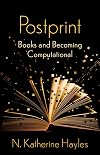
Postprint: Books and Becoming Computational by N Katherine Hayles warrants rereading after having some time to digest all of the information. What a reader takes from a first reading is going to depend heavily on both what they bring to the book and what chapter most appeals to them.
Very broadly, Hayles uses the concept of a cognitive assemblage to frame the current ideas and concerns around books and print media. Thus the period we're in, postprint, or perhaps more accurately show more post(exclusively)print. I'll highlight a few of my main takeaways and areas that intrigued me.
I was initially skeptical of the term cognitive assemblage but as she explained both the concept and the thinking behind her choice of words, I came to appreciate it. In particular her decision to use the idea of cognition versus thinking or another similar term. Her explanation that cognition is, and I am very much oversimplifying here, getting information and, based on that information, choosing one of several paths allows for the inclusion of computer-based and even electromechanical operations to be part of a cognitive assemblage. So once all of the steps in a process, whether creating a text or reading a text, are not entirely determined on each iteration by a human we have a sharing of the cognitive aspects and thus a cognitive assemblage. Trust me, she explains this much better than I do.
I found the chapter on university presses to be very interesting. How to meet demands for print and digital, how to look ahead and anticipate future advancements, and how academia, emphasis here on the humanities, can adjust its publishing expectations for hiring or tenure decisions. While this is specific to university presses the ideas and concerns can easily be applied to the publishing sector at large.
Hayles discusses several works that are postprint novels or require a computational element to "read." These analyses are intriguing whether you're familiar with the texts or not. The points I took away had more to do with what the implications are for future works though on my next reading I want to concentrate on the theoretical ideas they represent (either in their narrative or in how they must be "read"). The questions around language, whether words are constrictive or enabling, whether communication would be better or worse if we eliminated the need to put ideas into words, reminded me of a book I recently read, Hegel in a Wired Brain by Slavoj Zizek, that looks at what it might be like to communicate directly brain to brain without forming words. Would nuance be gained or lost?
I definitely recommend this to anyone interested in where books and printed media are going. There is a lot of information here and I have no doubt that someone with a stronger background in this area would have gotten a lot more out of it than I did. But the writing is clear and most terms are explained well enough that a reader can get the flow of the arguments. And yes, this is a book that rewards rereading after having had a chance to let the ideas sink in.
Reviewed from a copy made available by the publisher via NetGalley. show less
Very broadly, Hayles uses the concept of a cognitive assemblage to frame the current ideas and concerns around books and print media. Thus the period we're in, postprint, or perhaps more accurately show more post(exclusively)print. I'll highlight a few of my main takeaways and areas that intrigued me.
I was initially skeptical of the term cognitive assemblage but as she explained both the concept and the thinking behind her choice of words, I came to appreciate it. In particular her decision to use the idea of cognition versus thinking or another similar term. Her explanation that cognition is, and I am very much oversimplifying here, getting information and, based on that information, choosing one of several paths allows for the inclusion of computer-based and even electromechanical operations to be part of a cognitive assemblage. So once all of the steps in a process, whether creating a text or reading a text, are not entirely determined on each iteration by a human we have a sharing of the cognitive aspects and thus a cognitive assemblage. Trust me, she explains this much better than I do.
I found the chapter on university presses to be very interesting. How to meet demands for print and digital, how to look ahead and anticipate future advancements, and how academia, emphasis here on the humanities, can adjust its publishing expectations for hiring or tenure decisions. While this is specific to university presses the ideas and concerns can easily be applied to the publishing sector at large.
Hayles discusses several works that are postprint novels or require a computational element to "read." These analyses are intriguing whether you're familiar with the texts or not. The points I took away had more to do with what the implications are for future works though on my next reading I want to concentrate on the theoretical ideas they represent (either in their narrative or in how they must be "read"). The questions around language, whether words are constrictive or enabling, whether communication would be better or worse if we eliminated the need to put ideas into words, reminded me of a book I recently read, Hegel in a Wired Brain by Slavoj Zizek, that looks at what it might be like to communicate directly brain to brain without forming words. Would nuance be gained or lost?
I definitely recommend this to anyone interested in where books and printed media are going. There is a lot of information here and I have no doubt that someone with a stronger background in this area would have gotten a lot more out of it than I did. But the writing is clear and most terms are explained well enough that a reader can get the flow of the arguments. And yes, this is a book that rewards rereading after having had a chance to let the ideas sink in.
Reviewed from a copy made available by the publisher via NetGalley. show less
How We Became Posthuman: Virtual Bodies in Cybernetics, Literature, and Informatics by N. Katherine Hayles
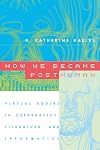
N Katherine Hayles is one of the most prominent scholars of cybernetics and the cultural theory of cyborgism. Her thesis in this book is that although in our modern age, there is an increasing move in cybernetics to regarding information and human subjectivity as bodiless, in fact, to be posthuman means to be embodied, only in a different way. Hayles discusses her theory while covering the history of the three waves of the cybernetics as well as using literary examples (she has degrees in show more both chemistry and English).
I read this book in order to supplement an essay I was writing on William Gibson's Neuromancer. Therefore most of my energy and critical analysis was spent on that angle, and I don't think I can offer a proper analysis of Hayles without it. However, just as a general observation: Hayles raises a lot of interesting ideas about the relation between human and machine. If you are even remotely interested in the subject, this is a good book to read. But I have to add that this is a highly academic book. I couldn't imagine a casual reader picking it up and enjoying it. show less
I read this book in order to supplement an essay I was writing on William Gibson's Neuromancer. Therefore most of my energy and critical analysis was spent on that angle, and I don't think I can offer a proper analysis of Hayles without it. However, just as a general observation: Hayles raises a lot of interesting ideas about the relation between human and machine. If you are even remotely interested in the subject, this is a good book to read. But I have to add that this is a highly academic book. I couldn't imagine a casual reader picking it up and enjoying it. show less
Electronic Literature: New Horizons for the Literary (Yusko Ward-Phillips Lectures in English Language and Literature) by N. Katherine Hayles
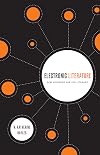
In Electronic Literature: New Horizons for the Literary (2008), N. Katherine Hayles argues that we cannot understand electronic literature through the lens of print (3); instead, we need to attend to the materiality of the text and moves it makes specific to its own materials and modes. She questions the notion of privileging the hyperlink as the distinguishing characteristic of digital literature because print media has analogous technologies, such as the footnote, references, etc. show more Additionally, we should question the supposed "user power" that many attribute to the hyperlink, because hyperlinks are already limited selections made by creators (31).
In Chapter 2, she describes the "feedback loops" in which "the human and the digital computer [are:] partners in a dynamic heterarchy bound together by intermediating dynamics" (83, 47) — that is, the human and the computer are increasingly bound together in complex ways. She builds on this in Chapter 3, where she argues that both "People and machines are embodied, and the specificities of their embodiments can best be understood in the recursive dynamics whereby they coevolve with one another" (129). Our bodies' relationships with technologies are one of "open-ended recursivity" (130).
Hayles notes the important aspect that all print material is already digital in its production process. In Chapter 5, Hayles argues that print should actually be understood as an output of digital files, not simply a separate medium from the digital. She writes that "The digital leaves its mark on print in new capabilities for innovative typography, new aesthetics for book design, and in the near future new modes of marketing" (159). show less
In Chapter 2, she describes the "feedback loops" in which "the human and the digital computer [are:] partners in a dynamic heterarchy bound together by intermediating dynamics" (83, 47) — that is, the human and the computer are increasingly bound together in complex ways. She builds on this in Chapter 3, where she argues that both "People and machines are embodied, and the specificities of their embodiments can best be understood in the recursive dynamics whereby they coevolve with one another" (129). Our bodies' relationships with technologies are one of "open-ended recursivity" (130).
Hayles notes the important aspect that all print material is already digital in its production process. In Chapter 5, Hayles argues that print should actually be understood as an output of digital files, not simply a separate medium from the digital. She writes that "The digital leaves its mark on print in new capabilities for innovative typography, new aesthetics for book design, and in the near future new modes of marketing" (159). show less
How We Became Posthuman: Virtual Bodies in Cybernetics, Literature, and Informatics by N. Katherine Hayles
"How we became posthuman" interprets the concepts and definitions of posthuman amist the evolution of technologies and their correlation to literature and society .
Spanning a period between the 40th and the 90th the author traces a path among the different visions and works that scientists and science fictions writers had about humans and human-like machines that technologist were building or hoping to build. She also explore the desire of scientist to build human like machine and at the show more same time the fear of having machines that will take over the humans.
The book is very hard to read. It is written in the style that a literary critic would use, as the author is. Not a book that popularize science, but a book beefed up with critical literary comparisons among different works, plays of words, sentences built to have double meaning, and constructions that tend more to art form and complacency than to clear exposition.
The author identifies three different main periods or concepts:
1- Homeostatsis or feedback loop, where system are defined by their workings that tend to an equilibrium with their inside and the environment.
2-Reflexivity, autopoiesis, where the main issue is if the observer is outside the system to study or is part of the system.
3-Virtuality, Emergent behavior, Artificial life, where the system is composed of many parts and the system overall behaviour is the result of the complex interrelation of the parts, of their emergent properties/behavior.
Main themes of the book are embodiment, in particular information embodiment, the border of the human body, and the concept of the liberal humanist. These themes are explored in the three different periods, and the contrasting views scientistists had of them even inside the same period.
How information lost its body and when is peraphs the main discussed theme. Her thesis is that the information must be embodied.
Across all book she describes at lenght the different positions, criticing them, but only in the last couple of pages she presents her solution to the problem: distributed cognition. She just write it there without any introduction or critic, simply as the solution to most of the problems she presented in the book. show less
Spanning a period between the 40th and the 90th the author traces a path among the different visions and works that scientists and science fictions writers had about humans and human-like machines that technologist were building or hoping to build. She also explore the desire of scientist to build human like machine and at the show more same time the fear of having machines that will take over the humans.
The book is very hard to read. It is written in the style that a literary critic would use, as the author is. Not a book that popularize science, but a book beefed up with critical literary comparisons among different works, plays of words, sentences built to have double meaning, and constructions that tend more to art form and complacency than to clear exposition.
The author identifies three different main periods or concepts:
1- Homeostatsis or feedback loop, where system are defined by their workings that tend to an equilibrium with their inside and the environment.
2-Reflexivity, autopoiesis, where the main issue is if the observer is outside the system to study or is part of the system.
3-Virtuality, Emergent behavior, Artificial life, where the system is composed of many parts and the system overall behaviour is the result of the complex interrelation of the parts, of their emergent properties/behavior.
Main themes of the book are embodiment, in particular information embodiment, the border of the human body, and the concept of the liberal humanist. These themes are explored in the three different periods, and the contrasting views scientistists had of them even inside the same period.
How information lost its body and when is peraphs the main discussed theme. Her thesis is that the information must be embodied.
Across all book she describes at lenght the different positions, criticing them, but only in the last couple of pages she presents her solution to the problem: distributed cognition. She just write it there without any introduction or critic, simply as the solution to most of the problems she presented in the book. show less
Lists
Awards


You May Also Like


Associated Authors
Statistics
- Works
- 21
- Also by
- 6
- Members
- 1,511
- Popularity
- #17,020
- Rating
- 3.7
- Reviews
- 7
- ISBNs
- 56
- Languages
- 5
- Favorited
- 1