

Vladimir Jankélévitch (1903–1985)
Author of Music and the Ineffable
About the Author
Image credit: Vladimir Jankélévitch en décembre 1981
Series
Works by Vladimir Jankélévitch
Fauré et l'inexprimable 3 copies
Zauber, Improvisation, Virtuosität: Schriften zur Musik (suhrkamp taschenbuch wissenschaft) (2020) 2 copies
L'austérité et la vie morale 2 copies
De la musique au silence 1 copy
De la musique au silence II : Debussy et le mystère de l'instant (Avec 46 exemples musicaux) - Edition originale (1976) 1 copy
Cahier Jankélévitch 1 copy
El Perdó 1 copy
Associated Works
Tagged
Common Knowledge
- Canonical name
- Jankélévitch, Vladimir
- Birthdate
- 1903-08-31
- Date of death
- 1985-06-06
- Gender
- male
- Education
- Unversité de Paris (Doctorat, Philosophie, Thèse principale 'L'Odyssée de la conscience dans la dernière philosophie de Schelling', Thèse complémentaire 'Valeur et signification de la mauvaise conscience', 19 32))
Agrégation de philosophie (Rang 1, 19 26)
Ecole normale supérieure (1922 | 1926) - Occupations
- philosopher
- Organizations
- Université de la Sorbonne (Professeur, Philosophie, 19 51 | 19 79)
Université de Lille (Professeur, 19 38 | 19 39 puis 19 47 | 19 51)
Université de Toulouse (Professeur, 19 36 | 19 38 puis 19 40)
Lycée du Parc, Lyon (Professeur, 19 33 | 19 36)
Lycée Malherbe, Caen (Professeur, 19 32 | 19 33)
Institut français de Prague (Professeur, 19 27 | 19 32) (show all 7)
Société toulousaine de philosophie (Membre) - Awards and honors
- Université libre de Bruxelles (Docteur honoris causa ∙ 19 65)
- Relationships
- Brunschvicg, Léon (Professeur)
Jankélévitch, Samuel (Père)
Cassou, Jean (Beau-frère)
Grappin, Pierre (Elève) - Nationality
- France
- Birthplace
- Bourges, Cher, Centre-Val de Loire, France
- Places of residence
- Bourges, France
Paris, France - Place of death
- Bourges, Cher, Centre-Val de Loire, France
- Burial location
- Cimetière Communal, Châtenay-Malabry, Hauts-de-Seine, Île de France, France
- Map Location
- France
- Associated Place (for map)
- France
Members
Reviews
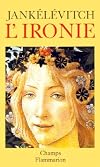
Qu'est-ce que l'ironie ? Quelles en sont les formes ? Quels en sont les pièges aussi? Autant de délicates questions auxquelles l'auteur répond, non sans ironie lui-même, avec l'aide d'une infinité d'exemples qui montrent son immense culture, musicale aussi bien que philosophique. Sommairement, qu'est-ce que l'ironie, sinon la conscience, mais une bonne conscience joyeuse - ce en quoi elle se distingue de l'hypocrisie? Pas d'humour sans amour, ni d'ironie sans joie. L'ironie, en somme, show more sauve ce qui peut être sauvé. Elle est mortelle aux illusions ; partout elle tisse les toiles d'araignée où se prendront les pédants, les vaniteux et les grotesques. 'Ironie, vraie liberté ! ', s'écrie Proudhon au fond de sa cellule de Sainte-Pélagie. L'ironie remet tout en question ; par ses interrogations indiscrètes elle ruine toute définition, dérange à tout moment la pontifiante pédanterie prête à s'installer dans une déduction satisfaite. Grâce à l'ironie, la pensée respire plus légèrement quand elle s'est reconnue, dansante et grinçante, dans le miroir de la réflexion. show less
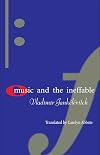
This is a short but thoughtful book in which the argument is stated on the first page—nnamely, that since music works through melodies, rhythms, and harmonies and not through concepts, it contains no messages that can be translated into words. There are 50,000 words devoted to the messages of music—ooften suggestive, poetic, and atmospheric words, but words nevertheless devoted to a subject that no words can capture. The author goes into detail about what music is not: hieroglyphics, show more language, sign system; and he argues that neither does it express emotions. Music is unique in a way that, well, only music can be. I personally can testify that music can elicit emotions and is important to my life, but I know perfectly healthy, intelligent people for whom music is of minimal if any importance. Fortunately, music has been important and vital to many humans over the eons, and this book tries to identify through words what that vitality means.
Vladimir Jankélévitch's book, Music and the Ineffable, delves into the philosophical and musical dimensions of music. In the book, Jankélévitch makes the case that music can produce infinite resonance in a variety of contexts and that it is ineffable, or incapable of being defined. He contends that music does not convey emotions, portray cultures or landscapes, or tell stories. It is also not a language, sign language, or hieroglyph. show less
Vladimir Jankélévitch's book, Music and the Ineffable, delves into the philosophical and musical dimensions of music. In the book, Jankélévitch makes the case that music can produce infinite resonance in a variety of contexts and that it is ineffable, or incapable of being defined. He contends that music does not convey emotions, portray cultures or landscapes, or tell stories. It is also not a language, sign language, or hieroglyph. show less


Lists
el (1)
You May Also Like


Associated Authors
Statistics
- Works
- 66
- Also by
- 1
- Members
- 872
- Popularity
- #29,353
- Rating
- 3.7
- Reviews
- 12
- ISBNs
- 176
- Languages
- 13
- Favorited
- 2

