
Hanan Al-Shaykh
Author of Women of Sand and Myrrh
About the Author
Hanan al-Shaykh was born & raised in Lebanon. She is the author of three novels - "Women of Sand & Myrrh", "The Story of Zahra" & "Beirut Blues" - as well as a collection of short stories, "I Sweep the Sun off Rooftops". She currently lives in London with her husband & two children. (Bowker Author show more Biography) show less
Works by Hanan Al-Shaykh
حكايتي شرح يطول 1 copy
فرس الشيطان 1 copy
A Bird in the Hand 1 copy
Associated Works
The Art of the Story: An International Anthology of Contemporary Short Stories (1999) — Contributor — 394 copies, 5 reviews
Tagged
Common Knowledge
- Canonical name
- Al-Shaykh, Hanan
- Legal name
- Sjaikh, Hanaan as-
- Other names
- حنان الشيخ
- Birthdate
- 1945-11-12
- Gender
- female
- Education
- Almillah primary school
Ahliyyah school
American Girls College, Cairo (1966) - Occupations
- novelist
- Nationality
- Lebanon (birth)
- Birthplace
- Beirut, Lebanon
- Places of residence
- Beirut, Lebanon
Saudi Arabia
London, England, UK
Cairo, Egypt - Associated Place (for map)
- London, England, UK
Members
Reviews

"I wanted to live for myself. I wanted my body to be mine alone. I wanted the place on which I stood and the air surrounding me to be mine and no one else's."
But, she's a woman, so this is unspeakably weird and wicked and ab-so-lute-ly impossible, and not self-understood and normal and not worth mentioning even, as it would be for a man.
Ah, Zahra. Poor downtrodden "flower", flailing about, more passive than any animal, in-between episodes of mindless violent reaction. How hard it is when the show more enemy can't be seen, defined, named, when the enemy is the entire world. Neurosis and mental illness can only be a natural response in those conditions.
She doesn't imagine a better life because even just imagining demands the existence of some pre-conditions of power and choice. In her world there is only one destiny for women, marriage and children. She's not considered desirable and becomes the mistress of the first guy who shows interest. It's a sad affair conducted on a cot in a garage and a remote cafe--he's married and doesn't plan to leave his family for her.
She has an abortion, then pays to "repair" her virginity, then takes up with her lover again--who doesn't even get to enjoy deflowering her again because he knows it's fake--then has a second abortion. And the whole time she not only doesn't enjoy the sex, the man disgusts her.
Off she goes to "Africa" (country unspecified and always just "Africa" in her mind) to spend some time with her uncle, a political exile. Uncle's inappropriate attentions spark another mental crisis in Zahra, who blindly accepts a random dude's marriage proposal, made just minutes after they met.
The marriage is awful and eventually broken. Zahra returns to Beirut, to her parents (where else...)
With the breakout of civil war there's a shift of Zahra's consciousness toward the outside. This doesn't lead anywhere special. She is now lost not just in her own life but the whole city, the country, is lost with her. In the apocalyptic chaos of a city at war with itself, she falls into an affair with a sniper, despite their first encounter being a rape. She thinks maybe this time... she enjoys sex for the first time. She doesn't know what is true or false, not sure even of his name. This goes on for months, then she discovers she's pregnant, although she was taking (or believed she was taking) contraceptive pills. The revelation ends the affair and Zahra's hope that her lover is someone other than what she thought at first, a stone-cold killer. show less
But, she's a woman, so this is unspeakably weird and wicked and ab-so-lute-ly impossible, and not self-understood and normal and not worth mentioning even, as it would be for a man.
Ah, Zahra. Poor downtrodden "flower", flailing about, more passive than any animal, in-between episodes of mindless violent reaction. How hard it is when the show more enemy can't be seen, defined, named, when the enemy is the entire world. Neurosis and mental illness can only be a natural response in those conditions.
She doesn't imagine a better life because even just imagining demands the existence of some pre-conditions of power and choice. In her world there is only one destiny for women, marriage and children. She's not considered desirable and becomes the mistress of the first guy who shows interest. It's a sad affair conducted on a cot in a garage and a remote cafe--he's married and doesn't plan to leave his family for her.
She has an abortion, then pays to "repair" her virginity, then takes up with her lover again--who doesn't even get to enjoy deflowering her again because he knows it's fake--then has a second abortion. And the whole time she not only doesn't enjoy the sex, the man disgusts her.
Off she goes to "Africa" (country unspecified and always just "Africa" in her mind) to spend some time with her uncle, a political exile. Uncle's inappropriate attentions spark another mental crisis in Zahra, who blindly accepts a random dude's marriage proposal, made just minutes after they met.
The marriage is awful and eventually broken. Zahra returns to Beirut, to her parents (where else...)
With the breakout of civil war there's a shift of Zahra's consciousness toward the outside. This doesn't lead anywhere special. She is now lost not just in her own life but the whole city, the country, is lost with her. In the apocalyptic chaos of a city at war with itself, she falls into an affair with a sniper, despite their first encounter being a rape. She thinks maybe this time... she enjoys sex for the first time. She doesn't know what is true or false, not sure even of his name. This goes on for months, then she discovers she's pregnant, although she was taking (or believed she was taking) contraceptive pills. The revelation ends the affair and Zahra's hope that her lover is someone other than what she thought at first, a stone-cold killer. show less

Four linked stories about women living in an unnamed desert country. Shuha is a Lebanese expat, and Suzanne American, whilst Tamr and Nur are both locals, one from a fairly ordinary middle-class background and the other a member of the jet-setting petrolearchy. The traditional restrictions on women’s lives in the country, crudely mapped onto its newly-rich, internationalised lifestyle, affect each of them in different ways. Long experience, guile, money, and shameless confrontation can get show more them around a lot of the barriers to living normal, independent lives, but sooner or later each of them hits a brick wall of misogyny, and their dreams of happiness evaporate. For the expats the solution is to give up and leave, but Tamr and Nur are stuck there, whether they like it or not.
The message seems to be clear: an appeal to tradition, law, or religion is not sufficient to convince women in one place that their needs for self-determination and sexual fulfilment are any less than those of women who happen to live elsewhere in the world. Maintaining otherwise is quite simply cruel, repressive and wasteful of women’s capacity to contribute to society. show less
The message seems to be clear: an appeal to tradition, law, or religion is not sufficient to convince women in one place that their needs for self-determination and sexual fulfilment are any less than those of women who happen to live elsewhere in the world. Maintaining otherwise is quite simply cruel, repressive and wasteful of women’s capacity to contribute to society. show less
The book combines overlapping narratives from different women leading shadowy existences in an unnamed desert Islamic state with complete erasure of women from public life. Profound unease, boredom, sexual mania press on everyone. It's like the whole place is insane.
A scathing, cruel book--but no more cruel than what women are made to endure.
A scathing, cruel book--but no more cruel than what women are made to endure.
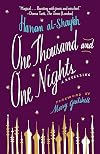
I'd been circling closer and closer to this book for a while. I'd never read any version of One Thousand and One Nights, and given my recent reading interests, it seemed inevitable that I do so, but what translation? Then I heard somewhere that Al-Shaykh, one of my favorite authors, had done a recent interpretation (along with another woman, I believe) for the stage. I was of course excited, but I pretty much detest reading plays, so I hadn't gone looking for it. When I saw this translation show more at the library, I had to check it out immediately.
I had nearly no idea what to expect. Sinbad, Aladdin and his lamps, maybe. Not even The Wrath and The Dawn had really given me much idea of what to expect. At first, there was a lot about this text that I found jarring, largely in the framing story, with its murderous cuckolded kings, whose wives had dallied with strangely racially caricatured slaves. It took me a while to realize that the stories hadn't really been modernized, or sanitized, just translated, and joyously celebrated as the source of so many stories, so much tradition. And the stories seemed deliberately chosen to complicate any ideas of who is the fairer, weaker, more honest, or more lustful sex.
When the stories ended I was sad, not because I disagreed with the way Al-Shaykh somewhat ambiguously concluded them, but just that I wanted more stories, all of the stories, for the book to go on and on.
A wonderful book. show less
I had nearly no idea what to expect. Sinbad, Aladdin and his lamps, maybe. Not even The Wrath and The Dawn had really given me much idea of what to expect. At first, there was a lot about this text that I found jarring, largely in the framing story, with its murderous cuckolded kings, whose wives had dallied with strangely racially caricatured slaves. It took me a while to realize that the stories hadn't really been modernized, or sanitized, just translated, and joyously celebrated as the source of so many stories, so much tradition. And the stories seemed deliberately chosen to complicate any ideas of who is the fairer, weaker, more honest, or more lustful sex.
When the stories ended I was sad, not because I disagreed with the way Al-Shaykh somewhat ambiguously concluded them, but just that I wanted more stories, all of the stories, for the book to go on and on.
A wonderful book. show less
Lists
wish list (1)
Awards


You May Also Like


Associated Authors
Statistics
- Works
- 24
- Also by
- 18
- Members
- 1,986
- Popularity
- #12,948
- Rating
- 3.5
- Reviews
- 48
- ISBNs
- 106
- Languages
- 11
- Favorited
- 3
