
Nancy K. MacLean
Author of Democracy in Chains: The Deep History of the Radical Right's Stealth Plan for America
About the Author
Image credit: Photo courtesy of Nancy MacLean
Works by Nancy K. MacLean
Democracy in Chains: The Deep History of the Radical Right's Stealth Plan for America (2017) 868 copies, 19 reviews
Associated Works
Tagged
Common Knowledge
- Birthdate
- 1959-08-22
- Gender
- female
- Education
- University of Wisconsin-Madison (PhD, History)
Brown University (B.A./M.A., History) - Occupations
- historian
writer
professor - Nationality
- USA
- Places of residence
- North Carolina, USA
- Associated Place (for map)
- North Carolina, USA
Members
Reviews
Democracy in chains : the deep history of the radical right's stealth plan for America by Nancy MacLean
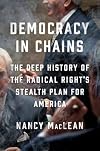
“Democracy in Chains” has received praise from the left and critique from the right. Some have called its journalistic integrity into question.
What is the context that has produced this book and controversy? Trump holds the presidency—an unprecedented failure of the immune system of our federal government. The Koch brothers plan to put $400 million into the 2018 election cycle. They’re so over-the-top that they got a millionaire’s tax pulled off the Massachusetts ballot—even show more though they have nothing to do with Massachusetts. Wealth inequality is at all-time highs in the United States; the United Nations did a study of the US and found 9 million houseless Americans, an embarrassment that will haunt our nation for centuries to come. Egged on by Russia, as well as libertarian funders at home, polarization has brought both the House and the Senate, as well as political discourse at large, to a halt. Belief in climate change peaked in the US somewhere around 2009. So is it any wonder that we’d have people looking to connect the dots?
There are other ways to explain how we’ve ended up here, but it’s not that much of a stretch to posit that James Buchanan, a 1986 winner of the Nobel Prize in Economics, had something to do with it. Buchanan died in 2013, and this book documents his career in a field called public choice theory. Buchanan and the Kochs are both looking to maximize “liberty” and minimize democracy. To some liberal Americans, this might sound striking, but the United States is actually one of the least democratic democracies, and is a great proving grounds for libertarian social policies.
The most memorable quote in the book is from Tyler Cowen, an economist at George Mason University and pop blogger, about the libertarian vision for the liquidation of labor, and the US resembling the tent villages of Rio de Janeiro, where environmental legislation is lax enough to destroy access to potable drinking water.
The last section of this book slows down, but overall it’s riveting. My next area of research: public choice theory. show less
What is the context that has produced this book and controversy? Trump holds the presidency—an unprecedented failure of the immune system of our federal government. The Koch brothers plan to put $400 million into the 2018 election cycle. They’re so over-the-top that they got a millionaire’s tax pulled off the Massachusetts ballot—even show more though they have nothing to do with Massachusetts. Wealth inequality is at all-time highs in the United States; the United Nations did a study of the US and found 9 million houseless Americans, an embarrassment that will haunt our nation for centuries to come. Egged on by Russia, as well as libertarian funders at home, polarization has brought both the House and the Senate, as well as political discourse at large, to a halt. Belief in climate change peaked in the US somewhere around 2009. So is it any wonder that we’d have people looking to connect the dots?
There are other ways to explain how we’ve ended up here, but it’s not that much of a stretch to posit that James Buchanan, a 1986 winner of the Nobel Prize in Economics, had something to do with it. Buchanan died in 2013, and this book documents his career in a field called public choice theory. Buchanan and the Kochs are both looking to maximize “liberty” and minimize democracy. To some liberal Americans, this might sound striking, but the United States is actually one of the least democratic democracies, and is a great proving grounds for libertarian social policies.
The most memorable quote in the book is from Tyler Cowen, an economist at George Mason University and pop blogger, about the libertarian vision for the liquidation of labor, and the US resembling the tent villages of Rio de Janeiro, where environmental legislation is lax enough to destroy access to potable drinking water.
The last section of this book slows down, but overall it’s riveting. My next area of research: public choice theory. show less
Democracy in Chains: The Deep History of the Radical Right's Stealth Plan for America by Nancy MacLean
The fact that this book came under such a fierce political attack by the institutions it critiques should speak to its value. MacLean does a good job winding through the life of Buchanan while always drawing things back to modern day impacts. The only drawback is that unlike Dark Money this one is written with a much clearer moral voice to it, criticizing blatantly undemocratic actions and casting a clear judgment on historical figures. That said, the book is over 50 pages of bibliography show more with many direct quotes, so having read it it's hard to argue she misrepresents anything.
Also the final chapter is really good at tying everything together, specifically with the line "The libertarian cause .... was never really about freedom as most people would define it. It was about the promotion of crippling division among the people so as to end any interference with what those who held vast power over others believe should be their prerogatives" show less
Also the final chapter is really good at tying everything together, specifically with the line "The libertarian cause .... was never really about freedom as most people would define it. It was about the promotion of crippling division among the people so as to end any interference with what those who held vast power over others believe should be their prerogatives" show less
Democracy in Chains: The Deep History of the Radical Right's Stealth Plan for America by Nancy MacLean
Perhaps the most important book I have read in decades. Explains the career and thought of an obscure economist named James McGill Buchanan. He was a libertarian who advocated secretly undermining American democracy in order to achieve his program. These ideas have in more recent decades been promoted and funded by Charles Koch and have great support within the right and the Republican Party today. The book tells us what to expect if these ideas of pure "economic freedom" become ever more show more incorporated into our public policy. Some parts of the book can seem tedious and too detailed concerning Buchanan's career, but it is absolutely essential that as many of us as possible understand the book's message. show less
Democracy in Chains: The Deep History of the Radical Right's Stealth Plan for America by Nancy MacLean
Economists like to portray their profession as a "science," but in truth there is as much or more faith than there is science. The same generally applies to political science as well. When the two mix, as it does in "political economy," then beliefs often seem to take precedence. Maclean, the author, is a historian and the presentation of history is shaped by the author's worldview. That being said, the book does not do what I would expect in presenting public choice economics or economic show more liberty or any rational definition of liberty--either economic, political, individual or social. At the same time, the book makes me extremely uncomfortable--if even 50% of what the author writes is true, then American democracy is at greater risk than I already believe it to be. Libertarianism as portrayed here (and elsewhere) leads to plutocracy, authoritarianism, and anarchy--I tend to agree. For the record, I'm fiercely independent politically, although I lean left of center--I believe there is more to be gained through collaboration and cooperation than through "great men" with money and/or charisma. I also tend to be skeptical of conspiracy theories in general--although I found the discussion in the chapter on Chile under Pinochet compelling. show less
Lists
Awards


You May Also Like


Associated Authors
Statistics
- Works
- 4
- Also by
- 1
- Members
- 1,132
- Popularity
- #22,674
- Rating
- 4.2
- Reviews
- 19
- ISBNs
- 23
- Languages
- 2