

Bruce J. Malina
Author of The New Testament World: Insights from Cultural Anthropology
About the Author
Bruce J. Malina is Professor of New Testament at Creighton University, Omaha, and author, coauthor, or editor of many influential volumes in New Testament.
Series
Works by Bruce J. Malina
Christian Origins and Cultural Anthropology: Practical Models for Biblical Interpretation (1986) 45 copies
Timothy: Paul's Closest Associate (Paul's Social Network-Brothers and Sisters in Faith series) (2008) 19 copies
Semeia 67: Transformations, Passages, and Processes: Ritual Approaches to Biblical Texts (1994) — Editor — 18 copies
The New Jerusalem in the Revelation of John: The City as Symbol of Life with God (Zaccheus Studies New Testament) (2000) 17 copies, 1 review
Associated Works
Tagged
Common Knowledge
- Legal name
- Malina, Bruce John
- Birthdate
- 1933-10-09
- Gender
- male
- Education
- St. Francis College, Burlington, Wisconsin (BA | 1956)
St. Anthony University, Rome, Italy (MA | 1964)
Pontifical Biblical Institute, Rome, Italy (MA | 1966)
Franciscan Institute for Biblical Research, Jerusalem, Israel (PhD | 1968) - Organizations
- Catholic Biblical Association
Society of Biblical Literature - Nationality
- USA
- Birthplace
- Brooklyn, New York, USA
- Places of residence
- Omaha, Nebraska, USA
- Associated Place (for map)
- USA
Members
Reviews
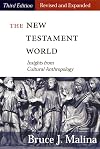
Imagine you are given some religious literature from an Aboriginal tribe in Australia. You read them, enjoying the beautiful poetry and transcendent meaning. You rest content that you understand them quite well. This may seem ridiculous, but Bruce Malina points out that this is what many people do with the New Testament. We read it little understanding that first-century Mediterranean culture is quite different from 21st-century American culture. In fact, when reading the NT, we are in show more effect thrown into a foreign country. Malina familiarizes readers with the values and social ontology of the Jesus' times.
Malina characterizes NT society as a collectivist, nonintrospective, stable society in which the social ontology is permeated with concepts of honor vs. shame and clean vs. unclean. People see themselves not as individuals (a la America) but as a part of a group, usually family. As such introspective accounts of someone's psychology are not important. The NT has very little of this type of description that modern Western culture thrives on.
NT society is kept stable by a system of social checks and balances. In America, there is a common belief that prosperity is possible for everyone. If we just redistribute goods better, everyone can be middle-class or above. Not so in the NT world. There the assumption is that all goods are limited. Any gain is at the expense of others in your similar social group or class. Hence envy is a powerful threat. Attracting the envy of others is dangerous, as they may do anything from gossiping about you to killing you. (The Jewish authorities' envy of Jesus is given as their motivation for crucifying him.) One form of envy is in the evil eye, which your enemy can give you as a curse. Certain amulets and spells could protect against the evil eye.
Malina sheds light on various NT passages and stories. For example, when Jesus uses the phrase, "Truly, I say to you..." he is not just emphasizing how true his saying is. It's more like "I swear on my honor, this is true..." Fear of others' envy and anger at his rising above the social status he was born into also explains both the messianic secret in Mark and Jesus' complaints that a prophet is never accepted in his homeland. Little asides like this make the book come together.
When I took Old Testament as Literature, my professor one day went on this rant about how the Israelites loved their wives. Malina points out that marriages in these times were arranged, and how a wife was basically a stranger in her husband's family's home until she bore a son. Her son was her main advocate in family affairs, not her husband, who advocated his mother. Hopefully Malina's research reaches a more popular audience so we can avoid these anachronisms. Highly recommended.
Rating 5/5 show less
Malina characterizes NT society as a collectivist, nonintrospective, stable society in which the social ontology is permeated with concepts of honor vs. shame and clean vs. unclean. People see themselves not as individuals (a la America) but as a part of a group, usually family. As such introspective accounts of someone's psychology are not important. The NT has very little of this type of description that modern Western culture thrives on.
NT society is kept stable by a system of social checks and balances. In America, there is a common belief that prosperity is possible for everyone. If we just redistribute goods better, everyone can be middle-class or above. Not so in the NT world. There the assumption is that all goods are limited. Any gain is at the expense of others in your similar social group or class. Hence envy is a powerful threat. Attracting the envy of others is dangerous, as they may do anything from gossiping about you to killing you. (The Jewish authorities' envy of Jesus is given as their motivation for crucifying him.) One form of envy is in the evil eye, which your enemy can give you as a curse. Certain amulets and spells could protect against the evil eye.
Malina sheds light on various NT passages and stories. For example, when Jesus uses the phrase, "Truly, I say to you..." he is not just emphasizing how true his saying is. It's more like "I swear on my honor, this is true..." Fear of others' envy and anger at his rising above the social status he was born into also explains both the messianic secret in Mark and Jesus' complaints that a prophet is never accepted in his homeland. Little asides like this make the book come together.
When I took Old Testament as Literature, my professor one day went on this rant about how the Israelites loved their wives. Malina points out that marriages in these times were arranged, and how a wife was basically a stranger in her husband's family's home until she bore a son. Her son was her main advocate in family affairs, not her husband, who advocated his mother. Hopefully Malina's research reaches a more popular audience so we can avoid these anachronisms. Highly recommended.
Rating 5/5 show less
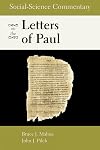
This is a very interesting commentary which provides a useful additional perspective over more conventional commentaries. However it is rather in the habit of presenting scholarly opinion about the historical background as if it were undisputed fact., While this may be partly down to the format the more frequent uses of phrases such as 'it is widely agreed' or 'latest scholarship suggests' would be welcome.
The New Jerusalem in the Revelation of John: The City as Symbol of Life with God (Zaccheus Studies New Testament) by Bruce J. Malina
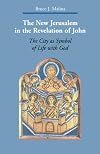
Bruce Malina takes a social-scientific approach to Revelation, here focusing on the astrological symbolism in chapters 21-22. Although this little book will probably strike mot readers as somewhat quirky, it offers some interesting insights into the symbolism of the New Jerusalem.
You May Also Like


Associated Authors
Statistics
- Works
- 24
- Also by
- 7
- Members
- 1,761
- Popularity
- #14,615
- Rating
- 3.8
- Reviews
- 6
- ISBNs
- 48
- Languages
- 4
- Favorited
- 1