

William Gurstelle
Author of Backyard Ballistics
About the Author
William Gurstelle is a professional engineer who has been building model catapults and ballistic devices for more than 30 years. He is also a contributing editor at Popular Science, a columnist for Make magazine, and a frequent contributor to the Atlantic, Maxim, Wired, and other national magazines.
Works by William Gurstelle
The art of the catapult : build Greek ballistae, Roman onagers, English trebuchts, and more ancient artillery (2004) 552 copies, 3 reviews
Absinthe & Flamethrowers: Projects and Ruminations on the Art of Living Dangerously (2009) 198 copies, 2 reviews
Adventures from the Technology Underground: Catapults, Pulsejets, Rail Guns, Flamethrowers, Tesla Coils, Air Cannons, and the Garage Warriors Who Love Them (2006) 141 copies, 3 reviews
Defending Your Castle: Build Catapults, Crossbows, Moats, Bulletproof Shields, and More Defensive Devices to Fend Off the Invading Hordes (2014) 86 copies
The Practical Pyromaniac: Build Fire Tornadoes, One-Candlepower Engines, Great Balls of Fire, and More Incendiary Devices (2011) 82 copies, 2 reviews
Tagged
Common Knowledge
- Birthdate
- 1956-03-29
- Gender
- male
- Short biography
- Named to Wired Magazine’s Smart List, William Gurstelle is a bestselling author, DIY expert, and professional speaker. The author of Backyard Ballistics, Absinthe and Flamethrowers, and seven other books, he is recognized for his particular talent for making science and technology accessible, intriguing, and – most of all – fun to all readers and audiences. Having sold more nearly half a million books, he is one of the world’s most widely read authors on science and technology.
The co-producer of the Emmy nominated PBS television show Make: Television, William also has a recurring on-air role in the series. In addition, he is a letterhead-listed contributing editor for Popular Mechanics and Make Magazine and is a frequent contributor to Wired.
He has been heard on NPR’s Science Friday, Weekend Edition with Scott Simon, and has made numerous appearances on History Channel, Discovery Channel, Tech TV, and CNN.
William and his books have been profiled in The New York Times, The Wall Street Journal, The London Daily Telegraph, Popular Mechanics, USA Today, and scores of other newspapers and magazines.
http://www.williamgurstelle.com/about... - Nationality
- USA
- Associated Place (for map)
- USA
Members
Reviews
Adventures from the Technology Underground: Catapults, Pulsejets, Rail Guns, Flamethrowers, Tesla Coils, Air Cannons, and the Garage Warriors Who Love Them by William Gurstelle
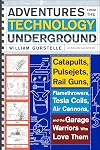
The full title of Gurstelle's book is: Adventures from the Technology Underground: Catapults, Pulsejets, Rail Guns, Flamethrowers, Tesla Coils, Air Cannons, and the Garage Warriors Who Love Them. That pretty much explains what it's about. We're talking about regular people who like to make or invent some interesting devices. After living with a design engineer for many, many years, I have an understanding about the fascination certain people may have in building some of these things in their show more garage (and he may or may not have built a few of these devices over the years, but I'm not telling.)
Chapters included are: High Powered Rockets, The Technology of Burning Man, Tesla Coils, High-Voltage Discharge Machines, Hurling Machines, Air Guns, Flamethrowers, Electrostatic Machines, Rail and Coil Guns, and Robots. The book includes separate sections with more technological detail on particular devices. Gurstelle suggests that you can read the sections if you are interested in more technical detail, but a casual reader can skip them. The sections are interesting, easy to understand (at least they were for this amateur), and include illustrations.
You need to know that this book is an introduction to the various catapults, aircannons, flamethrowers, etc., not a detailed set of schematics on how to build your own and what materials you'll need. There are notes and a further reading section if you really need to explore making your own "Punkin Chunk" air cannon or a personal Tesla coil. (Really, if you are expecting detailed instructions in a 224 page book that covers a wide range of projects, then you need to rethink that position.)
Gurstelle had five conditions that had to be met for inclusion in the book. Projects had to be founded upon physical science, the inventors had to have amateur standing, there are elements of danger involved, every project is high energy, the projects are recognized by others (pg 11-13).
With shows like Junkyard Wars, BattleBots, and Monster Garage, the whole idea of building something fantastic out of, well, junk or parts, is a concept many people can understand. Be forewarned, however, that this is not a book for the young scientist in your family - well, it might be with the exception of a certain section on, shall we say, "male enhancement," that might not be considered appropriate.
Very Highly Recommended - and I really want to see the quarter shrinking device. Really.
http://shetreadssoftly.blogspot.com/ show less
Chapters included are: High Powered Rockets, The Technology of Burning Man, Tesla Coils, High-Voltage Discharge Machines, Hurling Machines, Air Guns, Flamethrowers, Electrostatic Machines, Rail and Coil Guns, and Robots. The book includes separate sections with more technological detail on particular devices. Gurstelle suggests that you can read the sections if you are interested in more technical detail, but a casual reader can skip them. The sections are interesting, easy to understand (at least they were for this amateur), and include illustrations.
You need to know that this book is an introduction to the various catapults, aircannons, flamethrowers, etc., not a detailed set of schematics on how to build your own and what materials you'll need. There are notes and a further reading section if you really need to explore making your own "Punkin Chunk" air cannon or a personal Tesla coil. (Really, if you are expecting detailed instructions in a 224 page book that covers a wide range of projects, then you need to rethink that position.)
Gurstelle had five conditions that had to be met for inclusion in the book. Projects had to be founded upon physical science, the inventors had to have amateur standing, there are elements of danger involved, every project is high energy, the projects are recognized by others (pg 11-13).
With shows like Junkyard Wars, BattleBots, and Monster Garage, the whole idea of building something fantastic out of, well, junk or parts, is a concept many people can understand. Be forewarned, however, that this is not a book for the young scientist in your family - well, it might be with the exception of a certain section on, shall we say, "male enhancement," that might not be considered appropriate.
Very Highly Recommended - and I really want to see the quarter shrinking device. Really.
http://shetreadssoftly.blogspot.com/ show less
Backyard Ballistics: Build Potato Cannons, Paper Match Rockets, Cincinnati Fire Kites, Tennis Ball Mortars and More Dynamite Devices by William Gurstelle
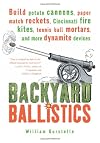
This book is not politically correct, in an era in which school science experiments have been tamed to the point that there is little possibility that the teacher will kill or maim him/herself. William Gurstelle, an engineer who has been collecting plans for devices that will throw stuff fast and far, is careful to emphasize the hazards implicit in shooting potatoes or water balloons the length of a football field, or launching flaming newspaper (Cincinnati fire kite) into the sky. show more Youngsters would need lots of adult supervision when making or using these devices, but any budding engineer would thrill to see them in action. show less
Backyard ballistics : build potato cannons, paper match rockets, Cincinnati fire kites, tennis ball mortars, and more dynamite devices by William Gurstelle
A manual that shows how to make fun shooting and flammable things such as a potato cannon, a paper match rocket and a Cincinnati fire kite. Far beyond the ballistic fun to be had are the opportunities to explore physics through the scientific method. The author explains the science behind each project and provides further thought for study. Includes sidebar stories about relevant scientists and emphasis on safety.
The Art of the Catapult: Build Greek Ballistae, Roman Onagers, English Trebuchets and More Ancient Artillery by William Gurstelle
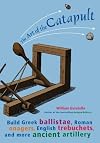
He also wrote "Building Bots: Designing and Building Warrior Robots", but I haven't read that one. "Catapult" is definitely in the spirit of "build it yourself", that I like to encourage here and also in "The Cost-Effective Teacher" feature in the print Journal. Gurstelle is an engineer, and he brings an engineer's perspective to the book. As in "Backyard Ballistics, he provides the colorful of the machines that he describes, but he also tells the reader how to tie the necessary knots and show more how to work with PVC pipe, which is used for some of them. Both of these skills can be useful in other contexts, of course. Projects like these have become very popular in physics classes, partly as a consequence of the excellent Nova program on ancient artillery. These would be excellent father-son-or-daughter activities but youngsters and (especially) exuberant teenagers need adult supervision when these things fire tennis balls or water balloons. They can cause damage or injury. [Isn't that part of the fun?] Chapter 1 is on safety, but cautions are also sprinkled as necessary through the descriptions of the construction and operation of ten different machine models. Part of Chapter 7 shows how to make your own rope, in a manner similar to that used by our clever ancestors. show less
You May Also Like


Associated Authors
Statistics
- Works
- 15
- Members
- 2,244
- Popularity
- #11,431
- Rating
- 3.8
- Reviews
- 19
- ISBNs
- 61
- Languages
- 2
