
Jack McDevitt
Author of The Engines of God
About the Author
Jack McDevitt (born 1935) is an American science fiction author whose novels frequently deal with attempts to make contact with alien races, and with archaeology or xenoarchaeology. He attended La Salle University, where a short story of his won the annual Freshman Short Story Contest and was show more published in the school's literary magazine, Four Quarters. He received a Master's degree in literature from Wesleyan University in 1971. Before becoming a full-time author, he was an English teacher, naval officer, Philadelphia taxi driver, customs officer and motivational trainer. His first published story was The Emerson Effect in The Twilight Zone Magazine in 1981. Two years later, he published his first novel, The Hercules Text, which won the Philip K. Dick Special Award. He won the 2006 Nebula Award for Best Novel for Seeker, the UPC International Prize for his novella Ships in the Night in 1991, and the John W. Campbell Memorial Award for best SF novel for Omega in 2003. (Bowker Author Biography) show less
Image credit: Jack McDevitt (by Vadaro, 2010)
Series
Works by Jack McDevitt
Henry James, This One's For You 11 copies
Cryptic [short story] 7 copies
Asimov's Science Fiction: Vol. 46, No. 3 & 4 [March/April 2022] (2022) — Contributor — 6 copies, 2 reviews
Asimov's Science Fiction: Vol. 45, No. 11 & 12 [November/December 2021] (2021) — Contributor — 5 copies
Promises to Keep 5 copies
The Far Shore 4 copies
The Candidate 4 copies
Time's Arrow 3 copies
Act of God 3 copies
Nothing Ever Happens In Rock City 3 copies
The Cat’s Pajamas 3 copies
Good Intentions 3 copies
Codice Hercules 3 copies
Lake Agassiz {short story} 2 copies
Black To Move 2 copies
Happy Birthday — Author — 2 copies
Kaminsky At War 2 copies
Deus Tex 2 copies
Windows 2 copies
The Tomb 2 copies
Melville On Iapetus 2 copies
Report From The Rear 2 copies
Indomitable 2 copies
Last Contact 2 copies
Tweak 2 copies
Never Despair 2 copies
Cruising Through Deuteronomy 2 copies
Ellie 2 copies
Dead In The Water 2 copies
Ajarändurid ei sure iial 1 copy
Collected Short Fiction 1 copy
Deepsix 1 copy
Variables 1 copy
Glory Days 1 copy
Blinker 1 copy
Midnight Clear 1 copy
Oculus 1 copy
Windrider 1 copy
The Hercules Test 1 copy
Tidal Effects 1 copy
Molly's Kids 1 copy
Valkyrie 1 copy
Enjoy the Moment 1 copy
Listen Up Nitwits 1 copy
Gus 1 copy
Waiting At The Altar 1 copy
Sunrise 1 copy
The Mission 1 copy
The Eagle Project 1 copy
Dutchman 1 copy
Riding with the Duke (short) 1 copy
Cosmic Harmony 1 copy
Ignition 1 copy
In The Tower 1 copy
The Last Dance 1 copy
Whistle 1 copy
Seeker [Excerpt] 1 copy
The Gold Signal 1 copy
Knock Knock [short story] — Author — 1 copy
Strange Pulp. May 2012 1 copy
Associated Works
Future Visions: Original Science Fiction Inspired by Microsoft (2015) — Contributor — 259 copies, 5 reviews
The Year's Best Science Fiction: First Annual Collection (1984) — Contributor — 147 copies, 1 review
Carbide Tipped Pens: Seventeen Tales of Hard Science Fiction (2016) — Contributor — 108 copies, 6 reviews
Time Machines: The Greatest Time Travel Stories Ever Written (1998) — Contributor — 82 copies, 5 reviews
Nebula Awards 24: SFWA's Choices for the Best Science Fiction and Fantasy 1988 (1990) — Contributor — 61 copies
A Cross of Centuries: Twenty-five Imaginative Tales About the Christ (2007) — Contributor — 31 copies, 2 reviews
Asimov's Science Fiction: Vol. 41, No. 11 & 12 [November/December 2017] (2017) — Contributor — 22 copies, 3 reviews
Analog Science Fiction and Fact: Vol. CXXII, No. 7 & 8 (July/August 2002) (2002) — Contributor — 14 copies, 1 review
Isaac Asimov's Science Fiction Magazine: Vol. 13, No. 12 [December 1989] (1989) — Author — 14 copies
Isaac Asimov's Science Fiction Magazine: Vol. 7, No. 11 [November 1983] (1983) — Contributor — 13 copies
The Loch Moose Monster: More Stories From Isaac Asimov's Science Fiction Magazine (1993) — Contributor — 13 copies
Isaac Asimov's Science Fiction Magazine: Vol. 7, No. 4 [April 1983] (1983) — Contributor — 13 copies
Isaac Asimov's Science Fiction Magazine: Vol. 8, No. 12 [December 1984] (1984) — Contributor — 12 copies
Isaac Asimov's Science Fiction Magazine: Vol. 11, No. 12 [December 1987] (1987) — Contributor — 12 copies
Isaac Asimov's Science Fiction Magazine: Vol. 10, No. 11 [November 1986] (1986) — Author — 11 copies
Starshipsofa Stories Vol 3 — Contributor — 4 copies
Asimov's Science Fiction: Vol. 44, No. 11 & 12 [November/December 2020] (2020) — Contributor — 3 copies
Aboriginal Science Fiction No. 55 & 56 Spring 1998 — Contributor — 1 copy
Tagged
Common Knowledge
- Legal name
- McDevitt, John Charles
- Birthdate
- 1935-04-14
- Gender
- male
- Education
- La Salle University
Wesleyan University - Occupations
- English teacher
naval officer
taxi driver
customs officer
motivational trainer
science fiction writer - Organizations
- Science Fiction and Fantasy Writers of America
- Nationality
- USA
- Birthplace
- Philadelphia, Pennsylvania, USA
- Places of residence
- Brunswick, Georgia, USA
Philadelphia, Pennsylvania, USA - Associated Place (for map)
- USA
Members
Discussions
Found: SF: First Contact story in Name that Book (December 2023)
Reviews
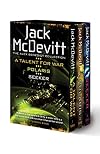
A Talent for War
Actually a reread. Between 1998 and 2015, McDevitt appeared on the Nebula Award shortlist pretty much every year. Clearly, there was something going on, because his books are at best merely okay. A Talent for War is the first book of the Alex Benedict series, and is set in the 116th century - not that you would know it: there is FTL and earthlike planets and AI and holograms, but every planet is pretty much the same, with some sort of vaguely twentieth-century US culture. In show more fact, take away the spaceships and the novel isn’t even science fiction. Benedict’s uncle dies in a liner disaster, and Benedict discovers he’d been investigating the last days of the war with the alien Ashiyyur. A small fleet of frigates, led by Christopher Sim, a history teacher and self-styled military leader, fight an unexpectedly successful series of battles against the aliens, which eventually brings other more powerful worlds into the war, and ultimately leads to the creation of the Confederacy. Benedict’s uncle had been looking into the myths surrounding Sim, and it soon transpires there are people who don’t want the truth to come out. A Talent for War is a fast read, and the mystery part of it is quite well done… but the world-building is meagre and unconvincing. Sim sees himself as some latter-day Spartan and there are numerous references to Hellenic Greece. Yet we’re supposed to believe that 9,500 years from now they have better documentation about Thermopylae than they do about their war 200 years earlier. McDevitt has written a further 8 Alex Benedict novels, the latest published last year. Some of them might be actual sf.
Polaris
One question I frequently ask myself when reading a book is, why the fuck did I read (or reread) this book? If it’s a book by an author unknown to me, then perhaps I have an excuse. But a reread of a novel I know to be not very good, or even actively bad? The only possible answer is: I am an idiot. When it comes to books, and books only, I hasten to add. (Well, maybe not just books.)
Anyway. Polaris is the second book in McDevitt’s series about far-future treasure hunter Alex Benedict, published fifteen years after the first book, and which is set in a human federation 9,600 years from now which somehow culturally resembles late twentieth-century USA. There’s a few sf tropes and macguffins in there, but everything else is more than familiar to a US sf reader of the 1990s and early 2000s.
The title refers to a ship which did a Marie Celeste some sixty years earlier. It carried seven famous passengers to the death of a star, and was found empty shortly after transmitting it was returning home. No one has ever solved the mystery.
Unlike the first book in the series, A Talent for War, Polaris is narrated by Benedict’s pilot and employee, Chase Kolpath. Benedict develops an interest in the Polaris mystery, and then shortly afterwards an exhibition of Polaris artefacts is bombed. The bombing is ostensibly a political assassination attempt, but Benedict suspects otherwise and begins digging deeper…
The solution to the mystery is, sadly, somewhat ordinary, and the real strangeness in the plot - the Polaris passengers faked their own deaths because they'd taken an immortality treatment, and have been conspiring behind the scenes ever since - is handled more or less in passing. Most of the plot covers the conspirators' attempts to prevent Benedict from discovering the truth, and some of the events are, I think, a great deal like events in A Talent for War (wasn't there a forced landing of a flying car into the sea in A Talent for War, as well?)
The world-building is just as sketchy as in the preceding novel, with a whole catalogue of sf tropes badly welded onto an essentially West Coast US society / monoculture. Cars fly, but remote towns can still be cut off by storm damage. The only real change from A Talent for War is that, thanks to a new starship drive discovered in that novel, interstellar travel in Polaris is more like twentieth-century air travel than sea travel.
These books are easy reads, and I suspect I’ll continue with them, but I can’t recommend them. Even the mysteries which drive their plots are feeble. Perhaps that will improve; I have no expectation the world-building will improve. In truth, the only interesting thing about these novels is that McDevitt managed to logroll his way onto the Nebula Award shortlist with them for a decade or more.
Seeker
Seeker is the final volume in the Alex Benedict omnibus I bought while it was on offer, and I still haven’t decided yet if I’m going to read further in the series. Because… they’re really bad, they’re terrible science fiction, but… they’re easy reads, you can polish one off in an afternoon, and there’s a certain fascination in seeing how poorly McDevitt builds his future federation. How the fuck this novel won the Nebula Award in 2006 is a mystery up there with, well, the commercial success of Oasis.
These stories are set nearly 10,000 years in the future, but you would never guess it. Houses have AIs, people travel between planets, cars fly, and, er, there’s probably a few other gizmos mentioned. But in terms of culture and society, McDevitt’s future resembles early twenty-first century USA - there are no characters, for example, with names that might seem out of place in present-day Los Angeles or New York. Having said that, there’s a single mention of “dark skin”, and even a paragraph on that old white sf bullshit by old white sf writers where all the races have interbred until everyone has “olive skin”. Homo sapiens has been around for over 100,000 years and we still have races. That’s not going to change in 10,000 years, even if McDevitt doesn’t like putting non-white people in his novels.
McDevitt mentions the Bataan Death March (I’ve met a survivor of this, by the way), and I still find it really bad craft where things that would be known to a late twentieth-century person are known to a twelfth-millennium person, but they know very little of the one hundred centuries in between, or even of events that happened a decade or so earlier.
The plot of Seeker - and I’m wondering if McDevitt borrowed the structure of his novels from Clive Cussler; certainly the conceit that they’re written by narrator Chase Kolpath, Alex Benedict’s pilot and assistant, is taken from Sherlock Holmes… An opening prologue describes a man trapped in a hotel after an avalanche - something else not solved after 10,000 years - and lamenting he never got to reveal the shocking discovery he and his wife had made.
Cut to the novel’s present, thirty-some years later. A woman - apparently they also have trailer trash 10,000 years in the future - offers Benedict an antique cup for sale. It proves to have come from the Seeker, a ship which disappeared in the 26th century after delivering a group of political dissidents to a colony world. The location of the world was never revealed, and the colony has been lost ever since. And become legend.
Of course, Benedict finds the ship. And the colony. As he and Kolpath investigate, Kolpath is assaulted by a man with a history of violent assaults on women - apparently not solved after 10,000 years - and then Benedict and Kolpath narrowly escape death when a shuttle they had planned to fly on is blown up by a bomb, killing all the passengers - something else not solved 10,000 years in the future.
I’m pretty sure you could rewrite Seeker and set it at the turn of the millennium. A lost historical colony somewhere in the Pacific, perhaps. A lost ship. Abandoned ships like the Marie Celeste were pretty common during the Age of Sail. Cussler has probably already written such a novel (his Iceberg involves a lost ship mysteriously re-appearing, for example). It would be difficult to hide in the opening years of the twenty-first century the survival of a colony lost for hundreds of years, but I’m sure a creative author could figure something out. Such an author would not be Jack McDevitt. show less
Actually a reread. Between 1998 and 2015, McDevitt appeared on the Nebula Award shortlist pretty much every year. Clearly, there was something going on, because his books are at best merely okay. A Talent for War is the first book of the Alex Benedict series, and is set in the 116th century - not that you would know it: there is FTL and earthlike planets and AI and holograms, but every planet is pretty much the same, with some sort of vaguely twentieth-century US culture. In show more fact, take away the spaceships and the novel isn’t even science fiction. Benedict’s uncle dies in a liner disaster, and Benedict discovers he’d been investigating the last days of the war with the alien Ashiyyur. A small fleet of frigates, led by Christopher Sim, a history teacher and self-styled military leader, fight an unexpectedly successful series of battles against the aliens, which eventually brings other more powerful worlds into the war, and ultimately leads to the creation of the Confederacy. Benedict’s uncle had been looking into the myths surrounding Sim, and it soon transpires there are people who don’t want the truth to come out. A Talent for War is a fast read, and the mystery part of it is quite well done… but the world-building is meagre and unconvincing. Sim sees himself as some latter-day Spartan and there are numerous references to Hellenic Greece. Yet we’re supposed to believe that 9,500 years from now they have better documentation about Thermopylae than they do about their war 200 years earlier. McDevitt has written a further 8 Alex Benedict novels, the latest published last year. Some of them might be actual sf.
Polaris
One question I frequently ask myself when reading a book is, why the fuck did I read (or reread) this book? If it’s a book by an author unknown to me, then perhaps I have an excuse. But a reread of a novel I know to be not very good, or even actively bad? The only possible answer is: I am an idiot. When it comes to books, and books only, I hasten to add. (Well, maybe not just books.)
Anyway. Polaris is the second book in McDevitt’s series about far-future treasure hunter Alex Benedict, published fifteen years after the first book, and which is set in a human federation 9,600 years from now which somehow culturally resembles late twentieth-century USA. There’s a few sf tropes and macguffins in there, but everything else is more than familiar to a US sf reader of the 1990s and early 2000s.
The title refers to a ship which did a Marie Celeste some sixty years earlier. It carried seven famous passengers to the death of a star, and was found empty shortly after transmitting it was returning home. No one has ever solved the mystery.
Unlike the first book in the series, A Talent for War, Polaris is narrated by Benedict’s pilot and employee, Chase Kolpath. Benedict develops an interest in the Polaris mystery, and then shortly afterwards an exhibition of Polaris artefacts is bombed. The bombing is ostensibly a political assassination attempt, but Benedict suspects otherwise and begins digging deeper…
The solution to the mystery is, sadly, somewhat ordinary, and the real strangeness in the plot - the Polaris passengers faked their own deaths because they'd taken an immortality treatment, and have been conspiring behind the scenes ever since - is handled more or less in passing. Most of the plot covers the conspirators' attempts to prevent Benedict from discovering the truth, and some of the events are, I think, a great deal like events in A Talent for War (wasn't there a forced landing of a flying car into the sea in A Talent for War, as well?)
The world-building is just as sketchy as in the preceding novel, with a whole catalogue of sf tropes badly welded onto an essentially West Coast US society / monoculture. Cars fly, but remote towns can still be cut off by storm damage. The only real change from A Talent for War is that, thanks to a new starship drive discovered in that novel, interstellar travel in Polaris is more like twentieth-century air travel than sea travel.
These books are easy reads, and I suspect I’ll continue with them, but I can’t recommend them. Even the mysteries which drive their plots are feeble. Perhaps that will improve; I have no expectation the world-building will improve. In truth, the only interesting thing about these novels is that McDevitt managed to logroll his way onto the Nebula Award shortlist with them for a decade or more.
Seeker
Seeker is the final volume in the Alex Benedict omnibus I bought while it was on offer, and I still haven’t decided yet if I’m going to read further in the series. Because… they’re really bad, they’re terrible science fiction, but… they’re easy reads, you can polish one off in an afternoon, and there’s a certain fascination in seeing how poorly McDevitt builds his future federation. How the fuck this novel won the Nebula Award in 2006 is a mystery up there with, well, the commercial success of Oasis.
These stories are set nearly 10,000 years in the future, but you would never guess it. Houses have AIs, people travel between planets, cars fly, and, er, there’s probably a few other gizmos mentioned. But in terms of culture and society, McDevitt’s future resembles early twenty-first century USA - there are no characters, for example, with names that might seem out of place in present-day Los Angeles or New York. Having said that, there’s a single mention of “dark skin”, and even a paragraph on that old white sf bullshit by old white sf writers where all the races have interbred until everyone has “olive skin”. Homo sapiens has been around for over 100,000 years and we still have races. That’s not going to change in 10,000 years, even if McDevitt doesn’t like putting non-white people in his novels.
McDevitt mentions the Bataan Death March (I’ve met a survivor of this, by the way), and I still find it really bad craft where things that would be known to a late twentieth-century person are known to a twelfth-millennium person, but they know very little of the one hundred centuries in between, or even of events that happened a decade or so earlier.
The plot of Seeker - and I’m wondering if McDevitt borrowed the structure of his novels from Clive Cussler; certainly the conceit that they’re written by narrator Chase Kolpath, Alex Benedict’s pilot and assistant, is taken from Sherlock Holmes… An opening prologue describes a man trapped in a hotel after an avalanche - something else not solved after 10,000 years - and lamenting he never got to reveal the shocking discovery he and his wife had made.
Cut to the novel’s present, thirty-some years later. A woman - apparently they also have trailer trash 10,000 years in the future - offers Benedict an antique cup for sale. It proves to have come from the Seeker, a ship which disappeared in the 26th century after delivering a group of political dissidents to a colony world. The location of the world was never revealed, and the colony has been lost ever since. And become legend.
Of course, Benedict finds the ship. And the colony. As he and Kolpath investigate, Kolpath is assaulted by a man with a history of violent assaults on women - apparently not solved after 10,000 years - and then Benedict and Kolpath narrowly escape death when a shuttle they had planned to fly on is blown up by a bomb, killing all the passengers - something else not solved 10,000 years in the future.
I’m pretty sure you could rewrite Seeker and set it at the turn of the millennium. A lost historical colony somewhere in the Pacific, perhaps. A lost ship. Abandoned ships like the Marie Celeste were pretty common during the Age of Sail. Cussler has probably already written such a novel (his Iceberg involves a lost ship mysteriously re-appearing, for example). It would be difficult to hide in the opening years of the twenty-first century the survival of a colony lost for hundreds of years, but I’m sure a creative author could figure something out. Such an author would not be Jack McDevitt. show less

When you are turning the soil on your farm you expect to find rocks. Or some trash. What you do not expect is a yacht - complete with sails and rigging. And when the yacht leads to more artifact, everyone in the country start wondering what all that is - especially when it turns out that the boat is made from an element that cannot exist.
McDevitt constructs the novel around these discoveries - with the whole paranoia and craziness that it entails - all happening on a Native American land show more does not help matters much. The scientists have their own ideas of how to handle things but politics and economy get into the picture. That's a part of the story that SF authors do not cover that often - the story of how we discover things is always fascinating but what happens to humanity at the background is even more fascinating.
McDevitt chooses an interesting way to show us what is happening - introducing characters for a page or so and never mentioning them again; using newspapers' and books and TV segments to show what happens outside of the story. And all that adds up to a background that allows you to see what is really happening.
I am not sure how much I liked the end - it felt almost like deus ex machina - it was an interesting way to wrap things up but I wish that things were actually resolved inside of the novel, with everyone involved.
The novel blends a lot of social issues - from private property and race relationships to religion and beliefs (and both things are not the same thing). And under the whole story is another one - about responsibility and trust and who has the right to make decisions about something that influences humanity. show less
McDevitt constructs the novel around these discoveries - with the whole paranoia and craziness that it entails - all happening on a Native American land show more does not help matters much. The scientists have their own ideas of how to handle things but politics and economy get into the picture. That's a part of the story that SF authors do not cover that often - the story of how we discover things is always fascinating but what happens to humanity at the background is even more fascinating.
McDevitt chooses an interesting way to show us what is happening - introducing characters for a page or so and never mentioning them again; using newspapers' and books and TV segments to show what happens outside of the story. And all that adds up to a background that allows you to see what is really happening.
I am not sure how much I liked the end - it felt almost like deus ex machina - it was an interesting way to wrap things up but I wish that things were actually resolved inside of the novel, with everyone involved.
The novel blends a lot of social issues - from private property and race relationships to religion and beliefs (and both things are not the same thing). And under the whole story is another one - about responsibility and trust and who has the right to make decisions about something that influences humanity. show less

Maleiva III is one very unlucky planet - another world, Morgan's World, ejected from its own star system a long time ago is on a collision course with it - and due to the sizes of the two planets, Maleiva III is about to be annihilated while the much bigger gas giant will just pass and continue on its part, grabbing some dust along the line.
Of course the problems on this planet did not start with Morgan. Three thousand years earlier, the whole star system ended up inside of a dust field show more which caused the previously Earth-like planet to enter a severe Ice Age. Had it not been for the disaster about to hit it, it would have exited the dust a few hundred years in the future, making it possible for humanity to terraform it. As it is, the Academy dispatches a team to look for signs of civilization - just to lose most of it to the local fauna. As neither the people on the ground, nor the scans showed any intelligence, the politics of the Academy took over and the planet was never revisited. And now, 20 years or so later, the collision is about to happen and for the first time since that fateful expedition in the last years of the 21st century, the world looks again at Maleiva III. A ship full of scientists is in the area to observe the collision and learn a lot more about the universe.
Except that the first thing they discover are signs of civilization - under the ice, big cities start becoming obvious, with weeks left before being lost forever. They seem to be medieval-level - so it seems like the inhabitants of Deepsix (also known as Maleiva III) never made it to the stars. And the ship of scientists has no archeologists - noone expected to find anything ON the ground. So Priscilla Hutchins gets rerouted and declared an archeologist (despite being just a pilot - but at least she has an idea what she is doing) and sent on the ground to investigate. Before long a ship full of tourists also show up and one of them, an author who is everything you would have hoped to not exist in the 22nd century in his attitudes towards women, decides that he is important enough and flies down to the ground. And disaster strikes - although things do not look too bad - help is on the way.
While all this is happening on the planet, things get even more complicated - the scientists find an object in orbit which appears to belong to a civilization which does not match what is on the ground and a sorry excuse for a human being puts corporate interest ahead of human life and the disaster turns lethal. Hutchins and the team on the ground goes on a long march to try to save themselves - and everyone up in orbit decides to work on a plan B - McGyver would have been really proud of them. And even knowing that there are later Hutchins novels, due to the difference in time between the two novels, the rescue was not really guaranteed. Which made the end of the novel better. And while everyone is working on rescuing the remaining 4 humans, we slowly learn the story of the planet and what happened to the people who called it home.
McDevitt's style is not for everyone - he gets extremely technical and spends more time on technology, natural sciences and archeology than on characters. An yet, he made me care about everyone on the ground - even if some of them were cartoonish in their descriptions and more types than people, the action carries the story.
The novel is the second in the Academy series but it only mentions the Omega clouds which were found in the first novel - Deepsix and its issues are not related to the clouds in any way or form. It technically contains spoilers for the first novel (so it is not a good idea to read it if you plan to read the first) but it is a standalone story which does not need the first novel. I hope that later novels will get back to the clouds.
Another enjoyable novel by McDevitt - as long as you are ok with his style. show less
Of course the problems on this planet did not start with Morgan. Three thousand years earlier, the whole star system ended up inside of a dust field show more which caused the previously Earth-like planet to enter a severe Ice Age. Had it not been for the disaster about to hit it, it would have exited the dust a few hundred years in the future, making it possible for humanity to terraform it. As it is, the Academy dispatches a team to look for signs of civilization - just to lose most of it to the local fauna. As neither the people on the ground, nor the scans showed any intelligence, the politics of the Academy took over and the planet was never revisited. And now, 20 years or so later, the collision is about to happen and for the first time since that fateful expedition in the last years of the 21st century, the world looks again at Maleiva III. A ship full of scientists is in the area to observe the collision and learn a lot more about the universe.
Except that the first thing they discover are signs of civilization - under the ice, big cities start becoming obvious, with weeks left before being lost forever. They seem to be medieval-level - so it seems like the inhabitants of Deepsix (also known as Maleiva III) never made it to the stars. And the ship of scientists has no archeologists - noone expected to find anything ON the ground. So Priscilla Hutchins gets rerouted and declared an archeologist (despite being just a pilot - but at least she has an idea what she is doing) and sent on the ground to investigate. Before long a ship full of tourists also show up and one of them, an author who is everything you would have hoped to not exist in the 22nd century in his attitudes towards women, decides that he is important enough and flies down to the ground. And disaster strikes - although things do not look too bad - help is on the way.
While all this is happening on the planet, things get even more complicated - the scientists find an object in orbit which appears to belong to a civilization which does not match what is on the ground and a sorry excuse for a human being puts corporate interest ahead of human life and the disaster turns lethal. Hutchins and the team on the ground goes on a long march to try to save themselves - and everyone up in orbit decides to work on a plan B - McGyver would have been really proud of them. And even knowing that there are later Hutchins novels, due to the difference in time between the two novels, the rescue was not really guaranteed. Which made the end of the novel better. And while everyone is working on rescuing the remaining 4 humans, we slowly learn the story of the planet and what happened to the people who called it home.
McDevitt's style is not for everyone - he gets extremely technical and spends more time on technology, natural sciences and archeology than on characters. An yet, he made me care about everyone on the ground - even if some of them were cartoonish in their descriptions and more types than people, the action carries the story.
The novel is the second in the Academy series but it only mentions the Omega clouds which were found in the first novel - Deepsix and its issues are not related to the clouds in any way or form. It technically contains spoilers for the first novel (so it is not a good idea to read it if you plan to read the first) but it is a standalone story which does not need the first novel. I hope that later novels will get back to the clouds.
Another enjoyable novel by McDevitt - as long as you are ok with his style. show less
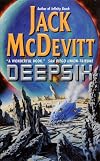
20 years after an initial disastrous expedition to Maleiva III, another expedition is sent to observe the destruction of the planet in a collision with a gas giant. Although there was not supposed to be intelligent life on the planet, scans reveal the remains of cities.
The archaeology in space was well done and left me wanting to know more, but I found the race against time to rescue the stranded explorers dragged a bit, with me just wishing they'd get on with it. The climax of the actual show more rescue in the last 15% or so was exciting, though. The biggest drawback was the character of Gregory MacAllister, a conservative populist "common sense" journalist who seemed to be fighting exactly the same enemies in 2220 as his predecessors in 1990s/early 2000s America (women, academics, the poor - undeserving almost by definition). As the epigraph for each chapter was taken from his writings, this grew tiresome very quickly. show less
The archaeology in space was well done and left me wanting to know more, but I found the race against time to rescue the stranded explorers dragged a bit, with me just wishing they'd get on with it. The climax of the actual show more rescue in the last 15% or so was exciting, though. The biggest drawback was the character of Gregory MacAllister, a conservative populist "common sense" journalist who seemed to be fighting exactly the same enemies in 2220 as his predecessors in 1990s/early 2000s America (women, academics, the poor - undeserving almost by definition). As the epigraph for each chapter was taken from his writings, this grew tiresome very quickly. show less
Lists
Awards


You May Also Like


Associated Authors
Statistics
- Works
- 124
- Also by
- 79
- Members
- 20,842
- Popularity
- #1,037
- Rating
- 3.6
- Reviews
- 578
- ISBNs
- 320
- Languages
- 12
- Favorited
- 66