
Bernard Knight
Author of The Sanctuary Seeker
About the Author
Disambiguation Notice:
Also writes as the Medieval Murderers with Ian Morson, Michael Jecks, Karen Maitland, Susanna Gregory, Philip Gooden and C.J. Sansom
Image credit: Bernard Knight, at Reading Festival of Crime Writing, Town Hall, Reading, Berkshire, Britain, on septembre 2010
Series
Works by Bernard Knight
The Birdman of Tonypandy 3 copies
Crowner 3 copies
Blood Identification 1 copy
The sanctuary seeker 1 copy
Elixir of death, The 1 copy
The Sacred Stone 1 copy
Associated Works
The Mammoth Book of Perfect Crimes & Impossible Mysteries (2006) — Contributor — 160 copies, 4 reviews
Tagged
Common Knowledge
- Other names
- Picton, Bernard
- Birthdate
- 1931-05-03
- Gender
- male
- Occupations
- forensic pathologist
medical school professor
artist
writer - Organizations
- The Medieval Murderers
Crime Writers' Association
UK Home Office
University of Wales College of Medicine - Awards and honors
- Order of the British Empire (Commander,
- Agent
- Sara Menguc
- Nationality
- UK
- Places of residence
- Cardiff, Wales, UK
- Disambiguation notice
- Also writes as the Medieval Murderers with Ian Morson, Michael Jecks, Karen Maitland, Susanna Gregory, Philip Gooden and C.J. Sansom
- Associated Place (for map)
- Wales, UK
Members
Reviews
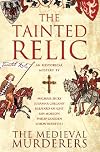
This was definitely an interesting read, and a fairly clever way to introduce new readers to the series characters of 6 historical mystery writers. For the most part, I enjoyed this, though the reasoning for a supposed holy relic from Jerusalem continuing to float around England for 500 years is tenuous, at best.
The plot is exactly as it says on the tin. The "tainted relic" is supposed to be a splinter from the True Cross, stained with Holy Blood. A curse was put on it when the family of its show more keeper was slain during the First Crusade. Barzak proclaimed that anyone who handled the sacred piece of wood would die once it left that person's possession. This novel follows the relic as it travels from the Holy Lan,d to France, and then on to England, from 1100 AD to the 1600s.
Each author contributes a self-contained "Act" to the story. The Prologue is by Simon Beaufort and features the knight, Geoffrey Mappstone, who is present in the Holy Land and writes the certificate of authenticity for the relic. The unusual deaths start right away, and this was a very good setup for the story to come.
Act 1, set in 1194 in Devonshire, features Sir John de Wolfe, who served as a coroner in medieval England (Bernard Knight). While nicely written and a good overview of his series and characters, I didn't enjoy this introduction to de Wolfe. The idea of adventures of one of the first coroners to hold the office was enticing, but de Wolfe is selfish and mean, IMO. I'm not sure I'd seek out this series.
Act 2, set in 1269 in Oxford, features the Falconer, penned by Ian Morson. The relic has come into the hands of monks who are dying pretty gruesome deaths, which the academic William Falconer sets out to solve. I enjoyed this section a lot, and quickly warmed to the characters here.
Act 3, set in 1323 in Lincolnshire, features former Knight Templar Sir Baldwin and is written by Michael Jeck. Perhaps surprisingly, this was perhaps my favorite act of the book - the plot moves at a fairly quick pace, and features a series of strange deaths, the aftereffects of which ripple through the town. It has a rather wry twist ending, too. I've tried and failed with the first book in Jeck's series featuring this character, but perhaps it is worth revisiting.
Act 4, set in 1353 Cambridge, features Susanna Gregory's series characters Matthew Bartholomew and Brother Michael of Michaelhouse, as the relic passes from a character in the previous act through the hands of several here, leading to a trail of improbable deaths. I found this act to be way too long, the plot too convoluted, and I actively disliked Bartholomew for most of it. Given my history with this character and this author, perhaps this is no surprise, but it was disappointing nonetheless. Gregory piles twist upon twist at the end, basically to prove that she can.
Act 5, set in 1600s London, is narrated by Nick Revill, one of the actors at Shakespeare's Globe Theater during the Elizabethan age. This is the only first person narration in the book, and I take it that this is a feature in Phillip Gooden's series. Revill is sent by Shakespeare into the depths of St Bartholomew's Fair to retrieve an early edition of a drawer play, but Nick and his friends stumble into more than they bargain for when the bookseller produces the ancient relic and its curse instead. The trio find him dead less than a hour later and are accused of committing the crime. This one has the most unusual solution of all, I'd wager.
There is a postscript epilogue at the end, also by Bernard Knight, in which the relic is unearthed from the mud of the Thames in 2005 by a construction worker who is working on the Millennium Dome. It is quite the fitting ending to this story, honestly, as the curse of the relic lives on.
I see that this group of writers has pooled together for 9 more books in a similar vein, and I'd definitely read more of these. I'm likely to seek out some of these series on their own as well, so overall, I'd say it's a win-win for me! show less
The plot is exactly as it says on the tin. The "tainted relic" is supposed to be a splinter from the True Cross, stained with Holy Blood. A curse was put on it when the family of its show more keeper was slain during the First Crusade. Barzak proclaimed that anyone who handled the sacred piece of wood would die once it left that person's possession. This novel follows the relic as it travels from the Holy Lan,d to France, and then on to England, from 1100 AD to the 1600s.
Each author contributes a self-contained "Act" to the story. The Prologue is by Simon Beaufort and features the knight, Geoffrey Mappstone, who is present in the Holy Land and writes the certificate of authenticity for the relic. The unusual deaths start right away, and this was a very good setup for the story to come.
Act 1, set in 1194 in Devonshire, features Sir John de Wolfe, who served as a coroner in medieval England (Bernard Knight). While nicely written and a good overview of his series and characters, I didn't enjoy this introduction to de Wolfe. The idea of adventures of one of the first coroners to hold the office was enticing, but de Wolfe is selfish and mean, IMO. I'm not sure I'd seek out this series.
Act 2, set in 1269 in Oxford, features the Falconer, penned by Ian Morson. The relic has come into the hands of monks who are dying pretty gruesome deaths, which the academic William Falconer sets out to solve. I enjoyed this section a lot, and quickly warmed to the characters here.
Act 3, set in 1323 in Lincolnshire, features former Knight Templar Sir Baldwin and is written by Michael Jeck. Perhaps surprisingly, this was perhaps my favorite act of the book - the plot moves at a fairly quick pace, and features a series of strange deaths, the aftereffects of which ripple through the town. It has a rather wry twist ending, too. I've tried and failed with the first book in Jeck's series featuring this character, but perhaps it is worth revisiting.
Act 4, set in 1353 Cambridge, features Susanna Gregory's series characters Matthew Bartholomew and Brother Michael of Michaelhouse, as the relic passes from a character in the previous act through the hands of several here, leading to a trail of improbable deaths. I found this act to be way too long, the plot too convoluted, and I actively disliked Bartholomew for most of it. Given my history with this character and this author, perhaps this is no surprise, but it was disappointing nonetheless. Gregory piles twist upon twist at the end, basically to prove that she can.
Act 5, set in 1600s London, is narrated by Nick Revill, one of the actors at Shakespeare's Globe Theater during the Elizabethan age. This is the only first person narration in the book, and I take it that this is a feature in Phillip Gooden's series. Revill is sent by Shakespeare into the depths of St Bartholomew's Fair to retrieve an early edition of a drawer play, but Nick and his friends stumble into more than they bargain for when the bookseller produces the ancient relic and its curse instead. The trio find him dead less than a hour later and are accused of committing the crime. This one has the most unusual solution of all, I'd wager.
There is a postscript epilogue at the end, also by Bernard Knight, in which the relic is unearthed from the mud of the Thames in 2005 by a construction worker who is working on the Millennium Dome. It is quite the fitting ending to this story, honestly, as the curse of the relic lives on.
I see that this group of writers has pooled together for 9 more books in a similar vein, and I'd definitely read more of these. I'm likely to seek out some of these series on their own as well, so overall, I'd say it's a win-win for me! show less

It is 1194, and John de Wolfe is settling into his new role as king's coroner for the county of Devon. As the novel begins, John, his bodyguard and fighting partner Gwyn of Polruan, and his clerk Thomas de Peyne are on their way to the Dartmoor village of Widecombe, where a body has been discovered in the brook. During the course of their investigations, it is discovered that the dead man was a Crusader, recently returned from the Holy Land. But the case turns more out to be more complex show more when a second body is found on Dartmoor ...
As before with the prequel to the Crowner John series, Crowner's Crusade, the historical setting and details are first rate, giving a realistic flavour of the time period with its day-to-day life, customs and laws – just a shame that the narration and the plotting aren't up to scratch. I don't think Bernard Knight is a natural storyteller, as there is something terribly stilted about his voice, and he completely failed to engage me in taking an interest in his characters. Though there's a creditable red herring in the book, in the end it was all to easy to figure out the true perpetrator(s), which was not helped by the fact that they made such easy mistakes that anyone would be able to pick up on the clues – except the sheriff of Exeter, John's brother-in-law, who obstinately refuses to acknowledge the perpetrator(s)' guilt in spite of the clear evidence.
As the book turned out to be more of a chore to read than expected, I decided to give up on the series, despite having another volume already on the shelf. show less
As before with the prequel to the Crowner John series, Crowner's Crusade, the historical setting and details are first rate, giving a realistic flavour of the time period with its day-to-day life, customs and laws – just a shame that the narration and the plotting aren't up to scratch. I don't think Bernard Knight is a natural storyteller, as there is something terribly stilted about his voice, and he completely failed to engage me in taking an interest in his characters. Though there's a creditable red herring in the book, in the end it was all to easy to figure out the true perpetrator(s), which was not helped by the fact that they made such easy mistakes that anyone would be able to pick up on the clues – except the sheriff of Exeter, John's brother-in-law, who obstinately refuses to acknowledge the perpetrator(s)' guilt in spite of the clear evidence.
As the book turned out to be more of a chore to read than expected, I decided to give up on the series, despite having another volume already on the shelf. show less
Crowner's Quest: An unputdownable mystery that won't let go (The Crowner John Mysteries Book 3) by Bernard Knight

Christmas Eve, 1194, Sir John de Wolfe, recently appointed coronor for Devon, gratefully escapes his wife Matilda's party to examine the body of a Canon who has been found hanged. Suicide is suspected, but it's soon apparent there is more to this case than meets the eye. But when a local lord is found dead, John suspects the two cases may be linked. As he digs deeper, he discovers a deadly conspiracy that could cost him more than his job.
This is the third book in this series but the first show more that I've actually read. Who committed the murders isn't much of a mystery but I'm a sucker for a historical yarn and this is a period of British history that I know virtually nothing about. I found this well paced, de Wolfe an interesting character. Knight has obviously done his homework but doesn't overdo it and I will certainly be looking out for more of the author's books. show less
This is the third book in this series but the first show more that I've actually read. Who committed the murders isn't much of a mystery but I'm a sucker for a historical yarn and this is a period of British history that I know virtually nothing about. I found this well paced, de Wolfe an interesting character. Knight has obviously done his homework but doesn't overdo it and I will certainly be looking out for more of the author's books. show less

A decent mystery that takes place during the conflict of the 1950s known as the Malayan Emergency. I particularly liked the main character, who, although didn't have a big part in the story, was a likeable fellow who was just amazed that life had brought him to this exotic place with his first responsible job and far away from his Tyneside home. The story describes the locale and setting very well, but not the background of the campaign, which has piqued my interest and necessitates more show more reading. show less
Lists
Awards

You May Also Like


Associated Authors
Statistics
- Works
- 46
- Also by
- 10
- Members
- 2,698
- Popularity
- #9,522
- Rating
- 3.5
- Reviews
- 49
- ISBNs
- 224
- Languages
- 2
- Favorited
- 5
