
Rosalind Ormiston
Author of Alphonse Mucha: Masterworks
About the Author
Works by Rosalind Ormiston
Hans Holbein: His Life and Works in 500 Images: An Illustrated Exploration of the Artist and his Context, with a Gallery of his Paintings and Drawings (2021) 10 copies
Tagged
Common Knowledge
- Canonical name
- Ormiston, Rosalind
- Gender
- female
- Education
- Kingston University
Birkbeck College - Occupations
- lecturer (History of Art Design and Architecture ∙ Kingston University ∙ Surrey)
art historian - Organizations
- Kingston University
- Nationality
- UK
- Places of residence
- London, England, UK
New York, New York, USA
Piedmont, Italy
Members
Reviews

As with all art books, I was frustrated at points while reading this book from all the flipping back and forth between sections to be able to look at the illustrations that matched the text, but I will forgive this volume since its pages collect an absolutely stunning array of Mucha's work. Unlike some Mucha books that I've read, the colour representation was absolutely spot on, and the size of the images adequately represented Mucha's artwork (with specially blown up sections to zoom in on show more some of the more intricate pices). I could have maybe used less written material during the second section (it seemed to duplicate some of the information that was covered in the first section) for a focus specifically on thematics, but for the most part the text was minimal and simple enough that it acted more as a white space counterpoint to the saturation of the artwork. show less
This is a lovely book in many ways. There is an absolute wealth of Mucha's graphic works ..including a lot of his commercial work for biscuit manufactures and chocolate manufacturers. And, because it is a large book, one has the opportunity to really examine the detail. In some cases enlargements are given which is quite fascinating to see. It is accompanied by a nice, if slightly stilted, biographical section and a second section which focuses on his work at the height of the period show more 1893-1905. However, it is greatly weakened by the fact that there appears to have been no coordination between the writers of the prose and the placement of the pictures. I found I had to frequently turn back 100 pages to view the particular work the was being described in detail. And one can look in vain for any connection between the script and the illustrations on or nearby that page.
It is also frustrating to find (as on p132 that the book describes "two lithographs that are noteworthy, for they show the wide illustrative range that Muncha possessed. The first is the image of Salome ,1897 (see page 134)". Ok so far so good. ....."The second is Salammbo, 1897......." But I looked in vain for a picture of Salammbo. Now this is just plain annoying. To be invited to compare but not being given anything to compare apart from words.
In fact the word descriptions are quite detailed ..and this is a bit of a give-away when "The Moon" is described as ..."dressed in a beautiful blue gown"...when the actual print is a murky brown. In fact, clearly the blues have dropped out of the printing process or the originals from which the plates were printed have lost their blue tones. There are a number of prints described as blue or turquoise ...which are just brown. And when I googled some of these images...sure enough they appear in blue and turquoise.
There is very little here .....if anything of his work outside the period 1893-1905. I don't recall anything from his period in America or for his work on the Slavic Epic or for his early work...pre-Paris. So, in a lot of ways, this book is a disappointment. The complete disjunction between the graphic work and the text is seriously problematic. Even for the relatively few graphics that are referred to in the text, one has to be continually turning backwards and forwards to see them. It seems to me that the graphics have been laid out first and the text has simply been inserted in the spaces left behind with no thought given to integrating the two. A pity, this book could have been much better. show less
It is also frustrating to find (as on p132 that the book describes "two lithographs that are noteworthy, for they show the wide illustrative range that Muncha possessed. The first is the image of Salome ,1897 (see page 134)". Ok so far so good. ....."The second is Salammbo, 1897......." But I looked in vain for a picture of Salammbo. Now this is just plain annoying. To be invited to compare but not being given anything to compare apart from words.
In fact the word descriptions are quite detailed ..and this is a bit of a give-away when "The Moon" is described as ..."dressed in a beautiful blue gown"...when the actual print is a murky brown. In fact, clearly the blues have dropped out of the printing process or the originals from which the plates were printed have lost their blue tones. There are a number of prints described as blue or turquoise ...which are just brown. And when I googled some of these images...sure enough they appear in blue and turquoise.
There is very little here .....if anything of his work outside the period 1893-1905. I don't recall anything from his period in America or for his work on the Slavic Epic or for his early work...pre-Paris. So, in a lot of ways, this book is a disappointment. The complete disjunction between the graphic work and the text is seriously problematic. Even for the relatively few graphics that are referred to in the text, one has to be continually turning backwards and forwards to see them. It seems to me that the graphics have been laid out first and the text has simply been inserted in the spaces left behind with no thought given to integrating the two. A pity, this book could have been much better. show less
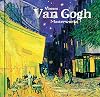
Nice collection of van Gogh's most important paintings and excerpts from his correspondence with family and friends throughout his life. There are more than 100 paintings from van Gogh included and a few from other painters. The paintings are not in chronological order, but a register at the end of the book sorted by title provides assistance in searching for a specific painting.
I'm not an art connoisseur, but from the small amount of artists I know, van Gogh is easily my favorite. So I was show more really happy when I found this book for a cheap price. And after I've read it I'm still happy, but there are some problems with it.
1. While most famous paintings are included, some are missing. Like Road With Cypress And Star.
2. For The Night Café the simpler watercolor version is used. This might also be the case for other paintings, but that was the one I noticed.
3. Almost all, if not all, paintings are cut. I'm unsure of the reason for this, but to me it is a disservice to van Gogh's intended arrangement.
4. The colors of the paintings feels a bit lackluster. Especially when compared to digital versions which can be found online.
As said I'm glad I picked it up and it is nice to be able to look at van Gogh's work in an actual book. Having said that I will go to the digital collections of his work when I want to see his work uncut and rich in colors.
3 stars out of 5. show less
I'm not an art connoisseur, but from the small amount of artists I know, van Gogh is easily my favorite. So I was show more really happy when I found this book for a cheap price. And after I've read it I'm still happy, but there are some problems with it.
1. While most famous paintings are included, some are missing. Like Road With Cypress And Star.
2. For The Night Café the simpler watercolor version is used. This might also be the case for other paintings, but that was the one I noticed.
3. Almost all, if not all, paintings are cut. I'm unsure of the reason for this, but to me it is a disservice to van Gogh's intended arrangement.
4. The colors of the paintings feels a bit lackluster. Especially when compared to digital versions which can be found online.
As said I'm glad I picked it up and it is nice to be able to look at van Gogh's work in an actual book. Having said that I will go to the digital collections of his work when I want to see his work uncut and rich in colors.
3 stars out of 5. show less

If you are looking for a book to read when you are stressed and simply want to contemplatively bask in the beauty of the stunningly creative, exquisitely detailed prints contained therein, then take time to drink a glass of wine, or cup of coffee or tea, go to a quiet space and be prepared to unwind.
William Morris was well acquainted with members of the Pre-Raphaelite Brotherhood. One of his best friends and mentors Dante Gabriel Rossetti introduced him to Jane Morris, who would become his show more wife and, in a sad triangle, using Jane as a muse and model, frustratingly tragic to Morris, Rossetti and Jane developed a life-long relationship.
William and Jane entertained members of the Pre-Raphaelite Brotherhood in their intricately designed Red House. Their residence became an inspirational meeting place for poets, writers and artists.
Later, moving to Kelmscott Manor, Morris honed his artistry when decorating with wallpapers and tapestries.
http://www.kelmscottmanor.org.uk/home
In mid life, Morris became increasingly dissatisfied with the industrialization of Victorian society. Becoming a socialist, his public lectures were forceful, animated and he adamantly railed against a society wherein machines manufactured goods at the expense of man-made artistic endeavors.
Becoming angry at a process that manipulated the poor masses while breeding what he called a tacky middle class, he believed that a society was crazy if in its out-of control progress it failed to improve the lives of the people who lived in that society.
Paradoxically, while Morris threw stones at those who were rapidly accumulating wealth at the expense of the downtrodden, Morris' status in life and wealth was inherited from his father who owned copper mines.
Later in life, he became very disillusioned with socialism stating that it failed to deliver a long-term solution to the betterment of society.
His legacy continues today. He was a genius of the arts and crafts movement, and his legacy of fine furnishings continues to inspire.
Highly recommended! show less
William Morris was well acquainted with members of the Pre-Raphaelite Brotherhood. One of his best friends and mentors Dante Gabriel Rossetti introduced him to Jane Morris, who would become his show more wife and, in a sad triangle, using Jane as a muse and model, frustratingly tragic to Morris, Rossetti and Jane developed a life-long relationship.
William and Jane entertained members of the Pre-Raphaelite Brotherhood in their intricately designed Red House. Their residence became an inspirational meeting place for poets, writers and artists.
Later, moving to Kelmscott Manor, Morris honed his artistry when decorating with wallpapers and tapestries.
http://www.kelmscottmanor.org.uk/home
In mid life, Morris became increasingly dissatisfied with the industrialization of Victorian society. Becoming a socialist, his public lectures were forceful, animated and he adamantly railed against a society wherein machines manufactured goods at the expense of man-made artistic endeavors.
Becoming angry at a process that manipulated the poor masses while breeding what he called a tacky middle class, he believed that a society was crazy if in its out-of control progress it failed to improve the lives of the people who lived in that society.
Paradoxically, while Morris threw stones at those who were rapidly accumulating wealth at the expense of the downtrodden, Morris' status in life and wealth was inherited from his father who owned copper mines.
Later in life, he became very disillusioned with socialism stating that it failed to deliver a long-term solution to the betterment of society.
His legacy continues today. He was a genius of the arts and crafts movement, and his legacy of fine furnishings continues to inspire.
Highly recommended! show less
You May Also Like


Associated Authors
Statistics
- Works
- 31
- Members
- 930
- Popularity
- #27,609
- Rating
- 4.3
- Reviews
- 13
- ISBNs
- 52
- Languages
- 5