
Charles Krauthammer (1950–2018)
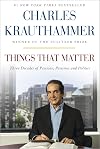
Author of Things That Matter: Three Decades of Passions, Pastimes and Politics
About the Author
Charles Krauthammer was born in Manhattan, New York on March 13, 1950. He received a degree in political science and economics from McGill University in 1970 and a medical degree from Harvard Medical School in 1975. In 1978, he was a research director at the National Institute of Mental Health in show more Washington and started getting articles about politics published in The New Republic. He started working for The New Republic full time in 1981 and wrote regularly for them until 2011. He also wrote regularly for Time magazine from 1983 to 2018 and a weekly column for The Washington Post from 1985 to 2018. He was a nightly panelist on Fox News's Special Report with Bret Baier for ten years and a panelist on PBS's Inside Washington from 1990 to 2013. He received the Pulitzer Prize for commentary in 1987 for his Washington Post columns and the William F. Buckley Award for Media Excellence. His books included Cutting Edges: Making Sense of the Eighties, Democratic Realism: An American Foreign Policy for a Unipolar World, and Things That Matter: Three Decades of Passions, Pastimes and Politics. He died from cancer of the small intestine on June 21, 2018 at the age of 68. (Bowker Author Biography) show less
Image credit: Charles Krauthammer
Works by Charles Krauthammer
Things That Matter: Three Decades of Passions, Pastimes and Politics (2013) 1,069 copies, 20 reviews
Associated Works
Liberty and Power: A Dialogue on Religion and U.S. Foreign Policy in an Unjust World (2004) — Contributor — 19 copies
Tagged
Common Knowledge
- Birthdate
- 1950-05-13
- Date of death
- 2018-06-21
- Gender
- male
- Education
- McGill University (BA - Political Science and Economics)
University of Oxford (Balliol College)
Harvard University (MD) - Occupations
- political columnist
conservative - Organizations
- American Board of Psychiatry and Neurology
Chess Journalists of America
Pro Musica Hebraica (co-founder)
Council on Foreign Relations
Massachusetts General Hospital (chief resident of psychiatry)
The New Republic (show all 11)
Time
The Washington Post
PBS
Fox News
The American Scholar - Awards and honors
- Edwin Dunlop Prize (1978)
Champion-Tuck Award (1984)
National Magazine Award (1984)
First Amendment Award (1985)
Pulitzer Prize (Commentary, 1987)
Irving Kristol Award (2004) (show all 10)
Bradley Prize (2004)
Eric Breindel Award (2008-2009)
William F. Buckley Award (2013)
Guardian of Zion Award (2002) - Relationships
- Hartman, David (teacher)
- Nationality
- USA
- Birthplace
- New York, New York, USA
- Places of residence
- Chevy Chase, Maryland, USA
- Associated Place (for map)
- USA
Members
Reviews
I just can't bring myself to give a compilation of columns, no matter how well chosen and organized, a five star rating, so we will have to settle for four stars, but that being said, the book is excellent.
Of course there are a few caveats:
- My review is totally biased because I love Krauthammer's writing and often agree with his views
- Although he is a former Democrat, he is now clearly conservative, and since I lean that way on almost every non social issue, well my views are especially show more simpatico.
That being said, I think it is hard to find a columnist who can write as succinctly as Krauthammer while bringing very strong intellectual arguments to bear. If you are not conservative and want to test your belief system against one of the best, read this book. He may not change your mind, but you may find yourself running to Google to bolster your arguments.
The book is divided into four sections: Personal, Political, Historical, and Global. He republishes "best of" columns from the eighties, nineties and recent past. The Political section is the most controversial. The Global section is the most dry, but also by far the most important. I think Krauthammer really has some important things to say about the role of the U.S. in today's world, and the various philosophies that impact our foreign policy. He is extremely thought provoking.
His personal background makes him more interesting. He is a former Democrat who went to Harvard Medical School to study psychiatry. There, he became paralyzed in a diving accident in his first year, but he persisted and became a doctor. He was a gifted writer and ultimately left medicine to write. The guy is an intellectual giant. Even when I don't agree with him, I find it hard to refute his case. Sometimes I change my mind.
I actually would love to read this book as a group read because there would be so much to discuss. All in all, I think this is very worthwhile reading no matter where you are on the political spectrum. show less
Of course there are a few caveats:
- My review is totally biased because I love Krauthammer's writing and often agree with his views
- Although he is a former Democrat, he is now clearly conservative, and since I lean that way on almost every non social issue, well my views are especially show more simpatico.
That being said, I think it is hard to find a columnist who can write as succinctly as Krauthammer while bringing very strong intellectual arguments to bear. If you are not conservative and want to test your belief system against one of the best, read this book. He may not change your mind, but you may find yourself running to Google to bolster your arguments.
The book is divided into four sections: Personal, Political, Historical, and Global. He republishes "best of" columns from the eighties, nineties and recent past. The Political section is the most controversial. The Global section is the most dry, but also by far the most important. I think Krauthammer really has some important things to say about the role of the U.S. in today's world, and the various philosophies that impact our foreign policy. He is extremely thought provoking.
His personal background makes him more interesting. He is a former Democrat who went to Harvard Medical School to study psychiatry. There, he became paralyzed in a diving accident in his first year, but he persisted and became a doctor. He was a gifted writer and ultimately left medicine to write. The guy is an intellectual giant. Even when I don't agree with him, I find it hard to refute his case. Sometimes I change my mind.
I actually would love to read this book as a group read because there would be so much to discuss. All in all, I think this is very worthwhile reading no matter where you are on the political spectrum. show less

All the conservative bits in my political leanings are thanks to powerhouse columnists like David Brooks, George Will and Charles Krauthammer. And whereas Brooks and Will are known for their genteel rhetoric, Krauthammer's arguments carry a measured, fiery anger. I love this guy. When he makes a point it's undeniably intelligent and there's just this wink of spirited condescension. And you'd have to be willfully close-minded to not be persuaded by his reasoning. When Krauthammer enters the show more conversation it's like the other pundits start to resemble shouting children by comparison.
Things That Matter is Charles Krauthammer's greatest hits album, the 'best of' from his 30+ years of political commentating. Organized by theme rather than by era (e.g. "Passions and Pastimes," "Heaven and Earth," and "Citizen and State"), the individual columns jump back and forth chronologically signaling that what matters to Krauthammer is bigger than the day-to-day news. One moment the context could be the Soviet Union; the next it's 9/11.
A personal observation (or non-observation): I've been following Charles Krauthammer for over 10 years now, and until I read this book I had no idea that he was paralyzed. When I see him on TV he's usually sitting in a newsroom along with everyone else. It says something about this man's character that his contributions to public discourse are demonstrably independent of his physical limitations. show less
Things That Matter is Charles Krauthammer's greatest hits album, the 'best of' from his 30+ years of political commentating. Organized by theme rather than by era (e.g. "Passions and Pastimes," "Heaven and Earth," and "Citizen and State"), the individual columns jump back and forth chronologically signaling that what matters to Krauthammer is bigger than the day-to-day news. One moment the context could be the Soviet Union; the next it's 9/11.
A personal observation (or non-observation): I've been following Charles Krauthammer for over 10 years now, and until I read this book I had no idea that he was paralyzed. When I see him on TV he's usually sitting in a newsroom along with everyone else. It says something about this man's character that his contributions to public discourse are demonstrably independent of his physical limitations. show less
The late Charles Krauthammer had originally intended this collection of columns and articles to focus on the things that mattered most to him, things other than politics, things like baseball, chess, science, medicine and family. Then he realized that ultimately everything that mattered most to him depended on politics. Consider how the political change that created Nazi Germany affected every aspect of life in Germany, and the rest of Europe as well.
So Krauthammer did include political show more commentary in “Things That Matter,” although these essays now seem the most dated, at least those that relate specifically to issues that were hot topics during the Clinton years or either of the Bush administrations. Obama discussions seem a bit more topical. The book predates the Trump administration.
When writing about politics in general terms, however, it sounds like it could have first appeared in print yesterday. One example is when he writes, “Conservatives think liberals are stupid. Liberals think conservatives are evil.” Krauthammer wrote this in 2002, but today conservatives are ranting about the stupidity of the open borders and Medicare-for-all advocated by left-wing politicians, while liberals use any excuse to call conservatives Nazis or racists.
Still he is at his best when writing about subjects more dear to his heart — why religion should be taught in the schools (“A healthy country would teach its children evolution — and the Ten Commandments.”), why Winston Churchill was the most important figure in the 20th century, why turning the border collie into a show dog is likely to ruin its most important quality — its intelligence, and so on.
This is good stuff, stuff that will matter to most readers as it mattered to Charles Krauthammer. show less
So Krauthammer did include political show more commentary in “Things That Matter,” although these essays now seem the most dated, at least those that relate specifically to issues that were hot topics during the Clinton years or either of the Bush administrations. Obama discussions seem a bit more topical. The book predates the Trump administration.
When writing about politics in general terms, however, it sounds like it could have first appeared in print yesterday. One example is when he writes, “Conservatives think liberals are stupid. Liberals think conservatives are evil.” Krauthammer wrote this in 2002, but today conservatives are ranting about the stupidity of the open borders and Medicare-for-all advocated by left-wing politicians, while liberals use any excuse to call conservatives Nazis or racists.
Still he is at his best when writing about subjects more dear to his heart — why religion should be taught in the schools (“A healthy country would teach its children evolution — and the Ten Commandments.”), why Winston Churchill was the most important figure in the 20th century, why turning the border collie into a show dog is likely to ruin its most important quality — its intelligence, and so on.
This is good stuff, stuff that will matter to most readers as it mattered to Charles Krauthammer. show less
Charles Krauthammer is living proof that life is not fair. This because, for the vast majority of people, no amount of study or practice would ever enable them to write so lucidly with such command of reason, history, and words. As a writer and a thinker, Krauthammer is quite simply magnificent.
This is not a political book. It is certainly about politics. And culture. And history. But it is not political in the sense that it will have a short shelf life, being only concerned with the issues show more of the moment. Nor is it written as an (almost) election year call to arms. Rather, it is a collection of Krauthammer's writing over the last 30 years from varied publications such as The National Journal, Washington Post, and Weekly Standard.
When I heard the book was not new material I was a bit disappointed--having read other "columns" books before and thinking them too fleeting. I couldn't have been more wrong. Krauthammer culled his vast material to choose writings, which are timeless. There was only one chapter that referenced an event with which I was unfamiliar (Bitburg Cemetery controversy), and most of these writings are from the 20 years before I was an adult and paying attention to such matters. The chapters are arranged in sections such as "Heaven & Earth", "Manners", and "Body & Soul." The section "Memory and Monuments", with articles on The Holocaust Museum and the Martin Luther King, Jr. monument, was particularly affecting. There are now dozens of sticky tabs protruding from my copy's pages as passage after passage deserved marking.
In his introduction he tells of his passage from liberalism to conservatism. While in college he witnessed an event that triggered a change which now meant, "viewing certainty with suspicion and acknowledging, with both regret and resolve, the imperfectability of man, the fallibility of institutions, and the tragic--rather than redemptive--nature of history." Conservatism in a nutshell. And yet, the idea America was founded on still prevails and, for all America's faults, "What eventually grew on this bloodied soil? The answer is, The great modern civilizations of the Americas--a new world of individual rights, an ever-expanding circle of liberty and, twice, a savior of the world from totalitarian barbarism." That is not nothing. And is worth remembering and defending.
If every conservative were as wise, measured, and persuasive as Krauthammer the Left would never win another election. It's to its benefit that this is not the case.
Read this book. You'll be moved by, and smarter for it. show less
This is not a political book. It is certainly about politics. And culture. And history. But it is not political in the sense that it will have a short shelf life, being only concerned with the issues show more of the moment. Nor is it written as an (almost) election year call to arms. Rather, it is a collection of Krauthammer's writing over the last 30 years from varied publications such as The National Journal, Washington Post, and Weekly Standard.
When I heard the book was not new material I was a bit disappointed--having read other "columns" books before and thinking them too fleeting. I couldn't have been more wrong. Krauthammer culled his vast material to choose writings, which are timeless. There was only one chapter that referenced an event with which I was unfamiliar (Bitburg Cemetery controversy), and most of these writings are from the 20 years before I was an adult and paying attention to such matters. The chapters are arranged in sections such as "Heaven & Earth", "Manners", and "Body & Soul." The section "Memory and Monuments", with articles on The Holocaust Museum and the Martin Luther King, Jr. monument, was particularly affecting. There are now dozens of sticky tabs protruding from my copy's pages as passage after passage deserved marking.
In his introduction he tells of his passage from liberalism to conservatism. While in college he witnessed an event that triggered a change which now meant, "viewing certainty with suspicion and acknowledging, with both regret and resolve, the imperfectability of man, the fallibility of institutions, and the tragic--rather than redemptive--nature of history." Conservatism in a nutshell. And yet, the idea America was founded on still prevails and, for all America's faults, "What eventually grew on this bloodied soil? The answer is, The great modern civilizations of the Americas--a new world of individual rights, an ever-expanding circle of liberty and, twice, a savior of the world from totalitarian barbarism." That is not nothing. And is worth remembering and defending.
If every conservative were as wise, measured, and persuasive as Krauthammer the Left would never win another election. It's to its benefit that this is not the case.
Read this book. You'll be moved by, and smarter for it. show less
You May Also Like


Associated Authors
Statistics
- Works
- 5
- Also by
- 5
- Members
- 1,451
- Popularity
- #17,710
- Rating
- 4.1
- Reviews
- 24
- ISBNs
- 22
- Languages
- 1
- Favorited
- 3