
Will Kymlicka
Author of Contemporary Political Philosophy
About the Author
Will Kymlicka is the Canada Research Chair in Political Philosophy at Queen's University
Image credit: Wikipedia user SJL
Works by Will Kymlicka
The Globalization of Ethics: Religious and Secular Perspectives (Ethikon Series in Comparative Ethics) (2007) — Editor — 15 copies
Multiculturalism and the Welfare State: Recognition and Redistribution in Contemporary Democracies (2006) 11 copies
Associated Works
Tagged
Common Knowledge
- Canonical name
- Kymlicka, Will
- Gender
- male
- Education
- University of Oxford (D.Phil., Philosophy, 1987)
University of Oxford (B.Phil., Philosophy, 1986)
University of Oxford (B.A., Political Science and Philosophy, 1984) - Organizations
- Queen's University
American Society for Political and Legal Philosophy - Relationships
- Patten, Alan (co-editor)
Opalski, Magdalena (co-editor)
Bashir, Bashir (co-editor) - Nationality
- Canada
- Associated Place (for map)
- Canada
Members
Reviews

This book can be summarized quite quickly: the authors argue that justice for animals should be conceived politically. Political animal rights would mean citizenship for domesticated animals, sovereignty for wild animals, and denizenship for liminal animals who live among humans without being domesticated. Much of the book is focused on defining these three animal groups, but the authors also illuminate their threefold categorization by drawing parallels to disabled people, sovereign show more countries, and denizens such as economic migrants and the Amish.
Clearly this is a trailblazing book with some truly novel ideas. As such, it is understandable that the arguments are broad and probing, but not particularly detailed or complex. The authors focus on presenting, as clearly as possible, a framework for others to build on. This is a good decision, since a more detailed mapping of political animal rights would probably have reduced the prospective readership of this book significantly.
As it stands, this book is a great starting point for conceiving animal rights, and animals themselves, in a new light. The authors recognize that political theory won’t improve the miserable position of most animals in contemporary society, but setting a preliminary political agenda for a future society which involves both humans and animals could still be an important achievement some day. show less
Clearly this is a trailblazing book with some truly novel ideas. As such, it is understandable that the arguments are broad and probing, but not particularly detailed or complex. The authors focus on presenting, as clearly as possible, a framework for others to build on. This is a good decision, since a more detailed mapping of political animal rights would probably have reduced the prospective readership of this book significantly.
As it stands, this book is a great starting point for conceiving animal rights, and animals themselves, in a new light. The authors recognize that political theory won’t improve the miserable position of most animals in contemporary society, but setting a preliminary political agenda for a future society which involves both humans and animals could still be an important achievement some day. show less

The author starts by explaining why equality and ethics are the key parts of modern political philosophy. He then presents utilitarianism as the historical source and counterpoint of most modern political philosophy. Then he proceeds to actual modern theories such as liberalism, libertarianism, marxism, communitarianism etc. with well-balanced and seemingly fair assessments. This book should suit beginners perfectly and more advanced practitioners can also spend some time re-reading it. I show more don't know any other overview of contemporary political philosophy which would match it in depth and clarity. show less
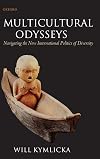
This was an interesting examination of the globalization of "multicultural liberalism". The author discusses international approaches to multiculturalism policies and minority rights. He makes a usesul distinction between responses to requests for greater political freedom and other collective rights from indigenous vs. historical minorities vs. new immigrants. He explains how politics and security concerns bring account, in large part, for different approaches to these groups, and different show more reactions from western democracies, as compared to post-communist states and to nations in Asia and Africa. Very thought-provoking. show less
I'm mostly ignorant of political philosophy and snagged this from my daughter after she finished a university class. Though at time I'm frustrated by an even-handedness that seems to forbid conslusions, this is a thorough, systematic review of what people are talking about and helped me quickly get up to speed so I could go on to original sources.
Lists
Awards


You May Also Like


Associated Authors
Statistics
- Works
- 36
- Also by
- 4
- Members
- 1,157
- Popularity
- #22,207
- Rating
- 3.7
- Reviews
- 11
- ISBNs
- 122
- Languages
- 13
- Favorited
- 1