
Seyla Benhabib
Author of Feminist Contentions: A Philosophical Exchange
About the Author
Seyla Benhabib is the Eugene Meyer Professor of Political Science and Philosophy at Yale University Her many books have been translated into more than fourteen languages, and include Dignity in Adversity. The Rights of Others, and The Claims of Culture (Princeton).
Works by Seyla Benhabib
Another Cosmopolitanism: Hospitality, Sovereignty, and Democratic Iterations (2006) — Author — 88 copies, 1 review
Feminism as Critique: Essays on the Politics of Gender in Late-Capitalist Societies (1987) 79 copies
Exile, Statelessness, and Migration: Playing Chess with History from Hannah Arendt to Isaiah Berlin (2018) 26 copies
Associated Works
Confronting Mass Democracy and Industrial Technology: Political and Social Theory from Nietzsche to Habermas (2002) — Contributor — 21 copies
Tagged
Common Knowledge
- Canonical name
- Benhabib, Seyla
- Birthdate
- 1950
- Gender
- female
- Education
- American College for Girls, Istanbul, Turkey (BA|Humanities)
Brandeis University (BA|Philosophy)
Yale University (MA|Philosophy)
Yale University (PhD|Philosophy) - Occupations
- Professor of Philosophy, Yale University
Professor of Political Science, Yale University - Organizations
- Yale University (Eugene Meyer Professor of Political Science and Philosophy)
- Relationships
- Fraser, Nancy (co-editor)
Cornell, Drucilla (co-editor)
Bonss, Wolfgang (co-editor)
McCole, John (co-editor)
Shapiro, Ira (co-editor) - Nationality
- Turkey (birth)
- Birthplace
- Istanbul, Turkey
- Associated Place (for map)
- Istanbul, Turkey
Members
Reviews

Benhabib argues that "those subject to the laws should also be their authors" and presents how that might become the case through implementation of what she calls "cosmopolitan federalism."
The book is very clearly written and well argued. I especially appreciate her descriptions of the paradox, which translates into conflicts on the ground, between the universality of human rights and the necessary territorial closure self-governing polity, which lies at the core of the very concept (and so show more every implementation) of liberal democracy. show less
The book is very clearly written and well argued. I especially appreciate her descriptions of the paradox, which translates into conflicts on the ground, between the universality of human rights and the necessary territorial closure self-governing polity, which lies at the core of the very concept (and so show more every implementation) of liberal democracy. show less
Benhabib engages with traditional Western liberal thinkers to articulate a moderate cosmopolitan position from the perspective of democratic discourse ethics. Although she is at times incisive, notably in her critique of Rawls, at other times her arguments are rather weak. For instance, her misreading of Walzer makes it clear that she refuses to acknowledge that neither democracy nor human rights are culturally neutral or objectively universal. In several places, she forgoes the opportunity show more to challenge (and even re-inscribes the legitimacy of) the system of global capitalism which is an integral structural component of the inequalities and migratory patterns she is concerned about. show less
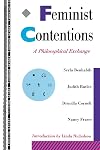
Interesting structure where four theorists give papers on the overlap between feminism and postmodernism, then respond to one another through criticism and adaptation of theories. Some excellent presentation on the difficulties of retaining a 'female' perspective in a society where identity is individualistic; competing opinions from psychology (Cornell) to philosophy (Butler) to social theory (Benhabib) that come together in the chapters of criticism. Difficult to read (some jargon, and show more some heavy theory) but worth the time. show less

Culture is important, and one can bring one's culture into discussions in civil society. But equality (via Benhabib's principles of egalitarian reciprocity, voluntary self-ascription, and freedom of exit and association) always takes first place. I think she makes a valuable addition to liberal-democratic theory in the vein of Habermas' Between Facts and Norms, but I don't know that she's offered anything to convince those who aren't already thinking in these terms.
Lists
Awards


You May Also Like


Associated Authors
Statistics
- Works
- 35
- Also by
- 8
- Members
- 1,143
- Popularity
- #22,461
- Rating
- 3.8
- Reviews
- 4
- ISBNs
- 118
- Languages
- 10
- Favorited
- 1
