
Walter D. Edmonds (1903–1998)
Author of The Matchlock Gun
About the Author
Image credit: Photo courtesy of the Frank E. Gannett Memorial Library
Works by Walter D. Edmonds
Dygartsbush 1 copy
drums along the monawk 1 copy
Chad Hanna - II. kötet 1 copy
ROME HAUL. No. 191 in The Modern Library Series. [Dramatizeed under the title "The Farmer Takes a Wife"]. (1938) 1 copy
The Erie Canal 1 copy
The story of Richard Storm 1 copy
The Magnificent Wilders 1 copy
Selected Short Stories 1 copy
The Matchlock Gun 1 copy
Associated Works
The Tavern Lamps Are Burning: Literary Journeys through Six Regions and Four Centuries of New York State (1964) — Contributor — 24 copies
The Best Short Stories of 1931 and the Yearbook of the American Short Story (1931) — Contributor — 7 copies, 1 review
The Best Short Stories of 1928 and the Yearbook of the American Short Story (1928) — Contributor — 3 copies
The Best Short Stories of 1929 and the Yearbook of the American Short Story (1929) — Contributor — 3 copies
The Best Short Stories of 1933 and the Yearbook of the American Short Story (1933) — Contributor — 2 copies
The Ethnic Image in Modern American Literature, 1900-1950, Volumes 1-2 (1984) — Contributor — 1 copy
Tagged
Common Knowledge
- Canonical name
- Edmonds, Walter D.
- Legal name
- Edmonds, Walter Dumaux
- Other names
- Edmonds, Wat (nickname)
- Birthdate
- 1903-07-15
- Date of death
- 1998-01-24
- Gender
- male
- Education
- Harvard University
- Occupations
- novelist
- Short biography
- Walter "Walt" Dumaux Edmonds (July 15, 1903 – January 24, 1998) was an American writer best known for historical novels. One of them, Drums Along the Mohawk (1936), was adapted as a Technicolor feature film in 1939, directed by John Ford and starring Henry Fonda and Claudette Colbert.
Edmonds was born in Boonville, New York. In 1919 he entered The Choate School (now Choate Rosemary Hall) in Wallingford, Connecticut. Originally intending to study chemical engineering, he became more interested in writing and worked as managing editor of the Choate Literary Magazine. He graduated in 1926 from Harvard, where he edited The Harvard Advocate, and where he studied with Charles Townsend Copeland.
In 1929, he published his first novel, Rome Haul, a work about the Erie Canal. The novel was adapted for the 1934 play The Farmer Takes a Wife and the 1935 film of the same name. He married Eleanor Stetson in 1930.
Drums Along the Mohawk was on the bestseller list for two years, second only to Margaret Mitchell's famous 1936 novel Gone with the Wind for part of that time. Bert Breen's Barn was a winner of the 1976 National Book Award in category Children's Books.
Edmonds eventually published 34 books, many for children, as well as a number of magazine stories. He won the Lewis Carroll Shelf Award in 1960 and the Newbery Medal in 1942, for The Matchlock Gun, and the National Book Award for Children's Literature in 1976, for Bert Breen's Barn.
When Eleanor died in 1956, Walter married Katherine Howe Baker Carr, who died in 1989. Walter Edmonds died in Concord, Massachusetts, in 1998. - Nationality
- USA
- Birthplace
- Boonville, New York, USA
- Place of death
- Concord, Massachusetts, USA
- Associated Place (for map)
- USA
Members
Reviews
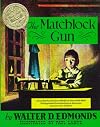
Books of this time represent Native Americans as savages and illustrations are stereotypical and awful and they are not represented as a people fighting for their beautiful land. I read this title right after reading "Daniel Boone" which in its attempt to represent early American heroes represents early American terrorists pouring in to kill anyone in the way of their getting more land. It is a terrible history, so poorly portrayed and so shameful.
Despite the beautiful illustrations and the show more simply told true story of a young family settling in upstate New York, "The Matchlock Gun" is a story of kill or be killed in which the Native Americans are again portrayed as savages that must be destroyed to save the poor settlers. The illustrations accurately show what life would have been like for the settlers, from the simple wood structure to the warming pans and cauldron in the fireplace and should not be ignored, despite the representations, but any introduction of this book to children today would have to be provided with a more fully informed perspective of how America was settled, not just as a victor's tale. Illustrations feature prominently, sometimes in double-page color spreads, other times in small, black and white supplements, making this much more akin to a picture book than a chapter book. A very quick read. I had a hard time "rating" it as the simply told story and illustrations are so well done, despite the message. It may be important to note that both "The Matchlock Gun" and "Daniel Boone" won the Newbery in the early 1940's, when the United States was preparing to enter World War II and when patriotism, nationalism and a sense of "othering" was going strong. show less
Despite the beautiful illustrations and the show more simply told true story of a young family settling in upstate New York, "The Matchlock Gun" is a story of kill or be killed in which the Native Americans are again portrayed as savages that must be destroyed to save the poor settlers. The illustrations accurately show what life would have been like for the settlers, from the simple wood structure to the warming pans and cauldron in the fireplace and should not be ignored, despite the representations, but any introduction of this book to children today would have to be provided with a more fully informed perspective of how America was settled, not just as a victor's tale. Illustrations feature prominently, sometimes in double-page color spreads, other times in small, black and white supplements, making this much more akin to a picture book than a chapter book. A very quick read. I had a hard time "rating" it as the simply told story and illustrations are so well done, despite the message. It may be important to note that both "The Matchlock Gun" and "Daniel Boone" won the Newbery in the early 1940's, when the United States was preparing to enter World War II and when patriotism, nationalism and a sense of "othering" was going strong. show less
Walter D Edmonds, teacher and historical writer, wrote the classic adult historical fiction book, Drums Along the Mohawk that was made into a popular movie. With his children’s book, The Matchlock Gun, he demonstrated his mastery not only of colonial New York history in the 1700s, America’s western frontier at the time, but also of world history. He presents it in a way that is not dry or preachy, but his casual adjectives and descriptions such as St Francis Indians, the Spanish gun from show more Bergom Op Zoom, and that Mama is a Palatine disliked by her Dutch mother-in-law show the depths of his knowledge and create a clear picture for us of those times.
The French and their Algonquian allies raided the American settlements before we were a nation, hoping to secure this country for their own, fighting the English, Dutch and Palatine settlers that had established themselves here. Through the young boy’s eyes we hear the story of the events around 1757 leading up to and including the Indian raid. Not a casual onlooker, Edward does his part to protect his family.
Some people ask me why I am interested in stories of the past that appear to us today to be racist or “politically incorrect”. We read that the boy’s Dutch grandmother barricaded herself in the house with her slaves and there is no understanding of why the St Francis Indians (Native Americans to us today) are visiting this horror on the frontier farmers. It is important to see the world through their eyes and not to forget our history. More importantly, I think we should not clean history up too much to suit todays norms or we may not remember the lessons we can learn from the past. There were Dutch slave owners in New York and New Jersey and the state of Rhode Island had the largest slave population in the country for a time. Historical writing is a wonderful starting point for looking into the realities of a situation.
The hard feelings between the Dutch and the Palatines lasted a long time and the divisions between the Dutch and the English were so strong, that after the English conquered New York in 1664 and the Dutch rebellion conquered it back for a year in 1673-1674, some of the Dutch refused to live under English rule and moved to New Jersey. The English and the French took even longer to make peace with each other on this side of the Atlantic. As a descendant of all of the parties involved, the Palatines, Dutch, French and St. Francis Indians, this book is a treasure, showing through the eyes of a child, the simple realities of life and survival on the frontier of New York State in the 1700s. It is still a good book for very young children and interesting and informative adult reading. show less
The French and their Algonquian allies raided the American settlements before we were a nation, hoping to secure this country for their own, fighting the English, Dutch and Palatine settlers that had established themselves here. Through the young boy’s eyes we hear the story of the events around 1757 leading up to and including the Indian raid. Not a casual onlooker, Edward does his part to protect his family.
Some people ask me why I am interested in stories of the past that appear to us today to be racist or “politically incorrect”. We read that the boy’s Dutch grandmother barricaded herself in the house with her slaves and there is no understanding of why the St Francis Indians (Native Americans to us today) are visiting this horror on the frontier farmers. It is important to see the world through their eyes and not to forget our history. More importantly, I think we should not clean history up too much to suit todays norms or we may not remember the lessons we can learn from the past. There were Dutch slave owners in New York and New Jersey and the state of Rhode Island had the largest slave population in the country for a time. Historical writing is a wonderful starting point for looking into the realities of a situation.
The hard feelings between the Dutch and the Palatines lasted a long time and the divisions between the Dutch and the English were so strong, that after the English conquered New York in 1664 and the Dutch rebellion conquered it back for a year in 1673-1674, some of the Dutch refused to live under English rule and moved to New Jersey. The English and the French took even longer to make peace with each other on this side of the Atlantic. As a descendant of all of the parties involved, the Palatines, Dutch, French and St. Francis Indians, this book is a treasure, showing through the eyes of a child, the simple realities of life and survival on the frontier of New York State in the 1700s. It is still a good book for very young children and interesting and informative adult reading. show less

In 1756, New York State was still a British colony, and the French and the Indians were constant threats to Edward and his family. When his father was called away to watch for a raid from the north, only Edward was left to protect Mama and little Trudy. His father had shown him how to use the huge matchlock gun, an old Spanish gun that was twice as long as he was, but would Edward be able to handle it if trouble actually came?

In 1756, New York State was still a British colony, and the French and the Indians were constant threats to Edward and his family. When his father was called away to watch for a raid from the north, only Edward was left to protect Mama and little Trudy. His father had shown him how to use the huge matchlock gun, an old Spanish gun that was twice as long as he was, but would Edward be able to handle it if trouble actually came?
Lists
Newbery Adjacent (12)
Sonlight Books (1)
Awards


You May Also Like


Associated Authors
Statistics
- Works
- 45
- Also by
- 25
- Members
- 4,193
- Popularity
- #5,997
- Rating
- 3.7
- Reviews
- 51
- ISBNs
- 89
- Favorited
- 2