
Kurban Said (1905–1942)
Author of Ali and Nino: A Love Story
About the Author
Kurban Said was the pseudonym of Lev Nussimbaum, who grew up in Baku and died in Italy in 1942. (Bowker Author Biography) The life of Kurban Said is shrouded in mystery--a story as exotic and elusive as his writings. Lev Naussimbaum (alias Essad Bey alias Kurban Said) was, it is believed, born in show more Baku in 1905, the son of a German governess and a Jewish businessman. He died in Positano, Italy, in 1942. (Bowker Author Biography) show less
Works by Kurban Said
Tagged
Common Knowledge
- Legal name
- Nussimbaum, Lev
- Other names
- Nussinbaum, Lev
Bey, Essad - Birthdate
- 1905-10-20
- Date of death
- 1942-08-27
- Gender
- male
- Education
- University of Berlin
- Occupations
- writer
journalist - Short biography
- Kurban Said is a pseudonym for Essad Bey, which is a pseudonym for Lev Nussimbaum. Nussimbaum was born in Baku, Azerbaijan, in 1905 (or in Kiev, Ukraine), in a rich Jewish family. As the Soviets conquered Azerbaijan, Nussimbaum fled to Berlin, Germany, where he converted to Islam. As Essad Bey, he was a striking and eccentric figure in Berlins high society. He was the author of semi-scientific orientalistic books, as well as adventurous novels about himself, set in Middle Eastern settings. Apart from the pseudonym Essad Bey, he used the name Kurban Said.
Nussimbaum died in 1942.
The Orientalist by Tom Reiss is a biography of Nussimbaum, and explains his choices of other names. - Nationality
- Azerbaijan
- Birthplace
- Kiev, Russian Empire
- Places of residence
- Baku, Azerbaijan
Berlin, Germany
Positano, Italy
Vienna, Austria
Kiev, Ukraine, Russian Empire - Place of death
- Positano, Italy
- Burial location
- Positano, Italy
- Map Location
- Azerbaijan
Members
Reviews
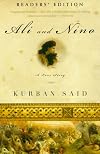
If Azerbaijan were to have a national book, many say that Ali and Nino would be it. A sweeping historical novel set in Baku during World War I, the protagonists Ali and Nino represent all the contradictions, alliances, and compromises that bring such complex diversity to such a geographically small region.
Ali Khan Shirvanshir loves Baku, the East, the desert, and his religion as a Mohammedan. His family has lived, and died in heroic battles against outsiders, in the Caucasus for centuries. show more But he is coming of age at a difficult time. Russia has introduced European sensibilities to the region, and with the outbreak of a distant world war, allegiances must be decided.
Nino Kipiani is a Georgian princess, a Christian, and raised as a European. She loves all things cosmopolitan and detests the idea of wearing a veil or adopting Eastern customs that are denigrating to women. As fate would have it, the two meet as schoolchildren, fall in love, and must defy parents, convention, and ethnic rancor to be together.
Much like the tale told by Robert Duvall in "Secondhand Lions", there is much swashbuckling: wild rides through the desert on horseback, blood feuds, mountain escapes, eunuchs and harems. But rescuing the novel from a Hollywood blockbuster fate is the historical setting and the complexity of the competing forces tearing at the lovers and the region.
Situated in Baku, but with excursions into Georgia, Persia, and Dagestan, and Armenia in the wings, the novel takes us through the collection of ethnically different peoples with different languages, religions, and cultural norms that comprise the Caucuses. The book begins with a catalogue of some of these differences.
We were a very mixed lot, we forty schoolboys who were having a Geography lesson one hot afternoon in the Imperial Russian Humanistic High School of Baku, Transcaucasia: thirty Mohammedans, four Armenians, two Poles, three Sectarians, and one Russian.
The quote also highlights the numerical disadvantage of the Russians, and yet how much influence they have in the region. As the book progresses, nascent nation building is caught up in larger battles between the new Soviet regime and the Ottomans.
Even the authorship of the book reflects the ambiguity and overlapping influences of the region. First published in Germany in 1937, the book was said to be the work of Kurban Said, but his true identity remained a mystery for decades. Even today there is some question, but it is generally believed to be the pen name for a joint collaboration between Baroness Elfriede Ehrenfels and an émigré from Azerbaijan, Lev Nussimbaum, who was born Jewish and converted to Islam. Azerbaijanis often cite an Azerbaijani writer named Chemenzeminli as the author. Once again Europe and Asia meet, Christians, Jews, and Muslims mingle, and nationalities collide in a muddle that seems indecipherable. But as Paul Theroux writes in the afterword:
Ali and Nino is both a love story and a cultural artifact, and part of its message is that governments rise and fall, wars rage, cities are laid to waste, people are displaced, authors die. What remains? Well, written words remain, and perhaps it is of little consequence who wrote them. show less
Ali Khan Shirvanshir loves Baku, the East, the desert, and his religion as a Mohammedan. His family has lived, and died in heroic battles against outsiders, in the Caucasus for centuries. show more But he is coming of age at a difficult time. Russia has introduced European sensibilities to the region, and with the outbreak of a distant world war, allegiances must be decided.
Nino Kipiani is a Georgian princess, a Christian, and raised as a European. She loves all things cosmopolitan and detests the idea of wearing a veil or adopting Eastern customs that are denigrating to women. As fate would have it, the two meet as schoolchildren, fall in love, and must defy parents, convention, and ethnic rancor to be together.
Much like the tale told by Robert Duvall in "Secondhand Lions", there is much swashbuckling: wild rides through the desert on horseback, blood feuds, mountain escapes, eunuchs and harems. But rescuing the novel from a Hollywood blockbuster fate is the historical setting and the complexity of the competing forces tearing at the lovers and the region.
Situated in Baku, but with excursions into Georgia, Persia, and Dagestan, and Armenia in the wings, the novel takes us through the collection of ethnically different peoples with different languages, religions, and cultural norms that comprise the Caucuses. The book begins with a catalogue of some of these differences.
We were a very mixed lot, we forty schoolboys who were having a Geography lesson one hot afternoon in the Imperial Russian Humanistic High School of Baku, Transcaucasia: thirty Mohammedans, four Armenians, two Poles, three Sectarians, and one Russian.
The quote also highlights the numerical disadvantage of the Russians, and yet how much influence they have in the region. As the book progresses, nascent nation building is caught up in larger battles between the new Soviet regime and the Ottomans.
Even the authorship of the book reflects the ambiguity and overlapping influences of the region. First published in Germany in 1937, the book was said to be the work of Kurban Said, but his true identity remained a mystery for decades. Even today there is some question, but it is generally believed to be the pen name for a joint collaboration between Baroness Elfriede Ehrenfels and an émigré from Azerbaijan, Lev Nussimbaum, who was born Jewish and converted to Islam. Azerbaijanis often cite an Azerbaijani writer named Chemenzeminli as the author. Once again Europe and Asia meet, Christians, Jews, and Muslims mingle, and nationalities collide in a muddle that seems indecipherable. But as Paul Theroux writes in the afterword:
Ali and Nino is both a love story and a cultural artifact, and part of its message is that governments rise and fall, wars rage, cities are laid to waste, people are displaced, authors die. What remains? Well, written words remain, and perhaps it is of little consequence who wrote them. show less
I had a hard time getting into the first few chapters of this book, but I stuck with it, and I'm glad that I did. Around the middle, the story picks up and starts to get breathlessly exciting, and beautiful descriptions of cultures and places. The story mainly takes place in Daku, Azerbeijan, but parts of it also take place in the surrounding Caucasus, Georgia, and Iran. Minutely detailed descriptions of setting, food, people, and customs are poetic and really make the reader feel as if they show more are in a bustling foreign locale. Legends and religious stories are retold without distracting from the overall flow of the narrative, but instead only adding to the background of the characters and the story. The two main characters, Ali, a Muslim, and Nino, his Christian love, are well-drawn, especially Ali, who narrates with a distinctive voice. This is a timely love story as divisions between Christians and Muslims continue to exist through out the world. Although the period details of the story are concrete, the essence feels as if it could happen today. A beautiful work of art, and I highly recommend it. show less
There is perhaps no better introduction to the Caucasus than reading the fictional “Ali and Nino” (1937), by Kurban Said (pseudonym for Lev Nussimbaum). Part touching love story, part description of the contrasting cultures in this part of the world, set against the outbreak of the First World War and the Russian Revolution, and its effects on Azerbaijan. Ali Khan is a Muslim Azerbaijani of Persian origin, Nino a Georgian, thus European, and Christian, but their love for each other seems show more to overcome the cultural differences, and their parents are modern enough to ultimately accept this. Yet, their live together becomes increasingly difficult because of a treacherous Armenian (of course, in an Azerbijani book), and modernity-opposing habits as blood honour and broader family values rooted in religion. And is ultimately undone by Azarbaijani nationalism. Read this book! show less
I have a book club that "reads around the world." For such a tucked away country as Azerbaijan, this book packs an unexpected punch. It is a delicate weaving of plot with geographical details, historical facts, and cultural nuances, creating a graceful balance that is perfect for this genre.
One reviewer mentioned that the book seems to be divided into 3 flowing phases: the first third drops names of various leaders throughout Middle Eastern history, in which you might find yourself show more floundering until you can grasp that "Mohammedan" is used synonymously in the book with East/Asiatic, and "Georgian" is synonymous with West/Europe/Christian. Once you get a feel for this rocking back and forth of East/West, Asia/Europe, Muslim/Christian, you'll be able to orient yourself within the story.
By this time, the plot starts rolling, and you are becoming more familiar with the characters and taking an interest in their activities. I personally found a topic or two each chapter to spend a few minutes researching on the internet (since the novel is so geographically-, historically-, and culturally-grounded), and the pictures and articles I looked through really helped the story come to life in a spectacular way, and vice versa.
Take quotes such as this:
"The glowing breath of Zoroaster's fire swept across the plain on the wings of the desert wind."
This perhaps seem loquacious, until your side-reading leads you to discover that not only does Azerbaijan have large reserves of natural gas, but that gas has escaped to the surface in some areas creating fires that have been burning for years. These "eternal fires" are thought to have played an important role in Zoroastrianism in Azerbaijan and Persia.
Cultural nuances dig deeper from there as the author explains the context of the time, so it will help if you spend a minute or two reading about Shia/Sunni Islam and the "Mourning of Muharram." Soon you find yourself rolling into the final third of the book, where you feel fully settled into the historical context, and then the book becomes a page-turner.
This novel is absolutely a gem and a shining example of historical fiction that will unlock the thoughts and mystery of Azerbaijan. show less
One reviewer mentioned that the book seems to be divided into 3 flowing phases: the first third drops names of various leaders throughout Middle Eastern history, in which you might find yourself show more floundering until you can grasp that "Mohammedan" is used synonymously in the book with East/Asiatic, and "Georgian" is synonymous with West/Europe/Christian. Once you get a feel for this rocking back and forth of East/West, Asia/Europe, Muslim/Christian, you'll be able to orient yourself within the story.
By this time, the plot starts rolling, and you are becoming more familiar with the characters and taking an interest in their activities. I personally found a topic or two each chapter to spend a few minutes researching on the internet (since the novel is so geographically-, historically-, and culturally-grounded), and the pictures and articles I looked through really helped the story come to life in a spectacular way, and vice versa.
Take quotes such as this:
"The glowing breath of Zoroaster's fire swept across the plain on the wings of the desert wind."
This perhaps seem loquacious, until your side-reading leads you to discover that not only does Azerbaijan have large reserves of natural gas, but that gas has escaped to the surface in some areas creating fires that have been burning for years. These "eternal fires" are thought to have played an important role in Zoroastrianism in Azerbaijan and Persia.
Cultural nuances dig deeper from there as the author explains the context of the time, so it will help if you spend a minute or two reading about Shia/Sunni Islam and the "Mourning of Muharram." Soon you find yourself rolling into the final third of the book, where you feel fully settled into the historical context, and then the book becomes a page-turner.
This novel is absolutely a gem and a shining example of historical fiction that will unlock the thoughts and mystery of Azerbaijan. show less
Lists
Awards


You May Also Like


Associated Authors
Statistics
- Works
- 18
- Members
- 1,281
- Popularity
- #20,020
- Rating
- 3.8
- Reviews
- 55
- ISBNs
- 99
- Languages
- 20
- Favorited
- 1