
Robert Badinter (1928–2024)
Author of Condorcet, 1743-1794
About the Author
Works by Robert Badinter
Associated Works
Crimes contre l'humanité. Barbie, Touvier, Bousquet, Papon (1998) — Preface, some editions — 2 copies
Tagged
Common Knowledge
- Legal name
- Badinter, Robert
- Birthdate
- 1928-30-03
- Date of death
- 2024-02-09
- Gender
- male
- Education
- Agrégation de droit privé (1952)
Université Columbia (MA, 19 49)
Université de Paris (Licence, Lettres, 19 47 / Licence droit, 19 48)
Lycée Vaugelas, Chambéry (19 43 | 19 44) - Occupations
- lawyer
Minister of Justice - Organizations
- Département des Hauts-de-Seine (Sénateur, 19 96 | 20 11)
Conseil constitutionnel française (Président, 19 86 | 19 95)
Ministère de la Justice française (Ministre, 19 81 | 19 86)
Université de Paris 1 (Professeur, Droit, 19 74 | 19 94)
Université d'Amiens (Professeur, Droit, 19 69 | 19 74)
Université de Besançon (Professeur, Droit, 19 68 | 19 69) (show all 11)
Université de Dijon (Professeur, Droit, 19 66 | 19 68)
Parti socialiste française
Barreau de Paris (Avocat, 19 51 | 20 17)
Badinter, Bredin et partenaire, Cabinet d'avocats (Fondateur, 19 65 | 19 81)
Société des amis de Victor Hugo. (Président d'honneur, 20 16 | ) - Awards and honors
- Aucune officielle d'état (Par choix personnel)
Université de Zagreb (Docteur honoris causa, 20 03)
HEC Paris (Docteur honoris causa, 20 06)
Université de Neuchâtel (Docteur honoris causa, 20 09)
Université d'État de Moldavie (Docteur honoris causa, 20 10)
Université Galatasaray (Docteur honoris causa, 20 11) (show all 7)
Université libre de Bruxelles (Docteur honoris causa, 20 13) - Relationships
- Badinter, Elisabeth (wife)
- Short biography
- Robert Badinter is a criminal lawyer, professor and politician best known for his efforts to abolish the death penalty in France (which was banned in 1981). A member of the Socialist Party, he served as Minister of Justice from 1981-1986 under President François Mitterrand. Currently, he is a Senator for the Hauts-de-Seine département.
He is married to the writer and academic Élisabeth Badinter. - Nationality
- France
- Birthplace
- Paris, Île-de-France, France
- Places of residence
- Paris, France
- Map Location
- France
- Associated Place (for map)
- Paris, France
Members
Reviews

It's not of a great style, but Bégaudeau knows definitely how to keep you reading without being able to stop. Certainly because of the context: as "L'esquive", it benefits from the rhythm of French urban language, and Bégaudeau adds to this a segmented narration, the whole thing becoming easy to read and quite addictive.
As for the "documentary" part, it gives you a glimpse on a handful of issues, without ever have this usual moralistic tone you tend to expect from any show more "Ministry-of-Education" product. And with this subtlety, it particularly highlights how aggressiveness exists on both sides, in each of the Education system’s protagonists; not only coming from pupils but also from teachers, who as much human being as everybody, can’t always let their own issues at the high school doors; who don’t always try to calm down a raising altercation with a pupil, maybe then taking the opportunity to get them punished and potentially excluded quicker than they should be. Where the teacher is not this devoted-to-his-job person, priest of Education, we think he is; where teaching, as much as it should be a vocation, can’t stay long as such in current conditions.
I also appreciated this evolution you can acknowledge only at the end: for months, the teacher cannot help himself to notice what pupils wear when they talk, and slowly this decreases. Humanization? As he’s learning to know them, does he become more focused by their personality?
And at last these always short but repetitive scenes in the staff room, where nobody is really listening to each other, where everybody tries nevertheless to drop his/her emotions on his/her colleagues. Where again teachers are just human beings as others, just doing a job and not communicating with their colleagues. show less
As for the "documentary" part, it gives you a glimpse on a handful of issues, without ever have this usual moralistic tone you tend to expect from any show more "Ministry-of-Education" product. And with this subtlety, it particularly highlights how aggressiveness exists on both sides, in each of the Education system’s protagonists; not only coming from pupils but also from teachers, who as much human being as everybody, can’t always let their own issues at the high school doors; who don’t always try to calm down a raising altercation with a pupil, maybe then taking the opportunity to get them punished and potentially excluded quicker than they should be. Where the teacher is not this devoted-to-his-job person, priest of Education, we think he is; where teaching, as much as it should be a vocation, can’t stay long as such in current conditions.
I also appreciated this evolution you can acknowledge only at the end: for months, the teacher cannot help himself to notice what pupils wear when they talk, and slowly this decreases. Humanization? As he’s learning to know them, does he become more focused by their personality?
And at last these always short but repetitive scenes in the staff room, where nobody is really listening to each other, where everybody tries nevertheless to drop his/her emotions on his/her colleagues. Where again teachers are just human beings as others, just doing a job and not communicating with their colleagues. show less
Demain vous voterez l'abolition de la peine de mort, Discours de Robert Badinter, 17 septembre 1981, suivi de Je crois qu'il y a lieu de recourir à la peine exemplaire, Discours de Maurice Barrès, 3 juillet 1908 by Robert Badinter

J’ai voulu lire ce livre pour le discours de Badinter, mais j’ai commencé par celui de Maurice Barrès, pour respecter l’ordre historique, et parce que je ne voulais pas finir par le discours de haine. C’est intéressant de voir d’ailleurs comment les deux discours se répondent, dans les arguments historiques et les arguments moraux.
Je ne pense pas que les chiffres puissent apporter quoi que ce soit à ce débat de la peine de mort, c’est juste une question morale, une question show more de comment l’on comprend l’humanité et comment l’on appréhende ce qui semble en faire dévier certains individus. Bien sût, si on lit ce livre c’est que l’on adhère à la définition de Badinter plutôt qu’à celle de Barrès, mais un petit rappel historique n’est pas de trop pour l’éclairage qu’il permet de porter sur des discours plus actuels. Deux discours intéressants donc, mais pour des raisons bien différentes, et un livre petit par son nombre de pages mais pas par la réflexion qu’il contient et qu’il suscite. show less
Je ne pense pas que les chiffres puissent apporter quoi que ce soit à ce débat de la peine de mort, c’est juste une question morale, une question show more de comment l’on comprend l’humanité et comment l’on appréhende ce qui semble en faire dévier certains individus. Bien sût, si on lit ce livre c’est que l’on adhère à la définition de Badinter plutôt qu’à celle de Barrès, mais un petit rappel historique n’est pas de trop pour l’éclairage qu’il permet de porter sur des discours plus actuels. Deux discours intéressants donc, mais pour des raisons bien différentes, et un livre petit par son nombre de pages mais pas par la réflexion qu’il contient et qu’il suscite. show less
"Demain vous voterez l'abolition de la peine de mort" ; Suivi de "Je crois qu'il y a lieu de recourir à la peine exemplaire" by Robert Badinter
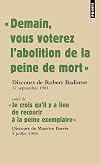
« Demain, vous voterez l’abolition de la peine de mort »
Ce petit livre de la collection Les Grands Discours aux éditions Points est tout à fait charmant. Il réunit différents discours sur la thématique de la peine de mort.
On doit saluer les propos introductifs, les quelques notes en bas de page et l’appareillage critique ainsi que la chronologie biographique qui permet un bref rappel du parcours des auteurs en présence.
Ce livre permet de mettre dans toutes les poches de grands show more discours qui ont fait l’histoire et qui sont quelques fois le produit de situations historiques. Ils sont aussi révélateurs de l’esprit des peuples et plus largement de l’humanité entière. On y retrouve quelques fois la marque du temps, le génie d’un homme ou d’une femme illustre ; rarement la bassesse profonde.
Une bonne édition, de qualité et à prix modique ! show less
Ce petit livre de la collection Les Grands Discours aux éditions Points est tout à fait charmant. Il réunit différents discours sur la thématique de la peine de mort.
On doit saluer les propos introductifs, les quelques notes en bas de page et l’appareillage critique ainsi que la chronologie biographique qui permet un bref rappel du parcours des auteurs en présence.
Ce livre permet de mettre dans toutes les poches de grands show more discours qui ont fait l’histoire et qui sont quelques fois le produit de situations historiques. Ils sont aussi révélateurs de l’esprit des peuples et plus largement de l’humanité entière. On y retrouve quelques fois la marque du temps, le génie d’un homme ou d’une femme illustre ; rarement la bassesse profonde.
Une bonne édition, de qualité et à prix modique ! show less

Histoire de sa grand-mère, immigration russe à Paris avant la guerre, bien documenté, intéressant.
Awards


You May Also Like


Associated Authors
Statistics
- Works
- 32
- Also by
- 3
- Members
- 307
- Popularity
- #76,699
- Rating
- 4.1
- Reviews
- 6
- ISBNs
- 56
- Languages
- 5


