
Harmony Becker
Author of They Called Us Enemy
Works by Harmony Becker
Anemone & Catharus 1 copy
Himawari Share, Volume 1 1 copy
Tagged
Common Knowledge
- Birthdate
- 20th century
- Gender
- female
- Occupations
- artist
illustrator - Agent
- DongWon Song
- Nationality
- USA
- Birthplace
- Cincinnati, Ohio, USA
- Places of residence
- South Korea
Japan
Columbus, Ohio, USA
Mexico City, Mexico
Members
Reviews

This is a poignant, thoughtful, funny and tender multi-cultural story about language, friendship and finding one’s feet. It follows three young women living in a sharehouse in Tokyo. Nao, who was born in Japan but grew up in America, has come to improve her mother tongue. Tina, from Singapore, and Hyejung, from Korea, are both studying for the university entrance exams. The three of them mainly communicate in English with each other, but they also have Japanese housemates, two brothers who show more don’t speak much English.
I loved this so much! It has a vibrant sense of place, and moreover of a place to be explored, and captures living in Japan through the seasons. I loved the characters and the illustrations, and the lively way the illustrations portray the characters. Their mannerisms, their quirks. Their hopes and dreams and frustrations. Their friendships.
When the characters are speaking Japanese (or Korean, etc), the speech bubbles are in Japanese characters, with the English translation written underneath. But if the POV character doesn’t understand what has been said, then the English translation might be incomplete or missing altogether. I thought this was a really effective way of capturing the experience of not knowing a language fluently (or not knowing it at all)!
Becker has also phonetically written her characters’ accents and at the end, there’s an author’s note “On the use of accents in this book”:
Unfortunately, it’s hard to quote pictures.
I am strongly considering buying myself a copy of this.
I loved this so much! It has a vibrant sense of place, and moreover of a place to be explored, and captures living in Japan through the seasons. I loved the characters and the illustrations, and the lively way the illustrations portray the characters. Their mannerisms, their quirks. Their hopes and dreams and frustrations. Their friendships.
When the characters are speaking Japanese (or Korean, etc), the speech bubbles are in Japanese characters, with the English translation written underneath. But if the POV character doesn’t understand what has been said, then the English translation might be incomplete or missing altogether. I thought this was a really effective way of capturing the experience of not knowing a language fluently (or not knowing it at all)!
Becker has also phonetically written her characters’ accents and at the end, there’s an author’s note “On the use of accents in this book”:
Western media has a long history of portraying Asian people in offensive, one-dimensional ways. So often characters are written with thick foreign accents for comic or exotic effect [...] I grew up listening to accented English in my home and community, and I have lived in several countries where I struggled with my own broken Japanese, Korean and Spanish. My intent with Himawari House was to allow characters who spoke with accents, who occasionally stumbled over their grammar, to be fully actualized, three-dimensional people. I love accents. I think they add depth and character to one’s speech -- a sense of place.I think it helps that accented English isn’t the only thing Hyejung and Tina speak, and so they’re not defined solely by their imperfect English -- standard, fluent English is used to translate the other languages they speak and to translate their thoughts. And because this is a graphic novel, it’s their visual depiction which makes the strongest impression.
Unfortunately, it’s hard to quote pictures.
I am strongly considering buying myself a copy of this.
I wonder how different I would have been if I had stayed here.show less
To be a part of everything… and not just a bystander.
I feel like I’m mourning a twin I lost in childhood.
A twin who never got to grow up… but who always… waited for me to come back.
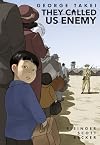
You probably know George Takei from his role as Hikaru Sulu in the original Star Trek series. You may know him as a LGBTQ and civil rights activist. But I didn’t know that, as a child, he had been interned, along with his family, at the easternmost Japanese internment camp, Rohwer Camp in Arkansas.
He was only four when his family was removed from their home in California and incarcerated. Like many kids of that age, as long as he was with his family, it seemed like an adventure – even in show more their first home in the horse stalls at the Santa Anita racetrack.
This graphic novel includes his experiences as a child and his deeper knowledge of events as an adult, including the despair and humiliations his parents endured. It ends talking about the kids incarcerated at the US border.
I learned so much from it. It’s deeply relevant today. I would love to see copies in American junior high and highschool classrooms as kids today so need to know this chapter of American history. show less
He was only four when his family was removed from their home in California and incarcerated. Like many kids of that age, as long as he was with his family, it seemed like an adventure – even in show more their first home in the horse stalls at the Santa Anita racetrack.
This graphic novel includes his experiences as a child and his deeper knowledge of events as an adult, including the despair and humiliations his parents endured. It ends talking about the kids incarcerated at the US border.
I learned so much from it. It’s deeply relevant today. I would love to see copies in American junior high and highschool classrooms as kids today so need to know this chapter of American history. show less
The Publisher Says: A stunning graphic memoir recounting actor/author/activist George Takei's childhood imprisoned within American concentration camps during World War II. Experience the forces that shaped an American icon -- and America itself -- in this gripping tale of courage, country, loyalty, and love.
George Takei has captured hearts and minds worldwide with his captivating stage presence and outspoken commitment to equal rights. But long before he braved new frontiers in Star Trek, he show more woke up as a four-year-old boy to find his own birth country at war with his father's -- and their entire family forced from their home into an uncertain future.
In 1942, at the order of President Franklin D. Roosevelt, every person of Japanese descent on the west coast was rounded up and shipped to one of ten "relocation centers," hundreds or thousands of miles from home, where they would be held for years under armed guard.
They Called Us Enemy is Takei's firsthand account of those years behind barbed wire, the joys and terrors of growing up under legalized racism, his mother's hard choices, his father's faith in democracy, and the way those experiences planted the seeds for his astonishing future.
What is American? Who gets to decide? When the world is against you, what can one person do? To answer these questions, George Takei joins co-writers Justin Eisinger & Steven Scott and artist Harmony Becker for the journey of a lifetime.
THIS WAS AN INTER–LIBRARY LOAN FROM MY LOCAL LIBRARY. THANKS, Y'ALL!
My Review: A graphic memoir? Me? And give it five stars?!? Never. Will not happen.
Yet here we are:
The horror of interning United States citizens based solely on the color of their skins!
Oh wait...we do that now..."interning" being synonymous with "incarcerating"...well, anyway, it's appalling and abominable. The Takei family is rousted out of their Los Angeles home by Executive Order 9066. They're shipped as far away from the Pacific Ocean as they can get: The Great State of Arkansas! *shudder* A swampy bit, as well...the Takeis weren't familiar with the climate, hot and humid summers with cold and snowy winters; the worst of all possible worlds for Mediterranean-climate natives!
George, brother Henry, and sister Nancy are lucky, however, as their father is a take-charge kind of a guy with a glad-handing streak as well as organizational capabilities, patience in abundance, and a generous heart. Mama Takei is sure her family will be okay despite everything because she is going to by-god *make* things okay. Her efforts to clothe and entertain her family, her strenuous work ethic keeping the children clean and as healthy as she can, mean that they're better off than many...so the Takeis help them. Because of course...those with nothing find a way to share with those who have even less.
There were good times as well as bad. Takei senior, as a helpful and useful inmate, got the family occasional privileges, like the use of a Jeep for a day out:
Not everyone in Arkansas thought the Japanese belonged in the camps. Not everyone in the US agreed with this vile act, this blot on the national escutcheon.
But tell that to the men who were young and patriotic enough to want to serve their country in the global war against fascism.
Their mistreatment at the hands of the democratic institutions designed to defend a citizen's life, liberty, and ability to pursue an existence that will make them happy radicalized them, leading to protests and horrors of oppression still worse than internment at Federal penitentiaries.
The tale ends, as we all know, when the war is over...but the country's wounds aren't healed so much as papered over. Now the returning African Americans, veterans and war workers, would need to gain civil rights...and there were injustices against the Japanese Americans unaddressed...and so on and so forth, to this good day, with others now in the victim role. Takei specifically draws parallels with the Muslim refugee crisis and the Hispanic emigration atrocities. He lived it. His voice carries authority: What we-the-people are allowing, even (I am nauseated to say) enjoying, to occur to Hispanic families is unconscionable, inexcusable, and proof that the lessons of history are lost on far too many of us.
Takei's journey took him into our living rooms on Star Trek: The Original Series, and its many sequels. He's spent his many years since riding that amazing introduction back into our lives advocating for positive social changes and fairer, more equal access to the USA's immense and unprecedented benefits for all. His life has been very well-lived and spent generously working to bring the American Dream into reality, only for *all* Americans.
Be like George, as the meme says.
(Only I like this one better.) show less
I doubt a book about immigrants and children of immigrants being snatched from their homes and placed in camps with awful conditions could possibly be more timely than it is right now. George Takei was one of those children. His father was born in Japan and his mother was a US citizen born in CA, but that did not matter. After Pearl Harbor no one of Japanese heritage was safe.
At first I questioned the logic of telling this story via a graphic novel, but I was not far into it when I realized show more what I brilliant idea it was. It's a perfect medium to capture both the innocence and horror of a child facing such an awful time. He was so young that he and his little brother thought it was a great adventure until they were hungry and cold, or stuck in a swampy camp down South.
George and his family were incarcerated for four long years. They lost their family cleaning business and their home and had to start from scratch when they were finally released. They were forced to live on the street for a while, as were thousands of others. I would have thought this was incomprehensible behavior by the federal government, but now I know better.
Highly recommended if you can handle it. show less
At first I questioned the logic of telling this story via a graphic novel, but I was not far into it when I realized show more what I brilliant idea it was. It's a perfect medium to capture both the innocence and horror of a child facing such an awful time. He was so young that he and his little brother thought it was a great adventure until they were hungry and cold, or stuck in a swampy camp down South.
George and his family were incarcerated for four long years. They lost their family cleaning business and their home and had to start from scratch when they were finally released. They were forced to live on the street for a while, as were thousands of others. I would have thought this was incomprehensible behavior by the federal government, but now I know better.
Highly recommended if you can handle it. show less
Lists
Youth: DEI (1)
Awards


You May Also Like


Associated Authors
Statistics
- Works
- 5
- Members
- 2,883
- Popularity
- #8,884
- Rating
- 4.4
- Reviews
- 157
- ISBNs
- 25
- Languages
- 5