
Edward Bernays (1891–1995)
Author of Propaganda
About the Author
The nephew of Sigmund Freud, Edward Bernays (1891-1995) pioneered the scientific technique of shaping and manipulating public opinion, which he called "engineering of consent." During World War I, he was an integral part - along with Walter Lippmann - of the U.S. Committee on Public Information show more (CPI), a powerful propaganda machine that advertised and sold the war to the American people as one that would "Make the World Safe for Democracy." The marketing strategies for all future wars would be based on the CPI model. Over the next half century, Bernays, combining the techniques he had learned in the CPI with the ideas of Lippmann and Freud, fashioned a career as an outspoken proponent of propaganda for political and corporate manipulation of the population, earning the moniker "father of public relations." Among his powerful clients were President Calvin Coolidge, Procter & Gamble, CBS, the American Tobacco Company and General Electric. In addition, his propaganda campaign for the United Fruit Company in the early 1950s led directly to the CIA's overthrow of the elected government of Guatemala show less
Image credit: Edward Bernays - A nephew of Sigmund Freud
Works by Edward Bernays
An outline of careers 1 copy
Пропаганда 1 copy
Tagged
Common Knowledge
- Other names
- Bernays, Edward Louis James
- Birthdate
- 1891-11-22
- Date of death
- 1995-03-09
- Gender
- male
- Education
- DeWitt Clinton High School (1908)
Cornell University (AB|1912) - Occupations
- public relations
advertising - Relationships
- Freud-Bernays, Anna (parent)
Fleischman, Doris E. (spouse)
Bernays, Anne (offspring)
Freud, Sigmund (uncle)
Freud, Anna (cousin)
Freud, Sophie (nibling) - Nationality
- Austria (birth)
USA (naturalized) - Birthplace
- Vienna, Austria
- Places of residence
- New York, New York, USA
- Place of death
- Cambridge, Massachusetts, USA
- Associated Place (for map)
- USA
Members
Reviews
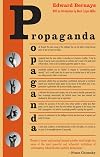
Twentieth century was thinking man's golden age (same as 21st one seems to be the age of over-sensitive, highly-emotional man). This was also the period where he made weapons to be used for its own suicide. And by this I do not mean military technology advances, ever deadlier, ever more powerful but subtle techniques of mass control and ultimately mind-messing techniques.
This is where we come at propaganda. Edward L. Bernays is considered father of the propaganda and it is visible from this show more book that he is a very proud of his achievements. Using his sharp mind he comes to the truly ingenious ways of manipulating masses (and I have to say that approach he used is so simple but so effective it is incredible... hat down by all means). And this is where we come to the catch.
As much as he tries to hide it, author thinks of him as above the plebs and even cut above the people he is helping achieving their goals. This is unavoidable - person just cannot hold same perspective when it has power of life and death over masses. So while main focus is how propaganda can help society, from education to every day life) it becomes more than obvious that propaganda is tool where goals are set by those using it - be it individuals, corporate entities or governments. and these goals do not need to align with goals that will benefit everyone. In every chapter author mentions puppeteers in the background of every event taking place but he stays to his conviction that people are doing right things and not abusing their power (heh, right).
Take for example author's role in tobacco industry propaganda - he did make a change and stopped supporting it but not after ensuring tobacco industry to become what it is today.
And this brings us to another point - propagandist (or PR person as author calls it) is a mercenary that works for money that is payed by interested parties. While it is expected for this person to avoid suspicious contracts, lets be honest, when we are talking about millions who exactly is paying attention to moralities. And this is where author goes into sphere of wishful thinking (and to be honest he shows he is aware of it, for a very clever man he is not that subtle, and one has to wonder how come).
All in all book is very contemporary and all examples and approaches are valid today (even more so with the rise of media and social networks in recent decades). What worries is how author remains OK with the aspect of the ever changing propaganda ideas - as long it goes with the client's plans all is good. Just take above mentioned tobacco industry, exalted at the beginning, during 1940's onward it was looked upon first with suspicion and then vilified. So propaganda info changed with time - but do we ever look back to devastation that came first? And does not this remind you of last and current year - what was laughed at, ridiculed, with new information was started to be treated as regular news ("We all knew it from the start!" Ha!) and people were left confused (to say the least).
This book is excellent read because after reading it (and if you payed attention) you will become aware of news and media patterns - approach did not change at all, only thing that changed is the level of mind-numbing-bombardment, number of vectors used rose hundred fold (previously only pamphlets and public speeches, then newspapers and radio, followed by TV and now practically inescapable Internet and social networks).
Recommended book to everyone. show less
This is where we come at propaganda. Edward L. Bernays is considered father of the propaganda and it is visible from this show more book that he is a very proud of his achievements. Using his sharp mind he comes to the truly ingenious ways of manipulating masses (and I have to say that approach he used is so simple but so effective it is incredible... hat down by all means). And this is where we come to the catch.
As much as he tries to hide it, author thinks of him as above the plebs and even cut above the people he is helping achieving their goals. This is unavoidable - person just cannot hold same perspective when it has power of life and death over masses. So while main focus is how propaganda can help society, from education to every day life) it becomes more than obvious that propaganda is tool where goals are set by those using it - be it individuals, corporate entities or governments. and these goals do not need to align with goals that will benefit everyone. In every chapter author mentions puppeteers in the background of every event taking place but he stays to his conviction that people are doing right things and not abusing their power (heh, right).
Take for example author's role in tobacco industry propaganda - he did make a change and stopped supporting it but not after ensuring tobacco industry to become what it is today.
And this brings us to another point - propagandist (or PR person as author calls it) is a mercenary that works for money that is payed by interested parties. While it is expected for this person to avoid suspicious contracts, lets be honest, when we are talking about millions who exactly is paying attention to moralities. And this is where author goes into sphere of wishful thinking (and to be honest he shows he is aware of it, for a very clever man he is not that subtle, and one has to wonder how come).
All in all book is very contemporary and all examples and approaches are valid today (even more so with the rise of media and social networks in recent decades). What worries is how author remains OK with the aspect of the ever changing propaganda ideas - as long it goes with the client's plans all is good. Just take above mentioned tobacco industry, exalted at the beginning, during 1940's onward it was looked upon first with suspicion and then vilified. So propaganda info changed with time - but do we ever look back to devastation that came first? And does not this remind you of last and current year - what was laughed at, ridiculed, with new information was started to be treated as regular news ("We all knew it from the start!" Ha!) and people were left confused (to say the least).
This book is excellent read because after reading it (and if you payed attention) you will become aware of news and media patterns - approach did not change at all, only thing that changed is the level of mind-numbing-bombardment, number of vectors used rose hundred fold (previously only pamphlets and public speeches, then newspapers and radio, followed by TV and now practically inescapable Internet and social networks).
Recommended book to everyone. show less
Eighty four years after its initial publication, Bernay's 'Propaganda' continues to illuminate some of the most important aspects of the modern societies we live in. His examples are certainly out-of-date, yet, the principles he keeps of referring to are more relevant than ever. It can be considered in the category of 'The Prince' by Machiavelli; you are going to admire the crystallization of the expression, and you are going to abhor the results at the same time, the results that are show more brought upon us by the people who understand the principles of 'Propaganda' and apply them to our daily lives ruthlessly.
The new introduction by Mark Crispin Miller does not fail to add value and more insight, too. His criticism of Bernays, properly put in historical context, sheds light on some obscure points of the book. Combined with the book, this gives you an astonishing overview of 'manufacturing consent' and the 'illusion of democracy'. show less
The new introduction by Mark Crispin Miller does not fail to add value and more insight, too. His criticism of Bernays, properly put in historical context, sheds light on some obscure points of the book. Combined with the book, this gives you an astonishing overview of 'manufacturing consent' and the 'illusion of democracy'. show less
After reading about this book's sizeable reputation, I expected a brutally leftist cultural revolution instruction manual along the lines of Saul Alinsky's Rules For Radicals. I feel it's actually a rather ho-hum pamphlet (yes, it's short) about subtle marketing techniques. But perhaps THAT is the greatest and most subversive achievement of this book: To put forth rather creepy tactics in an apparently bland way. And imagine my surprise to see a leftist introduction, by someone named Mark show more Crispin Miller, trashing Bernays as a right-wing ideologue (in other words, the kind of person who is mislabeled as a "fascist" by most modern-day liberals)! See the United Fruit Company's partnership with the CIA to overthrow Guatemala's government. To observe true leftist propaganda, check out many of the original programs, particularly Orange Is The New Black, aired on the company called Netflix, which was co-founded by one of Bernays' savvy descendants. show less
A fascinating look into propaganda and how inbuilt it is in our lives. We may give it different names like persuasion, mass marketing and so on but it is so much more than that. I think one thing I've learnt in my life is that nothing is pure evil nor pure good, it all depends on the context and the hands using it. Thank you for writing this Mr Bernays, may your god show you favor. Overall it was a very empowering read and I definitely suggest it- things like women's rights, slavery show more abolishment, etc wouldn't be present if not for this 'art'. show less
Lists
Awards

You May Also Like


Associated Authors
Statistics
- Works
- 13
- Members
- 1,509
- Popularity
- #17,038
- Rating
- 3.7
- Reviews
- 19
- ISBNs
- 91
- Languages
- 8
- Favorited
- 3