
John Brunner (1934–1995)
Author of Stand on Zanzibar
About the Author
Legendary science fiction author John Brunner was the winner of the Hugo award and two-time winner of the British Science Fiction Award. He was perhaps the first science fiction author to predict the Internet and coined the term "worm" to descibe computer viruses. Mr. Brunner died in 1995
Series
Works by John Brunner
The Society of Time: The Original Trilogy and Other Stories (British Library Science Fiction Classics) (2020) 34 copies
Chroniken der Zukunft III. Die Zeitsonde. Feinde aus dem Kosmos / Kinder der Retorte. (1984) 16 copies
The John Brunner Collection Volume One: The Sheep Look Up, The Crucible of Time, and The Jagged Orbit (2018) 15 copies, 1 review
The John Brunner Collection Volume Two: The Wrong End of Time, The Ladder in the Sky, and The Productions of Time (2018) 7 copies
Galaxy 9 - Eine Auswahl der besten Stories aus dem Schience Fiction Magazine Galaxy (1967) — Contributor — 4 copies
Moths 2 copies
Father of lies 2 copies
På tærsklen til evigheden 2 copies
The Brink 2 copies
They Take [short fiction] 2 copies
Host Age {short story} 2 copies
Lungfish 2 copies
Short Fiction Collection 1 copy
The Man from the Big Dark 1 copy
En las estrellas 1 copy
Les négriers du cosmos 1 copy
Angeles o monstruos 1 copy
Short Fiction Collected 1 copy
Evil That Men Do 1 copy
Chilidren of the Thunder 1 copy
Good with Rice 1 copy
Avvertite il mondo 1 copy
Rare JOHN BRUNNER The Days Of March LTD 1/26 SIGNED Slipcase NUCLEAR DISARMAMENT 1988 [Hardcover] John Brunner (1988) 1 copy
The Invisible Idiot — Author — 1 copy
The Easy Way Out 1 copy
Starlanes (July 1955 Issue) 1 copy
A Mercy Worse Than None 1 copy
Pond Water 1 copy
Dropping Ghyll 1 copy
Concerning the Forthcoming Inexpensive Paperback Translation of the Necronomicon of Abdul Alhazred 1 copy
Who Lies Beneath a Spell 1 copy
Tantamount to Murder 1 copy
The long way to Earth 1 copy
La Toile de l'araignée La Tangence des parallèles (Collection du livre d'anticipation) (1982) 1 copy
Even Chance (SS) 1 copy
Planetfall (SS) 1 copy
Amends 1 copy
Histrión del espacio 1 copy
Web of Everything 1 copy
La Cité du Tigre 1 copy
Telepata 1 copy
Associated Works
The Collected Stories of Philip K. Dick Volume 3: The Father-Thing (1987) — Introduction, some editions — 566 copies, 9 reviews
The Year's Best Science Fiction: Eighth Annual Collection (1991) — Contributor — 416 copies, 6 reviews
The Year's Best Fantasy and Horror: First Annual Collection (1986) — Contributor — 333 copies, 6 reviews
The Pendragon Chronicles: Heroic Fantasy From the Time of King Arthur (1989) — Contributor — 326 copies, 2 reviews
The Year's Best Fantasy and Horror: Sixth Annual Collection (1993) — Contributor — 219 copies, 1 review
Best Science Fiction Stories of the Year Fourth Annual Collection (1975) — Contributor — 84 copies, 3 reviews
In the Shadow of Frankenstein: Tales of the Modern Prometheus (2016) — Contributor — 58 copies, 1 review
Thieves' World® Volume One: Thieves' World, Tales from the Vulgar Unicorn, and Shadows of Sanctuary (2020) — Contributor — 52 copies, 4 reviews
Future Crimes: Mysteries and Detection through Time and Space (2021) — Contributor — 36 copies, 1 review
Spaceworlds (British Library Science Fiction Classics): Stories of Life in the Void: 17 (2021) — Contributor — 30 copies, 1 review
Holding your eight hands; an anthology of science fiction verse (1970) — Contributor — 25 copies, 1 review
Analog Science Fiction/Science Fact: Vol. LXXVI, No. 3 (November 1965) (1965) — Contributor — 17 copies
The Magazine of Fantasy and Science Fiction December 1980, Vol. 59, No. 6 (1980) — Author — 15 copies
The Magazine of Fantasy and Science Fiction June 1985, Vol. 68, No. 6 (1985) — Contributor — 14 copies
The Magazine of Fantasy and Science Fiction January 1992, Vol. 82, No. 1 (1992) — Contributor — 14 copies
Speaking of the Fantastic: Interviews with Writers of Science Fiction and Fantasy (2002) — Contributor — 13 copies
The Magazine of Fantasy and Science Fiction May 1989, Vol. 76, No. 5 (1989) — Contributor — 13 copies
Special Wonder: The Anthony Boucher Memorial Anthology of Fantasy and Science Fiction (1970) — Contributor — 12 copies
Analog Science Fact/Science Fiction: Vol. LXXII, No. 5 (January 1964) (1964) — Contributor — 11 copies
The Magazine of Fantasy and Science Fiction 65. Cyrion in Bronze. (1985) — Contributor, some editions — 11 copies
The far side of time, thirteen original stories;: A science fiction anthology (1974) — Contributor — 6 copies
Australia 2025 : fifteen leading Australians examine the changed face of their country fifty years from now (1975) — Contributor — 4 copies
Millemondi Inverno 1996 — Contributor — 2 copies
Science Fiction Review #29 — Contributor — 1 copy
Cerberus: A Magazine of SF Writings, Vol.1 No.1 (Fall 1977) — Contributor — 1 copy
Tagged
Common Knowledge
- Canonical name
- Brunner, John
- Legal name
- Brunner, John Kilian Houston
- Other names
- Hunt, Gill (pseudonym)
Loxmith, John (pseudonym)
Woodcott, Keith (pseudonym)
Brunner, K. Houston
Brunner, Kilian Houston
Staines, Trevor (pseudonym) (show all 7)
H*rb*rt, A. P. (pseudonym) - Birthdate
- 1934-09-24
- Date of death
- 1995-08-25
- Gender
- male
- Education
- St Andrews Prep School, Pangbourne
Cheltenham College - Occupations
- writer
linguist
translator
activist for nuclear disarmament
critic - Organizations
- Royal Air Force (1953-1955)
Campaign for Nuclear Disarmament
National Council for the Abolition of Nuclear Tests (1957-) - Awards and honors
- Guest of Honour, Eastercon, UK (1967, 1993)
- Agent
- Jane Judd Literary Agency
- Cause of death
- heart attack
- Nationality
- UK
- Birthplace
- Preston Crowmarsh, Oxfordshire, England, UK
- Place of death
- Glasgow, Scotland, UK
- Burial location
- Glasgow Necropolis, Glasgow, Scotland, UK
- Map Location
- England, UK
Members
Discussions
Lee Moyer Cover Recreations in Good Show Sir! — bad science fiction and fantasy covers (November 2024)
Happy Birthday, John Brunner in Dystopian novels (September 2013)
Reviews

review of
John Brunner's Castaway's World / The Rites of Ohe
by tENTATIVELY, a cONVENIENCE - September 27, 2013
Being now an unabashed enthusiast for Brunner's writing, I take it for granted that even his most 'generic' SF will be rife w/ imaginative takes on whatever plot he unfurls. I have a 'soft spot' for Ace Doubles, I always respected their clever marketing, & 2 Brunner novels in one Double is good enuf for me. Despite that, tho, I have somewhat low expectations of a Double b/c I see show more them as a packaging of 2 novels that might not have enuf substance or length to stand on their own. That's not quite the case here b/c Brunner manages to make both stories rich enuf to be stand-alones.
Castaway's World, the 1st of the 2 I read, is sortof Brunner's Lord of the Flies told about people who've managed to make it to a livable, but not necessarily 'hospitable' world after fleeing the death of their planet of origin. Typical of Brunner, he adds some human touches that more 'hard-science' SF writers might avoid in their attn to imagining other more technical aspects of life on a new planet. There's sexual tension, eg:
""No!" Suddenly there was a shrill cry, and Naline was on her feet, clawing at Delvia's back. "No! You aren't going to go!"
[..]
"Tears coursing down her cheeks, voice rough-edged with hysteria, Naline shrieked, "Why don't you say why you want to go? Why don't you say it's to get away from me? Why don't you say it's so you can get Lex the way you've had every other man you could drag in the bushes?"" - pp 46-47
Of course, sexual tension is hardly a new theme in SF - take the somewhat standard trope of multiple men fighting over one surviving woman in an apocalypse scenario. Nonetheless, I think that Brunner deals w/ it in a somewhat more enlightened & realistic way (even tho the above quote doesn't fully reveal that). I reckon it's an equally standard trope to have a person crack up under such circumstances but, again, I think Brunner handles it better than many:
""They found the other party's ship, and that was what they were after. They didn't contact us by radio because they found it could be repaired. When they remembered that we'd go after them if there wasn't some reason why not, they staged this little drama with their guns to make us think they'd been eaten by animals or something. Now they'll take the other ship and get away!"
"The almost paranoid quality of the fantasy had shocked her listeners so that for a long moment open mouths and horrified expressions were her only response. Jerode was wondering at the back of his mind what provisions could be made here for insane persons, when he heard something shouted from outside which made him more relieved than he had imagined possible." - p 80
An example of the shades of William Golding's Lord of the Flies might be this: "Lex had read in the history of psychology about self-mutilation to gain sympathy and attention, but centuries of advancement in juvenile education had almost abolished such pathological behavior. if he hadn't seen what Gomes was doing, he would have found it hard to believe that regression could be so swift and far-reaching." (pp 81-82)
Anyway, I (gratefully) don't feel 'compelled' to say much about either of these 2 bks. I'm happy to see that the protagonist Lex is a "Polymath", altho a newly defined one, & I was thoroughly entertained.
The Rites of Ohe did it for me even more. Again, the basic plot isn't exactly new: humans & their contact w/ other humanoid civilizations - but Brunner has a nice central touch wch I won't give away here. There're "immortals", humans who've had their lifespans & abilities extended phenomenally. Immortal Karmesin is a thousand yrs old w/ thousands more ahead of him, the average lifespan for the average human being somewhere over 100. The bk's cast of characters is printed opposite the title page. Typical of these Ace Doubles, I find it a bit cheesy but I like it anyway:
Karmesin
He spoke with the voice of history from the vantage point of a thousand-year life span.
Merry Duner
With the destiny of planets at stake, she cared only for the man she loved.
Dombeno
A politician with a taste for power, he was jealous of Karmesin's supreme authority.
Snow
This courteous, golden-skinned alien gave his life in trying to hide the deadly secret of his people.
Remlong
Obviously, he was ashamed of not being an Ohean, and it had a dreadful effect on his objectivity.
Rex Quant
An idea he had—which he never took seriously—condemned him to a terrible fate.
Lurid, eh? Borderline TABLOID even.. &, of course, a bit misleading. I'm always interested in alternate dating systems (such as "E.V." (Era Vulgari)) & Brunner uses one here that I imagine might be used elsewhere: "By the twenty-third century CTE (Common Terrestrial Era)". (p 17) & then there's the touch that seems all-too-contemporary but, most likely, already existed by the time of the writing of this novel (in the form of Kamikaze pilots at least), the suicide bomber:
""Lawman Anse," he introduced himself briefly, "We seem to have found the bomber, Secretary."
""Where is he?" Dombeno tensed.
""Here," Anse informed him in a disgusted tone, and made the robot display its burden. On a slab of cracked artificial marble, torn from the interior wall of the old wing, there were several smears of blood and organic residues, and a heap of jagged debris interspersed with recognizable bits of bone." - p 41
Then there's stuff like an apparent reference to Wilhelm Reich's 1946 Listen, Little Man! as Immortal Karmesin puts Dombeno 'in his place' by calling him a "Little man" twice during a conference (p 45) & then says it more explicitly again: "["] Listen, little man, I don't care about disrupting your city, or your planet for that matter.["]" (p 50)
My own experiences w/ family being considerably less than satisfactory, I read this part w/ especial interest: "She had sometimes wondered what life was like for people in the old days, the periods Rex studied, for example, or, more immediately, the days Karmesin could remember, when there were still traces of primitive human social structure such as the semi-permanent family. Modern human education was largely directed toward early self-sufficiency, in recognition of the race's apparent inability to impose on itself close-quarter ties lasting more than about two decades." (p 75) GURRRLLL you ain't missing much - at least from my perspective.
&, HEY!, I just realized that neither of these stories had hypnosis or steam cars, like so many other Brunner bks I've read do. There IS an instantaneously induced suicide that I vaguely remember encountering elsewhere.. but I cdn't find it in any of the other Brunner bks I've read so maybe it was in someone else's bk.
"The two gold-skinned men looked at one another. Snow gave a kind of non-human shrug, and Wanhope said something. As one, they closed their eyes and folded toward the floor like dolls.
""What the—?" exclaimed Kraesser, glancing up. the lawmen made to dive forward.
""Hold it!" Karmesin rapped, and switched on the speaker in his pocket again. The artificial voice spoke after a moment.
""First speaker: expression indicative of futility and discontinuance of effort, overtones of hopelessly disturbed pattern in the sense of pattern of events. Concept of permanent voluntary cessation, or death for two persons inclusive of speaker."
""As though we didn't know," Karmesin said, and switched it off." - p 86
What happens when 2 societies meet? One capable of interstellar travel, the other planetbound for a much longer time than the star-travelers have been around? Read this story, & other exciting tales from John Brunner, & find out!! show less
John Brunner's Castaway's World / The Rites of Ohe
by tENTATIVELY, a cONVENIENCE - September 27, 2013
Being now an unabashed enthusiast for Brunner's writing, I take it for granted that even his most 'generic' SF will be rife w/ imaginative takes on whatever plot he unfurls. I have a 'soft spot' for Ace Doubles, I always respected their clever marketing, & 2 Brunner novels in one Double is good enuf for me. Despite that, tho, I have somewhat low expectations of a Double b/c I see show more them as a packaging of 2 novels that might not have enuf substance or length to stand on their own. That's not quite the case here b/c Brunner manages to make both stories rich enuf to be stand-alones.
Castaway's World, the 1st of the 2 I read, is sortof Brunner's Lord of the Flies told about people who've managed to make it to a livable, but not necessarily 'hospitable' world after fleeing the death of their planet of origin. Typical of Brunner, he adds some human touches that more 'hard-science' SF writers might avoid in their attn to imagining other more technical aspects of life on a new planet. There's sexual tension, eg:
""No!" Suddenly there was a shrill cry, and Naline was on her feet, clawing at Delvia's back. "No! You aren't going to go!"
[..]
"Tears coursing down her cheeks, voice rough-edged with hysteria, Naline shrieked, "Why don't you say why you want to go? Why don't you say it's to get away from me? Why don't you say it's so you can get Lex the way you've had every other man you could drag in the bushes?"" - pp 46-47
Of course, sexual tension is hardly a new theme in SF - take the somewhat standard trope of multiple men fighting over one surviving woman in an apocalypse scenario. Nonetheless, I think that Brunner deals w/ it in a somewhat more enlightened & realistic way (even tho the above quote doesn't fully reveal that). I reckon it's an equally standard trope to have a person crack up under such circumstances but, again, I think Brunner handles it better than many:
""They found the other party's ship, and that was what they were after. They didn't contact us by radio because they found it could be repaired. When they remembered that we'd go after them if there wasn't some reason why not, they staged this little drama with their guns to make us think they'd been eaten by animals or something. Now they'll take the other ship and get away!"
"The almost paranoid quality of the fantasy had shocked her listeners so that for a long moment open mouths and horrified expressions were her only response. Jerode was wondering at the back of his mind what provisions could be made here for insane persons, when he heard something shouted from outside which made him more relieved than he had imagined possible." - p 80
An example of the shades of William Golding's Lord of the Flies might be this: "Lex had read in the history of psychology about self-mutilation to gain sympathy and attention, but centuries of advancement in juvenile education had almost abolished such pathological behavior. if he hadn't seen what Gomes was doing, he would have found it hard to believe that regression could be so swift and far-reaching." (pp 81-82)
Anyway, I (gratefully) don't feel 'compelled' to say much about either of these 2 bks. I'm happy to see that the protagonist Lex is a "Polymath", altho a newly defined one, & I was thoroughly entertained.
The Rites of Ohe did it for me even more. Again, the basic plot isn't exactly new: humans & their contact w/ other humanoid civilizations - but Brunner has a nice central touch wch I won't give away here. There're "immortals", humans who've had their lifespans & abilities extended phenomenally. Immortal Karmesin is a thousand yrs old w/ thousands more ahead of him, the average lifespan for the average human being somewhere over 100. The bk's cast of characters is printed opposite the title page. Typical of these Ace Doubles, I find it a bit cheesy but I like it anyway:
Karmesin
He spoke with the voice of history from the vantage point of a thousand-year life span.
Merry Duner
With the destiny of planets at stake, she cared only for the man she loved.
Dombeno
A politician with a taste for power, he was jealous of Karmesin's supreme authority.
Snow
This courteous, golden-skinned alien gave his life in trying to hide the deadly secret of his people.
Remlong
Obviously, he was ashamed of not being an Ohean, and it had a dreadful effect on his objectivity.
Rex Quant
An idea he had—which he never took seriously—condemned him to a terrible fate.
Lurid, eh? Borderline TABLOID even.. &, of course, a bit misleading. I'm always interested in alternate dating systems (such as "E.V." (Era Vulgari)) & Brunner uses one here that I imagine might be used elsewhere: "By the twenty-third century CTE (Common Terrestrial Era)". (p 17) & then there's the touch that seems all-too-contemporary but, most likely, already existed by the time of the writing of this novel (in the form of Kamikaze pilots at least), the suicide bomber:
""Lawman Anse," he introduced himself briefly, "We seem to have found the bomber, Secretary."
""Where is he?" Dombeno tensed.
""Here," Anse informed him in a disgusted tone, and made the robot display its burden. On a slab of cracked artificial marble, torn from the interior wall of the old wing, there were several smears of blood and organic residues, and a heap of jagged debris interspersed with recognizable bits of bone." - p 41
Then there's stuff like an apparent reference to Wilhelm Reich's 1946 Listen, Little Man! as Immortal Karmesin puts Dombeno 'in his place' by calling him a "Little man" twice during a conference (p 45) & then says it more explicitly again: "["] Listen, little man, I don't care about disrupting your city, or your planet for that matter.["]" (p 50)
My own experiences w/ family being considerably less than satisfactory, I read this part w/ especial interest: "She had sometimes wondered what life was like for people in the old days, the periods Rex studied, for example, or, more immediately, the days Karmesin could remember, when there were still traces of primitive human social structure such as the semi-permanent family. Modern human education was largely directed toward early self-sufficiency, in recognition of the race's apparent inability to impose on itself close-quarter ties lasting more than about two decades." (p 75) GURRRLLL you ain't missing much - at least from my perspective.
&, HEY!, I just realized that neither of these stories had hypnosis or steam cars, like so many other Brunner bks I've read do. There IS an instantaneously induced suicide that I vaguely remember encountering elsewhere.. but I cdn't find it in any of the other Brunner bks I've read so maybe it was in someone else's bk.
"The two gold-skinned men looked at one another. Snow gave a kind of non-human shrug, and Wanhope said something. As one, they closed their eyes and folded toward the floor like dolls.
""What the—?" exclaimed Kraesser, glancing up. the lawmen made to dive forward.
""Hold it!" Karmesin rapped, and switched on the speaker in his pocket again. The artificial voice spoke after a moment.
""First speaker: expression indicative of futility and discontinuance of effort, overtones of hopelessly disturbed pattern in the sense of pattern of events. Concept of permanent voluntary cessation, or death for two persons inclusive of speaker."
""As though we didn't know," Karmesin said, and switched it off." - p 86
What happens when 2 societies meet? One capable of interstellar travel, the other planetbound for a much longer time than the star-travelers have been around? Read this story, & other exciting tales from John Brunner, & find out!! show less

It takes time for the plot to unfold to the point that the inverted Cold War setting comes into focus: Russia is the enlightened, hip, and more open society; U.S. is the isolated, aggressively exploitative (both globally and towards its own citizens) society; and the narrative POV is that of Russian agents planted in the U.S. (It's unclear to me if Brunner's use of "Russia" over "Soviet Union" is deliberate and knowing, or reflects Western sloppiness prevalent at the time.) Brunner toys with show more reader expectations in a number of ways in this brief novel, and handles them adroitly enough not to require lots of padding to hide it in.
Brunner also weaves in multiple themes, with two I found most mysterious or intriguing actually receiving the smallest word count. That was not detrimental, and while initially taken separately these are threaded together in the end, in a satisfying way. Though I suspected from the beginning they would link up, precisely how was not clear. Setting the plot in motion is intelligence that an alien species has been detected outside Pluto, with communication possible but limited to images. Separately; a character's clairvoyant powers strongly suggest by their presence as a pivotal "new perspective" for making communicating more effective.What wasn't evident is that both the alien species and the clairvoyance are directly linked to time's arrow. The alien species lives through time in "reverse" sequence from human species, and clairvoyance somehow accesses time from the other end of lived experience, allowing Danty to know in advance ("wrong end of time").
Brunner glances over a premise explored iconically in Clarke's 2001 and later by Banks in his Excession novel of the Culture: the Out of Context / First Contact threat. Brunner places the alien threat "outside Pluto". Funny it's there, knowing as we do now there is nothing "there" to park around, and assume that decision is simply Brunner's alignment with then-accepted model of solar system. The resolution is interestingly anticlimactic, ending on a note of interspecies communication, handled offstage.
As with my reading of Sturgeon, the classic SFnal plot and premise are slight at first blush, but Brunner is unconstrained by this, leavening his tale with all manner of ideas and cultural observations, the cumulative effect of which is denser world-building than suggested by the small page count. Among these: future dialect used realistically in dialogue and left for the reader to interpret; global political alignments, permutated from 20th Century but not always in orthogonal directions; consumer trends reflecting political balance of power; the further development of familiar racial relations, at least in the US. There's a lot to take in as the landscape flashes past the novel's windows. show less
Brunner also weaves in multiple themes, with two I found most mysterious or intriguing actually receiving the smallest word count. That was not detrimental, and while initially taken separately these are threaded together in the end, in a satisfying way. Though I suspected from the beginning they would link up, precisely how was not clear. Setting the plot in motion is intelligence that an alien species has been detected outside Pluto, with communication possible but limited to images. Separately; a character's clairvoyant powers strongly suggest by their presence as a pivotal "new perspective" for making communicating more effective.
Brunner glances over a premise explored iconically in Clarke's 2001 and later by Banks in his Excession novel of the Culture: the Out of Context / First Contact threat. Brunner places the alien threat "outside Pluto". Funny it's there, knowing as we do now there is nothing "there" to park around, and assume that decision is simply Brunner's alignment with then-accepted model of solar system. The resolution is interestingly anticlimactic, ending on a note of interspecies communication, handled offstage.
As with my reading of Sturgeon, the classic SFnal plot and premise are slight at first blush, but Brunner is unconstrained by this, leavening his tale with all manner of ideas and cultural observations, the cumulative effect of which is denser world-building than suggested by the small page count. Among these: future dialect used realistically in dialogue and left for the reader to interpret; global political alignments, permutated from 20th Century but not always in orthogonal directions; consumer trends reflecting political balance of power; the further development of familiar racial relations, at least in the US. There's a lot to take in as the landscape flashes past the novel's windows. show less

****.5
Inspired by Alvin Toffler's prescient Future Shock (hence the title), this seminal book is exactly the proto-cyberpunk you'd expect from a book written 50 years ago. The plot isn't fantastic and the characters not great, and of course a lot of the tech predictions didn't work out as described, but none of that matters. Because what he does get right is the rise of the Internet, social media, malware, Wikileaks, hackers, the relationship of government and media, etc. It's like Cory show more Doctorow and William Gibson had a baby, who went back in time to 1974 and wrote the book they would have back then.
Brunner really needs to be more well known. show less
Inspired by Alvin Toffler's prescient Future Shock (hence the title), this seminal book is exactly the proto-cyberpunk you'd expect from a book written 50 years ago. The plot isn't fantastic and the characters not great, and of course a lot of the tech predictions didn't work out as described, but none of that matters. Because what he does get right is the rise of the Internet, social media, malware, Wikileaks, hackers, the relationship of government and media, etc. It's like Cory show more Doctorow and William Gibson had a baby, who went back in time to 1974 and wrote the book they would have back then.
Brunner really needs to be more well known. show less
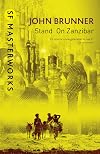
2010's world of 7 billion humans as seen from 1968.
This tour de force of world building combines broad strokes through media snapshots and a focus on a few characters. Much of John Brunner's vision has come true and much has not, and it's worth pondering what trends continued into the present confirming his predictions and what trends suffered discontinuities.
It's in the relationships between the main characters and particularly between the main characters and their "shiggies" that the show more difference between the prediction and the reality is most glaring but nevertheless, I am glad to have revisited this book because despite the gloomy atmosphere, it is fun. show less
This tour de force of world building combines broad strokes through media snapshots and a focus on a few characters. Much of John Brunner's vision has come true and much has not, and it's worth pondering what trends continued into the present confirming his predictions and what trends suffered discontinuities.
It's in the relationships between the main characters and particularly between the main characters and their "shiggies" that the show more difference between the prediction and the reality is most glaring but nevertheless, I am glad to have revisited this book because despite the gloomy atmosphere, it is fun. show less
Lists
Guilty Pleasures (1)
Uni (1)
Art of Reading (1)
Must read (1)
Best Cyberpunk (2)
SF Masterworks (2)
Best Dystopias (2)
Future Visions (1)
Five star books (1)
1970s (1)
Urban Fiction (1)
Awards


You May Also Like


Associated Authors
Statistics
- Works
- 290
- Also by
- 134
- Members
- 24,593
- Popularity
- #852
- Rating
- 3.7
- Reviews
- 433
- ISBNs
- 557
- Languages
- 17
- Favorited
- 39

