
Gary Gach
Author of The Complete Idiot's Guide to Understanding Buddhism
About the Author
Gary Gach has been a student of Buddhism for 40 years
Works by Gary Gach
Idiot's Guides: Buddhism, 3rd Edition (Complete Idiot's Guides (Lifestyle Paperback)) (2009) 58 copies, 1 review
Pause, Breathe, Smile: Awakening Mindfulness When Meditation Is Not Enough (2018) 11 copies, 2 reviews
Associated Works
Songs for Tomorrow: Poems 1960-2002 (Green Integer) (2009) — Translator, some editions — 22 copies, 1 review
Telephone 17 — Contributor — 1 copy
Tagged
Common Knowledge
- Birthdate
- 1947-11-30
- Gender
- male
- Education
- University of California, Riverside
University of California, Los Angeles
San Francisco State University - Occupations
- teacher
stevedore
hospital administrator
typesetter
editor - Organizations
- Order of Interbeing
- Agent
- Scovil Galen Ghosh Literary Agency, Inc.
Nancy Owen Barton Agency, LLC - Nationality
- USA
- Birthplace
- Hollywood, California, USA
- Associated Place (for map)
- California, USA
Members
Reviews
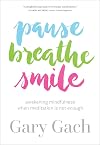
Pause, Breathe, Smile by Gary Gach offers a simple, yet highly effective method for cultivating mindfulness wherever you may be and whatever you may be doing. It's as simple as the title says, taking time to pause, breathe deep, and smile. This is a beneficial tool alone, and Gach teaches how to turn it into a proper longer meditation that can span twenty to forty minutes. He also teaches about variations of mindfulness meditation such as walking meditation, and the use of mindfulness bells. show more
I loved this book! It's easy to understand, with no frippery added. Gach has a warm inviting writing style, interacting directly with the reader. I practice mindfulness meditation myself, and found plenty of things to incorporate in my own practice. I started to use a mindfulness bell app on my phone. It had never occurred to me before, but it's been so useful! I'm also considering doing a meditation retreat. That's a scary concept for me, but Gach made it sound intriguing enough to seriously look into. This book is a great resource both for those new to mindfulness and meditation, and those with an established practise. Highly recommended!!
***Many thanks to Netgalley and Sounds True Publishing for providing an egalley in exchange for a fair and honest review. Reviewed for the San Francisco Book Review. show less
I loved this book! It's easy to understand, with no frippery added. Gach has a warm inviting writing style, interacting directly with the reader. I practice mindfulness meditation myself, and found plenty of things to incorporate in my own practice. I started to use a mindfulness bell app on my phone. It had never occurred to me before, but it's been so useful! I'm also considering doing a meditation retreat. That's a scary concept for me, but Gach made it sound intriguing enough to seriously look into. This book is a great resource both for those new to mindfulness and meditation, and those with an established practise. Highly recommended!!
***Many thanks to Netgalley and Sounds True Publishing for providing an egalley in exchange for a fair and honest review. Reviewed for the San Francisco Book Review. show less
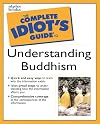
This is my second read-through of this book, and it stands up well. Gach does a good job of explaining Buddhism to people who aren't Buddhists and thus harbor misconceptions about what Buddhism is. The general material is the best. He gets a bit shaky when tackling the respective Buddhist schools; one gets the feeling he practices some form of Vipassana, and is a bit uncomfortable with the other schools, especially the far Eastern ones. Unfortunately, the final 1/3 of the book, with its show more tenuous attempts to relate Buddhism to pop psychology, pop culture, and scientific disciplines Gach knows precious little about, is quite poor compared to the earlier material. And it shows, judging by the fact that said sections are riddled with grammatical and typographical errors, whilst the first two are not. Also interesting to note--the Buddha on the cover is the Kamakura Daibutsu, not the Nara Daibutsu, as the book claims. show less
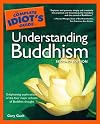
Some might complain about it not being thorough enough and shy from the "Idiot" label, but as an introduction to Buddhism, I found it a good springboard to jump in with, especially with little to no formal knowledge. Of course there are more in-depth, traditional and widely accepted Buddhist texts to study from, but this fits its intended purpose very well, and left me delightfully thirsty for the deeper knowledge an understanding that I am seeking in the more formal books.
WHAT WE TALK ABOUT WHEN WE TALK ABOUT MINDFULNESS
Now that mindfulness is the fastest-growing wellness trend since yoga, it seems as if everything is calling itself mindfulness these days. (And, since 2013, there’s been a countertrend of backlash, from various fronts, such as evangelical Christian fundamentalists and critics of neoliberal capitalism.) So I felt it an apt moment to reframe the narrative of what we talk about when we talk about mindfulness.
Five years in the making, my new show more book builds upon the success of scientific secularization to expand the horizon by going back to the roots. Genuine benefits from a shake-and-bake approach might be seen as an invitation for this deeper dive, into something more dynamic and consequential. Here’s a single strand upon which to string all the various beads being offered, as a coherent, dynamic whole.
If we're rebranding a certain aspect of Buddhism, why not include all the simple, basic ingredients of that ancient, ever-vital recipe: moral values in action [pause], meditation [breathe], insightful worldview [smile]. The three in tandem interact as a integral whole that a general audience can access and enjoy – 24/7.
Jon Kabat-Zinn meets Thich Nhat Hanh.
Clear, depthy, and potent.
That's it – in a nutshell.
For more info: http://GaryGach.com ||| http://GaryGach.com/books/pause-breathe-smile
Recent review: https://www.spiritualityandpractice.com/book-reviews/view/28606/pause-breathe-sm... show less
Now that mindfulness is the fastest-growing wellness trend since yoga, it seems as if everything is calling itself mindfulness these days. (And, since 2013, there’s been a countertrend of backlash, from various fronts, such as evangelical Christian fundamentalists and critics of neoliberal capitalism.) So I felt it an apt moment to reframe the narrative of what we talk about when we talk about mindfulness.
Five years in the making, my new show more book builds upon the success of scientific secularization to expand the horizon by going back to the roots. Genuine benefits from a shake-and-bake approach might be seen as an invitation for this deeper dive, into something more dynamic and consequential. Here’s a single strand upon which to string all the various beads being offered, as a coherent, dynamic whole.
If we're rebranding a certain aspect of Buddhism, why not include all the simple, basic ingredients of that ancient, ever-vital recipe: moral values in action [pause], meditation [breathe], insightful worldview [smile]. The three in tandem interact as a integral whole that a general audience can access and enjoy – 24/7.
Jon Kabat-Zinn meets Thich Nhat Hanh.
Clear, depthy, and potent.
That's it – in a nutshell.
For more info: http://GaryGach.com ||| http://GaryGach.com/books/pause-breathe-smile
Recent review: https://www.spiritualityandpractice.com/book-reviews/view/28606/pause-breathe-sm... show less
Awards


You May Also Like


Associated Authors
Statistics
- Works
- 7
- Also by
- 5
- Members
- 427
- Popularity
- #57,178
- Rating
- 4.0
- Reviews
- 7
- ISBNs
- 16
- Languages
- 1

