
Dan Gardner
Author of Superforecasting: The Art and Science of Prediction
About the Author
Works by Dan Gardner
The Science of Fear: Why We Fear the Things We Shouldn't--and Put Ourselves in Greater Danger (2008) 490 copies, 12 reviews
How Big Things Get Done: The Surprising Factors That Determine the Fate of Every Project, from Home Renovations to Space Exploration and Everything In Between (2023) 348 copies, 5 reviews
Future Babble: Why Expert Predictions Are Next to Worthless, and You Can Do Better (2010) 225 copies, 10 reviews
Science of Fear: Why We Fear the Things We Shouldn't-- and Put Ourselves in Greater Danger, The 1 copy
Jesus Reigns Forever 1 copy
Tagged
Common Knowledge
- Birthdate
- 1968
- Gender
- male
- Education
- York University (B.A.|1989| history)
York University (M.A.|1995| modern history)
Osgoode Hall Law School (1992) - Occupations
- journalist
author
lecturer - Organizations
- Ottawa Citizen
- Awards and honors
- Canadian Criminal Justice Association Public Education Award (2005)
John Howard Society’s Jim MacLatchie Award (2003)
Amnesty International Media Award
Michener Award - Nationality
- Canada
- Places of residence
- Ottawa, Ontario, Canada
- Associated Place (for map)
- Ontario, Canada
Members
Reviews
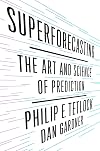
Prediction is hard, especially about the future. And despite the importance people and organizations lay on having a clear view of the future, we're not very good at prediction. The authors, Tetlock and Gardner, argue that the state of prediction is similar to the state of medicine, before randomized clinical trials. Sometime forecasters are right, but mostly they're wrong, and there's no way to separate the potentially useful treatments from quackish nonsense.
But there might be a better show more way. Superforecasters is a write up of the authors' Good Judgement Project, an IARPA (Intelligence Advanced Research Projects Agency) effort to systemically study predictions. The Good Judgement Project smoked the competition, including in-agency experts and prediction markets. Tetlock and Gardner used their background in psychology to find out what made their top 2%, the titular superforecasters, tick better than everyone else.
The first finding is that most of us are astonishingly bad at prediction. Generally, people have three settings for probability: impossible, certain, and maybe. Kahneman's System 1, the intuitive rush to judgment, is terrible at complex problems. Perhaps the biggest step is to slow down, and engage System 2, the rational and logical side of the mind. Beyond that, people with ideological blinders are lousy predictors. If everything has to fit into Marxist dialectics, or the immortal science of Friedman-Hayek Thought, you'll overlook evidence that contradicts the theory.
The Good Judgement project provide some necessary structure. Instead of weasel words (most of, highly likely) and vague timelines (in the near future), participants are given clear factual statements with a definite endpoint. There are thousands of predictions, and participants are allowed to update their initial assessments as they do more research.
Superforecasters are adept at seeing a problem in numerous ways, rather that focusing on grand theories. They tend to be comfortable with statistics. Participants in The Good Judgement Project self-selected as more intelligent and better educated than the population at large, but superforecasters aren't notably smarter or more credentialed than their less accurate peers. Instead, they have a bulldog tendency towards research, an ability to question their own assumptions, update beliefs, and think inside-out and outside-in.
Superforecasting is a fascinating and very useful book for anyone who is thinking about the future. show less
But there might be a better show more way. Superforecasters is a write up of the authors' Good Judgement Project, an IARPA (Intelligence Advanced Research Projects Agency) effort to systemically study predictions. The Good Judgement Project smoked the competition, including in-agency experts and prediction markets. Tetlock and Gardner used their background in psychology to find out what made their top 2%, the titular superforecasters, tick better than everyone else.
The first finding is that most of us are astonishingly bad at prediction. Generally, people have three settings for probability: impossible, certain, and maybe. Kahneman's System 1, the intuitive rush to judgment, is terrible at complex problems. Perhaps the biggest step is to slow down, and engage System 2, the rational and logical side of the mind. Beyond that, people with ideological blinders are lousy predictors. If everything has to fit into Marxist dialectics, or the immortal science of Friedman-Hayek Thought, you'll overlook evidence that contradicts the theory.
The Good Judgement project provide some necessary structure. Instead of weasel words (most of, highly likely) and vague timelines (in the near future), participants are given clear factual statements with a definite endpoint. There are thousands of predictions, and participants are allowed to update their initial assessments as they do more research.
Superforecasters are adept at seeing a problem in numerous ways, rather that focusing on grand theories. They tend to be comfortable with statistics. Participants in The Good Judgement Project self-selected as more intelligent and better educated than the population at large, but superforecasters aren't notably smarter or more credentialed than their less accurate peers. Instead, they have a bulldog tendency towards research, an ability to question their own assumptions, update beliefs, and think inside-out and outside-in.
Superforecasting is a fascinating and very useful book for anyone who is thinking about the future. show less
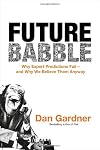
Dan Gardner is a columnist with the Ottawa Citizen and one of my favourites. He's skeptical, logical and writes well. All of these characteristics are in evidence in this book, which takes a cold hard look at the realm of predictions. Not the fortune-teller kind, but the kind made by experts and talking heads on the various current affairs shows: "What will the unemployment rate be next year?" "What do the climate models suggest our planet will look like two decades from now?" "Where's the show more price of oil headed?" Put simply, the thesis of this book is that the so-called experts are really no better at making predictions than a monkey throwing darts at a dart board. But if that's the case, why do we keep asking for predictions, and why do we keep thinking that THIS time the experts will be right?
Gardner explores this question in some depth, talking about how our brains evolved to process information from our environment and how what worked in the primitive world does not work quite so well in the more complex modern day. He also talks about two types of experts, which he calls "foxes" and "hedgehogs". Foxes assemble a great deal of information before they make their predictions, consider all sides of the issue, constantly question their assumptions, and are more willing to admit they are wrong when a prediction does not pan out. Hedgehogs, on the other hand, have a more narrow worldview and tend to stamp their predictions in the mould of whatever ideology they follow. They are also much less willing to admit error, which perversely makes them more popular. People prefer to listen to a confident but wrong expert over a more careful, cautious one.
Some parts felt a bit repetitive, but overall this book met my expectations. I would recommend it to news junkies in particular, especially those who enjoy picking apart media coverage or watching satire shows such as the Daily Show. show less
Gardner explores this question in some depth, talking about how our brains evolved to process information from our environment and how what worked in the primitive world does not work quite so well in the more complex modern day. He also talks about two types of experts, which he calls "foxes" and "hedgehogs". Foxes assemble a great deal of information before they make their predictions, consider all sides of the issue, constantly question their assumptions, and are more willing to admit they are wrong when a prediction does not pan out. Hedgehogs, on the other hand, have a more narrow worldview and tend to stamp their predictions in the mould of whatever ideology they follow. They are also much less willing to admit error, which perversely makes them more popular. People prefer to listen to a confident but wrong expert over a more careful, cautious one.
Some parts felt a bit repetitive, but overall this book met my expectations. I would recommend it to news junkies in particular, especially those who enjoy picking apart media coverage or watching satire shows such as the Daily Show. show less
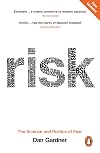
We are the safest humans who ever lived - the statistics prove it. And yet the media tells a different story with its warnings and scare stories. How is it possible that anxiety has become the stuff of daily life?
In this ground-breaking, compulsively readable book, Dan Gardner shows how our flawed strategies for perceiving risk influence our lives, often with unforeseen and sometimes-tragic consequences. He throws light on our paranoia about everything from paedophiles to terrorism and show more reveals how the most significant threats are actually the mundane risks to which we pay little attention.
Speaking to psychologists and scientists, as well as looking at the influence of the media and politicians, Gardner uncovers one of the central puzzles of our time: why are the safest people in history living in a culture of fear? show less
In this ground-breaking, compulsively readable book, Dan Gardner shows how our flawed strategies for perceiving risk influence our lives, often with unforeseen and sometimes-tragic consequences. He throws light on our paranoia about everything from paedophiles to terrorism and show more reveals how the most significant threats are actually the mundane risks to which we pay little attention.
Speaking to psychologists and scientists, as well as looking at the influence of the media and politicians, Gardner uncovers one of the central puzzles of our time: why are the safest people in history living in a culture of fear? show less
The Science of Fear: Why We Fear the Things We Shouldn't--and Put Ourselves in Greater Danger by Daniel Gardner
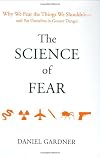
I am giving this book 5 stars because it has helped me tremendously during these uncertain times amidst the COVID-19 pandemic. The Science of Fear is all about risk assessment and critical thinking. It offers the reader a multi-disciplinary approach to considering why we fear what we fear, and why what we fear changes over time. Research from psychology and sociology, as well as history and media communications study, gives author Dan Gardner a wide range of information and perspectives to show more draw from. The book is objective and educational but also filled with just enough personality to keep it interesting without ever seeming flippant or questioning the seriousness of the subject matter. I loved it, and it has helped me stay calm during this whole coronavirus thing by encouraging me to assess the actual risk of getting infected and taking smart, necessary precautions while not wasting energy on emotional, overblown worries of extremely unlikely scenarios. show less
Lists
Awards


You May Also Like


Associated Authors
Statistics
- Works
- 9
- Members
- 2,787
- Popularity
- #9,220
- Rating
- 4.0
- Reviews
- 83
- ISBNs
- 74
- Languages
- 8
