
Robert D. Hare
Author of Without Conscience: The Disturbing World of the Psychopaths Among Us
About the Author
Works by Robert D. Hare
Without Conscience: The Disturbing World of the Psychopaths Among Us (1993) 1,087 copies, 27 reviews
The Hare PCL-R: Rating booklet 3 copies
Tagged
Common Knowledge
- Birthdate
- 1934
- Gender
- male
- Education
- University of Western Ontario
University of Alberta - Occupations
- Emeritus Professor of Psychology
- Organizations
- University of British Columbia
- Awards and honors
- Order of Canada
- Short biography
- Robert Hare is Emeritus Professor of Psychology, University of British Columbia, where he has taught and conducted research for more than four decades, and President of Darkstone Research Group Ltd., a forensic research and consulting firm. He has devoted most of his academic career to the investigation of psychopathy, its nature, assessment, and implications for mental health and criminal justice. He is the author of several books, including Without Conscience: The Disturbing World of the Psychopaths Among Us, and more than one hundred scientific articles on psychopathy. He is the developer of the Psychopathy Checklist-Revised (PCL-R) and a co-author of its derivatives, the Psychopathy Checklist: Screening Version, the Psychopathy Checklist: Youth Version, the Antisocial Process Screening Device, and the P-Scan (for use in law enforcement). He has consulted with law enforcement, including the FBI and the RCMP, was a member of the former Research Advisory Board of the FBI Child Abduction and Serial Murder Investigative Resources Center (CASMIRC), and is an Affiliate Member of the International Criminal Investigative Analysis Fellowship. He also was a member of the Advisory Panel established by Her Majesty’s Prison Service to develop new programs for the treatment of psychopathic offenders. His current research on psychopathy includes assessment issues, developmental factors, neurobiological correlates, risk for recidivism and violence, and the development (with S. Wong) of new treatment and management strategies for psychopathic offenders (Guidelines for a Psychopathy Treatment Program). He and Paul Babiak have extended the theory and research on psychopathy to the business and corporate world, with the development of the B-Scan-360, a 360º instrument used to screen for psychopathic traits and behaviors, and a book, Snakes in Suits: When Psychopaths Go To Work. He lectures widely on psychopathy and on the use and misuse of the PCL-R in the mental health and criminal justice systems. Among his most recent awards are the Silver Medal of the Queen Sophia Center in Spain; the Canadian Psychological Association Award for Distinguished Applications of Psychology; the American Academy of Forensic Psychology Award for Distinguished Applications to the Field of Forensic Psychology; the Isaac Ray Award presented by the American Psychiatric Association and the American Academy of Psychiatry and Law for Outstanding Contributions to Forensic Psychiatry and Psychiatric Jurisprudence; the B. Jaye Anno Award for Excellence in Communication, presented by the National Commission on Correctional Health Care; the Lifetime Achievement Award presented by the Society for the Scientific Study of Psychopathy; the CPA Award for Distinguished Contributions to the International Advancement of Psychology; the CPA Donald O. Hebb Award for Distinguished Contributions to Psychology as a Science; the Western Society of Criminology's Paul Tappan Award for Outstanding Contributions to the Field of Criminology; the British Columbia Psychological Association's Award for Recognition of a Distinguished Career and Enduring Contributions to Psychology; the Order of Canada presented by the Governor General of Canada recognizing a lifetime of outstanding achievement, dedication to community and service to the nation; and from the Center for the Advancement of Psychological Science and Law, recognition for Distinguished Lifetime Achievements as a Leader in Psychology and Law, and Outstanding Contributions to Forensic Psychology.
http://www.hare.org/welcome/bio.html - Nationality
- Canada
- Birthplace
- Calgary, Alberta, Canada
- Places of residence
- British Columbia, Canada
Ontario, Canada
USA - Associated Place (for map)
- Canada
Members
Reviews
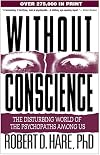
Forget Lord Voldemort. On the evidence, Robert Hare, the author of Without Conscience, was the first Death Eater.
I say that because, although Hare writes this book to warn about psychopaths, you can't help but feel that, deep down, he likes these people. He's always talking them up, as if they have a magical ability to make you believe anything they say. And then they'll take you for a ride, and you'll be left sadder, poorer, and possibly pregnant-er. Assuming you aren't dead-er.
All of which show more presents a very frightening picture, and some of it seems to be true. There are people who have little or no desire to help others, and who have little or no executive function to inhibit them from socially destructive behavior. There is evidence that these people have abnormal brains.
But are they really a distinct subgroup, incurable (says Hare), marked by brain abnormalities and a common set of traits? And has Robert Hare really created a magical Psychopathy Checklist to find them so that we can lock them up and throw away they key -- or, as Hare has done in his Frankenstein-esque experiments, torture them until he determines if they are really incapable of learning?
It should be noted that the American Psychiatric Association does not think so. Psychopathy is not a diagnosis they admit to their manuals. What they have is Antisocial Personality Disorder -- a description of a group of very unpleasant people, who fit some of the traits described above (lack of respect for others and lack of impulse control). But most of them aren't as bad as Hare's group; they may be larcenous, self-serving, power-seeking, destructive corporate cheaters, but most of them don't commit murder or rape or fraud otherwise engage in major criminal behavior. It has been claimed that all psychopaths have Antisocial Personality Disorder, but not all people with ASD are psychopaths. Perhaps so. But if Hare wants to go beyond what the diagnostic manuals say, he needs more than a checklist and a history of talking to dreadful people. And, on the evidence, he doesn't have that data. Think about this: If he has so much data on psychopathy, why does he keep citing fictional examples such as Hannibal Lecter? And keep citing the same high-profile murderers such as Ted Bundy?
The worst of it is, he has convinced many prison systems to take him seriously, and his checklist is sometimes used to determine whether prisoners get privileges or even parole.
Please don't misunderstand me. There are certainly many terrible people out there. And psychopathy may be a real psychological condition. But this book isn't the proof of it. It's a collection of horror stories. And if you want to know what's most horrible, consider this: Would you want to be locked up in prison for the rest of your life just because you scored high on the Psychopathy Checklist? With no one accepting that you are repentant or can learn? What if the person who administers the test has it in for you? Too scary a thought for me!
Hare's research -- despite his occasional sadism, both toward his experimental subjects and toward his readers -- has an important place. We need to find out about these people. But he has, I think, rushed to judgment. We as readers should not get caught in the same race. show less
I say that because, although Hare writes this book to warn about psychopaths, you can't help but feel that, deep down, he likes these people. He's always talking them up, as if they have a magical ability to make you believe anything they say. And then they'll take you for a ride, and you'll be left sadder, poorer, and possibly pregnant-er. Assuming you aren't dead-er.
All of which show more presents a very frightening picture, and some of it seems to be true. There are people who have little or no desire to help others, and who have little or no executive function to inhibit them from socially destructive behavior. There is evidence that these people have abnormal brains.
But are they really a distinct subgroup, incurable (says Hare), marked by brain abnormalities and a common set of traits? And has Robert Hare really created a magical Psychopathy Checklist to find them so that we can lock them up and throw away they key -- or, as Hare has done in his Frankenstein-esque experiments, torture them until he determines if they are really incapable of learning?
It should be noted that the American Psychiatric Association does not think so. Psychopathy is not a diagnosis they admit to their manuals. What they have is Antisocial Personality Disorder -- a description of a group of very unpleasant people, who fit some of the traits described above (lack of respect for others and lack of impulse control). But most of them aren't as bad as Hare's group; they may be larcenous, self-serving, power-seeking, destructive corporate cheaters, but most of them don't commit murder or rape or fraud otherwise engage in major criminal behavior. It has been claimed that all psychopaths have Antisocial Personality Disorder, but not all people with ASD are psychopaths. Perhaps so. But if Hare wants to go beyond what the diagnostic manuals say, he needs more than a checklist and a history of talking to dreadful people. And, on the evidence, he doesn't have that data. Think about this: If he has so much data on psychopathy, why does he keep citing fictional examples such as Hannibal Lecter? And keep citing the same high-profile murderers such as Ted Bundy?
The worst of it is, he has convinced many prison systems to take him seriously, and his checklist is sometimes used to determine whether prisoners get privileges or even parole.
Please don't misunderstand me. There are certainly many terrible people out there. And psychopathy may be a real psychological condition. But this book isn't the proof of it. It's a collection of horror stories. And if you want to know what's most horrible, consider this: Would you want to be locked up in prison for the rest of your life just because you scored high on the Psychopathy Checklist? With no one accepting that you are repentant or can learn? What if the person who administers the test has it in for you? Too scary a thought for me!
Hare's research -- despite his occasional sadism, both toward his experimental subjects and toward his readers -- has an important place. We need to find out about these people. But he has, I think, rushed to judgment. We as readers should not get caught in the same race. show less
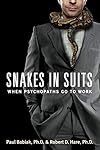
"Dumb psychopaths go to prison, smart psychopaths go to the executive floor". That's the premise of this interesting book that analyses how psychopaths manage to be successful in corporate environments or in specific industries. According to the author, psychopaths are 4 times more frequent among managers than among the general population.
The book offers many great insights, and although inevitably, when specific examples were mentioned, I did sometimes wonder whether impression management show more or high-energy office banter might label me a psychopath (don't read this if you have psychological hypochondria), the author makes clear that true psychopaths display an entire range of behaviours with underneath a chilling emotional shallowness.
The pace slows down a bit here and there when the author provides specific HR advice for people dealing with psychopaths (when they're already part of the organisation), or trying to weed out psychopaths from job applicants.
This book helped me realise that an old friend (now estranged), whose behaviour I'd always found strange and cruel, had many psychopathic tendencies, as did a former colleague whose destructive energy had previously baffled me (you know who you are :). If I'd read this book before, I'd have realised this sooner and I would have been better prepared to deal with their behaviour. But odds are I'll meet more psychopaths during the rest of my career, so unfortunately it will probably come in useful in the future. show less
The book offers many great insights, and although inevitably, when specific examples were mentioned, I did sometimes wonder whether impression management show more or high-energy office banter might label me a psychopath (don't read this if you have psychological hypochondria), the author makes clear that true psychopaths display an entire range of behaviours with underneath a chilling emotional shallowness.
The pace slows down a bit here and there when the author provides specific HR advice for people dealing with psychopaths (when they're already part of the organisation), or trying to weed out psychopaths from job applicants.
This book helped me realise that an old friend (now estranged), whose behaviour I'd always found strange and cruel, had many psychopathic tendencies, as did a former colleague whose destructive energy had previously baffled me (you know who you are :). If I'd read this book before, I'd have realised this sooner and I would have been better prepared to deal with their behaviour. But odds are I'll meet more psychopaths during the rest of my career, so unfortunately it will probably come in useful in the future. show less
While this book is a little dated, it survives for its ability to relay how psychopathy and the study of it developed over the years, primarily in the hands of this very author. It also survives for Hare's clear and everyday explanation of a personality disorder that is largely misunderstood, and far more prevalent in our society than anyone realizes. Trust me, over Hare's warning, you'll be diagnosing someone in your school or work or family before the last page - and you'll probably be show more right.
5 bones!!!!!
Highly Recommended show less
5 bones!!!!!
Highly Recommended show less
Sociopathy, or Psychopathy interests me because it shakes my still formative notions of a universe that is ultimately fair, and a creation that is essentially one (having only the appearance of being made up of parts). To have no conscience is to be soul-less, isn't it? How can a part of the whole, that we are, be soul-less? What could be gained from this, and what are the implications of being devoid of empathy?
Lists
You May Also Like


Associated Authors
Statistics
- Works
- 9
- Members
- 1,687
- Popularity
- #15,241
- Rating
- 3.7
- Reviews
- 35
- ISBNs
- 53
- Languages
- 9


