
Walter Piston (1894–1976)
Author of Harmony
About the Author
Works by Walter Piston
Piston: Symphony No. 4/Three New England Sketches/Capriccio for Harp and String Orchestra (2003) 6 copies
Piston: Chamber Music: Quintet for flute & strings / String Sextet / Piano Quartet / Piano Quintet (2000) 6 copies
Sonata 4 copies
Symphony No. 4 2 copies
Symphony no. 6 2 copies
String Quartet No. 3 2 copies
String Quartet No. 1 2 copies
Trios, piano, violin, cello, no. 1 2 copies
Divertimento for Nine Instruments 2 copies
String Quartet No. 2 2 copies
Duets, cello, piano 1 copy
Passacaglia 1 copy
Duo for cello and piano 1 copy
First Symphony 1 copy
Three New England Sketches 1 copy
Sonata for Violin and Piano 1 copy
Symphony No. 3 1 copy
Suite for Oboe and Piano 1 copy
String Quartet No. 5 1 copy
Symphony No. 2 1 copy
Quintet for Wind Instruments 1 copy
Serenata 1 copy
String Quartet No. 4 1 copy
Bow Down Thine Ear, O Lord 1 copy
Suite for Orchestra 1 copy
Associated Works
Tagged
Common Knowledge
- Canonical name
- Piston, Walter
- Birthdate
- 1894-01-20
- Date of death
- 1976-11-12
- Gender
- male
- Education
- Harvard College
Mechanical Arts High School, Boston
Massachusetts Normal Art School - Occupations
- composer
music theorist
professor - Organizations
- Harvard University
- Awards and honors
- Pulitzer Prize (Music ∙ 1948)
American Academy of Arts and Letters (1938) - Relationships
- Carter, Elliott (student)
Bernstein, Leonard (student)
Boulanger, Nadia (teacher)
Dukas, Paul (teacher)
Adler, Samuel (student)
Berger, Arthur (student) (show all 8)
Fine, Irving (student)
Anderson, Leroy (student) - Nationality
- USA
- Birthplace
- Rockland, Maine, USA
- Places of residence
- Boston, Massachusetts, USA
Belmont, Massachusetts, USA - Place of death
- Belmont, Massachusetts, USA
- Burial location
- Mount Auburn Cemetery, Cambridge, Massachusetts, USA
- Associated Place (for map)
- Massachusetts, USA
Members
Reviews

Miranda Cuckson as soloist delivers an absolutely beautiful performance -- airy and delicate in the 2nd movement while sacrificing none of the passion or playfulness of the outer movements. It's such a shame that she is let down a little by her orchestra (a bit too bland) and a lot by the recording engineer; she is much too distanced in the overall acoustic. If only she could have been given the support that James Buswell got from his orchestra (The National Symphony of the Ukraine) and his show more engineers (the estimable Naxos). show less

Here is a foundation for studying music theory. It is not a how-to text really, but benefits those engaged in learning the processes through music is notated. Can be considered very boring, or a necessary evil. Can also be regarded as the window through which all written music is seen, however distant.
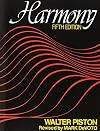
To say that I am starting to read this is a bit of a stretch, because it is a textbook rather than something that one reads and sets down. But, I wanted to get some music theory into my reading list, so here it is.
I was given this 1944 printing of this book about 40 years ago by a friend who saw my interest in learning music. Now I am starting to make a more serious study of music theory. Here goes.
I was given this 1944 printing of this book about 40 years ago by a friend who saw my interest in learning music. Now I am starting to make a more serious study of music theory. Here goes.
What are the harmonic materials used by composers? Common practices in composition which emerged in the 18th and 19th century are reported.
The work simply begins with the scales and intervals (the unit of harmony), through triads, progression, tonality (keys) and modality (scales), to the chords of the sixth--the figured bass. At this point, the work proceeds to the construction of harmonic phrases, elaborating on the modulations, secondary dominants, irregular resolutions, and the show more available chord sequences.
This is not a work for the faint-hearted and it is essential to have a keyboard at hand. Little absorption will be possible without practicums. For example, "Triads in the first inversion are called chords of the sixth, the characteristic interval being the sixth caused by the inversion of the third." [44] The vertical sonority cannot be understood by looking at these words. show less
The work simply begins with the scales and intervals (the unit of harmony), through triads, progression, tonality (keys) and modality (scales), to the chords of the sixth--the figured bass. At this point, the work proceeds to the construction of harmonic phrases, elaborating on the modulations, secondary dominants, irregular resolutions, and the show more available chord sequences.
This is not a work for the faint-hearted and it is essential to have a keyboard at hand. Little absorption will be possible without practicums. For example, "Triads in the first inversion are called chords of the sixth, the characteristic interval being the sixth caused by the inversion of the third." [44] The vertical sonority cannot be understood by looking at these words. show less
Lists
Tom's Bookstore (1)
You May Also Like


Associated Authors
Statistics
- Works
- 71
- Also by
- 2
- Members
- 1,025
- Popularity
- #25,136
- Rating
- 4.0
- Reviews
- 8
- ISBNs
- 26
- Languages
- 4
- Favorited
- 1