
Tom Sharpe (1) (1928–2013)
Author of Wilt
For other authors named Tom Sharpe, see the disambiguation page.
About the Author
Thomas Ridley Sharpe (born March 30, 1928) was an English satirical author, best known for his Wilt series, as well as Porterhouse Blue and Blott on the Landscape, which were both adapted for British television. Sharpe died in Spain on June 6, 2013. He was 85 years old. (Bowker Author Biography)
Image credit: Photo by Martin Pope, found at telegraph.co.uk
Series
Works by Tom Sharpe
Omnibus : "Indecent Exposure" ; "Porterhouse Blue" ; "The Great Pursuit" ; "Blott on the Landscape" (1986) 30 copies
Cancres Limited & Cie : Porterhouse ; Panique à Porterhouse ; Le Cru de la comtesse ; Fumiers et Cie (2010) 4 copies, 1 review
Marea aspirație 1 copy
Tom Sharpe Omnibus: Indecent Exposure, The Great Pursuit, Porterhouse Blue, Blott on the Landscape 1 copy
Wilt & The Wilt Alternative 1 copy
Associated Works
The Best of Saki [Picador/Pan/Folio, 49 stories] (1980) — Introduction, some editions — 342 copies, 5 reviews
Porterhouse Blue [1987 TV series] — Based on a book by — 7 copies
Tagged
Common Knowledge
- Canonical name
- Sharpe, Tom
- Legal name
- Sharpe, Thomas Ridley
- Birthdate
- 1928-03-30
- Date of death
- 2013-06-06
- Gender
- male
- Education
- Lancing College
Pembroke College, Cambridge - Occupations
- lecturer (history)
author
writer
teacher - Organizations
- British Royal Marines
Cambridge College of Arts and Technology - Awards and honors
- XXXIIIeme Grand Prix de l'Humour Noir Xavier Forneret (1986)
- Nationality
- UK
- Birthplace
- London, Middlesex, England, UK
- Places of residence
- Pietermaritzburg, South Africa
Cambridge, Cambridgeshire, England, UK
Costa Brava, Spain
Natal, South Africa
London, Middlesex, England, UK
Llafranc, Catalonia, Spain - Place of death
- Palafrugell, Catalonia
- Map Location
- England, UK
Members
Reviews

Tom Sharpe’s bawdy comic novels — usually featuring hapless technical college lecturers and inflatable sex toys — were a familiar feature of station bookstalls in the 1970s and 80s, with their iconic cover art by Paul Sample. Of course, they were always written in the worst possible taste, aiming to give offence to as large as possible a segment of the reading public. And we all loved them, largely because Sharpe was a very skilful and precise writer, who could make the English show more language do exactly what he wanted it to, even in the middle of the most outlandish Grand Guignol Set piece. He is often compared to P G Wodehouse (they were pen-pals and big fans of each other’s work) and Evelyn Waugh: in both cases it’s a comparison that makes a lot of sense, in spite of the big differences in their choice of subject-matter.
What it’s easy to forget is that Sharpe, whose mother was from South Africa, began his literary career in reaction to the horrors of apartheid, which he’d observed while working in Natal. His first play earned him jail time and a permanent ban from entering South Africa, and he followed it with two grotesque satirical novels about the South African police. Riotous assembly, written in a three-week fit of anger, was the first of these. At the heart of the story is Kommandant van Heerden, the incompetent police chief of the sleepy provincial town of Piemburg (a thinly disguised version of Pietermaritzburg, where Sharpe worked for some years). When Miss Hazelstone, doyenne of the surviving British community in Piemburg, calls in to report that she has murdered her Zulu cook in a fit of sexual jealousy, the Anglophile van Heerden takes steps intended to avoid a scandal, but his unclear orders to his demented subordinates lead to an appalling bloodbath. And, naturally enough, all their efforts to tidy the situation up again just make things worse.
As with all over the top satire, you have to wonder how effective it could ever have been. Sharpe is absolutely merciless with his policemen, and makes it pretty clear to us that everything that goes wrong here is the result of them acting on their demented racist assumptions about how the world should be, but he is so very cruel to them that we almost start to feel sympathy with their plight. And the situations are so absurd that they don’t really seem to be telling us much about the realities of life in South Africa at the time. I don’t suppose many people who read this book were supporters of apartheid waiting for Sharpe to convince them to change their minds, anyway. show less
What it’s easy to forget is that Sharpe, whose mother was from South Africa, began his literary career in reaction to the horrors of apartheid, which he’d observed while working in Natal. His first play earned him jail time and a permanent ban from entering South Africa, and he followed it with two grotesque satirical novels about the South African police. Riotous assembly, written in a three-week fit of anger, was the first of these. At the heart of the story is Kommandant van Heerden, the incompetent police chief of the sleepy provincial town of Piemburg (a thinly disguised version of Pietermaritzburg, where Sharpe worked for some years). When Miss Hazelstone, doyenne of the surviving British community in Piemburg, calls in to report that she has murdered her Zulu cook in a fit of sexual jealousy, the Anglophile van Heerden takes steps intended to avoid a scandal, but his unclear orders to his demented subordinates lead to an appalling bloodbath. And, naturally enough, all their efforts to tidy the situation up again just make things worse.
As with all over the top satire, you have to wonder how effective it could ever have been. Sharpe is absolutely merciless with his policemen, and makes it pretty clear to us that everything that goes wrong here is the result of them acting on their demented racist assumptions about how the world should be, but he is so very cruel to them that we almost start to feel sympathy with their plight. And the situations are so absurd that they don’t really seem to be telling us much about the realities of life in South Africa at the time. I don’t suppose many people who read this book were supporters of apartheid waiting for Sharpe to convince them to change their minds, anyway. show less

I was prompted to pick this up again on reading of Sharpe’s death last week. He was, as the obituarists all say, undoubtedly one of the greatest English comic writers of the last century, and will be sadly missed.
I didn't like Porterhouse Blue as much as his South African books and Wilt when I first read it, but now I find it has grown on me. Perhaps I was too close to my own college days then to see the funny side of academic life. On re-reading it, I think one of the most attractive show more things about it in hindsight is the way it links into a chain of great comic writing: Sharpe builds on Zuleika Dobson and the Oxford chapters of Decline and Fall; his cantankerous, gluttonous and decidedly unscholarly Bursar, Dean and Senior Tutor in turn gave Terry Pratchett the basis for his even more bizarre academics. But it’s a treasure in its own right. In between the Rabelaisian excess and the exploding condoms, there is some very sharp social satire. A lot of what he has to say about politics, the media and attitudes to education still rings very true nowadays, even if the last real Porterhouse was forced to modernise decades ago.
Robert McCrum in the Observer insists (inevitably) on comparing Sharpe to Wodehouse. The two corresponded and seem to have admired each others work, but they were very different sorts of comic writers. I don't mean that one was unstoppably ribald and the other did his best to ignore the existence of sex: that’s a purely trivial difference, which has more to do with the markets they were writing for than anything else. More to the point, perhaps, is that Sharpe sets his books in a world where evil exists and foolish acts can have serious consequences; in Wodehouse there is no irreversible event other than marriage, and even that is only allowed to happen offstage. Maybe that difference has something to do with Sharpe's firsthand experience of South Africa in the Apartheid era, but if we are going to suggest that, we have to remember that Wodehouse spent the war years in occupied France and Nazi Germany without any apparent effect on his escapist style. I think Wodehouse was convinced that his sole mission as a writer was to entertain. If he had anger to express, he didn't think it right to inflict it on his readers.
They were both very clever at setting up and exploiting comic situations, but Wodehouse was always a much more technical writer than Sharpe. A Wodehouse novel is constructed like a stage play, with infinite attention to structure and balance of the plot. The chaotic element appears only in Wodehouse’s fantastically creative approach to language. Sharpe, on the other hand, doesn't want to appear to care a bit about structure, and he only very occasionally gets fancy with words. He’s perfectly prepared to kill off a key character a third of the way through the book if that gives him a good comic climax, and he never misses the opportunity for a good joke or a satirical effect, even if they don't directly contribute to the storyline. The necessary chaos in a Sharpe plot is there at a very deep level, and the order only seems to be the superficial minimum needed to get him to some sort of conclusion. show less
I didn't like Porterhouse Blue as much as his South African books and Wilt when I first read it, but now I find it has grown on me. Perhaps I was too close to my own college days then to see the funny side of academic life. On re-reading it, I think one of the most attractive show more things about it in hindsight is the way it links into a chain of great comic writing: Sharpe builds on Zuleika Dobson and the Oxford chapters of Decline and Fall; his cantankerous, gluttonous and decidedly unscholarly Bursar, Dean and Senior Tutor in turn gave Terry Pratchett the basis for his even more bizarre academics. But it’s a treasure in its own right. In between the Rabelaisian excess and the exploding condoms, there is some very sharp social satire. A lot of what he has to say about politics, the media and attitudes to education still rings very true nowadays, even if the last real Porterhouse was forced to modernise decades ago.
Robert McCrum in the Observer insists (inevitably) on comparing Sharpe to Wodehouse. The two corresponded and seem to have admired each others work, but they were very different sorts of comic writers. I don't mean that one was unstoppably ribald and the other did his best to ignore the existence of sex: that’s a purely trivial difference, which has more to do with the markets they were writing for than anything else. More to the point, perhaps, is that Sharpe sets his books in a world where evil exists and foolish acts can have serious consequences; in Wodehouse there is no irreversible event other than marriage, and even that is only allowed to happen offstage. Maybe that difference has something to do with Sharpe's firsthand experience of South Africa in the Apartheid era, but if we are going to suggest that, we have to remember that Wodehouse spent the war years in occupied France and Nazi Germany without any apparent effect on his escapist style. I think Wodehouse was convinced that his sole mission as a writer was to entertain. If he had anger to express, he didn't think it right to inflict it on his readers.
They were both very clever at setting up and exploiting comic situations, but Wodehouse was always a much more technical writer than Sharpe. A Wodehouse novel is constructed like a stage play, with infinite attention to structure and balance of the plot. The chaotic element appears only in Wodehouse’s fantastically creative approach to language. Sharpe, on the other hand, doesn't want to appear to care a bit about structure, and he only very occasionally gets fancy with words. He’s perfectly prepared to kill off a key character a third of the way through the book if that gives him a good comic climax, and he never misses the opportunity for a good joke or a satirical effect, even if they don't directly contribute to the storyline. The necessary chaos in a Sharpe plot is there at a very deep level, and the order only seems to be the superficial minimum needed to get him to some sort of conclusion. show less
Wilt by Tom Sharpe
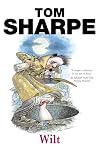
Wilt was my first introduction to the written work of Tom Sharpe, or so I thought until a quarter of the way through, when I realized I had actually watched the film adaptation starring Mel Smith and Griff Rhys Jones I couple of decades previous. Wilt drips with dry British humor that satirizes the cultural formalities and class division while somehow defending it at the same time. Wilt inadvertently frames himself for the murder of his wife - who isn't even dead, mind you - and through his show more constant attempts to clear his name provokes the reactionary disapproval of the local constabulary, his academic peers, and practically everybody else that gets drawn into the growing avalanche of complications. Things spin even further out of control when Wilt finds himself enjoying it. Yes, there is a blow-up sex doll involved, but the humor revolving dear Judy has less to do with its existence than the reaction to it. Wilt excels as a hilarious work also because the novel's hero Henry Wilt - beleaguered literature professor and married man - is just as off-kilter (if not more so) than the rest of characters galivanting through this comedy of errors. Fans of British humor will really get a kick out of Wilt. show less

Caustic humor is a long and noble British tradition. What sets Tom Sharpe ahead of the pack is not the depth of his perversion (which is deep enough) or the sheer volume of comic mayhem that he can squeeze into two hundred pages, but that he can make you laugh out loud at the most appalling things, and keep you coming back for more.
Part of his secret is that the stories are laced with Awful Truth. It’s hard to conceive that a writer who uses penis mutilation as a recurring motif and whose show more characters habitually cavort in rubber rooms and sex-toy factories might have something important to say. Sharpe is driven by a deep-seated anger at the system, and it’s the anger that powers the black extremes of his humor.
The other part of his secret is harder to express in a short recommendation: because, yes, the books are charming in a sick adult sort of way, and this charm of style seldom fails even when Sharpe is describing (in his South African series Indecent Exposure and Riotous Assembly) the efforts of white Afrikaners to eliminate black Africans by raping black women, or (in The Throwback) the efforts of a young man to hang onto his inheritance by having his dead grandfather stuffed and wired for sound. Look, I don’t expect you to believe me: read the books and find out for yourselves. Reading Tom Sharpe is a test of character — try him and see if you pass. show less
Part of his secret is that the stories are laced with Awful Truth. It’s hard to conceive that a writer who uses penis mutilation as a recurring motif and whose show more characters habitually cavort in rubber rooms and sex-toy factories might have something important to say. Sharpe is driven by a deep-seated anger at the system, and it’s the anger that powers the black extremes of his humor.
The other part of his secret is harder to express in a short recommendation: because, yes, the books are charming in a sick adult sort of way, and this charm of style seldom fails even when Sharpe is describing (in his South African series Indecent Exposure and Riotous Assembly) the efforts of white Afrikaners to eliminate black Africans by raping black women, or (in The Throwback) the efforts of a young man to hang onto his inheritance by having his dead grandfather stuffed and wired for sound. Look, I don’t expect you to believe me: read the books and find out for yourselves. Reading Tom Sharpe is a test of character — try him and see if you pass. show less
Lists
Favourite Books (1)
Awards


You May Also Like


Associated Authors
Statistics
- Works
- 39
- Also by
- 4
- Members
- 13,939
- Popularity
- #1,652
- Rating
- 3.6
- Reviews
- 204
- ISBNs
- 540
- Languages
- 17
- Favorited
- 1