
Dan Sperber
Author of The Enigma of Reason
About the Author
Disambiguation Notice:
Not to be combined with Daniel Sperber
Works by Dan Sperber
Associated Works
What Is Your Dangerous Idea? Today's Leading Thinkers on the Unthinkable (2007) — Contributor — 668 copies, 8 reviews
Le débat 47 (novembre/decembre 1987). Une Nouvelle science de l'esprit (1987) — Contributor — 1 copy
Tagged
Common Knowledge
- Birthdate
- 1942-06-20
- Gender
- male
- Occupations
- Il est directeur de recherche émérite au CNRS, professeur au département de Philosophie de la Central European University à Budapest et Directeur du site internet International Cognition and Culture Institute.
- Relationships
- Sperber, Manès (vader)
Sperber, Jenka (moeder)
Sperber, Vladimir (halfbroer) - Nationality
- France
- Birthplace
- Cagnes-sur-Mer, Frankrijk
- Disambiguation notice
- Not to be combined with Daniel Sperber
- Associated Place (for map)
- France
Members
Reviews
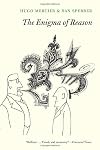
The first enigma I want to address is why I would read an evo-psych book since I don't accept its premises and find they are usually poorly reasoned. I will answer by giving reasons and admit up front that they were not why I read it but are being manufactured to answer the question I just asked.
(That I would do so supports one of the books premises, namely that reasons are mainly come up with afterwords, and not in making a decision.)
That answer is as follows: Actually, there are many times show more I wanted to abandon the book and yet I did not. When I was most bored, I found it soon picked up again. I thought it atypical in that it was well argued and had an interesting premise--that being, how did something as "broken" as reason ever evolve in the first place. That's a question. The answer, the actual premise, being that it evolved not for the reason we think it did while we're reasoning (and reasoning about reasoning) but for its survival value (which turns out also not to be what we think it is, but is instead concerned with how we form societies). The reasoning in this book, if it does well in the "marketplace of ideas", will help its authors increase their presence in the gene pool. (Well, perhaps not these particular authors who, for all I know, aren't going to be having more children, but as some sort of appropriate evo-psych generalization of that idea.
It also attacked the Thinking Fast and Slow guys (I enjoy seeing evo-psych people attack each other--this enjoyment, they would argue, is somehow also related to its survival value). In fact, there's much to like about this book if you enjoy a nice debunking, and I do. I almost want to give it another star now. show less
(That I would do so supports one of the books premises, namely that reasons are mainly come up with afterwords, and not in making a decision.)
That answer is as follows: Actually, there are many times show more I wanted to abandon the book and yet I did not. When I was most bored, I found it soon picked up again. I thought it atypical in that it was well argued and had an interesting premise--that being, how did something as "broken" as reason ever evolve in the first place. That's a question. The answer, the actual premise, being that it evolved not for the reason we think it did while we're reasoning (and reasoning about reasoning) but for its survival value (which turns out also not to be what we think it is, but is instead concerned with how we form societies). The reasoning in this book, if it does well in the "marketplace of ideas", will help its authors increase their presence in the gene pool. (Well, perhaps not these particular authors who, for all I know, aren't going to be having more children, but as some sort of appropriate evo-psych generalization of that idea.
It also attacked the Thinking Fast and Slow guys (I enjoy seeing evo-psych people attack each other--this enjoyment, they would argue, is somehow also related to its survival value). In fact, there's much to like about this book if you enjoy a nice debunking, and I do. I almost want to give it another star now. show less
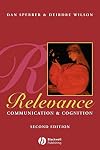
This book presents what I think future humans will recognize as one of the classic "great ideas": that human cognition and communication are geared toward the achievement of "relevance," defined as the property by which more "cognitive effects" are produced at less "cognitive cost." It moved the discussion of human communication in the fields of language philosophy and psychology/cognitive science away from the cheesy old "code" model where one brain composes an utterance in a transparent show more system that is then transmitted and translated transparently by a receiving brain, to one that is rooted in inference and interaction and mysteries and everything that makes life worth living. It is an idea rooted in the hardest of science (the best models of how we understand the brain) and with deep implications for the arts and the emotions (the study of metaphor, say, or the experience of irony, which come to be seen as not qualitatively different from default literalness and bald sincerity but as reliant on relevance principles--the former, where relevance allows us to skip straight to the intended "metaphorical" meaning while avoiding the allegedly default literal meaning (if I say "he's such a little trouper" you don't even stop to think of a member of an acting company but understand me to mean a staunch colleague, obviating the categorical distinction; and in the latter case, if, say, you're a nervous nelly and you stop for a loooong time at the crosswalk and there's no one in sight and I go "watch out for the car" with my dry wit, relevance says that I don't actually mean "watch out for the car."
And then they actually take us from there to why what I mean is "I think it's fine, dude" using a lot of inferred cognitive processes and (non-formal) logic, and I'll be honest, the detailed proofwork doesn't interest me much and that is one reason I only gave this 4 1/2 stars. I don't care if it's real so much as I care if it's fascinating, and this is, and the basic ideas about cognitive and communicative principles and not categorizing types of speech acts but instead understanding each utterance in terms of its unique contextual effects and seeing speech as structured by a semantic grammar that is analogous to syntactic grammar--drawing tree diagrams where we begin our interpretive engagement with the content of some communicative act or hell with the physical world as a whole by assuming that "something" (the old subject noun phrase) "did" (the verb) "something" (the predicate or the direct object, and then of course we can differentiate those into transitives and intransitives depending on whether something did something TO something or not and oh yeah, suck it generative grammar, language is structured the way it is to reflect reality and we lose the world of theta-roles and that of agents and experiencers and syntax and semantics are redeemed at a swoop. So simple ne. There are years of subtleties here but what I see rings true, though unless you intend to make a career in this stuff or are very patient you might be better served reading the intro and the postscript and a couple of their lighter papers. Sperber and Wilson are good writers but for a principle with so much Occam's razor potential for the study of language and cognition this drops into some dense and abstruse stuff. Nonetheless, a human triumph. show less
And then they actually take us from there to why what I mean is "I think it's fine, dude" using a lot of inferred cognitive processes and (non-formal) logic, and I'll be honest, the detailed proofwork doesn't interest me much and that is one reason I only gave this 4 1/2 stars. I don't care if it's real so much as I care if it's fascinating, and this is, and the basic ideas about cognitive and communicative principles and not categorizing types of speech acts but instead understanding each utterance in terms of its unique contextual effects and seeing speech as structured by a semantic grammar that is analogous to syntactic grammar--drawing tree diagrams where we begin our interpretive engagement with the content of some communicative act or hell with the physical world as a whole by assuming that "something" (the old subject noun phrase) "did" (the verb) "something" (the predicate or the direct object, and then of course we can differentiate those into transitives and intransitives depending on whether something did something TO something or not and oh yeah, suck it generative grammar, language is structured the way it is to reflect reality and we lose the world of theta-roles and that of agents and experiencers and syntax and semantics are redeemed at a swoop. So simple ne. There are years of subtleties here but what I see rings true, though unless you intend to make a career in this stuff or are very patient you might be better served reading the intro and the postscript and a couple of their lighter papers. Sperber and Wilson are good writers but for a principle with so much Occam's razor potential for the study of language and cognition this drops into some dense and abstruse stuff. Nonetheless, a human triumph. show less
Really loved this book! Can't believe two French academics could write so beautifully in English. Not an easy read exactly, but far from impenetrable- it takes a little work to read but ideas are explained slowly and carefully and convincingly. Basic premise is that the ability of humans to reason is more of a communications skill, evolved to help us make arguments and evaluate arguments made by others. In most cases, in non-social situations, people don't reason at all - we act intuitively. show more Bravo, a fine psychology/philosophy mix! show less
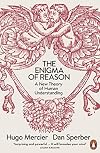
The best book I have read for a while.
Let me explain that.
It's a non fiction book; dealing with an area of study as to which I have no particular background or formal study. And yet I like to think of myself as a thinking person and have read widely, including as to philosophy and evolution amongst other topics. And I have always been intrigued as to whether there is such a thing as the "truth" [ I have always that there was a truth [as opposed to knowing what it was] and what role "reason" show more may play in discerning it.
Then along comes this book which I more or less picked up randomly at my favourite book shop (Folio Books in Brisbane Australia).
It is well written, in the sense that it is clearly written, does not try to use jargon for the (seemingly at times, in other books) reason that the author cannot explain (or cannot be bothered to explain) to a lay reader what the jargon refers to, and does not pretend to have all the answers (and points out what more research is required to go further).
And it deals with an interesting topic.
(My words) If reason (understood to be the application of what is, or akin to, classical logic, perhaps updated by Bayesian probabilities etc) is meant to result in (particularly after repeat applications of same by the same person or series of persons) in better answers why is it that reason results in "answers" which seemingly are so often wrong?
What then are "reasons" and what is “reason” and what is its function?
The authors' approach this from an evolutionary perspective...if reason is a trait of humans, and evolution impacts on traits, what affect has evolution had on reason? And they cite many studies to support their thesis. As i have already said, this is not my area of study, so I cannot comment on whether the studies they cite are valid, problematic etc, discredited by further studies etc. Yet I bought the logic of the thesis they put forward.
Well worth a read.
For more information google their names...there is a fair degree of discussion (both for and against) already, which will also give you a better sense of the thesis itself
Big Ship
16 September 2018 show less
Let me explain that.
It's a non fiction book; dealing with an area of study as to which I have no particular background or formal study. And yet I like to think of myself as a thinking person and have read widely, including as to philosophy and evolution amongst other topics. And I have always been intrigued as to whether there is such a thing as the "truth" [ I have always that there was a truth [as opposed to knowing what it was] and what role "reason" show more may play in discerning it.
Then along comes this book which I more or less picked up randomly at my favourite book shop (Folio Books in Brisbane Australia).
It is well written, in the sense that it is clearly written, does not try to use jargon for the (seemingly at times, in other books) reason that the author cannot explain (or cannot be bothered to explain) to a lay reader what the jargon refers to, and does not pretend to have all the answers (and points out what more research is required to go further).
And it deals with an interesting topic.
(My words) If reason (understood to be the application of what is, or akin to, classical logic, perhaps updated by Bayesian probabilities etc) is meant to result in (particularly after repeat applications of same by the same person or series of persons) in better answers why is it that reason results in "answers" which seemingly are so often wrong?
What then are "reasons" and what is “reason” and what is its function?
The authors' approach this from an evolutionary perspective...if reason is a trait of humans, and evolution impacts on traits, what affect has evolution had on reason? And they cite many studies to support their thesis. As i have already said, this is not my area of study, so I cannot comment on whether the studies they cite are valid, problematic etc, discredited by further studies etc. Yet I bought the logic of the thesis they put forward.
Well worth a read.
For more information google their names...there is a fair degree of discussion (both for and against) already, which will also give you a better sense of the thesis itself
Big Ship
16 September 2018 show less
Lists
Awards


You May Also Like


Associated Authors
Statistics
- Works
- 20
- Also by
- 4
- Members
- 836
- Popularity
- #30,568
- Rating
- 3.9
- Reviews
- 10
- ISBNs
- 67
- Languages
- 8
- Favorited
- 4