
Starhawk
Author of The Spiral Dance: A Rebirth of the Ancient Religion of the Goddess
About the Author
Starhawk is a Witch, peace activist, ecofeminist, and author of several books, including The Pagan Book of Living and Dying, The Fifth Sacred Thing, and Truth or Dare. She is the cofounder of the Bay Area Reclaiming Collective, and she teaches and lectures in the U.S., Canada, Central America, and show more Europe. show less
Image credit: Workshop at Occupy Santa Cruz
Series
Works by Starhawk
The Spiral Dance: A Rebirth of the Ancient Religion of the Goddess (1979) — Author — 2,796 copies, 24 reviews
The Twelve Wild Swans: A Journey to the Realm of Magic, Healing, and Action (2000) 423 copies, 2 reviews
Associated Works
Sisters of the Earth: Women's Prose and Poetry About Nature (1991) — Composer — 443 copies, 5 reviews
Cries of the Spirit: A Celebration of Women's Spirituality (2000) — Contributor — 404 copies, 2 reviews
Weaving the Visions: New Patterns in Feminist Spirituality (1989) — Contributor — 387 copies, 2 reviews
Wise Women: Over Two Thousand Years of Spiritual Writing by Women (1996) — Contributor — 231 copies, 1 review
Mythmakers and Lawbreakers: Anarchist Writers on Fiction (2010) — Contributor — 111 copies, 1 review
Green Egg Omelette: An Anthology of Art and Articles from the Legendary Pagan Journal (2009) — Contributor — 67 copies
Face to Face: Women Writers on Faith, Mysticism, and Awakening (2004) — Contributor — 39 copies, 1 review
Magic of the Pearl Pentacle: Reclaiming Love, Law, Wisdom, Liberty & Knowledge (2025) — Contributor — 2 copies
"Orpheus" VORTEX: A Journal of New Vision (Volume 1, Number 2) — Contributor — 1 copy
Tagged
Common Knowledge
- Canonical name
- Starhawk
- Legal name
- Simos, Miriam
- Birthdate
- 1951-06-17
- Gender
- female
- Education
- University of California, Los Angeles (BA|1972)
Antioch University West (MA|1982) - Occupations
- writer
- Organizations
- Reclaiming Tradition of Witchcraft
Media Alliance
Information Film Producers Association
American Academy of Religion
California Institute of Integral Studies - Awards and honors
- Lambda Literary Award (1994)
Samuel Goldwyn Writing Award (1973)
Media Alliance Meritorious Achievement Award (1988)
Nautilus Award (2003)
Nautilus Award (Silver - 2010) - Relationships
- Simos, Bertha (mother)
- Short biography
- Starhawk is a peace, environmental, and global justice activist and trainer, a permaculture designer and teacher, a Pagan and Witch.
- Nationality
- USA
- Birthplace
- St. Paul, Minnesota, USA
- Places of residence
- San Francisco, California, USA
St. Paul, Minnesota, USA
Los Angeles, California, USA
Sonoma, California, USA - Associated Place (for map)
- California, USA
Members
Reviews
This is an excellent book, and it was the first nonfiction book about Paganism that I ever read, back in the late 1980s. I have just reread it in 2024.
There are many noteworthy things about this book: its engagement of witchcraft and politics, the fact that it is not gender essentialist—Starhawk notes that the qualities ascribed to men and women are based in culture and not biology—and its emphasis on equality, the importance of immanence, and its acknowledgment that sometimes show more progressive people tie themselves in knots trying to be “correct”. I also love the real life examples of protests and rituals and trance work.
In the early 1980s when it was written, much of the protest movement was concerned with the possibility of nuclear annihilation, although climate change and the destruction of nature were already rearing their heads. Nonetheless the tactics of magical resistance described in the book are still valid.
Some of the vocabulary in the original edition (which is the one I read) of the book is outdated which some might find jarring—but it is easy to see that the intent behind the words is progressive.
The history section in the appendix contains a few ideas that have since been demonstrated to be wrong or exaggerated—but their loss does not undermine the overall argument, which is that historically there was a move away from immanence and interconnectivity and towards transcendence and hatred of the world and the flesh. It’s also true that midwives were persecuted as witches in German-speaking lands—the evidence is there in 17th century German popular broadsheets—even if there was not a comparable persecution in English-speaking lands.
Overall this is still a great book and I would recommend reading it. I see there’s an updated version of the book too. show less
There are many noteworthy things about this book: its engagement of witchcraft and politics, the fact that it is not gender essentialist—Starhawk notes that the qualities ascribed to men and women are based in culture and not biology—and its emphasis on equality, the importance of immanence, and its acknowledgment that sometimes show more progressive people tie themselves in knots trying to be “correct”. I also love the real life examples of protests and rituals and trance work.
In the early 1980s when it was written, much of the protest movement was concerned with the possibility of nuclear annihilation, although climate change and the destruction of nature were already rearing their heads. Nonetheless the tactics of magical resistance described in the book are still valid.
Some of the vocabulary in the original edition (which is the one I read) of the book is outdated which some might find jarring—but it is easy to see that the intent behind the words is progressive.
The history section in the appendix contains a few ideas that have since been demonstrated to be wrong or exaggerated—but their loss does not undermine the overall argument, which is that historically there was a move away from immanence and interconnectivity and towards transcendence and hatred of the world and the flesh. It’s also true that midwives were persecuted as witches in German-speaking lands—the evidence is there in 17th century German popular broadsheets—even if there was not a comparable persecution in English-speaking lands.
Overall this is still a great book and I would recommend reading it. I see there’s an updated version of the book too. show less

There is much that I admire in this tale of a community that seeks a non-violent defense against an agressor who has set loose a manufactured virus epidemic in preparation for an invasion.
Set in California after a social upheaval, Madrone's egalitarian hometown is threatened by a militaristic-hierarchical-fundamentalist-racist community to the south. Chapters alternate between her point of view, that of her grandmother Maya, one of the original activists from the 1990's, and that of her show more friend Bird who is imprisoned in the south. Starhawk gives a good overview of how the utopian society works, alternative healing, their consensus decision-making, their creed of the 4 sacred things (air, earth, fire, water) that all are committed to protecting.
There are some internal inconsistencies that need to be ignored (such as how come the rest of the world doesn't have a presence), and moments when the characters get a bit preachy. Overall, tho, this is just the book I wanted to read during the "pandemic" about which our media & politicos are trying to frighten us. show less
Set in California after a social upheaval, Madrone's egalitarian hometown is threatened by a militaristic-hierarchical-fundamentalist-racist community to the south. Chapters alternate between her point of view, that of her grandmother Maya, one of the original activists from the 1990's, and that of her show more friend Bird who is imprisoned in the south. Starhawk gives a good overview of how the utopian society works, alternative healing, their consensus decision-making, their creed of the 4 sacred things (air, earth, fire, water) that all are committed to protecting.
There are some internal inconsistencies that need to be ignored (such as how come the rest of the world doesn't have a presence), and moments when the characters get a bit preachy. Overall, tho, this is just the book I wanted to read during the "pandemic" about which our media & politicos are trying to frighten us. show less

there is such love in this book that at times it's a bit overwhelming. what a grand scope and idea. it took me a little while to get into it, and then a long time to read it (like at least twice as long as i feel like it should have taken) but i really did like what she was doing and i liked the story, the writing, the book itself. it wasn't written entirely in alternating chapters of viewpoints, but it was close, and i was glad to be with bird when we were with him, and with madrone when we show more were with her.
the utopia she creates is, well, just that, and it's a nice break from the dystopia that is in so many books, and in reality right now. but she doesn't just create a utopia, she fights for it and argues for it, and i appreciate that. she makes a world where sexuality, gender, and race all exist but don't matter. class is mostly erased. nonviolence is one of the only rules, and she doesn't allow it to go untested. so it's not just a story about this magical, wonderful place that feels like both heaven and an impossibility. she shows us how they got there and almost how to build it (except there is witchery and magic, probably because it's impossible to create this otherwise) and at least in part how to sustain it and fight for it.
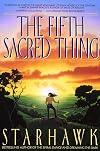
i really wish the cover had an obviously brown woman on it, though. madrone is not white and there is no reason to misrepresent her this way. i hate that in my head, i kept picturing white people, even when i knew the characters weren't white. (this is not the book's fault; i understand that it is mine.) but it would have been nice if the cover of the book didn't reinforce my bias.
there are many good ideas here, and interesting philosophical discussions. i also thought it was an interesting choice to put it in the future but the very near future, not even a few generations away. i'm glad i read this.
from her dedication, after mentioning specific children: "...and to all the new ones who must live in the future that we create or destroy with our choices today."
"It was beautiful and fierce and fragile, like a lot of things."
"'War is the great waster, as much in the preparations for it as in the waging of it.'"
"'The ends don't justify the means,' Maya said. 'That was what I learned from Vietnam, from the war and the protests against it. The means shape the ends. You become what you do.'"
"'What good is it all if we can't defend it? And how do we defend it without becoming what we're defending against?'"
"'...peace can't grow out of violence.'"
but she doesn't just throw these platitudes out. she allows her characters to know the contradiction in living those values and their lives, and in meeting violence. i am glad that she takes this book where she does, that she doesn't avoid the hard stuff, even in this utopia. i really appreciated what she did here. show less
the utopia she creates is, well, just that, and it's a nice break from the dystopia that is in so many books, and in reality right now. but she doesn't just create a utopia, she fights for it and argues for it, and i appreciate that. she makes a world where sexuality, gender, and race all exist but don't matter. class is mostly erased. nonviolence is one of the only rules, and she doesn't allow it to go untested. so it's not just a story about this magical, wonderful place that feels like both heaven and an impossibility. she shows us how they got there and almost how to build it (except there is witchery and magic, probably because it's impossible to create this otherwise) and at least in part how to sustain it and fight for it.
i really wish the cover had an obviously brown woman on it, though. madrone is not white and there is no reason to misrepresent her this way. i hate that in my head, i kept picturing white people, even when i knew the characters weren't white. (this is not the book's fault; i understand that it is mine.) but it would have been nice if the cover of the book didn't reinforce my bias.
there are many good ideas here, and interesting philosophical discussions. i also thought it was an interesting choice to put it in the future but the very near future, not even a few generations away. i'm glad i read this.
from her dedication, after mentioning specific children: "...and to all the new ones who must live in the future that we create or destroy with our choices today."
"It was beautiful and fierce and fragile, like a lot of things."
"'War is the great waster, as much in the preparations for it as in the waging of it.'"
"'The ends don't justify the means,' Maya said. 'That was what I learned from Vietnam, from the war and the protests against it. The means shape the ends. You become what you do.'"
"'What good is it all if we can't defend it? And how do we defend it without becoming what we're defending against?'"
"'...peace can't grow out of violence.'"
but she doesn't just throw these platitudes out. she allows her characters to know the contradiction in living those values and their lives, and in meeting violence. i am glad that she takes this book where she does, that she doesn't avoid the hard stuff, even in this utopia. i really appreciated what she did here. show less
A beautiful, surprising, and challenging book; a book where it is difficult to remember whilst reading that magic isn't real and events depicted withing couldn't happen. A book that also shows a glipse of a beautiful future that could be possible!
Lists
Five star books (1)
Awards


You May Also Like


Associated Authors
Statistics
- Works
- 32
- Also by
- 13
- Members
- 8,284
- Popularity
- #2,918
- Rating
- 4.0
- Reviews
- 83
- ISBNs
- 82
- Languages
- 8
- Favorited
- 27

