KARAMAZOV: The Legend of the Grand Inquisitor: Discussion Thread
Talk Le Salon Littéraire du Peuple pour le Peuple
Join LibraryThing to post.
This topic is currently marked as "dormant"—the last message is more than 90 days old. You can revive it by posting a reply.
1QuentinTom

Pobedonostsev

El Greco, 'Portrait of a Cardinal', thought to be Cardinal Don Fernando Niño de Guevara (1541-1609) the Grand Inquisitor

Francis Bacon 'Screaming Pope'
To my mind, this is one of the most incredible pieces of writing in world literature. If everything else written by D were to be erased from the record, leaving only this Legend, his stature as one of the greatest writers in history would still be assured, I think. There are two reasons for its greatness: its form, and its content. I’m going to focus my remarks on its form, in the hope that others will take up the challenge of guiding us through a discussion of its content and themes.
2tommyb27
Great pics, Tomcat.
Question on this exchange after Ivan finishes the tale:
Ivan: "Why do you take it so seriously? Surely you don't think I am going straight off to the Jesuits, to join the men who are correcting His work? Good Lord, it's no business of mine."
Alyosha: "With such a hell in your heart and head...that's just what you are going away for, to join them."
Surely not a literal reference to the Jesuits, so who is the 'them'? The socialists? Anarchists? Secular humanists generally?
Question on this exchange after Ivan finishes the tale:
Ivan: "Why do you take it so seriously? Surely you don't think I am going straight off to the Jesuits, to join the men who are correcting His work? Good Lord, it's no business of mine."
Alyosha: "With such a hell in your heart and head...that's just what you are going away for, to join them."
Surely not a literal reference to the Jesuits, so who is the 'them'? The socialists? Anarchists? Secular humanists generally?
4QuentinTom
I think Gene is right. I think Alyosha means that he thinks Ivan, out of his atheism is going to join 'those who are correcting His work'. Alyosha plumbs the depths of Ivan's cynicism: after all, if, according to Ivan, the Jesuits are atheists, why not join them?
Later, in chapter 7 when Ivan is on his way to Moscow he just says he is going to new scenes and places. he is no more specific than that. we never really get to find out why he is leaving the town, I think.
Hello Gene! I"m very interested to hear your thoughts on the legend of the Grand Inquisitor! :)
Later, in chapter 7 when Ivan is on his way to Moscow he just says he is going to new scenes and places. he is no more specific than that. we never really get to find out why he is leaving the town, I think.
Hello Gene! I"m very interested to hear your thoughts on the legend of the Grand Inquisitor! :)
5geneg
I've been racing ahead, I'm at Book IX Ivan 1 At Grushenka's. Once I get started reading I just can't stop until the book falls out of my hands, breaking my toes as it lands. I do want to participate in the discussion of the Grand Inquisitor and have set aside time tomorrow afternoon to go back to it and give it a good, careful read through the filter of my faith, if I can use that word without incurring the wrath of The Grand Atheist. My initial read through didn't leave me feeling very positive about either Jesus or the Church. I definitely want to take time to engage with the text.
6geneg
Here's a five minute excerpt of a talk by a fellow named Greg Boyd about what's wrong with Christianity in the US. Constantine's Pagan Influence on Christianity. In it he mentions the third temptation of Christ and the problems that have flowed from the Church's acceptance of that temptation.
I stand with this fellow. It helps explain what I said earlier about theology being the playground of Satan.
I stand with this fellow. It helps explain what I said earlier about theology being the playground of Satan.
7absurdeist
careful read through the filter of my faith, if I can use that word without incurring the wrath of The Grand Atheist
I'm laughing my ass off at the grandeur of that snipe!
I'm laughing my ass off at the grandeur of that snipe!
8QuentinTom
Notes on Form: Ambiguation
1. The first thing to note is the way D foregrounds the many narrative layers in which TLGI nestles. He does this in several ways:
Ivan has not actually written the legend, he only planned it, and he is giving Alyosha a précis of what he had planned to write. (incidentally, don’t worry too much about the word ‘poem’. D means this very loosely, as a written, foundational text. For example, Gogol called his novel Dead Souls a ‘poem’, coz he hoped it would become a foundational text in the way that Dante’s or Homer’s poems had. ) This gives TLGI a double status: as a story which doesn’t exist, and at the same time, as a story which does. Ivan repeatedly draws attention to this aspect of the Legend in his telling of it.
There is a tradition of this kind double status genre in Russian lit, not least by D himself in the Dairy, which is full of sketches (ocherk) like this, of plans for stories or novels he might one day write, in which the plan of the story virtually becomes the story itself (I adore this kind of narrative game – I know Gene hates it-: another practitioner of it is Borges).
Ivan begins with an introduction of a description of the genre in which celestial characters appear in tales, giving a potted history of the genre with detailed examples drawn from medieval mystery plays, and Russian epics and hagiographies. More nestling appears here: he cites a performance of a French mystery play nestling within the text of Hugo’s novel Notre Dame de Paris. This is very sneaky. Ivan is giving himself a precedent for creating a Legend about a supernatural being who appears to a living person- Christ and the Inquisitor. At the same time, D is also creating a double precedent (the examples cited by Ivan and the TLGI itself) for his own inclusion of the appearance of a supernatural being to a living person - the devil to Ivan- in the text of BK itself. In this way he made it virtually impossible for him to be accused of blasphemy.
Further double status: written (D’s text) and oral (Ivan’s retelling to Alyosha).
There is a further very subtle ambiguation of narrative provenance, in that D’s text is being related to us by a narrator whom we cannot put our finger on. Who is the narrator of this scene in the pub, the narrator of this conversation? How does (s)he come to be in possession of the details of the conversation? One’s head begins to spin when one contemplates all the narrative layers D creates for the Legend.
1. The first thing to note is the way D foregrounds the many narrative layers in which TLGI nestles. He does this in several ways:
Ivan has not actually written the legend, he only planned it, and he is giving Alyosha a précis of what he had planned to write. (incidentally, don’t worry too much about the word ‘poem’. D means this very loosely, as a written, foundational text. For example, Gogol called his novel Dead Souls a ‘poem’, coz he hoped it would become a foundational text in the way that Dante’s or Homer’s poems had. ) This gives TLGI a double status: as a story which doesn’t exist, and at the same time, as a story which does. Ivan repeatedly draws attention to this aspect of the Legend in his telling of it.
There is a tradition of this kind double status genre in Russian lit, not least by D himself in the Dairy, which is full of sketches (ocherk) like this, of plans for stories or novels he might one day write, in which the plan of the story virtually becomes the story itself (I adore this kind of narrative game – I know Gene hates it-: another practitioner of it is Borges).
Ivan begins with an introduction of a description of the genre in which celestial characters appear in tales, giving a potted history of the genre with detailed examples drawn from medieval mystery plays, and Russian epics and hagiographies. More nestling appears here: he cites a performance of a French mystery play nestling within the text of Hugo’s novel Notre Dame de Paris. This is very sneaky. Ivan is giving himself a precedent for creating a Legend about a supernatural being who appears to a living person- Christ and the Inquisitor. At the same time, D is also creating a double precedent (the examples cited by Ivan and the TLGI itself) for his own inclusion of the appearance of a supernatural being to a living person - the devil to Ivan- in the text of BK itself. In this way he made it virtually impossible for him to be accused of blasphemy.
Further double status: written (D’s text) and oral (Ivan’s retelling to Alyosha).
There is a further very subtle ambiguation of narrative provenance, in that D’s text is being related to us by a narrator whom we cannot put our finger on. Who is the narrator of this scene in the pub, the narrator of this conversation? How does (s)he come to be in possession of the details of the conversation? One’s head begins to spin when one contemplates all the narrative layers D creates for the Legend.
9QuentinTom
>5 geneg: great, gene, I really look forward to reading what you have to say. I hope others will also add their views.
10QuentinTom
And if by Grand Atheist you are referring to me, I am very much complimented. I shall add this to the list of titles I already have:
The Grand Atheist
The Duchess of Bromley
President of the Vagabonds and Vagrants Society
High Priest of Clupeus
The Grand Atheist
The Duchess of Bromley
President of the Vagabonds and Vagrants Society
High Priest of Clupeus
11slickdpdx
People tend to compare a position they don't favor with the ideal outcome, while holding their own positions to more reasonable real-world expectatations.
12QuentinTom
a cryptic utterance, slick. I fear I have not had as much vodka as you have. can you unpack what you mean a bit?
14QuentinTom
let's have a nice auto da fe:
http://www.youtube.com/watch?v=9zkE8R6Wf_c&feature=related
from Verdi's opera Don Carlos, based on Schiller's play.
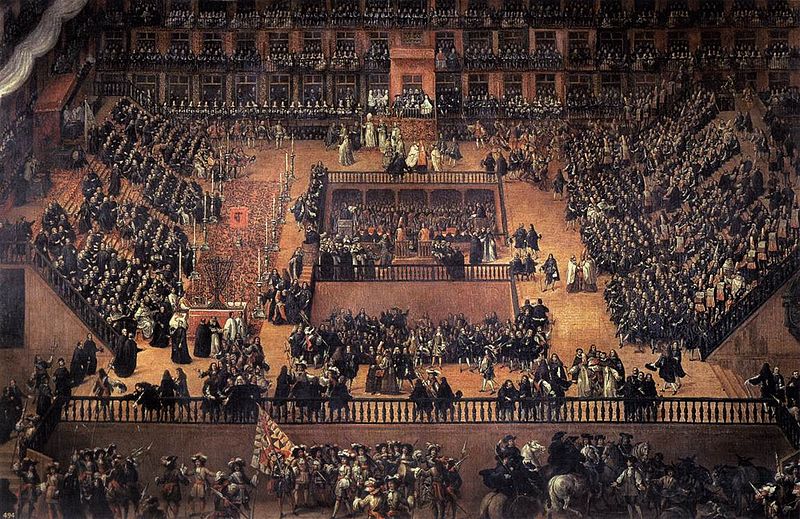
Francisco Ricci 'Auto de Fe' 1683
http://www.youtube.com/watch?v=9zkE8R6Wf_c&feature=related
from Verdi's opera Don Carlos, based on Schiller's play.
Francisco Ricci 'Auto de Fe' 1683
15tommyb27
>3 geneg: Those who are correcting His work.
Yes, geneg, now it seems to me that that's precisely right. I suppose for D the distinction between Catholics and socialists/anarchists - important enough in particular contexts - often didn't exist at all. The Ivan in 2.5.4 seems to voice the socialist/anarchist/left rejection of faith while in 2.5.5 he voices the catholic rejection (as D would have it). But when Alyosha says "you are going away...to join them," it doesn't seem to matter which particular "faction" of atheists Ivan is off to join. For me, this also helps with trying to understand D's fascinating and surprising hypothesis that catholicism produced socialism.
Yes, geneg, now it seems to me that that's precisely right. I suppose for D the distinction between Catholics and socialists/anarchists - important enough in particular contexts - often didn't exist at all. The Ivan in 2.5.4 seems to voice the socialist/anarchist/left rejection of faith while in 2.5.5 he voices the catholic rejection (as D would have it). But when Alyosha says "you are going away...to join them," it doesn't seem to matter which particular "faction" of atheists Ivan is off to join. For me, this also helps with trying to understand D's fascinating and surprising hypothesis that catholicism produced socialism.
16QuentinTom
Notes on Form: Literariness
2. In his introduction, Ivan foregrounds the literariness of the Legend by the inclusion of references to three poems: Schiller, Tyutchev and Polezhaev. I am unable to find an English version of this last poem, but here are the Schiller and the Tyutchev, the latter was a very famous poem in 19th Century Russia.
Schiller ‘Sehnsucht’ (Longing)
Ah, from this valley's grounds
that cold mists are pressing,
if I could only find a way out,
ah, how lucky I would feel!
Over there I glimpse pretty hills,
ever young and ever green!
If I had flight, if I had wings,
I would float over to those hills.
Harmonies I hear tinkling,
tones of sweet, heavenly peace;
and light winds bring
to me the scent of balsam.
Golden fruit I see glowing,
beckoning between dark leaves;
and the flowers that bloom there,
will never become Winter's prey.
Ah, how fine it must be to wander
there in eternal sunshine,
and the air on those heights -
O how refreshing it must be!
Yet I am stymied by the charging river,
that roars between us in rage;
its waves are so high
that my soul is horrified.
I see a small boat rocking there,
but ah! the ferryman is missing.
Go briskly to it and without hesitation:
his sails are ready.
You must believe, you must dare it,
for the Gods make no pledges.
Only a miracle can carry you
into that fair land of wonder.
Incidentally, Schubert set this poem to music, here is a performance:
http://www.youtube.com/watch?v=k_gs9VyryVM
Tyutchev:
These poor hamlets humbly faring
Nature sunk in desolation
Land of mine, such sorrow bearing
Land of all the Russian nation!
Nothing knowing, nothing seeing,
How can haughty foreign faces
Mark what mystery has being
In thy lowly, naked places?
There was one, my land, who knew thee,
with a cross upon him pressing,
like a servant passing through thee,
Heaven’s king once gave his blessing
Trans CM Bowra.
The Schiller highlights the themes of miracles, and the leap of faith; and the Tyutchev highlights the theme of the ‘ownership’ of the image of Christ by Russia, specifically, by Orthodoxy. The idea that Europe did not understand Russia, and that the Russian people had a special connection to Christ – and vice versa- were both themes that D hammered away at throughout his later works. Polezhaev was associated with the poetry of rebellion under Nicholas 1st. Like Dostoevsky, he was the victim of the vindictiveness of the Tsar. We can see all these themes in the Legend.
2. In his introduction, Ivan foregrounds the literariness of the Legend by the inclusion of references to three poems: Schiller, Tyutchev and Polezhaev. I am unable to find an English version of this last poem, but here are the Schiller and the Tyutchev, the latter was a very famous poem in 19th Century Russia.
Schiller ‘Sehnsucht’ (Longing)
Ah, from this valley's grounds
that cold mists are pressing,
if I could only find a way out,
ah, how lucky I would feel!
Over there I glimpse pretty hills,
ever young and ever green!
If I had flight, if I had wings,
I would float over to those hills.
Harmonies I hear tinkling,
tones of sweet, heavenly peace;
and light winds bring
to me the scent of balsam.
Golden fruit I see glowing,
beckoning between dark leaves;
and the flowers that bloom there,
will never become Winter's prey.
Ah, how fine it must be to wander
there in eternal sunshine,
and the air on those heights -
O how refreshing it must be!
Yet I am stymied by the charging river,
that roars between us in rage;
its waves are so high
that my soul is horrified.
I see a small boat rocking there,
but ah! the ferryman is missing.
Go briskly to it and without hesitation:
his sails are ready.
You must believe, you must dare it,
for the Gods make no pledges.
Only a miracle can carry you
into that fair land of wonder.
Incidentally, Schubert set this poem to music, here is a performance:
http://www.youtube.com/watch?v=k_gs9VyryVM
Tyutchev:
These poor hamlets humbly faring
Nature sunk in desolation
Land of mine, such sorrow bearing
Land of all the Russian nation!
Nothing knowing, nothing seeing,
How can haughty foreign faces
Mark what mystery has being
In thy lowly, naked places?
There was one, my land, who knew thee,
with a cross upon him pressing,
like a servant passing through thee,
Heaven’s king once gave his blessing
Trans CM Bowra.
The Schiller highlights the themes of miracles, and the leap of faith; and the Tyutchev highlights the theme of the ‘ownership’ of the image of Christ by Russia, specifically, by Orthodoxy. The idea that Europe did not understand Russia, and that the Russian people had a special connection to Christ – and vice versa- were both themes that D hammered away at throughout his later works. Polezhaev was associated with the poetry of rebellion under Nicholas 1st. Like Dostoevsky, he was the victim of the vindictiveness of the Tsar. We can see all these themes in the Legend.
17tommyb27
The tower of Babel seems to be another one of those recurring symbols, like the 'antheap':
The mystery narrator, 1.1.5: “socialism is not merely the labor question, it is before all things the atheistic question, the question of the form taken by atheism today. It is the question of the tower of Babel built without God, not to mount to Heaven from earth but to set up Heaven on earth.”
The Grand Inquisitor, 2.5.5: “Where Thy temple stood will rise a new building; the terrible tower of Babel will be built again. And though, like the one of old, it will not be finished, yet Though mightest...have cut short the sufferings of men for a thousand years; for they will come back to us after a thousand years of agony with their tower… And then we shall finish building their tower, for he finishes the building who feeds them.”
The mystery narrator, 1.1.5: “socialism is not merely the labor question, it is before all things the atheistic question, the question of the form taken by atheism today. It is the question of the tower of Babel built without God, not to mount to Heaven from earth but to set up Heaven on earth.”
The Grand Inquisitor, 2.5.5: “Where Thy temple stood will rise a new building; the terrible tower of Babel will be built again. And though, like the one of old, it will not be finished, yet Though mightest...have cut short the sufferings of men for a thousand years; for they will come back to us after a thousand years of agony with their tower… And then we shall finish building their tower, for he finishes the building who feeds them.”
18geneg
Two things I was meditating over as I began The Grand Inquisitor were that Jesus and the Church had changed places. The Church (RC, not Orthodox) had taken over from Jesus as the Judge and Jury. This was the first step on the road to secular humanism, which led to socialism: that man can live on bread alone, and the Church should be in charge of all the bread. The other was related to the Homily yesterday at Mass in which the Priest mentioned Christians as being at the mercy of Secular Humanism, a movement the RC Church, according to D. in this poem, as Ivan calls it, created. When I read my Bible I am struck by the notion that Jesus was the greatest humanist that ever lived. The Church is fighting its own particular battle with Christianity. The Church seeks and has attained secular power in many places and has convinced their adherents that they control the fate of their souls, while Jesus says My grace will wash your sins as white as snow. Where can one divine power from that? The Church seeks power, while Jesus opted for power through powerlessness, allowing the essential dignity of the human being to shine through. Ghandi understood this, so did MLK. The Church is a major secular institution.
Another thought I had this afternoon when I saw a film of St. Peter's in Rome, was how much political power and wealth the Church has accumulated. Jesus would be so proud. It all started going down hill with Augustine of Hippo. You can call him St. Augustine if you want, but he ain't no saint of mine.
Another thought I had this afternoon when I saw a film of St. Peter's in Rome, was how much political power and wealth the Church has accumulated. Jesus would be so proud. It all started going down hill with Augustine of Hippo. You can call him St. Augustine if you want, but he ain't no saint of mine.
19QuentinTom
well, on that last point at least we agree. St Augustine did more than anyone in the history of the West to ruin humanity's relationship with our own bodies, with his obsession with dirty sex and celibacy. contrast this with the utterly free attitude to sexuality in all the Eastern cultures.
tommy, the Tower of Babel, and the Crystal Palace are common symbols in D's work.
tommy, the Tower of Babel, and the Crystal Palace are common symbols in D's work.
20tommyb27
19> Hmm, this is way off topic here but... The west may have a very particular link between shame and sexuality. Maybe St Augustine bears the blame.
And yet "utterly free" is certainly not how I would describe the relationship of people in Eastern cultures to sexuality. Indeed, given how disruptive sexuality is, I'd be surprised indeed at any society which maintained an "utterly free attitude."
And yet "utterly free" is certainly not how I would describe the relationship of people in Eastern cultures to sexuality. Indeed, given how disruptive sexuality is, I'd be surprised indeed at any society which maintained an "utterly free attitude."
21QuentinTom
well, I think that's what I mean, about shame. I don't see any shame in Eastern attitudes to sexuality.
22QuentinTom
so gene, are you agreeing with Ivan in that case? do you think what the grand inquisitor says is a correct diagnosis of what's gone wrong with the church. Obviously I do, but I'm interested in what a practicing catholic thinks of this.
And to what extent do people think Ivan's views are meant to be applied to Orthodoxy?
And to what extent do people think Ivan's views are meant to be applied to Orthodoxy?
23tommyb27
So far Gene seems to mean only that the church has gone wrong through its materialism - more Alyosha's critique than Ivan's.
In addition to know what Gene thinks, I'd also like to know whether D himself believed the critique he put into Ivan's mouth: that the catholics did what they did out of a sincere love for humanity, conviced that the only way to help our weak species was through deception. Any hint of that in the Dosty archives?
In addition to know what Gene thinks, I'd also like to know whether D himself believed the critique he put into Ivan's mouth: that the catholics did what they did out of a sincere love for humanity, conviced that the only way to help our weak species was through deception. Any hint of that in the Dosty archives?
24tommyb27
And yes, I'd love to know whether D thought there was a danger that the Orthodox church could also go down the wrong path. Unfortunately, I know zilch about the Russian church.
25QuentinTom
>23 tommyb27:
Tommy, in A Writer’s Diary for 1876, D writes that Catholicism is above humanity, that it always allies itself with the powerful. In the diary for 1877 he wrote that Catholicism is the enemy of humanity. I think it’s safe to say that he thought Catholicism was only motivated by a lust for power, not a love for humanity. D detested everything about Catholicism and saw no good in it at all, anywhere. In D’s world view only Russia and Orthodoxy had a genuine love for humanity coz only Russia and Orthodoxy had the correct view of what humanity is. Socialists were also motivated for a love of humanity, but they had the wrong picture of what humanity is –atheist.
Regarding the deception part of your question, I think this is more a part of the thematic structure of BK. Deception and lies are an important theme in the novel: FP’s fabulous lies, Zosima’s strictures against lying, the trial scene at the end which seeks to sift lies from truth, the central place of deception in Ivan’s tale, Alyosha’s truth telling nature etc. D does write about lies in the Diary in a couple of places, but nowhere else. For D, lies are often a means to social interaction, especially the kind of lies FP tells, and also a means for arriving at truth:
All those things the human mind is forever and ever lying to itself about are much more understandable than the truth itself.
A Writer's Diary 1873.15
Hope this helps.
Tommy, in A Writer’s Diary for 1876, D writes that Catholicism is above humanity, that it always allies itself with the powerful. In the diary for 1877 he wrote that Catholicism is the enemy of humanity. I think it’s safe to say that he thought Catholicism was only motivated by a lust for power, not a love for humanity. D detested everything about Catholicism and saw no good in it at all, anywhere. In D’s world view only Russia and Orthodoxy had a genuine love for humanity coz only Russia and Orthodoxy had the correct view of what humanity is. Socialists were also motivated for a love of humanity, but they had the wrong picture of what humanity is –atheist.
Regarding the deception part of your question, I think this is more a part of the thematic structure of BK. Deception and lies are an important theme in the novel: FP’s fabulous lies, Zosima’s strictures against lying, the trial scene at the end which seeks to sift lies from truth, the central place of deception in Ivan’s tale, Alyosha’s truth telling nature etc. D does write about lies in the Diary in a couple of places, but nowhere else. For D, lies are often a means to social interaction, especially the kind of lies FP tells, and also a means for arriving at truth:
All those things the human mind is forever and ever lying to itself about are much more understandable than the truth itself.
A Writer's Diary 1873.15
Hope this helps.
26QuentinTom
Notes on Form: Miracles forshadowed
3.
In his paraphrase of The Virgin Among the Damned, Ivan prefigures many of the themes in the Inquisitor’s discourse: the necessity for miracles in sustaining belief, the sinners in the lake whom god has forgotten are an allegory of us on earth. Note how god’s reply to the Virgin: “how can I forgive his torturers?” is the same reply that Ivan made to Alyosha in the previous chapter, that the mother of the boy hunted down by the dogs might forgive his torturers, but Ivan himself cannot. ( I love Ivan’s sarcasm here: some fifteen centuries have elapsed since his prophet wrote ‘Behold I come quickly…’) When Christ comes to Seville, he performs two miracles before he is arrested: restoring the blind man’s sight, and resurrecting the little girl.
3.
In his paraphrase of The Virgin Among the Damned, Ivan prefigures many of the themes in the Inquisitor’s discourse: the necessity for miracles in sustaining belief, the sinners in the lake whom god has forgotten are an allegory of us on earth. Note how god’s reply to the Virgin: “how can I forgive his torturers?” is the same reply that Ivan made to Alyosha in the previous chapter, that the mother of the boy hunted down by the dogs might forgive his torturers, but Ivan himself cannot. ( I love Ivan’s sarcasm here: some fifteen centuries have elapsed since his prophet wrote ‘Behold I come quickly…’) When Christ comes to Seville, he performs two miracles before he is arrested: restoring the blind man’s sight, and resurrecting the little girl.
27QuentinTom

Botticelli, 'The Temptation of Christ', Sistine Chapel
29QuentinTom
Notes on Form: Discourse Strangeness and Sideshadowing
4.
The text of the Inquisitor’s discourse is utterly odd to read, I feel. There are several reasons for this. First, the form (the inquisitor’s long long speech to Christ) means that the subject of the sentences is all ‘You’, instead of the more conventional ‘I’, ‘we’ or ‘he/she’ of narrative discourse. The inquisitor is telling Christ what he Christ did, rather than telling a third person what someone else did, as in conventional narration. Second, the text is characterised by loads of subjunctives: ‘you could have done this instead’, ‘you should have done this instead’, ‘why didn’t you do this’ etc. the accumulative effect of these grammatical oddities over the great length of the speech adds to the strangeness of the tone. Third, is the fact that this is a dialogue with a missing -or at least silent- interlocutor: Christ. (isn’t that a definition of faith, perhaps?) (DFW uses a similar technique in Interviews with Hideous Men, I note in passing)
5.
Through his frequent use of the subjunctive, the Inquisitor effectively builds up a whole series of sideshadowing, alternative narratives for the main narrative of the Temptation in the Desert. You will see later in the trial scene that the prosecution and the defence both do the same for Dimitry, in examples of Kairova time.
4.
The text of the Inquisitor’s discourse is utterly odd to read, I feel. There are several reasons for this. First, the form (the inquisitor’s long long speech to Christ) means that the subject of the sentences is all ‘You’, instead of the more conventional ‘I’, ‘we’ or ‘he/she’ of narrative discourse. The inquisitor is telling Christ what he Christ did, rather than telling a third person what someone else did, as in conventional narration. Second, the text is characterised by loads of subjunctives: ‘you could have done this instead’, ‘you should have done this instead’, ‘why didn’t you do this’ etc. the accumulative effect of these grammatical oddities over the great length of the speech adds to the strangeness of the tone. Third, is the fact that this is a dialogue with a missing -or at least silent- interlocutor: Christ. (isn’t that a definition of faith, perhaps?) (DFW uses a similar technique in Interviews with Hideous Men, I note in passing)
5.
Through his frequent use of the subjunctive, the Inquisitor effectively builds up a whole series of sideshadowing, alternative narratives for the main narrative of the Temptation in the Desert. You will see later in the trial scene that the prosecution and the defence both do the same for Dimitry, in examples of Kairova time.
30tommyb27
>25 QuentinTom: D...thought Catholicism was only motivated by a lust for power, not a love for humanity. D detested everything about Catholicism and saw no good in it at all, anywhere.
Thanks, Tomcat. For me, this just adds to the mystery of this chapter. The below thoughts are pretty half-baked; I just hope they're coherent...
D sketches this grim, terrible figure of the Inquisitor, fresh from a slaughter, who imprisons and prepares to execute Christ. Perfect set-up for dumping all over the Catholic church and many of his Russian readers would have lapped it up. But D does something very different. Alyosha gives voice to what I guess was the standard sentiment amongst the Russian orthodox/slavophile crowd, including D himself:
“They are simply the Romish army for the earthly sovereignty of the world in the future... There’s no sort of mystery about it... It’s simple lust for power, for filthy earthly gain...”
But Ivan turns away this line of attack:
“Why can there not be among them one martyr oppressed by great sorrow and loving humanity? You see, only suppose that there was one...like my old Inquisitor... I tell you frankly that I firmly believe that there has always been such a man among those who stood at the head of the movement.”
Ivan isn’t giving voice to D’s own feelings about the Catholics nor obviously to the feelings of the Catholics about themselves. Instead, in his poem, this hated symbol of Rome’s earthly power becomes a far more sympathetic character, “oppressed by great sorrow and loving humanity,” in the course of putting forward a rather complex argument for atheism through an exegesis of the three temptations.
Wow. And whose argument was this? Was it unique to D? When Ivan 'returns his ticket' we have a recognizable secular left argument for atheism. But here??
And was anyone planning to toss in some insights on the three temptations and their traditional meaning for Christians? I didn’t even know what they were before reading this...
Thanks, Tomcat. For me, this just adds to the mystery of this chapter. The below thoughts are pretty half-baked; I just hope they're coherent...
D sketches this grim, terrible figure of the Inquisitor, fresh from a slaughter, who imprisons and prepares to execute Christ. Perfect set-up for dumping all over the Catholic church and many of his Russian readers would have lapped it up. But D does something very different. Alyosha gives voice to what I guess was the standard sentiment amongst the Russian orthodox/slavophile crowd, including D himself:
“They are simply the Romish army for the earthly sovereignty of the world in the future... There’s no sort of mystery about it... It’s simple lust for power, for filthy earthly gain...”
But Ivan turns away this line of attack:
“Why can there not be among them one martyr oppressed by great sorrow and loving humanity? You see, only suppose that there was one...like my old Inquisitor... I tell you frankly that I firmly believe that there has always been such a man among those who stood at the head of the movement.”
Ivan isn’t giving voice to D’s own feelings about the Catholics nor obviously to the feelings of the Catholics about themselves. Instead, in his poem, this hated symbol of Rome’s earthly power becomes a far more sympathetic character, “oppressed by great sorrow and loving humanity,” in the course of putting forward a rather complex argument for atheism through an exegesis of the three temptations.
Wow. And whose argument was this? Was it unique to D? When Ivan 'returns his ticket' we have a recognizable secular left argument for atheism. But here??
And was anyone planning to toss in some insights on the three temptations and their traditional meaning for Christians? I didn’t even know what they were before reading this...
31tommyb27
I've just got to get in one more thought before moving to the next chapter...
The kiss - what is that kiss about? Symbol of Christ's love obviously but why does Ivan use it to end his argument for atheism?
And these earlier, seemingly opposed exchanges:
2.5.3:
“Will you explain why you don’t accept the world?” asked Alyosha.
“‘Yes, I will. ...That’s what I’ve been leading up to. But Alyosha, I don’t want to corrupt you or to turn you from your stronghold. Perhaps I even want to be healed by you.’ Ivan smiled suddenly like a gentle child.”
2.54:
“Why are you testing me?” Alyosha cried. “Will you say what you mean?”
“Of course, I will. That’s what I’ve been leading up to. You are dear to me. I don’t want to let you go. And I won’t give you up to your Zossima.”
Ivan was silent for a moment. His face became all at once very sad.
God and the devil fighting in the mind of Ivan, as in the heart of Dimitri each time he confronts beauty?
The kiss - what is that kiss about? Symbol of Christ's love obviously but why does Ivan use it to end his argument for atheism?
And these earlier, seemingly opposed exchanges:
2.5.3:
“Will you explain why you don’t accept the world?” asked Alyosha.
“‘Yes, I will. ...That’s what I’ve been leading up to. But Alyosha, I don’t want to corrupt you or to turn you from your stronghold. Perhaps I even want to be healed by you.’ Ivan smiled suddenly like a gentle child.”
2.54:
“Why are you testing me?” Alyosha cried. “Will you say what you mean?”
“Of course, I will. That’s what I’ve been leading up to. You are dear to me. I don’t want to let you go. And I won’t give you up to your Zossima.”
Ivan was silent for a moment. His face became all at once very sad.
God and the devil fighting in the mind of Ivan, as in the heart of Dimitri each time he confronts beauty?
32QuentinTom
the Christians are being ominously silent, Tommy. I don't know what to do. I'm at my wits' end. It's so unlike them as well....
>30 tommyb27:
And whose argument was this? Was it unique to D?
as far as I know, it is unique to D. but if anyone knows different please speak up, I'd love to know too.
the incredible thing about the Legend is that D doesn't attack the Catholics directly, but has the Catholics attack Christ. Through this attack on Christ, he makes a totally oblique attack on the Catholics. Nothing is direct, but it's so powerful nonetheless.
>30 tommyb27:
And whose argument was this? Was it unique to D?
as far as I know, it is unique to D. but if anyone knows different please speak up, I'd love to know too.
the incredible thing about the Legend is that D doesn't attack the Catholics directly, but has the Catholics attack Christ. Through this attack on Christ, he makes a totally oblique attack on the Catholics. Nothing is direct, but it's so powerful nonetheless.
33anna_in_pdx
32: To me the fact he is attacking the Roman Catholics from a point of view of Orthodoxy is boring and not really powerful at all. It's just inter-Christian politics of the time. Of course he's writing for a Russian audience so his bad guy is not from their church but from another that they all enjoy piling on. It's not like you can only find that sort of attitude in the Roman Catholic church.
34anna_in_pdx
I posted a comment about the kiss on the wrong thread but in a nutshell I think it is because D. leaves the "who won?" debate up for grabs. Christians can believe that Christ ultimately "won" the exchange by the kiss. Materialists can say well, he can go ahead and kiss who he likes but the Inquisitor's mind was not changed by it. D. didn't come out clearly on one side or another, and if the whole Zossima section is meant to counteract it, he kinda was on the "giving Christ the last word" side anyhow.
35theaelizabet
I'm soon out the door and not able to be really focused until the weekend... thoughts...
Much to chew on above. I've realized that this is only to be my first read through of this remarkable book. There's too much to take in with just one reading. I may just plow through the rest of it for the narrative and then set about to reread.
Anyway, I feel I need to reread the church/state portion in light of Rebellion and Grand Inquisitor chapters. Interesting to me that that Grand Inquisitor has been published separately. I could be wrong, but I think without Rebellion and church/state section, one would miss much of what D. intended. At least I think so... maybe.
Inquisitor is Catholicism, but is Christ the one of "the horrible new heresy" (Protestantism) or of the Orthodoxy?
The kiss - what is that kiss about? Symbol of Christ's love obviously but why does Ivan use it to end his argument for atheism?
Or is it, and Alyosha's to Ivan, a Judas kiss?
Much to chew on above. I've realized that this is only to be my first read through of this remarkable book. There's too much to take in with just one reading. I may just plow through the rest of it for the narrative and then set about to reread.
Anyway, I feel I need to reread the church/state portion in light of Rebellion and Grand Inquisitor chapters. Interesting to me that that Grand Inquisitor has been published separately. I could be wrong, but I think without Rebellion and church/state section, one would miss much of what D. intended. At least I think so... maybe.
Inquisitor is Catholicism, but is Christ the one of "the horrible new heresy" (Protestantism) or of the Orthodoxy?
The kiss - what is that kiss about? Symbol of Christ's love obviously but why does Ivan use it to end his argument for atheism?
Or is it, and Alyosha's to Ivan, a Judas kiss?
36geneg
I've been too busy getting ready for Thanksgiving to give this the attention it deserves. I hope to be able to comment more fully and intelligently after the weekend. We're having guest stay with us and that had entailed a lot of work, making ready.
Don't look for my response to be an apology in support of Roman Catholicism. I am fully aware of my Church's shortcomings.
Don't look for my response to be an apology in support of Roman Catholicism. I am fully aware of my Church's shortcomings.
37janeajones
Just a rather general question -- I understand D's problem with the RC Church, but why doesn't he have the same problem with the Russian Orthodox Church? Wasn't it just as hierarchical and connected to the centers of power (the Czar, the government, etc.) as the RC Church? Did it do anything to end the horrors of serfdom and poverty in Russia?
Also -- I don't see Western socialism growing out of humanism, secular or otherwise, as much as I see it growing out of early,
pre-institutionalized Christianity -- it seems to me to be more closely aligned with monasticism (either Western or Eastern) than with humanism which is highly individualistic oriented.
Also -- I don't see Western socialism growing out of humanism, secular or otherwise, as much as I see it growing out of early,
pre-institutionalized Christianity -- it seems to me to be more closely aligned with monasticism (either Western or Eastern) than with humanism which is highly individualistic oriented.
38QuentinTom
Thanks for your comments everyone. I'm away all day today, more tomorrow.
39QuentinTom
>33 anna_in_pdx: Anna: It's not like you can only find that sort of attitude in the Roman Catholic church.
>37 janeajones: Jane: Wasn't it just as hierarchical and connected to the centers of power (the Czar, the government, etc.) as the RC Church? Did it do anything to end the horrors of serfdom and poverty in Russia?
Oh absolutely, both of you. And this is why I think Ivan’s objections to the Church can be applied to Orthodoxy just as well. The Orthodox church had just as long a history of cruelty and abuse of power as the Catholic, especially during the Schism of the 17th century, in which the Orthodox church allied itself irrevocably to the Romanov dynasty. I quote from The Romanovs by W Bruce Lincoln.
In the late night hours of November 14 1671 the archimandrite Iaokim (soon to become Russia’s patriarch) , and army officer and a detachment of burly soldiers knocked at Morozova’s door. Ioakim proclaimed that the Tsar had ordered her to recant her Old Belief. If she refused she must suffer as all heretics suffer. Her spirit, hardened by the martyrdom of many friends, Morozova refused. At Iaokim’s order the soldiers put her in irons and took her away to prison.

Surikov, 'Boyarina Morozova on her way to prison' 1887
…during the four years of her imprisonment, Morozova bore whippings, brandings and other tortures… Finally in the summer of 1675, she and her sister Evdokia were ordered to a dungeon that was devoid of all light and air. On pain of death the guards were ordered to deny them food and water Evdokia died in Mid September, some ten weeks after her torture began…Morozova died on November 1st 1675 she met her end by starvation.
Jesus loves and God is merciful and all that rubbish….
In the legend, the GI mentions ‘Miracle, Mystery and Authority’. Romanov state policy during the 19th century was based on the formula ‘Orthodoxy, Autocracy and Nationality’ (formulated by Uvarov). I see connections between these two triunes.
As to why D didn't see this, I don't know. He was an ardent nationalist, and for D, that meant a blind obedience and worship of Orthodoxy.
>37 janeajones: Jane: Wasn't it just as hierarchical and connected to the centers of power (the Czar, the government, etc.) as the RC Church? Did it do anything to end the horrors of serfdom and poverty in Russia?
Oh absolutely, both of you. And this is why I think Ivan’s objections to the Church can be applied to Orthodoxy just as well. The Orthodox church had just as long a history of cruelty and abuse of power as the Catholic, especially during the Schism of the 17th century, in which the Orthodox church allied itself irrevocably to the Romanov dynasty. I quote from The Romanovs by W Bruce Lincoln.
In the late night hours of November 14 1671 the archimandrite Iaokim (soon to become Russia’s patriarch) , and army officer and a detachment of burly soldiers knocked at Morozova’s door. Ioakim proclaimed that the Tsar had ordered her to recant her Old Belief. If she refused she must suffer as all heretics suffer. Her spirit, hardened by the martyrdom of many friends, Morozova refused. At Iaokim’s order the soldiers put her in irons and took her away to prison.

Surikov, 'Boyarina Morozova on her way to prison' 1887
…during the four years of her imprisonment, Morozova bore whippings, brandings and other tortures… Finally in the summer of 1675, she and her sister Evdokia were ordered to a dungeon that was devoid of all light and air. On pain of death the guards were ordered to deny them food and water Evdokia died in Mid September, some ten weeks after her torture began…Morozova died on November 1st 1675 she met her end by starvation.
Jesus loves and God is merciful and all that rubbish….
In the legend, the GI mentions ‘Miracle, Mystery and Authority’. Romanov state policy during the 19th century was based on the formula ‘Orthodoxy, Autocracy and Nationality’ (formulated by Uvarov). I see connections between these two triunes.
As to why D didn't see this, I don't know. He was an ardent nationalist, and for D, that meant a blind obedience and worship of Orthodoxy.
40QuentinTom
Notes on Form: Alyosha's Responses
6. It’s important to pay attention to Alyosha’s interruptions. He makes five during the retelling of the Legend itself and then there is an exchange at the end of the chapter. Let’s focus on the 1st , 3rd and 5th interruptions and the exchange as they relate to the form of the legend and its interpretative difficulties.
a. The first interruption and the third one express bewilderment at how the Legend is to be received, in much the same way that interpretative bewilderment greeted Ivan’s previous article about church and faith in Book 2. Is it a fantasy, or a mistake? (1st interruption) Is it a joke? (2nd interruption) Remember Rakitin’s remark about Ivan: an atheist who writes religious articles for a practical joke. Is this what this is?
b. Ivan replies to Alyosha’s first interruption, “Take it as the last," said Ivan, laughing, "if you are so corrupted by modern realism and can't stand anything supernatural. If you want confusion let it be so.” This is both a remark about our response to literature, and our response to religion (assuming that D is talking to modern, atheist intelligentsia). D offers us – or does he?- a way out of the maze of paradoxes and prophecies which is how he characteristically ambiguates meaning.
c. Ivan replies to Alyosha’s third interruption: Not a bit of it! He claims it as a merit for himself and his Church that at last they have vanquished freedom and have done so to make men happy. Which is a comment by the author (Ivan and D) on how we are to understand his text.
d. The 5th interruption and the small conversation which follows also foreground the interpretative ambiguity: "But... that's absurd!" he cried, flushing. "Your poem is in praise of Jesus, not in blame of Him -- as you meant it to be.” Isn’t this the response to all of D’s utterances, and one that is deliberately engineered by his use of a paradoxical style?
e. This 5th interruption is followed by a conversation about whether the Inquisitor’s discourse applies only to Catholicism, or also to Orthodoxy (and by implication, for this atheist, to all Christianity) during which Ivan utters this shattering sentence: it is no great moral blessedness to attain perfection and freedom, if at the same time one gains the conviction that millions of God's creatures have been created as a mockery…Alyosha reaches the conclusion that the inquisitor is an atheist, that he has lost his faith as result of his reflections over his lifetime, and Ivan confirms that this is the meaning of the story. It's perfectly true, it's true that that's the whole secret, but isn't that suffering, at least for a man like that, who has wasted his whole life in the desert and yet could not shake off his incurable love of humanity?
(To me, this is the crux of the matter, a love of God, or a love of humanity. It seems to me that those who serve god -the Church- cannot serve humanity, and this is my main bone of contention with Catholicism, perhaps D’s as well.)
At the end of the conversation Alyosha remarks sadly that Ivan is an atheist too. Remember, Alyosha’s function in the novel is to always speak the truth, and here Ivan does not contradict him.
f. At the conclusion of the tale Ivan just adds to the spin of paradox/prophecy with his final remark: "Why, it's all nonsense, Alyosha. It's only a senseless poem of a senseless student, who could never write two lines of verse. Why do you take it so seriously?
Why indeed?
7.
Alyosha’s kiss, and the self conscious way the text marks it as an echo of the way Ivan ends his tale: "That's plagiarism," cried Ivan, highly delighted. "You stole that from my poem" is a masterstroke of genius. Words are defeated by actions, rage is disarmed by brotherly love, Alyosha’s sense of humour is displayed, there is a final ambiguating spin of incredible power.
6. It’s important to pay attention to Alyosha’s interruptions. He makes five during the retelling of the Legend itself and then there is an exchange at the end of the chapter. Let’s focus on the 1st , 3rd and 5th interruptions and the exchange as they relate to the form of the legend and its interpretative difficulties.
a. The first interruption and the third one express bewilderment at how the Legend is to be received, in much the same way that interpretative bewilderment greeted Ivan’s previous article about church and faith in Book 2. Is it a fantasy, or a mistake? (1st interruption) Is it a joke? (2nd interruption) Remember Rakitin’s remark about Ivan: an atheist who writes religious articles for a practical joke. Is this what this is?
b. Ivan replies to Alyosha’s first interruption, “Take it as the last," said Ivan, laughing, "if you are so corrupted by modern realism and can't stand anything supernatural. If you want confusion let it be so.” This is both a remark about our response to literature, and our response to religion (assuming that D is talking to modern, atheist intelligentsia). D offers us – or does he?- a way out of the maze of paradoxes and prophecies which is how he characteristically ambiguates meaning.
c. Ivan replies to Alyosha’s third interruption: Not a bit of it! He claims it as a merit for himself and his Church that at last they have vanquished freedom and have done so to make men happy. Which is a comment by the author (Ivan and D) on how we are to understand his text.
d. The 5th interruption and the small conversation which follows also foreground the interpretative ambiguity: "But... that's absurd!" he cried, flushing. "Your poem is in praise of Jesus, not in blame of Him -- as you meant it to be.” Isn’t this the response to all of D’s utterances, and one that is deliberately engineered by his use of a paradoxical style?
e. This 5th interruption is followed by a conversation about whether the Inquisitor’s discourse applies only to Catholicism, or also to Orthodoxy (and by implication, for this atheist, to all Christianity) during which Ivan utters this shattering sentence: it is no great moral blessedness to attain perfection and freedom, if at the same time one gains the conviction that millions of God's creatures have been created as a mockery…Alyosha reaches the conclusion that the inquisitor is an atheist, that he has lost his faith as result of his reflections over his lifetime, and Ivan confirms that this is the meaning of the story. It's perfectly true, it's true that that's the whole secret, but isn't that suffering, at least for a man like that, who has wasted his whole life in the desert and yet could not shake off his incurable love of humanity?
(To me, this is the crux of the matter, a love of God, or a love of humanity. It seems to me that those who serve god -the Church- cannot serve humanity, and this is my main bone of contention with Catholicism, perhaps D’s as well.)
At the end of the conversation Alyosha remarks sadly that Ivan is an atheist too. Remember, Alyosha’s function in the novel is to always speak the truth, and here Ivan does not contradict him.
f. At the conclusion of the tale Ivan just adds to the spin of paradox/prophecy with his final remark: "Why, it's all nonsense, Alyosha. It's only a senseless poem of a senseless student, who could never write two lines of verse. Why do you take it so seriously?
Why indeed?
7.
Alyosha’s kiss, and the self conscious way the text marks it as an echo of the way Ivan ends his tale: "That's plagiarism," cried Ivan, highly delighted. "You stole that from my poem" is a masterstroke of genius. Words are defeated by actions, rage is disarmed by brotherly love, Alyosha’s sense of humour is displayed, there is a final ambiguating spin of incredible power.
41QuentinTom
>35 theaelizabet: Thea, I hear you! I am on my third reading, and I feel more and more that the book is receding away from me, and that I will never be able to grasp everything it contains. Sigh. But on the other hand, it's kind of consoling to know that there is a book I love which remains inexhaustible to me.
Don't worry too much about the church/state thing, as I said before, I think the responses to Ivan's article are more important than the actual contents.
oh, and totally brilliant point about the kiss being like Judas's kiss. Very insightful that.
Don't worry too much about the church/state thing, as I said before, I think the responses to Ivan's article are more important than the actual contents.
oh, and totally brilliant point about the kiss being like Judas's kiss. Very insightful that.
42QuentinTom
>34 anna_in_pdx: Anna: D. didn't come out clearly on one side or another, and if the whole Zossima section is meant to counteract it, he kinda was on the "giving Christ the last word" side anyhow.
Yes, but does he? What about Zosima's stinking corpse? "How could the Starets have done it?" as M Khoklakhova exclaims? (one of the funniest jokes in the book)
Your point here, and on the other thread where you made the same comment about how D never comes down on one side is absolutely right.
in 1876 he wrote in a letter to the brother of the philosopher Solvyov:
One can set up any paradox one likes, and so long as one doesn’t carry it to its ultimate conclusion, everyone will think it most subtle, witty, comme il faut; but once blurt out the last word, and quite frankly (not by implication) declare: “This is the Messiah!” why, nobody will believe in you any more – for it was so silly of you to push your idea to its ultimate conclusion.
He then goes on to mention Voltaire, a writer Dostoevsky intensely admired, and a famous master of paradox:
If many a famous wit, such as Voltaire, had resolved for once to rout all hints, allusions, and esotericisms by force of his genuine beliefs, to show the real Himself, he would quite certainly not have had a tithe of the success he enjoyed. He would merely have been laughed at. For a man instinctively avoids saying his last word, he has a prejudice against ‘thoughts said’.
He then quotes a line -"A thought once uttered is untrue-" from this very beautiful and famous poem by Tyutchev, Silentium:
Speak not, lie hidden, and conceal
the way you dream, the things you feel.
Deep in your spirit let them rise
akin to stars in crystal skies
that set before the night is blurred:
delight in them and speak no word.
How can a heart expression find?
How should another know your mind?
Will he discern what quickens you?
A thought once uttered is untrue.
Dimmed is the fountainhead when stirred:
drink at the source and speak no word.
Live in your inner self alone
within your soul a world has grown,
the magic of veiled thoughts that might
be blinded by the outer light,
drowned in the noise of day, unheard...
take in their song and speak no word.
He quotes the poem again in BK book 9, as we shall see, so the poem and its idea of silence, of leaving the last word unspoken, must have been very important to him.
Yes, but does he? What about Zosima's stinking corpse? "How could the Starets have done it?" as M Khoklakhova exclaims? (one of the funniest jokes in the book)
Your point here, and on the other thread where you made the same comment about how D never comes down on one side is absolutely right.
in 1876 he wrote in a letter to the brother of the philosopher Solvyov:
One can set up any paradox one likes, and so long as one doesn’t carry it to its ultimate conclusion, everyone will think it most subtle, witty, comme il faut; but once blurt out the last word, and quite frankly (not by implication) declare: “This is the Messiah!” why, nobody will believe in you any more – for it was so silly of you to push your idea to its ultimate conclusion.
He then goes on to mention Voltaire, a writer Dostoevsky intensely admired, and a famous master of paradox:
If many a famous wit, such as Voltaire, had resolved for once to rout all hints, allusions, and esotericisms by force of his genuine beliefs, to show the real Himself, he would quite certainly not have had a tithe of the success he enjoyed. He would merely have been laughed at. For a man instinctively avoids saying his last word, he has a prejudice against ‘thoughts said’.
He then quotes a line -"A thought once uttered is untrue-" from this very beautiful and famous poem by Tyutchev, Silentium:
Speak not, lie hidden, and conceal
the way you dream, the things you feel.
Deep in your spirit let them rise
akin to stars in crystal skies
that set before the night is blurred:
delight in them and speak no word.
How can a heart expression find?
How should another know your mind?
Will he discern what quickens you?
A thought once uttered is untrue.
Dimmed is the fountainhead when stirred:
drink at the source and speak no word.
Live in your inner self alone
within your soul a world has grown,
the magic of veiled thoughts that might
be blinded by the outer light,
drowned in the noise of day, unheard...
take in their song and speak no word.
He quotes the poem again in BK book 9, as we shall see, so the poem and its idea of silence, of leaving the last word unspoken, must have been very important to him.
43geneg
The issue, I believe, for which the lady in the painting above was dragged away was that the old belief dictated the sign of the cross be made with three fingers, while the new style belief was only two fingers should be used. Don't blame that crap on Jesus. Blame it on the men who were bent on improving His teaching. One problem lots of people seem to have is they confuse Christianity with the religious beliefs established by Moses, the prophets, Jesus, and Paul. They are in no way the same things.
44QuentinTom
oh come off it gene, Christianity was the INVENTION of Paul!
Granted, there may be little connection between the teachings of the historical Jesus and Paul's religion, but we don't know what those teachings were. Jesus did not write anything down, and we only have the sayings 'reported' in the Holy Book of Lies by Paul and the other disciples, people who had every incentive to lie in the interests of their new religion.
Be that as it may, the schism was about more than just fingers, although they did feature heavily:
Nikon (the architect of the reforms which created the Schism) substituted three fingers for two in the sign of the Cross; three hallelujahs for two; five consecrated loaves for seven at the offertory, one loaf rather than many on the altar; processions against rather than with the direction of the sun. He also eliminated some practices altogether: the twelve protestations accompanying the the prayer of Ephraim the Syrian during the Lent, the blessing of the Waters on Epiphany eve; he introduced textual changes effecting all three persons of the Holy Trinity. He altered the form of Addressing God in the Lord prayer, the description of the holy spirit in the creed, and the the spelling of Jesus's name (from Isus to Iisus) in all sacred writings).
from Billington The Icon and the Axe
The schism was really about aligning Orthodoxy with the power of the Romanov's, however, and vice versa, rather than these surface manifestations of it.
More from Wikipedia on the Great Schism.
http://en.wikipedia.org/wiki/Raskol
Granted, there may be little connection between the teachings of the historical Jesus and Paul's religion, but we don't know what those teachings were. Jesus did not write anything down, and we only have the sayings 'reported' in the Holy Book of Lies by Paul and the other disciples, people who had every incentive to lie in the interests of their new religion.
Be that as it may, the schism was about more than just fingers, although they did feature heavily:
Nikon (the architect of the reforms which created the Schism) substituted three fingers for two in the sign of the Cross; three hallelujahs for two; five consecrated loaves for seven at the offertory, one loaf rather than many on the altar; processions against rather than with the direction of the sun. He also eliminated some practices altogether: the twelve protestations accompanying the the prayer of Ephraim the Syrian during the Lent, the blessing of the Waters on Epiphany eve; he introduced textual changes effecting all three persons of the Holy Trinity. He altered the form of Addressing God in the Lord prayer, the description of the holy spirit in the creed, and the the spelling of Jesus's name (from Isus to Iisus) in all sacred writings).
from Billington The Icon and the Axe
The schism was really about aligning Orthodoxy with the power of the Romanov's, however, and vice versa, rather than these surface manifestations of it.
More from Wikipedia on the Great Schism.
http://en.wikipedia.org/wiki/Raskol
45geneg
You know, passing off what I say out of hand is not encouraging me to engage in this topic. Yes, Paul created Christianity, and much of what is in the Gospels was also discussed years earlier in Paul's letters. You and I approach this topic from two different points of view. I don't trash your atheism, I wish you would show me the same courtesy. If all you are going to do is beat me up for my seemingly irrational belief, (which by the way, I have come to quite rationally) then why should I even engage?
I sense a certain level of bitterness in you with regard to this topic. A kind of self-righteousness in your belief, a fundamentalist atheism. Maybe you should deal with that first, then we can engage with one another.
I've enjoyed discussing things with you for a couple of years now. If this is going to cause a problem, I would just as soon drop it.
I sense a certain level of bitterness in you with regard to this topic. A kind of self-righteousness in your belief, a fundamentalist atheism. Maybe you should deal with that first, then we can engage with one another.
I've enjoyed discussing things with you for a couple of years now. If this is going to cause a problem, I would just as soon drop it.
46absurdeist
44> Paul was ultimately exiled for his faith; all the other initial disciples of Christ literally died for their faith. I doubt they'd of been willing to die, tortured, for what they knew to be an out-and-out lie. Of course, people die for lies all the time (i.e., suicide bombers) but they think that what they're doing is true and honorable.
My point: No way do those initial disciples of Christ let themselves die excruciating deaths knowing that what they were about to die for was a lie.
And to play the devil's advocate, Murr, I suspect (though I could be wrong) that you've no difficulty accepting the veracity or authenticity of the ancient Greek texts like Sophocles whose first copies weren't made until, if memory serves, about a thousand years after the fact of their original writing; while ...
The first copies of the New Testament were made roughly, give or take a decade or two depending on which even secular sources you cite, within 120 years of their origination. I'm sure you don't question the accuracy of Sophocle's texts, even with that millennium between origination and first copy, but Paul's, just one-tenth of that time, is a "Holy Book of Lies"? Oh, Murr dear, too severe, too severe. I hissssssss back'at'chu!
For all we know, the texts of Sophocles and other ancient Greek greats are full of errors and lies.
My point: No way do those initial disciples of Christ let themselves die excruciating deaths knowing that what they were about to die for was a lie.
And to play the devil's advocate, Murr, I suspect (though I could be wrong) that you've no difficulty accepting the veracity or authenticity of the ancient Greek texts like Sophocles whose first copies weren't made until, if memory serves, about a thousand years after the fact of their original writing; while ...
The first copies of the New Testament were made roughly, give or take a decade or two depending on which even secular sources you cite, within 120 years of their origination. I'm sure you don't question the accuracy of Sophocle's texts, even with that millennium between origination and first copy, but Paul's, just one-tenth of that time, is a "Holy Book of Lies"? Oh, Murr dear, too severe, too severe. I hissssssss back'at'chu!
For all we know, the texts of Sophocles and other ancient Greek greats are full of errors and lies.
47absurdeist
And ... you've been wondering where your Christian audience is, Murr? Well, hell-ooooooo, why you expect they'd wanna be communicatin' wi'chu when you be insultin' their religion and sacred texts non-freakingstop? They already know you hate Christianity -- and sometimes they're even sympathetic to your hatred. But why they wanna be tryin' ta talk to you if you juss wanna hate and demean and disrespect their beliefs? How can they hope to have a meaningful, respectful conversation wi'chu you keep snipin' and snarkin' ad infinitum ever chance you get? Shit. Cain't you a stop bein' such a feline bitch long 'nuff for the RCs among us to get their perspectives across w/out havin' ta worry 'bout'chu mockin' and a skewerin' their belief system every post?
I shore as shinola-ain't-shit see them a goin' all satiric on you, Mister, for bein' GAB! -- (i.e., Grand Atheist Buddhist!) Sure you've got the gift of GAB, but shoot, they could launch into some mean spirited spiel of their own if they were so inclined, and publicly question what the eff good for the world is a bunch of bloated, stomach bulgin' Buddhists (do they all moonlight as Sumo wrestlers too?) -- I don't care if that's a stereotype! since you don't seem to not care about RC stereotypes neither! -- attired, them no good for nothin' Buddhists, in dated 1970s orange dress, like American prison inmates, sitting cross legged before some candle or incense, intoning what sounds like a lot of nonsense. What good is that for? they could ask, but they've so far refrained from doing so. Not much good for the world, they might say, but they ain't yet, cause they respect you and don't want to offend you, but Buddha and dukkha be damned, they're about to go off (be forewarned) on your beliefs, you keep denigratin' and demonizin' theirs. You a listnin', thou beloved Lion? And if they won't go off on you, well, Enrique may just be freeque enough to do it for 'em, go off like a loose cannon, and point out the inconsistencies and absurdities of your belief system.
He'd hate to do it, but he will if he has to you, just to bring some balance to all this bashin'.
I am Freeque, and I fear no one! Even the ones I love like certain tomcats.
I shore as shinola-ain't-shit see them a goin' all satiric on you, Mister, for bein' GAB! -- (i.e., Grand Atheist Buddhist!) Sure you've got the gift of GAB, but shoot, they could launch into some mean spirited spiel of their own if they were so inclined, and publicly question what the eff good for the world is a bunch of bloated, stomach bulgin' Buddhists (do they all moonlight as Sumo wrestlers too?) -- I don't care if that's a stereotype! since you don't seem to not care about RC stereotypes neither! -- attired, them no good for nothin' Buddhists, in dated 1970s orange dress, like American prison inmates, sitting cross legged before some candle or incense, intoning what sounds like a lot of nonsense. What good is that for? they could ask, but they've so far refrained from doing so. Not much good for the world, they might say, but they ain't yet, cause they respect you and don't want to offend you, but Buddha and dukkha be damned, they're about to go off (be forewarned) on your beliefs, you keep denigratin' and demonizin' theirs. You a listnin', thou beloved Lion? And if they won't go off on you, well, Enrique may just be freeque enough to do it for 'em, go off like a loose cannon, and point out the inconsistencies and absurdities of your belief system.
He'd hate to do it, but he will if he has to you, just to bring some balance to all this bashin'.
I am Freeque, and I fear no one! Even the ones I love like certain tomcats.
48tommyb27
now it even has a name - Grand Atheistic Buddhism! I love it. The world has another (non)religion on its hands.
49QuentinTom
>45 geneg:-7
Oh dear. so let me get this right. it's ok for religious people to snipe (Grand Atheist, anyone?) and present factually incorrect information (the teaching of Paul as somehow different from Christianity) but not ok for atheists to do the same (Holy Book of Lies) or for atheists to pull you up on your factually incorrect information?
so what you're proposing is a set of double standards, where us atheists have to tiptoe around the religious folk in case we offend them, but they can still continue to offend the atheist folk with their rationally held irrational beliefs and auto da fes. Ok, just so as I know where I am.
Sorry to offend anyone, really, I mean it, but a snipe from you is gonna get a snipe from me, and wrong information is gonna get corrected. or is that also forbidden now in case factual accuracy offends someone?
So perhaps we should just drop this thread, and move on to the second half of the book, where questions of belief and atheism play a much smaller part?
Oh dear. so let me get this right. it's ok for religious people to snipe (Grand Atheist, anyone?) and present factually incorrect information (the teaching of Paul as somehow different from Christianity) but not ok for atheists to do the same (Holy Book of Lies) or for atheists to pull you up on your factually incorrect information?
so what you're proposing is a set of double standards, where us atheists have to tiptoe around the religious folk in case we offend them, but they can still continue to offend the atheist folk with their rationally held irrational beliefs and auto da fes. Ok, just so as I know where I am.
Sorry to offend anyone, really, I mean it, but a snipe from you is gonna get a snipe from me, and wrong information is gonna get corrected. or is that also forbidden now in case factual accuracy offends someone?
So perhaps we should just drop this thread, and move on to the second half of the book, where questions of belief and atheism play a much smaller part?
50QuentinTom
>46 absurdeist:
For all we know, the texts of Sophocles and other ancient Greek greats are full of errors and lies.
yes, Freeeeque that's true. But on the other hand, those texts have never been proclaimed as the word as God, and no one was ever tortured or murdered because of them. A bit of a difference, I would say.
For all we know, the texts of Sophocles and other ancient Greek greats are full of errors and lies.
yes, Freeeeque that's true. But on the other hand, those texts have never been proclaimed as the word as God, and no one was ever tortured or murdered because of them. A bit of a difference, I would say.
51tommyb27
Who says it's ok for religious people to snipe?
I've seen real religious sniping at atheists and I honestly didn't take 'Grand Atheist' as an instance. More to the point, if Freeque knew that you felt that way, he'd probably refrain.
I've seen real religious sniping at atheists and I honestly didn't take 'Grand Atheist' as an instance. More to the point, if Freeque knew that you felt that way, he'd probably refrain.
52QuentinTom
and for what it's worth, Freeeeeeequy my beloved and great leader, I don't have a belief system. Buddhism is not a belief system. and I invite any kind of discussion on that as well.
53QuentinTom
>51 tommyb27:
It was a snipe, a very witty, clever and amusing snipe, and I enjoyed it immensley, but it was a snipe, and Gene knows it was. And I don't mind, coz we only sniping with PAINTBALLS after all. but now gene seems to have gone all self righteous on me. perhaps I went too far with the book of lies. I always go too far dammit.
It was a snipe, a very witty, clever and amusing snipe, and I enjoyed it immensley, but it was a snipe, and Gene knows it was. And I don't mind, coz we only sniping with PAINTBALLS after all. but now gene seems to have gone all self righteous on me. perhaps I went too far with the book of lies. I always go too far dammit.
54absurdeist
There is The Penguin Book of Lies you know, as well as Brad Meltzer's The Book of Lies if you're interested.
55geneg
What pisses me off Murr is you haven't paid any attention to what I said. Just what you thought I was saying. If I said something in error, correct me. Don't tell me I'm intentionally lying. Go back and read what I said. Christianity and the teachings of the New Testament (I'll put it that way to include both Christ and Paul and a half a dozen other folks, are not the same thing as Christianity. Christianity is a corruption of those teachings.
56QuentinTom
>43 geneg:
confuse Christianity with the religious beliefs established by Moses, the prophets, Jesus, and Paul
The religious belief established by Paul is Christianity. Christianity is the religious belief established by Paul. Jesus didn't establish a religious belief.
I agree with your point in so far as it relates to Moses and the prophets. They did not establish Christianity. But Paul did, didn't he. Ergo, you are mistaken in what you say in point 43 as it pertains to Paul and Christianity, which is what I was trying to point out.
Where did I accuse you of lying? copy and paste so I can see it, please?
If I am mistaken in misinterpreting what you wrote about Paul and Christianity, then I apologise, but I don't think I am.
>55 geneg:
Christianity and the teachings of the New Testament (I'll put it that way to include both Christ and Paul and a half a dozen other folks), are not the same thing as Christianity....
Is this an example of the Christian logic you mentioned earlier, gene, or have we both been drinking too much vodka? I can only go by what you actually say, not by what you think you say.
confuse Christianity with the religious beliefs established by Moses, the prophets, Jesus, and Paul
The religious belief established by Paul is Christianity. Christianity is the religious belief established by Paul. Jesus didn't establish a religious belief.
I agree with your point in so far as it relates to Moses and the prophets. They did not establish Christianity. But Paul did, didn't he. Ergo, you are mistaken in what you say in point 43 as it pertains to Paul and Christianity, which is what I was trying to point out.
Where did I accuse you of lying? copy and paste so I can see it, please?
If I am mistaken in misinterpreting what you wrote about Paul and Christianity, then I apologise, but I don't think I am.
>55 geneg:
Christianity and the teachings of the New Testament (I'll put it that way to include both Christ and Paul and a half a dozen other folks), are not the same thing as Christianity....
Is this an example of the Christian logic you mentioned earlier, gene, or have we both been drinking too much vodka? I can only go by what you actually say, not by what you think you say.
57PimPhilipse
Christianity is a meme. Memes mutate, as already observed by Spinoza:
Who, I say, does not perceive that this is the chief reason why so many sectaries teach contradictory opinions as Divine documents, and support their contentions with numerous Scriptural texts, till it has passed in Belgium into a proverb, geen ketter sonder letter - no heretic without a text?
Tractatus Theologico-Politicus Ch 14
So there have been, are, and will be gadzillions of Christianities, including (but not exclusively) harmful, objectionable or arrogant varieties.
Who, I say, does not perceive that this is the chief reason why so many sectaries teach contradictory opinions as Divine documents, and support their contentions with numerous Scriptural texts, till it has passed in Belgium into a proverb, geen ketter sonder letter - no heretic without a text?
Tractatus Theologico-Politicus Ch 14
So there have been, are, and will be gadzillions of Christianities, including (but not exclusively) harmful, objectionable or arrogant varieties.
58janeajones
And again, part of the problem is that many of those varieties of Christianities refuse to recognize each other as Christian. My fundamentalist students don't believe that Roman Catholics are Christians, and I don't think Dostoevsky did either, nor did he believe Protestants (those he reviles as Lutherans) were Christians. I'm afraid that any believer who believes that there is only ONE way to enlightenment or salvation (whatever that is) sabotages humanity.
59geneg
I will apologize to you for saying you called me a liar, but you did come damn close. I can not and will not defend the position of the GI. As I said earlier, the first thing the GI does is inform Christ that their positions have switched. In the absence of further direct input from God, the Church has taken over the role of continuing revelation. To me this is an indefensible position. This sets man up as God. Not too different from your position. This is how the Church created Atheism. Once that repositioning occurred, I can only object to the position of the GI. It makes for a short discussion.
You will never get an argument from me against the idea that Christianity as practiced, taught, and understood today breeds atheism. I have said many times in many forums we live in a world that has exchanged God for Mammmon, wealth, influence and raw political power. Our present world is corrupt and much of the reason is because of the crime of Christianism, my preferred term for corrupt Christianity. Christianism is the position of the GI. I consider atheist Europe with its various forms of democratic socialism to be closer to Christ than America. There is nothing Christian about America. I try to avoid arguing against the truth when I am aware of the truth.
I agree, Paul created Christianity, but the thing he created is much different than what we have today, to the point of being unrecognizable. So when you say Paul created Christianity, while correct, he created something entirely different than what passes for Christianity today. It is unfair to blame what Paul created for the atheism that currently passes for Christianity.
Let me just say one thing in defense of my faith. This is going to upset you, but I'm sorry. It really shouldn't. It takes as much faith for you to maintain your position that there is no God as for me to maintain mine that there is. We neither of us can prove our belief. You look at a miserable world, filled with injustice and tragedy and say how can a loving God do this. I look at the same world and say that same living God tells us how to avoid these problems and we ignore Him. We have sowed the wind and we reap the whirlwind. We neither of us have proof that God does not exist, or that He does exist. If one of us could prove our position the issue of religion would be a much more settled question.
I have no argument to make in favor of the GI's position. I see it, quite frankly, as idolatrous and dangerous and essentially atheistic. If, as you say, the Eastern Orthodox was aligning with the secular powers of the day, I suspect D. felt much the same way about it, as well. If he saw the error in the Catholic Church, he must have seen it in the Orthodox Church. However, if that's the case I can only understand his position with regard to P. as accepting the evil of a Church-State marriage as being less than the alternative, an atheistic socialism. All organized religion is corrupt in one way or another. This corruption comes because the church is not aligned with the will of God, but with the will of man. It's not God whose made a mess of things, but man. That's one reason why I believe atheism is equally as dangerous as Christianism (a variant of atheism, rather than reject God, they push Him aside as an inconvenience, it's the same thing in the end).
It's the same thing people said about Marxism. Had it been tried, it would have succeeded. At this point I suspect we will never know what would have happened if Christianity had actually been allowed to flourish without those who felt it necessary to correct it and finish the unfinished business of making it a tool to power. With regard to Christianity as it is practiced in the world today, you and I are on the same page. Only our prescription differs.
I agree, unless someone wishes to defend the position of The GI, let's move on. There's nothing to see here. I guess I'm not the Catholic you hoped I would be.
My position as a Catholic has nothing to do with Rome or the Bishops, and everything to do with Jesus and the Eucharist. I despise authoritarianism, and, as best as I can determine, so did Jesus.
You will never get an argument from me against the idea that Christianity as practiced, taught, and understood today breeds atheism. I have said many times in many forums we live in a world that has exchanged God for Mammmon, wealth, influence and raw political power. Our present world is corrupt and much of the reason is because of the crime of Christianism, my preferred term for corrupt Christianity. Christianism is the position of the GI. I consider atheist Europe with its various forms of democratic socialism to be closer to Christ than America. There is nothing Christian about America. I try to avoid arguing against the truth when I am aware of the truth.
I agree, Paul created Christianity, but the thing he created is much different than what we have today, to the point of being unrecognizable. So when you say Paul created Christianity, while correct, he created something entirely different than what passes for Christianity today. It is unfair to blame what Paul created for the atheism that currently passes for Christianity.
Let me just say one thing in defense of my faith. This is going to upset you, but I'm sorry. It really shouldn't. It takes as much faith for you to maintain your position that there is no God as for me to maintain mine that there is. We neither of us can prove our belief. You look at a miserable world, filled with injustice and tragedy and say how can a loving God do this. I look at the same world and say that same living God tells us how to avoid these problems and we ignore Him. We have sowed the wind and we reap the whirlwind. We neither of us have proof that God does not exist, or that He does exist. If one of us could prove our position the issue of religion would be a much more settled question.
I have no argument to make in favor of the GI's position. I see it, quite frankly, as idolatrous and dangerous and essentially atheistic. If, as you say, the Eastern Orthodox was aligning with the secular powers of the day, I suspect D. felt much the same way about it, as well. If he saw the error in the Catholic Church, he must have seen it in the Orthodox Church. However, if that's the case I can only understand his position with regard to P. as accepting the evil of a Church-State marriage as being less than the alternative, an atheistic socialism. All organized religion is corrupt in one way or another. This corruption comes because the church is not aligned with the will of God, but with the will of man. It's not God whose made a mess of things, but man. That's one reason why I believe atheism is equally as dangerous as Christianism (a variant of atheism, rather than reject God, they push Him aside as an inconvenience, it's the same thing in the end).
It's the same thing people said about Marxism. Had it been tried, it would have succeeded. At this point I suspect we will never know what would have happened if Christianity had actually been allowed to flourish without those who felt it necessary to correct it and finish the unfinished business of making it a tool to power. With regard to Christianity as it is practiced in the world today, you and I are on the same page. Only our prescription differs.
I agree, unless someone wishes to defend the position of The GI, let's move on. There's nothing to see here. I guess I'm not the Catholic you hoped I would be.
My position as a Catholic has nothing to do with Rome or the Bishops, and everything to do with Jesus and the Eucharist. I despise authoritarianism, and, as best as I can determine, so did Jesus.
60A_musing
Finally through this part of the book and still thinking on the section. But I'm starting to think the debate between Gene and Murr is very much a Dostoevskian debate.
Much of this discussion is exploring the sometimes alligned and sometimes antogonistic relationships between faith, scripture, and institutional church. How much is he using the Catholic church as a foil for a parallel Orthodox institution? There is a lot of parallelism between this and other parts of the book - the way different parts of the book echo across the others is really quite astounding.
This book is part of Alyosha's transit into the world and out of the monastery. That seems to me central in locating it. Ivan's relationship with Smerdyakov and his immediate feeling of anguish after the discussion also seem central to placing the GI story.
I'm still thinking through this and rereading the commentary.
Much of this discussion is exploring the sometimes alligned and sometimes antogonistic relationships between faith, scripture, and institutional church. How much is he using the Catholic church as a foil for a parallel Orthodox institution? There is a lot of parallelism between this and other parts of the book - the way different parts of the book echo across the others is really quite astounding.
This book is part of Alyosha's transit into the world and out of the monastery. That seems to me central in locating it. Ivan's relationship with Smerdyakov and his immediate feeling of anguish after the discussion also seem central to placing the GI story.
I'm still thinking through this and rereading the commentary.
62A_musing
Thea, I think you are very much right that this chapter has to be thought of in light of the Church/State discussion. After all, the Grand Inquisitor pretty much IS the realization of Ivan's Church/State synergy.
While I don't think there is any love lost between Dostoevsky and the Roman Catholic Church, I also don't read the Grand Inquisitor as the personification of Catholicism. Ivan could have had an appearance before the Pope. Certainly, the saintly de las Casas would have criticized his near contemporary GI in similar tones to Ivan, as a member of the Church and a good Catholic and Spaniard. D ultimately has bigger fish to fry than just the Catholic Church. So I think the GI is more an archetype not limited to the Jesuits, or Spain, or the Catholic Church, and an archetype who will echo through other characters as well. Also, note that he refers to Alyosha going back to Zosima with a phrase ("Pater Seraphicus") that is used to refer to St. Francis - there's a nice Franciscan/Jesuit dichotomy here.
For parallelism, Allyosha's Kiss/ Christ's Kiss/ Zossima's bow. Each of them serve as a confessor. Why does the Grand Inquisitor go on with his fantastic speach before someone whom, as the GI says repeatedly, already knows what he will say, what has been done? This is a ritual of confession and absolution. The Grand Inquisitor is confessing his sins, and finding his way to Christ, something of which Ivan is likely unconscious. Christ kisses him, he lets Christ go free (free!), but what then? Ivan is doing exactly the same with Alyossha in telling the tale: confessing and seeking absolution, and is filled with anguish afterwards. Why? He still has this patronis, Smerdyakov, a little devil who possesses him, that he is still fighting off. It's a side of him that is not yet ready for faith. Right after confessing, he's back to sinning.
I had made an observation in an earlier book that I thought the Zosima name could reflect the Pope, Zosimus, who mediated the debates between Augustine and the Pelagians on free will. I think Augustine and his City of God are all over this book, and want to think more on that, and on how the G.I. and his world relates to the City of God.
Well, more reading, more thinking, fascinating stuff. I must say, I do think the whole book is an incredible work of great faith.
While I don't think there is any love lost between Dostoevsky and the Roman Catholic Church, I also don't read the Grand Inquisitor as the personification of Catholicism. Ivan could have had an appearance before the Pope. Certainly, the saintly de las Casas would have criticized his near contemporary GI in similar tones to Ivan, as a member of the Church and a good Catholic and Spaniard. D ultimately has bigger fish to fry than just the Catholic Church. So I think the GI is more an archetype not limited to the Jesuits, or Spain, or the Catholic Church, and an archetype who will echo through other characters as well. Also, note that he refers to Alyosha going back to Zosima with a phrase ("Pater Seraphicus") that is used to refer to St. Francis - there's a nice Franciscan/Jesuit dichotomy here.
For parallelism, Allyosha's Kiss/ Christ's Kiss/ Zossima's bow. Each of them serve as a confessor. Why does the Grand Inquisitor go on with his fantastic speach before someone whom, as the GI says repeatedly, already knows what he will say, what has been done? This is a ritual of confession and absolution. The Grand Inquisitor is confessing his sins, and finding his way to Christ, something of which Ivan is likely unconscious. Christ kisses him, he lets Christ go free (free!), but what then? Ivan is doing exactly the same with Alyossha in telling the tale: confessing and seeking absolution, and is filled with anguish afterwards. Why? He still has this patronis, Smerdyakov, a little devil who possesses him, that he is still fighting off. It's a side of him that is not yet ready for faith. Right after confessing, he's back to sinning.
I had made an observation in an earlier book that I thought the Zosima name could reflect the Pope, Zosimus, who mediated the debates between Augustine and the Pelagians on free will. I think Augustine and his City of God are all over this book, and want to think more on that, and on how the G.I. and his world relates to the City of God.
Well, more reading, more thinking, fascinating stuff. I must say, I do think the whole book is an incredible work of great faith.
63A_musing
Gene, I think you're exactly right that atheism requires as much faith as theism - and while I agree on a personal level, I think, more importantly, that Dostoevsky's world reflects this way of thinking. Ivan has as much trouble committing to athiesm as theism for this reason, and really can't keep them apart.
64anna_in_pdx
61: I agree, this is like a modern debate between Aloysha and Ivan, only Gene is a more mature and verbal Aloysha. It seems to me that in D., Ivan and the GI view and all express themselves verbally while Aloysha and Zossima and Christ are more into showing than telling. Of course there is the section where Z. talks, but really Z. is more about doing things than talking about it. Christianity for them is acting.
65absurdeist
I've known all along that Murr was indeed a faitheist and not a true atheist. I'm glad, Gene, and A_Musing, you've pointed out the dialectic between tomcat's incredible faitheism and true atheism! And who cares if it ticks him off, Gene?! I, for one, enjoy seeing his back arched and hair standing on end. It's good for the thread's ratings too.
66geneg
Yes, yes, yes, Anna. One of my great inner conflicts is that I think all this stuff, and feel that I am right, but I cannot find a way within me to put it into action. Christ was all about the action. As a result I am very disappointed with myself, but unable to act on that disappointment.
67A_musing
Yes, I'd posit we're all faitheists, whether we like it or not. Original sin sort of deal.
68absurdeist
Well, and the more I considerate it this afternoon, after nearly electrocuting myself installing a ceiling fan because I'd stupidly flipped the breaker switch on instead of off, I'd posit, with the clarity that comes from surviving a near death experience, that tomcat is actually even more faithful in his faitheism, than you and Gene are in your faith.
Tomcat, I admire your hardcore faith. I think we all do, no? Let's all laud (if not applaud) tomcat's faith shall we?
Tomcat, I admire your hardcore faith. I think we all do, no? Let's all laud (if not applaud) tomcat's faith shall we?
69tommyb27
59> geneg: "It takes as much faith for you to maintain your position that there is no God as for me to maintain mine that there is. We neither of us can prove our belief. You look at a miserable world, filled with injustice and tragedy and say how can a loving God do this. ...We neither of us have proof that God does not exist, or that He does exist.
I can't agree and I'm surprised that others do. This strikes me as simply wrong. For me, being an atheist means precisely that I have no position that I need to maintain or prove. My atheism is defined precisely by the ABSENCE of a belief system related to "God." No, I do NOT say "how can a loving God do this" because, to repeat, no "God" comes into the picture at all, in any way, for me.
Now, my ideas about Marxism, maybe there one could make a better argument concerning faith. But my atheism, no.
I can't agree and I'm surprised that others do. This strikes me as simply wrong. For me, being an atheist means precisely that I have no position that I need to maintain or prove. My atheism is defined precisely by the ABSENCE of a belief system related to "God." No, I do NOT say "how can a loving God do this" because, to repeat, no "God" comes into the picture at all, in any way, for me.
Now, my ideas about Marxism, maybe there one could make a better argument concerning faith. But my atheism, no.
70tommyb27
I also think that this idea reveals a certain parochialism (typically American parochialism?). I've been living in Asia for 10 years now. Various cosmologies are available for those who choose to believe them; many people also believe nothing at all. In the west, the atheism/church question has caused a lot of heat. Not here. This cannot be emphasized too strongly: they would find 'tormented Ivan the atheist' to be a very strange character. It simply isn't an issue here.
71A_musing
Tommy, what you are describing is not atheism, which posits there is no god, but agnosticism, which posits neutrality or disinterest in god's existence. The statement "there is no God" seems to me to require as much of a leap of faith as the statement "there is a God"; if the statement is, "dunno, don't care", yes, that one says nothing of faith.
But maybe we should remove this discussion to the A/Theism thread and focus here on the book?
But maybe we should remove this discussion to the A/Theism thread and focus here on the book?
72QuentinTom
Gene, first, thanks for your thoughtful and considered response to the issues raised in TLGI. I’m glad we can continue this discussion on the level of the book. Your distinction between Christianity and Christianism is very helpful, and I think correct. As Pim in 57 says, there are many versions of Christianity, and I’m quite prepared to accept that the version founded by Paul has morphed into a totally different version today.
I’m not expecting you – or anyone- to defend the GI, but I am interested in hearing what religious people have to say about him, and what you said is very interesting and adds to my understanding of the book greatly, and I even agree with a lot of it.
However, I must take issue with one or two things, both on the level of clear thought and on a personal level.
As far as the latter goes, there seems to be an epidemic on LT recently of assuming positions that other people hold and not really listening to/reading what they actually say carefully, and asking them to clarify in areas where clarity is needed. I had to withdraw from a discussion on suicide in the Pro and Con group recently for the same reasons. You attribute things to me that are not correct. I did not come close to calling you a liar. I came close to calling you many other things, but not a liar. Why would I say you are lying? I know you are sincere in your convictions and to assume that I think you are lying about them is bizarre, and unnecessarily defensive on your part. Let’s try to listen carefully to each other and not project false assumptions onto others.
On the level of clear thought, tommy has said exactly what I would have said you about this:
It takes as much faith for you to maintain your position that there is no God as for me to maintain mine that there is.
Er. No. It doesn’t. And this is, excuse me for saying this, complete and utter nonsense of the most egregious and basic kind.
We neither of us can prove our belief. We neither of us have proof that God does not exist, or that He does exist. If one of us could prove our position the issue of religion would be a much more settled question.
This is real Tea-Party thinking, this is. Atheism is not a belief. It is the absence of belief. It is the absence of even seeing the necessity for or benefit of a belief.
It seems to be a misunderstanding of American Christians, even well-educated and literate ones such as yourself and A-musing, who based on post 63 (A_musing, this is also just wrong, and you misunderstand Ivan's struggle if you think this is right) agrees with you on this (I say American because I have never encountered this kind of woolly thinking in European Christians) that Atheism is some kind of an alternative, God-less ‘faith’ to a God-endowed ‘faith’. It is not. Atheism is the absence of any faith whatsoever.
Let me repeat for the benefit of those at the back: ATHEISM IS THE ABSENCE OF ANY FAITH WHATSOEVER! Atheists see no need or benefit to posit the existence of a god. It takes no effort at all to maintain this position. Atheists do not even experience this as position that needs to be maintained. It is not a conscious rejection of faith, it is the absence of seeing a need to have faith in anything to begin with: it is a default setting, a clean unmarked slate, a field of virgin snow with no tracks on it at all, a sheet of unsullied paper with no words, a naked way of seeing the world based on the evidence of the senses and what perception tells us is out there WITHOUT inventing narratives involving supernatural, invisible, all-powerful, beings. It is essential to understand this if one is to understand the argument between atheism and religion in Dostoevsky, for example.
You look at a miserable world, filled with injustice and tragedy and say how can a loving God do this. I look at the same world and say that same living God tells us how to avoid these problems and we ignore Him
No. I look at a miserable world, filled with injustice and tragedy and see no God in it at all, anywhere, of any kind whatsoever. Nor do I see the need to posit such a being in order to help me understand the world, or attempt to solve its problems. Your mistake is in thinking that my atheism -and Ivan’s- is ‘hatred of God’ in contrast to a Christian’s ‘love of God’. This is wrong. Atheism: a = absence, theism = god-belief; Atheism = absence of God. Got it?
This argument is not about those who love god and those who hate him, as you seem to think, but about those who posit a god, and those who see no need to or benefit of doing so. You project your own effort to maintain your faith –an effort I respect, BTW- onto my position. You are so wrapped up in the struggle to maintain your own faith that you are unable to understand or accept that there are MILLIONS and MILLIONS of people in the world who see no need or benefit for any kind of faith at all. (now, I am doing what said we should not, assume the positions of others…. Oh dear oh dear oh dear)
I’m not expecting you – or anyone- to defend the GI, but I am interested in hearing what religious people have to say about him, and what you said is very interesting and adds to my understanding of the book greatly, and I even agree with a lot of it.
However, I must take issue with one or two things, both on the level of clear thought and on a personal level.
As far as the latter goes, there seems to be an epidemic on LT recently of assuming positions that other people hold and not really listening to/reading what they actually say carefully, and asking them to clarify in areas where clarity is needed. I had to withdraw from a discussion on suicide in the Pro and Con group recently for the same reasons. You attribute things to me that are not correct. I did not come close to calling you a liar. I came close to calling you many other things, but not a liar. Why would I say you are lying? I know you are sincere in your convictions and to assume that I think you are lying about them is bizarre, and unnecessarily defensive on your part. Let’s try to listen carefully to each other and not project false assumptions onto others.
On the level of clear thought, tommy has said exactly what I would have said you about this:
It takes as much faith for you to maintain your position that there is no God as for me to maintain mine that there is.
Er. No. It doesn’t. And this is, excuse me for saying this, complete and utter nonsense of the most egregious and basic kind.
We neither of us can prove our belief. We neither of us have proof that God does not exist, or that He does exist. If one of us could prove our position the issue of religion would be a much more settled question.
This is real Tea-Party thinking, this is. Atheism is not a belief. It is the absence of belief. It is the absence of even seeing the necessity for or benefit of a belief.
It seems to be a misunderstanding of American Christians, even well-educated and literate ones such as yourself and A-musing, who based on post 63 (A_musing, this is also just wrong, and you misunderstand Ivan's struggle if you think this is right) agrees with you on this (I say American because I have never encountered this kind of woolly thinking in European Christians) that Atheism is some kind of an alternative, God-less ‘faith’ to a God-endowed ‘faith’. It is not. Atheism is the absence of any faith whatsoever.
Let me repeat for the benefit of those at the back: ATHEISM IS THE ABSENCE OF ANY FAITH WHATSOEVER! Atheists see no need or benefit to posit the existence of a god. It takes no effort at all to maintain this position. Atheists do not even experience this as position that needs to be maintained. It is not a conscious rejection of faith, it is the absence of seeing a need to have faith in anything to begin with: it is a default setting, a clean unmarked slate, a field of virgin snow with no tracks on it at all, a sheet of unsullied paper with no words, a naked way of seeing the world based on the evidence of the senses and what perception tells us is out there WITHOUT inventing narratives involving supernatural, invisible, all-powerful, beings. It is essential to understand this if one is to understand the argument between atheism and religion in Dostoevsky, for example.
You look at a miserable world, filled with injustice and tragedy and say how can a loving God do this. I look at the same world and say that same living God tells us how to avoid these problems and we ignore Him
No. I look at a miserable world, filled with injustice and tragedy and see no God in it at all, anywhere, of any kind whatsoever. Nor do I see the need to posit such a being in order to help me understand the world, or attempt to solve its problems. Your mistake is in thinking that my atheism -and Ivan’s- is ‘hatred of God’ in contrast to a Christian’s ‘love of God’. This is wrong. Atheism: a = absence, theism = god-belief; Atheism = absence of God. Got it?
This argument is not about those who love god and those who hate him, as you seem to think, but about those who posit a god, and those who see no need to or benefit of doing so. You project your own effort to maintain your faith –an effort I respect, BTW- onto my position. You are so wrapped up in the struggle to maintain your own faith that you are unable to understand or accept that there are MILLIONS and MILLIONS of people in the world who see no need or benefit for any kind of faith at all. (now, I am doing what said we should not, assume the positions of others…. Oh dear oh dear oh dear)
73QuentinTom
>71 A_musing: not correct, A_musing, I think.
OED (1973)
agnostic: 1870 one who holds that the existence of anything beyond material phenomena cannot be known.
which latter means can be neither proved nor disproved, leaving the question ultimately open, unanswerable either way in terms of our current apparatus of understanding, still open to closure in one way or the other on the eventual production of evidence proving existence or non existence. Agnosticism is essentially a deferring move, a postponement of a decision either way. It's the classic Buddhist position, of leaving the question alone.
atheist:1571 one who denies or disbelieves the existence of a god.
OED then refers us to 'Godless', or 'practical atheism' which it defines as follows:
Godless: 1528 without God, or a god
I am, and so is Ivan, and I think Tommy is as well, asserting the non existence of a god, due to the fact that the positing of such an entity is unnecessary, unbeneficial, and undesirable in interpreting (our perceptions of) the world.
Imagine a spectrum, with the confident atheist and believer at either end of the spectrum brandishing their fists at each other, and the indecisive agnostic hovering somewhere in the middle, chewing his fingers in doubt.
OED (1973)
agnostic: 1870 one who holds that the existence of anything beyond material phenomena cannot be known.
which latter means can be neither proved nor disproved, leaving the question ultimately open, unanswerable either way in terms of our current apparatus of understanding, still open to closure in one way or the other on the eventual production of evidence proving existence or non existence. Agnosticism is essentially a deferring move, a postponement of a decision either way. It's the classic Buddhist position, of leaving the question alone.
atheist:1571 one who denies or disbelieves the existence of a god.
OED then refers us to 'Godless', or 'practical atheism' which it defines as follows:
Godless: 1528 without God, or a god
I am, and so is Ivan, and I think Tommy is as well, asserting the non existence of a god, due to the fact that the positing of such an entity is unnecessary, unbeneficial, and undesirable in interpreting (our perceptions of) the world.
Imagine a spectrum, with the confident atheist and believer at either end of the spectrum brandishing their fists at each other, and the indecisive agnostic hovering somewhere in the middle, chewing his fingers in doubt.
74QuentinTom
i think it would be good at this point to remind ourselves that the Christian West has given us, in addition to oceans of blood and pain, moments of ineffable beauty in the search for grace and truth, whatever the source of that grace, and whatever the nature of that truth.
Happy Sunday everyone.
http://www.youtube.com/watch?v=IIcrgNtyX0U
Happy Sunday everyone.
http://www.youtube.com/watch?v=IIcrgNtyX0U
75absurdeist
Tomcat, bravo!
You've taken a lot of heat for your honest views, and I commend you for seeing some of the sublime, aesthetic beauty that's arisen out of the Christian West nevertheless.
I'd also like to add some more music and inspiring images to the mix.
Happy Sunday to you too, Murr!
http://www.youtube.com/watch?v=mm5DbMpvKcA&feature=player_embedded#
You've taken a lot of heat for your honest views, and I commend you for seeing some of the sublime, aesthetic beauty that's arisen out of the Christian West nevertheless.
I'd also like to add some more music and inspiring images to the mix.
Happy Sunday to you too, Murr!
http://www.youtube.com/watch?v=mm5DbMpvKcA&feature=player_embedded#
76QuentinTom
Awesome!!!!!
>70 tommyb27:
Tommy: check this out:
Dostoevsky has been and is being read by people all over the world, many of whom are heirs to traditions neither Western nor Christian. One wonders how deeply a Hindu or a Buddhist is affected by Ivan Karamazov's anguished polemic about the Christian God and the world created by that
God, about the suffering of tortured innocent children and the suffering of intellectuals torturing themselves on account of the children. The Hindu or Buddhist might consider this, while perhaps fascinatingly exotic as literature, philosophically a non-problem, a problem created by some peculiarities of Christianity. According to a distinguished student of Buddhism: "The mentality fostered by both Hinduism and Buddhism is not such as to see a problem in evil or suffering, as happened elsewhere, because a sense of the relative and its ambivalent character, at once a veil over the absolute and a revealer thereof, of a reality at one level and an illusion at another, is too strongly ingrained in Indian thought to allow of evil being regarded as anything more than a particular case of the relative, viewed from its privative angle. Suffering in all its forms is then accepted as a measure of the world's apparent remoteness from the divine principle. The principle is absolutely omnipresent in the world, but the world is relatively absent from the principle; this apparent contradiction between 'essence' and 'accidents' is paid for in 'suffering'. By identifying ourselves, consciously or unconsciously or by our actions, with our 'accidents', whereby a specious selfhood is both created and nourished, we invite an inescapable repercussion in the form of the good and evil that consequently shape our lives for us while we are swept along by the stream of becoming. So long as that stream continues to flow, in the passage from action to concordant reaction, suffering will be experienced in positive or negative Form, as unwanted presence of the painful or else as absence of the desirable." (9) It is the discernment and diagnosis of this painful situation (the result of our lack of understanding), and advice for eliminating the pain by attaining correct understanding and behaving accordingly, that constitute the heart of Buddhist teaching.
BUDDHISM AND THE BROTHERS KARAMAZOV
Michael Futrell
http://www.utoronto.ca/tsq/DS/02/155.shtml
A_musing, I also found this reference on Dostoevsky and Islam, but I don't have access to Jstor:
M. Futrell, "Dostoevsky and Islam (and Chokan Valikhanov)", Slavonic and East European Review, 57, 1, London, 1979
>70 tommyb27:
Tommy: check this out:
Dostoevsky has been and is being read by people all over the world, many of whom are heirs to traditions neither Western nor Christian. One wonders how deeply a Hindu or a Buddhist is affected by Ivan Karamazov's anguished polemic about the Christian God and the world created by that
God, about the suffering of tortured innocent children and the suffering of intellectuals torturing themselves on account of the children. The Hindu or Buddhist might consider this, while perhaps fascinatingly exotic as literature, philosophically a non-problem, a problem created by some peculiarities of Christianity. According to a distinguished student of Buddhism: "The mentality fostered by both Hinduism and Buddhism is not such as to see a problem in evil or suffering, as happened elsewhere, because a sense of the relative and its ambivalent character, at once a veil over the absolute and a revealer thereof, of a reality at one level and an illusion at another, is too strongly ingrained in Indian thought to allow of evil being regarded as anything more than a particular case of the relative, viewed from its privative angle. Suffering in all its forms is then accepted as a measure of the world's apparent remoteness from the divine principle. The principle is absolutely omnipresent in the world, but the world is relatively absent from the principle; this apparent contradiction between 'essence' and 'accidents' is paid for in 'suffering'. By identifying ourselves, consciously or unconsciously or by our actions, with our 'accidents', whereby a specious selfhood is both created and nourished, we invite an inescapable repercussion in the form of the good and evil that consequently shape our lives for us while we are swept along by the stream of becoming. So long as that stream continues to flow, in the passage from action to concordant reaction, suffering will be experienced in positive or negative Form, as unwanted presence of the painful or else as absence of the desirable." (9) It is the discernment and diagnosis of this painful situation (the result of our lack of understanding), and advice for eliminating the pain by attaining correct understanding and behaving accordingly, that constitute the heart of Buddhist teaching.
BUDDHISM AND THE BROTHERS KARAMAZOV
Michael Futrell
http://www.utoronto.ca/tsq/DS/02/155.shtml
A_musing, I also found this reference on Dostoevsky and Islam, but I don't have access to Jstor:
M. Futrell, "Dostoevsky and Islam (and Chokan Valikhanov)", Slavonic and East European Review, 57, 1, London, 1979
77A_musing
The author of that article is very wry - the last line is especially grand: "however, as regards the ability to combine contradictions, he (Dostoevsky) probably had little to learn from Buddhists."
As to Ivan, I note that he is the person most concerned here with whether or not God exists. Does Zosima ask those questions? Does he really argue with Ivan on them, looking to refute them? We're coming up to the chapters where Zosima talks about his life, through Alyosha's writing, and in those, we don't see an awful lot of discussion of struggles with the existence or non-existence of God. Likewise, I read Ivan coming to Alyosha with this story as comparable to the sacrament of confession.
Murr, Tommy, I think we each approach this faith thing very differently. I look at the question, and say, ok, I do not "know" whether or not there is a God, nor can I. Perhaps, with your dictionary, you will assert I am thus agnostic, but that is of no matter. Thus, not knowing, understanding that "belief" rather than "knowledge" is inevitable, I have faith in a diety, though I think for most religions the more interesting question is not whether there is a god or gods but what or who such god/gods might be. To not have faith would similiarly be an act of faith: it would require me to embrace a position, that God does not exist, that I cannot prove. You could try to reduce this approach by absurdities (is it an act of faith to assert there are no little green men on mars watching us?), which is the way of positivists and empiricists everywhere, but it is hard to logically counter without asserting a radically different way of "knowing", which I can similarly reduce by absurdities.
As I read what Murr and Tommy write, they, and Murr in particular, firmly assert the absence of a God, and deny that this assertion requires an act of faith or belief. I'd ask then for a proof of the non-existence of God. In the absence of such a proof, why would anyone be certain? What gives rise to that certainty? All I know thus far is that you think god to be unnecessary, unbeneficial, and undesirable, all of which seem to be ways of justifying belief or faith rather than establishing certainty, there being many unnecessary, unbeneficial, and undesirable things in the world (beginning with the Grand Inquisitor? or is he not in the world?).
Is any of this terribly important to understanding the book? I think Futrell's notion of Zosima and the concept of the Bodhisatva gets to some of it. Ivan likes to wring his hands and complain about suffering, and that is a very "European" or "Modern" way to thinking for D; Zosima likes to look at the soul of each confessing person, setting aside the physical ills. He's not terribly worried about the specifics of Dmitry's faith or lack of it, but sees the suffering he will go through and honors it; and he sees Ivan's struggles as reflecting the state of his soul, not as actually leading to useful knowledge one way or the other.
If you think any of this reflects a fundamental misunderstanding of Ivan, I'm interested in the "proper" reading: don't just leave me hanging, correct my understanding! One of the beauty's of this author is the ability I see for each person to read themselves into the book, and I'm sure I'm reading myself into it. But at the end Brother's K seems very much like Ivan's article in how it is received.
As to Ivan, I note that he is the person most concerned here with whether or not God exists. Does Zosima ask those questions? Does he really argue with Ivan on them, looking to refute them? We're coming up to the chapters where Zosima talks about his life, through Alyosha's writing, and in those, we don't see an awful lot of discussion of struggles with the existence or non-existence of God. Likewise, I read Ivan coming to Alyosha with this story as comparable to the sacrament of confession.
Murr, Tommy, I think we each approach this faith thing very differently. I look at the question, and say, ok, I do not "know" whether or not there is a God, nor can I. Perhaps, with your dictionary, you will assert I am thus agnostic, but that is of no matter. Thus, not knowing, understanding that "belief" rather than "knowledge" is inevitable, I have faith in a diety, though I think for most religions the more interesting question is not whether there is a god or gods but what or who such god/gods might be. To not have faith would similiarly be an act of faith: it would require me to embrace a position, that God does not exist, that I cannot prove. You could try to reduce this approach by absurdities (is it an act of faith to assert there are no little green men on mars watching us?), which is the way of positivists and empiricists everywhere, but it is hard to logically counter without asserting a radically different way of "knowing", which I can similarly reduce by absurdities.
As I read what Murr and Tommy write, they, and Murr in particular, firmly assert the absence of a God, and deny that this assertion requires an act of faith or belief. I'd ask then for a proof of the non-existence of God. In the absence of such a proof, why would anyone be certain? What gives rise to that certainty? All I know thus far is that you think god to be unnecessary, unbeneficial, and undesirable, all of which seem to be ways of justifying belief or faith rather than establishing certainty, there being many unnecessary, unbeneficial, and undesirable things in the world (beginning with the Grand Inquisitor? or is he not in the world?).
Is any of this terribly important to understanding the book? I think Futrell's notion of Zosima and the concept of the Bodhisatva gets to some of it. Ivan likes to wring his hands and complain about suffering, and that is a very "European" or "Modern" way to thinking for D; Zosima likes to look at the soul of each confessing person, setting aside the physical ills. He's not terribly worried about the specifics of Dmitry's faith or lack of it, but sees the suffering he will go through and honors it; and he sees Ivan's struggles as reflecting the state of his soul, not as actually leading to useful knowledge one way or the other.
If you think any of this reflects a fundamental misunderstanding of Ivan, I'm interested in the "proper" reading: don't just leave me hanging, correct my understanding! One of the beauty's of this author is the ability I see for each person to read themselves into the book, and I'm sure I'm reading myself into it. But at the end Brother's K seems very much like Ivan's article in how it is received.
78A_musing
Love the Palestrina. I'll have to try to figure out if I can get a hold of the article on Islam and D; I'm thinking it may be a bit of an analytical dead-end on the book, though.
79tommyb27
77> A_musing, I think you know that you are not addressing my position at all. You might be addressing Murr's, so I will leave it to him to respond.
81QuentinTom
I'd ask then for a proof of the non-existence of God.
This is surely satirical, right?
This is surely satirical, right?
82A_musing
Tongue in cheek, indeed! The only thing more comical than proofs of God's existence are proofs of his non-existence - why I like faith and doubt and dislike certainty and knowledge.
83QuentinTom
Dammit, and there I have had a sleepless night trying to think of how to prove the non existence of something. Grrrr. No more herring for you, A_musing, you bad human.
I work on the assumption that all knowledge is provisional, relative and temporary, so I guess we're not too different after all.
I work on the assumption that all knowledge is provisional, relative and temporary, so I guess we're not too different after all.
84dchaikin
I've been afraid to post here because I've gotten into these kinds of religious-based debates before on LT and I have bad habit of getting too emotionally involved.
But, I don't think the Grand Inquisitor needs to be seen as a lesson on religion. D had some very specific things in mind regarding the Russian Orthodox Church and whatever Pobedonostsev might have been doing. But, he made the effort to keep it ambivalent and, in doing so he expanded the relevance. I think there is a lesson in human nature that is more fundamental than the religious questions discussed here. For example, I see a lesson on the human need to control to the point of causing utter destruction, and yet to do so in the name of and in the belief of doing good. And there is a lesson in complexity of the human psyche. D makes an effort to show his characters working against there best interests (poor Dimitri!), but usually he shows his characters as almost acting on an whim, heavily driven by emotion (Kairova time). Here, the Grand Inquisitor is quite level headed as he become exactly what he is trying to eradicate...D's version of the banality of evil, if you like. Surely there are numerous other ways to take this too.
But, I don't think the Grand Inquisitor needs to be seen as a lesson on religion. D had some very specific things in mind regarding the Russian Orthodox Church and whatever Pobedonostsev might have been doing. But, he made the effort to keep it ambivalent and, in doing so he expanded the relevance. I think there is a lesson in human nature that is more fundamental than the religious questions discussed here. For example, I see a lesson on the human need to control to the point of causing utter destruction, and yet to do so in the name of and in the belief of doing good. And there is a lesson in complexity of the human psyche. D makes an effort to show his characters working against there best interests (poor Dimitri!), but usually he shows his characters as almost acting on an whim, heavily driven by emotion (Kairova time). Here, the Grand Inquisitor is quite level headed as he become exactly what he is trying to eradicate...D's version of the banality of evil, if you like. Surely there are numerous other ways to take this too.
85A_musing
I think that's on target, and like the "banality of evil" concept, and would add some other sorts of big memes (much as I hate the word, it's useful) that perhaps we should consider separately from, if not wholly divorced from, religion: honesty and dishonesty, both to one's self and the broader world (compare the soon following visitor to Zosima); themes of the effectiveness or ineffectiveness of punishment by society (by shame) rather than by one's self, through guilt. They'll all get mixed up together with religion, but still conceptually distinct in many ways.
86QuentinTom
yes, I agree, you got the nail on the head there, dan, with your idea of expanding the relevancy.
Quick summary of the last two posts on some of the other themes of TLGI:
- the human need to control to the point of causing utter destruction, and yet to do so in the name of and in the belief of doing good
- complexity of the human psyche
- honesty and dishonesty, both to one's self and the broader world (compare the soon following visitor to Zosima)
- themes of the effectiveness or ineffectiveness of punishment by society (by shame) rather than by one's self, through guilt
- the banality of evil
Quick summary of the last two posts on some of the other themes of TLGI:
- the human need to control to the point of causing utter destruction, and yet to do so in the name of and in the belief of doing good
- complexity of the human psyche
- honesty and dishonesty, both to one's self and the broader world (compare the soon following visitor to Zosima)
- themes of the effectiveness or ineffectiveness of punishment by society (by shame) rather than by one's self, through guilt
- the banality of evil
87LolaWalser
I've no problem defending the Grand Inquisitor's intention to kill Christ. It's what any pragmatic politician would do, and the church is a political party. Popular figureheads are dandy when symbolic; terrible burdens in the flesh.
The perfection exemplified by Christ is impossible to emulate, therefore impossible to bear without agony and hatred. The Fathers knew this--Christ's second coming signifies the end of times, judgement day, filtering away the irrevocably lost from the perfectibles, and the latter's ascension to heaven with Christ. Everything will be fine in heaven. It's down here, where we do the dirty business of keeping alive, that facing godly virtue is difficult.
By the way, I really don't see how anyone can read "banality" into the Grand Inquisitor's intention to murder Christ. Freakin' 21st century, everyone is so jaded...
The perfection exemplified by Christ is impossible to emulate, therefore impossible to bear without agony and hatred. The Fathers knew this--Christ's second coming signifies the end of times, judgement day, filtering away the irrevocably lost from the perfectibles, and the latter's ascension to heaven with Christ. Everything will be fine in heaven. It's down here, where we do the dirty business of keeping alive, that facing godly virtue is difficult.
By the way, I really don't see how anyone can read "banality" into the Grand Inquisitor's intention to murder Christ. Freakin' 21st century, everyone is so jaded...
88QuentinTom
lol
89Macumbeira
When I read all this, I can't believe we are in 2010. Yo guys wake up, I tought this discussion was over... since long...
90QuentinTom
Well, it is in most of the world, Mac, don't worry. just there are some corners of the world where the European enlightenment hasn't reached yet.
91Macumbeira
The opening of this chapter made me think of the scene in Master und Margarita where Jezus meets Pontius Pilatus... that was also an inquisition was it not ? Dosto's influence on Bulgy ?
92Macumbeira
Tomcat have you any information what the communist attitude was towards the brothers ?
Was it promoted or forbidden ?
Was it promoted or forbidden ?
94tommyb27
I'd also be interested if you know more on this Tomcat. In the meantime, there's this...
http://www.utoronto.ca/tsq/DS/08/143.shtml
Gorky's hostile attitude to Dostoyevsky's work and his influence is well-known. It is an attack which he launches on many occasions. Thus in "Zametki o meshchanstve" printed in 1905 in the Bolshevik journal Novaya zhizn' he berates both Dostoevsky and Tolstoy for what he sees as their bourgeois philistinism, and renews the attack in an article of 1909 Razrusheniye lichnosti. (1) When the following year the Moscow Arts' Theatre staged a version of The Brothers Karamazov, Gorky gave daily vent to his indignation, but his anger burst into print when he learned in 1913 that, following its success with The Brothers Karamazov, the company intended to mount a stage version of The Devils (under the title Nikolay Stavrogin) and that the Nezlyubin Theatre was planning to stage an adaptation of The Idiot. Gorky wrote a strong letter to the editor of the paper Russkoye Slovo, which was printed on September 22 1913, under the heading of O "Karamazovshchine". The howl of protest which Gorky's intervention aroused caused him to return to the assault over a month later with a second article in Russkoye Slovo: Esche O "karamazovshchine"(2).
In general Lenin appears to have approved of this attack on Dostoeyevsky, with one significant exception. Eshche O "karamazovshchine", as it appeared in Russkoye slovo had a final paragraph concerned with Gorky's own obsession - God-building. This ending was scathingly denounced by Lenin, and Gorky withdrew it when the article was later reprinted in 1917.(3) This hint of party censorship is particularly ironic given the fact that it was precisely the advocacy of censorship, of which Gorky himself was accused in his stand against the staging of Dostoyevsky's novels. Ironic it may be, but the spectre of censorship is ominous. In his speech to the First Congress of the Union of Soviet Writers in 1934, Gorky once more spoke up against Dostoyevsky and pilloried him as 'The Grand Inquisitor' himself.(4) Again ironic and again ominous; for from that time on a strange silence seemed to fall on Dostoyevsky studies in the Soviet Union, and it lasted a long time. ...
http://www.utoronto.ca/tsq/DS/08/143.shtml
Gorky's hostile attitude to Dostoyevsky's work and his influence is well-known. It is an attack which he launches on many occasions. Thus in "Zametki o meshchanstve" printed in 1905 in the Bolshevik journal Novaya zhizn' he berates both Dostoevsky and Tolstoy for what he sees as their bourgeois philistinism, and renews the attack in an article of 1909 Razrusheniye lichnosti. (1) When the following year the Moscow Arts' Theatre staged a version of The Brothers Karamazov, Gorky gave daily vent to his indignation, but his anger burst into print when he learned in 1913 that, following its success with The Brothers Karamazov, the company intended to mount a stage version of The Devils (under the title Nikolay Stavrogin) and that the Nezlyubin Theatre was planning to stage an adaptation of The Idiot. Gorky wrote a strong letter to the editor of the paper Russkoye Slovo, which was printed on September 22 1913, under the heading of O "Karamazovshchine". The howl of protest which Gorky's intervention aroused caused him to return to the assault over a month later with a second article in Russkoye Slovo: Esche O "karamazovshchine"(2).
In general Lenin appears to have approved of this attack on Dostoeyevsky, with one significant exception. Eshche O "karamazovshchine", as it appeared in Russkoye slovo had a final paragraph concerned with Gorky's own obsession - God-building. This ending was scathingly denounced by Lenin, and Gorky withdrew it when the article was later reprinted in 1917.(3) This hint of party censorship is particularly ironic given the fact that it was precisely the advocacy of censorship, of which Gorky himself was accused in his stand against the staging of Dostoyevsky's novels. Ironic it may be, but the spectre of censorship is ominous. In his speech to the First Congress of the Union of Soviet Writers in 1934, Gorky once more spoke up against Dostoyevsky and pilloried him as 'The Grand Inquisitor' himself.(4) Again ironic and again ominous; for from that time on a strange silence seemed to fall on Dostoyevsky studies in the Soviet Union, and it lasted a long time. ...
95theaelizabet
Thanks for this tommyb. All fascinating. I'm especially intrigued by MAT's staging of D's work. I figured as much. When I get some time I'm going to explore that.
96Macumbeira
Gorky was an asshole
97tommyb27
Mac, I'm intrigued. Do you have a reading of D which the communists would have responded warmly to?
98Macumbeira
Ofcourse not. Communist is the opposite of culture, literature, art etc. Communisme is B.A.D. Gorky was an instrument of the Communist establishment and howled with the wolves. He even advertized the gulag's as a kind of club mediteranee.
"According to Aleksandr Solzhenitsyn, Gorky's return to the Soviet Union was motivated by material needs. In Sorrento, Gorky found himself without money and without fame. He visited the USSR several times after 1929, and in 1932 Joseph Stalin personally invited him to return for good, an offer he accepted. In June 1929, Gorky visited Solovki (cleaned up for this occasion) and wrote a positive article about that Gulag camp, which had already gained ill fame in the West. Later he stated that everything he had written was under the control of censors. What he actually saw and thought when visiting the camp has been a highly discussed topic.
Gorky's return from Fascist Italy was a major propaganda victory for the Soviets. He was decorated with the Order of Lenin and given a mansion (formerly belonging to the millionaire Ryabushinsky, now the Gorky Museum) in Moscow and a dacha in the suburbs. One of the central Moscow streets, Tverskaya, was renamed in his honor, as was the city of his birth. The largest fixed-wing aircraft in the world in the mid-1930s, the Tupolev ANT-20 (photo), was also named Maxim Gorky. It was used for propaganda purposes and often demonstratively flew over the Soviet capital".
"According to Aleksandr Solzhenitsyn, Gorky's return to the Soviet Union was motivated by material needs. In Sorrento, Gorky found himself without money and without fame. He visited the USSR several times after 1929, and in 1932 Joseph Stalin personally invited him to return for good, an offer he accepted. In June 1929, Gorky visited Solovki (cleaned up for this occasion) and wrote a positive article about that Gulag camp, which had already gained ill fame in the West. Later he stated that everything he had written was under the control of censors. What he actually saw and thought when visiting the camp has been a highly discussed topic.
Gorky's return from Fascist Italy was a major propaganda victory for the Soviets. He was decorated with the Order of Lenin and given a mansion (formerly belonging to the millionaire Ryabushinsky, now the Gorky Museum) in Moscow and a dacha in the suburbs. One of the central Moscow streets, Tverskaya, was renamed in his honor, as was the city of his birth. The largest fixed-wing aircraft in the world in the mid-1930s, the Tupolev ANT-20 (photo), was also named Maxim Gorky. It was used for propaganda purposes and often demonstratively flew over the Soviet capital".
99QuentinTom
Salonistas, we are straying from the topic. But it's a fascinating one, so I'm going to start a new thread here for other writers on Dostoevsky.
Let me do a bit of research on Soviet Dostoeology and get back to you.
Mac, BK was HUGE influence on M&M, as you shall see when we get to book 11, when Ivan is visited by the devil himself.
Let me do a bit of research on Soviet Dostoeology and get back to you.
Mac, BK was HUGE influence on M&M, as you shall see when we get to book 11, when Ivan is visited by the devil himself.
100absurdeist
I'll triple that "fascinating" descriptive! Yes, a thread devoted to this topic will be compelling.
Thought provoking contributions tommyb & Big Mac! As an aside, is Maxim Gorky worth reading, even despite his spurious character?
Thought provoking contributions tommyb & Big Mac! As an aside, is Maxim Gorky worth reading, even despite his spurious character?
101slickdpdx
The most spurious characters can also be the most worth reading, can't they? No opinion on Maxim.
102Macumbeira
I just finished the inquisitor and it is just fascinating reading. Absolutely brillant. My mind is shooting in all directions for the moment, and I am to reread it right now.
Tomcat have you more information about it's genesis ?
Tomcat have you more information about it's genesis ?
103PimPhilipse
Belknap in "The Genesis of The Brothers Karamazov" cites a number of possible sources. I won't go through them all, but just want to mention a poem ascribed to Victor Hugo called "Christ au Vatican" that covers the theme of Christ coming back to earth and finding himself in confilct with the reigning church.
Mac and other francophones, you can find the text here:
http://religion-christianisme-hugo.wifeo.com/le-christ-au-vatican-de--v-hugo.php
Mac and other francophones, you can find the text here:
http://religion-christianisme-hugo.wifeo.com/le-christ-au-vatican-de--v-hugo.php
104Macumbeira
Super Pim thanks !
106QuentinTom
wow! amazing, both 103 and 105! thank you both!
Mac: Here is an excised passage from TLGI, present in the drafts in the note books, but not in the final published version:
the banner of earthly bread would have united all men in indisputable harmony, whereas the ideal of heavenly bread has condemned the Christan world to eternal war....
Then where will there be a community of worship, when the majority of people don't even understand what such a thing is. In place of harmonious worship the banner of discord and war without end has been raised up; this would not have occurred under the banner of earthly bread. But remember, religion is not suited to the vast majority of the people and it cannot be called a religion of love, in that he came only for the elect, for the strong and powerful, and that even those who have undergone his cross will not find anything after his cross. Behold your One Without Sin Whom you have set to the fore. And consequently the idea of slavery, subjugation and mystery -the idea of the Roman church and perhaps also of the Masons is much more suited to the happiness of the people, although it has been based on universal deceit. Here is what your One Without Sin means.
I for one can see why it never made its way into the final version. First, the censor would have had a fit, and D would probably have caused even his friend the dour Pobedonostsev to raise an eyebrow; secondly, it comes too close to the truth for even a tormented atheist/believer like Dostoevsky himself to countenance.
Mac: Here is an excised passage from TLGI, present in the drafts in the note books, but not in the final published version:
the banner of earthly bread would have united all men in indisputable harmony, whereas the ideal of heavenly bread has condemned the Christan world to eternal war....
Then where will there be a community of worship, when the majority of people don't even understand what such a thing is. In place of harmonious worship the banner of discord and war without end has been raised up; this would not have occurred under the banner of earthly bread. But remember, religion is not suited to the vast majority of the people and it cannot be called a religion of love, in that he came only for the elect, for the strong and powerful, and that even those who have undergone his cross will not find anything after his cross. Behold your One Without Sin Whom you have set to the fore. And consequently the idea of slavery, subjugation and mystery -the idea of the Roman church and perhaps also of the Masons is much more suited to the happiness of the people, although it has been based on universal deceit. Here is what your One Without Sin means.
I for one can see why it never made its way into the final version. First, the censor would have had a fit, and D would probably have caused even his friend the dour Pobedonostsev to raise an eyebrow; secondly, it comes too close to the truth for even a tormented atheist/believer like Dostoevsky himself to countenance.
110dchaikin
#87 for Lola
"Indeed, you're angry with me that I have not appeared to you in some sort of red glow, 'in thunder and lightning,' with scorched wings, but have presented myself in such a modest form. You're insulted, first, in your aesthetic feelings, and, second, in your pride: how could such a banal devil come to such a great man?"
-the words of the Devil himself (maybe). Book XI, chapter 9 (my italics)
But then the Devil isn't the Grand Inquisitor...
"Indeed, you're angry with me that I have not appeared to you in some sort of red glow, 'in thunder and lightning,' with scorched wings, but have presented myself in such a modest form. You're insulted, first, in your aesthetic feelings, and, second, in your pride: how could such a banal devil come to such a great man?"
-the words of the Devil himself (maybe). Book XI, chapter 9 (my italics)
But then the Devil isn't the Grand Inquisitor...
111LolaWalser
Right, first, this is not the Grand Inquisitor, nor does it have anything to do with the Legend of the Grand Inquisitor.
Second, Ivan's devil (which I hope you understand is Ivan's projection of his own tormenting, culpable self) is banal in form--he presents himself as a shabby, louche "gentleman" of wide smiles and conciliating gestures, like some trickster setting up a con in a railway coach. He's not the picture of the magnificent Mephistopheles, the terrifying Beelzebub, the tragic Lucifer. Ivan's "evil" self is low, base and vicious like any ordinary crook (actually, Ivan's "good", superior self cannot invest the side of him that wished for his father's death with any sort of terrible tragic magnificence.)
Third, what is the problem with that usually misused phrase "the banality of evil"--well, the fact that 99% of those that like to throw it about apparently haven't read or understood Arendt's Eichmann in Jerusalem. The phrase in context refers to specific kind of evil, that committed by "banal men" of Eichmann's ilk--men who aren't sadistic, insane, particularly racist or xenophobic, bland quiet dutiful men who hear and obey.
Never for a moment did Arendt say, mean or imply that "evil"--any evil everywhere, evil in abstract--is somehow "banal". It would be an idiotic thought to begin with.
Second, Ivan's devil (which I hope you understand is Ivan's projection of his own tormenting, culpable self) is banal in form--he presents himself as a shabby, louche "gentleman" of wide smiles and conciliating gestures, like some trickster setting up a con in a railway coach. He's not the picture of the magnificent Mephistopheles, the terrifying Beelzebub, the tragic Lucifer. Ivan's "evil" self is low, base and vicious like any ordinary crook (actually, Ivan's "good", superior self cannot invest the side of him that wished for his father's death with any sort of terrible tragic magnificence.)
Third, what is the problem with that usually misused phrase "the banality of evil"--well, the fact that 99% of those that like to throw it about apparently haven't read or understood Arendt's Eichmann in Jerusalem. The phrase in context refers to specific kind of evil, that committed by "banal men" of Eichmann's ilk--men who aren't sadistic, insane, particularly racist or xenophobic, bland quiet dutiful men who hear and obey.
Never for a moment did Arendt say, mean or imply that "evil"--any evil everywhere, evil in abstract--is somehow "banal". It would be an idiotic thought to begin with.
112dchaikin
Lola, 1st, I'm just giving you are hard time. It's a nudging light criticism at best. But, I like your response. Neither the GI or Ivan's Devil saw their actions as normal and hence don't fall into the Arendt's definition. But, what they say, how they justify themselves - it's not at all fanatical, but reasoned out clearly and mildly, with a cool head. I guess I would say that they acted normal
One disagreement, the GI and Ivan's Devil have a lot do with each other - for starters they are both Ivan's creation and, in different ways, both his own manifestation of evil.
One disagreement, the GI and Ivan's Devil have a lot do with each other - for starters they are both Ivan's creation and, in different ways, both his own manifestation of evil.
113LolaWalser
I was focussing strictly on your willful transposition of a adjective (and by the way, a translated adjective) from one character to the other. Anyway, in general, I don`t follow your thinking very well.
114dchaikin
Lola - Ok, apologies, this is not the way I wanted this conversation to go. I thought it was funny, the coincidence that....anyway, it didn't come out at all humorous. forget it.
115QuentinTom
but excellent points from both of you.
Ivan's "good", superior self cannot invest the side of him that wished for his father's death with any sort of terrible tragic magnificence.
brilliant, that.
and great reminder from Dan that the devil and the GI are both projections/creations of Ivan. One of the differences between 'TLGI' and 'The Devil' chapters is that 'TLGI' forms a threesome between Christ, Man and the Church, in which power is discussed, and which Christ is silent; while in 'The Devil', the threesome is between god, man and the devil, in which god is absent - as always- and questions of rationalism and faith are discussed.
Ivan's "good", superior self cannot invest the side of him that wished for his father's death with any sort of terrible tragic magnificence.
brilliant, that.
and great reminder from Dan that the devil and the GI are both projections/creations of Ivan. One of the differences between 'TLGI' and 'The Devil' chapters is that 'TLGI' forms a threesome between Christ, Man and the Church, in which power is discussed, and which Christ is silent; while in 'The Devil', the threesome is between god, man and the devil, in which god is absent - as always- and questions of rationalism and faith are discussed.
116dchaikin
And, it's not every day I get criticized for willfully transposing a translated adjective. If you're going to get bitched at for no friggin' reason, it's nice to know it was at least done intellectually.
117QuentinTom
dan:
"an intellectual trouncing is better than a wet slap with a herring."
Ancient feline proverb.
hope you feel better now.
:)
"an intellectual trouncing is better than a wet slap with a herring."
Ancient feline proverb.
hope you feel better now.
:)
118geneg
Sometime back I promised Murr I would give my own thoughts as a Christian, albeit a certain kind of Christian, and not the kind he probably expects. So here is the first installment:
THE PREFACE
The preface consists of two themes in Christian thinking, both of which I take issue with as presented by Ivan. First, the theme of Hell and its torments. Couched in terms of sixteenth century religious writings and plays that depict Hell as ever lasting torment, only slightly mediated through the ministrations of the Virgin Mary (a very problematic figure in Christian lore), we face Ivan's first misconception of Christ's teaching on Hell. Let me begin by stating that the Old Testament does not teach a life after death. Life after death is new in Judaism in the two hundred or so years before Christ and has pagan roots. In Christ's time there was a religious and political split over this issue, The party of the Sadduccees believed death was final, and the party of the Pharisees believed there was a life after death. Jesus was a Pharisee and actively preached a life after death. However, what He preached with regard to this life was that on the day of the final judgment those who strove to live as God wished would go on to live an everlasting life, those who did not live as God wished would burn in the fires of Gehenna. Gehenna was the trash dump for Jerusalem and, like a slag heap in a West Virginia mining town, burned continuously, consuming everything in it, eventually to nothing. A cleansing fire. The analogy would be to the vaporization of diseased bodies through cleansing fire, a metaphor never out of use.
So, the first question becomes one of the nature of Hell. Is it a place where individuals, such as the rich man in the parable of Lazarus and the rich man, burn forever, or is it a place, like Gehenna, of cleansing fire? Jesus presents the issue both ways. One, the fires of Gehenna as a direct statement, the everlasting fire as a prop in a parable. I don't know which is likely to be the case. My personal belief is to try to follow God as best I can in this life and the afterlife will take care of itself. However, this is decidedly a minority view. Jesus Himself did not place much significance on the afterlife. That's why so much imagination is expended on the subject.
There are two approaches to God, one sees Him as the essential task-master, the God who will “get you for that”. Not the God I believe in, but many Christians can't see past this God. The God I believe in is the Benevolent God, guiding us as we lead our lives. In some ways stern where He deems it necessary, but mostly teaching through example: if you do this, this will surely follow. Not that He will cause it to happen in some anthropomorphological sense, but that the natural conclusion associated with a particular action or set of actions is this. This is the theme of the minor prophets. How Israel sinned and how that leads to whatever bad current situation Israel is in at the time.
For Ivan, probably Dostoyevsky, and millions of Christians around the world He is stern in His dealings with humans and His punishments are certain and severe. They are the punishments envisioned by the man who hates with extreme animus, the self-righteous man. The man who usurps God's will for his own. To this man everlasting torment is the just punishment for sin. When one reads about this God there seems to be a certain amount of glee in God's revenge on sinners, who are, just coincidentally people the self-righteous man doesn't like, people who don't believe as the self-righteous tell them they must believe, people who break the laws of the self-righteous. This seems to me a very human sort of Hell, a non-transcendent place of human devised tortures. Not very God-like.
A merciful God is not the sort to punish people forever in a burning lake of fire for wearing clothing made of mixed fabrics, or eating shrimp, or even committing murder. God's purpose in winnowing the wheat from the chaff is to cleanse the earth of sin. Keeping sin around for eternity would be counter-productive at best and continue the existence of sin in the world. If I've been pious all my life and am in heaven, isn't there an element of temptation in enjoying the misfortune of those in Hell? If I enjoy their torments doesn't this mean I commit the sin of Pride? The story of Jonah in the Bible, the parts not about the whale, are a great glimpse of what God thinks of schadenfreude. Poor Jonah, so disappointed. The Hell of Dante is a man made construction and has no place in Christianity. As art and imagination it may be wonderful, as Christianity it is decidedly not. It is a residue of the Church having control over the soul of the individual, thus the person's fate in the afterlife. This is a thrust toward political power, not a belief in a merciful God. The Church during the Sixteenth Century, and indeed off and on from the Fourth Century forward has replaced Jesus in deciding who shall have life everlasting and who shall die. In the Grand Inquisitor we see many instances of the Church usurping Jesus. To see this sense of glee at the misfortune of the damned in action one need only read the twelfth volume of the Left Behind Series. It is filled with “let's go here to see who Jesus massacres next”. Spoken with a sense of revenge, an emotion Jesus teaches against. Unfortunately many Christians want revenge rather than justice and are confused when justice is what they get. What's that old saw, The hand of Fate grinds exceeding slow, but exceeding fine? Something like that.
The second error in the preface is the desire for Jesus' second coming. Jesus Himself tells us that no man knows the day or the hour, but only the Father. There is a kind of theology that exerts all kinds of mystical thinking, numerology, and time spent contrary to the wishes of God attempting to foretell to the day and the hour when this event will occur (see the aforementioned Left Behind series). Several times throughout history people have had it nailed down, sold all their worldly possessions, and waited on a mountaintop somewhere to be raptured, only to be disappointed. The Seventh-Day Adventists are a direct result of the failure of one of these guesses. This stems from a misconception of Jesus' mission, brought about by a confusion in the way Paul is read, the doctrine of faith alone. Faith alone is like a paleo-postmodernism. If I will it, it will be so. Faith alone ignores all the teachings about works of service, brotherhood, and justice. Jesus doesn't mention faith alone as the way to the Kingdom of God, but faith leading to good works on behalf of one's fellows. Jesus is about action, not navel gazing. Paul clearly lays out the progression of faith to justification to works to righteousness to faith. Each succeeding link in the circular chain feeding the next one. We are known by our works. The criteria Jesus lays out for salvation in Matthew (the Gospel to the Pharisees) is one of works, not faith, nor belief, even. Jesus is the Way, the Truth, and the Life not as an end unto Himself, or the gateway to Heaven, but the Way is through service to one another, the Truth is revealed through the works of service (remember above, the idea of actions bringing about certain results – this is the Truth of Jesus – reality is what is is no matter how much you wish it to be what you wish it to be, B will surely follow A no matter how hard you try to ignore it), and the Life is lived in the self-reinforcing chain. One needs only to look at the religious mess in Palestine at the time of Christ (and today) to see where the God of Stern punishment and revenge leads. The same place that same God is leading us today. Our hubris and arrogance, our constant baiting and mocking God will lead us to destruction as surely as B follows A. Works of service fall by the wayside in the need to adhere to arbitrary, ossified rules about the nature of work and sin. Consider the Pharisees rebuking Jesus for doing works of service on the Sabbath. Jesus reminds us that God does not need the Sabbath, Man does. That God does not need to rest on the Sabbath, and doing God's work on the Sabbath is a good thing.
So, two misconceptions held by many Christians as well as Ivan, that Hell is a place of ever-lasting torment affording the righteous the knowledge that God is a vindictive, vengeful God who hates their enemies as much as they do, and that Jesus' second coming is the be all and end all of the “Good News”. Ivan starts off on a faulty foundation. His preface paints an erroneous view of Christianity, accurate for the sixteenth century, maybe, but erroneous nonetheless. This places the Grand Inquisitor and his entire position outside the teachings of Christ and firmly in the grasp of an angry God who he seeks to manipulate to enforce the will of the Church: the God who is on our side, not the God on whose side we strive to be. Ivan may not meet the devil for several more chapters, but the Church met him long ago, and as Pogo says, he is us.
This rather sandy foundation bodes not well for the rest of the discussion.
THE PREFACE
The preface consists of two themes in Christian thinking, both of which I take issue with as presented by Ivan. First, the theme of Hell and its torments. Couched in terms of sixteenth century religious writings and plays that depict Hell as ever lasting torment, only slightly mediated through the ministrations of the Virgin Mary (a very problematic figure in Christian lore), we face Ivan's first misconception of Christ's teaching on Hell. Let me begin by stating that the Old Testament does not teach a life after death. Life after death is new in Judaism in the two hundred or so years before Christ and has pagan roots. In Christ's time there was a religious and political split over this issue, The party of the Sadduccees believed death was final, and the party of the Pharisees believed there was a life after death. Jesus was a Pharisee and actively preached a life after death. However, what He preached with regard to this life was that on the day of the final judgment those who strove to live as God wished would go on to live an everlasting life, those who did not live as God wished would burn in the fires of Gehenna. Gehenna was the trash dump for Jerusalem and, like a slag heap in a West Virginia mining town, burned continuously, consuming everything in it, eventually to nothing. A cleansing fire. The analogy would be to the vaporization of diseased bodies through cleansing fire, a metaphor never out of use.
So, the first question becomes one of the nature of Hell. Is it a place where individuals, such as the rich man in the parable of Lazarus and the rich man, burn forever, or is it a place, like Gehenna, of cleansing fire? Jesus presents the issue both ways. One, the fires of Gehenna as a direct statement, the everlasting fire as a prop in a parable. I don't know which is likely to be the case. My personal belief is to try to follow God as best I can in this life and the afterlife will take care of itself. However, this is decidedly a minority view. Jesus Himself did not place much significance on the afterlife. That's why so much imagination is expended on the subject.
There are two approaches to God, one sees Him as the essential task-master, the God who will “get you for that”. Not the God I believe in, but many Christians can't see past this God. The God I believe in is the Benevolent God, guiding us as we lead our lives. In some ways stern where He deems it necessary, but mostly teaching through example: if you do this, this will surely follow. Not that He will cause it to happen in some anthropomorphological sense, but that the natural conclusion associated with a particular action or set of actions is this. This is the theme of the minor prophets. How Israel sinned and how that leads to whatever bad current situation Israel is in at the time.
For Ivan, probably Dostoyevsky, and millions of Christians around the world He is stern in His dealings with humans and His punishments are certain and severe. They are the punishments envisioned by the man who hates with extreme animus, the self-righteous man. The man who usurps God's will for his own. To this man everlasting torment is the just punishment for sin. When one reads about this God there seems to be a certain amount of glee in God's revenge on sinners, who are, just coincidentally people the self-righteous man doesn't like, people who don't believe as the self-righteous tell them they must believe, people who break the laws of the self-righteous. This seems to me a very human sort of Hell, a non-transcendent place of human devised tortures. Not very God-like.
A merciful God is not the sort to punish people forever in a burning lake of fire for wearing clothing made of mixed fabrics, or eating shrimp, or even committing murder. God's purpose in winnowing the wheat from the chaff is to cleanse the earth of sin. Keeping sin around for eternity would be counter-productive at best and continue the existence of sin in the world. If I've been pious all my life and am in heaven, isn't there an element of temptation in enjoying the misfortune of those in Hell? If I enjoy their torments doesn't this mean I commit the sin of Pride? The story of Jonah in the Bible, the parts not about the whale, are a great glimpse of what God thinks of schadenfreude. Poor Jonah, so disappointed. The Hell of Dante is a man made construction and has no place in Christianity. As art and imagination it may be wonderful, as Christianity it is decidedly not. It is a residue of the Church having control over the soul of the individual, thus the person's fate in the afterlife. This is a thrust toward political power, not a belief in a merciful God. The Church during the Sixteenth Century, and indeed off and on from the Fourth Century forward has replaced Jesus in deciding who shall have life everlasting and who shall die. In the Grand Inquisitor we see many instances of the Church usurping Jesus. To see this sense of glee at the misfortune of the damned in action one need only read the twelfth volume of the Left Behind Series. It is filled with “let's go here to see who Jesus massacres next”. Spoken with a sense of revenge, an emotion Jesus teaches against. Unfortunately many Christians want revenge rather than justice and are confused when justice is what they get. What's that old saw, The hand of Fate grinds exceeding slow, but exceeding fine? Something like that.
The second error in the preface is the desire for Jesus' second coming. Jesus Himself tells us that no man knows the day or the hour, but only the Father. There is a kind of theology that exerts all kinds of mystical thinking, numerology, and time spent contrary to the wishes of God attempting to foretell to the day and the hour when this event will occur (see the aforementioned Left Behind series). Several times throughout history people have had it nailed down, sold all their worldly possessions, and waited on a mountaintop somewhere to be raptured, only to be disappointed. The Seventh-Day Adventists are a direct result of the failure of one of these guesses. This stems from a misconception of Jesus' mission, brought about by a confusion in the way Paul is read, the doctrine of faith alone. Faith alone is like a paleo-postmodernism. If I will it, it will be so. Faith alone ignores all the teachings about works of service, brotherhood, and justice. Jesus doesn't mention faith alone as the way to the Kingdom of God, but faith leading to good works on behalf of one's fellows. Jesus is about action, not navel gazing. Paul clearly lays out the progression of faith to justification to works to righteousness to faith. Each succeeding link in the circular chain feeding the next one. We are known by our works. The criteria Jesus lays out for salvation in Matthew (the Gospel to the Pharisees) is one of works, not faith, nor belief, even. Jesus is the Way, the Truth, and the Life not as an end unto Himself, or the gateway to Heaven, but the Way is through service to one another, the Truth is revealed through the works of service (remember above, the idea of actions bringing about certain results – this is the Truth of Jesus – reality is what is is no matter how much you wish it to be what you wish it to be, B will surely follow A no matter how hard you try to ignore it), and the Life is lived in the self-reinforcing chain. One needs only to look at the religious mess in Palestine at the time of Christ (and today) to see where the God of Stern punishment and revenge leads. The same place that same God is leading us today. Our hubris and arrogance, our constant baiting and mocking God will lead us to destruction as surely as B follows A. Works of service fall by the wayside in the need to adhere to arbitrary, ossified rules about the nature of work and sin. Consider the Pharisees rebuking Jesus for doing works of service on the Sabbath. Jesus reminds us that God does not need the Sabbath, Man does. That God does not need to rest on the Sabbath, and doing God's work on the Sabbath is a good thing.
So, two misconceptions held by many Christians as well as Ivan, that Hell is a place of ever-lasting torment affording the righteous the knowledge that God is a vindictive, vengeful God who hates their enemies as much as they do, and that Jesus' second coming is the be all and end all of the “Good News”. Ivan starts off on a faulty foundation. His preface paints an erroneous view of Christianity, accurate for the sixteenth century, maybe, but erroneous nonetheless. This places the Grand Inquisitor and his entire position outside the teachings of Christ and firmly in the grasp of an angry God who he seeks to manipulate to enforce the will of the Church: the God who is on our side, not the God on whose side we strive to be. Ivan may not meet the devil for several more chapters, but the Church met him long ago, and as Pogo says, he is us.
This rather sandy foundation bodes not well for the rest of the discussion.
119QuentinTom
gene, I"m excited about this: thanks for putting so much effort into a long response. I have a full weekend teaching ahead of me, so it will take some time to go through your post carefully. But I will.
122absurdeist
Yes, thanks indeed, Gene. Hopefully in the next installment, though, you can maybe flesh out your thoughts a bit and not be so brief.
123QuentinTom
the Old Testament does not teach a life after death. Life after death is new in Judaism in the two hundred or so years before Christ and has pagan roots.
I'm astounded by this. Are you saying that the old testament Hebrews did not believe in the immortality of the soul?
Ivan starts off on a faulty foundation. His preface paints an erroneous view of Christianity, accurate for the sixteenth century, maybe, but erroneous nonetheless.
But don't forget that the story about hell Ivan is telling in the preamble is not Ivan's. It's a summary of a monastic text called The Virgin among the Damned, which is itself a transcription of an oral tale belonging to the people.
So how many layers is that? the narrator has written down for us what Ivan is telling Alyosha what he read in a monastic text which was taken down by a monk who was told the tale by a peasant who inherited it from his tradition: alternatively oral and written texts...mmm interesting, no?. given all these layers, and presumable belief in the tale by the peasants and the monks who preserved it, it's interesting that you call it an 'erroneous' view of the afterlife.
Jesus is the Way, the Truth, and the Life
I've heard this bumper sticker, ready-made idea repeated so often, but I confess to being obfuscated. I understand all the words in the sentence, but I just don't get the sentence. Repeating something does not make it true or even comprehensible. Anyone who claims to be the truth, or the possessor of the truth, or a knower of the truth is seriously deluded.
not as an end unto Himself, or the gateway to Heaven, but the Way is through service to one another, the Truth is revealed through the works of service (remember above, the idea of actions bringing about certain results – this is the Truth of Jesus – reality is what is is no matter how much you wish it to be what you wish it to be- B will surely follow A no matter how hard you try to ignore it
I have huge problems with this. what is reality? Seriously, what is it? this view of things is just far too simplistic, gene, in my view.
B will surely follow A no matter how hard you try to ignore it and the Life is lived in the self-reinforcing chain.
Is this determinism? Are you saying causality is the only reality? This is very interesting, because the whole project of BK is to show that man is not determined, that B does not follow A, that man is spiritually free, this is the implication of Kairova time, of the multiplicity of possibilities that lie directly ahead of us at each moment of the unfolding present.
This places the Grand Inquisitor and his entire position outside the teachings of Christ
Yes, this much is clear from the text, and I agree with your reading here.
I'm astounded by this. Are you saying that the old testament Hebrews did not believe in the immortality of the soul?
Ivan starts off on a faulty foundation. His preface paints an erroneous view of Christianity, accurate for the sixteenth century, maybe, but erroneous nonetheless.
But don't forget that the story about hell Ivan is telling in the preamble is not Ivan's. It's a summary of a monastic text called The Virgin among the Damned, which is itself a transcription of an oral tale belonging to the people.
So how many layers is that? the narrator has written down for us what Ivan is telling Alyosha what he read in a monastic text which was taken down by a monk who was told the tale by a peasant who inherited it from his tradition: alternatively oral and written texts...mmm interesting, no?. given all these layers, and presumable belief in the tale by the peasants and the monks who preserved it, it's interesting that you call it an 'erroneous' view of the afterlife.
Jesus is the Way, the Truth, and the Life
I've heard this bumper sticker, ready-made idea repeated so often, but I confess to being obfuscated. I understand all the words in the sentence, but I just don't get the sentence. Repeating something does not make it true or even comprehensible. Anyone who claims to be the truth, or the possessor of the truth, or a knower of the truth is seriously deluded.
not as an end unto Himself, or the gateway to Heaven, but the Way is through service to one another, the Truth is revealed through the works of service (remember above, the idea of actions bringing about certain results – this is the Truth of Jesus – reality is what is is no matter how much you wish it to be what you wish it to be- B will surely follow A no matter how hard you try to ignore it
I have huge problems with this. what is reality? Seriously, what is it? this view of things is just far too simplistic, gene, in my view.
B will surely follow A no matter how hard you try to ignore it and the Life is lived in the self-reinforcing chain.
Is this determinism? Are you saying causality is the only reality? This is very interesting, because the whole project of BK is to show that man is not determined, that B does not follow A, that man is spiritually free, this is the implication of Kairova time, of the multiplicity of possibilities that lie directly ahead of us at each moment of the unfolding present.
This places the Grand Inquisitor and his entire position outside the teachings of Christ
Yes, this much is clear from the text, and I agree with your reading here.
124tommyb27
123> Ah, the old causality versus free will question. The Kairova/vortex opposition becomes interesting here:
"If only Dmitri hadn't picked up that pestle" versus "Being Dmitri, he could have done no other"
D seems to really bring out this tension between our freedom to choose from among the paths present at each moment and the 'psychological' features of our personalities that keep leading us down the same paths, time and again.
But yes I agree with Murr: surely finding and acting on this freedom is central to D's whole point with BK, yeh?
"If only Dmitri hadn't picked up that pestle" versus "Being Dmitri, he could have done no other"
D seems to really bring out this tension between our freedom to choose from among the paths present at each moment and the 'psychological' features of our personalities that keep leading us down the same paths, time and again.
But yes I agree with Murr: surely finding and acting on this freedom is central to D's whole point with BK, yeh?
125tommyb27
I'm sorry Murr but I'm going to start generalizing kairova/vortex beyond possibilities in crime scenes and inevitably unfolding catastrophes. They're just too useful. I'll rename them if you prefer, although I do like 'vortex time'
126QuentinTom
they not my terms tommy, they Gary Saul Morson's. Do with them what you will.
:)
:)
127tommyb27
Interesting too how nearly everything seems inevitable in retrospect. A fallacy historians are very susceptible to.
128QuentinTom
tolstoy called it the 'fallacy of retrospection' in W&P.
130absurdeist
You'll find the best vortexes in Sedona, AZ, has been my experience ... on the Jeep tours at least.
131geneg
Murr, as to the Old Testament teachings, immortality was realized through ones children and future generations. Each human was a part of a continuum. That's one reason why marriage was a property transaction and why bastardy was considered such a grave condition. Through a transfer of property one could be assured that the progeny were his. His immortality would be assured for another generation. I think Richard Dawkins would have no problem understanding this. With bastardy the lines begin to lose coherence and immortality might be lost at some point. You begin to see intimations of individual immortality in the deutero-canonical works. This is one reason the Jews dropped them from their canon. They felt there was too much speculative material. One of the results of going to an individual view of the everlasting soul was that who's your daddy became way less important.
We all live and exist in a fairly simple reality. One we are created, or evolved if you will, I have no problem with evolution (God works in mysterious ways His wonders to perform), to function in without worrying about all the complexities involved in "Reality". If we didn't live in a simple reality we would be paralyzed with indecision and confusion. When you see something brown, do you worry about your inability to communicate its brownness to others? You tell someone it is brown and instinctively trust that brownness means the same thing to the other person. It's only in the last two hundred years we have established the underlying physical reality of brown. Or at least begun to understand the mechanism of brown. Reality is what it is, our understanding of reality changes and deepens over time, but that doesn't mean the essential nature of reality has changed. In places where reality appears to differ (I read somewhere that in Japan, for instance, green is seen as a shade of blue), the differences are circumstantial and cultural, with a dollop of human difference thrown in. But the underlying physics of the reality is the same. There is precious little blue, for instance, in the Blue Ridge Mountains of North America, but if someone only saw them from miles away they would swear they must be covered with blue trees. We understand the reality of this phenomenon without needing to resort to blue trees. This is one reason why "Absolute Truth" is such a stupid concept. We aren't privy to the knowledge of Absolutes (well, with the possible exception of mathematics), thus to declare an Absolute Truth just makes the declarer seem uninformed at best. The identification of absolute truths, beyond the absolute that we don't know the absolute truth is a major mistake for religions to make. Some people look at religion as a sort of neurosis, particularly among those who lean toward authoritarianism. I'm not so sure this isn't correct in describing many, but not all, religious people.
As for the free will or determinism argument. I agree, we are always faced with a wide variety of choices, but, as in a Borges story, once we have acted on a choice, all the other choices collapse into the choice we made. Once enough choices are made the results of our choices begin to take shape. No one is destined to make a set of choices, beyond what their genetic makeup and psychological situation dictate for them. It is this that provides the underlying reasons for my belief in God, and your reasons for not believing in God - the differences in our genetic and psychological makeup. You may or may not have had a choice in creating who you are.
Anyway, the choices you make are irrevocable and create new choices while eliminating others. You may get a chance to remake some of your choices, but that does not mean that after you have made a choice you can roll back all subsequent choices and their ripples to the same point to remake it. It means you have the opportunity in the future to remake a choice you made in the past. And, in the long run the choice you make the second time will not result in the same universal outcome had you made that choice the first time. However, the choice you make the first time will play a role in the choice you make the second time. Once again, the story of Jonah is a perfect illustration of this.
I don't believe everything is inevitable until you've traced the entire chain of choices that lead to the outcome in question. Something currently impossible to do. Things are not inevitable, if they were, moral systems, or any philosophy of life and living would be pointless. But our choices do eventually dictate the outcomes, at least within the sphere of human activity. We may have only little if any impact on events outside of our realm of action, such as volcanoes, earthquakes, and other natural events. What else is politics than an attempt to influence people's choices to effect a specific outcome?
The reference to The Way, The Truth, and The Life is to a moral system that is designed to effect what I can only describe as liberal outcomes. If life, history, or the future was all pre-determined any attempt to effect outcomes would be pointless. To look at a set of choices following them to their conclusion and then to say it didn't have to end this way is wrong. It could not have ended any other way. Looking at the end from the beginning, without looking at all the steps in between, one has no possible way to determine how that end was achieved. This inability to predict the outcome persists until the last choice. Each choice up the chain does not dictate the subsequent choices, it merely informs them. Subsequent choices can only be made from that set of choices allowed by the previous choice. But once the series of individual choices is set in motion, and once all choices are accounted for, the outcome will be B follows A just as surely as we are where we are. Once the photon has made the "choice" to go through the slit, it will be a wave until it has an opportunity to go through a hole. After all, how else did I get to Georgia and you to Taiwan? (It is Taiwan, is it not? Or is it Indonesia? Or Malaya?) Through the entire set of choices that we made from birth to the present. If that weren't so, logic would be pointless, too. After all, what is illogic but choices that hinder or prevent us from reaching our goal. Your illogic may be my logic, particularly if my goal is antithetical to yours.
These are the things I believe. I am not an expert logician, physicist, or philosopher. Not even an apprentice. I only know what I see around me. I have always been mystified by people who want to make human reality so much more difficult to understand than it is. We humans are emergent at a certain level of cognizance. As we explore other levels we see things differently, but they only enrich our knowledge, not our fundamental reactions to the world around us. Plate tectonics may tell us about earthquakes, but our humane reactions (or inaction) are part of what defines us as human. At least at this stage of our evolutionary development.
I see Christianity as a moral program. Other than to say God can do what He chooses, you will not find me resting any of the ideas I will present in this discussion on any but the most modern mumbo-jumbo. To me miracles, the Virgin Mary, and so forth as essential to Christianity (however, being a Christian I do believe in both the virgin birth and the resurrection, two points of mumbo-jumbo I do rely on, but will avoid using in this discussion) are a fog obscuring the real issues involved in "Love God with all your heart, and love your neighbor as yourself". A pretty liberal philosophy of life, I think.
We all live and exist in a fairly simple reality. One we are created, or evolved if you will, I have no problem with evolution (God works in mysterious ways His wonders to perform), to function in without worrying about all the complexities involved in "Reality". If we didn't live in a simple reality we would be paralyzed with indecision and confusion. When you see something brown, do you worry about your inability to communicate its brownness to others? You tell someone it is brown and instinctively trust that brownness means the same thing to the other person. It's only in the last two hundred years we have established the underlying physical reality of brown. Or at least begun to understand the mechanism of brown. Reality is what it is, our understanding of reality changes and deepens over time, but that doesn't mean the essential nature of reality has changed. In places where reality appears to differ (I read somewhere that in Japan, for instance, green is seen as a shade of blue), the differences are circumstantial and cultural, with a dollop of human difference thrown in. But the underlying physics of the reality is the same. There is precious little blue, for instance, in the Blue Ridge Mountains of North America, but if someone only saw them from miles away they would swear they must be covered with blue trees. We understand the reality of this phenomenon without needing to resort to blue trees. This is one reason why "Absolute Truth" is such a stupid concept. We aren't privy to the knowledge of Absolutes (well, with the possible exception of mathematics), thus to declare an Absolute Truth just makes the declarer seem uninformed at best. The identification of absolute truths, beyond the absolute that we don't know the absolute truth is a major mistake for religions to make. Some people look at religion as a sort of neurosis, particularly among those who lean toward authoritarianism. I'm not so sure this isn't correct in describing many, but not all, religious people.
As for the free will or determinism argument. I agree, we are always faced with a wide variety of choices, but, as in a Borges story, once we have acted on a choice, all the other choices collapse into the choice we made. Once enough choices are made the results of our choices begin to take shape. No one is destined to make a set of choices, beyond what their genetic makeup and psychological situation dictate for them. It is this that provides the underlying reasons for my belief in God, and your reasons for not believing in God - the differences in our genetic and psychological makeup. You may or may not have had a choice in creating who you are.
Anyway, the choices you make are irrevocable and create new choices while eliminating others. You may get a chance to remake some of your choices, but that does not mean that after you have made a choice you can roll back all subsequent choices and their ripples to the same point to remake it. It means you have the opportunity in the future to remake a choice you made in the past. And, in the long run the choice you make the second time will not result in the same universal outcome had you made that choice the first time. However, the choice you make the first time will play a role in the choice you make the second time. Once again, the story of Jonah is a perfect illustration of this.
I don't believe everything is inevitable until you've traced the entire chain of choices that lead to the outcome in question. Something currently impossible to do. Things are not inevitable, if they were, moral systems, or any philosophy of life and living would be pointless. But our choices do eventually dictate the outcomes, at least within the sphere of human activity. We may have only little if any impact on events outside of our realm of action, such as volcanoes, earthquakes, and other natural events. What else is politics than an attempt to influence people's choices to effect a specific outcome?
The reference to The Way, The Truth, and The Life is to a moral system that is designed to effect what I can only describe as liberal outcomes. If life, history, or the future was all pre-determined any attempt to effect outcomes would be pointless. To look at a set of choices following them to their conclusion and then to say it didn't have to end this way is wrong. It could not have ended any other way. Looking at the end from the beginning, without looking at all the steps in between, one has no possible way to determine how that end was achieved. This inability to predict the outcome persists until the last choice. Each choice up the chain does not dictate the subsequent choices, it merely informs them. Subsequent choices can only be made from that set of choices allowed by the previous choice. But once the series of individual choices is set in motion, and once all choices are accounted for, the outcome will be B follows A just as surely as we are where we are. Once the photon has made the "choice" to go through the slit, it will be a wave until it has an opportunity to go through a hole. After all, how else did I get to Georgia and you to Taiwan? (It is Taiwan, is it not? Or is it Indonesia? Or Malaya?) Through the entire set of choices that we made from birth to the present. If that weren't so, logic would be pointless, too. After all, what is illogic but choices that hinder or prevent us from reaching our goal. Your illogic may be my logic, particularly if my goal is antithetical to yours.
These are the things I believe. I am not an expert logician, physicist, or philosopher. Not even an apprentice. I only know what I see around me. I have always been mystified by people who want to make human reality so much more difficult to understand than it is. We humans are emergent at a certain level of cognizance. As we explore other levels we see things differently, but they only enrich our knowledge, not our fundamental reactions to the world around us. Plate tectonics may tell us about earthquakes, but our humane reactions (or inaction) are part of what defines us as human. At least at this stage of our evolutionary development.
I see Christianity as a moral program. Other than to say God can do what He chooses, you will not find me resting any of the ideas I will present in this discussion on any but the most modern mumbo-jumbo. To me miracles, the Virgin Mary, and so forth as essential to Christianity (however, being a Christian I do believe in both the virgin birth and the resurrection, two points of mumbo-jumbo I do rely on, but will avoid using in this discussion) are a fog obscuring the real issues involved in "Love God with all your heart, and love your neighbor as yourself". A pretty liberal philosophy of life, I think.
132QuentinTom
That is really interesting about old testament hebrews, I had no idea about that, so thanks for enlightening me there.
Reality:
But the underlying physics of the reality is the same.
Are they though? What about individual differences in the brain/organs of perception and the way these perceive reality? these are also part of the physics of reality, as you call it. Have you read any of Oliver Sacks's work?
The differences are circumstantial and cultural, with a dollop of human difference thrown in
we differ here. I think these differences are crucial and not circumstantial at all. I know that the people I live with, my neighbours, the people around me view reality fundamentally differently from the way I do. they actually see it differently, because their ideology is different, their language is different. you see what you bring as Henry Adams said. I think the extent and importance of this difference is constantly underestimated and overlooked, especially by people who only speak one language. The ability to speak and live in another culture and language makes these differences and their extent very clear.
If we didn't live in a simple reality we would be paralyzed with indecision and confusion.
I very often am, precisely due to the fact that I don't have a simple idea of what reality is.
When you see something brown, do you worry about your inability to communicate its brownness to others?
Frequently.
Only very simple things can be said without falsehood. The whole language is a machine for making falsehoods.
Iris Murdoch
This is one reason why "Absolute Truth" is such a stupid concept. We aren't privy to the knowledge of Absolutes (well, with the possible exception of mathematics), thus to declare an Absolute Truth just makes the declarer seem uninformed at best. The identification of absolute truths, beyond the absolute that we don't know the absolute truth is a major mistake for religions to make.
You voice my own objections to the bumper sticker: I am the Way, the Truth, the Life.
Determinism:
I don't believe everything is inevitable until you've traced the entire chain of choices that lead to the outcome in question. Something currently impossible to do. Things are not inevitable, if they were, moral systems, or any philosophy of life and living would be pointless. But our choices do eventually dictate the outcomes, at least within the sphere of human activity. We may have only little if any impact on events outside of our realm of action, such as volcanoes, earthquakes, and other natural events. What else is politics than an attempt to influence people's choices to effect a specific outcome?
Agreed, all of it. And I think this is what Dostoevsky believed as well, and was trying to show especially in BK. As Tommy very wisely said previously in the thread, we live in Kairova time, and look back on it in vortex time, which I think is D's point.
Your illogic may be my logic, particularly if my goal is antithetical to yours.
This is where I"m kind of confused, gene, coz in the past we have argued about this before. This kind of relativism is the essence of post modernism, which you have been very vocal about disagreeing with. In the past you have always maintained that there is only one kind of logic, only one way of seeing the world. you have attributed this relativism to fascist regimes etc, while I have tried to argue the opposite, that it's in fact positivism that leads to fascist regimes: "this is how it is, disagree with me and I'll shoot you", is the essence of Fascism. I see some inconsistency there in your argument. Not an accusation, BTW, just an observation. All arguments, my own included are inconsistent and riddled with paradoxes: knowledge is after all provisional and relative.
Christianity
I see Christianity as a moral program.
I see Christianity as the gospel of hate, and I decry all attempts at establishing moral programs as antithetical to the full roundedness and spiritual freedom of the human being.
"Love God with all your heart, and love your neighbor as yourself".
Oh I agree whole-heartedly with the second part, whole-heartedly. The problem is, I see the first part of the sentence as profoundly antithetical to the idea of loving humanity, both logically, philosophically, and historically. what do I do with my love if my god tells me to kill you coz your god is not the same as my god? Not to mention what if your/my god is merely a bicameral voice/the devil masquerading as god/ a psychic emanation/ a politically motivated ideology/ indigestion?
history, unfortunately, is weighted in favour against the supposition that loving god will result in loving your neighbour, and rather weighted in favour of the opposite, that loving god provides all kinds of respectable sanctions for the attempt to simply kill your neighbour.
Reality:
But the underlying physics of the reality is the same.
Are they though? What about individual differences in the brain/organs of perception and the way these perceive reality? these are also part of the physics of reality, as you call it. Have you read any of Oliver Sacks's work?
The differences are circumstantial and cultural, with a dollop of human difference thrown in
we differ here. I think these differences are crucial and not circumstantial at all. I know that the people I live with, my neighbours, the people around me view reality fundamentally differently from the way I do. they actually see it differently, because their ideology is different, their language is different. you see what you bring as Henry Adams said. I think the extent and importance of this difference is constantly underestimated and overlooked, especially by people who only speak one language. The ability to speak and live in another culture and language makes these differences and their extent very clear.
If we didn't live in a simple reality we would be paralyzed with indecision and confusion.
I very often am, precisely due to the fact that I don't have a simple idea of what reality is.
When you see something brown, do you worry about your inability to communicate its brownness to others?
Frequently.
Only very simple things can be said without falsehood. The whole language is a machine for making falsehoods.
Iris Murdoch
This is one reason why "Absolute Truth" is such a stupid concept. We aren't privy to the knowledge of Absolutes (well, with the possible exception of mathematics), thus to declare an Absolute Truth just makes the declarer seem uninformed at best. The identification of absolute truths, beyond the absolute that we don't know the absolute truth is a major mistake for religions to make.
You voice my own objections to the bumper sticker: I am the Way, the Truth, the Life.
Determinism:
I don't believe everything is inevitable until you've traced the entire chain of choices that lead to the outcome in question. Something currently impossible to do. Things are not inevitable, if they were, moral systems, or any philosophy of life and living would be pointless. But our choices do eventually dictate the outcomes, at least within the sphere of human activity. We may have only little if any impact on events outside of our realm of action, such as volcanoes, earthquakes, and other natural events. What else is politics than an attempt to influence people's choices to effect a specific outcome?
Agreed, all of it. And I think this is what Dostoevsky believed as well, and was trying to show especially in BK. As Tommy very wisely said previously in the thread, we live in Kairova time, and look back on it in vortex time, which I think is D's point.
Your illogic may be my logic, particularly if my goal is antithetical to yours.
This is where I"m kind of confused, gene, coz in the past we have argued about this before. This kind of relativism is the essence of post modernism, which you have been very vocal about disagreeing with. In the past you have always maintained that there is only one kind of logic, only one way of seeing the world. you have attributed this relativism to fascist regimes etc, while I have tried to argue the opposite, that it's in fact positivism that leads to fascist regimes: "this is how it is, disagree with me and I'll shoot you", is the essence of Fascism. I see some inconsistency there in your argument. Not an accusation, BTW, just an observation. All arguments, my own included are inconsistent and riddled with paradoxes: knowledge is after all provisional and relative.
Christianity
I see Christianity as a moral program.
I see Christianity as the gospel of hate, and I decry all attempts at establishing moral programs as antithetical to the full roundedness and spiritual freedom of the human being.
"Love God with all your heart, and love your neighbor as yourself".
Oh I agree whole-heartedly with the second part, whole-heartedly. The problem is, I see the first part of the sentence as profoundly antithetical to the idea of loving humanity, both logically, philosophically, and historically. what do I do with my love if my god tells me to kill you coz your god is not the same as my god? Not to mention what if your/my god is merely a bicameral voice/the devil masquerading as god/ a psychic emanation/ a politically motivated ideology/ indigestion?
history, unfortunately, is weighted in favour against the supposition that loving god will result in loving your neighbour, and rather weighted in favour of the opposite, that loving god provides all kinds of respectable sanctions for the attempt to simply kill your neighbour.
133QuentinTom
http://www.youtube.com/watch?v=1vZIChQI9JQ&feature=related
The purpose of the singer is the song.
Alexander Herzen
The purpose of the singer is the song.
Alexander Herzen
134anna_in_pdx
130: Here in Oregon, there's the Oregon vortex
http://www.oregonvortex.com/
Geneg, thanks so much for a very intellectual but still Christian outlook on BK. I am really enjoying reading this and also learning a lot.
http://www.oregonvortex.com/
Geneg, thanks so much for a very intellectual but still Christian outlook on BK. I am really enjoying reading this and also learning a lot.
135geneg
Murr, agreement with the Iris Murdoch quote, "Only very simple things can be said without falsehood. The whole language is a machine for making falsehoods" while strictly true, this is a very facile view of language. I once used, this argument in a paper in a class in which we were studying just this phenomena of language. My prof gave me an F because I was using it to refute his favorite philosopher, Nietzsche. Apparently N. was the only person in the world whose language did not suffer from this paradox. At some point we have to trust our ability to make language work for us or this becomes a real stumbling block to communication. Oops, I don't assent to that assertion because language can't be used here. It almost sounds like a cop out. I know what you mean, but either state this up front, in which case I can cut this whole impossible conversation short, or try to accept my poor communication skills and work with me on trying to get the points out there. (This is not a criticism of you personally, it's just the result of saying communication through language is impossible.) It almost sounds like someone saying, oops, that's too complex to communicate over so let's just accept what I'm saying and move on. Some philosophers, in order to get around this conundrum have made their language so dense, trying to rope in every possible meaning, that it does not communicate very well and gets lost in the weeds. My bullshit meter runs on opacity. That's just pointless intellectual masturbation in my book.
As for reality, I was attempting to separate the human half of reality from the physical half of reality when I said, "The differences are circumstantial and cultural, with a dollop of human difference thrown in". When I refer to "Reality", I am referring to that thing that still remains when all perception has been removed. Now, I know this is impossible since everything in the universe is more or less influenced by everything else, but there is a lot of perception going on out there that does not lead to conscious choice, such as the moon's perception of the earth's gravity keeping it from flying off into space. A lot of stuff that just happens happens because it was formed that way. I'm referring to what's left after all cognizance is gone. Of course we all see things differently, and cultural and genetic influence play a substantial role in that, but what is, is, regardless of how it is perceived by us. The reason we need (as I see it, you see it otherwise) a moral program is because of our different perceptions. By the way, the entire program is built around honor, (not bullshit testosterone driven forms of honor, but honor that stems from respect for the other) mutual respect, empathy, and compassion. How does corruption reflect honor or gay-bashing support the idea of mutual respect, or ignoring the plight of the poor in favor of the wealthy support empathy and compassion? They don't - one sign that those who engage in these behaviors are not engaging with God's program. The program is essentially one of egoless service, a theme I believe D. takes up in The Idiot. Isn't this a more liberal program than socialism or even democracy? The stress is upon the egolessness of it. Therein lies the rub. How many people do you know who have managed to perfectly suppress their own wishes, desires, ulterior motives, and manipulations in the service of others? None would be my guess. So what I do is strive for it as much as I can and fight the temptation to succumb, something I am less than successful at.
When I rail against post-modernism it is from the attempts of people to deny and supplant reality. This is seen in Ivan's preface. He starts from two principles that are not correct and attempts to build an edifice on those erroneous presumptions. That's what I don't like about post-modernism. It essentially says make up a set of initial positions out of thin air, since everything is perception to begin with, and proceed from there. "Perception is reality", a favorite saying of the right wing in this country. It is, as far as I can tell, Chapter 1 verse 1 of Satan's Bible. Perception is most decidedly not reality. It may represent a close approximation to reality, the closer the better, but it may also represent some bullshit that thumbs its nose at reality, deficits don't matter, for instance. Plato covered all this twenty-five hundred years ago. It's why he thought sophists should be run out of town on a rail. Post-Modernism, or at least the parts I object to, are nothing but modern day sophistry.
Setting a phony perception as your initial conditions can only lead to a lot of juggling before the entire edifice collapses. Our experience in Iraq is classic in this regard. Against the best intelligence available we thought we would be able to corral the Iraqi's into our view of what we wanted to be real. They had a somewhat different view. Hence the debacle. That's my objection to that aspect of pomo. One has to at least start from a grounded set of initial conditions. The more closely grounded to what is, the better.
When I talked about logic I was using it as a tool for accomplishing something. Two people who want the same end, because of constraints imposed by the necessity of the approach to reaching that end will take different logical steps to achieve the goal. Sometimes those steps may be in direct opposition, but are equally logical. Or are you saying there is only one way to logically effect a goal? That sounds pretty deterministic to me. I will grant you that opposed methods of getting to the same place quite often don't get us to the same place, but that may be because in reality we are not trying to go to the same place, we just think or say we are. Self-deception is key to Satan's program. The ancient Greeks understood this, too.
The weak link in all of this is the human, thus the need for a program, a set of premises that will lead to a liberal world.
Loving God requires trying to follow his desires for us. We have an entire book detailing those desires. The perversion of Christianity into hate groups, judgmentalism, and so forth has nothing to do with loving God. In fact God tells the Hebrews He gets no joy from the sweet smell of their incense or their sacrifices. In today's world sweet incense and sacrifices translate to what I think of as piety, an outward show of religious obedience to form, not necessarily substance, whether the Sign of the Cross should be made with two fingers or three. This is pointless and useless to God. We're talking about selflessness in working to help others, the desire to do what's right because we believe it is the right thing. God wants justice, because we love him we want to create justice. Do you do things for your spouse because it makes you look good in their eyes, or because you genuinely wish to please them? That's the difference. We are told by God to bring justice to the world and we try to do it not to be saved, or for our own gain, although many, many do, but because we recognize His program yields justice. God knows our motives. He knows why people do what they do. Trying to fool Him is a loser's game. It's better to do nothing than try to fool God.
A lot of people talk a good game of Christianity, but I daresay the great majority of them wouldn't know it if it struck them in the face, and that's why Christianity has such a bad reputation. So many people believe today in religion the way the Pharisees believed in Jesus' time. Now if you want to attribute that to Christianity, I can't nay say you. It certainly seems that way, but between what most Christians believe and what Jesus actually taught stands 2,000 years of Satan working overtime to render Christianity exactly what it is, the opposite of what God wants and Jesus taught. You can't throw the program out because nowhere is the program in place. For all intents and purposes Christianity is a failed religion. But I have hope: not in the professing Christians, but in those who practice near selfless service to others because something inside them tells them it is the right thing to do. As I said elsewhere I have greater faith in the European atheists because of their socialism than I do the Americans who say they practice Christianity. I don't think God will quibble that atheists are leading the way, as long as the way is followed.
Which brings up my final point for this post. The Way, the Truth, and the Life is not a bumper sticker, it is a self description by Jesus. I, too, despise bumper sticker Christianity (in case of rapture this vehicle will be unmanned, one of the loonier ones) because so much of it is self-serving. Look at me. I am a Christian. When you see that bumper sticker, ask the person to whom it belongs what it means. More than likely their response will be nothing like mine above, but will be all wrapped up in getting to heaven. Self-serving. it's an attitude that says, "Don't YOU WANT to go to Heaven." After all, life is all about me, isn't it? I will do whatever it takes to get to Heaven, including hate all the right people.
There's a very moving story of Jesus on a hill overlooking Jerusalem. He says (and I'm not quoting, it's my best memory) "Jerusalem! Jerusalem! How I have wanted to gather you to me as a mother hen gathers her chicks", and Jesus wept. I expect His reaction to His Church would be much the same, today.
If I forget to address any of your points, please remind me. It's not intentional.
As for reality, I was attempting to separate the human half of reality from the physical half of reality when I said, "The differences are circumstantial and cultural, with a dollop of human difference thrown in". When I refer to "Reality", I am referring to that thing that still remains when all perception has been removed. Now, I know this is impossible since everything in the universe is more or less influenced by everything else, but there is a lot of perception going on out there that does not lead to conscious choice, such as the moon's perception of the earth's gravity keeping it from flying off into space. A lot of stuff that just happens happens because it was formed that way. I'm referring to what's left after all cognizance is gone. Of course we all see things differently, and cultural and genetic influence play a substantial role in that, but what is, is, regardless of how it is perceived by us. The reason we need (as I see it, you see it otherwise) a moral program is because of our different perceptions. By the way, the entire program is built around honor, (not bullshit testosterone driven forms of honor, but honor that stems from respect for the other) mutual respect, empathy, and compassion. How does corruption reflect honor or gay-bashing support the idea of mutual respect, or ignoring the plight of the poor in favor of the wealthy support empathy and compassion? They don't - one sign that those who engage in these behaviors are not engaging with God's program. The program is essentially one of egoless service, a theme I believe D. takes up in The Idiot. Isn't this a more liberal program than socialism or even democracy? The stress is upon the egolessness of it. Therein lies the rub. How many people do you know who have managed to perfectly suppress their own wishes, desires, ulterior motives, and manipulations in the service of others? None would be my guess. So what I do is strive for it as much as I can and fight the temptation to succumb, something I am less than successful at.
When I rail against post-modernism it is from the attempts of people to deny and supplant reality. This is seen in Ivan's preface. He starts from two principles that are not correct and attempts to build an edifice on those erroneous presumptions. That's what I don't like about post-modernism. It essentially says make up a set of initial positions out of thin air, since everything is perception to begin with, and proceed from there. "Perception is reality", a favorite saying of the right wing in this country. It is, as far as I can tell, Chapter 1 verse 1 of Satan's Bible. Perception is most decidedly not reality. It may represent a close approximation to reality, the closer the better, but it may also represent some bullshit that thumbs its nose at reality, deficits don't matter, for instance. Plato covered all this twenty-five hundred years ago. It's why he thought sophists should be run out of town on a rail. Post-Modernism, or at least the parts I object to, are nothing but modern day sophistry.
Setting a phony perception as your initial conditions can only lead to a lot of juggling before the entire edifice collapses. Our experience in Iraq is classic in this regard. Against the best intelligence available we thought we would be able to corral the Iraqi's into our view of what we wanted to be real. They had a somewhat different view. Hence the debacle. That's my objection to that aspect of pomo. One has to at least start from a grounded set of initial conditions. The more closely grounded to what is, the better.
When I talked about logic I was using it as a tool for accomplishing something. Two people who want the same end, because of constraints imposed by the necessity of the approach to reaching that end will take different logical steps to achieve the goal. Sometimes those steps may be in direct opposition, but are equally logical. Or are you saying there is only one way to logically effect a goal? That sounds pretty deterministic to me. I will grant you that opposed methods of getting to the same place quite often don't get us to the same place, but that may be because in reality we are not trying to go to the same place, we just think or say we are. Self-deception is key to Satan's program. The ancient Greeks understood this, too.
The weak link in all of this is the human, thus the need for a program, a set of premises that will lead to a liberal world.
Loving God requires trying to follow his desires for us. We have an entire book detailing those desires. The perversion of Christianity into hate groups, judgmentalism, and so forth has nothing to do with loving God. In fact God tells the Hebrews He gets no joy from the sweet smell of their incense or their sacrifices. In today's world sweet incense and sacrifices translate to what I think of as piety, an outward show of religious obedience to form, not necessarily substance, whether the Sign of the Cross should be made with two fingers or three. This is pointless and useless to God. We're talking about selflessness in working to help others, the desire to do what's right because we believe it is the right thing. God wants justice, because we love him we want to create justice. Do you do things for your spouse because it makes you look good in their eyes, or because you genuinely wish to please them? That's the difference. We are told by God to bring justice to the world and we try to do it not to be saved, or for our own gain, although many, many do, but because we recognize His program yields justice. God knows our motives. He knows why people do what they do. Trying to fool Him is a loser's game. It's better to do nothing than try to fool God.
A lot of people talk a good game of Christianity, but I daresay the great majority of them wouldn't know it if it struck them in the face, and that's why Christianity has such a bad reputation. So many people believe today in religion the way the Pharisees believed in Jesus' time. Now if you want to attribute that to Christianity, I can't nay say you. It certainly seems that way, but between what most Christians believe and what Jesus actually taught stands 2,000 years of Satan working overtime to render Christianity exactly what it is, the opposite of what God wants and Jesus taught. You can't throw the program out because nowhere is the program in place. For all intents and purposes Christianity is a failed religion. But I have hope: not in the professing Christians, but in those who practice near selfless service to others because something inside them tells them it is the right thing to do. As I said elsewhere I have greater faith in the European atheists because of their socialism than I do the Americans who say they practice Christianity. I don't think God will quibble that atheists are leading the way, as long as the way is followed.
Which brings up my final point for this post. The Way, the Truth, and the Life is not a bumper sticker, it is a self description by Jesus. I, too, despise bumper sticker Christianity (in case of rapture this vehicle will be unmanned, one of the loonier ones) because so much of it is self-serving. Look at me. I am a Christian. When you see that bumper sticker, ask the person to whom it belongs what it means. More than likely their response will be nothing like mine above, but will be all wrapped up in getting to heaven. Self-serving. it's an attitude that says, "Don't YOU WANT to go to Heaven." After all, life is all about me, isn't it? I will do whatever it takes to get to Heaven, including hate all the right people.
There's a very moving story of Jesus on a hill overlooking Jerusalem. He says (and I'm not quoting, it's my best memory) "Jerusalem! Jerusalem! How I have wanted to gather you to me as a mother hen gathers her chicks", and Jesus wept. I expect His reaction to His Church would be much the same, today.
If I forget to address any of your points, please remind me. It's not intentional.
136geneg
In places where I may have contradictory views or say contradictory things, if you catch it, please let me know. This is the first time I've aired some of these thoughts to this extent. I wish I was a college professor and could organize my arguments better. As a result, I very well may contradict myself. You can imagine what having this conversation with other Christians would be like. I appreciate the fact that you are not just shouting me down. You are witnessing me pull these arguments together into a coherent (I hope) form.
137QuentinTom
gene, I'm enjoying this conversation tremendously. But I notice that we have somewhat hijacked the thread, and that others are silent.
what do we do? carry on regardless? provide popcorn?
what do we do? carry on regardless? provide popcorn?
138tommyb27
I would be interested in hearing Gene carry on with his reading of TLGI. (I'm a bit worried that a thread on language and truth generally could carry on forever.)
And one small popcorn, easy on the salt and butter.
And one small popcorn, easy on the salt and butter.
141Macumbeira
hand me the popcorn and the coke and be quiet. I am listening
142slickdpdx
RE: Xtianity. In my study of the major world religions I noted that most (maybe all - it was a while back) had some version of the "golden rule" but it was in the non-X religions phrased in the negative: don't treat others in a manner you wouldn't want to be treated. Thought that was interesting. The negative version is more workable, I think, but doesn't aspire as high. That high aspiration is expressed by Alyosha.
143QuentinTom
The negative version is more workable, I think, but doesn't aspire as high.
Brilliant comment.
Brilliant comment.
144geneg
The last two days did not afford me an opportunity to work on this. I think the next one will cover the rest of the GI discussion. It will be mostly if not entirely about the freedom of will lost when we trade control over our lives to institutions. One of my favorite topics. Christ was a true revolutionary.
I'm beginning to believe both Ivan and Alyosha represent facets of Christ. I like Ivan for this.
I'm beginning to believe both Ivan and Alyosha represent facets of Christ. I like Ivan for this.
145geneg
I thought I would get to the actual interview today, but had forgot that I wanted to make a point about the interlude between the preface and the interview.
Jesus among the people
Between the Preface and the actual interview with the Grand Inquisitor lies a piece recapping Jesus' ministry among the poor and infirm. This is essentially the miracle worker Jesus of the Gospels. Although I do have one quibble with the way events are portrayed here by Ivan.
The only child of a wealthy resident of the City has died and he has had the child in her coffin dragged out to be placed at the feet of Jesus. The mother says, “If it is thou, raise my child”. This is a test of God. One that God, especially as Jesus, refuses to engage in throughout the Gospels, particularly in the Second Temptation (If thou Art He, cast thyself down . . .). In the analogous passage in the Bible, the raising of the Centurion's daughter, there is no hesitation in faith. None of Jesus' miracles of healing involve faith conditioned upon “If it is You”. The belief in Jesus' healing power is never at issue. The faith in who Jesus is is never at issue. The most touching example, to me of Jesus' healing power is the one in which the woman with an issue of blood finds her way to Him without His knowledge, but when He feels the power of healing being expended He turns to her and tells her that because of her faith, her unconditional faith, she has been healed.
The only time God ever responded to a test was when the children of Israel were wandering in the desert and were worrying about their diminishing water supply. God had promised them all the water and food they would need on their way, but the people were getting anxious and convinced Moses to strike the rock, as he had done before at God's command, to make water pour out. Moses, who knew that only God could command the rocks to yield water, however, afraid of an uprising, tested God by striking the rock without authority. God, cleft the rock with water and the Israelites drank and filled their water jugs. However, this test of God had serious repercussions for Moses. In punishment for testing God, Moses was denied entry into the Promised Land. As the Israelites stood on the mountain overlooking the broad, green fields, flowing with milk and honey, God demanded of Moses his life for the sin of the testing.
So I think this test is misplaced. I don't know if Ivan realized he was putting God to the test with this passage or not. Many Christians are always making deals with God, or demanding proofs from God. Show me a sign kind of stuff. When God creates a sign He tells you what it will be and to look for it. I wonder if D. phrased this this way on purpose or if it was just a typical pattern of thought in Eastern Orthodoxy (and, indeed, all of Christianity) at the time.
It's like the issue of public prayer. Jesus preaches against it for exactly the reasons people do it. As I said in my last note it's a sign of insincere public piety. People may be sincere in their public prayers, but the entire reason for public prayer is to impress your fellows with how well you pray, or how pious you are, or, possibly, to put God to the test, publicly.
In any case this little interlude ends with essentially the same ending as the Gospels: Jesus being handed over to the religious authorities on a charge of blasphemy. In the scene in BK He has gone behind the back of His Church to perform miracles, and to bring the people to Him, but they betray Him to the Grand Inquisitor through fear. It is this fear I will address in my next post and which is the heart and soul of the interview.
Jesus among the people
Between the Preface and the actual interview with the Grand Inquisitor lies a piece recapping Jesus' ministry among the poor and infirm. This is essentially the miracle worker Jesus of the Gospels. Although I do have one quibble with the way events are portrayed here by Ivan.
The only child of a wealthy resident of the City has died and he has had the child in her coffin dragged out to be placed at the feet of Jesus. The mother says, “If it is thou, raise my child”. This is a test of God. One that God, especially as Jesus, refuses to engage in throughout the Gospels, particularly in the Second Temptation (If thou Art He, cast thyself down . . .). In the analogous passage in the Bible, the raising of the Centurion's daughter, there is no hesitation in faith. None of Jesus' miracles of healing involve faith conditioned upon “If it is You”. The belief in Jesus' healing power is never at issue. The faith in who Jesus is is never at issue. The most touching example, to me of Jesus' healing power is the one in which the woman with an issue of blood finds her way to Him without His knowledge, but when He feels the power of healing being expended He turns to her and tells her that because of her faith, her unconditional faith, she has been healed.
The only time God ever responded to a test was when the children of Israel were wandering in the desert and were worrying about their diminishing water supply. God had promised them all the water and food they would need on their way, but the people were getting anxious and convinced Moses to strike the rock, as he had done before at God's command, to make water pour out. Moses, who knew that only God could command the rocks to yield water, however, afraid of an uprising, tested God by striking the rock without authority. God, cleft the rock with water and the Israelites drank and filled their water jugs. However, this test of God had serious repercussions for Moses. In punishment for testing God, Moses was denied entry into the Promised Land. As the Israelites stood on the mountain overlooking the broad, green fields, flowing with milk and honey, God demanded of Moses his life for the sin of the testing.
So I think this test is misplaced. I don't know if Ivan realized he was putting God to the test with this passage or not. Many Christians are always making deals with God, or demanding proofs from God. Show me a sign kind of stuff. When God creates a sign He tells you what it will be and to look for it. I wonder if D. phrased this this way on purpose or if it was just a typical pattern of thought in Eastern Orthodoxy (and, indeed, all of Christianity) at the time.
It's like the issue of public prayer. Jesus preaches against it for exactly the reasons people do it. As I said in my last note it's a sign of insincere public piety. People may be sincere in their public prayers, but the entire reason for public prayer is to impress your fellows with how well you pray, or how pious you are, or, possibly, to put God to the test, publicly.
In any case this little interlude ends with essentially the same ending as the Gospels: Jesus being handed over to the religious authorities on a charge of blasphemy. In the scene in BK He has gone behind the back of His Church to perform miracles, and to bring the people to Him, but they betray Him to the Grand Inquisitor through fear. It is this fear I will address in my next post and which is the heart and soul of the interview.
146tommyb27
Thanks for stepping through that a bit, Gene. I was/am a bit confused by that episode, especially as D placed it so closely to the GI's discussion of the temptations...
147QuentinTom
yes, very interesting about testing. Adds considerably to my understanding of TLGI.
So I think this test is misplaced. I don't know if Ivan realized he was putting God to the test with this passage or not.
surely you mean Christ and not god? isn't this testing of faith the same kind of test of faith that the devil tempts Christ with in the second temptation: throw yourself off the mountain and god will save you?
Gene, you can be sure Ivan/Dostoevsky knows exactly what he is doing at all times. the question is, what is he doing?
So I think this test is misplaced. I don't know if Ivan realized he was putting God to the test with this passage or not.
surely you mean Christ and not god? isn't this testing of faith the same kind of test of faith that the devil tempts Christ with in the second temptation: throw yourself off the mountain and god will save you?
Gene, you can be sure Ivan/Dostoevsky knows exactly what he is doing at all times. the question is, what is he doing?

