steven03tx's 2012 reading log, part 1
This topic was continued by steven03tx's 2012 reading log, part 2.
Talk Club Read 2012
Join LibraryThing to post.
This topic is currently marked as "dormant"—the last message is more than 90 days old. You can revive it by posting a reply.


2StevenTX
Groups, Goals and Challenges -- largely explaining why I'm reading what I'm reading
ReadLiterature.com - I've been a member of this non-LT online group since 2005. We have 16 books scheduled for 2012, starting in January with The Savage Detectives
Reading Globally - In 2012 the focus will be on the Balkans, the Middle East, and China. I'll be focusing heaviest on China because I'm co-leader for that discussion in the fourth quarter of the year. In addition, I have a personal challenge, starting in 2012, to read books representing 80 different countries.
Author-Themed Reads - This group is doing Japanese authors in 2012, focusing on Shusaku Endo, Natsume Soseki, Kobo Abe, Ryu Murakami, and Yukio Mishima. We're also reading 1Q84 in the first quarter.
Patrick White 100th Anniversary Challenge - I'll be reading as many books by this Australian author as I can fit into the schedule.
The 12 in 12 Category Challenge - Trying to read at least nine books in each of 12 categories based on those in The Rough Guide to Classic Novels. My thread is here but the reviews I post are just copies of what you see here in Club Read. There are also several group reads in which I plan to participate, starting in January with Oryx and Crake.
1001 Books You Must Read Before You Die - My goal is to read 1001 of the 1294 books that have been included in the three versions of this list. My personal thread is here. As of January 1, I have read 459, so I hope to reach the halfway point in 2012.
ReadLiterature.com - I've been a member of this non-LT online group since 2005. We have 16 books scheduled for 2012, starting in January with The Savage Detectives
Reading Globally - In 2012 the focus will be on the Balkans, the Middle East, and China. I'll be focusing heaviest on China because I'm co-leader for that discussion in the fourth quarter of the year. In addition, I have a personal challenge, starting in 2012, to read books representing 80 different countries.
Author-Themed Reads - This group is doing Japanese authors in 2012, focusing on Shusaku Endo, Natsume Soseki, Kobo Abe, Ryu Murakami, and Yukio Mishima. We're also reading 1Q84 in the first quarter.
Patrick White 100th Anniversary Challenge - I'll be reading as many books by this Australian author as I can fit into the schedule.
The 12 in 12 Category Challenge - Trying to read at least nine books in each of 12 categories based on those in The Rough Guide to Classic Novels. My thread is here but the reviews I post are just copies of what you see here in Club Read. There are also several group reads in which I plan to participate, starting in January with Oryx and Crake.
1001 Books You Must Read Before You Die - My goal is to read 1001 of the 1294 books that have been included in the three versions of this list. My personal thread is here. As of January 1, I have read 459, so I hope to reach the halfway point in 2012.
3StevenTX
Favorites and Disappointments
Favorite Works
Outlaws of the Marsh by Shi Nai'an
Some Prefer Nettles by Jun'ichiro Tanzaki
The Savage Detectives by Roberto Bolaño
The Windup Girl by Paolo Bacigalupi
The Beginning of Spring by Penelope Fitzgerald
Most Unique
The Songs of Bilitis by Pierre Louÿs
The Adventures of Telemachus by Louis Aragon
Favorite Authors (multiple books read in year)
Pierre Louÿs
Favorite New (to me) Authors
Roberto Bolaño
Paolo Bacigalupi
Mo Yan
Penelope Fitzgerald
Shusaku Endo
Favorite Works
Outlaws of the Marsh by Shi Nai'an
Some Prefer Nettles by Jun'ichiro Tanzaki
The Savage Detectives by Roberto Bolaño
The Windup Girl by Paolo Bacigalupi
The Beginning of Spring by Penelope Fitzgerald
Most Unique
The Songs of Bilitis by Pierre Louÿs
The Adventures of Telemachus by Louis Aragon
Favorite Authors (multiple books read in year)
Pierre Louÿs
Favorite New (to me) Authors
Roberto Bolaño
Paolo Bacigalupi
Mo Yan
Penelope Fitzgerald
Shusaku Endo
5StevenTX
2012 Statistics
Unless otherwise noted, these statistics are based on works read, not physical books. Every novel or play is a separate work, even if I read them from an omnibus volume. For short stories the physical volume is considered the work. Novellas are counted separately if they were originally published on their own, otherwise they are considered short stories.
Summary of Books Read
39 - works
37 - physical volumes
3 - ebooks
By Type
34 - novels
1 - plays
4 - short story collections
1 - epic verse and prose poems
__ poetry collections
__ non-fiction
Authors
36 - different authors
22 - first-time authors
28 - male
7 - female
__ anonymous, unknown or mixed
Authors with Multiple Books Read
Pierre Louÿs (2)
Authors by Country of Origin
5 - Japan
4 - China
4 - England
4 - United States
3 - France
3 - Hellenistic Greek
2 - Ireland
1 - Chile
1 - Canada
1 - Egypt
1 - Norway
1 - Scotland
1 - Croatia
1 - South Africa
1 - Australia
1 - Spain
1 - Colombia
1 - Albania
Works by Original Language
16 - English
6 - Japanese
4 - French
4 - Chinese
3 - Greek
3 - Spanish
1 - Arabic
1 - Norwegian
1 - Serbo-Croatian
1 - Albanian
Works by Decade of First Publication
4 - Pre-1700
1 - 1820s
1 - 1870s
1 - 1880s
2 - 1890s
5 - 1920s
1 - 1930s
2 - 1940s
2 - 1950s
3 - 1960s
5 - 1970s
4 - 1980s
4 - 1990s
2 - 2000s
3 - 2010s
Unless otherwise noted, these statistics are based on works read, not physical books. Every novel or play is a separate work, even if I read them from an omnibus volume. For short stories the physical volume is considered the work. Novellas are counted separately if they were originally published on their own, otherwise they are considered short stories.
Summary of Books Read
39 - works
37 - physical volumes
3 - ebooks
By Type
34 - novels
1 - plays
4 - short story collections
1 - epic verse and prose poems
__ poetry collections
__ non-fiction
Authors
36 - different authors
22 - first-time authors
28 - male
7 - female
__ anonymous, unknown or mixed
Authors with Multiple Books Read
Pierre Louÿs (2)
Authors by Country of Origin
5 - Japan
4 - China
4 - England
4 - United States
3 - France
3 - Hellenistic Greek
2 - Ireland
1 - Chile
1 - Canada
1 - Egypt
1 - Norway
1 - Scotland
1 - Croatia
1 - South Africa
1 - Australia
1 - Spain
1 - Colombia
1 - Albania
Works by Original Language
16 - English
6 - Japanese
4 - French
4 - Chinese
3 - Greek
3 - Spanish
1 - Arabic
1 - Norwegian
1 - Serbo-Croatian
1 - Albanian
Works by Decade of First Publication
4 - Pre-1700
1 - 1820s
1 - 1870s
1 - 1880s
2 - 1890s
5 - 1920s
1 - 1930s
2 - 1940s
2 - 1950s
3 - 1960s
5 - 1970s
4 - 1980s
4 - 1990s
2 - 2000s
3 - 2010s
6labfs39
Happy Reading in the New Year, Steven!
I admire your organization. It takes me so long to do my end of year tally. Yours will be a snap.
I admire your organization. It takes me so long to do my end of year tally. Yours will be a snap.
7kidzdoc
Happy New Year, Steven! I'll start 1Q84 later today, after I finish Volcano by Shusaku Endo, which I'm also reading for lilisin's Author Theme Reads group. I'll read The Vivisector for the Patrick White 100th anniversary challenge, although I probably won't read it before the spring, and I'll read A Mind at Peace by Ahmet Hamdi Tanpinar for the Reading Globally first quarter challenge this month.
8StevenTX
1. The Sea and Poison by Shusaku Endo
First published in Japanese 1957
Translation by Michael Gallagher 1972


The Sea and Poison is the story of medical experiments carried out by vivisection upon American prisoners by Japanese doctors during World War II. It is just as much the story of the Holocaust or any other act of organized inhumanity, for it is about apathy, indifference, and guilt and what leads otherwise good people to become participants in evil acts.
The novel begins in post-War Japan where the narrator, a newcomer to a community outside Tokyo, in need of medical care finds a doctor named Suguro who is remarkably skillful but strangely reclusive and reticent. On investigating Suguro's background he learns that the doctor was imprisoned for war crimes committed at the hospital where he interned in Fukuoka.
The narrative then shifts from first to third person and back several times to tell the story, not just of Dr Suguro, but of other participants in the Fukuoka experiments as well. Each of them has come to the point, through various happenings in their personal lives, where each believes he or she is capable of complete indifference to human suffering.
The Sea and Poison is compact, engrossing, and rich with symbolism. The sea, for example, is an ever-present element in the minds of the characters, even when not physically apparent, with the surging surf echoing in their heads like the heartbeat of a human conscience. Another persistent symbol is the dust, dirt, and blood which can never be completely washed away just as the doctors and nurses can never erase their guilt or the memories of what they have seen and done. By extension the novel addresses Japan's collective war guilt, but even more importantly speaks to man's history of atrocities against our own kind.
First published in Japanese 1957
Translation by Michael Gallagher 1972


The Sea and Poison is the story of medical experiments carried out by vivisection upon American prisoners by Japanese doctors during World War II. It is just as much the story of the Holocaust or any other act of organized inhumanity, for it is about apathy, indifference, and guilt and what leads otherwise good people to become participants in evil acts.
The novel begins in post-War Japan where the narrator, a newcomer to a community outside Tokyo, in need of medical care finds a doctor named Suguro who is remarkably skillful but strangely reclusive and reticent. On investigating Suguro's background he learns that the doctor was imprisoned for war crimes committed at the hospital where he interned in Fukuoka.
The narrative then shifts from first to third person and back several times to tell the story, not just of Dr Suguro, but of other participants in the Fukuoka experiments as well. Each of them has come to the point, through various happenings in their personal lives, where each believes he or she is capable of complete indifference to human suffering.
The Sea and Poison is compact, engrossing, and rich with symbolism. The sea, for example, is an ever-present element in the minds of the characters, even when not physically apparent, with the surging surf echoing in their heads like the heartbeat of a human conscience. Another persistent symbol is the dust, dirt, and blood which can never be completely washed away just as the doctors and nurses can never erase their guilt or the memories of what they have seen and done. By extension the novel addresses Japan's collective war guilt, but even more importantly speaks to man's history of atrocities against our own kind.
9baswood
Excellent review steven especially your thoughts in your last paragraph. This book has been well liked by other club read readers.
10dmsteyn
Very good review, Steven. This sounds like a thoughtful examination of a very difficult topic.
11stretch
Great review! I read it last year. I certainly thought very highly of it. I completed missed the symbolism with the sea, totally reshapes the passages where the sea takes an important role for me now.
12labfs39
I'll add my voice to the chorus of accolades for your review. The book's been on my list, but I think I'll move it up now. How was the writing? You mention some switches back and forth between first and third person, and I wasn't sure if you thought it worked well or not.
13StevenTX
Lisa, the writing in The Sea and Poison was clear, straightforward and unembellished. It's an easy book to read in one day. The changes between first and third person were from chapter to chapter, so it wasn't confusing. Each of the third person chapters was still only from a single character's point of view, so I'm not sure that much was gained from the use of first person, but it didn't hurt the novel either.
14StevenTX
2. The Savage Detectives by Roberto Bolaño
First published in Spanish 1998
Translation by Natasha Wimmer 2007


The Savage Detectives is an autobiographical novel told in documentary fashion. It begins in 1975 with the diary of Juan García Madero, a seventeen-year-old law student who aspires, instead, to be a poet. He starts his diary by announcing that he has been invited to join the visceral realists, only to admit that he really doesn't know what visceral realism is. What he does know, however, is that it is a movement being revived in Mexico City by two rather shadowy poet figures, Ulises Lima, a Mexican, and Alberto Belano, a Chilean (and obviously Bolaño himself). However, the activities Madero relates in his delightfully naïve diary turn out to be far more social and sexual than poetical, as he is increasingly caught up in the poets' circle of colleagues living on the intellectual, political, and legal fringe of Mexican society.
The narrative completely changes form about a fifth of the way through the novel into a series of short (1-10 pages) dated statements by various individuals, some of which are characters integral to the story, others making only a brief and single appearance. The form resembles that of a television documentary where individuals pause for a moment in their daily routine and address the camera in response to an unseen interviewer. The statements, roughly but not entirely chronological, follow the lives of Lima and Belano from 1976 when they leave Mexico City to the mid-1990s, eventually separating and traveling through Europe and Africa. In some cases, however, the speaker has his or her own story to tell, and the visceral realists are mentioned only briefly, if at all.
With dozens of voices speaking, often contradictory and obviously unreliable, the picture that gradually emerges of Lima and Belano is, at most, a composite. The two men never speak for themselves, and, ironically, this book about poets is entirely without an example of their poetry. Their voice is only heard in the impression they make on others. The author makes frequent use of visual and spatial allegory, so perhaps it is best to imagine The Savage Detectives as a large painting, one that is wrought in intricate and varied detail, but with two roughly man-shaped voids in the center. The outline of these shapes is deliberately vague, yet every detail of the painting is in some way a description of the missing forms.
As the title of the novel implies, Belano and Lima are on a quest, yet one in which their passion and recklessness threatens to destroy not only that which they seek, but the two men themselves. They are both hero and anti-hero, at times saviors, at times fugitives, sometimes slavishly in love, more often fiercely independent and unpredictable. Aside from being the portrait of two poets, The Savage Detectives also vividly depicts the broader Ibero-American literary scene from an insider's point of view. It is a great novel, comparable in many ways to Kerouac's On the Road, Miller's Tropic of Cancer, and especially Cortázar's Hopscotch (La Rayuela).
A final note: Do not fail to read Natasha Wimmer's introduction to her English translation. It is exactly what an introduction should be. It provides essential background information on the author and the influences which went into his work, yet neither spoils the plot nor prejudices your assessment of the novel itself.
First published in Spanish 1998
Translation by Natasha Wimmer 2007


The Savage Detectives is an autobiographical novel told in documentary fashion. It begins in 1975 with the diary of Juan García Madero, a seventeen-year-old law student who aspires, instead, to be a poet. He starts his diary by announcing that he has been invited to join the visceral realists, only to admit that he really doesn't know what visceral realism is. What he does know, however, is that it is a movement being revived in Mexico City by two rather shadowy poet figures, Ulises Lima, a Mexican, and Alberto Belano, a Chilean (and obviously Bolaño himself). However, the activities Madero relates in his delightfully naïve diary turn out to be far more social and sexual than poetical, as he is increasingly caught up in the poets' circle of colleagues living on the intellectual, political, and legal fringe of Mexican society.
The narrative completely changes form about a fifth of the way through the novel into a series of short (1-10 pages) dated statements by various individuals, some of which are characters integral to the story, others making only a brief and single appearance. The form resembles that of a television documentary where individuals pause for a moment in their daily routine and address the camera in response to an unseen interviewer. The statements, roughly but not entirely chronological, follow the lives of Lima and Belano from 1976 when they leave Mexico City to the mid-1990s, eventually separating and traveling through Europe and Africa. In some cases, however, the speaker has his or her own story to tell, and the visceral realists are mentioned only briefly, if at all.
With dozens of voices speaking, often contradictory and obviously unreliable, the picture that gradually emerges of Lima and Belano is, at most, a composite. The two men never speak for themselves, and, ironically, this book about poets is entirely without an example of their poetry. Their voice is only heard in the impression they make on others. The author makes frequent use of visual and spatial allegory, so perhaps it is best to imagine The Savage Detectives as a large painting, one that is wrought in intricate and varied detail, but with two roughly man-shaped voids in the center. The outline of these shapes is deliberately vague, yet every detail of the painting is in some way a description of the missing forms.
As the title of the novel implies, Belano and Lima are on a quest, yet one in which their passion and recklessness threatens to destroy not only that which they seek, but the two men themselves. They are both hero and anti-hero, at times saviors, at times fugitives, sometimes slavishly in love, more often fiercely independent and unpredictable. Aside from being the portrait of two poets, The Savage Detectives also vividly depicts the broader Ibero-American literary scene from an insider's point of view. It is a great novel, comparable in many ways to Kerouac's On the Road, Miller's Tropic of Cancer, and especially Cortázar's Hopscotch (La Rayuela).
A final note: Do not fail to read Natasha Wimmer's introduction to her English translation. It is exactly what an introduction should be. It provides essential background information on the author and the influences which went into his work, yet neither spoils the plot nor prejudices your assessment of the novel itself.
16baswood
Excellent review of Savage Detectives steven. Bolano was a very talented writer, but he is not too difficult to read. I read 2666 last year which has many stylistic quirks, but I never felt all at sea as with some modern experimental writers. Thank goodness for an intelligent introduction to the book as well; I have read some stinkers of late.
I have The Savage Detectives now on my reading list.
I have The Savage Detectives now on my reading list.
17theaelizabet
It is an excellent review, Steven, one which may finally make me take this book off my shelf this year.
18StevenTX
3. Oryx and Crake by Margaret Atwood
First published 2003


Oryx and Crake is a science fiction novel that is both dystopian and post-apocalyptic. It is a cautionary tale about the dangers of genetic engineering but, more importantly, a statement about humanity putting its physical desires ahead of its intellectual and spiritual needs.
The novel begins with a character called Snowman living in a devastated landscape and believing he may be the last survivor of the human species. Nearby is a community of creatures he calls "Crakers," human in appearance but different in ways that make it obvious they are the result of some genetic accident or manipulation. Within a few pages the reader is taken back to Snowman's childhood when he was called Jimmy. This is a time recognizable as a near-future extrapolation of the trends we see evident today: greater division between the rich and the poor, environmental damage due to global warming, corporations growing more powerful than governments, and science turning to genetic engineering in ever bolder projects to solve the problems of overpopulation and food shortage.
The mysteries to be revealed, of course, are what specifically happened to turn Jimmy's world into Snowman's, what brought the Crakers into existence, and why Jimmy/Snowman was the only human survivor.
In parallel with the advancements in genetic manipulation the author depicts an increasingly open market for the sexual exploitation of women and children, as well as the abuse of animals for entertainment purposes.
Oryx and Crake is a good novel, but not among Atwood's best. The impact of the frighteningly plausible "Jimmy" passages is diluted by the rather contrived set of events that leads to Snowman's world.
Other books I have read by Margaret Atwood:
Surfacing
The Handmaid's Tale
Cat's Eye
Alias Grace
The Blind Assassin
First published 2003


Oryx and Crake is a science fiction novel that is both dystopian and post-apocalyptic. It is a cautionary tale about the dangers of genetic engineering but, more importantly, a statement about humanity putting its physical desires ahead of its intellectual and spiritual needs.
The novel begins with a character called Snowman living in a devastated landscape and believing he may be the last survivor of the human species. Nearby is a community of creatures he calls "Crakers," human in appearance but different in ways that make it obvious they are the result of some genetic accident or manipulation. Within a few pages the reader is taken back to Snowman's childhood when he was called Jimmy. This is a time recognizable as a near-future extrapolation of the trends we see evident today: greater division between the rich and the poor, environmental damage due to global warming, corporations growing more powerful than governments, and science turning to genetic engineering in ever bolder projects to solve the problems of overpopulation and food shortage.
The mysteries to be revealed, of course, are what specifically happened to turn Jimmy's world into Snowman's, what brought the Crakers into existence, and why Jimmy/Snowman was the only human survivor.
In parallel with the advancements in genetic manipulation the author depicts an increasingly open market for the sexual exploitation of women and children, as well as the abuse of animals for entertainment purposes.
When did the body first set out on its own adventures? Snowman thinks; after having ditched its old travelling companions, the mind and the soul, for whom it had once been considered a corrupt puppet acting out their dramas for them, or else bad company, leading the two astray. It must have got tired of the soul's constant nagging and whining and the anxiety-driven intellectual web-spinning of the mind, distracting it whenever it was getting its teeth into something juicy or its fingers into something good. It had dumped the other two back there somewhere, leaving them stranded in some damp sanctuary or stuffy lecture hall while it made a beeline for the topless bars, and it had dumped culture along with them.... the body had its own cultural forms. It had its own art. Executions were its tragedies, pornography was its romance.
Oryx and Crake is a good novel, but not among Atwood's best. The impact of the frighteningly plausible "Jimmy" passages is diluted by the rather contrived set of events that leads to Snowman's world.
Other books I have read by Margaret Atwood:
Surfacing
The Handmaid's Tale
Cat's Eye
Alias Grace
The Blind Assassin
19labfs39
Very nice review, Steven. I too felt there was potential in the themes, but lack of finesse in the execution.
20Nickelini
I enjoyed your comments on Oryx and Crake. I think I probably liked the novel better than you did, but it's been a while since I read it. I'm looking forward to reading the others in the series.
21kidzdoc
Fabulous reviews of The Savage Detectives and Oryx and Crake, Steven. I'll have to give the former book another try; I gave up on it halfway through several years ago.
22StevenTX
Thanks, Darryl. Halfway through I wasn't sold on it either, but then with a few passages (which unfortunately I was too caught up in reading to flag) it all started gelling with me and for the last 250 pages or so I couldn't put it down.
23StevenTX
Film: Nicholas Nickleby (2002)
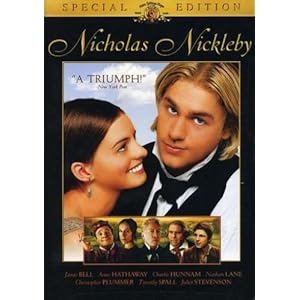
Compressing a 700-page novel into a 2-hour movie is not, I'm sure, an easy challenge. The makers of this film did it about as well as could be expected, keeping all the essential plot elements and characters while omitting some and combining others. It does feel a bit rushed, though, as the viewer has very little time to get acquainted with a character or situation before something new is introduced, but I suppose that's typical of modern film-making.
Compared with the Dickens original, the film is lighter in mood. The characters are more moderate. Nicholas isn't as short-tempered as in the novel. His uncle Ralph Nickleby isn't as heartless. Madeline isn't nearly as fragile or tragic. Smike isn't as pathetic. Mrs. Nickleby, who provides much of the humor in the novel, barely appears in the movie at all. And the London settings are much brighter and roomier than the impression I had from the novel. On the plus side the dialogue is authentic, with many of the lines taken directly from the novel and no jarring modern expressions.
Visually the settings and costumes appeared appropriate, if a bit more opulent than I had pictured them. There were a couple of errors. Brides typically wore dark colors then, not the white as depicted in the movie. And letters are shown with postage stamps on them, even though the stamp wasn't introduced until 1840, the year after the serialization of Nicholas Nickleby was complete.
I'm no judge of acting, but it seemed some of the performances could have been a bit more sincere. On the whole, though, this is a good movie that captures the essence of the novel.
Compressing a 700-page novel into a 2-hour movie is not, I'm sure, an easy challenge. The makers of this film did it about as well as could be expected, keeping all the essential plot elements and characters while omitting some and combining others. It does feel a bit rushed, though, as the viewer has very little time to get acquainted with a character or situation before something new is introduced, but I suppose that's typical of modern film-making.
Compared with the Dickens original, the film is lighter in mood. The characters are more moderate. Nicholas isn't as short-tempered as in the novel. His uncle Ralph Nickleby isn't as heartless. Madeline isn't nearly as fragile or tragic. Smike isn't as pathetic. Mrs. Nickleby, who provides much of the humor in the novel, barely appears in the movie at all. And the London settings are much brighter and roomier than the impression I had from the novel. On the plus side the dialogue is authentic, with many of the lines taken directly from the novel and no jarring modern expressions.
Visually the settings and costumes appeared appropriate, if a bit more opulent than I had pictured them. There were a couple of errors. Brides typically wore dark colors then, not the white as depicted in the movie. And letters are shown with postage stamps on them, even though the stamp wasn't introduced until 1840, the year after the serialization of Nicholas Nickleby was complete.
I'm no judge of acting, but it seemed some of the performances could have been a bit more sincere. On the whole, though, this is a good movie that captures the essence of the novel.
25lilisin
Your thread is like visiting a candy shop! So tempting! I'm looking forward to following it again this year although I'll probably reply to all the Japanese works in the Author Theme Reads threads. I also very much like how you organized the first few posts. It will be interesting to see you update those as the year progresses.
Also see you're about to start reading Distant View of a Minaret. I read that back in 2004 and remember it being quite good. Don't see it around these parts (LT) all that much though.
Also see you're about to start reading Distant View of a Minaret. I read that back in 2004 and remember it being quite good. Don't see it around these parts (LT) all that much though.
26StevenTX
#25- A candy shop with no calories--I guess that's good. As to the style and organization of my thread, all I can say is that I know a good idea when I steal one. ;-)
I've read the first couple of stories from Distant View of a Minaret already and would be eagerly finishing it except that I also want to keep up on 1Q84. The author defies stereotypes by being both feminist and Muslim.
I've read the first couple of stories from Distant View of a Minaret already and would be eagerly finishing it except that I also want to keep up on 1Q84. The author defies stereotypes by being both feminist and Muslim.
27rebeccanyc
Just catching up. I too enjoyed The Savage Detectives when I read it several years ago. The Sea and Poison is one of the books I bought for the author theme reads group, so I'm appreciative in advance for your review.
28StevenTX
4. 1Q84 by Haruki Murakami
First published in Japanese 2009 (parts 1 & 2), 2010 (part 3)
English translation by Jay Rubin (parts 1 & 2) and Philip Gabriel (part 3) 2011


A young woman taking a taxi to an urgent appointment is caught in a horrendous traffic jam on an elevated Tokyo expressway. She abandons her taxi and takes an emergency stairway down from the freeway to the street level. Almost immediately, however, she begins to discover hints that, like Alice descending into Wonderland, she has somehow crossed over into a different reality.
A young writer is called upon by his editor to rewrite a novella so it can qualify for a prestigious literary prize. Its author, a beautiful and mysterious 17-year-old girl, has told a fantastic story, but in terrible prose. The writer, at first unwilling to accept such an unethical assignment, finds himself inexorably drawn toward the young girl and into the dangerous and magical world of her novella.
The two converging stories of Aomame, the woman in traffic, and Tengo, the man who ghostwrites the novella, are told in alternate chapters. The setting is Tokyo in 1984, but in an alternate reality which Aomame names "1Q84." At the heart of the story is a fanatical cult and the bizarre secret it is protecting.
1Q84 is typical of Murakami's work in that it has moments of intense and emotional realism along with bizarre and cryptic elements of pure fantasy. There is no attempt to explain away these elements or fit them into any kind of system. While the characters move toward a personal resolution, there is no resolution for the world itself. The author's Wonderland remains unexplained and unexplainable; the characters simply learn to operate within it. This leads to the obvious question of whether this huge novel has anything to say beyond being hugely entertaining. There are certainly some illuminating passages on the nature of love and friendship, on the causes and effects of broken homes and family violence, on music and how it both reflects and influences our moods, and on God and religion.
If there is, however, a larger all-encompassing theme to 1Q84 perhaps it is on the nature of fiction itself and the way an author becomes part of the world he creates. Perhaps Tengo has simply written the novel around himself and disappeared into it, making 1Q84 a huge work of metafiction. This is admittedly just conjecture about what is probably intended to be ultimately an inscrutable work of the imagination.
Other books I have read by Haruki Murakami:
After the Quake
Norwegian Wood
The Wind-Up Bird Chronicle
Kafka on the Shore
Cover: The cover of 1Q84 is unusual, not in what it depicts, but in how it works. The dust jacket is semi-transparent, and there is an image on the cover of the book itself (Aomame on the front, Tengo on the back). Neither the jacket nor the cover have a complete picture, but when superimposed they produce the image you see--obviously a metaphor for how the story itself is put together. The spine of the books is especially odd. "1" and "8" are printed on the dust jacket along with the name of the author and publisher, "Q" and "4" on the book itself. So if you remove the dust jacket all you have is an anonymous work titled "Q4." The interior of the book has similar gimmicks. Page numbers are printed in varying positions on the margin, and every other page number is backwards.
First published in Japanese 2009 (parts 1 & 2), 2010 (part 3)
English translation by Jay Rubin (parts 1 & 2) and Philip Gabriel (part 3) 2011


A young woman taking a taxi to an urgent appointment is caught in a horrendous traffic jam on an elevated Tokyo expressway. She abandons her taxi and takes an emergency stairway down from the freeway to the street level. Almost immediately, however, she begins to discover hints that, like Alice descending into Wonderland, she has somehow crossed over into a different reality.
A young writer is called upon by his editor to rewrite a novella so it can qualify for a prestigious literary prize. Its author, a beautiful and mysterious 17-year-old girl, has told a fantastic story, but in terrible prose. The writer, at first unwilling to accept such an unethical assignment, finds himself inexorably drawn toward the young girl and into the dangerous and magical world of her novella.
The two converging stories of Aomame, the woman in traffic, and Tengo, the man who ghostwrites the novella, are told in alternate chapters. The setting is Tokyo in 1984, but in an alternate reality which Aomame names "1Q84." At the heart of the story is a fanatical cult and the bizarre secret it is protecting.
1Q84 is typical of Murakami's work in that it has moments of intense and emotional realism along with bizarre and cryptic elements of pure fantasy. There is no attempt to explain away these elements or fit them into any kind of system. While the characters move toward a personal resolution, there is no resolution for the world itself. The author's Wonderland remains unexplained and unexplainable; the characters simply learn to operate within it. This leads to the obvious question of whether this huge novel has anything to say beyond being hugely entertaining. There are certainly some illuminating passages on the nature of love and friendship, on the causes and effects of broken homes and family violence, on music and how it both reflects and influences our moods, and on God and religion.
If there is, however, a larger all-encompassing theme to 1Q84 perhaps it is on the nature of fiction itself and the way an author becomes part of the world he creates. Perhaps Tengo has simply written the novel around himself and disappeared into it, making 1Q84 a huge work of metafiction. This is admittedly just conjecture about what is probably intended to be ultimately an inscrutable work of the imagination.
Other books I have read by Haruki Murakami:
After the Quake
Norwegian Wood
The Wind-Up Bird Chronicle
Kafka on the Shore
Cover: The cover of 1Q84 is unusual, not in what it depicts, but in how it works. The dust jacket is semi-transparent, and there is an image on the cover of the book itself (Aomame on the front, Tengo on the back). Neither the jacket nor the cover have a complete picture, but when superimposed they produce the image you see--obviously a metaphor for how the story itself is put together. The spine of the books is especially odd. "1" and "8" are printed on the dust jacket along with the name of the author and publisher, "Q" and "4" on the book itself. So if you remove the dust jacket all you have is an anonymous work titled "Q4." The interior of the book has similar gimmicks. Page numbers are printed in varying positions on the margin, and every other page number is backwards.
29labfs39
I like your review, Stephen. You manage to express the similar feeling I had when reading The Wind-Up Bird Chronicle. Is there a point to this? If so, what? If not, should there be, or is it okay to write stories for their own sake alone? And, being highly suspicious of erudition for its own sake, I was left wondering how much effort Murakami was putting into being enigmatic. You have read much more by him, what do you think of Murakami's works in general? I have 1Q84 on my TBR shelf, but haven't yet had the umph to start.
30StevenTX
Lisa, I think 1Q84 and The Wind-Up Bird Chronicle are very similar works (as is Kafka on the Shore). They are both fascinating and enigmatic with a touch of spirituality. I'm not a huge fan of magical realism in general, yet I do enjoy Murakami's work. The characters and settings are very good and the stories suspenseful, even if the outcomes are perplexing. Perhaps you could say his work is more evocative than cognitive.
If I had to draw a distinction between The Wind-Up Bird Chronicle and 1Q84 I would say that the latter verges more into fantasy and science fiction. While the rules of its new world are never explained, at least there's the impression that it is a coherent world with rules of some sort, not just a collection of random and miraculous appearances. So fans of SF&F might take to 1Q84 more readily than to Murakami's other novels.
If I had to draw a distinction between The Wind-Up Bird Chronicle and 1Q84 I would say that the latter verges more into fantasy and science fiction. While the rules of its new world are never explained, at least there's the impression that it is a coherent world with rules of some sort, not just a collection of random and miraculous appearances. So fans of SF&F might take to 1Q84 more readily than to Murakami's other novels.
31baswood
Excellent thoughts on Murakami, Steven and Lisa. For someone who has not read any Murakami then your review has very succinctly told me what I need to know. Its on my to buy list.
32Nickelini
I hadn't felt much interest in 1Q84, but you've intrigued me! Thanks for posting your comments.
34bragan
>32 Nickelini:: Agreed. That's the first review I've seen that's really made me feel interested in it.
35StevenTX
5. Distant View of a Minaret and Other Stories by Alifa Rifaat
Short stories first published in Arabic
Translated into English by Denys Johnson-Davies and published as a collection 1983

Distant View of a Minaret is a collection of 15 stories, all of them set in Egypt, mostly in Cairo. The protagonists are, in almost every case, women. They are women of all ages, economic circumstances, and states of mind. Most of the stories deal with times of passage: puberty, female circumcision, marriage, childbirth, separation, the death of a spouse or parent, and the death of the woman herself. All of the stories occur within the context of Islam, its daily rituals and its traditions governing sexual and family matters. Yet within this framework there is remarkable frankness. In the title story, "Distant View of a Minaret," a young married woman rues her husband's insensitivity to her sexual needs. In "An Incident in the Ghobashi Household," a mother finds a novel way to conceal her unmarried daughter's pregnancy. And in "My World of the Unknown," a story of scorching sensuality, a woman discovers sexual rapture with the help of an enchanted snake.
Other stories focus on the poignant issues of aging, loneliness and death, offering a look at household and community life. In "At the Time of the Jasmine," one of the few stories focusing on a male character, a man's journey back home to bury his father brings him back in touch with the traditions and values of his youth. In "The Flat in Nakshabandi Street" an elderly woman's life has been reduced to the view of a single street from her third story window. Finally, "Just Another Day" brings the collection to a close by following the thoughts of a woman as she slips peacefully from this life to the next.
Alifa Rifaat (1930-1996) was in most respects a typical Arab woman: she was a devout Muslim, did not attend college, spoke only Arabic, and seldom traveled outside her native Egypt. It is all the more surprising, therefore, that her work is that of an accomplished writer and that she so adeptly and candidly conveys to us the sense of her world and its values. She depicts women struggling for independence and fulfillment in a patriarchal society, but they are struggling within the structures and precepts of their religion, not against them.
Cover: This one will surely be a contender for 2012's "worst cover." Yes, the picture shows a minaret in the distance. But this is a book about women, not minarets, so why choose a picture of a man? Publishers put provocative pictures of women on books where such illustrations are barely relevant. In this case, where such a picture would be totally appropriate, they show us a guy scratching his neck.
Short stories first published in Arabic
Translated into English by Denys Johnson-Davies and published as a collection 1983

Distant View of a Minaret is a collection of 15 stories, all of them set in Egypt, mostly in Cairo. The protagonists are, in almost every case, women. They are women of all ages, economic circumstances, and states of mind. Most of the stories deal with times of passage: puberty, female circumcision, marriage, childbirth, separation, the death of a spouse or parent, and the death of the woman herself. All of the stories occur within the context of Islam, its daily rituals and its traditions governing sexual and family matters. Yet within this framework there is remarkable frankness. In the title story, "Distant View of a Minaret," a young married woman rues her husband's insensitivity to her sexual needs. In "An Incident in the Ghobashi Household," a mother finds a novel way to conceal her unmarried daughter's pregnancy. And in "My World of the Unknown," a story of scorching sensuality, a woman discovers sexual rapture with the help of an enchanted snake.
Other stories focus on the poignant issues of aging, loneliness and death, offering a look at household and community life. In "At the Time of the Jasmine," one of the few stories focusing on a male character, a man's journey back home to bury his father brings him back in touch with the traditions and values of his youth. In "The Flat in Nakshabandi Street" an elderly woman's life has been reduced to the view of a single street from her third story window. Finally, "Just Another Day" brings the collection to a close by following the thoughts of a woman as she slips peacefully from this life to the next.
Alifa Rifaat (1930-1996) was in most respects a typical Arab woman: she was a devout Muslim, did not attend college, spoke only Arabic, and seldom traveled outside her native Egypt. It is all the more surprising, therefore, that her work is that of an accomplished writer and that she so adeptly and candidly conveys to us the sense of her world and its values. She depicts women struggling for independence and fulfillment in a patriarchal society, but they are struggling within the structures and precepts of their religion, not against them.
Cover: This one will surely be a contender for 2012's "worst cover." Yes, the picture shows a minaret in the distance. But this is a book about women, not minarets, so why choose a picture of a man? Publishers put provocative pictures of women on books where such illustrations are barely relevant. In this case, where such a picture would be totally appropriate, they show us a guy scratching his neck.
37rebeccanyc
Sounds like a fascinating book!
38StevenTX
#36 - Thanks, Lisa. I didn't see it. Barry's North and South must've knocked me off! ;-)
40labfs39
#38. Now you have two hot reviews simultaneously! Numbers 8 and 10. If you don't see them perhaps your list is set to display only 5 reviews? Mine shows 10. Congratulations!
42StevenTX
6. The Songs of Bilitis by Pierre Louÿs
First published 1894 as Les chansons de Bilitis
English translation by Mitchell S. Buck 1926

"I sing of my flesh and my life, and not of the sterile shadows of buried lovers. Rest upon thy bed, O my body, according to thy voluptuous mission! Taste thy daily enjoyments and the passions without a tomorrow. Leave not a delight unknown to be regretted on the day of my death." Thus, more than 2500 years ago, wrote Bilitis: courtesan, poet, and protégé of Sappho. Her remarkable prose poems were presented to the French reading public in their first complete and unexpurgated translation in 1894 by Pierre Louÿs.
Or so he would have us believe. Les chansons de Bilitis, complete with biographical sketch and an authoritative-looking bibliography, fooled even some experts when it was first published. But it was just a hoax, all of it the product of Louÿs's imagination. Yet what a beautiful hoax it is.
The work consists of 143 short prose poems, divided into three books. In the first book Bilitis, the daughter of a Greek father and Phoenician mother, tells of her youth in Pamphylia, the southern coast of Asia Minor. "Stripped of my clothes, I climbed into a tree..." she begins. She revels both in her pastoral surroundings and in discovering the pleasures of her own body. Louÿs modeled his verses on the forms and themes of the Greek lyric poets, capturing their unique combination of youthful innocence and sensuousness.
In the second book of verses, Bilitis has taken ship to the isle of Lesbos where she meets the famous Sappho and learns the pleasures of lesbian love. She takes a younger girl, Mnasidika, as a lover and devotes many of her verses to describing their love--a love that eventually turns to jealousy when Mnasidika abandons Bilitis. "And, above all, if my despair is a perpetual torture, it is because I know, moment by moment, how she swoons in the arms of another, what she demands of her and what she gives her."
Bilitis journeys finally to Kypros where she becomes a courtesan serving the temple of Astarte. She celebrates her sybaritic life, laughs at the foibles of her friends and lovers, but wistfully recalls her lost love Mnasidika. Finally, approaching 40, Bilitis, with a hint of bitterness, calls out "Child, do not pass without loving me. I am still beautiful in the night; thou shalt see how much warmer my autumn is than the springtime of another.... Thou shalt be my last lover."
This classic work of French Decadence is both refined and sensual, evoking uninhibited pagan passions in beautiful verse and sumptuous imagery.
Other works I have read by Pierre Louÿs
The She-Devils, a translation of Trois Filles de Leur Mère
First published 1894 as Les chansons de Bilitis
English translation by Mitchell S. Buck 1926

"I sing of my flesh and my life, and not of the sterile shadows of buried lovers. Rest upon thy bed, O my body, according to thy voluptuous mission! Taste thy daily enjoyments and the passions without a tomorrow. Leave not a delight unknown to be regretted on the day of my death." Thus, more than 2500 years ago, wrote Bilitis: courtesan, poet, and protégé of Sappho. Her remarkable prose poems were presented to the French reading public in their first complete and unexpurgated translation in 1894 by Pierre Louÿs.
Or so he would have us believe. Les chansons de Bilitis, complete with biographical sketch and an authoritative-looking bibliography, fooled even some experts when it was first published. But it was just a hoax, all of it the product of Louÿs's imagination. Yet what a beautiful hoax it is.
The work consists of 143 short prose poems, divided into three books. In the first book Bilitis, the daughter of a Greek father and Phoenician mother, tells of her youth in Pamphylia, the southern coast of Asia Minor. "Stripped of my clothes, I climbed into a tree..." she begins. She revels both in her pastoral surroundings and in discovering the pleasures of her own body. Louÿs modeled his verses on the forms and themes of the Greek lyric poets, capturing their unique combination of youthful innocence and sensuousness.
In the second book of verses, Bilitis has taken ship to the isle of Lesbos where she meets the famous Sappho and learns the pleasures of lesbian love. She takes a younger girl, Mnasidika, as a lover and devotes many of her verses to describing their love--a love that eventually turns to jealousy when Mnasidika abandons Bilitis. "And, above all, if my despair is a perpetual torture, it is because I know, moment by moment, how she swoons in the arms of another, what she demands of her and what she gives her."
Bilitis journeys finally to Kypros where she becomes a courtesan serving the temple of Astarte. She celebrates her sybaritic life, laughs at the foibles of her friends and lovers, but wistfully recalls her lost love Mnasidika. Finally, approaching 40, Bilitis, with a hint of bitterness, calls out "Child, do not pass without loving me. I am still beautiful in the night; thou shalt see how much warmer my autumn is than the springtime of another.... Thou shalt be my last lover."
This classic work of French Decadence is both refined and sensual, evoking uninhibited pagan passions in beautiful verse and sumptuous imagery.
Other works I have read by Pierre Louÿs
The She-Devils, a translation of Trois Filles de Leur Mère
43DieFledermaus
I'm a couple books behind now but good review of 1Q84. I think you enjoyed it more than I did, but I liked the metafictional aspect.
I think I have something by Louys on the pile - what did you think of The She-Devils?
I think I have something by Louys on the pile - what did you think of The She-Devils?
46StevenTX
#43 - The She-Devils is very explicit erotica with a psychological edge to it. The Songs of Bilitis is a much finer work. I think She-Devils also suffers from a very poor translation.
#44 - For those who read French, Chansons de Bilitis is available free from Project Gutenberg. A similar work by Louÿs, titled Aphrodite, is also available in French and in English translation as Ancient Manners.
http://www.gutenberg.org/ebooks/search.html/?default_prefix=author_id&sort_o...
#44 - For those who read French, Chansons de Bilitis is available free from Project Gutenberg. A similar work by Louÿs, titled Aphrodite, is also available in French and in English translation as Ancient Manners.
http://www.gutenberg.org/ebooks/search.html/?default_prefix=author_id&sort_o...
47PimPhilipse
I browsed through the Gutenberg edition of Bilitis but the transliterated greek drove me nuts. Come on guys, this is the UTF-8 age! I settled for the scanned version on archive.org (which also has translations).
48DieFledermaus
Hmmmm......I don't mind erotica, but poorly translated erotica could be bad. The one I have is an ebook of The Woman and the Puppet - I think I got it from GoogleBooks.
49StevenTX
7. The End of the Affair by Graham Greene
First published 1952


In London during World War II a writer named Maurice Bendrix has carried on an affair with Sarah, the wife of his friend Henry Miles. More than a year after the affair was broken off, Henry, who was ignorant of it all, approaches Bendrix with a problem. He thinks his wife is seeing someone and wants Bendrix's advice about hiring a detective. Bendrix has never stopped loving Sarah, and now he is consumed with jealousy over the idea of her having taken another lover.
Just as he did in Brighton Rock, Graham Greene tells an essentially secular story for the first half of the book, then transforms the novel into one about religious conviction. Bendrix, Henry and Sarah are all ostensibly atheists, but Sarah harbors a latent uncertainty that has been tormenting her mind and driving her unpredictable actions. She finds herself torn between love and faith.
There are strong characters in this novel, and meaningful moral dilemmas. It also captures some of the moods of Londoners under the V-1 "buzz bomb" attacks in 1944 and describes the conditions in which they lived during and after the war. However it isn't a very pleasant novel to read. Bendrix, who narrates the story, is perpetually bitter, even when he is with the woman he loves. Nor is the resolution fully satisfactory. In his earlier novels such as The Heart of the Matter, Greene dealt wonderfully with situations where a character must choose between two courses of action on the basis of his belief system. In The End of the Affair, however, the choice is between belief and non-belief, a much more challenging situation which the author handles less convincingly.
Other books I have read by Graham Greene:
Brighton Rock
The Power and the Glory
The Heart of the Matter
The Third Man
First published 1952


In London during World War II a writer named Maurice Bendrix has carried on an affair with Sarah, the wife of his friend Henry Miles. More than a year after the affair was broken off, Henry, who was ignorant of it all, approaches Bendrix with a problem. He thinks his wife is seeing someone and wants Bendrix's advice about hiring a detective. Bendrix has never stopped loving Sarah, and now he is consumed with jealousy over the idea of her having taken another lover.
Just as he did in Brighton Rock, Graham Greene tells an essentially secular story for the first half of the book, then transforms the novel into one about religious conviction. Bendrix, Henry and Sarah are all ostensibly atheists, but Sarah harbors a latent uncertainty that has been tormenting her mind and driving her unpredictable actions. She finds herself torn between love and faith.
There are strong characters in this novel, and meaningful moral dilemmas. It also captures some of the moods of Londoners under the V-1 "buzz bomb" attacks in 1944 and describes the conditions in which they lived during and after the war. However it isn't a very pleasant novel to read. Bendrix, who narrates the story, is perpetually bitter, even when he is with the woman he loves. Nor is the resolution fully satisfactory. In his earlier novels such as The Heart of the Matter, Greene dealt wonderfully with situations where a character must choose between two courses of action on the basis of his belief system. In The End of the Affair, however, the choice is between belief and non-belief, a much more challenging situation which the author handles less convincingly.
Other books I have read by Graham Greene:
Brighton Rock
The Power and the Glory
The Heart of the Matter
The Third Man
50baswood
Steven, excellent review of The End of the Affair Greene seems to have lots of bitter characters in his novels, if not bitter then at least world weary, especially if they have no faith. I read 7 novels by Greene last year and do not feel inclined to read any more, except maybe Brighton Rock.
51StevenTX
8. Four Major Plays by Henrik Ibsen
A Doll's House (1879), Ghosts (1881), Hedda Gabler (1890), and The Master Builder (1892)
Hedda Gabler translated by Jens Arup, the rest by James McFarland


These are four exceptional plays, intense, compact and timeless.
In "A Doll's House" a woman has everything a woman is expected to want: home, husband, children and friends, but she realizes it isn't what she wants. This play causes a furor when first performed, and some will still find it shocking.
In "Ghosts," a woman's apparent act of charity conceals a scandalous family history.
The title character of "Hedda Gabler," a proud and beautiful general's daughter, threw herself into a loveless marriage out of despair, but now finds herself at the apex of a love triangle.
And in "The Master Builder," a play resembling a Greek tragedy, an aging contractor with an emotionally crippled wife finds in the young people who work for him both a temptation and a threat.
A Doll's House (1879), Ghosts (1881), Hedda Gabler (1890), and The Master Builder (1892)
Hedda Gabler translated by Jens Arup, the rest by James McFarland


These are four exceptional plays, intense, compact and timeless.
In "A Doll's House" a woman has everything a woman is expected to want: home, husband, children and friends, but she realizes it isn't what she wants. This play causes a furor when first performed, and some will still find it shocking.
In "Ghosts," a woman's apparent act of charity conceals a scandalous family history.
The title character of "Hedda Gabler," a proud and beautiful general's daughter, threw herself into a loveless marriage out of despair, but now finds herself at the apex of a love triangle.
And in "The Master Builder," a play resembling a Greek tragedy, an aging contractor with an emotionally crippled wife finds in the young people who work for him both a temptation and a threat.
52dmsteyn
I always mean to read more Ibsen, but so far I've only got to "A Doll's House", which I read for a drama course at university, and "Peer Gynt", which I read last year. I enjoyed both, but I didn't particularly like the "Peer Gynt" translation (admittedly, it was the last play that Ibsen wrote in verse, so I understand that it may have been more difficult to translate than his later plays).
53labfs39
Four great plays. I wonder if I have the same edition? Unfortunately, I haven't read a play in years now. Love to go to the theatre though.
54StevenTX
I find that reading plays makes a nice break from novels and other prose works. I enjoy the theater too, and over the last decade have seen more plays than I have movies. I would love to see something by Ibsen or Chekhov on stage, but such productions tend to be infrequent, expensive, and not to my wife's taste. Instead we see the folksy comedies performed at the local community theater where the cast includes our house painter, the cashier at Chick Fil-A, our city councilman, etc.
55janeajones
Ibsen is a fabulous window into the late 19th century -- and into our own world. I don't understand why his plays aren't done more often. Doll's House is a staple of college lit anthologies, but Hedda Gabler, An Enemy of the People, Rosmersholm and others are still incredibly potent today.
56labfs39
>54 StevenTX: LOL I can just see your local theater group now! I agree that finding more meatier productions is getting harder. I think that with the economy, and so many theater groups struggling, that light and catchy is the only way they can draw big enough crowds to stay in business. Sad. Yet I am part of the problem. We tightened up our belts this year and didn't renew our annual subscription to the theater. (Although we did take friends to see a musical there over Thanksgiving.) *sigh* I hope that some of our wealthier community members will pitch in a little extra during the downturn.
57DieFledermaus
>52 dmsteyn: - I love Ibsen, but I read a so-so translation of Peer Gynt as well. Did like the idea of people being secret trolls though. Sometimes I wonder who else could be a secret troll.
58kidzdoc
I don't think I've read any of Ibsen's plays, but I'll get to them in the near future.
Seeing that photo of him makes me want to borrow my barber's clippers, though.
Seeing that photo of him makes me want to borrow my barber's clippers, though.
59dchaikin
I'm only just now catching up here. Wonderful reviews throughout, Steven, especially your review of 1Q84. You made the The Songs of Bilitis & The Savage Detectives sound fascinating.
Also, that's a cool picture of your niece.
Also, that's a cool picture of your niece.
60StevenTX
9. The Young Girl's Handbook of Good Manners by Pierre Louÿs
Written 1917, first published posthumously and anonymously 1927
Translation by Geoffrey Longnecker 2010


This short work is a parody of the books of etiquette and morals that were in vogue in the late 19th century. It offers advice in a number of categories such as "In the Home" and "At School." Here are some of the the milder examples:
This is no great work of literature, but as a satire of social conventions, puritanical morals and sexual naïveté, The Young Girl's Handbook of Good Manners is still as apt and amusing as it was almost a century ago.
Written 1917, first published posthumously and anonymously 1927
Translation by Geoffrey Longnecker 2010


This short work is a parody of the books of etiquette and morals that were in vogue in the late 19th century. It offers advice in a number of categories such as "In the Home" and "At School." Here are some of the the milder examples:
At Confession: If your confessor asks you how many times you have polluted yourself, do not reply: "And you?"
In Class: Do not draw teacher's private parts on the blackboard, especially if she showed them to you in confidence.
At the Hotel, Traveling: Do not ring for the maître d'hôtel at eleven o'clock at night to ask him for a banana. At that hour, ask for a candle.
Duties Toward Your Sister: When your dear sister leaves for the ball, do not write on the back of her white dress: "Please bugger me, gentlemen." Abstain from all inscriptions of this sort.
This is no great work of literature, but as a satire of social conventions, puritanical morals and sexual naïveté, The Young Girl's Handbook of Good Manners is still as apt and amusing as it was almost a century ago.
61labfs39
This one sounds a hoot!
Edited to add: you definitely need to post this one, Steven. The only other review (except a link that I did not click on) was written by someone who sounds quite horrified.
Edited to add: you definitely need to post this one, Steven. The only other review (except a link that I did not click on) was written by someone who sounds quite horrified.
62StevenTX
#61 - Review posted as requested, Lisa. Actually I had misgivings about even admitting to owning this book, much less reviewing it. There are many who take offense at this sort of publication. It was quite a relief to see your comment.
According to the translator's introduction, Pierre Louÿs was one of the most prolific writers of erotic fiction of all time. At his death in 1925 his executors found over 900 pounds (pounds, not pages!) of unpublished manuscripts. The great majority were auctioned off to private collectors and have never been published.
According to the translator's introduction, Pierre Louÿs was one of the most prolific writers of erotic fiction of all time. At his death in 1925 his executors found over 900 pounds (pounds, not pages!) of unpublished manuscripts. The great majority were auctioned off to private collectors and have never been published.
63labfs39
Although I'm not a reader of erotic fiction, this book sounds more like a satire of the Young Ladies Book of Deportment genre. Published in 1917, I find his lewd satire rather interesting historically. Britain had been in WWI for three years by then, and I can see the book having a wide audience in the trenches. I wonder how many copies were sold before the war ended.
64StevenTX
It was written in 1917 but not published until 1927, at least according to Wikipedia's sources, so the troops in the trenches had to do without this one, though I imagine some of Louÿs's earlier works were popular. The introduction to my copy only speaks about the English translation saying that a version was "briefly available in the 1970s" but not widely available until this 2010 edition.
68StevenTX
10. Red Sorghum: A Novel of China by Mo Yan
First published in Chinese 1987
English translation by Howard Goldblatt 1993


"Over decades that seem but a moment in time, lines of scarlet figures shuttled among the sorghum stalks to weave a vast human tapestry. They killed, they looted, and they defended their country in a valiant, stirring ballet that makes us unfilial descendants who now occupy the land pale by comparison. Surrounded by progress, I feel a nagging sense of our species' regression." Thus the narrator of Mo Yan's novel states the theme of Red Sorghum.
The setting for the novel is the author's native village of Northeast Gaomi Township in the province of Shandong near the tip of the Chinese peninsula that points toward Korea. Most of the events in the novel take place between 1923 and 1941. During the first part of that period the region was loosely governed by one of China's many warlords. In 1937 the Japanese occupied the province, leading to years of violent repression and resistance.
The narrative timeline is complex. The first-person narrator revisits his home town in the 1980s to construct his family's history. He begins his account in 1939 as his father, a teenage boy at the time, is preparing to participate in a partisan ambush of a Japanese convoy. This battle will be the central event in the novel. The story then shifts back to 1923 for the marriage of the narrator's paternal grandmother. These shifts in time occur frequently throughout the novel as though the principal characters are remembering their past, with the 1939-1941 timeline being the principal one.
Though the characters' proper names are given, they are chiefly referred to by relationship as "Granddad," "Grandma," "Father," "Little Auntie," etc., thus reaffirming the narrator's invisible presence. Grandma, a remarkably strong and free-spirited woman, inherits a distillery while still a teenage girl and proves more than equal to the task of managing it. Granddad, a large and violent man, begins his career while still a boy by murdering his mother's lover, then alternates between manual labor and banditry until emerging as a feared guerrilla warrior after the Japanese invasion. The relationship between these two is both passionate and tempestuous.
Violence and passion prevail in this story of remarkable heroism, brutality, treachery and suffering. When the Chinese partisan bands aren't fighting the Japanese, they are fighting each other for control of weapons and food supplies. The primitive, defiant individualism and amorality of Granddad and his contemporaries brings to mind the Old West of Cormac McCarthy's Blood Meridian.
Mo Yan's style of writing verges on magical realism, with its sensuality and capriciousness, but there is nothing disarmingly "magic" about it. The environment is a real as it can be, with every scene oozing blood, sweat, mud, pus, sap or semen. Red Sorghum is a harrowing, earthy and unforgettable immersion in the violent and tragic lives of its characters.
First published in Chinese 1987
English translation by Howard Goldblatt 1993


"Over decades that seem but a moment in time, lines of scarlet figures shuttled among the sorghum stalks to weave a vast human tapestry. They killed, they looted, and they defended their country in a valiant, stirring ballet that makes us unfilial descendants who now occupy the land pale by comparison. Surrounded by progress, I feel a nagging sense of our species' regression." Thus the narrator of Mo Yan's novel states the theme of Red Sorghum.
The setting for the novel is the author's native village of Northeast Gaomi Township in the province of Shandong near the tip of the Chinese peninsula that points toward Korea. Most of the events in the novel take place between 1923 and 1941. During the first part of that period the region was loosely governed by one of China's many warlords. In 1937 the Japanese occupied the province, leading to years of violent repression and resistance.
The narrative timeline is complex. The first-person narrator revisits his home town in the 1980s to construct his family's history. He begins his account in 1939 as his father, a teenage boy at the time, is preparing to participate in a partisan ambush of a Japanese convoy. This battle will be the central event in the novel. The story then shifts back to 1923 for the marriage of the narrator's paternal grandmother. These shifts in time occur frequently throughout the novel as though the principal characters are remembering their past, with the 1939-1941 timeline being the principal one.
Though the characters' proper names are given, they are chiefly referred to by relationship as "Granddad," "Grandma," "Father," "Little Auntie," etc., thus reaffirming the narrator's invisible presence. Grandma, a remarkably strong and free-spirited woman, inherits a distillery while still a teenage girl and proves more than equal to the task of managing it. Granddad, a large and violent man, begins his career while still a boy by murdering his mother's lover, then alternates between manual labor and banditry until emerging as a feared guerrilla warrior after the Japanese invasion. The relationship between these two is both passionate and tempestuous.
Violence and passion prevail in this story of remarkable heroism, brutality, treachery and suffering. When the Chinese partisan bands aren't fighting the Japanese, they are fighting each other for control of weapons and food supplies. The primitive, defiant individualism and amorality of Granddad and his contemporaries brings to mind the Old West of Cormac McCarthy's Blood Meridian.
Mo Yan's style of writing verges on magical realism, with its sensuality and capriciousness, but there is nothing disarmingly "magic" about it. The environment is a real as it can be, with every scene oozing blood, sweat, mud, pus, sap or semen. Red Sorghum is a harrowing, earthy and unforgettable immersion in the violent and tragic lives of its characters.
69deebee1
Great review, steven. This is now on my wishlist -- shifts in time, magical realism, and war are, for me, a simply irresistible mix!
70dchaikin
What a window into the unknown this could be. One of these upcoming years I'm going to dedicate to and around China. I'll keep this one in mind. Great review.
71pamelad
Thanks for the informative review of Red Sorghum, which is now on my list.
After reading your review of The Savage Detectives I rushed out and bought the book.
After reading your review of The Savage Detectives I rushed out and bought the book.
72StevenTX
#70 - Dan, the Reading Globally group is doing a feature on China for the 4th quarter of this year. I am the co-moderator, so I'm reading up ahead of time to make some good recommendations. You'll probably find lots of good ideas from that discussion whenever you're ready to turn your reading that direction.
#71 - Wow. I hope you aren't disappointed in either of them.
#71 - Wow. I hope you aren't disappointed in either of them.
75rebeccanyc
Glad to hear about Red Sorghum. I read his Life and Death Are Wearing Me Out, and while I found parts of it enjoyable, it really could have benefited from a good editor (yes, it wore me out).
76kidzdoc
Excellent review of Red Sorghum, Steven. I also have Life and Death Are Wearing Me Out, so I'm disappointed that Rebecca was lukewarm about it.
77rebeccanyc
Life and Death Are Wearing Me Out had a fun premise and was pretty lively, but after a while . . . it just went on too long.
78StevenTX
Life and Death Are Wearing Me Out is the only one of Mo's translated novels I don't have. I usually prefer to read an author's works in the order they were published, so the next one I will read by Mo will be The Garlic Ballads. There are other Chinese authors I want to sample in the meantime, though.
79DieFledermaus
Great review of Red Sorghum and I'll be looking forward to the Reading Globally China theme.
80StevenTX
11. Vox by Nicholson Baker
First published 1992


A man and a woman each dial a phone sex service and are randomly connected with one another. The novel consists entirely of one long conversation between them. They get acquainted, explore each other's tastes and interests, then share some of their sexual fantasies and experiences. Finally, speaking alternately, they jointly construct a scenario for their mutual sexual gratification using what they have learned about the other to maximum effect.
Nothing exists outside the dialog in this novel, so all interpretation is left up to the reader. It can be taken as an example of the powers of language and the imagination, as two perfect strangers using only their voices open up so fully and construct a gratifying relationship. Or it can be read as a grim commentary on the loneliness of modern life, when two apparently intelligent and likable people can only find rapport through such mechanical and anonymous methods. I found it to be more of the latter, and a reminder of how difficult our inhibitions make it for people to establish trust and find pleasure in one another. In the 20 years since the novel was published we've certainly seen a trend for people to retreat behind the anonymity of the Internet, probably at the cost of having more fulfilling interpersonal relationships.
Other books I have read by Nicholson Baker:
The Fermata
First published 1992


A man and a woman each dial a phone sex service and are randomly connected with one another. The novel consists entirely of one long conversation between them. They get acquainted, explore each other's tastes and interests, then share some of their sexual fantasies and experiences. Finally, speaking alternately, they jointly construct a scenario for their mutual sexual gratification using what they have learned about the other to maximum effect.
Nothing exists outside the dialog in this novel, so all interpretation is left up to the reader. It can be taken as an example of the powers of language and the imagination, as two perfect strangers using only their voices open up so fully and construct a gratifying relationship. Or it can be read as a grim commentary on the loneliness of modern life, when two apparently intelligent and likable people can only find rapport through such mechanical and anonymous methods. I found it to be more of the latter, and a reminder of how difficult our inhibitions make it for people to establish trust and find pleasure in one another. In the 20 years since the novel was published we've certainly seen a trend for people to retreat behind the anonymity of the Internet, probably at the cost of having more fulfilling interpersonal relationships.
Other books I have read by Nicholson Baker:
The Fermata
82StevenTX
Progress report: Outlaws of the Marsh, Volume 1

I've finished the first of four volumes of this 2000-page epic, one of the traditional four great novels of Imperial China. The author, Shi Nai'an, lived from 1296 to 1372. The editors believe the work was also edited by Lou Guanzhong, the author of The Romance of the Three Kingdoms. Outlaws of the Marsh has also been translated under the titles Water Margin and All Men Are Brothers.
The setting is China during the twilight of the Northern Song Dynasty in the early 12th century. The empire is plagued by corruption and inefficiency and will soon fall to barbarian invaders from the north, the Jurchens.
The novel itself is an interconnected series of adventures featuring various heroes as protagonists (eventually 108 in all, according to the introduction). The stories are joined into a single narrative by having one hero, during or at the end of his adventure, meet up with the man who will be featured in the next adventure. Some characters return and some form joint enterprises, so there is still an overall feel that this is one novel and not just a fix-up of independent tales.
What all of the principal characters have in common is that they are outcasts in one form or another. Some are men who have been unjustly exiled by the scheming of a jealous rival. Some are under sentence for forgivable crimes, such as accidentally killing a wicked merchant or an unfaithful wife. Several of them become bandits, joining forces in a citadel hidden within the marshes. Others are still, at least at this point in the story, on the road or at some temporary place of refuge.
The stories bear strong resemblance in many ways to the Arthurian legends that were being recorded at the same time by Shi's European contemporaries. These heroes, in their solitary rambles, encounter each other in much the same form as knight errant--jousting to the point of exhaustion, then becoming fast friends. The chief difference is in the absence of anything resembling courtly love. Women have only small rôles in this story, typically as either scheming old hags or beautiful but unfaithful concubines.
Here the warrior monk known as "Sagacious Lu" demonstrates his strength by uprooting a willow tree:


I've finished the first of four volumes of this 2000-page epic, one of the traditional four great novels of Imperial China. The author, Shi Nai'an, lived from 1296 to 1372. The editors believe the work was also edited by Lou Guanzhong, the author of The Romance of the Three Kingdoms. Outlaws of the Marsh has also been translated under the titles Water Margin and All Men Are Brothers.
The setting is China during the twilight of the Northern Song Dynasty in the early 12th century. The empire is plagued by corruption and inefficiency and will soon fall to barbarian invaders from the north, the Jurchens.
The novel itself is an interconnected series of adventures featuring various heroes as protagonists (eventually 108 in all, according to the introduction). The stories are joined into a single narrative by having one hero, during or at the end of his adventure, meet up with the man who will be featured in the next adventure. Some characters return and some form joint enterprises, so there is still an overall feel that this is one novel and not just a fix-up of independent tales.
What all of the principal characters have in common is that they are outcasts in one form or another. Some are men who have been unjustly exiled by the scheming of a jealous rival. Some are under sentence for forgivable crimes, such as accidentally killing a wicked merchant or an unfaithful wife. Several of them become bandits, joining forces in a citadel hidden within the marshes. Others are still, at least at this point in the story, on the road or at some temporary place of refuge.
The stories bear strong resemblance in many ways to the Arthurian legends that were being recorded at the same time by Shi's European contemporaries. These heroes, in their solitary rambles, encounter each other in much the same form as knight errant--jousting to the point of exhaustion, then becoming fast friends. The chief difference is in the absence of anything resembling courtly love. Women have only small rôles in this story, typically as either scheming old hags or beautiful but unfaithful concubines.
Here the warrior monk known as "Sagacious Lu" demonstrates his strength by uprooting a willow tree:

83baswood
I have had Vox sitting on my bookshelf for ages and so I was pleased to read your review.
Outlaws of the Marsh looks intriguing and I admire your stamina in planning to read all 2000 pages. I was wondering whether they had the same weaponry in China and whether there was any chivalry.
Outlaws of the Marsh looks intriguing and I admire your stamina in planning to read all 2000 pages. I was wondering whether they had the same weaponry in China and whether there was any chivalry.
84StevenTX
Barry, Outlaws of the Marsh doesn't provide as much detail on weapons, accouterments, and combat as in Chrétien de Troyes. The translator does use words like "chivalry" and "joust," but I don't know how closely the customs paralleled those of Europe. This edition has no explanatory notes on such matters.
One of the biggest differences between China and Europe is the relative rarity of horses in China at this time. (I guess that changed a century later when the Mongols invaded.) There is at least one instance in the book of a joust on horseback, but for the most part all combat--and virtually all travel--is by foot. Fairly wealthy men still traveled great distances on foot with servants carrying their gear or merchandise on carrying poles.
Having to walk everywhere means obviously no heavy body armor. Men wear helmets in combat, but no other armor and no shields.
The weapons vary: spear-tipped lances, trident-tipped lances, halberds, heavy wooden staffs, iron staffs, and curved swords are all mentioned. Each warrior fought with what he had at hand, so a man armed with a lance might be matched against one with a staff.
They did have staged ceremonial combats like Arthur's jousting tournaments, but, in this story at least, not with such frequency or on such a scale. Instead most battles are one-on-one encounters on the road. Still, there seemed to be a set of rules for proper combat which are referred to as "chivalry." A typical description might read "they fought 30 rounds with neither gaining the advantage until Wu leaped back out of the combat circle." Exactly what defined the "round" or "combat circle" isn't clear.
For all its fighting, Outlaws isn't a very bloody novel. Most battles end in mutual exhaustion, after which the combatants discover they are on the same side anyway, go off to the nearest tavern, and knock back 30-40 bowls of wine apiece, get roaring drunk, tear up the joint, and get run out of town.
One of the biggest differences between China and Europe is the relative rarity of horses in China at this time. (I guess that changed a century later when the Mongols invaded.) There is at least one instance in the book of a joust on horseback, but for the most part all combat--and virtually all travel--is by foot. Fairly wealthy men still traveled great distances on foot with servants carrying their gear or merchandise on carrying poles.
Having to walk everywhere means obviously no heavy body armor. Men wear helmets in combat, but no other armor and no shields.
The weapons vary: spear-tipped lances, trident-tipped lances, halberds, heavy wooden staffs, iron staffs, and curved swords are all mentioned. Each warrior fought with what he had at hand, so a man armed with a lance might be matched against one with a staff.
They did have staged ceremonial combats like Arthur's jousting tournaments, but, in this story at least, not with such frequency or on such a scale. Instead most battles are one-on-one encounters on the road. Still, there seemed to be a set of rules for proper combat which are referred to as "chivalry." A typical description might read "they fought 30 rounds with neither gaining the advantage until Wu leaped back out of the combat circle." Exactly what defined the "round" or "combat circle" isn't clear.
For all its fighting, Outlaws isn't a very bloody novel. Most battles end in mutual exhaustion, after which the combatants discover they are on the same side anyway, go off to the nearest tavern, and knock back 30-40 bowls of wine apiece, get roaring drunk, tear up the joint, and get run out of town.
85baswood
Thanks for that steven. It does sound a different culture. I like the idea of most battles ending in mutual exhaustion and then off to the nearest tavern.
86dchaikin
I love that I can find on these threads such thoughtful and intelligent commentary on important works I previously had never heard of. Enjoying your posts on Outlaws of the Marsh.
Also, enjoyed your review of Vox - "In the 20 years since the novel was published we've certainly seen a trend for people to retreat behind the anonymity of the Internet, probably at the cost of having more fulfilling interpersonal relationships." - first of all, I'm in the process in following that trend just now. But, still, how true - except strike the word probably. But then, on the other hand, without our internet and our LT I think my reading would be so much less...wouldn't it?
Also, enjoyed your review of Vox - "In the 20 years since the novel was published we've certainly seen a trend for people to retreat behind the anonymity of the Internet, probably at the cost of having more fulfilling interpersonal relationships." - first of all, I'm in the process in following that trend just now. But, still, how true - except strike the word probably. But then, on the other hand, without our internet and our LT I think my reading would be so much less...wouldn't it?
87arubabookwoman
Hi Steven--I'd appreciate it if you'd post your comments on Outlaws of the Marsh on the Reading Globally Classics in Their Own Country--I'm sure that it will intrigue some people there, as it did me.
89dchaikin
: ) - Oh, there are pockets on brilliance. Montrose was a wonderful place to live. (Actually, my neighbor later became the Poet Laureate of Texas in 2008 and I was very friendly with him. He's the one who got me to actually read poetry. Look him up, his name is Larry Thomas. PM me, and I'll send you a book. I'm serious about that.). But now I live in suburbia...
90pamelad
Steven, I just clicked on your name to find out which police state you lived in (Texas?), and received an LT message saying "This member has been removed."
94kidzdoc
This is an unpleasant surprise, to say the least. I've just sent a message to info (at) librarything (dot) com about Steven's membership; if and when I get a reply I'll post it here. I hope that this is a mistake!
95rebeccanyc
I just sent an e-mail too.
96kidzdoc
This is the reply I just received from Jeremy:
The account was not deleted by LibraryThing; I don't have any further
information on it, but he certainly wasn't removed by us.
Best,
Jeremy
97rebeccanyc
I got that too. How weird. I hope he reappears.
98Rebeki
I think we've been keeping Jeremy busy. I've only been a lurker on Steven's threads until now, but I also sent an email (and got the same response, obviously).
99jbd1
>98 Rebeki: - Yes, I got three emails within two minutes :-) (hence the same reply to all three)
100rebeccanyc
It seems strange because he just posted here yesterday evening and seemed very engaged. Hope everything is OK with him.
101StevenTX
I'm back, at least partly. Jeremy was kind enough to restore my account last night, but it will be next week before he can restore my books. It was entirely my doing--a brief self-destructive rampage. Now I feel like Tom Sawyer walking in on his own funeral. Thank you all for your concern and sorry for the confusion.
My wife prescribed therapy at the used book store today. It worked, but now my TBR stats don't look so good.
My wife prescribed therapy at the used book store today. It worked, but now my TBR stats don't look so good.
103Nickelini
Yes....one minute he's making disparaging comments about Texas and the next minute.....
Anyway, glad you're back. And with new books to tell us about too.
Anyway, glad you're back. And with new books to tell us about too.
104StevenTX
12. The Private Memoirs and Confessions of a Justified Sinner by James Hogg
First published 1824
Read ebook from Project Gutenberg

The novel begins with an "editor's introduction" that tells of a Scots family in the early 18th century. A fun-loving laird unwisely takes a puritanical young bride. The couple never reconcile their differences and eventually separate, but not before the birth of two sons. The elder, George, is a fine and cheerful lad, the image of his doting father. The younger, Robert, bears his mother's dour temperament (and a close resemblance to her Calvinist minister). The two boys are raised separately, finally coming into contact as young men. Their meeting is followed by a series of tragic murders, disappearances, and mysterious phenomena.
After this framing narrative comes the body of the work, the "sinner's" memoir, which tells the story over again from the perspective of one of its characters.
Key to the work is the Calvinist idea of predestination, which holds that divine grace rather than good works is the key to salvation. The author, without delving into theological concepts, deplores the self-righteousness of those who deem themselves among the saved and think this gives them license to despise others.
The Confessions is a gothic novel in its use of mystery, suspense and the supernatural. It is quite gripping at times, and very entertaining. It's also quite refreshing to find an author of that era who, instead of deploring the dissolute lifestyle of the libertine, prefers it to the priggish arrogance of the self-righteous.
First published 1824
Read ebook from Project Gutenberg

The novel begins with an "editor's introduction" that tells of a Scots family in the early 18th century. A fun-loving laird unwisely takes a puritanical young bride. The couple never reconcile their differences and eventually separate, but not before the birth of two sons. The elder, George, is a fine and cheerful lad, the image of his doting father. The younger, Robert, bears his mother's dour temperament (and a close resemblance to her Calvinist minister). The two boys are raised separately, finally coming into contact as young men. Their meeting is followed by a series of tragic murders, disappearances, and mysterious phenomena.
After this framing narrative comes the body of the work, the "sinner's" memoir, which tells the story over again from the perspective of one of its characters.
Key to the work is the Calvinist idea of predestination, which holds that divine grace rather than good works is the key to salvation. The author, without delving into theological concepts, deplores the self-righteousness of those who deem themselves among the saved and think this gives them license to despise others.
The Confessions is a gothic novel in its use of mystery, suspense and the supernatural. It is quite gripping at times, and very entertaining. It's also quite refreshing to find an author of that era who, instead of deploring the dissolute lifestyle of the libertine, prefers it to the priggish arrogance of the self-righteous.
105StevenTX
13. Exercises in Style by Raymond Queneau
First published in French 1947
English translation by Barbara Wright 1958


Two men stand next to each other on a crowded Paris bus. The younger one has a long neck and a hat with a cord around the crown instead of a ribbon. He accuses the other of deliberately stepping on his toes, but the altercation goes no further as he grabs an empty seat. Two hours later we see the same young man with a friend who tells him that the top button of his overcoat should be placed higher.
This simple and meaningless story is told a total of 99 times in the manner of a baroque theme and variations. Each telling follows a theme either in its form, perspective, or use of language. There is, for example, the telegraph message. There is one in Cockney slang. There is one as the libretto of an opera. There is one using botanical images and metaphors. There are variations with letters and words transposed. My favorite, titled "Hellenisms," uses manufactured words with Greek roots: "In a hyperomnibus full of petrolonauts in a chronia of metarush I was a martyr to this microrama..."
Exercises in Style is a marvelous and entertaining display of the flexibility of language and the way that it becomes part of the story.
First published in French 1947
English translation by Barbara Wright 1958


Two men stand next to each other on a crowded Paris bus. The younger one has a long neck and a hat with a cord around the crown instead of a ribbon. He accuses the other of deliberately stepping on his toes, but the altercation goes no further as he grabs an empty seat. Two hours later we see the same young man with a friend who tells him that the top button of his overcoat should be placed higher.
This simple and meaningless story is told a total of 99 times in the manner of a baroque theme and variations. Each telling follows a theme either in its form, perspective, or use of language. There is, for example, the telegraph message. There is one in Cockney slang. There is one as the libretto of an opera. There is one using botanical images and metaphors. There are variations with letters and words transposed. My favorite, titled "Hellenisms," uses manufactured words with Greek roots: "In a hyperomnibus full of petrolonauts in a chronia of metarush I was a martyr to this microrama..."
Exercises in Style is a marvelous and entertaining display of the flexibility of language and the way that it becomes part of the story.
106dchaikin
Steven - glad to see you back, and reviewing. Very interesting, both reviews, and off the beaten track.
107labfs39
Wow, that was scary. Glad you're back.
Where do you learn about such an interesting variety of books? I never know what I'll find here, but it's always unusual and often fascinating.
Where do you learn about such an interesting variety of books? I never know what I'll find here, but it's always unusual and often fascinating.
108DieFledermaus
>104 StevenTX:, 105 - Enjoyed both of those books and your reviews. I was rather sad that I couldn't read the Queneau in the original French though - it definitely works translated, but I wondered what kinds of changes had to be made.
109pamelad
Welcome back.
James Hogg's book has been sitting on my Kindle for a while. Your review has encouraged me to read it. Nothing like a free, entertaining book!
James Hogg's book has been sitting on my Kindle for a while. Your review has encouraged me to read it. Nothing like a free, entertaining book!
110StevenTX
#107 - Where do you learn about such an interesting variety of books? - Starting about a dozen years ago, when I was at a watershed in my reading interests, I saw a list of the "100 Greatest Novels of the 20th Century" and decided to read all of them. That soon led to my looking for other lists of books for fresh ideas. I know many people ridicule the practice of following lists, but for me it has been an introduction to works I would never have discovered otherwise. Most of the books I've read this year, including the two latest, were featured on recommended reading lists.
#108 - I wondered what kinds of changes had to be made - The translator's introduction goes into this, and mentions that she discussed her translations at length with Queneau himself. Some of the variations are analogues of the original. For example, where Queneau had an Englishman speaking bad French, Wright uses a Frenchman speaking bad English.
#108 - I wondered what kinds of changes had to be made - The translator's introduction goes into this, and mentions that she discussed her translations at length with Queneau himself. Some of the variations are analogues of the original. For example, where Queneau had an Englishman speaking bad French, Wright uses a Frenchman speaking bad English.
111StevenTX
14. The Return of Philip Latinowicz by Miroslav Krleža
First published in Serbo-Croatian 1932
English translation by Zora Depolo 1959


Forty-year-old Philip Latinowicz, a painter and art critic, finding himself dispirited and void of inspiration, returns to the home he hasn't seen in 23 years. His memories of his past there are troubled. His mother, always cold and distant, refused to tell Philip who his father was. Yet when he returned home after a night of carousing, she condemned his immorality and refused to open the door to him, sending him out into the world alone while still a teenager.
The village of Kostanjevec to which he returns is in eastern Croatia. It is in a state of decay following the breakup of the Austro-Hungarian Empire in 1918. Philip is at times dismayed by the squalor and ignorance of the common people, as well as by the haughty irrelevance of aristocrats living on memories of lost grandeur. At other times he is invigorated by the simple pleasures of rural life and the beauties of nature.
Ultimately Philip's solitary reverie is replaced by a tempestuous daily relationship with a circle of troubled people like himself, at the center of which is Xenia, a femme fatale who seems to keep around her the shattered remnants of the men she has ruined like the drained carcasses of flies in a spider's web. Much of the novel consists of dialog in which one of these men challenges Philip's romantic view of the world and the very nature and purpose of his art.
As a novel of ideas coming out of a society in decay and disillusionment, this is not a cheerful or optimistic book. The questions it raises, however, about art, morality, and civilization in general are still relevant.
First published in Serbo-Croatian 1932
English translation by Zora Depolo 1959


Forty-year-old Philip Latinowicz, a painter and art critic, finding himself dispirited and void of inspiration, returns to the home he hasn't seen in 23 years. His memories of his past there are troubled. His mother, always cold and distant, refused to tell Philip who his father was. Yet when he returned home after a night of carousing, she condemned his immorality and refused to open the door to him, sending him out into the world alone while still a teenager.
The village of Kostanjevec to which he returns is in eastern Croatia. It is in a state of decay following the breakup of the Austro-Hungarian Empire in 1918. Philip is at times dismayed by the squalor and ignorance of the common people, as well as by the haughty irrelevance of aristocrats living on memories of lost grandeur. At other times he is invigorated by the simple pleasures of rural life and the beauties of nature.
Ultimately Philip's solitary reverie is replaced by a tempestuous daily relationship with a circle of troubled people like himself, at the center of which is Xenia, a femme fatale who seems to keep around her the shattered remnants of the men she has ruined like the drained carcasses of flies in a spider's web. Much of the novel consists of dialog in which one of these men challenges Philip's romantic view of the world and the very nature and purpose of his art.
As a novel of ideas coming out of a society in decay and disillusionment, this is not a cheerful or optimistic book. The questions it raises, however, about art, morality, and civilization in general are still relevant.
112lilisin
My mother and grandmother have been trying to get me to read Queneau for a long time. So much to read! It is in my bookcase though. Just have to get to it someday.
113DieFledermaus
>110 StevenTX: - I really like lists as long as one is not religious about them.
>111 StevenTX: - Great review - was hoping to read that one soon but it hasn't turned up yet.
>111 StevenTX: - Great review - was hoping to read that one soon but it hasn't turned up yet.
114labfs39
like the drained carcasses of flies in a spider's web Wonderfully gruesome image and another intriguing review. I fear that I am too impulsive a reader to follow a list, but reviews like yours expand my horizons for when I choose my next book.
ETA: Reminder to post your review; there is only one other.
ETA: Reminder to post your review; there is only one other.
115StevenTX
#114 - Though my account was reactivated, I still have no library. I can't post any reviews for the time being since you can't post a review to a book that isn't in your collection. Hopefully they'll be able to restore my books soon. If not, I'll just have to re-enter them.
116jbd1
>115 StevenTX: - Sorry - it takes a bit of doing to do this.
117StevenTX
No apologies necessary on your part, Jeremy. It's all my own doing, and if I have to re-key 5,000 books it just serves me right.
118StevenTX
Here's a nice quote from The Return of Philip Latinowicz:
"Xenia, who was then by everybody called Babocka, was in her twenty-seventh year. She had the sleek long head of a Borzoi on a fragile, slender body. Fair-haired with deep shining eyes, she used her delicate, sharply-cut lips shrewdly and sensitively: from those pale, moist lips of hers flagrant and poisonous lies flowed like sheer poetry. Her body, a vessel of deep and obscure passions, was hermaphrodite, yet appeared the pure body of a girl on the threshold of her first spring. She blossomed like a cankered flower; her perfumes of wet, decaying hay, her opium-sprinkled cigarettes, and her broken contralto voice clouded in thick smoke, floated round the heads of the first and second generations of our newly established gentry like some mysterious incense."
Also, I don't think I've ever read a book which makes such a persistent point of the amount of smoking that is taking place. We are repeatedly told that Philip has smoked 40-50 cigarettes on a given day, and the other characters are always smoking as well. Every room is smoke-filled, and every indoor space and object reeks of tobacco. On top of that, Philip's mother runs a tobacco shop. The novel was written at a time when smoking was so ingrained in European life that most authors would only rarely bother mentioning it. I suppose the author's point is to contrast the clean, fresh natural outdoor spaces with the stuffy, polluted atmosphere of a decadent culture.
"Xenia, who was then by everybody called Babocka, was in her twenty-seventh year. She had the sleek long head of a Borzoi on a fragile, slender body. Fair-haired with deep shining eyes, she used her delicate, sharply-cut lips shrewdly and sensitively: from those pale, moist lips of hers flagrant and poisonous lies flowed like sheer poetry. Her body, a vessel of deep and obscure passions, was hermaphrodite, yet appeared the pure body of a girl on the threshold of her first spring. She blossomed like a cankered flower; her perfumes of wet, decaying hay, her opium-sprinkled cigarettes, and her broken contralto voice clouded in thick smoke, floated round the heads of the first and second generations of our newly established gentry like some mysterious incense."
Also, I don't think I've ever read a book which makes such a persistent point of the amount of smoking that is taking place. We are repeatedly told that Philip has smoked 40-50 cigarettes on a given day, and the other characters are always smoking as well. Every room is smoke-filled, and every indoor space and object reeks of tobacco. On top of that, Philip's mother runs a tobacco shop. The novel was written at a time when smoking was so ingrained in European life that most authors would only rarely bother mentioning it. I suppose the author's point is to contrast the clean, fresh natural outdoor spaces with the stuffy, polluted atmosphere of a decadent culture.
121baswood
#118. How times change steven, I can remember the sitting room in the house I grew up in being a permanent fug of smoke. It's strange when reading books from that era and quite a long time afterwards because we should always imagine the characters with a cigarette in their hand and living in smoke filled rooms.
Looks like your back up and running now.
Looks like your back up and running now.
122StevenTX
15. Rashōmon and 17 Other Stories by Ryūnosuke Akutagawa
Rashōmon first published in Japanese 1915, other stories through 1927 (posthumous)
English translation by Jay Rubin 2006


Akutagawa Ryūnosuke--to put his name in proper Japanese order--lived from 1892 to 1926. He was born into poverty, but nonetheless achieved a high level of education, mastering both English and Chinese. His maturation as a writer came during Japan's Taishō Era, 1912-1926, a brief episode of cultural openness and artistic flowering. His writing reflects, on the one hand, the bright but fragile temper of the time, and on the other his own troubled and divided soul.
The stories of Akutagawa are divided thematically in this collection into four groups. The first section, "A World in Decay," includes his most famous story, Rashōmon. These are dark and magical tales of Japan's past that, at the same time, reflect a confidence in the power of a writer's artistic vision. The most memorable of these stories is "Hell Screen," in which an artist commissioned to paint a picture of Hell compulsively, but knowingly, draws himself into the very Hell he is painting.
The second group of stories, subtitled "Under the Sword," continues the historical setting, but in a starkly realistic mode. The theme here is faith and loyalty against a background of religious or political change. Akutagawa's writings were heavily influenced by Christianity, and several of his stories feature Japanese Christians being persecuted for their beliefs. These were written at a time when Japan was politically divided over the issue of Western cultural influence.
Next is a short selection of stories called "Modern Tragicomedy," in which we see Akutagawa at his most cheerful and playful, writing satirically of Japanese life in the 1920s. In "Horse Legs" a clerical error on the part of some bureaucratic divine authority has killed a man before his allotted time. He is brought back to life with apologies, but since his legs had already begun to decompose he is given a pair of horse's legs instead. In "Green Onions" the focus of the story isn't the plot itself, but the author's need to finish it before his deadline.
The final segment is a series of autobiographical stories Akutagawa wrote in his final months, some of which were not published until after his death. These are grim and troubled stories reflecting the author's tragic life. His mother was insane, an insanity he always feared he had inherited. He was raised by foster parents, having little contact with his natural father, and as a sickly child in a society prizing martial virtues he was ostracized by his teachers as well as his fellow students. Yet his early love for literature and his intellectual accomplishments made him contemptuous of others even as he was hurt by their rejection of him. Similar internal conflicts developed over religion and sex, as he flirted with Christianity and had several extra-marital affairs.
Akutagawa's final story, "Slipping Gears," reads like an extended suicide note. He felt himself slipping into madness--parts of the story itself seem deranged--and finished: "--I don't have the strength to keep writing this. To go on living with this feeling is painful beyond description. Isn't there someone kind enough to strangle me in my sleep?" On 24 July, 1927, Akutagawa took an overdose of sedative and died in his sleep.
Akutagawa read widely in the Western classics, and his works are sprinkled with references to authors such as Shakespeare, Dostoevsky, and Flaubert, just as to the Japanese and Chinese classics. This, plus his association with Christianity, makes his stories particularly approachable by Western readers. The Penguin edition is abundantly footnoted to provide the necessary background material on Japanese history and Asian literature. This collection is an excellent introduction to modern Japanese literature.
Cover: I put off buying this book because of its cover. On the front and back covers, as well as the end flaps, is a montage of scenes from the story Rashōmon. While they are accurate in their gruesome detail, the cartoon style gives the book an adolescent look.
Rashōmon first published in Japanese 1915, other stories through 1927 (posthumous)
English translation by Jay Rubin 2006


Akutagawa Ryūnosuke--to put his name in proper Japanese order--lived from 1892 to 1926. He was born into poverty, but nonetheless achieved a high level of education, mastering both English and Chinese. His maturation as a writer came during Japan's Taishō Era, 1912-1926, a brief episode of cultural openness and artistic flowering. His writing reflects, on the one hand, the bright but fragile temper of the time, and on the other his own troubled and divided soul.
The stories of Akutagawa are divided thematically in this collection into four groups. The first section, "A World in Decay," includes his most famous story, Rashōmon. These are dark and magical tales of Japan's past that, at the same time, reflect a confidence in the power of a writer's artistic vision. The most memorable of these stories is "Hell Screen," in which an artist commissioned to paint a picture of Hell compulsively, but knowingly, draws himself into the very Hell he is painting.
The second group of stories, subtitled "Under the Sword," continues the historical setting, but in a starkly realistic mode. The theme here is faith and loyalty against a background of religious or political change. Akutagawa's writings were heavily influenced by Christianity, and several of his stories feature Japanese Christians being persecuted for their beliefs. These were written at a time when Japan was politically divided over the issue of Western cultural influence.
Next is a short selection of stories called "Modern Tragicomedy," in which we see Akutagawa at his most cheerful and playful, writing satirically of Japanese life in the 1920s. In "Horse Legs" a clerical error on the part of some bureaucratic divine authority has killed a man before his allotted time. He is brought back to life with apologies, but since his legs had already begun to decompose he is given a pair of horse's legs instead. In "Green Onions" the focus of the story isn't the plot itself, but the author's need to finish it before his deadline.
The final segment is a series of autobiographical stories Akutagawa wrote in his final months, some of which were not published until after his death. These are grim and troubled stories reflecting the author's tragic life. His mother was insane, an insanity he always feared he had inherited. He was raised by foster parents, having little contact with his natural father, and as a sickly child in a society prizing martial virtues he was ostracized by his teachers as well as his fellow students. Yet his early love for literature and his intellectual accomplishments made him contemptuous of others even as he was hurt by their rejection of him. Similar internal conflicts developed over religion and sex, as he flirted with Christianity and had several extra-marital affairs.
Akutagawa's final story, "Slipping Gears," reads like an extended suicide note. He felt himself slipping into madness--parts of the story itself seem deranged--and finished: "--I don't have the strength to keep writing this. To go on living with this feeling is painful beyond description. Isn't there someone kind enough to strangle me in my sleep?" On 24 July, 1927, Akutagawa took an overdose of sedative and died in his sleep.
Akutagawa read widely in the Western classics, and his works are sprinkled with references to authors such as Shakespeare, Dostoevsky, and Flaubert, just as to the Japanese and Chinese classics. This, plus his association with Christianity, makes his stories particularly approachable by Western readers. The Penguin edition is abundantly footnoted to provide the necessary background material on Japanese history and Asian literature. This collection is an excellent introduction to modern Japanese literature.
Cover: I put off buying this book because of its cover. On the front and back covers, as well as the end flaps, is a montage of scenes from the story Rashōmon. While they are accurate in their gruesome detail, the cartoon style gives the book an adolescent look.
123Nickelini
Interesting comments on Rashomon. One of these days I'll get to those stories. I read one of them, and wrote a paper on it, for university. However, he remains a mystery. I have a different Penguin edition than you have, and I hope mine has excellent note too. I've seen your edition, and my thoughts matched yours.
124Rise
Great review of the book. I've seen another cover featuring with a drawing of a samurai warrior. This seems to be the largest collection of Akutagawa stories. I'm waiting for a copy of Mandarins which has 15 of his stories, I think. I've read a few Akutagawa stories in an earlier translation after watching the Kurosawa film. I was surprised to learn that the movie was based on two stories: "Rashōmon" and "In a Grove".
125StevenTX
Yesterday I read several chapters from the second volume of Outlaws of the Marsh before finishing off Rashomon and Seventeen Other Stories by reading the autobiographical stories. In the first story I read, Akutagawa describes his first exposure to literature, and the first work he mentions is Outlaws of the Marsh. He then mentions an incident from the very chapter I had just finished reading. What a strange coincidence.
The particular scene, incidentally, is one that involves cannibalism, something that also occurs in The Romance of the Three Kingdoms.
The particular scene, incidentally, is one that involves cannibalism, something that also occurs in The Romance of the Three Kingdoms.
126baswood
When I saw Rashomon and 17 other stories at the start of your thread, I thought it was a graphic novel. Excellent review as always.
128StevenTX
16. The Mystery of Edwin Drood by Charles Dickens
Serialized 1870, unfinished
Read ebook from Project Gutenberg


Alas! we shall never know the true fate of Edwin Drood, or whether the one who acts with obvious villainy is truly the villain. Nor shall we know which of several potential suitors, if any, eventually wins the hand of the beautiful but delicate Miss Rose Bud. What sinisters purpose was served by Jasper's midnight visit to the crypt? And is the inquisitive Mr. Datchery a detective, a blackmailer, or neither?
From its opening scene in a London opium den, it's apparent that The Mystery of Edwin Drood was to have been a shade darker than Dickens' previous novels and more akin to the "sensation novels" of Wilkie Collins. Yet it is still suffused with Dickens' startling wit and peopled with his unique and lovable eccentrics. It's such a shame that he died with the second half of the novel unwritten.
Other works I have read by Charles Dickens:
The Pickwick Papers, The Adventures of Oliver Twist, The Life and Adventures of Nicholas Nickleby, A Christmas Carol, David Copperfield, Bleak House, A Tale of Two Cities, Great Expectations, and Our Mutual Friend

Serialized 1870, unfinished
Read ebook from Project Gutenberg


Alas! we shall never know the true fate of Edwin Drood, or whether the one who acts with obvious villainy is truly the villain. Nor shall we know which of several potential suitors, if any, eventually wins the hand of the beautiful but delicate Miss Rose Bud. What sinisters purpose was served by Jasper's midnight visit to the crypt? And is the inquisitive Mr. Datchery a detective, a blackmailer, or neither?
From its opening scene in a London opium den, it's apparent that The Mystery of Edwin Drood was to have been a shade darker than Dickens' previous novels and more akin to the "sensation novels" of Wilkie Collins. Yet it is still suffused with Dickens' startling wit and peopled with his unique and lovable eccentrics. It's such a shame that he died with the second half of the novel unwritten.
Other works I have read by Charles Dickens:
The Pickwick Papers, The Adventures of Oliver Twist, The Life and Adventures of Nicholas Nickleby, A Christmas Carol, David Copperfield, Bleak House, A Tale of Two Cities, Great Expectations, and Our Mutual Friend

129StevenTX
17. The Adventures of Telemachus by Louis Aragon
First published 1922 as Les Aventures de Télémaque
Translated by Renée Riese Hubert and Judd D. Hubert 1988

Louis Aragon's Dadaist novel is a farcical exploration of the ideas of self, language, time, and freedom. The simple plot is a visit by Telemachus, searching for his lost father Ulysses, to the island of the nymph Calypso. Telemachus is accompanied by Mentor, who is actually the goddess Minerva disguised as an old man.
Much of the novel is simply the exposition of ideas and the play of language with no particular relevance to what is happening. For example, Telemachus speaks:
A contrasting sense of identity is later expressed by one of the water sprites that attends Calypso:
Another theme running throughout the novel is the imperative for rebellion and non-conformity, usually expressed by Mentor:
And for an example of the play of language:
Much of The Adventures of Telemachus is probably not intended to make any sense except as an experience in novel images and forms of expression. It is that, as well as an amusing challenge to conventional thinking.
First published 1922 as Les Aventures de Télémaque
Translated by Renée Riese Hubert and Judd D. Hubert 1988

Louis Aragon's Dadaist novel is a farcical exploration of the ideas of self, language, time, and freedom. The simple plot is a visit by Telemachus, searching for his lost father Ulysses, to the island of the nymph Calypso. Telemachus is accompanied by Mentor, who is actually the goddess Minerva disguised as an old man.
Much of the novel is simply the exposition of ideas and the play of language with no particular relevance to what is happening. For example, Telemachus speaks:
Everything that is not myself is incomprehensible.... Language, contrary to all appearances, consists merely of I; and any word I repeat casts off everything that is not me until it becomes an organic noise through which my life is displayed. There is only myself in the world, and if from time to time I am weak enough to believe in the existence of a woman, I need only to bend over her breast to hear the pounding of my heart and recognize myself. Feelings are no more than languages that facilitate the practices of certain functions.
A contrasting sense of identity is later expressed by one of the water sprites that attends Calypso:
If you wish to answer for someone you assert: I am as sure of him as myself. Now, the one person in the world about whom I can have no psychological assurance is myself. The law of my being eludes me.... At every moment I betray myself, I fail to keep my own word, I contradict myself. I am not the person in whom I would place my confidence.
Another theme running throughout the novel is the imperative for rebellion and non-conformity, usually expressed by Mentor:
As soon as we obey, do we obey ourselves?... They made laws, ethics, æsthetics to instill in you the respect of frail objects. Whatever is frail is fair game for breakage. Try your strength just once; after that I dare you not to continue. Whatever you cannot break will break you, will be your master. Shatter sacrosanct ideas, anything that brings tears to the eyes, shatter, shatter.
And for an example of the play of language:
In the nutcracker of your arms love breaks with the clouds, men's teeth under my fist, dried out trees spouting harsh language, broad panels of rough silk torn like chimeras, mechanical smokes, perfumes of the swamps.
Much of The Adventures of Telemachus is probably not intended to make any sense except as an experience in novel images and forms of expression. It is that, as well as an amusing challenge to conventional thinking.
130labfs39
If only I had time to read all the titles and authors that you introduce to me! Nice reviews (and commentary). I'm so glad Jeremy was able to reinstate all your reviews and books. Btw, did you know that you can back up your LT files onto your computer, as extra insurance against losing everything? It makes me feel more secure, although my computer is more likely to crash than their system!
131DieFledermaus
I'd been planning to get Rashomon for a long time but it was great to read about all the other stories in your review - they sound so funny and weird. I actually like the graphic novel-type cover because it's different from the covers that are usually on my books.
132baswood
The Adventures of Telemachus looks like a difficult read. I do not pretend to understand the first paragraph that you have quoted; it is the last sentence that puzzles me. Still that would not matter to me too much as I have learned that I don't need to understand everything or perhaps even very much at all. Fascinating review.
133StevenTX
#130 - Thanks for reminding me about the export function. I backed everything up this morning.
#132 - I don't think it's all supposed to be meaningful. There are paragraphs with words apparently chosen at random much like something from William S. Burroughs. There are three pages with the same name repeated over and over for no apparent reason. The idea that language must convey meaning is apparently one of the rules the author is determined to break.
I would need to know more about Dada and Surrealism to understand everything Aragon is doing. This is not the place I had intended to start, but the other works by Aragon I wanted were too expensive at the time I bought this one.
#132 - I don't think it's all supposed to be meaningful. There are paragraphs with words apparently chosen at random much like something from William S. Burroughs. There are three pages with the same name repeated over and over for no apparent reason. The idea that language must convey meaning is apparently one of the rules the author is determined to break.
I would need to know more about Dada and Surrealism to understand everything Aragon is doing. This is not the place I had intended to start, but the other works by Aragon I wanted were too expensive at the time I bought this one.
134dchaikin
Aragon is out of my league, I don't think I could get through that kind of book right now. Still, interesting to read about.
I'm guessing you read The Mystery of Edwin Drood for some kind of completeness with Dickens... ??
I'm guessing you read The Mystery of Edwin Drood for some kind of completeness with Dickens... ??
135StevenTX
I'm guessing you read The Mystery of Edwin Drood for some kind of completeness with Dickens... ??
Dickens' 200th birthday is this coming Thursday, and my non-LT online reading group picked this title to commemorate the event because it was the only one none of us had already read. There are still several other novels by Dickens that I'd like to read, most notably Hard Times, and I may re-read Great Expectations with the "12 in 12 Category Challenge" group this month.
Dickens' 200th birthday is this coming Thursday, and my non-LT online reading group picked this title to commemorate the event because it was the only one none of us had already read. There are still several other novels by Dickens that I'd like to read, most notably Hard Times, and I may re-read Great Expectations with the "12 in 12 Category Challenge" group this month.
136StevenTX
18. The Sense of an Ending by Julian Barnes
First published 2011, winner of the Booker Prize


This is a short but intense and deeply affecting novel about memory and the way we construct our own past. The narrator, a man in his 60s, first tells of his youth, his friends, and his first girlfriend as he remembers them. Then, in the second half of the novel, comes an event that forces him to reinterpret his past and re-evaluate his own character.
I won't add to the 80+ reviews of this work, but I do highly recommend it.
Other works I have read by Julian Barnes:
Flaubert's Parrot
Arthur and George
First published 2011, winner of the Booker Prize


This is a short but intense and deeply affecting novel about memory and the way we construct our own past. The narrator, a man in his 60s, first tells of his youth, his friends, and his first girlfriend as he remembers them. Then, in the second half of the novel, comes an event that forces him to reinterpret his past and re-evaluate his own character.
I won't add to the 80+ reviews of this work, but I do highly recommend it.
Other works I have read by Julian Barnes:
Flaubert's Parrot
Arthur and George
137baswood
Glad you enjoyed The sense of an Ending. I have just borrowed it and should read it in the next week or two.
138rebeccanyc
Just catching up and enjoying your eclectic reading and excellent reviews. I'm particularly intrigued by The Return of Philip Latinowicz as I'm fond of books that are neither "cheerful or optimistic"!
139StevenTX
Adding some thoughts about The Sense of an Ending:
Being roughly the same age as the author and the narrator, and thus having reached the point of my life where memories predominate, I can strongly relate to Barnes' thesis about how we construct our own history, gradually turning fragmented and selective memories into a seemingly coherent and consistent story. I certainly hope nothing comes along that forces me to re-interpret my past the way Tony had to. It wouldn't be worth the £500.
I had a nagging feeling that I'd read a similar story before, then it occurred to me yesterday that it was another Booker Prize winner, The Sea by John Banville. It would give away too many spoilers to point out the similarities, but anyone who has read both books will see them. Of course there are also substantial differences in the two novels, most notably in Banville's Nabokovian language.
The brevity and simplicity of The Sense of an Ending are a message to the reader, along with the narrator's occasional comments such as "but that has no part in this story," that everything he does mention is a clue. So when Veronica keeps harping at Tony "You still don't get it," she's talking to the reader as well.
Interesting quote: "I hate the way the English have about not being serious about being serious. I really hate it."
Another: "most people didn't experience 'the sixties' until the seventies." This is very true, as I've tried to convince my younger relatives on several occasions.
And: "Does character develop over time?... Our attitudes and opinions change; we develop new habits and eccentricities; but that's something different, more like decoration. Perhaps character resembles intelligence, except that character peaks a little later: between twenty and thirty, say. And after that we're just stuck with what we've got. We're on our own. If so, that would explain a lot of lives, wouldn't it? And also--if this isn't too grand a word--our tragedy." I'm not sure if I can agree with this theory, but it begs the question then of what does it take to change a person's character after it's been formed.
Being roughly the same age as the author and the narrator, and thus having reached the point of my life where memories predominate, I can strongly relate to Barnes' thesis about how we construct our own history, gradually turning fragmented and selective memories into a seemingly coherent and consistent story. I certainly hope nothing comes along that forces me to re-interpret my past the way Tony had to. It wouldn't be worth the £500.
I had a nagging feeling that I'd read a similar story before, then it occurred to me yesterday that it was another Booker Prize winner, The Sea by John Banville. It would give away too many spoilers to point out the similarities, but anyone who has read both books will see them. Of course there are also substantial differences in the two novels, most notably in Banville's Nabokovian language.
The brevity and simplicity of The Sense of an Ending are a message to the reader, along with the narrator's occasional comments such as "but that has no part in this story," that everything he does mention is a clue. So when Veronica keeps harping at Tony "You still don't get it," she's talking to the reader as well.
Interesting quote: "I hate the way the English have about not being serious about being serious. I really hate it."
Another: "most people didn't experience 'the sixties' until the seventies." This is very true, as I've tried to convince my younger relatives on several occasions.
And: "Does character develop over time?... Our attitudes and opinions change; we develop new habits and eccentricities; but that's something different, more like decoration. Perhaps character resembles intelligence, except that character peaks a little later: between twenty and thirty, say. And after that we're just stuck with what we've got. We're on our own. If so, that would explain a lot of lives, wouldn't it? And also--if this isn't too grand a word--our tragedy." I'm not sure if I can agree with this theory, but it begs the question then of what does it take to change a person's character after it's been formed.
140baswood
steven, when I finally get to the end of Moby-DickThe sense of an Ending is my next novel to read. I am really looking forward to it after reading your thoughts on it.
Ah the sixties. I wish I was still living in the sixties, it was just so exciting and hopeful. I will be interested to read Barnes's take on them.
Ah the sixties. I wish I was still living in the sixties, it was just so exciting and hopeful. I will be interested to read Barnes's take on them.
141StevenTX
19. A Question of Power by Bessie Head
First published 1974

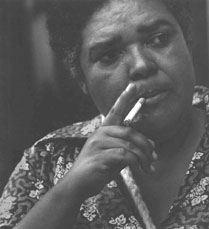
A Question of Power is a semi-autobiographical novel. The protagonist, a woman named Elizabeth, like the author is born in apartheid South Africa to a white mother and black father. She emigrates to Botswana, taking up residence in a large village.
Elizabeth tries various avocations, but discovers that her true love is gardening, and she begins to work on an experimental farm under the tutelage of a cadre of Danish volunteers. But even as Elizabeth attains some material stability in her life, her mental state deteriorates as she suffers debilitating dreams and hallucinations. Her mind becomes a battleground between two elements represented by two men, Sello and Dan. Sello represents, roughly, the traditional, tribal and mystical side of her environment, Dan the nationalistic, modern and hedonistic. But there are also religious references drawn from paganism, Christianity, Buddhism, Hindu and Islam. The two specters assume opposite poles in any number of spiritual frames of reference in dialogues and images often filled with sexual references and symbols. Eventually Elizabeth's only path to sanity is through a humanistic rejection of all notions of an external god.
I found it difficult to follow most of Elizabeth's dream images or visions, as they were simply too chaotic. It might be possible to see her insanity as a product of apartheid and her divided mental state as a reflection of an Africa torn between traditional and modern cultural values, but the story isn't coherent enough to infer such a political or social interpretation with any confidence. The evils that torment Elizabeth may have originated with racism, but Elizabeth's spiritual conflict is more generalized to the larger notions of good and evil, God and Man. This is an interesting but very challenging novel.
First published 1974

A Question of Power is a semi-autobiographical novel. The protagonist, a woman named Elizabeth, like the author is born in apartheid South Africa to a white mother and black father. She emigrates to Botswana, taking up residence in a large village.
Elizabeth tries various avocations, but discovers that her true love is gardening, and she begins to work on an experimental farm under the tutelage of a cadre of Danish volunteers. But even as Elizabeth attains some material stability in her life, her mental state deteriorates as she suffers debilitating dreams and hallucinations. Her mind becomes a battleground between two elements represented by two men, Sello and Dan. Sello represents, roughly, the traditional, tribal and mystical side of her environment, Dan the nationalistic, modern and hedonistic. But there are also religious references drawn from paganism, Christianity, Buddhism, Hindu and Islam. The two specters assume opposite poles in any number of spiritual frames of reference in dialogues and images often filled with sexual references and symbols. Eventually Elizabeth's only path to sanity is through a humanistic rejection of all notions of an external god.
I found it difficult to follow most of Elizabeth's dream images or visions, as they were simply too chaotic. It might be possible to see her insanity as a product of apartheid and her divided mental state as a reflection of an Africa torn between traditional and modern cultural values, but the story isn't coherent enough to infer such a political or social interpretation with any confidence. The evils that torment Elizabeth may have originated with racism, but Elizabeth's spiritual conflict is more generalized to the larger notions of good and evil, God and Man. This is an interesting but very challenging novel.
142dchaikin
@141 - would make an interesting group read, sounds like different readers would have different responses. Interesting stuff.
Also enjoyed your thoughts on The Sense of an Ending.
Also enjoyed your thoughts on The Sense of an Ending.
143StevenTX
20. Some Prefer Nettles by Jun'ichirō Tanizaki
First published in Japanese 1928-29
English translation by Edward G. Seidensticker 1955


Some Prefer Nettles is the story of a Japanese couple living in Osaka in the 1920s and caught between the cultural tides of East and West. Kaname is a man intrigued by Western ideas, especially sexual liberalism. When his love for his wife Misako had faded away, he even encouraged her to take a lover as he visits a Eurasian prostitute. For two years now the couple have been ready to divorce, but have held back from fear of change, from fear of facing family members, and to protect their young son.
Misako's father is the relative who's opinion matters the most, and, almost as if sensing what is developing, he attempts to draw them back to their Japanese roots by exposing them more to cultural traditions, in particular the puppet theater. Misako herself resists, but Kaname is drawn into an appreciation for his heritage as he accompanies his father-in-law on a rural pilgrimage to a puppet theater festival. The widowed father-in-law brings along his submissive young mistress, O-hisa, as though to demonstrate to Kaname what an appropriate Japanese male-female relationship should be.
This beautifully written novel shows a man torn between contrasting elements that pull his affections and emotions in opposite directions. It depicts as well a country torn between the subtle and refined pleasures of its past and the sensuous allure of Western cultural influences.
Other books I have read by Jun'ichirō Tanizaki:
The Makioka Sisters
First published in Japanese 1928-29
English translation by Edward G. Seidensticker 1955


Some Prefer Nettles is the story of a Japanese couple living in Osaka in the 1920s and caught between the cultural tides of East and West. Kaname is a man intrigued by Western ideas, especially sexual liberalism. When his love for his wife Misako had faded away, he even encouraged her to take a lover as he visits a Eurasian prostitute. For two years now the couple have been ready to divorce, but have held back from fear of change, from fear of facing family members, and to protect their young son.
Misako's father is the relative who's opinion matters the most, and, almost as if sensing what is developing, he attempts to draw them back to their Japanese roots by exposing them more to cultural traditions, in particular the puppet theater. Misako herself resists, but Kaname is drawn into an appreciation for his heritage as he accompanies his father-in-law on a rural pilgrimage to a puppet theater festival. The widowed father-in-law brings along his submissive young mistress, O-hisa, as though to demonstrate to Kaname what an appropriate Japanese male-female relationship should be.
This beautifully written novel shows a man torn between contrasting elements that pull his affections and emotions in opposite directions. It depicts as well a country torn between the subtle and refined pleasures of its past and the sensuous allure of Western cultural influences.
Other books I have read by Jun'ichirō Tanizaki:
The Makioka Sisters
144zenomax
Some excellent reviews of intriguing books steven, most of which I am not familiar with.
However I am a longtime adherent of Dada and loved the quotes from the Louis Aragon book. To me the Dadaists provide an alternative way into the mysteries of the imagination (an alternative to, in particular, the esoteric tradition which I am reading up on now, but which doesn't come to me as naturally as Dada does).
Your review has inspired me to reread some old Dada favourites and perhaps try some new!
However I am a longtime adherent of Dada and loved the quotes from the Louis Aragon book. To me the Dadaists provide an alternative way into the mysteries of the imagination (an alternative to, in particular, the esoteric tradition which I am reading up on now, but which doesn't come to me as naturally as Dada does).
Your review has inspired me to reread some old Dada favourites and perhaps try some new!
145StevenTX
#144 - What are some of those old Dada favorites? I know very little about the movement and would like to read some more.
146zenomax
Steven most Dadaist activity comes from poetry, collage, do it yourself magazines and 'events'.
Hugo Ball began the movement, and it was taken up with gusto by Tzara, Marcel Duchamp, Max Ernst, Johnnes Baader, the Herzefelds,Kurt Schwitters and others.
It might be best to get hold of an overview of the movement first. Things become more orgenised under their successors the Surrealists and you can read their automatic writings (chance was an important feature for them) and Andre Breton's novel Nadja....
Hugo Ball began the movement, and it was taken up with gusto by Tzara, Marcel Duchamp, Max Ernst, Johnnes Baader, the Herzefelds,Kurt Schwitters and others.
It might be best to get hold of an overview of the movement first. Things become more orgenised under their successors the Surrealists and you can read their automatic writings (chance was an important feature for them) and Andre Breton's novel Nadja....
147StevenTX
Thanks, Zeno. I've added a couple of appropriate titles to my wishlist. I did read Nadja last year. I should probably approach these readings more systematically. I have too many other themes going on at the moment, though.
148StevenTX
21. The Living and the Dead by Patrick White
First published 1941

Set in London in the 1930s, The Living and the Dead is the story of Catherine Standish and her two adult children, Elyot and Eden. They are three individuals living behind emotional barriers, seldom able to empathize or give themselves fully to love. There are also class barriers involved, as each increasingly finds her or his upper class status more of a burden than a privilege. Each eventually comes to question the purpose of life, seeking answers--or escape--in different directions.
The novel focuses not on events, but on feelings. White writes from deep inside the psyche of each of his characters in insightful, analytic prose. This is a thoughtful, but slow-paced novel, and the author's turgid style does not make it easy to read. The absence of quotation marks is only occasionally confusing, but White's frequent use of second person (suddenly it is "You took the train..." instead of Elyot or Eden) just calls attention to how the author is writing, not what he is saying. The characters are well-crafted, and there are beautifully-written passages throughout the book, but I found this bleak, uneventful and difficult novel on the whole unrewarding.
First published 1941

Set in London in the 1930s, The Living and the Dead is the story of Catherine Standish and her two adult children, Elyot and Eden. They are three individuals living behind emotional barriers, seldom able to empathize or give themselves fully to love. There are also class barriers involved, as each increasingly finds her or his upper class status more of a burden than a privilege. Each eventually comes to question the purpose of life, seeking answers--or escape--in different directions.
The novel focuses not on events, but on feelings. White writes from deep inside the psyche of each of his characters in insightful, analytic prose. This is a thoughtful, but slow-paced novel, and the author's turgid style does not make it easy to read. The absence of quotation marks is only occasionally confusing, but White's frequent use of second person (suddenly it is "You took the train..." instead of Elyot or Eden) just calls attention to how the author is writing, not what he is saying. The characters are well-crafted, and there are beautifully-written passages throughout the book, but I found this bleak, uneventful and difficult novel on the whole unrewarding.
149pamelad
How unfortunate that your introduction to Patrick White was such a disappointment. I have just borrowed A Fringe of Leaves from the library. On a quick scan it looks promising.
Good review of Some Prefer Nettles.
Good review of Some Prefer Nettles.
150baswood
Excellent thoughts on Patrick Wrights writing style Steven. Are you going to give him another try this year?
151StevenTX
#150 - My reading plans change day to day, but I certainly still want to read Voss and perhaps others. I'm not at all averse to difficult books as long as the rewards are in proportion to the effort.
152StevenTX
22. Two Novels: J and Seventeen by Kenzaburō Ōe
Seventeen first published 1961
J first published 1963
Translated by Luk Van Haute


The two short novels in this volume have in common society's judgment of the individual. In each case a person who has engaged in disapproved sexual behavior pushes back against society in a self-destructive manner.
"J" is the nickname of a wealthy young man. As the novel opens he is in a speeding car heading toward a remote Japanese fishing village. Everyone in the car but the driver is drunk, and one of the women is naked. Passing through the village in the dark of night they suddenly come upon a crowd gathered silently outside a house. It is the village populace expressing its collective disapproval of an adulteress by simply staring at her window throughout the night. J and his companions are on their way to his vacation home where they will make an avant-garde film, but not before continuing their drunken orgy. The villagers' unspoken condemnation will haunt them, however, when sobriety sets in.
In the second half of the novel, J, now back in Tokyo, is obsessed with the need to take sexual risks by becoming a "chikan," a subway molester. Gradually he comes to realize that the thrill in the sexual act is not getting away with it, but in the sure knowledge that he will eventually be caught.
In Seventeen an unnamed young man turns 17-years-old on the emotional roller coaster of adolescence. He is an habitual masturbator, and oscillates between euphoria and guilt. This happens to be at a time of intense internal political division in Japan, and while the young man has previously been somewhat left-wing in his ideas, he is suddenly and dramatically drawn into a far-right political movement as a catharsis for his sexual guilt.
The implication for Japanese readers at the time is that the young onanist is Otoya Yamaguchi, a 17-year-old zealot who assassinated the head of the Japan Socialist Party on October 12, 1960. His representation of one of their martyrs as a sexual deviant earned Ōe the enmity of the political Right and caused the author for some years to fear for his personal safety.
These are two excellent novels that explore the relationship between social boundaries and personal guilt.
Other books I have read by Kenzaburō Ōe:
A Personal Matter
Seventeen first published 1961
J first published 1963
Translated by Luk Van Haute


The two short novels in this volume have in common society's judgment of the individual. In each case a person who has engaged in disapproved sexual behavior pushes back against society in a self-destructive manner.
"J" is the nickname of a wealthy young man. As the novel opens he is in a speeding car heading toward a remote Japanese fishing village. Everyone in the car but the driver is drunk, and one of the women is naked. Passing through the village in the dark of night they suddenly come upon a crowd gathered silently outside a house. It is the village populace expressing its collective disapproval of an adulteress by simply staring at her window throughout the night. J and his companions are on their way to his vacation home where they will make an avant-garde film, but not before continuing their drunken orgy. The villagers' unspoken condemnation will haunt them, however, when sobriety sets in.
In the second half of the novel, J, now back in Tokyo, is obsessed with the need to take sexual risks by becoming a "chikan," a subway molester. Gradually he comes to realize that the thrill in the sexual act is not getting away with it, but in the sure knowledge that he will eventually be caught.
In Seventeen an unnamed young man turns 17-years-old on the emotional roller coaster of adolescence. He is an habitual masturbator, and oscillates between euphoria and guilt. This happens to be at a time of intense internal political division in Japan, and while the young man has previously been somewhat left-wing in his ideas, he is suddenly and dramatically drawn into a far-right political movement as a catharsis for his sexual guilt.
The implication for Japanese readers at the time is that the young onanist is Otoya Yamaguchi, a 17-year-old zealot who assassinated the head of the Japan Socialist Party on October 12, 1960. His representation of one of their martyrs as a sexual deviant earned Ōe the enmity of the political Right and caused the author for some years to fear for his personal safety.
These are two excellent novels that explore the relationship between social boundaries and personal guilt.
Other books I have read by Kenzaburō Ōe:
A Personal Matter
154dchaikin
Just catching your last three reviews, Steven. Enjoying your window into Japanese literature. And very interesting about Patrick White. I opened up Tree of Man, but haven't actually started yet. It will take some concentration.
155baswood
Interesting selection now on your reading shelf. I have read the Dan Simmons which I enjoyed, but Room was one of those book that starts brilliantly, but for me got worse and worse the more I read into it..
156StevenTX
Room is the March selection for my non-LT reading group, so I'll be starting it in about two weeks. I'm not sure when I'll get to Endymion. I decided to push back some the group stuff here to make time for more personal choices in my reading, including finishing three or four SF series in progress. There will be more China Miéville and Kim Stanley Robinson before long. My reading is still pretty haphazard--nothing structured like yours and Dan's.
157StevenTX
23. The Childlike Life of the Black Tarantula by Kathy Acker
First published 1973
(This is the first of three short novels in the omnibus volume Portrait of an Eye. Since I probably won't be reading them back-to-back, I'll post mini-reviews here of each one as I read them, then assemble a formal review at the end.)
Kathy Acker's first published novel, The Childlike Life of the Black Tarantula, has all of the elements that characterize her later, more widely-read novels: autobiographical themes, explicit sex and violence, an angry and sometimes hysterical tone, and pervasive references to other literary works.
This novel is in the form of a theme and variations, with the theme being Kathy's early life (characterized chiefly by a loveless relationship with her mother and frustrated sexual desire), and the variations being six different literary or historical works. In the first chapter, for example, she retells the lives of several famous murderesses with her own life experiences and feelings interwoven with those of the killers. She returns to the theme of murder in the final chapter by drawing on the life and philosophy of the Marquis de Sade. In the intervening segments her literary models include a collection of historical rogues and the works of Alexander Trocchi and William Butler Yeats.
Feminism is certainly a theme of the first segment, as Acker depicts each of the murderesses as victims of gender prejudice and/or sexual abuse. For the most part, however, the novel is an anguished self-portrait of a traumatized young woman who craves the warmth of a physical relationship but rejects all emotional involvement. The style varies from documentary to stream of consciousness, resulting in a sometimes seamless blend of the historical/literary subject, Kathy's own past, and Kathy as she is writing in the present.
First published 1973
(This is the first of three short novels in the omnibus volume Portrait of an Eye. Since I probably won't be reading them back-to-back, I'll post mini-reviews here of each one as I read them, then assemble a formal review at the end.)
Kathy Acker's first published novel, The Childlike Life of the Black Tarantula, has all of the elements that characterize her later, more widely-read novels: autobiographical themes, explicit sex and violence, an angry and sometimes hysterical tone, and pervasive references to other literary works.
This novel is in the form of a theme and variations, with the theme being Kathy's early life (characterized chiefly by a loveless relationship with her mother and frustrated sexual desire), and the variations being six different literary or historical works. In the first chapter, for example, she retells the lives of several famous murderesses with her own life experiences and feelings interwoven with those of the killers. She returns to the theme of murder in the final chapter by drawing on the life and philosophy of the Marquis de Sade. In the intervening segments her literary models include a collection of historical rogues and the works of Alexander Trocchi and William Butler Yeats.
Feminism is certainly a theme of the first segment, as Acker depicts each of the murderesses as victims of gender prejudice and/or sexual abuse. For the most part, however, the novel is an anguished self-portrait of a traumatized young woman who craves the warmth of a physical relationship but rejects all emotional involvement. The style varies from documentary to stream of consciousness, resulting in a sometimes seamless blend of the historical/literary subject, Kathy's own past, and Kathy as she is writing in the present.
159StevenTX
24. Callirhoe by Chariton, and
25. An Ephesian Story: Anthia and Habrocomes by Xenophon of Ephesus
from Two Novels of Ancient Greece
Both novels Hellenistic Greek from 1st or 2nd Century
Translation by Stephen M. Trzaskoma 2010


The two works in this volume are the oldest known pieces of prose fiction to which we might reasonably apply the term "novels." Some scholars prefer the term "romances," but by either name they represent the emergence of the narrative form that now dominates our literature. Nothing whatsoever is known about the two authors except what can be deduced from these two works: that they both lived in the Hellenistic world sometime around the end of the 1st Century.
Though there is no direct link between them, the two stories have remarkably similar plots, suggesting perhaps a common oral tradition leading to a number of variations and imitations. In both stories a young Greek couple, each one being of striking physical beauty, meets and marries. Soon, however, misfortune strikes, separating them and sending each on a perilous odyssey across the Mediterranean, not knowing if their beloved spouse is alive or dead. In each case the young lady is taken for dead at one point and wakes to find herself in a tomb. In each story the young man is crucified for a crime of which he is innocent, only to be rescued at the last minute.
Callirhoe is the longer, more elaborate, and much the better of the two stories. It is set at the end of the Peloponnesian War and begins in Sicily in the city of Syracuse, which is celebrating its great victory over the Athenians. Callirhoe, the daughter of the city's greatest general, has come of age and is so beautiful that suitors are besieging her home for her hand. Not among them is Chaireas, the most handsome youth and son of the second most powerful man in Syracuse, because their respective fathers are political rivals. But when the two accidentally meet, it is love at first sight.
With surprising ease the two fathers are reconciled and the blissful couple are soon married. The jealous suitors, however, resentful of having been upstaged by a newcomer, lay a plot to convince Chaireas that his bride is unfaithful to him. Enraged, Chaireas kicks Callirhoe in the belly, knocking the wind out of her so effectively that everyone assumes she is dead. Learning that he has been deceived, Chaireas can barely be restrained from killing himself as his young wife is laid to rest, surrounded by gold and silver.
Hours later, of course, Callirhoe snaps back to life finding herself helplessly entombed. No one can hear her cries for help, but fortunately a band of grave robbers are tunneling their way in to get the gold. When they find the tomb's occupant alive and unharmed, they resolve to take her too, knowing she'll fetch a great price at some distant slave market. The next morning Chaireas finds the tomb emptied, the body gone, and resolves to go in search of his wife, be she dead or alive. Thus begin the wanderings of Callirhoe and Chaireas. They will criss-cross the Mediterranean, be sold as slaves one minute, befriended by kings and princes the next. Callirhoe's phenomenal beauty will only grow in power and reputation, as entire cities turn out just to get a glimpse of her. She is like Frodo's Ring of Power--every man who sees her, covets her, and he who holds her is consumed by jealousy. Eventually the pair travel as far as Persian Babylon, but armies will march, cities will fall, and fleets will be destroyed before they can hope of being reunited.
Xenophon's story of Anthia and Habrocomes follows a similar outline, though it is both shorter and smaller in scale. Anthia is the prettiest girl in Ephesus, Habrocomes the handsomest boy. They fall so madly in love with each other that they become physically ill. Their two fathers have to resort to an oracle to figure out that the two are in love. The prophecy also has some cryptic and disturbing language about "terrible sufferings," "endless troubles," and "calamities" that await them, but says all will come right in the end. So the two are married and, in hopes of escaping the predicted calamities, the parents send them off on a honeymoon trip to Egypt. As their ship disappears from view, the none-too-bright parents recall the words of the oracle: "Both will flee across the sea, driven by madness, will face chains among men with the sea in their veins."
Sure enough, their ship is taken by pirates, they are sold into slavery, and begin their separate odysseys. Anthia's beauty may not topple kingdoms, but it is enough to get her both into and out of some terrible scrapes. She, of course, must face the obligatory ordeal of the tomb, not to mention being hung up in a tree for target practice, thrown into a pit with wild dogs, and sold to a pimp. Habrocomes will have his crucifixion, a burning at the stake, and a spell in an Italian stone quarry. Bizarre coincidences rule (thanks to the gods' interference, no doubt). Anthia will be captured on three different continents by the same bandit!
The two novels survived from antiquity as part of the same, single manuscript. Despite the similar plots, there are some interesting differences. In Xenophon's story, which is set at an unspecified time but also in Classical Greece, both homosexual and heterosexual love are mentioned, while in Callirhoe there is no hint that homosexual relationships were both common and accepted at that time. In An Ephesian Story the characters pray and sacrifice to whichever god happens to be the patron of the city in which they find themselves, whereas in Chariton's novel it is always, and only, the goddess Aphrodite, no matter where they go. Moreover, Callirhoe's piety is repeatedly pointed out, and the goddess of love is given a distinctly and uncharacteristically chaste demeanor. If the antiquity of the manuscript weren't well established, one might suspect a Christian re-working of the tale. In fact, if you were to substitute the Virgin Mary for Aphrodite and give Chaireas a horse, you might easily pass the Callirhoe off as a medieval romance from a millennium later.
The introduction by translator Stephen M. Trzaskoma is excellent, and his translation strikes an appropriate balance between flavor and readability, making both novels--but especially Callirhoe--a joy to read.
25. An Ephesian Story: Anthia and Habrocomes by Xenophon of Ephesus
from Two Novels of Ancient Greece
Both novels Hellenistic Greek from 1st or 2nd Century
Translation by Stephen M. Trzaskoma 2010


The two works in this volume are the oldest known pieces of prose fiction to which we might reasonably apply the term "novels." Some scholars prefer the term "romances," but by either name they represent the emergence of the narrative form that now dominates our literature. Nothing whatsoever is known about the two authors except what can be deduced from these two works: that they both lived in the Hellenistic world sometime around the end of the 1st Century.
Though there is no direct link between them, the two stories have remarkably similar plots, suggesting perhaps a common oral tradition leading to a number of variations and imitations. In both stories a young Greek couple, each one being of striking physical beauty, meets and marries. Soon, however, misfortune strikes, separating them and sending each on a perilous odyssey across the Mediterranean, not knowing if their beloved spouse is alive or dead. In each case the young lady is taken for dead at one point and wakes to find herself in a tomb. In each story the young man is crucified for a crime of which he is innocent, only to be rescued at the last minute.
Callirhoe is the longer, more elaborate, and much the better of the two stories. It is set at the end of the Peloponnesian War and begins in Sicily in the city of Syracuse, which is celebrating its great victory over the Athenians. Callirhoe, the daughter of the city's greatest general, has come of age and is so beautiful that suitors are besieging her home for her hand. Not among them is Chaireas, the most handsome youth and son of the second most powerful man in Syracuse, because their respective fathers are political rivals. But when the two accidentally meet, it is love at first sight.
With surprising ease the two fathers are reconciled and the blissful couple are soon married. The jealous suitors, however, resentful of having been upstaged by a newcomer, lay a plot to convince Chaireas that his bride is unfaithful to him. Enraged, Chaireas kicks Callirhoe in the belly, knocking the wind out of her so effectively that everyone assumes she is dead. Learning that he has been deceived, Chaireas can barely be restrained from killing himself as his young wife is laid to rest, surrounded by gold and silver.
Hours later, of course, Callirhoe snaps back to life finding herself helplessly entombed. No one can hear her cries for help, but fortunately a band of grave robbers are tunneling their way in to get the gold. When they find the tomb's occupant alive and unharmed, they resolve to take her too, knowing she'll fetch a great price at some distant slave market. The next morning Chaireas finds the tomb emptied, the body gone, and resolves to go in search of his wife, be she dead or alive. Thus begin the wanderings of Callirhoe and Chaireas. They will criss-cross the Mediterranean, be sold as slaves one minute, befriended by kings and princes the next. Callirhoe's phenomenal beauty will only grow in power and reputation, as entire cities turn out just to get a glimpse of her. She is like Frodo's Ring of Power--every man who sees her, covets her, and he who holds her is consumed by jealousy. Eventually the pair travel as far as Persian Babylon, but armies will march, cities will fall, and fleets will be destroyed before they can hope of being reunited.
Xenophon's story of Anthia and Habrocomes follows a similar outline, though it is both shorter and smaller in scale. Anthia is the prettiest girl in Ephesus, Habrocomes the handsomest boy. They fall so madly in love with each other that they become physically ill. Their two fathers have to resort to an oracle to figure out that the two are in love. The prophecy also has some cryptic and disturbing language about "terrible sufferings," "endless troubles," and "calamities" that await them, but says all will come right in the end. So the two are married and, in hopes of escaping the predicted calamities, the parents send them off on a honeymoon trip to Egypt. As their ship disappears from view, the none-too-bright parents recall the words of the oracle: "Both will flee across the sea, driven by madness, will face chains among men with the sea in their veins."
Sure enough, their ship is taken by pirates, they are sold into slavery, and begin their separate odysseys. Anthia's beauty may not topple kingdoms, but it is enough to get her both into and out of some terrible scrapes. She, of course, must face the obligatory ordeal of the tomb, not to mention being hung up in a tree for target practice, thrown into a pit with wild dogs, and sold to a pimp. Habrocomes will have his crucifixion, a burning at the stake, and a spell in an Italian stone quarry. Bizarre coincidences rule (thanks to the gods' interference, no doubt). Anthia will be captured on three different continents by the same bandit!
The two novels survived from antiquity as part of the same, single manuscript. Despite the similar plots, there are some interesting differences. In Xenophon's story, which is set at an unspecified time but also in Classical Greece, both homosexual and heterosexual love are mentioned, while in Callirhoe there is no hint that homosexual relationships were both common and accepted at that time. In An Ephesian Story the characters pray and sacrifice to whichever god happens to be the patron of the city in which they find themselves, whereas in Chariton's novel it is always, and only, the goddess Aphrodite, no matter where they go. Moreover, Callirhoe's piety is repeatedly pointed out, and the goddess of love is given a distinctly and uncharacteristically chaste demeanor. If the antiquity of the manuscript weren't well established, one might suspect a Christian re-working of the tale. In fact, if you were to substitute the Virgin Mary for Aphrodite and give Chaireas a horse, you might easily pass the Callirhoe off as a medieval romance from a millennium later.
The introduction by translator Stephen M. Trzaskoma is excellent, and his translation strikes an appropriate balance between flavor and readability, making both novels--but especially Callirhoe--a joy to read.
160janeajones
fascinating .. something I shall have to pursue.
161baswood
I had to check wiki because I had gotten my Xenophon's mixed up. It is surprising that prose fiction was so late in making it's appearance. It got me to thinking about whether there was any prose fiction from the Roman world. I couldn't think of any.
Great review and congratulations in being the first to review it. There is only one other person on LT who admits to owning it.
Great review and congratulations in being the first to review it. There is only one other person on LT who admits to owning it.
162Linda92007
An excellent review, Steven. It is always fascinating to go back to the very beginnings of our literary traditions and see how timeless the works and themes are.
163dmsteyn
>161 baswood: - Barry, there is The Metamorphoses of Apuleius, more commonly called The Golden Ass - according to Wikipedia, it is the only Latin novel to survive in its entirety.
164StevenTX
#161 - I should have pointed out that this is not the same Xenophon who wrote the Anabasis (and lived 500 years earlier). It was apparently a fairly common Greek name at the time, which is one the identity and dates of the author cannot be established.
There are two Latin works that contend for the title of the earliest novel: The Satyricon of Petronius and The Golden Ass by Apuleius. The translator discusses these as well in his introduction. Some scholars contend Callirhoe was written as early as 100 BC, which would make it by far the oldest. Others say as late as 200 AD.
There are three other surviving Hellenistic prose works. Collectively they are known to scholars as "The Big Five." The other three reflect a stylistic renaissance that occurred in the 2nd century, making them clearly newer than the two in this volume.
One interesting aspect of Callirhoe is how often Chariton borrows phrases and idioms from earlier works--virtually every Greek and early Roman classic known to us (and no doubt many that have since disappeared). There is nothing as obvious as "wine-dark sea," or "rosy-fingered dawn," but many more subtle borrowings from Homer, all the Greek dramatists, Herodotus, Thucydides, Plutarch, etc. The translator footnotes several of these per page. Chariton was obviously a very well-read man. Nothing comparable may be said of Xenophon of Ephesus, as his work is several steps down on the literary scale.
I found it remarkable how much "at home" I felt with Callirhoe, compared with the cultural differences we encounter in Greek drama and epics. As I said, change the name of deity and it could pass for a Medieval romance. Move the setting away from the Mediterranean and it could be 19th century romanticism. Trade the triremes for spaceships and you could be reading mid-20th century pulp science fiction. (I won't go so far as to make Callirhoe a vampire, though.)
There are two Latin works that contend for the title of the earliest novel: The Satyricon of Petronius and The Golden Ass by Apuleius. The translator discusses these as well in his introduction. Some scholars contend Callirhoe was written as early as 100 BC, which would make it by far the oldest. Others say as late as 200 AD.
There are three other surviving Hellenistic prose works. Collectively they are known to scholars as "The Big Five." The other three reflect a stylistic renaissance that occurred in the 2nd century, making them clearly newer than the two in this volume.
One interesting aspect of Callirhoe is how often Chariton borrows phrases and idioms from earlier works--virtually every Greek and early Roman classic known to us (and no doubt many that have since disappeared). There is nothing as obvious as "wine-dark sea," or "rosy-fingered dawn," but many more subtle borrowings from Homer, all the Greek dramatists, Herodotus, Thucydides, Plutarch, etc. The translator footnotes several of these per page. Chariton was obviously a very well-read man. Nothing comparable may be said of Xenophon of Ephesus, as his work is several steps down on the literary scale.
I found it remarkable how much "at home" I felt with Callirhoe, compared with the cultural differences we encounter in Greek drama and epics. As I said, change the name of deity and it could pass for a Medieval romance. Move the setting away from the Mediterranean and it could be 19th century romanticism. Trade the triremes for spaceships and you could be reading mid-20th century pulp science fiction. (I won't go so far as to make Callirhoe a vampire, though.)
165rebeccanyc
Agree with everyone that it's fascinating to go back to the earliest books in our literary tradition, and I'm impressed both by the liveliness of the stories (which makes sense, coming from an oral tradition in which the storytellers had to keep the audience engaged) and by your comment about how modern such old books can seem, something I discovered with the medieval stories I read last year and with nonfiction books I've read about earlier times. It is always striking, at least for me, how little human behavior and interactions change; it's often the external trappings and changes in culture and technology that make the modern seem different from the ancient.
166baswood
Excellent stuff steven on the early novels and your enthusiasm for them is very well communicated. If rebecca is right and I think she is there is still much enjoyment to be gained from reading older stuff.
167DieFledermaus
Added Callirhoe to the list - great review. Do you know if those novels influenced Longus' Daphnis and Chloe? That one's been on the list for a long time now and I know the premise is similar (though admittedly it is a pretty common plot).
168edwinbcn
Nice reviews of Xenophon, especially prose works. We have all read the great Greek plays by various authors, and they can be very rewarding reading, nonetheless I much prefer reading prose, so I will definitely keep an eye open for these, and also, Daphnis and Chloe, which I bought 3 years ago, but is on my tbr.
169StevenTX
#167 - I'm out of town right now & didn't bring my copy with me, but as I recall the only clue to a relative dating of the 5 Greek novels is a stylistic reformation that occurred some time in the 2nd century--a return to the more formal modes of classical Greek. Callirhoe and An Ephesian Story came before this change, Daphnis and Chloie, The Aethiopika of Heliodorus of Emesa, and Leucippe and Clitophon by Achilles Tatius obviously came after. That would imply that there is no apparent direct link between any two (would "intertextual antecedence" be the right term?). But there are enough similarities in plot to make it obvious that they all drew from a common tradition.
I had no plans to read the other three, but I may do so now that my interest has been piqued. I have a copy of Leucippe and Clitophon. The other two are available as free Google ebooks. I'm not sure, though, how long they are or how readable their older translations may be.
I had no plans to read the other three, but I may do so now that my interest has been piqued. I have a copy of Leucippe and Clitophon. The other two are available as free Google ebooks. I'm not sure, though, how long they are or how readable their older translations may be.
170StevenTX
A pictorial preview of a coming review a la baswood:

This is the enigmatic opening scene of The Aethiopica by Heliodorus of Emesa, 2nd Century. A ship lies beached on a desert shore. A sumptuous feast is laid, but nearly all the feasters lie dead among violent disorder. Only two still live: a grievously wounded young man and the remarkably beautiful young woman who tends him. From a distance, however, a menacing band looks on, wondering themselves just what has happened here.
Painting by Abraham Bloemaert, 1625.

This is the enigmatic opening scene of The Aethiopica by Heliodorus of Emesa, 2nd Century. A ship lies beached on a desert shore. A sumptuous feast is laid, but nearly all the feasters lie dead among violent disorder. Only two still live: a grievously wounded young man and the remarkably beautiful young woman who tends him. From a distance, however, a menacing band looks on, wondering themselves just what has happened here.
Painting by Abraham Bloemaert, 1625.
171StevenTX
26. Aethiopica by Heliodorus of Emesa
Also known as The Adventures of Theagenes and Chariclea
2nd Century Phoenician writing in Greek
Aethiopica is one of the five surviving Greek novels or romances from the Hellenistic Era. It is closely related in concept to the two described above, Callirhoe and An Ephesian Story, but longer and told in a more complex style and form.
The novel begins with the aftermath of some strange catastrophe which has left almost an entire ship's crew dead on the shores of Egypt. It appears at first that the only one living is a beautiful maiden named Chariclea, but soon she finds her beloved is still alive, an equally attractive young man named Theagenes. Scarcely are they united when a band of brigands chances upon them, takes them captive, and plunders the ship, taking the two lovers as slaves.
Heliodorus, the author, quotes Homer often enough to make it obvious that he has taken The Odyssey as his model, starting his narrative in mid-story and having his characters relate their past adventures in long sessions with their new acquaintances. We learn that Chariclea was a priestess of Delphi who only recently learned herself that she is actually an Ethiopian princess. Her mother the queen, it seems, stared too long at a painting of Andromeda while she was pregnant and thus gave birth to a white-skinned, blonde daughter. Fearing that her husband would accuse her of infidelity, she sent her daughter away while claiming that the child was stillborn.
As a priestess, Chariclea was sworn to chastity until she met Theagenes (as pictured above), a noble youth from Thessaly. It was love at first sight for both. She agrees to marry him, but insists on remaining a virgin until she has returned with Theagenes to her Ethiopian birthplace. This they will accomplish with the aid of an Egyptian priest who has been seeking Chariclea and appears at just the right moment to mastermind their elopement.
Fortuitous coincidences occur right and left (obviously the work of the gods), and several more major characters appear whose histories, when told, intertwine with those of the loving couple. There will be battles, conflagrations, floods, dungeons, poisonings, and more for the pair to endure. Naturally every man who sees Chariclea falls in love with her and wants to seize her for himself, but none will be as dangerous as the Persian princess Arsace who tries to seduce Theagenes.
I read this novel from two different translations, both as ebooks in public domain from Google Books. I started with an edition from 1897 published by The Athenian Society. The translator was not named, but it was a very readable rendition and--as the original Greek was given on facing pages--presumably a faithful one. It turned out, however, that this was only the first of several volumes, but Google hadn't digitized the rest. So I found another translation on Google, this one in an edition titled The Greek Romances of Heliodorus, Longus, and Achillies Tatius, published 1889 and translated by Rev. Rowland Smith of Oxford. This translation was a bit more turgid, but acceptable. Because I read the novel from two different sources, I'm not posting this as a formal review. (The only edition available on Amazon, by the way, is a translation made by Thomas Underdown in 1587.)
This was, incidentally, my first experience using my NookColor to read ebooks that were PDF files of page images rather than OCR'd text. I can discuss this aspect further if anyone is interested.
The Aethiopica is entertaining, but I wouldn't put it in the same class as Chariton's Callirhoe. The characters aren't as appealing or realistic and the narrative isn't as suspenseful. The best part of the book, in my opinion, was a fascinating description of the siege of the city of Syene (modern Aswan) and a subsequent battle in the desert featuring Persian armored cavalry against Ethiopian elephants and various African auxiliaries.
And speaking of sieges, Heliodorus the author, who identifies himself as a Phoenician, was from the Syrian city of Emesa. It is now known as Homs, and is under siege at this moment.
Also known as The Adventures of Theagenes and Chariclea
2nd Century Phoenician writing in Greek
Aethiopica is one of the five surviving Greek novels or romances from the Hellenistic Era. It is closely related in concept to the two described above, Callirhoe and An Ephesian Story, but longer and told in a more complex style and form.
The novel begins with the aftermath of some strange catastrophe which has left almost an entire ship's crew dead on the shores of Egypt. It appears at first that the only one living is a beautiful maiden named Chariclea, but soon she finds her beloved is still alive, an equally attractive young man named Theagenes. Scarcely are they united when a band of brigands chances upon them, takes them captive, and plunders the ship, taking the two lovers as slaves.
Heliodorus, the author, quotes Homer often enough to make it obvious that he has taken The Odyssey as his model, starting his narrative in mid-story and having his characters relate their past adventures in long sessions with their new acquaintances. We learn that Chariclea was a priestess of Delphi who only recently learned herself that she is actually an Ethiopian princess. Her mother the queen, it seems, stared too long at a painting of Andromeda while she was pregnant and thus gave birth to a white-skinned, blonde daughter. Fearing that her husband would accuse her of infidelity, she sent her daughter away while claiming that the child was stillborn.
As a priestess, Chariclea was sworn to chastity until she met Theagenes (as pictured above), a noble youth from Thessaly. It was love at first sight for both. She agrees to marry him, but insists on remaining a virgin until she has returned with Theagenes to her Ethiopian birthplace. This they will accomplish with the aid of an Egyptian priest who has been seeking Chariclea and appears at just the right moment to mastermind their elopement.
Fortuitous coincidences occur right and left (obviously the work of the gods), and several more major characters appear whose histories, when told, intertwine with those of the loving couple. There will be battles, conflagrations, floods, dungeons, poisonings, and more for the pair to endure. Naturally every man who sees Chariclea falls in love with her and wants to seize her for himself, but none will be as dangerous as the Persian princess Arsace who tries to seduce Theagenes.
I read this novel from two different translations, both as ebooks in public domain from Google Books. I started with an edition from 1897 published by The Athenian Society. The translator was not named, but it was a very readable rendition and--as the original Greek was given on facing pages--presumably a faithful one. It turned out, however, that this was only the first of several volumes, but Google hadn't digitized the rest. So I found another translation on Google, this one in an edition titled The Greek Romances of Heliodorus, Longus, and Achillies Tatius, published 1889 and translated by Rev. Rowland Smith of Oxford. This translation was a bit more turgid, but acceptable. Because I read the novel from two different sources, I'm not posting this as a formal review. (The only edition available on Amazon, by the way, is a translation made by Thomas Underdown in 1587.)
This was, incidentally, my first experience using my NookColor to read ebooks that were PDF files of page images rather than OCR'd text. I can discuss this aspect further if anyone is interested.
The Aethiopica is entertaining, but I wouldn't put it in the same class as Chariton's Callirhoe. The characters aren't as appealing or realistic and the narrative isn't as suspenseful. The best part of the book, in my opinion, was a fascinating description of the siege of the city of Syene (modern Aswan) and a subsequent battle in the desert featuring Persian armored cavalry against Ethiopian elephants and various African auxiliaries.
And speaking of sieges, Heliodorus the author, who identifies himself as a Phoenician, was from the Syrian city of Emesa. It is now known as Homs, and is under siege at this moment.
173baswood
Steven, fascinating stuff. Are you intent on reading novels from the very beginning? The Aethiopica is one of those stories that has survived down the ages as Abraham Bloemaert's picture demonstrates. Interesting fact about Homs.
174rebeccanyc
Another very interesting review, and I love the picture.
175StevenTX
#173 - Are you intent on reading novels from the very beginning?
One of many sources of inspiration in my reading is the series 1001 Books You Must Read Before You Die, and I thought one approach to the list would be simply to start at the beginning and read chronologically every available work I hadn't already read. That led me to Callirhoe, and then to Aethiopica. I read An Ephesian Story because it was short and in the same volume as Callirhoe. The other two ancient Greek romances aren't on the list, but I did consider reading them anyway. I've found, however, that when I read several highly similar book in a row, they begin to run together, so I think I'll move on and save the others for later. My next unread novel on the list is Outlaws of the Marsh, which I'm already reading as part of my focus on Chinese literature (a separate goal). I know many people here are disdainful of reading lists, but they have led me to some wonderful discoveries like Callirhoe that I wouldn't otherwise have known of.
One of many sources of inspiration in my reading is the series 1001 Books You Must Read Before You Die, and I thought one approach to the list would be simply to start at the beginning and read chronologically every available work I hadn't already read. That led me to Callirhoe, and then to Aethiopica. I read An Ephesian Story because it was short and in the same volume as Callirhoe. The other two ancient Greek romances aren't on the list, but I did consider reading them anyway. I've found, however, that when I read several highly similar book in a row, they begin to run together, so I think I'll move on and save the others for later. My next unread novel on the list is Outlaws of the Marsh, which I'm already reading as part of my focus on Chinese literature (a separate goal). I know many people here are disdainful of reading lists, but they have led me to some wonderful discoveries like Callirhoe that I wouldn't otherwise have known of.
176StevenTX
27. Selected Stories of Lu Hsun
Eighteen stories first published 1918-1926
Translation by Yang Hsien-yi and Gladys Yang 1972


Lu Xun was the most prominent Chinese writer of the first half of the 20th century. His writings reflect a time of transition between ancient traditions and modern ways and the political turmoil following the final collapse of dynastic rule. Lu's beliefs were progressive and socialist, but with strong sympathy for the common person trapped in the values and practices of an archaic tradition.
There is considerable variety in the stories this collection, ranging from light political satires, to dark cultural allegories, and to poignant personal tragedies. The settings also vary: urban-rural, past-present, realistic-imaginary. The collection is arranged chronologically, and the general trend is from the general and political in the earlier stories to the intimate and personal in the later ones.
The opening selection, "A Madman's Diary," is an allegorical depiction of feudalism through the thoughts of a man obsessed with cannibalism. Like many of Lu's stories it shows the influence of Nikolai Gogol in its use of the absurd and fantastic.
Lu's most famous story, and the longest in the collection, is "The True Story of Ah Q." Ah Q is a shiftless simpleton who gets caught up in the political rivalries between nationalist and socialist factions in rural China. He's only looking for his next meal, but he finds himself one day a pariah, the next a hero, the next a criminal depending on how the political winds are blowing. This is a superb double-edged satire, both showing the need for social reform and poking fun at the selfish motives of the supposed reformers.
Several of the stories focus on the status of women in China. It was a time when girls in rural areas were still having their feet bound and might be sold as concubines, while women in urban China attended college, wore Western dress and started careers. Institutions and attitudes were slow to adapt. "Regret for the Past" depicts the struggles of a couple who--for reasons never given--decide to live together unmarried. The strain of society's disapproval eventually drives them into poverty and dooms their relationship. In "Divorce," a woman with modern attitudes is forced to go through an archaic divorce process by submitting her case to the village sage.
The final story in the collection, "Forging the Swords," is an allegorical attack on aristocratic tradition in the mode of (and referencing) Hans Christian Andersen's tale "The Emperor's New Clothes." It has a macabre twist to it, however, featuring two severed heads fighting one another in a cauldron of boiling water as a third man beheads himself so his head can join the fray. This is one of several stories in which Lu Xun resembles his European contemporary Franz Kafka.
This collection was published in 2003, but the translations are not new. They were first published in Beijing in 1972 before the use of the new Pinyin system of romanization became standard. Thus the author's name is given as "Lu Hsun" rather than "Lu Xun," and the names of characters and places are similarly spelled under the old Wade-Giles system. This is the only drawback to the translation, which I found perfectly readable. The 2003 edition includes an introduction by Ha Jin which provides useful biographical information and an assessment of Lu Xun's place in Chinese literary tradition.
Eighteen stories first published 1918-1926
Translation by Yang Hsien-yi and Gladys Yang 1972


Lu Xun was the most prominent Chinese writer of the first half of the 20th century. His writings reflect a time of transition between ancient traditions and modern ways and the political turmoil following the final collapse of dynastic rule. Lu's beliefs were progressive and socialist, but with strong sympathy for the common person trapped in the values and practices of an archaic tradition.
There is considerable variety in the stories this collection, ranging from light political satires, to dark cultural allegories, and to poignant personal tragedies. The settings also vary: urban-rural, past-present, realistic-imaginary. The collection is arranged chronologically, and the general trend is from the general and political in the earlier stories to the intimate and personal in the later ones.
The opening selection, "A Madman's Diary," is an allegorical depiction of feudalism through the thoughts of a man obsessed with cannibalism. Like many of Lu's stories it shows the influence of Nikolai Gogol in its use of the absurd and fantastic.
Lu's most famous story, and the longest in the collection, is "The True Story of Ah Q." Ah Q is a shiftless simpleton who gets caught up in the political rivalries between nationalist and socialist factions in rural China. He's only looking for his next meal, but he finds himself one day a pariah, the next a hero, the next a criminal depending on how the political winds are blowing. This is a superb double-edged satire, both showing the need for social reform and poking fun at the selfish motives of the supposed reformers.
Several of the stories focus on the status of women in China. It was a time when girls in rural areas were still having their feet bound and might be sold as concubines, while women in urban China attended college, wore Western dress and started careers. Institutions and attitudes were slow to adapt. "Regret for the Past" depicts the struggles of a couple who--for reasons never given--decide to live together unmarried. The strain of society's disapproval eventually drives them into poverty and dooms their relationship. In "Divorce," a woman with modern attitudes is forced to go through an archaic divorce process by submitting her case to the village sage.
The final story in the collection, "Forging the Swords," is an allegorical attack on aristocratic tradition in the mode of (and referencing) Hans Christian Andersen's tale "The Emperor's New Clothes." It has a macabre twist to it, however, featuring two severed heads fighting one another in a cauldron of boiling water as a third man beheads himself so his head can join the fray. This is one of several stories in which Lu Xun resembles his European contemporary Franz Kafka.
This collection was published in 2003, but the translations are not new. They were first published in Beijing in 1972 before the use of the new Pinyin system of romanization became standard. Thus the author's name is given as "Lu Hsun" rather than "Lu Xun," and the names of characters and places are similarly spelled under the old Wade-Giles system. This is the only drawback to the translation, which I found perfectly readable. The 2003 edition includes an introduction by Ha Jin which provides useful biographical information and an assessment of Lu Xun's place in Chinese literary tradition.
177baswood
Whatever list you are working from steven it is providing you with a wonderful selection of reading.
I am a list person; if there is not a list available then I find myself making up my own. Long live lists
I am a list person; if there is not a list available then I find myself making up my own. Long live lists
178DieFledermaus
I also enjoy lists - I get new recommendations which is always helpful.
Enjoying the reviews of Greek novels.
Enjoying the reviews of Greek novels.
179StevenTX
28. Heavy Wings by Zhang Jie
First published in China 1980 as Chenzhong de chibang
Also published as Leaden Wings
English translation by Howard Goldblatt 1989


China in 1980 was in a difficult period of economic and social transition. Zhang Jie described it as it was happening in her novel Heavy Wings. The setting is Beijing, and the principal characters are mostly workers or executives with either the Morning Light Auto Works or the Ministry of Heavy Industry which oversees it. The key conflict is a dispute in management philosophy which basically boils down to the question: "Does the worker serve the state, or does the state serve the worker?"
Chen Yongming, the manager of Morning Light Auto Works, believes that happy workers are better workers, and that giving employees some autonomy improves production and quality. He has taken risks like diverting funds to build housing for his employees, and those risks are paying off. A cadre member of the Ministry of Heavy Industry named He Jiabin, excited about what Chen has done, collaborates with a journalist to publish an article praising Chen's new philosophy. The publicity generated by the article soon pits two senior members of the ministry against each other, with each attempting to represent his views as the proper expression of Marxist doctrine. He Jiabin's superior and supporter, Vice-Minister Zheng Ziyun, bears the brunt of the power struggle and emerges as the novel's chief protagonist.
The conflict reverberates up and down the management chain and into the personal lives of those involved. Zheng's opponents attempt to slander him by implying an illicit relationship between Zheng and the female reporter who co-authored the infamous article. At the same time, Zheng is having trouble at home with his callous, unloving wife, and his rebellious daughter. The role of women is a major theme in the novel, with the puritanical ideals of officialdom coming under heavy criticism as well. An unmarried couple seen together is a scandal, and a successful woman is sneeringly assumed to have used sex to achieve her position. And where did Marx write, wonders one character, that a man may not kiss his wife in public?
That Heavy Wings was published in China in 1980 to wide acclaim shows that Zhang Jie caught the mood of the moment quite accurately and at a time when China's leaders were open to the ideas represented in the novel. The sense of the uncertainty about the future that the populace and its government must have felt is expressed in the following passage when He Jiabin comforts a woman he has loved secretly for years but has never been able to marry, or even dared to kiss, because of political issues in her past:
Zhang Jie is obviously at pains herself not to imply any criticism of Chairman Deng Xiaoping or the Communist Party in her novel. It does not promote capitalism, just a reform of management practices and social attitudes under communism. Obviously China was soon to evolve in ways that vastly exceeded the reforms promoted in the novel.
While Heavy Wings is a very rewarding and informative novel, it is anything but lively. There are so many characters introduced in successive chapters that the novel at first reads like a series of loosely linked short stories. And the lengthy discussions of management practices often make it seem more like a case study in a textbook on organizational psychology. The more human side of the story only comes to the fore in the last third of the novel when the philosophical cases have all been made and the effects of conflict and stress take their toll on the rivals and their families. I would recommend it especially to those with an interest in recent Chinese history and not just looking for entertainment.
First published in China 1980 as Chenzhong de chibang
Also published as Leaden Wings
English translation by Howard Goldblatt 1989


China in 1980 was in a difficult period of economic and social transition. Zhang Jie described it as it was happening in her novel Heavy Wings. The setting is Beijing, and the principal characters are mostly workers or executives with either the Morning Light Auto Works or the Ministry of Heavy Industry which oversees it. The key conflict is a dispute in management philosophy which basically boils down to the question: "Does the worker serve the state, or does the state serve the worker?"
Chen Yongming, the manager of Morning Light Auto Works, believes that happy workers are better workers, and that giving employees some autonomy improves production and quality. He has taken risks like diverting funds to build housing for his employees, and those risks are paying off. A cadre member of the Ministry of Heavy Industry named He Jiabin, excited about what Chen has done, collaborates with a journalist to publish an article praising Chen's new philosophy. The publicity generated by the article soon pits two senior members of the ministry against each other, with each attempting to represent his views as the proper expression of Marxist doctrine. He Jiabin's superior and supporter, Vice-Minister Zheng Ziyun, bears the brunt of the power struggle and emerges as the novel's chief protagonist.
The conflict reverberates up and down the management chain and into the personal lives of those involved. Zheng's opponents attempt to slander him by implying an illicit relationship between Zheng and the female reporter who co-authored the infamous article. At the same time, Zheng is having trouble at home with his callous, unloving wife, and his rebellious daughter. The role of women is a major theme in the novel, with the puritanical ideals of officialdom coming under heavy criticism as well. An unmarried couple seen together is a scandal, and a successful woman is sneeringly assumed to have used sex to achieve her position. And where did Marx write, wonders one character, that a man may not kiss his wife in public?
That Heavy Wings was published in China in 1980 to wide acclaim shows that Zhang Jie caught the mood of the moment quite accurately and at a time when China's leaders were open to the ideas represented in the novel. The sense of the uncertainty about the future that the populace and its government must have felt is expressed in the following passage when He Jiabin comforts a woman he has loved secretly for years but has never been able to marry, or even dared to kiss, because of political issues in her past:
"Oh Jiabin, Jiabin, why has everything turned out so badly?"
He pats her on the back. "Because we're living in a society that's neither capitalist nor communist, neither fish nor fowl, neither this nor that, neither hot nor cold, always at odds, up and down, where nothing is as it should be, and everything can be interpreted one way or the other. No one ever knows which way to go, and nothing's ever made clear. So why should your own agony be more important than the agonies of an entire society?... It's not the fault of any one person. These are the pains that come during a time of transition."
Zhang Jie is obviously at pains herself not to imply any criticism of Chairman Deng Xiaoping or the Communist Party in her novel. It does not promote capitalism, just a reform of management practices and social attitudes under communism. Obviously China was soon to evolve in ways that vastly exceeded the reforms promoted in the novel.
While Heavy Wings is a very rewarding and informative novel, it is anything but lively. There are so many characters introduced in successive chapters that the novel at first reads like a series of loosely linked short stories. And the lengthy discussions of management practices often make it seem more like a case study in a textbook on organizational psychology. The more human side of the story only comes to the fore in the last third of the novel when the philosophical cases have all been made and the effects of conflict and stress take their toll on the rivals and their families. I would recommend it especially to those with an interest in recent Chinese history and not just looking for entertainment.
180StevenTX
Here are some of the best bandit names and nicknames from Outlaws of the Marsh, the 14th century Chinese classic:
Song Jiang, the Timely Rain
Lu Junyi, the Jade Unicorn
Sagacious Lu, the Tattooed Monk
Yang Zhi, the Blue-Faced Beast
Mu Hong, the Unrestrained
Mu Chun, the Slightly Restrained
Li Jun, the Turbulent River Dragon
Xie Bao, the Twin-Tailed Scorpion
Xuan Zan, the Ugly Son-in-Law
Ou Peng, the Golden Wings Brushing the Clouds
Yang Lin, the Elegant Panther
Jiang Jing, the Magic Calculator
Wang Ying, the Stumpy Tiger
Hu Sannian, Ten Feet of Steel
Tong Meng, the River-Churning Clam
Yang Chung, the White-Spotted Snake
Tao Zongwant, the Nine-Tailed Tortoise
Zhu Gui, The Dry-Land Crocodile
Bai Sheng, the Daylight Rat
Shi Qian, the Flea on a Drum
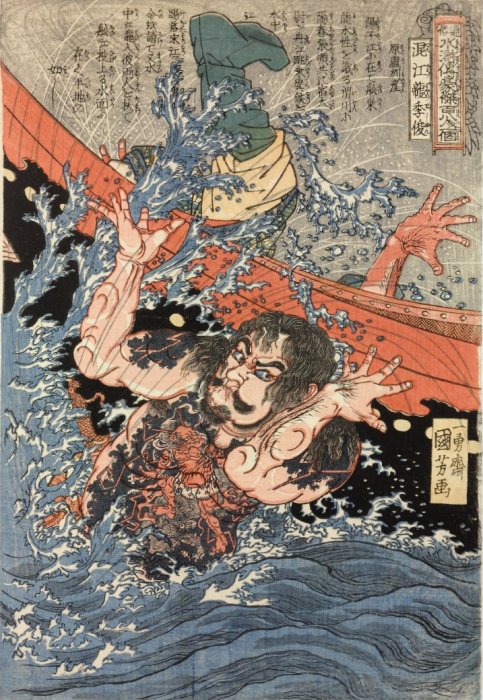
Here, in a Japanese print, the Turbulent River Dragon capsizes an enemy boat.
There are 108 named bandits in all. Song Jiang is the bandit leader and the only one known to have been an historical figure--a sort of Robin Hood on a much grander scale. One of the above is a woman, and you would never guess which. It is "Ten Feet of Steel," so called because she wields two five-foot swords.
Full review to come once I've finished all four volumes. I'm on volume three right now.
Song Jiang, the Timely Rain
Lu Junyi, the Jade Unicorn
Sagacious Lu, the Tattooed Monk
Yang Zhi, the Blue-Faced Beast
Mu Hong, the Unrestrained
Mu Chun, the Slightly Restrained
Li Jun, the Turbulent River Dragon
Xie Bao, the Twin-Tailed Scorpion
Xuan Zan, the Ugly Son-in-Law
Ou Peng, the Golden Wings Brushing the Clouds
Yang Lin, the Elegant Panther
Jiang Jing, the Magic Calculator
Wang Ying, the Stumpy Tiger
Hu Sannian, Ten Feet of Steel
Tong Meng, the River-Churning Clam
Yang Chung, the White-Spotted Snake
Tao Zongwant, the Nine-Tailed Tortoise
Zhu Gui, The Dry-Land Crocodile
Bai Sheng, the Daylight Rat
Shi Qian, the Flea on a Drum
Here, in a Japanese print, the Turbulent River Dragon capsizes an enemy boat.
There are 108 named bandits in all. Song Jiang is the bandit leader and the only one known to have been an historical figure--a sort of Robin Hood on a much grander scale. One of the above is a woman, and you would never guess which. It is "Ten Feet of Steel," so called because she wields two five-foot swords.
Full review to come once I've finished all four volumes. I'm on volume three right now.
181rebeccanyc
Love the bandit nicknames. One of my favorite aspects of a completely different book which I read last year, Luc Sante's Low Life: Lures and Snares of Old New York was the gang names, including the Dead Rabbits (in which "dead" means "best" and "rabbit" means "tough guy")! I look forward to reading your full review.
182kidzdoc
Awesome! From now on, please call me Mu Chun (the Slightly Restrained; that fits perfectly with my book buying tendencies). Hmm; Ron Artest (Metta World Peace) and Chad Johnson (Chad Ochocinco) got their names officially changed, maybe I'll do the same...
Is Outlaws of the Marsh really 2149 pages in length? The Kindle version is only $3.49, so I'll add it to my wish list and wait for your review of it.
Excellent review of Heavy Wings; I think I'll read it for the 4th quarter Reading Globally challenge.
Is Outlaws of the Marsh really 2149 pages in length? The Kindle version is only $3.49, so I'll add it to my wish list and wait for your review of it.
Excellent review of Heavy Wings; I think I'll read it for the 4th quarter Reading Globally challenge.
183rebeccanyc
Well, if you're the slightly restrained, Darryl, I"m Mu Hong, the unrestrained (book-buying-wise, that is)!
184StevenTX
#182 - Yes, my paperback edition is 2149 pages in four volumes. These are, however, mass-market-sized paperbacks; a larger format would cut the number of pages substantially and fit in a single volume.
I had no idea this was available electronically, but it is the same Sidney Shapiro translation I am reading. That's quite a bargain. They also have the other three great Chinese classics for under $4 each: A Dream of Red Mansions, Journey to the West and Romance of the Three Kingdoms.
I had no idea this was available electronically, but it is the same Sidney Shapiro translation I am reading. That's quite a bargain. They also have the other three great Chinese classics for under $4 each: A Dream of Red Mansions, Journey to the West and Romance of the Three Kingdoms.
185janeajones
182 and 183> I don't think either of you are in the least restrained as to book-buying!
186rebeccanyc
#185 Darryl is trying to restrict his book buying this year and I am trying to undermine his resolve.
187StevenTX
Darryl is trying to be Pei Xuan, the Ironclad Virtue, while Rebecca takes the role of Ruan the Seventh, the Devil Incarnate (to cite two more names from the book).
188kidzdoc
LOL! 'Ironclad Virtue' might be a bit of an overstatement; 'Tofuclad Virtue' is probably more like it.
If Rebecca is the Devil Incarnate, what does that make avaland?
If Rebecca is the Devil Incarnate, what does that make avaland?
189rebeccanyc
It's so much more fun to be devilish!
190SassyLassy
Heavy Wings: A fascinating period in China, so I will give it a try. If a Goldblatt translation can't liven it up, it must have been earnest indeed.
I found a reference last week to a book called Rhetoric of the Chinese Cultural Revolution by Lu Xing, published in 2004. While the GPCR ended just before your book, the author would still be heavily influenced by this rhetorical tradition, especially the contortions involved in not criticizing or promoting a particular path or person, so perhaps she was being particularly cautious, given as you say, no one knew which way things would go
I also really enjoyed your Lu Hsun/Xun review and will look for that as well.
I found a reference last week to a book called Rhetoric of the Chinese Cultural Revolution by Lu Xing, published in 2004. While the GPCR ended just before your book, the author would still be heavily influenced by this rhetorical tradition, especially the contortions involved in not criticizing or promoting a particular path or person, so perhaps she was being particularly cautious, given as you say, no one knew which way things would go
I also really enjoyed your Lu Hsun/Xun review and will look for that as well.
191StevenTX
#188 - I just looked at her profile gallery and decided avaland must be Liu Tang, the Red-Haired Demon. Of course kidzdoc, you are in reality An Daoquan, the Skilled Doctor. (Even tough there are 108 of them, I'm afraid we're going to run out of apt nicknames pretty soon.)
#190 - It is very obvious in the novel that people are trying to walk a fine line between the discredited Gang of Four of the Cultural Revolution on the one hand and the still-demonized Rightists on the other, the author included. It was acceptable to admit that China had problems, but dangerous to offer bold solutions.
However, I would say that 90% of the discord and stress in Heavy Wings can be found in any large bureaucratic organization, including the one I worked in for 30 years. Chen Yongming's management reforms bear a strong resemblance to the "Total Quality Managment" practices I experienced in the 1980s, and which were accompanied by an equal amount of anguish, backstabbing and turmoil.
#190 - It is very obvious in the novel that people are trying to walk a fine line between the discredited Gang of Four of the Cultural Revolution on the one hand and the still-demonized Rightists on the other, the author included. It was acceptable to admit that China had problems, but dangerous to offer bold solutions.
However, I would say that 90% of the discord and stress in Heavy Wings can be found in any large bureaucratic organization, including the one I worked in for 30 years. Chen Yongming's management reforms bear a strong resemblance to the "Total Quality Managment" practices I experienced in the 1980s, and which were accompanied by an equal amount of anguish, backstabbing and turmoil.
193StevenTX
29. Room by Emma Donoghue
First published 2010


With over 400 reviews already posted about Room, I'm not doing a full review on this one. I don't think I could do it justice without giving away too much of the plot anyway.
Briefly, the situation is that a boy has spent his first five years in a single room where his mother has been held captive. They have a television and a few books, so the child knows something of the outside world, even though he thinks it's all make believe. The boy, whose name is Jack, is the narrator of the story. For Jack, "Room" is the whole world, and he associates it warmly with the love he and his mother share. For her, however, it is a prison. Their contrasting perspectives are one theme of the novel. Another is Jack's use of language with no direct knowledge of the objects, activities and ideas it represents.
Room is a gripping and moving novel for at least two-thirds of the way through. Towards the end it fell a bit flat for me, with the author seeming too intent on finding "closure" at the expense of carrying out the psychological and linguistic ideas which she built so well in the beginning of the book. It's still a very good novel, though, and many readers will no doubt be pleased with the ending.
First published 2010


With over 400 reviews already posted about Room, I'm not doing a full review on this one. I don't think I could do it justice without giving away too much of the plot anyway.
Briefly, the situation is that a boy has spent his first five years in a single room where his mother has been held captive. They have a television and a few books, so the child knows something of the outside world, even though he thinks it's all make believe. The boy, whose name is Jack, is the narrator of the story. For Jack, "Room" is the whole world, and he associates it warmly with the love he and his mother share. For her, however, it is a prison. Their contrasting perspectives are one theme of the novel. Another is Jack's use of language with no direct knowledge of the objects, activities and ideas it represents.
Room is a gripping and moving novel for at least two-thirds of the way through. Towards the end it fell a bit flat for me, with the author seeming too intent on finding "closure" at the expense of carrying out the psychological and linguistic ideas which she built so well in the beginning of the book. It's still a very good novel, though, and many readers will no doubt be pleased with the ending.
194baswood
Room for me is a novel of two halves and so I agree with your view of it. Curiously it is a novel I like less and less the further I am away from reading it.
195Nickelini
#194 Curiously it is a novel I like less and less the further I am away from reading it.
Well said--I know that feeling. I feel it a lot, especially with the typical book club novels (Life of Bees, Lovely Bones, I could go on). I call those "potato chip books" -- they fun at the time, but make me feel sort of regretful and queasy later on.
That said, I'm reading Room for my book club in the next few months, and I received my copy today from an LT member who hated it and wanted it out of her house!
Well said--I know that feeling. I feel it a lot, especially with the typical book club novels (Life of Bees, Lovely Bones, I could go on). I call those "potato chip books" -- they fun at the time, but make me feel sort of regretful and queasy later on.
That said, I'm reading Room for my book club in the next few months, and I received my copy today from an LT member who hated it and wanted it out of her house!
196StevenTX
Lessons in 12th century Chinese military history from Outlaws in the Marsh:

In the 4th volume of Outlaws of the Marsh the outlaw force under Song Jiang has now grown to more than 100,000 fighters, and instead of individual exploits we now have open war between the outlaw armies and the Empire. The outlaw forces are headquartered on Mount Lian, a mountain situated in the center of a marsh on the Yellow River. (At least it was at the time; the river has since shifted course.) So the Empire used naval forces in combination with land armies to attack the outlaws. I've just run across the first mention of paddle-wheel warships, and was fortunate enough to find the above picture of one.
Paddle wheels are well suited for shallow rivers. In the American Civil War, some paddle-wheel ironclad steamships could operate in as little as a foot of water. These Chinese vessels were, of course, powered only by human muscles. The central tower structure protected archers and crossbowmen as they fired down upon the enemy.
In Volume 3 there is the first mention of armored cavalry (shown in the lower left above). Both rider and horse were fully armored with chain mail. The Imperial armored cavalry were impervious to arrow attack and were, at first, invulnerable to any weapons the outlaws had. Soon, however, the clever bandits came up with the idea of using barbed pikes, as shown, to trip the horses and pull the riders to the ground. Their armor was so heavy they couldn't even stand up on their own, much less remount their horses. Though the use of armored cavalry wasn't as widespread as in Europe, it seems to have been at roughly the same stage of development.

We know that the Chinese invented gunpowder but were slow to grasp its military potential. In Outlaws of the Marsh cannon are mostly used as noise-makers for signalling or for scaring enemy horses, but one expert has developed cannon that can be used as siege weapons. There isn't any information about the nature of the projectiles, but they were probably roughly hewn stone balls. The cannon have sufficient range to fire across the marsh and destroy fortifications on the slopes of Mount Liang.
Despite these impressive advances in military technology, most battles begin--as in The Iliad--with one army's champion challenging the other army's best warrior to individual combat. Only after this ceremonial duel is resolved do the troops move forward.

In the 4th volume of Outlaws of the Marsh the outlaw force under Song Jiang has now grown to more than 100,000 fighters, and instead of individual exploits we now have open war between the outlaw armies and the Empire. The outlaw forces are headquartered on Mount Lian, a mountain situated in the center of a marsh on the Yellow River. (At least it was at the time; the river has since shifted course.) So the Empire used naval forces in combination with land armies to attack the outlaws. I've just run across the first mention of paddle-wheel warships, and was fortunate enough to find the above picture of one.
Paddle wheels are well suited for shallow rivers. In the American Civil War, some paddle-wheel ironclad steamships could operate in as little as a foot of water. These Chinese vessels were, of course, powered only by human muscles. The central tower structure protected archers and crossbowmen as they fired down upon the enemy.
In Volume 3 there is the first mention of armored cavalry (shown in the lower left above). Both rider and horse were fully armored with chain mail. The Imperial armored cavalry were impervious to arrow attack and were, at first, invulnerable to any weapons the outlaws had. Soon, however, the clever bandits came up with the idea of using barbed pikes, as shown, to trip the horses and pull the riders to the ground. Their armor was so heavy they couldn't even stand up on their own, much less remount their horses. Though the use of armored cavalry wasn't as widespread as in Europe, it seems to have been at roughly the same stage of development.

We know that the Chinese invented gunpowder but were slow to grasp its military potential. In Outlaws of the Marsh cannon are mostly used as noise-makers for signalling or for scaring enemy horses, but one expert has developed cannon that can be used as siege weapons. There isn't any information about the nature of the projectiles, but they were probably roughly hewn stone balls. The cannon have sufficient range to fire across the marsh and destroy fortifications on the slopes of Mount Liang.
Despite these impressive advances in military technology, most battles begin--as in The Iliad--with one army's champion challenging the other army's best warrior to individual combat. Only after this ceremonial duel is resolved do the troops move forward.
197rebeccanyc
You are definitely getting me very intrigued by Outlaws of the Marsh!
198StevenTX
30. Fortunata and Jacinta by Benito Pérez Galdós
First published in Spanish as Fortunata y Jacinta 1887
English translation by Agnes Moncy Gullón 1986


Fortunata and Jacinta is widely considered to be the greatest Spanish novel of the 19th century. The setting is Madrid in the 1870s, a time of great political turmoil. While the novel references some of the historical events taking place at the time, its focus is an intensely detailed and realistic portrait of the characters who inhabit it.
Juan Santa Cruz, the spoiled only child of a prosperous merchant family, has grown up to become an idle playboy. The latest object of his attentions is Fortunata, the beautiful and free-spirited niece of a local market vendor. She becomes his mistress. Appalled at the possibility of a connection to someone so far below their own social level, Juan's parents hustle him into courtship and marriage. His bride is Jacinta: pretty, refined, saintly, and loving. For a while, Jacinta makes her husband forget about Fortunata.
Meanwhile, Fortunata has caught the eye of Maximiliano Rubín, a sickly young pharmacy student. "Maxi," pious and chaste, makes it his project to redeem Fortunata from her poverty and her sinful past. He is determined to make her his wife, even though she confesses she can never love such a pathetic creature. Besieged by a flood of priestly advice from all sides, Fortunata consents to a loveless marriage to save her soul. But once she's another man's wife, Juan Santa Cruz, bored with Jacinta, comes back into her life. The ecstasy and anguish she has experienced in the past is nothing compared with what's to come.
Fortunata is the novel's pivotal character and its central idea. Crude and illiterate, yet beautiful and artlessly charming, violent yet loving, spiteful but forgiving, she both enchants and exasperates everyone around her. Everyone is always trying to change Fortunata--to reform her, tame her, and educate her--and she is always trying to change herself. Yet in the end, one closest to her admits that all these efforts were in vain:
The intractability of human nature is demonstrated in the public sphere as well as the private. During the period of Fortunata and Jacinta Spain went through several governments, from monarchy to republic and back to monarchy. These events aren't directly shown in the novel--the characters' lives are remarkably unaffected, in fact, by their country's state of virtual anarchy--but we see opinions and convictions vacillate as frequently as the political winds change. Just as Juan Santa Cruz always wants the woman he shouldn't have, the public is always in favor of the faction that is out of power at the moment.
Fortunata and Jacinta is about a place almost as much as it is about people. Pérez Galdós describes Madrid in loving detail: the rhythms of daily life, the sounds and smells of the market place, the ebb and flow of trade, the traffic jams and quiet alleyways, the hullabaloo of café society. The physical world is constantly a part of the novel in the texture of clothing, the taste of a confection, the distant sound of a piano, and the vibration from booted feet climbing the stairs.
Pérez Galdós writes in the realist tradition of Balzac, depicting human nature and behavior as he sees it. It is up to the reader to decide if Fortunata is a devil or an angel. The author is transparent and non-judgmental, providing physical description and letting his characters' thoughts and speech convey feelings and ideas. This does make for some long and relatively uneventful passages, and there are some prolonged and not indispensable side trips into the affairs of some lesser characters. In the end, though, Fortunata and Jacinta is a rewarding novel, not as great as, but similar in many ways to Tolstoy's Anna Karenina.
First published in Spanish as Fortunata y Jacinta 1887
English translation by Agnes Moncy Gullón 1986


Fortunata and Jacinta is widely considered to be the greatest Spanish novel of the 19th century. The setting is Madrid in the 1870s, a time of great political turmoil. While the novel references some of the historical events taking place at the time, its focus is an intensely detailed and realistic portrait of the characters who inhabit it.
Juan Santa Cruz, the spoiled only child of a prosperous merchant family, has grown up to become an idle playboy. The latest object of his attentions is Fortunata, the beautiful and free-spirited niece of a local market vendor. She becomes his mistress. Appalled at the possibility of a connection to someone so far below their own social level, Juan's parents hustle him into courtship and marriage. His bride is Jacinta: pretty, refined, saintly, and loving. For a while, Jacinta makes her husband forget about Fortunata.
Meanwhile, Fortunata has caught the eye of Maximiliano Rubín, a sickly young pharmacy student. "Maxi," pious and chaste, makes it his project to redeem Fortunata from her poverty and her sinful past. He is determined to make her his wife, even though she confesses she can never love such a pathetic creature. Besieged by a flood of priestly advice from all sides, Fortunata consents to a loveless marriage to save her soul. But once she's another man's wife, Juan Santa Cruz, bored with Jacinta, comes back into her life. The ecstasy and anguish she has experienced in the past is nothing compared with what's to come.
Fortunata is the novel's pivotal character and its central idea. Crude and illiterate, yet beautiful and artlessly charming, violent yet loving, spiteful but forgiving, she both enchants and exasperates everyone around her. Everyone is always trying to change Fortunata--to reform her, tame her, and educate her--and she is always trying to change herself. Yet in the end, one closest to her admits that all these efforts were in vain:
I wasn't the only one who was deceived; she was, too. We defrauded each other. We didn't take nature into account, the grand mother and teacher who rectifies the errors of those of her children who go astray. We do countless foolish things and nature corrects them. We protest against her admirable lessons, which we don't understand, and when we want her to obey us, she grabs us and smashes us to bits, as the sea does whoever tries to rule it.
The intractability of human nature is demonstrated in the public sphere as well as the private. During the period of Fortunata and Jacinta Spain went through several governments, from monarchy to republic and back to monarchy. These events aren't directly shown in the novel--the characters' lives are remarkably unaffected, in fact, by their country's state of virtual anarchy--but we see opinions and convictions vacillate as frequently as the political winds change. Just as Juan Santa Cruz always wants the woman he shouldn't have, the public is always in favor of the faction that is out of power at the moment.
Fortunata and Jacinta is about a place almost as much as it is about people. Pérez Galdós describes Madrid in loving detail: the rhythms of daily life, the sounds and smells of the market place, the ebb and flow of trade, the traffic jams and quiet alleyways, the hullabaloo of café society. The physical world is constantly a part of the novel in the texture of clothing, the taste of a confection, the distant sound of a piano, and the vibration from booted feet climbing the stairs.
Pérez Galdós writes in the realist tradition of Balzac, depicting human nature and behavior as he sees it. It is up to the reader to decide if Fortunata is a devil or an angel. The author is transparent and non-judgmental, providing physical description and letting his characters' thoughts and speech convey feelings and ideas. This does make for some long and relatively uneventful passages, and there are some prolonged and not indispensable side trips into the affairs of some lesser characters. In the end, though, Fortunata and Jacinta is a rewarding novel, not as great as, but similar in many ways to Tolstoy's Anna Karenina.
199DieFledermaus
Great review - added Fortunata and Jacinta to the list.
201msjohns615
Good stuff, glad to see somebody is out there reading books by Benito Pérez Galdós! I enjoyed your review and will try and read Fortunata y Jacinta someday. I think "loving" is a good way to describe BPG's descriptions...I've always appreciated his ability to develop a nice, warm rapport with his readers.
202janeajones
Another one on my wishlist -- oh if life were only so long..........
203Linda92007
Just catching up and finding more excellent reviews, Steven!
204StevenTX
31. The Windup Girl by Paolo Bacigalupi
First published 2009

In the future depicted in The Windup Girl, most fossil fuels have been exhausted, climate change has taken place as currently predicted, genetic engineering has proven to be more a curse than a cure, and multi-national corporations are now more powerful than governments. Our great-grandchildren may be fated to live in such a world.
The setting is the Kingdom of Thailand, a country that has yet to fall under the control of the multi-national food conglomerates known as "calorie companies". In Bangkok the glass towers of the "Expansion" (our period) stand empty for the lack of electricity to cool them and operate the elevators. The streets are crowded with pedal rickshaws and megodonts, the genetically-engineered successor to elephants. Megodonts and human muscle are the chief source of power for industry as well as transportation. Massive levees keep out the ever-rising sea. Famine and disease are perpetual threats, as most natural plant and animal species have been wiped out by climate change or by man-made viruses deliberately released to attack a corporation's competitors. Now genetic engineering must be used defensively to keep food sources a step ahead of rapidly mutating microbes.
Even human beings have been the subject of genetic manipulation. Emiko, the "Windup Girl" of the title, is a woman genetically modified to be obedient and sexually pleasing, the perfect concubine or sex slave. She and her kind are banned in Thailand, where the powerful Environment Ministry uses ruthless methods to keep the country free from genetic contamination and corporate control. But there are those in Thailand who want to open the kingdom to outside trade, as well as those who will take bribes to overlook the presence of Emiko and other quarantine violations.
The novel is told from the perspective of several characters, Emiko included. There is no single protagonist and no clear distinction between good and evil. Issues are complex and loyalties are often divided. Readers who want a clear-cut hero triumphing over evil may not care for this novel. To me, however, it is the moral ambiguity of the tale that makes it both convincing and captivating. The plot is unpredictable all the way to the final pages, and seeing ethical questions from multiple angles makes this a very mature and thoughtful novel.
First published 2009

In the future depicted in The Windup Girl, most fossil fuels have been exhausted, climate change has taken place as currently predicted, genetic engineering has proven to be more a curse than a cure, and multi-national corporations are now more powerful than governments. Our great-grandchildren may be fated to live in such a world.
The setting is the Kingdom of Thailand, a country that has yet to fall under the control of the multi-national food conglomerates known as "calorie companies". In Bangkok the glass towers of the "Expansion" (our period) stand empty for the lack of electricity to cool them and operate the elevators. The streets are crowded with pedal rickshaws and megodonts, the genetically-engineered successor to elephants. Megodonts and human muscle are the chief source of power for industry as well as transportation. Massive levees keep out the ever-rising sea. Famine and disease are perpetual threats, as most natural plant and animal species have been wiped out by climate change or by man-made viruses deliberately released to attack a corporation's competitors. Now genetic engineering must be used defensively to keep food sources a step ahead of rapidly mutating microbes.
Even human beings have been the subject of genetic manipulation. Emiko, the "Windup Girl" of the title, is a woman genetically modified to be obedient and sexually pleasing, the perfect concubine or sex slave. She and her kind are banned in Thailand, where the powerful Environment Ministry uses ruthless methods to keep the country free from genetic contamination and corporate control. But there are those in Thailand who want to open the kingdom to outside trade, as well as those who will take bribes to overlook the presence of Emiko and other quarantine violations.
The novel is told from the perspective of several characters, Emiko included. There is no single protagonist and no clear distinction between good and evil. Issues are complex and loyalties are often divided. Readers who want a clear-cut hero triumphing over evil may not care for this novel. To me, however, it is the moral ambiguity of the tale that makes it both convincing and captivating. The plot is unpredictable all the way to the final pages, and seeing ethical questions from multiple angles makes this a very mature and thoughtful novel.
205rebeccanyc
Sounds fascinating but creepy, as I said on your other thread.
206Linda92007
An enticing review, Steven. It does make one think about the world that we will be leaving for future generations. Creepy perhaps, but unfortunately all too plausible.
208StevenTX
32. Outlaws of the Marsh
Written in the 14th century and attributed to Shi Nai'an and Luo Guanzhong
Translated from the Chinese by Sidney Shapiro 1993
Also published as Water Margin, as All Men Are Brothers, and as Marshes of Mount Liang
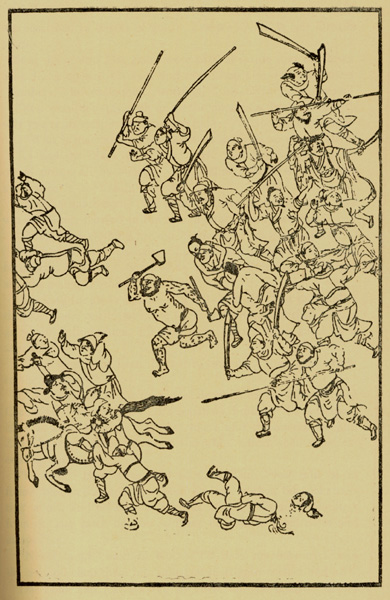
As the wild geese flock over Liangshan Marsh on an autumn eve, so do the pages fly by, a hundred score and more, leaving us all too soon with nothing but the echo of their song, the traces of our tears, and the last dregs of the wine. But the memory of Song Jiang and the 108 heroes of Liangshan Marsh is everywhere and everlasting.
Shi Nai'an wrote Outlaws of the Marsh some time in the 14th century. Luo Guanzhong, the fabled author of Romance of the Three Kingdoms probably assisted Shi. Or perhaps Luo Guanzhong was Shi Nai'an. Or perhaps neither existed. But the novel certainly exists, even though its original form and content are as uncertain as its author's name. Its translation, too, has taken many identities: "The Water Margin," "All Men Are Brothers," "Marshes of Mount Liang," and "Outlaws of the Marsh."
We do know that Song Jiang was a real person, the leader of a band of outlaws in the waning years of the great Song Dynasty early in our 12th century. Some of the other characters are known to have lived, but most of Outlaws of the Marsh is only what we wish might have happened.
The events of the novel take place in roughly four phases. In the beginning, we find find first one brave individual, then another, the victim either of the machinations of a corrupt official or of his own overly zealous defense of his honor. Major Lu Da comes to the aid of a poor man and his daughter, killing the gangster who is threatening their liberty, but because of the gangster's local connections Lu must go into hiding in the guise of a Buddhist monk. Meanwhile in the capital, Arms Instructor Lin Chong is framed and sent into exile because his superior's son lusts after Lin's beautiful young wife. Each story connects loosely to the next, and these are only two of many stories just as two stars in the firmament. Occasionally we hear mention of Liangshan Marsh, at the center of which lies Mount Liang, a notorious haven for outlaws. We also meet Song Jiang, a mere county clerk, but a man with a widespread reputation for honesty and a willingness to stick his neck out to help brave men in need. Soon enough, Song Jiang himself comes afoul of the law.
Out of compassion for her family, Song Jiang takes a concubine named Poxi. His duties leave little time for her, so she soon takes a lover. Poxi dares to belittle Song Jiang, and in a rage he stabs her to death. Refusing his friends' offer of rescue, Song confesses his guilt and takes his punishment of exile and imprisonment. But as Song suffers increasing persecution in prison, his friends plan a daring rescue. By the time all is said and done, a sizable force of reputable fighters has assembled on Mount Liang and talked the reluctant Song Jiang into becoming their leader.
In the second phase of the novel, instead of a series of loosely connected adventures involving one or two individuals, we have a more purposeful tale of Liangshan Marsh buildings its forces. The men call themselves members of the "gallant brotherhood," an idea more than an organization. It roughly corresponds to the contemporary European idea of chivalry. The Song Dynasty is in its final years, and the boy emperor is under the sway of ministers who conceal from him the truth. Corruption reigns at all levels. Brave men fight for honor's sake, and to break the law--even to rob and murder--is no disgrace if the victim is someone who has exploited the people. In a typical chapter, a man from Liangshan challenges a solitary traveler to combat, only to find that he is a worthy opponent who is himself a victim of injustice. After fighting to mutual exhaustion, the newcomer joins the brigand for a few dozen cups of wine, then eagerly becomes one of the gallant band under Song Jiang. Soon a galaxy of heroes begins to assemble: men with nicknames like Li Kui the Black Whirlwind, Li Jun the Turbulent River Dragon, and Xie Bao the Twin-Tailed Scorpion.
Where the Chinese idea of chivalry differs from its European equivalent is in the treatment of women. The knights of Europe fawned over their lady loves, married or otherwise. Song Jiang's heroes do no such thing. Women, in fact, get rather rough treatment for at least the first half of the novel (and that's 1000 pages). The young and pretty ones are usually, like Poxi, unfaithful and wind up getting carved into pieces. The old ones are usually the abettors of the young ones and come to similar ends. One mother spends three pages berating her son for not visiting her more frequently, then a tiger eats her. Finally we come to an exception: the men of Liangshan Marsh encounter a local landowner's daughter nicknamed Ten Feet of Steel for her skill in wielding a pair of five-foot swords. When they finally defeat her, she joins their band. But even she has no say in the matter when Song Jiang gives her in marriage to Stumpy Tiger Wang.
The third phase of the novel sees the forces of Song Jiang at the height of their powers. There are now 108 chieftains, each of whose adventures we have followed as he or she came to join the gallant brotherhood. But these are only the leaders: there are as many as 100,000 fighting men on Mount Liang, and who knows how many non-combatants. They control a large swath of territory, but maintain their honor by protecting the common people while preying only upon the corrupt and powerful. Finally the Emperor is forced to send troops against Song Jiang, only to see one army after another crushed in defeat. Song Jiang, in the meantime, maintains that his only goal is to obtain the Emperor's amnesty so he and his followers can fight in defense of their homeland. "Act on Heaven's Behalf," reads the banner at his headquarters.
As the novel moves into events of a larger scale, it provides memorable depictions of Chinese warfare, just as it has done of many other phases of Chinese life. We see, for example, the early use of siege canon. Of paddle-wheeled river vessels powered by human muscle. Of the use of observation towers on the battlefield. And of the archaic battlefield traditions where generals led their armies literally into battle and were the first to engage in combat while their troops watched and cheered them on. Song Jiang, interestingly, is an exception to the rule. Described as short, fat and swarthy, he never participates in combat. He is neither the brains nor the brawn of his army, but simply its moral force.
Finally the Emperor, learning of the Song Jiang's true nature through the kind offices of a courtesan, grants the bandits their desire for an amnesty. Song Jiang's army is now a part of the imperial army, but no less beset by the jealous machinations of those corrupt officials. In the final phase of the novel, the men of Liangshan Marsh are sent against China's northern enemy, the Liao Tartars. In one of the novels most memorable passages, we come to a climactic battle in which the forces of the Song Dynasty under Song Jiang are arrayed in the plains of Manchuria against the mighty Liao army, an army that includes a division of 5,000 female warriors. The war between the Chinese and the Liao is real; the participation of Song Jiang's men is--perhaps--imaginary. But the fruits of victory will bring Song Jiang and his men nothing but a much greater and more deadly challenge.
Much of what happens in Outlaws of the Marsh seems oddly familiar, as though these are people and ideas we have seen before. The idea of criminals being assembled as an elite fighting force being just one such theme. How did this come to be? The legend of Song Jiang is the equivalent in Chinese culture to the West's King Arthur and Robin Hood put together. It is as influential in Japan as it is in China. Many of the ideas of from Outlaws of the Marsh seem to have been used in Kurasawa's epic 1954 film "The Seven Samurai." That movie was, in turn, the inspiration for American films such as "The Magnificent Seven" and "The Dirty Dozen." So Song Jiang and his heroes live on in forms they could never have imagined.
The translation by Sidney Shapiro provides an excellent balance of readability and historical flavor. To read Outlaws of the Marsh is to be immersed in the culture of 12th century China, at one moment oddly familiar, at another completely alien. To be sure, 108 major characters is a lot, but each one is an individual with his or her own characteristics and personality, and each of the 100 chapters is a fresh new adventure. It is a novel that is immensely and compulsively readable, with each chapter ending in a cliffhanger posing a critical question and the words: "Read our next chapter if you would know."
Is this, perchance, the greatest, the most entertaining, the most enduring novel ever written? Read Outlaws of the Marsh if you would know.

Written in the 14th century and attributed to Shi Nai'an and Luo Guanzhong
Translated from the Chinese by Sidney Shapiro 1993
Also published as Water Margin, as All Men Are Brothers, and as Marshes of Mount Liang
As the wild geese flock over Liangshan Marsh on an autumn eve, so do the pages fly by, a hundred score and more, leaving us all too soon with nothing but the echo of their song, the traces of our tears, and the last dregs of the wine. But the memory of Song Jiang and the 108 heroes of Liangshan Marsh is everywhere and everlasting.
Shi Nai'an wrote Outlaws of the Marsh some time in the 14th century. Luo Guanzhong, the fabled author of Romance of the Three Kingdoms probably assisted Shi. Or perhaps Luo Guanzhong was Shi Nai'an. Or perhaps neither existed. But the novel certainly exists, even though its original form and content are as uncertain as its author's name. Its translation, too, has taken many identities: "The Water Margin," "All Men Are Brothers," "Marshes of Mount Liang," and "Outlaws of the Marsh."
We do know that Song Jiang was a real person, the leader of a band of outlaws in the waning years of the great Song Dynasty early in our 12th century. Some of the other characters are known to have lived, but most of Outlaws of the Marsh is only what we wish might have happened.
The events of the novel take place in roughly four phases. In the beginning, we find find first one brave individual, then another, the victim either of the machinations of a corrupt official or of his own overly zealous defense of his honor. Major Lu Da comes to the aid of a poor man and his daughter, killing the gangster who is threatening their liberty, but because of the gangster's local connections Lu must go into hiding in the guise of a Buddhist monk. Meanwhile in the capital, Arms Instructor Lin Chong is framed and sent into exile because his superior's son lusts after Lin's beautiful young wife. Each story connects loosely to the next, and these are only two of many stories just as two stars in the firmament. Occasionally we hear mention of Liangshan Marsh, at the center of which lies Mount Liang, a notorious haven for outlaws. We also meet Song Jiang, a mere county clerk, but a man with a widespread reputation for honesty and a willingness to stick his neck out to help brave men in need. Soon enough, Song Jiang himself comes afoul of the law.
Out of compassion for her family, Song Jiang takes a concubine named Poxi. His duties leave little time for her, so she soon takes a lover. Poxi dares to belittle Song Jiang, and in a rage he stabs her to death. Refusing his friends' offer of rescue, Song confesses his guilt and takes his punishment of exile and imprisonment. But as Song suffers increasing persecution in prison, his friends plan a daring rescue. By the time all is said and done, a sizable force of reputable fighters has assembled on Mount Liang and talked the reluctant Song Jiang into becoming their leader.
In the second phase of the novel, instead of a series of loosely connected adventures involving one or two individuals, we have a more purposeful tale of Liangshan Marsh buildings its forces. The men call themselves members of the "gallant brotherhood," an idea more than an organization. It roughly corresponds to the contemporary European idea of chivalry. The Song Dynasty is in its final years, and the boy emperor is under the sway of ministers who conceal from him the truth. Corruption reigns at all levels. Brave men fight for honor's sake, and to break the law--even to rob and murder--is no disgrace if the victim is someone who has exploited the people. In a typical chapter, a man from Liangshan challenges a solitary traveler to combat, only to find that he is a worthy opponent who is himself a victim of injustice. After fighting to mutual exhaustion, the newcomer joins the brigand for a few dozen cups of wine, then eagerly becomes one of the gallant band under Song Jiang. Soon a galaxy of heroes begins to assemble: men with nicknames like Li Kui the Black Whirlwind, Li Jun the Turbulent River Dragon, and Xie Bao the Twin-Tailed Scorpion.
Where the Chinese idea of chivalry differs from its European equivalent is in the treatment of women. The knights of Europe fawned over their lady loves, married or otherwise. Song Jiang's heroes do no such thing. Women, in fact, get rather rough treatment for at least the first half of the novel (and that's 1000 pages). The young and pretty ones are usually, like Poxi, unfaithful and wind up getting carved into pieces. The old ones are usually the abettors of the young ones and come to similar ends. One mother spends three pages berating her son for not visiting her more frequently, then a tiger eats her. Finally we come to an exception: the men of Liangshan Marsh encounter a local landowner's daughter nicknamed Ten Feet of Steel for her skill in wielding a pair of five-foot swords. When they finally defeat her, she joins their band. But even she has no say in the matter when Song Jiang gives her in marriage to Stumpy Tiger Wang.
The third phase of the novel sees the forces of Song Jiang at the height of their powers. There are now 108 chieftains, each of whose adventures we have followed as he or she came to join the gallant brotherhood. But these are only the leaders: there are as many as 100,000 fighting men on Mount Liang, and who knows how many non-combatants. They control a large swath of territory, but maintain their honor by protecting the common people while preying only upon the corrupt and powerful. Finally the Emperor is forced to send troops against Song Jiang, only to see one army after another crushed in defeat. Song Jiang, in the meantime, maintains that his only goal is to obtain the Emperor's amnesty so he and his followers can fight in defense of their homeland. "Act on Heaven's Behalf," reads the banner at his headquarters.
As the novel moves into events of a larger scale, it provides memorable depictions of Chinese warfare, just as it has done of many other phases of Chinese life. We see, for example, the early use of siege canon. Of paddle-wheeled river vessels powered by human muscle. Of the use of observation towers on the battlefield. And of the archaic battlefield traditions where generals led their armies literally into battle and were the first to engage in combat while their troops watched and cheered them on. Song Jiang, interestingly, is an exception to the rule. Described as short, fat and swarthy, he never participates in combat. He is neither the brains nor the brawn of his army, but simply its moral force.
Finally the Emperor, learning of the Song Jiang's true nature through the kind offices of a courtesan, grants the bandits their desire for an amnesty. Song Jiang's army is now a part of the imperial army, but no less beset by the jealous machinations of those corrupt officials. In the final phase of the novel, the men of Liangshan Marsh are sent against China's northern enemy, the Liao Tartars. In one of the novels most memorable passages, we come to a climactic battle in which the forces of the Song Dynasty under Song Jiang are arrayed in the plains of Manchuria against the mighty Liao army, an army that includes a division of 5,000 female warriors. The war between the Chinese and the Liao is real; the participation of Song Jiang's men is--perhaps--imaginary. But the fruits of victory will bring Song Jiang and his men nothing but a much greater and more deadly challenge.
Much of what happens in Outlaws of the Marsh seems oddly familiar, as though these are people and ideas we have seen before. The idea of criminals being assembled as an elite fighting force being just one such theme. How did this come to be? The legend of Song Jiang is the equivalent in Chinese culture to the West's King Arthur and Robin Hood put together. It is as influential in Japan as it is in China. Many of the ideas of from Outlaws of the Marsh seem to have been used in Kurasawa's epic 1954 film "The Seven Samurai." That movie was, in turn, the inspiration for American films such as "The Magnificent Seven" and "The Dirty Dozen." So Song Jiang and his heroes live on in forms they could never have imagined.
The translation by Sidney Shapiro provides an excellent balance of readability and historical flavor. To read Outlaws of the Marsh is to be immersed in the culture of 12th century China, at one moment oddly familiar, at another completely alien. To be sure, 108 major characters is a lot, but each one is an individual with his or her own characteristics and personality, and each of the 100 chapters is a fresh new adventure. It is a novel that is immensely and compulsively readable, with each chapter ending in a cliffhanger posing a critical question and the words: "Read our next chapter if you would know."
Is this, perchance, the greatest, the most entertaining, the most enduring novel ever written? Read Outlaws of the Marsh if you would know.

209Linda92007
What a wonderful review, Steven. Thanks!
210C4RO
I know of "Water Margin" from a really excellent TV series. A lot of your story sounded familiar and I had no idea it was one of those it's-really-a-book things you come across now and again!
211rebeccanyc
Wow! Your review makes me want to run out and read this book even though the number of pages, not to mention the number of characters, is daunting. I especially appreciated your connecting it to modern tales.
ETA In fact, I just ordered it!
ETA In fact, I just ordered it!
212baswood
Fabulous review steven. A book that I had never heard of until you started posting about it. I am not quite so impulsive as Rebecca and so have not rushed to order it yet.... but it sounds so intriguing, I know I would be fascinated to read about 12th century Chinese culture.
213janeajones
Fascinating review though it sounds a bit heavy on the battle-fronts for my taste. I had the same trouble with swaths of Malory -- especially the Tristram section.
214rebeccanyc
212 I am not generally an impulsive person -- except when it comes to buying books!
215baswood
Steven I see you have Patrick White's The Tree of Man up for reading soon. I have scheduled it for next month as I have The Aunt's story to read first.
216StevenTX
33. No One Writes to the Colonel and Other Stories by Gabriel García Márquez
Translation by J. S. Bernstein first published 1968


The novella and eight short stories in this collection share the same setting, some of the same characters, and the same themes, but each story is independent. The setting is in or near Macondo, the imaginary town representing the author's Colombian birthplace in many of his works.
In No One Writes to the Colonel, a retired officer and his asthmatic wife wait for years in poverty for the Colonel's promised pension. As they near starvation, the only thing of value left to them is a fighting cock that once belonged to their now-dead son. They sell their last possessions to feed the cock while they, themselves, go hungry.
The other stories are similar depictions of people who are impoverished and powerless but not without pride and hope. In "One of These Days" the local dentist gets his revenge on behalf of the people when the town's mayor develops an abscess. In "There Are No Thieves in This Town" a desperate man with a pregnant wife tries to rob the local pool hall but comes away with nothing but three billiard balls. And in "One Day After Saturday" a strange plague of dying birds convinces the local priest that the end of the world is at hand.
With just a hint of the magical realism that would soon become his trademark, these stories would be a good introduction to the work of Gabriel García Márquez.
Other books I have read by Gabriel García Márquez:
One Hundred Years of Solitude
Memories of My Melancholy Whores
Clandestine in Chile
Translation by J. S. Bernstein first published 1968


The novella and eight short stories in this collection share the same setting, some of the same characters, and the same themes, but each story is independent. The setting is in or near Macondo, the imaginary town representing the author's Colombian birthplace in many of his works.
In No One Writes to the Colonel, a retired officer and his asthmatic wife wait for years in poverty for the Colonel's promised pension. As they near starvation, the only thing of value left to them is a fighting cock that once belonged to their now-dead son. They sell their last possessions to feed the cock while they, themselves, go hungry.
The other stories are similar depictions of people who are impoverished and powerless but not without pride and hope. In "One of These Days" the local dentist gets his revenge on behalf of the people when the town's mayor develops an abscess. In "There Are No Thieves in This Town" a desperate man with a pregnant wife tries to rob the local pool hall but comes away with nothing but three billiard balls. And in "One Day After Saturday" a strange plague of dying birds convinces the local priest that the end of the world is at hand.
With just a hint of the magical realism that would soon become his trademark, these stories would be a good introduction to the work of Gabriel García Márquez.
Other books I have read by Gabriel García Márquez:
One Hundred Years of Solitude
Memories of My Melancholy Whores
Clandestine in Chile
217StevenTX
#213 - Yes, there is a lot of fighting. In the first half of the novel it's one-on-one encounters much like those in the Arthurian stories. In the second half there are also detailed descriptions of military maneuvers and battles. Women have a very small role in the novel. Drinking and fighting seem to have dominated the agenda.
#215 - I've read just the first chapter of The Tree of Man so far, but I think I'll enjoy it. I keep several books going at once, so I'll probably still be reading it when you've started it.
#215 - I've read just the first chapter of The Tree of Man so far, but I think I'll enjoy it. I keep several books going at once, so I'll probably still be reading it when you've started it.
218StevenTX
34. Broken April by Ismail Kadare
First published in Albanian 1978
English edition 1990, translator not identified
(probably translated from a 1982 French edition)


For centuries the highlands of northern Albania have been under the rule of the "Kanun," a set of folk laws centered around rigid concepts of family honor that manifest themselves in endless blood feuds. The plateau...
Blood feuds dominate the culture, the architecture, and even the agricultural practices of the region. A man with a blood debt to collect must hunt and kill his designated victim, even though he knows he will, in his turn, be hunted and killed.
Broken April, which takes place in the 1930s, describes the Kanun from three persepective. Gjorg is a young villager who has just killed a man to avenge his brother's death. He must attend his victim's funeral, then sit down to dinner with the victim's family. He has a thirty days truce during which he enjoys immunity; then it will be his turn to be hunted for the rest of his life.
Bessian is a writer from the capital of Tirana who is so fascinated with the Kanun that he takes his young bride Diana up into the highlands for their honeymoon. Their bemused fascination for a barbaric culture gradually becomes something far more serious that threatens their relationship.
Mark Ukacierra is the steward of the castle which is the heart and protector of the Kanun. It is his duty to collect the blood-tax that men like Gjorg must pay without fail when they kill their man. He is the custodian of centuries of records, killing by killing, that help sustain the blood feuds when the will or memory of individuals lapse.
The novel neither condemns nor excuses the Kanun and its code of blood feuds, but shows instead how it is integral to the culture.
Broken April is a haunting and disturbing novel about the side of human nature that is drawn to violence and death.
Other books I have read by Ismail Kadare:
Spring Flowers, Spring Frost
First published in Albanian 1978
English edition 1990, translator not identified
(probably translated from a 1982 French edition)


For centuries the highlands of northern Albania have been under the rule of the "Kanun," a set of folk laws centered around rigid concepts of family honor that manifest themselves in endless blood feuds. The plateau...
...is the only region of Europe which--while being an integral part of a modern state...--has rejected the laws, the legal institutions, the police, the courts, in short, all the structures of the state... replacing them with other moral rules which are themselves just as adequate... and thus to put the High Plateau, let's say nearly half of the kingdom, quite beyond the control of the state.
Blood feuds dominate the culture, the architecture, and even the agricultural practices of the region. A man with a blood debt to collect must hunt and kill his designated victim, even though he knows he will, in his turn, be hunted and killed.
Broken April, which takes place in the 1930s, describes the Kanun from three persepective. Gjorg is a young villager who has just killed a man to avenge his brother's death. He must attend his victim's funeral, then sit down to dinner with the victim's family. He has a thirty days truce during which he enjoys immunity; then it will be his turn to be hunted for the rest of his life.
Bessian is a writer from the capital of Tirana who is so fascinated with the Kanun that he takes his young bride Diana up into the highlands for their honeymoon. Their bemused fascination for a barbaric culture gradually becomes something far more serious that threatens their relationship.
Mark Ukacierra is the steward of the castle which is the heart and protector of the Kanun. It is his duty to collect the blood-tax that men like Gjorg must pay without fail when they kill their man. He is the custodian of centuries of records, killing by killing, that help sustain the blood feuds when the will or memory of individuals lapse.
The novel neither condemns nor excuses the Kanun and its code of blood feuds, but shows instead how it is integral to the culture.
As weeks and months went by, Gjorg came to understand that the other part, which was concerned with everyday living and was not drenched with blood, was inextricably bound to the bloody part, so much so that no one could really tell where one part left off and the other began. The whole was so conceived that one begat the other, the stainless giving birth to the bloody, and the second to the first, and so on forever, from generation to generation.
Broken April is a haunting and disturbing novel about the side of human nature that is drawn to violence and death.
Other books I have read by Ismail Kadare:
Spring Flowers, Spring Frost
219StevenTX
A postscript on Broken April:
The experience of Bessian and Diana, the honeymooners who are traveling through the Albanian highlands, reminded me Port and Kit Moresby in The Sheltering Sky by Paul Bowles, one of my all-time favorite novels. There is the same sexual tension and jealousy brought about by exposure to a more violent and masculine culture.
The experience of Bessian and Diana, the honeymooners who are traveling through the Albanian highlands, reminded me Port and Kit Moresby in The Sheltering Sky by Paul Bowles, one of my all-time favorite novels. There is the same sexual tension and jealousy brought about by exposure to a more violent and masculine culture.
220Linda92007
An interesting review, Steven. Of all of Kadare's novels, Broken April is the one not to be found in the two library systems I can readily access. I guess I will start with another of his works.
221rebeccanyc
Sounds fascinating. I was not impressed by the only Kadare I've read, The Successor, but this might tempt me.
222baswood
Steven, good review of Broken April. The blood feuds are a fascinating subject. Something a little similar was happening in Greece on the Mani Peninsula up to the 1930's. A place I have visited and it still feels a bit weird.
I share your admiration for The Sheltering Sky
I share your admiration for The Sheltering Sky
224StevenTX
35. Portrait of an Eye by Kathy Acker
An omnibus volume containing three short novels:
The Childlike Life of the Black Tarantula by the Black Tarantula (1973)
I Dreamt I Was a Nymphomaniac: Imagining (1974)
The Adult Life of Toulouse Lautrec by Henri Toulouse Lautrec (1975)


This collection presents Acker's first three novels, each around 100 pages in length. They are all autobiographical to some extent, are each written in the same style, and share the themes of feminism, sexuality, and political protest. There is also extensive borrowing of characters and settings from other artistic works, as is the case with the title of the volume, Portrait of an Eye, which calls to mind Georges Battaile's Story of the Eye but is also a pun on the autobiographical nature of Acker's novels.
The Childlike Life of the Black Tarantula by the Black Tarantula is in the form of a theme and variations, with the theme being Kathy's early life (characterized chiefly by a loveless relationship with her mother and frustrated sexual desire), and the variations being six different literary or historical works. In the first chapter, for example, she retells the lives of several famous murderesses with her own life experiences and feelings interwoven with those of the killers. She returns to the theme of murder in the final chapter by drawing on the life and philosophy of the Marquis de Sade. In the intervening segments her literary models include a collection of historical rogues and the works of Alexander Trocchi and William Butler Yeats.
Feminism is the principal theme at first, as Acker depicts each of the murderesses as victims of gender prejudice and/or sexual abuse. For the most part, however, the novel is an anguished self-portrait of a traumatized young woman who craves the warmth of a physical relationship but rejects all emotional involvement. The style varies from documentary to stream of consciousness, resulting in a sometimes seamless blend of the historical/literary subject, Kathy's own past, and Kathy as she is writing in the present.
In I Dreamt I Was a Nymphomaniac: Imagining the narrator names herself Kathy Acker, though the details of the narrator's life do not match those of the author's. This is the most conventionally structured of the three novels: it is roughly chronological, and when we hear from a different narrator it is in a chapter identified as "Peter's Story." The focus, as one might guess from the title, is on sex and sexual identity. The narrator craves sex almost as a physical addition, but is perpetually frustrated in emotional relationships with both men and women.
Gender identity is a transient characteristic in this novel. The narrator is bisexual (as was the author). Some of the characters identified as male in one sentence are female in the next. There are relationships between women posing as men and men posing as women. Interwoven with the ideas of sexuality is a growing sense of political frustration and exclusion. The novel ends with a diatribe against the California penal system for its persecution of prisoners for their political activities, citing cases where men incarcerated for minor offenses have been kept indefinitely in solitary confinement because of their ideology. There is a metaphor here tying sexual frustration and political repression.
The Adult Life of Toulouse Lautrec is both the most difficult and the most interesting of the three novels. The narrator is Henri Toulouse Lautrec, only "he" is a young woman. She lives in the 1880s in a Paris bordello along with other artists including Vincent Van Gogh (also a woman, but later a man). This narrator, as in the previous novels, is beset by sexual desires, complicated in this case by the fact she is crippled and undesirable.
The novel opens with a party being given at the whorehouse where all the rich and powerful of Paris are present. Suddenly a girl known as "the Twerp" runs in screaming that she has witnessed a murder. No one pays any attention to her, but at the end of the party the Twerp herself is found dead. A detective named Poirot takes on the case of the girl's murder. He goes to the poorest sections of Paris where the Twerp lived, and is accompanied by the narrator. The depiction of the misery and squalor of Paris segues into an essay on the nature of imperialism and its relationship to poverty and injustice. Interwoven with this is a biographical essay on Vincent Van Gogh (now male) with scenes of poverty and exploitation among coal miners reminiscent of Zola's Germinal.
The intermingling of fiction and editorial continues as the novel begins to shift back and forth in time and focus. Events in Paris of the 1880s are blended with those in the Unites States in the 1960s, and the novel ends with a scene involving CIA-paid assassins and plots against Fidel Castro and Dominican dictator Rafael Trujillo. Along the way, and randomly interspersed, there are essays on the origins and evils of capitalism, the power of multi-national corporations, and the life and diplomatic philosophy of Henry Kissinger.
Kathy Acker's writings are disjointed, strident, radical and explicit. They are probably best appreciated by those of her generation who will understand the political background and references to such things as the SLA and "Tania" (Patricia Hearst). The combination of feminism, sex and politics may seem irrational, but there is a deep connection. In the late 1960s and early 70s, people in the U.S. enjoyed new freedoms of expression and behavior. Works like these novels were openly published for the first time in history. There was a surge of optimism that radical social change would take place, abolishing war and poverty. But what happened instead, and what Acker deplores in The Adult Life of Toulouse Lautrec, was that the political and economic establishment became even more entrenched. The United States continued (and still continues) to operate on a war economy, to support dictatorships, and to conduct assassinations. The gap between rich and poor continued to grow, and corporations became more immune to political control. The sense of political freedom was like the sense of sexual freedom and gender empowerment: an illusion with nothing of substance behind it. Freedom of expression without power is like sex without love; it only makes the hunger and the frustration grow.
Other works I have read by Kathy Acker:
Blood and Guts in High School
Empire of the Senseless
Great Expectations
An omnibus volume containing three short novels:
The Childlike Life of the Black Tarantula by the Black Tarantula (1973)
I Dreamt I Was a Nymphomaniac: Imagining (1974)
The Adult Life of Toulouse Lautrec by Henri Toulouse Lautrec (1975)


This collection presents Acker's first three novels, each around 100 pages in length. They are all autobiographical to some extent, are each written in the same style, and share the themes of feminism, sexuality, and political protest. There is also extensive borrowing of characters and settings from other artistic works, as is the case with the title of the volume, Portrait of an Eye, which calls to mind Georges Battaile's Story of the Eye but is also a pun on the autobiographical nature of Acker's novels.
The Childlike Life of the Black Tarantula by the Black Tarantula is in the form of a theme and variations, with the theme being Kathy's early life (characterized chiefly by a loveless relationship with her mother and frustrated sexual desire), and the variations being six different literary or historical works. In the first chapter, for example, she retells the lives of several famous murderesses with her own life experiences and feelings interwoven with those of the killers. She returns to the theme of murder in the final chapter by drawing on the life and philosophy of the Marquis de Sade. In the intervening segments her literary models include a collection of historical rogues and the works of Alexander Trocchi and William Butler Yeats.
Feminism is the principal theme at first, as Acker depicts each of the murderesses as victims of gender prejudice and/or sexual abuse. For the most part, however, the novel is an anguished self-portrait of a traumatized young woman who craves the warmth of a physical relationship but rejects all emotional involvement. The style varies from documentary to stream of consciousness, resulting in a sometimes seamless blend of the historical/literary subject, Kathy's own past, and Kathy as she is writing in the present.
In I Dreamt I Was a Nymphomaniac: Imagining the narrator names herself Kathy Acker, though the details of the narrator's life do not match those of the author's. This is the most conventionally structured of the three novels: it is roughly chronological, and when we hear from a different narrator it is in a chapter identified as "Peter's Story." The focus, as one might guess from the title, is on sex and sexual identity. The narrator craves sex almost as a physical addition, but is perpetually frustrated in emotional relationships with both men and women.
Gender identity is a transient characteristic in this novel. The narrator is bisexual (as was the author). Some of the characters identified as male in one sentence are female in the next. There are relationships between women posing as men and men posing as women. Interwoven with the ideas of sexuality is a growing sense of political frustration and exclusion. The novel ends with a diatribe against the California penal system for its persecution of prisoners for their political activities, citing cases where men incarcerated for minor offenses have been kept indefinitely in solitary confinement because of their ideology. There is a metaphor here tying sexual frustration and political repression.
The Adult Life of Toulouse Lautrec is both the most difficult and the most interesting of the three novels. The narrator is Henri Toulouse Lautrec, only "he" is a young woman. She lives in the 1880s in a Paris bordello along with other artists including Vincent Van Gogh (also a woman, but later a man). This narrator, as in the previous novels, is beset by sexual desires, complicated in this case by the fact she is crippled and undesirable.
The novel opens with a party being given at the whorehouse where all the rich and powerful of Paris are present. Suddenly a girl known as "the Twerp" runs in screaming that she has witnessed a murder. No one pays any attention to her, but at the end of the party the Twerp herself is found dead. A detective named Poirot takes on the case of the girl's murder. He goes to the poorest sections of Paris where the Twerp lived, and is accompanied by the narrator. The depiction of the misery and squalor of Paris segues into an essay on the nature of imperialism and its relationship to poverty and injustice. Interwoven with this is a biographical essay on Vincent Van Gogh (now male) with scenes of poverty and exploitation among coal miners reminiscent of Zola's Germinal.
The intermingling of fiction and editorial continues as the novel begins to shift back and forth in time and focus. Events in Paris of the 1880s are blended with those in the Unites States in the 1960s, and the novel ends with a scene involving CIA-paid assassins and plots against Fidel Castro and Dominican dictator Rafael Trujillo. Along the way, and randomly interspersed, there are essays on the origins and evils of capitalism, the power of multi-national corporations, and the life and diplomatic philosophy of Henry Kissinger.
Kathy Acker's writings are disjointed, strident, radical and explicit. They are probably best appreciated by those of her generation who will understand the political background and references to such things as the SLA and "Tania" (Patricia Hearst). The combination of feminism, sex and politics may seem irrational, but there is a deep connection. In the late 1960s and early 70s, people in the U.S. enjoyed new freedoms of expression and behavior. Works like these novels were openly published for the first time in history. There was a surge of optimism that radical social change would take place, abolishing war and poverty. But what happened instead, and what Acker deplores in The Adult Life of Toulouse Lautrec, was that the political and economic establishment became even more entrenched. The United States continued (and still continues) to operate on a war economy, to support dictatorships, and to conduct assassinations. The gap between rich and poor continued to grow, and corporations became more immune to political control. The sense of political freedom was like the sense of sexual freedom and gender empowerment: an illusion with nothing of substance behind it. Freedom of expression without power is like sex without love; it only makes the hunger and the frustration grow.
Other works I have read by Kathy Acker:
Blood and Guts in High School
Empire of the Senseless
Great Expectations
225rebeccanyc
I haven't read any Kathy Acker, and after reading about these books I'm not sure I want to, and yet your review gives me enough insight into them that I think maybe I should. I remember reading some pretty strange feminist political works back in the late 60s and early 70s.
226baswood
Excellent review of Portrait of an Eye. I have read some Acker but back in the 1980's and was impressed with her writing. These three short novels would seem to be full of interest.
227janeajones
I have two of Acker's novels and have been meaning to read them for years. She's definitely my generation -- born a year before I was -- but her sensibility is so raw that I think I have shied away.
228StevenTX
#225 - Acker was not a typical feminist by any means, at least when it comes to her attitude towards certain expressions of sexuality. Some passages in her novels could be considered pornographic, though "transgressive" would be a better description of her writing in general. Much of it is intended to shock. Not all of her novels are as political as these. Her best known work is Blood and Guts in High School.
229StevenTX
36. The Beginning of Spring by Penelope Fitzgerald
First published 1988


Frank Reid is an Englishman living and working in Moscow, the city where he was born and raised. He owns the small printing firm his father started. He has visited his native country only long enough to attend University and find a wife. It is now 1913, and Frank comes home from work one day to find a letter from his wife Nellie announcing that she has left him to return to England, taking their three young children with her. There had been no hint of dissatisfaction on her part either with Frank himself or their situation in Moscow. Frank is even more dumbfounded when he soon gets a call from the train station saying that his three children are there needing to be picked up. Giving no reason, Nellie has abandoned them at a station down the line and sent them back to Moscow unescorted.
Frank is the sort of man who takes life as it comes, but now he has all he can handle. His wife is mysteriously missing. He has three young children on his hands. Moscow is a simmering stew of political unrest, and as a printer and a foreigner he comes under increasing scrutiny from the tsarist police. Moscow is a city where, it seems, everyone knows everyone else's troubles, and Frank is soon besieged with offers of advice and assistance. A would-be governess virtually stalks him looking for a job. A Russian friend wants to foster Frank's children. And his head accountant, a fellow Englishman but a Tolstoyan utopianist, virtually forces on Frank a mysterious young woman, Lisa Ivanovna, as the children's caretaker. Frank only complicates things himself by falling in love with Lisa.
The Beginning of Spring is a beguiling portrait of the last days of Old Russia. It is a mixture of genuine warmth, political suspicion, quaint customs, totalitarian regulations, festive energy, and wasteful inefficiency. Penelope Fitzgerald's wry humor is reminiscent of Gogol and Goncharov. Her prose is both beautiful and concise, and her characters are marvelously engaging. The description of both the city and nature coming alive in the Russian spring is breathtaking. In the end we come to see everything with poor bewildered Frank in a new light, as he learns that he can't always depend on people being what he believes or wishes them to be.
First published 1988


Frank Reid is an Englishman living and working in Moscow, the city where he was born and raised. He owns the small printing firm his father started. He has visited his native country only long enough to attend University and find a wife. It is now 1913, and Frank comes home from work one day to find a letter from his wife Nellie announcing that she has left him to return to England, taking their three young children with her. There had been no hint of dissatisfaction on her part either with Frank himself or their situation in Moscow. Frank is even more dumbfounded when he soon gets a call from the train station saying that his three children are there needing to be picked up. Giving no reason, Nellie has abandoned them at a station down the line and sent them back to Moscow unescorted.
Frank is the sort of man who takes life as it comes, but now he has all he can handle. His wife is mysteriously missing. He has three young children on his hands. Moscow is a simmering stew of political unrest, and as a printer and a foreigner he comes under increasing scrutiny from the tsarist police. Moscow is a city where, it seems, everyone knows everyone else's troubles, and Frank is soon besieged with offers of advice and assistance. A would-be governess virtually stalks him looking for a job. A Russian friend wants to foster Frank's children. And his head accountant, a fellow Englishman but a Tolstoyan utopianist, virtually forces on Frank a mysterious young woman, Lisa Ivanovna, as the children's caretaker. Frank only complicates things himself by falling in love with Lisa.
The Beginning of Spring is a beguiling portrait of the last days of Old Russia. It is a mixture of genuine warmth, political suspicion, quaint customs, totalitarian regulations, festive energy, and wasteful inefficiency. Penelope Fitzgerald's wry humor is reminiscent of Gogol and Goncharov. Her prose is both beautiful and concise, and her characters are marvelously engaging. The description of both the city and nature coming alive in the Russian spring is breathtaking. In the end we come to see everything with poor bewildered Frank in a new light, as he learns that he can't always depend on people being what he believes or wishes them to be.
230rebeccanyc
#228, I'm not sure what a "typical feminist" is! Some of the writers I read in the 60s and 70s definitely saw men as sexual aggressors and shied away, but others embraced their sexuality wherever it led them.
#229 The Beginning of Spring sounds interesting, although I was underwhelmed by the only Penelope Fitzgerald I've read, The Bookshop. Maybe I just wasn't in the right mood for it.
#229 The Beginning of Spring sounds interesting, although I was underwhelmed by the only Penelope Fitzgerald I've read, The Bookshop. Maybe I just wasn't in the right mood for it.
231baswood
steven, good review of The Beginning of Spring. I have not read any Penelop Fitzgerald, but I am encouraged to do so by your review.
232Nickelini
Thanks for posting your thoughts on The Beginning of Spring. I recently bought it but actually don't know anything about it. Looking forward to reading it now.
233StevenTX
37. Whores for Gloria by William T. Vollmann
First published 1991


Jimmy is a Vietnam veteran living month-to-month off his disability check in San Francisco's Tenderloin district (home of Sam Spade in The Maltese Falcon) in the late 1980s. Jimmy spends most of his monthly check on Budweiser and prostitutes. But what he wants most from the prostitutes isn't sex, but their memories. Jimmy is constructing, in his mind, a woman named Gloria, and he is building her out of the childhood memories and adult experiences of the streetwalkers whom he pays just to talk to him.
Gloria may have been a childhood sweetheart, she may be an estranged lover, or she may be pure fantasy. Jimmy, at least, has a clear idea of what she must be like, and he is both specific and determined in his quest to find the right memories to complete his vision.
The story of Jimmy and Gloria is just a vehicle, however, for the novel's real purpose which is to serve as a collective portrait of the prostitutes of that particular place and time. In a series of appendices the author provides quotations from the streetwalkers he interviewed, a glossary, a profile of the typical prostitute, and a list of services and typical prices. His portrayal of the profession is sympathetic but unvarnished, and includes, of course, drugs, AIDS, alcoholism, violence, and theft. Vollmann avoids moral judgment of the prostitutes and their clients; his only editorial comment is to remark that most of the ills associated with prostitution derive from its illegality and not from the trade itself.
Other works I have read by William T. Vollmann:
Europe Central
First published 1991


Jimmy is a Vietnam veteran living month-to-month off his disability check in San Francisco's Tenderloin district (home of Sam Spade in The Maltese Falcon) in the late 1980s. Jimmy spends most of his monthly check on Budweiser and prostitutes. But what he wants most from the prostitutes isn't sex, but their memories. Jimmy is constructing, in his mind, a woman named Gloria, and he is building her out of the childhood memories and adult experiences of the streetwalkers whom he pays just to talk to him.
Gloria may have been a childhood sweetheart, she may be an estranged lover, or she may be pure fantasy. Jimmy, at least, has a clear idea of what she must be like, and he is both specific and determined in his quest to find the right memories to complete his vision.
The story of Jimmy and Gloria is just a vehicle, however, for the novel's real purpose which is to serve as a collective portrait of the prostitutes of that particular place and time. In a series of appendices the author provides quotations from the streetwalkers he interviewed, a glossary, a profile of the typical prostitute, and a list of services and typical prices. His portrayal of the profession is sympathetic but unvarnished, and includes, of course, drugs, AIDS, alcoholism, violence, and theft. Vollmann avoids moral judgment of the prostitutes and their clients; his only editorial comment is to remark that most of the ills associated with prostitution derive from its illegality and not from the trade itself.
Other works I have read by William T. Vollmann:
Europe Central
234Mr.Durick
I was unimpressed by You Bright & Risen Angels but very impressed by Europe Central. Whores for Gloria may touch on some dark spots in me that I ought to explore; it is now on my wish list.
Thank you,
Robert
Thank you,
Robert
235rebeccanyc
I've had Europe Central on the TBR for years, but have not yet been able to pick it up and read it. Not sure how intriguing Whores for Gloria sounds, for me anyway.
236SassyLassy
I've had the same problem with Europe Central. It looks very daunting; maybe it wouldn't look quite so intimidating in paperback, but the hardcover was on an excellent sale.
237StevenTX
Europe Central is a very different sort of book than Whores for Gloria, and would definitely appeal to a wider readership. It melds fictionalized biographies of several persons, chiefly Dmitri Shostakovitch, with historical interpretations of the Second World War and early Cold War. In size and structure it resembles Infinite Jest, but Europe Central takes its subject matter entirely seriously.
One caveat about the novel is that some of the key relationships in it, while quite convincing, are pure invention--most notably the love affair between Shostakovitch and the filmmaker's wife (whose name I don't recall). I read elsewhere that there is no reason to think they ever met.
When you read it make sure you have recordings of Shostakovitch's 7th "Leningrad" symphony and his 8th string quartet available.
One caveat about the novel is that some of the key relationships in it, while quite convincing, are pure invention--most notably the love affair between Shostakovitch and the filmmaker's wife (whose name I don't recall). I read elsewhere that there is no reason to think they ever met.
When you read it make sure you have recordings of Shostakovitch's 7th "Leningrad" symphony and his 8th string quartet available.
238rebeccanyc
I've read a lot about the Stalinist era and some about the second world war; do you think that would make me appreciate Europe Central or be annoyed by it? And thanks for the listening recommendation.
239StevenTX
I think the more background you have the more likely you are to appreciate it. The title Europe Central is not just a reversal of "Central Europe." It is a metaphor for Europe as a telephone exchange with Hitler and Stalin as the switchboard operators. (Younger visitors are temporarily excused to Google "telephone switchboard." Take note of the photographs.) Telephone exchange operators used to identify themselves as "Central."
(A bit of trivia having nothing to do with the book: During WWII my mother worked as a switchboard operator in the Soviet embassy in Washington. She spoke to Stalin on several occasions because he often placed his own telephone calls instead of having a secretary do it.)
The narrative jumps around in time and place as postmodern works tend to do and is by no means what you would class as historical fiction, but it does dwell a bit on Gen. Paulus and his 6th Army at Stalingrad, as well as on a division of Soviet deserters who were enlisted to fight for the Nazis. (It's been about 5 years since I read it, so I may be overlooking other features.)
Those who are most likely to be annoyed would be Shostakovitch fans who object to Vollmann's interpretation of the composer's personality. Shostakovitch has been my favorite composer since I was a teenager, but I don't associate moral qualities with artistic abilities, so it doesn't bother me that he is made out to be a rather unappealing character.
(A bit of trivia having nothing to do with the book: During WWII my mother worked as a switchboard operator in the Soviet embassy in Washington. She spoke to Stalin on several occasions because he often placed his own telephone calls instead of having a secretary do it.)
The narrative jumps around in time and place as postmodern works tend to do and is by no means what you would class as historical fiction, but it does dwell a bit on Gen. Paulus and his 6th Army at Stalingrad, as well as on a division of Soviet deserters who were enlisted to fight for the Nazis. (It's been about 5 years since I read it, so I may be overlooking other features.)
Those who are most likely to be annoyed would be Shostakovitch fans who object to Vollmann's interpretation of the composer's personality. Shostakovitch has been my favorite composer since I was a teenager, but I don't associate moral qualities with artistic abilities, so it doesn't bother me that he is made out to be a rather unappealing character.
240rebeccanyc
Thanks, Steven, that's all very helpful and leads me to think I might enjoy the book after all. And that is beyond amazing about your mother and Stalin! What a creepy brush with history!
241SassyLassy
I agree with Rebecca. I can do this! Thanks for the background and the listening recommendations. I don't usually listen to music while I read, but will give this a go, especially during the Stalingrad sections. Great story about your mother.
242StevenTX
38. The Butcher Boy by Patrick McCabe
First published 1992


With an alcoholic father and a mentally ill mother it is no surprise that Francie Brady is destined for juvenile delinquency, nor that he progresses to drunkenness and criminal insanity. What is notable about The Butcher Boy is that the story is vividly narrated by Francie himself.
The setting is a small town in Ireland in the early 1960s. As a child, Francie must bear not only the poverty in which he lives but the shame of being the son of the town drunk and having his mother carted off to an asylum. He fixates his resentment on a prosperous neighbor and her nerdy son, whom he bullies relentlessly. Francie's escape from reality is to go on Huck Finn-like outings with his friend Joe. Eventually, though, his behavior worsens to the point where he alienates his friends and frightens his enemies into taking action against him.
The author uses stream of consciousness to put the reader inside Francie's mind as he wanders from reality, to flights of childish imagination, to drunken illusion, and eventually to pure delusion. It is not at all a difficult book to read, though some readers may find the subject matter unpleasant. It is easy to sympathize with Francie at first, with his love of John Wayne movies and comic books, only to have to follow him down a long nightmare journey into darkness.
First published 1992


With an alcoholic father and a mentally ill mother it is no surprise that Francie Brady is destined for juvenile delinquency, nor that he progresses to drunkenness and criminal insanity. What is notable about The Butcher Boy is that the story is vividly narrated by Francie himself.
The setting is a small town in Ireland in the early 1960s. As a child, Francie must bear not only the poverty in which he lives but the shame of being the son of the town drunk and having his mother carted off to an asylum. He fixates his resentment on a prosperous neighbor and her nerdy son, whom he bullies relentlessly. Francie's escape from reality is to go on Huck Finn-like outings with his friend Joe. Eventually, though, his behavior worsens to the point where he alienates his friends and frightens his enemies into taking action against him.
The author uses stream of consciousness to put the reader inside Francie's mind as he wanders from reality, to flights of childish imagination, to drunken illusion, and eventually to pure delusion. It is not at all a difficult book to read, though some readers may find the subject matter unpleasant. It is easy to sympathize with Francie at first, with his love of John Wayne movies and comic books, only to have to follow him down a long nightmare journey into darkness.
243dmsteyn
I had heard of the film of this book, but wasn't aware that it was an adaptation. Thanks for the interesting review.
244dchaikin
Sounds good, Steven. I'm noticing a suddenly much more modern trend to your reading...since the Marsh
245StevenTX
Thanks, Dan. I guess I have been reading more recent books lately, but it's not by design. I've also been reading mostly shorter books, but there's a reason for that: my wife and I have been babysitting grandchildren at there house every day for more than a week, and short books are easier to carry around. I have some longer and older works in progress too, but I'm just not making as much headway in them.
You might say that my reading in general is well-planned, but the plan changes so often that the overall effect is randomness. Some days I spend more time planning what I'm going to read (and buy) than I do reading. Then someone's review here in Club Read, or a new themed reading idea, will generate enthusiasm in a new direction, and I'll scrap the plan I just made for something completely different.
You might say that my reading in general is well-planned, but the plan changes so often that the overall effect is randomness. Some days I spend more time planning what I'm going to read (and buy) than I do reading. Then someone's review here in Club Read, or a new themed reading idea, will generate enthusiasm in a new direction, and I'll scrap the plan I just made for something completely different.
246baswood
Steven sounds like a great way to plan your reading and another excellent review of The Butcher Boy
247edwinbcn
Nice review of The Butcher Boy, the only major work of Patrick McCabe I haven't read (and it is a bit hard to come by). McCabe is perhaps the most original Irish writer, a bit difficult to like, as his books deal with, as you said, unpleasant subject matter, and seem to vary quite a great deal in style and approach.
Interesting remarks also about William T. Vollmann's novels. I have several, including Europe Central, but never came round to reading them. Some are in storage at my Mum's place. I have always had the idea that Vollmann is a very interesting author. Shostakovitch is one of my favourite composers, and I will remember your suggestion to keep Symphony nr. 7 Leningrad and String Quartet nr. 8 at hand, just as it was useful to listen to Janáček’s Sinfonietta while reading 1Q84.
I follow your thread regularly, but do not always have time to comment. However, there's always a lot of interest to find here.
Interesting remarks also about William T. Vollmann's novels. I have several, including Europe Central, but never came round to reading them. Some are in storage at my Mum's place. I have always had the idea that Vollmann is a very interesting author. Shostakovitch is one of my favourite composers, and I will remember your suggestion to keep Symphony nr. 7 Leningrad and String Quartet nr. 8 at hand, just as it was useful to listen to Janáček’s Sinfonietta while reading 1Q84.
I follow your thread regularly, but do not always have time to comment. However, there's always a lot of interest to find here.
248DieFledermaus
Very nice reviews of the Vollmanns. I had never heard of Whores for Gloria before - it sounds almost metafictional. I'm not really familiar with Shostakovitch's work except for his operas (though I saw a ballet set to his Concerto DSCH and enjoyed both the dancing and music)- do you have any recommendations of pieces to start with?
249Linda92007
I enjoyed your review of The Butcher Boy, Steven, and since LT tells me I already own it, I will bump it higher up on the TBR list. I am interested in reading more Irish authors.
250StevenTX
#247 - I'm the same about reading and not commenting. Often I just can't think of anything to say that hasn't already been said, or I fall too far behind and the conversation has already moved on.
#248 - Shostakovitch's 5th Symphony (he wrote 15 in all) is his most popular work and probably the best place to start, though critics say it panders to Stalin's musical tastes. The 7th (Leningrad) is a patriotic work comparable in context to the 1812 Overture (no cannons, though). His 8th and 10th symphonies are also quite vigorous. The composer's later symphonies such as #13 (Babi-Yar) incorporate vocal elements and a more tragic tone. Any of his two piano concertos and two violin concertos would also provide a good introduction. If you like solo piano music I can recommend the 24 Preludes and Fugues (a 20th century Well-Tempered Clavier). The 8th String Quartet is perhaps his finest composition, but it's an autobiographical work that's easier to appreciate if you know what came before it.
#248 - Shostakovitch's 5th Symphony (he wrote 15 in all) is his most popular work and probably the best place to start, though critics say it panders to Stalin's musical tastes. The 7th (Leningrad) is a patriotic work comparable in context to the 1812 Overture (no cannons, though). His 8th and 10th symphonies are also quite vigorous. The composer's later symphonies such as #13 (Babi-Yar) incorporate vocal elements and a more tragic tone. Any of his two piano concertos and two violin concertos would also provide a good introduction. If you like solo piano music I can recommend the 24 Preludes and Fugues (a 20th century Well-Tempered Clavier). The 8th String Quartet is perhaps his finest composition, but it's an autobiographical work that's easier to appreciate if you know what came before it.
251rebeccanyc
Based on your encouragement, I've started Europe Central (which I was surprised to see I'd never entered into LT, although I've had it since before I joined LT). It is extremely dense and slow reading, and I think would be incomprehensible to someone without some knowledge of Russia and Germany in the early 20th century. I'll definitely gear up for the musical accompaniment.
This topic was continued by steven03tx's 2012 reading log, part 2.

