Baswood's books, music, films, live shows, and french life.
Talk Club Read 2012
Join LibraryThing to post.
This topic is currently marked as "dormant"—the last message is more than 90 days old. You can revive it by posting a reply.
1baswood
After spending the last couple of years reading as much as possible from medieval literature Its time to move on to the renaissance, however there are three Italian texts I must read first:
The Decameron, Boccaccio
The Divine Comedy, Dante
Petrarch's Sonnets
From the Italian Renaissance I plan to read:
The civilization of Renaissance Italy, Jacob Burckhardt
The Lives of the Artists, Vasari
The Civilization of Europe in the Renaissance
Lucrezia Borgia, Maria Bellonci
The Book of the Courtier, Baldassare Castiglione
The Prince, Machiavelli
Orlando Furioso Ariosto
From Giotto to Durer: Early Renaissance Painting in the National Gallery
The Selected writings of Christine de Pizan
From the French Renaissance
Selected Poems, Francois Villon
Emblems of Desire, Maurice Sceve
Poems of Love, Ronsard
Pleiade Poetics: a study in 16th century thought and terminology Graham Castor
Gargantua and Pantegruel, Rabelais
Rabelais and his world, Mikhail Bakhtin
French Renaissance Comedy Brian Jeffrey
Agrippa D'Aubigne
Essays, Montaigne
Torments of Love, Helisenne de Crenne
The Heptameron, Marguerite de Navarre
The period between Chaucer and Spenser in England seems to have a paucity of decent literature but I will be reading:
The Paston Letters
Utopia, Thomas More
Morte d'Arthur, Mallory
Poems by John Skelton
Sir Thomas Wyatt poems
Poems of Henry Howard
Life and writings of George Gascoigne
For the Patrick White 100th anniversary challenge I shall try and read as many of his novels and essays as I can, but I am sure I won't read as many as steven03tx
Then there are also the Salon reads, starting with Moby Dick on January 1st and the recommendations that I pick up from you wonderful people on club read 2012
Music of course - I will be listening to music from the early renaissance
Live shows - these will be mainly from visits to the best jazz town in France, which is Marciac of course.
Films - I might manage to note down films as well.
Ambitious? well you could say that. Foolish? almost certainly.
The Decameron, Boccaccio
The Divine Comedy, Dante
Petrarch's Sonnets
From the Italian Renaissance I plan to read:
The civilization of Renaissance Italy, Jacob Burckhardt
The Lives of the Artists, Vasari
The Civilization of Europe in the Renaissance
Lucrezia Borgia, Maria Bellonci
The Book of the Courtier, Baldassare Castiglione
The Prince, Machiavelli
Orlando Furioso Ariosto
From Giotto to Durer: Early Renaissance Painting in the National Gallery
The Selected writings of Christine de Pizan
From the French Renaissance
Selected Poems, Francois Villon
Emblems of Desire, Maurice Sceve
Poems of Love, Ronsard
Pleiade Poetics: a study in 16th century thought and terminology Graham Castor
Gargantua and Pantegruel, Rabelais
Rabelais and his world, Mikhail Bakhtin
French Renaissance Comedy Brian Jeffrey
Agrippa D'Aubigne
Essays, Montaigne
Torments of Love, Helisenne de Crenne
The Heptameron, Marguerite de Navarre
The period between Chaucer and Spenser in England seems to have a paucity of decent literature but I will be reading:
The Paston Letters
Utopia, Thomas More
Morte d'Arthur, Mallory
Poems by John Skelton
Sir Thomas Wyatt poems
Poems of Henry Howard
Life and writings of George Gascoigne
For the Patrick White 100th anniversary challenge I shall try and read as many of his novels and essays as I can, but I am sure I won't read as many as steven03tx
Then there are also the Salon reads, starting with Moby Dick on January 1st and the recommendations that I pick up from you wonderful people on club read 2012
Music of course - I will be listening to music from the early renaissance
Live shows - these will be mainly from visits to the best jazz town in France, which is Marciac of course.
Films - I might manage to note down films as well.
Ambitious? well you could say that. Foolish? almost certainly.
2edwinbcn
Very ambitious. I will follow and enjoy reading your comments, but probably not be able to follow you in reading such a difficult programme.
3Poquette
The Renaissance has so many riches, and even though much of my reading focuses on that era, I am still hung up on art history, intellectual history (if you can call it that) and just plain history. Looking forward to comparing notes, once again!
4Deskdude
Very interesting list. That's one thing I like about LT: being affirmed that I'm not the only one with these interests ("intellectual history", etc.). I just finished a fairly quick read of The Divine Comedy, but now plan to go back through and read it slowly (a little each day?) with references to the notes. Best of luck on the list!
5theaelizabet
I admire your list, Barry. Oh, that I could be so disciplined in my reading! My daughter is reading (and apparently enjoying) The Decameron for her high school humanities class. I'll be sure to steer her to your thoughts, when they come.
6baswood
Nice to see you all here.
I have just finished the introduction to The Decameron. I am reading the Penguin classics edition and the intro clocked in at over 140 pages. It was however quite good.
For those that do not know; The Decameron was set in the year 1348, there is a plague in Florence and ten young people (7 Young ladies and 3 Young men) decide to leave the city for the countryside. To amuse themselves they agree to tell stories and they agree to tell a story for each day of their sojourn which will last ten days. So that ten people telling a story each for ten days; even I can work that one out; that's 100 stories.
I plan to read ten stories a day and if I can summon the necessary wherewithal I will summarise my impressions as I go along.
I have just finished the introduction to The Decameron. I am reading the Penguin classics edition and the intro clocked in at over 140 pages. It was however quite good.
For those that do not know; The Decameron was set in the year 1348, there is a plague in Florence and ten young people (7 Young ladies and 3 Young men) decide to leave the city for the countryside. To amuse themselves they agree to tell stories and they agree to tell a story for each day of their sojourn which will last ten days. So that ten people telling a story each for ten days; even I can work that one out; that's 100 stories.
I plan to read ten stories a day and if I can summon the necessary wherewithal I will summarise my impressions as I go along.
7pamelad
Durrell's Esprit de Corps would be a few centuries on from the rest of your list, Baswood! A bit of light relief?
8baswood
I need a bit of light relief from reading Lawrence Durrells collected poems which I have been reading for two years
9QuentinTom
Bas, I am shocked, shocked to discover that you have no DH Lawrence planned for 2012!!!! Have you finally seen the truth?
Also, no reread of Porius? Poor show, old boy.
Also, no reread of Porius? Poor show, old boy.
10baswood
Hi Tc, I will be reading Porius again this year - honest. As for Lawrence it's not time for a re-read yet, but I will dip into the essays and the poetry.
It is the year for Patrick White and strangely enough he does remind me of Lawrence at times. I have to say I am really looking forward to reading the old curmudgeon.
It is the year for Patrick White and strangely enough he does remind me of Lawrence at times. I have to say I am really looking forward to reading the old curmudgeon.
11baswood

10 stories a day for 10 days The Decameron Giovanni Boccaccio
From the stories that have been popularised by the many film versions (apart from Pasolini's great film) they would lead one to think that they were little more than pornography. Most of them based around the hypocrisy of the clergy, lustful men and wanton women.
A summary of the hundred stories are at http://en.wikipedia.org/wiki/Summary_of_Decameron_tales
Before we get to the first day of the stories Boccaccio's introduction describes in some graphic detail life in plague ravaged Florence in 1348. It raged for over 6 months killing an estimated two thirds of the population. Those that could flee the city did and those that stayed behind became inured to what was happening around them. Boccaccio describes the breakdown in law and order, people living as if each day would be their last and the problems of burying the dead. Seven young women survivors find themselves sheltering in a church and decide to leave the city, but as the leader of the group opines:
"that women when left to themselves, are not the most rational of creatures, and without the supervision of some man or other their capacity for getting things done is somewhat restricted. We are fickle, quarrelsome, suspicious,and easily frightened......"
They promptly round up three male friends of good breeding to accompany them to a palatial residence in the countryside.
Day one and the first ten stories
Each member of the group must tell a story and the underlying theme of these tales is cleverness and intelligence exercised by both men and women to get themselves out of tricky situations. The first story the longest and probably the best is about Ceperello 'perhaps the worst man ever born' who when he finds himself taken ill among strangers with whom he is doing business with, asks for a priest to give him absolution. A friar duly arrives and Ceperello claims to have led such a blameless life that at his funeral the friar claims he was a saint. People come from far and wide to worship at his tomb and soon miracles are reported. This is good for business all round. The story within a story of the Jew outwitting Saladin is also very good and I particularly liked the final story of the older lover who has the final word when mocked by younger women.
Dioneo the most extrovert of the young men gets to tell a story of friars and a peasant girl that is both witty and salacious but that is the only one from this first day of stories.
There are five stories about the mendicant orders all showing them in a very bad light, Emiliia says:
It is not unduly difficult to, for anyone so inclined, to discuss, criticise and admonish the clergy for their foul and corrupt way of life, which in many ways resembles a sitting target of evil.
In another story a Jew travels to Rome to see the Pope and sees so much depravity and corruption that he immediately converts to Christianity, believing that there must be something in this religion that makes it so popular despite the corruption that is plainly visible for all to see.
Four of the stories are concerned with nobility and courtly love and two feature clever Jews. Courtiers also come in for some stick as one of the tellers says our modern courtiers are better described as asses, brought up not in any court, but in the dungheap of the scum of the earth's iniquities,
Two stories feature women as sexual objects and two describe how a clever woman can either outwit a man or make him change his ways. There is a French connection to four of the tales.
The stories range in length from 12 pages to one page, They are all told with wit and charm and some are genuinely funny.
12Poquette
Barry, I'm wishing I had read Boccaccio. I have a copy and it is embarrassing not to have read it. Your preview is enticing . . .
13baswood
Suzanne, I see that my Penguin Classics edition was published in 1995 and that is probably when I bought it. So it has been on my shelf for 16 years and looks as good as new.
14StevenTX
I read The Decameron about ten years ago (actually took it on a trip to Italy), and loved it. There's great variety in the stories. The anti-clericalism surprised me. A couple of the tales are variations of stories that also appear in the works of Chaucer and Shakespeare. I'm sure there are many other such connections as well.
15baswood
steven, yes there are plenty of connections and as I am reading the stories I am thinking with some of them that I know that story from somewhere or other.
16baswood

Nino Davoli as Andreuccio of Perugia from Pasolini 's Decameron
Day 2 and ten more stories
The theme for the second days story telling is fortune or how people who are suffering from a series of misfortunes are brought to a state of unexpected happiness.
The stories are getting longer as the ten young people get into their stride and there are some classics told on this second day.
The best known is about Andreuccio of Perugia a greenhorn horse dealer who comes to Naples to do some business. He is tricked at every turn, falls into an open sewer, loses his money, gets lowered to the bottom of a well and finally gets trapped in a tomb. Its all hilarious and is the funniest story featured in the Pasolini film.
Three of the stories feature life in medieval towns: there is the merchant who is robbed but finds shelter with an amorous widow who takes him to her bed, There are the acrobats who feign disfigurement in order to get close to the tomb of a saint.
Merchants and business men feature, being cheated of their money or duped into believing their wives are unfaithful. Three stories feature loss of birthright as those of noble birth fall on hard times or are shipwrecked, but they all manage to clear their names and win back their rightful place in society. Robbers and evil men are brought to justice.
There are bawdy stories here mainly told by the three young men. The sultan's daughter who is shipwrecked on her way to an arranged marriage with the king of Portugal, discovers the joy of sex with her various male protectors.
she had no conception of the kind of horn that men do their butting with .... and with the Heaven sent assistance of Saint-Stiffen-in-the-Hand began consoling her to such good effect that she soon returned his affection.
The young lady happily takes nine partners before her fortunes change and she can go on her way to her marriage to the king of Portugal. After the telling of this story by Panfilo Boccaccio in an authorial intervention says:
The ladies heaved many a sigh over the fair lady's several adventures: but who knows what their motives might have been? Perhaps some of them were sighing , not so much because they felt sorry for Alatiel, but because they longed to be married no less often than she was.
Dioneo has requested that he gets the last slot each day to tell his story. He tells the raunchiest tales sexing them up for all he is worth and his story today about the young woman marrying an impotent judge is very good indeed.
Boccaccio never refers to fortune as a wheel, which is most strange for a medieval writer. His view of fortune is that it is constantly moving in one direction then another after her own inscrutable fashion, without following any discernible plan.
A very varied bunch of stories today and like the first days efforts the story tellers usually manage to link them with the previous story told.
17japaul22
Great reviews of The Decameron so far! I can't see myself reading it in the near future, but you've put it on my radar as a must-read at some point in my life. Looking forward to your next review!
18arubabookwoman
Well you've enticed me to download The Decameron onto my Kindle. What a great idea to keep track of the stories in your thread as you read them!
19QuentinTom
>14 StevenTX: The anti-clericalism surprised me.
Why? Renaissance lit is full of anti clericalism. That's why it's called the Renaissance...
Bas, if you get the chance to see Pasolini's movie, grab it. it's magnificently bawdy.
Why? Renaissance lit is full of anti clericalism. That's why it's called the Renaissance...
Bas, if you get the chance to see Pasolini's movie, grab it. it's magnificently bawdy.
20StevenTX
Why? Renaissance lit is full of anti clericalism. That's why it's called the Renaissance...
Because the Decameron was written almost a century before the Renaissance is considered to have begun. (And I don't think of the Renaissance as anti-clerical anyway. It opened the door to the secular, but did not oppose religion. Much of its scholarship and art was initiated by and paid for by the Church.)
Because the Decameron was written almost a century before the Renaissance is considered to have begun. (And I don't think of the Renaissance as anti-clerical anyway. It opened the door to the secular, but did not oppose religion. Much of its scholarship and art was initiated by and paid for by the Church.)
21theaelizabet
Bas, I've been copying your Decameron comments and sending them in emails to my daughter. She's just finished Day Three and says she's enjoying the book (I frequently hear giggles) and is surprised by the blatant sexuality. As she notes, "Wow. Some things never change." She's reading Canterbury Tales for the same class so her likely heretofore fairytale view of this era has undoubtedly disappeared.
22baswood
Renaissance Music
My knowledge of renaissance music is pretty much at zero and so I aked a friend who knows a lot more than I do; what I should be listening to. I have copied his enthusiastic reply and I will attempt some of it. I am heartened by the fact that the Naxos label specialises in early music and it is a budget label.
"I could probably witter on about Renaissance composers in an uninformed but opinionated way for ages but I’ll limit myself to a few highlights from the list of composers. Of course, for me it all starts a bit earlier with Machaut but that’s just me. And I should point out that these are very personal views and pretty much every music critic would disagree with most of it.
Dunstable was enormously influential throughout Europe to the extent that it was said that there were two great Englishmen – Shakespeare and Dunstable. It’s difficult to understand why now, especially since a lot of the music has been lost. But there are some glorious mass settings and motets such as ‘Veni Sancte Spiritus’.
Binchois and Dufay followed Dunstable and are the core of the Burgundian composers. There are secular as well as sacred works. In fact I think Binchois is a little pedestrian in his sacred works but his chansons such as ‘Filles a marier’ are well worth hearing.
Ockeghem was an extraordinarily clever composer and his works are not only beautiful to listen to, they’re also full of tricks such as tunes that reappear backwards. Difficult to pick the best but the ‘Missa pro defunctis (the requiem)’, ‘Missa Prolatonum’, ‘Missa De Plus en Plus’, ‘Missa Mi-mi’ and ‘Alma Redemptoris mater’ are all worth hearing.
I’m very fond of the music of Busnois (there are secular as well as sacred works) but the ‘Missa L'homme armé’ is probably his greatest work.
Obrecht is less fancy than a lot of his contemporaries but his ‘Missa Malheur Me Bat’ in particular is very fine.
Josquin des Prez is a major figure but, although he wrote many fine works, they don’t always do it for me. This is probably my fault. The ‘Missa Malheur Me Bat’ is very fine, though.
Gombert’s work doesn’t seem to be performed as much as it deserves in my view. It’s deceptively complex and absorbing – works such as ‘Missa Media Vita’ and ‘Missa Tempore Paschali’.
Taverner is best known for ‘The Western Wynde’ mass and it’s probably his best work.
Tallis, of course, is a true great. Having said that, he could write some really turgid stuff when he wanted to. He even wrote turgid motets and then based really turgid parody masses on them. On the other hand he wrote some of the best English music ever written. He’s best known for the 40 part motet ‘Spem in Alium’, of course, and although it’s probably become a little over familiar these days, it still doesn’t get much better than that.
There’s no doubt that Palestrina was a great composer and moved music on but he could also be a bit irritating and predictable. Most people wouldn’t agree with me. I feel similarly about Lassus. Fine music, but I can only take small doses at any one time.
Byrd wrote some glorious music but it feels like the end of a tradition. I think his best works are the masses for small numbers of voices (designed to be sung in secret – he was a Catholic when that wasn’t such a good idea).
Tomás Luis de Victoria was, to me, possibly the greatest of them all. Historically he suffered from not being Palestrina and so music historians tended to overlook him for many years. There’s been a revival in his work lately and so there are plenty of good recordings around now. Everything he wrote was excellent but the ‘Missa Gaudeamus’, the ‘Missa Pro Victoria’ and, above all, the Requiem are sublime.
Not on the list are John Sheppard (in particular the Western Wind mass) and Nicholas Ludford who was an English composer with an austere, simple style that I enjoy a lot. Also Alessandro Striggio who tends to get overlooked (a lot of his work hasn’t survived, sadly) but who wrote the 40 part motet ‘Ecce beatam lucem’ and the recently rediscovered ‘Missa sopra Ecco sì beato giorno’ for 40 and 60 voices. Without ‘Ecce beatam lucem’, there’d be no ‘Spem in Alium’.
I'm exhausted now - I think I need to lie down in a darkened room."
My knowledge of renaissance music is pretty much at zero and so I aked a friend who knows a lot more than I do; what I should be listening to. I have copied his enthusiastic reply and I will attempt some of it. I am heartened by the fact that the Naxos label specialises in early music and it is a budget label.
"I could probably witter on about Renaissance composers in an uninformed but opinionated way for ages but I’ll limit myself to a few highlights from the list of composers. Of course, for me it all starts a bit earlier with Machaut but that’s just me. And I should point out that these are very personal views and pretty much every music critic would disagree with most of it.
Dunstable was enormously influential throughout Europe to the extent that it was said that there were two great Englishmen – Shakespeare and Dunstable. It’s difficult to understand why now, especially since a lot of the music has been lost. But there are some glorious mass settings and motets such as ‘Veni Sancte Spiritus’.
Binchois and Dufay followed Dunstable and are the core of the Burgundian composers. There are secular as well as sacred works. In fact I think Binchois is a little pedestrian in his sacred works but his chansons such as ‘Filles a marier’ are well worth hearing.
Ockeghem was an extraordinarily clever composer and his works are not only beautiful to listen to, they’re also full of tricks such as tunes that reappear backwards. Difficult to pick the best but the ‘Missa pro defunctis (the requiem)’, ‘Missa Prolatonum’, ‘Missa De Plus en Plus’, ‘Missa Mi-mi’ and ‘Alma Redemptoris mater’ are all worth hearing.
I’m very fond of the music of Busnois (there are secular as well as sacred works) but the ‘Missa L'homme armé’ is probably his greatest work.
Obrecht is less fancy than a lot of his contemporaries but his ‘Missa Malheur Me Bat’ in particular is very fine.
Josquin des Prez is a major figure but, although he wrote many fine works, they don’t always do it for me. This is probably my fault. The ‘Missa Malheur Me Bat’ is very fine, though.
Gombert’s work doesn’t seem to be performed as much as it deserves in my view. It’s deceptively complex and absorbing – works such as ‘Missa Media Vita’ and ‘Missa Tempore Paschali’.
Taverner is best known for ‘The Western Wynde’ mass and it’s probably his best work.
Tallis, of course, is a true great. Having said that, he could write some really turgid stuff when he wanted to. He even wrote turgid motets and then based really turgid parody masses on them. On the other hand he wrote some of the best English music ever written. He’s best known for the 40 part motet ‘Spem in Alium’, of course, and although it’s probably become a little over familiar these days, it still doesn’t get much better than that.
There’s no doubt that Palestrina was a great composer and moved music on but he could also be a bit irritating and predictable. Most people wouldn’t agree with me. I feel similarly about Lassus. Fine music, but I can only take small doses at any one time.
Byrd wrote some glorious music but it feels like the end of a tradition. I think his best works are the masses for small numbers of voices (designed to be sung in secret – he was a Catholic when that wasn’t such a good idea).
Tomás Luis de Victoria was, to me, possibly the greatest of them all. Historically he suffered from not being Palestrina and so music historians tended to overlook him for many years. There’s been a revival in his work lately and so there are plenty of good recordings around now. Everything he wrote was excellent but the ‘Missa Gaudeamus’, the ‘Missa Pro Victoria’ and, above all, the Requiem are sublime.
Not on the list are John Sheppard (in particular the Western Wind mass) and Nicholas Ludford who was an English composer with an austere, simple style that I enjoy a lot. Also Alessandro Striggio who tends to get overlooked (a lot of his work hasn’t survived, sadly) but who wrote the 40 part motet ‘Ecce beatam lucem’ and the recently rediscovered ‘Missa sopra Ecco sì beato giorno’ for 40 and 60 voices. Without ‘Ecce beatam lucem’, there’d be no ‘Spem in Alium’.
I'm exhausted now - I think I need to lie down in a darkened room."
23baswood
Teresa, I wished I had read the Decameron and The Canterbury Tales when I was 15. Luckily your daughter is not old enough to catch the Pasolini film.
24Poquette
Wow! That's quite a précis on Renaissance Music. I'm copying that into my notebook for future reference. Despite my lifelong love of music in the classical tradition, I am quite oblivious of dates, and as I was reading through the commentary, I kept thinking, is he going to mention John Blow and where is Monteverdi? Turns out they are from a later century. But for what it's worth, I have been listening to a Hyperion CD called Fairest work of happy Nature, Songs and keyboard music by John Blow. The songs are sung sublimely by John Mark Ainsley, my favorite tenor. But perhaps I am jumping the gun for you.
25baswood
Hi Deborah and Jennifer nice to see you here. The story tellers in The Decameron are taking a two days rest. They will not tell stories on Friday because that was the day of the crucifiction neither on Saturday because that is the day the ladies wash their hair (no joking). I am taking a days rest and will carry on reading on Saturday (I don't need to wash my hair).
27japaul22
That is a very complete list of renaissance musicians that your friend sent you. He/she is missing one of my favorites as a brass player, though. Gabrieli wrote toward the end of the renaissance period. He wrote amazing works for brass, many of which are intended to be heard antiphonally (from different sides of the performing space, "in stereo"). One of the classic brass recordings of all time is The Antiphonal Music of of Gabrieli. It's performed by members of Chicago Symphony, Cleveland Symphony, and Philadelphia Orchesatra from the 70s. It's really an amazing recording. It's not done on period instruments, but the effect is amazing.
28QuentinTom
Dowland, Dowland, Dowland, Dowland, no Dowland? drop everything and start there. get the Lute songs, with Mark Padmore and Elizabeth Kenny (Hyperion). There is a lot of English lute music available (this repertoire reached a high point in the english renaissance): try, Johnson, 'The Prince's Almain' on Naxos.
did I say Dowland?
did I say Dowland?
29baswood
Oh I know Dowland well enough I have the "Flow my Tears" CD with Paul Agnew tenor and Chistopher Wilson Lute doing songs from the first and second book of songs. However these are well into the Elizabethan age and Shakespeare and co are next years reading. Lovely stuff though.
30edwinbcn
We cannot fast-forward to next year, right? I will join you reading Shakespeare. The other day, my colleague brought up that at least five students in his class are reading Shakespeare, and one of them has read the complete works (extracurricular).
It is often tempting to converge our reading, but I still have so many books. People here are so disciplined with their TBR piles of less than 100. My TBR mountain is more like 4,000.
It is often tempting to converge our reading, but I still have so many books. People here are so disciplined with their TBR piles of less than 100. My TBR mountain is more like 4,000.
31DieFledermaus
>22 baswood: - Wow, that's a very helpful list. My knowledge of early classical music pretty much starts with Monteverdi - only familiar with a couple names mentioned. Looking forward to reading your posts on Renaissance music.
32baswood
Edwin, it is very tempting to fast forward a year for the Shakespeare reading, but I am going to wait till 2013 and then I will read the complete works. It would be great to exchange views with you, if you are going to be reading the Bard then as well.
33baswood
The Decameron
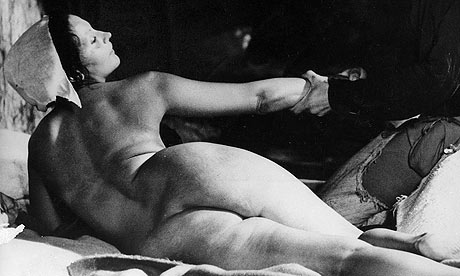
Day 3 and ten more stories
After a two day rest the story tellers decide to abandon their country palace in case "others come" and so they walk two miles down a little used path to an abandoned splendid ornate palace. Their steward and servants have been sent on ahead to prepare rooms for them and when they arrive they are pleased to find a well stocked wine cellar and a beautiful walled garden.
Neifile is queen for the day and she picks as a subject; stories about people who by their own efforts have achieved an object greatly desired or recaptured a thing previously lost. As the stories roll out it soon becomes apparent that the real theme is love or more precisely; the tricks and subterfuges that can be used to get into bed with your hearts desire.
Filostrato's story sets the tone: Musetto pretends to be a dumb mute so that he can find employment in a convent where there are some fine young nuns. They are soon vying for his attentions and a time table has to be worked out so that he can sleep with them all.
Pampineas tells of a groom who tricks his way into the bed of a queen by impersonating the king
A lady uses a friar as an unwitting go-between to make arrangements to visit her lover
Dom Felice persuades a novitiate friar to undertake an all night penance so that he can get into bed with his young wife.
A merchant makes a present of a horse to a nobleman in return for an opportunity to speak to his wife in private. He uses the time to successfully seduce her.
Ricciordio tells his friends jealous wife that her husband is having an affair and tricks her into an assignation with him.
A courtier rejected by his mistress leaves town for 7 years and on his return discovers that his lover's husband has been accused of his murder. He clears the husband of the crime and win's back his mistress.
Ferondo a wealthy yeoman is jealous of his beautiful wife. The saintly Abbot lusts after her and so he tricks Ferondo into taking a magic powder, which renders him unconscious. He locks Ferondo in a darkened room and makes him believe he is in purgatory. Meanwhile the Abbot sleeps with his wife.
Gilette tricks her reluctant husband into believing that she is his mistress so that she can win his love.
A gullible young woman is used by a hermit for sex making her believe that it is the path to salvation.
These are a tremendous set of stories with all the tricks and subterfuges working perfectly so that most people get to have what they want, which in most cases is sex. Four of the stories feature the clergy, three stories feature men of lower rank who seduce/trick noble women. Four of the stories are set in the world of courtly love and the final story is pornography.
My favourite story is the one where the Abbott tricks Ferondo into thinking he is dead and been sent to purgatory. He arranges for one of the monks to give him a beating twice a day because he has been so jealous of his wife. This goes on for ten months until the Abbott gets the wife pregnant. At this point Ferondo is released and believing he has been brought back to life vows to become less protective of his wife. He is overjoyed to find his wife pregnant believing the child to be his and the Abbott now has better access to the wife.
Interestingly one of the stories is extended because of a four page rant against the friars. This is delivered by Tedaldo who is incensed that his mistress has given him up because of advice from a friar in the confessional. The dichotomy of the friars is well expressed by the mistress when she says 'Friend of God,' she said 'I know full well that what you say is true, and you have taught me a great deal about friars, all of whom I have hitherto regarded as saints.
The final tale delivered by Dioneo was not translated from the original language for over 500 years because of its pornographic content. The gullible young woman who is duped into thinking that "putting the devil back into hell" is the way to god is told with much humour. Dioneo ends his story by saying to the ladies in the group:
And so young ladies if you stand in need of God's grace, see that you learn to put the devil back into Hell, for it is greatly to His liking and pleasurable to the parties concerned, and a great deal of good can arise and flow in the process.
Blasphemous I suppose but the young ladies in the group "shook with mirth"
Day 3 and ten more stories
After a two day rest the story tellers decide to abandon their country palace in case "others come" and so they walk two miles down a little used path to an abandoned splendid ornate palace. Their steward and servants have been sent on ahead to prepare rooms for them and when they arrive they are pleased to find a well stocked wine cellar and a beautiful walled garden.
Neifile is queen for the day and she picks as a subject; stories about people who by their own efforts have achieved an object greatly desired or recaptured a thing previously lost. As the stories roll out it soon becomes apparent that the real theme is love or more precisely; the tricks and subterfuges that can be used to get into bed with your hearts desire.
Filostrato's story sets the tone: Musetto pretends to be a dumb mute so that he can find employment in a convent where there are some fine young nuns. They are soon vying for his attentions and a time table has to be worked out so that he can sleep with them all.
Pampineas tells of a groom who tricks his way into the bed of a queen by impersonating the king
A lady uses a friar as an unwitting go-between to make arrangements to visit her lover
Dom Felice persuades a novitiate friar to undertake an all night penance so that he can get into bed with his young wife.
A merchant makes a present of a horse to a nobleman in return for an opportunity to speak to his wife in private. He uses the time to successfully seduce her.
Ricciordio tells his friends jealous wife that her husband is having an affair and tricks her into an assignation with him.
A courtier rejected by his mistress leaves town for 7 years and on his return discovers that his lover's husband has been accused of his murder. He clears the husband of the crime and win's back his mistress.
Ferondo a wealthy yeoman is jealous of his beautiful wife. The saintly Abbot lusts after her and so he tricks Ferondo into taking a magic powder, which renders him unconscious. He locks Ferondo in a darkened room and makes him believe he is in purgatory. Meanwhile the Abbot sleeps with his wife.
Gilette tricks her reluctant husband into believing that she is his mistress so that she can win his love.
A gullible young woman is used by a hermit for sex making her believe that it is the path to salvation.
These are a tremendous set of stories with all the tricks and subterfuges working perfectly so that most people get to have what they want, which in most cases is sex. Four of the stories feature the clergy, three stories feature men of lower rank who seduce/trick noble women. Four of the stories are set in the world of courtly love and the final story is pornography.
My favourite story is the one where the Abbott tricks Ferondo into thinking he is dead and been sent to purgatory. He arranges for one of the monks to give him a beating twice a day because he has been so jealous of his wife. This goes on for ten months until the Abbott gets the wife pregnant. At this point Ferondo is released and believing he has been brought back to life vows to become less protective of his wife. He is overjoyed to find his wife pregnant believing the child to be his and the Abbott now has better access to the wife.
Interestingly one of the stories is extended because of a four page rant against the friars. This is delivered by Tedaldo who is incensed that his mistress has given him up because of advice from a friar in the confessional. The dichotomy of the friars is well expressed by the mistress when she says 'Friend of God,' she said 'I know full well that what you say is true, and you have taught me a great deal about friars, all of whom I have hitherto regarded as saints.
The final tale delivered by Dioneo was not translated from the original language for over 500 years because of its pornographic content. The gullible young woman who is duped into thinking that "putting the devil back into hell" is the way to god is told with much humour. Dioneo ends his story by saying to the ladies in the group:
And so young ladies if you stand in need of God's grace, see that you learn to put the devil back into Hell, for it is greatly to His liking and pleasurable to the parties concerned, and a great deal of good can arise and flow in the process.
Blasphemous I suppose but the young ladies in the group "shook with mirth"
34baswood
The Decameron
Day 4 ten more stories and Boccaccio answers his critics.
The Fourth day starts with Boccaccio answering his critics and so one assumes that his manuscripts for the whole venture were released as he wrote them, or possibly he is merely anticipating the criticism and has his tongue firmly in his cheek.
He answers the charges that he is too fond of the ladies; that he spends too much time in delighting consoling and singing their praises. He goes on to say:
Others laying claim to greater profundity, have said that it is not good for a man of my age to engage in such pursuits as discussing the ways of women and providing for their pleasure.
Boccaccio answers his critics by telling a story making it the 101st story in the Decameron.
Back to the story tellers and Filostrato insists that the theme should be "Those whose love ended unhappily" A sombre mood descends on the company and the first story sets the tone for all the rest. Tancredi Prince of Salerno worships his daughter and his horrified when he accidentally discovers that she has taken a lover the unfortunate and humbly born Guiscardo. Tancredi has Guiscardo locked up and confronts his daughter with the information. She is unrepentant and Tancredi blurts out "In Gods name you might have at least chosen someone whose rank was similar to yours". Tancredi orders that Guiscardo is to be killed and that his heart should be cut out and presented to his daughter. When she receives the phial with the heart inside she pours poison into it and drinks the contents. Her last request is that she be buried with the remains of her lover.
This first story highlights the themes of most of those that follow:
- One of the lovers is killed and the other commits suicide.
- One of the lovers is of lower rank and is usually killed by the kin folks of the other.
- There is no compassion and plenty of cruelty
- Humour is almost totally absent
-The lovers are united in death invariably being buried together.
Filostrato is keen to keep the story tellers to the chosen theme and shows his displeasure if the women in the stories do not get their just deserts (death) as he sees it. It soon becomes apparent that Filostrato has his own axe to grind. He has been rejected in the past by one of the young ladies in the company.
It is only Dioneo who rejects the command to tell a story of unhappy love and he tells his usual bawdy tale with much humour and which ends happily for all concerned.
From today's reading it is evident that there are three things going on here:
1) The world of the author - shown by Boccaccio's defence of his writing
2) The world of the story tellers - From the start it was clear that the story tellers all knew one another, but now it appears the relationships between them will be explored.
3) The world within the stories themselves.
Day 4 ten more stories and Boccaccio answers his critics.
The Fourth day starts with Boccaccio answering his critics and so one assumes that his manuscripts for the whole venture were released as he wrote them, or possibly he is merely anticipating the criticism and has his tongue firmly in his cheek.
He answers the charges that he is too fond of the ladies; that he spends too much time in delighting consoling and singing their praises. He goes on to say:
Others laying claim to greater profundity, have said that it is not good for a man of my age to engage in such pursuits as discussing the ways of women and providing for their pleasure.
Boccaccio answers his critics by telling a story making it the 101st story in the Decameron.
Back to the story tellers and Filostrato insists that the theme should be "Those whose love ended unhappily" A sombre mood descends on the company and the first story sets the tone for all the rest. Tancredi Prince of Salerno worships his daughter and his horrified when he accidentally discovers that she has taken a lover the unfortunate and humbly born Guiscardo. Tancredi has Guiscardo locked up and confronts his daughter with the information. She is unrepentant and Tancredi blurts out "In Gods name you might have at least chosen someone whose rank was similar to yours". Tancredi orders that Guiscardo is to be killed and that his heart should be cut out and presented to his daughter. When she receives the phial with the heart inside she pours poison into it and drinks the contents. Her last request is that she be buried with the remains of her lover.
This first story highlights the themes of most of those that follow:
- One of the lovers is killed and the other commits suicide.
- One of the lovers is of lower rank and is usually killed by the kin folks of the other.
- There is no compassion and plenty of cruelty
- Humour is almost totally absent
-The lovers are united in death invariably being buried together.
Filostrato is keen to keep the story tellers to the chosen theme and shows his displeasure if the women in the stories do not get their just deserts (death) as he sees it. It soon becomes apparent that Filostrato has his own axe to grind. He has been rejected in the past by one of the young ladies in the company.
It is only Dioneo who rejects the command to tell a story of unhappy love and he tells his usual bawdy tale with much humour and which ends happily for all concerned.
From today's reading it is evident that there are three things going on here:
1) The world of the author - shown by Boccaccio's defence of his writing
2) The world of the story tellers - From the start it was clear that the story tellers all knew one another, but now it appears the relationships between them will be explored.
3) The world within the stories themselves.
35dchaikin
Finally catching up here. These day-by-day summaries of the Decameron are fascinating.
As for you 2012 goals, I would call them insane if I didn't find myself a bit jealous not to be along the same track. Thinking about whether I could do Shakespeare in 2013...
As for you 2012 goals, I would call them insane if I didn't find myself a bit jealous not to be along the same track. Thinking about whether I could do Shakespeare in 2013...
37StevenTX
I love your Day 3 post. One of these days I may actually manage to read it. :)
I read the complete Shakespeare within a year a few years ago simply by making a ritual of "Sunday night Shakespeare." After 6:00 PM every Sunday I put aside whatever else I was reading and read one of the Bard's plays, or as much of one as I had time to read. It was like a weekly night out at the theater, and even after I finished Shakespeare I continued for a while reading a play every Sunday. 2013 is a long way off, but I may join you in re-reading some of the major plays.
I read the complete Shakespeare within a year a few years ago simply by making a ritual of "Sunday night Shakespeare." After 6:00 PM every Sunday I put aside whatever else I was reading and read one of the Bard's plays, or as much of one as I had time to read. It was like a weekly night out at the theater, and even after I finished Shakespeare I continued for a while reading a play every Sunday. 2013 is a long way off, but I may join you in re-reading some of the major plays.
39theaelizabet
I like the Sunday Night Shakespeare idea, too. What I'd really like to have is a regular group committed to the reading of Shakespeare's plays out loud. To bad we can't all get together for it. I think I'd manage a mean Lady Macbeth. Have you heard about Nashville Shakespeare Festival's Shakespeare Allowed? There's more about it here: How Shakespeare Got Me Through Unemployment
40baswood
Teresa, that's a nice idea. I do read certain speeches out loud so as to get a different feel for the text. The BBC filmed 37 of the plays in the late 70's early 80's which I have secreted away on my hard drive and so I am looking forward to watching them.
41baswood

The Decameron - Day 5 and ten more tales
The story tellers are determined to lift their spirits after the tales of tragedy that featured on the previous day. Fiametta is queen for the day and she decrees that the subject of the tales will be "The adventures of lovers who survived calamities or misfortunes and attained a state of happiness." The story telling gets off to a poor start with the first four tales being overcomplicated and relying far too much on coincidence and they only come alive when we get to the fifth story: two would be lovers of the same young woman bribe the servants in the house for information as to when she will be left alone by her guardian, one bribes the manservant the other the maid. On the appointed day both lovers turn up with their retinues and there is tremendous confusion and a full scale fight breaks out. All is resolved to everyone's satisfaction in the end.
This story seems to inspire the rest of the group because there are some gems after that, although the punishments set up for the wayward lovers become more and more severe. The impoverished Teodoro falls in love with his master's (Amerigo) daughter. She gets pregnant and under torture reveals the identity of her lover. He is to be burnt at the stake and is whipped along the road to the public square, meanwhile Amerigo gives his daughter a choice of methods of suicide. Fortunately Teodoro is recognised by an important emissary as he is being scourged and he intervenes to persuade Amerigo to spare the lovers
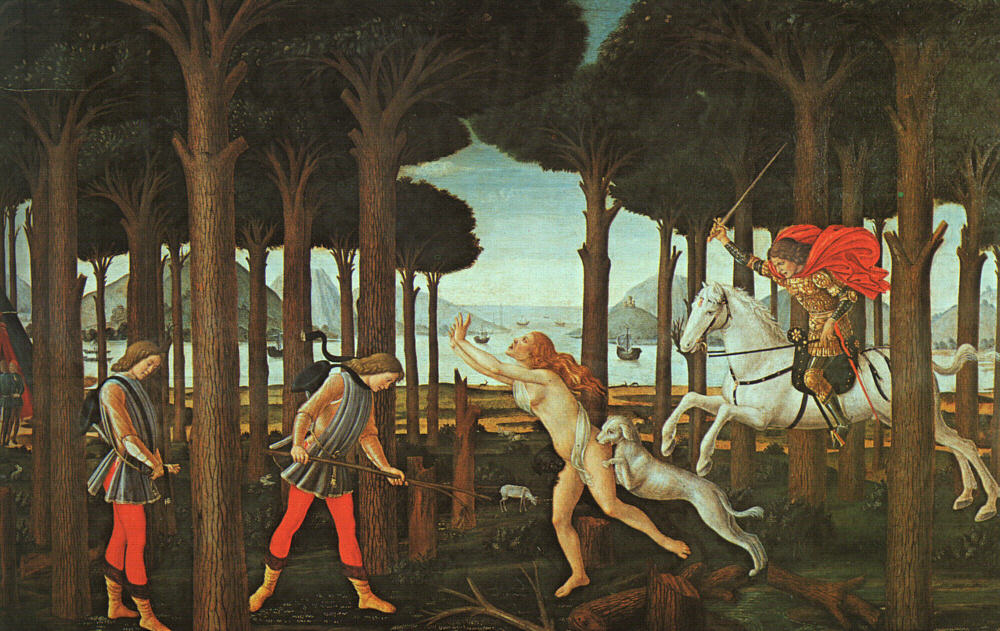
The most gruesome of the tales involves a spurned lover witnessing a truly horrific scene; a naked woman is being chased through the forest by two large dogs and a knight on horseback. The dogs bring down the woman and the knight runs her through with his sword cuts out her heart and entrails and feeds them to the dogs. The lover is astonished to see the woman recover and dash off again through the woods; the knight tells the lover not to interfere as they are in purgatory and must enact this scene over and over again every day. The lover arranges for his lady to witness the scene, telling her this is what happens to women who spurn their lovers.
There is also a beautiful story about an impoverished nobleman whose only remaining possession is a prize falcon. He willingly sacrifices this to provide a breakfast to the rich woman of his dreams.
Dioneo as usual ends the day with a bawdy tale. A wife complains that her husband does not satisfy her needs and says: since the miserable sinner deserts me to go clogging through the dry, I'd get someone else to come aboard the wet. The husband comes home and discovers his wife with a young man, but he comes to an arrangement with them and the dazed young man the morning afterwards cannot remember who he spent the the most time with: the husband or the wife.
Dioneo is asked to sing a song to end the day but Fiametta loses patience with the bawdiness of his lyrics. He eventually sings something that is acceptable to everybody.
42dchaikin
You make this more enticing every day. I'm wondering where his stories come from. Does Boccaccio use known sources? Are any of these wholly his own creation?
43StevenTX
Botticelli did a series of paintings on the gruesome story of Nastagio degli Onesti. Here are the first two. You can view the full series plus some detail views here by doing a title search on "Nastagio."


44baswood
Oh steven that is brilliant. I did not know of those paintings. It is indeed a gruesome story and some more information can be found here: http://www.bergerfoundation.ch/Sandro/44onesti2_english.html
45baswood
Dan, it is always difficult to know whether a story was entirely made up by a medieval author as the whole idea of authorship was quite different from that of today. From a medieval author's point of view The whole approach seems to have been: why make up anything new when there are plenty of stories around that can be adapted to suit my needs. Not only are there plenty of stories around but they many will have the authority of coming from classical writers.
Boccaccio's stories come from a number of sources:
The 'Novellino' - an anonymous collection of medieval tales
The Fabliaux - A collection of French tales many of them bawdy by nature
Exempla - various antidotes and short essays written in Latin
Medieval chronicles - historical records of more recent events
Collections of stories originating in the East.
No doubt there is plenty of scholarship on the sources for each of the hundred tales.
Boccaccio's stories come from a number of sources:
The 'Novellino' - an anonymous collection of medieval tales
The Fabliaux - A collection of French tales many of them bawdy by nature
Exempla - various antidotes and short essays written in Latin
Medieval chronicles - historical records of more recent events
Collections of stories originating in the East.
No doubt there is plenty of scholarship on the sources for each of the hundred tales.
46dchaikin
#45 - thanks...I haven't heard of The 'Novellino', The Fabliaux or Exempla before. More mysteries.
47janeajones
You've probably already run across The Decameron Web from Brown University, but if you've missed it, it's a trove of information: http://www.brown.edu/Departments/Italian_Studies/dweb/index.php
49rebeccanyc
You are completely intriguing me with The Decameron!
51baswood
The Decameron
Day 6 and ten more tales
Elissa is the queen for the day and she chooses as the subject; how clever people can turn the tables on their opponents by witty/caustic verbal replies
This proves to be not such an inspiring subject for the story tellers and the day starts off badly with a quarrel among the servants. The two combatants are led outside and asked what the argument is about. Tindaro says that his belief that most women are virgins on their wedding night is hotly disputed by Licisca. She calls him a fool and retorts that she could tell him a thing or two about how wives trick their husbands. Dioneo is called in to make a judgement on the argument and finds in favour of Licisca.
The stories are all about Florentine people who have recently died or are still living and so the topicality would have appealed to an audience at the time. My penguin classics edition has notes about the people mentioned, but it is difficult to appreciate the satire or irony and so the piquancy of the stories has been lost. One of the stories features the artist Giotto and there is much praise for his lifelike paintings and yet it is is ugly appearance that forms the subject of the story. To our eyes Giotto's frescoes are not lifelike and so how much of this is ironic is not easy to judge.
for the first time there is a direct reference to the plague in one of the stories: Monna Nonno de Pulci is described as "no longer with us having died in middle age during the present epidemic"
Most of these stories are very short and it is only Dioneo's final tale that stretches to more than three pages. As usual Dioneo kicks against the trend, but this time for once his subject is friars and their holy relics rather than sex. He tells of friar Cipolla who has promised to show his followers a feather left behind by the angel Gabriel when he informed the Virgin Mary that she would birth the son of God. When he opens the casket he finds the feather has been replaced by some lumps of coal (by some local pranksters). The friar undaunted has no trouble in convincing the congregation that the coals were those that were used to roast St Lawrence and he makes even more money in his collection by using the coals to mark the sign of the cross on peoples clothing.
The day ends as usual with singing and dancing and Dioneo is chosen to be king for the next day. He immediately chooses his subject as "The tricks that women play on their husbands in the cause of love to get their own way." There are protests from the women in the group who feel the subject matter is too unseemly, but Dioneo retorts that if they do not tell a story then they obviously have a guilty conscience.
Tomorrows stories should be interesting
Day 6 and ten more tales
Elissa is the queen for the day and she chooses as the subject; how clever people can turn the tables on their opponents by witty/caustic verbal replies
This proves to be not such an inspiring subject for the story tellers and the day starts off badly with a quarrel among the servants. The two combatants are led outside and asked what the argument is about. Tindaro says that his belief that most women are virgins on their wedding night is hotly disputed by Licisca. She calls him a fool and retorts that she could tell him a thing or two about how wives trick their husbands. Dioneo is called in to make a judgement on the argument and finds in favour of Licisca.
The stories are all about Florentine people who have recently died or are still living and so the topicality would have appealed to an audience at the time. My penguin classics edition has notes about the people mentioned, but it is difficult to appreciate the satire or irony and so the piquancy of the stories has been lost. One of the stories features the artist Giotto and there is much praise for his lifelike paintings and yet it is is ugly appearance that forms the subject of the story. To our eyes Giotto's frescoes are not lifelike and so how much of this is ironic is not easy to judge.
for the first time there is a direct reference to the plague in one of the stories: Monna Nonno de Pulci is described as "no longer with us having died in middle age during the present epidemic"
Most of these stories are very short and it is only Dioneo's final tale that stretches to more than three pages. As usual Dioneo kicks against the trend, but this time for once his subject is friars and their holy relics rather than sex. He tells of friar Cipolla who has promised to show his followers a feather left behind by the angel Gabriel when he informed the Virgin Mary that she would birth the son of God. When he opens the casket he finds the feather has been replaced by some lumps of coal (by some local pranksters). The friar undaunted has no trouble in convincing the congregation that the coals were those that were used to roast St Lawrence and he makes even more money in his collection by using the coals to mark the sign of the cross on peoples clothing.
The day ends as usual with singing and dancing and Dioneo is chosen to be king for the next day. He immediately chooses his subject as "The tricks that women play on their husbands in the cause of love to get their own way." There are protests from the women in the group who feel the subject matter is too unseemly, but Dioneo retorts that if they do not tell a story then they obviously have a guilty conscience.
Tomorrows stories should be interesting
52rebeccanyc
Much to my amazement, I see I have a copy of this in my library. After looking for it physically, I see I bought it when I was a freshman in college and took a course on the Renaissance. I have no recollection of reading anything from it (and it certainly doesn't look well-thumbed); it's a Modern Library edition and cost $2.95 in 1972!
53baswood
Be careful rebecca, you might get hooked into reading it. Look what happened recently with Parzival.
I am reading the penguin classics version with a translation by G H McWilliam, but I note that his original translation was 1972. Might you have the same translation.
I am reading the penguin classics version with a translation by G H McWilliam, but I note that his original translation was 1972. Might you have the same translation.
54rebeccanyc
My translation is by Frances Winwar and was either first published in 1955 (Random House copyright) or 1930 (The Limited Editions Club copyright). I hope it won't seem too dated. (I may take it on a trip I'm going on at the end of the month.) I'm going to have to edit my book info, since I obviously entered this book into my library in my early days on LT before I was entering translators, etc.
55baswood

Day 7 and ten more tales
At the end of the sixth day the men form their own group to play dice and the women go off to explore the Valley of the Ladies just a mile away. They discover an enchanted valley with a clear pool at the bottom and they strip off and have a swim. Refreshed they return to the palace and tell the men about the valley and they decide tomorrow that they will tell their stories in this beautiful setting.
The theme of the day is "the tricks women play against their husbands in the cause of love" and it is no surprise that these are all adulterous tales. The first couple of tales feature labourers and trades people from the lower end of society and the stories move up through the ranks until finishing with a story set amongst the patricians in Ancient Greece. Foolish, jealous and finally elderly husbands are tricked by their unfaithful wives, who become more inventive as the tales roll out.
The first three stories tell how a wife can fool a husband who thinks he has caught her in bed with a lover by:
- pretending that the knocking on her door is that of a werewolf and only fervent prayers will drive it away
- Hiding her lover in a large vat and convincing her husband that he is in there because he is going to buy it. She cheekily then gets her husband to get inside to clean it while she enjoys her lover outside.
- telling her husband that the friar in her bedroom is there to cure their son of the worms.
The tales then become more complex as jealous husbands get their comeuppance
- a wife returning to her house after an assignation with her lover finds her husband has locked her out. She pretends to throw herself down the well so that he rushes outside and she can creep into the house and turn the tables on him.
- a jealous husband disguises himself as a priest to hear his wife's confession and hears more than he bargained for.
- a wife entertaining two lovers does some very fancy footwork to convince her husband that nothing is going on.
The next three stories are excellent, especially the one that features the clash in temperament and suspicions between the rich merchant class and the aristocracy. A noble born wife has married a merchant and takes advantage of his long trips away on business. She arranges for her lover to visit her when next he is at home, but it is dark when he enters the bedroom. He is discovered by the husband but in the darkness he escapes and the wife's maid takes the place of her mistress and receives the expected beating from the enraged husband. The wife's noble kinsfolk are informed of the wife's shame by the outraged husband, but when they see her she shows no sign of the beatings and they are disgusted by this upstart merchant, who they brand a liar.
The penultimate story set in Ancient Greece is also a gem, but it is Dioneo who as usual has the last story to tell. He feels that everyone has had enough of clever wives and so he tells a slight tale involving ghosts and god fathers.
56dchaikin
One of the stories features the artist Giotto and there is much praise for his lifelike paintings and yet it is is ugly appearance that forms the subject of the story. To our eyes Giotto's frescoes are not lifelike and so how much of this is ironic is not easy to judge.
I'm not an expert here, but my impression was that Giotto was far ahead of his time, especially in terms of lifelike paintings.

I'm not an expert here, but my impression was that Giotto was far ahead of his time, especially in terms of lifelike paintings.

57baswood
Yes that's true Dan, but Boccaccio makes such a strong point about them saying for instance that "whatever he depicted had the appearance not of a reproduction but the thing itself...that peoples eyes are deceived and they mistake the picture for the real thing." This may have been true when the frescoes were new and freshly painted, but the ones I have seen in Florence would not be mistaken for the real thing., not with my 20th century eyes anyway.

Giotto: Legend of St Francis - Miracle of the Spring

Giotto: Legend of St Francis - Miracle of the Spring
58Poquette
Regarding Giotto's (1267-1337) lifelike rendering of people, Boccaccio was not being ironic. If you look at work by his near contemporaries Duccio (c. 1255-1318) and Cimabue (1240-1302), you will see the highly stylized, relatively flat features, still heavily influenced by Byzantine iconography although they were beginning to move away from it. Giotto made the complete break from Byzantine influence. Here are a couple of examples:
Duccio:
http://en.wikipedia.org/wiki/File:Duccio_Madonna_Gualino.jpg
Cimabue:
http://en.wikipedia.org/wiki/File:Cimabue_033.jpg
Duccio:
http://en.wikipedia.org/wiki/File:Duccio_Madonna_Gualino.jpg
Cimabue:
http://en.wikipedia.org/wiki/File:Cimabue_033.jpg
59DieFledermaus
Enjoying your posts - reminds me of some of the stories that I really liked and some that were groan-worthy.
60baswood
Suzanne,
Irony and Boccaccio. You can never be sure about the irony. At the time when The Decameron was being written sometime after 1348, Renaissance art in Florence was in its first flower and Giotto was one of the earliest artists to depict three dimensional lifelike figures. Compared to the work of an artist like Massacio 1401-1428 his figures do not look so lifelike because he had not the command of perspective that was developed later.
Masaccio
http://en.wikipedia.org/wiki/Masaccio
When I saw Giotto's frescoes in Florence what struck me was that in his art you could see the link between iconography and figure painting. He more often than not seemed to combine both in the same painting. Later artists like Masaccio were producing work that had broken free from the iconography.
My Favourite Masaccio: The Tribute Money 1427 in the Brancacci chapel. Florence

Edited to get rid of some inaccuracies
Irony and Boccaccio. You can never be sure about the irony. At the time when The Decameron was being written sometime after 1348, Renaissance art in Florence was in its first flower and Giotto was one of the earliest artists to depict three dimensional lifelike figures. Compared to the work of an artist like Massacio 1401-1428 his figures do not look so lifelike because he had not the command of perspective that was developed later.
Masaccio
http://en.wikipedia.org/wiki/Masaccio
When I saw Giotto's frescoes in Florence what struck me was that in his art you could see the link between iconography and figure painting. He more often than not seemed to combine both in the same painting. Later artists like Masaccio were producing work that had broken free from the iconography.
My Favourite Masaccio: The Tribute Money 1427 in the Brancacci chapel. Florence

Edited to get rid of some inaccuracies
61Jargoneer
It's a bit unfair to use like-for-like comparisons with Giotto and Massacio due to the century between their work, Massacio had the advantage of being able to study Fillipo Brunelleshi, who developed linear perspective. Giotto at the time of Boccaccio was state of art but that doesn't necessarily mean that Boccaccio wasn't being ironic. What we don't know is how Boccaccio viewed the move to a more realistic style in art. We automatically assume now that people would have been in favour of this movement but that isn't necessarily so - realism could be seen to undermine the artificial beauty of art. (My Name is Red plays with how dangerous the idea of perspective was from an Islamic point of view).
62baswood
Good point Jargoneer it was unfair to make like for like comparisons.
Looking back on my last post I have edited it, so that it makes a little more sense now.
At the time that The Decameron was being written Boccaccio would only have been able to see the paintings of Giotto, which as Suzanne has rightly pointed out were the first steps towards a more realist style. Now whether Boccaccio would have approved of the new innovations in religious art is another question.
Looking back on my last post I have edited it, so that it makes a little more sense now.
At the time that The Decameron was being written Boccaccio would only have been able to see the paintings of Giotto, which as Suzanne has rightly pointed out were the first steps towards a more realist style. Now whether Boccaccio would have approved of the new innovations in religious art is another question.
63dchaikin
Jargoneer - Interesting point and something I think about from time to time. There is something beautiful in stylized medieval and Byzantine representations that is lost as art approaches reality.
64msjohns615
Hi Bas, I'm enjoying your commentaries on The Decameron. It sounds like a blast and I hope to find time to read it some day in the not-too-distant future. You might enjoy El libro de buen amor (The Book of Good Love), written in Spain around the same time. It's a similar hodgepodge of stories and I wonder how the two books compare.
In terms of your overall project of reading medieval/Renaissance literature, I might recommend a few more Spanish texts that might be fun for you considering your focus on England/France/Italy:
The Poem of The Cid is apparently quite distinct from the other famous medieval epic poems. I enjoyed its realistic depiction of the exploits of Spain's national hero.
La Celestina is thought of as a book of transition between medieval and Renaissance literature. It's a dialogued novel, or an unrepresentable 20+ act play, or whatever you'd like to think of it as. It was pretty famous througout Europe and prefigured the Quixote in a way, in that it showed the failure of an idealized hero (Calixto, the male lead, in many ways fits into the courtly love tradition) in the real world. I've also heard it referred to as the first book where characters' speech changes to reflect their interlocutor (i.e. servants speak differently to each other and to their masters).
I'm not sure if there's a good translation of Don Juan Manuel's El conde Lucanor (Tales of Count Lucanor), but it's a collection of exempla and you'd probably find some interesting versions of some stories you're already familiar with.
In any case, I'll be paralleling your Renaissance reads with my own little project to re-read some of Spain's Siglo de Oro classics, so I'll keep reading your thread and chiming in where I can.
In terms of your overall project of reading medieval/Renaissance literature, I might recommend a few more Spanish texts that might be fun for you considering your focus on England/France/Italy:
The Poem of The Cid is apparently quite distinct from the other famous medieval epic poems. I enjoyed its realistic depiction of the exploits of Spain's national hero.
La Celestina is thought of as a book of transition between medieval and Renaissance literature. It's a dialogued novel, or an unrepresentable 20+ act play, or whatever you'd like to think of it as. It was pretty famous througout Europe and prefigured the Quixote in a way, in that it showed the failure of an idealized hero (Calixto, the male lead, in many ways fits into the courtly love tradition) in the real world. I've also heard it referred to as the first book where characters' speech changes to reflect their interlocutor (i.e. servants speak differently to each other and to their masters).
I'm not sure if there's a good translation of Don Juan Manuel's El conde Lucanor (Tales of Count Lucanor), but it's a collection of exempla and you'd probably find some interesting versions of some stories you're already familiar with.
In any case, I'll be paralleling your Renaissance reads with my own little project to re-read some of Spain's Siglo de Oro classics, so I'll keep reading your thread and chiming in where I can.
65Poquette
Barry, when you talk about Giotto in Florence, the Ognissanti Madonna comes to mind, which assuredly reflects the old Byzantine style. I was thinking more in terms of the frescoes at the Scrovegni Chapel in Padua. The Massacio, as Jargoneer pointed out, is much later. And I share in your admiration.
66baswood
Matt, Thanks for posting those recommendations, I have been reading your reviews and they all sound worth reading. I will try and get hold of The Book of Good Love and La Celestina sounds like a must read.
The fascinating thing about medieval Spain was that for much of the period parts of it were under Muslim control and I am wondering how this is reflected in late medieval and early renaissance literature. Another avenue to explore.
The fascinating thing about medieval Spain was that for much of the period parts of it were under Muslim control and I am wondering how this is reflected in late medieval and early renaissance literature. Another avenue to explore.
67dmsteyn
>Barry, an interesting thing that I noticed in my recent reading of Don Quixote is that Cervantes has a Moor, Cide Hamete Benengeli, as the chronicler of the story. There aren't many Moorish characters - a few moriscos - but it did strike me as an odd choice for Cervantes.


69baswood
1) North and South, Elizabeth Gaskell
A socialist tract, a paean to capitalism, a Victorian love story, a bildungsroman, or a realist portrayal of life in mid nineteenth century industrial England. This very wonderful novel is all of these things; what it is not is a novel about the divide between the North and the South, but this title was suggested by Charles Dickens whose own novel Hard Times had just been published. Hard Times a novel also concerned with working conditions was not one of Dickens's greatest achievements and lacked the breadth of vision that Mrs Gaskell achieved with North and South.
Mrs Gaskell's original title was Margaret Hale and her novel charts Margaret's course from a well born but impoverished parson's daughter to an heiress and part owner of a large textile mill. The novel opens with Margaret staying with her wealthy cousins in London, but after her cousins marriage she rejoins her parent at Helstone a hamlet in the New Forest. She loves the gentle country life, but the family faces a major change when her father must give up his parish over religious scruples and opts to move to Milton (Manchester) the centre of the cotton industry, where he will eek out a living as a tutor. The family find Milton noisy, ugly, dirty and crowded but Margaret is determined to make the best of it for her parents sake. She makes friends with the Higgens family: mill workers and trade unionists while her father becomes a tutor to Mr Thornton a mill owner and captain of industry. Mr Thornton falls in love with Margaret but she is repelled by his hard commercialism and rejects his marriage proposal. The novel charts the bildungsroman of both Margaret and Mr Thornton which must happen before they can reach any kind of accommodation.
The reader of course recognises their suitability and similarity and the outcome to their possible relationship is only revealed on the last page of the novel. Here is Mr Thornton's view of Margaret when he first sees her in some rented rooms:
but now that he saw Margaret, with her superb ways of moving and looking, he began to feel ashamed of having imagined that it would do very well for the Hales.....Margaret could not help her looks, but the short curled upper lip the round, massive upturned chin, the manner of carrying her head; her movements full of soft feminine defiance always gave strangers the impression of haughtiness
And this is Margaret's view of Mr Thornton when she sees him at dinner talking to his colleague Mill Owners:
some dispute arose, which was warmly contested, it was referred to Mr Thornton who had hardly spoken before, but who now gave an opinion, the grounds of which were so clearly stated that even the opponents yielded. Margaret's attention was called to her host; his whole manner as master of the house, as entertainer of his friends was so straightforward, simple and modest as to be thoroughly dignified. Margaret thought she had never seen him to so much advantage.
Margaret's friendship with the Higgens family which has allowed her to see the suffering of the mill workers at first hand has driven a wedge between her and Thornton:
Margaret's whole soul rose up against him while he reasoned in this way as if commerce were everything and humanity nothing
The battle between commerce and humanity, capital and labour is fought out in the factories and mills of Milton and the rhetoric used then is just as relevant as it was in the 1980's when Britain's industry was reshaped under Thatcher's government. Mrs Gaskell guides the reader to a more humanitarian view; the fight between the masters and the men could be ameliorated if only they would take note of what each was saying. Both their livelihoods depend on the success of the industry and if they could find ways of working together then surely it would be to everyone's benefit. This is skillfully reflected in the battle of wills between Margaret and Mr Thornton whose own love story is brilliantly woven into the fabric of the events on the industrial battle ground.
The struggle between the masters and the men is a titanic struggle for power and the hard headed Thornton sets himself against Higgens who becomes a sort of working class hero. Gaskell refuses to take sides as she ensures that both viewpoints are given equal weight. Higgens and Thornton are both proud men but are also honorable men and it is through Margaret's friendship with both of them that at last a dialogue can begin. Mrs Gaskell has Higgens speak in the local dialect which highlights the differences between him and the mill owners but also between him and the Hales family. It is superbly done.
Milton is brought to vibrant life through Margaret's eyes and becomes almost another character in the novel. The smoke and the grime, the rough streets the workers pouring out of the factories at certain times of the day catching Margaret unawares and always ready with some witty comment about the way she looks. Mr Thornton's house is situated opposite his mill inside the factory gates, a large courtyard and a flight of steps is all that separates him from his work. Margaret and her family are horrified by the noise and the industry when they first visit.
Change is the motif that runs throughout this novel. The vibrant trade capital of Milton is constantly changing and at a rapid pace. To succeed in their ventures then the attitudes of the mill owners must change as must the trade unionists. Margaret must adapt to her new situation and Mr Thonton must change his way of thinking if he wants to win Margaret. The people who cannot change must make way and there are plenty of deaths, most of which have repercussions for Margaret. Both her parents die, Bessy Higgens finally succumbs to her terminal illness contracted whilst working in the mills. Mr Bell the Oxford friend of Mr Hale must also depart as his refuge in academia does not fit him for the new commercial world. Margaret's strength of character enables her to deal with all that life throws at her and although she bends she does not break and her experiences in Milton only serve to make her stronger.
Mrs Gaskell's achievement in bringing off this novel should be admired by every reader. The avoidance of sentimentality, her refusal to take sides, her realistic portrayal of industrial conflict and the brilliant characters that people her book all add up to a wonderful reading experience. A five star read
A socialist tract, a paean to capitalism, a Victorian love story, a bildungsroman, or a realist portrayal of life in mid nineteenth century industrial England. This very wonderful novel is all of these things; what it is not is a novel about the divide between the North and the South, but this title was suggested by Charles Dickens whose own novel Hard Times had just been published. Hard Times a novel also concerned with working conditions was not one of Dickens's greatest achievements and lacked the breadth of vision that Mrs Gaskell achieved with North and South.
Mrs Gaskell's original title was Margaret Hale and her novel charts Margaret's course from a well born but impoverished parson's daughter to an heiress and part owner of a large textile mill. The novel opens with Margaret staying with her wealthy cousins in London, but after her cousins marriage she rejoins her parent at Helstone a hamlet in the New Forest. She loves the gentle country life, but the family faces a major change when her father must give up his parish over religious scruples and opts to move to Milton (Manchester) the centre of the cotton industry, where he will eek out a living as a tutor. The family find Milton noisy, ugly, dirty and crowded but Margaret is determined to make the best of it for her parents sake. She makes friends with the Higgens family: mill workers and trade unionists while her father becomes a tutor to Mr Thornton a mill owner and captain of industry. Mr Thornton falls in love with Margaret but she is repelled by his hard commercialism and rejects his marriage proposal. The novel charts the bildungsroman of both Margaret and Mr Thornton which must happen before they can reach any kind of accommodation.
The reader of course recognises their suitability and similarity and the outcome to their possible relationship is only revealed on the last page of the novel. Here is Mr Thornton's view of Margaret when he first sees her in some rented rooms:
but now that he saw Margaret, with her superb ways of moving and looking, he began to feel ashamed of having imagined that it would do very well for the Hales.....Margaret could not help her looks, but the short curled upper lip the round, massive upturned chin, the manner of carrying her head; her movements full of soft feminine defiance always gave strangers the impression of haughtiness
And this is Margaret's view of Mr Thornton when she sees him at dinner talking to his colleague Mill Owners:
some dispute arose, which was warmly contested, it was referred to Mr Thornton who had hardly spoken before, but who now gave an opinion, the grounds of which were so clearly stated that even the opponents yielded. Margaret's attention was called to her host; his whole manner as master of the house, as entertainer of his friends was so straightforward, simple and modest as to be thoroughly dignified. Margaret thought she had never seen him to so much advantage.
Margaret's friendship with the Higgens family which has allowed her to see the suffering of the mill workers at first hand has driven a wedge between her and Thornton:
Margaret's whole soul rose up against him while he reasoned in this way as if commerce were everything and humanity nothing
The battle between commerce and humanity, capital and labour is fought out in the factories and mills of Milton and the rhetoric used then is just as relevant as it was in the 1980's when Britain's industry was reshaped under Thatcher's government. Mrs Gaskell guides the reader to a more humanitarian view; the fight between the masters and the men could be ameliorated if only they would take note of what each was saying. Both their livelihoods depend on the success of the industry and if they could find ways of working together then surely it would be to everyone's benefit. This is skillfully reflected in the battle of wills between Margaret and Mr Thornton whose own love story is brilliantly woven into the fabric of the events on the industrial battle ground.
The struggle between the masters and the men is a titanic struggle for power and the hard headed Thornton sets himself against Higgens who becomes a sort of working class hero. Gaskell refuses to take sides as she ensures that both viewpoints are given equal weight. Higgens and Thornton are both proud men but are also honorable men and it is through Margaret's friendship with both of them that at last a dialogue can begin. Mrs Gaskell has Higgens speak in the local dialect which highlights the differences between him and the mill owners but also between him and the Hales family. It is superbly done.
Milton is brought to vibrant life through Margaret's eyes and becomes almost another character in the novel. The smoke and the grime, the rough streets the workers pouring out of the factories at certain times of the day catching Margaret unawares and always ready with some witty comment about the way she looks. Mr Thornton's house is situated opposite his mill inside the factory gates, a large courtyard and a flight of steps is all that separates him from his work. Margaret and her family are horrified by the noise and the industry when they first visit.
Change is the motif that runs throughout this novel. The vibrant trade capital of Milton is constantly changing and at a rapid pace. To succeed in their ventures then the attitudes of the mill owners must change as must the trade unionists. Margaret must adapt to her new situation and Mr Thonton must change his way of thinking if he wants to win Margaret. The people who cannot change must make way and there are plenty of deaths, most of which have repercussions for Margaret. Both her parents die, Bessy Higgens finally succumbs to her terminal illness contracted whilst working in the mills. Mr Bell the Oxford friend of Mr Hale must also depart as his refuge in academia does not fit him for the new commercial world. Margaret's strength of character enables her to deal with all that life throws at her and although she bends she does not break and her experiences in Milton only serve to make her stronger.
Mrs Gaskell's achievement in bringing off this novel should be admired by every reader. The avoidance of sentimentality, her refusal to take sides, her realistic portrayal of industrial conflict and the brilliant characters that people her book all add up to a wonderful reading experience. A five star read
70pamelad
Great review of North and South. It's made me want to read the book again.
71dmsteyn
Thanks for a wonderful review, Barry! I still need to read Gaskell, but this makes me want to even more. Thumbed.
72DieFledermaus
Your review made me rethink North and South - I enjoyed Cranford and Wives and Daughters (well, not the non-ending of the latter - I didn't know it was unfinished when I bought it and was quite annoyed for a couple days after finishing it) but I guess I got an idea that North and South was dull and didactic. Sounds tempting from your post.
74avaland
>69 baswood: Terrific review of North and South, Barry! It's a favorite book of mine (ooooh, sooo many favorites...). Random thoughts: I think the second time I read it, I was struck that the love storyline was a bit of pride and prejudice. I also remember during one study or another, that the economic term 'middle-class' did not exist in England until somewhere in the mid-19th century, about the time this book was published.
75StevenTX
Great review of North and South, Barry. It's one I definitely want to read. I enjoyed Cranford last year. It sounds like North and South has a harder edge to it, more like George Eliot than Dickens.
76deebee1
I've had that book languishing on my shelf for several years now, Barry. After your review, the time has come to pull it out.
77baswood
Thank's everybody. North and South, Elizabeth Gaskell was chosen by our book club to read and I know that they are all going to enjoy it. The other book chosen was The Elegance of the Hedgehog by Muriel Barbery, which I had better get on to read as the club meet on Thursday.
78rebeccanyc
I'll be interested in what you think of The Elegance of the Hedgehog. It was very popular here on LT, but I just couldn't get into it and dropped it before I hit 50 pages.
79Linda92007
An excellent review of North and South, which I think I will purchase soon, as the Kindle version is not much more than the price of a cup of coffee. A good investment.
80janeajones
Great review of North and South, Barry. I got a copy of it in the fall and have been meaning to read it -- must put it closer to the "read me now" pile. The conflict between Margaret and Thornton must have influenced Shaw in plays like Major Barbara and Mrs. Warren's Profession.
81baswood
The Decameron
Day 8 ten more tales
The subject for today's stories is "the tricks that people in general, men and women alike are forever playing on one another" Many of theses stories are comic tales but by no means all and in one or two the levels of violence particularly against women is somewhat shocking
The first two stories have the same theme: a grasping wife asks her lover for money before she will sleep with him. The lover borrows the money from the husband gives it to the wife and when the loan is due for repayment he tells the husband he has already repaid his wife. This clever story was used by Chaucer for his Shipman's tale in the Canterbury tales.
Three of the tales feature the comic trio of Calandrino, Bruno and Buffalmacco who are painters(artists) by profession. In fact Buffalmacco was a painter of some stature whose frescoes can still be seen in Florence. Bruno and Buffalmacco are clever clowns while Calandrino is the butt of their jokes:
- Calandrino is convinced that he can find a stone that will make him invisible. Bruno and Buffalmacco play along and pretend not to be able to see Caladrino when he has already picked up a sack load of pebbles. He rushes home excited but is seen by his wife who he accuses of breaking the spell. He gives her a fearful beating.
- Calandrino has a fine pig that he has slaughtered, but Bruno and Buffalmacco steal it from him and then trick him into admitting that it was not really stolen but he has sold it to raise some money.
- The three painters outwit a proud and boastful doctor by spinning him a yarn about a special club they belong to. The doctor spends time and money cultivating their friendship only to find himself left in a ditch on the night of his supposed entry into the club
These comic stories are interesting for the information that can be gleaned about the work of painters in the 14th century. Boccaccio also uses them to have fun with people and place names, some of which is inevitably lost in translation.
There is a charming wife swapping story that ends very amicably and there is a silly story about a judge losing his trousers
Story number seven which is by far the longest is a tale of revenge. A scholar is locked in a courtyard in freezing temperatures by the woman he loves, while she entertains another lover. He nearly freezes to death before he is released. He gets his revenge by trapping the women naked on top of a ruined tower where she is nearly burnt to death by the hot sun. Her torture goes on for a long time and she barely survives. The other story tellers agree that in this case the punishment far outweighed the crime.
The final tale features a merchant who is tricked out of his money by a Sicilian women, but later manages to turn the tables on her getting his money back with interest. This story is interesting for the description of the medieval bonded warehouse scheme that was in operation in Mediterranean ports.
Day 8 ten more tales
The subject for today's stories is "the tricks that people in general, men and women alike are forever playing on one another" Many of theses stories are comic tales but by no means all and in one or two the levels of violence particularly against women is somewhat shocking
The first two stories have the same theme: a grasping wife asks her lover for money before she will sleep with him. The lover borrows the money from the husband gives it to the wife and when the loan is due for repayment he tells the husband he has already repaid his wife. This clever story was used by Chaucer for his Shipman's tale in the Canterbury tales.
Three of the tales feature the comic trio of Calandrino, Bruno and Buffalmacco who are painters(artists) by profession. In fact Buffalmacco was a painter of some stature whose frescoes can still be seen in Florence. Bruno and Buffalmacco are clever clowns while Calandrino is the butt of their jokes:
- Calandrino is convinced that he can find a stone that will make him invisible. Bruno and Buffalmacco play along and pretend not to be able to see Caladrino when he has already picked up a sack load of pebbles. He rushes home excited but is seen by his wife who he accuses of breaking the spell. He gives her a fearful beating.
- Calandrino has a fine pig that he has slaughtered, but Bruno and Buffalmacco steal it from him and then trick him into admitting that it was not really stolen but he has sold it to raise some money.
- The three painters outwit a proud and boastful doctor by spinning him a yarn about a special club they belong to. The doctor spends time and money cultivating their friendship only to find himself left in a ditch on the night of his supposed entry into the club
These comic stories are interesting for the information that can be gleaned about the work of painters in the 14th century. Boccaccio also uses them to have fun with people and place names, some of which is inevitably lost in translation.
There is a charming wife swapping story that ends very amicably and there is a silly story about a judge losing his trousers
Story number seven which is by far the longest is a tale of revenge. A scholar is locked in a courtyard in freezing temperatures by the woman he loves, while she entertains another lover. He nearly freezes to death before he is released. He gets his revenge by trapping the women naked on top of a ruined tower where she is nearly burnt to death by the hot sun. Her torture goes on for a long time and she barely survives. The other story tellers agree that in this case the punishment far outweighed the crime.
The final tale features a merchant who is tricked out of his money by a Sicilian women, but later manages to turn the tables on her getting his money back with interest. This story is interesting for the description of the medieval bonded warehouse scheme that was in operation in Mediterranean ports.
82baswood
An excellent investment Linda - enjoy. Isn't the kindle a truly wonderful thing.
Thanks Jane, it deserves to be read.
Thanks Jane, it deserves to be read.
83kidzdoc
Excellent review of North and South, Barry. I've just downloaded the free version of it (from Project Gutenberg) onto my laptop.
85baswood
The Decameron
Day 9 Emilia is Queen and ten more tales
Emilia gives the company free reign to base their story on the subject of their choice. many of the tales are humorous, but when it comes to Emilia's tale the humour has gone and we are left with a disturbing story that is so misogynist in tone that it even has some of the company murmuring their disapproval.
There are two more stories featuring the comic trio of painters: Calandrino, Bruno and Buffalmacco. Once again it is Calandrino who is the butt end of the jokes. In the first tale he is tricked into believing he is pregnant, he at once blames his long suffering wife Tessa for insisting on being "on top". Bruno and Buffalmacco are in league with the local doctor and a potion is concocted that will cure Calandrino but of course it comes at a price. In the second tale Calandrino is 'set up' with another woman and Bruno and Buffalmaco ensure that it is Tessa who catches him out and can exact her revenge. These stories are funny as is the one about the widow who concocts a way of getting rid of two suitors who are pestering her to distraction. She sets them a test to prove their love that she believes will scare them off; it involves grave robbing, but they come through only to be thwarted at the last minute when they bump into the night watch.
There are a couple of bawdy tales one of which Chaucer has used for The Franklin's tale in his Canterbury tales and one involving nuns and a pair of priests breeches. It is left to Dioneo to get right down to the dirt with his final tale, which describes how a priest persuades his hosts wife that he can turn her into a donkey; she has to bend over naked to he can fix the tail.
By the time we get to story number seven the humour has gone; Pampinea tells a tale of a husband who dreams his wife is savaged by a wolf. He warns his wife not to go out the next day but she doesn't listen and the expected attack by the wolf leaves her horribly disfigured. The moral to this story that the husband knows best and that a wife should always obey him is clearly spelt out. It is Emilia story however that provides some consternation amongst the female members of the company, when she insists that women should be beaten if they do not obey their menfolk she insists that this advice comes from Solomon himself:
All women are pliant and yielding by nature and hence for those that step beyond their permitted bounds the rod is required to punish their transgressions; and in order to sustain the virtue of the others, who practice restraint, the rod is required to encourage and frighten them.
Her tale involves a woman taking a horrendous beating from her husband: there was not a bone nor a muscle nor a sinew in the good woman's back that was not rent asunder
Day 9 Emilia is Queen and ten more tales
Emilia gives the company free reign to base their story on the subject of their choice. many of the tales are humorous, but when it comes to Emilia's tale the humour has gone and we are left with a disturbing story that is so misogynist in tone that it even has some of the company murmuring their disapproval.
There are two more stories featuring the comic trio of painters: Calandrino, Bruno and Buffalmacco. Once again it is Calandrino who is the butt end of the jokes. In the first tale he is tricked into believing he is pregnant, he at once blames his long suffering wife Tessa for insisting on being "on top". Bruno and Buffalmacco are in league with the local doctor and a potion is concocted that will cure Calandrino but of course it comes at a price. In the second tale Calandrino is 'set up' with another woman and Bruno and Buffalmaco ensure that it is Tessa who catches him out and can exact her revenge. These stories are funny as is the one about the widow who concocts a way of getting rid of two suitors who are pestering her to distraction. She sets them a test to prove their love that she believes will scare them off; it involves grave robbing, but they come through only to be thwarted at the last minute when they bump into the night watch.
There are a couple of bawdy tales one of which Chaucer has used for The Franklin's tale in his Canterbury tales and one involving nuns and a pair of priests breeches. It is left to Dioneo to get right down to the dirt with his final tale, which describes how a priest persuades his hosts wife that he can turn her into a donkey; she has to bend over naked to he can fix the tail.
By the time we get to story number seven the humour has gone; Pampinea tells a tale of a husband who dreams his wife is savaged by a wolf. He warns his wife not to go out the next day but she doesn't listen and the expected attack by the wolf leaves her horribly disfigured. The moral to this story that the husband knows best and that a wife should always obey him is clearly spelt out. It is Emilia story however that provides some consternation amongst the female members of the company, when she insists that women should be beaten if they do not obey their menfolk she insists that this advice comes from Solomon himself:
All women are pliant and yielding by nature and hence for those that step beyond their permitted bounds the rod is required to punish their transgressions; and in order to sustain the virtue of the others, who practice restraint, the rod is required to encourage and frighten them.
Her tale involves a woman taking a horrendous beating from her husband: there was not a bone nor a muscle nor a sinew in the good woman's back that was not rent asunder
86QuentinTom
how do you find the time? Decameron, Gaskell, reviewing, kindling? AWESOME!
88baswood
The Decameron
10th and final day 10 more stories
I am slightly ahead of the game as it took the storytellers 14 days to tell their hundred stories (they had four days rest) and it has taken me 12 days to read them.
The subject for the final day was "those who have performed liberal or munificent deeds, whether in the cause of of love or otherwise"
All the stories feature the upper echelons of society. There are stories about Kings, abbots, Marquis, knights and even Saladin features. The bawdiness and humour have largely disappeared and some of the longest stories are here.
The stories are generally upbeat as you would expect as the subject is the generosity of one person to another.
However Dioneo gets to tell the final story and it is the one that Chaucer used for his Clerks Tale - The tale of the patient Griselda. Chaucer's tale is disturbing enough but this version is perhaps even more so. A nobleman tests his lowly born wife to the extremes of her forbearance, even to the extent of pretending to have her children murdered. A strange choice with which to end this collection of tales.
There is a final author's epilogue where Boccaccio again answers his critics.
10th and final day 10 more stories
I am slightly ahead of the game as it took the storytellers 14 days to tell their hundred stories (they had four days rest) and it has taken me 12 days to read them.
The subject for the final day was "those who have performed liberal or munificent deeds, whether in the cause of of love or otherwise"
All the stories feature the upper echelons of society. There are stories about Kings, abbots, Marquis, knights and even Saladin features. The bawdiness and humour have largely disappeared and some of the longest stories are here.
The stories are generally upbeat as you would expect as the subject is the generosity of one person to another.
However Dioneo gets to tell the final story and it is the one that Chaucer used for his Clerks Tale - The tale of the patient Griselda. Chaucer's tale is disturbing enough but this version is perhaps even more so. A nobleman tests his lowly born wife to the extremes of her forbearance, even to the extent of pretending to have her children murdered. A strange choice with which to end this collection of tales.
There is a final author's epilogue where Boccaccio again answers his critics.
89baswood
It been a good week for films.
At my local cinema we saw Take Shelter directed by Jeff Nichols.
There is a stand out central performance by Michael Shannon as Curtis: a man who is convinced that an apocalyptic storm is coming and he becomes driven in his belief that he must build a storm shelter. The film carefully leaves the audience guessing as to whether Curtis is suffering a mental breakdown or worse. A slow moving intense film.
On TV there was Get Low 2009 directed by Aaron Schneider. Robert Duvall plays a hermit who wants to have a funeral party before he dies. He has a shocking secret to tell. Set in the 1930's Tennessee the film has a good period feel and a good performance by Robert Duvall well supported by Bill Murray and Sissy Spacek. Another great film to look at and a slow moving story.
Last night we saw It's Complicated directed by Nancy Myers. This is a frothy comedy about a divorced couple who meet and get back together again at their son's graduation. Lots of complications, some laughs but nothing we have not seen before. Meryl Streep stars and is brilliant as usual, Steve Martin is OK if a bit slimy (he is not supposed to be) and then there is Alec Baldwin who never could act and he hasn't improved with age.
Question - Why do modern American actresses always seem to wear T shirts in bed, even during the love scenes, Many of the guys also wear T shirts in bed, it all seems rather unhealthy to me. Meryl Streep bucks the trend and appears naked in "It's Complicated" and that's what made me think about it. In French movies no one wears anything in bed.
At my local cinema we saw Take Shelter directed by Jeff Nichols.
There is a stand out central performance by Michael Shannon as Curtis: a man who is convinced that an apocalyptic storm is coming and he becomes driven in his belief that he must build a storm shelter. The film carefully leaves the audience guessing as to whether Curtis is suffering a mental breakdown or worse. A slow moving intense film.
On TV there was Get Low 2009 directed by Aaron Schneider. Robert Duvall plays a hermit who wants to have a funeral party before he dies. He has a shocking secret to tell. Set in the 1930's Tennessee the film has a good period feel and a good performance by Robert Duvall well supported by Bill Murray and Sissy Spacek. Another great film to look at and a slow moving story.
Last night we saw It's Complicated directed by Nancy Myers. This is a frothy comedy about a divorced couple who meet and get back together again at their son's graduation. Lots of complications, some laughs but nothing we have not seen before. Meryl Streep stars and is brilliant as usual, Steve Martin is OK if a bit slimy (he is not supposed to be) and then there is Alec Baldwin who never could act and he hasn't improved with age.
Question - Why do modern American actresses always seem to wear T shirts in bed, even during the love scenes, Many of the guys also wear T shirts in bed, it all seems rather unhealthy to me. Meryl Streep bucks the trend and appears naked in "It's Complicated" and that's what made me think about it. In French movies no one wears anything in bed.
90Mr.Durick
I liked Get Low too. I think I didn't go to It's Complicated because the reviews talked me out of it. I would like to see Take Shelter from your description; this is the first I have heard of it.
People in American movies wear clothes to bed because the producers feel they would rather fight over other things to preserve a rating. Also a good many Americans do wear clothes to bed.
Robert
People in American movies wear clothes to bed because the producers feel they would rather fight over other things to preserve a rating. Also a good many Americans do wear clothes to bed.
Robert
91japaul22
It's those puritanical American roots. We're much more prudish over here than we like people to think we are.
92StevenTX
Congratulations on finishing The Decameron, Barry, and thanks for taking us along with you. It brought back fond memories, in particular the story of Calandrino believing he was pregnant: our tour guide read this to us ten years ago as we were traveling through the beautiful Tuscan countryside.
People go naked in bed? I think they arrest you for that where I live.
People go naked in bed? I think they arrest you for that where I live.
93pamelad
>91 japaul22: In Australia, your first statement is a double entendre.
94japaul22
>93 pamelad: ha-ha! :-)
95Poquette
Before having the benefit of your extended notes, I was never much interested in actually reading the Decameron! But I'm going to dig that copy out that's lying around here somewhere and read it one of these days. Thanks Barry!
96dmsteyn
Congratulations on the Decameron reading, Barry! I intend to read it... but then, I intend to read a lot of things.
In any case, wearing clothes in bed is one of the unwritten Hollywood rules. Another one is 'All beds have special L-shaped sheets which reach up to the armpit level on a woman but only to waist level on the man lying beside her.'
You can find them all over the Internet.
In any case, wearing clothes in bed is one of the unwritten Hollywood rules. Another one is 'All beds have special L-shaped sheets which reach up to the armpit level on a woman but only to waist level on the man lying beside her.'
You can find them all over the Internet.
97edwinbcn
I really liked your review of North and South; it makes me want to dig it up and read it right-away.
98baswood
I have just finished The Elegance of the Hedgehog and I am in the not very impressed camp. We are going to discuss it at our book club meeting on Thursday and so I will note down my thoughts after that.
I have cleared the decks of all other books, there is clear water ahead and so I hope I will not have to jump ship again - yes its back to Moby-Dick. Where's my harpoon?
I have cleared the decks of all other books, there is clear water ahead and so I hope I will not have to jump ship again - yes its back to Moby-Dick. Where's my harpoon?
99japaul22
I tried to read The Elegance of the Hedgehog with a newborn, i.e. no sleep, and only got about 50 pages in before I gave up. I remember vaguely feeling that it was somewhat pretentious in tone but I don't remember why. I'm thinking of trying it again this year, so I'll be interested in your review.
100Jargoneer
Great review of North and South. Gaskell is one of my favourite Victorian writers and it is good to see her popularity rise in recent years - possibly more due to the BBC than anything else. When the BBC filmed North and South they used Edinburgh as parts of Milton and I walked through the sets to and from work. It was quite odd leaving a modern office and strolling through a Victorian street scene.
Re Dickens and Gaskell, he once said of her, Oh! Mrs Gaskell-fearful-fearful! If I were Mr G. Oh heavens how I would beat her!
Re Dickens and Gaskell, he once said of her, Oh! Mrs Gaskell-fearful-fearful! If I were Mr G. Oh heavens how I would beat her!
103baswood
Dan, I will post some final thoughts on the Decameron soon. I needed a different head on to read Moby Dick and yes I am enjoying it.
104ncgraham
Just catching up ... what a beautiful Masaccio! Also, kudos to you for making your way through The Elegance of the Hedgehog. I received it as an audiobook through Early Reviewers and gave up on it about halfway through. Granted, that was probably because it was an audiobook ... I find they have a way of making a bad book worse.
My review, if you're interested:
http://www.librarything.com/work/1753963/reviews/47510552
My review, if you're interested:
http://www.librarything.com/work/1753963/reviews/47510552
105baswood
Nathan, great review of half the book. I began to feel really sorry for Colombe, getting slagged off for being a very normal intelligent teenager and having to put up with her insufferable younger sister. The ending to is such a cop out. All that cod philosophy was so pretentious. I am firmly in the didn't like it camp.
106baswood
2) The Elegance of the hedgehog by Muriel Barbury
At our meeting of the book club today the merits of The Elegance of the Hedgehog split the opinions of all of us who were there. Most people liked it, some liked it a lot and thought it was the best novel they had read in ages. Comments like "It really spoke to me" and "it is a novel I will treasure and go back to again and again" were bandied about. Me, I just felt sorry for Colombe, but let me explain.
The novel is convincingly set in in present day Paris and features the denizens of an up market apartment block. The novel is presented in a first person narrative style by two of these inhabitants. Renee is the concierge who works hard at hiding her intelligence behind the gruff exterior and no-nonsense approach typical of a 50 year old women in her profession and Paloma is a 12 year old super intelligent daughter of one of the rich residents who takes cover behind an intensely introverted persona. Renee and Paloma are both disillusioned by, as they see it the crass valueless life styles of the people around them.
Barbery uses the thoughts of these two females to satirise the lives of the nouveau rich in Paris and she tilts at some familiar targets; consumerism, hypocrisy, class-ism, academia, psychoanalysis and false values. Her aim is true and she hits the mark eloquently enough, but at the expense of her novel. She interjects mainly through Paloma, but sometimes directly with short philosophical essays exploring such ideas as; the meaning of life, the beauty in art and the movement of the world. She gets back to her novel with the introduction of M. Kakuro; a Japanese gentlemen who moves into one of the apartments and has the role of recognising the humanity in both Renee and Paloma and bringing them out of their shells. A love story develops.
Muriel Barbery's prose is beautiful, her little stories are funny and her philosophical insights can be thought provoking................Hold on a minute. I am not supposed to be liking this book and in the end I don't. Having two female characters present to the world such a miserable face does not endear them to anyone. Paloma is one of a seemingly endless line of precocious children who is made out to be some sort of guru for the world's ills. She is in fact insufferable. She has not a good word to say about any of her family particularly her older sister Colombe, who comes in for a real pasting and her only crime is that she is an intelligent young lady who goes to a good school and is negotiating her teenage years to the best of her ability. I think Colombe is a saint for putting up with one of the most annoying 12 year olds in literature. Renee is hardly any better as she chooses to be rude and dismissive to most of the residents for whom she works and then wonders why people don't give her the time of day. Then along comes M Kakuro the knight in shinning armour who sees beyond the exteriors of both Paloma and Renee and charms them into submission .............Oh Pe lease
Well that's the annoying bit out of the way, but what made me think this was not a great book was the way it was structured. Muriel Barbery is a teacher of philosophy and in this her second book she seems to vacillate between telling a story and presenting some philosophical insights on modern day living. To my mind she fails to combine the two in any meaningful way and her book becomes little more than a series of vignettes.
The book has its moments, but they are only moments and in the end it does not have the courage of its own convictions. Perhaps there is a great novel in Muriel Barbery, but in my opinion she has not written it here. A three star read.
At our meeting of the book club today the merits of The Elegance of the Hedgehog split the opinions of all of us who were there. Most people liked it, some liked it a lot and thought it was the best novel they had read in ages. Comments like "It really spoke to me" and "it is a novel I will treasure and go back to again and again" were bandied about. Me, I just felt sorry for Colombe, but let me explain.
The novel is convincingly set in in present day Paris and features the denizens of an up market apartment block. The novel is presented in a first person narrative style by two of these inhabitants. Renee is the concierge who works hard at hiding her intelligence behind the gruff exterior and no-nonsense approach typical of a 50 year old women in her profession and Paloma is a 12 year old super intelligent daughter of one of the rich residents who takes cover behind an intensely introverted persona. Renee and Paloma are both disillusioned by, as they see it the crass valueless life styles of the people around them.
Barbery uses the thoughts of these two females to satirise the lives of the nouveau rich in Paris and she tilts at some familiar targets; consumerism, hypocrisy, class-ism, academia, psychoanalysis and false values. Her aim is true and she hits the mark eloquently enough, but at the expense of her novel. She interjects mainly through Paloma, but sometimes directly with short philosophical essays exploring such ideas as; the meaning of life, the beauty in art and the movement of the world. She gets back to her novel with the introduction of M. Kakuro; a Japanese gentlemen who moves into one of the apartments and has the role of recognising the humanity in both Renee and Paloma and bringing them out of their shells. A love story develops.
Muriel Barbery's prose is beautiful, her little stories are funny and her philosophical insights can be thought provoking................Hold on a minute. I am not supposed to be liking this book and in the end I don't. Having two female characters present to the world such a miserable face does not endear them to anyone. Paloma is one of a seemingly endless line of precocious children who is made out to be some sort of guru for the world's ills. She is in fact insufferable. She has not a good word to say about any of her family particularly her older sister Colombe, who comes in for a real pasting and her only crime is that she is an intelligent young lady who goes to a good school and is negotiating her teenage years to the best of her ability. I think Colombe is a saint for putting up with one of the most annoying 12 year olds in literature. Renee is hardly any better as she chooses to be rude and dismissive to most of the residents for whom she works and then wonders why people don't give her the time of day. Then along comes M Kakuro the knight in shinning armour who sees beyond the exteriors of both Paloma and Renee and charms them into submission .............Oh Pe lease
Well that's the annoying bit out of the way, but what made me think this was not a great book was the way it was structured. Muriel Barbery is a teacher of philosophy and in this her second book she seems to vacillate between telling a story and presenting some philosophical insights on modern day living. To my mind she fails to combine the two in any meaningful way and her book becomes little more than a series of vignettes.
The book has its moments, but they are only moments and in the end it does not have the courage of its own convictions. Perhaps there is a great novel in Muriel Barbery, but in my opinion she has not written it here. A three star read.
108rebeccanyc
Well, at least you finished it, Barry. I gave up on it.
109japaul22
Great review! I tried the book in 2010 and gave up after about 50 pages. I was considering attempting it again this year, but now I'm pushing it back down to the bottom of the TBR pile. We'll see if I get to it or not.
110dchaikin
What a terrific review, you had me laughing and curious at the same time. I had added to my wishlist at one point, I think I'll leave it there.
111Linda92007
An excellent review of The Elegance of the Hedgehog, Barry. It confirms what I had already suspected from reading others. I am greatly enjoying your reviews. You have a talent for conveying the essence of a book in a way that both intrigues and informs, and with humor!
112msjohns615
@106: Ha, that's pretty much how I felt about that book...I also thought that Barbery must have been angling for a movie deal. The plot just felt like it was tailor made for an artsy Hollywood adaptation, the type of movie that would have a highly respectable cast and garner multiple Oscar nominations.
113Rebeki
Hi Barry, I enjoyed your review of The Elegance of the Hedgehog and agree that you have a talent for writing interesting reviews. It's not a book I've read, but I know it was very popular in the UK and it's nice to have the hype deflated sometimes. I may end up reading it one day, but with your reservations in mind.
And you almost have me wanting to read something from earlier than the 18th century...
And you almost have me wanting to read something from earlier than the 18th century...
114baswood
Linda and Rebeki, thanks for your kind words - I enjoy writing the reviews.
Matt, you are right about the movie deal, It was made into a movie in 2009 called the hedgehog. It has been on French television recently and I will try and catch it next time it's on.
Dan and Jennifer, the book just might be your thing as some people in our book club really liked it.
Rebecca I think you have made your decision on it.
Matt, you are right about the movie deal, It was made into a movie in 2009 called the hedgehog. It has been on French television recently and I will try and catch it next time it's on.
Dan and Jennifer, the book just might be your thing as some people in our book club really liked it.
Rebecca I think you have made your decision on it.
115juliette07
~ 89 Where do you go to the cinema?
116baswood
Hi Juliette,
My local town Marciac has a small cinema, as do most of the towns in this region of France. There is a different film on most nights and some of the films are shown in the original language.
My local town Marciac has a small cinema, as do most of the towns in this region of France. There is a different film on most nights and some of the films are shown in the original language.
117pamelad
Excellent review on The Elegance of the Hedgehog. I concur wholeheartedly with your views on the repellent Paloma and tedious Renee. I gave up in relief at page 60.
118DieFledermaus
Good review of The Elegance of the Hedgehog - I had similar thoughts but I think I liked it more than you did. Didn't love it though but I thought it was entertaining and funny. There was a self-righteousness that was annoying and the ending was pretty bad.
120Poquette
Barry, your review was probably better than the book from the sound of things. Maybe I'll wait a couple of years . . . ;-)
121baswood
Back to the cinema
It was Robert DeNiro week last week
Taxi Driver 1976 Directed by Martin Scorcese
I remember seeing this back when it was released and being startled by the shocking violence towards the end of the film that just seemed to explode from Travis Bickle's rage. My goodness how young DeNiro looked, but he had that sort of crooked smile and inclination of his head that made him instantly recognisable. I had forgotten that Harvey Keital played the pimp Sport.
A Great movie
Heat 1995 Directed by Michael Mann.
One of the best action crime movies ever made with electric performances by Al Pacino and Val Kilmer with a more studied performance by DeNiro. Michael Mann really moves the film in the set piece action scenes without resorting to the fast cutting techniques that are so prevalent in today's releases. It is a long film but the time just flashes by.
Frankenstein 1994 Directed by Kenneth Branagh
This film is a bit of a disaster due mainly to Branagh being horribly miscast as Dr Frankenstein. DeNiro has moments of nobility as the monster later on in the film, but he can't save this mess What was Branagh thinking of when he directed himself in this.
It was Robert DeNiro week last week
Taxi Driver 1976 Directed by Martin Scorcese
I remember seeing this back when it was released and being startled by the shocking violence towards the end of the film that just seemed to explode from Travis Bickle's rage. My goodness how young DeNiro looked, but he had that sort of crooked smile and inclination of his head that made him instantly recognisable. I had forgotten that Harvey Keital played the pimp Sport.
A Great movie
Heat 1995 Directed by Michael Mann.
One of the best action crime movies ever made with electric performances by Al Pacino and Val Kilmer with a more studied performance by DeNiro. Michael Mann really moves the film in the set piece action scenes without resorting to the fast cutting techniques that are so prevalent in today's releases. It is a long film but the time just flashes by.
Frankenstein 1994 Directed by Kenneth Branagh
This film is a bit of a disaster due mainly to Branagh being horribly miscast as Dr Frankenstein. DeNiro has moments of nobility as the monster later on in the film, but he can't save this mess What was Branagh thinking of when he directed himself in this.
122baswood
Quatrain
Francis I am, which weighs me down
born in Paris near Pontoise town,
and with a stretch of rope my pate
will learn for once my arse's weight.
Francois Villon 1431-1463
The quatrain was composed when Villon was imprisoned in the Chatelet towards the end of 1462. He had been arrested for a minor brawling incident with a papal scribe Ferrebouc who, unluckily, had influence. He was tortured and sentenced to be strangled and hanged.
Francis I am, which weighs me down
born in Paris near Pontoise town,
and with a stretch of rope my pate
will learn for once my arse's weight.
Francois Villon 1431-1463
The quatrain was composed when Villon was imprisoned in the Chatelet towards the end of 1462. He had been arrested for a minor brawling incident with a papal scribe Ferrebouc who, unluckily, had influence. He was tortured and sentenced to be strangled and hanged.
123ncgraham
I never could make my way through that version of Frankenstein; a lot of good talent went to waste in it. Branagh is certainly capable of greatness (Henry V, anyone?) but I find a lot of his work campy or hammy. Frankenstein is certainly his nadir as actor and director. The long scene of him reanimating the Monster while running about shirtless is hilariously bad.
124Poquette
The Branagh version of Frankenstein was unseen by me until after I read Frankenstein last year. It started off promisingly enough for the first ten minutes or so, but as Nathan said, it devolved quickly into a fiasco. And what they did to Helena Bonham-Carter should not have happened to a dog, IMHO.
125zenomax
Your de Niro week sounds interesting Bas.
De Niro at his best is riveting to watch - and Taxi Driver has long been a favourite of mine. Although I usually dismiss films that feel the need to show graphic violence, in this case it added electricity to the movie.
I think Taxi Driver and The Deer Hunter were De Niro's finest performances, where the monosyballic off screen presence becomes something tangibly different - perhaps his unconscious daemons breaking through into the real world.
Heat was ok, never bothered to watch Frankenstein - Branagh's hammy style (in Nathan's accurate description) puts me off. The only time I saw a Branagh depiction that I really liked was in the film about the Wansee meetings. Branagh & Stanley Tucci were both really compelling .
De Niro at his best is riveting to watch - and Taxi Driver has long been a favourite of mine. Although I usually dismiss films that feel the need to show graphic violence, in this case it added electricity to the movie.
I think Taxi Driver and The Deer Hunter were De Niro's finest performances, where the monosyballic off screen presence becomes something tangibly different - perhaps his unconscious daemons breaking through into the real world.
Heat was ok, never bothered to watch Frankenstein - Branagh's hammy style (in Nathan's accurate description) puts me off. The only time I saw a Branagh depiction that I really liked was in the film about the Wansee meetings. Branagh & Stanley Tucci were both really compelling .
126baswood
Hi folks,
So no one likes Frankenstien (the film)? your right Nathan, Branagh running around shirtless was unintentionally funny. In fact he was so pleased with this scene he repeated it when he remade poor Helen Bonham-Carter.
Tonight watched the film Agora 2009 Directed by Alejandro Amenabar. I enjoyed the film but I cried when the Christians destroyed the great library at Alexandria.
In the words of the prophet "Don't follow leaders, watch the parking meters"
We had settled down to watch episodes 7, 8, 9. of The Borgias, but found that it had been dubbed into French, which was peculiar as none of the preceding episodes had been. No great loss I was only watching it to see the very wonderful Jeremy Irons.
So no one likes Frankenstien (the film)? your right Nathan, Branagh running around shirtless was unintentionally funny. In fact he was so pleased with this scene he repeated it when he remade poor Helen Bonham-Carter.
Tonight watched the film Agora 2009 Directed by Alejandro Amenabar. I enjoyed the film but I cried when the Christians destroyed the great library at Alexandria.
In the words of the prophet "Don't follow leaders, watch the parking meters"
We had settled down to watch episodes 7, 8, 9. of The Borgias, but found that it had been dubbed into French, which was peculiar as none of the preceding episodes had been. No great loss I was only watching it to see the very wonderful Jeremy Irons.

128baswood
3) The Great Rising of 1381 by Alastair Dunn
The Great Rising or Peasants Revolt of 1381 was a violent and bloody affair; fired by revolutionary zeal that threatened for a few brief days to overturn the social order of England. The rebel's demands for the abolition of serfdom, freely negotiated contracts between master and servant and mandatory rents which were forced on Richard II would have changed the social fabric of England. A real revolution.
Alastair Dunn has written a readable scholarly account of the events, using both primary and secondary sources. He has kept speculation to a minimum, piecing together the available evidence to present the reader with an enlarged view of what happened and why.
The story itself is a thrilling one. The majority of the English peasantry in the 14th century was still in serfdom, however there were signs of economic growth and so some peasants had been able to break free and there were more ongoing disputes between peasants and their feudal lords. The great plague of 1349 and its recurrences changed the supply and demand equation and there was now a shortage of labour that led to an increase in wages or demands for freedom. Edward III introduced his Ordinance of Labour which attempted to forcibly keep payment for labour at pre plague rates. It had the effect of producing a black market and the peasantry found themselves suffering further harassment. Edward III's final years were marked by senility, a corrupt court and a series of humiliating defeats in the war with France. When Richard II became king in 1377 at 10years old his advisers introduced a poll tax to replenish the treasury. The poll tax was a flat rate tax on all able bodied persons and so the burden fell on the poorer sections of the community, a big hike of the tax in 1380 was a direct cause of the revolt.
Peasants and the urban poor marched through Kent under the leadership of Wat Tyler, another band marched through Essex. They quickly co-ordinated a march on London. It was estimated that 50,000 people were on the move. They entered London and joined with disaffected townspeople to rampage through the city burning government buildings and the houses of the hated courtiers. Richard II and his treasurer Sir Robert Hales and the Chancellor the Bishop of Sudbury sought refuge in the Tower of London. The next morning June 14 Richard rode out to meet the rebel leaders at Mile End and agreed to most of their demands. Meanwhile the rebels had stormed the Tower and dragged out Hales and Sudbury and executed them on Tower Hill, along with any other government officials they could lay their hands on. Richard II regrouped the royal party for a further meeting with the rebels at Smithfields on June 15. Wat Tyler made further demands including the dis endowment of church lands. There was an argument with the "arrogant" Tyler, daggers were drawn and Tyler was mortally wounded by the mayor of London. He was dragged back to Smithfields where he was summarily beheaded and his head on a pole was shown to his supporters. The rebels melted away.
The Government had been taken by surprise. The rebels had moved so quickly that they were able to storm the Tower of London which was unprepared for an assault. However once the royal party had regrouped they quickly wrested back control and the reprisals were savage. Rebel leaders were executed as traitors which meant being hung drawn and quartered. Risings had occurred in other parts of the country and they were quelled relatively easily with the usual reprisals.
These events have fascinated me as it was the first credible opposition to the ruling nobility. Little is known about the rebel leaders; Wat Tyler, John Ball and Jack Straw, but they certainly were initially successful and were on the verge of leading a revolution. The only information available comes from the royal chroniclers and the clergy and so the telling of the events has a definite bias. It is certain that the 14 year old boy King Richard II played a significant part in the events, but how much was it at the instigation of his advisers? and was he set up? Was there a plot to assassinate Wat Tyler. These questions can of course never be answered, there is just no more information available just plenty of what Ifs, but this has not stopped Alastair Dunn writing an enthralling history of the events.
The Great Rising or Peasants Revolt of 1381 was a violent and bloody affair; fired by revolutionary zeal that threatened for a few brief days to overturn the social order of England. The rebel's demands for the abolition of serfdom, freely negotiated contracts between master and servant and mandatory rents which were forced on Richard II would have changed the social fabric of England. A real revolution.
Alastair Dunn has written a readable scholarly account of the events, using both primary and secondary sources. He has kept speculation to a minimum, piecing together the available evidence to present the reader with an enlarged view of what happened and why.
The story itself is a thrilling one. The majority of the English peasantry in the 14th century was still in serfdom, however there were signs of economic growth and so some peasants had been able to break free and there were more ongoing disputes between peasants and their feudal lords. The great plague of 1349 and its recurrences changed the supply and demand equation and there was now a shortage of labour that led to an increase in wages or demands for freedom. Edward III introduced his Ordinance of Labour which attempted to forcibly keep payment for labour at pre plague rates. It had the effect of producing a black market and the peasantry found themselves suffering further harassment. Edward III's final years were marked by senility, a corrupt court and a series of humiliating defeats in the war with France. When Richard II became king in 1377 at 10years old his advisers introduced a poll tax to replenish the treasury. The poll tax was a flat rate tax on all able bodied persons and so the burden fell on the poorer sections of the community, a big hike of the tax in 1380 was a direct cause of the revolt.
Peasants and the urban poor marched through Kent under the leadership of Wat Tyler, another band marched through Essex. They quickly co-ordinated a march on London. It was estimated that 50,000 people were on the move. They entered London and joined with disaffected townspeople to rampage through the city burning government buildings and the houses of the hated courtiers. Richard II and his treasurer Sir Robert Hales and the Chancellor the Bishop of Sudbury sought refuge in the Tower of London. The next morning June 14 Richard rode out to meet the rebel leaders at Mile End and agreed to most of their demands. Meanwhile the rebels had stormed the Tower and dragged out Hales and Sudbury and executed them on Tower Hill, along with any other government officials they could lay their hands on. Richard II regrouped the royal party for a further meeting with the rebels at Smithfields on June 15. Wat Tyler made further demands including the dis endowment of church lands. There was an argument with the "arrogant" Tyler, daggers were drawn and Tyler was mortally wounded by the mayor of London. He was dragged back to Smithfields where he was summarily beheaded and his head on a pole was shown to his supporters. The rebels melted away.
The Government had been taken by surprise. The rebels had moved so quickly that they were able to storm the Tower of London which was unprepared for an assault. However once the royal party had regrouped they quickly wrested back control and the reprisals were savage. Rebel leaders were executed as traitors which meant being hung drawn and quartered. Risings had occurred in other parts of the country and they were quelled relatively easily with the usual reprisals.
These events have fascinated me as it was the first credible opposition to the ruling nobility. Little is known about the rebel leaders; Wat Tyler, John Ball and Jack Straw, but they certainly were initially successful and were on the verge of leading a revolution. The only information available comes from the royal chroniclers and the clergy and so the telling of the events has a definite bias. It is certain that the 14 year old boy King Richard II played a significant part in the events, but how much was it at the instigation of his advisers? and was he set up? Was there a plot to assassinate Wat Tyler. These questions can of course never be answered, there is just no more information available just plenty of what Ifs, but this has not stopped Alastair Dunn writing an enthralling history of the events.
129Nickelini
I've had a lovely time catching up on all your threads and tangents. I might even need to blow the dust off my unread Decameron now.
130dmsteyn
Another informative and enticing review, Barry. I've always been interested in Medieval England and, although I have heard of Wat Tyler and the rebellion, I know realise how little I actually know about it. One for the wishlist.
Thumbed.
Thumbed.
131arubabookwoman
I'm enjoying your fantastic reviews!
I haven't read any Gaskell yet, but own North and South, and must try to get to it soon.
Like several commenters here, I abandoned The Elegance of the Hedgehog fairly early into it. Although you didn't like it, your review piqued my interest enough to at least give it another cry.
And prompted by your commentary, I've purchased a copy of The Decameron. Who knows when I'll get to it, but you've made it very enticing, and somehow less daunting than I've for years assumed it was.
I haven't read any Gaskell yet, but own North and South, and must try to get to it soon.
Like several commenters here, I abandoned The Elegance of the Hedgehog fairly early into it. Although you didn't like it, your review piqued my interest enough to at least give it another cry.
And prompted by your commentary, I've purchased a copy of The Decameron. Who knows when I'll get to it, but you've made it very enticing, and somehow less daunting than I've for years assumed it was.
132rebeccanyc
That's really fascinating information about the peasants' revolt.
133japaul22
Great review of The Great Rising of 1381! You've gotten me interested.
136kidzdoc
Excellent review of The Great Rising of 1381, Barry!
137baswood
Thanks everybody, and nice to see you here Joyce (I love your photo of the pile of books you have just bought).
arubabookwoman, I hope that you get to dip into those Decameron Tales.

Anti Poll Tax demonstrations in London 1990 nearly 600 years after Wat Tyler and the peasants revolt. No revolution in 1990, but at least it saw the government back down and was the swansong of Margaret Thatcher.
http://news.bbc.co.uk/2/hi/uk_news/magazine/8593158.stm
arubabookwoman, I hope that you get to dip into those Decameron Tales.

Anti Poll Tax demonstrations in London 1990 nearly 600 years after Wat Tyler and the peasants revolt. No revolution in 1990, but at least it saw the government back down and was the swansong of Margaret Thatcher.
http://news.bbc.co.uk/2/hi/uk_news/magazine/8593158.stm
138zenomax
Nice review of Dunn's book bas. I am interested in reading it - anti authority and working class revolts through history fascinate me too.
I think there is a great book yet to be written about the schisms that ran through the UK during the Thatcher period. Maybe a couple more decades need to pass before the period is seen clearly in retrospect.
I think there is a great book yet to be written about the schisms that ran through the UK during the Thatcher period. Maybe a couple more decades need to pass before the period is seen clearly in retrospect.
139baswood
zeno, you are right about letting some time pass before the Thatcher period is assessed or historicized. Anybody that I would want to read would need another couple of decades to stop being so angry.
140baswood
I have started reading "The Canzoniere" by Petrarch. These are 366 poems: many of them sonnets but interspersed with ballads sestinas and other forms.
Francesco Petrarca, simply known as Petrarch lived from 1304-1374 and wrote in the Italian vernacular of his time. I am reading a modern translation by David Young.
The Canzionere were the work of a lifetime for Petrarch. The subject of the poems is his love for Laura. He fell in love with Laura in 1327 and spent the rest of his life writing about his unrequited love for her.
Here is Canzoniere no 13 which is in the sonnet form that Petrarch made famous.
When now and then among the other ladies,
Love makes his home within her charming face
The way's in which each one can't match her beauty
renew desire, and my passion thrives.
I bless the place, the time, I bless the hour
that raised my eyes so high; and thus I say:
"Soul, you must give both deep and hearty thanks
that for that honour you were first picked out.
"The loving thought that she aroused in you
can make you climb up towards the highest good,
and teach you to hate things that men desire;
She'll fill your mind with courageous joy,
and lead you thus toward heaven, a straight path
along which I am moving, high with hope.
(Translated by David Young)
Laura was a respectable married lady and she remained faithful to her marriage (at least as far as Petrarch was concerned). This poem for me is a perfect expression of courtly love (or Adulterous love) where it was believed that such love would ennoble the soul and lead a man to do good deeds in honour of his love. In poem no 13 in the final 6 lines the poet has a conversation with his soul, which tells him that his love will "lead you thus toward heaven"
Laura died in 1348 but Petrarch continued to write his love poetry to her until he died in 1374.
Francesco Petrarca, simply known as Petrarch lived from 1304-1374 and wrote in the Italian vernacular of his time. I am reading a modern translation by David Young.
The Canzionere were the work of a lifetime for Petrarch. The subject of the poems is his love for Laura. He fell in love with Laura in 1327 and spent the rest of his life writing about his unrequited love for her.
Here is Canzoniere no 13 which is in the sonnet form that Petrarch made famous.
When now and then among the other ladies,
Love makes his home within her charming face
The way's in which each one can't match her beauty
renew desire, and my passion thrives.
I bless the place, the time, I bless the hour
that raised my eyes so high; and thus I say:
"Soul, you must give both deep and hearty thanks
that for that honour you were first picked out.
"The loving thought that she aroused in you
can make you climb up towards the highest good,
and teach you to hate things that men desire;
She'll fill your mind with courageous joy,
and lead you thus toward heaven, a straight path
along which I am moving, high with hope.
(Translated by David Young)
Laura was a respectable married lady and she remained faithful to her marriage (at least as far as Petrarch was concerned). This poem for me is a perfect expression of courtly love (or Adulterous love) where it was believed that such love would ennoble the soul and lead a man to do good deeds in honour of his love. In poem no 13 in the final 6 lines the poet has a conversation with his soul, which tells him that his love will "lead you thus toward heaven"
Laura died in 1348 but Petrarch continued to write his love poetry to her until he died in 1374.
141Poquette
Barry, I read the Canzoniere some years ago and was captivated by the idea of someone idolizing a person from a distance for so many years. It seemed hard to believe, but then one begins to realize that others have been similarly inspired, most notably Dante and his Beatrice. There is someone else who slips my mind at the moment, but whatever. Petrarch's poems at some point became a bit repetitive for me but still it is amazing that he found so many ways to pay homage to his Laura.
142baswood
Suzanne, did you mean Shakespeare and his sonnet sequence?
I haven't found Petrarch repetitive yet , but I am only on poem no 23, I might feel differently when I get to number 366.
I haven't found Petrarch repetitive yet , but I am only on poem no 23, I might feel differently when I get to number 366.
144dmsteyn
Well, our old friend, John Clare, had a life-long yearning for his childhood sweetheart, Mary Joyce, which he expressed in his poetry, and Wordsworth also wrote those enigmatic 'Lucy poems'. And Spenser of course idolized Queen Elizabeth from a distance for years... but then, most of the Elizabethan poets did, or pretended to do so.
148baswood

Jacky Terrasson Played solo piano at L'Astrada in Marciac on a cold Saturday night.
Warm enough inside the theatre though as Jacky played for nearly two hours, mixing standards with his own tunes. A wonderful evening of improvisational piano playing.
http://www.youtube.com/watch?v=FYbfRZnY0mg
149kidzdoc
>148 baswood: Thanks for the Jacky Terrason solo, Barry. He's high on my list of artists that I have yet to see perform on stage.
151rachbxl
What a wonderful thread! I'm just sorry that I didn't get to read your accounts of The Decameron day by day, as you wrote them, but I've really enjoyed catching up over the last couple of days.
153edwinbcn
Very interesting, that book about peasant uprisings in medieval Britain (The Great Rising of 1381). I o not know much up such uprisings in Britain, and had no idea they occurred on that scale as early as the late Fourteenth Century.
My reading, so far, has mainly covered peasant uprisings on the Continent, particularly in Germany. I first got interested in this part of history through reading The Peasant War in Germany by Friedrich Engels and then learnt more about visiting the Peasants' War museum in Böblingen near Stuttgart. However, the German Peasant War took place in 1525.
In 2010, I read Peasant fires. The drummer of Niklashausen, which was interesting but a little bit too superficial. I still have an unread volume, Rebellion and riot. Popular disorder in England during the reign of Edward VI which describes in the early to middle Sixteenth Century in Britain. I would also be very interested to read The Great Rising of 1381.
I am a bit surprised (*wink*) that you have reverted to the Middle Ages. As part of your Progress, I was more expecting you would read Der Aufstand der Ciompi about the uprising of textile workers in early Renaissance Florence (1378).
Petrarca's time in Italy was very interesting. As a high school student I read Rienzi, the last of the Roman tribunes and bought Petrarca's Le rime (= Complete Poetry) in a nice white leather 1898 Italian edition. (I only read the parts about about Cola di Rienzo) - you may remember that name from Byron's Childe Harold in Canto IV, CXIV. Petrarca was a friend of Cola di Rienzo.
Around the same time I also bought Dante's Divina Comedia and Bocaccio's work, but all those books are stored in my Mum's attic.
My reading, so far, has mainly covered peasant uprisings on the Continent, particularly in Germany. I first got interested in this part of history through reading The Peasant War in Germany by Friedrich Engels and then learnt more about visiting the Peasants' War museum in Böblingen near Stuttgart. However, the German Peasant War took place in 1525.
In 2010, I read Peasant fires. The drummer of Niklashausen, which was interesting but a little bit too superficial. I still have an unread volume, Rebellion and riot. Popular disorder in England during the reign of Edward VI which describes in the early to middle Sixteenth Century in Britain. I would also be very interested to read The Great Rising of 1381.
I am a bit surprised (*wink*) that you have reverted to the Middle Ages. As part of your Progress, I was more expecting you would read Der Aufstand der Ciompi about the uprising of textile workers in early Renaissance Florence (1378).
Petrarca's time in Italy was very interesting. As a high school student I read Rienzi, the last of the Roman tribunes and bought Petrarca's Le rime (= Complete Poetry) in a nice white leather 1898 Italian edition. (I only read the parts about about Cola di Rienzo) - you may remember that name from Byron's Childe Harold in Canto IV, CXIV. Petrarca was a friend of Cola di Rienzo.
Around the same time I also bought Dante's Divina Comedia and Bocaccio's work, but all those books are stored in my Mum's attic.
154baswood
edwin, interesting post especially the links to peasant uprisings. I will look to get The Peasant war in Germany and I am also interested in the textile workers in early renaissance Florence.
Where do the middle ages end and the renaissance begin? a much disputed topic. You are right though I still seem to be looking backwards rather than forwards and I still have The Divine Comedy to read.
I will also follow up your link to Rienzi, the last of the Roman Tribunes.
Now what do you say about Francois Villon (1431-1463) Renaissance or Medieval?
Where do the middle ages end and the renaissance begin? a much disputed topic. You are right though I still seem to be looking backwards rather than forwards and I still have The Divine Comedy to read.
I will also follow up your link to Rienzi, the last of the Roman Tribunes.
Now what do you say about Francois Villon (1431-1463) Renaissance or Medieval?


156baswood

4) Francois Villon Selected Poems translated by Peter Dale
Francois Villon (1431-1463) was a murderer, theif, brawler and jailbird, but he found the the time and inspiration to write poetry that has been acclaimed as some of the best of French lyricism. He was no fifteenth century courtier writing flowery verse to the lady of his dreams; no pandering powdered flunky, but a man steeped in the ordure of medieval Paris; more at home in the criminal underworld than the higher circles of society. His poetry is full of rage, of protest and a feel of a man banging his head against a wall, determined to be heard as he rails against the injustices that he sees all around him.
Villon held no official positions or place in society but we still know quite a bit about him from two sources; unfortunately one of these is the criminal records of the time and the other is his own version of events mainly in his long poem Le Testement. He was born in 1431 and his early education was on the streets of Paris. He was taken under the wing of a churchman Guillaume de Villon and received an education and in 1449 he received his degree in Paris, which also fortunately entitled him to the protection of the church as opposed to civil law. He led a riotous life as a student and surfaced officially again in 1455 as a result of his murder of a priest in a dagger fight. He fled Paris, but a plea of self defence was accepted and he was pardoned in 1446. In that same year he was implicated in the famous robbery of the college of Navarre, he fled again and this time he was banished, making whatever living he could as a clerk and vagabond. In 1460 he was found in Orleans and imprisoned for his part in the robbery, freed in a general amnesty he was subsequently imprisoned by the Bishop of Aussigny in Meung-sur-Loire. He was tortured and held in appalling conditions, until another amnesty secured his release. He then composed his famous Le Testement with its opening stanzas telling of his treatment at the hands of the Bishop. He slunk back to Paris but was soon arrested again for brawling and this time sentenced to death by strangulation and hanging. He escaped the gallows by yet another amnesty, but now broken in health he disappears from view in 1463.
Villons life of hard knocks gave him plenty to write about and most of this poured out of him in Le Testement. His earlier Le Lais was a dry run for his masterpiece, but these and a few other shorter poems notably: Villons Debate with his Heart and Ballad of the Hanged Man are all that his reputation is based on. He was writing 20 years before the invention of the printing press and he joked about his testement being heard throughout France, he could hardly have imagined that it would become one of the most famous poems in French literature.
Villons subject matter is the human condition; the unfairness of the haves and the have nots, the degradation of the human spirit through poverty and age, the ability of love to make a fool of both men and women and finally the futility of an existence when all that we have to look forward to is a painful death. These are themes as relevant today as they were for Villon and it is his incorrigible spirit, his defiance and his humour that hold us spellbound when we read his poems. The final lines of Le Testement show a man who is able to raise a glass of wine as the curtain falls on his life:
"Prince, gentle as a merlin hear
what part he did upon the pall
he swigged his wine, dark red and clear
prepared to leave this world and all.
The first 1000 lines of Le Testement are superb indeed; the poet uses them to reflect on his life and times. How much of this is authentic we cannot know for sure, after all it is Villons testement, but its intensity of feeling speaks in volumes to us. We learn of his imprisonement and torture in some biting irony:
"He fattened me for half a year
on one small loaf and water free
Generous? Tight? a sows ear
God deal with him as he with me."
(He was subjected to water torture in the Bishop of Aussigny's prison)
Villons testement however is no panegyric; on the one hand he says he is innocent and his conscience is clear and on the other he admits to the most apalling behaviour, the poems constant movement between these two positions gives it an authenticity and realism that is enthralling.
Many of the 205 stanzas are are of eight lines with a regular rhyming scheme and these are interspersed with a number of ballads that have become famous down the years. These ballads develop out of the longer poem and are an essential part of it. In one of these he speaks with the voice of an old woman; Le Regrets de la Belle Haulmiere (The old woman regrets the days of her youth). The old woman has outlived her lover who has treated her badly:
"But now he is dead this thirty year
While I survive grey haired and old
Oh, when I see what filth appears
When I am naked I grow cold:
Poor dry shrivelled, fold on fold
What once I was, what now in age:
Meagre and rank, nothing to hold
I almost lose my mind in rage.
The old woman almost loses her mind in rage and this is symptomatic of Villon's poetry; a railing against the world, against the human condition will break through the irony and humour. Villon as one would expect does no see love through the rose coloured glasses of the courtly lover; it is bawdy, bestial and not to be trusted; stanza 69 is a double ballade with the refrain "happy the man who has none of it.". His views on women are somewhat refreshing for a medieval man; all are decent and respectable to begin with, it is life and human nature that changes things. This is wonderful humanist poetry. Villon's ability to drop the reader right into the life and times of Medieval Paris is uncanny, with his trenchant observations of life, which he is able to portray in terse energetic lines.
I read the Penguin classics edition translated by Peter Dale. It has both the original french and the English translation on opposite pages. Dale has taken some liberties with the text to provide a strict metrical translation with the rhyming scheme in tact. This is fine because you can always refer back to the original french if you choose to do so. There is much for the modern reader to enjoy here and for me it was a five star read.
157dchaikin
#153/154 - you all have me pondering the lists on these pages:
http://en.wikipedia.org/wiki/Popular_revolt_in_late-medieval_Europe
http://en.wikipedia.org/wiki/List_of_peasant_revolts
http://en.wikipedia.org/wiki/Popular_revolt_in_late-medieval_Europe
http://en.wikipedia.org/wiki/List_of_peasant_revolts
158dchaikin
#156 - awaiting continuation. Fascinating stuff on Villon, great (half?) review.
ETA - when I posted this, Bas had not completed the review.
ETA - when I posted this, Bas had not completed the review.
159Poquette
Barry, I have avoided Villon for various reasons, but the extensive background you present is causing me to reconsider. Sounds like the Penguin Classics is the way to go. Would enjoy having both English and French versions to peruse.
160baswood
Thanks Dan for those excellent links.
Suzanne, there is not too much to read of the Villon. I am taking my copy to a French reading group/book club tomorrow. I am the worst french speaker in the group, but Villon's medieval French might even things up a bit.
Suzanne, there is not too much to read of the Villon. I am taking my copy to a French reading group/book club tomorrow. I am the worst french speaker in the group, but Villon's medieval French might even things up a bit.
161baswood
The first and perhaps most famous ballade from Villons Le Testement was set to music by Georges Brassens. The repeated refrain is "Mais ou sont les neiges d'antan?" (where is the drift of last years snow)
http://www.youtube.com/watch?v=Ip7fIB4aOeA
http://www.youtube.com/watch?v=Ip7fIB4aOeA
163Mr.Durick
I've always heard that as, "Where are the snows of yesteryear?" I wonder whether the difference in translation makes a difference.
Robert
Robert
164Poquette
>161 baswood: - tres charmant!
165baswood
#163 Robert, Where are the snows of yesteryear is the correct literal translation and so I thought that Peter Dale's different translation was due to his desire to keep to the the strict metrical line of the poem. However I do not see Dale's translation working any better than the usual one and so I am puzzled.
166baswood
Francois Villon and Francesco Petrarch: Francois Villon writing in Paris in 1460 and Petrarch in Rome one hundred years earlier, both writing poetry in the vernacular rather than the usual Latin. They seem worlds apart. Petrarch the gentleman man of letters who travelled widely on church business and Villon the vagabond criminal scribbling away between time spent in prison.
What they have in common these days is that both are considered great poets. Villon is seen as the father of French lyrical poetry, while Petrarch's sonnets have inspired the greatest love poetry in the English language.
It has been interesting to read them side by side as it were in translation, to compare and contrast:
Petrarch Canzoniere 123 translated by David Young
Her lovely paleness made a cloud of love
that covered her sweet smile - so majestic
it stirred my heart and brought him out to meet it
right in the middle of my rapturous face.
I learned then how they apprehend in Paradise
as mercy showed quite clearly in her thought
while I alone was able to perceive it
because I gaze at nothing else on earth.
Each look angelic, every humble gesture
that ever came forth from a loving lady
would seem like scorn compared to what I speak of.
Her lovely gaze was fixed upon the earth,
and as her silence spoke it seemed to say:
"Who separates me from my faithful friend?"
Villon from ballade from Le Testement translated by Peter Dale
We make peace then in bed, she takes my fill,
gorged like a dung beetle, blows me a bad
and mighty poisonous fart. I fit her bill
she says, and laughing bangs my nob quite glad.
She thwacks my thigh and, after what we've had,
dead drunk we sleep like logs - and let the fleas.
Though when we stir her quim begins to tease,
She mounts; I groan beneath the weight - I'm splayed!
Her screwing soon will bring me to my knees
in this whorehouse where we do a roaring trade
Vary the wind, come frost, I live in ease.
I am a fucker; she fucks as I please.
Layman or laity - no matter of degrees!
Layer on layer of onion overlaid,
Our filth we love and filths upon us seize;
Now we flee honour, honour from us flees
in this whorehouse where we do a roaring trade.
What they have in common these days is that both are considered great poets. Villon is seen as the father of French lyrical poetry, while Petrarch's sonnets have inspired the greatest love poetry in the English language.
It has been interesting to read them side by side as it were in translation, to compare and contrast:
Petrarch Canzoniere 123 translated by David Young
Her lovely paleness made a cloud of love
that covered her sweet smile - so majestic
it stirred my heart and brought him out to meet it
right in the middle of my rapturous face.
I learned then how they apprehend in Paradise
as mercy showed quite clearly in her thought
while I alone was able to perceive it
because I gaze at nothing else on earth.
Each look angelic, every humble gesture
that ever came forth from a loving lady
would seem like scorn compared to what I speak of.
Her lovely gaze was fixed upon the earth,
and as her silence spoke it seemed to say:
"Who separates me from my faithful friend?"
Villon from ballade from Le Testement translated by Peter Dale
We make peace then in bed, she takes my fill,
gorged like a dung beetle, blows me a bad
and mighty poisonous fart. I fit her bill
she says, and laughing bangs my nob quite glad.
She thwacks my thigh and, after what we've had,
dead drunk we sleep like logs - and let the fleas.
Though when we stir her quim begins to tease,
She mounts; I groan beneath the weight - I'm splayed!
Her screwing soon will bring me to my knees
in this whorehouse where we do a roaring trade
Vary the wind, come frost, I live in ease.
I am a fucker; she fucks as I please.
Layman or laity - no matter of degrees!
Layer on layer of onion overlaid,
Our filth we love and filths upon us seize;
Now we flee honour, honour from us flees
in this whorehouse where we do a roaring trade.
168janeajones
can't say that particular Villon is very lyrical...!
169baswood
Something a bit more lyrical perhaps from Villon
Ballad from Le Testement
Peddle indulgences, as you may:
Cog the dice for your cheating throws:
Try if counterfeit coin will pay,
At risk of roasting at last, like those
That deal in treason. Lie and glose,
Rob and ravish: what profits it?
Who gets the purchase, do you suppose?
Taverns and wenches, every whit.
II
Rhyme, rail, wrestle and cymbals play:
Flute and fool it in mummer's shows:
Along with the strolling players stray
From town to city, without repose;
Act mysteries, farces, imbroglios:
Win money at gleek or a lucky hit
At the pins: like water, away it flows;
Taverns and wenches, every whit.
III
Turn from your evil courses I pray,
That smell so foul in a decent nose:
Earn your bred in some honest way.
If you have no letters, nor verse nor prose,
Plough or groom horses, beat hemp or toze.
Enough shall you have if you think but fit:
But cast not your wage to each wind that blows;
Taverns and wenches, every whit.
ENVOI
Douglets, pourpoints and silken hose,
Gowns and linen, woven or knit,
Ere your wede's worn, away it goes;
Taverns and wenches, every whit.
Francois Villon
Ballad from Le Testement
Peddle indulgences, as you may:
Cog the dice for your cheating throws:
Try if counterfeit coin will pay,
At risk of roasting at last, like those
That deal in treason. Lie and glose,
Rob and ravish: what profits it?
Who gets the purchase, do you suppose?
Taverns and wenches, every whit.
II
Rhyme, rail, wrestle and cymbals play:
Flute and fool it in mummer's shows:
Along with the strolling players stray
From town to city, without repose;
Act mysteries, farces, imbroglios:
Win money at gleek or a lucky hit
At the pins: like water, away it flows;
Taverns and wenches, every whit.
III
Turn from your evil courses I pray,
That smell so foul in a decent nose:
Earn your bred in some honest way.
If you have no letters, nor verse nor prose,
Plough or groom horses, beat hemp or toze.
Enough shall you have if you think but fit:
But cast not your wage to each wind that blows;
Taverns and wenches, every whit.
ENVOI
Douglets, pourpoints and silken hose,
Gowns and linen, woven or knit,
Ere your wede's worn, away it goes;
Taverns and wenches, every whit.
Francois Villon
171dukedom_enough
>156 baswood:,
Rodin seems to have titled a sculpture, Celle qui fut la belle heaulmière, (possibly NSFW) after "Le Regrets...".
Rodin seems to have titled a sculpture, Celle qui fut la belle heaulmière, (possibly NSFW) after "Le Regrets...".
173baswood
I braved a local French bookclub today armed with my Francois Villon, selected poems, which I intended to talk about. I did not get off to a good start. Villon was a notorious criminal as well as a famous poet and I made a joke in my best French that the name Villon sounds like the word villain in English: 'how apt?' I said. There were puzzled looks all round until somebody interrupted me to inform me that I had mispronounced the name Villon. It was painfully explained that the ill sound in Villon is pronounced as Vi-yon. They had not even understood who I was talking about.
My french is not so bad that I did not know about the pronunciation of the double L sound it was just that I had got it in my head that Villon sounded like villain. Oh well. The group then went on to talk about the poet Rudebuef and I thought at first that there was some kind of joke going on as the French refer to the English rather patronisingly as Les Rosbiffs (this is because of our predilection for eating overcooked roast meat), but no there really was a poet of the middle ages named Rudebuef or Rutebuef. Isn't language wonderful.
I have learned a lesson - no more cross language jokes.
My french is not so bad that I did not know about the pronunciation of the double L sound it was just that I had got it in my head that Villon sounded like villain. Oh well. The group then went on to talk about the poet Rudebuef and I thought at first that there was some kind of joke going on as the French refer to the English rather patronisingly as Les Rosbiffs (this is because of our predilection for eating overcooked roast meat), but no there really was a poet of the middle ages named Rudebuef or Rutebuef. Isn't language wonderful.
I have learned a lesson - no more cross language jokes.
174Mr.Durick
I brought up the pronunciation of those l's in Villon's name to my high school French teacher, a PhD, and if I remember correctly she admitted it was a problem, but it was a problem, she said, because it depended on who you were talking to. Perhaps the y sound has become universalized in the 50 years since, but I think some French people used to pronounce the l's as l's.
I think what prompted the question was a teevee program about him.
Robert
I think what prompted the question was a teevee program about him.
Robert
177rebeccanyc
Just catching up with you. I'm enjoying reading the poems you're posting.
178baswood


Herman Melville wrote a very funny book. You can almost see a wicked smile about to break out from this portrait of him
179baswood
5) Moby-Dick by Herman Melville
This was my second reading of Moby-Dick and I still do not love the book! So much has been written about it since it regularly features in lists of the top 50 best books ever written and top ten lists of American novels. Moby-Dick has not always been a critical success and received mixed reviews when published in 1851. It was only with the advent of modernism some 70 years later, that it's perceived difficulties were seen as strengths and forerunners to the modernist movement. D H Lawrence was amongst the first of the British critics to acclaim it as a work of the first order. The difficulties that were apparent in that first publication are still there in the book today and although the modern reader will have absorbed many of them, for example; fragmentation of plot, use of intertextuality and themes of loss and madness, they still give the feel of a novel pushing the boundaries, almost experimental in its conception.
A major theme of the novel is the collection and use of knowledge as exemplified by many chapters on the anatomy, nature, habitat and man's use of the living and dead whale. There are chapters too on the workings of a whale ship and details of the hazards in chasing their prey in the small whale boats. These chapters are interspersed with the narrative of Ahab's obsession with killing Moby-Dick and so there is a juxtaposition between the hunt for the white whale and a quest for knowledge. The information chapters then feed into the narrative and are themselves driven by it; the quest and the hunt. Rarely are the information/knowledge chapters less than fascinating reading. The narrator Ishmael/Melville's kleptomaniac use of metaphors, the richness of the prose and engrossing facts about whales and whaling should hold many readers attention while waiting for the story to continue. Some of Melville's best writing can be found in these chapters, for example "The Whiteness of the Whale"
"Bethink thee of the albatross: whence come those clouds of spiritual wonderment and pale dread, in which that white phantom sails in the imagination? Not Coleridge first threw that spell: but God';s great, unflattering laureate, Nature
Most famous in our Western annals and Indian traditions is that of the White Steed of the Prairies; a magnificent milk-white charger, large-eyed, small-headed, bluff-chested, and with the dignity of a thousand monarchs in his lofty, overscorning carriage. He was the elected Xerxes of vast herds of wild horses, whose pastures in those days were only fenced by the Rocky Mountains and the Alleghanies......."
This quest for knowledge allows Melville to display his own knowledge of literature, of which he takes full advantage. However engrossing these chapters may be they do interrupt the narrative flow and this has been perceived as one of the difficulties in reading Moby-Dick. Melville's syntax also presents some difficulties: all those commas. When reading I naturally pause when I come to a comma, but there are so many in patches of Melville's prose that it makes some sentences seem disjointed and ungainly.
It was a hard life on board a whaleship with voyages lasting three or four years as the search for whales to fill the casks with oil became more difficult, it was an environment where death was not unusual. It should be no surprise then that Melville; a whale man himself should not populate the Pequod with sympathetic characters. Only Starbuck and Queequeg are allowed to show much humanity; the narrator Ishmael of the famous first line becomes almost a non character when the Pequod leaves harbour. There is no love, no female characters and very little sense of finer feelings. This is indeed a man's world.
"You don't have to be crazy to work here, but it helps" was a popular slogan pinned to many work notice boards in the 1970's. It would certainly apply to the Pequod. Ahab the monomaniacal captain afflicted with his "fatal pride" is almost totally insane, his harpooneer Fedallah the "Dark Shadow" could be the devil incarnate. Pip the cabin boy loses his sanity completely and shacks up with Ahab and Stubb...........well he is blissfully unaware of how crazy he is. A conversation with Flask the third mate goes like this:
"Why don't you be sensible Flask? It's easy to be sensible; why don't ye, then? any man with half an eye can be sensible".
"I don't know that, Stubb. You sometimes find it rather hard."
(I don't think I have missed any of Melville's commas)
Melville's characters do not develop as such; they just get crazier and this craziness turns to madness as the mood gets darker the nearer they get to Moby-Dick. Melville leaves us in no doubt with his stage like portentions, hints and omens that the Pequod is heading towards it's doom. I felt no pity for them; my sympathies had a long time ago transferred to the white whale; that wondrous creature of nature so lovingly descibed by Ishmael.
It is good to be aware of Melvilles sense of humour and how he uses this to great effect in Moby Dick. The humour is there right at the start with Ishmael's discomfort about his sleeping arrangements with the cannibal. They become the best of friends in bed and Ishmael is driven to breaking down the door when Queequeg doesn't answer him, only to find in this instance that Queequeg has fallen into a meditative trance in front of a heathen idol and is oblivious of anything around him. Yes it is funny but it is also tinged with the theme of homo-eroticism that surfaces again later in the book. Melville skillfully uses humour to reflect more weighty themes and like all good humorists there is always some uncertainty about whether some incidents are meant to be funny. I found much to laugh at and in Stubb, Melville has created one of the great comic characters in literature
This is an American novel that reeks of the pioneer spirit. A melting pot of influences that spill out in Melville's prose. A new country bursting at the seams with new ideas and practical know-how and a thirst for knowledge. Old Europe appears dead in the water as the Pequod meets German, French and English whaleships on the open seas and none of them are spared the satire that comes from Melville's pen. They are redundant in the face of the new spirit of the Americans. This is also reflected in Melville's drive to produce a mighty book; one where he has the freedom to break from the confines of the European novel:
"Such, and so magnifying, is the virtue of a large and liberal theme: we expand to its bulk. To produce a mighty book you must choose a mighty theme. No great and enduring volume can ever be written on the flea, though many there be who have tried it" (chapter 104: The Fossil Whale)
There is however a darker side to this relentless pushing ahead this unfettered freedom to achieve certain goals and maybe this is recognised by Melville. From my vantage point in the 21st century I can see a correlation between the whale hunts and the slaughter of the native Indians as land grabbing on the American continent was in full flow. The better equipped American soldiers were able to kill and plunder from the native Indians almost at will and it was only when they suffered a reverse that the Indians were named and branded as evil before being hunted down. The Indian wars were a feature of American life at the time Melville was writing and near the start of the novel there was that curious wigwam on board the Pequod.
Melville was a voracious reader of books and his extensive knowledge of them is evident throughout Moby-Dick. Shakespeare and the Bible were major reference points and and his re-interpretation of Jonah and the Whale in Father Mapple's sermon is a tour de force. There are many similar highlights throughout the novel and so many layers of meaning to be uncovered. I read the Penguin English Library Edition which has a commentary of notes stretching to 300 pages; enough to keep the amateur scholar busy through many a long night.
Moby-Dick is a thoroughly original novel, years ahead of its time. It bears re-reading as many times as you may wish to do so. It will continue to reveal new ideas, new meanings, new pleasures and new patches of wonderful writing that you may be amazed that you had not noticed before. It is a treasure-trove but alas I fear it is a novel that I will never love. Perhaps if I was an American................
.
This was my second reading of Moby-Dick and I still do not love the book! So much has been written about it since it regularly features in lists of the top 50 best books ever written and top ten lists of American novels. Moby-Dick has not always been a critical success and received mixed reviews when published in 1851. It was only with the advent of modernism some 70 years later, that it's perceived difficulties were seen as strengths and forerunners to the modernist movement. D H Lawrence was amongst the first of the British critics to acclaim it as a work of the first order. The difficulties that were apparent in that first publication are still there in the book today and although the modern reader will have absorbed many of them, for example; fragmentation of plot, use of intertextuality and themes of loss and madness, they still give the feel of a novel pushing the boundaries, almost experimental in its conception.
A major theme of the novel is the collection and use of knowledge as exemplified by many chapters on the anatomy, nature, habitat and man's use of the living and dead whale. There are chapters too on the workings of a whale ship and details of the hazards in chasing their prey in the small whale boats. These chapters are interspersed with the narrative of Ahab's obsession with killing Moby-Dick and so there is a juxtaposition between the hunt for the white whale and a quest for knowledge. The information chapters then feed into the narrative and are themselves driven by it; the quest and the hunt. Rarely are the information/knowledge chapters less than fascinating reading. The narrator Ishmael/Melville's kleptomaniac use of metaphors, the richness of the prose and engrossing facts about whales and whaling should hold many readers attention while waiting for the story to continue. Some of Melville's best writing can be found in these chapters, for example "The Whiteness of the Whale"
"Bethink thee of the albatross: whence come those clouds of spiritual wonderment and pale dread, in which that white phantom sails in the imagination? Not Coleridge first threw that spell: but God';s great, unflattering laureate, Nature
Most famous in our Western annals and Indian traditions is that of the White Steed of the Prairies; a magnificent milk-white charger, large-eyed, small-headed, bluff-chested, and with the dignity of a thousand monarchs in his lofty, overscorning carriage. He was the elected Xerxes of vast herds of wild horses, whose pastures in those days were only fenced by the Rocky Mountains and the Alleghanies......."
This quest for knowledge allows Melville to display his own knowledge of literature, of which he takes full advantage. However engrossing these chapters may be they do interrupt the narrative flow and this has been perceived as one of the difficulties in reading Moby-Dick. Melville's syntax also presents some difficulties: all those commas. When reading I naturally pause when I come to a comma, but there are so many in patches of Melville's prose that it makes some sentences seem disjointed and ungainly.
It was a hard life on board a whaleship with voyages lasting three or four years as the search for whales to fill the casks with oil became more difficult, it was an environment where death was not unusual. It should be no surprise then that Melville; a whale man himself should not populate the Pequod with sympathetic characters. Only Starbuck and Queequeg are allowed to show much humanity; the narrator Ishmael of the famous first line becomes almost a non character when the Pequod leaves harbour. There is no love, no female characters and very little sense of finer feelings. This is indeed a man's world.
"You don't have to be crazy to work here, but it helps" was a popular slogan pinned to many work notice boards in the 1970's. It would certainly apply to the Pequod. Ahab the monomaniacal captain afflicted with his "fatal pride" is almost totally insane, his harpooneer Fedallah the "Dark Shadow" could be the devil incarnate. Pip the cabin boy loses his sanity completely and shacks up with Ahab and Stubb...........well he is blissfully unaware of how crazy he is. A conversation with Flask the third mate goes like this:
"Why don't you be sensible Flask? It's easy to be sensible; why don't ye, then? any man with half an eye can be sensible".
"I don't know that, Stubb. You sometimes find it rather hard."
(I don't think I have missed any of Melville's commas)
Melville's characters do not develop as such; they just get crazier and this craziness turns to madness as the mood gets darker the nearer they get to Moby-Dick. Melville leaves us in no doubt with his stage like portentions, hints and omens that the Pequod is heading towards it's doom. I felt no pity for them; my sympathies had a long time ago transferred to the white whale; that wondrous creature of nature so lovingly descibed by Ishmael.
It is good to be aware of Melvilles sense of humour and how he uses this to great effect in Moby Dick. The humour is there right at the start with Ishmael's discomfort about his sleeping arrangements with the cannibal. They become the best of friends in bed and Ishmael is driven to breaking down the door when Queequeg doesn't answer him, only to find in this instance that Queequeg has fallen into a meditative trance in front of a heathen idol and is oblivious of anything around him. Yes it is funny but it is also tinged with the theme of homo-eroticism that surfaces again later in the book. Melville skillfully uses humour to reflect more weighty themes and like all good humorists there is always some uncertainty about whether some incidents are meant to be funny. I found much to laugh at and in Stubb, Melville has created one of the great comic characters in literature
This is an American novel that reeks of the pioneer spirit. A melting pot of influences that spill out in Melville's prose. A new country bursting at the seams with new ideas and practical know-how and a thirst for knowledge. Old Europe appears dead in the water as the Pequod meets German, French and English whaleships on the open seas and none of them are spared the satire that comes from Melville's pen. They are redundant in the face of the new spirit of the Americans. This is also reflected in Melville's drive to produce a mighty book; one where he has the freedom to break from the confines of the European novel:
"Such, and so magnifying, is the virtue of a large and liberal theme: we expand to its bulk. To produce a mighty book you must choose a mighty theme. No great and enduring volume can ever be written on the flea, though many there be who have tried it" (chapter 104: The Fossil Whale)
There is however a darker side to this relentless pushing ahead this unfettered freedom to achieve certain goals and maybe this is recognised by Melville. From my vantage point in the 21st century I can see a correlation between the whale hunts and the slaughter of the native Indians as land grabbing on the American continent was in full flow. The better equipped American soldiers were able to kill and plunder from the native Indians almost at will and it was only when they suffered a reverse that the Indians were named and branded as evil before being hunted down. The Indian wars were a feature of American life at the time Melville was writing and near the start of the novel there was that curious wigwam on board the Pequod.
Melville was a voracious reader of books and his extensive knowledge of them is evident throughout Moby-Dick. Shakespeare and the Bible were major reference points and and his re-interpretation of Jonah and the Whale in Father Mapple's sermon is a tour de force. There are many similar highlights throughout the novel and so many layers of meaning to be uncovered. I read the Penguin English Library Edition which has a commentary of notes stretching to 300 pages; enough to keep the amateur scholar busy through many a long night.
Moby-Dick is a thoroughly original novel, years ahead of its time. It bears re-reading as many times as you may wish to do so. It will continue to reveal new ideas, new meanings, new pleasures and new patches of wonderful writing that you may be amazed that you had not noticed before. It is a treasure-trove but alas I fear it is a novel that I will never love. Perhaps if I was an American................
.
180japaul22
Fantastic review, Barry! I find it hard to believe that you didn't love this novel, though, after everything positive you have to say. Would you say you appreciate it but just didn't connect with it? I'm curious.
181Linda92007
Barry, you get extra credit for re-reading a book you didn't like to begin with and not quitting, even when you realize that you still don't like it! I bought Moby-Dick a few weeks ago, but am waiting for the inspiration to dive in. But when I do, it will be great to have so many different perspectives to consider. Thanks for the interesting review!
182Poquette
Wow! What an analysis of Moby-Dick! I'm mightily impressed, Barry. Despite your dislike of the novel, I see you gave it five stars. Interesting . . . I gave you a thumbs up, of course.
183StevenTX
Barry, you are nudging me ever closer to re-reading this book. (Shameful, actually, that I haven't done so already, seeing as it's been 45 years.)
A problem I have with Moby-Dick, as with several other classics, is that my memory of the book has been polluted by my memory of the movie. I read the novel once, then saw the movie perhaps a dozen times. My image of Ahab is of Gregory Peck, and who knows how many misconceptions I carry about the novel because of similar overlays. All the more reason to read the book again.
Being something of a fan of the comma myself, I may take to Melville's style more readily than you did. Wonderful review, of course!
A problem I have with Moby-Dick, as with several other classics, is that my memory of the book has been polluted by my memory of the movie. I read the novel once, then saw the movie perhaps a dozen times. My image of Ahab is of Gregory Peck, and who knows how many misconceptions I carry about the novel because of similar overlays. All the more reason to read the book again.
Being something of a fan of the comma myself, I may take to Melville's style more readily than you did. Wonderful review, of course!
184rebeccanyc
I've picked up Moby-Dick and attempted to read at least three times starting in my teens, including once taking the drastic measure of bringing it, and only it, on a trip. Yet although I've long given up on it, your review almost, that's almost, makes me want to try it again.
185Mr.Durick
I agree that yours is an interesting review, and I am glad it is here.
You called to mind something I was entirely negligent of. I typically find a novel lacking if it is not about character (accepting of course that there are other legitimate long prose fiction forms) and so was struck by your, "Melville's characters do not develop as such..." I look for development of character usually, but the other take on character that I have sometimes found fascinating and legitimate in novel-making is steadfastness of character in the face of overwhelming demands that it change. I am wondering now whether it might be the latter that Melville has done, or whether this novel is about something other than character.
Thank you,
Robert
You called to mind something I was entirely negligent of. I typically find a novel lacking if it is not about character (accepting of course that there are other legitimate long prose fiction forms) and so was struck by your, "Melville's characters do not develop as such..." I look for development of character usually, but the other take on character that I have sometimes found fascinating and legitimate in novel-making is steadfastness of character in the face of overwhelming demands that it change. I am wondering now whether it might be the latter that Melville has done, or whether this novel is about something other than character.
Thank you,
Robert
186baswood
Thanks everybody,
jennifer and suzanne, I do find it difficult to connect with Moby Dick and although I don't love it, I don't dislike it. I admire Melville's writing almost from a distance, it does not pull me in. I read the novel slowly over a five week period and some days I enjoyed it more than others. I was not able to identify with any of Melville's characters apart from Ishmael and pretty soon into the book he becomes a non- character. There is no warmth and little humanity and the absence of love, apart from the love of knowledge, were the main reasons for my lack of connectivity. This is not to say its a poor novel because it does not have these things; its just that the wonderful things it does have do not thrill me so much.
I intend to read it again at some time, because there is so much to it.
Robert, I think the novel is about other things apart from character. It is almost as though Melville's characters are a a bit one dimensional. For all Ahab's soliloquizing we are not witnessing a character with any great depth. There is a steadfastness in the face of overwhelming demands, but it is not a good, humane or even decent steadfastness, in fact it is more like an obsession.
jennifer and suzanne, I do find it difficult to connect with Moby Dick and although I don't love it, I don't dislike it. I admire Melville's writing almost from a distance, it does not pull me in. I read the novel slowly over a five week period and some days I enjoyed it more than others. I was not able to identify with any of Melville's characters apart from Ishmael and pretty soon into the book he becomes a non- character. There is no warmth and little humanity and the absence of love, apart from the love of knowledge, were the main reasons for my lack of connectivity. This is not to say its a poor novel because it does not have these things; its just that the wonderful things it does have do not thrill me so much.
I intend to read it again at some time, because there is so much to it.
Robert, I think the novel is about other things apart from character. It is almost as though Melville's characters are a a bit one dimensional. For all Ahab's soliloquizing we are not witnessing a character with any great depth. There is a steadfastness in the face of overwhelming demands, but it is not a good, humane or even decent steadfastness, in fact it is more like an obsession.
187QuentinTom
There she blows!!!!!!!!!! Wonderful stuff baz.
188LisaCurcio
B, I am almost to the end and I think you have "nailed it" for many of us. I never could get far into it in the past. I have enjoyed reading it this time, but this novel is not about characters, as you say. It is really about an industry, about things, about the whale. Never having seen the movie, I did not carry any prejudices. I did not find a hero, although, I certainly found myself rooting for the whale(s). Frankly, I think that is a 20th/21st century reaction. I doubt earlier readers had that reaction.
Will I reread it? I don't know. There are so many other things to read. Am I glad I finally managed it? Absolutely.
Will I reread it? I don't know. There are so many other things to read. Am I glad I finally managed it? Absolutely.
189baswood
Well done Lisa, when you are not in the mood for Moby-Dick it can take a bit of an effort to push through it. Sam over at the saloon did a great job in guiding us all through it.
Rooting for the whales, yes we should all be rooting for the whales, although as you say that would not have been the case for most people 150 years ago.
Rooting for the whales, yes we should all be rooting for the whales, although as you say that would not have been the case for most people 150 years ago.
190pamelad
Great review. I was wondering whether not being American would make the book a harder slog, so was interested to read your perspective.
191StevenTX
Barry, I assume you went to school in England. Which works of American literature, if any, were required reading at that time? Is that when you first read Moby-Dick?
Every state in the US has different requirements, but at the time and place I went to school we alternated a year of American literature with a year of English literature, and wound up reading more of the latter because it came at the higher grade levels. Moby-Dick was not mandatory reading, but I did read it, perhaps from an optional reading list or just on my own--I don't recall.
Every state in the US has different requirements, but at the time and place I went to school we alternated a year of American literature with a year of English literature, and wound up reading more of the latter because it came at the higher grade levels. Moby-Dick was not mandatory reading, but I did read it, perhaps from an optional reading list or just on my own--I don't recall.
192baswood
Steven, I read the following in high school:
To The Lighthouse Virginia Woolf
The Wasteland and selected poems T S Eliot
Othello Shakespeare
Silas Marner George Eliot
Portrait of the Artist as a Young Man James Joyce
The Prologue to the Canterbury Tales and The Clerks Tale - Geoffrey Chaucer
Now you could argue that T S Eliot was an American Author as he was born an American but became a naturalised British subject. However as you can see from the list there was no American Authors on the curriculum and there was no encouragement to read any.
I read Economics at University but did not hang around long enough to get a degree.
I first read Moby-Dick about 10 years ago I think........ This was not because of any reading programme I was engaged in but just a whim, I had probably picked up a copy at a charity shop. It does however coincide with some courses I took with the Open University which greatly stimulated my desire to read more literature. I did a History of Art course with the OU.
To The Lighthouse Virginia Woolf
The Wasteland and selected poems T S Eliot
Othello Shakespeare
Silas Marner George Eliot
Portrait of the Artist as a Young Man James Joyce
The Prologue to the Canterbury Tales and The Clerks Tale - Geoffrey Chaucer
Now you could argue that T S Eliot was an American Author as he was born an American but became a naturalised British subject. However as you can see from the list there was no American Authors on the curriculum and there was no encouragement to read any.
I read Economics at University but did not hang around long enough to get a degree.
I first read Moby-Dick about 10 years ago I think........ This was not because of any reading programme I was engaged in but just a whim, I had probably picked up a copy at a charity shop. It does however coincide with some courses I took with the Open University which greatly stimulated my desire to read more literature. I did a History of Art course with the OU.
193baswood
At the cinema:
I saw "A Dangerous Method" which is a new release and tackled the relationship between those Godfathers of psychotherapy;Sigmund Freud and Carl Jung. It was a pleasant movie nicely paced and beautifully shot in all the period detail, but I did not learn too much more than I already knew about both men.
There were eight people in total to see the film, five of whom were psychotherapists and so I felt a little outnumbered. Of course the film featured the fact that Jung slept with at least two of his patients and so in our chat after the film I thought about asking my psychotherapist friends "How many patients they had slept with" I didn't in the end because one of them was my wife and I might not have been overjoyed at the answer and the other reason was that I didn't want a lecture on the ethics of their profession - I have heard too many of those.
I saw "A Dangerous Method" which is a new release and tackled the relationship between those Godfathers of psychotherapy;Sigmund Freud and Carl Jung. It was a pleasant movie nicely paced and beautifully shot in all the period detail, but I did not learn too much more than I already knew about both men.
There were eight people in total to see the film, five of whom were psychotherapists and so I felt a little outnumbered. Of course the film featured the fact that Jung slept with at least two of his patients and so in our chat after the film I thought about asking my psychotherapist friends "How many patients they had slept with" I didn't in the end because one of them was my wife and I might not have been overjoyed at the answer and the other reason was that I didn't want a lecture on the ethics of their profession - I have heard too many of those.
194StevenTX
#192 - No Dickens? That's surprising. We read two of his novels, and much more overall but chiefly from the 19th century.
195baswood
6) The Beginnings of Western Science: The European Scientific Tradition in Philosophical, Religious and Institutional Context, 600 BC to AD 1450. By David C Lindberg.
If you wish to understand how teachings from antiquity vitally affected the middle ages then you could do no better than reading Lindbergs book. He claims that no previous knowledge of the history is necessary to grasp his arguments and this may be so, but his book is no mere introduction. I found it invaluable for a clearer understanding of how the rediscovery of Aristotle's teachings in particular, shaped the thoughts of the medieval scholars.
Lindberg recognises that the term Western Science in the title is misleading as what he is intent on exploring is natural philosophy; that is ancient and medieval attempts to investigate nature. His book therefore covers philosophy and religion as well as rigorously examining how ancient and medieval people viewed and understood their world.
Lindberg aims to discuss the question of continuity between ancient and medieval science and so he must therefore demonstrate the achievements of the classical world. He starts further back than this with an overview of prehistoric, Babylonian and Egyptian science before launching into the teachings of Plato and Aristotle of ancient Greece. Philosophy, metaphysics, epistemology, motion, the workings of the cosmos are all examined in enough detail to enable Lindberg to draw out the essential differences between the teachings of Plato and his pupil Aristotle. He broadens out the picture with an overview of the Stoics and the Epicureans and their follows chapters on mathematics, astronomy, optics and weights, before a very good overview of Galen and the achievements of Hellenistic medicine.
The Roman invasion of the Greek world and the subsequent amalgamation of Greek learning is very well explained, Lindberg comments:
"Members of the Roman upper class had about the same level of interest in the fine points of Greek natural philosophy as the average American politician has in metaphysics and epistemology. At best their desire was as the Roman playwright Enius put it "To study philosophy but in moderation" The only surprise is that historians expected it to be otherwise"
The Romans popularised Greek ideas, but Greek teaching survived in satellite towns like Alexandria in Egypt. The teachings of Plato tended to get the upper hand and with the advent of Christianity his pagan world view was more easily adapted by the early Christians. Lindberg follows this with an excellent overview of Islamic science and its mingling with Greek learning and then explains how such learning survived through the dark ages until a new burst of scholarly activity started again in the Carolingian Empire.
Universities and other centres of learning became a feature of the twelfth century and Lindberg describes how classical texts were rediscovered, many of them having to be translated from the Arabic after surviving with commentary in the Islamic world. Aristotle became a huge influence and Lindberg skillfully tells how his teachings were adapted for use in the Christian world. This was because at the end of the day it was recognised by Christian scholars that this pagan knowledge was just too valuable to be ignored. Late medieval learning is then described especially in relation to how Aristotle's teachings were re-examined and expanded where necessary and there are further chapters on optics, cosmology, medicine, astronomy, astrology and alchemy.
Finally Lindberg steps back to consider the legacy of medieval learning and expounds on the two polar views, which can be summed up as the continuity debate. Was there a gradual increase in knowledge from the middle ages up to the time of the scientific breakthroughs in the 17th and 18th centuries or was their a discontinuity and a need for a re-evaluation of learning before the leaps forward could take place? Lindberg says he is in the discontinuity camp and sets out his reasons.
Throughout the book Lindberg emphasises that we should not look on the achievements of the classical and medieval worlds from a modern standpoint, We may think they got a lot wrong, but it worked for them and only by looking at the world through their eyes will we be able to understand and evaluate their achievements.
The book is well annotated and there is an extensive bibliography. It is a bit text bookish, but Lindberg writes engagingly and it filled in some gaps in my knowledge A genuine 5 star read
If you wish to understand how teachings from antiquity vitally affected the middle ages then you could do no better than reading Lindbergs book. He claims that no previous knowledge of the history is necessary to grasp his arguments and this may be so, but his book is no mere introduction. I found it invaluable for a clearer understanding of how the rediscovery of Aristotle's teachings in particular, shaped the thoughts of the medieval scholars.
Lindberg recognises that the term Western Science in the title is misleading as what he is intent on exploring is natural philosophy; that is ancient and medieval attempts to investigate nature. His book therefore covers philosophy and religion as well as rigorously examining how ancient and medieval people viewed and understood their world.
Lindberg aims to discuss the question of continuity between ancient and medieval science and so he must therefore demonstrate the achievements of the classical world. He starts further back than this with an overview of prehistoric, Babylonian and Egyptian science before launching into the teachings of Plato and Aristotle of ancient Greece. Philosophy, metaphysics, epistemology, motion, the workings of the cosmos are all examined in enough detail to enable Lindberg to draw out the essential differences between the teachings of Plato and his pupil Aristotle. He broadens out the picture with an overview of the Stoics and the Epicureans and their follows chapters on mathematics, astronomy, optics and weights, before a very good overview of Galen and the achievements of Hellenistic medicine.
The Roman invasion of the Greek world and the subsequent amalgamation of Greek learning is very well explained, Lindberg comments:
"Members of the Roman upper class had about the same level of interest in the fine points of Greek natural philosophy as the average American politician has in metaphysics and epistemology. At best their desire was as the Roman playwright Enius put it "To study philosophy but in moderation" The only surprise is that historians expected it to be otherwise"
The Romans popularised Greek ideas, but Greek teaching survived in satellite towns like Alexandria in Egypt. The teachings of Plato tended to get the upper hand and with the advent of Christianity his pagan world view was more easily adapted by the early Christians. Lindberg follows this with an excellent overview of Islamic science and its mingling with Greek learning and then explains how such learning survived through the dark ages until a new burst of scholarly activity started again in the Carolingian Empire.
Universities and other centres of learning became a feature of the twelfth century and Lindberg describes how classical texts were rediscovered, many of them having to be translated from the Arabic after surviving with commentary in the Islamic world. Aristotle became a huge influence and Lindberg skillfully tells how his teachings were adapted for use in the Christian world. This was because at the end of the day it was recognised by Christian scholars that this pagan knowledge was just too valuable to be ignored. Late medieval learning is then described especially in relation to how Aristotle's teachings were re-examined and expanded where necessary and there are further chapters on optics, cosmology, medicine, astronomy, astrology and alchemy.
Finally Lindberg steps back to consider the legacy of medieval learning and expounds on the two polar views, which can be summed up as the continuity debate. Was there a gradual increase in knowledge from the middle ages up to the time of the scientific breakthroughs in the 17th and 18th centuries or was their a discontinuity and a need for a re-evaluation of learning before the leaps forward could take place? Lindberg says he is in the discontinuity camp and sets out his reasons.
Throughout the book Lindberg emphasises that we should not look on the achievements of the classical and medieval worlds from a modern standpoint, We may think they got a lot wrong, but it worked for them and only by looking at the world through their eyes will we be able to understand and evaluate their achievements.
The book is well annotated and there is an extensive bibliography. It is a bit text bookish, but Lindberg writes engagingly and it filled in some gaps in my knowledge A genuine 5 star read
196Poquette
Lindberg's book sounds like a must read, for me at least. Very useful review, Barry. Thanks!
197Nickelini
It is a bit text bookish, but Lindberg writes engagingly and it filled in some gaps in my knowledge A genuine 5 star read
Indeed! It was my text book for a history of science course that I took at uni a few years ago (part of the history curriculum that gave me some pseudo-science marks). I enjoyed the book very much, and it was one of the few text books that I didn't sell back to the uni bookstore.
Indeed! It was my text book for a history of science course that I took at uni a few years ago (part of the history curriculum that gave me some pseudo-science marks). I enjoyed the book very much, and it was one of the few text books that I didn't sell back to the uni bookstore.
198baswood
That's a great recommendation Joyce.
Suzanne, Lindberg's book was a must read recommendation to me by people in the Medieval Europe group and I am glad I read it. He does a really good job of explaining the teachings and differences between the Platonists and the Aristotoleans and the issues that they threw up for the Christians. I struggled a little with some of the chapters on mathematics and optics and found myself checking how things are understood today so I did not go around with ideas of the classical Greeks still firmly lodged in my head.
Suzanne, Lindberg's book was a must read recommendation to me by people in the Medieval Europe group and I am glad I read it. He does a really good job of explaining the teachings and differences between the Platonists and the Aristotoleans and the issues that they threw up for the Christians. I struggled a little with some of the chapters on mathematics and optics and found myself checking how things are understood today so I did not go around with ideas of the classical Greeks still firmly lodged in my head.
199rebeccanyc
The book does sound interesting, although maybe a little more than I want to know. I did find it interesting to learn, in Stacy Schiff's Cleopatra: A Life, that the Alexandrians of her day (basically Greek, in terms of scientific knowledge) knew that the basic geography of Europe, Africa, and Asia, knew the earth was round, and various other pieces of scientific knowledge that seem to have been lost in the west for some time afterwards. (I don't have the book in front of me right now, and can't seem to remember what other items she highlighted.)
200Linda92007
Another wonderful review, Barry. I always learn a great deal over here.

202baswood
7) The Sense of an Ending Julian Barnes
Readability was the watchword for the 2011 Man Booker prize panel, but I hoped for more from the eventual winner, but like Tony Webster "I didn't get it". It starts of well enough with the main character's reflections on the nature of time and its effects on the memory, but twenty pages later Barnes is well into a jokey blokey style of writing that stays with the novel until its ending a short 130 pages later. It did have a mystery from the past to solve, a good story with a twist in the final few pages and there was plenty of nostalgia for youth and times past, but enough to win one of the most prestigious prizes in literature today - I think not.
Just what was the selection criteria used by the Man Booker panel? I can only suppose it was something like this:
1) A well respected previously nominated author with at least ten published novels
2) A novel that can be read at one sitting, is not too heavy to read in bed and is under 150 pages long
3) Subject matter that would appeal to an over 60 reading group that is well represented on the judging panel - J B's novel is perfect with its reflections on the passing of time and its nostalgia for times past
4) A final twist and a satisfactory tying up of loose ends so that the reader gets a sense of fulfilment when finishing.
5) It must be witty at all times with a couple of good jokes and any aphorisms should be repeated to ensure they hit the mark
6) There must be a time shift in the novel as its well known that most novels today have at least two parts.
7) There ought to be some cultural references - J B scores highly here with his naming of Donovan's A gift from a flower to a garden. This shows good taste and some 60's street cred.
8) Any difficult words or Latin phrases should be fully explained in the text, the reader should not be troubled with the chore of looking things up.
9) The novel must be well written with no annoying intertextuality or stylistic unevenness.
10) There should be no hint of experimentation, literary cleverness or any of that post modernism crap.
11) Unwritten criteria - A white male author over 60 would be acceptable to all panel members.
It is not Julian Barnes fault that his novel satisfies this criteria. He has written a good amusing and at times thoughtful novel that I found very entertaining and similar in some respects to the previous years winner: Howard Jacobson's The Finkler Question. I had enjoyed Finkler and although I found it a bit light weight, it did at least stretch to a normal novels length with its 300 plus pages. I hope Barnes novel does not set new trends in liteness because if it does then next years winner will have to be pinned down to stop it floating away.
Surely there are novels out there that have more depth to them, or tell an unusual or interesting story or push the boundaries just a little. Lets get away from all this wit and lightness of touch. lets have some passion, some poetry, some writing that will make us think deeper than mere nostalgia and reminiscence. I would rate Julian Barnes novel at 3.5 stars as it is good of its kind.
Readability was the watchword for the 2011 Man Booker prize panel, but I hoped for more from the eventual winner, but like Tony Webster "I didn't get it". It starts of well enough with the main character's reflections on the nature of time and its effects on the memory, but twenty pages later Barnes is well into a jokey blokey style of writing that stays with the novel until its ending a short 130 pages later. It did have a mystery from the past to solve, a good story with a twist in the final few pages and there was plenty of nostalgia for youth and times past, but enough to win one of the most prestigious prizes in literature today - I think not.
Just what was the selection criteria used by the Man Booker panel? I can only suppose it was something like this:
1) A well respected previously nominated author with at least ten published novels
2) A novel that can be read at one sitting, is not too heavy to read in bed and is under 150 pages long
3) Subject matter that would appeal to an over 60 reading group that is well represented on the judging panel - J B's novel is perfect with its reflections on the passing of time and its nostalgia for times past
4) A final twist and a satisfactory tying up of loose ends so that the reader gets a sense of fulfilment when finishing.
5) It must be witty at all times with a couple of good jokes and any aphorisms should be repeated to ensure they hit the mark
6) There must be a time shift in the novel as its well known that most novels today have at least two parts.
7) There ought to be some cultural references - J B scores highly here with his naming of Donovan's A gift from a flower to a garden. This shows good taste and some 60's street cred.
8) Any difficult words or Latin phrases should be fully explained in the text, the reader should not be troubled with the chore of looking things up.
9) The novel must be well written with no annoying intertextuality or stylistic unevenness.
10) There should be no hint of experimentation, literary cleverness or any of that post modernism crap.
11) Unwritten criteria - A white male author over 60 would be acceptable to all panel members.
It is not Julian Barnes fault that his novel satisfies this criteria. He has written a good amusing and at times thoughtful novel that I found very entertaining and similar in some respects to the previous years winner: Howard Jacobson's The Finkler Question. I had enjoyed Finkler and although I found it a bit light weight, it did at least stretch to a normal novels length with its 300 plus pages. I hope Barnes novel does not set new trends in liteness because if it does then next years winner will have to be pinned down to stop it floating away.
Surely there are novels out there that have more depth to them, or tell an unusual or interesting story or push the boundaries just a little. Lets get away from all this wit and lightness of touch. lets have some passion, some poetry, some writing that will make us think deeper than mere nostalgia and reminiscence. I would rate Julian Barnes novel at 3.5 stars as it is good of its kind.
203Linda92007
Sounds like your review is more entertaining than the book itself!
204japaul22
Interesting thoughts on The Sense of an Ending. My question is, if you didn't have the expectations that go along with winning the Man Booker, would you have felt the same? I really liked the book. I had no expectations going in because I don't purposefully follow the Man Booker winners/nominees. To me, I liked the tight focus of the novel which I ended up thinking of almost as a long short story. Anyway, I enjoyed your review - sorry you were disappointed.
205baswood
Jennifer, your question: if you didn't have the expectations that go along with winning the Man Booker, would you have felt the same?
I wouldn't have felt the same if the book had not been the Man Booker prize winner. I expected something quite special and at only 150 pages I thought it must really have a wow factor. Perhaps some beautiful poetic style writing, perhaps a finely structured novel or something dense, buzzing with new ideas. It had none of these things.
I did enjoy reading the novel after all I am a child of the sixties and so much of what Barnes said resonated with me. I also know that many people on LT have read and enjoyed the book. I think it was more a reaction to the Man Booker prize competition which appears to be down grading itself in an effort to promote more book sales that nudged me into writing a bit of a rant.
I must put myself in a better frame of mind for my next novel Night Train to Lisbon, Pascal Mercier; I don't want to sound like an old grouch.
I wouldn't have felt the same if the book had not been the Man Booker prize winner. I expected something quite special and at only 150 pages I thought it must really have a wow factor. Perhaps some beautiful poetic style writing, perhaps a finely structured novel or something dense, buzzing with new ideas. It had none of these things.
I did enjoy reading the novel after all I am a child of the sixties and so much of what Barnes said resonated with me. I also know that many people on LT have read and enjoyed the book. I think it was more a reaction to the Man Booker prize competition which appears to be down grading itself in an effort to promote more book sales that nudged me into writing a bit of a rant.
I must put myself in a better frame of mind for my next novel Night Train to Lisbon, Pascal Mercier; I don't want to sound like an old grouch.
206QuentinTom
Surely there are novels out there that have more depth to them, or tell an unusual or interesting story or push the boundaries just a little. Lets get away from all this wit and lightness of touch. lets have some passion, some poetry, some writing that will make us think deeper than mere nostalgia and reminiscence......
Yes, there are: Moby Dick!!!!!!!!
Yes, there are: Moby Dick!!!!!!!!
207rebeccanyc
Great review, but I will certainly avoid the book now. Especially with your comparison with The Finkler Question which, unlike you, I really disliked.
208petermc
Great review on The Beginnings of Western Science!
209baswood
Yes TC but have we got to go all the way back to 1851?
Thanks rebecca and peter.
rebecca there seems to be a certain Man Booker style emerging as the Finkler Question and The Sense of an Ending could easily have been written by the same male author.
Thanks rebecca and peter.
rebecca there seems to be a certain Man Booker style emerging as the Finkler Question and The Sense of an Ending could easily have been written by the same male author.
210StevenTX
I liked The Sense of an Ending a bit more than you did (4 stars versus 3.5), but I see your point about its being on the light side to have claimed a (formerly?) prestigious prize.
There are many points of similarity between this novel and the 2005 winner, John Banville's The Sea. One point where they are not at all alike, however, is in language (your #8). Banville made you dust off the dictionary and keep it handy. But then the Booker committee was criticized for the selection as being inaccessible (i.e. unsaleable) to the average reader. Obviously they took that criticism to heart.
There are many points of similarity between this novel and the 2005 winner, John Banville's The Sea. One point where they are not at all alike, however, is in language (your #8). Banville made you dust off the dictionary and keep it handy. But then the Booker committee was criticized for the selection as being inaccessible (i.e. unsaleable) to the average reader. Obviously they took that criticism to heart.
211rachbxl
I'm a bit behind, but I love the story of your Villon/villain mistake - having been there so many times myself, I can just imagine the uncomprehending stares....
212edwinbcn
I am glad with your frankness in the review on The Sense of an Ending. Although I still have some unread novels by Barnes lying around, I have basically had it with this author. I do not enjoy the jokey blokey style in many of his novels.
Based on the prize and the many positive reviews, I would buy this book without hesitation, while now I am tempted either not to buy, or give the book at least a very critical glance, before buying.
These kind of critical review are very helpful.
Based on the prize and the many positive reviews, I would buy this book without hesitation, while now I am tempted either not to buy, or give the book at least a very critical glance, before buying.
These kind of critical review are very helpful.
213Poquette
Barry, I thought I had left a comment last evening about your witty review, but I must not have actually posted it. Oh well, lost in the ether . . .
I think I was also going to say that I am disappointed to hear that you were less than pleased with The Sense of an Ending merely because I have enjoyed two other Barnes books so much.
I think I was also going to say that I am disappointed to hear that you were less than pleased with The Sense of an Ending merely because I have enjoyed two other Barnes books so much.
214baswood
Suzanne, Disappointed is how I felt about The Sense of an Ending
215Poquette
Barry, I'm only about six months late, but I'm finally beginning Arthurian Romances, and I must say, it's starting off delightfully. Is it permitted for one to laugh out loud at dialogue like this?
Then [Erec] said: 'Sir, you do not know what guest you have lodged, what is his station or ancestry. I am the son of a rich and powerful king: my father is named King Lac; the Bretons call me Erec. I am of the court of King Arthur and have been with him for three years. I do not know whether my father's fame or mine ever came to this land, but I promise that, if you equip me with armour and entrust your daughter to me to win the sparrow-hawk tomorrow, I shall take her to my land if God gives me the victory; there I shall crown her and she will be queen of ten cities.'I have gotten to the end of the "first movement." This is going to be fun.
'Ah, good sir, is this the truth? Are you Erec, the son of Lac?'
'That is my name,' he said, 'exactly.'
The host rejoiced greatly at this and said: 'We have indeed heard tell of you in this land. Now I love and esteem you even more, for you are very valiant and bold. I shall never refuse your request: I entrust my beautiful daughter to you, just as you desire.' Then he took her by the hand. 'Here,' he said, 'I give her to you.'
216baswood
Suzanne, The whole thing is delightful and it is permitted to laugh at the quaintness of the text. It has a certain music to it that you will be well used to when you get to the end. I had to keep pinching myself to believe that it was written in the 12th century.
Enjoy
Enjoy
217pamelad
Just finished The Sense of an Ending, so dropped in to read your review. I am also disappointed that the Booker judges chose such a trivial book. I do not at all enjoy these "dreary old man looks back on his life" books.
219baswood
At the Cinema.
Three trips to the cinema in two days is a bit of a record for us since we moved to France.
Last night saw The Guard directed by John Landis. Unlikely partnerships between cops has been way overdone, but this one succeeds brilliantly. An FBI agent teams up with a reluctant member of the Irish Guarda to catch some smugglers. Irish landscapes some wonderful downbeat humour and a tense story make this a winner. John Landis has made some quirky little movies in his time and he is at his quirkiest here. Highly recommended and if you can cope with the Irish accent you should laugh your socks off.
This afternoon saw L'Arriere-Pays (The Hinterland) A film written directed and starring Jacques Nolot and made in 1998. This film will be of limited interest for many people but for me it was an unforgettable experience. This slice of French life film was shot entirely in my local town of Marciac and apart from M Nolot all the other characters were local people. We recognised many of our neighbours enjoying their 15 minutes of fame. The film now is 14 years old and so it was great to see people on screen when they were so much younger. Our small cinema was nearly full and there was some clapping at the end. It must have been sad for some people as many of the older towns people would have passed away since the film was made, (but perhaps not as there are many 90 year olds around here still going strong.)
Back into town this evening to see The Artist directed by Michael Hazanavicius. This much hyped film and winner of many BAFTA awards I found to be a little disappointing. It is a homage to silent black and white movies and starts off brilliantly, but I thought it out stayed its welcome and became in the end a gimmick. It is well acted but when the best actor is Uggie the dog then I think there are problems.
Three trips to the cinema in two days is a bit of a record for us since we moved to France.
Last night saw The Guard directed by John Landis. Unlikely partnerships between cops has been way overdone, but this one succeeds brilliantly. An FBI agent teams up with a reluctant member of the Irish Guarda to catch some smugglers. Irish landscapes some wonderful downbeat humour and a tense story make this a winner. John Landis has made some quirky little movies in his time and he is at his quirkiest here. Highly recommended and if you can cope with the Irish accent you should laugh your socks off.
This afternoon saw L'Arriere-Pays (The Hinterland) A film written directed and starring Jacques Nolot and made in 1998. This film will be of limited interest for many people but for me it was an unforgettable experience. This slice of French life film was shot entirely in my local town of Marciac and apart from M Nolot all the other characters were local people. We recognised many of our neighbours enjoying their 15 minutes of fame. The film now is 14 years old and so it was great to see people on screen when they were so much younger. Our small cinema was nearly full and there was some clapping at the end. It must have been sad for some people as many of the older towns people would have passed away since the film was made, (but perhaps not as there are many 90 year olds around here still going strong.)
Back into town this evening to see The Artist directed by Michael Hazanavicius. This much hyped film and winner of many BAFTA awards I found to be a little disappointing. It is a homage to silent black and white movies and starts off brilliantly, but I thought it out stayed its welcome and became in the end a gimmick. It is well acted but when the best actor is Uggie the dog then I think there are problems.
220avidmom
Oh, no!!!! I was planning on seeing The Artist. Maybe you've saved me some hard earned$$$$.
221pamelad
avidmom, I loved The Artist. The two main characters are very appealing, and the film wittily pays homage to the cliches of the silent era.
But Barry, I wasn't so keen on The Guard. I enjoyed the sardonic, anti-authority humour, but found the film overall to be too blokey and violent.
But Barry, I wasn't so keen on The Guard. I enjoyed the sardonic, anti-authority humour, but found the film overall to be too blokey and violent.
222ncgraham
I loved The Artist too. While there might not have been awards buzz if it had been in color and sound, I probably still would have liked it. Not terribly original, of course—the plot is a bit like the lovechild of Singin' in the Rain and A Star is Born—but utterly charming and, like Pam, I loved the characters.
I liked Scorcese's Hugo even more, but apparently people think that one is gimmicky too. (???)
I liked Scorcese's Hugo even more, but apparently people think that one is gimmicky too. (???)
223Poquette
L'Arriere-Pays (The Hinterland) sounds like a must see, if for nothing else but to get a glimpse of your environs. I wonder if it is on DVD or video for Zone 1 (i.e., the US).
224Mr.Durick
I just did a movie and teevee search on BN.COM for L'Arriere-Pays and got three books back as a result. IMDB didn't come up with it at all.
I liked The Guard a whole lot perhaps because I'm, like, a bloke. On the other hand I thought The Artist was indeed based on a gimmick. I liked it because it did reflect on early movie making, but it certainly had its longeurs. It was okay -- not to be dismissed, but not special attention worthy.
I compared Tin Tin to The Artist because of the dog and because of the urban urgent driving scene.
Robert
I liked The Guard a whole lot perhaps because I'm, like, a bloke. On the other hand I thought The Artist was indeed based on a gimmick. I liked it because it did reflect on early movie making, but it certainly had its longeurs. It was okay -- not to be dismissed, but not special attention worthy.
I compared Tin Tin to The Artist because of the dog and because of the urban urgent driving scene.
Robert
225baswood
Robert, link to L'Arriere-Pays on Imdb http://www.imdb.com/title/tt0156300/
227Poquette
I still don't think it is available for Zone 1, which may be why Robert could not find it. It doesn't seem to be available at Amazon US and they seem to have almost everything.

232Linda92007
Nineteen thumbs on your review of Moby-Dick and a hot review for over a week! Congratulations, Barry. I wonder if that is a record?
233dchaikin
It's sad that you can have so much appreciation for MD, but still not enjoy. A terrific review. Your review of Lindberg makes me realize that I've forgotten almost everything. And what I remember, you don't mention - that road to the empirical scientific method, common sense by modern standards, was a very long road that was anything but common sense to the leading philosophers throughout history.
234baswood
"Our life, those are fleeting formations of quicksand formed by one gust of wind, destroyed by the next. Images of futility that blow away even before they have properly formed”.
235baswood
8) Night Train to Lisbon, Pascal Mercier
"Our life, those are fleeting formations of quicksand formed by one gust of wind, destroyed by the next. Images of futility that blow away even before they have properly formed”.
I cracked open Pascal Mercier’s book with some intrepidation, not really in the mood to read yet another novel written by a philosophy lecturer that specialised in wise words on the meaning or otherwise of our existence. This one has our hero picking up a book in a foreign bookstore and setting out on a hunt to meet the author; the purveyor of wisdom. There have been a number of these literary detection novels where a little known writer is tracked down by afictionado’s in search of literary fame. Possession by A S Byatt springs to mind. I feared that Night Train to Lisbon would be an uneasy amalgamation of one of these with some philosophical thoughts as evinced in my recently read of The Elegance of a Hedgehog by Muriel Barbery. The snippets from critical reviews on the inside cover claiming the book would be a life changing experience written by a visionary author, also did not bode well.
Imagine my surprise when I found myself completely caught up in this novel’s milieu from the moment that Raimund Gregorius stepped into a Spanish book shop in his home town of Bern Switzerland with his head ringing with the sound of the Portuguese language. The bookshop “smelt wonderfully of old leather and dust” as Gregorius picks from a shelf; UM OURIVES DAS PALAVARAS by AMADEU INACIO DE ALMEIDA PRADO, LISBOA 1975. He does not read Portuguese but the book seller reads out loud for him the title and a short introduction. Gregorius is captivated by the sound of the language and when the book seller translates a passage including the sentence “Given that we can live only a small part of what there is in us” he realises he must have this book. He rushes home armed with a Portuguese dictionary so that he can make his own translations.
As lovers of books and bookshops, that we all are, who has not had that moment of discovery similar to Gregorius’s; Mercier’s sympathetically well drawn leading character, who has spent his life as a student and then a teacher of classical languages. Gregorius’s careful translations reveals an exotic world of modern thought and investigations into language and the use of words. He wants to know more, he wants to meet the author, he wants to be in Portugal and so he walks away from his job and his life in Bern and boards a train to Lisbon. I have done something similar in my life a couple of times and so I was travelling hopefully with Gregorius. I was still concerned however that Mercier’s book might either sink under a weight of cod philosophy or that Gregorius the 57 year old scholar would prove to be so capable and resourceful that he would become totally unbelievable. I needn’t have worried I was in safe hands.
A chance meeting on the Lisbon train with a business man gives Gregorius some contacts and a foothold in the city, Gregorius says:
“There were those people who read and there were others, whether you were a reader or a non-reader, it was soon apparent. There was no greater distinction between people. People were amazed when he asserted this and many shook their heads at such crankiness, but that’s how it was and Gregorius knew it. He knew it.”
The city of Lisbon is explored not by its tourist sights, but by its bookshops. Gregorius soon learns that Amandeu had died in 1973, but his publisher puts him in contact with members of his family. He continues to translate chapters from the book as he tracks down two sisters. The elder sister Adriana is still under the power of her brother. The house where she assisted his work as a doctor remains untouched since the day of his death. It is a shrine. In contrast Melodie still living in the family house is a girl “who didn’t seem to touch the ground”. Friends and lovers are contacted and it soon becomes apparent that Amandeu was involved in the resistance movement against the Portuguese dictator Salazar. Amandeu was a charismatic man who touched the lives of almost everybody he met. Gregorius finds his old school; the Liceu, where some of the teachers were priests in the old Jesuit tradition. He translates his speech that was made to the school on Diploma day, which Amadeu had entitled “Reverence and Loathing for the word of God. At 17 years old Amandeu was already a powerful thinker who was not afraid to speak his mind. His tour de force of a speech touches on issues that were to occupy his thoughts for the rest of his life: the inside and outside of people and how we appear to others and how we appear to ourselves, the use of words, the need for secrets, secrets even from an omnipresent God, he rails against the human condition and the existential nature of his thoughts are already evident.
Pascal Mercier skillfully weaves Gregorius’s translations into the narrative of his search and so we witness the effect of the events discovered about Amandeu's life on his thoughts and actions through his writings. We are already aware that the star pupil at school is a troubled man; pressure from his family pushes him into a medical career, he is uneasy about his relationship with his doting sister, he joins the resistance movement where friendships are stretched to breaking point and betrayals are common place. Imprisonment and torture are just a step away and his writings reflect the damage to his health and his character. The titles of the essays will give a flavour of his state of mind: “The Shadow of the Soul, Treacherous Words, The Disconcerting shadow of Death and finally Furious Loneliness”.
Gregorius is deeply affected by the careful translation he is making and when he digs further and finds unsent letters and memos in locked drawers, that reveal more of Amandeu’s personal anguish, then it causes Gregorius to think about his own life. Grgorius becomes ill with a condition that is similar to one that Amandeu suffered as Amandeu seems to reach out to him beyond the grave. Mercier’s thought provoking book has many layers and calls for careful reading.
Mercier has used italics to highlight the sections that are the translations made by Gregorius of Amandeu’s writings. As soon as I had finished the novel, I went back through to read these passages in isolation and found new depths in the writing. Many of these short essays can stand alone and the quality of thought in them is at times outstanding. The extended metaphor of “I Live in Myself as a Moving Train” is writing at its best.
For a book that has language and the use of words as a key theme it is interesting to think about the fact that Gregorius is making translations from the Portuguese with the aid of dictionaries and occasionally native speakers. In addition Mercier’s book was originally written in German and I was reading an English translation by Barbara Harshav; treacherous words indeed perhaps or as Amandeu says “In the changing light of the words the same things can look different”
This is an excellent novel and one that I will keep to read again. Some beautiful and intelligent writing, with its layers of meaning makes this a book for grown-up people.
Not a life changing experience but still a 4.5 star read.
"Our life, those are fleeting formations of quicksand formed by one gust of wind, destroyed by the next. Images of futility that blow away even before they have properly formed”.
I cracked open Pascal Mercier’s book with some intrepidation, not really in the mood to read yet another novel written by a philosophy lecturer that specialised in wise words on the meaning or otherwise of our existence. This one has our hero picking up a book in a foreign bookstore and setting out on a hunt to meet the author; the purveyor of wisdom. There have been a number of these literary detection novels where a little known writer is tracked down by afictionado’s in search of literary fame. Possession by A S Byatt springs to mind. I feared that Night Train to Lisbon would be an uneasy amalgamation of one of these with some philosophical thoughts as evinced in my recently read of The Elegance of a Hedgehog by Muriel Barbery. The snippets from critical reviews on the inside cover claiming the book would be a life changing experience written by a visionary author, also did not bode well.
Imagine my surprise when I found myself completely caught up in this novel’s milieu from the moment that Raimund Gregorius stepped into a Spanish book shop in his home town of Bern Switzerland with his head ringing with the sound of the Portuguese language. The bookshop “smelt wonderfully of old leather and dust” as Gregorius picks from a shelf; UM OURIVES DAS PALAVARAS by AMADEU INACIO DE ALMEIDA PRADO, LISBOA 1975. He does not read Portuguese but the book seller reads out loud for him the title and a short introduction. Gregorius is captivated by the sound of the language and when the book seller translates a passage including the sentence “Given that we can live only a small part of what there is in us” he realises he must have this book. He rushes home armed with a Portuguese dictionary so that he can make his own translations.
As lovers of books and bookshops, that we all are, who has not had that moment of discovery similar to Gregorius’s; Mercier’s sympathetically well drawn leading character, who has spent his life as a student and then a teacher of classical languages. Gregorius’s careful translations reveals an exotic world of modern thought and investigations into language and the use of words. He wants to know more, he wants to meet the author, he wants to be in Portugal and so he walks away from his job and his life in Bern and boards a train to Lisbon. I have done something similar in my life a couple of times and so I was travelling hopefully with Gregorius. I was still concerned however that Mercier’s book might either sink under a weight of cod philosophy or that Gregorius the 57 year old scholar would prove to be so capable and resourceful that he would become totally unbelievable. I needn’t have worried I was in safe hands.
A chance meeting on the Lisbon train with a business man gives Gregorius some contacts and a foothold in the city, Gregorius says:
“There were those people who read and there were others, whether you were a reader or a non-reader, it was soon apparent. There was no greater distinction between people. People were amazed when he asserted this and many shook their heads at such crankiness, but that’s how it was and Gregorius knew it. He knew it.”
The city of Lisbon is explored not by its tourist sights, but by its bookshops. Gregorius soon learns that Amandeu had died in 1973, but his publisher puts him in contact with members of his family. He continues to translate chapters from the book as he tracks down two sisters. The elder sister Adriana is still under the power of her brother. The house where she assisted his work as a doctor remains untouched since the day of his death. It is a shrine. In contrast Melodie still living in the family house is a girl “who didn’t seem to touch the ground”. Friends and lovers are contacted and it soon becomes apparent that Amandeu was involved in the resistance movement against the Portuguese dictator Salazar. Amandeu was a charismatic man who touched the lives of almost everybody he met. Gregorius finds his old school; the Liceu, where some of the teachers were priests in the old Jesuit tradition. He translates his speech that was made to the school on Diploma day, which Amadeu had entitled “Reverence and Loathing for the word of God. At 17 years old Amandeu was already a powerful thinker who was not afraid to speak his mind. His tour de force of a speech touches on issues that were to occupy his thoughts for the rest of his life: the inside and outside of people and how we appear to others and how we appear to ourselves, the use of words, the need for secrets, secrets even from an omnipresent God, he rails against the human condition and the existential nature of his thoughts are already evident.
Pascal Mercier skillfully weaves Gregorius’s translations into the narrative of his search and so we witness the effect of the events discovered about Amandeu's life on his thoughts and actions through his writings. We are already aware that the star pupil at school is a troubled man; pressure from his family pushes him into a medical career, he is uneasy about his relationship with his doting sister, he joins the resistance movement where friendships are stretched to breaking point and betrayals are common place. Imprisonment and torture are just a step away and his writings reflect the damage to his health and his character. The titles of the essays will give a flavour of his state of mind: “The Shadow of the Soul, Treacherous Words, The Disconcerting shadow of Death and finally Furious Loneliness”.
Gregorius is deeply affected by the careful translation he is making and when he digs further and finds unsent letters and memos in locked drawers, that reveal more of Amandeu’s personal anguish, then it causes Gregorius to think about his own life. Grgorius becomes ill with a condition that is similar to one that Amandeu suffered as Amandeu seems to reach out to him beyond the grave. Mercier’s thought provoking book has many layers and calls for careful reading.
Mercier has used italics to highlight the sections that are the translations made by Gregorius of Amandeu’s writings. As soon as I had finished the novel, I went back through to read these passages in isolation and found new depths in the writing. Many of these short essays can stand alone and the quality of thought in them is at times outstanding. The extended metaphor of “I Live in Myself as a Moving Train” is writing at its best.
For a book that has language and the use of words as a key theme it is interesting to think about the fact that Gregorius is making translations from the Portuguese with the aid of dictionaries and occasionally native speakers. In addition Mercier’s book was originally written in German and I was reading an English translation by Barbara Harshav; treacherous words indeed perhaps or as Amandeu says “In the changing light of the words the same things can look different”
This is an excellent novel and one that I will keep to read again. Some beautiful and intelligent writing, with its layers of meaning makes this a book for grown-up people.
Not a life changing experience but still a 4.5 star read.
236Linda92007
Another excellent and intriguing review, Barry. And the beauty of the opening quote...
237SassyLassy
Wonderful review; a book I had never thought of reading has now gone to the top of my wanted list.
238detailmuse
Barry my process of catching up here has been a sort of Decameron! Enjoying the images, the book group reports, your capsules of the Decameron stories, your review of Moby-Dick. Added The Beginnings of Western Science to my wishlist. I “favorited” your review of The Elegance of the Hedgehog to come back to after I read the novel … which I will dig out one day because a trustworthy local friend raves about it. (I thought Barbery’s Gourmet Rhapsody was okay.)
A question comes to mind. I’m reading Follett’s The Pillars of the Earth and am surprised every 50 pages or so to find a summing-up of what’s happened. On the one hand, it breaks the reader-trance and feels unnecessary but on the other, it’s an admirably succinct summary of dozens of pages. I attributed it to authorial style -- until I started Don Quixote and there it was again. Now I’m wondering if it’s meaningfully/historically stylistic?
A question comes to mind. I’m reading Follett’s The Pillars of the Earth and am surprised every 50 pages or so to find a summing-up of what’s happened. On the one hand, it breaks the reader-trance and feels unnecessary but on the other, it’s an admirably succinct summary of dozens of pages. I attributed it to authorial style -- until I started Don Quixote and there it was again. Now I’m wondering if it’s meaningfully/historically stylistic?
239Poquette
Barry, tremendous review of A Night Train to Lisbon! I have it sitting here on my Kindle and it is already on my list of hope to reads this year. Your review confirms my initial interest and tells me I should read it sooner rather than later.
240Rebeki
Great review of Night Train to Lisbon. As I've remarked before on LT, I bought this book after a chance meeting on a (day) train (to Wrocław) with a British man reading it in German, who was full of praise for it. Of course, I still haven't read it, but your review makes me far more enthusiastic, if a little concerned that I'm not "grown up" enough!
241baswood
Hi MJ nice to see you here. I will be interested to hear what you think of The Pillars of the Earth. I have not read it but enjoyed the TV series based on the book.
From my reading of medieval literature I have not come across a summing up at the end of a chapter as being something that was used by writers of that era. There are other more learned contributors in this group that might be able to add their views.
Back to Pillars of the Earth, which has been criticised by people who believe that Follett has transposed 21st century thoughts and ideas onto his 14th century characters, in a way that makes some of their actions unlikely. It may be something you might want to think about as you read through. I will get to the book one day hopefully but it is not on my reading list at the moment.
From my reading of medieval literature I have not come across a summing up at the end of a chapter as being something that was used by writers of that era. There are other more learned contributors in this group that might be able to add their views.
Back to Pillars of the Earth, which has been criticised by people who believe that Follett has transposed 21st century thoughts and ideas onto his 14th century characters, in a way that makes some of their actions unlikely. It may be something you might want to think about as you read through. I will get to the book one day hopefully but it is not on my reading list at the moment.
242pamelad
Thank you for introducing Night Train to Lisbon. Good review.
243Poquette
Interesting comment about the summaries in Pillars of the Earth. It's been a while but I don't remember that feature. I'll have to go back and have a look.
244detailmuse
>barry, suzanne
I've read ~150pp of Pillars and have seen it twice, just a couple sentences right in the middle of things and startling in how unnecessary it is (the story is very easy to follow). I'd be ignoring it but for then noticing it in Don Quixote. I'll be on the lookout and mark it next time.
I've read ~150pp of Pillars and have seen it twice, just a couple sentences right in the middle of things and startling in how unnecessary it is (the story is very easy to follow). I'd be ignoring it but for then noticing it in Don Quixote. I'll be on the lookout and mark it next time.
245kidzdoc
Fabulous review of Night Train to Lisbon, Barry. I'll move it to a much higher position on my TBR list.
246japaul22
Barry, I just started The Turn of the Screw and thought of you when I read the first sentence. ;-) It has so many commas that I had to read it about 4 times to get it.
The story had held us, round the fire, sufficiently breathless, but except the obvious remark that it was gruesome, as, on Christmas Eve in an old house, a strange tale should essentially be, I remember no comment uttered till somebody happened to say that it was the only case he had met in which such a visitation had fallen on a child.
Wow, puts Melville to shame.
The story had held us, round the fire, sufficiently breathless, but except the obvious remark that it was gruesome, as, on Christmas Eve in an old house, a strange tale should essentially be, I remember no comment uttered till somebody happened to say that it was the only case he had met in which such a visitation had fallen on a child.
Wow, puts Melville to shame.
247dchaikin
terrific review of Night Train to Lisbon. I've owned a copy for a few years and been wondering what is in there. Actually, if I would just have faithfully followed my TBR I would have read this by now...
248baswood
Thanks folks,
Jennifer, looks like you have found yourself some commas, if used unwisely they can make a sentance difficult to grasp and that sentance from Turn of the Screw will certanly slow down the reader so that there is time to grasp the meaning. But think of that sentance without commas and it suddenly becomes very difficult.
Another little section from Night Train to Lisbon, Pascal Mercier
When I read a newspaper, listen to the radio or overhear what people are saying in a cafe, I often feel an aversion, even disgust at the same words written and spoken over and over - at the same expressions, phrases, and metaphors repeated. And the worse is, when I listen to myself I have to admit I endlessly repeat the same thing. They're so horrible frayed and threadbare, these words, worn out by constant overuse. Do they still have any meaning? Naturally words have a function; people act on them, they laugh and cry, they go left or right The waiter brings the cafe or tea. But that is not what I want to ask. The question is:are they still an expression of thoughts? Or only effective sounds that drive people in one direction or another.
Jennifer, looks like you have found yourself some commas, if used unwisely they can make a sentance difficult to grasp and that sentance from Turn of the Screw will certanly slow down the reader so that there is time to grasp the meaning. But think of that sentance without commas and it suddenly becomes very difficult.
Another little section from Night Train to Lisbon, Pascal Mercier
When I read a newspaper, listen to the radio or overhear what people are saying in a cafe, I often feel an aversion, even disgust at the same words written and spoken over and over - at the same expressions, phrases, and metaphors repeated. And the worse is, when I listen to myself I have to admit I endlessly repeat the same thing. They're so horrible frayed and threadbare, these words, worn out by constant overuse. Do they still have any meaning? Naturally words have a function; people act on them, they laugh and cry, they go left or right The waiter brings the cafe or tea. But that is not what I want to ask. The question is:are they still an expression of thoughts? Or only effective sounds that drive people in one direction or another.
249bonniebooks
Barry, I have very little overlap with you in terms of reading interests, but tend to agree with you when we have read the same book. Mostly, I enjoy being educated by you!
251DieFledermaus
Just chiming in to agree with everyone about your review - added Night Train to Lisbon to the list.
252baswood

Patrick White and Tom Jones
(Tom Jones is the cat)
May 28 of this year marks Patrick White's 100th anniversary. I intend to read all of his 11 novels (available in print) this year, so that's about one a month. I have just finished his second published novel The Living and the Dead. I have long been an admirer of White and so expect to rate none of his novels below a four star read. The Living and the Dead just about makes four stars.
253Linda92007
I'm looking forward to your Patrick White reviews. I am not familiar with this author, but the local library actually has several of his titles, making it easy to rectify that.
254Poquette
Barry, until all the talk about White and his anniversary I had never heard of him. But I've lived a sheltered life. ;-) Yeah.
255japaul22
I had also never heard of Patrick White until LT. I'll be curious to read your reviews and hear which you think would be the best to start with if I'm not planning to read them all.
257baswood
9) The Living and the Dead Patrick White
“The drabbest dreariest thing ever written” was Patrick White’s comment on this his second novel published in 1941. He didn’t like it much, but I think there is much to admire. There is already here a fine writer at work, a worthy successor to the innovative modern novelists of the early 20th century. The third year of the second world war was perhaps not the best time to publish such a novel; it received mixed reviews in England, was largely ignored in White’s native Australia and was only generally well reviewed in America..
White’s prose can be dense, sudden shifts in time, changes to points of view and the use of stream of consciousness can make his writing appear difficult and in The Living and the Dead the narrative drive does not really get going until the second part, which is half way through the novel. There is some very fine writing in the first part, but there is also the sense of a young writer flexing his muscles and being a little self conscious.:
“Everything in Germany was too green. There was a hectic feverish tone about the undergrowth, from which you could detach a smell, strange and repellent, of rotting leaves. Passing a cemetery at dusk, the urns wept white draperies”
The novel starts with Elyot Standish seeing off his sister Eden at one of the large London train stations. Characters that will feature later in the novel flash through Elyot’s mind “Elyot wandered in the street homeward in fact, but in a sense directionless, in his own train of thought” and when he gets home he is “Alone, he was not yet alone, uniting as he did the themes of so many other lives.” White has then set up the catalyst for his story and this dramatic departure is the culmination of events leading up to it. We are plunged further back in time to Elyot’s mother Kitty Goose who makes a marriage into a higher strata of society. Willy Standish her husband is a gentleman artist, but he proves to be untrustworthy and when he loses money on the stock exchange; Kitty now Mrs Catherine Standish seeks a way out of her marriage. Elyot and Eden are old enough to be evacuated during the war and Mrs Standish with the help of an admirer the wonderfully named Aubury Silk is able to leave her husband and live in some comfort. White relates the children's lives as evacuees, their friendship with Connie Tiarks and then there is another time shift to Elyot in his late teens. White has predicted a German defeat in the war and Elyot visits Germany where he has his first difficult encounter with a young woman. Another jump in time and Elyot and Eden are living with their mother in a house near Sloane Square in London
The groundwork has been laid and now in part 2 White wrestles with the major themes of his novel: class structure and the paralysis of the wealthy, the failure of love and a general lack of purpose in the years after the war. White introduces some superb new characters; Muriel Raphael a Jewess and owner of an art gallery, Lady Adelaide Blenkinsop a society hostess, Wally Collins a jazz musician and lover of Mrs Standish. Other characters from part one are developed further; Julia Fallon the former nurse and part time servant and Connie Tiarks the sad lumpy childhood friend hopelessly in love with Elyot. It is left to the most vital of the new characters; the carpenter Joe Barnett to state that he believed in “the living as opposed to the dead”. Here we come to the crux of the novel; The Living and the Dead; who are the living and who are the dead? Elyot with his failure to love, his scholarly work and his detachment from those around him is among the dead. Joe who will go off to fight in the Spanish Civil war is among the living, although he ends up dead. Eden it appears can only be among the living when she is with Joe; she wakes up next to Joe in bed and White says of her:
“Oh dear she sighed sleepily, I am impotent, quite impotent, but in love, in love, this has happened, and this, and this, then why not. She drifted in a bell tone that came from seaward. Then there was just the sound of frost.”
There are many brilliant passages of writing, but White truly delivers early in part 2, with his portrayal of one of Lady Blenkinsop’s dinner parties. He skilfully changes the point of view from Lady Blenkinsop to Elyot Standish as the meal progresses. His use of stream of consciousness is masterly in the passage where Elyot thinks of the painting in the drawing room by Poussin: this leads him to think of a meeting with Joe in his workshop and those thoughts are interrupted by snatches of conversation around the dinner table, which become enmeshed in his conversation with Joe. Suddenly his reverie is interrupted by Muriel Raphael sitting next to him who asks him what he finds in a painting by Poussin:
“Elyot closed the door very quickly on the more private personal moments. Even then, Muriel’s smile. He had to defend himself.
I enjoy his conviction. His detachment. Particularly his detachment.
Elyot is indeed one of the dead; a repressed homosexual.
There are many such moments like this where the reader gasps at White’s skill as a novelist. He gets inside his characters, they are true to themselves. The diner party scene also shows White’s power as a humorist: there is wit, irony and some wonderful puns, but I can’t quite forgive him for this one though, when the abortionist says to Eden “Its many a hole I've got the theatre out of”.
The Living and the Dead is not a well structured thought out novel. The second world war is in full swing in parts of White’s novel and yet it hardly registers. Joe’s decision to fight in the Spanish civil war holds no conviction, it feels more like a plot device. Patrick White is interested in his characters; their failures in life and in love, everything else is subservient to this. There are difficulties for the more casual reader: White expects his readers to concentrate, his use of modernist techniques can make the reader work hard to figure out what is going on. But any hard work is worth it as there is so much to enjoy. Patrick White is not yet at the height of his considerable powers, but still head and shoulders above most writers of his generation. This early novel is a four star read.
“The drabbest dreariest thing ever written” was Patrick White’s comment on this his second novel published in 1941. He didn’t like it much, but I think there is much to admire. There is already here a fine writer at work, a worthy successor to the innovative modern novelists of the early 20th century. The third year of the second world war was perhaps not the best time to publish such a novel; it received mixed reviews in England, was largely ignored in White’s native Australia and was only generally well reviewed in America..
White’s prose can be dense, sudden shifts in time, changes to points of view and the use of stream of consciousness can make his writing appear difficult and in The Living and the Dead the narrative drive does not really get going until the second part, which is half way through the novel. There is some very fine writing in the first part, but there is also the sense of a young writer flexing his muscles and being a little self conscious.:
“Everything in Germany was too green. There was a hectic feverish tone about the undergrowth, from which you could detach a smell, strange and repellent, of rotting leaves. Passing a cemetery at dusk, the urns wept white draperies”
The novel starts with Elyot Standish seeing off his sister Eden at one of the large London train stations. Characters that will feature later in the novel flash through Elyot’s mind “Elyot wandered in the street homeward in fact, but in a sense directionless, in his own train of thought” and when he gets home he is “Alone, he was not yet alone, uniting as he did the themes of so many other lives.” White has then set up the catalyst for his story and this dramatic departure is the culmination of events leading up to it. We are plunged further back in time to Elyot’s mother Kitty Goose who makes a marriage into a higher strata of society. Willy Standish her husband is a gentleman artist, but he proves to be untrustworthy and when he loses money on the stock exchange; Kitty now Mrs Catherine Standish seeks a way out of her marriage. Elyot and Eden are old enough to be evacuated during the war and Mrs Standish with the help of an admirer the wonderfully named Aubury Silk is able to leave her husband and live in some comfort. White relates the children's lives as evacuees, their friendship with Connie Tiarks and then there is another time shift to Elyot in his late teens. White has predicted a German defeat in the war and Elyot visits Germany where he has his first difficult encounter with a young woman. Another jump in time and Elyot and Eden are living with their mother in a house near Sloane Square in London
The groundwork has been laid and now in part 2 White wrestles with the major themes of his novel: class structure and the paralysis of the wealthy, the failure of love and a general lack of purpose in the years after the war. White introduces some superb new characters; Muriel Raphael a Jewess and owner of an art gallery, Lady Adelaide Blenkinsop a society hostess, Wally Collins a jazz musician and lover of Mrs Standish. Other characters from part one are developed further; Julia Fallon the former nurse and part time servant and Connie Tiarks the sad lumpy childhood friend hopelessly in love with Elyot. It is left to the most vital of the new characters; the carpenter Joe Barnett to state that he believed in “the living as opposed to the dead”. Here we come to the crux of the novel; The Living and the Dead; who are the living and who are the dead? Elyot with his failure to love, his scholarly work and his detachment from those around him is among the dead. Joe who will go off to fight in the Spanish Civil war is among the living, although he ends up dead. Eden it appears can only be among the living when she is with Joe; she wakes up next to Joe in bed and White says of her:
“Oh dear she sighed sleepily, I am impotent, quite impotent, but in love, in love, this has happened, and this, and this, then why not. She drifted in a bell tone that came from seaward. Then there was just the sound of frost.”
There are many brilliant passages of writing, but White truly delivers early in part 2, with his portrayal of one of Lady Blenkinsop’s dinner parties. He skilfully changes the point of view from Lady Blenkinsop to Elyot Standish as the meal progresses. His use of stream of consciousness is masterly in the passage where Elyot thinks of the painting in the drawing room by Poussin: this leads him to think of a meeting with Joe in his workshop and those thoughts are interrupted by snatches of conversation around the dinner table, which become enmeshed in his conversation with Joe. Suddenly his reverie is interrupted by Muriel Raphael sitting next to him who asks him what he finds in a painting by Poussin:
“Elyot closed the door very quickly on the more private personal moments. Even then, Muriel’s smile. He had to defend himself.
I enjoy his conviction. His detachment. Particularly his detachment.
Elyot is indeed one of the dead; a repressed homosexual.
There are many such moments like this where the reader gasps at White’s skill as a novelist. He gets inside his characters, they are true to themselves. The diner party scene also shows White’s power as a humorist: there is wit, irony and some wonderful puns, but I can’t quite forgive him for this one though, when the abortionist says to Eden “Its many a hole I've got the theatre out of”.
The Living and the Dead is not a well structured thought out novel. The second world war is in full swing in parts of White’s novel and yet it hardly registers. Joe’s decision to fight in the Spanish civil war holds no conviction, it feels more like a plot device. Patrick White is interested in his characters; their failures in life and in love, everything else is subservient to this. There are difficulties for the more casual reader: White expects his readers to concentrate, his use of modernist techniques can make the reader work hard to figure out what is going on. But any hard work is worth it as there is so much to enjoy. Patrick White is not yet at the height of his considerable powers, but still head and shoulders above most writers of his generation. This early novel is a four star read.
258StevenTX
Excellent review of The Living and the Dead, Barry. You enjoyed it more overall than I did, but I completely agree with your assessment of the novel's strengths and weaknesses.
259Poquette
You are piquing my interest, Barry! Not sure when I will get to White, but will add him to the list.
260edwinbcn
Somehow, some writers are framed in my mind as pretty awful, and should be avoided. In one way or other, without ever having read anything by the author, nor even any reviews,Pascal Mercier had ended up in that category for me. In that category, I would not pick up books in the book store, not even to have a look, and most likely skip reviews about the author in newspapers.
But here on LT, I skim all, and slow down to read when something seems interesting, and so you have raised my interest in Mercier, Barry. Next time, I'm in a book store, I will have a look.
But here on LT, I skim all, and slow down to read when something seems interesting, and so you have raised my interest in Mercier, Barry. Next time, I'm in a book store, I will have a look.
261edwinbcn
I will look forward to all your reviews on books by Patrick White. I intend to read quite a few, if not all of them myself, although I had a bit of a false start with The Twyborn Affair.
263Linda92007
Interesting assessment by Patrick White of his own novel. This one does not seem to be readily available in my area, so I am holding on for further reviews. Of White's works you have read, do you have a favorite?
264QuentinTom
brilliant. Bas, Voss is my mother's all time favourite book, I have started it several times, but always abandoned it. She, however, raves about it. I'm gonna give White another go. I loved the excerpts you provided. Looking forward to more.
265baswood
Patrick White isn't for everybody and perhaps now he is a writer out of fashion.
My favourite White novel, (but I have not read them all yet) is The Vivisector. It is a novel for someone who really likes Patrick White. His prose in this novel is extraordinary. The novel that first turned me on to White was Voss, but it is a long time ago when I read it, but according to my diary for this year I hope to get to it in May. For people wanting to read one of White's more rounded novels then The Eye of the Storm is excellent.
My favourite White novel, (but I have not read them all yet) is The Vivisector. It is a novel for someone who really likes Patrick White. His prose in this novel is extraordinary. The novel that first turned me on to White was Voss, but it is a long time ago when I read it, but according to my diary for this year I hope to get to it in May. For people wanting to read one of White's more rounded novels then The Eye of the Storm is excellent.
266baswood
An extract from Patrick White's The Living and the Dead. Elyot Standish is at a dinner party hosted by Adelaide Blenkinsop, he has noticed a painting by the french classical painter Poussin, the wine is flowing and his mind wanders from the conversation around him. We learn that he previously met Joe Barnett a carpenter and lover of Elyot's sister Eden. Elyot one suspects is homosexual:
In the drawing room was a Poussin that Adelaide had inherited from an uncle, the pediments of stone, the deep Mediterranean sky that no wind moved across. Remote in its solidarity, it was remote and present too. It was like the evening you had sat before dusk on a carpenters trestle in Clerkenwell. This started to form again in the less less substantial debris of the conversation. So that Adelaide's head began to dissolve cloudily against the Mediterranean sky, and Gerald, the solid material slabs of Gerald's life, the hands held talon-wise in the manicurists bowl, lunches at the House, all less significant than Clerkenwell and Poussin. Adelaide talked about her husband. My husband, Adelaide said, to reassure to wrap a kind of mystical aura round the fish skin of Gerald Blenkinsop, his official kisses. But did it? So you're Elyot Standish, said the voice of Joe Barnett. It took for granted. The italianate chapel was a chocolate tower that did not melt. You waited calmly for the bells. Poussin's two old men walking to draw water, moved and did not move, they had time and all time, the certainty of time in which to step from stone into the dark grove of Mediterranean trees. Nearer and in a different convention, three people stood in the naked light, or the two and Eden's face, it was not more than this, that you dared not think of, that returned the expression on Eden's face. Certainty exists, taken for granted. There is also evidence in the knowledge of Poussin, but not the personal evidence. Then Eden's face. This was very personal. It remained with him, the unguarded expression, the intensity of an expression divided even from a face.
In the drawing room was a Poussin that Adelaide had inherited from an uncle, the pediments of stone, the deep Mediterranean sky that no wind moved across. Remote in its solidarity, it was remote and present too. It was like the evening you had sat before dusk on a carpenters trestle in Clerkenwell. This started to form again in the less less substantial debris of the conversation. So that Adelaide's head began to dissolve cloudily against the Mediterranean sky, and Gerald, the solid material slabs of Gerald's life, the hands held talon-wise in the manicurists bowl, lunches at the House, all less significant than Clerkenwell and Poussin. Adelaide talked about her husband. My husband, Adelaide said, to reassure to wrap a kind of mystical aura round the fish skin of Gerald Blenkinsop, his official kisses. But did it? So you're Elyot Standish, said the voice of Joe Barnett. It took for granted. The italianate chapel was a chocolate tower that did not melt. You waited calmly for the bells. Poussin's two old men walking to draw water, moved and did not move, they had time and all time, the certainty of time in which to step from stone into the dark grove of Mediterranean trees. Nearer and in a different convention, three people stood in the naked light, or the two and Eden's face, it was not more than this, that you dared not think of, that returned the expression on Eden's face. Certainty exists, taken for granted. There is also evidence in the knowledge of Poussin, but not the personal evidence. Then Eden's face. This was very personal. It remained with him, the unguarded expression, the intensity of an expression divided even from a face.
267baswood
TC your mother has good taste. Does she also like D H Lawrence? you know the guy that wrote one of the best novels about Australia - Kangaroo of course.
268DieFledermaus
What a tempting review of The Living and the Dead. I have Riders in the Chariot so I'll probably try to read that first, but it's great that so many reviews of White's work are being posted.
269arubabookwoman
I'm finally catching up on your always engrossing thread.
I've never cared for Julian Barnes (other than A History of the World in 10 1/2 Chapters, which I loved), so was not intending to read The Sense of an Ending. I did enjoy your reference to Donovan's Gift of a Flower to a Garden. I lived in London in 1967/8, and went to a concert by Donovan. At the end he threw daffodils into the audience, and I was thrilled to get one. It was one of my most prized possessions for quite a while. What can I say--I was 18.
I'm definitely adding Night Train to Lisbon to my wish list. It sounds like a book I would very much like.
I'll be trying to read/reread a few of Patrick White's novels this year, and I was glad to see you reference The Vivisector as a good one. I have that on my Kindle, and it's the only book by White that I own and have not read. (I read quite a few of his books at the time he won the Nobel, and they're still hanging out on my shelf). I reread Voss last year in preparation for my trip to Australia, and it was very good.
Sorry to go on for so long. Hopefully I'll visit your thread more regularly in the future.
I've never cared for Julian Barnes (other than A History of the World in 10 1/2 Chapters, which I loved), so was not intending to read The Sense of an Ending. I did enjoy your reference to Donovan's Gift of a Flower to a Garden. I lived in London in 1967/8, and went to a concert by Donovan. At the end he threw daffodils into the audience, and I was thrilled to get one. It was one of my most prized possessions for quite a while. What can I say--I was 18.
I'm definitely adding Night Train to Lisbon to my wish list. It sounds like a book I would very much like.
I'll be trying to read/reread a few of Patrick White's novels this year, and I was glad to see you reference The Vivisector as a good one. I have that on my Kindle, and it's the only book by White that I own and have not read. (I read quite a few of his books at the time he won the Nobel, and they're still hanging out on my shelf). I reread Voss last year in preparation for my trip to Australia, and it was very good.
Sorry to go on for so long. Hopefully I'll visit your thread more regularly in the future.
270Jargoneer
Just catching up.
Re Barnes - I think he won the Booker on the merits of his past work (not unlike Banville). That's the problem with all prizes - all they getting awarded on merit for that year or are the judges taking into account the belief the nominee 'should' have won it before.
Re Night Train to Lisbon - my partner has been reading books on Lisbon before our trip in April but this one she found a non-starter, she read about 100 pages and then took it back to the library. Not that I agree with her literary analysis though.
Re Barnes - I think he won the Booker on the merits of his past work (not unlike Banville). That's the problem with all prizes - all they getting awarded on merit for that year or are the judges taking into account the belief the nominee 'should' have won it before.
Re Night Train to Lisbon - my partner has been reading books on Lisbon before our trip in April but this one she found a non-starter, she read about 100 pages and then took it back to the library. Not that I agree with her literary analysis though.
271baswood
Good luck with the Patrick White reads arubabookwoman, and hope to see you here again soon.
Turner, If you wanted to read a book about Lisbon then Night train to Lisbon would not be it. It could be a night train to anywhere as long as it had decent bookshops a hotel and a train station.
Enjoy your trip to Lisbon; I have never been.
Turner, If you wanted to read a book about Lisbon then Night train to Lisbon would not be it. It could be a night train to anywhere as long as it had decent bookshops a hotel and a train station.
Enjoy your trip to Lisbon; I have never been.
272baswood
10) The Great Gatsby F Scott Fitzgerald
The Great Gatsby is a great novel. Writing at its finest as Fitzgerald tells his story of new money and the American dream in a little over 100 pages; there is hardly a word out of place as he writes so insight-fully about such shallow people.
Fitzgerald pulls of a masterstroke within the first couple of pages. He has Nick Carraway tell the story in the first person. Now Nick is a representative of old American money: descended from the Dukes of Buccleuch, he can stand back aloof from the events around him, these new rich people have no affect on him. He has been told by his father
"Whenever you feel like criticising anyone......just remember that all the people in this world haven't had the advantages that you've had"
Nick can therefore get the reader right close into the action without having to make his own views known, we are aware of his position in the story and we can make our own judgements about the characters.
It has been said before many times that this novel captures the feel of the jazz age, the advent of the motor car, the labour saving machinery and the new leisured class. All of this should be good, it should be progress, but Fitzgeralds characters turn it all to ash. Gatsby is an example of someone who is always going to be striving for things and when he gets them he is never satisfied, but the striving continues until he reaches beyond what he can achieve.
There are many wonderful themes running through this book, which speaks to us today just as it has always done to readers in the past. If we in the West do not come away from this book with a feeling that something has been lost along the way, then indeed we have lost our sense of wonder. This superb novel is a five star read.
The Great Gatsby is a great novel. Writing at its finest as Fitzgerald tells his story of new money and the American dream in a little over 100 pages; there is hardly a word out of place as he writes so insight-fully about such shallow people.
Fitzgerald pulls of a masterstroke within the first couple of pages. He has Nick Carraway tell the story in the first person. Now Nick is a representative of old American money: descended from the Dukes of Buccleuch, he can stand back aloof from the events around him, these new rich people have no affect on him. He has been told by his father
"Whenever you feel like criticising anyone......just remember that all the people in this world haven't had the advantages that you've had"
Nick can therefore get the reader right close into the action without having to make his own views known, we are aware of his position in the story and we can make our own judgements about the characters.
It has been said before many times that this novel captures the feel of the jazz age, the advent of the motor car, the labour saving machinery and the new leisured class. All of this should be good, it should be progress, but Fitzgeralds characters turn it all to ash. Gatsby is an example of someone who is always going to be striving for things and when he gets them he is never satisfied, but the striving continues until he reaches beyond what he can achieve.
There are many wonderful themes running through this book, which speaks to us today just as it has always done to readers in the past. If we in the West do not come away from this book with a feeling that something has been lost along the way, then indeed we have lost our sense of wonder. This superb novel is a five star read.
273Linda92007
I'm ashamed to say that I have yet to read The Great Gatsby. Time to take care of that!
274Nickelini
Your comments, more than anything else I've read, convince me that I need to reread The Great Gatsby. Thanks! I've suspected so much for a while now, but now I know I missed ....everything. I read it back in the 1980s, and I was expecting something very different. When I didn't what I was looking for, I completely missed what WAS there. (It's embarrassing to admit, but what I was looking for at that time was the same story, but told in the way that Sidney Sheldon or Dominick Dunne would have. Shudder.)
275Poquette
Great review, Barry. I read it so long ago I'm sure it would now be like reading it for the first time. Surely I was too young to get it. You captured the overall atmosphere nicely.
276Jargoneer
>276 Jargoneer: - couldn't agree more, The Great Gatsby is an out-and-out five star book. For such a short novel there is so much in it - the kind of book you can read again and again and pick up something new.
Have you read Tender is the Night? It's not as good as Gatsby but it still very good, under-rated because of the shadow of the earlier work. (Not that either novel made any impact when they were first published).
On a related topic, Budd Schulberg, better known for writing On the Waterfront, wrote a great novel , The Disenchanted, based on his experiences looking after Fitzgerald in Hollywood. Well worth looking for.
Have you read Tender is the Night? It's not as good as Gatsby but it still very good, under-rated because of the shadow of the earlier work. (Not that either novel made any impact when they were first published).
On a related topic, Budd Schulberg, better known for writing On the Waterfront, wrote a great novel , The Disenchanted, based on his experiences looking after Fitzgerald in Hollywood. Well worth looking for.
277StevenTX
About a dozen years ago, after having read nothing but non-fiction and genre fiction for many years, I decided to explore the classic works of literature I had never read, and I started with The Great Gatsby. It obviously got me off to a strong start, because my interest and enthusiasm haven't waned. Soon it will be time to re-read it.
I'll second Jargoneer's recommendation of Tender Is the Night. This Side of Paradise, Fitzgerald's first novel, isn't as well written but it's worth reading too.
I'll second Jargoneer's recommendation of Tender Is the Night. This Side of Paradise, Fitzgerald's first novel, isn't as well written but it's worth reading too.
278baswood
If you have not read The Great Gatsby it is well worth spending an afternoon with it..... or perhaps several afternoons.
two recommendations for Tender is the Night so I will add that to my next book buying evening, which happens to be tonight: It was my choice of books for the bookclub and so I went with Our Mutual Friend: Charles Dickens and A Visit from the Goon Squad: Jennifer Egan. I might also check out The Disenchanted. I feel a list coming on.
two recommendations for Tender is the Night so I will add that to my next book buying evening, which happens to be tonight: It was my choice of books for the bookclub and so I went with Our Mutual Friend: Charles Dickens and A Visit from the Goon Squad: Jennifer Egan. I might also check out The Disenchanted. I feel a list coming on.
280baswood

La Main Harmonique
A choral group from South West France directed by Frederic Betous performed in concert tonight at L'Astrada; Marciac.
The eight voice choir supported by three viol players sung arrangements by Cyprien de Rore (1515-1565) and Adriaan Willaert(1490-1562) of poems by Petrarch. Beautiful music - some madrigal moments. It fitted in nicely with my reading of Petrarch's Canzoniere, where I am on poem 266 with only another 100 to go.
281Jargoneer
Not that I want to encourage people spending even money on books but this is what Anthony Burgess said about The Disenchanted (it was one of his 99 novels) -
This is a haunting novel. No fiction has ever done better at presenting the inner torments of a writer in decline, nor at suggesting the fundamental nobility of artistic dedication.
283dchaikin
That was great stuff on Patrick White. And enjoyed your comments on TGG, which I need to reread, especially since I was in high school when I read it.
284baswood
Searching round the net for some bargain books and ended up ordering the following:
A visit from the Goon Squad Jennifer Egan
Our Mutual Friend Charles Dickens
A Troubadour's Testament James Cowan
Tender is the Night F Scott Fitzgerald
Eifelheim Michael Flynn
The Tree of Man Patrick White
Morality Play Barry Unsworth
The Corner that Held Them Sylvia Townsend Warner
The Earlier Tudors J D Mackie
The Oxford History of Western Music: Music from Earliest Notations to the sixteenth Century Richard Tarushkin
Hope to read them all by the end of next month.
I have just finished reading The Fifteenth Century 1399 - 1485 By E F Jacob. This is in The Oxford History of England series and was a bit of a slog.
A visit from the Goon Squad Jennifer Egan
Our Mutual Friend Charles Dickens
A Troubadour's Testament James Cowan
Tender is the Night F Scott Fitzgerald
Eifelheim Michael Flynn
The Tree of Man Patrick White
Morality Play Barry Unsworth
The Corner that Held Them Sylvia Townsend Warner
The Earlier Tudors J D Mackie
The Oxford History of Western Music: Music from Earliest Notations to the sixteenth Century Richard Tarushkin
Hope to read them all by the end of next month.
I have just finished reading The Fifteenth Century 1399 - 1485 By E F Jacob. This is in The Oxford History of England series and was a bit of a slog.
285AnnieMod
>284 baswood:
You are a bad person... I had forgotten I was looking for a nice copy of the Mackie. Oh well.
Good list of books :)
You are a bad person... I had forgotten I was looking for a nice copy of the Mackie. Oh well.
Good list of books :)
287rebeccanyc
Nice list, and two of my favorites, A Visit from the Goon Squad and The Corner That Held Them.
288Linda92007
A challenging month of reading with some tempting titles, Barry.
289baswood
11) The Fifteenth Century 1399-1485 by E F Jacob
This is one of the Oxford History of England series, which aimed to provide a complete history from Roman Times up to 1945 in 15 volumes. This 700 page tome packs in much information, but is not always the easiest of reads.
The narrative starts with Henry Bolinbroke's usurpation of Richard II's throne and the setting up of the Lancaster dynasty. Henry IV's reign was marked by his constant struggle to hold onto and consolidate his kingship. England was at war with France (100 years war) and there were incursions from Wales and Scotland, plots by supporters of Richard II also had to be dealt with. He was successful because at his death his able son Henry V was crowned king. Henry V was the medieval; warrior king "par excellence". His success in France made him a hero in England where opposition was largely dampened down. After Agincourt and the Treaty of Troyes he came within a whisker of securing the French crown as well, but one siege too many saw him off and he left his son a minor under the protection of his brothers. A battle for control of the kingdom between Gloucester and Bedford was the result with the young Henry VI king in name only. English commanders suffered reverses in France leading to the congress at Arras and opposition to heavy taxation in England led to more unrest.
It is at this point that E F Jacob leaves his narrative to fill in the social, economic and political history of England. There is a sort of 200 page hiatus while he explores the church and its government, Trade and finance, political development and life in the towns and the countryside. This is done for the whole period of the book and so there are characters that appear that have not yet been caught up in the narrative drive. Back to narrative history and Henry VI struggles to gain control. The Duke of York becomes a power in the land and after campaigning in France returns to England at the head of large army marching towards London. He defeats the Kings supporters at St Albans but swears allegiance to Henry VI. England is in ferment now with Henry VI wife Margaret of Anjou becoming a major player. Finally after a series of battles and changing allegiances Edward son of the Duke of York is acclaimed King. The Yorkists are now running the country, however there are still plots to restore Henry VI and he regains his crown in 1470. Edward lives to fight another day and with a vengeance, as he forces his way back onto the throne, eliminating as many of Henry's supporters as possible. He hangs onto power until his death in 1483, but leaves his son Edward a minor under the protection of his brother Richard. Edward never gets to be crowned as he and his brother (the two princes of the Tower) disappear and Richard seizes the throne as Richard III. There is no stability to Richard's kingship and warring factions back Henry Tudor who arrives from France with a new army to defeat Richard at Market Bosworth. The narrative ends with Henry Tudor about to be crowned as Henry VII.
E F Jacobs excellent preface to his history, highlights themes that he finds present throughout the period. The 15th century morally and intellectually was not a time of stagnation, but one of ferment, it saw the rise of the knight of the Shire as a player on the political stage, the firming up of financial systems of credit to finance war and bids for power, the legacy of Henry V's struggle to become king of France and the further breakdown of law and order brought about by groupings/factions of powerful magnates who would not hesitate to use force. Jacobs does not lose sight of these themes as his history unrolls.
Pluses and minuses - I think that on the plus side, Jacob is able to impart a wealth of information, with an excellent index and extensive bibliography. Some concentration is needed at times to pick up the narrative thread, but it is never lost and the other histories present a fuller picture of the period than would otherwise have been the case. There is even a final chapter on artistic development at a time when the art of war was so dominant.
On the minus side Jacob's style can be challenging for the general reader who is not familiar with the workings of the medieval systems of government. He does expect some knowledge, but nothing that cannot be explained by using wiki or a good dictionary. What is a little more problematical is the use of titles when referring to the magnates and their followers; it is difficult at times to discern who is doing what to whom as titles changed hands when a new leader came to power. It is sometimes disconcerting to come across someone who had been beheaded, just a few pages previously. Not all of the information here will be of interest for example if you are not concerned with the pricing systems in use in the textile industry then there will be some longueurs. The book was published in 1961 and has only been corrected since for errors and so it feels a little dated.
If you want more than an overview of the period and want to get stuck into a history that feels solid and well researched, with very little speculation then I would recommend the Oxford History series. In trying to be a complete history it can feel a little like information overload, but there is much here to stimulate further reading on issues that become of interest. I love this series of books, but I do not always love reading them and so I rate this one at four stars..
This is one of the Oxford History of England series, which aimed to provide a complete history from Roman Times up to 1945 in 15 volumes. This 700 page tome packs in much information, but is not always the easiest of reads.
The narrative starts with Henry Bolinbroke's usurpation of Richard II's throne and the setting up of the Lancaster dynasty. Henry IV's reign was marked by his constant struggle to hold onto and consolidate his kingship. England was at war with France (100 years war) and there were incursions from Wales and Scotland, plots by supporters of Richard II also had to be dealt with. He was successful because at his death his able son Henry V was crowned king. Henry V was the medieval; warrior king "par excellence". His success in France made him a hero in England where opposition was largely dampened down. After Agincourt and the Treaty of Troyes he came within a whisker of securing the French crown as well, but one siege too many saw him off and he left his son a minor under the protection of his brothers. A battle for control of the kingdom between Gloucester and Bedford was the result with the young Henry VI king in name only. English commanders suffered reverses in France leading to the congress at Arras and opposition to heavy taxation in England led to more unrest.
It is at this point that E F Jacob leaves his narrative to fill in the social, economic and political history of England. There is a sort of 200 page hiatus while he explores the church and its government, Trade and finance, political development and life in the towns and the countryside. This is done for the whole period of the book and so there are characters that appear that have not yet been caught up in the narrative drive. Back to narrative history and Henry VI struggles to gain control. The Duke of York becomes a power in the land and after campaigning in France returns to England at the head of large army marching towards London. He defeats the Kings supporters at St Albans but swears allegiance to Henry VI. England is in ferment now with Henry VI wife Margaret of Anjou becoming a major player. Finally after a series of battles and changing allegiances Edward son of the Duke of York is acclaimed King. The Yorkists are now running the country, however there are still plots to restore Henry VI and he regains his crown in 1470. Edward lives to fight another day and with a vengeance, as he forces his way back onto the throne, eliminating as many of Henry's supporters as possible. He hangs onto power until his death in 1483, but leaves his son Edward a minor under the protection of his brother Richard. Edward never gets to be crowned as he and his brother (the two princes of the Tower) disappear and Richard seizes the throne as Richard III. There is no stability to Richard's kingship and warring factions back Henry Tudor who arrives from France with a new army to defeat Richard at Market Bosworth. The narrative ends with Henry Tudor about to be crowned as Henry VII.
E F Jacobs excellent preface to his history, highlights themes that he finds present throughout the period. The 15th century morally and intellectually was not a time of stagnation, but one of ferment, it saw the rise of the knight of the Shire as a player on the political stage, the firming up of financial systems of credit to finance war and bids for power, the legacy of Henry V's struggle to become king of France and the further breakdown of law and order brought about by groupings/factions of powerful magnates who would not hesitate to use force. Jacobs does not lose sight of these themes as his history unrolls.
Pluses and minuses - I think that on the plus side, Jacob is able to impart a wealth of information, with an excellent index and extensive bibliography. Some concentration is needed at times to pick up the narrative thread, but it is never lost and the other histories present a fuller picture of the period than would otherwise have been the case. There is even a final chapter on artistic development at a time when the art of war was so dominant.
On the minus side Jacob's style can be challenging for the general reader who is not familiar with the workings of the medieval systems of government. He does expect some knowledge, but nothing that cannot be explained by using wiki or a good dictionary. What is a little more problematical is the use of titles when referring to the magnates and their followers; it is difficult at times to discern who is doing what to whom as titles changed hands when a new leader came to power. It is sometimes disconcerting to come across someone who had been beheaded, just a few pages previously. Not all of the information here will be of interest for example if you are not concerned with the pricing systems in use in the textile industry then there will be some longueurs. The book was published in 1961 and has only been corrected since for errors and so it feels a little dated.
If you want more than an overview of the period and want to get stuck into a history that feels solid and well researched, with very little speculation then I would recommend the Oxford History series. In trying to be a complete history it can feel a little like information overload, but there is much here to stimulate further reading on issues that become of interest. I love this series of books, but I do not always love reading them and so I rate this one at four stars..
290Poquette
Sounds very interesting, Barry. In fact, the whole series sounds interesting. Realistically I'm probably not going to tackle this series, but wish I had thought of it sooner.
291AnnieMod
The New Oxford History volumes split this volume a bit (ok.. a lot - it is now split between 3 different volumes - one of them not written yet...) which changed the focus and the way some of the things got grouped.
292rebeccanyc
Great review, Barry. The series sounds excellent, but much more than I want to know about English history (or that I would have the time to read -- to the exclusion of other books, that is).
293StevenTX
A very useful review, Barry, and a nice capsule history in itself. If I ever get to visit England I'll be looking for a general history, but 15 volumes would be more than I could handle.
I'm relieved to see I'm not the only one who finds the business of titles in English history confusing when "Gloucester" can be one person on one page, a different person the next, and only careful reading and a good memory can keep them separate.
I'm relieved to see I'm not the only one who finds the business of titles in English history confusing when "Gloucester" can be one person on one page, a different person the next, and only careful reading and a good memory can keep them separate.
294baswood
Annie thanks for the heads up on the New Oxford Histories of England, but on reading some reviews I think I will stick with the old series.
Thanks for stopping by folks.
One of the features of the Old Oxford History Series was their exciting covers:
Thanks for stopping by folks.
One of the features of the Old Oxford History Series was their exciting covers:
295AnnieMod
I was not trying to tell you to switch to the new one - I was just commenting on its existence :)
I am split - I like some of the old volumes more and some of the new ones more. And I hope they go around and do the missing volumes :)
>293 StevenTX:
At least there are no cases when you read on the last line of a paragraph "and Birmingham died from his wounds" and on the first line on the next paragraph "Birmingham was the first to return from this war". Might not have been Birmingham (cannot really remember) but it takes a few seconds to realise that the author means the new Birmingham in the second paragraph. :) Makes reading English history fun :) One of the reasons why most of the historians will go for longer names (James Cavendish, Earl of Blah Blah instead of just the Earl of Blah Blah). But then half the people in that era have the same names anyway. ;)
I am split - I like some of the old volumes more and some of the new ones more. And I hope they go around and do the missing volumes :)
>293 StevenTX:
At least there are no cases when you read on the last line of a paragraph "and Birmingham died from his wounds" and on the first line on the next paragraph "Birmingham was the first to return from this war". Might not have been Birmingham (cannot really remember) but it takes a few seconds to realise that the author means the new Birmingham in the second paragraph. :) Makes reading English history fun :) One of the reasons why most of the historians will go for longer names (James Cavendish, Earl of Blah Blah instead of just the Earl of Blah Blah). But then half the people in that era have the same names anyway. ;)
296Linda92007
An excellent review, Barry. I was not very interested in history during my student years and am now sorry. Actually, I think reading historical fiction has been one of the things that has brought me to a belated interest.
297baswood


Arjun and the Good Snake by Rick Harsch. Rick is an author who is active on Librarything. He posts regularly on the Salon threads. I have read his latest book as part of a group read - review to follow.
298baswood

Arjun and the Good Snake by Rick Harsch
Rick Harsch will tell you what its like to be an alcoholic
He will tell you of his struggle to secure the love of his son
He will tell you what its really like to live in India
He will angrily tell you about the human condition; his human condition
He will rant about American and British foreign policies
He will digress with stories from Indian myths and legends
He will take you on a tour of Southern Indian temples
And he will take you on a hunt for deadly poisonous snakes and tell tales of serpents and snake people
He will tell you what its like to be Rick Harsch; it will be low down and dirty, it will be bursting with passion and love, it will be seeking some sort of redemption, but above all else it will be real. Harsch does not leave it there, however, but asks the question; what is reality? He draws on Sankara; 8th century Indian philosophy for his metaphor of the rope and the snake: A man is walking down a forest path, he sees a venomous snake underneath his footfall, he is too late to alter his stride and is filled with the fear of someone who is about to die; thoughts pour into his head in the fraction of a second before his foot lands on - a piece of rope:
“although he merely saw and stepped on a rope. But another reality occurred: his fear, his rush of sensations regarding imminent death, which were no less real than the rope. The rope is reality; the snake induced sensation represents man’ false relationship with the real”
This concept of maya is too simple for Harsch, but he uses the motif of the snake and the rope later in the book.
It is not easy to classify Arjun and the Good Snake; it could be labelled a confessional autobiography or a non-fictional novel. I tend towards the confessional myself, because Harsch leaves nothing out; we feel his pain, we feel his idiocy and we feel his struggle with his demons. The book proper starts with Harsch’s life in Izola Slovenia. He is an American author; a professor who ekes out a living teaching in the local school. He lives with his Indian wife and two children in an apartment with a balcony and a view of the sea. He struggles with his alcoholism and his family struggle with him; he hunts snakes in vacant lots, he drinks refosk: the local wine and works hard at his relationship with his 5 year old son Arjun. A trip is arranged to India where the family will stay with their in-laws for 6 weeks in a suburb of Chennai. Rick can indulge his obsession with poisonous snakes and can use this to bond further with Arjun. He will stay dry and he has an idea for a book and he will use the time to make diaries and notes; the result is a feverish bout of writing, which he will knock into shape when he returns to Izola, but once home his alcoholism claims him again until:
“I struggle like a Japanese robotic pet to work on this book between disastrous bouts of drinking”
We may wonder that Harsch manages to produce any sort of work at all, but much good writing has been done in difficult circumstances and despite Ricks penchant for losing his notes there is some excellent writing here. The snake hunt for the deadly saw scaled viper and the Indian cobra is genuinely exciting, His characters come alive on the page; the alcoholic auto rickshaw driver Gopal, the odious American tourist, but most charmingly his beautiful son Arjun. His descriptions of the rock temple carvings near Mahabalipuram are shot through with his knowledge of Hindu religion and writing, but this is no mere travelogue and Harsch digresses wonderfully and naturally. One of my favourite passages shows Harsch at his most inventive; the appearance of ants in his coffee cup whilst on the balcony of the house in India lead to all sorts of ruminations about ants and their industry. His love and reverence of the natural world infuses his witty asides about the indomitable ants. He says “ants seemed the perfect metaphor representing Indian cohabitation and industry and gentle demeanour to other creatures”
Rick Harsch loves being in India, he loves his son Arjun and his family, but his struggle with alcoholism, with his demons, keep pulling him back.and so on his return to Slovenia:
“I follow that fatherly convention with a dog walk, that leads to the Manzioli wine bar, which is followed by more hours alone on the balcony. I stay up late, so I wake up late, after Arjun and Bhairavi have gone to school, so I don’t see them. I suppose then, that for two weeks I hemorrhaged more mental and physical energy acquiring refosk than I yielded to my family. I imagine that only the dogs are happy”
Harsch writes in the first person, he does not ask for our sympathy or our understanding he writes it just as it is. In his preface he explains that he has supplemented his diary and notes of his trip to India from the vantage point of his return to Slovenia. This has obviously helped to provide some shape and order to his book and his use of italics to distinguish current thoughts form those he had in India add another layer to the writing, but this does not stop further digressions and when Rick Harsch digresses we know we are in for some fun.
Rick Harsch writes well; his prose flows and his interesting use of words draw on an eclectic vocabulary. There is much to enjoy here especially for those thinking of visiting India where there is much wisdom to be gained from a man who is used to living in a society that is not of his birth. However this is not a comfortable read; Harsch is too honest, too angry at times and too sick with alcoholism for that, but he never loses his sense of humour, or his love for his son. This is not a perfectly formed book or a flawless piece of non fiction writing; it was never intended to be, but it is heartfelt, sincere and as real as Harsch can make it to be - feel the passion. A recommended read. . .
. . .
299Linda92007
Your review of Arjun and the Good Snake is intriguing, Barry, but I don't think I can get past that blown up picture of the snake!
300QuentinTom
great stuff bas. I recommend Arjun as well. an inspiring read.
301rebeccanyc
Great review, and great picture of the snake!
303LisaCurcio
The snake picture in 297 is not in Rick's book. I am a little put off by snakes, but there were no pictures in Rick's book remotely like that one :-)
After reading Rick's book, I was a little less put off by snakes, although I am not going to run to the nature center (I live in the city!) to ask to hold snakes. It is a good book, and great review Barry.
After reading Rick's book, I was a little less put off by snakes, although I am not going to run to the nature center (I live in the city!) to ask to hold snakes. It is a good book, and great review Barry.
304baswood
You are right Lisa the picture was not in Rick's book. I read the kindle version where the photographs were of course in black and white and were just about recognisable. Lovely picture of Arjun near the end of the book.
It is amazing the number of people put off by snakes. We have some quite large grass snakes here, which are perfectly harmless, but do give a shock when one lifts the carpet laying on top of the compost heap to find a grass snake curled up.
It is amazing the number of people put off by snakes. We have some quite large grass snakes here, which are perfectly harmless, but do give a shock when one lifts the carpet laying on top of the compost heap to find a grass snake curled up.
305Poquette
I love snakes and India, but I'm afraid I'll pass on Rick. Interesting to read your review, though, Barry. It explains a lot . . .
306dchaikin
Terrific review Bas. Apologies to Rick, but I'm in a weird stage where I'm uncomfortable reading a book by someone who might actually know I'm reading their book. But, regardless, you've made this very tempting.
307baswood
Dan and Suzanne, It was strange reading a book written by someone whom I already felt I knew a little because of his postings on LT over at the salon. It was even more weird because of the confessional nature of his book. He has assured me that the Rick in his book is the same Rick that I know from his postings. Writing a review therefore was a bit difficult.
His response to the review was positive, but in typical Rick fashion said it was the first time that he had earned the epithet of idiocy.
Oh dear I thought I have really offended him and so I took the word idiocy out of the review and apologised to him. He immediately posted back to me asking that I put back the word idiocy, because he really had done some idiotic things and the word was apt in describing his behaviour. I have therefore done as he has requested.
I think Rick Harsch is as honest as one could possibly be and his reaction to my review would seem to be typical of the man. His book never wavers into feelings of self pity and I admire him for this. I also admire some very fine passages of prose and some wonderful stories he has to tell. TomcatMurr has used the phrase "an inspiring read" and I think he is right.
Here is a challenge; pretend you had just written a book similar to Ricks, then read my review and see if you would be offended by my remarks.
His response to the review was positive, but in typical Rick fashion said it was the first time that he had earned the epithet of idiocy.
Oh dear I thought I have really offended him and so I took the word idiocy out of the review and apologised to him. He immediately posted back to me asking that I put back the word idiocy, because he really had done some idiotic things and the word was apt in describing his behaviour. I have therefore done as he has requested.
I think Rick Harsch is as honest as one could possibly be and his reaction to my review would seem to be typical of the man. His book never wavers into feelings of self pity and I admire him for this. I also admire some very fine passages of prose and some wonderful stories he has to tell. TomcatMurr has used the phrase "an inspiring read" and I think he is right.
Here is a challenge; pretend you had just written a book similar to Ricks, then read my review and see if you would be offended by my remarks.
308dchaikin
I would be grateful.
I recently wrote a review for an author I really like and who I've been in brief contact with online. He asked me that, if I read his book, to please review and post on amazon.com...good or bad. Well, there were three reviews on amazon, each more glowing in praise then the next. So, I tried to be more honest and nuanced, but once I posted, my one little criticism suddenly seemed to loom over the whole review. So, I'm left feeling bad, feeling that I failed to write the glowing review and instead left a criticism that any author is likely to let sink into the bone. He did give me a nice compliment about the review... and he is still in contact with me.
I recently wrote a review for an author I really like and who I've been in brief contact with online. He asked me that, if I read his book, to please review and post on amazon.com...good or bad. Well, there were three reviews on amazon, each more glowing in praise then the next. So, I tried to be more honest and nuanced, but once I posted, my one little criticism suddenly seemed to loom over the whole review. So, I'm left feeling bad, feeling that I failed to write the glowing review and instead left a criticism that any author is likely to let sink into the bone. He did give me a nice compliment about the review... and he is still in contact with me.
309Poquette
Critiquing a friend's work is very ticklish. A friend of mine is in the process of writing a novel, and he asked me to "look it over." Well, the problem is that I edit manuscripts for a living, so "looking it over" is something I didn't really want to do. So I read a couple of chapters, and they really need a lot of work. But I didn't want to tatter his sails, so I started out with the positives and then mentioned one or two things that needed work. I am afraid despite my attempts at diplomacy, he was completely crestfallen. It's sort of like, "How dare you criticize my baby?" I really did try to be constructive, though, and hope in the end he will appreciate it.
310AnnieMod
If an author cannot take criticism, they should quit writing - friends or not -- if they write something, they agree people to comment on, hate, love or throw the book in the trash...

