Alter on the edge of history
Talk Le Salon Littéraire du Peuple pour le Peuple
Join LibraryThing to post.
This topic is currently marked as "dormant"—the last message is more than 90 days old. You can revive it by posting a reply.
1dchaikin
Finally a kick of 1 & 2 Samuel
Previous threads are
Prep: http://www.librarything.com/topic/127545
Genesis: http://www.librarything.com/topic/129966
Exodus: http://www.librarything.com/topic/131811
Leviticus: http://www.librarything.com/topic/133405
Numbers: http://www.librarything.com/topic/135184
Deuteronomy: www.librarything.com/topic/136380
Joshua: http://www.librarything.com/topic/137927
Judges (same thread as Joshua, starts on post #69): http://www.librarything.com/topic/137927#3452932
Ruth (same thread as Joshua, starts on post #142): http://www.librarything.com/topic/137927#3478722
Previous threads are
Prep: http://www.librarything.com/topic/127545
Genesis: http://www.librarything.com/topic/129966
Exodus: http://www.librarything.com/topic/131811
Leviticus: http://www.librarything.com/topic/133405
Numbers: http://www.librarything.com/topic/135184
Deuteronomy: www.librarything.com/topic/136380
Joshua: http://www.librarything.com/topic/137927
Judges (same thread as Joshua, starts on post #69): http://www.librarything.com/topic/137927#3452932
Ruth (same thread as Joshua, starts on post #142): http://www.librarything.com/topic/137927#3478722
2dchaikin
I have read Alter's introduction, Kugel's take on Samuel and Saul and the chapter on Samuel in The Literary Guide to the Bible, which isn't a ton, but enough to confuse me and delay a proper intro.
But, for the moment:
It's possible we are entering mythologized version of real history. See a simplified interpretation here: http://www.jewishvirtuallibrary.org/jsource/History/davidjer.html
an excerpt:
But, regardless of the facts, note first the ambivalence—the books will grudgingly conceded the necessity of a king, but the authors don't have to like it—and the second the myth of David, a flawed and tragic hero.
And - finally, note that 1 & 2 Samuel are one book, split merely due to the limited amount of text one could fit on a single scroll (and still be able to use it).
But, for the moment:
It's possible we are entering mythologized version of real history. See a simplified interpretation here: http://www.jewishvirtuallibrary.org/jsource/History/davidjer.html
an excerpt:
Thus the founders of Israel were not Abraham and Moses; but Saul and David. It was apparently Saul who consolidated the hill farmers under his rule and created fighting units capable of confronting the Philistines. It was David who defeated the Philistines and united the hill farmers with the people of the Canaanite plains, thus establishing the Kingdom of Israel and its capital city.
But, regardless of the facts, note first the ambivalence—the books will grudgingly conceded the necessity of a king, but the authors don't have to like it—and the second the myth of David, a flawed and tragic hero.
And - finally, note that 1 & 2 Samuel are one book, split merely due to the limited amount of text one could fit on a single scroll (and still be able to use it).
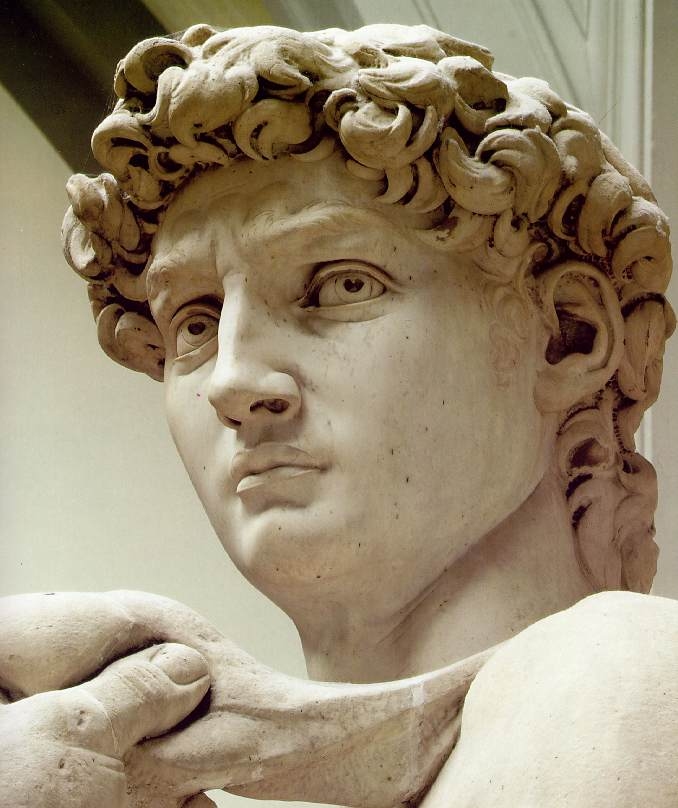


6MeditationesMartini
I always wondered why people still call their kid "Saul." Wasn't he pretty terrible? Nobody calls their child Jezebel or Herod or ... Pharaoh.
7MeditationesMartini
Donatello's David! He was something of a louche role model for me in grade 11.

10dchaikin
#9 - oooh...maybe I can get there too.
ETA : but no kindle version. I won't be getting there as soon as I hoped.
ETA : but no kindle version. I won't be getting there as soon as I hoped.
11JDHomrighausen
> 6
My mom used to go to this nail salon run and staffed by Vietnamese immigrants (stereotypical I know). One of them wanted to change its name to "Jezebel's Hair Salon." After all, she told my mom, it's a Biblical name right? Thankfully my mom talked her out of that one.
Although given general Biblical literacy in the "Christian" USA, most people would probably just think it was a funny name.
My mom used to go to this nail salon run and staffed by Vietnamese immigrants (stereotypical I know). One of them wanted to change its name to "Jezebel's Hair Salon." After all, she told my mom, it's a Biblical name right? Thankfully my mom talked her out of that one.
Although given general Biblical literacy in the "Christian" USA, most people would probably just think it was a funny name.
12JDHomrighausen
dchaikin, I just want to say that this is my favorite thing on LT, and thank you so much for running it. :)
13FlorenceArt
One silly question, did they stitch several skins together to make a scroll? Or were scrolls made from paper only?
14MeditationesMartini
Parchment? Papyrus? Vellum?
15dchaikin
#13-14 Qumran scrolls are mainly Parchment from animal hide. There was some Papyrus. take peak here: http://maxwellinstitute.byu.edu/dss/creation.html (One excerpt: The Great Isaiah Scroll required seventeen sheets or the hides of at least nine animals.)
16dchaikin
#6 - Martin - No clue, but it's a common Jewish name. Apparently he still gets some respect (or a lot of people don't like their children).
#11 - There was once a "Jezebel Inn" off a highway near me. I was never sure what went on there, but it has long since died, and sadly, the sign was eventually taken down
#12 - Jonathan, thanks!
Panicking about time. I want to finish Samuel in July, because I have a two week interruption in early August...but finding time for this kind of reading is not so easy. So far I've read chapter 1...
#11 - There was once a "Jezebel Inn" off a highway near me. I was never sure what went on there, but it has long since died, and sadly, the sign was eventually taken down
#12 - Jonathan, thanks!
Panicking about time. I want to finish Samuel in July, because I have a two week interruption in early August...but finding time for this kind of reading is not so easy. So far I've read chapter 1...
17JDHomrighausen
No need to rush, D. I'm going to detour a little bit myself. Found David's Truth in Israel's Imagination and Memory by Walter Brueggeman on kindle. It's a short book about different portraits of David offered by the Biblical tradition. Brueggeman is a very well-known Protestant Biblical scholar so I'm excited to try one of his works.
As usual, I have Kugel, Alter, and my Oxford History of the Biblical World, which has a chapter on Israel's monarchy. I also just finished Joel Hoffman's In the Beginning: A Short History of the Hebrew Language.
So if you go slow, no worries, because I'm sure we'll all find other things to read in the meantime, and in my case I'll try to read things that will add to the discussion here.
As usual, I have Kugel, Alter, and my Oxford History of the Biblical World, which has a chapter on Israel's monarchy. I also just finished Joel Hoffman's In the Beginning: A Short History of the Hebrew Language.
So if you go slow, no worries, because I'm sure we'll all find other things to read in the meantime, and in my case I'll try to read things that will add to the discussion here.
18FlorenceArt
Go slow, by all means, this way I may have a chance to follow along :-P
Seriously, don't worry about the pace, we've all been following at different paces anyway, I think. Personally I don't read very much at the moment, being busy and preoccupied with many many other things, plus I am still holding to the hope of some day getting to the end of Infinite Jest... I haven't even finished Alter's introduction.
Seriously, don't worry about the pace, we've all been following at different paces anyway, I think. Personally I don't read very much at the moment, being busy and preoccupied with many many other things, plus I am still holding to the hope of some day getting to the end of Infinite Jest... I haven't even finished Alter's introduction.
19dchaikin
Well, I haven't put an intro together yet, but I've read through chapter 14, with notes. If I have time over lunch, I will try to post something on something...not sure what yet, though.
20JDHomrighausen
Hey everyone,
I have to be upfront with y'all - my Buddhist studies class is about to end, and then I have a retreat from July 29 to August 9. And I won't be able to hit David before that. So I'll be on David hiatus.
However, I am rapidly trying to finish three books on Biblical language and literature, including Robert Alter's The Art of Biblical Narrative and The Art of Biblical Poetry. If anyone wants, I'll post reviews of those here since a lot of Alter's views on literary criticism and the Bible and specific ways of reading it will shed light on the books we're reading. He really seems to repeat similar themes in his books.
I have to be upfront with y'all - my Buddhist studies class is about to end, and then I have a retreat from July 29 to August 9. And I won't be able to hit David before that. So I'll be on David hiatus.
However, I am rapidly trying to finish three books on Biblical language and literature, including Robert Alter's The Art of Biblical Narrative and The Art of Biblical Poetry. If anyone wants, I'll post reviews of those here since a lot of Alter's views on literary criticism and the Bible and specific ways of reading it will shed light on the books we're reading. He really seems to repeat similar themes in his books.
21dchaikin
No problem J. If you can catch up afterward, we'll still be at it. Anyway, I have a two-week hiatus coming up.
22dchaikin
Finally a rough introduction. I'll add more when we get to David.
Narrative Structure
There are different breakdowns, but I'll use the Harper Collins Study Bible's divisions
1. Story of Samuel : 1 Sam 1:1 - 7:17 (This is the section most consistent with Judges. The Ark Narrative is here in I Sam 4 - 6)
2. Inauguration of kingship : 1 Sam 8:1 - 15:34 (Saul's highlights and then condemnation)
3. David's rise : 1 Sam 15:35 - 2 Sam 5:10
4. David's reign : 2 Sam 5:11 - 12:31 (centered on Nathan's oracle in chapter 7)
5. Absalom's revolt : 2 Sam 13:1 - 20:22
6. miscellany : 2 Sam 20:23 - 24:25
"The same careful interplay of Poetic fragment, folkloric tradition, archival notation, and elaborated narrative that inform biblical literature as a whole can be found in Samuel, as can the political, cultural, and religious argument that gave rise to biblical tradition itself."(Joel Rosenberg in The Literary Guide to the Bible)
Dating - from Alter
Alter sees these books as old stories from close to the time of the actual events. He sees the oldest parts as the ark narrative (1 Sam 4-6) and 2 Sam 6, and thinks both may be pre-Davidic. (I'm not convinced). Then there are three stages - the origin of the stories in Davidic times (~950 bce), a Deuteronomist editor from roughly Josiah's times (622 bce) and finally a post-exilic editor.
History or Legend
Most critics compare these stories to something like those on King Arthur. Alter prefers the analogy of Shakespeare's historical plays. His point - he argues that the general historical facts are preserved. (I'm partial to the King Arthur analogy.)
Kugel notes that in this time period most of the usual foreign influences are in weakened - Egypt, Babylon, Assyria, Aram/Syria and the Hittites - none are expanding. So, there is a window for a kingdom to be founded.
YHWH
"YHWH is invoked as the God of surprise, bringing down the mighty, raising up the downtrodden; impoverishing the wealthy and enriching the pauper; bereaving the fertile and making the barren teh fruitful—always circumventing the trappings of human vanity and the complacency of the overcontented" (Robinson)
Prophecy - from Kugel
These books mark the beginning of biblical prophecy as an institution. Kugel notes that it starts with the monarchy, and ends, post-exile, with the end of the monarchy. There is some kind of connection between kingship and the prophets. But these prophets have a habit of being critical and against their kings. They are a sort of counterweight.
Samuel
Samuel as the perfect Judge, the high point of the pre-monarchic period. He is he figure who "embodies a decentralized, theocratic, avocational, and minimalist authority" (Rosenberg).
Saul
Kugel notes that Saul is anointed king three times. First Samuel secretly and literally anoints him with oil (1 Sam 9:27-10:8). Then Samuel publicly selects Saul by lot, but Saul is found hiding, and not everyone accepts (1 Sam 10:17-10:28). Finally, coming off victory against the Ammonites he is kinged again (1 Sam 11:12-11:15) - and Samuel ruins his moment with a sermon against kingship (1 Sam 12)
Saul is also unusual for his ecstasy and later his insanity - "Is Saul among the prophets?"
Knowledge
Saul, whose name is derived from the Hebrew work for ask, has a theme of seeking key knowledge, and not finding it. David first has knowledge he needs, but is blinded later once king and isolated within his own palace.
Symmetries
Rosenberg makes a big fuss over symmetries. The big ones he notes are (1) 1 Sam 8 - 12, framed by warnings of Samuel against kingship. And (2) 1 Sam 13-31, Saul's kingship framed by Samuel's patronage at one end, and condemnation at the other. In the middle David does NOT kill saul (chap 24-26). And (3) 2 Sam 15-20 with Absalom and Sheba ben Bichri, with YHWH playing the prophet in the middle.
Narrative Structure
There are different breakdowns, but I'll use the Harper Collins Study Bible's divisions
1. Story of Samuel : 1 Sam 1:1 - 7:17 (This is the section most consistent with Judges. The Ark Narrative is here in I Sam 4 - 6)
2. Inauguration of kingship : 1 Sam 8:1 - 15:34 (Saul's highlights and then condemnation)
3. David's rise : 1 Sam 15:35 - 2 Sam 5:10
4. David's reign : 2 Sam 5:11 - 12:31 (centered on Nathan's oracle in chapter 7)
5. Absalom's revolt : 2 Sam 13:1 - 20:22
6. miscellany : 2 Sam 20:23 - 24:25
"The same careful interplay of Poetic fragment, folkloric tradition, archival notation, and elaborated narrative that inform biblical literature as a whole can be found in Samuel, as can the political, cultural, and religious argument that gave rise to biblical tradition itself."(Joel Rosenberg in The Literary Guide to the Bible)
Dating - from Alter
Alter sees these books as old stories from close to the time of the actual events. He sees the oldest parts as the ark narrative (1 Sam 4-6) and 2 Sam 6, and thinks both may be pre-Davidic. (I'm not convinced). Then there are three stages - the origin of the stories in Davidic times (~950 bce), a Deuteronomist editor from roughly Josiah's times (622 bce) and finally a post-exilic editor.
History or Legend
Most critics compare these stories to something like those on King Arthur. Alter prefers the analogy of Shakespeare's historical plays. His point - he argues that the general historical facts are preserved. (I'm partial to the King Arthur analogy.)
Kugel notes that in this time period most of the usual foreign influences are in weakened - Egypt, Babylon, Assyria, Aram/Syria and the Hittites - none are expanding. So, there is a window for a kingdom to be founded.
YHWH
"YHWH is invoked as the God of surprise, bringing down the mighty, raising up the downtrodden; impoverishing the wealthy and enriching the pauper; bereaving the fertile and making the barren teh fruitful—always circumventing the trappings of human vanity and the complacency of the overcontented" (Robinson)
Prophecy - from Kugel
These books mark the beginning of biblical prophecy as an institution. Kugel notes that it starts with the monarchy, and ends, post-exile, with the end of the monarchy. There is some kind of connection between kingship and the prophets. But these prophets have a habit of being critical and against their kings. They are a sort of counterweight.
Samuel
Samuel as the perfect Judge, the high point of the pre-monarchic period. He is he figure who "embodies a decentralized, theocratic, avocational, and minimalist authority" (Rosenberg).
Saul
Kugel notes that Saul is anointed king three times. First Samuel secretly and literally anoints him with oil (1 Sam 9:27-10:8). Then Samuel publicly selects Saul by lot, but Saul is found hiding, and not everyone accepts (1 Sam 10:17-10:28). Finally, coming off victory against the Ammonites he is kinged again (1 Sam 11:12-11:15) - and Samuel ruins his moment with a sermon against kingship (1 Sam 12)
Saul is also unusual for his ecstasy and later his insanity - "Is Saul among the prophets?"
Knowledge
Saul, whose name is derived from the Hebrew work for ask, has a theme of seeking key knowledge, and not finding it. David first has knowledge he needs, but is blinded later once king and isolated within his own palace.
Symmetries
Rosenberg makes a big fuss over symmetries. The big ones he notes are (1) 1 Sam 8 - 12, framed by warnings of Samuel against kingship. And (2) 1 Sam 13-31, Saul's kingship framed by Samuel's patronage at one end, and condemnation at the other. In the middle David does NOT kill saul (chap 24-26). And (3) 2 Sam 15-20 with Absalom and Sheba ben Bichri, with YHWH playing the prophet in the middle.
23dchaikin
The points I seemed to have missed there is that Samuel is different from the other books we've read. There is a clear story-telling and literary sense, and a long-term coherence. Alter constantly argues against the multiple sources for various writings, saying it's possible these could be different parts of a whole, and he has a point. Much of this fits together. Story-wise, we have something much richer than what we have dealt with up this point. What is missing are the ancient fragment's. Even Hannah's song feels distinctly younger than anything in Judges. There is nothing like the Song of Deborah, or Song of Miriam or the archaic blessings/curses by Moses & Jacob.
24JDHomrighausen
Here we go. I hope this isn't as much of a trudge to read as it was to write....!
The Art of Biblical Narrative by Robert Alter
Finished 7/21/12
When I was a freshman in high school, my English teacher quipped that Edith Hamilton was the goddess of Greek mythology. If every pantheon has a scholar that is the god of it, then Robert Alter is the God of the Hebrew Bible. After creating and popularizing literary approaches to the Bible in this book and The Art of Biblical Poetry, he began his brilliant translations of the Torah, Psalms, Wisdom books, and the one my group read is doing now, The David Story.
Alter's main point in this careful polemic is that historical-critical scholarship, which dominated biblical scholarship in most of the twentieth century, is unimaginative. It places too much emphasis on the fragmented nature of the Biblical texts, and in doing so overlooks the nuances of language and story that unify the tomes. When it sees two different writing styles, it automatically assumes that there are multiple sources at work, rather than that one author or authorial school intentionally changed voices. The closest it ever got to literary criticism, form criticism, only created categories to place different texts in, without exploring the dynamics of how the author employed or refused to employ the genre. By assuming that the text is fragmentary and often not well-wrought, it denigrates the text.
Alter seeks to restore the genius of the writers of the Hebrew Bible not from an a priori religious framework of inspiration, but by close readings of pericopes demonstrating the subtleties of the Biblical tales that previous scholarship, done by historians and archaeologists rather than literary critics, did not pick up on. Alter situates his analysis of the literary techniques and forms of the Hebrew Bible in the overarching theological problematic of the monotheistic revolution: how do God and man interact? The Bible everywhere explores the tension between God's perfect plan and man's uncertain agency, between God's certain knowledge and man's chaotic uncertainty, between the seeming contradiction of a Godly determinism and the basic human impulse to free will. The Bible explores this not just in its content, but in its use of narrative style, dialogue, repetition, and type-scenes.
In chapter two, Alter begins his scrutiny of narrative by looking at the difference between ancient polytheistic myth and the Bible. The difference is that the pagan world of myth had a stable closure, and stories were tied to orality, to repetition, to ritual. Hebrew narrative has an indeterminacy to it, as the stories are ambiguous, leave things unsaid, and leave the reader with multiple meanings available. (This underdetermined nature of Biblical narrative was likely what led to later midrashic traditions.) He compares the creation narrative of J starting in Genesis 2:4 with the Enuma Elish, and finds that humanity in Genesis has a "morally problematic interiority," made in the image of God but also autonomous, that is not in the Babylonian creation myth. This indeterminacy and element of the chaotic humanness (which the reader always lives in) plays out in the Bible's depiction of history, which oscillates between God's hand being clearly at work (Esther) and human drama taking the spotlight (Deueteronomistic history), with no book being completely at one extreme or the other. The Hebrews were writing neither history nor fiction, but "fictionalized history" with conscious artistic intent. This fiction written in order to explore history plays out most fully in the David saga, which Alter compares to Shakespeare's fictionalized versions of English history. In its deep characterization and portrayal of the human, Alter sees in the Bible a possible birth of fiction.
The third chapter moves onto type-scenes, archetypal repetitions of events that formed part of the unspoken artistic conventions of Biblical narrative. Since we don't know of any ancient Hebrew literary theory, we can only guess what these conventions might be. These type-scenes, such as the hero's betrothal played out in Moses, Jacob, and Samson, are consciously varied to let the reader infer aspects of the particular hero of that story. For example, whereas Moses' betrothal begins with him defending helpless women and properly meeting the bride's father, Samson bluntly desires a foreign woman and simply demands his parents secure her. Moses' near-perfect morality contrasts with Samson's hot-headed and cocky swag, both here and everywhere else in their stories. These repeated type-scenes capture the cyclical rhythm of God's activity in history - the saga of human life, of following and forgetting God, of birth and death.
In chapter four, Alter makes a fascinating assertion about Biblical narration: it is scant. The reader learns far more about characters through dialogue and reported action than through an omniscient narrator's epithetic labeling. This is unique to the Bible; Homer has long monologue rather than dialogue. By focusing the reader on dialogue, the emphasis becomes characters' reactions to events rather than the events themselves. And not knowing about a character's interior motives leaves us wondering about them, leaves us in the human's-eye view of uncertainty rather than the God's-eye view of omniscience about the character. This emphasis on the spoken word even evokes the theology that as God creates and reveals with words, so God-imaged humanity reveals and creates with words. The reader of Biblical narrative is advised to look closely at the dialogue. Does a character speak in lofty near-verse or in brief, slangy utterances? When does the narrator transition between his voice and the dialogue, what is being emphasized in doing so? The narrator's hands-off treatment, prefiguring modern novels, lets human agency express itself in the midst of a God-driven world.
But not only are type-scenes repeated. Repetition moves up a scale, from words, motifs, themes, and sequences of actions, up to type-scenes. As Biblical narrative moves on, it adds new connotations and meanings to repeated units, as they evoke their past instantiations. Just as God's orderly pattern of words created an orderly universe, so God's word is repeated and made sense of in the context of Biblical narrative. For example, the motif of water repeats in Moses' life, from the water he was put in at birth to the water he draws from the stone in the desert. Elsewhere in the Bible, water will evoke Moses and how water both let them escape from Egypt and prevented them from entering Canaan. Not only is repetition key in the Bible, but so is lack of repetition - say a type-scene of a hero is omitted from one hero's story - or difference from the usual way of repeating a unit. Dialogues can be repeated by characters saying the same words but with different intentions. As Alter says, the Biblical narratives are not merely conveying information, they are using language - the vehicle of the story - as an intrinsic part of what is being narrated.
Despite the fact that little explicit characterization is done in the Bible (remember: dialogue-focused), characters still seem fully fleshed out. How? Alter explores this in the sixth chapter. Though the Biblical narrator is almost always omniscient, we only see glimpses of this, and are instead given information about a character indirectly through actions and words. Looking at when a narrator chooses to reveal their knowledge can tell us a lot about the content. For example, when David is coming to power, we only hear his public speeches and actions. Yet the narrator reveals Saul's internal motives and crazed thoughts. Only later in the David saga do we see the complex man behind the public image. This reticence to share leaves the reader both wondering about the characters (remember: human's-eye view) and allows the characters to develop. There are no Homeric epithets in the Bible.
Alter then returns to the historical-critical scholars for the seventh chapter, on "composite artistry." What is a "book" in the Bible? Can any one book be set apart from the others, or are the boundaries too porous? Is any book unified, or is it a patchwork of different authors? In what I consider the most brilliant chapter of the book, Alter finds a middle road: yes, there are differing voices and styles in the Bible, and there is a multiplicity. But the final redactors also used literary genius in bringing these different accounts together. For example, the surface contradiction between the Priestly creation's simultanous creation of man and woman and the Yahwist's creation of woman from man are in fact complementary. The Yahwist perspective coming from sexism paints women as inferior, as helpers for the men who do the important things in society. The Priestly account recognizes that women are mens' equal in morality, in strength, in intelligence. Together these provide two contrasting and complementary perspectives that can both be found elsewhere in the Bible. Same with the tension between P's rhymic, orderly, rational creation emphasizing God and J's chaotic creation emphasizing man and his free will. What seems like a contradiction - or elsewhere in the Bible, seems like sloppy editing - is only so due to the reader's inability to read literary nuances. Narrative structure allows for these "montage of views arranged in sequence" concerning God's agency vs. humanity's, the universe's chaos and its order, and the messy human drama of history and God's divine plan. Literature is paradoxical as is human life.
Last but not least, Alter examines how Biblical narrative is a form of knowledge. It reveals a fund of experience, of human life, that is both the same and wildly different from the 21st-century North American reader's. The narrator only lets us learn what he wants us to learn. The narrator's relation to the reader is like God's relation to humanity - only allowing the recipient to have some knowledge, but also forcing them to think things out for themselves. Alter looks at the scenes where Joseph re-encounters his brothers, showing his Joseph's motives are both clear and unclear. The reader, putting herself in this story and all the others of the Bible, begins to see how to relate to God in her human uncertainty and chaos. The Bible's artistry, first seen as a rejection of a purely didactic purpose, turns out to have theological import.
This multiplicity of meanings, this ongoing human saga, is what attracts me to the Bible. The Hebrew Bible far more than the New Testament contains a complete portrait of a human society, of people experiencing human dramas, of the mundane aspects of life apart from the specifically religious. Alter's book hit me like dynamite opening new caves to explore in my ongoing quest to dive into sacred texts. His ability to convey literary nuances while not expecting the reader to know Hebrew is even more amazing. My only complaint is that the book is a bit dated. The second edition only updated a few things here and there, and did not take into account all the scholarship in literary criticism and the Bible that has happened in the thirty years since Alter published his book. Still, this book is worth its weight in gold, and belongs on every literature lover's shelf.
Rating: 5/5
The Art of Biblical Narrative by Robert Alter
Finished 7/21/12
When I was a freshman in high school, my English teacher quipped that Edith Hamilton was the goddess of Greek mythology. If every pantheon has a scholar that is the god of it, then Robert Alter is the God of the Hebrew Bible. After creating and popularizing literary approaches to the Bible in this book and The Art of Biblical Poetry, he began his brilliant translations of the Torah, Psalms, Wisdom books, and the one my group read is doing now, The David Story.
Alter's main point in this careful polemic is that historical-critical scholarship, which dominated biblical scholarship in most of the twentieth century, is unimaginative. It places too much emphasis on the fragmented nature of the Biblical texts, and in doing so overlooks the nuances of language and story that unify the tomes. When it sees two different writing styles, it automatically assumes that there are multiple sources at work, rather than that one author or authorial school intentionally changed voices. The closest it ever got to literary criticism, form criticism, only created categories to place different texts in, without exploring the dynamics of how the author employed or refused to employ the genre. By assuming that the text is fragmentary and often not well-wrought, it denigrates the text.
Alter seeks to restore the genius of the writers of the Hebrew Bible not from an a priori religious framework of inspiration, but by close readings of pericopes demonstrating the subtleties of the Biblical tales that previous scholarship, done by historians and archaeologists rather than literary critics, did not pick up on. Alter situates his analysis of the literary techniques and forms of the Hebrew Bible in the overarching theological problematic of the monotheistic revolution: how do God and man interact? The Bible everywhere explores the tension between God's perfect plan and man's uncertain agency, between God's certain knowledge and man's chaotic uncertainty, between the seeming contradiction of a Godly determinism and the basic human impulse to free will. The Bible explores this not just in its content, but in its use of narrative style, dialogue, repetition, and type-scenes.
In chapter two, Alter begins his scrutiny of narrative by looking at the difference between ancient polytheistic myth and the Bible. The difference is that the pagan world of myth had a stable closure, and stories were tied to orality, to repetition, to ritual. Hebrew narrative has an indeterminacy to it, as the stories are ambiguous, leave things unsaid, and leave the reader with multiple meanings available. (This underdetermined nature of Biblical narrative was likely what led to later midrashic traditions.) He compares the creation narrative of J starting in Genesis 2:4 with the Enuma Elish, and finds that humanity in Genesis has a "morally problematic interiority," made in the image of God but also autonomous, that is not in the Babylonian creation myth. This indeterminacy and element of the chaotic humanness (which the reader always lives in) plays out in the Bible's depiction of history, which oscillates between God's hand being clearly at work (Esther) and human drama taking the spotlight (Deueteronomistic history), with no book being completely at one extreme or the other. The Hebrews were writing neither history nor fiction, but "fictionalized history" with conscious artistic intent. This fiction written in order to explore history plays out most fully in the David saga, which Alter compares to Shakespeare's fictionalized versions of English history. In its deep characterization and portrayal of the human, Alter sees in the Bible a possible birth of fiction.
The third chapter moves onto type-scenes, archetypal repetitions of events that formed part of the unspoken artistic conventions of Biblical narrative. Since we don't know of any ancient Hebrew literary theory, we can only guess what these conventions might be. These type-scenes, such as the hero's betrothal played out in Moses, Jacob, and Samson, are consciously varied to let the reader infer aspects of the particular hero of that story. For example, whereas Moses' betrothal begins with him defending helpless women and properly meeting the bride's father, Samson bluntly desires a foreign woman and simply demands his parents secure her. Moses' near-perfect morality contrasts with Samson's hot-headed and cocky swag, both here and everywhere else in their stories. These repeated type-scenes capture the cyclical rhythm of God's activity in history - the saga of human life, of following and forgetting God, of birth and death.
In chapter four, Alter makes a fascinating assertion about Biblical narration: it is scant. The reader learns far more about characters through dialogue and reported action than through an omniscient narrator's epithetic labeling. This is unique to the Bible; Homer has long monologue rather than dialogue. By focusing the reader on dialogue, the emphasis becomes characters' reactions to events rather than the events themselves. And not knowing about a character's interior motives leaves us wondering about them, leaves us in the human's-eye view of uncertainty rather than the God's-eye view of omniscience about the character. This emphasis on the spoken word even evokes the theology that as God creates and reveals with words, so God-imaged humanity reveals and creates with words. The reader of Biblical narrative is advised to look closely at the dialogue. Does a character speak in lofty near-verse or in brief, slangy utterances? When does the narrator transition between his voice and the dialogue, what is being emphasized in doing so? The narrator's hands-off treatment, prefiguring modern novels, lets human agency express itself in the midst of a God-driven world.
But not only are type-scenes repeated. Repetition moves up a scale, from words, motifs, themes, and sequences of actions, up to type-scenes. As Biblical narrative moves on, it adds new connotations and meanings to repeated units, as they evoke their past instantiations. Just as God's orderly pattern of words created an orderly universe, so God's word is repeated and made sense of in the context of Biblical narrative. For example, the motif of water repeats in Moses' life, from the water he was put in at birth to the water he draws from the stone in the desert. Elsewhere in the Bible, water will evoke Moses and how water both let them escape from Egypt and prevented them from entering Canaan. Not only is repetition key in the Bible, but so is lack of repetition - say a type-scene of a hero is omitted from one hero's story - or difference from the usual way of repeating a unit. Dialogues can be repeated by characters saying the same words but with different intentions. As Alter says, the Biblical narratives are not merely conveying information, they are using language - the vehicle of the story - as an intrinsic part of what is being narrated.
Despite the fact that little explicit characterization is done in the Bible (remember: dialogue-focused), characters still seem fully fleshed out. How? Alter explores this in the sixth chapter. Though the Biblical narrator is almost always omniscient, we only see glimpses of this, and are instead given information about a character indirectly through actions and words. Looking at when a narrator chooses to reveal their knowledge can tell us a lot about the content. For example, when David is coming to power, we only hear his public speeches and actions. Yet the narrator reveals Saul's internal motives and crazed thoughts. Only later in the David saga do we see the complex man behind the public image. This reticence to share leaves the reader both wondering about the characters (remember: human's-eye view) and allows the characters to develop. There are no Homeric epithets in the Bible.
Alter then returns to the historical-critical scholars for the seventh chapter, on "composite artistry." What is a "book" in the Bible? Can any one book be set apart from the others, or are the boundaries too porous? Is any book unified, or is it a patchwork of different authors? In what I consider the most brilliant chapter of the book, Alter finds a middle road: yes, there are differing voices and styles in the Bible, and there is a multiplicity. But the final redactors also used literary genius in bringing these different accounts together. For example, the surface contradiction between the Priestly creation's simultanous creation of man and woman and the Yahwist's creation of woman from man are in fact complementary. The Yahwist perspective coming from sexism paints women as inferior, as helpers for the men who do the important things in society. The Priestly account recognizes that women are mens' equal in morality, in strength, in intelligence. Together these provide two contrasting and complementary perspectives that can both be found elsewhere in the Bible. Same with the tension between P's rhymic, orderly, rational creation emphasizing God and J's chaotic creation emphasizing man and his free will. What seems like a contradiction - or elsewhere in the Bible, seems like sloppy editing - is only so due to the reader's inability to read literary nuances. Narrative structure allows for these "montage of views arranged in sequence" concerning God's agency vs. humanity's, the universe's chaos and its order, and the messy human drama of history and God's divine plan. Literature is paradoxical as is human life.
Last but not least, Alter examines how Biblical narrative is a form of knowledge. It reveals a fund of experience, of human life, that is both the same and wildly different from the 21st-century North American reader's. The narrator only lets us learn what he wants us to learn. The narrator's relation to the reader is like God's relation to humanity - only allowing the recipient to have some knowledge, but also forcing them to think things out for themselves. Alter looks at the scenes where Joseph re-encounters his brothers, showing his Joseph's motives are both clear and unclear. The reader, putting herself in this story and all the others of the Bible, begins to see how to relate to God in her human uncertainty and chaos. The Bible's artistry, first seen as a rejection of a purely didactic purpose, turns out to have theological import.
This multiplicity of meanings, this ongoing human saga, is what attracts me to the Bible. The Hebrew Bible far more than the New Testament contains a complete portrait of a human society, of people experiencing human dramas, of the mundane aspects of life apart from the specifically religious. Alter's book hit me like dynamite opening new caves to explore in my ongoing quest to dive into sacred texts. His ability to convey literary nuances while not expecting the reader to know Hebrew is even more amazing. My only complaint is that the book is a bit dated. The second edition only updated a few things here and there, and did not take into account all the scholarship in literary criticism and the Bible that has happened in the thirty years since Alter published his book. Still, this book is worth its weight in gold, and belongs on every literature lover's shelf.
Rating: 5/5
25janeajones
Fascinating review, Jonathan.
26JDHomrighausen
Thank you. But it's nowhere near as fascinating as Alter himself!
27FlorenceArt
Ack, now I want to read Alter's book too. Thank you Jonathan, great review.
28MeditationesMartini
Yeah, super interesting. This:
When it sees two different writing styles, it automatically assumes that there are multiple sources at work, rather than that one author or authorial school intentionally changed voices.
is something I've frequently been thinking--it seems like such a failure of imagination to assune otherwise, so programmatic.
And this:
This fiction written in order to explore history plays out most fully in the David saga, which Alter compares to Shakespeare's fictionalized versions of English history. In its deep characterization and portrayal of the human, Alter sees in the Bible a possible birth of fiction.
is also intuitively convincing, especially with regard to Samuel, and valuable. Just as I'll preserve Falstaff, Richard III, et al., in mind as the real and awesome way history happened, I'll do the same with David and Jonathan and the rest.
With regard to this:
But the final redactors also used literary genius in bringing these different accounts together. For example, the surface contradiction between the Priestly creation's simultanous creation of man and woman and the Yahwist's creation of woman from man are in fact complementary. The Yahwist perspective coming from sexism paints women as inferior, as helpers for the men who do the important things in society. The Priestly account recognizes that women are mens' equal in morality, in strength, in intelligence. Together these provide two contrasting and complementary perspectives that can both be found elsewhere in the Bible. Same with the tension between P's rhymic, orderly, rational creation emphasizing God and J's chaotic creation emphasizing man and his free will. What seems like a contradiction - or elsewhere in the Bible, seems like sloppy editing - is only so due to the reader's inability to read literary nuances.
I'd agree except to replace "inability," usually, with "unwillingness." I feel like although the former is also true, more interesting and problematic is that there are a large number of people perfectly capable of engaging in these sorts of readings who are unwilling to do so for doctrinal reasons. I guess from the perspective of a believer that "unwillingness" might actually be inability, though--not non-capability, but a conscience or faith or feeling-that-it's-impossible-to-believe-that-way-if-it-doesn't-match-your-felt-sense-of-God's-plan thing.
When it sees two different writing styles, it automatically assumes that there are multiple sources at work, rather than that one author or authorial school intentionally changed voices.
is something I've frequently been thinking--it seems like such a failure of imagination to assune otherwise, so programmatic.
And this:
This fiction written in order to explore history plays out most fully in the David saga, which Alter compares to Shakespeare's fictionalized versions of English history. In its deep characterization and portrayal of the human, Alter sees in the Bible a possible birth of fiction.
is also intuitively convincing, especially with regard to Samuel, and valuable. Just as I'll preserve Falstaff, Richard III, et al., in mind as the real and awesome way history happened, I'll do the same with David and Jonathan and the rest.
With regard to this:
But the final redactors also used literary genius in bringing these different accounts together. For example, the surface contradiction between the Priestly creation's simultanous creation of man and woman and the Yahwist's creation of woman from man are in fact complementary. The Yahwist perspective coming from sexism paints women as inferior, as helpers for the men who do the important things in society. The Priestly account recognizes that women are mens' equal in morality, in strength, in intelligence. Together these provide two contrasting and complementary perspectives that can both be found elsewhere in the Bible. Same with the tension between P's rhymic, orderly, rational creation emphasizing God and J's chaotic creation emphasizing man and his free will. What seems like a contradiction - or elsewhere in the Bible, seems like sloppy editing - is only so due to the reader's inability to read literary nuances.
I'd agree except to replace "inability," usually, with "unwillingness." I feel like although the former is also true, more interesting and problematic is that there are a large number of people perfectly capable of engaging in these sorts of readings who are unwilling to do so for doctrinal reasons. I guess from the perspective of a believer that "unwillingness" might actually be inability, though--not non-capability, but a conscience or faith or feeling-that-it's-impossible-to-believe-that-way-if-it-doesn't-match-your-felt-sense-of-God's-plan thing.
29MeditationesMartini
As for Samuel, it's magnificent! This is what I'm looking for in my mythology. Tears, betrayal, love and war, powerful passions that bestride the sands of earth under their sandalled feet. I curse the Easy-to-Read version mildly again, because I would like to see what a great translator would do with the original's obviously powerful dramatic sense.
I had a lot of time to read on safari this weekend, and I'm a ways into Book II. A couple of questions:
1. I'm not sure I completely get the thing with the people wanting a king. I get the tension between the "decentralized, theocratic, avocational, and minimalist authority" and the centralization that comes historically with the development of the nation-state, and I get that the people want security and don't necessarily trust God to give it to them, and I get that that's part of why it's bad for them to ask for a king, but after years of Judges and chaos, doesn't it seem that the old way is broken? I am not sure what is meant to adhere them to the former situation with only God over them except that it gives them more chances to demonstrate their faith in trying circumstances. Surely there's room in a Jehovian faith for prosperity-building and good stewardship? Or is the point that the position of king signifies and inevitably leads to war on a larger, more organized scale, and realpolitik, and Hiroshima?
2. Smaller thing: I see in I Sam 11:8 that Israel and Judah are now separate. Did I miss this? When/why did it happen? Or are they just being treated separately since David is from Judah and that makes them special now? I see that Saul is a Benjaminite--they really haven't had an illustrious career as a tribe, have they? But I find Saul the most compelling character in this book--so much promise, baleful majesty, tragedy, insanity. I read "Is Saul among the prophets?" not only as referring to his insanity but also the essential ambiguity in his character before that, and what it means for his people--how can those of us who are not privy to the secret divine scorecard coexist with the state in a condition of clashing secular authority and lead moral lives? This is the question of the role of hermeneutics--how to read the signs--in the larger question of how to do right and preserve yourself when all around you is chaos. Abner is a different facet of this--Joam (Joab?) is out for pure vengeance, but Abner, as he has been all along, is trying to negotiate with the imperfect situation to emerge with peace. I think about a lot of good people who have supported bad regimes, for idealistic or practical reasons or because they were deluded, and I suspect they would relate to all this. Is Saul among the prophets? Do we hunt David or join him?
I had a lot of time to read on safari this weekend, and I'm a ways into Book II. A couple of questions:
1. I'm not sure I completely get the thing with the people wanting a king. I get the tension between the "decentralized, theocratic, avocational, and minimalist authority" and the centralization that comes historically with the development of the nation-state, and I get that the people want security and don't necessarily trust God to give it to them, and I get that that's part of why it's bad for them to ask for a king, but after years of Judges and chaos, doesn't it seem that the old way is broken? I am not sure what is meant to adhere them to the former situation with only God over them except that it gives them more chances to demonstrate their faith in trying circumstances. Surely there's room in a Jehovian faith for prosperity-building and good stewardship? Or is the point that the position of king signifies and inevitably leads to war on a larger, more organized scale, and realpolitik, and Hiroshima?
2. Smaller thing: I see in I Sam 11:8 that Israel and Judah are now separate. Did I miss this? When/why did it happen? Or are they just being treated separately since David is from Judah and that makes them special now? I see that Saul is a Benjaminite--they really haven't had an illustrious career as a tribe, have they? But I find Saul the most compelling character in this book--so much promise, baleful majesty, tragedy, insanity. I read "Is Saul among the prophets?" not only as referring to his insanity but also the essential ambiguity in his character before that, and what it means for his people--how can those of us who are not privy to the secret divine scorecard coexist with the state in a condition of clashing secular authority and lead moral lives? This is the question of the role of hermeneutics--how to read the signs--in the larger question of how to do right and preserve yourself when all around you is chaos. Abner is a different facet of this--Joam (Joab?) is out for pure vengeance, but Abner, as he has been all along, is trying to negotiate with the imperfect situation to emerge with peace. I think about a lot of good people who have supported bad regimes, for idealistic or practical reasons or because they were deluded, and I suspect they would relate to all this. Is Saul among the prophets? Do we hunt David or join him?
30JDHomrighausen
> 28
Good point, Martini. I think it's just people not being very imaginative in how they read. It's a problem.
In my Scripture classes our teachers would describe the difference between "true" and "truth." "True" is facticity, while "truth" is deeper. Living in a hyper-science-obsessed, "Just the facts ma'am" kind of culture, we often assume that things must be factually accurate for them to be truth. So Adam and Eve had to really exist to have any kind of truth, because allegory and myth aren't really true. (We can't even use the word "myth" without taking pains to distinguish it from "urban legend" or "mythbusters.")
In fact, though, ancient people were less concerned about facticity - modern history and journalistic standards were not a concern in the ancient near east. What was important were truths that human life could be structured around. I would go even further: assuming that the most important part of a text is its factual accuracy, contrary to what many literalists believe, denigrates the text, by pigeon-holing it into the category of "history textbook" rather than the vague, shifting, composite genre that it really falls into. This especially applies to a book like Genesis, or even like Samuel and Kings.
Speaking of Samuel and Kings, in a few weeks, I promise....
Good point, Martini. I think it's just people not being very imaginative in how they read. It's a problem.
In my Scripture classes our teachers would describe the difference between "true" and "truth." "True" is facticity, while "truth" is deeper. Living in a hyper-science-obsessed, "Just the facts ma'am" kind of culture, we often assume that things must be factually accurate for them to be truth. So Adam and Eve had to really exist to have any kind of truth, because allegory and myth aren't really true. (We can't even use the word "myth" without taking pains to distinguish it from "urban legend" or "mythbusters.")
In fact, though, ancient people were less concerned about facticity - modern history and journalistic standards were not a concern in the ancient near east. What was important were truths that human life could be structured around. I would go even further: assuming that the most important part of a text is its factual accuracy, contrary to what many literalists believe, denigrates the text, by pigeon-holing it into the category of "history textbook" rather than the vague, shifting, composite genre that it really falls into. This especially applies to a book like Genesis, or even like Samuel and Kings.
Speaking of Samuel and Kings, in a few weeks, I promise....
31MeditationesMartini
Yes! Absolutely! Couldn't have said it better.
32dchaikin
Jonathan - wonderful review, I mean really well presented and perfect for us in this group read.. More to say to you and Martin - but no time. With my trip coming, my time is getting less... will try.
33dchaikin
Some comments...
1. I need to read The Art of the Biblical Narrative - again, great review Jonathan
2. on changing voices:
J - When it sees two different writing styles, it automatically assumes that there are multiple sources at work, rather than that one author or authorial school intentionally changed voices.
M response - is something I've frequently been thinking--it seems like such a failure of imagination to assume otherwise, so programmatic.
J (later in review, before M's response) - " In what I consider the most brilliant chapter of the book, Alter finds a middle road: yes, there are differing voices and styles in the Bible, and there is a multiplicity. But the final redactors also used literary genius in bringing these different accounts together."
Ok, my response. I can accept Alter's points as presented here. But I suspect two other things are very important here. One is that the bible is, in many ways, an archive. It's there to preserve. If there are contradictions, the editors did not work them out for readers, but only acknowledged that the different versions existed (as selected by the editors over time).
This brings me back to Judges where we have these folktales retold. There is so much literary potential in these stories, and yet they are given such plain and basic rendering. I think the editors were merely making an effort to preserve. The basics are there - now let's move on to David.
The second thing is that once something becomes sacred, it acquires a permanence. It can be re-worked, but it can't be removed (until the culture finally forgets about it.) New variations of religion have to either preserve the old, even if they contradict, or overthrow it.
more coming...
1. I need to read The Art of the Biblical Narrative - again, great review Jonathan
2. on changing voices:
J - When it sees two different writing styles, it automatically assumes that there are multiple sources at work, rather than that one author or authorial school intentionally changed voices.
M response - is something I've frequently been thinking--it seems like such a failure of imagination to assume otherwise, so programmatic.
J (later in review, before M's response) - " In what I consider the most brilliant chapter of the book, Alter finds a middle road: yes, there are differing voices and styles in the Bible, and there is a multiplicity. But the final redactors also used literary genius in bringing these different accounts together."
Ok, my response. I can accept Alter's points as presented here. But I suspect two other things are very important here. One is that the bible is, in many ways, an archive. It's there to preserve. If there are contradictions, the editors did not work them out for readers, but only acknowledged that the different versions existed (as selected by the editors over time).
This brings me back to Judges where we have these folktales retold. There is so much literary potential in these stories, and yet they are given such plain and basic rendering. I think the editors were merely making an effort to preserve. The basics are there - now let's move on to David.
The second thing is that once something becomes sacred, it acquires a permanence. It can be re-worked, but it can't be removed (until the culture finally forgets about it.) New variations of religion have to either preserve the old, even if they contradict, or overthrow it.
more coming...
34dchaikin
3. from Martin in 29 As for Samuel, it's magnificent! This is what I'm looking for in my mythology. Tears, betrayal, love and war, powerful passions that bestride the sands of earth under their sandalled feet.
yes yes yes. What a change. I'm having to re-address how I approach this (...without having time to re-address this). It's different to have a story and then to think about it in so many new ways. There is a lot more room for asking why and why not and what does this really mean. Is Samuel really talking with/listening to God, or just making it all up as suits him? Is the author aware of the ambiguity? Does the author want us to be thinking about this? and so on and so forth...
4. from Martin in 29 1. I'm not sure I completely get the thing with the people wanting a king.
I'm somehow a little confused by your overall intent here, but I'll take a go at responding.
My understanding is that (1) the people don't want a king because of what the institution imposes on them. The whole point of the first five books was to overthrow authority. We were slaves! Now we have gotten rid of all that Egyptian sponsored Canaanite overrule. We only answer to God now. This is a form of freedom (think Libertarian). Government - taxes - conscription - legal codes - the EPA - eminent domain - Social security - healthcare - minimum wage - all this stuff is oppressive. It all comes with a king. Why chuck Egypt and then support David?
But (2) there is this Philistine problem. In Judges we find that not having a king doesn't work so well. Too many dangers. Israelites have to regroup and find a savior every so often. That's actually bearable, and occasionally there's a Samuel, which is quite nice. But these Philistines are a different problem. They are way way stronger than the other groups. They are technologically way more sophisticated. The Judges situation won't do.
5. from Martin in 29 Smaller thing: I see in I Sam 11:8 that Israel and Judah are now separate. Did I miss this?
First, they were never together. There were twelve tribes. Saul united several them, but NOT Judah. Second, political hindsight. Judah wants to present their own dominance in the book. So, David comes from Judah, and finally brings Israel into unified brilliance...or something like that. Point is Judah-dominance is a good thing.
Saul is flawed largely because this story takes a Judahist tilt. David's rise is as the golden boy for the same reason.
6. ""Is Saul among the prophets?" - lots to think about here
yes yes yes. What a change. I'm having to re-address how I approach this (...without having time to re-address this). It's different to have a story and then to think about it in so many new ways. There is a lot more room for asking why and why not and what does this really mean. Is Samuel really talking with/listening to God, or just making it all up as suits him? Is the author aware of the ambiguity? Does the author want us to be thinking about this? and so on and so forth...
4. from Martin in 29 1. I'm not sure I completely get the thing with the people wanting a king.
I'm somehow a little confused by your overall intent here, but I'll take a go at responding.
My understanding is that (1) the people don't want a king because of what the institution imposes on them. The whole point of the first five books was to overthrow authority. We were slaves! Now we have gotten rid of all that Egyptian sponsored Canaanite overrule. We only answer to God now. This is a form of freedom (think Libertarian). Government - taxes - conscription - legal codes - the EPA - eminent domain - Social security - healthcare - minimum wage - all this stuff is oppressive. It all comes with a king. Why chuck Egypt and then support David?
But (2) there is this Philistine problem. In Judges we find that not having a king doesn't work so well. Too many dangers. Israelites have to regroup and find a savior every so often. That's actually bearable, and occasionally there's a Samuel, which is quite nice. But these Philistines are a different problem. They are way way stronger than the other groups. They are technologically way more sophisticated. The Judges situation won't do.
5. from Martin in 29 Smaller thing: I see in I Sam 11:8 that Israel and Judah are now separate. Did I miss this?
First, they were never together. There were twelve tribes. Saul united several them, but NOT Judah. Second, political hindsight. Judah wants to present their own dominance in the book. So, David comes from Judah, and finally brings Israel into unified brilliance...or something like that. Point is Judah-dominance is a good thing.
Saul is flawed largely because this story takes a Judahist tilt. David's rise is as the golden boy for the same reason.
6. ""Is Saul among the prophets?" - lots to think about here
35MeditationesMartini
Yeah, I think you've pretty much got my intent with the king question. I just meant more, it's interesting that God seems to prefer the undivided loyalty that leaves them weak and divided and at the mercy of their enemies, especially when there's been so much emphasis on the militay triumphs he''s brought them in the past, to the kingdom that allows them to prosper and win, albeit with divided loyalties. It's also interesting that there's so much distinction made between a judge and a king--both are divinely anointed in the Biblical context, after all. I suppose the difference is that the king passes his kingdom on, although I remember something early on about Samuel and God discussing Samuel's sons (not) inheriting his position too? Or was that Eli's sons, in line with the stuff about them being bad dudes?
And I guess I misspoke about Judah. I meant something like "differentiable from the others in a unique way." Such that you could say "Israel and Judah," as in the verse, but not e.g. "Israel and Ephraim." But I hear you saying that Saul only united "several" of the tribes/ Does this mean that there were others besides Judah that were not included? Did I miss that?
And I guess I misspoke about Judah. I meant something like "differentiable from the others in a unique way." Such that you could say "Israel and Judah," as in the verse, but not e.g. "Israel and Ephraim." But I hear you saying that Saul only united "several" of the tribes/ Does this mean that there were others besides Judah that were not included? Did I miss that?
36dchaikin
Both and Samuel and Eli had trouble with their sons. Eli's son's problems were given more detail.
Much to figure out in the God vs Judge vs King triangle. I tried, but got tangled up.
Judah is probably on it's own. Saul is Benjaminite, which is between Judah and every other tribe except for Simeon and Reuben. Simeon may no longer be independent from Judah. Reuben could go either way, but may no longer exist.
Much to figure out in the God vs Judge vs King triangle. I tried, but got tangled up.
Judah is probably on it's own. Saul is Benjaminite, which is between Judah and every other tribe except for Simeon and Reuben. Simeon may no longer be independent from Judah. Reuben could go either way, but may no longer exist.
37JDHomrighausen
> 33
Your comment made me think of the Marcionites. They were an early Christian group who said the Old Testament should be chucked!
Your comment made me think of the Marcionites. They were an early Christian group who said the Old Testament should be chucked!
39dchaikin
1 Samuel Chapters 1-8
The story of Samuel's rise. In chapter seven he becomes the highpoint in the era of Judges, the ideal of what a Judge can and should be. Then he chapter 8 his sons let him down. Mixed in is the very odd ark narrative. I'll try to keep these simple as my notes come from Alter...although I know Martin at least is not reading Alter.
Chapter 1
Samuel's birth to the barren Hannah, after she pledges her unconceived son to be a nazarite under Eli at Shiloh.
- Hannah & Peninnah compare to Rebecca and Leah
- Eli makes a parody of the annunciation. Note that he blesses Hannah without ever hearing her petition.
- Eli's sons are Hophni & Phineas
- Samuel (of Ephraim) - "for from the Lord I asked for him"
Chapter 2
Hannah's psalm
- This marks a change in the books, a pivot point of sorts. Hannah's psalm is redefining God, setting up the God of the books of Samuel and Kings. Of the surface, she repeatedly makes the point that God reverse fortunes, and wrecks havoc on complacency. God is no longer anthropomorphic, and not so vengeful and so overwhelmingly dangerous. God is still violent, but he is also "all knowing" and all powerful, "His is the measure of actions." God is now out there somewhere, more of an untouchable force, more of a broad concept than a very specific Holy of Holies in the arc.
- We learn of how bad Eli's sons are. "And he would thrust into the cauldron or the pot or the vat or the kettle" - a frenzy of gluttony.
- And later "A man of God" comes to Eli and predicts the death of his son. The authors don't like Eli. He doesn't get an angel, just a man.
Chapter 3
A wonderfully written chapter. First the author use humor to expose Eli as lacking vision, while God speaks directly to Samuel. Then he brings out a touching moment where Samuel is forced to tell Eli of the curse on his sons. Eli responds with stoic dignity, "He is the LORD. What is good in His eyes let him do."
- Samuel's "Here I am" rings of Isaac
The first three chapters were so well done, that book immediately makes a great effort to keep our expectations down with the awkward arc narrative.
Chapter 4
- Philistines wipe out Israelites/Hebrews at Eben-ezer, kill Eli's sons, and take the arc. News of the arc kills Eli, and Phineas's wife names her future son Ichabod, for "Glory is exiled.
- note the runner bringing the news to bad Eli...a reverse marathon
Chapter 5
The arc plays a trick on the Philistines, it brings bubonic plague (tumors). Note this is reminiscent of the plagues of Egypt
Chapter 6
The arc has a mini-Exodus and wandering in the wilderness. This chapter is simply strange.
- The philistines return the arc to Beth-shemesh with golden tumors and mice (I am fascinated that the authors were able to associate bubonic plague with mice at this time!)
- Joshua and Beth-shemesh didn't understand the tumor and mice thing. So, they accept the arc and put it on stone, hold a sacrifice - and all die of the plague... (OK, the book doesn't say that. It says God struck them down. Apparently Joshua wasn't priestly enough)
- The arc ends up at Kiriath-jearim in the house of Abinadab...not Shiloh. We can read this as meaning Shiloh has been wiped out and is no longer the holy sight.
Chapter 7
Samuel as the pinnacle of Judges. He leads a ceremony to cleanse the arc, reform the religion and then leads a route of the the Philistines.
- Eben-ezer - Stone of Hope. Signifies of righting of wrongs, and makes a perfect name for the Scrooge.
- Samuel rules especially in Ramah, but also in Bethel, Gilgal and Mizpah - this is the land of Ephraim and Benjamin.
Chapter 8
Like Eli, Samuel's sons (Joel and Abijah) go bad. With no hereditary future, Samuel rages against kings.
8:7 The LORD speaking says to Samuel "for it is not you they have cast aside, but Me the have cast aside from reigning over them."
The story of Samuel's rise. In chapter seven he becomes the highpoint in the era of Judges, the ideal of what a Judge can and should be. Then he chapter 8 his sons let him down. Mixed in is the very odd ark narrative. I'll try to keep these simple as my notes come from Alter...although I know Martin at least is not reading Alter.
Chapter 1
Samuel's birth to the barren Hannah, after she pledges her unconceived son to be a nazarite under Eli at Shiloh.
- Hannah & Peninnah compare to Rebecca and Leah
- Eli makes a parody of the annunciation. Note that he blesses Hannah without ever hearing her petition.
- Eli's sons are Hophni & Phineas
- Samuel (of Ephraim) - "for from the Lord I asked for him"
Chapter 2
Hannah's psalm
- This marks a change in the books, a pivot point of sorts. Hannah's psalm is redefining God, setting up the God of the books of Samuel and Kings. Of the surface, she repeatedly makes the point that God reverse fortunes, and wrecks havoc on complacency. God is no longer anthropomorphic, and not so vengeful and so overwhelmingly dangerous. God is still violent, but he is also "all knowing" and all powerful, "His is the measure of actions." God is now out there somewhere, more of an untouchable force, more of a broad concept than a very specific Holy of Holies in the arc.
- We learn of how bad Eli's sons are. "And he would thrust into the cauldron or the pot or the vat or the kettle" - a frenzy of gluttony.
- And later "A man of God" comes to Eli and predicts the death of his son. The authors don't like Eli. He doesn't get an angel, just a man.
Chapter 3
A wonderfully written chapter. First the author use humor to expose Eli as lacking vision, while God speaks directly to Samuel. Then he brings out a touching moment where Samuel is forced to tell Eli of the curse on his sons. Eli responds with stoic dignity, "He is the LORD. What is good in His eyes let him do."
- Samuel's "Here I am" rings of Isaac
The first three chapters were so well done, that book immediately makes a great effort to keep our expectations down with the awkward arc narrative.
Chapter 4
- Philistines wipe out Israelites/Hebrews at Eben-ezer, kill Eli's sons, and take the arc. News of the arc kills Eli, and Phineas's wife names her future son Ichabod, for "Glory is exiled.
- note the runner bringing the news to bad Eli...a reverse marathon
Chapter 5
The arc plays a trick on the Philistines, it brings bubonic plague (tumors). Note this is reminiscent of the plagues of Egypt
Chapter 6
The arc has a mini-Exodus and wandering in the wilderness. This chapter is simply strange.
- The philistines return the arc to Beth-shemesh with golden tumors and mice (I am fascinated that the authors were able to associate bubonic plague with mice at this time!)
- Joshua and Beth-shemesh didn't understand the tumor and mice thing. So, they accept the arc and put it on stone, hold a sacrifice - and all die of the plague... (OK, the book doesn't say that. It says God struck them down. Apparently Joshua wasn't priestly enough)
- The arc ends up at Kiriath-jearim in the house of Abinadab...not Shiloh. We can read this as meaning Shiloh has been wiped out and is no longer the holy sight.
Chapter 7
Samuel as the pinnacle of Judges. He leads a ceremony to cleanse the arc, reform the religion and then leads a route of the the Philistines.
- Eben-ezer - Stone of Hope. Signifies of righting of wrongs, and makes a perfect name for the Scrooge.
- Samuel rules especially in Ramah, but also in Bethel, Gilgal and Mizpah - this is the land of Ephraim and Benjamin.
Chapter 8
Like Eli, Samuel's sons (Joel and Abijah) go bad. With no hereditary future, Samuel rages against kings.
8:7 The LORD speaking says to Samuel "for it is not you they have cast aside, but Me the have cast aside from reigning over them."
40MeditationesMartini
Hannah's song! That was the other thing I wanted to mention. And that redefinition of God is extended hugely by David at the end. They're weird bookends, the songs, because much as I do think this book is special, God behaves pretty much like he always has, and yet the way they talk about him is so modern.
And thanks for clearing up the tumours/buboes thing. That bothered me.
And thanks for clearing up the tumours/buboes thing. That bothered me.
41dchaikin
Martin - I'll have to wait till I get there before I can respond. But curious about "God behaves pretty much like he always has"
I'm on I Samuel, Chapter 20.
I'm on I Samuel, Chapter 20.
42MeditationesMartini
I guess I mean, he's as capricious, as vicious, as focused on bloodshed and punishing people arbitrarily and inconsistent application of his laws and sort of "gotcha" moments where Samuel is like "oooh, you shouldn'ta done that," but then in with all the you-smote-my-foes-thanks-buddy stuff David is also like "He brought me forth also into a large place: he delivered me, because he delighted in me," and that seems like a big change, and very modern. (It's even more rhetorically contemporary in the Easy-to-Read Version.)
43FlorenceArt
Hi All,
Just a note to let you know that I'm not reading along for the moment. I've been insanely busy and now I am mostly trying to stay alive until the start of my holidays next week, plus I'm getting close to the end of Infinite Jest and trying to get that one out of the way. But I'm still lurking and enjoying your conversation. I'll try to catch up when I'm on holiday.
Just a note to let you know that I'm not reading along for the moment. I've been insanely busy and now I am mostly trying to stay alive until the start of my holidays next week, plus I'm getting close to the end of Infinite Jest and trying to get that one out of the way. But I'm still lurking and enjoying your conversation. I'll try to catch up when I'm on holiday.
44dchaikin
We are all a scatter. I'll post what I can, but it won't be much till mid-August. Shall we plan ahead, formally schedule a break and a time to regroup? Or would we risk losing our momentum?
45MeditationesMartini
I'm good with whatever, but given that three of four of us are on hiatus, a pause would seem apposite.
46dchaikin
#42 - Martin - the difference I note is that while Samuel claims God does this and that, we don't really know for sure that God has anything to do with anything. Samuel is likely making stuff up, and the author knows it and indicates this whenever he (or she) has Samuel tell us what God said. (When David is introduced, the narrator is careful to tell us directly what God said, instead of reporting through Samuel - an important difference, and an important narrator contribution)
47MeditationesMartini
Oh interesting. So do you see Samuel as disingenuous in some way? It's like, with David we get the direct connection with God, but in a way the routing it through the prophet provides a kind of guarantee of the report of God's words--a "divine verbatim" if you will. Whereas with the narrator only, we have more guarantee (one less intermediary) but also less (the removal of the holy guarantor)--and certainly David makes enough mistakes, in contrast to the seemingly infallible Samuel, that one has to wonder.
48dchaikin
We are seeing less and less of God's direct intervention over the course of each book, and presumably are falling farther and farther from the perfection in the Garden of Eden.
Samuel is passionate, super-confident and very strong character, one who creates through personality, and despite his own contradictions. He's not exactly disingenuous; he's more like a man possessed by his own self-importance. Following him may be disingenuous, at least for Saul. I think he's the kind of person that could make up something God said, and then be completely convinced God actually said it. All that is in the text, the ambiguity is for the careful reader, and there for the sake of deeper complexity. The writer opens us to his flaws without ever really undermining him.
Can't comment on David yet...
But David's introduction is so critical to Israel's history, and so important to Judah's elite, that care is taken to show that his election is not in any doubt. Too risky to have Samuel as an intermediary at that point. But, I would not be surprised if later David makes up his own conversations with God...or if Nathan does.
Short answer - the narrator always speaks the truth, and you should accept these comments without even the slightest of doubt*, but the characters may not be so reliable.
*or the next thing you know, you will be boycotting Chic-fil-a...unless your in Texas. Then you'll be sure to take your whole family there in an ecstasy of grease-smeared, artery-clogging, beef-free, homosexually-directed hatred. But, if you're in Texas, you wouldn't doubt the narrator anyway.
Samuel is passionate, super-confident and very strong character, one who creates through personality, and despite his own contradictions. He's not exactly disingenuous; he's more like a man possessed by his own self-importance. Following him may be disingenuous, at least for Saul. I think he's the kind of person that could make up something God said, and then be completely convinced God actually said it. All that is in the text, the ambiguity is for the careful reader, and there for the sake of deeper complexity. The writer opens us to his flaws without ever really undermining him.
Can't comment on David yet...
But David's introduction is so critical to Israel's history, and so important to Judah's elite, that care is taken to show that his election is not in any doubt. Too risky to have Samuel as an intermediary at that point. But, I would not be surprised if later David makes up his own conversations with God...or if Nathan does.
Short answer - the narrator always speaks the truth, and you should accept these comments without even the slightest of doubt*, but the characters may not be so reliable.
*or the next thing you know, you will be boycotting Chic-fil-a...unless your in Texas. Then you'll be sure to take your whole family there in an ecstasy of grease-smeared, artery-clogging, beef-free, homosexually-directed hatred. But, if you're in Texas, you wouldn't doubt the narrator anyway.
49FlorenceArt
I remember that in the book of Moses, Alter noted the difference between the LORD, who speaks directly to His people, or at least chosen intermediaries (Moses), as opposed to foreign gods who have to go through dubious means such as dreams and portents (although the LORD does stoop to using dreams and portents on occasion). Don't know if this is relevant to this conversation but that's the thought that came to me reading 46 and 47.
52dchaikin
1 Samuel Chapters 9-15 - Samuel promotes than turns from Saul
I wanted to be brief, it just didn’t happen. Anyway, note the dynamics between Samuel and Saul, the two askers. And note all the questions we’re left to ponder.
Reading between the lines, but not too deeply as it's very obvious, Samuel wants a puppet king. Saul's divine selection seems to be more like Samuel's selection; one based on Saul's appearance, and, possibly, his apparent simplicity. Saul's resistance seems passive, he just doesn't quite follow directions.
Chapter 9
Saul the Benjaminite, son of Kish, searching for his father's two lost asses in the region of Zuf, stumbles across Samuel - who is expecting a future king.
-note Saul's character is set up here. He is (1) always searching for and asking for information (2) never getting an answer and (3) always needing help, or a nudge.
(1) Of course we me Saul on a quest. Also, several of his first spoken lines are questions. To his fellow lad about the seer, "What shall we bring to the man?", to the women at the well, "Is there a seer hereabouts?" and, his first words to Samuel, "Tell me, pray, where is the house of the seer?"
(2) He never does find his sheep. Nor does Samuel answer him when Saul, spoken to like a future king deserving "all the treasure of Israel", asks "why have you spoken to me in this fashion?"
(3) It's the lad who must push Samuel to go see the seer, and even provide the quarter of a shekel of silver for an offering.
Chapter 10
Samuel anoints Saul the first time, privately, and sends him a series of instructions, leading to an moment of religious ecstasy, and the question, "Is Saul, too, among the prophets?". Then Samuel anoints Saul the second time, publicly selecting him by lot in Gilgal, but first has to find him hiding in some gear. The Israelites aren't all quite ready to accept him as king.
Samuel's instructions:
1. to Rachel's tomb to find out about the asses
2. to Terebinth of Tabor to meet three men "going up to Gad at Bethel"
3. to Philistine-controlled Gibeath-Elohim to meet a band for prophets.
4. to Gilgal to wait for Samuel, and wait for instructions.
Note 1 : that Saul is doing what he's told...except for the hiding in the luggage bit.
Note 2: Samuel finally informs Saul, "Has not the LORD anointed you over His inheritance as prince?" Searching these chapters carefully, it's not clear that Samuel did not make the selection of Saul by himself. In chapter 9 we are told that God told Samuel the day the future king would visit, but that’s really all we get from God. And it is Samuel who anoints him, not the LORD...
Note 3: As Samuel introduces a king, publicly, he also undermines him. The selection of a king by lot begins by Samuel first criticizing the Israelites for wanting a king. "And you on your part have cast aside your God Who delivers you from all your ills and troubles, and you have said, 'No! A king you shall put over us!'."
thoughts:
1. Is Saul Samuels' choice, or the LORD's choice?
2. Are we supposed to ask this question? And, if so, what does that say about Samuel?
3. And, if so, why Saul?
I wanted to be brief, it just didn’t happen. Anyway, note the dynamics between Samuel and Saul, the two askers. And note all the questions we’re left to ponder.
Reading between the lines, but not too deeply as it's very obvious, Samuel wants a puppet king. Saul's divine selection seems to be more like Samuel's selection; one based on Saul's appearance, and, possibly, his apparent simplicity. Saul's resistance seems passive, he just doesn't quite follow directions.
Chapter 9
Saul the Benjaminite, son of Kish, searching for his father's two lost asses in the region of Zuf, stumbles across Samuel - who is expecting a future king.
-note Saul's character is set up here. He is (1) always searching for and asking for information (2) never getting an answer and (3) always needing help, or a nudge.
(1) Of course we me Saul on a quest. Also, several of his first spoken lines are questions. To his fellow lad about the seer, "What shall we bring to the man?", to the women at the well, "Is there a seer hereabouts?" and, his first words to Samuel, "Tell me, pray, where is the house of the seer?"
(2) He never does find his sheep. Nor does Samuel answer him when Saul, spoken to like a future king deserving "all the treasure of Israel", asks "why have you spoken to me in this fashion?"
(3) It's the lad who must push Samuel to go see the seer, and even provide the quarter of a shekel of silver for an offering.
Chapter 10
Samuel anoints Saul the first time, privately, and sends him a series of instructions, leading to an moment of religious ecstasy, and the question, "Is Saul, too, among the prophets?". Then Samuel anoints Saul the second time, publicly selecting him by lot in Gilgal, but first has to find him hiding in some gear. The Israelites aren't all quite ready to accept him as king.
Samuel's instructions:
1. to Rachel's tomb to find out about the asses
2. to Terebinth of Tabor to meet three men "going up to Gad at Bethel"
3. to Philistine-controlled Gibeath-Elohim to meet a band for prophets.
4. to Gilgal to wait for Samuel, and wait for instructions.
Note 1 : that Saul is doing what he's told...except for the hiding in the luggage bit.
Note 2: Samuel finally informs Saul, "Has not the LORD anointed you over His inheritance as prince?" Searching these chapters carefully, it's not clear that Samuel did not make the selection of Saul by himself. In chapter 9 we are told that God told Samuel the day the future king would visit, but that’s really all we get from God. And it is Samuel who anoints him, not the LORD...
Note 3: As Samuel introduces a king, publicly, he also undermines him. The selection of a king by lot begins by Samuel first criticizing the Israelites for wanting a king. "And you on your part have cast aside your God Who delivers you from all your ills and troubles, and you have said, 'No! A king you shall put over us!'."
thoughts:
1. Is Saul Samuels' choice, or the LORD's choice?
2. Are we supposed to ask this question? And, if so, what does that say about Samuel?
3. And, if so, why Saul?
53dchaikin
Chapter 11
Saul takes down Nahash the Ammonite and right-eye gouger of Jabesh-gilead. Now Saul has the support he needs for acceptance as king. There is another gathering at Gilgal.
Note 1: note the Judges references
A: Jabesh-gilead is the town that did not support the Israel's punishment of Benjamin. The town was massacred. There is some kind of Benjamininte-Jabesh-gilead link
B: Saul gathers the tribes by hacking up an oxen and sending the parts around to the tribes. It's a threat as much as a request. But it also echoes the gang rape victim in Judges.
thought:
Why would this echo the rape story? Is this a criticism of Saul, or an attempt to keep to known themes?
Chapter 12
Samuel's sermon re-anointing Saul king at Gilgal. The point here is that Samuel undermines and upstages Saul. He begins by criticizing the Israelite’s desire for a king. Then leaves this line, "I on my part, too, far be it from me to offend the LORD by ceasing to intercede on your behalf" - ie. I can't take away that king, but if you happen to need me instead, I’m still available.
Note the legal tone throughout.
Chapter 13
A set-up for a big battle against the Philistines.
When Samuel waits till last minute to arrive at the pre-battle sacrifice, Saul runs the sacrifice himself. Samuel confront him, "You have played the fool!... But now your kingdom shall not stand. The LORD has already sought out for himself a man after His own heart and the LORD has appointed him prince to his people, for you have not kept what the LORD commanded of you.” Then Samuel abandons the army, as do most of the troops.
This is all political play. Samuel is manipulating to gain the upper hand and force Saul to remain a puppet. This is Saul's first clear failure to follow instructions. It doesn't seem to be an accident by Saul. But, Saul oversteps. And this was set this up as a trap by Samuel.
Saul takes down Nahash the Ammonite and right-eye gouger of Jabesh-gilead. Now Saul has the support he needs for acceptance as king. There is another gathering at Gilgal.
Note 1: note the Judges references
A: Jabesh-gilead is the town that did not support the Israel's punishment of Benjamin. The town was massacred. There is some kind of Benjamininte-Jabesh-gilead link
B: Saul gathers the tribes by hacking up an oxen and sending the parts around to the tribes. It's a threat as much as a request. But it also echoes the gang rape victim in Judges.
thought:
Why would this echo the rape story? Is this a criticism of Saul, or an attempt to keep to known themes?
Chapter 12
Samuel's sermon re-anointing Saul king at Gilgal. The point here is that Samuel undermines and upstages Saul. He begins by criticizing the Israelite’s desire for a king. Then leaves this line, "I on my part, too, far be it from me to offend the LORD by ceasing to intercede on your behalf" - ie. I can't take away that king, but if you happen to need me instead, I’m still available.
Note the legal tone throughout.
Chapter 13
A set-up for a big battle against the Philistines.
When Samuel waits till last minute to arrive at the pre-battle sacrifice, Saul runs the sacrifice himself. Samuel confront him, "You have played the fool!... But now your kingdom shall not stand. The LORD has already sought out for himself a man after His own heart and the LORD has appointed him prince to his people, for you have not kept what the LORD commanded of you.” Then Samuel abandons the army, as do most of the troops.
This is all political play. Samuel is manipulating to gain the upper hand and force Saul to remain a puppet. This is Saul's first clear failure to follow instructions. It doesn't seem to be an accident by Saul. But, Saul oversteps. And this was set this up as a trap by Samuel.
54dchaikin
Chapter 14
The big battle against the Philistines, showing Jonathan's bravery and Saul's incompetence.
1. Without Samuel, Saul is forced to rely on Eli's grandson, Ahijah, for prophecy.
2. In the meantime, Saul's son Jonathan, makes a brave but brilliant military move starting a panic of the Philistines and a route.
3. Saul, consulting Ahijah for divination, finally realizes there is already a rout. "Pull back your hand" he tells Ahijah. That is, you can stop this, it's now a waste of time...
4. Then Saul sets his own son up for failure by making an oath against any soldier eating during the battle. Jonathan can’t hear the oath. Think of Jephthah and dumb oaths.
5. Jonathan breaks the oath he hasn’t heard, since he led the charge, by eating honey. This apparent defiance leads to an eating orgy…
6. When Saul finds out he condemns Jonathan, his son and the war hero, to death. Jonathan is saved by supporters, but his rift with his father will not heal.
Jonathan vs Saul
Jonathan is daring where Saul is hesitant
Jonathan uses an amour bearer, where Saul uses Ahijah, the defective prophet.
The big battle against the Philistines, showing Jonathan's bravery and Saul's incompetence.
1. Without Samuel, Saul is forced to rely on Eli's grandson, Ahijah, for prophecy.
2. In the meantime, Saul's son Jonathan, makes a brave but brilliant military move starting a panic of the Philistines and a route.
3. Saul, consulting Ahijah for divination, finally realizes there is already a rout. "Pull back your hand" he tells Ahijah. That is, you can stop this, it's now a waste of time...
4. Then Saul sets his own son up for failure by making an oath against any soldier eating during the battle. Jonathan can’t hear the oath. Think of Jephthah and dumb oaths.
5. Jonathan breaks the oath he hasn’t heard, since he led the charge, by eating honey. This apparent defiance leads to an eating orgy…
6. When Saul finds out he condemns Jonathan, his son and the war hero, to death. Jonathan is saved by supporters, but his rift with his father will not heal.
Jonathan vs Saul
Jonathan is daring where Saul is hesitant
Jonathan uses an amour bearer, where Saul uses Ahijah, the defective prophet.
55dchaikin
Chapter 15
1. Samuel commands Saul to lead a ban on the Amaleks.
2. Saul attacks, but doesn’t complete the ban. He spares the king, Agag, and takes the best of cattle.
3. And then this happens:
And so on until finally Samuel says, ‘Does the LORD take delight in burnt offerings and sacrifices as in listening to the voice of the LORD? … Since you have cast off the word of the LORD, He has cast you aside as king.”. Then, as Saul pleads we get this sequence:
And that marks the chilling end Samuel promotion of Saul…
1. Samuel commands Saul to lead a ban on the Amaleks.
2. Saul attacks, but doesn’t complete the ban. He spares the king, Agag, and takes the best of cattle.
3. And then this happens:
(Samuel arrives)
Saul: “Blessed be you to the LORD! I have fulfilled the word of the LORD”
Samuel: “And what is this sound of sheep in my ears, and the sound of cattle that I heard?”
Saul: “From the Amalekite they have brought them, for the troops spared the best of the sheep and the cattle in order to sacrifice to the LORD you God, and the rest we put under ban.”
And so on until finally Samuel says, ‘Does the LORD take delight in burnt offerings and sacrifices as in listening to the voice of the LORD? … Since you have cast off the word of the LORD, He has cast you aside as king.”. Then, as Saul pleads we get this sequence:
Saul: “I have offended. Now show me honor, pray, before the elders of my people and before Israel, and turn back with me, that I may bow to the LORD your God.
Samuel (turning back): “Bring forth to me Agag”
Samuel: “As your sword has bereaved women, more bereaved than all women your mother!”
(And Samuel cut him apart before the LORD at Gilgal)
And that marks the chilling end Samuel promotion of Saul…
56MeditationesMartini
>52 dchaikin: this is so fascinating. What does it say about David, who also pushes back against Samuel for room to manoeuvre, but with more success (aided, of course, by the prophet's convenient death)? Does the king's legitimacy via God require an intemediary, or can that powerful source of alternative authority be tamed, kept in a box until the king needs it? Shades of Henry VIII here, and Sir Thomas More.
And yeah, the more I think about him the more Samuel seems like a sinister chancer, a Rasputin almost. I know there's a better comparison.
And yeah, the more I think about him the more Samuel seems like a sinister chancer, a Rasputin almost. I know there's a better comparison.
57dchaikin
Before I head out, a side note from The Bible Unearthed by Israel Finkelstein & Neil Asher Silberman. They argue the OT was originally written in late 700's bce (near the reign of Josiah)
Their argument goes something like this (a direct quote):
"Archeologist and anthropologist working all over the world have carefully studies the context in which sophisticated genres of writing emerge, and in almost every case they are a sign of state formation, in which power in centralized in national institutions like and official cult of monarchy"
The problem I have with this is that this is the assumed date of Deuteronomy, a work clearly modifying older works...so I would think the first four must have been around in some kind of coherent form...but, I haven't read much to this book yet.
The relevance here is that this implies that Saul and David pre-date any significant state formation...and, hence, are purely mythical and only developed here as part of the state myth.
See you all in about 2 weeks.
Their argument goes something like this (a direct quote):
"Archeologist and anthropologist working all over the world have carefully studies the context in which sophisticated genres of writing emerge, and in almost every case they are a sign of state formation, in which power in centralized in national institutions like and official cult of monarchy"
The problem I have with this is that this is the assumed date of Deuteronomy, a work clearly modifying older works...so I would think the first four must have been around in some kind of coherent form...but, I haven't read much to this book yet.
The relevance here is that this implies that Saul and David pre-date any significant state formation...and, hence, are purely mythical and only developed here as part of the state myth.
See you all in about 2 weeks.
59dchaikin
Well, Finkelstein & Silberman have momentarily convinced me we have spent these 7 and half months reading what is mainly a 7th century text. And they've convinced me that David and Solomon existed, but only as minor tribal leaders in the southern part of the Judean hills. King Arthur indeed.
I'm back from my trip, but have not made any progress with 1 Samuel. Anyone else around?
I'm back from my trip, but have not made any progress with 1 Samuel. Anyone else around?
60JDHomrighausen
I'm here. Read 1 Samuel and need to make notes. I'm still down for group reads; in fact, it's my favorite part of LT! I've just mentally signed up for so many that now my own reading is falling away!
62MeditationesMartini
And I, waitfully watching.
63dchaikin
This anchor is having trouble finding time to read this book. Wants to make promise it will catch up in time, really thinks it will, hasn't actually worked out the time-logistics...
I'm targeting Thursday to finish 1 Samuel and then three more week for 2 Samuel. I will try to push faster if this seems too slow. I think my kindle KJV estimates will finish the OT within the decade...
I'm targeting Thursday to finish 1 Samuel and then three more week for 2 Samuel. I will try to push faster if this seems too slow. I think my kindle KJV estimates will finish the OT within the decade...
64JDHomrighausen
Look at the bright side: these are some of the longest and most difficult-to-slog through books in the whole set. We'll be through long before the end of the decade. And even if we never finish, look at how much we've done!
65MeditationesMartini
>64 JDHomrighausen: I like your moxie.
66FlorenceArt
Well, now that I managed to finish Infinite Jest, I'm not about to be impressed by this book! Though it will probably take me a bit longer to finish...
I'm back too, from a great holiday in the Cévennes. I even read a bit during the holiday, and I'm about to start chapter 7.
I'm back too, from a great holiday in the Cévennes. I even read a bit during the holiday, and I'm about to start chapter 7.
68dchaikin
I've finished 1 Samuel and am slowly making my way through 2 Samuel. I'll begin posting summaries on 1 Samuel chapters 16-31 - summarizing the fall of Saul.
Reading this book as sixth-century construction changes my take on it. Israel Finkelstein & Neil Asher Silberman conclude that there was rich and powerful kingdom in Israel that resembled David's Kingdom - it was the 9th-century Northern Kingdom under the Omrides (include Ahab). Moab, Edom and even Aram-Damascus lost land and/or paid tribute to this kingdom, for a brief period.
David, who must have existed because there was a Davidic line, and Solomon were, at best, leaders of a sparsely spread backwater population in out-of-the-way Judah. No one cared because there weren't any riches or strategic importance in Judah. The wealth of Israel came from the more fertile northern areas.
Later Assyria turned aggressive, the northern kingdom fell, and overnight, archeologically, Judah sprung up massive wealth. There was give in take in Judah about religion, but at some point a purist faction devoted to YHWH held influence, led by Hezekiah and later Josiah. They put the books together, very quickly. And that is how, according to Israel Finkelstein & Neil Asher Silberman, we have this story of Saul and David. Saul the failure, and David whose mythical kingdom takes all its cues from the real 9th-century northern Kingdom of Israel...
Reading this book as sixth-century construction changes my take on it. Israel Finkelstein & Neil Asher Silberman conclude that there was rich and powerful kingdom in Israel that resembled David's Kingdom - it was the 9th-century Northern Kingdom under the Omrides (include Ahab). Moab, Edom and even Aram-Damascus lost land and/or paid tribute to this kingdom, for a brief period.
David, who must have existed because there was a Davidic line, and Solomon were, at best, leaders of a sparsely spread backwater population in out-of-the-way Judah. No one cared because there weren't any riches or strategic importance in Judah. The wealth of Israel came from the more fertile northern areas.
Later Assyria turned aggressive, the northern kingdom fell, and overnight, archeologically, Judah sprung up massive wealth. There was give in take in Judah about religion, but at some point a purist faction devoted to YHWH held influence, led by Hezekiah and later Josiah. They put the books together, very quickly. And that is how, according to Israel Finkelstein & Neil Asher Silberman, we have this story of Saul and David. Saul the failure, and David whose mythical kingdom takes all its cues from the real 9th-century northern Kingdom of Israel...
69dchaikin
1 Samuel 16 - 18 - David's beginning
Chapter 16 - David selected and anointed by Samuel. Saul begins going crazy, but is soothed by David playing the Lyre
- "For not as a man sees does God see. For a man sees with his eyes and the LORD sees with the heart."
- David is the 8th son of Jesse
- Saul goes crazy : "And the spirit of the LORD had turned from Saul, and an evil spirit from the LORD struck terror in him."
Chapter 17 - David and Goliath in the Valley of Terebinth.
folkloric story - The youth from the provinces saves the king through wit and resourcefulness.
Odd that Saul doesn't know who David is.
the clothes theme - David offered Saul's armor, but it's too heavy for him - clothes are always associated with kingship in the Saul story. David isn't ready to be king.
Chapter 18 - Saul jealous of David's success, tries to kill him (1st spear episode), then gives him his daughter (Michal) to marry...
This is a continuation of the narrative from chapter 17. No natural chapter break.
The woman sing: "Saul has struck down his thousands and David his tens of thousands."
Interesting sequence with Merab offered to David, then given to Adriel the Meholathite, then Michal offered David, but only for 100 Philistine foreskins
Note 1: Love - everyone loves David. Even Michal (here). Alter tells us she is the only woman in the Old Testament to love a man!
Note 2: Parallels here to Jacob and Laban and Rachel and Leah
Note 3: Jonathan begins his (possibly sexual) bond with David and gives David his cloak. With the cloak, think Joseph...and also the cloak symbolizes kingship. Jonathan is offering David the kingship, symbolically.
Chapter 16 - David selected and anointed by Samuel. Saul begins going crazy, but is soothed by David playing the Lyre
- "For not as a man sees does God see. For a man sees with his eyes and the LORD sees with the heart."
- David is the 8th son of Jesse
- Saul goes crazy : "And the spirit of the LORD had turned from Saul, and an evil spirit from the LORD struck terror in him."
Chapter 17 - David and Goliath in the Valley of Terebinth.
folkloric story - The youth from the provinces saves the king through wit and resourcefulness.
Odd that Saul doesn't know who David is.
the clothes theme - David offered Saul's armor, but it's too heavy for him - clothes are always associated with kingship in the Saul story. David isn't ready to be king.
Chapter 18 - Saul jealous of David's success, tries to kill him (1st spear episode), then gives him his daughter (Michal) to marry...
This is a continuation of the narrative from chapter 17. No natural chapter break.
The woman sing: "Saul has struck down his thousands and David his tens of thousands."
Interesting sequence with Merab offered to David, then given to Adriel the Meholathite, then Michal offered David, but only for 100 Philistine foreskins
Note 1: Love - everyone loves David. Even Michal (here). Alter tells us she is the only woman in the Old Testament to love a man!
Note 2: Parallels here to Jacob and Laban and Rachel and Leah
Note 3: Jonathan begins his (possibly sexual) bond with David and gives David his cloak. With the cloak, think Joseph...and also the cloak symbolizes kingship. Jonathan is offering David the kingship, symbolically.
71JDHomrighausen
*cheers on* Go Dan!
I will get to Alter next week - right now I am wondering how stupid it was to sign up for LT group reads of 1 and 2 Samuel, Paradise Lost, and the Dhammapada, all while trying to finish Alter's book on Biblical poetry.
At least school hasn't started yet.
I will get to Alter next week - right now I am wondering how stupid it was to sign up for LT group reads of 1 and 2 Samuel, Paradise Lost, and the Dhammapada, all while trying to finish Alter's book on Biblical poetry.
At least school hasn't started yet.
72dchaikin
1 Samuel 19 - 22 - The beginning part of David's flight.
Chapter 19 - Saul pledges safety for David then tries to kill him. And then the weird bit on the ecstasy at Naioth.
Three parts
1. Jonathan works on Saul to get him to favor David, until Saul finally pledges, "As the LORD lives, he shall not be put to death.
2. Martial success by David leads to "An evil spirit of the LORD coming on Saul and then the second spear episode.
- Michal saves David, making a fake David out of "the household gods"
3. David flees to Samuel in Naioth in Ramah. All Saul's messengers who approach, and eventually Saul himself fall into naked ecstasy outside Naioth.
- story parallel - Saul is naked an exposed. David is covered (We don't see any "real" David in 1 Samuel)
Again we are to ask, ""Is Saul, too, among the prophets?" - but this time there is a sense of a sneer, maybe.
Chapter 20 - Long chapter where David finally flees, permanently.
Three parts
1. Jonathan makes a plan for David to check Saul's wrath. Note how out of the way Jonathan goes to help and protect David. "Whatever you desire, I shall do for you. "
- So, why does Jonathan do this? Because Saul is crazy? Is there a homosexual aspect to it? If Saul is crazy, it would put his son in an awkward and uncertain position.
2. Saul flips out when he finds that David has fled again (like he would come back now....) and worse that Jonathan is helping. He flings a most interesting insult at Jonathan and then tries to kill him with a spear (third spear episode - at this point we to assume Saul is a very bad shot)
3. Jonathan completes his plan, helping David safely flee, alone
Chapter 21 - David's flight - two bad moves
1. Nob
Here we can picture quite a scene with a renegade David, in an innocent appearance, asking for shelter with the priest Abimelech, while Abimelech fully realizes the lethal trap he has been brought into, and meets David trembling. (If you were Abimelech, what would you do?)
- Doeg the Edomite, Saul's man, is detained...
- Abimelech is also the name of Judge killed by the millstone
2. Gath
David attempts to find shelter under Achish, king of Gath...desperate, he walks himself into a trap. Achish knows the killer of Goliath. But, David saves himself by acting like a lunatic.
Chapter 22 - more on David's flight
1. Cave of Adullam - where David picks up 400 ragtag, disgruntled men for his soldiers (like Abimelech's ragtag army of tough guys)
2. Mizpeh of Moab - David places his parents here for protection then Gad the prophet sends David to Judah to the forest of Hereth.
- note 1 - This is the last we hear of Davids parents. But the next we hear of Moab, David is brutal. Alter thinks the implication is that Moab killed David's parents
- note 2 - David, on the run, has something Saul doesnot have - a prophet
3. Saul's confrontation with Abimelech and Doeg's slaughter of the Nob priests.
- Abimelech stands out here with his sophisticated answer to Saul.
- But the main point here is that Saul is insane. He has surrounded himself with dangerous men like Doeg and his own Benjaminites and he has become wantonly murderous.
- The other point here is that the slaughter of Nob finally fulfills the doom-prophecy to Eli in 1 Samuel chapter 2.
- Also, Abiathar, the one survivor, becomes David's priest...Saul has no priest.
Chapter 19 - Saul pledges safety for David then tries to kill him. And then the weird bit on the ecstasy at Naioth.
Three parts
1. Jonathan works on Saul to get him to favor David, until Saul finally pledges, "As the LORD lives, he shall not be put to death.
2. Martial success by David leads to "An evil spirit of the LORD coming on Saul and then the second spear episode.
- Michal saves David, making a fake David out of "the household gods"
3. David flees to Samuel in Naioth in Ramah. All Saul's messengers who approach, and eventually Saul himself fall into naked ecstasy outside Naioth.
- story parallel - Saul is naked an exposed. David is covered (We don't see any "real" David in 1 Samuel)
Again we are to ask, ""Is Saul, too, among the prophets?" - but this time there is a sense of a sneer, maybe.
Chapter 20 - Long chapter where David finally flees, permanently.
Three parts
1. Jonathan makes a plan for David to check Saul's wrath. Note how out of the way Jonathan goes to help and protect David. "Whatever you desire, I shall do for you. "
- So, why does Jonathan do this? Because Saul is crazy? Is there a homosexual aspect to it? If Saul is crazy, it would put his son in an awkward and uncertain position.
2. Saul flips out when he finds that David has fled again (like he would come back now....) and worse that Jonathan is helping. He flings a most interesting insult at Jonathan and then tries to kill him with a spear (third spear episode - at this point we to assume Saul is a very bad shot)
3. Jonathan completes his plan, helping David safely flee, alone
Chapter 21 - David's flight - two bad moves
1. Nob
Here we can picture quite a scene with a renegade David, in an innocent appearance, asking for shelter with the priest Abimelech, while Abimelech fully realizes the lethal trap he has been brought into, and meets David trembling. (If you were Abimelech, what would you do?)
- Doeg the Edomite, Saul's man, is detained...
- Abimelech is also the name of Judge killed by the millstone
2. Gath
David attempts to find shelter under Achish, king of Gath...desperate, he walks himself into a trap. Achish knows the killer of Goliath. But, David saves himself by acting like a lunatic.
Chapter 22 - more on David's flight
1. Cave of Adullam - where David picks up 400 ragtag, disgruntled men for his soldiers (like Abimelech's ragtag army of tough guys)
2. Mizpeh of Moab - David places his parents here for protection then Gad the prophet sends David to Judah to the forest of Hereth.
- note 1 - This is the last we hear of Davids parents. But the next we hear of Moab, David is brutal. Alter thinks the implication is that Moab killed David's parents
- note 2 - David, on the run, has something Saul doesnot have - a prophet
3. Saul's confrontation with Abimelech and Doeg's slaughter of the Nob priests.
- Abimelech stands out here with his sophisticated answer to Saul.
- But the main point here is that Saul is insane. He has surrounded himself with dangerous men like Doeg and his own Benjaminites and he has become wantonly murderous.
- The other point here is that the slaughter of Nob finally fulfills the doom-prophecy to Eli in 1 Samuel chapter 2.
- Also, Abiathar, the one survivor, becomes David's priest...Saul has no priest.
74dchaikin
Chapter 23 More on David's flight and Saul's pursuit
1. Keilah - Based on Ephod readings by Abiathar, David first delivers Keilah from Philistines, then flees.
2. Wilderness of Ziph - Davids first natural stronghold.
- Jonathan finds David and again pledges protection
- Ziph's give David's location away to Saul (first time)
3. Wilderness of Maon
- Saul's soldiers, surely outnumbering David's 400, are on the brink of taking David down when they are called away by a Philistine invasion.
- Saul's insanity - he chases David, neglecting his kingdom.
4. En-gedi
side note - this valley was on my itinerary when visiting Israel. The valley is a spring fed oasis with waterfalls, surrounded by cliffs and desert. There are plenty of small caves: http://en.wikipedia.org/wiki/Ein_Gedi

...I'm out of time...
1. Keilah - Based on Ephod readings by Abiathar, David first delivers Keilah from Philistines, then flees.
2. Wilderness of Ziph - Davids first natural stronghold.
- Jonathan finds David and again pledges protection
- Ziph's give David's location away to Saul (first time)
3. Wilderness of Maon
- Saul's soldiers, surely outnumbering David's 400, are on the brink of taking David down when they are called away by a Philistine invasion.
- Saul's insanity - he chases David, neglecting his kingdom.
4. En-gedi
side note - this valley was on my itinerary when visiting Israel. The valley is a spring fed oasis with waterfalls, surrounded by cliffs and desert. There are plenty of small caves: http://en.wikipedia.org/wiki/Ein_Gedi

...I'm out of time...
75dchaikin
Wondering if I'm going about these summaries the right way. Feels like I'm putting in too much random info. Maybe I need to condense to a sentence, or drop the chapter-by-chapter summaries altogether. Any thoughts?
76JDHomrighausen
Whatever works for you. Focused commentary on one part of the story, or a particular character, works better for me than summaries with lots of scattered info. But if the summaries help you, go for it! And I can't blame you for using them, because I feel like the Deuteronomistic History has more details (names, places, events) to keep track of than most books of the Bible, NT included. I mean, Genesis had a lot of names, but it focuses mostly on one family (excepting all that Adam/Eve and Noah stuff) so at least it's only one family tree to keep track of.
77dchaikin
thinking I need to find a short version. This following with be a short-version-experiment.
78dchaikin
1 Samuel 24 - 28
Chapter 24 Short version: David doesn't kill Saul - the first time.
A tough chapter to be brief. This is the time in cave in En-Gedi where Saul chooses to rest in the exact cave the David is hiding with his men. After David spares Saul and symbolically cuts a piece of his cloak, he confronts Saul with it and dramatic speeches following with veiled threats, foreshadowing, references to Saul's insanity, references to Jacob fooling Isaac and a direct quote from Judah to Tamar ("You are more right than I."). On the surface David is merciful and Saul and David separate as friends again. What is noteworthy here is that David's actions are practical, not merciful. He can't kill Saul. He doesn't have enough men (Saul has 3000), but he does manage to save himself. Also David is always careful to respect the position of the king, at least the book is careful to make it look that way.
Chapter 25 David takes Abigail from Nabal
Another tough chapter to be brief. Abigail's speech stands out as she cleverly manipulates David and, if you read it in a certain perspective, she basically says, "don't kill Nabal, let me do it for you." She does this without, of course, saying anything of the sort. There is more to think about. Is David running a protection racket? How much of a bastard is David really?
We also learn other bits
- Samuel has died
- David has another wife - Ahinoam
- Saul has given Michal to Palti son of Laish
Chapter 26 David doesn't kill Saul the second time.
In Ziph David sneaks into Saul's sleeping camp, with two others, and, symbolically, takes his spear and, oddly, a water jug. Then he confronts Saul from a safe distance, holding the spear (and happens to say "what evil is in my hand?"). This is the last time David and Saul interact.
Chapter 27 David joins with the Achish, Philistine king of Gath and is given Ziklag
As Alter points out, it's strange the bible would tell us that David was a traitor, even if it goes out of it's way to show that David never fought the Israelites.
Chapter 28 Saul has a witch conjure of Samuel's ghost - inspiring Macbeth
Another tough chapter to keep brief. The whole sequence here is quite fascinating - how Saul breaks his own laws of religious purity to reach Samuel, and how Samuel so harshly condemns him and his sons. And note more symbolism in Saul's disguise, in his inability to see Samuel, and in his flinging himself on the ground.
But, what does it mean if the Bible admits that ghosts, while not acceptable to the faith, actually exist? Should believers believe in these ghosts now? strange.
Chapter 24 Short version: David doesn't kill Saul - the first time.
A tough chapter to be brief. This is the time in cave in En-Gedi where Saul chooses to rest in the exact cave the David is hiding with his men. After David spares Saul and symbolically cuts a piece of his cloak, he confronts Saul with it and dramatic speeches following with veiled threats, foreshadowing, references to Saul's insanity, references to Jacob fooling Isaac and a direct quote from Judah to Tamar ("You are more right than I."). On the surface David is merciful and Saul and David separate as friends again. What is noteworthy here is that David's actions are practical, not merciful. He can't kill Saul. He doesn't have enough men (Saul has 3000), but he does manage to save himself. Also David is always careful to respect the position of the king, at least the book is careful to make it look that way.
Chapter 25 David takes Abigail from Nabal
Another tough chapter to be brief. Abigail's speech stands out as she cleverly manipulates David and, if you read it in a certain perspective, she basically says, "don't kill Nabal, let me do it for you." She does this without, of course, saying anything of the sort. There is more to think about. Is David running a protection racket? How much of a bastard is David really?
We also learn other bits
- Samuel has died
- David has another wife - Ahinoam
- Saul has given Michal to Palti son of Laish
Chapter 26 David doesn't kill Saul the second time.
In Ziph David sneaks into Saul's sleeping camp, with two others, and, symbolically, takes his spear and, oddly, a water jug. Then he confronts Saul from a safe distance, holding the spear (and happens to say "what evil is in my hand?"). This is the last time David and Saul interact.
Chapter 27 David joins with the Achish, Philistine king of Gath and is given Ziklag
As Alter points out, it's strange the bible would tell us that David was a traitor, even if it goes out of it's way to show that David never fought the Israelites.
Chapter 28 Saul has a witch conjure of Samuel's ghost - inspiring Macbeth
Another tough chapter to keep brief. The whole sequence here is quite fascinating - how Saul breaks his own laws of religious purity to reach Samuel, and how Samuel so harshly condemns him and his sons. And note more symbolism in Saul's disguise, in his inability to see Samuel, and in his flinging himself on the ground.
But, what does it mean if the Bible admits that ghosts, while not acceptable to the faith, actually exist? Should believers believe in these ghosts now? strange.
79dchaikin
1 Samuel 29 - 31
Chapter 29 Where the authors seem to let David off the hook for working with Philistines against Israelites
Takes place just before the event with Samuel's ghost in chap 28. Here Achish is forced to send David away just as he's about to wipe out Saul's army. What's noteworthy is how loyal Achish sees David, and how incorrect he is. David has been tricking him.
Questions to ask:
What is David stayed with the Philistines?
What if he joined Saul against the Philistines, could David have turned the battle and saved Saul?
Chapter 30 David deals with Amalekite raid on unprotected Ziklag
In sequence, David discovers the raid, hunts down the raiders, is helped by a Egyptian slave of the Amalekites, abandoned to die in the desert, catches the raiders unaware and chases them off (well, he kill some, but 400 escape). Then, loaded with Amalekite booty, and sends is all around Judah sharing the wealth and binding Judah to him. The point seems to be that he really had a good reason not to help Achish, so of course he wasn't in fight against Israelites...and that he's a good military leader...and that he is always making the apparently generous, but actually strategic move.
Chapter 31 Saul loses the battle, his sons and his life
And the Philistines have divided Israel into a northern part and Benjamin/Judah to the south. Lots of sadness here Jonathan dies, Saul must kill himself, and he body symbolically stripped and mutilated. But, it's quite convenient for David...
I Samuel end note:
Reading along here I'm finding myself sympathetic with Saul for whatever reason, and finding a growing dislike of David. Oh, and this is the best literature we have had in this book so far...by far.
Chapter 29 Where the authors seem to let David off the hook for working with Philistines against Israelites
Takes place just before the event with Samuel's ghost in chap 28. Here Achish is forced to send David away just as he's about to wipe out Saul's army. What's noteworthy is how loyal Achish sees David, and how incorrect he is. David has been tricking him.
Questions to ask:
What is David stayed with the Philistines?
What if he joined Saul against the Philistines, could David have turned the battle and saved Saul?
Chapter 30 David deals with Amalekite raid on unprotected Ziklag
In sequence, David discovers the raid, hunts down the raiders, is helped by a Egyptian slave of the Amalekites, abandoned to die in the desert, catches the raiders unaware and chases them off (well, he kill some, but 400 escape). Then, loaded with Amalekite booty, and sends is all around Judah sharing the wealth and binding Judah to him. The point seems to be that he really had a good reason not to help Achish, so of course he wasn't in fight against Israelites...and that he's a good military leader...and that he is always making the apparently generous, but actually strategic move.
Chapter 31 Saul loses the battle, his sons and his life
And the Philistines have divided Israel into a northern part and Benjamin/Judah to the south. Lots of sadness here Jonathan dies, Saul must kill himself, and he body symbolically stripped and mutilated. But, it's quite convenient for David...
I Samuel end note:
Reading along here I'm finding myself sympathetic with Saul for whatever reason, and finding a growing dislike of David. Oh, and this is the best literature we have had in this book so far...by far.
80JDHomrighausen
> 78
Good stuff, Dan. I'm still in the midst of other reading but will get to this. This Coursera fantasy and sci-fi course is a lot of time as well.
You wrote:
" But, what does it mean if the Bible admits that ghosts, while not acceptable to the faith, actually exist? Should believers believe in these ghosts now? strange.
One thing I've read in a number of different places about the ancient Israelites is that the question of God was not one of existence. Nowhere in the Hebrew Bible is there any debate about whether or not any form of deity exists. The debate is whether or not the Hebrew deity, Elohim, is stronger than the other gods. How would a phrase such as "You shall have no other gods before me" make sense if there were no other gods? It's often said that early Hebrew religion was more henotheistic: acknowledging other gods to exist but only worshipping their god, or arguing that their God Elohim was in fact the much greater god behind all the multitude of pagan gods. Look at Genesis 1: the sun, moon, oceans, stars have their own gods to a polytheistic mind, but the Hebrews are saying that their God created and controls all those other 'deities'! The monotheistic 'revolution' took longer than that word implies, as we'll see more easily in 2 Kings where Israel repeatedly strays to other gods.
So I think the problem is not that ghosts exist, but that Saul was placing his trust in the discernment of a spirit other than God. He should have been in close communion with God, but he had left God behind long before this point in the story, and is now on a downhill spiral of anger and jealous of David's anointing.
As for the second question, I don't think we need to believe in ghosts any more than we need to believe in a flat earth with a dome separating the upper from the lower waters, or in Jacob's questionable theories of breeding animals to create certain traits. This just isn't central to the theological message of any part of the Bible for me.
Good stuff, Dan. I'm still in the midst of other reading but will get to this. This Coursera fantasy and sci-fi course is a lot of time as well.
You wrote:
" But, what does it mean if the Bible admits that ghosts, while not acceptable to the faith, actually exist? Should believers believe in these ghosts now? strange.
One thing I've read in a number of different places about the ancient Israelites is that the question of God was not one of existence. Nowhere in the Hebrew Bible is there any debate about whether or not any form of deity exists. The debate is whether or not the Hebrew deity, Elohim, is stronger than the other gods. How would a phrase such as "You shall have no other gods before me" make sense if there were no other gods? It's often said that early Hebrew religion was more henotheistic: acknowledging other gods to exist but only worshipping their god, or arguing that their God Elohim was in fact the much greater god behind all the multitude of pagan gods. Look at Genesis 1: the sun, moon, oceans, stars have their own gods to a polytheistic mind, but the Hebrews are saying that their God created and controls all those other 'deities'! The monotheistic 'revolution' took longer than that word implies, as we'll see more easily in 2 Kings where Israel repeatedly strays to other gods.
So I think the problem is not that ghosts exist, but that Saul was placing his trust in the discernment of a spirit other than God. He should have been in close communion with God, but he had left God behind long before this point in the story, and is now on a downhill spiral of anger and jealous of David's anointing.
As for the second question, I don't think we need to believe in ghosts any more than we need to believe in a flat earth with a dome separating the upper from the lower waters, or in Jacob's questionable theories of breeding animals to create certain traits. This just isn't central to the theological message of any part of the Bible for me.
81JDHomrighausen
Okay, now for my own foray into 1 Samuel. I read it in my NRSV on retreat - my Kindle (with the Alter translation) was left back at the guest house.
Dan, I'll start with your comments in 39. You mentioned that Eli parodies the annunciation. I'm not sure if that's a Jewish word, but to my Catholic ears "annunciation" always refers to Mary's Magnificat in Luke 1. in The Art of Biblical Narrative, Alter writes about type-scenes as a stock narrative technique that (in its variations) reveals the personality of different Biblical characters. For a woman, whose main social role was to produce children (preferrably boys), knowing that you would have a son who would be a great religious figure was a big deal. Mary's Magnificant echoes Hannah's own song of praise and thanksgiving to God. For the early Christians, who came out of Judaism and knew the Jewish Bible deep in their bones, Mary's Magnificat would undoubtedly evoke Hannah. For this modern-day Catholic, who hears a lot more of Luke than of 1 Samuel, reading Hannah adds depth to the Marian canticle I already knew. Good stuff.
I have to disagree with you about the ark narrative being "awkward." This is one of the funniest parts of 1 Samuel! The ark, like a narrative pinball, goes from character to character, nation to nation. But the only way the other groups can get rid of it and its curses is by worshipping it! Interiorly, they stay with their own gods and refuse to see the Elohim as the true god. But externally, they worship it, not out of love or a covenant, but only to appease it and get it off their backs. By revealing the religious psychology of the non-Hebrews - they only worship gods externally to appease them - the Deuteronomist is taking a dig at the non-Israelite gods around him. Plus it's just funny.
It also shows how deep Elohim's devotion to Israel is - He refuses to be anywhere else. When the Israelites worship God and God is making them powerful, God's devotion is welcome. But there was also the flip side of the covenant: if you make the covenant and stray from it, God will smite you and His devotion will be like a curse! While the non-Israelites are clueless in thinking that Elohim is like their gods who are easily sated with external sacrifices without true devotion or covenantal relationship, the Israelites are also clueless, because they're disobeying God by worshipping Baal and calling for a king. So who's really better?
Chapter 9 introduces Saul. From the start, he seems mediocre. He hides at his own coronation, and when he goes into a prophetic frenzy in 10, he doesn't even say anything prophetic as a future leader of Israel should! When I first read 1 and 2 Samuel, I thought this was a challenge to God's omniscience. After all, if God knows everything, then didn't God know Saul's personality well enough to know he'd be a madman and a failure? God even is said to regret choosing Saul, which is an odd thing for a perfect being to say. But now I see another reading: God wanted to punish Israel for taking a king, so he deliberately picked someone who would shame the nation.
Dan, I'll start with your comments in 39. You mentioned that Eli parodies the annunciation. I'm not sure if that's a Jewish word, but to my Catholic ears "annunciation" always refers to Mary's Magnificat in Luke 1. in The Art of Biblical Narrative, Alter writes about type-scenes as a stock narrative technique that (in its variations) reveals the personality of different Biblical characters. For a woman, whose main social role was to produce children (preferrably boys), knowing that you would have a son who would be a great religious figure was a big deal. Mary's Magnificant echoes Hannah's own song of praise and thanksgiving to God. For the early Christians, who came out of Judaism and knew the Jewish Bible deep in their bones, Mary's Magnificat would undoubtedly evoke Hannah. For this modern-day Catholic, who hears a lot more of Luke than of 1 Samuel, reading Hannah adds depth to the Marian canticle I already knew. Good stuff.
I have to disagree with you about the ark narrative being "awkward." This is one of the funniest parts of 1 Samuel! The ark, like a narrative pinball, goes from character to character, nation to nation. But the only way the other groups can get rid of it and its curses is by worshipping it! Interiorly, they stay with their own gods and refuse to see the Elohim as the true god. But externally, they worship it, not out of love or a covenant, but only to appease it and get it off their backs. By revealing the religious psychology of the non-Hebrews - they only worship gods externally to appease them - the Deuteronomist is taking a dig at the non-Israelite gods around him. Plus it's just funny.
It also shows how deep Elohim's devotion to Israel is - He refuses to be anywhere else. When the Israelites worship God and God is making them powerful, God's devotion is welcome. But there was also the flip side of the covenant: if you make the covenant and stray from it, God will smite you and His devotion will be like a curse! While the non-Israelites are clueless in thinking that Elohim is like their gods who are easily sated with external sacrifices without true devotion or covenantal relationship, the Israelites are also clueless, because they're disobeying God by worshipping Baal and calling for a king. So who's really better?
Chapter 9 introduces Saul. From the start, he seems mediocre. He hides at his own coronation, and when he goes into a prophetic frenzy in 10, he doesn't even say anything prophetic as a future leader of Israel should! When I first read 1 and 2 Samuel, I thought this was a challenge to God's omniscience. After all, if God knows everything, then didn't God know Saul's personality well enough to know he'd be a madman and a failure? God even is said to regret choosing Saul, which is an odd thing for a perfect being to say. But now I see another reading: God wanted to punish Israel for taking a king, so he deliberately picked someone who would shame the nation.
82JDHomrighausen
Chapters 12-15
Two things emerge:
First, the theme of promises. Promises in the Hebrew Bible tend to be broken - particularly if made by the entire nation of Israel. Israel is a fickle people. They forget what they said yesterday. They forgot about their covenant with God about five minutes after they unanimously agreed to it in Exodus! So when the Israelites *promise* to not blame Samuel for all the mess that's going to happen when they get their first king, I already know that the exact opposite is likely to happen: they will later trash-talk Samuel for being stupid enough to anoint a king. This ties back to Alter's discussion (in AoBN) about how the Bible defines words and themes in its own literary universe. The theme/word "promise" simply has a different meaning here. It's that which will be broken. There's a lot of dramatic irony resulting from this, because I as the reader can see stuff coming that the characters don't.
Speaking of irony, in chapter 10 God (through Samuel) gives Saul very specific instructions on what he is to do in order that the sign of God's appointing Saul ruler is fulfilled. But when we go to 13, Saul does not follow the last part of the instructions. Now, does this mean that Saul was never actually anointed as ruler by God, only poured oil on by Samuel? I'm not sure what to make of this.
The introduction of Jonathan is always fun for me since I've got the same name. And Jonathan is quite a character. While his cowardly dad is sitting under a pomegranate tree, he has already stealthily killed enemies (ch 14). Saul makes a stupid oath about the honeycomb, seemingly more out of anger or bravado than any real need. I feel sorry for Jonathan for having such an embarrassing dad, and amazed at the humility he will later show by giving his right to the throne to David.
Two things emerge:
First, the theme of promises. Promises in the Hebrew Bible tend to be broken - particularly if made by the entire nation of Israel. Israel is a fickle people. They forget what they said yesterday. They forgot about their covenant with God about five minutes after they unanimously agreed to it in Exodus! So when the Israelites *promise* to not blame Samuel for all the mess that's going to happen when they get their first king, I already know that the exact opposite is likely to happen: they will later trash-talk Samuel for being stupid enough to anoint a king. This ties back to Alter's discussion (in AoBN) about how the Bible defines words and themes in its own literary universe. The theme/word "promise" simply has a different meaning here. It's that which will be broken. There's a lot of dramatic irony resulting from this, because I as the reader can see stuff coming that the characters don't.
Speaking of irony, in chapter 10 God (through Samuel) gives Saul very specific instructions on what he is to do in order that the sign of God's appointing Saul ruler is fulfilled. But when we go to 13, Saul does not follow the last part of the instructions. Now, does this mean that Saul was never actually anointed as ruler by God, only poured oil on by Samuel? I'm not sure what to make of this.
The introduction of Jonathan is always fun for me since I've got the same name. And Jonathan is quite a character. While his cowardly dad is sitting under a pomegranate tree, he has already stealthily killed enemies (ch 14). Saul makes a stupid oath about the honeycomb, seemingly more out of anger or bravado than any real need. I feel sorry for Jonathan for having such an embarrassing dad, and amazed at the humility he will later show by giving his right to the throne to David.
83MeditationesMartini
Wish I'd had more time to join in on this discussion--looking forward to being home and in one place again this week. But Jonathan, just wanted to say that this
Now, does this mean that Saul was never actually anointed as ruler by God, only poured oil on by Samuel? I'm not sure what to make of this.
is something that hadn't occurred to me at all and that makes the story seem less unjust to Saul somehow.
Now, does this mean that Saul was never actually anointed as ruler by God, only poured oil on by Samuel? I'm not sure what to make of this.
is something that hadn't occurred to me at all and that makes the story seem less unjust to Saul somehow.
84JDHomrighausen
> 79, 83
Both of you have expressed your sympathy for Saul, or said the story seems unjust to him. I got a different feeling from it. It's hard for me to sympathize with Saul after he's already repeatedly tried to kill David, after he goes back on his promises to stop harming David. Saul is just totally erratic, to the point where he seems on a manic-depressive cycle. But maybe you guys have a softer spot for the underdog than I do. And David really does off as a do-no-wrong goody-two-shoes here, which I can see as irritating! :)
Also, Martini, if I may ask - where have you been travelling?
Both of you have expressed your sympathy for Saul, or said the story seems unjust to him. I got a different feeling from it. It's hard for me to sympathize with Saul after he's already repeatedly tried to kill David, after he goes back on his promises to stop harming David. Saul is just totally erratic, to the point where he seems on a manic-depressive cycle. But maybe you guys have a softer spot for the underdog than I do. And David really does off as a do-no-wrong goody-two-shoes here, which I can see as irritating! :)
Also, Martini, if I may ask - where have you been travelling?
85JDHomrighausen
Dan, I'm looking back over your invaluable summary and commentary of each chapter. Thanks for posting it.
You mentioned that "David offered Saul's armor, but it's too heavy for him - clothes are always associated with kingship in the Saul story. David isn't ready to be king." Alter has another explanation here. Saul is described (when he is introduced) as a very tall, strong man, head and shoulders over other Israelite men. David is a lad, small, not physically imposing. Saul's armor was simply too big for David.
So David doesn't wear any armor. Unlike Goliath, who needs another man just to hold his should for him, since he is no dependent on armor and weaponry for his fighting power. Joel Hoffman pointed out in And God Said that shepherds, far from being the whimsical pastorals we might visualize now, were might, strong characters who could beat up wild wolves and bears. David's cudgel and slingshot were all he needed against those uncivilized animals. So why would he need any better weaponry against the Philistine uncivilized animal?
Last but not least, Alter points out that Samuel didn't learn from his mistake in choosing Saul - the mistake of picking the strong, tall man. Samuel wants to choose David's physically imposing big brothers, making the same mistake. Samuel in this case wasn't very attuned to seeing the characters of these prospective kings. David has the right character, knowing how to use words, how to fight well, and how to make everyone love him during his gradual God-led takeover of the monarchy.
You mentioned that "David offered Saul's armor, but it's too heavy for him - clothes are always associated with kingship in the Saul story. David isn't ready to be king." Alter has another explanation here. Saul is described (when he is introduced) as a very tall, strong man, head and shoulders over other Israelite men. David is a lad, small, not physically imposing. Saul's armor was simply too big for David.
So David doesn't wear any armor. Unlike Goliath, who needs another man just to hold his should for him, since he is no dependent on armor and weaponry for his fighting power. Joel Hoffman pointed out in And God Said that shepherds, far from being the whimsical pastorals we might visualize now, were might, strong characters who could beat up wild wolves and bears. David's cudgel and slingshot were all he needed against those uncivilized animals. So why would he need any better weaponry against the Philistine uncivilized animal?
Last but not least, Alter points out that Samuel didn't learn from his mistake in choosing Saul - the mistake of picking the strong, tall man. Samuel wants to choose David's physically imposing big brothers, making the same mistake. Samuel in this case wasn't very attuned to seeing the characters of these prospective kings. David has the right character, knowing how to use words, how to fight well, and how to make everyone love him during his gradual God-led takeover of the monarchy.
86dchaikin
Jonathan - enjoyed your comments. One surprise I'm finding on reading this is that there is nothing uniquely Christian about a divine announcement to a usually barren woman that she is pregnant. It happens several times, starting with Sarah. I think it fair to call these other events a variation on The annuciation, and the terms seems reasonable to use in all these cases. That does seems to change the meaning behind Mary's, maybe. I mean it becomes a variation on the other stories in the book, making more traditional, and at the same time more touching in what is new there. I liked your response to Hannah.
On Saul - as everything here, you can go through the bible and pick examples as to why something is good or likable and, for the same thing, why is it awful. Saul does terrible things, and the massacre at Nob stands out. But his chasing David makes sense here. David is openly challenging the king, even if he's doing it in such a way that most Israelits would not recognize. Both David and Saul know what's going on, and like Mary during the reign of Elizabeth I, Saul knows David has got to go. His failure putting David in his place is his failure as a king.
Further, we all know the historian is pro-David, even if there is ambivalence towards kingship. So we know Saul is getting loser treatment, he is bad because...the writers were active in a newly rich Judah after the once powerful Israelite kingdom has fallen. Whatever Saul is here, we can be sure his real life inspiration was radically different.
On Saul - as everything here, you can go through the bible and pick examples as to why something is good or likable and, for the same thing, why is it awful. Saul does terrible things, and the massacre at Nob stands out. But his chasing David makes sense here. David is openly challenging the king, even if he's doing it in such a way that most Israelits would not recognize. Both David and Saul know what's going on, and like Mary during the reign of Elizabeth I, Saul knows David has got to go. His failure putting David in his place is his failure as a king.
Further, we all know the historian is pro-David, even if there is ambivalence towards kingship. So we know Saul is getting loser treatment, he is bad because...the writers were active in a newly rich Judah after the once powerful Israelite kingdom has fallen. Whatever Saul is here, we can be sure his real life inspiration was radically different.
87dchaikin
#85 - Good correction. I think there is a symbolic intention behind David's inability to wear the royal armoire, but agree it's not the primary thing there.
all-in-all, Samuel doesn't seem to come out all the great here. He is merely an instrument of God, but otherwise flawed, proud, black-and-white, cruel, heartless, self-concerned...amount other issues.
all-in-all, Samuel doesn't seem to come out all the great here. He is merely an instrument of God, but otherwise flawed, proud, black-and-white, cruel, heartless, self-concerned...amount other issues.
88MeditationesMartini
>84 JDHomrighausen: I'm pretty sure everybody here's already hear about it ad nauseam, LBT, so imma PM you. Last count on countries visited this summer: Uganda, Rwanda, Tanzania, Poland, and the cruddy UK.
89kradcliffe
MM, I think it's a pity you don't travel more. See a bit of the world. But, I guess some people just won't go outside their comfort zones.
90JDHomrighausen
Finally finished 1 Samuel!
I'd like to look more at chapters 21-26, beginning with David's taking of the consecrated bread and Goliath's sword and ending with the scene where David sneaks into Saul's camp and takes his spear and water jug.
David is a man in the wilderness. He goes into forests and caves; he is away from civilization. Saul represents civilization: he is a king (at least politically if not theologically), he has an army on his side.
Yet Saul is in the wilderness mentally. He has gone mad with jealousy, vengeance, and perhaps a touch of manic-depressive bipolarity. David is the civilized one, mentally. He follows scrupulously the dictates of the LORD, he refuses to kill Saul the two times he could easily have done so. And he is the perfect rhetorician who always knows what to say. This is the upside-down world created when God's anointed ruler of Israel is running through the forest and trying to hide in Gath (Philistine territory, and as Alter notes the hometown of Goliath) while a jealous, God-disobeying madman is running the country.
This is why it's important to note that the two near-fatal encounters between Saul and David occur not on a battlefield or in a royal palace, but in the wilderness: a cave and a camp. The wilderness here stands for the untamed chaos not only of anti-civilization, but of the human psyche. Saul's descent into madness brings him into closer and closer contact with his adversary, who destroys him not with a spear or sword but with being perfect and with God's blessing - things Saul can only wish for.
There is another story like this in world literature. The tale of Robin Hood runs as deeply through the Anglo literary imagination as David does in the Jewish imagination. Stories about Robin Hood and his merry men showed up in bits and pieces throughout medieval literature, later strung together in Howard Pyle's The Merry Adventures of Robin Hood in 1883. Robin Hood, like David, lives in the wilderness - Sherwood Forest. Like David in this section of 1 Samuel, he is an outlaw who transgresses social codes in order to do what is right. Robin Hood, who steals from and outwits the moronic, padded-waist, uncaring rich people to give to the poor, is a character the reader cheers on. Same with the cunning and articulate David, who while running away from the law is waiting for God to clear the political scene so he can be king. And these encounters with the high-status oafs occur in the underdog's territory: just as Robin Hood lures the sheriff into the forest, David catches Saul in the cave. Robin Hood and David both gather a "band of merry men" about them, men who are disgruntled with society and prefer to be in this alternative civilization with a true and just ruler rather than an ineffective and spineless one.
There's something appealing about these stories in which the righteous underdog defeats the dopey elites. David later beats Saul, not by blood but by patience and righteousness. Robin Hood is never outsmarted by the sheriff. Perhaps the link between these two is that other major figure of the Anglo literary imagination, Jesus, who is the supreme underdog. The literature of the underdog is always popular in times of social unrest - indeed, Robin Hood tales were most popular in times of peasant dissatisfaction, and the David tales were written post-exile after the kingdom fell apart. We will always need to be reassured that a righteous underdog can be victorious, in this world or a heavenly one.
ETA: Something I forgot to mention: lest you have never heard of Robin Hood or don't believe he survived past medieval lore, according to IMDB there has been at least one film adaptation of Robin Hood for every decade of the past 100 years - beginning with silent films and ending with Russell Crowe. I grew up reading Robin Hood stories and just loved him.
I'd like to look more at chapters 21-26, beginning with David's taking of the consecrated bread and Goliath's sword and ending with the scene where David sneaks into Saul's camp and takes his spear and water jug.
David is a man in the wilderness. He goes into forests and caves; he is away from civilization. Saul represents civilization: he is a king (at least politically if not theologically), he has an army on his side.
Yet Saul is in the wilderness mentally. He has gone mad with jealousy, vengeance, and perhaps a touch of manic-depressive bipolarity. David is the civilized one, mentally. He follows scrupulously the dictates of the LORD, he refuses to kill Saul the two times he could easily have done so. And he is the perfect rhetorician who always knows what to say. This is the upside-down world created when God's anointed ruler of Israel is running through the forest and trying to hide in Gath (Philistine territory, and as Alter notes the hometown of Goliath) while a jealous, God-disobeying madman is running the country.
This is why it's important to note that the two near-fatal encounters between Saul and David occur not on a battlefield or in a royal palace, but in the wilderness: a cave and a camp. The wilderness here stands for the untamed chaos not only of anti-civilization, but of the human psyche. Saul's descent into madness brings him into closer and closer contact with his adversary, who destroys him not with a spear or sword but with being perfect and with God's blessing - things Saul can only wish for.
There is another story like this in world literature. The tale of Robin Hood runs as deeply through the Anglo literary imagination as David does in the Jewish imagination. Stories about Robin Hood and his merry men showed up in bits and pieces throughout medieval literature, later strung together in Howard Pyle's The Merry Adventures of Robin Hood in 1883. Robin Hood, like David, lives in the wilderness - Sherwood Forest. Like David in this section of 1 Samuel, he is an outlaw who transgresses social codes in order to do what is right. Robin Hood, who steals from and outwits the moronic, padded-waist, uncaring rich people to give to the poor, is a character the reader cheers on. Same with the cunning and articulate David, who while running away from the law is waiting for God to clear the political scene so he can be king. And these encounters with the high-status oafs occur in the underdog's territory: just as Robin Hood lures the sheriff into the forest, David catches Saul in the cave. Robin Hood and David both gather a "band of merry men" about them, men who are disgruntled with society and prefer to be in this alternative civilization with a true and just ruler rather than an ineffective and spineless one.
There's something appealing about these stories in which the righteous underdog defeats the dopey elites. David later beats Saul, not by blood but by patience and righteousness. Robin Hood is never outsmarted by the sheriff. Perhaps the link between these two is that other major figure of the Anglo literary imagination, Jesus, who is the supreme underdog. The literature of the underdog is always popular in times of social unrest - indeed, Robin Hood tales were most popular in times of peasant dissatisfaction, and the David tales were written post-exile after the kingdom fell apart. We will always need to be reassured that a righteous underdog can be victorious, in this world or a heavenly one.
ETA: Something I forgot to mention: lest you have never heard of Robin Hood or don't believe he survived past medieval lore, according to IMDB there has been at least one film adaptation of Robin Hood for every decade of the past 100 years - beginning with silent films and ending with Russell Crowe. I grew up reading Robin Hood stories and just loved him.
91Porius
There's also the sometimes unfriendly Robin Goodfellow
that shrewd and knavish sprite
Call'd Robin Goodfellow: are not you he
That frights the maidens of the villagery;
Skim milk, and sometimes labour in the quern
And bootless make the breathless housewife churn;
And sometime make the drink to bear no barm;
Mislead night-wanderers, laughing at their harm?
Those that Hobgoblin call you and sweet Puck,
You do their work, and they shall have good luck:
Are not you he?
that shrewd and knavish sprite
Call'd Robin Goodfellow: are not you he
That frights the maidens of the villagery;
Skim milk, and sometimes labour in the quern
And bootless make the breathless housewife churn;
And sometime make the drink to bear no barm;
Mislead night-wanderers, laughing at their harm?
Those that Hobgoblin call you and sweet Puck,
You do their work, and they shall have good luck:
Are not you he?
94JDHomrighausen
My goal is to be done with The David Story by the end of the week. I’m also working through James Kugel’s The Great Poems of the Bible, which I’ll post my review of here.
2 Samuel 1-12
Overall another set of hits. Chapters 1-12 cover the death of Saul, the executions of two opportunists, some political shenanigans, and finally David’s steamy adultery with Bathsheba.
Chapter 6 containts the episode in which the ark is brought back to Jerusalem and Michal berates David for dancing naked in the street. Michal, as you recall, loved David when she first met him as a young shepherd, and was later betrothed to him but given to Paltiel. I wish we had gotten more of her perspective her, how she went from loving this daring, handsome figure to despising him. Of course she was upset that he pulled her away from her life, from a husband who loved her and whom she perhaps loved back. Did she side with her father and come to despise him as an enemy, or did she, like Jonathan, lose respect for her dad? We don't know. David gets the last word in this scene.
David's adultery with Bathsheba was just comical. Here is the King of Israel, who is supposed to be the model of virtue, and he is messing around with a woman whose husband is fighting the king's war. David, no longer a warrior who will slay a hundred Philistines for their foreskins, sits in the palace contentedly. Alter points out that he never leaves the palace once in 11-12. Uriah, a real paragon of virtue, refuses to sleep with his wife while serving military duty, as David claimed of himself when in 1 Samuel he took the consecrated bread from the temple.
Alter points out that David's life of luxury and use of messengers to communicate results in greater scandal from this episode. Messengers will gossip. Was Uriah aware that David had slept with his wife and was trying to get him to cover? Either Uriah was unaware, or he was aware and he was getting subtle payback at the king. Perhaps the soldiers he slept with the first night at the gate told him. Regardless, I wouldn't want to be the guy.
Am I the only one whose eyes gloss over in the discussion of military battles and place names and various kings? It's so hard to keep track of!
2 Samuel 1-12
Overall another set of hits. Chapters 1-12 cover the death of Saul, the executions of two opportunists, some political shenanigans, and finally David’s steamy adultery with Bathsheba.
Chapter 6 containts the episode in which the ark is brought back to Jerusalem and Michal berates David for dancing naked in the street. Michal, as you recall, loved David when she first met him as a young shepherd, and was later betrothed to him but given to Paltiel. I wish we had gotten more of her perspective her, how she went from loving this daring, handsome figure to despising him. Of course she was upset that he pulled her away from her life, from a husband who loved her and whom she perhaps loved back. Did she side with her father and come to despise him as an enemy, or did she, like Jonathan, lose respect for her dad? We don't know. David gets the last word in this scene.
David's adultery with Bathsheba was just comical. Here is the King of Israel, who is supposed to be the model of virtue, and he is messing around with a woman whose husband is fighting the king's war. David, no longer a warrior who will slay a hundred Philistines for their foreskins, sits in the palace contentedly. Alter points out that he never leaves the palace once in 11-12. Uriah, a real paragon of virtue, refuses to sleep with his wife while serving military duty, as David claimed of himself when in 1 Samuel he took the consecrated bread from the temple.
Alter points out that David's life of luxury and use of messengers to communicate results in greater scandal from this episode. Messengers will gossip. Was Uriah aware that David had slept with his wife and was trying to get him to cover? Either Uriah was unaware, or he was aware and he was getting subtle payback at the king. Perhaps the soldiers he slept with the first night at the gate told him. Regardless, I wouldn't want to be the guy.
Am I the only one whose eyes gloss over in the discussion of military battles and place names and various kings? It's so hard to keep track of!
95MeditationesMartini
>89 kradcliffe: I'd respond to your gibes, but then I'd have to participate in the thread. And I just can't.
David-as-Robin-Hood makes me feel better about him, though.
David-as-Robin-Hood makes me feel better about him, though.
96dchaikin
J - The battles are interesting. The places David attacks are the actually territories controlled by the kingdom of Israel under Ahab...
97JDHomrighausen
After being listed as "currently reading" on LT for over a month I finally finished The David Story: a Translation with Commentary. What a relief! In fact this afternoon I went to a Judaica store and picked up The Wisdom Books: A Translation with Commentary, containing Job, Proverbs, and Ecclesiastes.
Whilst researching Alter online I came upon this gem from an interview:
"Alter is 76, and he retired recently from his post at UC Berkeley, though he remains in good health and is still an avid tennis player. He is currently working on a translation of the Former Prophets (Joshua, Judges, Samuel, and Kings), which he expects to send to his publisher in the spring of 2012 and to publish in 2013. After that, he expects to continue on to the major prophets — Isaiah, Jeremiah, and Ezekiel — if, as he said, “I remain in good health and enthusiastic.”
Alter says that he is often asked if he intends to translate the entire Hebrew bible. The answer, he explains with a wry smile, is not entirely in his own hands: “That’s basically an actuarial question.”"
So let's hope he remains alive and lucid.
Whilst researching Alter online I came upon this gem from an interview:
"Alter is 76, and he retired recently from his post at UC Berkeley, though he remains in good health and is still an avid tennis player. He is currently working on a translation of the Former Prophets (Joshua, Judges, Samuel, and Kings), which he expects to send to his publisher in the spring of 2012 and to publish in 2013. After that, he expects to continue on to the major prophets — Isaiah, Jeremiah, and Ezekiel — if, as he said, “I remain in good health and enthusiastic.”
Alter says that he is often asked if he intends to translate the entire Hebrew bible. The answer, he explains with a wry smile, is not entirely in his own hands: “That’s basically an actuarial question.”"
So let's hope he remains alive and lucid.
98dchaikin
thanks for posting that.
by the way - the wilderness/civilized theme is coloring how I'm reading about David now (I just finished Chap 15, and David is back in the wilderness, where he seems to be more suited)
by the way - the wilderness/civilized theme is coloring how I'm reading about David now (I just finished Chap 15, and David is back in the wilderness, where he seems to be more suited)
99dchaikin
#95 Martin - You're missed, but no worries about not hanging on now. We've been at this some nine months! The good news if that if you find time to catch up, I'll still be here, working my way through.
100dchaikin
2 Samuel 1-7 - quick summaries
Chapter 1 David learns of Saul's death and gives his lament
David's Lament marks a transition. It closes the Saul-David story, and we move into David's story.
note 1: The messenger is the lying Amalekite, who David puts to death, and who leaves us wondering what David really knows.
note 2: "More wondrous your love to me/ than the love of women" - this line may hint at gay intimacy between David and Jonathan, something we might already be wondering about...or it may not hint at that.
Chapter 2 Judah anoints David King, Abner anoints Ish-bosheth
- but Ish-bosheth (bosheth = shame) must conquer his territory - the northern tribes
- Field of Flints - where the ritual battle of 12-on-12 kills all participants and where Abner kills Asahel and then makes in stand on the Hill of Ammah. Joab halts his attack, pledges peace and returns to Judah.
Chapter 3 Where the bible pins Abner's death on Joab, and supports David's claims of innocence.
David is in Hebron. And, among other things, this chapter has a list of David's sons (in Hebron), has an interesting confrontation between Abner and Ish-bosheth, showing that Abner is the man in charge, and includes Michal's forcible return to David and her powerless husband's, Paltiel, memorable reaction: "And her husband went with her, weeping as he went after her.".
David's sons in Hebron
Amnon - by Ahinoam the Jezreelite (later rapes Tamar)
Chileab - by Abigail
Absalom - by Maacah, connected with Geshur (later revolts against David)
Adonijah - by Haggith (later goes bad)
Shephatiah - by Abital
Ithream - by Eglah
Chapter 4 Ish-bosheth killed
The body part chapter. Ish-bosheth is killed, and his killers come to David, who continues his routine of killing messengers. Mephibosheth the cripple is Saul's final remaining son.
Chapter 1 David learns of Saul's death and gives his lament
David's Lament marks a transition. It closes the Saul-David story, and we move into David's story.
note 1: The messenger is the lying Amalekite, who David puts to death, and who leaves us wondering what David really knows.
note 2: "More wondrous your love to me/ than the love of women" - this line may hint at gay intimacy between David and Jonathan, something we might already be wondering about...or it may not hint at that.
Chapter 2 Judah anoints David King, Abner anoints Ish-bosheth
- but Ish-bosheth (bosheth = shame) must conquer his territory - the northern tribes
- Field of Flints - where the ritual battle of 12-on-12 kills all participants and where Abner kills Asahel and then makes in stand on the Hill of Ammah. Joab halts his attack, pledges peace and returns to Judah.
Chapter 3 Where the bible pins Abner's death on Joab, and supports David's claims of innocence.
David is in Hebron. And, among other things, this chapter has a list of David's sons (in Hebron), has an interesting confrontation between Abner and Ish-bosheth, showing that Abner is the man in charge, and includes Michal's forcible return to David and her powerless husband's, Paltiel, memorable reaction: "And her husband went with her, weeping as he went after her.".
David's sons in Hebron
Amnon - by Ahinoam the Jezreelite (later rapes Tamar)
Chileab - by Abigail
Absalom - by Maacah, connected with Geshur (later revolts against David)
Adonijah - by Haggith (later goes bad)
Shephatiah - by Abital
Ithream - by Eglah
Chapter 4 Ish-bosheth killed
The body part chapter. Ish-bosheth is killed, and his killers come to David, who continues his routine of killing messengers. Mephibosheth the cripple is Saul's final remaining son.
101dchaikin
Chapter 5 David anointed King of Israel and consolidates by taking Jerusalem and defeating the Philistines twice.
- Jerusalem was taken from Jebusites to become the City of David. Alter notes the curious line "Whoever strikes down the Jebusites and reaches the conduit..." - which some interpret as implying the attach was up the "Warren shaft" - a deep pit dug down to a spring, inside the city. For what it's worth, walking down the shaft was part of my recent tour of Jerusalem. It's quite impressive, and dates from long before this episode. Our guide said ~1800 bce.
David's sons in Jerusalem
Shammua
Shobab
Nathan - not the prophet
Solomon - son of bathsheba, and, of course, David's eventual heir
Ibhar
Elishua
Nepheg
Japhia
Elishama
Eliada
Eliphelet
Chapter 6 David brings the arc to the City of David, leading to a confrontation with Michal
The arc adventures are quite interesting. The priest Uzzah touches the arc to steady it, and is struck down - freaking out David and sizzling in our minds the power and terror intended to be associated with the arc. Further, David and crew "were playing before the LORD with all their might". This may be a translation issue, but the implication to me is that they are demonstrating ritual ecstasy, as soley act. Whereas inside they are simply scared to death.
In the meantime Davids "leaping and whirling" leads him to expose himself, bringing upon him the scorn of Michal. When confronted, he tells Michal he would debase himself to honor the LORD...but we know that the priests are specifically instructed to take precautions to avoid exposing themselves, it's in Leviticus. In any case, as Alter points out, don't miss the overriding theme here. The civilized and noble Michal ups her nose as the base and wild David, criticizing him with her sophisticated sarcasm. As Jonathan pointed out above, David is associated with the wilderness. Michal, in Saul's line, should be associated with civilization. There is a nice cultural criticism going on here that can be taken to go several ways.
Chapter 7 God speaks to David through Nathan
Here God pledges David will found a line of kings. Further, the authors work in divine approval of David not building a temple. The temple can wait.
- Jerusalem was taken from Jebusites to become the City of David. Alter notes the curious line "Whoever strikes down the Jebusites and reaches the conduit..." - which some interpret as implying the attach was up the "Warren shaft" - a deep pit dug down to a spring, inside the city. For what it's worth, walking down the shaft was part of my recent tour of Jerusalem. It's quite impressive, and dates from long before this episode. Our guide said ~1800 bce.
David's sons in Jerusalem
Shammua
Shobab
Nathan - not the prophet
Solomon - son of bathsheba, and, of course, David's eventual heir
Ibhar
Elishua
Nepheg
Japhia
Elishama
Eliada
Eliphelet
Chapter 6 David brings the arc to the City of David, leading to a confrontation with Michal
The arc adventures are quite interesting. The priest Uzzah touches the arc to steady it, and is struck down - freaking out David and sizzling in our minds the power and terror intended to be associated with the arc. Further, David and crew "were playing before the LORD with all their might". This may be a translation issue, but the implication to me is that they are demonstrating ritual ecstasy, as soley act. Whereas inside they are simply scared to death.
In the meantime Davids "leaping and whirling" leads him to expose himself, bringing upon him the scorn of Michal. When confronted, he tells Michal he would debase himself to honor the LORD...but we know that the priests are specifically instructed to take precautions to avoid exposing themselves, it's in Leviticus. In any case, as Alter points out, don't miss the overriding theme here. The civilized and noble Michal ups her nose as the base and wild David, criticizing him with her sophisticated sarcasm. As Jonathan pointed out above, David is associated with the wilderness. Michal, in Saul's line, should be associated with civilization. There is a nice cultural criticism going on here that can be taken to go several ways.
Chapter 7 God speaks to David through Nathan
Here God pledges David will found a line of kings. Further, the authors work in divine approval of David not building a temple. The temple can wait.
102PossMan
#97: Many thanks for that information librattyteen - I had no idea how old Alter was but really look forward to any future works as I think his commentaries are superb and have re-awakened my interest in the Bible. By the way I was less enamoured with Proverbs and Ecclesiastes but more because of the nature of the works themselves rather than his commentary. And as for his commentary on Psalms they are such an important part of the Anglican liturgy I was once so familiar with that it is hard not to make unfair comparisons. But his insights are invaluable as when he points out that what was translated as "salvation" would not have carried, in those days, the Christian concept of salvation.
103Porius
This tangle, or tango can be found in just about every culture at some level or another. Arthur Machen/Oscar Wilde. GBS/Chesterton. Wyndham Lewis/James Joyce. Classicism/Romanticism. The Raw and the Cooked. Macpherson/Dr. Johnson, etc. etc.
Not enough time in the day, though I manage to read the thread.
So they set the ark of God on a new cart, and brought it out of the house of Abinadab, which was on the hill; and Uzzah and Ahio, the sons of Abinadab, drove the new cart. And they brought it out of the house of Abinadab, which was on the hill, accompanying the ark of God; and Ahio went before the ark. Then David and all the house of Israel played music before the Lord on all kinds of instruments of fir wood, on harps, on stringed instruments, on tambourines, on sistrums, and on cymbals.
Please forgive my horning in but this is a particularly fascinating stretch of the Story.
Now as the ark of the Lord came into the City of David, Michal, Saul's daughter, looked through a window and saw King David leaping and whirling before the Lord; and she despised him in her heart. So they brought the ark of the Lord, and set it in its place in the midst of the tabernacle that David had erected for it. Then David offered burnt offerings and peace offerings before the Lord. And when David had finished offering burnt offerings and peace offerings, he blessed the people in the name of the Lord of hosts. Then he distributed among all the people, among the whole multitude of Israel, both the women and the men, to everyone a loaf of bread, a piece of meat, and a cake of raisins. So all the people departed, everyone to his house.
"No doubt, there are particularly nice and dainty people who will censure God's chosen if they live wholly to his praise, and they will call them eccentric, old-fashioned, obstinate, absurd, and I don't know what besides. From the window of their superiority they look down upon us."
Then David returned to bless his household. And Michal the daughter of Saul came out to meet David, and said, "How glorious was the king of Israel today, uncovering himself today in the eyes of the maids of his servants, as one of the base fellows shamelessly uncovers himself!"
So David said to Michal, "It was before the Lord, who chose me instead of your father and all his house, to appoint me ruler over the people of the Lord, over Israel. Therefore I will play music before the Lord. And I will be even more undignified than this, and will be humble in my own sight. But as for the maidservants of whom you have spoken, by them I will be held in honor." Therefore Michal the daughter of Saul had no children to the day of her death.
Not enough time in the day, though I manage to read the thread.
So they set the ark of God on a new cart, and brought it out of the house of Abinadab, which was on the hill; and Uzzah and Ahio, the sons of Abinadab, drove the new cart. And they brought it out of the house of Abinadab, which was on the hill, accompanying the ark of God; and Ahio went before the ark. Then David and all the house of Israel played music before the Lord on all kinds of instruments of fir wood, on harps, on stringed instruments, on tambourines, on sistrums, and on cymbals.
Please forgive my horning in but this is a particularly fascinating stretch of the Story.
Now as the ark of the Lord came into the City of David, Michal, Saul's daughter, looked through a window and saw King David leaping and whirling before the Lord; and she despised him in her heart. So they brought the ark of the Lord, and set it in its place in the midst of the tabernacle that David had erected for it. Then David offered burnt offerings and peace offerings before the Lord. And when David had finished offering burnt offerings and peace offerings, he blessed the people in the name of the Lord of hosts. Then he distributed among all the people, among the whole multitude of Israel, both the women and the men, to everyone a loaf of bread, a piece of meat, and a cake of raisins. So all the people departed, everyone to his house.
"No doubt, there are particularly nice and dainty people who will censure God's chosen if they live wholly to his praise, and they will call them eccentric, old-fashioned, obstinate, absurd, and I don't know what besides. From the window of their superiority they look down upon us."
Then David returned to bless his household. And Michal the daughter of Saul came out to meet David, and said, "How glorious was the king of Israel today, uncovering himself today in the eyes of the maids of his servants, as one of the base fellows shamelessly uncovers himself!"
So David said to Michal, "It was before the Lord, who chose me instead of your father and all his house, to appoint me ruler over the people of the Lord, over Israel. Therefore I will play music before the Lord. And I will be even more undignified than this, and will be humble in my own sight. But as for the maidservants of whom you have spoken, by them I will be held in honor." Therefore Michal the daughter of Saul had no children to the day of her death.
104dchaikin
#103 - Spurgeon clearly took sides. Could easily spin that the other way.
(The text in quotes comes from C. H. Spurgeon...at least that's what google tells me.)
(The text in quotes comes from C. H. Spurgeon...at least that's what google tells me.)
105Porius
Spurgeon it was. Baptist. He would have an ax to grind, no? I didn't see his name connected to quotes. They don't represent my opinion as I haven't any exegetical opinion. I love the confrontation in all its controlled lunacy.
http://www.workersforjesus.com/TissDanc.jpg
http://www.workersforjesus.com/TissDanc.jpg
106JDHomrighausen
> 101
Dan, I like how you caught the subtle mixture of fear and ecstasy in front of the ark. That story seemed a little odd to me, because it had David uncharacteristically hesitant and unsure what to do. He usually seems so self-sure.
But - his wife's name is Michal, not Micah! Micah was a later prophet!
Dan, I like how you caught the subtle mixture of fear and ecstasy in front of the ark. That story seemed a little odd to me, because it had David uncharacteristically hesitant and unsure what to do. He usually seems so self-sure.
But - his wife's name is Michal, not Micah! Micah was a later prophet!
107JDHomrighausen
> 105
I love how your linked image has David so modest when the text clearly says he was naked.
I love how your linked image has David so modest when the text clearly says he was naked.
110JDHomrighausen
Since we're reading Kugel's commentaries, I thought I'd post my review of another of his books here.
The Great Poems of the Bible: A Reader's Companion with New Translations by James L. Kugel
Finished 8/28/12
Kugel, a Hebrew Bible scholar at Harvard University, has written a more popular book excerpting and commenting on various poems throughout the Jewish Bible. His guided tour through the mentality and history of the Israelites was a valuable read, connecting dots that I hadn't known about before.
Beginning with the Psalms, Kugel describes the mindset of the ancient Israelite, who saw God as a much a common topic as money and celebrities are to us now. In a world where God controls everything: nature, the caprices of personal relationships, even others' motivations, God was not a ttopic of discussion for the philosophers to speculate about but a living pre-theoretical reality to be related to.
My favorite chapter was about Biblical Wisdom, which Kugel enters into through a discussion of Job 28. Wisdom is inscrutable; it is made by God; it can be taught as a body of knowledge but also must be learned through experience. Job contends with the problem of theodicy, but doesn't realize that the divine pattern God has put in human affairs is not always apparent to the eye. The wisdom sage must be patient, must know that there is a divine plan to be trusted in, must know that man's view is too small and petty to fathom the justice of God in history. The wicked will fail, even if we don't live to see it.
From a discussion of the famous Psalm 23, Kugel turns to the topic of the afterlife. What does it mean to "dwell in the house of the Lord forever"? Ancient Israel did not have a clear conception of the afterlife, only an indefinite Sheol or place of the dead. Only in later interpretation of the already-written Bible did such a tradition arise. Commentators noticed that the Garden of Eden was never destroyed, only locked up "to guard the way to the tree of Life" (Gen. 3:24). Perhaps this is where the just went after death: a place of close intimacy with God, eating from the tree of life. Yet other parts of the Bible indicate going upwards after death, such as Elijah's being taken bodily up into heaven. Is the Garden of Eden on earth or were Adam and Eve cast out in a literal fall? Either way, the Hebrew Bible does describe something after death, and hints in places at something more definite than a bland "Sheol."
But the most poignant and sad chapter was on Psalm 137 and Lamentations, covering the seige of Jerusalem and the starvation and cannibalism the Israelites fell into. This is were Kugel excels: bringing out the human dilemmas behind these distant and often overly theologized texts. That said, his translations can at times be idiosyncratic. I don't agree with his views in the introduction on the nature of Biblical poetry and parallelism. He doesn't see any gap between poetry and prose in the Bible, but I think this comes from having an overly narrow view of the scope of parallelism and its technique. Furthermore, while his discussions of individual poems are worth reading, the chapters don't always connect very well, and particularly towards the end the book felt disjointed. But it's a good read, especially for anyone reading the Bible from a literary or historical perspective.
The Great Poems of the Bible: A Reader's Companion with New Translations by James L. Kugel
Finished 8/28/12
Kugel, a Hebrew Bible scholar at Harvard University, has written a more popular book excerpting and commenting on various poems throughout the Jewish Bible. His guided tour through the mentality and history of the Israelites was a valuable read, connecting dots that I hadn't known about before.
Beginning with the Psalms, Kugel describes the mindset of the ancient Israelite, who saw God as a much a common topic as money and celebrities are to us now. In a world where God controls everything: nature, the caprices of personal relationships, even others' motivations, God was not a ttopic of discussion for the philosophers to speculate about but a living pre-theoretical reality to be related to.
My favorite chapter was about Biblical Wisdom, which Kugel enters into through a discussion of Job 28. Wisdom is inscrutable; it is made by God; it can be taught as a body of knowledge but also must be learned through experience. Job contends with the problem of theodicy, but doesn't realize that the divine pattern God has put in human affairs is not always apparent to the eye. The wisdom sage must be patient, must know that there is a divine plan to be trusted in, must know that man's view is too small and petty to fathom the justice of God in history. The wicked will fail, even if we don't live to see it.
From a discussion of the famous Psalm 23, Kugel turns to the topic of the afterlife. What does it mean to "dwell in the house of the Lord forever"? Ancient Israel did not have a clear conception of the afterlife, only an indefinite Sheol or place of the dead. Only in later interpretation of the already-written Bible did such a tradition arise. Commentators noticed that the Garden of Eden was never destroyed, only locked up "to guard the way to the tree of Life" (Gen. 3:24). Perhaps this is where the just went after death: a place of close intimacy with God, eating from the tree of life. Yet other parts of the Bible indicate going upwards after death, such as Elijah's being taken bodily up into heaven. Is the Garden of Eden on earth or were Adam and Eve cast out in a literal fall? Either way, the Hebrew Bible does describe something after death, and hints in places at something more definite than a bland "Sheol."
But the most poignant and sad chapter was on Psalm 137 and Lamentations, covering the seige of Jerusalem and the starvation and cannibalism the Israelites fell into. This is were Kugel excels: bringing out the human dilemmas behind these distant and often overly theologized texts. That said, his translations can at times be idiosyncratic. I don't agree with his views in the introduction on the nature of Biblical poetry and parallelism. He doesn't see any gap between poetry and prose in the Bible, but I think this comes from having an overly narrow view of the scope of parallelism and its technique. Furthermore, while his discussions of individual poems are worth reading, the chapters don't always connect very well, and particularly towards the end the book felt disjointed. But it's a good read, especially for anyone reading the Bible from a literary or historical perspective.
111JDHomrighausen
For those struggling to find time to keep up, a little motivation. :)
"The story of David is probably the single greatest narrative representation in antiquity of a human life evolving by slow stages through time, shaped and altered by the pressures of political life, public institutions, family, the impulses of body and spirit, the eventual sad decay of the flesh. It also provides the most unflinching insight into the cruel processes of history and into human behavior warped by the pursuit of power. And nowhere is the Bible's astringent narrative economy, its ability to define characters and etch revelatory dialogue in a few telling strokes, more brilliantly deployed."
- Robert Alter, "Introduction" to The David Story
"The David narratives in the books of Samuel constitute the most powerful and artistic of all of the narratives of ancient Israel. ... More than any other person, ancient Israel was fascinated by David, deeply attracted to him, bewildered by him, and occasionally embarrassed by him, yet never disowned him. David is one of those extraordinary historical figures who has a literary future. That is, his memory and presence keep generating more and more stories. ... There can be no doubt that it is David's magnificent and mysterious person that generated them, perhaps because Israel could never get it quite right. None of the stories could comprehend him, let alone contain him."
- Walter Brueggemann, "Introduction" to David's Truth: In Israel's Imagination and Memory
I find it fascinating that these two Biblical scholars at the top of their field, both writing for both scholarly and public audiences, one Jewish and one Christian, both find David the most compelling story in this huge canon.
"The story of David is probably the single greatest narrative representation in antiquity of a human life evolving by slow stages through time, shaped and altered by the pressures of political life, public institutions, family, the impulses of body and spirit, the eventual sad decay of the flesh. It also provides the most unflinching insight into the cruel processes of history and into human behavior warped by the pursuit of power. And nowhere is the Bible's astringent narrative economy, its ability to define characters and etch revelatory dialogue in a few telling strokes, more brilliantly deployed."
- Robert Alter, "Introduction" to The David Story
"The David narratives in the books of Samuel constitute the most powerful and artistic of all of the narratives of ancient Israel. ... More than any other person, ancient Israel was fascinated by David, deeply attracted to him, bewildered by him, and occasionally embarrassed by him, yet never disowned him. David is one of those extraordinary historical figures who has a literary future. That is, his memory and presence keep generating more and more stories. ... There can be no doubt that it is David's magnificent and mysterious person that generated them, perhaps because Israel could never get it quite right. None of the stories could comprehend him, let alone contain him."
- Walter Brueggemann, "Introduction" to David's Truth: In Israel's Imagination and Memory
I find it fascinating that these two Biblical scholars at the top of their field, both writing for both scholarly and public audiences, one Jewish and one Christian, both find David the most compelling story in this huge canon.
112Porius
teen, Tissot was a Frenchman working in Victorian England, most of his subjects would of course be covered from head to toe.
http://sucheternaldelight.files.wordpress.com/2008/10/tissot-bird.jpg
I'm no biblical scholar, the bible, etc. is like an m-80 in the wrong hands it seems to me, and for all of that, this is of at least mild interest.
http://www.doesgodexist.org/JulAug06/DancingNakedorUnderstandingBadly.html
I knew something was rotten in the state of Denmark after reading Shaw's preface to ANDROCLES AND THE LION when I was but a callow youth.
A Victorian paints David all buttoned up. Hollywood has D. dancing about in's diaper.
http://www.youtube.com/watch?v=vVEwea58LZ8&feature=related
Every generation gets the David that they desire. Stanford's ULYSSES THEME is an indispensible study on this difficult subject.
http://sucheternaldelight.files.wordpress.com/2008/10/tissot-bird.jpg
I'm no biblical scholar, the bible, etc. is like an m-80 in the wrong hands it seems to me, and for all of that, this is of at least mild interest.
http://www.doesgodexist.org/JulAug06/DancingNakedorUnderstandingBadly.html
I knew something was rotten in the state of Denmark after reading Shaw's preface to ANDROCLES AND THE LION when I was but a callow youth.
A Victorian paints David all buttoned up. Hollywood has D. dancing about in's diaper.
http://www.youtube.com/watch?v=vVEwea58LZ8&feature=related
Every generation gets the David that they desire. Stanford's ULYSSES THEME is an indispensible study on this difficult subject.
113JDHomrighausen
Okay, a kick of 2 Samuel 13-24.
This is the part where David's life becomes a mess: his son Amnon rapes one of David's daughters, son Absalom kills Amnon, David hunts down but doesn't find Absalom, Absalom rebels against David, David ends up with two dead sons. (The text doesn't mention what happened to Tamar, the daughter.)
This is not only a grave personal sorrow for King David, not only an affront to his political power and anointing by God, but also a harrowing journey through his haunted past of sin.
First, we have Tamar and Amnon. It's unclear why Amnon wanted his sister so much, but in my mind it can only be mental illness. (I know of a real-life story of a man in love with his sister; he killed himself the day after she got married.) Amnon's direct order: "Lie with me," contrasts with her frantic language of evasion. She is at a loss, in a scary and unexpected situation. But most telling is David's reaction: "he was greatly incensed," but he did nothing. How can he punish Amnon for his act of using power to take a forbidden woman, when he did the same to Uriah? His moral authority subtly called into question, he stays silent.
Then all goes crazy. Absalom kills Amnon after luring him in. This is the fruit of David's act of killing Uriah and taking Bathsheba.
Later, David has to relive his past, his true roots as a wilderness man (not a palace man) by hiding in the wilderness during his son's rebellion. Absalom, like his father, tries to take over by deceit rather than bloodshed, sending his men out to announce that he is now king. (In an age of slow communication, people might believe that the king had died and they had not been informed yet.) This is precisely what David did to Saul: a subtle takeover based on prying at the reigning ruler's psyche rather than their flesh. Absalom knows that David will not kill his own son. And he is right. David goes into sorrowful hysterics when his son is declared dead.
I feel sorry for David from 2 Samuel 13 until the end of his life. His office weighs on him heavily, and he can't even trust his own sons of his wily general Joab. The person who keeps his confidence the best is Ittai the Gittite, who is a foreigner!
Will post my review of David's Truth: In Israel's Imagination and Memory later - I'm half-through it already.
This is the part where David's life becomes a mess: his son Amnon rapes one of David's daughters, son Absalom kills Amnon, David hunts down but doesn't find Absalom, Absalom rebels against David, David ends up with two dead sons. (The text doesn't mention what happened to Tamar, the daughter.)
This is not only a grave personal sorrow for King David, not only an affront to his political power and anointing by God, but also a harrowing journey through his haunted past of sin.
First, we have Tamar and Amnon. It's unclear why Amnon wanted his sister so much, but in my mind it can only be mental illness. (I know of a real-life story of a man in love with his sister; he killed himself the day after she got married.) Amnon's direct order: "Lie with me," contrasts with her frantic language of evasion. She is at a loss, in a scary and unexpected situation. But most telling is David's reaction: "he was greatly incensed," but he did nothing. How can he punish Amnon for his act of using power to take a forbidden woman, when he did the same to Uriah? His moral authority subtly called into question, he stays silent.
Then all goes crazy. Absalom kills Amnon after luring him in. This is the fruit of David's act of killing Uriah and taking Bathsheba.
Later, David has to relive his past, his true roots as a wilderness man (not a palace man) by hiding in the wilderness during his son's rebellion. Absalom, like his father, tries to take over by deceit rather than bloodshed, sending his men out to announce that he is now king. (In an age of slow communication, people might believe that the king had died and they had not been informed yet.) This is precisely what David did to Saul: a subtle takeover based on prying at the reigning ruler's psyche rather than their flesh. Absalom knows that David will not kill his own son. And he is right. David goes into sorrowful hysterics when his son is declared dead.
I feel sorry for David from 2 Samuel 13 until the end of his life. His office weighs on him heavily, and he can't even trust his own sons of his wily general Joab. The person who keeps his confidence the best is Ittai the Gittite, who is a foreigner!
Will post my review of David's Truth: In Israel's Imagination and Memory later - I'm half-through it already.
114JDHomrighausen
> 112
The link to the article you posted about David not being naked is an odd one. It seems the author, on theological grounds, cannot believe that Samuel and Chronicles tell different versions of the same story, which is his only way to argue that dozens of Biblical scholars who do professional translations are wrong. (Note the author has no theological education and doesn't seem to know Hebrew from the article.) So I'm more than a little skeptical of what he says. There are plenty of infallibilists who will argue elaborately to discount any and all discrepancies between different accounts and texts, but that seems to me an unusual a priori belief imposed on a mass of joyfully messy texts.
The link to the article you posted about David not being naked is an odd one. It seems the author, on theological grounds, cannot believe that Samuel and Chronicles tell different versions of the same story, which is his only way to argue that dozens of Biblical scholars who do professional translations are wrong. (Note the author has no theological education and doesn't seem to know Hebrew from the article.) So I'm more than a little skeptical of what he says. There are plenty of infallibilists who will argue elaborately to discount any and all discrepancies between different accounts and texts, but that seems to me an unusual a priori belief imposed on a mass of joyfully messy texts.
115dchaikin
Jonathan - you're out-reading all of us, by miles. Do you thing Kugel was worth reading for help with the psalms or proverbs?
David losses his edge in Jersalem. Bathsheba was a cause and an example. His doing nothing about Amnon was a result but also another example. And in the end it's Joab who seems to actually be in charge...??
David losses his edge in Jersalem. Bathsheba was a cause and an example. His doing nothing about Amnon was a result but also another example. And in the end it's Joab who seems to actually be in charge...??
117Porius
Just something to chew on teen. Be sceptical, always a good thing. The tangle is just too great to sort out. We can pick our poison but that's about it I'm afraid. The Bible (OT), is interesting in spots, but can be dull as ditchwater.
118dchaikin
Have now replaced every instance of Micah with Michal in all my posts ... there were quite a few instances.
119JDHomrighausen
> 115
Kugel did have a few chapters on Proverbs ("Solomon's Riddles") and Wisdom Lit in general. He dissects some of the more stumping proverbs.
He has another book on the nature of Biblical poetry that Alter rebuts.
While I am glad to be able to outread everyone, I have no school until September 17 (quarter system). Having neither family nor job I basically have nothing to do but read. Sadly this will end soon.
Kugel did have a few chapters on Proverbs ("Solomon's Riddles") and Wisdom Lit in general. He dissects some of the more stumping proverbs.
He has another book on the nature of Biblical poetry that Alter rebuts.
While I am glad to be able to outread everyone, I have no school until September 17 (quarter system). Having neither family nor job I basically have nothing to do but read. Sadly this will end soon.
120dchaikin
2 Samuel 8-12 David begins to falter once in Jerusalem
Chapter 8 A summary of David's conquests, giving him an empire.
David is a real historical character, but his real rule may have been merely over a collection of small tribes the hills of Judah. But holding back the Philistines, overpowering Moab, Edom, Ammon, and even Aram-Damascus - there is some archeological evidence for all of this, but by Omrides and Ahab, kings of the northern kingdom of Israel. Those will be the bad guys in Kings.
The end note of David's bureaucracy is interesting because (1) it just is, I mean we get David's recorder, scribe, among others and (2) because when this story ends with David's collapse, in Chapter 20, there is a new list with differences to ponder. The lists open and close the story of David in Jerusalem.
Chapter 9
Meet Mephibosheth, Saul's last son, and his conniving servant Ziba. See David put Mephibosheth under, in Alter's words, a "luxurious house arrest".
Chapter 10 Ammonite revolt (with Aramean help)
This incident is actually summarized in chapter 8, so is out of chronological sequence. It's noteworthy that in the initial revolt David delegates the military leadership for the first time. Joab and Abishai handle the revolt. Later, when the Aramean's regroup under Hadadezer, David leads the victory.
Chapter 11 Bathsheba and Uriah
Poor Uriah, but what does Bathsheba think? And when Uriah gives his long response to David in 11:11, does he know about Bathsheba and David or not? Either way, quite a story and quite touching how much the authors of this tale respect Uriah; and yet they still squash him. We'll see this again with Ahitophel. It doesn't pay to have dignity in this world.
This is the major turning point in the David story. David crosses the line here on several levels - in morality, in judgement, in leadership. He was clearly a better leader in the wilderness. (and Michal was right to spurn him.) The Davidic line is divinely promised, but David's story is downhill the rest of the way.
Chapter 12
Nathan slams David here through his parable and his dire prophecy. There will be a four-fold payment for Uriah - Bathsheba's unborn child, Tamar, Amnon and Absalom will all be lost.
I think Alter misunderstands David's response to the loss of Bathsheba's baby. When the baby is sick, David does every thing he can think of to get divine help. He fasted and prostrated himself for a week. When the baby dies, David stops all this and immediately eats and acts normal. When questioned he says, "While the child was still alive I fasted and wept, for I thought, 'Who knows, the LORD may favor me and the child will live.' And now that he is dead, why should I fast? Can I bring him back? I am going to him and he will not come back to me."
Alter sees this as insight into "his sense of naked vulnerability" to mortality and into why David's emotions will undermine his leadership. I don't see that here. I see a repeat of the false dance before the arc. David is acting, playing the devout one in hope that he can fool god and have his son saved. When this doesn't work, David moves on ("And now that he is dead, why should I fast? Can I bring him back?"). He is actually coldly calculating through the whole episode, he just doing this thing with God instead of with Saul. Unlike Alter, I don't see a human side of David in this, but instead I see an intense coldness.
Chapter 8 A summary of David's conquests, giving him an empire.
David is a real historical character, but his real rule may have been merely over a collection of small tribes the hills of Judah. But holding back the Philistines, overpowering Moab, Edom, Ammon, and even Aram-Damascus - there is some archeological evidence for all of this, but by Omrides and Ahab, kings of the northern kingdom of Israel. Those will be the bad guys in Kings.
The end note of David's bureaucracy is interesting because (1) it just is, I mean we get David's recorder, scribe, among others and (2) because when this story ends with David's collapse, in Chapter 20, there is a new list with differences to ponder. The lists open and close the story of David in Jerusalem.
Chapter 9
Meet Mephibosheth, Saul's last son, and his conniving servant Ziba. See David put Mephibosheth under, in Alter's words, a "luxurious house arrest".
Chapter 10 Ammonite revolt (with Aramean help)
This incident is actually summarized in chapter 8, so is out of chronological sequence. It's noteworthy that in the initial revolt David delegates the military leadership for the first time. Joab and Abishai handle the revolt. Later, when the Aramean's regroup under Hadadezer, David leads the victory.
Chapter 11 Bathsheba and Uriah
Poor Uriah, but what does Bathsheba think? And when Uriah gives his long response to David in 11:11, does he know about Bathsheba and David or not? Either way, quite a story and quite touching how much the authors of this tale respect Uriah; and yet they still squash him. We'll see this again with Ahitophel. It doesn't pay to have dignity in this world.
This is the major turning point in the David story. David crosses the line here on several levels - in morality, in judgement, in leadership. He was clearly a better leader in the wilderness. (and Michal was right to spurn him.) The Davidic line is divinely promised, but David's story is downhill the rest of the way.
Chapter 12
Nathan slams David here through his parable and his dire prophecy. There will be a four-fold payment for Uriah - Bathsheba's unborn child, Tamar, Amnon and Absalom will all be lost.
I think Alter misunderstands David's response to the loss of Bathsheba's baby. When the baby is sick, David does every thing he can think of to get divine help. He fasted and prostrated himself for a week. When the baby dies, David stops all this and immediately eats and acts normal. When questioned he says, "While the child was still alive I fasted and wept, for I thought, 'Who knows, the LORD may favor me and the child will live.' And now that he is dead, why should I fast? Can I bring him back? I am going to him and he will not come back to me."
Alter sees this as insight into "his sense of naked vulnerability" to mortality and into why David's emotions will undermine his leadership. I don't see that here. I see a repeat of the false dance before the arc. David is acting, playing the devout one in hope that he can fool god and have his son saved. When this doesn't work, David moves on ("And now that he is dead, why should I fast? Can I bring him back?"). He is actually coldly calculating through the whole episode, he just doing this thing with God instead of with Saul. Unlike Alter, I don't see a human side of David in this, but instead I see an intense coldness.
122JDHomrighausen
> 120
I didn't get the impression of David as coldly calculating here. Maybe he is learning how to adjust to being a ruler, and having to bottle his emotions up to stay on top of royal business. Ironically, his reaction is the opposite when Absalom dies - he breaks down in hysterics and Joab has to prod him to keep a stiff upper lip and talk to his people. A running thread through this book is how public life impacts his private domain. Perhaps we should pity a man who can't let himself mourn his own child because he has to be a strong ruler.
I didn't get the impression of David as coldly calculating here. Maybe he is learning how to adjust to being a ruler, and having to bottle his emotions up to stay on top of royal business. Ironically, his reaction is the opposite when Absalom dies - he breaks down in hysterics and Joab has to prod him to keep a stiff upper lip and talk to his people. A running thread through this book is how public life impacts his private domain. Perhaps we should pity a man who can't let himself mourn his own child because he has to be a strong ruler.
123dchaikin
#122 - yeah, my commentary doesn't match his reactions to Amnon and Absalom. Maybe I'm wrong there (and I was self-righteous about it when I posted...)
Was thinking of the mortality rate of those who bring a information to David, and then I came across this poem by Hayden Carruth: http://www.poetryfoundation.org/poetrymagazine/poem/26073#poem
Was thinking of the mortality rate of those who bring a information to David, and then I came across this poem by Hayden Carruth: http://www.poetryfoundation.org/poetrymagazine/poem/26073#poem
124dchaikin
A bit long, with interesting info dispersed, but worth a look if you have the time: http://ngm.nationalgeographic.com/2010/12/david-and-solomon/draper-text/1
ETA - and for more reading:
http://www.cjconroy.net/bib/chron-low.htm#three
ETA - and for more reading:
http://www.cjconroy.net/bib/chron-low.htm#three
125dchaikin
Looking back over my posts I notice I missed two things about chapter 12
The first is that Solomon is born from Bathsheba after the first baby dies. And, curiously, he's given a special name by Nathan, Jedidiah
Solomon - roughly means "peace"
Jedidiah - means "God's Friend"
That second is a point that Alter makes in his book The Art of Biblical Narrative. There are type scenes in the bible. And, in marriages, the type scene involves meeting a future bride at the well. The man, or servant of the man, travels somewhere, comes to a well, and meets a woman. Later this woman becomes the mans wife - see especially Isaac's servant and Rebecca, and also Jacob & Rachel. In the book of Samuel, Saul comes to the well and meets some women, but the type scene is corrupted. Instead of finding a wife, Saul is directed to Samuel, and the biblical authors have their touching humor.
But David has three prominent marriages—to Michal, Abigail and Bathsheba—and yet no scenes at a well. And yet one thing they all have in common is that David draws blood. To gain Michal, he has to show 100 Philistine foreskins. To gain Abigail, her husband needs to die. And here with Bathsheba we have the murder of Uriah. The well of water before marriage has been replaced with a pools of blood.
The first is that Solomon is born from Bathsheba after the first baby dies. And, curiously, he's given a special name by Nathan, Jedidiah
Solomon - roughly means "peace"
Jedidiah - means "God's Friend"
That second is a point that Alter makes in his book The Art of Biblical Narrative. There are type scenes in the bible. And, in marriages, the type scene involves meeting a future bride at the well. The man, or servant of the man, travels somewhere, comes to a well, and meets a woman. Later this woman becomes the mans wife - see especially Isaac's servant and Rebecca, and also Jacob & Rachel. In the book of Samuel, Saul comes to the well and meets some women, but the type scene is corrupted. Instead of finding a wife, Saul is directed to Samuel, and the biblical authors have their touching humor.
But David has three prominent marriages—to Michal, Abigail and Bathsheba—and yet no scenes at a well. And yet one thing they all have in common is that David draws blood. To gain Michal, he has to show 100 Philistine foreskins. To gain Abigail, her husband needs to die. And here with Bathsheba we have the murder of Uriah. The well of water before marriage has been replaced with a pools of blood.
126dchaikin
2 Samuel 13-20 fulfilling out Nathan's prophecy
Chapter 13 - The Rape of Tamar
Amnon longs for, then rapes his half sister Tamar. After the rape, in a psychologically penetrating description, Amnon's emotions flip. Instead of love, he is repulsed by Tamar and sends her away. We aren't told why he suddenly hates her, and can conjecture. But...yet it somehow fits our intuitive logic of an unstable, hormonal, spoiled rotten heir to thrown. Amnon would fit right into Shakespeare. We even have an Iago-equivalent in Jonadab, who urges Amnon on, and then cleanly separates from this all once Amnon is slain.
Alter points out all the links to Joseph and Potiphar's wife. Joseph gets away, because he's the man. Tamar is overpowered. Alter also points out the link with Dinah in Tamar's pleading for Amnon not to do this "scurrilous thing"
And in the end David does nothing, and Absalom acts out the punishment, having Amnon killed; and, now responsible for killing the heir and, conveniently, the main obstacle to his own possible inheritance of the thrown, is now forced into exile. As Alter notes, this marks the point where David loses control of his kingdom. It's his own fault, because of his own action. The rest of his life he will be under control of circumstance, advisers and opponents. Alter notes that David is actually manipulated here, twice. First Amnon sets up his rape by pleading for Tamar's care from David. Then Absalom sets up the murder of Amnon when he request David to join the sheep shearing festival, knowing full well that David no longer leaves his palace. And that, therefore, David would send Amnon in his place.
Finally note the relationship between David's silence over the rape of Amnon and Jacob's silence over the rape of Dinah. Both cases mark the end of the fathers effective leadership.
Chapter 13 - The Rape of Tamar
Amnon longs for, then rapes his half sister Tamar. After the rape, in a psychologically penetrating description, Amnon's emotions flip. Instead of love, he is repulsed by Tamar and sends her away. We aren't told why he suddenly hates her, and can conjecture. But...yet it somehow fits our intuitive logic of an unstable, hormonal, spoiled rotten heir to thrown. Amnon would fit right into Shakespeare. We even have an Iago-equivalent in Jonadab, who urges Amnon on, and then cleanly separates from this all once Amnon is slain.
Alter points out all the links to Joseph and Potiphar's wife. Joseph gets away, because he's the man. Tamar is overpowered. Alter also points out the link with Dinah in Tamar's pleading for Amnon not to do this "scurrilous thing"
And in the end David does nothing, and Absalom acts out the punishment, having Amnon killed; and, now responsible for killing the heir and, conveniently, the main obstacle to his own possible inheritance of the thrown, is now forced into exile. As Alter notes, this marks the point where David loses control of his kingdom. It's his own fault, because of his own action. The rest of his life he will be under control of circumstance, advisers and opponents. Alter notes that David is actually manipulated here, twice. First Amnon sets up his rape by pleading for Tamar's care from David. Then Absalom sets up the murder of Amnon when he request David to join the sheep shearing festival, knowing full well that David no longer leaves his palace. And that, therefore, David would send Amnon in his place.
Finally note the relationship between David's silence over the rape of Amnon and Jacob's silence over the rape of Dinah. Both cases mark the end of the fathers effective leadership.
127dchaikin
Chapter 14 - Absalom's return
With Absalom gone, and David failing, Joab fills the vacuum. Realizing Absalom is a danger, he manipulates a resolution between father and wayward son. David delays meeting with Absalom for two years before Joab forces him to act - and David kisses Absalom.
This whole sequence is set up with the wise woman from Tekoa, an elegantly sophisticated manipulator in her own right. "For we surely will die, like water spilled to the ground, which cannot be gathered again." This little poetic is her phrase of transition from her story to confronting David about Absalom. She ends up setting David up in a trap of his own words, closing the trap in 14:19 when she tells him ,"By your life, the lord the king, there is no turning right or left from all that my lord the king has spoken!"
Chapter 15 - Absalom's rebellion
Absalom kind of traps his supporters, taking them to Hebron for a festival, then starting his rebellion. Among the trapped are Ahitophel, David's main adviser.
In the end, the rebellion actually awakens David. He must flee Jerusalem, and he returns to the wilderness where he excels. We learn about his personal guard of foreign soldiers. Kugel thinks some of the personal guard were Jebusites - i.e. that when David conquered Jerusalem, instead of wiping the Jebusites out, he offered them a chance to become his personal guard. Owning their life to him, and having no ties to anyone else in Israel, they become very loyal.
We also learn of David's spy network left in Jerusalem, including the priests Zadok and Abiathar, and Hushai, one of David's advisers. David leaves his concubines behind too, which turns out to be a mistake.
Chapter 16 - miscellaneous bits of David's flight and Absalom's entry into Jerusalem.
David's flight includes Ziba's false condemnation of Mephibosheth (who, of course, was stuck in Jerusalem, unable to travel), Shimei's insults and David's response involving Abishai.
Absalom meanwhile accepts Hushai as an adviser along with Ahitophel. Then he beds all ten of David's concubines, publicly.
Of Ahitophel we are told, "And the council of Ahitophel that he would give in those days was as one would inquire of an oracle"...meaning? We later realize this means Ahitophel is the right guy to listen to, the one who gets it. But, now we might wonder whether Ahitophel has gotten too arrogant.
With Absalom gone, and David failing, Joab fills the vacuum. Realizing Absalom is a danger, he manipulates a resolution between father and wayward son. David delays meeting with Absalom for two years before Joab forces him to act - and David kisses Absalom.
This whole sequence is set up with the wise woman from Tekoa, an elegantly sophisticated manipulator in her own right. "For we surely will die, like water spilled to the ground, which cannot be gathered again." This little poetic is her phrase of transition from her story to confronting David about Absalom. She ends up setting David up in a trap of his own words, closing the trap in 14:19 when she tells him ,"By your life, the lord the king, there is no turning right or left from all that my lord the king has spoken!"
Chapter 15 - Absalom's rebellion
Absalom kind of traps his supporters, taking them to Hebron for a festival, then starting his rebellion. Among the trapped are Ahitophel, David's main adviser.
In the end, the rebellion actually awakens David. He must flee Jerusalem, and he returns to the wilderness where he excels. We learn about his personal guard of foreign soldiers. Kugel thinks some of the personal guard were Jebusites - i.e. that when David conquered Jerusalem, instead of wiping the Jebusites out, he offered them a chance to become his personal guard. Owning their life to him, and having no ties to anyone else in Israel, they become very loyal.
We also learn of David's spy network left in Jerusalem, including the priests Zadok and Abiathar, and Hushai, one of David's advisers. David leaves his concubines behind too, which turns out to be a mistake.
Chapter 16 - miscellaneous bits of David's flight and Absalom's entry into Jerusalem.
David's flight includes Ziba's false condemnation of Mephibosheth (who, of course, was stuck in Jerusalem, unable to travel), Shimei's insults and David's response involving Abishai.
Absalom meanwhile accepts Hushai as an adviser along with Ahitophel. Then he beds all ten of David's concubines, publicly.
Of Ahitophel we are told, "And the council of Ahitophel that he would give in those days was as one would inquire of an oracle"...meaning? We later realize this means Ahitophel is the right guy to listen to, the one who gets it. But, now we might wonder whether Ahitophel has gotten too arrogant.
128dchaikin
Chapter 17 - Ahitophel and Hushai's council
Ahitophel gets right to the point, attack now. Hushai smooth talks Absalom into sitting tight. Absalom fatefully concludes, "The council of Hushai is better than the council of Ahitophel"
Ahitophel abandons Absalom at this point, returns home and hangs himself. And it's here that we see his true insight. He gets it, the whole picture. He knows now that Absalom with fail, David will want his revenge. Ahitophel chooses his own death, in dignity and with respectful and honored burial.
Among other bits, we meet Amasa, who will lead Absalom's troops and we meet the leaders who shelter David, including Barzillai.
chapters 18-20 may need to wait a bit.
Ahitophel gets right to the point, attack now. Hushai smooth talks Absalom into sitting tight. Absalom fatefully concludes, "The council of Hushai is better than the council of Ahitophel"
Ahitophel abandons Absalom at this point, returns home and hangs himself. And it's here that we see his true insight. He gets it, the whole picture. He knows now that Absalom with fail, David will want his revenge. Ahitophel chooses his own death, in dignity and with respectful and honored burial.
Among other bits, we meet Amasa, who will lead Absalom's troops and we meet the leaders who shelter David, including Barzillai.
chapters 18-20 may need to wait a bit.
129JDHomrighausen
Dan, your comment on the marriage well turning into a figurative well of blood in David's story is fascinating. That had never occurred to me. I love how there are always new details to discover in these stories.
I did finish David's Truth: In Israel's Imagination and Memory, and it was a good read. I'm trying to find novels that retell or extend on the David story. I ordered (through interlibrary loan) God Knows (thanks Porius!) and The King David Report, a book suggested by Walter Brueggemann. I also found a novel about Michal called Queenmaker.
Yesterday the girlfriend and I went to Santa Cruz and we went to Book Shop Santa Cruz, where I discovered a short graphic novel titled Goliath. I finished it in half an hour. The author portrays Goliath not as a mean fighting machine, but as a gentle, calm, and abnormally tall (8') man who detests violence and is horrible at swordfighting. As an administrator in the army, he suggests to the king that they send forth a champion rather than fight as armies, so there will be less bloodshed. He doesn't foresee that the king will choose him to be that champion. The king schemes that no Israelite will step forward to fight such a big man, and the enemy army will simply run away. But the Philistine king didn't foresee David. A fun little novel giving a good "What if" story.
I did finish David's Truth: In Israel's Imagination and Memory, and it was a good read. I'm trying to find novels that retell or extend on the David story. I ordered (through interlibrary loan) God Knows (thanks Porius!) and The King David Report, a book suggested by Walter Brueggemann. I also found a novel about Michal called Queenmaker.
Yesterday the girlfriend and I went to Santa Cruz and we went to Book Shop Santa Cruz, where I discovered a short graphic novel titled Goliath. I finished it in half an hour. The author portrays Goliath not as a mean fighting machine, but as a gentle, calm, and abnormally tall (8') man who detests violence and is horrible at swordfighting. As an administrator in the army, he suggests to the king that they send forth a champion rather than fight as armies, so there will be less bloodshed. He doesn't foresee that the king will choose him to be that champion. The king schemes that no Israelite will step forward to fight such a big man, and the enemy army will simply run away. But the Philistine king didn't foresee David. A fun little novel giving a good "What if" story.
130dchaikin
I just ordered God knows...
I'll certainly look forward to your review of David's Truth. As for David, the more I read, the more I think the author's hated him. He was important to them, but he did so many bad things, and so many of this good things are just political ploys...or, at the end ,weaknesses.
I'll certainly look forward to your review of David's Truth. As for David, the more I read, the more I think the author's hated him. He was important to them, but he did so many bad things, and so many of this good things are just political ploys...or, at the end ,weaknesses.
131MeditationesMartini
He kind of reminds me of Nixon in The Public Burning.
133dchaikin
Have some time, maybe I can make a little more progress this am (locally am)
Chapter 18 Absalom anti-climatically defeated, then the interesting stuff happens.
The battle is merely a sentence of set up and a sentence of conclusion. "And the troops sallied forth to the field to meet Israel, and the battle took place in the forest of Ephraim. And the troops of Israel were routed there by David's servants, and great was the slaughter there, twenty thousand."...Actually the whole battle description is merely "And the troops of Israel were routed there by David's servants".
Then there is the lengthy description of Absalom's death, having been set up by David's command to Joab to "Deal gently for me with he lad Absalom" And Absalom's death is quite fascinating, hanging from a tree by his head (meaning hair), "and he dangled between heaven and earth, while mule which was beneath him passed on", the mule symbolically carrying away his kingship. Joab first uses him as a pincushion, then has ten men take him down, spreading and diluting the blame.
Joab's defiance is significant beyond the striking imagery. Not only is it done, but with gruesomely emphatic intent. (And I wonder whether Joab had an already captured Absalom hung up in the tree by command). He has taken over, and he fully maintains his bloody pragmatism. When Absalom's exile was a danger, Joab had the danger fixed by manipulating reconciliation. Now Absalom's existence is a danger, even if the wooly-headed old king doesn't fully grasp this, so he ends Absalom's existence. Whatever we might think of Joab, he never makes a wrong step towards his own prerogative.
It's also interesting to me that after the mere fragment of battle description, so much text used to describe the two messengers sent to inform David of result and the dreaded news of Absalom's death. Of course, the book is focusing on the point, and the details of the battle are just details, while David's breakdown is central and needs its framing and setup. Anyway, there is tension in David's history of cutting down the messenger, something Joab is fully aware of, and there elegance in the Cushites words on Absalom. "And the king said to the Cushite, 'Is it well with the lad Absalom?' And the Cushite said, 'May the enemies of my lord the king be like the lad, and all who have risen against you for evil!'"
Chapter 18 Absalom anti-climatically defeated, then the interesting stuff happens.
The battle is merely a sentence of set up and a sentence of conclusion. "And the troops sallied forth to the field to meet Israel, and the battle took place in the forest of Ephraim. And the troops of Israel were routed there by David's servants, and great was the slaughter there, twenty thousand."...Actually the whole battle description is merely "And the troops of Israel were routed there by David's servants".
Then there is the lengthy description of Absalom's death, having been set up by David's command to Joab to "Deal gently for me with he lad Absalom" And Absalom's death is quite fascinating, hanging from a tree by his head (meaning hair), "and he dangled between heaven and earth, while mule which was beneath him passed on", the mule symbolically carrying away his kingship. Joab first uses him as a pincushion, then has ten men take him down, spreading and diluting the blame.
Joab's defiance is significant beyond the striking imagery. Not only is it done, but with gruesomely emphatic intent. (And I wonder whether Joab had an already captured Absalom hung up in the tree by command). He has taken over, and he fully maintains his bloody pragmatism. When Absalom's exile was a danger, Joab had the danger fixed by manipulating reconciliation. Now Absalom's existence is a danger, even if the wooly-headed old king doesn't fully grasp this, so he ends Absalom's existence. Whatever we might think of Joab, he never makes a wrong step towards his own prerogative.
It's also interesting to me that after the mere fragment of battle description, so much text used to describe the two messengers sent to inform David of result and the dreaded news of Absalom's death. Of course, the book is focusing on the point, and the details of the battle are just details, while David's breakdown is central and needs its framing and setup. Anyway, there is tension in David's history of cutting down the messenger, something Joab is fully aware of, and there elegance in the Cushites words on Absalom. "And the king said to the Cushite, 'Is it well with the lad Absalom?' And the Cushite said, 'May the enemies of my lord the king be like the lad, and all who have risen against you for evil!'"
134MeditationesMartini
Whatever we might think of Joab, he never makes a wrong step towards his own prerogative.
That is exactly right, and well said.
And, >132 dchaikin:, thanks!
That is exactly right, and well said.
And, >132 dchaikin:, thanks!
135dchaikin
Chapter 19 - Absalom, Absalom....and the Missouri Compromise.
Upon the Cushite's word, David fully breaks down, repeating the mourning words about "Absalom, my son" over and over again. We might notice the Cushite is spared and wander into Joab's speech of, essentially, "Hey, snap out of it". But it only slowly dawns on the first time reader what a state it is the David collapses in front of. Absalom's support was widespread and apparently he was pretty popular and every tribe seems to deliberate before giving in to David. And yet the king can barely sit quietly in view of the troops at the gate. And when he returns he is so low that he can't Shimei, but vows forgiveness. And, when Mephibosheth exposes Ziba's lie, David oddly, let's Ziba off the hook and allows him to keep half of Mephibosheth's property (there must be more going on here). And worse, Judah is the last tribe to accept David back.
But the strangest part about this book is the back and forth between Judah and the other tribes. As they join together, there is a clear and bitter split. This is David's Missouri Compromise, the north-south divide has only been delayed.
And Joab has been replaced by Amasa as commander of the army...
Chapter 20 Sheba's rebellion
Sheba is upstaged by Joab. In selected bits...."And Joab said to Amasa, 'Is it well with you my brother?' ... grasped Amasa's beard ... and he struck him with it in the belly and spilled his innards to the ground ... And Amasa was wallowing in blood in the midst of the road, and the man saw that all the troops had come to a halt" Wow...graphic...visually dramatic...
other stuff happens here too. Anyway, despite his best efforts, it appears that David is under the thumb of his commander, Joab, the real power in Israel.
The chapter closes with David's new slate of bureaucrats. Compare with the end of Chapter 8. The two lists bookend David's fall.
Upon the Cushite's word, David fully breaks down, repeating the mourning words about "Absalom, my son" over and over again. We might notice the Cushite is spared and wander into Joab's speech of, essentially, "Hey, snap out of it". But it only slowly dawns on the first time reader what a state it is the David collapses in front of. Absalom's support was widespread and apparently he was pretty popular and every tribe seems to deliberate before giving in to David. And yet the king can barely sit quietly in view of the troops at the gate. And when he returns he is so low that he can't Shimei, but vows forgiveness. And, when Mephibosheth exposes Ziba's lie, David oddly, let's Ziba off the hook and allows him to keep half of Mephibosheth's property (there must be more going on here). And worse, Judah is the last tribe to accept David back.
But the strangest part about this book is the back and forth between Judah and the other tribes. As they join together, there is a clear and bitter split. This is David's Missouri Compromise, the north-south divide has only been delayed.
And Joab has been replaced by Amasa as commander of the army...
Chapter 20 Sheba's rebellion
Sheba is upstaged by Joab. In selected bits...."And Joab said to Amasa, 'Is it well with you my brother?' ... grasped Amasa's beard ... and he struck him with it in the belly and spilled his innards to the ground ... And Amasa was wallowing in blood in the midst of the road, and the man saw that all the troops had come to a halt" Wow...graphic...visually dramatic...
other stuff happens here too. Anyway, despite his best efforts, it appears that David is under the thumb of his commander, Joab, the real power in Israel.
The chapter closes with David's new slate of bureaucrats. Compare with the end of Chapter 8. The two lists bookend David's fall.
 .
.  .
. 
137dchaikin
Something weird happened to me when I was reading about Absalom's rebellion. I couldn't stand putting the book down, I really felt that need to know what was going to happen next. That was a first for me here.
138FlorenceArt
Struggling to catch up, I'm still with Saul. Seems there is some pretty interesting stuff ahead...
139dchaikin
Saul is quite entertaining too.
I finished reading The David Story last week. First I'll finish my posts here, and then I'll kick off Kings. Alter hasn't published Kings, so I will use the NRSV in the Harper Collins Study Bible.
I finished reading The David Story last week. First I'll finish my posts here, and then I'll kick off Kings. Alter hasn't published Kings, so I will use the NRSV in the Harper Collins Study Bible.
140FlorenceArt
Yes, I'm feeling kind of sorry for Saul, he's being manipulated from beginning to end it seems.
142FlorenceArt
Ah yes... I haven't come to that part yet I guess.
Also, he does tend to make unreasonable commitments, like when he wants his army to fight while famished.
Also, he does tend to make unreasonable commitments, like when he wants his army to fight while famished.
143dchaikin
2 Samuel 21-24 - coda...or appendix...or whatever
This all feels very anticlimactic after Absalom. Alter goes on about chiastic structure.
Chapter 21
Gibeons impale seven sons of Saul. Some kind of tribal blood guilt causes a famine. David saves the day by allowing seven descendents of Saul to be publicly impaled and sacrificed. But, it's all OK, because after Rizpah, the mother of two, mourns to a pathetic enough level to get David's attention, he collects the bodies and gives them a nice burial.
Then four Philistines, offspring of a Titan, are slain. Abishai finally gets to kill someone. But inconsistencies. Goliath is killed by someone other than David? The six-fingered man is killed by someone other the Inigo Montoya?
Chapter 22 - David's victory psalm
This is psalm 18, but with some differences. It's much more interesting after Alter's notes. Alter says this echoes Hannah's psalm, but to me it seems more archaic with a much more anthropomorphic god with smoke coming out his nostrils. One distinct parallel to Hannah : "A lowly people You save, / You cast Your eyes down on the haughty"
Chapter 23 - David's last poetic utterance and a list of a bunch of warriors
Honestly, I forgot this as soon as I finished reading it. Alter makes claims that the language of the psalm implies a 10th century origin.
Chapter 24 another evil census and the purchase of Mount Moriah.
The capricious god begins to intervene again. We didn't see this god in the regular narrative after Nathan pronounced the curse in payment for Uriah. Anyway, back to Pentateuch form, God demands a census even though it is apparently quite evil. Whatever the original intentions were between the pro-central-state-ists and the anti-tax biblical libertarians seems to be lost.
The consequences bring us, sadly, to Israel today. The god-ordained census leads to a god-driven famine which is stopped by a sacrifice on Mount Moriah - the exact place Isaac was almost sacrificed and later the holy of holies in the Jerusalem temples, and the place of Mohamed's rise to heaven, and finally the location of the Dome of the Rock. (The rock is Mount Moriah).
That's not important.
What is significant is after the sacrifice David purchased the land from the Jebusite owner Aruanah. Now, if you get some Jewish fundamentalist talking about this, run for your life. They will go ballistic. They still today point to this biblical reference as proof that Jews are the only rightful owner of rock. They should, of course, take up their case with the proper Roman Empire authorities.
This all feels very anticlimactic after Absalom. Alter goes on about chiastic structure.
Chapter 21
Gibeons impale seven sons of Saul. Some kind of tribal blood guilt causes a famine. David saves the day by allowing seven descendents of Saul to be publicly impaled and sacrificed. But, it's all OK, because after Rizpah, the mother of two, mourns to a pathetic enough level to get David's attention, he collects the bodies and gives them a nice burial.
Then four Philistines, offspring of a Titan, are slain. Abishai finally gets to kill someone. But inconsistencies. Goliath is killed by someone other than David? The six-fingered man is killed by someone other the Inigo Montoya?
Chapter 22 - David's victory psalm
This is psalm 18, but with some differences. It's much more interesting after Alter's notes. Alter says this echoes Hannah's psalm, but to me it seems more archaic with a much more anthropomorphic god with smoke coming out his nostrils. One distinct parallel to Hannah : "A lowly people You save, / You cast Your eyes down on the haughty"
Chapter 23 - David's last poetic utterance and a list of a bunch of warriors
Honestly, I forgot this as soon as I finished reading it. Alter makes claims that the language of the psalm implies a 10th century origin.
Chapter 24 another evil census and the purchase of Mount Moriah.
The capricious god begins to intervene again. We didn't see this god in the regular narrative after Nathan pronounced the curse in payment for Uriah. Anyway, back to Pentateuch form, God demands a census even though it is apparently quite evil. Whatever the original intentions were between the pro-central-state-ists and the anti-tax biblical libertarians seems to be lost.
The consequences bring us, sadly, to Israel today. The god-ordained census leads to a god-driven famine which is stopped by a sacrifice on Mount Moriah - the exact place Isaac was almost sacrificed and later the holy of holies in the Jerusalem temples, and the place of Mohamed's rise to heaven, and finally the location of the Dome of the Rock. (The rock is Mount Moriah).
That's not important.
What is significant is after the sacrifice David purchased the land from the Jebusite owner Aruanah. Now, if you get some Jewish fundamentalist talking about this, run for your life. They will go ballistic. They still today point to this biblical reference as proof that Jews are the only rightful owner of rock. They should, of course, take up their case with the proper Roman Empire authorities.
144Porius
Fascinating D. You got me stealing time to read as much as my poor eyes will take. I always think of this skit when the subject of who the land belongs to comes up.
http://www.youtube.com/watch?v=1f-kfRREA8M
http://www.youtube.com/watch?v=1f-kfRREA8M
145dchaikin
1 Kings 1-2 - Solomon steals and secures the throne.
I'm including these here as they are part of Alters The David Story. I will copy this post to the future Kings thread.
Chapter 1 - A feeble David finally out maneuvers Joab...
One of the best chapters in the story. David is old and mentally feeble, unsuccessfully warmed by a selected virgin, Abishag the shunammite. Joab, who in charge anyway, is moving on. Adonijah is the first in line for the thrown and Joab supports him and likely pushes his succession. But these politics have consequences. Solomon, Bathsheba, Nathan and others will all need to be liquidated if Adonijah is to secure the throne. They need to act.
Enter Bathsheba's brain. We haven't really met her yet. Here, with Nathan's help, she fully manipulates David, getting him to proclaim "'as I swore to you by the Lord God of Israel, saying, "Solomon your son shall be king after me, and he shall sit on my throne in my stead,"'" So, Solomon immediate becomes king, and Adonijah is left to concede, flipping the liquidation requirements around 180 degrees.
Now, was David really just a cloudy bumbling fool, or did he realize that this was finally payback at Joab?
Chapter 2 - last curses, liquidation and a glorious future...
Moses is really the king of the dying curse. But Jacob had his, and so did Joshua, but not so elaborate. Samuel merely curses Saul (in the afterlife). So, David is in the theme when his dying words are curses. David's are relayed in a private council with Solomon. Of Joab, Solomon is told, "do not let his gray head go down in peace to Sheol.". Shimei is condemned as well. Angry is a death bed.
In any case Solomon runs this all through:
Adonijah - Benaiah stabs him on Solomon's orders, over that shunammite.
Abiathar - he just made the wrong choice. He's banished and Eli's blood is out of the priesthood.
Joab - He's killed while holding the horns of the alter - the ones that are supposed to protect fugitives. Benaiah again
Shimei - given a deal he can't refuse and can't obey. Say hi to Benaiah.
Benaiah is now commander of the army
Zadok is now head priest
"And the kingdom was unshaken in Solomon's hand"
I'm including these here as they are part of Alters The David Story. I will copy this post to the future Kings thread.
Chapter 1 - A feeble David finally out maneuvers Joab...
One of the best chapters in the story. David is old and mentally feeble, unsuccessfully warmed by a selected virgin, Abishag the shunammite. Joab, who in charge anyway, is moving on. Adonijah is the first in line for the thrown and Joab supports him and likely pushes his succession. But these politics have consequences. Solomon, Bathsheba, Nathan and others will all need to be liquidated if Adonijah is to secure the throne. They need to act.
Enter Bathsheba's brain. We haven't really met her yet. Here, with Nathan's help, she fully manipulates David, getting him to proclaim "'as I swore to you by the Lord God of Israel, saying, "Solomon your son shall be king after me, and he shall sit on my throne in my stead,"'" So, Solomon immediate becomes king, and Adonijah is left to concede, flipping the liquidation requirements around 180 degrees.
Now, was David really just a cloudy bumbling fool, or did he realize that this was finally payback at Joab?
Chapter 2 - last curses, liquidation and a glorious future...
Moses is really the king of the dying curse. But Jacob had his, and so did Joshua, but not so elaborate. Samuel merely curses Saul (in the afterlife). So, David is in the theme when his dying words are curses. David's are relayed in a private council with Solomon. Of Joab, Solomon is told, "do not let his gray head go down in peace to Sheol.". Shimei is condemned as well. Angry is a death bed.
In any case Solomon runs this all through:
Adonijah - Benaiah stabs him on Solomon's orders, over that shunammite.
Abiathar - he just made the wrong choice. He's banished and Eli's blood is out of the priesthood.
Joab - He's killed while holding the horns of the alter - the ones that are supposed to protect fugitives. Benaiah again
Shimei - given a deal he can't refuse and can't obey. Say hi to Benaiah.
Benaiah is now commander of the army
Zadok is now head priest
"And the kingdom was unshaken in Solomon's hand"
146dchaikin
P - I'll have to look at that video at home. Very curious, and apologies for the theft-inducement.
147JDHomrighausen
Dan - when will we be moving on to 1 and 2 Kings? Just say the word.
148dchaikin
Jonathan - Go for it. I'm just waiting to find free time to kick off the thread..and to get some focused reading in. No other purpose in my delay. I've started lugging around the copy I plan to use (Harper Collins Study Bible)
149MeditationesMartini
I haven't got myself re-Bibled yet, but I will be joining at the appropriate time!
150dchaikin
OK, Kings is kicked off here: http://www.librarything.com/topic/142552
151FlorenceArt
What, already? I'm only starting on 2 Samuel!
152dchaikin
Sorry Flo. We are all going different speeds. Take your time, I'll be looking for your comments.
153FlorenceArt
Starting to read the Bathsheba story now. The plot thickens. How many wives does David have by now?
One thing that has been nagging at me for a while: Michal's husband following her weeping as she is sent back to David. Isn't there an identical episode in one of the earlier books? Deuteronomy or maybe Judges? Alter doesn't mention it, so maybe it's my imagination.
One thing that has been nagging at me for a while: Michal's husband following her weeping as she is sent back to David. Isn't there an identical episode in one of the earlier books? Deuteronomy or maybe Judges? Alter doesn't mention it, so maybe it's my imagination.
154JDHomrighausen
I don't remember, Florence. But if it comes to me I'll let you know.
156dchaikin
In chapter 14 Sampson marries a woman from Timnah, and then abandons her. In chapter 15 he flips out when he finds this woman has married someone else, and this leads to him burning the Philistine fields by setting fires to the tails of 300 foxes.
But the story doesn't exactly match David, Michal and Paltiel. Sampson doesn't get her back, and the husband doesn't make an appearance, and the poor woman gets burned to death along with her father, all for her derelict husbands crimes. See, things are much better under a king...
But the story doesn't exactly match David, Michal and Paltiel. Sampson doesn't get her back, and the husband doesn't make an appearance, and the poor woman gets burned to death along with her father, all for her derelict husbands crimes. See, things are much better under a king...
157FlorenceArt
I made several searches in my French Bible and can't find this other episode, so I guess it was only my imagination, sorry!
158FlorenceArt
Finally finished Alter's David Story. Fascinating, especially with his comments as usual. I only had very vague ideas about David and Solomon. Establishing a royal dynasty is hard and dirty work.
I think I might take a break before moving on to the rest of Kings. I am already desperately behind, aren't I?
I think I might take a break before moving on to the rest of Kings. I am already desperately behind, aren't I?
159dchaikin
Congrats Flo. You aren't all that far behind me. I've only read through chap 11 in 1 Kings and haven't posted any comments yet. Chapters 3-11 are kinds of mindless...
160JDHomrighausen
> 158, 159
Congrats Florence! It is a long haul, and I seem to remember you moving as well.
I haven't started on 1 Kings either. I have so much school reading that I really have to push to get non-school reading done.
Congrats Florence! It is a long haul, and I seem to remember you moving as well.
I haven't started on 1 Kings either. I have so much school reading that I really have to push to get non-school reading done.
161FlorenceArt
Thank you both! I was lazy and didn't post my thoughts on this book, but it was really fascinating.
One thing that is obvious is that there is a general misunderstanding about the meaning of the word "wise" in the Bible. As Alter says in his notes, compared to our understanding of wisdom it lacks the moral aspect. A wise man counsels Amnon on the best way to get Tamar in his bedroom. And Solomon is wise in the biblical sense of cunning and smart. And ruthless too, but I guess that isn't included in the biblical definition of wise, it's a bonus.
One thing that is obvious is that there is a general misunderstanding about the meaning of the word "wise" in the Bible. As Alter says in his notes, compared to our understanding of wisdom it lacks the moral aspect. A wise man counsels Amnon on the best way to get Tamar in his bedroom. And Solomon is wise in the biblical sense of cunning and smart. And ruthless too, but I guess that isn't included in the biblical definition of wise, it's a bonus.
163dchaikin
I just posted a review : http://www.librarything.com/review/82257703
164anna_in_pdx
Wow, Dan. Really interesting. Almost makes me want to read it!
165MeditationesMartini
Awesome, Dan.
167FlorenceArt
Yes, great review Dan. I'm afraid I missed a lot of the things that you saw.
Still reading the Oxford History of the Biblical World. The chapter I'm reading now deals with the pre-monarchic period, when "There was no king in Israel" and "Everyone did as they wished". It's interesting to see how much historical information you can get from the text.
Still reading the Oxford History of the Biblical World. The chapter I'm reading now deals with the pre-monarchic period, when "There was no king in Israel" and "Everyone did as they wished". It's interesting to see how much historical information you can get from the text.
168dchaikin
Thanks Flow. Enjoy Oxford's history. Next you will need to read Finkelstein's history. : )
I'm just beginning Dickens for the group read. I will come back here (well, to Kings) afterward, I think.
I'm just beginning Dickens for the group read. I will come back here (well, to Kings) afterward, I think.
169FlorenceArt
No hurry, no worry. We'll move on when we move on. I have a pile of books to red in the meantime!
I don't know about Finkelstein. I saw a documentary on his theories and it didn't leave a very good impression, but that's probably due to the poor quality of the documentary and not to him.
Anyway I still need to read Christianity: the first three thousand years. Or do I? But I bought it...
I don't know about Finkelstein. I saw a documentary on his theories and it didn't leave a very good impression, but that's probably due to the poor quality of the documentary and not to him.
Anyway I still need to read Christianity: the first three thousand years. Or do I? But I bought it...
170dchaikin
That could wait for the NT :)
National Geographic leaves the impression that Finkelstein is quite a loud ass, see the link in #124. Not sure how true that is, but his idea are...well, I'm still carrying them around.
National Geographic leaves the impression that Finkelstein is quite a loud ass, see the link in #124. Not sure how true that is, but his idea are...well, I'm still carrying them around.
171JDHomrighausen
> 170
Thank you for posting that. I've wanted to know where I could get the "other side of the story" to Finkelstein. I think Dever may be it.
Thank you for posting that. I've wanted to know where I could get the "other side of the story" to Finkelstein. I think Dever may be it.
172dchaikin
Do you mean Who Were the Early Israelites and Where Did They Come From? by William G. Dever
It's a 2003 publication that appears to include something like a history of the archeology. Wondering if he covers Finkelstein.
It's a 2003 publication that appears to include something like a history of the archeology. Wondering if he covers Finkelstein.

