This topic is currently marked as "dormant"—the last message is more than 90 days old. You can revive it by posting a reply.
1qebo

Monarch butterflies in Mexico for the winter. (See my 2012 garden thread for context.)
Source: Monarch Watch (Copyrighted. Materials may be used for educational purposes. I hope this counts.)
Other threads
75 Books Challenge
ROOT Challenge
Scientific American
2qebo
January
#01: No Impact Man by Colin Beavan -- (Jan 8)
#02: The Social Conquest of Earth by E. O. Wilson -- (Jan 10)
#03: Tulipomania by Mike Dash -- (Jan 17)
#04: Them by Jon Ronson -- (Jan 25)
February
#05: The Ghost Map by Steven Johnson -- (Feb 1)
#06: Among the Creationists by Jason Rosenhouse -- (Feb 3)
March
#07: Toms River by Dan Fagin -- (Mar 15)
#08: The Ancestor's Tale by Richard Dawkins -- (Mar 17)
April
#09: Desperately Seeking Snoozin' by John Weidman -- (Apr 29)
May
#10: Wild by Cheryl Strayed -- (May 25)
June
#11: Chrysalis by Kim Todd -- (June 9)
#12: In the Mind's Eye by Arnold Lazarus -- (Jun 30)
July
#13: Chasing Monarchs by Robert Michael Pyle -- (Jul 6)
#14: Paradise Lot by Eric Toensmeier -- (Jul 13)
#15: Only a Theory by Kenneth Miller -- (Jul 18)
August
#16: Columbine by Dave Cullen -- (Aug 9)
September
#17: The Wildlife Gardener's Guide by Janet Marinelli -- (Sep 12)
#18: The Pine Barrens by John McPhee -- (Sep 30)
October
#19: Radioactive : A Tale of Love and Fallout by Lauren Redniss -- (Oct 5)
#20: Natural Insect Control edited by Warren Schultz -- (Oct 8)
#21: Settled in the Wild by Susan Shetterly -- (Oct 22)
November
#22: Nim Chimpsky by Elizabeth Hess -- (Nov 5)
#23: Seabiscuit by Laura Hillenbrand
December
#24: A Thread Across the Ocean by John Steele Gordon -- (Dec 4)
#25: Logavina Street by Barbara Demick -- (Dec 6)
#26: Why Evolution is True by Jerry Coyne -- (Dec 12)
#27: Stiff by Mary Roach -- (Dec 23)
#28: The Drunken Botanist by Amy Stewart -- (Dec 30)
#01: No Impact Man by Colin Beavan -- (Jan 8)
#02: The Social Conquest of Earth by E. O. Wilson -- (Jan 10)
#03: Tulipomania by Mike Dash -- (Jan 17)
#04: Them by Jon Ronson -- (Jan 25)
February
#05: The Ghost Map by Steven Johnson -- (Feb 1)
#06: Among the Creationists by Jason Rosenhouse -- (Feb 3)
March
#07: Toms River by Dan Fagin -- (Mar 15)
#08: The Ancestor's Tale by Richard Dawkins -- (Mar 17)
April
#09: Desperately Seeking Snoozin' by John Weidman -- (Apr 29)
May
#10: Wild by Cheryl Strayed -- (May 25)
June
#11: Chrysalis by Kim Todd -- (June 9)
#12: In the Mind's Eye by Arnold Lazarus -- (Jun 30)
July
#13: Chasing Monarchs by Robert Michael Pyle -- (Jul 6)
#14: Paradise Lot by Eric Toensmeier -- (Jul 13)
#15: Only a Theory by Kenneth Miller -- (Jul 18)
August
#16: Columbine by Dave Cullen -- (Aug 9)
September
#17: The Wildlife Gardener's Guide by Janet Marinelli -- (Sep 12)
#18: The Pine Barrens by John McPhee -- (Sep 30)
October
#19: Radioactive : A Tale of Love and Fallout by Lauren Redniss -- (Oct 5)
#20: Natural Insect Control edited by Warren Schultz -- (Oct 8)
#21: Settled in the Wild by Susan Shetterly -- (Oct 22)
November
#22: Nim Chimpsky by Elizabeth Hess -- (Nov 5)
#23: Seabiscuit by Laura Hillenbrand
December
#24: A Thread Across the Ocean by John Steele Gordon -- (Dec 4)
#25: Logavina Street by Barbara Demick -- (Dec 6)
#26: Why Evolution is True by Jerry Coyne -- (Dec 12)
#27: Stiff by Mary Roach -- (Dec 23)
#28: The Drunken Botanist by Amy Stewart -- (Dec 30)
4qebo
#1: No Impact Man by Colin Beavan – (Jan 8)
The author decided to stop ranting about environmental destruction, and do something about it. With the somewhat reluctant cooperation of his wife, while living in a New York apartment with a toddler and dog, he embarked on a year long project to reduce or counteract his impact on the planet. In stages they reduced trash, eliminated all but self-propelled travel, purchased no new products, consumed only local food, shut off the electricity and relied on a solar panel, and got involved with city environmental organizations. This was not 100% pure; the adults had jobs, the child was in daycare, and the rules allowed socializing in the homes of friends. The year was not without marital discord, but his wife seized the opportunity to change unsatisfying habits (too much TV, too much shopping), she loved the scooter and the rickshaw, and if he was going to transform their shared life for his goals, then she was going to write her opinions on the bathroom wall. She did not, however, take to the peppermint tea as a substitute for coffee. The book is not much of a how-to; it is more rationale and musings and consequences and relationships. A documentary, recorded through year, complements the book, with little additional information but a view of the personalities in action. There is a blog too.
5qebo
#2: The Social Conquest of Earth by E. O. Wilson – (Jan 10)
(Science, Religion, and History group read)
The key term is “eusociality” (“true social condition”), defined as groups with multiple generations and a cooperative division of labor that appears altruistic, with some members taking on roles that reduce lifespan or offspring so that other members can increase lifespan or offspring. Both ant and human societies can be so described. This book is about the similarities and differences, the evolution of ants, the evolution of humans in corresponding steps, the controversy of kin selection versus group selection, and human nature as the inevitable consequence of a tension between individual and group selection.
It reads less cohesively than one might hope, with repetition not as reminder or emphasis but more as if the parts were not carefully stitched into a whole, and vague speculation patched onto specifics. Terms such as “altruism” and “cooperation” are left somewhat open to interpretation. It is not intended to be a scholarly treatment. (Though at the end is a list of references for each chapter.) I wanted more comprehensive and detailed evidence in the sections about ants, because this is Wilson’s area of expertise, and tentatively accepted the sections about humans as sketched hypothesis rather than formal theory. Reservations aside, it is quintessential Wilson, with biophilia throughout, and an insistence that we can and should see ourselves in other creatures. “History makes no sense without prehistory, and prehistory makes no sense without biology.”
The summary below is vastly simplified, prone to corruption by misunderstanding, and mostly for my own benefit (because my memory is poor and I’ll be pursuing some of those references), presented for anyone else who may find it useful, as either a preview or an excuse not to read the entire book. Note that I don’t necessarily agree with it all.
Ant Evolution
Ants evolved from solitary winged wasps, about 150 million years ago. (The discovery of Sphecomyrma freyi “ranked in scientific importance with Archaeopteryx ... and Australopithecus“.) Eventually the queens continued to fly briefly, and the workers ceased to fly. About 130 million years ago, a radical change occurred: gymnosperms (conifers, cycads, ginkgos) gave way to angiosperms (flowering plants). Ants were “lifted in the tide” of this more complex environment, and by 65 million years ago most of the two dozen subfamilies had appeared. Two evolutionary advances were partnership with aphids and other insects that thrive on plant sap, and the addition of seeds to prey and carrion as a food source. Now, ants dominate the insects. All ants on earth weigh roughly the same as all humans.
The crucial evolutionary step is a persistent nest within foraging range of food, exploring and returning to the same spot rather than roaming through a region. Among solitary animals, young typically disperse from the nest to breed. Many species of sawfly form coordinated aggregations, but females travel from prey to prey to lay eggs, and none has crossed over to eusociality. The threshold of eusociality is reached when some of the young remain in the nest. As soon as a cohesive group exists, natural selection acts upon it. A cooperating group fares better than independent individuals in constructing and defending a nest, and locating and transporting food. Eusociality may occur in response to environmental pressures, for example if predators steal eggs when the mother leaves the nest to forage for food. With a wider variety of food, the harvest season is extended, and the potential for overlap of generations is increased.
The more elaborate and extensive the nest, the more ferocious ants are in defending it. In two strains of fire ant, one with few queens and odor-based territorial behavior, the other with many queens and no territorial behavior, the difference is in a single gene that is key to odor recognition and identification of nestmates.
How might division of labor emerge? It is preexisting behavior of solitary insects. When two normally solitary bees are placed together so that only one nest can be built, they form a hierarchy and divide labor. The dominant female stays in the nest to guard and lay eggs, while the subordinate female forages for food. Individuals tend to move from one task to another in sequence, avoiding a task that is already done or in progress, and vary in the level of stimulation that triggers activity. So when two individuals are placed together, the one with the lower threshold begins a task, and the other takes on a different task. A division of labor does not require genetic change in behavior. All that is necessary is for the dispersal mechanism to be suppressed so that offspring remain in the nest.
Only the queen reproduces. While natural selection is acting on the colony as a superorganism, it is actually acting on the individual queen’s genes. The queen and workers share a low variety of the genes prescribing caste, and a higher variety of genes for other traits such disease resistance. Initially, workers had a different role from but similar appearance to the queen. Once the workers were anatomically distinct, the eusocial colony could not revert. How could anatomical differences occur? Wing development, for example, is regulated by a gene network. By 150 million years ago, the network had been altered in some species so that genes were not expressed under some circumstances. Any fertilized egg can become a queen or a worker, depending on environmental conditions, e.g. season and food and pheromones.
Group Selection vs Kin Selection
A classic explanation for altruism has been the theory of kin selection, proposed by William D. Hamilton in 1964, and summarized in the inequality rb > c (r = relatedness, b = benefit, c = cost). The inclusive fitness of an individual is its own fitness (number of offspring) plus the effect of its actions on the fitness of collateral relatives. An altruistic individual may fail to reproduce, but genes shared with relatives survive, and altruism increases with closeness of relationship. Wilson was an early proponent of this theory, hooked by the association of haplodiploid reproduction in wasps and bees and ants with eusocial behavior. The problem, though, is that this association doesn’t apply to termites, or shrimp, or mole rats. And not all haplodiploid species are eusocial. And clonal species, with an even closer genetic relationship, aren’t eusocial. In some bird and mammal species, offspring may remain at home to help raise younger siblings, delaying their own reproduction in favor of their parents’. This has been attributed to kin selection, but studying a wider range of species suggests that correlation with the degree of relationship isn’t so clear, and the driving factor may be expectation of inheritance when resources are scarce. Measures of relationship in two systems may be identical, but yield different levels of cooperation. Measures of relationship may be on opposite ends of the spectrum, but yield equal levels of cooperation. In essence, none of the terms in the equation could be unambiguously defined, and became “whatever it takes to make Hamilton’s inequality work”.
In a 2010 Nature article, Martin Nowak, Corina Tarnita, and Wilson presented a game theory model demonstrating that kin selection as an explanation for ant eusociality is incorrect. To Wilson’s satisfaction. This is a highly controversial conclusion. In this book, he does not give technical specifics, and he does not present the array of arguments pro and con. He believes that the case is closed: game theory models show that selection “reverberates” up and down multiple levels, and can be applied universally, with degree of relationship irrelevant, whereas kin theory models have limited scope and can always be restated in terms of group selection.
Human Evolution and Human Nature
The prerequisite of a protected and persistent nest applies to other animals that have achieved a eusocial level of organization: shrimp that build nests in marine sponges, mole rats with a queen and workers and soldiers. How does it apply to humans? A campsite with fire. The split of humans and chimpanzees occurred about 6 million years ago. Both have grasping hands suitable for tools. Both have cultural transmission of tool use. Both form organized packs for hunting. Both occupy and defend territory. Chimpanzees, however, roam through an area of many square miles in search of food. Homo erectus controlled fire a million years ago.
Unlike ants, individual humans reproduce. As groups become cohesive entities, natural selection operates on two levels simultaneously: individual selection (within groups) and group selection (between groups). Although group selection happens with other animals, it does not rise to the same level. In humans, individual and group selection are in chronic tension, and this is the core of human nature. Individual selection is responsible for much of “sin”; in competition within the group, the more selfish individual prevails. Group selection is responsible for much of “virtue”; in competition between groups, the more internally cooperative group prevails. Neither extreme will do. Too far in the direction of individuals, and society would dissolve. Too far in the direction of groups, and society would resemble an ant colony of robots.
“I believe that ample evidence, arising from multiple branches of learning in the sciences and humanities, allows a clear definition of human nature.” Human nature is neither genetic code, nor cultural universals. “Human nature is the inherited regularities of mental development common to our species. They are the ‘epigenetic rules,’ which evolved by the interaction of genetic and cultural evolution.” Examples: incest avoidance, and color vocabulary (which is based on the way brains are wired to perceive color). Cultural variation is determined by two properties, both subject to natural selection: the degree of flexibility in epigenetic rules, and the inclination to imitate. Wide variation in a dimension (e.g. marriage) doesn’t mean that genes are not involved. The expression of genes may be plastic, and plasticity itself is adaptive. Genetic evolution has not ceased, but continues in conjunction with culture. A “textbook example” is lactose tolerance. With global interaction, variation within populations increases, and variation between populations decreases.
The creative arts are “filtered through the narrow biological channels of human cognition”, e.g. what is visually appealing, complex enough to be interesting, simple enough to be comprehensible. The conflict between individual and group is the foundation of the humanities. The study of interacting genetic and cultural evolution should “make the pathways to harmony among the three great branches”: natural science, social science, humanities.
Because of group selection, tribalism is fundamental. Social organization has progressed through egalitarian bands and hierarchical chiefdoms and centralized states, but this is cultural evolution, not genetic evolution. We retain tribal psychology in an interlocking system of groups, instinctively favoring in-group members. War is the inevitable curse. Organized religion is an expression of tribalism; illogic is not a weakness, but a strength that binds members together. The myths and gods of organized religion are “stultifying and divisive”, encourage ignorance, and distract from problems of the real world. (Ahem. Please don’t kill the messenger.) The Neolithic significantly increased food supply, but did not change human nature. “Humanity failed to seize the great opportunity given it at the dawn of the Neolithic era. It might then have halted population growth below the constraining minimum limit.” But it didn’t, and we are now facing the consequences. One instinct that might redeem us: the golden rule.
6qebo

#3: Tulipomania by Mike Dash – (Jan 17)
Tulips originated in the Pamir and Tien Shan mountains of Asia, were carried across the steppe by Turkish nomads, and achieved a “position of eminence” in the Ottoman Empire. It was probably in the Istanbul gardens of Suleyman that European ambassadors encountered tulips. By 1559 tulips had definitely arrived in Europe, and over the next few decades they spread, thanks in part to the enthusiasm of Flemish botanist Carolus Clusius, and the convenience of mailing bulbs. In 1593, Clusius accepted a position at the University of Leiden, and arrived with his collection of tulip bulbs to establish a botanical garden. Clusius classified nearly three dozen types by color and shape and bloom time, a mixture of wildflowers and cultivars.
Tulips can be grown from seeds or bulbs. Seeds are iffy; they may not bloom for six or seven years, and may not especially resemble the parents. Offsets from bulbs are essentially clones and may bloom within a year or two, but at this rate, even under ideal circumstances, new varieties remain rare for years. With different species unnaturally packed together and hybridizing in gardens, hundreds of varieties appeared, in colors more intense and distinct than other available flowers such as lilies and carnations. Tulips with simple coloring, like the wild ancestors, were considered “rude”. The most valued varieties were patterned. Strangely and unpredictably, single color “breeder” bulbs might or might not produce “broken” offsets, though seeds always produced breeders, and broken bulbs always produced more of the same. The reason, not discovered until the 20th century: the mosaic virus, transmitted by aphids.
By 1600, the United Provinces (or Dutch Republic) had become the richest country in Europe. The tulip was a status symbol throughout Europe, exotic and rare and expensive, but in the United Provinces the tulip connoisseurs were businessmen and merchants with country homes and gardens, not aristocrats. Initially tulips came from elsewhere, and were bought and sold by not always reputable rhizotomi “root cutters”, but by 1630, nearly every town in the United Provinces had professional horticulturists. This led to a marketing problem: tulips bloom for a mere few days each year, so had to be sold as bulbs, and bulbs do not reveal what they will become. The solution: illustrated catalogs, filled with varieties of Admiraels and Genereals and Generalissimos, named by their creators. As the local supply of tulips increased, prices of the more common varieties dropped. Tulips now were bought by artisans and tradesmen, or by peddlers who sold them at country markets to farmers and laborers. It became an attractive prospect to buy a few bulbs, plant them in pots or small garden plots, and turn them into money.
The tulip trade was necessarily tied to the calendar, with bulbs exchanged in the summer, after the flowers were gone and before the bulbs had to be returned to the ground. This though was a system for people who cared about the flowers for aesthetic reasons. The new “florists” did not. The unit of exchange shifted from the tangible bulb to the abstract promissory note. Now trade could occur year round, and middlemen could get involved. Thus arose a futures market, chains of speculation tied to bulbs not yet available, commitments made on the untested assumption that the next link was financially solvent and honorable. Prices peaked in late 1636, and crashed in early 1637. The bulb growers proposed a plan for recovery: pay the promised amount for the actual bulb, or pay 10% to annul the contract, but they lacked authority to enforce it. The Court of Holland wanted nothing to do with the mess, and recommended temporary suspension of contracts pending an investigation that never happened. So growers and traders were left to settle disputes among themselves, and mostly did; money that didn’t exist wasn’t worth pursuing through the legal system. In the end, the rise and fall of tulip mania had little effect on the economy as a whole.
This is a short, engaging, informative book, with chapters on boom and bust set in the cultural context of the United Provinces and the Ottoman Empire. It might have benefited from a few illustrations of tulips and a map or two, but the descriptions and anecdotes do a more than sufficient job of painting a detailed picture.
7NielsenGW
Excellent review -- I've been seeing this one around for a while now, but sadly, I've already read a book in DDC 635. Such a shame as you;ve made it sounds particularly interesting.
8qebo
7: Thanks. One LT review says that other books cover the same territory better, but I haven't read those books, so what do I know? 200 pages was about right for my interest level. You've reminded me that I need to fill in my DD challenge list, which is not nearly as well rounded as yours.
9banjo123
Great reviews. Did you read Botany of Desire? Does Tulipomania add much to that?
11qebo
#4: Them by Jon Ronson – (Jan 25)
A journalist hangs around with various extremists who have in common a belief that the world is controlled by a small group of conspirators.
He shadows Omar Bakri Mohammed, who describes himself as “Osama Bin Laden’s man in Great Britain” and holds rallies advocating the transformation of Great Britain into an Islamic nation, who launches thousands of helium balloons proclaiming holy war that sink to the ground because the attached postcards were too heavy, who collects money for Hamas and Hizbullah in giant plastic Coca-Cola bottles because that’s what was available at the Cash and Carry.
He visits Rachel Weaver, who recounts the Ruby Ridge siege that happened when she was 10. He accompanies Randy Weaver to the Branch Davidian church in Waco, where volunteers constructing a new church wear the “Death to the New World Order” t-shirts that Randy Weaver sells at gun shows, though Randy Weaver has come to believe that Ruby Ridge was a clash of egos.
He treks to Bohemian Grove with Alex Jones, who broadcasts a talk show from his home and is funding the new Branch Davidian church. He attends a meeting of the Canadian Jewish Congress and others in coalition to protest an appearance by David Icke, whose views would seem to accord with Alex Jones’, except for the twist that the global elite are descended from extraterrestrial lizards. The coalition assumes that lizard is code word for Jew. Canadian immigration officials assume that lizard is code word for Jew. Actually, interrogation reveals that that lizard means lizard, with an elaborate typology. And alarmingly, the fans of David Icke are the coalition’s core constituents: people concerned about global capitalism.
He travels to a Bilderberg Group meeting with Big Jim Tucker, journalist for The Spotlight, who calls a friend every day with a cryptic message announcing that he is still alive, who gets drunk and sings “Yes We Have No Bananas” with tourists in a bar.
He visits Thom Robb, Grand Wizard if the Knights of the Ku Klux Klan, who reads self help books and runs personality skills workshops in an effort to give the KKK an image makeover, who worries that maybe he is weird, whose followers tediously dither whether the cross should be soaked in kerosene before or after it is raised.
The episodes are related in breezy style, heavy on conversational and anecdotal charm, light on the extremist bits. The overall impression is of bumbling eccentrics, foibled rather than fearsome. This is perhaps a useful perspective to keep in mind, but not exactly illuminating.
12qebo
#5: The Ghost Map by Steven Johnson – (Feb 1)
(Science, Religion, and History group read)
Cholera originated in India. It is mentioned in Sanskrit texts circa 500 BC, and 2000+ years later it had not spread much beyond. By the late 1700s, it was affecting British soldiers in India. By the early 1800s, it had spread further into Asia, to Turkey and Persia and Japan and Russia, and to the US. In the 1830s, it hit England. Over the next two decades, outbreaks would flare and subside, leaving tens of thousands dead.
Cholera thrives when drinking water is contaminated by sewage, especially in a dense population with an unbroken cycle and readily accessible victims. The initial symptom is an ordinary upset stomach. The significant diagnostic symptom is the evacuation of water with small white particles, “rice-water stool”. Cholera is caused by the bacterium Vibrio cholerae. The small intestine has two cell types, which absorb and secrete water, maintaining a balance. Cholera covers the surface and injects a toxin disrupting the balance, so water is expelled with epithelial cells. The dehydration reduces blood flow, the heart pumps faster to compensate, blood vessels at the extremities constrict, gallbladder and spleen shut down, kidneys fail, waste accumulates. Until death is near, blood flow to the brain continues, so the victim is fully aware. The cure is simple: drink water to counteract the dehydration.
In the summer of 1854, when cholera terrified and devastated the neighborhood of Soho in London, eventually killing nearly 700 people, cause and cure were unknown. The predominant theory of disease was miasma, foul air, associated with poverty both by people who disdained the poor and by people who advocated on their behalf. This theory was accepted by the medical and political establishment, and by people who were otherwise reformers, such as Florence Nightingale and Edwin Chadwick, and there was certainly enough foul air in London to support it intuitively. The critical issue was of more precise correlation.
Until 1815, the London drainage system was intended for surface water, and putting sewage into it was illegal. Sewage, poured from buckets or flushed from water closets, instead went into cellar cesspools, which were emptied by the “night soil men”. Edwin Chadwick, head of General Board of Health in 1854, had pressed over decades for state engagement in the health of its citizens and investment in infrastructure, and championed the Nuisances Removal and Contagious Diseases Prevention Act of 1848, which required sewage to drain into a central system that emptied into the Thames. Meanwhile, a miscellany of pipes supplying water to wealthy homes had consolidated into ten major firms, each supplying water to private homes or public pumps in an area of the city, with intake pipes in the Thames. Parliament had ordered all intake pipes to be set above the tidewater mark by 1855, and some companies complied immediately, but others were holding out until the deadline. London infrastructure was on its way to improvement, but the previously clean Thames was in a state of worst case scenario for cholera. In 1849-1849, a cholera outbreak killed 15,000 people.
John Snow had become famous as the inventor of a device to control the dosage of ether, and was invited to administer chloroform to Queen Victoria when she gave birth in 1853. In the 1840s he set his mind to cholera, reading accounts of epidemics and details of deaths, and requesting information from water and sewer authorities. In an 1849 monograph, he argued that cholera was caused by an unknown agent ingested by drinking water contaminated with the waste of victims, not by miasma. Despite his reputation, this theory was received with skepticism. He did, however, persuade William Farr, city demographer and author of Weekly Returns of Births and Deaths, to track where victims got their water. His office, as it happened, was a five minute walk from Soho, so when cholera erupted in 1854, he was in a position to make door to door inquiries. Suspicion fell on the Broad Street pump. The local Board of Governors removed the handle, and the outbreak subsided.
Henry Whitehead was the assistant curate of St Luke’s Church in Soho. From his normal social rounds, and his calls to houses where people were dying, and he could see that cholera did not correlate with the cleanliness of the house. Giving a sermon after the cholera had subsided, he noticed a disproportionate number of poor elderly women in the pews who had been spared. He published a monograph on his observations and inquiries.
When the Board of Governors formed a committee to investigate the cholera outbreak, both Snow and Whitehead were invited to join. The significant contribution of John Snow was a map. To an existing map of cholera deaths and sewer lines, he added water pumps and a Voronoi diagram showing which houses were nearest which pump. The map made the connection clear; rather than a circular area of miasma, the shape was like an amoeba with deaths along streets leading to the Broad Street pump. The significant contribution of Henry Whitehead was the index case. Researching city records of deaths, he found reference to an unnamed baby who had died immediately before the cholera outbreak, in a house across the street from the Broad Street pump. He consulted the baby’s mother, who described soaking diapers and tossing the water into the cellar cesspool. Excavation revealed a decaying wall between the cellar and the pump.
In retrospect, the case was closed. In the real world, the miasma theory persisted until another cholera outbreak in the 1860s shifted opinion to the water theory. John Snow died in 1858. The cholera bacterium had been seen under a microscope by Filippo Pacini in 1854, but this was ignored until rediscovery by Robert Koch 30 years later, and general acceptance of the germ theory of disease.
This bare outline summarizes, but doesn’t do justice to, the engaging story telling that occupies most of the book. The conclusion is enthusiastic and perhaps longer than necessary praise of visualizing data in maps and local knowledge, and forms of communication at the intersection that get citizens involved in government action, which I skimmed because it overlaps with Steven Johnson’s later book Future Perfect.
13qebo
#6: Among the Creationists by Jason Rosenhouse – (Feb 3)
Jason Rosenhouse is a math professor whose hobby is attending creationist conferences. In 2000, he moved from New England to Kansas for a postdoctoral position that included coordinating the Kansas State University teacher certification program with Kansas Board of Education math standards, so he became inadvertent witness to controversy over evolution in public education. A few years later he moved to Virginia for an assistant professorship at James Madison University, not far from Jerry Falwell’s Liberty University in Lynchburg.
I’ve been reading his blog for years, expected to pick up this book eventually, tossed it into the e-shopping cart when it didn’t make the cut as a Science, Religion, and History group read. I can’t fully tell whether he gets it, accurately presents the perspective of insiders (creationism strikes me as so dull that I wonder why anyone would want to hang onto it, and the dishonesty of the Intelligent Design people makes me seethe), but others have said he does a pretty decent job for an outsider. His tone is not completely devoid of snark, but is not unsympathetic either. The gist is that he can understand why, if certain aspects of Christianity matter deeply, then evolution would be difficult to accept, and a compromise of theistic evolution would be unpalatable. It is not as simple as literal vs metaphorical meaning of the Bible, but more about the relationship between humans and God that is disturbingly called into question.
The chapters are organized around three conferences (the 2005 Creation Mega-Conference in Lynchburg VA (focus on young earth creationism), the 2007 Darwin vs Design conference in Knoxville TN (focus on Intelligent Design), the 2008 Conference on Creationism in Pittsburgh PA (focus on “scientific” creationism)), and the Creation Museum in Petersburg KY, with summaries of conference presentations, anecdotes of conversations with participants, discussions of theological and philosophical issues. His emphasis is not so much on refuting creationist claims, but more on exposing strategies employed by creationists of various stripes to maintain views at odds with virtually every scientist on earth, with more insight into the appeal than I’d be able to muster, and perhaps a backdrop of his own views mellowing from pure scientific argumentativeness to a more psychologically nuanced understanding of the trouble spots.
He is not unsympathetic because he is not anti-religion. He is an atheist Jew, a combination that isn’t a contradiction; belief (or dis-belief) is not a litmus test for cultural belonging. A chapter entitled “Why I Love Being Jewish” is preceded by this:
As a nonbeliever there are certain words that do not come naturally to me. Words like holy, worship, faith, sacred, prayer, numinous, divine, and perhaps most of all, transcendent. When I hear people use such language, it usually just sounds pretentious and overwrought to me. I do, however, get occasional glimpses into what “transcendent” might mean. What other word adequately captures the gloriousness of humanity’s journey from frightened and primitive beginnings to ever greater understanding of the world?
Would you really like to know how to honor scripture? You do not do it by burdening the ancients with notions of infallibility, or by acting as though their simplest thoughts were expressed in poetry and metaphor, or by twisting their plain words into a form more consonant with modern science. You do not honor them by pretending they were possessed of special insight. They were just people, no different from anyone today, doing their best to make sense of their world. Reading their literature instantly connects you to fellow human beings far removed in space and time, not because of the answers they provided, but because of the questions they asked.
You honor scripture by seeing it as one link in a long chain.
Recommended for its succinctity (219 pages), clarity (e.g. a preface that outlines the chapters to follow), and straightforwardness, as well as its sincere (and IMO successful) attempt at insight.
14qebo
#7: Toms River by Dan Fagin – (Mar 15)
I’m doing a miserable job with book reviews, or rather no job at all. This book deserves a thorough review because it’s excellent, besides which it’s an ER so I’m obligated, but I just can’t dredge up the necessary concentration (and as a practical matter, I can’t read the print in dim light, and in bright light I’m typically either working or outside). So here’s a placeholder, while I move on to brief blurbs about the others.
And finally...
“The very big idea that would transform Toms River and reshape the global economy was born in 1856 in the attic laboratory of a precocious eighteen-year-old chemistry student named William Henry Perkin...” who was occupying a school break with experiments suggested by his mentor, August Wilhelm von Hoffman. The focus of his attention was coal tar, a waste product of coal converted into coal gas and coke. The hope was to synthesize quinine, an amine. The result was a bright purple residue that stuck to the test tube and transferred to a cotton wipe. This was not to be idly dismissed as a failure. In a world of expensive dyes made from snails or insects or lichens, aniline dyes made from industrial waste were phenomenal. Within six months, he had dropped out of school to build a factory near London.
In Basel Switzerland, on the Rhine river, three dye manufacturers (Ciba, Geigy, Sandoz) took advantage of lax patent laws and extended the idea to other coal tar constituents and a rainbow of colors. In 1920, these three formed a partnership and entered the US market by purchasing a factory in Cincinnati OH, on the Ohio River. As in Switzerland, waste was discharged into the river, and as in Switzerland, there were rumors about cancer and complaints about pollution and gestures of governmental concern. ”The Swiss could see what was coming, and they reacted in time-honored fashion: They made plans to skip town.” In 1952, they skipped to a rural area without a formal name, which became known as Toms River NJ. Cincinnati Chemical Works became Toms River Chemical Company.
The factory was built on sand and gravel. The company initially expected that separation of wells for water and lagoons for waste would be sufficient, but the ground was absorbent and the waste corroded the liners, in part because the company crushed waste drums for efficient use of space. By the mid 1950s, employees were complaining about the smell of drinking fountain water in company buildings. The company shifted waste containers to the river, where wells two miles downstream supplied water to the town. By the mid 1960s, employees who were also customers of Toms River Water Company recognized the smell of tap water at home. Neither company wanted to invite investigation, so the chemical company began piping waste to the ocean, and the water company closed the worst of the wells and added chlorine to the others. In 1972, the Clean Water Act established standards and a permit process, requiring waste treatment at an off-site facility, but the chemical company saved substantial money by not complying. This came to light in 1984, when a road buckled, and the ground underneath was found to be saturated with black liquid, traced to a wastepipe leak. A reporter published the list of chemicals from the permit application, and residents petitioned the EPA to refuse renewal.
Meanwhile, cancer. Here the book has bits of overlap with The Emperor of All Maladies in a history of cancer research and The Ghost Map in a history of epidemiology and mapping, and a thorough explanation of why a “cancer cluster” is so difficult to determine: everything clusters by chance, cancer is more ubiquitous than most people realize, cancer is not a single disease. Left to mere statistical analysis, things would have gone nowhere. Instead, a number of intensely persistent people got involved. Linda Gillick’s son was diagnosed with neuroblastoma; when he was 10 and had survived beyond expectations, she founded Oceans of Love and became “the hub of information about childhood cancer in Ocean County”. Lisa Boornazian was a nurse on a cancer ward in Philadelphia; she noticed a disproportionate number of cases from Toms River and mentioned this to her sister-in-law, an EPA hazardous waste specialist, who contacted an acquaintance at the Agency for Toxic Substances and Disease Registry, who requested a formal investigation by the New Jersey Department of Health, which sent a letter to local physicians, among them a friend of Linda Gillick. Loop closed, she contacted Jan Schlichtmann of A Civil Action. Behind the scenes, a chemist ran tests and read studies to determine exactly what the problem was with the water.
This book was a page turner from the start, weaving history and science and law and drama in impressive and fascinating detail. Sooo much more to it than I have briefly outlined. I bogged down somewhat in the court case at the end, but this is because the law aspect is not so much my thing, and the science by then was mostly done. Highly recommended.
15qebo
#8: The Ancestor’s Tale by Richard Dawkins – (Mar 17)
I read this while I was sick, and compliments to the conversational style, it took my mind off the physical discomfort and didn’t demand great concentration, but it was informative in a manner that allows either picking up bits and pieces or pursuing further. The arrangement is a pilgrimage of humans and other creatures from the present to the origin of life, with 40 rendezvous points at “concestors” (common ancestors) along the way. Each chapter begins with a diagram of the relevant branches of the evolutionary tree, and contains descriptions physiological and molecular features we have in common, with anecdotes of critterly idiosyncrasies and scientific investigations that illuminate how we know what we know, as well as remaining areas of uncertainty or speculation (always noted) about relationships or the exact nature of concestors. It’s a helpful way to look at the complexity that is us, stepping backward to see where we’ve been, rather than stepping forward as if the path was inevitable.
16qebo
#9: Desperately Seeking Snoozin’ by John Weidman -- (Apr 29)
I read this during a highly unpleasant bout of insomnia, happened to have it around because a friend had raved about it some years before when its techniques solved his problem. This is neither a compelling story nor a scientific analysis; it is an awkward account of one man’s experience plus bits of light research. The gist is: set a sleep period that is no longer than absolutely necessary (e.g. 6 hours), develop a pre-sleep routine, and stick to the schedule and the compartmentalization of “sleep hygiene” (e.g. no naps, no reading or TV in bed), while introducing better habits such as exercise and nutrition. It’s sensible but not unusual advice. What worked for me was emphasis on anxiety reduction after an illness, not precisely this method, but then I didn’t have a history of insomnia.
17qebo
#10: Wild by Cheryl Strayed – (May 25)
This is a sort of book that I typically enjoy reading, and get vicarious encouragement from, the “lost to found” of the subtitle. This particular book though, just did not grab me. I kept plodding along and waiting for... something. The author was in her early 20s and married when her mother died of cancer. In grief, she flailed through several drug-impaired affairs. Given an opportunity after divorce to change her name, she chose Strayed as an apt description, and on a whim that became an obsession of equipment purchases, decided to hike the Pacific Crest Trail, desperately but vaguely hoping for transformation though deprivation and discipline. Apparently it worked; she’s writing near twenty years later, settled and careered. Somehow though, I failed to see the process. There’s not so much about nature; a bear, a rattlesnake, blisters, a few what-an-amazing-view moments. There’s more about people in the past (family episodes that don’t connect into any great insight), in the present (passing encounters with others along the trail), and behind the scenes (a concerned and supportive ex-husband and friends who kept her supplied with letters and care packages). Reviews from others, who responded with emotion and admiration, suggest that the problem is me; I simply didn’t click with the author as a person. I recognized the 20-something attitudes, and maybe wanted more of the 40-something person she became as a result of the experience.
18qebo
#11: Chrysalis by Kim Todd – (June 9)
This is a biography of Maria Sibylla Merian, late 17th – early 18th century German artist-scientist, illustrator of caterpillars, notable because she placed them in ecological context, observing and recording host plants and life cycles. Her father was a publisher and engraver. Her stepfather was a painter. Her art began with osmosis of family skills and stylized sketches for embroidery. Not much is known about her inner life, aside from a negative comment about her marriage (to an apprentice of her stepfather), which she exited with her two daughters, to a religious community near Amsterdam. During her marriage, she taught embroidery and painting to the daughters of elite families (and she remained in affectionate correspondence with former students for years afterward), and published a book about caterpillars. After the religious community folded, she and her daughters, also artists, set up shop in Amsterdam. (Fun connection: One daughter’s daughter married mathematician Leonhard Euler.) She visited collectors of exotic specimens, and eventually convinced the city to fund her for two years in the colony of Suriname, the source of her most famous book, The Metamorphosis of the Insects of Suriname.
The biography is satisfying in detail about documented events, and not to be faulted for the absence of personal information that simply doesn’t exist. I wanted more illustrations, but suppose there are cost and copyright issues. Its strength is in the depiction of science three centuries ago, and how one woman navigated the social and intellectual constraints.
19qebo
#12: In the Mind’s Eye by Arnold Lazarus -- (Jun 30)
A family friend lent this to me when I was sick and extremely anxious about the symptoms and potential for duration into forever. By the time I read it, the symptoms and anxiety had subsided, so I wasn’t in the relevant frame of mind. Still, the gesture was kind, and I read the book out of respect. The book was written in the 1970s, and as is often the case with ideas from decades ago, it goes into extensive description and explanation of stuff that seems pretty common now, in the category of cognitive therapy. It is about imagery as a therapy or self-help technique, mentally acting out positive and negative scenarios to overcome phobias or anxieties or dysfunctional habits: imagine how your ideal self would behave in a troublesome situation, imagine going through the actions that will move you toward goals, imagine what will be important when you look back six months or five years from now, imagine how you could constructively react if the outcome you most fear actually occurs, imagine relaxing in a comfortable environment and gradually introduce increasingly difficult elements. In practical terms, I can’t say that any of this was revelationally useful, but I appreciated the tone of reassurance and respect: you don’t necessarily need years of delving into your deep dark past to overcome problems, and you don’t necessarily need professional help either; you can try these techniques at home.
21qebo
20: Don't be too worried. Reviews on LT tend to be extremely positive (a majority) or similar to mine (a minority). May be a personality thing, rather than the book itself.
22qebo
#13: Chasing Monarchs by Robert Michael Pyle – (Jul 6)
This is exactly what the title says. A standard map of migrating monarchs shows the eastern monarchs going to Mexico, and the western monarchs going to California. The author set out to follow western monarchs, starting in Washington, according to a set of rules: follow a monarch as far as it can be seen, when it disappears keep going in the same direction until another monarch appears, repeat. Of course the rules are incomplete. What if there are two monarchs going in different directions? What if there are zero monarchs for hundreds of miles? A bit of tweaking kept the spirit of the enterprise. He ended up in Mexico, indicating that the monarchs are not adhering to theoretical purity. Along the way, well, he went here, he went there, he met this naturalist friend, he met that naturalist friend, he saw this butterfly, he saw that butterfly. Not much structure or context; what I learned has been stated in the previous sentence. Well, also that monarchs are sparse; there is a map of his 20 sightings over 7 states.
23qebo
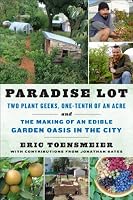
#14: Paradise Lot by Eric Toensmeier and Jonathan Bates – (Jul 13)
In 2004, two “plant nerds” (the primary and contributing authors) bought a duplex on a 1/10 acre lot of “urbanite” soil in Holyoke MA, with a plan to bring permaculture into an urban context. This is the story of their garden through seasons and years, with background of how each came to permaculture as a vocation, and bits of entwined life as both men marry and their wives introduce ideas and expertise. It is useful for its scale (it does not assume multiple acres and ample space for trees), its attitude (despite relevant education, much trial and error was involved, and the garden remains a work in progress), and its results (an appendix of mostly edible perennials that can make it through a New England winter). They advise a year of preparation, observing sunny and shady areas, testing (and amending) the soil; by this method (sketches are included), they determined the one location suitable for a greenhouse, and a microclimate where tropical plants could survive. The emphasis is on sustainable polyculture, low maintenance (perennials and self-seeding annuals, spreading but not invasive) and high density (multiple layers and multiple edible parts), attractive to wildlife (at least far more so than the average city yard), native when plausible but not ideologically purist. Not great literature, but informative and encouraging.
24qebo
#15: Only a Theory by Kenneth Miller -- (Jul 18)
Following up on his testimony at the Dover PA Intelligent Design trial, the author refutes several standard examples of “irreducible complexity”: the mousetrap analogy, the bacterial flagellum, and blood clotting, and suggests questions that ID proponents could ask if they were really scientists. Short (just over 200 pages), coherent, and civil; worth a read as either introduction or refresher.
25qebo
#16: Columbine by Dave Cullen -- (Aug 9)
I got this book after Sandy Hook. It is a detailed account, published a decade after the fact, of the Columbine HS massacre: the year plus of preparation and warning signs, the aftermath among survivors. Unsurprisingly, many anecdotes and speculations swirling around at the time were not true; a decade to disentangle seems about right. The portrayal is of a folie à deux, with Eric Harris as psychopath and Dylan Klebold as depressive, neither a pure case. Some of their messed up thinking slipped out to family and friends, setting off alarms and gestures of intervention, inadequate and unsustained, because who would’ve believed how deep it went? Other perspectives exist, but I’d just as soon not spend any more time with these people, so I’ll hope this one is good enough.
26mabith
I should probably put Columbine on my to-read list, but I fear I'd have a hard time talking myself into actually reading it. I was in 8th grade when it happened and things changed quite a lot at my school, yet, not enough (a kid called in a bomb scare as a 'joke' and very little happened to him because he was a popular jock and his parents were well-connected, but after Columbine they constantly came down extremely hard on us alternative kids over very small matters). So glad I went to a tiny, liberal Quaker boarding school for high school.
27qebo
#17: The Wildlife Gardener's Guide by Janet Marinelli -- (Sep 12)
I got this because it was mentioned somewhere in my traipsing around in native plant info, and I was about to visit the Brooklyn Botanic Garden, which publishes this book and others of its ilk. It is short and simple and unremarkable information-wise, but it is nicely organized with essentials for attracting birds and butterflies and beneficial insects, basic descriptions of various environments such as forests and floodplains, lists of appropriate native plants for different regions, instructions for spaces as small as a backyard border or window box. Nowhere near exhaustive, but a useful item to have around.
28qebo
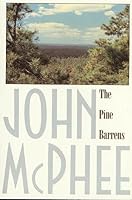
#18: The Pine Barrens by John McPhee – (Sep 30)
I’m not sure why I even have this book. Perhaps I tossed this into the pot with another book by John McPhee? I read it now because I’d been writing a review of Toms River which is on the edge of the pine barrens, and because it is short so why not. It was published as a book in 1967 after a run in New Yorker magazine. My paperback is recent. An epilogue of changes since then would’ve been a welcome feature, especially since the last chapter is about schemes in the past and pressures in the then-present to sell and develop the land. Also an index would’ve been nice. 45 years is long enough ago that it’s not so clear how much is time and how much is place. Local characters throughout, not so very exotic, but there is an interesting chapter on forest fires, and a couple of botanical bits stood out for me. (1) This is where cultivated blueberries were developed. In 1911, Elizabeth White read an article in a USDA publication suggesting the possibility of crossing wild blueberries for improved varieties, and invited its author Frederick Colville to use her family land for experiments. The collaboration was commercially successful, and some of the results were named after the “pineys” who collected blueberries, for example the Rubel blueberry. (2) An episode of Edgar Wherry leading a field trip through the woods, pointing to a “weed of civilization”, ebony spleenwort. It is not a pine barrens native, could not be, because the soil is too acidic. It enters as spores, and grows where lime was used for buildings, marking ruins even if there is no other visible
29qebo
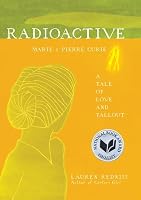
#19: Radioactive : A Tale of Love and Fallout by Lauren Redniss -- (Oct 5)
This is sort of a book about Marie and Pierre Curie, more about her than him because she lived for nearly three decades after he died. The science is more outlined than explained, more metaphysical than technical, but that’s OK; it’s an artistic perspective. The art is gorgeous, line drawings and cyanotype printing, appropriately glowy. The typeface was designed by the author, and whatever its artistic merits may be, as a practical matter I had to read in daylight to separate text from background. The mini-biographies include excerpts from letters and romantic touches (”Their handwritings intermingle in their notebooks.”), and several pages about her affair with Paul Langevin when she was widowed and he was married, which became a public scandal in 1911 as she was about to accept her second Nobel prize. (In 1948, her granddaughter married his grandson.) Throughout, in what seems a disorganized arrangement, and also unfair the Curies (who were of an earlier era, chose to give their discoveries to the world free of patents, researched the potential of radiation as a cure for cancer), are inserts about the “fallout”: e.g. personal anecdotes of Hiroshima, Chernobyl, Three Mile Island. So I have mixed feelings about the content, but the book is worth the price of admission for the art alone.
30qebo

#20: Natural Insect Control edited by Warren Schultz -- (Oct 8)
This is a short book, probably not intended to be read cover to cover, though I did. The longest section is on the pests, about one page each in alphabetical order, with descriptions of lifecycle, symptoms, controls, and an illustration of the pest in its pesty stage; this section might benefit from illustrations of the entire life cycle for recognition and context. Other sections are on cultural controls (e.g. crop rotation), beneficial insects (e.g. ladybugs), natural pesticides (e.g. alcohol). This is basic information, helpful if you’re starting from scratch, as I am. I’d expect more detailed books to exist, but this one is good enough as a first pass.
31banjo123
I am going to have to look for Radioactive. I have been interested in Curie ever since I read a biography of her in high school.
32qebo
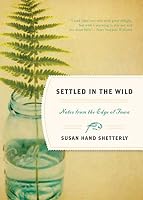
#21: Settled in the Wild by Susan Shetterly -- (Oct 22)
A collection of essays focusing on landscape and wildlife in and around Surry ME over several decades. All written evocatively, and semi-independently, without a connecting story arc; mentions of the author’s family, for example, have her married or divorced, with children toddlers or teenagers or grown and gone. The essays that stand out are about birds: turkeys, loons, cormorants, a raven whose flesh has grown over a strand of fishing line, a hawk with an injured eye. The author was licensed to rehabilitate wild birds; she is observant and compassionate.
33qebo
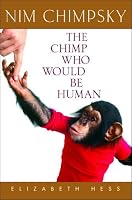
#22: Nim Chimpsky by Elizabeth Hess -- (Nov 5)
I read this because I’d just finished the novel We Are All Completely Beside Ourselves about a chimpanzee raised in a human family, and I happened to have this book around, apparently picked up while browsing bargain shelves some years ago. I’m sorry that I waited so long; it is excellent.
Nim Chimpsky was born in 1973 in the Institute for Primate Studies at the Oklahoma University, torn from his mother (who’d been through this before and was resigned to the routine) within weeks and sold to Columbia University for an experiment: would a chimpanzee raised in a human family communicate with a linguistic complexity that could be distinguished from mere mimicry. By then other experiments had established that chimpanzees lack the mechanics to vocalize human language, but can learn signs and symbols. Trouble ensued from the start. Nobody initially knew ASL so a window of developmental opportunity was missed. Nim did not live with the primary scientist; he lived with the family of a former student, and perspectives on caretaking differed, the rigorous requirements of a formal study vs the free-spirit style of the family. And chimpanzees occupy a space of almost-but-not-quite; not a pet, not a child. Nim was attached to the family and vice versa, engaging and clever, holding up his end of the deal with ASL, but his manners were far from impeccable. This was not unprecedented. Although chimpanzees are adorable as infants, within a few years they are too strong, too agile, too emotionally unconstrained for a household; they wreak havoc by accident or intention, and they bite. The family agonized but couldn’t cope, and Nim was moved to a university facility. In 1977, after further trouble and diminishing returns, the experiment was officially ended and he was sent back to Oklahoma University.
The book covers the two dozen plus years of Nim’s life as he is shunted around the country, caged and often isolated, a failed experiment and ruined for any other, his need for social interaction and communication not always recognized even by the most sympathetic caretakers. Just about everyone involved was interviewed for this book, which paints a detailed picture of affairs and animosities, a soap opera of psychologists. The chimpanzees seem quite civilized in comparison. Good things happen, and there are heroes you’ve never heard of, along with prominent names who are less savory than you might wish. An appendix gives a where-are-they-now (2008) update. An associated documentary film has numerous clips and summaries online.
34qebo
#23: Seabiscuit by Laura Hillenbrand -- (Nov 15)
Who would’ve thought that a horse would merit nearly 350 pages? I read this book because Unbroken was such a compelling page-turner; it seemed worth a try, but I was doubtful. And it drew me in completely. I’m not all that keen on horses, but the author conveyed the appeal of the Depression era public distraction of horse racing, with a cast of naturally colorful characters, no contrivance needed: the owner Charles Howard, who converted 21 cents into a bicycle repair shop and an automobile franchise; the trainer Tom Smith, who spoke to people in cleverly selected monosyllables but spoke to horses in their own language; the jockey Red Pollard, who successfully kept the secret that he was blind in one eye. All three saw something special in this horse of stellar pedigree but idiosyncratic and misunderstood form, who had been relegated to the lower tier of races. The style is an immersive you-were-there perspective, made possible by contemporary reports and interviews, a volume of minutiae that could’ve been a slog, but it is so skillfully arranged and presented that the effect is anxious anticipation. This incredibly talented horse was also fragile; hopes and reputations and dollars depended on the perfect alignment of fitness and race schedules, and there are several sequences of yes, it’s going to happen, it’s going to happen, ... oh no! And yet it has to happen, the crucial megabucks race with the top-ranked competition, or this horse would not be famous. Highly recommended.
35qebo
#24: A Thread Across the Ocean by John Steele Gordon -- (Dec 4)
Imagine a world in which news crosses the Atlantic Ocean several weeks after the fact; kings die, wars begin, and nobody knows. The electrical telegraph, invented in the 1830s, began to change this situation, and cables were rapidly strung across continents. A cable was laid across the Rhine in the 1840s, and across the English Channel in the 1850s, but the Atlantic Ocean was dauntingly vast, and it was not at all certain that a cable could be laid, let alone function.
Enter Cyrus Field, New York businessman from a prominent Massachusetts family, who enlisted a who’s who of 19th century technology (e.g. Peter Cooper of Cooper Union, Samuel Morse of Morse Code, William Thomson / Lord Kelvin of thermodynamics) in his mission to link Europe with North America with a trans-Atlantic telegraph cable, as well as negotiating with governments and persuading investors. He began with recognition of the shortest path, from Ireland to Newfoundland, and set the stage in 1854 by connecting Newfoundland to Nova Scotia and thus to the mainland, a learning experience. The first effort to cross the Atlantic in 1857 failed, another and very expensive learning experience that dampened enthusiasm for the project. 2000+ miles of cable is heavy; it had to be coiled onto and fed gradually off ships that couldn’t hold the full length, so two sections had to be spliced, and oops, the direction of the twist was not in the specs so two manufacturers made different decisions; it had to be tested continuously for a signal and if the signal ceased then there was no other way for the ships to communicate; if pulled or pushed or turned too sharply it snapped and fell to the bottom and had to be fished out; ships were vulnerable to storms and less able to maneuver when loaded with the heavy and precious cables and machinery; the volume of metal and insulation affected worldwide supplies and prices. Success did occur with the second effort in 1866, but was not at all guaranteed. This is a short book, but engaging and informative and a reminder not to take the modern world for granted.
36qebo
#25: Logavina Street by Barbara Demick -- (Dec 6)
I was quite mesmerized by Nothing to Envy a couple years ago, so got this earlier book, republished recently, as soon as I knew it existed. The style is similar, focused on a small set of ordinary people caught up in national politics, in that case the bizarro delusion of North Korea, in this case the disintegration of Yugoslavia. The author was a journalist stationed in Eastern Europe in the mid 1990s, and arrived in Sarajevo after world “empathy fatigue” had set in. Slovenia and Croatia and Bosnia had declared independence, and Sarajevo was surrounded by Serb nationalists lobbing bombs and shooting bullets into public spaces. The newspaper editors suggested that she choose a street, and interview its residents over time. A page at the beginning indicates the scale: a map of nations after the Dayton peace accord showing the location of Sarajevo, a map of Sarajevo surrounded by Serb front lines showing the location of Logavina street, a map of Logavina street showing the locations of its residents and other landmarks. Though electricity was intermittent, plumbing was nonexistent, and food was scarce, Sarajevo citizens took pride in their multi-ethnic enclave. The author captures both the fear and the moral resistance in day to day life. North Korea is tough to beat for compelling reading, and through no fault of its own this book falls short, but it’s still immersive and insightful and well worth attention.
37qebo
#26: Why Evolution is True by Jerry Coyne -- (Dec 12)
I read the author’s blog, as much as anything for the Hili Dialogues, so I figured I should read his book. It’s... OK. Well, it’s better than OK but I’m not really the target audience; the intent is persuasion, which isn’t necessary. It is though a useful overview of multiple lines of evidence for evolution, echoing On the Origin of Species, with modern updates.
38qebo
#27: Stiff by Mary Roach -- (Dec 23)
I’ve had this sitting around for years; it had potential as mildly engaging and informative, but never quite grabbed my immediate interest. I plucked it off the shelf after happening upon a positive review while I was open to finishing the year with random and not too long books. My reactions aren’t much different than my expectations. I’m not squeamish about cadavers in the abstract (in person might be a different matter), and the author’s attitude is respectful despite frequent insertions of punny humor. I learned that if you will your body to science, you can specify what you _don’t_ want done with it, but not what you _do_ want done with it, and since some of the things that can be done with it would never have crossed your mind, you’d best be flexible.
39qebo
#28: The Drunken Botanist by Amy Stewart -- (Dec 30)
This is not a book to read straight through cover to cover (though I did), but a book to have on hand for inspiration, experiment, and conversation, suitable for anyone whose interests include gardening and alcoholic drinks. It is packed with information: classic drink recipes, historical tales, botanical facts, gardening advice. Examples: the domestication of yeast, the origin of cork, the resurrection of an ancient date palm seed, the chemistry of licorice, why quinine glows under ultraviolet light; that apricots are close relatives of almonds, that cashews are close relatives of poison ivy. The author knows her way around plants, and apparently knows her way around alcohol too; depending on how long the research stretched out, it could’ve been anywhere from entertaining to debilitating. The book is divided into three sections: plants that are transformed into alcohol, plants that are integrated into the product, plants that mixed in or added as garnish for serving. Each section is arranged by plant type or component: grains, fruits, flowers, trees, herbs, spices, roots, seeds, nuts... in alphabetical order by common name, with frequent insertions of “grow your own”, “a field guide to...”, “bugs in booze”. Open it to any random page and meander.
The ARC lacks an index, and for this reason I intend to purchase the real thing.

