1001 Books - Let's just take it a book at a time...
Talk 1001 Books to read before you die
Join LibraryThing to post.
This topic is currently marked as "dormant"—the last message is more than 90 days old. You can revive it by posting a reply.
1M1nks


This is something I've been interested in doing for years after realising that I stopped reading a lot of published fiction and was really only reading historical non fiction because I couldn't find any books which I thought guaranteed me a good read. Or at least promised to be worth my time investment even if I didn't like it in the end.
When I found the initial 1001 list I got quite enthusiastic although my ardour was cooled somewhat by the obvious slant towards English writers and the huge oversampling of certain authors. I wanted to read a variety and if I found I detested an author and then 'had' to read another 7 of his works... Argh!
And yes, I know you don't 'have' to actually read every book, but, well if you are going to start something like this...
I also moved away from any library which made getting books rather more problematic.
However, skip forward a few years and I now have access to a few libraries again, I have two electronic readers and have discovered the wonderful Open Library system which makes tracking down books so much easier. The list itself has also hugely improved and includes a lot more work from around the globe and a lot less oversampling. All of which have made me decide that it's time to revisit this list.
Also, I'm not sure if other people have this problem but I found that going through the list, that about half of what I had read already was so vaguely remembered that I am really going to have to reread them. Blast :-) So, I have started up a blog to log the books that I remember and as I move through the list; hopefully this will assist in my memory!
Anyway, I have a goal and an incentive to keep reading. I'm about 8% through the 2012 list (which is the one I'm using).
Edit: Current progress at around 22% of the 2012 list and 20% of the full Combined.
Pre 1700's
1 The Thousand and One Nights
2 Tale of the Bamboo Cutter
3 Aesop’s Fables
4 The Golden Ass
5 Don Quixote
6 The Pilgrim’s Progress
7 Oroonoko
1700s
8 Robinson Crusoe
9 Moll Flanders
10 Gulliver’s Travels
11 A Modest Proposal
12 Tom Jones
13 Fanny Hill
14 The Female Quixote
15 Candide
16 The Castle of Otranto
17 The Vicar of Wakefield
18 A Sentimental Journey
19 Dangerous Liaisons
20 The Monk
21 The Nun
1800s
22 Sense and Sensibility
23 Pride and Prejudice
24 Mansfield Park
25 Emma
26 Frankenstein
27 Last of the Mohicans
28 Oliver Twist
29 The Fall of the House of Usher
30 Dead Souls
31 The Pit and the Pendulum
32 The Three Musketeers
33 The Count of Monte-Cristo
34 Jane Eyre
35 Vanity Fair
36 Wuthering Heights
37 The Tenant of Wildfell Hall
38 David Copperfield
39 The Scarlet Letter
40 Moby-Dick
41 Bleak House
42 North and South
43 Madame Bovary
44 The Woman in White
45 The Mill on the Floss
46 Great Expectations
47 Les Misérables
48 Uncle Silas
49 Alice’s Adventures in Wonderland
50 Journey to the Centre of the Earth
51 Crime and Punishment
52 The Moonstone
53 Little Women
54 War and Peace
55 Through the Looking Glass
56 Middlemarch
57 Around the World in Eighty Days
58 Far from the Madding Crowd
59 Drunkard
60 Anna Karenina
61 The Portrait of a Lady
62 Treasure Island
63 The Adventures of Huckleberry Finn
64 King Solomon’s Mines
65 The Strange Case of Dr. Jekyll and Mr. Hyde
66 Hunger
67 The Picture of Dorian Gray
68 Tess of the D’Urbervilles
69 The Adventures of Sherlock Holmes
70 Diary of a Nobody
71 The Time Machine
72 The Island of Dr. Moreau
73 Dracula
74 What Maisie Knew
75 The War of the Worlds
76 As a Man Grows Older
77 The Awakening
78 Persuasion
79 Northanger Abbey
80 The Life and Adventures of Nicholas Nickleby
81 A Christmas Carol
82 Martin Chuzzlewit
83 The Purloined Letter
84 La Reine Margot
85 Hard Times
86 A Tale of Two Cities
87 Our Mutual Friend
88 Daniel Deronda
89 The Brothers Karamazov
90 Kidnapped
91 The Mayor of Casterbridge
92 The Yellow Wallpaper
93 The Turn of the Screw
.
2M1nks
1900s
94 Buddenbrooks
95 The Hound of the Baskervilles
96 Heart of Darkness
97 The Wings of the Dove
98 The Call of the Wild
99 The House of Mirth
100 A Room With a View
101 Howards End
102 Sons and Lovers
103 The Thirty-Nine Steps
104 Of Human Bondage
105 The Good Soldier
106 The Home and the World
107 Women in Love
108 The Age of Innocence
109 Ulysses
110 Life and Death of Harriett Frean
111 Siddhartha
112 A Passage to India
113 The Trial
114 The Great Gatsby
115 Mrs. Dalloway
116 The Murder of Roger Ackroyd
117 To The Lighthouse
118 Steppenwolf
119 Lady Chatterley’s Lover
120 Orlando
121 Cold Comfort Farm
122 Brave New World
123 Testament of Youth
124 Miss Lonelyhearts
125 The Street of Crocodiles
126 Thank You, Jeeves
127 Tender is the Night
128 The Postman Always Rings Twice
129 Independent People
130 At the Mountains of Madness
131 Gone With the Wind
132 Out of Africa
133 The Hobbit
134 Of Mice and Men
135 The Big Sleep
136 The Grapes of Wrath
137 The Little Prince
138 The Razor’s Edge
139 Pippi Longstocking
140 Animal Farm
141 The Bridge on the Drina
142 Midaq Alley
143 Cry, the Beloved Country
144 Nineteen Eighty-Four
145 Love in a Cold Climate
146 The Garden Where the Brass Band Played
147 I, Robot
148 The Grass is Singing
149 A Town Like Alice
150 The 13 Clocks
151 The Catcher in the Rye
152 Day of the Triffids
153 The Old Man and the Sea
154 A Thousand Cranes
155 Casino Royale
156 Lucky Jim
157 Lord of the Flies
158 Lolita
159 The Lord of the Rings
160 On the Road
161 The Once and Future King
162 The Leopard
163 Breakfast at Tiffany’s
164 Billiards at Half-Past Nine
165 Naked Lunch
166 To Kill a Mockingbird
167 The Country Girls
168 God's Bits of Wood
169 Catch-22
170 The Prime of Miss Jean Brodie
171 Faces in the Water
172 Stranger in a Strange Land
173 Pale Fire
174 A Clockwork Orange
175 One Flew Over the Cuckoo’s Nest
176 One Day in the Life of Ivan Denisovich
177 The Bell Jar
178 Silence
179 The Master and Margarita
180 One Hundred Years of Solitude
181 Do Androids Dream of Electric Sheep?
182 2001: A Space Odyssey
183 Portnoy’s Complaint
184 Slaughterhouse Five
185 Here's to You, Jesusa
186 I Know Why the Caged Bird Sings
187 The Summer Book
188 The Optimist's Daughter
189 A Dance to the Music of Time
190 Interview With the Vampire
191 Quartet in Autumn
192 The Shining
193 The Cement Garden
194 Hitchhiker’s Guide to the Galaxy
195 So Long a Letter
196 Midnight’s Children
197 The Color Purple
198 If Not Now, When?
199 Shame
200 The Wasp Factory
201 Democracy
202 The Lover
203 Dictionary of the Khazars
204 The Handmaid’s Tale
205 Contact
206 The Cider House Rules
207 Love in the Time of Cholera
208 Watchmen
209 The New York Trilogy
210 The Bonfire of the Vanities
211 Dirk Gently’s Holistic Detective Agency
212 Paradise of the Blind
213 Like Water for Chocolate
214 Remains of the Day
215 London Fields
216 Moon Palace
217 Sexing the Cherry
218 Get Shorty
219 Wild Swans
220 Written on the Body
221 The English Patient
222 Possessing the Secret of Joy
223 Birdsong
224 Captain Corelli’s Mandolin
225 Our Lady of the Assassins
226 Infinite Jest
227 Memoirs of a Geisha
228 The Hours
229 The Voyage Out
230 The Garden Party
231 The Sound and the Fury
232 Harriet Hume
233 Cakes and Ale
234 The Pursuit of Love
235 Cannery Row
236 The Drowned World
237 The Collector
238 Chocky
239 Troubles
240 Sula
241 Grimus
242 The World According to Garp
243 Queer
244 Oranges Are Not the Only Fruit
245 The Long Dark Teatime of the Soul
246 Black Dogs
247 Jazz
248 The Robber Bride
249 American Pastoral
250 Tipping the Velvet
251 Amsterdam
252 Timbuktu
2000s
253 White Teeth
254 The Devil and Miss Prym
255 Atonement
256 Life of Pi
257 The Book about Blanche and Marie
258 The Sense of an Ending
259 The Art of Fielding
260 1Q84
261 The Blind Assassin
262 The Colour
263 Drop City
264 Never Let Me Go
265 A Short History of Tractors in Ukrainian
94 Buddenbrooks
95 The Hound of the Baskervilles
96 Heart of Darkness
97 The Wings of the Dove
98 The Call of the Wild
99 The House of Mirth
100 A Room With a View
101 Howards End
102 Sons and Lovers
103 The Thirty-Nine Steps
104 Of Human Bondage
105 The Good Soldier
106 The Home and the World
107 Women in Love
108 The Age of Innocence
109 Ulysses
110 Life and Death of Harriett Frean
111 Siddhartha
112 A Passage to India
113 The Trial
114 The Great Gatsby
115 Mrs. Dalloway
116 The Murder of Roger Ackroyd
117 To The Lighthouse
118 Steppenwolf
119 Lady Chatterley’s Lover
120 Orlando
121 Cold Comfort Farm
122 Brave New World
123 Testament of Youth
124 Miss Lonelyhearts
125 The Street of Crocodiles
126 Thank You, Jeeves
127 Tender is the Night
128 The Postman Always Rings Twice
129 Independent People
130 At the Mountains of Madness
131 Gone With the Wind
132 Out of Africa
133 The Hobbit
134 Of Mice and Men
135 The Big Sleep
136 The Grapes of Wrath
137 The Little Prince
138 The Razor’s Edge
139 Pippi Longstocking
140 Animal Farm
141 The Bridge on the Drina
142 Midaq Alley
143 Cry, the Beloved Country
144 Nineteen Eighty-Four
145 Love in a Cold Climate
146 The Garden Where the Brass Band Played
147 I, Robot
148 The Grass is Singing
149 A Town Like Alice
150 The 13 Clocks
151 The Catcher in the Rye
152 Day of the Triffids
153 The Old Man and the Sea
154 A Thousand Cranes
155 Casino Royale
156 Lucky Jim
157 Lord of the Flies
158 Lolita
159 The Lord of the Rings
160 On the Road
161 The Once and Future King
162 The Leopard
163 Breakfast at Tiffany’s
164 Billiards at Half-Past Nine
165 Naked Lunch
166 To Kill a Mockingbird
167 The Country Girls
168 God's Bits of Wood
169 Catch-22
170 The Prime of Miss Jean Brodie
171 Faces in the Water
172 Stranger in a Strange Land
173 Pale Fire
174 A Clockwork Orange
175 One Flew Over the Cuckoo’s Nest
176 One Day in the Life of Ivan Denisovich
177 The Bell Jar
178 Silence
179 The Master and Margarita
180 One Hundred Years of Solitude
181 Do Androids Dream of Electric Sheep?
182 2001: A Space Odyssey
183 Portnoy’s Complaint
184 Slaughterhouse Five
185 Here's to You, Jesusa
186 I Know Why the Caged Bird Sings
187 The Summer Book
188 The Optimist's Daughter
189 A Dance to the Music of Time
190 Interview With the Vampire
191 Quartet in Autumn
192 The Shining
193 The Cement Garden
194 Hitchhiker’s Guide to the Galaxy
195 So Long a Letter
196 Midnight’s Children
197 The Color Purple
198 If Not Now, When?
199 Shame
200 The Wasp Factory
201 Democracy
202 The Lover
203 Dictionary of the Khazars
204 The Handmaid’s Tale
205 Contact
206 The Cider House Rules
207 Love in the Time of Cholera
208 Watchmen
209 The New York Trilogy
210 The Bonfire of the Vanities
211 Dirk Gently’s Holistic Detective Agency
212 Paradise of the Blind
213 Like Water for Chocolate
214 Remains of the Day
215 London Fields
216 Moon Palace
217 Sexing the Cherry
218 Get Shorty
219 Wild Swans
220 Written on the Body
221 The English Patient
222 Possessing the Secret of Joy
223 Birdsong
224 Captain Corelli’s Mandolin
225 Our Lady of the Assassins
226 Infinite Jest
227 Memoirs of a Geisha
228 The Hours
229 The Voyage Out
230 The Garden Party
231 The Sound and the Fury
232 Harriet Hume
233 Cakes and Ale
234 The Pursuit of Love
235 Cannery Row
236 The Drowned World
237 The Collector
238 Chocky
239 Troubles
240 Sula
241 Grimus
242 The World According to Garp
243 Queer
244 Oranges Are Not the Only Fruit
245 The Long Dark Teatime of the Soul
246 Black Dogs
247 Jazz
248 The Robber Bride
249 American Pastoral
250 Tipping the Velvet
251 Amsterdam
252 Timbuktu
2000s
253 White Teeth
254 The Devil and Miss Prym
255 Atonement
256 Life of Pi
257 The Book about Blanche and Marie
258 The Sense of an Ending
259 The Art of Fielding
260 1Q84
261 The Blind Assassin
262 The Colour
263 Drop City
264 Never Let Me Go
265 A Short History of Tractors in Ukrainian
5M1nks
I just finished Atonement. I'm not sure if I'm meant to add it to my list or not, although I guess it's my thread so I can do what I like?
Anyway, here is what I posted on Goodreads as a pre review comment:
I ended up enjoying it but I found it rather difficult to really enjoy at first. I liked the start very much but then it started to get a bit samey. There was a lot of 'delicate literary allusions and descriptive passages' which I liked at first but then it started to grate on me as pretentious and I just wanted some action.
I think looking back on it, that this was deliberate as there were three different points of view and the two 'pretentious' ones came from the girls, while the guys was a lot more blunt and direct. I'd have to read more of Ian McEwan to be sure (first time reading him). It also wasn't helped that I do a lot of my reading on the train into and back from work and I think I might have been better served reading it in bigger chunks. The last 140 pages or so I really found griping and I stayed up past my bedtime finishing it.
I'll do a proper review on my blog but I've still got to publish The Shining first.
I rate this 3 1/2 stars. Well written and enjoyable but lacking that spark which would make it truly amazing.
Anyway, here is what I posted on Goodreads as a pre review comment:
I ended up enjoying it but I found it rather difficult to really enjoy at first. I liked the start very much but then it started to get a bit samey. There was a lot of 'delicate literary allusions and descriptive passages' which I liked at first but then it started to grate on me as pretentious and I just wanted some action.
I think looking back on it, that this was deliberate as there were three different points of view and the two 'pretentious' ones came from the girls, while the guys was a lot more blunt and direct. I'd have to read more of Ian McEwan to be sure (first time reading him). It also wasn't helped that I do a lot of my reading on the train into and back from work and I think I might have been better served reading it in bigger chunks. The last 140 pages or so I really found griping and I stayed up past my bedtime finishing it.
I'll do a proper review on my blog but I've still got to publish The Shining first.
I rate this 3 1/2 stars. Well written and enjoyable but lacking that spark which would make it truly amazing.
6Yells
Your thread, your rules! I think most of us have a general thread with an overall list of what we have read and then we continually add the newbies to it. If you join the Progress List thread, Jonny will check here once a month or so and update your totals from here.
7M1nks
Wow, I'm reading Les Miserables as my 'bath book' and I've just read an amazing section on the battle of Waterloo. I had no idea it was there - my only experience of Les Mis is the musical (which is great). Such fantastic things this list throws my way.
Also posted my review of The Shining and started on Atonement.
Also posted my review of The Shining and started on Atonement.
8ELiz_M
>7 M1nks: I stayed up very very late one night reading the Waterloo section of Les Mis because I NEEDED to find out who won (even though I knew who lost....)
10ipsoivan
>1 M1nks: yup, I have the same problem as you mention here. I read a lot of the books at some point, but really can't remember them. Without going back over to my own thread, I'm guessing I started out enthusiastically saying that I had covered about 270 books, then on looking them over realized I could remember the details of maybe 170. I sheepishly updated. I'm enjoying the revisits.
11M1nks
Thanks Paruline - I'm sure you'll notice that I'm heavily slanted towards the classics! Virtually nothing in my list which isn't. Which is the great thing about the 1001 challenge of course, it will make me read those authors which wouldn't normally come my way. I have discovered Attwood (although she's hardly modern modern I suppose), Burroughs (ditto) and McEwan.
12M1nks
It's maddening isn't it! Having a blog and writting a review is a good mind focuser though. I'm trying to write things which might be of interest to others if they want to read them, don't contain lots of spoilers but will still be a memory jog to me if I find details starting to fade.
Just taking the effort to do this means the books already cement in my head just that little bit more.
Just taking the effort to do this means the books already cement in my head just that little bit more.
13M1nks
Although Ipsoivan looking back on my list I found that I was rather hard on myself. Due to my habit of rereading books I actually found that most of them I could remember. It was more those that I'd only read the once which failed the test. About 5 which isn't too bad.
14M1nks
Ok, so I had a very chilled out day reading the montly read The Mill on the Floss (which I greatly enjoyed) and then went 'that was great - NEXT!' and went to get out Dead Souls from the Open Library only to find that I'd lost broadband. All weekend and it's still down! Gagh! Very frustrating.
So, no Dead Souls for me yet. I do have The Monk still on my Nook and also The Woman in White which I started reading but Dead Souls might have to wait unless I can download it at work or something...
So, no Dead Souls for me yet. I do have The Monk still on my Nook and also The Woman in White which I started reading but Dead Souls might have to wait unless I can download it at work or something...
16M1nks
Too late :-) I was already 15% into The Woman in White and quite hooked and then I picked up Dead Souls at work and transported it home on a USB stick and loaded it into my nook. Now I'm about halfway through that and loving it. It's the first bit of Russian Lit I've found which is funny. I was beginning to think the whole lot of them didn't understand the concept of humour...
17M1nks
As an aside I have just realised that the last books I've read/are reading are: The Mill on the Floss, Les Miserables, The Monk, The Woman in White and Dead Souls.
So much for trying to read something a bit more modern! My new Book Club read is Jack Kerouac 'On the Road' which is from the 1950's - at least a wee bit closer to the present day. I know nothing about Kerouac's work but according to the very little I've let myself look at on Wikipedia he is a 'Beats generation' writer so that might dovetail in nicely with the William Borroughs novel I just read.
So much for trying to read something a bit more modern! My new Book Club read is Jack Kerouac 'On the Road' which is from the 1950's - at least a wee bit closer to the present day. I know nothing about Kerouac's work but according to the very little I've let myself look at on Wikipedia he is a 'Beats generation' writer so that might dovetail in nicely with the William Borroughs novel I just read.
18aliciamay
I've been focused more on the classics too, they're just so readable. I need to pace myself or I'll wind up with only modern books full of stream of consciousness and magical realism left to read!
19M1nks
Finished Dead Souls or rather read as much as Gogol had written before destroying his work. I also started to read the bit which was tacked on the end to ‘finish it’ but very quickly agreed with the pre warning in that it was ‘third rate’. In truth, utter tripe and I didn’t want to ruin the great book I’d just read with someone’s pathetic attempt to tie up the loose ends.
John Kerouac next :-)
John Kerouac next :-)
20M1nks
Started The Street of Crocodiles which came available through the Open Library. I'm absolutely blown away, I can't remember reading anything so beautiful. I'll be adding a physical copy to my shelves for sure.
21M1nks
Just finished The Woman in White which I greatly enjoyed. I do find Wilkie Collins a bit silly, I bought No Name several years ago and read it having no idea of who he was and I thought that was really ridiculous.
This book had a great story attached to it though so I forgave it.
This book had a great story attached to it though so I forgave it.
22M1nks
I'm nearly finished The Street of Crocodiles I absolutely love it but it's a book that you need to be in the mood for. Even though I only have a short bit left I don't want to force it until I'm ready to really appreciate it.
I've also now started Sons and Lovers and will also re-read The Adventures of Sherlock Holmes and The Murder of Rodger Ackroyd as well. I've picked those 3 as part of my seasonal book challenge as all 3 could do with a revisit although it's only really Sons and Lovers than I can barely remember any of.
I'm still nibbling away at one of my bath books Les Miserables as well, just read a fantastic bit about a convent - the detail! I'm really impressed by this work
EDIT - probably won't be reading Rodger Ackroyd and Sherlock Holmes now - change of reading plan.
I've also now started Sons and Lovers and will also re-read The Adventures of Sherlock Holmes and The Murder of Rodger Ackroyd as well. I've picked those 3 as part of my seasonal book challenge as all 3 could do with a revisit although it's only really Sons and Lovers than I can barely remember any of.
I'm still nibbling away at one of my bath books Les Miserables as well, just read a fantastic bit about a convent - the detail! I'm really impressed by this work
EDIT - probably won't be reading Rodger Ackroyd and Sherlock Holmes now - change of reading plan.
23M1nks
Oh and I'm also reading Out of Africa from the Open Library but it's only available as an internet book so I can't download it to my readers which makes things a bit awkward.
24M1nks
Started The Home and The World which I downloaded to my kindle. I'm not enjoying it. The 3 characters are all frustrating; one is so 'good' he does bad, one is weak willed and stupid and the other is evil, greedy and venal.
Fortunately it's very short.
Fortunately it's very short.
25paruline
>24 M1nks:, Really? I loved that one; one of my best find on the list. I thought the themes were universal and timeless and the writing flowed beautifully.
26M1nks
That's literature for you; one persons art is another persons firestarter :-)
Reading Sons and Lovers in my efforts to avoid it; I am really enjoying S & L this time, I think I was just a bit too young at 16 or 17 for it
Reading Sons and Lovers in my efforts to avoid it; I am really enjoying S & L this time, I think I was just a bit too young at 16 or 17 for it
27paruline
>26 M1nks:, too true. Life would be boring if we all liked the same books :)
28M1nks
Right, well I finished The Home and the World, it got slightly less annoying but I still found it pointless. This is one book which left me feeling blank.
It did have its good points; I liked the very start, I found the moving between 3 narrators interesting right up until I disliked all three of them and the slice of Indian history was a little interesting as well.
But, I'm just glad it was short and can only rate it 1 star. Not my sort of book at all.
It did have its good points; I liked the very start, I found the moving between 3 narrators interesting right up until I disliked all three of them and the slice of Indian history was a little interesting as well.
But, I'm just glad it was short and can only rate it 1 star. Not my sort of book at all.
29M1nks
Reread Sons and Lovers which, as I said in an earlier post I enjoyed a lot more than I remembered the first time around. However I once again found the parts which irritated; the constant conflict between men and women, the love/hate relationships that everybody seemed to have, the casual cruelty that people would use on those nearest to them without once! getting a ding around the ear and told to sod the hell off!
I also found his passionate scenes about as erotic as a cold flannel on a winters morning.
That being said that it was still a good book. I liked the details of the era, the day to day living, the quiet stoicism of the working class. When dealing with these topics D H Lawrence was at his best; when try to convey intricate human relationships through indecisiveness and arguments I just got horribly bored and thought 'Oh for pete's sake, not this again!'.
I also found his passionate scenes about as erotic as a cold flannel on a winters morning.
That being said that it was still a good book. I liked the details of the era, the day to day living, the quiet stoicism of the working class. When dealing with these topics D H Lawrence was at his best; when try to convey intricate human relationships through indecisiveness and arguments I just got horribly bored and thought 'Oh for pete's sake, not this again!'.
30M1nks
I intend to start on Around The World in 80 Days as my electronic book. That should make a pleasant change from Lawrence. It's a little shorter than I expected I must say, he must cram a lot in.
31M1nks
Finished Around the World in 80 Days. Very short and very dry. Much preferred the TV series (Brosnan) which is a shame. For such a fabulous story to be so colourless is just tragic - what a waste! What a great premise for a story and it was reduced to a bland race across the world without the least time for smelling the flowers along the way.
I found a few of the changes from the series to be interesting such as when travelling across America and being attacked by Indians, in the book Aouda (Princess Aouda in the tv version - another way they strip the romance out of everything! AND they straight away dress her in 'proper' European clothes instead of having her wear the beautiful indian saris) shoots a gun in defence. In the show however she declares that they are only defending their land against invaders, that she fully understands how they feel and forbids Passpartout to attack them.
It was still an entertaining read I just thought it sad because it could have been so much more. However that's what so great about the shows and films which it spawned. Other people obviously thought the same thing and fleshed out the skeleton of the book into a magnificent adventure. And for that I can say Thank You Mr Verne.
And I've ordered the DVDs so I can rewatch them, Pierce Brosnan is very dishy in the role (not that that influenced me!
I found a few of the changes from the series to be interesting such as when travelling across America and being attacked by Indians, in the book Aouda (Princess Aouda in the tv version - another way they strip the romance out of everything! AND they straight away dress her in 'proper' European clothes instead of having her wear the beautiful indian saris) shoots a gun in defence. In the show however she declares that they are only defending their land against invaders, that she fully understands how they feel and forbids Passpartout to attack them.
It was still an entertaining read I just thought it sad because it could have been so much more. However that's what so great about the shows and films which it spawned. Other people obviously thought the same thing and fleshed out the skeleton of the book into a magnificent adventure. And for that I can say Thank You Mr Verne.
And I've ordered the DVDs so I can rewatch them, Pierce Brosnan is very dishy in the role (not that that influenced me!
32hdcclassic
For me the preferred version is the cartoon series with anthropomorphic animals that came out when I was a kid, likewise fleshed out.
After that the book was a bit boring. Verne had imagination but I think it can be agreed some of his books greatly benefit from having visuals in them too.
After that the book was a bit boring. Verne had imagination but I think it can be agreed some of his books greatly benefit from having visuals in them too.
33M1nks
My steady nibbling away at Les Miserables is working, today I definitely have less to read than I have already covered! Page 795 and I'm right in the middle of a dramatic scene that I had to leave because my bath water was really cold...
34M1nks
I've started on one of my library books (The New York Trilogy) although my reading of 1001 dropped a bit over the last three days while as I read another Harry Potter and an Agatha Christie, watched the BBC's Tom Jones and played some computer games. Just needed a little break.
35M1nks
Finished Out of Africa which I found a very good read. I didn't find it condescending or racist at all (which I see some reviewers found it); I saw a slightly removed observer from a different culture talking about her impressions of different cultures, people and situations and I found it all quite fascinating.
Far more than any slight tinges of colonial superiority, I found the occasional casual brutal treatment of animals to be the most distressing but like with most things I just accepted it and moved on.
Far more than any slight tinges of colonial superiority, I found the occasional casual brutal treatment of animals to be the most distressing but like with most things I just accepted it and moved on.
36M1nks
Started listening to life of pi as my first audiobook while walking the dog, walking to work, exercising, housework etc. It sounds great so far. The Library only has a 'very' limited collection of audio books and I only have them for a week so I'll have to keep getting them out (so long as no one else takes them out).
37M1nks
paradise of the blind err whoops... I was just meaning to have a little taste and then... It's really short! And easy to read! It was gone before I knew it:-(
38M1nks
I fell for the Greenwich Library thing again! Gah! I see a green tree and think that it's got to be the right one. Hopefully now I'll remember my local Greenwich is red not green, has a flower not a tree and had 'Royal Borough of' in front of it.
39M1nks
My current reading progress:
I'm about half an hour from the (hopefully) grand finale of Life of Pi and I'm itching to know if my feelings of 'hold on a gosh darned minute!' are going to be fully realised. I'm still at work and I have about another 4 hours before I can plug myself into my mp3 player for the trip home. I feel really quite grateful to the 1001 list for pushing it my way as it's possible I wouldn't have ever read it. The Goodreads Seasonal Challenge deserves a special mention as well for suggesting this book for one of their tasks (a book that is set at least 50% on the sea); otherwise I might have had to re-read Moby Dick and even though I know I should I can't say the thought is currently filling me with enthusiasm...
I already have another audio book loaded and ready to go, The Cement Garden. I discovered that audio books loaded onto my player don't expire like my e-books do. Which is great because I only get them for a week via my libraries and that is really not enough.
For the rest of my reading, after noming up Paradise of the Blind in a single session, I am polishing off Thousand Cranes which is very very short. My OpenLibrary has 6 books lined up, one of which, Get Shorty I see has just become available. I only have a day to grab it and 2 weeks to read it so I'd best get a motor on.
The other five will slowly work their way through to me. No real rush, especially for Testament of Youth which I don't want to get hold of too far before November. I've got 2 people in front of me so it could be a week or month. It seems to be difficult to predict.
At home I still have The New York Trilogy, A Short History of Tractors in Ukrainian, IQ84 and Les Miserables to finish off/get started on.
Other than that I have a physical book The brothers Karamazov with the Feydor? translation which was recommended to me ready to pick up from my local library.
So, a nice lot of reading to be continuing on with, nicely interspersed with some Harry Potter and Agatha Christie's. Ah, it's so nice to be reading some decent books again and to have my complaints of 'I can't find anything decent to read!' be a thing of the past :-)
I'm about half an hour from the (hopefully) grand finale of Life of Pi and I'm itching to know if my feelings of 'hold on a gosh darned minute!' are going to be fully realised. I'm still at work and I have about another 4 hours before I can plug myself into my mp3 player for the trip home. I feel really quite grateful to the 1001 list for pushing it my way as it's possible I wouldn't have ever read it. The Goodreads Seasonal Challenge deserves a special mention as well for suggesting this book for one of their tasks (a book that is set at least 50% on the sea); otherwise I might have had to re-read Moby Dick and even though I know I should I can't say the thought is currently filling me with enthusiasm...
I already have another audio book loaded and ready to go, The Cement Garden. I discovered that audio books loaded onto my player don't expire like my e-books do. Which is great because I only get them for a week via my libraries and that is really not enough.
For the rest of my reading, after noming up Paradise of the Blind in a single session, I am polishing off Thousand Cranes which is very very short. My OpenLibrary has 6 books lined up, one of which, Get Shorty I see has just become available. I only have a day to grab it and 2 weeks to read it so I'd best get a motor on.
The other five will slowly work their way through to me. No real rush, especially for Testament of Youth which I don't want to get hold of too far before November. I've got 2 people in front of me so it could be a week or month. It seems to be difficult to predict.
At home I still have The New York Trilogy, A Short History of Tractors in Ukrainian, IQ84 and Les Miserables to finish off/get started on.
Other than that I have a physical book The brothers Karamazov with the Feydor? translation which was recommended to me ready to pick up from my local library.
So, a nice lot of reading to be continuing on with, nicely interspersed with some Harry Potter and Agatha Christie's. Ah, it's so nice to be reading some decent books again and to have my complaints of 'I can't find anything decent to read!' be a thing of the past :-)
40M1nks
Annnnd Possessing the Secret of Joy also just came up on my OpenLibrary list so that's another one to add to the pile!
44Simone2
You mean Life of Pi? The end is great, isnt' it? Gave me something to think about!
45M1nks
Yes, Life of Pi, I saw parts of it coming, or rather, I was getting suspicious but it was better and more detailed. But I just loved the book. The humour, the interesting animal tales (I've always loved nature shows). The audio version I listened to was fantastic. It's going to be a hard act to follow.
46annamorphic
Who read your audio? that's a book I haven't read and I'm always on the lookout for good audios.
47M1nks
Jeff Woodman and Alexander Marshall; I put in down in the audio thread which I'm going to go through especially carefully now that I've worked out how audio books can greatly expand my 'reading time'.
I started listening to The Cement Garden on the walk from the train station to work this morning and although I'm not quite half an hour in it does suffer, as I feared it would, from being listened to after Life of Pi. It's well read, the voice is clear and expressive even if it's rather flat in tone. He drops into a school boy hush of repressed excitment when talking about 'naughty things'. But, it's a dull drab setting, not India, a zoo or the Pacific Ocean.
I'm also thinking that it's only 4 and a half hours so it will be gone in a few days or less so I'll need get hold of something fast. It's a shame I haven't managed to get any more of list from my seasonal reading challenge on audio but maybe I just haven't been looking hard enough.
I started listening to The Cement Garden on the walk from the train station to work this morning and although I'm not quite half an hour in it does suffer, as I feared it would, from being listened to after Life of Pi. It's well read, the voice is clear and expressive even if it's rather flat in tone. He drops into a school boy hush of repressed excitment when talking about 'naughty things'. But, it's a dull drab setting, not India, a zoo or the Pacific Ocean.
I'm also thinking that it's only 4 and a half hours so it will be gone in a few days or less so I'll need get hold of something fast. It's a shame I haven't managed to get any more of list from my seasonal reading challenge on audio but maybe I just haven't been looking hard enough.
48M1nks
Thousand Cranes is down. A rather interesting read; it took me a little while to get into the flow and head of the Japanese characters. I remembered parts of my holiday in Japan oh so many years ago when I spent 3 weeks visiting a friend who had lived there for three years and was coming home. The Tea Ceremony, the dance, the politeness and careful social interactions. Once I got there it all became a lot easier.
51M1nks
Oh I 'liked' it. It was just, the subject matter was a little disturbing. Most of it was fairly disturbing.
Maybe it wasn't so different from Life of Pi after all, if you look at some of the message of the two books through very filtered lenses.
Very, very, filtered lenses.
Maybe it wasn't so different from Life of Pi after all, if you look at some of the message of the two books through very filtered lenses.
Very, very, filtered lenses.
52M1nks
I finished reading A Short History of Tractors in Ukrainian which was a lovely little read. I'm not sure what I was expecting but that wasn't it regardless.
I've put Les Miserables to one side for now while I concentrate on reading all of my library books. IQ84 should be next but it's a bulky, heavy hardback which is very inconvenient both for lugging around on the train to read to and from work and for reading in the bath. It's a shame I didn't get that one as an ebook.
I've put Les Miserables to one side for now while I concentrate on reading all of my library books. IQ84 should be next but it's a bulky, heavy hardback which is very inconvenient both for lugging around on the train to read to and from work and for reading in the bath. It's a shame I didn't get that one as an ebook.
53M1nks
My audio book worries are over for a while. I just found Les Miserables - it wasn't filed under 'Literature' for some reason. God knows who does the classifying - One of the greatest novels of all time isn't literature but Magic Ballerina and Mr Stink is.
I'm about 2/3rds of the way through so I don't need the entire 57 hours :-)
I'm about 2/3rds of the way through so I don't need the entire 57 hours :-)
54M1nks
Ugh, changed my mind. Just listened to some of it - the voice is unbearable. An english voice so 'posh' in tone it sounds like he's taking the mickey. Deep gasping breaths and running words hurridly into each other. Awful. I'll have to find something else, I'm not listening to that for 5 minutes, let alone 5 days.
55M1nks
Fahrenheit 451 I'll this instead.
56M1nks
Finally finished up The New York Trilogy. It’s been dragging around in my handbag for a while as it was a bit of a tedious read. A shame really. I loved the start and quite enjoyed the ending but the middle, especially the 2nd story Ghosts, rather ground me down. I just got sick of it. The main theme of the book/s (City of Glass/Ghost/The Locked Room) was identity or the lack of it. People changed, merged, substituted themselves; In Ghosts they mostly didn’t have real names at all but were Mr White, Mr Black, Mr Blue, Mr Green. The idea was interesting but I’m a girl that likes a point in what I read and these stories all went nowhere. I suppose you could say the lack of point was the point but I thought it was rather like opening an intricately wrapped present, spending ages on it because whoever had wrapped it had taken so much trouble with it you don’t want to rip the paper or tear any bow, and then, once you’ve gone to all that trouble, the box turns out to be empty. And the same thing for the next two. In retrospect the names of the stories were what gave the most information, otherwise the stories themselves were rather a torturous exercise in futilely chasing your own tail.
Eventually I just stopped really caring. I wasn’t going to get what I wanted so I wasn’t going to waste emotional investment. I just read it and put it away.
Interesting enough on a certain level I suppose but not really my cup of tea.
Eventually I just stopped really caring. I wasn’t going to get what I wanted so I wasn’t going to waste emotional investment. I just read it and put it away.
Interesting enough on a certain level I suppose but not really my cup of tea.
57Stillman
Heh... you hate New York Trilogy for all the reasons I adore it! It was the first book I read that showed me how playful literature can be. It's on my re-read pile, but I confess I'm worried that having built it up in my head for the last twenty years I can only be disappointed in it.
58M1nks
Well I didn't hate it. I gave it a 2 star which is a 'not really something I enjoyed but I didn't completely dislike it' rating. I can certainly see why people would like it. For the start I did, it then just got too much.
59M1nks
Finished Fahrenheit 451 which I've confirmed isn't on the list (but definitely should be) and started Far From the Madding Crowd as my next audio.
60M1nks
Back from some much appreciated Santorini Sunshine and I managed to do a little bit of reading while on my holiday. In fact I finished my two Open Library books and my audio book went flat. I remembered that I hadn’t finished reading The Monk on the way home so I got a few hours in and only have about a hundred pages to go.
Possessing the Secret of Joy I didn’t enjoy at all. After the wonderful The Color Purple this one was charmless. It jumped around a great deal, the main character was completely unsympathetic to me. She seemed to be a poster child for refusing to take responsibility for your actions, blaming everybody around her and treating them terribly, dwelling on how awful your life is and working yourself up into an hysterical state and driving yourself into mental illness.
The subject matter gave the book some interest but it was hardly pleasant and didn’t rescue me from lack of any real interest.
Get Shorty was very similar to the movie. It’s been years since I’ve seen it but it made an impression and I kept having scenes superimposed over what I was reading. The plot was rather twisty and you had to follow what was going on but it was an enjoyable if not life changing read.
I’m still working through Far From the Madding Crowd now that I’ve charged up my Sansa again. I remember that I was quite keen to ‘read’ this because I had been told that it was a cheerful Thomas Hardy and I thought it would at least have the charm of novelty to read a book by him that was happy. Well. I’m not sure what yardstick was used but I am pretty sure that Mr Hardy wouldn’t know happy if it was wearing a thong and a pink feather boa!
And on the upcoming reads front I have still to really start IQ84 and The Brothers Karamazov and I’ve just picked up Like Water for Chocolate and The Golden Ass from the Open Library so no letting up on the reading front now I’m back. I still have to finish Les Miserable too as that has been rather pushed to one side with all of the other reading I’ve got to do. At least I don’t have a time limit for that one!
Possessing the Secret of Joy I didn’t enjoy at all. After the wonderful The Color Purple this one was charmless. It jumped around a great deal, the main character was completely unsympathetic to me. She seemed to be a poster child for refusing to take responsibility for your actions, blaming everybody around her and treating them terribly, dwelling on how awful your life is and working yourself up into an hysterical state and driving yourself into mental illness.
The subject matter gave the book some interest but it was hardly pleasant and didn’t rescue me from lack of any real interest.
Get Shorty was very similar to the movie. It’s been years since I’ve seen it but it made an impression and I kept having scenes superimposed over what I was reading. The plot was rather twisty and you had to follow what was going on but it was an enjoyable if not life changing read.
I’m still working through Far From the Madding Crowd now that I’ve charged up my Sansa again. I remember that I was quite keen to ‘read’ this because I had been told that it was a cheerful Thomas Hardy and I thought it would at least have the charm of novelty to read a book by him that was happy. Well. I’m not sure what yardstick was used but I am pretty sure that Mr Hardy wouldn’t know happy if it was wearing a thong and a pink feather boa!
And on the upcoming reads front I have still to really start IQ84 and The Brothers Karamazov and I’ve just picked up Like Water for Chocolate and The Golden Ass from the Open Library so no letting up on the reading front now I’m back. I still have to finish Les Miserable too as that has been rather pushed to one side with all of the other reading I’ve got to do. At least I don’t have a time limit for that one!
61M1nks
Just finished Far From the Madding Crowd, after such a long time (well, it seemed quite long) it ended rather abruptly. Just, oh they are engaged, now they are married, now the book is over. It felt like about 5 mins. Considering the rest of the book was so typically verbose I expected another 30 minutes at least in a detail description of the country wedding. Denied!
A nice enjoyable book overall but I have to take issue with whoever it is that said it was a happy book. From now on I will just accept that Thomas Hardy does not ‘do’ happy. I guess it had a happy ending if you can forget about the corpses and the guy rotting in prison.
{And it's a good thing I quite like Hardy as I see I have another 4 on the extended list to get through!}
A nice enjoyable book overall but I have to take issue with whoever it is that said it was a happy book. From now on I will just accept that Thomas Hardy does not ‘do’ happy. I guess it had a happy ending if you can forget about the corpses and the guy rotting in prison.
{And it's a good thing I quite like Hardy as I see I have another 4 on the extended list to get through!}
62arukiyomi
if you're disappointed by books ending abruptly after marriage don't bother with any Jane Austen.
In fact, don't bother anyway... ;-)
In fact, don't bother anyway... ;-)
64M1nks
The Monk - I shall never call Wuthering Heights OTT again.
65M1nks
Finally got around to finishing The Monk. I have to say it wasn’t what I was expecting, I guess I’m not used to the religious/moral books of that time period so although I was prepared for superstition, ghosts and a bit of gypsy fortune-telling the appearance on the scene of Lucifer and his demonic servants rather took me by surprise!
It was a quite enjoyable read so long as I was wearing my ‘do not take this at all seriously and don’t get offended with the endemic sexism and whatnot’ hat and, like I said, it surprised me several times with the various plot twists mostly due to the fact that such outrageous behaviour was completely alien to my experience. Mostly I just found everything hilarious. One particular scene where the pervy monk was spying on Antonia getting ready for a bath and a pretty little song bird fly at her and nuzzled into her breast (cos that’s what bird do!) and she had to raise her arms (which were modestly covering her bosom even when in the supposed privacy of her bath chamber) to push it away giving Mr Perv a full frontal. That had me in stitches!
It was a quite enjoyable read so long as I was wearing my ‘do not take this at all seriously and don’t get offended with the endemic sexism and whatnot’ hat and, like I said, it surprised me several times with the various plot twists mostly due to the fact that such outrageous behaviour was completely alien to my experience. Mostly I just found everything hilarious. One particular scene where the pervy monk was spying on Antonia getting ready for a bath and a pretty little song bird fly at her and nuzzled into her breast (cos that’s what bird do!) and she had to raise her arms (which were modestly covering her bosom even when in the supposed privacy of her bath chamber) to push it away giving Mr Perv a full frontal. That had me in stitches!
66M1nks
The Strange Case of Dr. Jekyll and Mr. Hyde and Other Tales of Terror – This was a really neat little horror story and I wish I didn’t know the story but, alas, I can’t imagine anyone of my age (who isn’t a total ignoramus) being unaware of this iconic story even if you don’t know the exact particulars. It was well written and the narrator had a rather old fashioned, pompous English voice which suited the time period of the three tales (there were two other stories included with Dr Jekyll). Despite the fact that I basically knew the story I still found it a creepy tale and the skilful writing conjured up the atmospherically foggy streets of London. The action nearly always took place at night which added to the unsettling tone.
All in all a wonderful read. 4 out of 5 stars.
All in all a wonderful read. 4 out of 5 stars.
67M1nks
The Time Machine – Another classic that I’ve heard about most of my life but never read. It was short, rather exciting and full of philosophical pondering which seems a bit of a hallmark of fiction from around this era. I’ve seen the 2002 movie (which I actually liked) so I knew the premise of the Eloi vs the Morlocks, although they are of course very differently portrayed.
In the end I enjoyed it rather a lot and wished it was a little longer 3 ½ stars out of 5.
One other point, this really brought home to me how slow listening to audio books is compared with reading as it is a bit over five hours as a .WMA file and I finished the last of it by reading over the internet on a free html page. I think I must have been about 20 times faster as it only took a few short minutes to read the last part as opposed to the 3 hours or so for the first part.
In the end I enjoyed it rather a lot and wished it was a little longer 3 ½ stars out of 5.
One other point, this really brought home to me how slow listening to audio books is compared with reading as it is a bit over five hours as a .WMA file and I finished the last of it by reading over the internet on a free html page. I think I must have been about 20 times faster as it only took a few short minutes to read the last part as opposed to the 3 hours or so for the first part.
68M1nks
I swear my reading has slowed down but perhaps it’s only my perception because I have a lot to get through and I’m not spending as much time as I’d like reading even though it’s about standard.
I’ve finished the two short tales of Dr Jekyll and The Time Machine and I’ve just finished The Golden Ass which was a rollicking read. I’ve begun working my way through Les Miserables again as I’m determined to finally knock this one the head – I’ve a bit over 200 pages to go I think so that should be done in another day or two.
1Q84 Bks 1 & 2 is a bit under halfway way through. This has been surprisingly easy to read, maybe I was a little intimidated by the size and some comments from other readers about how odd the author is – I’ve only really had a couple of reading sessions and it just got gobbled up, his style must suit me. I think I can renew Bk 3 so that can be read whenever. Although I’d prefer to do it soon after finishing the first two.
For my new audio I’ve picked up Moll Flanders. I actually think having now begun it that I have read it before but as it’s obviously one of those which hasn’t stuck too well and I only have the vaguest memories even as I progress it’s worth a re-read.
On my ereader I have Like Water for Chocolate waiting patiently for me and Testament of Youth came up yesterday so that’s been added on now as well.
And finally, looming like a reproachful spectre, I have The Brothers Karamazov which I reserved especially from the library and that I haven’t even started! Bad Nicky! Bad Nicky!!
Anyone else thinking that their pile of TBR is starting to topple over?
I’ve finished the two short tales of Dr Jekyll and The Time Machine and I’ve just finished The Golden Ass which was a rollicking read. I’ve begun working my way through Les Miserables again as I’m determined to finally knock this one the head – I’ve a bit over 200 pages to go I think so that should be done in another day or two.
1Q84 Bks 1 & 2 is a bit under halfway way through. This has been surprisingly easy to read, maybe I was a little intimidated by the size and some comments from other readers about how odd the author is – I’ve only really had a couple of reading sessions and it just got gobbled up, his style must suit me. I think I can renew Bk 3 so that can be read whenever. Although I’d prefer to do it soon after finishing the first two.
For my new audio I’ve picked up Moll Flanders. I actually think having now begun it that I have read it before but as it’s obviously one of those which hasn’t stuck too well and I only have the vaguest memories even as I progress it’s worth a re-read.
On my ereader I have Like Water for Chocolate waiting patiently for me and Testament of Youth came up yesterday so that’s been added on now as well.
And finally, looming like a reproachful spectre, I have The Brothers Karamazov which I reserved especially from the library and that I haven’t even started! Bad Nicky! Bad Nicky!!
Anyone else thinking that their pile of TBR is starting to topple over?
69annamorphic
Wait your name is Nicky?? I had been reading you as Minks, perhaps a furrier, but now I see that you are NKS of the M1. A highway patrol officer, no doubt.
71M1nks
Hah, too funny!
Minka was the name of our family dog many years ago (a russian song that my father thought of when he was in the shower). I used to used that name a fair bit but it was often already taken, so I used M1nka, then that started to be occupied a lot as well and I switched to M1nks which I usually use. It was pointed out to me that M1nks can be read as 'Minx' as in 'you saucy minx you!' but it wasn't meant to be, just a loving tribute to a dearly loved pet...
Yes, I am female :-)
Minka was the name of our family dog many years ago (a russian song that my father thought of when he was in the shower). I used to used that name a fair bit but it was often already taken, so I used M1nka, then that started to be occupied a lot as well and I switched to M1nks which I usually use. It was pointed out to me that M1nks can be read as 'Minx' as in 'you saucy minx you!' but it wasn't meant to be, just a loving tribute to a dearly loved pet...
Yes, I am female :-)
72annamorphic
Funny how we choose our handles. My real name isn't Anna, either, although I do sometimes stretch into distorted shapes ; -).
73Simone2
>71 M1nks: Funny indeed, how I apparently made a whole image of you based on a name!
>72 annamorphic: You're name is not Anna?? Then what is it?
By the way, mine isn't Simone :-)
>72 annamorphic: You're name is not Anna?? Then what is it?
By the way, mine isn't Simone :-)
74annamorphic
All is revealed on my profile page. I know your name too, Simone!
75Simone2
>74 annamorphic: O yes, now I remember having seen it before. You're a writer yourself! So impressive!
76M1nks
The Golden Ass – a jumble of tales pushed together to create a semi cohesive whole following the unfortunate Lucius a ‘man’ more sinned against than sinning. Led on by his overwhelming curiosity to explore the mysteries of magic he reaches to wisdom in the form of an owl and is brought back down to earth in a bump in the shape of an ass and his trials begin. I won’t speak much about his sufferings, suffice it to say that I am surprised that any ass in Greece has a life expectancy of above a few months…
The story telling style of this novel is rather different to modern day, there are a lot of ‘and let me tell you this tale’ and ‘well if you can spare me the time please tell me the story’ so the plot has so many stitched on parts it’s more a bawdy 1001 Nights than an individual (morality?) tale in its own right.
Enjoyable enough but I find that I prefer a story to have not quite so many others tacked on any which way. 2 ½ stars.
The story telling style of this novel is rather different to modern day, there are a lot of ‘and let me tell you this tale’ and ‘well if you can spare me the time please tell me the story’ so the plot has so many stitched on parts it’s more a bawdy 1001 Nights than an individual (morality?) tale in its own right.
Enjoyable enough but I find that I prefer a story to have not quite so many others tacked on any which way. 2 ½ stars.
77M1nks
Like Water for Chocolate – Highly unusual, Like Water for Chocolate explores the connection between food and our emotions bringing them together in a magical symbiosis. Tita, the heroine of the story has a marvellous talent for cookery and her unexpressed passions can sometimes burst out through her dishes in the most surprising of ways. It wasn’t a ‘happy story’ as such but the portrayal of events is done in such an odd manner that I didn’t really connect on an emotional level with any of the ‘tragic’ moments of the book.
Like Water for Chocolate seduced in being a feast for the senses and the frequently bizarre recipes perfectly complemented the oddity that was the book itself. 3 stars.
Like Water for Chocolate seduced in being a feast for the senses and the frequently bizarre recipes perfectly complemented the oddity that was the book itself. 3 stars.
78M1nks
Les Miserables - Finally I finished this magnificent epic. No poor words of mine could possibly do justice to this marvellous work but I will say that it was worth the wait. This is my first Victor Hugo and as I stated previously I have been just blown away by the detail and life he breathes into his work. His treatise on Waterloo which almost deserved to be a short book in its own right, his love of Paris, the thieves cant; everything was just wonderful.
A glowing 5 stars.
A glowing 5 stars.
79M1nks
Testament of Youth - The novel is in three main parts; the first deals with her life up to the outbreak of war, the second with The Great War itself and the third with the after effects which ends a bit before European relations really break down and World War II comes along. Each of these 'parts' is excellent in their own way and they are all extremely interesting as to what they reveal about a time of life far removed from the now, but it is the section on the war which forms the central core of the book and is definitely its emotional heart.
Poignant and aching with loss this is a true war story. Don't expect to be able to read it all in one hit unless you are made of sterner stuff than I am; I needed 'time out' sessions at regular intervals to allow the latest griefs to be absorbed before I continued on.
A superb book to read during the 100 year remembrance 'celebrations'.
4 out of 5 stars.
Poignant and aching with loss this is a true war story. Don't expect to be able to read it all in one hit unless you are made of sterner stuff than I am; I needed 'time out' sessions at regular intervals to allow the latest griefs to be absorbed before I continued on.
A superb book to read during the 100 year remembrance 'celebrations'.
4 out of 5 stars.
80M1nks
You know, looking back through my posts I have actually read a fair number of books since I've started this. From the pile of books I have I now only have the final part of 1Q84 to finish off and, still, most of The Brothers Karamazov. I have at least started that little monster though, even if I'm only about 120 pages in.
81M1nks
Moll Flanders - This was a re-read, but it was a re-read of a book that I only remembered as I re read it :-) I'm sure everyone's got books like that from their past.
'Moll' is a woman who can't be kept down and I liked her very much. I did however find Mr Defoes habit of misplacing her children to be rather amusing. A lot of people couldn't stand her because of this, but I'm pretty sure that it says more about the men of that time than it does about this gutsy heroine.
Putting her amazing maternal skills aside all she ever really wanted was a secure home and I can certainly sympathise with that! In that quest she moves from situation to situation but usually steadily progresses downwards on the morality scale. Most reprehensibly I didn't care which I'm sure Mr Defoe knew I shouldn't despite all of his pious protests about how this is meant to be a 'warning'. Any believability in that statement was finally irrevocably lost when Moll finally became financially secure through the proceeds and crime and incest.
Ah Moll, what a woman you were!
Very enjoyable but wouldn't be for everyone. 3 1/2 stars.
'Moll' is a woman who can't be kept down and I liked her very much. I did however find Mr Defoes habit of misplacing her children to be rather amusing. A lot of people couldn't stand her because of this, but I'm pretty sure that it says more about the men of that time than it does about this gutsy heroine.
Putting her amazing maternal skills aside all she ever really wanted was a secure home and I can certainly sympathise with that! In that quest she moves from situation to situation but usually steadily progresses downwards on the morality scale. Most reprehensibly I didn't care which I'm sure Mr Defoe knew I shouldn't despite all of his pious protests about how this is meant to be a 'warning'. Any believability in that statement was finally irrevocably lost when Moll finally became financially secure through the proceeds and crime and incest.
Ah Moll, what a woman you were!
Very enjoyable but wouldn't be for everyone. 3 1/2 stars.
82M1nks
I Know Why the Caged Bird Sings - Not quite sure what to make of this one yet. It was enjoyable, if that's the right word. It was..., something. Maybe it will come to me after a bit more thought.
3 stars.
3 stars.
83M1nks
I seem to be having a bit of a Russian literature fest – it wasn’t planned as I find Russian Lit to be exceedingly depressing; but I just finished 5 of Chekov’s plays as a bit of side reading, and I’m working through The Brothers Karamazov (which I will say isn’t too soul destroying… yet) and I’m listening to Crime and Punishment on audio. This is by far the worst – the protagonist is even more annoying than I vaguely remember him being and it’s not exactly a cheerful work.
I Know Why the Caged Bird Sings fortunately wasn’t as bad as I thought it would be (talk about all the hysteria about one part in the book!) but considering I’ve just finished Testament of Youth I’m really in need of a literary pick me up!
I’m pinning my hopes on The Once and Future King which came up as my final OpenLibrary book. I wasn’t going to check it out in the end as I still have Mrs Dalloway and The Hours to get through before the middle of the month along with everything else but in the end I thought ‘I’ll just see what it’s like’ and thank goodness I did! I’m aware that the story gets a little darker towards the end, or so the reviews say anyway, but at the moment it’s a riot and a wonderful tonic to the doom and gloom of Crime and Punishment. Once I’m through that there is going to be to No More Russian Lit! for a few months…
I Know Why the Caged Bird Sings fortunately wasn’t as bad as I thought it would be (talk about all the hysteria about one part in the book!) but considering I’ve just finished Testament of Youth I’m really in need of a literary pick me up!
I’m pinning my hopes on The Once and Future King which came up as my final OpenLibrary book. I wasn’t going to check it out in the end as I still have Mrs Dalloway and The Hours to get through before the middle of the month along with everything else but in the end I thought ‘I’ll just see what it’s like’ and thank goodness I did! I’m aware that the story gets a little darker towards the end, or so the reviews say anyway, but at the moment it’s a riot and a wonderful tonic to the doom and gloom of Crime and Punishment. Once I’m through that there is going to be to No More Russian Lit! for a few months…
85hdcclassic
Nikolai Leskov is mostly fun too. See also Turgenev, Puskin and Lermontov, none of which exactly wallow on depression even if they are not always that cheerful either...
86annamorphic
Eugene Onegin in the Charles Johnston translation was a completely delightful and short Russian book.
87M1nks
Thanks for the rec's :-) When I feel the urge to once more read some Russian Literature I shall try some of the lighter fare.
88M1nks
The Once and Future King - A fantastic retelling of Mallory, I can see why this is such a classic. Although I knew it was going to head into tragedy I lapped up the humour while I could and then settled down for a good cry once the dream was dead. Poor Wart and his lost happy childhood with his wonderful lessons from Merlyn. Poor Lancelot who I grew to love. Poor Round Table, broken irrevocably.
R.I.P.
4 stars
R.I.P.
4 stars
89fundevogel
Heartbreaking isn't it?
90M1nks
I've started Mrs. Dalloway, it's a bit heavy going, not because the prose is so dense but because it's precisely the opposite. It's like scattered light and my brain began to hurt trying to follow the various thoughts and jumps.
I think there would be a certain type of mindset I could get into whereby the prose would flow perfectly but reading it on the train into work is probably not conducive to this. Unfortunately that is really the only time I've got just at the moment.
I think there would be a certain type of mindset I could get into whereby the prose would flow perfectly but reading it on the train into work is probably not conducive to this. Unfortunately that is really the only time I've got just at the moment.
91M1nks
Mrs. Dalloway - Rather a slog. I had to keep forcing my mind to concentrate on the words I was reading as I would sometime be aware that I'd read several pages of words and they'd all been completely meaningless.
Otherwise I found pieces of the book entertaining but mostly I was just bored. 1 1/2 stars.
Otherwise I found pieces of the book entertaining but mostly I was just bored. 1 1/2 stars.
92M1nks
1Q84 - I was rather disappointed by this book and I'm not often. Usually I like a book or I don't and that's that. In this case though I felt it could have been so much more and wasn't.
* Some of the idea's were great but they weren't carried through enough; so much so indeed that I had to wonder if the author himself had thought it through or was just throwing in mysterious crap to spice the book up.
* There were some interesting characters but lots of rather dull ones including one major character whose perspective took up about half the book in #1 and #2.
* The romance was possibly believable on one side but not on the the other.
* The authors interest in breasts and pubic hair was puerile and embarrassing.
* Constant repetitions grew monotonous.
The final book introduced another interesting character which increased my enjoyment as now only 33% of the time was spent with Mr Boring and the pace of the novel increased a little. It was enough to raise my rating to a rather grudging 2 1/2 stars.
* Some of the idea's were great but they weren't carried through enough; so much so indeed that I had to wonder if the author himself had thought it through or was just throwing in mysterious crap to spice the book up.
* There were some interesting characters but lots of rather dull ones including one major character whose perspective took up about half the book in #1 and #2.
* The romance was possibly believable on one side but not on the the other.
* The authors interest in breasts and pubic hair was puerile and embarrassing.
* Constant repetitions grew monotonous.
The final book introduced another interesting character which increased my enjoyment as now only 33% of the time was spent with Mr Boring and the pace of the novel increased a little. It was enough to raise my rating to a rather grudging 2 1/2 stars.
93arukiyomi
heh... good review. I have this on a shelf... but a shelf thousands of miles away. I think it might stay there for a while. I still haven't recovered from The Wind-Up Bird Chronicle!
94M1nks
Crime and Punishment - A re-read as I remembered so little about. A bit did come back to me but it wasn't like my re-read of Moll Flanders where I thought I hadn't read it before and it was only when I went back to it that the entire story, fairly much, came flooding back. Crime and Punishment truly was so vaguely remembered that whole chunks of it were entirely new.
I found this on audio and, as with all audio 'reads', this drew out the process a great deal as I listen soooo much more slowly than I read. However this can sometimes be a good thing as I have a tendency to quickly skip over some sections rather than slow down and appreciate every word.
Whatever the difference (perhaps age?) this time around I enjoyed Crime and Punishment enormously. Well, mostly - I still found the protagonist incredibly irritating at times and would have been willing to brain him with an axe myself. The narrator was superb, truly superb and this doubtless contributed greatly to my listening pleasure as well. The diverse range of characters were convincingly portrayed (although I was occasionally straining to hear the soft voiced ladies over the noise of London’s traffic) and panting desperation and pathos of madness and grief done so well I had tears in my eyes at some points and horror in my heart at others.
Very very well done. 4 stars.
I found this on audio and, as with all audio 'reads', this drew out the process a great deal as I listen soooo much more slowly than I read. However this can sometimes be a good thing as I have a tendency to quickly skip over some sections rather than slow down and appreciate every word.
Whatever the difference (perhaps age?) this time around I enjoyed Crime and Punishment enormously. Well, mostly - I still found the protagonist incredibly irritating at times and would have been willing to brain him with an axe myself. The narrator was superb, truly superb and this doubtless contributed greatly to my listening pleasure as well. The diverse range of characters were convincingly portrayed (although I was occasionally straining to hear the soft voiced ladies over the noise of London’s traffic) and panting desperation and pathos of madness and grief done so well I had tears in my eyes at some points and horror in my heart at others.
Very very well done. 4 stars.
96M1nks
I'm working through The Hours which is my companion monthly read for the Goodreads 1001 books group. I am rather ashamed to say that this book is much much more enjoyable to me than Mrs. Dalloway...
Oh dear! There go all my literary pretensions :-)
Oh dear! There go all my literary pretensions :-)
97M1nks
The Hours - I'm glad I read this so soon after Mrs. Dalloway, I'm sure it added quite a bit to my enjoyment.
I enjoyed it much more than I thought I would which was a pleasant surprise. It hasn't quite inspired me to give Mrs. Dalloway another go but I am at least thinking about it.
3 stars
I enjoyed it much more than I thought I would which was a pleasant surprise. It hasn't quite inspired me to give Mrs. Dalloway another go but I am at least thinking about it.
3 stars
98M1nks
Oranges are Not the Only Fruit - It’s safe to say that Oranges are Not the Only Fruit is not at all what I was expecting. The Goodreads blurb whilst not lying as such does paint a picture of the lonely and deprived childhood and a culmination of events that lead to a desperate resolution carried out in a heroic manner. The reviews I grazed to pick up a feel for other peoples opinions of the books seemed to agree for the most part.
Well, there were elements of that certainly but what I found came through most of all was the humour. Certainly her home life was a little peculiar judged on my standards but here is no oppressed dumb victim tormented in unspeakable ways by a callous and bigoted mother. Here is a bright young lady, obviously she has some personal charisma and very definite ideas about what she like and doesn’t like. I took note of her view from a very young age that she didn’t like men and had no wish to marry ‘a beast’. Another time when her mother was covering her ears(to prevent her hearing the loud fornication (on a Sunday!) from next door she bit her mothers hand. Good grief, I can’t imagine what my mother would have done to me if I’d ever bitten her hand…
This warm current of amusement at the ridiculous kept a permanent smile on my lips the same way the peculiarities of the protagonists life, engaged and kept my interest throughout.
The only part I felt somewhat let the book down was the ending. It was rather confused (not helped by the increase in magical stories which appeared in the text to provide, so I presume, some parallels between her life and theirs) and ended abruptly without satisfactory closure. In my eyes anyway.
Regardless, this was a lovely little book. I was planning on giving this a 4 star all the way through but the ending has lowered my rating half a star. It may go back to a 4 star after some reflection however.
Well, there were elements of that certainly but what I found came through most of all was the humour. Certainly her home life was a little peculiar judged on my standards but here is no oppressed dumb victim tormented in unspeakable ways by a callous and bigoted mother. Here is a bright young lady, obviously she has some personal charisma and very definite ideas about what she like and doesn’t like. I took note of her view from a very young age that she didn’t like men and had no wish to marry ‘a beast’. Another time when her mother was covering her ears(to prevent her hearing the loud fornication (on a Sunday!) from next door she bit her mothers hand. Good grief, I can’t imagine what my mother would have done to me if I’d ever bitten her hand…
This warm current of amusement at the ridiculous kept a permanent smile on my lips the same way the peculiarities of the protagonists life, engaged and kept my interest throughout.
The only part I felt somewhat let the book down was the ending. It was rather confused (not helped by the increase in magical stories which appeared in the text to provide, so I presume, some parallels between her life and theirs) and ended abruptly without satisfactory closure. In my eyes anyway.
Regardless, this was a lovely little book. I was planning on giving this a 4 star all the way through but the ending has lowered my rating half a star. It may go back to a 4 star after some reflection however.
99M1nks
Madame Bovary - Madame Bovary was a right little madame! At first she irritated me immensely with her selfish narcissism but later her overweening conceit became so hilariously predictable that my sense of humour was greatly tickled and she began to amuse me so much I couldn't help liking her. That is liking her in a 'point finger and laugh' sort of a way.
For instance during one of the many times she drove herself into ill health she turned to religion for solace. I was actually impressed for all of about the three sentences it took for her to move from consolation, to pious overreaction to her dreaming about becoming a saint. Oh Lord!
Her husband I felt extremely sorry for; he was pretty stupid and all my motherly instincts were aroused. I wanted to pat the poor lambs head, then again I wasn't impressed by him not getting his daughter properly educated, infatuated with his wife or not.
Oh well, to tragedy it went and I can't say I was exactly sorry on Emma's account, little idiot that she was, but her husband and the poor little girl were another matter. It was an interesting tale considering how utterly banal their lives were. The poetry of the language, the peek at small town/village life and the rather devastating way Mr Flaubert drew the characters in his little drama kept me fairly engrossed. The final remarks themselves were a work of art.
3 1/2 stars.
For instance during one of the many times she drove herself into ill health she turned to religion for solace. I was actually impressed for all of about the three sentences it took for her to move from consolation, to pious overreaction to her dreaming about becoming a saint. Oh Lord!
Her husband I felt extremely sorry for; he was pretty stupid and all my motherly instincts were aroused. I wanted to pat the poor lambs head, then again I wasn't impressed by him not getting his daughter properly educated, infatuated with his wife or not.
Oh well, to tragedy it went and I can't say I was exactly sorry on Emma's account, little idiot that she was, but her husband and the poor little girl were another matter. It was an interesting tale considering how utterly banal their lives were. The poetry of the language, the peek at small town/village life and the rather devastating way Mr Flaubert drew the characters in his little drama kept me fairly engrossed. The final remarks themselves were a work of art.
3 1/2 stars.
100M1nks
The Hours - A more detailed 'review' of this book:
There are constant parallels and distorted mirroring of Mrs Dalloway of course, I think perhaps a little too many, that the book tried too hard in certain situations and didn’t quite live up to the delicate touch of the ‘original’. This I found most obvious in the suicide. Overall though I greatly enjoyed the interweaving threads especially as I’d just read Mrs. Dalloway.
Although The Hours used the Stream of Consciousness style I found so difficult to follow previously it wasn’t so flittery here. Or I didn’t think so at least. I found it easy to follow the plot, didn’t lose myself between different characters thoughts and, generally, found it much less of a brain strain.
As far as plain old readability goes, The Hours wins out. I liked the book. But, still, even though I liked The Hours and didn’t much like Mrs. Dalloway, I still feel like Mrs. Dalloway was a work of literary art and The Hours a bit of a pale copy. Almost a cheat in a way, riding on the coattails of a very famous book.
I realise this is quite hard to explain so I'm not going to try. I'll just say 'it gave me that feeling' and leave it at that :-)
There are constant parallels and distorted mirroring of Mrs Dalloway of course, I think perhaps a little too many, that the book tried too hard in certain situations and didn’t quite live up to the delicate touch of the ‘original’. This I found most obvious in the suicide. Overall though I greatly enjoyed the interweaving threads especially as I’d just read Mrs. Dalloway.
Although The Hours used the Stream of Consciousness style I found so difficult to follow previously it wasn’t so flittery here. Or I didn’t think so at least. I found it easy to follow the plot, didn’t lose myself between different characters thoughts and, generally, found it much less of a brain strain.
As far as plain old readability goes, The Hours wins out. I liked the book. But, still, even though I liked The Hours and didn’t much like Mrs. Dalloway, I still feel like Mrs. Dalloway was a work of literary art and The Hours a bit of a pale copy. Almost a cheat in a way, riding on the coattails of a very famous book.
I realise this is quite hard to explain so I'm not going to try. I'll just say 'it gave me that feeling' and leave it at that :-)
101M1nks
Buddenbrooks - Quite an unusual read. Not only is it a wonderful insight into a world I know nothing about the book spans several generations and that means there isn't really a single character on which the novel can focus. It's a bit disconcerting until you adjust your head.
The Buddenbrooks are a merchant family, wealthy and well respected, however that seems to be not only their defining characteristic but also their ONLY characteristic. All Buddenbrooks must be this way - it doesn't make for a dynamic family life and it doesn't allow for mavericks. Conform or be scorned.
For the grandfather at the start of the book this is his choice but through successive generations you can see the toll that this overriding dynamic takes on those less inclined. Occasionally there are flickers of desire for 'something' beyond the confines of dutiful marriage and merchantile work but these are usually quickly extinguished.
The family degenerates slowly; not through any one particular catastrophe but more through little single events which gradually all add up. For a while I had some hopes that one or two of the family members would find a new path and a different way of life, but if this happens it is outside the scope of this book. Thomas Mann purely concerns himself with the downfall of the Buddenbrook family as it is.
An excellent read but I found parts of it a little dry and tedious. Overall though very good; I am giving it 3 stars.
The Buddenbrooks are a merchant family, wealthy and well respected, however that seems to be not only their defining characteristic but also their ONLY characteristic. All Buddenbrooks must be this way - it doesn't make for a dynamic family life and it doesn't allow for mavericks. Conform or be scorned.
For the grandfather at the start of the book this is his choice but through successive generations you can see the toll that this overriding dynamic takes on those less inclined. Occasionally there are flickers of desire for 'something' beyond the confines of dutiful marriage and merchantile work but these are usually quickly extinguished.
The family degenerates slowly; not through any one particular catastrophe but more through little single events which gradually all add up. For a while I had some hopes that one or two of the family members would find a new path and a different way of life, but if this happens it is outside the scope of this book. Thomas Mann purely concerns himself with the downfall of the Buddenbrook family as it is.
An excellent read but I found parts of it a little dry and tedious. Overall though very good; I am giving it 3 stars.
102annamorphic
I am utterly baffled at how you read this much! Even in those halcyon days when I was ostensibly researching my dissertation but generally spent the hours before noon each day absorbed in fiction, I did not read as much as you do.
104M1nks
The Diary of a Nobody - An absolutely charming little tale with some slightly more heavy comments on the passing of the old, traditional, Victorian ways and the rise of the young, brash, morally less upright younger generation.
Personally I loved it and I'll probably get a copy for my own bookshelf.
4 stars
Personally I loved it and I'll probably get a copy for my own bookshelf.
4 stars
105M1nks
Here's to you, Jesusa! - What a slog this one was! Jesusa was a paean for a cantakerous, cynical, 'mean' witch of a woman who the biographer, for reasons unknown, seemed to believe was a woman without peer.
My only joy in reading this book was finishing it.
1 star.
My only joy in reading this book was finishing it.
1 star.
106M1nks
On the Road - The definitive book demonstrating that no matter how far you go and how many times, you will carry the corruption in your soul with you and everything you come into contact with will be contaminated by your filth.
1 1/2 stars
1 1/2 stars
107M1nks
The Optimist's Daughter - A rather unusual book, very heavy on the human interaction side of things and very light on any direct action. A daughter returns home to attend her sick father, he has remarried and has a much younger, and very unpleasant, wife (Fay). After her father takes an unexpected turn for the worse Laura and Fay return to the family home and make the necessary arrangements.
This is a complete study on what is said, what is unsaid, conversations being continued which have their roots many years in the past. I don’t think this style of book would be everyone’s cup of tea but it suited me quite well
3 stars
This is a complete study on what is said, what is unsaid, conversations being continued which have their roots many years in the past. I don’t think this style of book would be everyone’s cup of tea but it suited me quite well
3 stars
108M1nks
I am currently listening to The House of Mirth on audio. It is such a contrast to On the Road!
109M1nks
Orlando - Finished this this morning and I found it a very pleasant little re-read - I have evidently changed my tastes a tab since I was 9yrs old :-)
I loved the sense of moving through history, at the start of a paragraph you could be at one point in time and by the next I'd realise we were somewhere else. Orlando was also extremely amusing, I hadn't realised before how truly funny Virginia Woolf can be.
Everything was handled with a poetical grace; Ms Woolf has such a gift with language, something I saw in Mrs. Dalloway a work I didn't particulary like; it elevates her writting into literary art.
3 1/2 stars
I loved the sense of moving through history, at the start of a paragraph you could be at one point in time and by the next I'd realise we were somewhere else. Orlando was also extremely amusing, I hadn't realised before how truly funny Virginia Woolf can be.
Everything was handled with a poetical grace; Ms Woolf has such a gift with language, something I saw in Mrs. Dalloway a work I didn't particulary like; it elevates her writting into literary art.
3 1/2 stars
110M1nks
Alice in Wonderland & Through The Looking Glass - Childhood favourites which haven't lost their savour even as a cynical adult.
5 star and 4 stars respectively
5 star and 4 stars respectively
111M1nks
I am listening to The House of Mirth on audio and although it's a truly superb book having to listen to it in short sections is like dying the death of a thousand cuts. As things grow steadily more tragic for our heroine I am alternately sorry to leave her when I do and scared to re-join her when I can.
112M1nks
The House of Mirth - My second Edith Wharton work and I believe her first true novel, The House of Mirth is a true feast for the senses but a more erroneously named novel I have yet to read, it was certainly ironically meant.
The lovely heroine of the piece, Lilly, is a little like Madame Bovary, but with intelligence, charm, style and morals along with her beauty. In my time with her I grew to love her as a friend, seeing all her faults and being driven to the precipice of frustration at her contradictory behaviour but caring passionately for her well being and praying that someway, somehow, everything would turn out alright and she’d finally come to rest in a safe harbour.
For the story itself, I lived and breathed a totally different world while I resided between its pages; a place both appealing and abhorrent by turns. The House of Mirth put me through the emotional wringer and I know the after effects will remain with me for a long time. This is one I’ll never forget.
5 stars
The lovely heroine of the piece, Lilly, is a little like Madame Bovary, but with intelligence, charm, style and morals along with her beauty. In my time with her I grew to love her as a friend, seeing all her faults and being driven to the precipice of frustration at her contradictory behaviour but caring passionately for her well being and praying that someway, somehow, everything would turn out alright and she’d finally come to rest in a safe harbour.
For the story itself, I lived and breathed a totally different world while I resided between its pages; a place both appealing and abhorrent by turns. The House of Mirth put me through the emotional wringer and I know the after effects will remain with me for a long time. This is one I’ll never forget.
5 stars
113M1nks
A Clockwork Orange - A rather grim and ultra-violent view of the world. As far as dystopian literature goes this ranks pretty low. It wasn't a bad story but I have definitely read better. Perhaps it suffers a little from the fact that I had quite high expectations due to its fame.
3 1/2 stars
3 1/2 stars
114M1nks
Queen Margot - A crazy explosion of a novel with a very very strained narrative; crazy co-incidences and highly improbably incidents abound. I can see why this is not the novel that Dumas is best known for as it is certainly no Conte of Monte Cristo or even The Three Musketeers, but it is enjoyable enough.
3 stars
3 stars
115M1nks
After womanfully struggling through Here's to You, Jesusa! and On the Road, I feel as though the book gods are rewarding me with The House of Mirth and The Sense of an Ending and Infinite Jest in tree book form.
116M1nks
The Summer Book - A quiet and nostalgic book which, as I’m sure everyone who reads this will know, chronicles the relationship between a young girl (Sophia) and her grandmother as they spend their summers on a little island. The pair of them have independent personalities and they frequently rub up against each other. Sophia is treated like an adult in that her grandmother demands no respect from her and speaks her as an equal.
Sophia herself is highly imaginative and loves having interesting rambling conversations about god and other such immutable subjects. These often form the core of the spiritual ponderings but the island itself plays its part and the occasional outsider dropping into their family circle adds a hint of spice.
The grandmothers personality I found the more interesting of the two as I’ve observed many a precocious child in life as well as in literature, but the perspective of the old has been a much rarer encounter.
“Wise as she was, she realised that people can postpone their rebellious phases until they’re eighty-five years old, and she decided to keep an eye on herself”
There is no specific point to this work that I could discover, there is no plot as such, the novel simply describes a time and place and a way of thinking that does precisely that.
3 stars
Sophia herself is highly imaginative and loves having interesting rambling conversations about god and other such immutable subjects. These often form the core of the spiritual ponderings but the island itself plays its part and the occasional outsider dropping into their family circle adds a hint of spice.
The grandmothers personality I found the more interesting of the two as I’ve observed many a precocious child in life as well as in literature, but the perspective of the old has been a much rarer encounter.
“Wise as she was, she realised that people can postpone their rebellious phases until they’re eighty-five years old, and she decided to keep an eye on herself”
There is no specific point to this work that I could discover, there is no plot as such, the novel simply describes a time and place and a way of thinking that does precisely that.
3 stars
117M1nks
The Sense of an Ending - This is a difficult book to review without giving away more of the plot than I am comfortable doing. The major premise of the book is memory and how events from our past can continue to impact us in our future even if we aren't aware of it at the time.
The protagonist of the story begins by giving us an account of his school and university days, his friends, girlfriends and certain dramatic events which occurred during those years. Then the scene moves forward many years into 'present day' and the past returns in the form of a solicitors letter.
Anthony (Tony) is led down a twisting path, trying to make sense and amends for things which he barely remembers and still less understands. And we, the readers, are as much in the dark as he is. In the end is anything resolved, or do we merely get 'a sense of an ending'?
4 stars
The protagonist of the story begins by giving us an account of his school and university days, his friends, girlfriends and certain dramatic events which occurred during those years. Then the scene moves forward many years into 'present day' and the past returns in the form of a solicitors letter.
Anthony (Tony) is led down a twisting path, trying to make sense and amends for things which he barely remembers and still less understands. And we, the readers, are as much in the dark as he is. In the end is anything resolved, or do we merely get 'a sense of an ending'?
4 stars
118M1nks
I've finished my 2nd Steinbeck and it's another 5 star. As I don't give those out very often I think I might be reading a lot more of his work whether on the list or not.
119M1nks
OMG I was just working out my reading for the next little while and I thought I'd check the local libraries in NZ as I'm heading there in a few weeks and I can't fill my suitcase completely full of books! So I noticed on the site a link for ebooks and audio books and I thought I'd take a quick look and see if they had a semi decent range.
Holy shit! It's huge! The fiction ebook section is 18,000 books! The fiction Audio book section is 5,000. That's all of the ones available on Overdrive anyway. Once again NZ shows me that it tends to embrace useful technology with open arms. Well, I better make sure I pick up a new library card while I'm there and get my internet pin!
I'm soooo happpyyyyy!!!!
(I'm really really sad...)
Holy shit! It's huge! The fiction ebook section is 18,000 books! The fiction Audio book section is 5,000. That's all of the ones available on Overdrive anyway. Once again NZ shows me that it tends to embrace useful technology with open arms. Well, I better make sure I pick up a new library card while I'm there and get my internet pin!
I'm soooo happpyyyyy!!!!
(I'm really really sad...)
120Simone2
Why are you sad while there are so many beautiful books waiting for you on the other side of the world? Don't be! Have a happy new year!
121M1nks
The Pursuit of Love - This wasn't actually my first Nancy Mitford book as I realised a couple of days ago that I have two of her history books.
The cover made me raise my eyebrows, it looked so exactly like a trashy chic lit book but it didn't take long for the quality of this to shine through. I listened to this on audio and it was masterly. Very funny although I can see why some reviewers got annoyed at the main character. I just liked her for who she was and enjoyed my time in the mad world of Alconleigh.
Long Live the Hons!
4 stars
The cover made me raise my eyebrows, it looked so exactly like a trashy chic lit book but it didn't take long for the quality of this to shine through. I listened to this on audio and it was masterly. Very funny although I can see why some reviewers got annoyed at the main character. I just liked her for who she was and enjoyed my time in the mad world of Alconleigh.
Long Live the Hons!
4 stars
122amerynth
Glad you liked The Pursuit of Love... Love in a Cold Climate is great too. If you don't know a lot about the Mitford sisters, it's worthwhile to read a bit about them. Nancy's books are basically all about her family and they were an interesting lot.
123M1nks
The Lover - According to the blurb I was supposed to read 'an unforgettable tale of an incandescent relationship'. Instead I got a story about an almost pre-pubescent girl who likes to have sex.
And has a very f**ked up family.
I think so anyway, the way the story was related was choppy and vague.
2 1/2 stars
And has a very f**ked up family.
I think so anyway, the way the story was related was choppy and vague.
2 1/2 stars
124M1nks
Of Mice and Men - How can something so short be so good? I'm in awe of how much Steinbeck packed in to this tiny powerhouse of a novel. I'm sure I have more to say but right now that is going to have to be it.
5 stars
5 stars
125Simone2
>124 M1nks: Nicely formulated, 'a tiny powerhouse'. I felt the same way about Of Mice and Men.
126lilisin
Funny enough I'm one of the few who doesn't see the "power" behind Of Mice and Men. I read it and it was fine but the book merely exists for me. The Lover on the other hand is a beautiful introspection on Indochina, sibling relationships, interracial relationships, etc. if the book didn't make sense I suggest watching the movie of the same title.
127M1nks
The Nun - Rather an unbelievable tale in both the character of the protagonist and the trials that beset her. Although I am sure that convents aren't holy places occupied only by the pure, the run of bad luck she experienced was a little too much. As such, although I would have been interested to learn more about the conditions of convents I can only take everything with an extremely large pinch of salt...
2 1/2 stars
2 1/2 stars
128M1nks
Tender is the Night - I don't quite want to say 'thank goodness that's over' but I came pretty close to wishing it was true at several points in the book.
I enjoyed the way it was written. Apparently it was rewritten many years afterwards by someone who put it together chronologically. That would have destroyed one of the charms of the piece, the sense of mystery and the gradual unfolding of the characters. Even if I didn't like them very much.
It was meant to be 'deep' I think but it didn't help that I didn't really believe in the credentials of one of the main players. I know doctors are human and medical science has progressed, but, still, there was some serious violations of codes of ethics going on!
So, in the end it gets a 2 1/2 stars. I'm not unhappy to have spent the time reading (well, listening) to it but I don't think this will be one I'll revisit. But you never know.
I enjoyed the way it was written. Apparently it was rewritten many years afterwards by someone who put it together chronologically. That would have destroyed one of the charms of the piece, the sense of mystery and the gradual unfolding of the characters. Even if I didn't like them very much.
It was meant to be 'deep' I think but it didn't help that I didn't really believe in the credentials of one of the main players. I know doctors are human and medical science has progressed, but, still, there was some serious violations of codes of ethics going on!
So, in the end it gets a 2 1/2 stars. I'm not unhappy to have spent the time reading (well, listening) to it but I don't think this will be one I'll revisit. But you never know.
129M1nks
Waiting for the Dark, Waiting for the Light - I felt my interest cycle as I read through. It started off very interesting, I lost the plot a bit and then it came back with a resurgence toward the end. My main problem with it was it focused an a middle aged man who drank too much couldn't commit to any relationship and had lots of insecurity problems. So, pretty standard boring fare really...
Another one I'm giving 2 1/2 stars
Another one I'm giving 2 1/2 stars
130M1nks
The Brothers Karamazov - Finally! I just got this finished in time to return to the library. Now I can go pack, I'll review later.
Whew! (wipes sweat from brow)
Whew! (wipes sweat from brow)
131JonnySaunders
Hey M1nks!
That's a furious reading pace you're maintaining! Very impressive.
What is your current total? I'm struggling to figure out your total to update the progress index so have just been using your ticker, but it doesn't seem to have moved in a while.
That's a furious reading pace you're maintaining! Very impressive.
What is your current total? I'm struggling to figure out your total to update the progress index so have just been using your ticker, but it doesn't seem to have moved in a while.
132M1nks
Hah, yes I've been too busy reading rather than updating my totals. I don't have time right now but I'll make sure I do soon. I've been a bit slower recently and I'm 'stuck' on some bigger books but I do need to keep on top of my totals.
It's great seeing that bar move on up...
It's great seeing that bar move on up...
133M1nks
The 39 Steps - this was absolutely ridiculous! I can see why so many people think it's rubbish; the plot was thinner than an anorexic stick insect and the book was riddled with people who apparently believed any sort of tall tale they were fed. In fact one guy even basically said that it was only outrageous stories that he believed.
I still liked it though but I am in no way defending its status as 'proper' literature.
2 1/2 stars
I still liked it though but I am in no way defending its status as 'proper' literature.
2 1/2 stars
135M1nks
Infinite Jest - how to describe a book that has probably engaged me more than any book for about two decades? It's not for everybody, it's not easy, it moves effortlessly between the grotesque and the sublime, occasionally with only a few spare words separating them. And the ending will make you want to throw the book against the wall. For a few heartbeats at least, and then, if you having been paying attention throughout you'll re-read the first section and spend a few days turning it all over in your mind. Your conclusions may be very different to mine, but one thing is for sure, like the rest of the book nothing is handed to you; you need to search for the answers yourself. And perhaps with the help of a really great book group ;-)
I can't really explain this book and its impact on me. It was an experience to be lived through and I'm so very glad I did.
5 stars (of course)
I can't really explain this book and its impact on me. It was an experience to be lived through and I'm so very glad I did.
5 stars (of course)
136Simone2
Wow, I haven't read such an enthusiastic review about this book before. Now I suddenly want to buy it instantly!
137Yells
I was thinking about tackling that one this year. Is it similar at all to Catch-22? I am reading that one now and loving it. I figured Infinite Jest would have the same tone?
138M1nks
It's very similar in several way. In fact Catch-22 was the last book that did this to me and that was about 20 years ago :-). Its humour is different but it is a very funny novel.
Infinite Jest is hard work and several people in our group found sections of it traumatising but those that stuck with it have nearly all rated it 5 stars.
Infinite Jest is hard work and several people in our group found sections of it traumatising but those that stuck with it have nearly all rated it 5 stars.
139Yells
Cool thanks! I am s-l-o-w-l-y reading Catch-22 because there is just so much in there. Love the dry humour but it's exhausting to read too much at a time. I am thinking Infinite Jest may take a long time to finish but I will be in the 'love-it' category.
140M1nks
Well, yes, I can certainly identify with parts of this: http://www.buzzfeed.com/amandag4a39fb3ca/what-happens-when-you-read-infinite-jes...
142M1nks
American Pastoral - This book contained a few firsts and high water marks for me; it was my first Philip Roth read, it is the longest allegory I can remember reading and it is the first book which contains such obsessive details on the making of gloves.
The peculiar thing about this whole novel is that it is a great big lie and you know it. The narrator, who at the start is a distinct voice which then fades away as his fantasy really picks up steam, begins the book by demonstrating just how vivid and out of control his imagination is and then we see that he got everything wrong. Which doesn't deter him in the least from going right on and inventing a most detailed history for a range of characters based on nothing more than their names and knowing where they lived. It's quite a remarkable performance and reinforces that this story isn't about them at all.
The plot itself can really be explained in a few sparse sentences but explaining things in sparse sentences is clearly not something Mr Roth subscribes to. Why use 15 words in a sentence when you could make it sixty? Why say something in one paragraph when you could talk about it with slight variations for the next 5 pages?
Fortunately the man can write but while listening to this (audiobook by Ron Silver who did a marvellous job) I would occasionally wish that maybe once (just once) Philip Roth would skate over some little insignificant detail and not delve into it as exhaustively as he did. It never happened, well, not that I noticed anyway.
3 1/2 stars
The peculiar thing about this whole novel is that it is a great big lie and you know it. The narrator, who at the start is a distinct voice which then fades away as his fantasy really picks up steam, begins the book by demonstrating just how vivid and out of control his imagination is and then we see that he got everything wrong. Which doesn't deter him in the least from going right on and inventing a most detailed history for a range of characters based on nothing more than their names and knowing where they lived. It's quite a remarkable performance and reinforces that this story isn't about them at all.
The plot itself can really be explained in a few sparse sentences but explaining things in sparse sentences is clearly not something Mr Roth subscribes to. Why use 15 words in a sentence when you could make it sixty? Why say something in one paragraph when you could talk about it with slight variations for the next 5 pages?
Fortunately the man can write but while listening to this (audiobook by Ron Silver who did a marvellous job) I would occasionally wish that maybe once (just once) Philip Roth would skate over some little insignificant detail and not delve into it as exhaustively as he did. It never happened, well, not that I noticed anyway.
3 1/2 stars
144M1nks
The Colour - A very beautiful read, almost dreamlike in tone which is rather strange as the setting is early NZ/Goldrush and the environment is often harsh and ugly. But somehow this story retains its purity amidst the filth.
4 stars
4 stars
145M1nks
The Old Man and the Sea - My first Hemingway and I can't say it moved me. I've read all of the impassioned reviews on Goodreads raving about the intenseness of the story and what it stands for and I can't help think about Mr Hemingway's own comment that it was just a story about a man and a fish and nothing else.
I think he might have received his literature prize for a mirage...
Well, it was short but I stand by my initial reaction of 'meh'.
2 stars
I think he might have received his literature prize for a mirage...
Well, it was short but I stand by my initial reaction of 'meh'.
2 stars
146M1nks
Sula - Listening to Toni Morrison read this book was a little like experiencing eating a rich treacle pudding. So luxurious, extremely decadent and it gave me a sense of slight guilt; that just by being a party to this experience I was somehow being sinful and of low moral standing.
When I could make out her voice that was, it was a little hard at times.
Sula was lush and dirty at the same time. Toni Morrison is an excellent writer and it won't be long before I 'read' another of her works.
3 1/2 stars (even with the poor audio)
When I could make out her voice that was, it was a little hard at times.
Sula was lush and dirty at the same time. Toni Morrison is an excellent writer and it won't be long before I 'read' another of her works.
3 1/2 stars (even with the poor audio)
147M1nks
A Question of Upbringing
&
A Buyer's Market
I have set myself the task of reading one book a month of this 12 volume epic; it's a shame I didn't do this last year when I would have had some company of course but there you go!
Powel's writing seems so effortless and his sense of humour so unexpected that these books were a joy to read. I'm not sure what I was expecting but his light hearted style was definitely not it. Actually I probably do know what I was expecting; serious prose rather more turgid in style than this free flowing delight.
I'm marking them as both 3/3 1/2 stars for now as they are part of a greater whole and as such I don't feel that warm glow of completion on finishing them. I'm pretty positive that I'm going to love this series. Yah :-)
&
A Buyer's Market
I have set myself the task of reading one book a month of this 12 volume epic; it's a shame I didn't do this last year when I would have had some company of course but there you go!
Powel's writing seems so effortless and his sense of humour so unexpected that these books were a joy to read. I'm not sure what I was expecting but his light hearted style was definitely not it. Actually I probably do know what I was expecting; serious prose rather more turgid in style than this free flowing delight.
I'm marking them as both 3/3 1/2 stars for now as they are part of a greater whole and as such I don't feel that warm glow of completion on finishing them. I'm pretty positive that I'm going to love this series. Yah :-)
148M1nks
Love in the Time of Cholera - Yet another 'first' for an author, my first Gabriel Garcia Marquez, and it was a good one :-) I didn't 'get' the romance; like the female protagonist I take a practical view to life and the actions of the impassioned lover seemed pointless and silly to me as well. But the book itself was a literary masterpiece. I walked alongside the excessively romantic (and perhaps a trifle oversexed) Florentino Ariza and enjoyed every step.
This was a story about life itself and the relationships between people, all sorts of people. Things change, lives change but live for today while you plan for tomorrow.
4 stars
This was a story about life itself and the relationships between people, all sorts of people. Things change, lives change but live for today while you plan for tomorrow.
4 stars
149M1nks
Ulysses - OMG the Beast is dead. Or at least badly wounded. Stabbed with a tooth pick? Maybe?
Look, the truth be told, even though I've read and listened to this monster about 4 times and I'm still going through it with my book group, I still haven't actually absorbed most of what is in there. That will take another couple of years. Of constant study.
Parts were great but many (especially one section near the end) were very tedious. It suffered in my eyes from 'clever dick author' syndrome; James Joyce is obviously incredibly clever and very well read but although much gold is buried in this tome it takes a certain type to want to dedicate years of your life to extracting a great deal of it. I will and am devoting some more time to going over it yet again but for now I just want to mark that I have FINALLY gotten through this colossus!
2 1/2 stars
Look, the truth be told, even though I've read and listened to this monster about 4 times and I'm still going through it with my book group, I still haven't actually absorbed most of what is in there. That will take another couple of years. Of constant study.
Parts were great but many (especially one section near the end) were very tedious. It suffered in my eyes from 'clever dick author' syndrome; James Joyce is obviously incredibly clever and very well read but although much gold is buried in this tome it takes a certain type to want to dedicate years of your life to extracting a great deal of it. I will and am devoting some more time to going over it yet again but for now I just want to mark that I have FINALLY gotten through this colossus!
2 1/2 stars
150puckers
>149 M1nks: your thoughts are similar to mine, though I think it will take me more than two years to finish it. The "rejoyce" weekly podcasts keep me moving slowly through it but they are scheduled to last another 20 years!
151annamorphic
I think that Joyce is like Rubens in that he takes on the entire literary/ artistic canon of the past and transforms it, setting a new path for the future so that modern literature would be utterly different without him. And yet both Rubens and Joyce can be hard to take on their own. I am a big Rubens fan and I loved Ulysses but you have to be willing to put in a good bit of your own intellectual energy, because so much went into making them. if that makes sense.
152M1nks
Yes, that's what I think about it. His own statement of 'I expect nothing more from my reader than that they devote the rest of their lives reading my works' rather gives the point away. The question is, will the time invested be worth it to me considering I've now read it three times (including audio) and I'm reading it again. If a book takes that much work is it really only suited to a very particular type of reader?
I can't answer that now and perhaps I'll never be able to.
I can't answer that now and perhaps I'll never be able to.
153M1nks
The Acceptance World - My March reach of the 12 Volume Dance to the Music of Time. A little more business and politics focused than the previous two so I enjoyed it a bit less. Still, it was mostly entertaining and had a great ending sequence. It was enough to rate it another 3 star.
154M1nks
The Remains of the Day - One of the best known 'English' novels (and it's written by a man called Kazuo Ishiguro), The Remains of the Day suits its name perfectly. Written as a retrospective after WW II by a butler who has seen the passing of the 'glory days' and now has only 'the remains of the day' to look forward to this book is gently melancholic in tone.
It isn't so much the passing of time which impacts on the heart but the story of Stevens himself, an 'unreliable' narrator who spends his time lying to himself and trying to logically adapt to a world which he no longer fits into. For some 'the remains of the day' can be the best time of life, looking back with satisfaction and pride on what they have accomplished, but for many there is a sense of failure, of not living up to our full potential, of allowing the days to slip past us while we think we will always be able to fix things tomorrow, until finally we realise we have too few tomorrows left.
4 stars
It isn't so much the passing of time which impacts on the heart but the story of Stevens himself, an 'unreliable' narrator who spends his time lying to himself and trying to logically adapt to a world which he no longer fits into. For some 'the remains of the day' can be the best time of life, looking back with satisfaction and pride on what they have accomplished, but for many there is a sense of failure, of not living up to our full potential, of allowing the days to slip past us while we think we will always be able to fix things tomorrow, until finally we realise we have too few tomorrows left.
4 stars
155M1nks
The Bamboo Cutter and the Moon Maiden - Not much to really say about this one. It's short and an early example of the classic mythological tale, neither bad nor particularly good. No doubt more enjoyable for children.
156M1nks
The Good Soldier - I really have to hand it to the 1001 list (and Combined List), it points me in the direction of books that I would almost certainly have never read in the course of my life. Considering I started this challenge because I was sick of reading the same books and the same authors but didn't want to waste my time on pap literature that was as vapid as it was formulaic, it has delivered beautifully.
This little gem of a book highlights the polite façade that existed between two couples in the Edwardian era who had been friends for around 10 years but whose 'goings on' were about as poisonousness and unfaithful as they could be. It's a book to be understood more in the light of some life experience, I don't think this is one to be read when you are either very young or very sheltered as it requires a walking in the shoes of some diverse (and somewhat perverse) characters and if you have no connection to any of them then this book would fall flat even with its delightful prose.
Personally I loved it.
4 stars
This little gem of a book highlights the polite façade that existed between two couples in the Edwardian era who had been friends for around 10 years but whose 'goings on' were about as poisonousness and unfaithful as they could be. It's a book to be understood more in the light of some life experience, I don't think this is one to be read when you are either very young or very sheltered as it requires a walking in the shoes of some diverse (and somewhat perverse) characters and if you have no connection to any of them then this book would fall flat even with its delightful prose.
Personally I loved it.
4 stars
157M1nks
The Moonstone - What a ripping good yarn! From start to finish I was enraptured by this Victorian mystery and as for Mr Dickens (who apparently didn't like it), with all due respect sir, you can go soak your head!
5 stars
5 stars
158M1nks
Queer - I've only read two of Burroughs' books (Naked Lunch and this one) but I seem to be a fan of his style. Naked Lunch was a bit of work, this one was an easy cruise. It follows the story of a 'William Lee' living in Mexico City and falling in love with a young, mostly heterosexual guy. This really isn't going to end well, you can just tell. And so can Lee, but with the helpless longing of lovers everywhere logic is abandoned and heartbreak is invited inside.
Burroughs strips himself bare in this novel, exposing a pathetic soul that had me often wanting to avert my eyes. It was a quick read, I wish it was longer. I haven't read Junkie but I guess that will be next on the list.
4 stars
Burroughs strips himself bare in this novel, exposing a pathetic soul that had me often wanting to avert my eyes. It was a quick read, I wish it was longer. I haven't read Junkie but I guess that will be next on the list.
4 stars
159annamorphic
#158, You saw a lot in that book that I did not see. It just annoyed me. On the other hand, I'm with you on The Moonstone!
160M1nks
Yes Burroughs is an author whose writing style many dislike. That being said, Queer was a much easier read than Naked Lunch. I certainly understand people who don't like his work for other reasons as well, it just seems to appeal to me. I thought this book so sad, this was written after he had shot his wife during a drunken game and was living in exile . His needy searching for love and acceptance was seared onto the pages. I realised all of this once I'd finished reading it and the pain I felt there suddenly made perfect sense.
161M1nks
Tipping the Velvet - I was rather looking forward to this book - Victorian setting, London night life, cross dressing ladies, lesbian sex scenes and all manner of weird and wonderful exotics, what's not to like? Well, I was mightily disappointed. I'm not sure how any writer can take all of that and turn it into a book so dull I struggled to maintain my interest but somehow Sarah Waters managed it.
The setting she created was so unlikely that I wouldn't have known it was meant to be the 1890's unless I was specifically told. The main character was extremely unlikable, the situations she got herself into laughably formulaic (which considering she was a cross dressing lesbian took some doing) and all in all this just left me cold.
1 1/2 stars
The setting she created was so unlikely that I wouldn't have known it was meant to be the 1890's unless I was specifically told. The main character was extremely unlikable, the situations she got herself into laughably formulaic (which considering she was a cross dressing lesbian took some doing) and all in all this just left me cold.
1 1/2 stars
162annamorphic
#161, wow, that is sad. I was kind of impressed by her The Night Watch (because the 1940s is my favorite period) and looked forward to reading one that was on The List. But I'm not even into the 1890s!
163M1nks
Well if you enjoyed one of her books maybe you'd like this one. It's got a high rating on Goodreads, personally I thought it was a joke (which went on far too long) but tastes do vary.
And as for not being into the 1890s, don't worry. As I said you wouldn't have had any idea of this being the time period, it feels about as authentic as a plastic Buddha.
And as for not being into the 1890s, don't worry. As I said you wouldn't have had any idea of this being the time period, it feels about as authentic as a plastic Buddha.
164amaryann21
I liked Fingersmith much better. Tipping the Velvet was a lot more work and far less enjoyable.
165M1nks
Good to know. I've had my fill of Sarah Waters right now though and am no longer in no hurry to read Fingersmith. Hopefully though when I do come around to reading it I will like it much more than Tipping the Velvet. Having such a low bar of expectation might help.
166M1nks
Heart of Darkness - A classic of literature whichever side of the fence you sit on with regards to its impact as a novel set in colonial times. As with most of my reading I'm happy to put all judgements of that sort to one side and just look at it as a creature of its time and enjoy it without agonised heart burnings. And this was a most enjoyable little piece of prose.
For someone who can't even claim English as a first language Joseph Conrad writes with a sparse prose style which doesn't leave anything wanting as far as descriptive impact goes (and isn't really that sparse and is often long winded. Confused? I can't explain it any better :-)). Perhaps this is a product of his learning the language at a later age, once I get to read more of his work I'll be in a better position to judge.
Heart of Darkness has our protagonist taking a job as a steam boat captain working for a Belgian company looking for ivory and prepared to go to fairly much any length to obtain it. Or at least that is what this novel implies. The allegory 'heart of darkness' is referred back to many times and I'm sure I have no need to belabour the point in this short review. Suffice to say that I liked this short read but I didn't 'get it'. That is, I appreciated its prose, liked its compactness and enjoyed the story, but it didn't strike me with hurricane like force and I thought it trailed off a bit at the end.
3 1/2 stars
For someone who can't even claim English as a first language Joseph Conrad writes with a sparse prose style which doesn't leave anything wanting as far as descriptive impact goes (and isn't really that sparse and is often long winded. Confused? I can't explain it any better :-)). Perhaps this is a product of his learning the language at a later age, once I get to read more of his work I'll be in a better position to judge.
Heart of Darkness has our protagonist taking a job as a steam boat captain working for a Belgian company looking for ivory and prepared to go to fairly much any length to obtain it. Or at least that is what this novel implies. The allegory 'heart of darkness' is referred back to many times and I'm sure I have no need to belabour the point in this short review. Suffice to say that I liked this short read but I didn't 'get it'. That is, I appreciated its prose, liked its compactness and enjoyed the story, but it didn't strike me with hurricane like force and I thought it trailed off a bit at the end.
3 1/2 stars
167M1nks
Jazz - This was my second Toni Morrison book and it was very similar in writing style; so much so that I am going to have to have a long gap between these and book #3 so I don't get bored with how she writes.
Jazz was not an easy book to follow as it time skips and jumps around narrators constantly. There is a lot of symbolism as well which makes it even more tricky. The story 'mostly' follows the lives of three people; Violet and Joe a married couple who finally come to New York and Dorcas the young girl the older Joe has an affair with and who, at the start of the book, has been murdered by him. Toni Morrison doesn't seem to like having too many mysteries in her books, the facts are laid out for you, now it's just a case of following and making sense of the 'why'.
A good book but it does take a bit of work to get the most out of.
3 1/2 stars
Jazz was not an easy book to follow as it time skips and jumps around narrators constantly. There is a lot of symbolism as well which makes it even more tricky. The story 'mostly' follows the lives of three people; Violet and Joe a married couple who finally come to New York and Dorcas the young girl the older Joe has an affair with and who, at the start of the book, has been murdered by him. Toni Morrison doesn't seem to like having too many mysteries in her books, the facts are laid out for you, now it's just a case of following and making sense of the 'why'.
A good book but it does take a bit of work to get the most out of.
3 1/2 stars
168M1nks
Amsterdam - Ian McEwan is a versatile writer; this is the third book of his I've read (The Cement Garden, Attonement) and I only know that because his name is on the cover. Compare that with Toni Morrison and after finishing Jazz I know I need a break because otherwise I'll overdose on her style of writing.
This little winner of the Man Booker prize follows the relationship of two men after the death of their one time lover. Both very successful in their field, they would consider themselves part of the moral elite. One is a composer the other an editor fighting 'the establishment' and their hypocrisy; both consider themselves beyond the crass and greedy motivations which afflict so many others. Events however may prove them wrong.
Amsterdam isn't a 'real' story, it's far too contrived for that, it's there to make a point and in my mind does so in rather a heavy handed manner. I prefer a story to lead me down the path not steamroll me. It's interesting & entertaining but to my mind not truly worthy of its prize unless the offering were pretty poor that year.
3 stars.
This little winner of the Man Booker prize follows the relationship of two men after the death of their one time lover. Both very successful in their field, they would consider themselves part of the moral elite. One is a composer the other an editor fighting 'the establishment' and their hypocrisy; both consider themselves beyond the crass and greedy motivations which afflict so many others. Events however may prove them wrong.
Amsterdam isn't a 'real' story, it's far too contrived for that, it's there to make a point and in my mind does so in rather a heavy handed manner. I prefer a story to lead me down the path not steamroll me. It's interesting & entertaining but to my mind not truly worthy of its prize unless the offering were pretty poor that year.
3 stars.
169M1nks
One of our book group members has just finished this (Infinite Jest). He was so mad at the ending that he downgraded it from 5 to 4 stars. Then after a few days of calming down put it back up to 5 saying that it was so brilliant he'd forgive even that. We've been talking about it for the last couple of days now, as each person gets through it it stimulates another burst of 'well what about this?' and 'OMG did you pick this bit up?'. As one of my friends says 'just when I thought I'd escaped it sucks me back in...'
170M1nks
Lolita - Well I can truthfully say that reading Lolita is something I have been meaning to do for many years, so in that sense I'm delighted to have done so. For the rest... I'm not as impressed as I thought I would be. The writing is beautiful and the memories and desires inside Humberts head suitably skin crawling, the narrator, Jeremy Irons certainly did a fine job bringing him to life.
With all that though, hmm, I'm still a trifle disappointed.
I had read many reviews commenting about feeling sympathy for the monster, some which even suggest it was a little romantic and I can honestly say that these comments shocked me more than anything in the book. Due to these sorts of phrases I expected Humbert to cover his tracks more than he did, to present himself in a better light, but, no. His every disgusting thought, his hypocrisy concerning his nightly rapes, everything was laid bare. There was no verbal seduction, the vile Humbert stood bare, condemned from his own mouth. So, I was disappointed; I wanted a moral conflict within myself and there was none.
For the rest I thought it dragged, the last half of the book that is. It was no longer engrossing, everything became a bit stale.
I rate this 2 1/2 stars
With all that though, hmm, I'm still a trifle disappointed.
I had read many reviews commenting about feeling sympathy for the monster, some which even suggest it was a little romantic and I can honestly say that these comments shocked me more than anything in the book. Due to these sorts of phrases I expected Humbert to cover his tracks more than he did, to present himself in a better light, but, no. His every disgusting thought, his hypocrisy concerning his nightly rapes, everything was laid bare. There was no verbal seduction, the vile Humbert stood bare, condemned from his own mouth. So, I was disappointed; I wanted a moral conflict within myself and there was none.
For the rest I thought it dragged, the last half of the book that is. It was no longer engrossing, everything became a bit stale.
I rate this 2 1/2 stars
171M1nks
Our Lady of the Assassins - This was just, just, well just 'ugh'! Dark, violent and repetitive (oh look he just shot someone, now he shoots someone else and there he is shooting yet another person, now I'll comment for the 20th time how violent Columbia is and how corrupt the society is before the next person gets shot). There is some very dark and black humour running through but still, not my sort of book.
I will say though that if this book is truly 'autobiographical' then the author is a murderous psycho whether he actually directly shot people or not!
1 star
I will say though that if this book is truly 'autobiographical' then the author is a murderous psycho whether he actually directly shot people or not!
1 star
172M1nks
I think I need to read some more cheerful 1001 books. I'm reading a fair bit of other works to keep my reading balanced but I need to be reminded that not all great literature requires misery and death.
Just most of it.
Just most of it.
173puckers
Good luck in finding them! There are some cheerful, even laugh-out-loud, books on the list but the vast majority of them are fairly morose existential pieces heading downhill to inevitable doom. Like you I am mixing up my reading a bit more this year with non-list books. Few of these books are great literature so your last comment is probably correct but it is nice to read something that lets you exercise a few more muscles on your face from time to time.
Interested in your comments on Lolita. I rated this a lot higher (4.5/5) not because I had any sort of sympathy Humbert but I just thought Nabokov's writing was superb. I only took off half a mark because I couldn't bring myself round to give 5/5 for a book covering this subject matter.
Interested in your comments on Lolita. I rated this a lot higher (4.5/5) not because I had any sort of sympathy Humbert but I just thought Nabokov's writing was superb. I only took off half a mark because I couldn't bring myself round to give 5/5 for a book covering this subject matter.
174M1nks
I certainly agree the writing was a work of art, but in the end it didn't grab me personally. I don't have any beef with the subject matter because I see nothing which suggested that Nabokov was trying to say it was 'ok'. It's just that it didn't personally ring my bell. In the end, even with all it had going with it, I felt a bit bored.
My 2 1/2 rating is given to books that I can see are actually very good (as if there can being any doubt in this case) but I can't honestly say that I enjoyed enough that I really want to read it again sometime (my 3 stars and up).
My 2 1/2 rating is given to books that I can see are actually very good (as if there can being any doubt in this case) but I can't honestly say that I enjoyed enough that I really want to read it again sometime (my 3 stars and up).
175M1nks
As a Man Grows Older - Self centred, middle aged man blames women for everything which goes wrong in his life.
Well obviously it's a bit more involved than that but that's a good place to start :-)
Emilio Brentani is a man coming up on forty and just beginning to realise that he's really done nothing worthwhile in his life. He had enough talent to write a book when he was younger which got him enough of an 'artistic' reputation that he hasn't had to do anything since and happily does (or doesn't do) just that. He lives with his sister, the virtuous but rather plain and boring Amalia, and earns just enough in his boring job as an insurance agent (oh the humanity) to keep the both of them in a simple style of living.
Wow, that's pretty depressing all right.
Time for the villainess of the piece to step into the picture. Enter the lovely Angiolina, a young woman who he meet after performing the heroic act of picking up her sunshade. He weaves a fantasy of a pure Madonna around this woman and he shows the virtue and sweetness of his nature by stating that he can't marry her while trying to work things around to making her his mistress.
Time passes, Emilio blames Angiolina for having known other men before, during and after their affair as it would be perfectly reasonable to expect that any woman accepting his dishonourable proposals would be as pure as the driven snow. However he can't really make up his mind to finish it. Well not for longer than five minutes.
As the injured and betrayed man, he lashes against his friends and his boring sister and generally behaves in a wonderful fashion. Oh, the trials of the innocent.
Given all of that you might be surprised to find that I still found it an enjoyable read :-)
3 stars
Well obviously it's a bit more involved than that but that's a good place to start :-)
Emilio Brentani is a man coming up on forty and just beginning to realise that he's really done nothing worthwhile in his life. He had enough talent to write a book when he was younger which got him enough of an 'artistic' reputation that he hasn't had to do anything since and happily does (or doesn't do) just that. He lives with his sister, the virtuous but rather plain and boring Amalia, and earns just enough in his boring job as an insurance agent (oh the humanity) to keep the both of them in a simple style of living.
Wow, that's pretty depressing all right.
Time for the villainess of the piece to step into the picture. Enter the lovely Angiolina, a young woman who he meet after performing the heroic act of picking up her sunshade. He weaves a fantasy of a pure Madonna around this woman and he shows the virtue and sweetness of his nature by stating that he can't marry her while trying to work things around to making her his mistress.
Time passes, Emilio blames Angiolina for having known other men before, during and after their affair as it would be perfectly reasonable to expect that any woman accepting his dishonourable proposals would be as pure as the driven snow. However he can't really make up his mind to finish it. Well not for longer than five minutes.
As the injured and betrayed man, he lashes against his friends and his boring sister and generally behaves in a wonderful fashion. Oh, the trials of the innocent.
Given all of that you might be surprised to find that I still found it an enjoyable read :-)
3 stars
176M1nks
Drop City - Peace, Love, Sex and Lots of Drugs and Rock'n'Roll Hippie commune meets wild frontier Alaska homesteaders with some rather predictable results. And others not quite so predictable.
It's the rockin' 60's and for some young things in America that means rebelling against the 'square' world and all those stupid rules and living off food stamps and joining your fellow brothers and sisters in a mutual gathering place dedicated to peace, love and lots of mind altering drugs. But along with the peace and love comes the arguements about who does the things like the cleaning and the building of life's little luxuries like a flushing toilet so people don't have to shit in the woods.
After a series of run ins with 'the man' the Californian commune decides to up sticks to Alaska, the last frontier and far away from all of the petty rules and really live off the land (and food stamps). Ohhh boy....
T.C.Boyle has a lot of fun with this book and I had a lot of fun reading it. The humours not for everyone, it consists mostly of laughing at people rather than with them, such as an ardent hippie expounding on the karmic necessity of never harming a living creature and then squashing a mosquito straight afterwards. Even without the jokes though this book is worth the admission price. Boyle has a pretty cynical eye but he doesn't come down too hard on either one side or the other; the good and the bad are both portrayed.
4 stars
It's the rockin' 60's and for some young things in America that means rebelling against the 'square' world and all those stupid rules and living off food stamps and joining your fellow brothers and sisters in a mutual gathering place dedicated to peace, love and lots of mind altering drugs. But along with the peace and love comes the arguements about who does the things like the cleaning and the building of life's little luxuries like a flushing toilet so people don't have to shit in the woods.
After a series of run ins with 'the man' the Californian commune decides to up sticks to Alaska, the last frontier and far away from all of the petty rules and really live off the land (and food stamps). Ohhh boy....
T.C.Boyle has a lot of fun with this book and I had a lot of fun reading it. The humours not for everyone, it consists mostly of laughing at people rather than with them, such as an ardent hippie expounding on the karmic necessity of never harming a living creature and then squashing a mosquito straight afterwards. Even without the jokes though this book is worth the admission price. Boyle has a pretty cynical eye but he doesn't come down too hard on either one side or the other; the good and the bad are both portrayed.
4 stars
177M1nks
The Drunkard - My first Zola and more of an exposition on the life of the poor of Paris than I was expecting; he seemed like the French Dickens although without any even bleak humour. The 'heroine' of this work, Gervaise, has small dreams - work hard, sleep and live clean, don't be beaten, die in her bed - and without spoiling the story at all I can tell you that she has a hard job fulfilling even these lowly ambitions.
Gervaise tries so very hard and recovers from blow after blow but each time the dirt is a little harder to wash off until she is ground down into the dust along with those around her. It's no surprise and I was bracing myself for it from the word go so I managed to maintain my equilibrium and not dissolve into a puddle of misery right along with her. In fact I didn't get an emotional gut punch until the very last paragraph.
What a life people, I'd be praying for the undertaker too!
Apart from all of this individual suffering, The Drunkard is a wonderful window into the working class poor of Paris during this time. I would imagine the whole series would be. I guess I'll have to continue reading at some point but I'll take a breather for now.
3 1/2 stars
Gervaise tries so very hard and recovers from blow after blow but each time the dirt is a little harder to wash off until she is ground down into the dust along with those around her. It's no surprise and I was bracing myself for it from the word go so I managed to maintain my equilibrium and not dissolve into a puddle of misery right along with her. In fact I didn't get an emotional gut punch until the very last paragraph.
What a life people, I'd be praying for the undertaker too!
Apart from all of this individual suffering, The Drunkard is a wonderful window into the working class poor of Paris during this time. I would imagine the whole series would be. I guess I'll have to continue reading at some point but I'll take a breather for now.
3 1/2 stars
178M1nks
Steppenwolf - This was a surprise, I didn't expect to enjoy this at all as it's a famous 'philosophical' book and I find philosophy generally rather irritating. However I liked this, I didn't understand it all but it was presented in such a way that the views and theories it was expounding became part of the 'plot' and so more relevant to me. A bit like Sophie's World I guess but rather different in style.
The last third is generally when Hermann Hesse loses his audience according to the reviews I've since read but I was still getting enough out of it to, if not be sure that I 100% 'got it', was enough in tune to keep thinking about the various meanings which was probably more what the author wanted anyway. This book is meant to make you think and if you are sure you have all the answers then you've probably missed the point.
Aside from everything else I now know how to pronounce Geothe so I got something solid out of the read :-)
3 stars
The last third is generally when Hermann Hesse loses his audience according to the reviews I've since read but I was still getting enough out of it to, if not be sure that I 100% 'got it', was enough in tune to keep thinking about the various meanings which was probably more what the author wanted anyway. This book is meant to make you think and if you are sure you have all the answers then you've probably missed the point.
Aside from everything else I now know how to pronounce Geothe so I got something solid out of the read :-)
3 stars
179M1nks
Democracy - This was a pleasant surprise, I went into it not expecting very much and found myself hooked by the very first words.
The light at dawn during those Pacific tests was something to see.
Something to behold.
Something that could almost make you think you saw God, he said.
He said to her.
Jack Lovett said to Inez Victor.
Joan Didion uses her short sentences rather like short machine gun bursts, and it works well. It gives a sense of intimacy and longing, which echoes throughout the rest of the book even if Joan is writing the part you are currently reading in a more conventional format.
For the rest, the book doesn't exactly move at a breakneck pace, even though a lot of happening in the world; this is set around the events of 1975 when the States had to pull out of Vietnam. I would have enjoyed it even more if I'd had even the slightest background knowledge of this part of history but I am profoundly ignorant. If I ever re-read this I'll make sure to do a bit of prep work in this area first.
3 stars
The light at dawn during those Pacific tests was something to see.
Something to behold.
Something that could almost make you think you saw God, he said.
He said to her.
Jack Lovett said to Inez Victor.
Joan Didion uses her short sentences rather like short machine gun bursts, and it works well. It gives a sense of intimacy and longing, which echoes throughout the rest of the book even if Joan is writing the part you are currently reading in a more conventional format.
For the rest, the book doesn't exactly move at a breakneck pace, even though a lot of happening in the world; this is set around the events of 1975 when the States had to pull out of Vietnam. I would have enjoyed it even more if I'd had even the slightest background knowledge of this part of history but I am profoundly ignorant. If I ever re-read this I'll make sure to do a bit of prep work in this area first.
3 stars
180M1nks
2001: A Space Odyssey - Not a gripping read. I haven't seen the movie because I've never been able to sit through the opening docking sequence and that put me off ever wanting to go out of my way to watch it. Actually it might be better than the book.
The book, the movie and the screenplay were all written at the same time and if this is what the result is I'm not a fan. A lot happens, so how come nothing happens? I think it's because I kept falling asleep listening to the technical minutiae of the nuts and bolts of the space mission; very interesting for some no doubt but not my cup of tea. Well, not for half the book anyway.
This had potential but in the end it had no fizz, no go, no pizzaz! Honestly, it's about space travel and man learning that they aren't alone in the the universe this shouldn't be made dull! I was expecting better.
2 stars
The book, the movie and the screenplay were all written at the same time and if this is what the result is I'm not a fan. A lot happens, so how come nothing happens? I think it's because I kept falling asleep listening to the technical minutiae of the nuts and bolts of the space mission; very interesting for some no doubt but not my cup of tea. Well, not for half the book anyway.
This had potential but in the end it had no fizz, no go, no pizzaz! Honestly, it's about space travel and man learning that they aren't alone in the the universe this shouldn't be made dull! I was expecting better.
2 stars
181M1nks
Man I really need to update this more often so I don't have to add 5 books in one hit! Two at a time until I've caught up.
182Yells
>180 M1nks: I'm afraid I fast-forwarded through much of the movie as I was waiting for something to happen. And now the book is largely the same? Yuck! :)
183M1nks
The Female Quixote - It is a bit of a one line joke as was Don Quixote but it's delivered well and explored in all its different possible permutations.
Our lovely young heroine has raised herself on a diet of fantastical romances and has disregarded all other works which might have been supposed to provide a leavening of commonsense. The result is a hysterical fool whose arrant stupidity endangers and humiliates everyone around her. Charlotte Lennox tries hard to convince me of this young ladies worth but she fails. The woman was quite mad and her lover was a total sap for having feelings for her.
Putting my contempt for the main character to one side the book was really quite enjoyable, although I had no respect for anyone contained within it's covers (they were all either crazy, stupid, spiteful or deceitful) I enjoyed having a good laugh at their expense. I guess my favourite characters were Arabella's long suffering maid and the worldly wise countess who had a good shot at curing the lady of her fancies until she was hurried out of the way due to a family illness or some such event so Arabella would be left to her own devices once more.
My only real issue with the work was the final resolution and how it was only a priest who could bring the reason of his faith to bear on her and show her the faults in her world view. Considering the myriad of intelligent people she had around it was rather ridiculous that none of them were capable of the basic reasoning it took.
Otherwise it was handled well.
3 stars.
Our lovely young heroine has raised herself on a diet of fantastical romances and has disregarded all other works which might have been supposed to provide a leavening of commonsense. The result is a hysterical fool whose arrant stupidity endangers and humiliates everyone around her. Charlotte Lennox tries hard to convince me of this young ladies worth but she fails. The woman was quite mad and her lover was a total sap for having feelings for her.
Putting my contempt for the main character to one side the book was really quite enjoyable, although I had no respect for anyone contained within it's covers (they were all either crazy, stupid, spiteful or deceitful) I enjoyed having a good laugh at their expense. I guess my favourite characters were Arabella's long suffering maid and the worldly wise countess who had a good shot at curing the lady of her fancies until she was hurried out of the way due to a family illness or some such event so Arabella would be left to her own devices once more.
My only real issue with the work was the final resolution and how it was only a priest who could bring the reason of his faith to bear on her and show her the faults in her world view. Considering the myriad of intelligent people she had around it was rather ridiculous that none of them were capable of the basic reasoning it took.
Otherwise it was handled well.
3 stars.
184M1nks
If Not Now, When? - Rather an unusual book I think as it deals with the events of the Holocaust by focusing on a group of Jewish partisans fighting back with limited weapons but plenty of spirit. It's not a happy book, the life is hard and death is common both from violence and from more prosaic things like the weather and poor food, but these people steadfastly refuse the label of 'victim'. They know their very existence is a miracle, they know they are standing mounds of fellow Jewish corpses, but they live in the now and take each day as it comes.
They aren't hero's, although there are many acts of heroism throughout the book. Everybody they encounter isn't a textbook villain, although the hatred towards their race which has led to genocide is all around them. There is no safety, although the group moves around to various 'safe havens'. This book is 'real' and while not being a delight to read it was interesting and less upsetting than it could have been.
3 1/2 stars
They aren't hero's, although there are many acts of heroism throughout the book. Everybody they encounter isn't a textbook villain, although the hatred towards their race which has led to genocide is all around them. There is no safety, although the group moves around to various 'safe havens'. This book is 'real' and while not being a delight to read it was interesting and less upsetting than it could have been.
3 1/2 stars
185M1nks
A Day in the Life of Ivan Denisovitch - Following on from If Not Now, When? this cheery little story depicts another tale of survival against the odds from the other side of the fence.
Ivan is a political prisoner of war arrested for breathing too loudly at the wrong time, or rather for being a spy and traitor to his country. His sentence isn't too long, he was arrested before it became the practice to impose 25 years as the standard length, but he probably won't be released at the end of his time anyway so that doesn't really matter. His life consists of work, poor food and both obeying and avoiding rules depending on what he can get away with. It's not exactly a great life but everyone learns to take pleasure and comfort in the small things even if those have been obtained at the expense of someone else. It's a dog eat dog world in Stalin's work camps and you need to chose your comrades carefully.
For one day we follow Ivan around as he shuffles to and fro in the daily dance. It's a good day, he comes out ahead in the food column and manages to secrete a little something away to perhaps make his life easier in the days to come. He doesn't end up in prison.
This is the sort of book that makes me appreciate my warm bath and ham and cheese toastie.
3 1/2 stars
Ivan is a political prisoner of war arrested for breathing too loudly at the wrong time, or rather for being a spy and traitor to his country. His sentence isn't too long, he was arrested before it became the practice to impose 25 years as the standard length, but he probably won't be released at the end of his time anyway so that doesn't really matter. His life consists of work, poor food and both obeying and avoiding rules depending on what he can get away with. It's not exactly a great life but everyone learns to take pleasure and comfort in the small things even if those have been obtained at the expense of someone else. It's a dog eat dog world in Stalin's work camps and you need to chose your comrades carefully.
For one day we follow Ivan around as he shuffles to and fro in the daily dance. It's a good day, he comes out ahead in the food column and manages to secrete a little something away to perhaps make his life easier in the days to come. He doesn't end up in prison.
This is the sort of book that makes me appreciate my warm bath and ham and cheese toastie.
3 1/2 stars
186hdcanis
Well, there is a double whammy of books, wonder if there's some nice book about Khmer Rouge to round that off...
188M1nks
London Fields by Martin Amis - A bit of a change of pace from the previous two reads! (although this was an audio so I'd been listening to it concurrently). London Fields was an unexpectedly glorious romp through a grimy, fraudulent little London that I almost, but not quite, recognised.
Following my usual practice of knowing as little as possible about a book before I start I was braced for a gruesome murder story based around a psychotic mass killer. This was because the blurb mentioned a Nicola Six and I drew the conclusion that there was a nutjob running around London killing women who had been blessed with the name 'Nicola' (disturbing considering that's my name!) and Nicola Six was next for the chopping block. But no, it's all right, she's just a lady with an unusual name. And an unusual personality. And London itself is a little bit off. Strike that, the entire world seems to be not quite right.
And it wasn't. It took a while but I finally cottoned on to the fact that this world wasn't quite my own. It was close but there were a few subtle differences. Some not so subtle. It did make me feel a bit better because Amis was really depicting London as a sink of inequity. Seriously, it's not that bad.
The action in this book revolves around three main characters and one narrator a little bit off to the side who tries to keep himself aloof. There is Nicola Six, one of the most peculiar creations to ever grace the insides of a novel, a 'working' class man who made me feel like bathing after too long in his company and an upper class toff with a horrible wife and an absolutely indescribable child. The narrator I shall leave to himself because he would prefer it that way. Together this bunch of misfits horrified me, shocked me; made me laugh and made me go 'oh no you didn't!' 'Oh, yes, they did!'
Highly recommended for those who like their humour served with a hearty side of black.
Yet no one seemed to have thought through the implications of a world in which everyone cheated. The other morning Keith had bought five hundred vanity sachets of Outrage, his staple perfume. At lunchtime he discovered that they all contained water, a substance not much less expensive than Outrage, but harder to sell. Keith was relieved that he had already unloaded half the consignment on Damian Noble in the Portobello Road. Then he held Damian's tenners up to the light: they were crude forgeries. He passed on the notes without much trouble, in return for twenty-four bottles of vodka which, it turned out, contained a misty, faintly scented liquid. Outrage!
4 1/2 stars
Following my usual practice of knowing as little as possible about a book before I start I was braced for a gruesome murder story based around a psychotic mass killer. This was because the blurb mentioned a Nicola Six and I drew the conclusion that there was a nutjob running around London killing women who had been blessed with the name 'Nicola' (disturbing considering that's my name!) and Nicola Six was next for the chopping block. But no, it's all right, she's just a lady with an unusual name. And an unusual personality. And London itself is a little bit off. Strike that, the entire world seems to be not quite right.
And it wasn't. It took a while but I finally cottoned on to the fact that this world wasn't quite my own. It was close but there were a few subtle differences. Some not so subtle. It did make me feel a bit better because Amis was really depicting London as a sink of inequity. Seriously, it's not that bad.
The action in this book revolves around three main characters and one narrator a little bit off to the side who tries to keep himself aloof. There is Nicola Six, one of the most peculiar creations to ever grace the insides of a novel, a 'working' class man who made me feel like bathing after too long in his company and an upper class toff with a horrible wife and an absolutely indescribable child. The narrator I shall leave to himself because he would prefer it that way. Together this bunch of misfits horrified me, shocked me; made me laugh and made me go 'oh no you didn't!' 'Oh, yes, they did!'
Highly recommended for those who like their humour served with a hearty side of black.
Yet no one seemed to have thought through the implications of a world in which everyone cheated. The other morning Keith had bought five hundred vanity sachets of Outrage, his staple perfume. At lunchtime he discovered that they all contained water, a substance not much less expensive than Outrage, but harder to sell. Keith was relieved that he had already unloaded half the consignment on Damian Noble in the Portobello Road. Then he held Damian's tenners up to the light: they were crude forgeries. He passed on the notes without much trouble, in return for twenty-four bottles of vodka which, it turned out, contained a misty, faintly scented liquid. Outrage!
4 1/2 stars
189M1nks
The Garden Where the Brass Band Played by Simon Vestdijk - I really don't have too much to say about this one, it started out well but by about halfway through it just lost my interest. I normally don't mind stories about small town drama's but this one felt too formulaic as it went on.
There is a lot of music in it, that might be of interest to some people. I can't say it did anything for me.
2 stars
There is a lot of music in it, that might be of interest to some people. I can't say it did anything for me.
2 stars
190M1nks
:-) It wasn't actually that depressing to read them both together. For what they were they were about as upbeat as they could be.
191M1nks
I will get around to that some day. Due to the seasonal reading challenge on Goodreads I read books that I wouldn't normally read first simply because they fit into one of the posted tasks. Even while I was reading 'If Not Now, When?' though I noticed the book was covered in reviews about how fantastic 'The Periodic Table' was rather than praising the book I was actually reading.
192M1nks
Moon Palace by Paul Auster - Hmmm. My first Paul Auster work was The New York Trilogy which I read a few months ago. I was impressed by the beauty of the writing and the intricacy of the stories but felt an emotional disconnection due to them not really going any where. In the end I just found them frustrating.
So, Moon Palace which is not a collection of short stories but a full length novel in its own right was an oppurtunity to see what Paul Auster could do in this format. As it turned out though, it was mainly a case of different name, same story.
Moon Palace opens in the same way as all of his New York Trilogy stories; a seemingly 'normal' man, Mr Fogg, who begins to disassociate himself from society and starts both an internal and external disintegration. In the short stories that wouldn't change but in this longer novel there is an intervention and the protagonist gets his life back on track in a different environment and the past becomes a closed book as he starts again. He comes into contact with Effing Thomas (oh the wit) who was quirky, unusual, bizarre, and, yes, very very similar to the quirky, unusual and bizarre characters in The New York Trilogy. Things continue along in this second phase of the novel for a while before everything breaks down and once again Mr Fogg leaves it all behind and embarks on his next adventure. In fact you could almost call it the third short story in the novel. Which then follows a very similar trajectory. Again.
Paul Auster can you write any other type of books?
2 stars
So, Moon Palace which is not a collection of short stories but a full length novel in its own right was an oppurtunity to see what Paul Auster could do in this format. As it turned out though, it was mainly a case of different name, same story.
Moon Palace opens in the same way as all of his New York Trilogy stories; a seemingly 'normal' man, Mr Fogg, who begins to disassociate himself from society and starts both an internal and external disintegration. In the short stories that wouldn't change but in this longer novel there is an intervention and the protagonist gets his life back on track in a different environment and the past becomes a closed book as he starts again. He comes into contact with Effing Thomas (oh the wit) who was quirky, unusual, bizarre, and, yes, very very similar to the quirky, unusual and bizarre characters in The New York Trilogy. Things continue along in this second phase of the novel for a while before everything breaks down and once again Mr Fogg leaves it all behind and embarks on his next adventure. In fact you could almost call it the third short story in the novel. Which then follows a very similar trajectory. Again.
Paul Auster can you write any other type of books?
2 stars
193M1nks
At Lady Molly's & Casanova's Chinese Restaurant - Due to slackness on my part in getting these books out of the library on time, I missed my April reading of At Lady Molly's and had a back to back reading with this and Casanova's Chinese Restaurant. It may have been a bit of a blessing as I think I might be finally getting a grip on the main players in this work, at least I definitely felt less lost than I was with March's update. Being able to read two at once and with the prospect of #6 only a couple of weeks away I might have a good opportunity to really solidify my hold on 'who's who'.
Note to other readers; it would probably be a good idea to take notes on people as you meet them, unless your memory is much better than mine. Some people Jenkins meets in the dance go flying past, perhaps never to be seen again, but many others have a nasty habit of popping up a few books down the line and I'm left wondering 'now, where have I seen you before?'. It's just like real life.
For the books themselves the tone seems to be a little sadder. Marriages and relationships are falling by the wayside as time goes on. Several people have swapped partners at a dizzying rate. Powell certainly does not see any stability in the dance so far.
Note to other readers; it would probably be a good idea to take notes on people as you meet them, unless your memory is much better than mine. Some people Jenkins meets in the dance go flying past, perhaps never to be seen again, but many others have a nasty habit of popping up a few books down the line and I'm left wondering 'now, where have I seen you before?'. It's just like real life.
For the books themselves the tone seems to be a little sadder. Marriages and relationships are falling by the wayside as time goes on. Several people have swapped partners at a dizzying rate. Powell certainly does not see any stability in the dance so far.
194M1nks
Cricky, I've nearly caught up on my '1001' reviews. Best get reading furiously again so I can fall way behind once more!
196amaryann21
>192 M1nks: I wonder if you'd like The Music of Chance better than the Austers you've read already. It definitely still feels like his work, but not the same as The New York Trilogy. I really enjoyed Music, very readable, though still absurd in its storyline.
197M1nks
Well I've enjoyed reading Timbuktu which I'll post a review for shortly, but I am concerned with the reviews which have comments like 'this is nothing like Paul Austers usual work'. I thought Timbuktu had similar themes but they were presented in a different way. If The Music of Chance is on the list I guess I'll get around to it at some point?
198amaryann21
It is on the list, the only reason I knew it existed :) Timbuktu was a little different, but not completely out of his range. Mr Vertigo was also fun.
199M1nks
Timbuktu - My 3rd Auster in relatively quick succession (I'll definitely be taking a break from his work now) and a change of perspective in narrator. Instead of a variety of mentally lacking men (always with the men) we have a relatively sane canine; a scruffy fellow going by the name of Mr. Bones.
Things don't veer too far off course though, Mr. Bones is still an outsider and his master certainly fits the mentally cuckoo protagonist type typical for Paul Auster, only this story is told by the dog. And I guess it's probably a sad thing to realise that the most intelligent and rational character I've yet encountered between the pages of his books walks on four legs.
Still, credit where it's due, I found this an enjoyable read.
3 stars
Things don't veer too far off course though, Mr. Bones is still an outsider and his master certainly fits the mentally cuckoo protagonist type typical for Paul Auster, only this story is told by the dog. And I guess it's probably a sad thing to realise that the most intelligent and rational character I've yet encountered between the pages of his books walks on four legs.
Still, credit where it's due, I found this an enjoyable read.
3 stars
201M1nks
I can see why; it gives a different perspective on the role of one outside of standard society when the story is driven by a dog. There are ponderings about what 'humanity' actually means, the power structure family and institutions and lots of insights into why we might do things as a species. It's a variant of the 'child narrator' type and seeing as it's a dog with the strong bonds towards man it works.
202paruline
Yeah, but I've seen it done before Timbuktu, so I wasn't blown away by the originality of it.
203M1nks
Chocky by John Wyndham - A wonderfully engrossing little story which I read in one sitting after intending to only read the first few pages just 'to get a feel' of the text.
A perfectly normal young boy suddenly disturbs his family when he forms a relationship with an invisible friend inside his head called 'Chocky'. His parents are sure that Chocky doesn't exist but are puzzled by all of the unusual questions that their son begins to ask and the development of his strange abilities.
I kept waiting for everything to turn dark and depressing and was pleasantly surprised when it never did. Or, at least, not from the area I was bracing myself for.
Well worth a read.
4 stars
A perfectly normal young boy suddenly disturbs his family when he forms a relationship with an invisible friend inside his head called 'Chocky'. His parents are sure that Chocky doesn't exist but are puzzled by all of the unusual questions that their son begins to ask and the development of his strange abilities.
I kept waiting for everything to turn dark and depressing and was pleasantly surprised when it never did. Or, at least, not from the area I was bracing myself for.
Well worth a read.
4 stars
204M1nks
Grimus by Salman Rushdie - What an incredible book for a first work! It may be a trifle immature and a little puerile in parts but the vivid imagination behind it causes it to blaze out of the pages in glorious Technicolor.
I've always loved mythology and Grimus has its roots in this grand old tradition. Add in some mystery, a dash of scientific magic and human interest and shake it all together for a book that caught my interest from the start and never let it go. If this is what Salman Rushdie manages to write straight out of the authorship gate I'm not sure if I'm more excited to think of the literary treats in store for me, or apprehensive to think that the rest of the books won't live up to the promise of Grimus.
I'm going to go with Door #2 for now.
4 stars
I've always loved mythology and Grimus has its roots in this grand old tradition. Add in some mystery, a dash of scientific magic and human interest and shake it all together for a book that caught my interest from the start and never let it go. If this is what Salman Rushdie manages to write straight out of the authorship gate I'm not sure if I'm more excited to think of the literary treats in store for me, or apprehensive to think that the rest of the books won't live up to the promise of Grimus.
I'm going to go with Door #2 for now.
4 stars
205M1nks
The Grass is Singing by Doris Lessing -
My thoughts were a little confused after reading this. For one I still wasn't quite clear on what had happened. Oh the woman was dead, there was no question of that not being the case; we are told on page one so it's not exactly suspenseful. But I still wasn't clear exactly 'what had happened'.
Leaving that to one side I was also unclear as to how I was supposed to feel about it all. The deceased lady was rather unpleasant but she was lonely. Her life was poor and stifled but she was horribly racist and nasty to everyone who came near her. Nothing went right for either her or her husband but they had married for the wrong reasons and didn't take any real steps towards sorting their own lives out.
I think I was supposed to feel sorry for her but she made it very hard to do so. Truly she was a horrible woman and her husband a complete drip and just as racist as she was but in a slightly less offensive way.
In the end I couldn't really care about anyone. The book was beautifully written and interesting in it's depiction of farming life and social structure but as for the two main characters. Weell. I guess I felt a little sorry for him.
3 stars
My thoughts were a little confused after reading this. For one I still wasn't quite clear on what had happened. Oh the woman was dead, there was no question of that not being the case; we are told on page one so it's not exactly suspenseful. But I still wasn't clear exactly 'what had happened'.
Leaving that to one side I was also unclear as to how I was supposed to feel about it all. The deceased lady was rather unpleasant but she was lonely. Her life was poor and stifled but she was horribly racist and nasty to everyone who came near her. Nothing went right for either her or her husband but they had married for the wrong reasons and didn't take any real steps towards sorting their own lives out.
I think I was supposed to feel sorry for her but she made it very hard to do so. Truly she was a horrible woman and her husband a complete drip and just as racist as she was but in a slightly less offensive way.
In the end I couldn't really care about anyone. The book was beautifully written and interesting in it's depiction of farming life and social structure but as for the two main characters. Weell. I guess I felt a little sorry for him.
3 stars
206Simone2
>205 M1nks: I love your review of The Grass is Singing and yes, Rushdie will live up to your expectations. Midnight's Children and The Satanic Verses are among my all time favourites.
207M1nks
Have you read The Grass is Singing Simone? The blurb talks about the beauty of the land and her lonliness and desperate connection to the black servant she employs. It rather neglects to mention how contemptuous she is of everyone of colour. More than contemptuous, she views them as sub human, more disgusting and smelly than farm animals.
It's hard to read that and then know that I'm somehow meant to empathise with her plight and feel our shared humanity.
It's hard to read that and then know that I'm somehow meant to empathise with her plight and feel our shared humanity.
208Simone2
>207 M1nks: Yes I have read it and the way Doris Lessing describes this awful situation really grapped me.
209M1nks
What does grapped mean Simone? I've just tried to google it but I can't find any reference to it. I presume it's slang?
210annamorphic
I loved The Grass is Singing. It was the heroine's very limitations as a human being, her complete inability to move beyond them, that made her tragedy so... gripping, I think. Her tragedy did not just come from within herself, though -- it was a reflection of the warped world in which she had grown up, the society that existed around her. I found this a pretty amazing book, especially for a first book.
211Simone2
>209 M1nks: No it's my bad English :-). I meant grabbed... Or is that not an expression you can use in this context either?
212annamorphic
I thought you meant gripped! Perhaps you invented a new word between the two.
213M1nks
Oronooko - Was this supposed to be factual, entirely fictitious, or a mixture of both? Well, in truth I know it's fiction but it has that disconcerting habit of mingling real people in with the story and it's always then that I start losing my grip on what is meant to be real and what's not. I do however know that if Ms Behn had written this in the modern age she'd have had lawyers knocking on her door before the pages had cooled from the printing press handing her writs for slander, or libel I guess seeing as it's written.
For the rest of the work I found it a little dull, racist and Eurocentric which was hardly a surprise seeing who wrote it and the time it was written in, but short enough for it not to be a pain to read. It certainly had its moments of interest and if it was written in a different way I would probably have in enjoyed it more, the premise of the tale being exciting enough.
2 stars
For the rest of the work I found it a little dull, racist and Eurocentric which was hardly a surprise seeing who wrote it and the time it was written in, but short enough for it not to be a pain to read. It certainly had its moments of interest and if it was written in a different way I would probably have in enjoyed it more, the premise of the tale being exciting enough.
2 stars
214M1nks
The Sound and the Fury - My first foray into this work was like being caught in a crossfire of words. A veritable hail whizzed and crashed about my ears and I hadn't the slightest clue as to what was going on.
Disorientation I decided must be precisely what Faulker wants; Press Onwards Brave Soldier!.
So I did and it become clearer. A little anyway. It still remained a puzzle to be worked on.
The Sound and the Fury focuses on the fortunes of one house of gentrified southern folk, the Compsons, and also includes the family of the Gibsons, the black family who are the servants of the Compsons and are headed by the family matriarch Dilsey. The Compson family are disintegrating as we watch and Dilsey, who has looked after all of the Compson children as well as her own, comments that she has seen 'The First and the Last'.
The events which take place are seen through the eyes of 4 different narrators (none of which is the girl/woman on whose actions everything circles around), 1 of which is mentally deficient and another in the throes of a complete mental breakdown. Oh it's a joyous ride!
It was a fascinating read but it does take a bit of work.
4 stars
Disorientation I decided must be precisely what Faulker wants; Press Onwards Brave Soldier!.
So I did and it become clearer. A little anyway. It still remained a puzzle to be worked on.
The Sound and the Fury focuses on the fortunes of one house of gentrified southern folk, the Compsons, and also includes the family of the Gibsons, the black family who are the servants of the Compsons and are headed by the family matriarch Dilsey. The Compson family are disintegrating as we watch and Dilsey, who has looked after all of the Compson children as well as her own, comments that she has seen 'The First and the Last'.
The events which take place are seen through the eyes of 4 different narrators (none of which is the girl/woman on whose actions everything circles around), 1 of which is mentally deficient and another in the throes of a complete mental breakdown. Oh it's a joyous ride!
It was a fascinating read but it does take a bit of work.
4 stars
215M1nks
Pilgrim's Progress - I have no original comments to make about this work; I didn't like it (clearly) but I was hardly the intended audience. Where some found it inspiring I found it deadly dull. While others commented on the love within the pages I saw only violence and tyranny. Instead of feeling that the warning speeches in the text were doing me good I was repulsed by what I saw as their smug pomposity. I found the whole thing bland and tedious in the extreme and had to force myself to finish it.
Originally, after putting this into my 'thank goodness that's over!' book pile I considered it the worst book I had ever read but shortly after that I really got stuck into the short stories of Chesterton's Father Brown and I found those even more detestable. At least Bunyan had the excuse of being a fairly uneducated man who wrote in the 1600's.
1/2 star
Originally, after putting this into my 'thank goodness that's over!' book pile I considered it the worst book I had ever read but shortly after that I really got stuck into the short stories of Chesterton's Father Brown and I found those even more detestable. At least Bunyan had the excuse of being a fairly uneducated man who wrote in the 1600's.
1/2 star
216annamorphic
Your review really makes me look forward to Pilgrim's Progress! Seriously, I am just hoping that it's better on audiobooks.
218M1nks
So Long a Letter - Short and bittersweet, this book deals with the impact on women of the Islamic sanctioned practice of multiple wives. Two women have their husbands take a second wife. One, who has her pressed on him by his mother, is not very happy with the idea but goes along with it; the other deserts his first wife for the young girl he fancies, a school friend of his own daughter.
Aissatou refuses to accept her husbands new wife and leaves him, her best friend Ramatoulaye considers her options and decides to submit however she is not given the chance to as her husband never comes near her again and Ramatoulaye is left to mourn the loss of her love and respect for the man she had built a life with.
So Long a Letter is a sad indictment of the treatment of African society towards its women. I can feel the authors hope through this work, hope that things are changing and that women themselves are the driving force behind this change.
3 stars
Aissatou refuses to accept her husbands new wife and leaves him, her best friend Ramatoulaye considers her options and decides to submit however she is not given the chance to as her husband never comes near her again and Ramatoulaye is left to mourn the loss of her love and respect for the man she had built a life with.
So Long a Letter is a sad indictment of the treatment of African society towards its women. I can feel the authors hope through this work, hope that things are changing and that women themselves are the driving force behind this change.
3 stars
219M1nks
God's Bits of Wood - I saw this on my library's 1001 bookshelf and was captivated by the colourful cover. As I haven't read nearly enough African literature but have enjoyed everything I have read, I decided to take a proverbial punt.
I found out that God's Bits of Wood was written about the 1947-8 Dakar-Niger railway strike, something which I knew nothing about and still know virtually nothing as there isn't very much information available on the Internet. This book was well written and engaged me right from the first page. I had other books which should have had priority in my reading schedule but this fairly much kicked its way to the front.
It's about personalities rather than being overly heavy on the facts and I detected a bit of wistful thinking? about the prominent role of women. I also raised my womanly 'western' eyebrows rather sceptically with Mr Ousmane Sembène's insistence on the right of men to have four wives and to have support for all of them and their huge brood. This was especially so because I'd just read So Long a Letter and that particular African lady didn't seem so very enamoured with that custom.
Leaving that to one side I really enjoyed reading this.
3 1/2 stars
I found out that God's Bits of Wood was written about the 1947-8 Dakar-Niger railway strike, something which I knew nothing about and still know virtually nothing as there isn't very much information available on the Internet. This book was well written and engaged me right from the first page. I had other books which should have had priority in my reading schedule but this fairly much kicked its way to the front.
It's about personalities rather than being overly heavy on the facts and I detected a bit of wistful thinking? about the prominent role of women. I also raised my womanly 'western' eyebrows rather sceptically with Mr Ousmane Sembène's insistence on the right of men to have four wives and to have support for all of them and their huge brood. This was especially so because I'd just read So Long a Letter and that particular African lady didn't seem so very enamoured with that custom.
Leaving that to one side I really enjoyed reading this.
3 1/2 stars
220M1nks
Moby-Dick - This is a re-read that I have been promising myself for several years. My first attempt at Moby-Dick was not a success. Whether it was time constraints, age or it just 'wasn't the right time' I didn't enjoy it at all. Like so many I got tangled up in rope and smothered in whale blubber and finishing it became a chore.
I'm always a bit sad when I read a true classic and decide that I really don't like it, especially when I read so many reviews which acknowledge the books difficulties but insist that the sheer brilliance of the writing make even the boring bits bearable. So, I decided that I would have another attempt at this leviathan, but if it didn't work out a second time I'd give up for good. I'm no Ahab.
This around I was more prepared and I was in no hurry. I listened to Anthony Heald's audio recording and re-read sections as I slowly moved through it as well as doing some extra research on Schmoop for any deeper meanings which I may have missed.
Mr Heald greatly impressed me with his audio of Crime and Punishment but it took a little longer to appreciate Moby-Dick, his voice sounded very different and the whole reading seemed flatter. Later I realised that it suited the work perfectly, the voices sounded sea-doggish, Herman Melville's lyrical prose came alive and the steady cadence helped me drift away in a semi somnolent doze during the more uninteresting passages. And there still were many of those. I found that I was more interested in the whaling life this time around but I will admit to tuning out on the odd occasion.
Once I was through the middle section I realised I was rather hooked. Rather than listening to the audio with a sort of penitential air I was actually letting other books take a back seat so keen was I to get another update in this great whale adventure. The last few days of listening were especially exciting; I finally came to appreciate Ahab and experience something other than frustration and annoyance. His monomaniacal drive and connection to his crew gave me an emotional gut punch at the very end as I grieved for the fate of the doomed Pequod.
I'm very glad I gave this another go. And I'm also very glad that I tried it as an audiobook with such an excellent reader as Anthony Heald.
4 stars
I'm always a bit sad when I read a true classic and decide that I really don't like it, especially when I read so many reviews which acknowledge the books difficulties but insist that the sheer brilliance of the writing make even the boring bits bearable. So, I decided that I would have another attempt at this leviathan, but if it didn't work out a second time I'd give up for good. I'm no Ahab.
This around I was more prepared and I was in no hurry. I listened to Anthony Heald's audio recording and re-read sections as I slowly moved through it as well as doing some extra research on Schmoop for any deeper meanings which I may have missed.
Mr Heald greatly impressed me with his audio of Crime and Punishment but it took a little longer to appreciate Moby-Dick, his voice sounded very different and the whole reading seemed flatter. Later I realised that it suited the work perfectly, the voices sounded sea-doggish, Herman Melville's lyrical prose came alive and the steady cadence helped me drift away in a semi somnolent doze during the more uninteresting passages. And there still were many of those. I found that I was more interested in the whaling life this time around but I will admit to tuning out on the odd occasion.
Once I was through the middle section I realised I was rather hooked. Rather than listening to the audio with a sort of penitential air I was actually letting other books take a back seat so keen was I to get another update in this great whale adventure. The last few days of listening were especially exciting; I finally came to appreciate Ahab and experience something other than frustration and annoyance. His monomaniacal drive and connection to his crew gave me an emotional gut punch at the very end as I grieved for the fate of the doomed Pequod.
I'm very glad I gave this another go. And I'm also very glad that I tried it as an audiobook with such an excellent reader as Anthony Heald.
4 stars
221M1nks
I have just read my 200th list book and as I'm quite far behind I'm going to post my quick updates here and I'll expand the reviews as and when.
222M1nks
Portnoy's Complaint by Philip Roth - That... was quite a book...
Basically one long whine from an oversexed, perverted jewish man who blames his mother and American society for everything. It's certainly very funny in parts but it's still a bit of a one trick pony and did get tiresome.
The protagonist is meant to be pouring his heart, guts and various other bodily organs out to us, the reader, as we take the role of the poor shmucks shrink. Portnoy needs one. Probably he needs several.
There's a lot of moaning and self deprecating humour all served up with a big plate of 'middle aged, American Jewish manhood angst' much of which I found it hard to relate to but still found funny. It's a good read so long as your not the sort to take anything too seriously and if you happen to have more in common with Portnoy than I did then it would no doubt resonate even more strongly with you.
3 stars
Basically one long whine from an oversexed, perverted jewish man who blames his mother and American society for everything. It's certainly very funny in parts but it's still a bit of a one trick pony and did get tiresome.
The protagonist is meant to be pouring his heart, guts and various other bodily organs out to us, the reader, as we take the role of the poor shmucks shrink. Portnoy needs one. Probably he needs several.
There's a lot of moaning and self deprecating humour all served up with a big plate of 'middle aged, American Jewish manhood angst' much of which I found it hard to relate to but still found funny. It's a good read so long as your not the sort to take anything too seriously and if you happen to have more in common with Portnoy than I did then it would no doubt resonate even more strongly with you.
3 stars
223M1nks
The Story of Blanche and Marie - I have worked out that there is a specific type of literature that I don't care for; books which are very well written but contain little else.
The Story of Blanche and Marie had no real story or plot and was written in a dreamy cyclic sort of a way, dipping in and out at various points in Blanche and Maries life. After hearing the same thing repeated over and over I got sick of it. I was concurrently reading The Year of the Death of Ricardo Reis and that solidified my thoughts as to my reading preferences. It too was beautifully written and meandered along dropping its little nuggets of excellent prose that I was too asleep to appreciate.
The Story of Blanche and Marie did have its interesting aspects, for one I learned a little more about the personal life of Marie Curie, an absolutely extraordinary woman, but I wish that I didn't have to wade through this turgid collection of words to do so.
1 1/2 stars
The Story of Blanche and Marie had no real story or plot and was written in a dreamy cyclic sort of a way, dipping in and out at various points in Blanche and Maries life. After hearing the same thing repeated over and over I got sick of it. I was concurrently reading The Year of the Death of Ricardo Reis and that solidified my thoughts as to my reading preferences. It too was beautifully written and meandered along dropping its little nuggets of excellent prose that I was too asleep to appreciate.
The Story of Blanche and Marie did have its interesting aspects, for one I learned a little more about the personal life of Marie Curie, an absolutely extraordinary woman, but I wish that I didn't have to wade through this turgid collection of words to do so.
1 1/2 stars
224M1nks
The Year of the Death of Ricardo Reis - This was beautifully written and bored me senseless. I was a third of the way through the book and realised that the protagonist had arrived in Portugal, checked into his hotel and wandered around the city for a bit. Action packed it was not.
I'll probably re-read it again at some point but it's a one star for now.
I'll probably re-read it again at some point but it's a one star for now.
225M1nks
Independent People - Magnificent. One of those 'sweeping epics' that aren't written very often. It's a bit grim in places I suppose and the main character isn't very likable. But, on the positive side it's got mythology and poetry woven into the prose and it works wonderfully well.
The books 'hero' is a big tough man with a chip on his shoulder even bigger and tougher than he is. He has worked for others and has now just managed to buy his own land which he is fiercely proud of. He moved there with his new wife and thinks only of getting free of the mortgage debt and being able to say that he is truly 'independent' and he will let nothing stand in his way. There is much to admire in this attitude but it becomes clear that when taken to excess the desire for complete independence can become a dangerous thing for you and those around you.
Added to this simple tale of farming under extreme conditions is more than a dash of Icelandic mythology and an obviously old and rich tradition of poetry and word play. Then, as the story progresses, Iceland is affected by world events outside of its rather isolated borders as the world war and economic ideas begin to change the very makeup of the country.
It's a fascinating book, full of character and unexpected charm.
4 stars
The books 'hero' is a big tough man with a chip on his shoulder even bigger and tougher than he is. He has worked for others and has now just managed to buy his own land which he is fiercely proud of. He moved there with his new wife and thinks only of getting free of the mortgage debt and being able to say that he is truly 'independent' and he will let nothing stand in his way. There is much to admire in this attitude but it becomes clear that when taken to excess the desire for complete independence can become a dangerous thing for you and those around you.
Added to this simple tale of farming under extreme conditions is more than a dash of Icelandic mythology and an obviously old and rich tradition of poetry and word play. Then, as the story progresses, Iceland is affected by world events outside of its rather isolated borders as the world war and economic ideas begin to change the very makeup of the country.
It's a fascinating book, full of character and unexpected charm.
4 stars
226M1nks
The Awakening - Exquisite writing; it reminded me a great deal of works by Katherine Mansfield and Emily Wharton with its delicate and refined touch. The same focus on society manners and doing the socially acceptable thing. The same uneasy undercurrents subtly tugging at your feet just below the surface.
Mrs Edna Pontillier comes to realise that she is extremely unsatisfied with her life; she has a successful husband and healthy and happy children but her soul is stifled. Her slowly kindling passion fixates on a new acquaintance meet on holiday, who, being a gentleman, removes himself from temptation but the newly awakened Mrs Pontillier doesn't wish to return to her old way of life and starts to strike out rebelliously against anything she thinks is holding her back.
This is a slow burning book as suits the time it was written and the subject matter. At the time it was considered very shocking and I'm sure many would still think it so but the conflict between personal freedom and dutiful responsibility are just as relevant now which makes this slender novel even more of a worthwhile read.
3 1/2 stars
Mrs Edna Pontillier comes to realise that she is extremely unsatisfied with her life; she has a successful husband and healthy and happy children but her soul is stifled. Her slowly kindling passion fixates on a new acquaintance meet on holiday, who, being a gentleman, removes himself from temptation but the newly awakened Mrs Pontillier doesn't wish to return to her old way of life and starts to strike out rebelliously against anything she thinks is holding her back.
This is a slow burning book as suits the time it was written and the subject matter. At the time it was considered very shocking and I'm sure many would still think it so but the conflict between personal freedom and dutiful responsibility are just as relevant now which makes this slender novel even more of a worthwhile read.
3 1/2 stars
227M1nks
The 13 Clocks by James Thurber - 2 stars
I liked the language and the imagination, sections such as this one mentioned in another review nearly carried the entire work for me:
"The brambles and thorns grew thick and thicker in a ticking thicket of bickering crickets. Farther along and stronger, bonged the gongs of a throng of frogs, green and vivid on their lily pads. From the sky came the crying of flies, and the pilgrims leaped over a bleating sheep creeping knee-deep in a sleepy stream, in which swift and slippery snakes slid and slithered silkily, whispering sinful secrets."
Unfortunately along with the clever work play I found it rather disturbing due to the whole 'sex slave' thing; the dastardly duke has a niece who he uses for her warmth (his hands are ice cold) but it comes out later that she actually isn't his niece but a girl who he stole her from her parents. He was also going to take her forcibly as his bride and was only restraining himself up til this point due to a witches curse, which was due to expire the day after the grand climax of the book. She of course doesn't get any say in the matter, in point of fact she doesn't get any say in anything because he's taken her voice and she can only speak a single phrase over and over again like a talking parrot.
Never fear though, this being a fairy story she is kindly rescued by the prince in disguise, whereupon it is just taken for granted that she'll marry him and she once again doesn't get a chance to express herself. She's just the 'female to be rescued/married/used'. Bah.
It certainly didn't lack for imagination but I found it too distasteful to really enjoy it.
2 stars
I liked the language and the imagination, sections such as this one mentioned in another review nearly carried the entire work for me:
"The brambles and thorns grew thick and thicker in a ticking thicket of bickering crickets. Farther along and stronger, bonged the gongs of a throng of frogs, green and vivid on their lily pads. From the sky came the crying of flies, and the pilgrims leaped over a bleating sheep creeping knee-deep in a sleepy stream, in which swift and slippery snakes slid and slithered silkily, whispering sinful secrets."
Unfortunately along with the clever work play I found it rather disturbing due to the whole 'sex slave' thing; the dastardly duke has a niece who he uses for her warmth (his hands are ice cold) but it comes out later that she actually isn't his niece but a girl who he stole her from her parents. He was also going to take her forcibly as his bride and was only restraining himself up til this point due to a witches curse, which was due to expire the day after the grand climax of the book. She of course doesn't get any say in the matter, in point of fact she doesn't get any say in anything because he's taken her voice and she can only speak a single phrase over and over again like a talking parrot.
Never fear though, this being a fairy story she is kindly rescued by the prince in disguise, whereupon it is just taken for granted that she'll marry him and she once again doesn't get a chance to express herself. She's just the 'female to be rescued/married/used'. Bah.
It certainly didn't lack for imagination but I found it too distasteful to really enjoy it.
2 stars
228M1nks
#200
Silence by Shusaku Endo - 3 1/2 stars
Silence is set (mostly) in Japan in the 1600's after the rulers of Japan had decided that the foreign faith of Christianity/Catholicism was a danger to their country and had outlawed its practice and delivered death and torture to any caught practising it or sheltering any priests.
Although a fictional tale, Shusaku Endo weaves a lot of fact into this work and the main character, a young Portuguese Jesuit called Sebastião Rodrigues is based on a real person by the name of Giuseppe Chiara, who was sent to Japan and captured. Alone and afraid, Sebastiao suffers a crises of faith as his appeals to his god are left unanswered and he hears only a resounding silence.
Silence was a very quick read, both because it was quite short and because it was easily digestible. However considering it dealt with the torture of catholics by the Japanese it might be considered quite disturbing by some readers.
Silence by Shusaku Endo - 3 1/2 stars
Silence is set (mostly) in Japan in the 1600's after the rulers of Japan had decided that the foreign faith of Christianity/Catholicism was a danger to their country and had outlawed its practice and delivered death and torture to any caught practising it or sheltering any priests.
Although a fictional tale, Shusaku Endo weaves a lot of fact into this work and the main character, a young Portuguese Jesuit called Sebastião Rodrigues is based on a real person by the name of Giuseppe Chiara, who was sent to Japan and captured. Alone and afraid, Sebastiao suffers a crises of faith as his appeals to his god are left unanswered and he hears only a resounding silence.
Silence was a very quick read, both because it was quite short and because it was easily digestible. However considering it dealt with the torture of catholics by the Japanese it might be considered quite disturbing by some readers.
231M1nks
Thanks :-). I'm having a bit of a reading burst; I've been chewing through a load of books recently, a bit under half of which are 1001'ers
232annamorphic
#227 --wait, The Thirteen Clocks involved a sex slave?? I read this when I was about 12 and I definitely didn't notice. James Thurber does sex slaves?
234M1nks
Thanks paruline and puckers :-) I do feel happy to have reached it seeing as I didn't really notice my 100th as I wasn't seriously working on the list at that stage. I'm really aiming for my 250 now which will be a really big achievement. I don't think I'll make it by the end of the year though. Maybe in January.
235M1nks
More short comments on books as I'm reading rather than reviewing right now.
Sexing The Cherry by Jeanette Winterson - An entertaining read. Just weird enough to be quirky rather than utterly incomprehensible. Even so it is definitely one of the more peculiar books from the 1001 list. It's a little hard to say exactly what this was about, you really need to read it for yourself and see if you get any message out of it.
I found it enjoyable but I can see how it wouldn't be another persons cup of tea.
3 stars
Sexing The Cherry by Jeanette Winterson - An entertaining read. Just weird enough to be quirky rather than utterly incomprehensible. Even so it is definitely one of the more peculiar books from the 1001 list. It's a little hard to say exactly what this was about, you really need to read it for yourself and see if you get any message out of it.
I found it enjoyable but I can see how it wouldn't be another persons cup of tea.
3 stars
236M1nks
The Kindly Ones by Anthony Powell - This is Number Six in my year long project read of A Dance to the Music of Time so I am now halfway through! Two months behind schedule but never mind... In #6 the spectre of the next world war hangs oppressively over the entire book and it affects it in a myriad of subtle ways. Fantastic writing by Powell.
4 stars
4 stars
237M1nks
The Valley of Bones by Anthony Powell- And here is #7 which I managed to knock off a week or so before the end of July so hooray for me! This section of Powell's grand opus is almost entirely filled with Manly Men doing Manly Things! Or rather, it's a quite farcical book filled with the absurdities of bureaucrats and war. I found that I quite missed the snarky little socialite conversations :-)
Nick isn't exactly in the thick of the war just at the moment, he's bumbling around training areas and is mostly concerned with regulations rather than enemy bullets. I'm not sure if that will change - as everyone seems to be keen to point out to him, he's getting rather 'long in the tooth'.
3 stars
Nick isn't exactly in the thick of the war just at the moment, he's bumbling around training areas and is mostly concerned with regulations rather than enemy bullets. I'm not sure if that will change - as everyone seems to be keen to point out to him, he's getting rather 'long in the tooth'.
3 stars
238M1nks
White Teeth by Zadie Smith -What happens when immigrants come to a country which has a culture vastly different to their original one? What happens to their children? Do they assimilate seamlessly? Well perhaps some do, but that wouldn't make for a particularly entertaining novel now would it?
Zadie Smith follows the fortunes of one particular immigrant family and their interactions with a couple of others.
Samad Iqbal is decent family man and wanna be decent Muslim role model (he slips up a fair amount here). He marries late in life to a demure (hah!) young bride chosen for him long before her birth. He is also a little bit of a fish out of water in his adopted country of Great Britain where he lives after the war. You know, THE War! (II).
His best (and only) friend is Archibald Jones, a born and bred Britisher with a horrible aversion to making any meaningful decisions without relying on fates assistance by means of a coin toss. These two men reside near each other and their wives and their children mingle together in this extremely funny, 'story of their lives'.
A startlingly impressive book especially for a first novel. Zadie Smith deserves all of the praise she got for writing this as far as I'm concerned.
4 stars
Zadie Smith follows the fortunes of one particular immigrant family and their interactions with a couple of others.
Samad Iqbal is decent family man and wanna be decent Muslim role model (he slips up a fair amount here). He marries late in life to a demure (hah!) young bride chosen for him long before her birth. He is also a little bit of a fish out of water in his adopted country of Great Britain where he lives after the war. You know, THE War! (II).
His best (and only) friend is Archibald Jones, a born and bred Britisher with a horrible aversion to making any meaningful decisions without relying on fates assistance by means of a coin toss. These two men reside near each other and their wives and their children mingle together in this extremely funny, 'story of their lives'.
A startlingly impressive book especially for a first novel. Zadie Smith deserves all of the praise she got for writing this as far as I'm concerned.
4 stars
239M1nks
The Turn of the Screw by Henry James - Short, weird, ultimately unsatisfying.
I wasn't greatly pleased by this ending (or by much of the rest of it). I found it too vague and I don't agree with the assumption that 'that is its genius'. A book which leaves you with a puzzle to work out can be incredibly satisfying (I loved Infinite Jest) but this doesn't provide enough clues to do that.
I wasn't happy with the entire books premise of the great evil of the two spirits and how the governess just managed to 'know' everything. I was especially annoyed at the presumption that the previous governess was apparently irredeemably wicked because she'd been seduced into a liaison with a lower class man and possibly got pregnant and maybe killed herself. If there was anything else she was guilty of hinted at in the text I missed it.
Other assumptions also got up my nose and I don't know if Henry James thought this way or was playing it up for the book. How incredibly sexist the whole thing was, how Flora was disregarded in favour of Miles.
I can see why this is in the list as it was apparently 'the first' but later works did it much better in my opinion.
2 1/2 stars
I wasn't greatly pleased by this ending (or by much of the rest of it). I found it too vague and I don't agree with the assumption that 'that is its genius'. A book which leaves you with a puzzle to work out can be incredibly satisfying (I loved Infinite Jest) but this doesn't provide enough clues to do that.
Other assumptions also got up my nose and I don't know if Henry James thought this way or was playing it up for the book. How incredibly sexist the whole thing was, how Flora was disregarded in favour of Miles.
I can see why this is in the list as it was apparently 'the first' but later works did it much better in my opinion.
2 1/2 stars
240M1nks
The Day of the Triffids by John Wyndham -
4 stars
How can a book which talks about the end of world being nigh, hurried along by 7 foot high, walking, carnivorous plants be this good? And more importantly, why did it take the 1001 list to clue me in to the wonderful works of John Wyndham?
I wasn't as trepidatious as I could have been prior to embarking on this read because I'd recently finished the wonderful Chocky and I didn't think any author who wrote that could make a total hash of any science fiction piece they put their hand to. Several of my Goodreads friends with similar taste to mine had also already read The Day of the Triffids and they gave it high marks across the board.
They were quite right of course; this is a fantastic little read. Some people may take issue with this bit of it or that bit of it (sexism being the major sticking point) and they have a point, but I didn't let it worry me. From the very creepy start (I avoided reading any spoilers so I had no idea what was going on), to the sensible and believable history of the Triffids and the unfolding horror of the apocalypse and humanities various conflicting views of the future I was on the edge of my reading seat.
As far as enjoyable science fiction reads go, this is one of the best.
4 stars
How can a book which talks about the end of world being nigh, hurried along by 7 foot high, walking, carnivorous plants be this good? And more importantly, why did it take the 1001 list to clue me in to the wonderful works of John Wyndham?
I wasn't as trepidatious as I could have been prior to embarking on this read because I'd recently finished the wonderful Chocky and I didn't think any author who wrote that could make a total hash of any science fiction piece they put their hand to. Several of my Goodreads friends with similar taste to mine had also already read The Day of the Triffids and they gave it high marks across the board.
They were quite right of course; this is a fantastic little read. Some people may take issue with this bit of it or that bit of it (sexism being the major sticking point) and they have a point, but I didn't let it worry me. From the very creepy start (I avoided reading any spoilers so I had no idea what was going on), to the sensible and believable history of the Triffids and the unfolding horror of the apocalypse and humanities various conflicting views of the future I was on the edge of my reading seat.
As far as enjoyable science fiction reads go, this is one of the best.
241M1nks
The Country Girls by Edna O'Brien - Interesting but incomplete; to be honest I spent most of the book wishing I was Kate just so I could give 'Baba' a well deserved kick in the pants rather than concentrating too hard on what I was reading. By small degrees though I was drawn into the story and I began to find Kate both interesting and engaging. I'll be reading the other books in the series which is a compliment to the skill of Edna O'Briens writing ability.
Deceptively simple, this short little work was a very easy read. It depicts the life of two young Irish Catholic girls in the 1950's. Caithleen is rather poorer (but a lot brighter) than her best 'frenemy' Bridget and also a lot nicer and more introspective. For those who are looking for a 1001 work which strains neither their mental acuity or their emotional state overly much, this would probably hit the spot nicely.
3 stars
Deceptively simple, this short little work was a very easy read. It depicts the life of two young Irish Catholic girls in the 1950's. Caithleen is rather poorer (but a lot brighter) than her best 'frenemy' Bridget and also a lot nicer and more introspective. For those who are looking for a 1001 work which strains neither their mental acuity or their emotional state overly much, this would probably hit the spot nicely.
3 stars
242manda-jane
I agree totally, I did moby dick via audible too and it allowed me not to get bogged down by some of the long winded descriptions. What a fantastically researched book though, I felt Melville made sure he got down on pen and paper every damn fact he knew about whales though. Plus when you research melvilles own life story, it was just as interesting and eventful as his book. I really liked it.
243manda-jane
The tv mini series of the early 80s was as scary as hell! I know when I read this I will be reliving that!
244manda-jane
I didn't really get it and told myself I should re read to try and figure it all at. Didn't enjoy enough to do that though!
245M1nks
Finally caught up on my 'quick reviews' with proper ones! Of course I've now got six new books to add!
246M1nks
Of Human Bondage by W. Somerset Maugham
4 1/2 stars
Reading a work like Of Human Bondage always gives me a dose of satisfaction over and above what is due for just reading it. I'm fairly sure it's a combination of size, literary value and basic gravitas. I felt the same when I polished off similar books like Moby-Dick; or, The Whale, War and Peace, Les Misérables, Bleak House and so on. Even without the self satisfaction of reading a 'long and worthy' book though, Of Human Bondage would still make me pleased to have invested the time in it.
The protagonist, Philip, begins as a young boy afflicted with a clubfoot who has just had the misfortune of losing his mother, six months after the death of his father. He is sent to live with his uncle and aunt, an older couple who have no children of their own. The structure is unusual and doesn't lend itself to long term memory retention, Philip moves around a lot and you are just starting to get familiar with one part when the entire scene changes and he's relocated yet again. I see many readers commenting on the fact that they knew they enjoyed it but they can't seem to remember much about it which I set down a lot to the ever shifting scenery.
As is common with Maughams short stories, the characters (and there are many) who fill the pages of this rather weighty tome, are as diverse and perverse as people in real life including Philip himself who has a personality which lead many people in my reading group to want to thump him on the head at various times during his not so illustrious career. In other words, they are human, and like them or loathe them, they are who they are.
Of Human Bondage was billed as 'an emotional powerhouse of a novel' and it was certainly that. I don't think I was as powerfully affected as some, possibly due to my cynicism or ready acceptance of human foibles, but at time it gripped even me. I did grow to care about Philip as he grew up and I found the ending satisfying.
4 1/2 stars
Reading a work like Of Human Bondage always gives me a dose of satisfaction over and above what is due for just reading it. I'm fairly sure it's a combination of size, literary value and basic gravitas. I felt the same when I polished off similar books like Moby-Dick; or, The Whale, War and Peace, Les Misérables, Bleak House and so on. Even without the self satisfaction of reading a 'long and worthy' book though, Of Human Bondage would still make me pleased to have invested the time in it.
The protagonist, Philip, begins as a young boy afflicted with a clubfoot who has just had the misfortune of losing his mother, six months after the death of his father. He is sent to live with his uncle and aunt, an older couple who have no children of their own. The structure is unusual and doesn't lend itself to long term memory retention, Philip moves around a lot and you are just starting to get familiar with one part when the entire scene changes and he's relocated yet again. I see many readers commenting on the fact that they knew they enjoyed it but they can't seem to remember much about it which I set down a lot to the ever shifting scenery.
As is common with Maughams short stories, the characters (and there are many) who fill the pages of this rather weighty tome, are as diverse and perverse as people in real life including Philip himself who has a personality which lead many people in my reading group to want to thump him on the head at various times during his not so illustrious career. In other words, they are human, and like them or loathe them, they are who they are.
Of Human Bondage was billed as 'an emotional powerhouse of a novel' and it was certainly that. I don't think I was as powerfully affected as some, possibly due to my cynicism or ready acceptance of human foibles, but at time it gripped even me. I did grow to care about Philip as he grew up and I found the ending satisfying.
247M1nks
Quartet in Autumn - By Barbara Pym
4 stars
This hit a little close to home at times and it didn't make for comfortable reading because of it. I thought I was being overly sensitive but once I'd finished (which didn't take long as it's a quick and enjoyable read) I noticed that many other reviewers experienced similar thoughts to mine.
Barbara Pym takes four variously messed up individuals and plays out the tragedy of their everyday life, and in so doing, speaks to the lonely introvert which dwells inside many of us. The portraits aren't mirrors (at least I hope not) but there is so much simple human sorrow contained in all of these four lives that some aspect is going to resonate with you.
This work isn't dramatic or life changing, at least not in a common way, but it's worth the paper it's printed on. Take a read and then maybe take a look at your own life. I certainly wasn't able to stop myself from doing so.
4 stars
This hit a little close to home at times and it didn't make for comfortable reading because of it. I thought I was being overly sensitive but once I'd finished (which didn't take long as it's a quick and enjoyable read) I noticed that many other reviewers experienced similar thoughts to mine.
Barbara Pym takes four variously messed up individuals and plays out the tragedy of their everyday life, and in so doing, speaks to the lonely introvert which dwells inside many of us. The portraits aren't mirrors (at least I hope not) but there is so much simple human sorrow contained in all of these four lives that some aspect is going to resonate with you.
This work isn't dramatic or life changing, at least not in a common way, but it's worth the paper it's printed on. Take a read and then maybe take a look at your own life. I certainly wasn't able to stop myself from doing so.
248gypsysmom
Quartet in Autumn sound intriguing. I haven't read anything by Barbara Pym. I think I always thought she was a romance novelist but it sounds like she has more depth than that. Thanks for your review.
249M1nks
This was the first one of hers I've ever read and it certainly wasn't a romance. Other than that the only thing I know about her is that Excellent Women is another famous book and that she had a great deal of trouble getting published until Philip Larkin and some other guy who I don't remember both nominated her as the most underrated writer of the 20th century.
250hdcanis
Haven't read Quartet in Autumn yet but several other Pym books...and she does employ some elements of romance novel (including lightness and airiness of style) but they do go outside the genre trappings and are often more concerned with certain existential dread...
(see also Elizabeth Bowen and Elizabeth Taylor for something similar, and supposedly also e.g. Iris Murdoch and Anne Tyler)
(see also Elizabeth Bowen and Elizabeth Taylor for something similar, and supposedly also e.g. Iris Murdoch and Anne Tyler)
251M1nks
The comments did say that if you were familiar with Pyms other work you would likely find Quartet in Autumn much darker in tone. It was apparently written during the 15 years she found it impossible to get published and people think that her later works contain more bitterness than her earlier works. It still has a light touch so far as writing style goes though, and a certain dry unexpected humour.
252hdcanis
I've read one post-break book by hers (An Academic Question) which was also a bit down-key and darker than others, so there's probably changes in her writing.
(Also read the two books which faced the publishing problems and can understand that An Unsuitable Attachment was not so well-liked, it was a bit formless and more-of-the-same, The Sweet Dove Died on the other hand was wonderful)
(Also read the two books which faced the publishing problems and can understand that An Unsuitable Attachment was not so well-liked, it was a bit formless and more-of-the-same, The Sweet Dove Died on the other hand was wonderful)
253M1nks
Midnight's Children - Salman Rushdie
5 stars
Some authors have intimidated me in the past, I'm not sure why. Mr Rushdie was one such. The first book of his that I was aware of, was, unsurprisingly, The Satanic Verses and along with all of the hysteria I also picked up that it was a weighty tome of a book and that many people either didn't like it and/or didn't understand it. It put me off. I filed him under 'highly serious writer' and somehow got it into my head that I wouldn't enjoy his work.
Grimus was my first introduction thanks to the 1001 list and the fact that I read it for a book challenge. I wasn't expecting to but I absolutely loved it. Then, by chance, Midnight's Children came up in a group read that I mostly wasn't able to participate in but jumped in just at the very end. This time I had higher expectations, which it meet and exceeded and it really deserves a much better review than I am going to give it here.
Grimus was beauty and colour but it was a little raw; Midnight's Children has all of those attributes but showcased in a different way. Grimus was an immature work, Midnight's Children is the full blown prose of a master storyteller.
The main protagonist is born with his dark 'twin', on the very stroke of midnight when India is officially proclaimed an independent nation; his destiny becomes entwined with that of the fortunes of his new country. Other children, born at the same hour, are also connected to him but nothing is as simple as a single sentence. As with India itself, the fates are capricious and often cruel and people have a way of tearing things apart.
I continue to be very much impressed by Salman Rushdie's work and am looking forward to Shame which is next on the list.
5 stars
Some authors have intimidated me in the past, I'm not sure why. Mr Rushdie was one such. The first book of his that I was aware of, was, unsurprisingly, The Satanic Verses and along with all of the hysteria I also picked up that it was a weighty tome of a book and that many people either didn't like it and/or didn't understand it. It put me off. I filed him under 'highly serious writer' and somehow got it into my head that I wouldn't enjoy his work.
Grimus was my first introduction thanks to the 1001 list and the fact that I read it for a book challenge. I wasn't expecting to but I absolutely loved it. Then, by chance, Midnight's Children came up in a group read that I mostly wasn't able to participate in but jumped in just at the very end. This time I had higher expectations, which it meet and exceeded and it really deserves a much better review than I am going to give it here.
Grimus was beauty and colour but it was a little raw; Midnight's Children has all of those attributes but showcased in a different way. Grimus was an immature work, Midnight's Children is the full blown prose of a master storyteller.
The main protagonist is born with his dark 'twin', on the very stroke of midnight when India is officially proclaimed an independent nation; his destiny becomes entwined with that of the fortunes of his new country. Other children, born at the same hour, are also connected to him but nothing is as simple as a single sentence. As with India itself, the fates are capricious and often cruel and people have a way of tearing things apart.
I continue to be very much impressed by Salman Rushdie's work and am looking forward to Shame which is next on the list.
254M1nks
At the Mountains of Madness - By H. P. Lovecraft
1/2 star
I remember reading a bit of Lovecraft when I was younger, I even played some roleplaying games with those of my friends who enjoyed such things and had a blast doing it. One memorable evening we hired out a hall and had a live action roleplay which involved us hapless victims visiting a mental asylum, where, unknown to us, the inmates had taken over. Sound silly but it was an enormous amount of fun.
I loved the basis of the Lovecraftian universe but I didn't remember much enjoying the stories themselves. From the little I remember they were 'ok'. So, I thought that I would have a similar reaction to At The Mountains Of Madness. Perhaps I would enjoy it a little more seeing at this was the one singled out for inclusion in the 1001 list.
No such luck; it was terrible. Beyond terrible. To borrow some of the stupidly over the top language that infested this work 'it was infinitely terrible and I suffered unfathomable pain and unspeakable torments of unbearable suffering in having to read it'.
In other words it was utter, utter shite.
Whether looking at the groanworthy prose (of which, I assure you, the above sample would not be greatly out of place), the tedious details which, one presumes, are meant to offer verisimilitude to the work but which only served to bore the pants off of me, or the godlike comprehension of the narrator who, by looking a few scribbles and pictures on the walls can tell you in five minutes the history, names and age of an entire civilisation, this story by Lovecraft was so ridiculous I found myself thinking at one point that perhaps it was so bleeding awful it was good. But no. It was just terrible.
Still, no accounting for taste. :-)
1/2 star
I remember reading a bit of Lovecraft when I was younger, I even played some roleplaying games with those of my friends who enjoyed such things and had a blast doing it. One memorable evening we hired out a hall and had a live action roleplay which involved us hapless victims visiting a mental asylum, where, unknown to us, the inmates had taken over. Sound silly but it was an enormous amount of fun.
I loved the basis of the Lovecraftian universe but I didn't remember much enjoying the stories themselves. From the little I remember they were 'ok'. So, I thought that I would have a similar reaction to At The Mountains Of Madness. Perhaps I would enjoy it a little more seeing at this was the one singled out for inclusion in the 1001 list.
No such luck; it was terrible. Beyond terrible. To borrow some of the stupidly over the top language that infested this work 'it was infinitely terrible and I suffered unfathomable pain and unspeakable torments of unbearable suffering in having to read it'.
In other words it was utter, utter shite.
Whether looking at the groanworthy prose (of which, I assure you, the above sample would not be greatly out of place), the tedious details which, one presumes, are meant to offer verisimilitude to the work but which only served to bore the pants off of me, or the godlike comprehension of the narrator who, by looking a few scribbles and pictures on the walls can tell you in five minutes the history, names and age of an entire civilisation, this story by Lovecraft was so ridiculous I found myself thinking at one point that perhaps it was so bleeding awful it was good. But no. It was just terrible.
Still, no accounting for taste. :-)
255M1nks
The Soldier's Art - By Anthony Powell
3 stars
Number 8, the second book of the war 'trilogy' and STILL no actual action. I guess Mr Powell decided that he had to play to his strengths and writing about actual military conflict wasn't it. I am still a little disappointed though as for much of it I wouldn't have any idea that Great Britain and her colonies are fighting for the future of their beliefs and values, London is in the middle of the Blitz and men are dying like flies all over the world and the only hint I get of it comes from the odd complaint about food.
Oh well, it was still a good book.
3 stars
Number 8, the second book of the war 'trilogy' and STILL no actual action. I guess Mr Powell decided that he had to play to his strengths and writing about actual military conflict wasn't it. I am still a little disappointed though as for much of it I wouldn't have any idea that Great Britain and her colonies are fighting for the future of their beliefs and values, London is in the middle of the Blitz and men are dying like flies all over the world and the only hint I get of it comes from the odd complaint about food.
Oh well, it was still a good book.
256M1nks
The Leopard by Guiseppe Di Lampedusa
3 1/2 stars
One of the more unusual books I have read from the list (although I'm not a quarter of the way through the combined one yet). It has a rather 'Gone With the Wind' feel to it even though the setting is Sciliy, the main character is still a person of great privilege and does not lose this position and he is a man rather than a woman :-)
The Leopard opens around 1860 and centres on the family and fortunes of the Prince of Salina, Don Fabrizio.
Don Fabrizio is an aristocrat of the old school; imperious and proud of his lineage. However he is also a man of intelligence and, to a certain extent, adaptability. Scilly is shortly to become part of Greater Italy and things are about to change; if he is to survive he knows he must bow to the inevitable. The person he loves most, his nephew Tancredi, who fought for the unification, ostensibly against his uncles interests, sets his heart on the lovely and wealthy, yet much less well born, Angelica. Don Fabrizio, although deploring her birth, greatly admires her beauty and sees the advantages of the match.
It took a while for me to truly enjoy The Leopard, it seemed at first to just be a rather depressing account of class privilege. Then, at one particular point, I felt a stab of melancholic sympathy which grew into a true connection. The last part of the book was intensely moving and I came close to rating this 4 stars. However, it does have its slow sections and because of these I will stick to my 3 1/2 stars.
3 1/2 stars
One of the more unusual books I have read from the list (although I'm not a quarter of the way through the combined one yet). It has a rather 'Gone With the Wind' feel to it even though the setting is Sciliy, the main character is still a person of great privilege and does not lose this position and he is a man rather than a woman :-)
The Leopard opens around 1860 and centres on the family and fortunes of the Prince of Salina, Don Fabrizio.
Don Fabrizio is an aristocrat of the old school; imperious and proud of his lineage. However he is also a man of intelligence and, to a certain extent, adaptability. Scilly is shortly to become part of Greater Italy and things are about to change; if he is to survive he knows he must bow to the inevitable. The person he loves most, his nephew Tancredi, who fought for the unification, ostensibly against his uncles interests, sets his heart on the lovely and wealthy, yet much less well born, Angelica. Don Fabrizio, although deploring her birth, greatly admires her beauty and sees the advantages of the match.
It took a while for me to truly enjoy The Leopard, it seemed at first to just be a rather depressing account of class privilege. Then, at one particular point, I felt a stab of melancholic sympathy which grew into a true connection. The last part of the book was intensely moving and I came close to rating this 4 stars. However, it does have its slow sections and because of these I will stick to my 3 1/2 stars.
258Simone2
>253 M1nks: I agree on Rushdie. I also read The Satanic Verses and enjoyed it very much. It is certainly readable, although a bit of knowledge of the Islam comes in handy.
But as you loved Midnight's Children as much as I did, I am sure you'll feel the same about The Satanic Verses.
But as you loved Midnight's Children as much as I did, I am sure you'll feel the same about The Satanic Verses.
259annamorphic
I also thought that Midnight's Children was brilliant. I probably would have enjoyed it even more without the self-congratulatory preface by Rushdie ("Here is my work of genius! the world has recognized that I am a genius!") and had I not read his truly dreadful Fury previously. I think I gave MC four stars out of spite...
260M1nks
The Prime of Miss Jean Brodie by Muriel Spark
4 stars
Miss Jean Brodie, is an unusual sort of teacher. She has less of a focus on education and more of a focus on 'breeding a lady', or as she herself would say, making them the 'crème de la crème'.
Rather comical at first glance this book soon shows a more disturbing side to Miss Brodie's relationship with her favoured pupils as well as some of her beliefs and sympathies towards certain social systems.
I found this short novella intriguing; it certainly wasn't the life affirming tale of mentor inspiration I thought it was going to be.
For now I'll rate it 3 1/2 stars but I do want to re-read this at some point as I haven't been able to get it out of my head and it may rise to a 4 star. (note: it did)
4 stars
Miss Jean Brodie, is an unusual sort of teacher. She has less of a focus on education and more of a focus on 'breeding a lady', or as she herself would say, making them the 'crème de la crème'.
Rather comical at first glance this book soon shows a more disturbing side to Miss Brodie's relationship with her favoured pupils as well as some of her beliefs and sympathies towards certain social systems.
I found this short novella intriguing; it certainly wasn't the life affirming tale of mentor inspiration I thought it was going to be.
For now I'll rate it 3 1/2 stars but I do want to re-read this at some point as I haven't been able to get it out of my head and it may rise to a 4 star. (note: it did)
261M1nks
The Island of Doctor Moreau by H. G. Wells
3 stars
Who are we to play 'God'? Can we? Should we? Does pain matter if the outcome increases knowledge? What does it mean to be 'human'? Is being 'human' superior to be an 'animal'?
This story raises all these questions and more. Dr Moreau isan extreme vivisectionist but is he a 'bad man'? Especially given the prevailing opinion of might makes right. Didn't God give man dominion over animals? If that is so is it not the highest compliment we can pay to try to emulate the creator? Or is that blasphemous hubris?
I found this an entertaining read and I'm not going to get too hung up on any deep thoughts. People can read it and make up their own minds.
3 stars
Who are we to play 'God'? Can we? Should we? Does pain matter if the outcome increases knowledge? What does it mean to be 'human'? Is being 'human' superior to be an 'animal'?
This story raises all these questions and more. Dr Moreau is
I found this an entertaining read and I'm not going to get too hung up on any deep thoughts. People can read it and make up their own minds.
262M1nks
Lucky Jim by Kingsley Amis
2 1/2 stars
'Lucky' Jim is a prat. And he's rather lazy, shallow and mean. But otherwise he's quite an amusing guy.
He has a girl he's sort of seeing. But she's not that attractive. She's got connections though and is otherwise useful to him.
There's this other girl and she's really hot. Plus she's a girlfriend of someone he doesn't like. So that's a bonus.
In the end it's proved that attractive girls are great and not so attractive girls aren't. That's convenient.
In conclusion, this book had it's moments but other parts I found uncomfortable reading.
2 1/2 stars
'Lucky' Jim is a prat. And he's rather lazy, shallow and mean. But otherwise he's quite an amusing guy.
He has a girl he's sort of seeing. But she's not that attractive. She's got connections though and is otherwise useful to him.
There's this other girl and she's really hot. Plus she's a girlfriend of someone he doesn't like. So that's a bonus.
In the end it's proved that attractive girls are great and not so attractive girls aren't. That's convenient.
In conclusion, this book had it's moments but other parts I found uncomfortable reading.
263M1nks
Our Mutual Friend by Charles Dickens
5 stars
I thought this was the last completed Dickens novel which remained unread (happily though actually one more remains) and it was a reminder that the man is an absolute master of his craft. I may frequently not like his pathetic 'heroines', his mawkish sentimentality often revolts my cynical heart and the coincidences which abound in his works might strain my sense of credulity to the uppermost, but Mr Dickens has it where it really counts - nobody writes a cracking good yarn better than he does.
Being rather a weighty tome I thought this would last me a fair few days but I had forgotten the magnetic pull a really good novel can exert. I carried this everywhere with me; waiting for the toast to pop, running my bath, pulling clothes out of the washing machine, all household chores were done one handed while I devoured this delicious book. In the end it last about 24 hours.
Mysterious corpses, vast fortunes, miserly misers, delightfully villainous villains and even women who didn't make me want to slap some spirit into them! This book had it all. And in true Dickens style when the curtain came down virtue was rewarded and the dastardly were punished.
Happy sigh :-)
5 stars
I thought this was the last completed Dickens novel which remained unread (happily though actually one more remains) and it was a reminder that the man is an absolute master of his craft. I may frequently not like his pathetic 'heroines', his mawkish sentimentality often revolts my cynical heart and the coincidences which abound in his works might strain my sense of credulity to the uppermost, but Mr Dickens has it where it really counts - nobody writes a cracking good yarn better than he does.
Being rather a weighty tome I thought this would last me a fair few days but I had forgotten the magnetic pull a really good novel can exert. I carried this everywhere with me; waiting for the toast to pop, running my bath, pulling clothes out of the washing machine, all household chores were done one handed while I devoured this delicious book. In the end it last about 24 hours.
Mysterious corpses, vast fortunes, miserly misers, delightfully villainous villains and even women who didn't make me want to slap some spirit into them! This book had it all. And in true Dickens style when the curtain came down virtue was rewarded and the dastardly were punished.
Happy sigh :-)
264japaul22
>263 M1nks: I haven't read a Dickens novel in a while - maybe it's time again!
265M1nks
The Castle of Otranto by Horace Walpole
1/2 star
Pathetic. I'd say that Walpole must have written this as a joke but apparently he thought it was the best thing he had ever written. Thank goodness this is the only thing of his on the 1001 list!
I still think it's better than At the Mountains of Madness but they are fighting for second place.
(Pilgrim's Progress is in 'pride of place' at the bottom of the heap)
1/2 star
Pathetic. I'd say that Walpole must have written this as a joke but apparently he thought it was the best thing he had ever written. Thank goodness this is the only thing of his on the 1001 list!
I still think it's better than At the Mountains of Madness but they are fighting for second place.
(Pilgrim's Progress is in 'pride of place' at the bottom of the heap)
266M1nks
There's just something about a good Dicken's novel. I know the man had his faults, but, oh, his books can be truly magical. The sort of novels that bring joy to my soul as sappy as that sounds.
267M1nks
One Hundred Years of Solitude by Gabriel Garcia Marquez
2 1/2 stars
This just managed to squeeze out a 2 1/2 star rating. Parts of it were really good, both clever and humorous, but, after a time I found that all of the bizarre details just became predictable. Every single event and every single character was shown to have some crazy weirdness and I frankly just got bored of it. As time passed I realised I was mentally bracing myself every time something or someone new hove into view. At that point it really lost much of its appeal.
There were though a lot of interesting moments, and, although the individual people were hard to track due to the naming convention (fairly much every male in the book had one of two different names) there were some real characters amongst them.
The tying in to history was quite cleverly done as well; this insignificant village was a microcosm of what was happening in the greater country of Columbia. I'm not very up with the play on Columbian history but it wasn't too hard to draw inferences.
So, for those who really love magical realism, this is likely going to be the book for you. For those who hate it, stay far far away. And for those of you, like myself, who like it in moderate doses, well, you might very well have an opinion similar to mine. The place had its charms but when the wind blew me out of town it was with a sigh of relief that I went.
2 1/2 stars
This just managed to squeeze out a 2 1/2 star rating. Parts of it were really good, both clever and humorous, but, after a time I found that all of the bizarre details just became predictable. Every single event and every single character was shown to have some crazy weirdness and I frankly just got bored of it. As time passed I realised I was mentally bracing myself every time something or someone new hove into view. At that point it really lost much of its appeal.
There were though a lot of interesting moments, and, although the individual people were hard to track due to the naming convention (fairly much every male in the book had one of two different names) there were some real characters amongst them.
The tying in to history was quite cleverly done as well; this insignificant village was a microcosm of what was happening in the greater country of Columbia. I'm not very up with the play on Columbian history but it wasn't too hard to draw inferences.
So, for those who really love magical realism, this is likely going to be the book for you. For those who hate it, stay far far away. And for those of you, like myself, who like it in moderate doses, well, you might very well have an opinion similar to mine. The place had its charms but when the wind blew me out of town it was with a sigh of relief that I went.
268M1nks
The Drowned World by J G Ballard
1 star
My quick summation of this book was as follows: Bleugh! Sexist, Racist and Pointless. All of which would have been forgivable if it was an interesting read.
And that about sums it up. I had high hopes on starting, just the basic premise of the book, a world submerged, stifling heat, humans driven to the poles leaving the majority of the world to be taken over by the wild jungle, all very exciting stuff. And then I met some of the most uninteresting characters ever to 'grace' a novel. They spend most of the book lounging around in the heat. Occasionally some scientist blithers on in pointless psychoanalytical babble about what it all means. And what does it mean? Well, that apparently they are descending into their primitive roots, which also apparently involves lazing around doing nothing.
Honestly!
Then this weird white guy and his black flunkies and a bunch of alligators turns up and things really get out of control.
Please tell me the rest of Ballard's list novels are more interesting than this. Some of them are much longer than this was.
1 star
My quick summation of this book was as follows: Bleugh! Sexist, Racist and Pointless. All of which would have been forgivable if it was an interesting read.
And that about sums it up. I had high hopes on starting, just the basic premise of the book, a world submerged, stifling heat, humans driven to the poles leaving the majority of the world to be taken over by the wild jungle, all very exciting stuff. And then I met some of the most uninteresting characters ever to 'grace' a novel. They spend most of the book lounging around in the heat. Occasionally some scientist blithers on in pointless psychoanalytical babble about what it all means. And what does it mean? Well, that apparently they are descending into their primitive roots, which also apparently involves lazing around doing nothing.
Honestly!
Then this weird white guy and his black flunkies and a bunch of alligators turns up and things really get out of control.
Please tell me the rest of Ballard's list novels are more interesting than this. Some of them are much longer than this was.
269M1nks
Robinson Crusoe by Daniel Defoe
3 stars
Forgive me for my bluntness but Robinson Crusoe was a total douchebag. I am as yet undecided as to whether Daniel Defoe knew that he was a total douchebag and wrote him deliberately as such because he is one sly soab who like punking his audience even if they never got the joke. Having read Moll Flanders where she may mouth repentance and remorse but still, in the end, retires quite happily on the proceeds of her immorality and life of crime, I am leaning towards the opinion that Daniel Defoe was having a laugh.
Here we have a white European man who, eventually, comes to supposedly represent a devout Christian man embodying all their virtues when said devout Christian man has all the morals and integrity of a grade A louse.
Without wanting to give away too much of the plot (but I will tell you that he gets stranded on an island for years) our virtuous hero starts out an illustrious career by going to sea against his parents wishes despite pooping his underpants and nearly losing his life on his first voyage. He gets captured as a slave which he bemoans, gets his freedom with the help of a young arab boy to whom he promises great things then sells him into slavery as soon as he is rescued, settles down to be a farmer then goes off on another expedition to get slaves from the areas he past on his last voyage (people who were very kind to him). He gets shipwrecked and finally gets to spend some serious time with his bible as nothing better is around. Then he gets another slave, runs into some Europeans who he doesn't strictly speaking enslave but makes them promise to obey him in all things (all hail the king), then while they are off getting ready to escape the place, he has another adventure which results in him leaving them all behind without a second thought.
I could go on, but really, isn't that enough? Robinson Crusoe is a prime arse and I think we've all been had!
Other than that though, it's an entertaining story, archaic language and all.
3 stars
Forgive me for my bluntness but Robinson Crusoe was a total douchebag. I am as yet undecided as to whether Daniel Defoe knew that he was a total douchebag and wrote him deliberately as such because he is one sly soab who like punking his audience even if they never got the joke. Having read Moll Flanders where she may mouth repentance and remorse but still, in the end, retires quite happily on the proceeds of her immorality and life of crime, I am leaning towards the opinion that Daniel Defoe was having a laugh.
Here we have a white European man who, eventually, comes to supposedly represent a devout Christian man embodying all their virtues when said devout Christian man has all the morals and integrity of a grade A louse.
Without wanting to give away too much of the plot (but I will tell you that he gets stranded on an island for years) our virtuous hero starts out an illustrious career by going to sea against his parents wishes despite pooping his underpants and nearly losing his life on his first voyage. He gets captured as a slave which he bemoans, gets his freedom with the help of a young arab boy to whom he promises great things then sells him into slavery as soon as he is rescued, settles down to be a farmer then goes off on another expedition to get slaves from the areas he past on his last voyage (people who were very kind to him). He gets shipwrecked and finally gets to spend some serious time with his bible as nothing better is around. Then he gets another slave, runs into some Europeans who he doesn't strictly speaking enslave but makes them promise to obey him in all things (all hail the king), then while they are off getting ready to escape the place, he has another adventure which results in him leaving them all behind without a second thought.
I could go on, but really, isn't that enough? Robinson Crusoe is a prime arse and I think we've all been had!
Other than that though, it's an entertaining story, archaic language and all.
270gypsysmom
>263 M1nks: This is one that I haven't read either but it sounds great. I have this one and Martin Chuzzlewit yet to read.
271puckers
>268 M1nks: Empire of the Sun is the most mainstream of the Ballards I've read, and the one I enjoyed most. However I thought the next most enjoyable was The Drowned World so good luck with the rest of his books!
272M1nks
Martin Chuzzlewit is possibly my favourite Dickens. It's a toss-up between that one and The Pickwick Papers.
273gypsysmom
>272 M1nks: Thanks for that recommendation.
274M1nks
Troubles by J. G. Farrell
3 1/2 stars
This was an unexpectedly delightful read. Major Archer returns from the war and heads over to Ireland to meet up with the woman he became engaged to a little while previously. They hadn't known each other very well prior to their engagement and he finds her a rather different person than he remembered.
The Majestic Hotel which her family owns and where Major Archer finds himself staying on in a kind of limbo, is decaying gracefully around his ears often leading to rather hilarious incidents as the book passes. The relations between 'Great Britain' and Ireland are also crumbling, though not so gracefully, and this leads to some not quite so amusing incidents as well.
3 1/2 stars
This was an unexpectedly delightful read. Major Archer returns from the war and heads over to Ireland to meet up with the woman he became engaged to a little while previously. They hadn't known each other very well prior to their engagement and he finds her a rather different person than he remembered.
The Majestic Hotel which her family owns and where Major Archer finds himself staying on in a kind of limbo, is decaying gracefully around his ears often leading to rather hilarious incidents as the book passes. The relations between 'Great Britain' and Ireland are also crumbling, though not so gracefully, and this leads to some not quite so amusing incidents as well.
275M1nks
The Yellow Wallpaper by Charlotte Gilman
3 stars
I've only read The Yellow Wallpaper so I won't rate the rest of the book until I it arrives from the library. The first story was thrilling and chilling as well as being very interesting because it was something she wrote to try to convince the medical profession of the error of their ways of treatment. This brought back shade of Janet Frame when she wrote The Lagoon which certainly saved her from being lobotomized.
3 stars
I've only read The Yellow Wallpaper so I won't rate the rest of the book until I it arrives from the library. The first story was thrilling and chilling as well as being very interesting because it was something she wrote to try to convince the medical profession of the error of their ways of treatment. This brought back shade of Janet Frame when she wrote The Lagoon which certainly saved her from being lobotomized.
276M1nks
Midaq Alley by Naguib Mahfouz
3 1/2 stars
This is a single coherent novel but it reads almost like a series of shorts. The spotlight shines intensely on one area of Midaq Alley illuminating what is taking place in the lives of those under its beam, then it blinks offs and flicks on somewhere else. It seems to roam restlessly but the threads slowly weave together into an explosive climax.
The ending is almost bye the bye however; Midaq Alley's true charm lies in the excellence of those brief snippets of peoples everyday lives. Rarely have I read a translated work which could interest me so much in the minutia of the commonplace.
An extremely entertaining read.
3 1/2 stars
This is a single coherent novel but it reads almost like a series of shorts. The spotlight shines intensely on one area of Midaq Alley illuminating what is taking place in the lives of those under its beam, then it blinks offs and flicks on somewhere else. It seems to roam restlessly but the threads slowly weave together into an explosive climax.
The ending is almost bye the bye however; Midaq Alley's true charm lies in the excellence of those brief snippets of peoples everyday lives. Rarely have I read a translated work which could interest me so much in the minutia of the commonplace.
An extremely entertaining read.
277M1nks
I set myself a goal of reading 200 books this year of which I wanted half to be 1001 books (individual counting from series however, so The Dance to the Music of Time = 12 books not 1). I've just tallied up my 1001 books and I'm 11 off my goal. I think I'll actually make it!
278ELiz_M
>277 M1nks: Excellent!
280M1nks
Shame by Salman Rushdie
4 1/2 stars
The 3rd instalment in my unintentional chronological reading of Mr Rushdies works and it was as fantastic as I had hopes of it being. Shame felt a little like the Pakistan counterpart to the Indian Midnight's Children but it can certainly stand on its own.
As with Midnight's Children there are threads of magical realism woven skilfully in with the everyday but they were more sparse here. Long sections would pass where the only magic was in the writing, not in the plot. Bizarre events were more likely to be the creation of different customs and rituals rather than magical influences and there was no shortage of oddities dreamed up by the strange individuals jammed between these pages.
The plot followed the politics of Pakistan and would have been even more interesting if I'd had more than a passing knowledge of the events surrounding the various coups but even with only such rudimentary gleanings the book didn't suffer. Shame and the trouble it brings to peoples lives was really forefront and centre and that needed no historical knowledge to be understood.
4 1/2 stars
The 3rd instalment in my unintentional chronological reading of Mr Rushdies works and it was as fantastic as I had hopes of it being. Shame felt a little like the Pakistan counterpart to the Indian Midnight's Children but it can certainly stand on its own.
As with Midnight's Children there are threads of magical realism woven skilfully in with the everyday but they were more sparse here. Long sections would pass where the only magic was in the writing, not in the plot. Bizarre events were more likely to be the creation of different customs and rituals rather than magical influences and there was no shortage of oddities dreamed up by the strange individuals jammed between these pages.
The plot followed the politics of Pakistan and would have been even more interesting if I'd had more than a passing knowledge of the events surrounding the various coups but even with only such rudimentary gleanings the book didn't suffer. Shame and the trouble it brings to peoples lives was really forefront and centre and that needed no historical knowledge to be understood.
281M1nks
I'm so far behind with my reviews I'm going to post the short thoughts I make at the end of the books. Hopefully I'll fill these in later with slightly longer comments!
282M1nks
To the Lighthouse by Virginia Woolf
3 stars
I think I'm gaining an appreciation for Ms Woolf's style. Either that or this was just a good book.
Either way I found this really very enjoyable. A bit slow in places to be sure, but still very enjoyable overall.
3 stars
I think I'm gaining an appreciation for Ms Woolf's style. Either that or this was just a good book.
Either way I found this really very enjoyable. A bit slow in places to be sure, but still very enjoyable overall.
283M1nks
#225 (I found a few more books which I'd missed noting down as read so this came up rather sooner than I was anticipating)
The Devil and Miss Prym by Paulo Coelho
3 stars
My first Paulo Coelho read so I wasn't sure what to expect. Also, having to rely on translations makes me a bit nervous, I'm sure many subtleties are lost.
Still, I found it a very interesting book. It was simple and short and it felt rather more like an old style morality tale. I'm not sure if I quite agree with the premise of the book being a struggle against good and evil though, because it seemed rather like it was a struggle between prudence and greed. People didn't choose to do the right thing because it was the right thing, they did so out of fear of being caught and realising that what they were going to win wasn't worth the cost . That may very well have been what Paulo Coelho meant to demonstrate (which shows a rather low opinion of humanity) but it wasn't truly an epic 'angels vs devils' scrap.
The Devil and Miss Prym by Paulo Coelho
3 stars
My first Paulo Coelho read so I wasn't sure what to expect. Also, having to rely on translations makes me a bit nervous, I'm sure many subtleties are lost.
Still, I found it a very interesting book. It was simple and short and it felt rather more like an old style morality tale. I'm not sure if I quite agree with the premise of the book being a struggle against good and evil though, because
284M1nks
Frankenstein by Mary Shelley
3 stars
This has been on my 'should go on my tbr pile' since I was a teenager and read Dracula. So, I'm glad it's finally been read.
I can see why this is rated such a classic; it's a very thought provoking novel. And once I have time I'll record some of them ;-)
Review
One of the world's best known classics, even if a lot of people haven't actually ever read it most people in the western world know the basic story.
I was one of those sort. Even though I'd never read the book or watched a single movie (which may or may not differ wildly from the book in any case) I knew enough to know who Frankenstein was and was even switched on enough to know that he wasn't the monster. Or perhaps he was...
Mary Shelley does a great job of questioning 'what makes up a man'? Or rather 'what is humane behaviour'? To make a monster do you really have to go to the great lengths that Frankenstein went to?
This was both an entertaining and a thought provoking read.
3 stars
This has been on my 'should go on my tbr pile' since I was a teenager and read Dracula. So, I'm glad it's finally been read.
I can see why this is rated such a classic; it's a very thought provoking novel. And once I have time I'll record some of them ;-)
Review
One of the world's best known classics, even if a lot of people haven't actually ever read it most people in the western world know the basic story.
I was one of those sort. Even though I'd never read the book or watched a single movie (which may or may not differ wildly from the book in any case) I knew enough to know who Frankenstein was and was even switched on enough to know that he wasn't the monster. Or perhaps he was...
Mary Shelley does a great job of questioning 'what makes up a man'? Or rather 'what is humane behaviour'? To make a monster do you really have to go to the great lengths that Frankenstein went to?
This was both an entertaining and a thought provoking read.
285M1nks
The Military Philosophers by Anthony Powell (# 9)
2 stars
My least enjoyed section of the series so far. It was the last book of the war trilogy and he still hasn't seen any action which was rather disappointing, also a whole slew of new characters were introduced and just as I thought I'd started to get a handle on each of them, he shifted again and I basically just gave up.
It was 'ok' but I hope the next offering is more entertaining and less jumpy aroundish.
2 stars
My least enjoyed section of the series so far. It was the last book of the war trilogy and he still hasn't seen any action which was rather disappointing, also a whole slew of new characters were introduced and just as I thought I'd started to get a handle on each of them, he shifted again and I basically just gave up.
It was 'ok' but I hope the next offering is more entertaining and less jumpy aroundish.
286M1nks
The Hitchhiker's Guide to the Galaxy by Douglas Adams
5 stars
A re-read but it's been a few years. An absolute classic for those whose humour is orientated that way. Mine absolutely is.
5 stars
A re-read but it's been a few years. An absolute classic for those whose humour is orientated that way. Mine absolutely is.
287M1nks
Never Let Me Go by Kazuo Ishiguro
4 stars
I was flying between the UK/NZ on my yearly pilgrimage, looking for a movie to occupy my time and watched this. I had no idea what it was about which is always the best way to approach a book or a movie I find, and I enjoyed it thoroughly. I didn't know it was originally a book and I certainly didn't know it was on the 1001 list. That did mean I didn't have much of a sense of mystery while reading this, but seeing as the movie was so faithful to the novel that was ok.
Never Let Me Go follows the life of Kathy and her two school friends, Ruth and Tommy. The three are part of a select and special group of children who live slightly apart from the rest of England and spend their childhood living and learning at the boarding school of Halisham. The three children have very different personalities and a rather complex pattern of personal relations develop between them as they age and leave school.
After a little more time together Kathy decides that it is time to begin to live her life on her own and breaks away from her childhood ties, then, ten years later, the three come together again and try to resolve some of the hurts of the past while there is still time.
Never Let Me Go is an emotional book but the calm voice of the narrator (Kathy) keeps a distance between you even when she is speaking about some pretty unpleasant and upsetting things. It really wasn't until the end, when she herself breaks down a little, that I felt it. A very skilful performance by Mr Kazuo Ishiguro (and I still feel some amazement at such an 'english' novel coming from the pen of someone with a name like that!).
4 stars
I was flying between the UK/NZ on my yearly pilgrimage, looking for a movie to occupy my time and watched this. I had no idea what it was about which is always the best way to approach a book or a movie I find, and I enjoyed it thoroughly. I didn't know it was originally a book and I certainly didn't know it was on the 1001 list. That did mean I didn't have much of a sense of mystery while reading this, but seeing as the movie was so faithful to the novel that was ok.
Never Let Me Go follows the life of Kathy and her two school friends, Ruth and Tommy. The three are part of a select and special group of children who live slightly apart from the rest of England and spend their childhood living and learning at the boarding school of Halisham. The three children have very different personalities and a rather complex pattern of personal relations develop between them as they age and leave school.
After a little more time together Kathy decides that it is time to begin to live her life on her own and breaks away from her childhood ties, then, ten years later, the three come together again and try to resolve some of the hurts of the past while there is still time.
Never Let Me Go is an emotional book but the calm voice of the narrator (Kathy) keeps a distance between you even when she is speaking about some pretty unpleasant and upsetting things. It really wasn't until the end, when she herself breaks down a little, that I felt it. A very skilful performance by Mr Kazuo Ishiguro (and I still feel some amazement at such an 'english' novel coming from the pen of someone with a name like that!).
289M1nks
Dirk Gently's Holistic Detective Agency by Douglas Adams
4 stars
Douglas Adam's humour and quirky style is on full display in this delightfully convoluted and complex novel that really has to be re-read to be fully appreciated. A realistic approach is probably to waive all thoughts of a clear understanding on your first go through and just enjoy it for laughs. I certainly did.
The gem of a book brings together aliens, electric monks, ghosts, dead poets, crazy Cambridge professors, possibly insane detectives, a long suffering girlfriend who I thought was fantastic and a plot which doesn't proceed in a strictly linear fashion just to add to the confusion.
Like I said though, don't worry about it making sense on the first go through.
4 stars
Douglas Adam's humour and quirky style is on full display in this delightfully convoluted and complex novel that really has to be re-read to be fully appreciated. A realistic approach is probably to waive all thoughts of a clear understanding on your first go through and just enjoy it for laughs. I certainly did.
The gem of a book brings together aliens, electric monks, ghosts, dead poets, crazy Cambridge professors, possibly insane detectives, a long suffering girlfriend who I thought was fantastic and a plot which doesn't proceed in a strictly linear fashion just to add to the confusion.
Like I said though, don't worry about it making sense on the first go through.
290M1nks
The Last of the Mohicans by James Fenimore Cooper
2 stars
"I am not a prejudiced man, nor one who vaunts himself on his natural privileges, though the worst enemy I have on earth, and he is an Iroquois, daren't deny that I am genuine white,"
It is a truth universally acknowledged that any person who starts a sentence with 'I am not a racist/sexist/prejudiced person' is about to show beyond a shadow of a doubt that they absolutely are and it's no different here.
Hawkeye, a man who, though raised amongst Indians, was, as he constantly reminds us, a white man. And when I say constantly, I do mean constantly! At one point it felt like every time Hawkeye opened his mouth it was just to point out, in case we had somehow missed it, that he was of pure white blood and let no one deny it. As time progressed however he did diversify a bit into patronising his Indian companions, patronising his white companions and offering his views on how his way of life was the epitome of manly endeavour and all others were worthless. Yes, the man was a complete douche.
More gratingly, Hawkeye, seems to reveal the bigotry of James Fenimore Cooper himself with his obsession on the innate superiority of the whites and his own magnificence for being a 'man without a cross' (born with no suggestion of pollution of blood in his ancestry). It's not the only time race and blood purity comes up in the book it's just the most annoying.
The Last of the Mohicans is apparently held by some to be enlightened for its time which is probably why I detested this aspect of it so much. If a book is flat out offensive and universally acknowledged to be so it is much less of a trial to endure reading it than if I am in a constant state of agitation over thinking that others consider this somewhat progressive or even laudable (I had similar problems with Lady Chatterley's Lover a recent read).
I found it excruciating in its views on race and the odd statement of approval towards the heroic Mohicans similar to a joke like 'I'm not prejudiced towards blacks, I think everyone should own one!'
By the middle of the book I was sure that this novel, which I had had such high hopes for, was going to land directly in my disliked bucket; the only question was, was it going to be a half a star or a one star rating. Then it redeemed itself greatly with a climatic and genuinely moving ending. The strengths of the novel which had always been there managed to shine through all of the endemic racism and awful characterization. It didn't quite make up for all of the previous rubbish but it did do much. Ah for a decent editor who could have cut out the rotten wood and truly saved the tree - still, I'll take what I can get. It wasn't a complete wash and that was more than I was expecting at one point.
2 stars
"I am not a prejudiced man, nor one who vaunts himself on his natural privileges, though the worst enemy I have on earth, and he is an Iroquois, daren't deny that I am genuine white,"
It is a truth universally acknowledged that any person who starts a sentence with 'I am not a racist/sexist/prejudiced person' is about to show beyond a shadow of a doubt that they absolutely are and it's no different here.
Hawkeye, a man who, though raised amongst Indians, was, as he constantly reminds us, a white man. And when I say constantly, I do mean constantly! At one point it felt like every time Hawkeye opened his mouth it was just to point out, in case we had somehow missed it, that he was of pure white blood and let no one deny it. As time progressed however he did diversify a bit into patronising his Indian companions, patronising his white companions and offering his views on how his way of life was the epitome of manly endeavour and all others were worthless. Yes, the man was a complete douche.
More gratingly, Hawkeye, seems to reveal the bigotry of James Fenimore Cooper himself with his obsession on the innate superiority of the whites and his own magnificence for being a 'man without a cross' (born with no suggestion of pollution of blood in his ancestry). It's not the only time race and blood purity comes up in the book it's just the most annoying.
The Last of the Mohicans is apparently held by some to be enlightened for its time which is probably why I detested this aspect of it so much. If a book is flat out offensive and universally acknowledged to be so it is much less of a trial to endure reading it than if I am in a constant state of agitation over thinking that others consider this somewhat progressive or even laudable (I had similar problems with Lady Chatterley's Lover a recent read).
I found it excruciating in its views on race and the odd statement of approval towards the heroic Mohicans similar to a joke like 'I'm not prejudiced towards blacks, I think everyone should own one!'
By the middle of the book I was sure that this novel, which I had had such high hopes for, was going to land directly in my disliked bucket; the only question was, was it going to be a half a star or a one star rating. Then it redeemed itself greatly with a climatic and genuinely moving ending. The strengths of the novel which had always been there managed to shine through all of the endemic racism and awful characterization. It didn't quite make up for all of the previous rubbish but it did do much. Ah for a decent editor who could have cut out the rotten wood and truly saved the tree - still, I'll take what I can get. It wasn't a complete wash and that was more than I was expecting at one point.
291.Monkey.
>290 M1nks: That's one that I intend on skipping, or at least waiting many many years before I bother with. Because yeah, I don't need to read "classics" utterly full of racist tripe that'll just piss me off. :|
292lilisin
>290 M1nks:
And yet it turned into one of my favorite movies with a beautiful soundtrack. At least the book helped give enough inspiration for that. (Even if because of many reviews like yours I have been turned away from the idea of reading the book.)
And yet it turned into one of my favorite movies with a beautiful soundtrack. At least the book helped give enough inspiration for that. (Even if because of many reviews like yours I have been turned away from the idea of reading the book.)
293annamorphic
>290 M1nks: That was actually a very intriguing review! Thank you. I will not utterly despair when, some day, this one makes it out of my TBR pile...
294M1nks
The Last of the Mohicans definitely had its good points. Coopers writing, though terrible in many ways, was decent in conjuring up visual pictures of the vast and sweeping beauty of the American wilderness. Many commented on how dull they found it; I thought it was suited to the tone of the book. The story itself is rather exciting and also handled quite well. My main gripe was Hawkeye and his constant pontificating. He is obviously the voice of the author and I always consider it poor writing when a novelist hits the reader so bluntly and continuously over the head with his own opinions and prejudices. And the way he constantly had Hawkeye repeating his 'I am a man without a cross' is just appallingly bad writing; there's no excuse or defence for such shoddy work.
But, it really did have a grand beauty and certain grace. I can certainly see how it would make an excellent movie sans all of the racist and sexist crap which sticks in the gullet of the modern reader.
But, it really did have a grand beauty and certain grace. I can certainly see how it would make an excellent movie sans all of the racist and sexist crap which sticks in the gullet of the modern reader.
296M1nks
Hunger by Knut Hamsun
3 stars
This was not a particularly enjoyable read. It was very well written and I liked the protagonist who seemed to be a rather interesting blend of Dostoevsky's Raskolnikov and Razumikhin, in that he was very touchy and had an unusual way of looking at the world (ie borderline insane) but was also a man with a heart of gold and a great sense of optimism. All of this was very well and it kept the book from becoming too gruesome I suppose by providing a leavening dab of humour. None the less, the main focus of the story was the physical and mental breakdown of the unnamed young writer. He had moments of ups with his many downs but there was a steady downward trajectory into starvation and utter despair. However skilfully handled by Knut Hamsum it doesn't make for a cheerful read.
As an aside, I found out later that Knut Hamsun was an unrepentant Nazi sympathiser. A shame considering the mans great talents, somehow I don't like to think of Nobel prize winners being so morally deficient. A real pity.
3 stars
This was not a particularly enjoyable read. It was very well written and I liked the protagonist who seemed to be a rather interesting blend of Dostoevsky's Raskolnikov and Razumikhin, in that he was very touchy and had an unusual way of looking at the world (ie borderline insane) but was also a man with a heart of gold and a great sense of optimism. All of this was very well and it kept the book from becoming too gruesome I suppose by providing a leavening dab of humour. None the less, the main focus of the story was the physical and mental breakdown of the unnamed young writer. He had moments of ups with his many downs but there was a steady downward trajectory into starvation and utter despair. However skilfully handled by Knut Hamsum it doesn't make for a cheerful read.
As an aside, I found out later that Knut Hamsun was an unrepentant Nazi sympathiser. A shame considering the mans great talents, somehow I don't like to think of Nobel prize winners being so morally deficient. A real pity.
297M1nks
Candide by Voltaire
3 stars
Short and very much not to the point! This novelette meanders more than a drunken donkey, starting with our young hero living happily in the castle of Baron Thunder-ten-Tronckh in Westphalia, imbibing the wisdom of the philosopher Pangloss, who maintains that everything that happens is always 'for the best'.
Bad things then happen, starting off with an amorous adventure with the lovely Cunégonde which leads to his expulsion from this bucolic paradise and continues with a frankly hilarious trip all around the globe exposing the idealistic young man to some of the realities of life and human nature. Can Candide maintain his faith in Pangloss's teachings in the face of such horrors? And will he ever manage to win his 'happy ever after' with the exquisite Cunégonde?
3 stars
Short and very much not to the point! This novelette meanders more than a drunken donkey, starting with our young hero living happily in the castle of Baron Thunder-ten-Tronckh in Westphalia, imbibing the wisdom of the philosopher Pangloss, who maintains that everything that happens is always 'for the best'.
Bad things then happen, starting off with an amorous adventure with the lovely Cunégonde which leads to his expulsion from this bucolic paradise and continues with a frankly hilarious trip all around the globe exposing the idealistic young man to some of the realities of life and human nature. Can Candide maintain his faith in Pangloss's teachings in the face of such horrors? And will he ever manage to win his 'happy ever after' with the exquisite Cunégonde?
298M1nks
The Art of Fielding by Chad Harbach
3 stars
Bro's before Ho's might well be a tagline of this book. Or maybe 'Bro's don't need no Ho's' because this was a very male book. Manly men doing manly things. Or playing lots of baseball anyway. Women don't really get a look in here and the one woman who does makes me wish there was even less of them, especially after listening to her expound on female psychology. Yeah, Chad Harbach, as a male writer it's best if you just don't go there - nothing screams 'I'm an idiot' louder than a man explaining how women think, and doing it via a female mouthpiece of your own invention just makes it worse.
Leaving that to one side though there is a lot to like in this. Manly men doing manly things isn't necessarily bad especially when accompanied by the redeeming touch of a sense of humour.
"Remember when it was easy to be a man? Now we're all supposed to look like Captain Abercrombie here. Six-pack abs, three percent body fat. All that crap. Me, I hearken back to a simpler time." Schwartz patted his thick, sturdy midriff. "A time when a hairy back meant something."
"Profound loneliness?" Starblind offered.
I'm not remotely interested in softball, er, sorry, baseball! but I am interested in social interactions in a semi formalised structure, and a college campus and sports team is just that. You have your coaches, your have your leaders, you have your grinders , your standout stars, your jokers and your doubters. It's all very clichéd but if done well it's still interesting enough to hold the readers interest. Harbach doesn't do a bad job but unfortunately for me my favourite characters weren't the two leads, I had to be difficult and fall in literary love with one of the more minor stars and for most of the book I just wanted to shove everyone else out of the way so I could concentrate on him. It made for awkward reading :-).
3 stars
Bro's before Ho's might well be a tagline of this book. Or maybe 'Bro's don't need no Ho's' because this was a very male book. Manly men doing manly things. Or playing lots of baseball anyway. Women don't really get a look in here and the one woman who does makes me wish there was even less of them, especially after listening to her expound on female psychology. Yeah, Chad Harbach, as a male writer it's best if you just don't go there - nothing screams 'I'm an idiot' louder than a man explaining how women think, and doing it via a female mouthpiece of your own invention just makes it worse.
Leaving that to one side though there is a lot to like in this. Manly men doing manly things isn't necessarily bad especially when accompanied by the redeeming touch of a sense of humour.
"Remember when it was easy to be a man? Now we're all supposed to look like Captain Abercrombie here. Six-pack abs, three percent body fat. All that crap. Me, I hearken back to a simpler time." Schwartz patted his thick, sturdy midriff. "A time when a hairy back meant something."
"Profound loneliness?" Starblind offered.
I'm not remotely interested in softball, er, sorry, baseball! but I am interested in social interactions in a semi formalised structure, and a college campus and sports team is just that. You have your coaches, your have your leaders, you have your grinders , your standout stars, your jokers and your doubters. It's all very clichéd but if done well it's still interesting enough to hold the readers interest. Harbach doesn't do a bad job but unfortunately for me my favourite characters weren't the two leads, I had to be difficult and fall in literary love with one of the more minor stars and for most of the book I just wanted to shove everyone else out of the way so I could concentrate on him. It made for awkward reading :-).
299M1nks
The War of the Worlds by H. G Wells
3 stars
My introduction to The War of the Worlds came when I was about 8 and for some reason my school teacher had us listen to the musical, either whole or part, I can't remember now. I loved it and took a copy of it then much later bought it on CD.
When I was a little older I saw an old movie with the same name, not in a movie theatre, but in some sort of wooden hall as I recall, with it being projected onto a pull down screen. I don't remember much about the movie but I do recall being rather disappointed that it didn't follow the musical at all; it seemed almost a completely different story.
Finally, at the advanced age of... but a lady never tells her age ;-), I read/listened to the original War of the Worlds. The pods coming from Mars, the crashing on the common, the building of the machines and the massacre of mankind. Here was the creeping horror of the red weed and a little more information about the black smoke and a few extra characters that didn't make it into the musical. Here was the original prose of H. G. Wells, snippets of which I recognised; the audiobook reader did an excellent job but he couldn't compare to Richard Burton.
It was all quite wonderful. And once I'd finished I listened to The War of the Worlds musical right through (who needs sleep) which I hadn't heard for years. The book got 3 stars, the musical, just as fabulous as I'd remembered, gets 5.
Thank you Mr Wells for this wonderful trip down memory lane. I know I did things arse about face, but if you'd never written your story, I'd never have had the very great pleasure of Jeff Wayne's magnum opus, and for that, I truly thank you.
P.S. The musical can currently be listened to on YouTube, but if you like it I urge you to buy it, for the marvellous artwork that it comes with if nothing else.
https://www.youtube.com/watch?v=Mlpl-RzsCck
3 stars
My introduction to The War of the Worlds came when I was about 8 and for some reason my school teacher had us listen to the musical, either whole or part, I can't remember now. I loved it and took a copy of it then much later bought it on CD.
When I was a little older I saw an old movie with the same name, not in a movie theatre, but in some sort of wooden hall as I recall, with it being projected onto a pull down screen. I don't remember much about the movie but I do recall being rather disappointed that it didn't follow the musical at all; it seemed almost a completely different story.
Finally, at the advanced age of... but a lady never tells her age ;-), I read/listened to the original War of the Worlds. The pods coming from Mars, the crashing on the common, the building of the machines and the massacre of mankind. Here was the creeping horror of the red weed and a little more information about the black smoke and a few extra characters that didn't make it into the musical. Here was the original prose of H. G. Wells, snippets of which I recognised; the audiobook reader did an excellent job but he couldn't compare to Richard Burton.
It was all quite wonderful. And once I'd finished I listened to The War of the Worlds musical right through (who needs sleep) which I hadn't heard for years. The book got 3 stars, the musical, just as fabulous as I'd remembered, gets 5.
Thank you Mr Wells for this wonderful trip down memory lane. I know I did things arse about face, but if you'd never written your story, I'd never have had the very great pleasure of Jeff Wayne's magnum opus, and for that, I truly thank you.
P.S. The musical can currently be listened to on YouTube, but if you like it I urge you to buy it, for the marvellous artwork that it comes with if nothing else.
https://www.youtube.com/watch?v=Mlpl-RzsCck
300M1nks
Black Dogs by Ian McEwan
3 stars
Short, quite interesting. Doesn't really stand out in any major way.
Perhaps the same thing can be said about this review?
Oh alright! The books Black Dogs are hinted at being physical manifestations of humanities capability for evil. One of the characters in this book confronts these two horrible beasts during an idyllic walk through the French countryside. Although through the use of cunning and violence she manages to drive them away, the experience affects her deeply and changes her life outlook and her relationship to her partner in ways not quite understood at the time.
Ian McEwan is a good writer and this is a good book. But it doesn't stand out in any major way :-).
3 stars
Short, quite interesting. Doesn't really stand out in any major way.
Perhaps the same thing can be said about this review?
Oh alright! The books Black Dogs are hinted at being physical manifestations of humanities capability for evil. One of the characters in this book confronts these two horrible beasts during an idyllic walk through the French countryside. Although through the use of cunning and violence she manages to drive them away, the experience affects her deeply and changes her life outlook and her relationship to her partner in ways not quite understood at the time.
Ian McEwan is a good writer and this is a good book. But it doesn't stand out in any major way :-).
301M1nks
Do Androids Dream of Electric Sheep by Phillip K. Dick
4 stars
“My schedule for today lists a six-hour self-accusatory depression.”
That is a great quote! For those among us who might occasionally be guilty of the destructive and non productive form of behaviour known as 'wallowing' this is the ultimate. Just don't go too far and top yourself while under the influence.
Phillip K. Dick's book was, as surely every man and his dog knows, the blueprint on which Bladerunner was made. And Ridley Scott does a good job; at least I've never heard the bloody screams which abound anywhere The Shining fans congregate (the book is great, the movie was a travesty! Gasp! How dare you! The movie was a work of genius and King is just a spoilt little brat who can't accept that Kubrick actually improved his work! Walking hedgery?! Are you kidding me?! )
Oh well :-) Personally I think they were both pretty good.
Anyway, back to Mr Dick.
The movie, while excellent, does miss out a lot (in fact, nearly everything if you want to be completely honest) and one of the best are these 'mood' injectors. Pick a mood, any mood, and program it in and 'voila'! Instant personality adjuster. With all of this on hand why isn't society just one great happy ball of fun? Well, probably because we are human and no matter what neat toys we get to play with we will eventually find a way to mess it up. Especially seeing as society is mostly in the toilet due to intense environmental degradation (yep, our fault too) and constant pressure to pack up the kiddies and shuffle off to a great life on Mars!
MARS! A Fun Place For the Whole Family!
Every one who goes get's their own android supplied to them by the state to make sure their stay on the paradise that is Mars is as enjoyable as all of the propaganda, I mean information!, makes it out to be :-) But make sure those androids stay on Mars now. You too actually. No coming back to Earth. Not that you'll want to seeing as it's so great out there and all.
It's this background information on the society of the novel which makes the novel better than the movie. The movie is an action film with a bit of an intellectual workout (Is he? Isn't he?). The book is almost philosophical in places.
All in all a very refreshing and stimulating read. Even without the chemical mood injection.
4 stars
“My schedule for today lists a six-hour self-accusatory depression.”
That is a great quote! For those among us who might occasionally be guilty of the destructive and non productive form of behaviour known as 'wallowing' this is the ultimate. Just don't go too far and top yourself while under the influence.
Phillip K. Dick's book was, as surely every man and his dog knows, the blueprint on which Bladerunner was made. And Ridley Scott does a good job; at least I've never heard the bloody screams which abound anywhere The Shining fans congregate (the book is great, the movie was a travesty! Gasp! How dare you! The movie was a work of genius and King is just a spoilt little brat who can't accept that Kubrick actually improved his work! Walking hedgery?! Are you kidding me?! )
Oh well :-) Personally I think they were both pretty good.
Anyway, back to Mr Dick.
The movie, while excellent, does miss out a lot (in fact, nearly everything if you want to be completely honest) and one of the best are these 'mood' injectors. Pick a mood, any mood, and program it in and 'voila'! Instant personality adjuster. With all of this on hand why isn't society just one great happy ball of fun? Well, probably because we are human and no matter what neat toys we get to play with we will eventually find a way to mess it up. Especially seeing as society is mostly in the toilet due to intense environmental degradation (yep, our fault too) and constant pressure to pack up the kiddies and shuffle off to a great life on Mars!
MARS! A Fun Place For the Whole Family!
Every one who goes get's their own android supplied to them by the state to make sure their stay on the paradise that is Mars is as enjoyable as all of the propaganda, I mean information!, makes it out to be :-) But make sure those androids stay on Mars now. You too actually. No coming back to Earth. Not that you'll want to seeing as it's so great out there and all.
It's this background information on the society of the novel which makes the novel better than the movie. The movie is an action film with a bit of an intellectual workout (Is he? Isn't he?). The book is almost philosophical in places.
All in all a very refreshing and stimulating read. Even without the chemical mood injection.
302M1nks
Right that was a nice load of reviews. Only another 10 or so and then I can let myself fall way behind again :-)
303Tanglewood
> 301 Great review of Do Androids Dream of Electric Sheep. I haven't read any of his works yet, but I'll be moving this one up on my TRB pile.
304M1nks
Lady Chatterley's Lover by D. H. Lawrence
1/2 star (this book made me angry)
Warning this review contains foul language. It's taken directly from the book though, so...
A long raving diatribe against women written by a man whose reaction to the growing independence of half of the human race is one of hatred and fear. That this misogynistic piece of crap has somehow come to stand for 'woman's sexual liberation' is bewildering to me.
If only I could have shot her, and ended the whole misery! It ought to be allowed. When a woman gets absolutely possessed by her own will, her own will set against everything, then it's fearful, and she should be shot at last
And that about sums up D H Lawrence's frustration. How dare women have a will of their own. She should spread her legs and let his John Thomas fuck her Lady Jane and let's have no lip out of her!
'The rest? There is no rest. Only to my experience the mass of women are like this: most of them want a man, but don't want the sex, but they put up with it, as part of the bargain. The more old-fashioned sort just lie there like nothing and let you go ahead. They don't mind afterwards: then they like you. But the actual thing itself is nothing to them, a bit distasteful. Add most men like it that way. I hate it. But the sly sort of women who are like that pretend they're not. They pretend they're passionate and have thrills. But it's all cockaloopy. They make it up. Then there's the ones that love everything, every kind of feeling and cuddling and going off, every kind except the natural one. They always make you go off when you're NOTin the only place you should be, when you go off. - Then there's the hard sort, that are the devil to bring off at all, and bring themselves off, like my wife. They want to be the active party. - Then there's the sort that's just dead inside: but dead: and they know it. Then there's the sort that puts you out before you really ''come'', and go on writhing their loins till they bring themselves off against your thighs. But they're mostly the Lesbian sort. It's astonishing how Lesbian women are, consciously or unconsciously. Seems to me they're nearly all Lesbian.'
The only worthwhile women according to Mr Lawrence is one that a man can fuck without any sort of foreplay or intimacy, who climaxes at the same instant as him and who worships his penis. The rest are all worthless, probably lesbian and deserve to be killed.
Fantastic!
Oh and there's the rest of the usual stuff about class struggle (Mellors has a chip on his shoulder as big as a continent and hates the entire world) and Connie just lies there and doesn't say anything, the same way as she hasn't said anything for the entire book despite being a supposedly well educated and intelligent woman. The perfect woman so far as D H Lawrence is concerned. She just meekly listens to the constant crap that spews out of the mouths of all of the men around her. On the very few occasions she actually volunteers something Mellors promptly throws a tanty even if he's just been incredibly rude to her. He can dish it, and does, but his tender male ego can't handle the slightest check, he runs off and sulks like a spoiled two year old.
'It's a fact!' he said. 'Anything for a bit of warm-heartedness. But the women don't like it. Even you don't really like it. You like good, sharp, piercing cold-hearted fucking, and then pretending it's all sugar. Where's your tenderness for me? You're as suspicious of me as a cat is of a dog. I tell you it takes two even to be tender and warm-hearted. You love fucking all right: but you want it to be called something grand and mysterious, just to flatter your own self-importance. Your own self-importance is more to you, fifty times more, than any man, or being together with a man.'
'But that's what I'd say of you. Your own self-importance is everything to you.'
'Ay! Very well then!' he said, moving as if he wanted to rise. 'Let's keep apart then. I'd rather die than do any more cold-hearted fucking.'
This whole book was just one long wail from a bad tempered, impotent man who probably has as much sexual fire as a 10 day old stinking dead fish, taking out his frustrations with the changing world and spitefully attacking the emerging class of women who had the temerity to start living their lives for themselves and were no longer contented to just be holes in which men could shove their cocks.
Oh, and I'd bet a lot of money that he was a lousy lover judging from what he thinks makes for great sex.
1/2 star (this book made me angry)
Warning this review contains foul language. It's taken directly from the book though, so...
A long raving diatribe against women written by a man whose reaction to the growing independence of half of the human race is one of hatred and fear. That this misogynistic piece of crap has somehow come to stand for 'woman's sexual liberation' is bewildering to me.
If only I could have shot her, and ended the whole misery! It ought to be allowed. When a woman gets absolutely possessed by her own will, her own will set against everything, then it's fearful, and she should be shot at last
And that about sums up D H Lawrence's frustration. How dare women have a will of their own. She should spread her legs and let his John Thomas fuck her Lady Jane and let's have no lip out of her!
'The rest? There is no rest. Only to my experience the mass of women are like this: most of them want a man, but don't want the sex, but they put up with it, as part of the bargain. The more old-fashioned sort just lie there like nothing and let you go ahead. They don't mind afterwards: then they like you. But the actual thing itself is nothing to them, a bit distasteful. Add most men like it that way. I hate it. But the sly sort of women who are like that pretend they're not. They pretend they're passionate and have thrills. But it's all cockaloopy. They make it up. Then there's the ones that love everything, every kind of feeling and cuddling and going off, every kind except the natural one. They always make you go off when you're NOTin the only place you should be, when you go off. - Then there's the hard sort, that are the devil to bring off at all, and bring themselves off, like my wife. They want to be the active party. - Then there's the sort that's just dead inside: but dead: and they know it. Then there's the sort that puts you out before you really ''come'', and go on writhing their loins till they bring themselves off against your thighs. But they're mostly the Lesbian sort. It's astonishing how Lesbian women are, consciously or unconsciously. Seems to me they're nearly all Lesbian.'
The only worthwhile women according to Mr Lawrence is one that a man can fuck without any sort of foreplay or intimacy, who climaxes at the same instant as him and who worships his penis. The rest are all worthless, probably lesbian and deserve to be killed.
Fantastic!
Oh and there's the rest of the usual stuff about class struggle (Mellors has a chip on his shoulder as big as a continent and hates the entire world) and Connie just lies there and doesn't say anything, the same way as she hasn't said anything for the entire book despite being a supposedly well educated and intelligent woman. The perfect woman so far as D H Lawrence is concerned. She just meekly listens to the constant crap that spews out of the mouths of all of the men around her. On the very few occasions she actually volunteers something Mellors promptly throws a tanty even if he's just been incredibly rude to her. He can dish it, and does, but his tender male ego can't handle the slightest check, he runs off and sulks like a spoiled two year old.
'It's a fact!' he said. 'Anything for a bit of warm-heartedness. But the women don't like it. Even you don't really like it. You like good, sharp, piercing cold-hearted fucking, and then pretending it's all sugar. Where's your tenderness for me? You're as suspicious of me as a cat is of a dog. I tell you it takes two even to be tender and warm-hearted. You love fucking all right: but you want it to be called something grand and mysterious, just to flatter your own self-importance. Your own self-importance is more to you, fifty times more, than any man, or being together with a man.'
'But that's what I'd say of you. Your own self-importance is everything to you.'
'Ay! Very well then!' he said, moving as if he wanted to rise. 'Let's keep apart then. I'd rather die than do any more cold-hearted fucking.'
This whole book was just one long wail from a bad tempered, impotent man who probably has as much sexual fire as a 10 day old stinking dead fish, taking out his frustrations with the changing world and spitefully attacking the emerging class of women who had the temerity to start living their lives for themselves and were no longer contented to just be holes in which men could shove their cocks.
Oh, and I'd bet a lot of money that he was a lousy lover judging from what he thinks makes for great sex.
305M1nks
The Fall of the House of Usher
The Pit and the Pendulum
The Purloined Letter
3 stars
I read a collection of short stories by Poe, nearly all I'd read before apart from perhaps The Cask of Amontillado. They weren't quite as good as I remember them being as a teenager but I guess that was only to be expected. I'm glad I read them first at the time of life where I could probably expect to get the most out of them.
The Pit and the Pendulum
The Purloined Letter
3 stars
I read a collection of short stories by Poe, nearly all I'd read before apart from perhaps The Cask of Amontillado. They weren't quite as good as I remember them being as a teenager but I guess that was only to be expected. I'm glad I read them first at the time of life where I could probably expect to get the most out of them.
306M1nks
What Maisie Knew by Henry James
3 1/2 stars
The most enjoyable Henry James I've read (well, I think so but as I can't actually remember anything about The Portrait of a Lady I might have liked that one even more). There is the same going around and around the issue without ever straight out saying what is going on but seeing as I'm looking through the eyes of a young child, incredibly confused with everything changing, it's far more understandable to write in this way.
I was touched by the personality of Maisie and quite intrigued by the adults around her; slowly learning their personalities through the snippets that Maisie picked up. I would often come to a different conclusion from my adult perspective but due to the limited amount of information I was given there was still an element of building a coherent picture of the world using one information brick at a time.
As the years pass and poor Maisie is treated more and more like a parcel, often disregarded completely when her parents find her inconvenient, Maisie learns far more about the world than is good for a young child. Her formal education is woefully neglected but her understanding of the faults and foibles of those around her is impressed with indelible force into her young mind.
3 1/2 stars
The most enjoyable Henry James I've read (well, I think so but as I can't actually remember anything about The Portrait of a Lady I might have liked that one even more). There is the same going around and around the issue without ever straight out saying what is going on but seeing as I'm looking through the eyes of a young child, incredibly confused with everything changing, it's far more understandable to write in this way.
I was touched by the personality of Maisie and quite intrigued by the adults around her; slowly learning their personalities through the snippets that Maisie picked up. I would often come to a different conclusion from my adult perspective but due to the limited amount of information I was given there was still an element of building a coherent picture of the world using one information brick at a time.
As the years pass and poor Maisie is treated more and more like a parcel, often disregarded completely when her parents find her inconvenient, Maisie learns far more about the world than is good for a young child. Her formal education is woefully neglected but her understanding of the faults and foibles of those around her is impressed with indelible force into her young mind.
308bucketyell
Now I am REALLY looking forward to reading that one... not.... :)
310M1nks
Many people whose views on books I respect loved it. I find it hard to comprehend but LCL is a seriously divisive book. I'm not trying to convince anyone that my view is the only valid one. I detested it, loathed it, despised it! But, who knows, you might love it :-)
311M1nks
I think I downloaded the audio from youtube Tanglewood. If you like audiobooks I recommend it, the guy who read it did a very good job.
Oh, no. Actually I got that one from one of my libraries. Scott Brick was the narrator.
Oh, no. Actually I got that one from one of my libraries. Scott Brick was the narrator.
312annamorphic
>304 M1nks: Now I am dying to read Lady Chatterly. Perhaps it should be a group read in 2016, so that we can all vent our anger and frustration together.
313M1nks
The Tenant of Wildfell Hall by Anne Bronte
4 stars
Gilbert Markham is deeply intrigued by Helen Graham, a beautiful and secretive young widow ..., her reclusive behavior ... begins to wonder whether his trust in her has been misplaced. It is only when she allows Gilbert to read her diary that the truth is revealed and the shocking details of her past.
Now I thought that was going to be a perfect set up for another book like Wuthering Heights or Jane Eyre! Not giving away any spoilers but I was ready for whatever horrors Widfell Hall was going to throw at me!
But then nothing came. Well, nothing of the macabre or wildly improbable anyway. It appears that Anne Bronte is a sensible young lady who wrote a Victorian novel which could prove relevant and instructive to many in her society. Which may account for the fact that it was apparently highly controversial; it's one thing to write an incredibly wild and outlandish tale which has no bearing on common life, quite another to bring to light some of societies dirty laundry and discuss rationally how best to clean them.
So this wasn't at all what I expected but I still greatly enjoyed it. Some readers may find it too slow, some may find the characters annoying (I particularly disliked the 'hero' - an ill tempered, violent, arrogant, self satisfied, unsteady and disloyal friend.), some might find it a trifle 'preachy'; all I can say is that the story maintained my interest and the young lady heroine I found admirable rather than priggish. She was a strong character with believable and relatable flaws - I wish only that she had better taste in men...
4 stars
Gilbert Markham is deeply intrigued by Helen Graham, a beautiful and secretive young widow ..., her reclusive behavior ... begins to wonder whether his trust in her has been misplaced. It is only when she allows Gilbert to read her diary that the truth is revealed and the shocking details of her past.
Now I thought that was going to be a perfect set up for another book like Wuthering Heights or Jane Eyre! Not giving away any spoilers but I was ready for whatever horrors Widfell Hall was going to throw at me!
But then nothing came. Well, nothing of the macabre or wildly improbable anyway. It appears that Anne Bronte is a sensible young lady who wrote a Victorian novel which could prove relevant and instructive to many in her society. Which may account for the fact that it was apparently highly controversial; it's one thing to write an incredibly wild and outlandish tale which has no bearing on common life, quite another to bring to light some of societies dirty laundry and discuss rationally how best to clean them.
So this wasn't at all what I expected but I still greatly enjoyed it. Some readers may find it too slow, some may find the characters annoying (I particularly disliked the 'hero' - an ill tempered, violent, arrogant, self satisfied, unsteady and disloyal friend.), some might find it a trifle 'preachy'; all I can say is that the story maintained my interest and the young lady heroine I found admirable rather than priggish. She was a strong character with believable and relatable flaws - I wish only that she had better taste in men...
314M1nks
Cannery Row by John Steinbeck
3 1/2 stars
This was a charming little read; it briefly follows the lives of various individuals who live on Cannery Row and their relationships and interactions with each other. The main story mostly centres around 'Doc' and a rather engaging man called Mack and his group of friends who doss down, rent free, in a 'house' owned by Mr Lee, another prominent resident of Cannery Row.
Doc, who seems to be the only functioning adult in the place, is a well liked, rather enigmatic figure to the residents in Cannery Row. He does scientific research and Mack and his boys sometimes do some paid work collecting specimens such as frogs to assist him in his work.
The plot, in as much as there is one, centres around the desire of Mack and his friends to throw a great party for Doc to show him how much they appreciate him. Really though there is no plot. This is a slice of American life, a 'time and a place' novel. Read it for its characters and its humour, not because you're looking for an exciting ride.
3 1/2 stars
This was a charming little read; it briefly follows the lives of various individuals who live on Cannery Row and their relationships and interactions with each other. The main story mostly centres around 'Doc' and a rather engaging man called Mack and his group of friends who doss down, rent free, in a 'house' owned by Mr Lee, another prominent resident of Cannery Row.
Doc, who seems to be the only functioning adult in the place, is a well liked, rather enigmatic figure to the residents in Cannery Row. He does scientific research and Mack and his boys sometimes do some paid work collecting specimens such as frogs to assist him in his work.
The plot, in as much as there is one, centres around the desire of Mack and his friends to throw a great party for Doc to show him how much they appreciate him. Really though there is no plot. This is a slice of American life, a 'time and a place' novel. Read it for its characters and its humour, not because you're looking for an exciting ride.
315M1nks
The Collector by John Fowles
2 1/2 stars
This one didn't grab me as much as I wanted it to. The start was great and the insight into the mind of 'the collector' was as disturbing as I'm sure Fowles wanted it to be. But then the perspective changed. Initially it worked but unfortunately as it kept attention on her it began to drag. She was extremely opinionated and intellectually snobby, but, like nearly all human beings of that age she was extremely boring! All she did was regurgitate the opinions of those around her whilst pluming herself on her intellectual integrity and thinking that her love trials were the most important things in the world. I disliked her so much I almost lost sympathy for her plight. Perhaps John Fowles wanted me to do so? Well if so he dragged it out too much, because not only did I find her boring I started to find the book boring at well, as her views and monologues dominated a large chunk of its pages and they sent me to my bookshelves to find something more entertaining to read.
The final part did work well and it certainly deserves its reputation as a 'spine chilling moment'. I wasn't surprised by it though. Judging by some review comments other readers seemed to be swayed into feeling that they 'began to almost understand...'. I never did. At no point was I seduced by any point of view enough to let my opinion be clouded by doubt, so the actions taken at the end of the novel didn't surprise me in the slightest; they were the logical conclusion to the rationale the whole book was based upon.
2 1/2 stars
This one didn't grab me as much as I wanted it to. The start was great and the insight into the mind of 'the collector' was as disturbing as I'm sure Fowles wanted it to be. But then the perspective changed. Initially it worked but unfortunately as it kept attention on her it began to drag. She was extremely opinionated and intellectually snobby, but, like nearly all human beings of that age she was extremely boring! All she did was regurgitate the opinions of those around her whilst pluming herself on her intellectual integrity and thinking that her love trials were the most important things in the world. I disliked her so much I almost lost sympathy for her plight. Perhaps John Fowles wanted me to do so? Well if so he dragged it out too much, because not only did I find her boring I started to find the book boring at well, as her views and monologues dominated a large chunk of its pages and they sent me to my bookshelves to find something more entertaining to read.
The final part did work well and it certainly deserves its reputation as a 'spine chilling moment'. I wasn't surprised by it though. Judging by some review comments other readers seemed to be swayed into feeling that they 'began to almost understand...'. I never did. At no point was I seduced by any point of view enough to let my opinion be clouded by doubt, so the actions taken at the end of the novel didn't surprise me in the slightest; they were the logical conclusion to the rationale the whole book was based upon.
316M1nks
Uncle Silas by J. Sheridan Le Fanu
5 stars
This was a wonderfully engaging read which I have to say was a bit of a surprise. Considering the time period it was written in and the fact that it is a famous 'gothic' horror novel I was braced for fainting and hysterical heroines, supernatural mysteries and a plot improbable enough to make Walpole proud (the author of The Castle of Otranto). I was also listening to an audio reading from librivox and I wasn't expecting to be able to stomach it as I don't have a particularly high opinion of the quality of those recordings.
In all things I was pleasantly surprised. The audio wasn't great but the reader didn't change and I got used to his rather flat delivery. It certainly didn't take away from my enjoyment anyway.
The plot was suitably eerie but relied on atmosphere and psychological means to create the horror rather than supernatural effects or straight out violence and gore. I think this might have been one of the earliest gothic novels to do this and it was extremely effective. Along with the heroine I continually wondered 'who am I able to trust?'. Every persons actions and motives were scrutinised, as, like her, I had nothing other than my own perceptions to guide me.
But the heroine herself was the biggest shock; she wasn't exactly kick arse but she had a definite will of her own and when her back was really against the wall she fought like a tigress to save herself rather than wilting up like a flower in traditional gothic horror style. I'm not saying that there weren't times I didn't want to reach into the pages of the novel and give her a good shake (at one point in particular I thought 'look it would be so easy, all you'd have to do is....) but if she had done so then the book would have been over and it wouldn't have had its dramatically climatic ending. Which was great! I was on the metaphorical edge of my seat over the last few pages, almost holding my breath it was so exciting. I think listening to it on audio made it even more explosive as I couldn't increase the speed at which I read, I could only proceed along at the same torturous pace, heart palpitations be damned.
5 stars
This was a wonderfully engaging read which I have to say was a bit of a surprise. Considering the time period it was written in and the fact that it is a famous 'gothic' horror novel I was braced for fainting and hysterical heroines, supernatural mysteries and a plot improbable enough to make Walpole proud (the author of The Castle of Otranto). I was also listening to an audio reading from librivox and I wasn't expecting to be able to stomach it as I don't have a particularly high opinion of the quality of those recordings.
In all things I was pleasantly surprised. The audio wasn't great but the reader didn't change and I got used to his rather flat delivery. It certainly didn't take away from my enjoyment anyway.
The plot was suitably eerie but relied on atmosphere and psychological means to create the horror rather than supernatural effects or straight out violence and gore. I think this might have been one of the earliest gothic novels to do this and it was extremely effective. Along with the heroine I continually wondered 'who am I able to trust?'. Every persons actions and motives were scrutinised, as, like her, I had nothing other than my own perceptions to guide me.
But the heroine herself was the biggest shock; she wasn't exactly kick arse but she had a definite will of her own and when her back was really against the wall she fought like a tigress to save herself rather than wilting up like a flower in traditional gothic horror style. I'm not saying that there weren't times I didn't want to reach into the pages of the novel and give her a good shake (at one point in particular I thought 'look it would be so easy, all you'd have to do is....) but if she had done so then the book would have been over and it wouldn't have had its dramatically climatic ending. Which was great! I was on the metaphorical edge of my seat over the last few pages, almost holding my breath it was so exciting. I think listening to it on audio made it even more explosive as I couldn't increase the speed at which I read, I could only proceed along at the same torturous pace, heart palpitations be damned.
317M1nks
Books Do Furnish a Room by Anthony Powell
Book #10, supposed to be read in October but, surprise surprise, I missed and ended up reading it at the end of November.
It was a relief to be through the war novels which I found increasingly tedious. Whether it was my perception due to the contrast with the previous few books or a deliberate attempt by Powell, I found this a much more light hearted read as well.
3 stars
Book #10, supposed to be read in October but, surprise surprise, I missed and ended up reading it at the end of November.
It was a relief to be through the war novels which I found increasingly tedious. Whether it was my perception due to the contrast with the previous few books or a deliberate attempt by Powell, I found this a much more light hearted read as well.
3 stars
318M1nks
Billiards at Half-Past Nine by Heinrich Boll
2 1/2 stars
This was a very confusing novel due to the changing narrator. It may possibly have been made worse by the copy that I had. It was an epub and not of very high quality. There was no notification between narrator transitions and I found it rather confusing. Especially as the narrators all mostly sounded the same and I had to work things out based on verbal clues as to who they were.
Other than that I'm not sure what the whole point of the book was. It was obviously anti-war and anti-facism but other than that rather vague group affiliation I'm at a bit of a loss.
What I do know is that it mostly focused on three generations of the Faehmel family with the main character, Robert, representing the 'middle' generation. Robert seems an incredibly repressed man. He adheres to an exact schedule without deviating an inch and greatly dislikes any intrusion into his private time. Why? War stuff and reasons. Clear? Good :-)
Nobody much really seems to live in the present in this book; everyone is too busy wallowing in past depressions which is probably why they all seem a trifle cuckoo. I would recommend they all think seriously about employing the services of a good shrink who might help put the past where it should be and help them get on with the tricky business of actually living their lives.
2 1/2 stars
This was a very confusing novel due to the changing narrator. It may possibly have been made worse by the copy that I had. It was an epub and not of very high quality. There was no notification between narrator transitions and I found it rather confusing. Especially as the narrators all mostly sounded the same and I had to work things out based on verbal clues as to who they were.
Other than that I'm not sure what the whole point of the book was. It was obviously anti-war and anti-facism but other than that rather vague group affiliation I'm at a bit of a loss.
What I do know is that it mostly focused on three generations of the Faehmel family with the main character, Robert, representing the 'middle' generation. Robert seems an incredibly repressed man. He adheres to an exact schedule without deviating an inch and greatly dislikes any intrusion into his private time. Why? War stuff and reasons. Clear? Good :-)
Nobody much really seems to live in the present in this book; everyone is too busy wallowing in past depressions which is probably why they all seem a trifle cuckoo. I would recommend they all think seriously about employing the services of a good shrink who might help put the past where it should be and help them get on with the tricky business of actually living their lives.
319M1nks
The Postman Always Rings Twice by James M. Cain
2 1/2 stars
I was rather surprised to find once I'd started reading this that I'd seen the movie (also on a 1001 list). For once I think the movie probably improves on the book. This was an interesting enough read but the characters aren't particularly well developed. I read The Big Sleep at fairly much the same time and wasn't overly enthusiastic about that either, I may possibly just not be a fan of the genre. This is a classic read though and I don't feel like I wasted my time, it's just that it didn't leave what I think will be a lasting impression. Too be honest I think that I'll mostly just remember the movie.
2 1/2 stars
I was rather surprised to find once I'd started reading this that I'd seen the movie (also on a 1001 list). For once I think the movie probably improves on the book. This was an interesting enough read but the characters aren't particularly well developed. I read The Big Sleep at fairly much the same time and wasn't overly enthusiastic about that either, I may possibly just not be a fan of the genre. This is a classic read though and I don't feel like I wasted my time, it's just that it didn't leave what I think will be a lasting impression. Too be honest I think that I'll mostly just remember the movie.
320M1nks
The Big Sleep by Raymond Chandler
2 1/2 stars
A classic hardboiled read but I can't say that I actually enjoyed it. I think I read this many years ago as an introduction to the noir type genre and as I recall my experiment started and ended with this. I found the writing too jerky and abrupt, the plot overly complex (so much so that I believe the myth about Chandler forgetting to tie up who killed one of the people in the novel and not remembering himself) but the gumshoe shows near miraculous powers of deduction and follows every twist and turn.
For the rest although the sexism, homophobia and odd bit of racism made me roll my eyes, it fitted the story and the time period. The authors obvious loathing of women wasn't so palatable though.
I definitely prefer the film.
2 1/2 stars
A classic hardboiled read but I can't say that I actually enjoyed it. I think I read this many years ago as an introduction to the noir type genre and as I recall my experiment started and ended with this. I found the writing too jerky and abrupt, the plot overly complex (so much so that I believe the myth about Chandler forgetting to tie up who killed one of the people in the novel and not remembering himself) but the gumshoe shows near miraculous powers of deduction and follows every twist and turn.
For the rest although the sexism, homophobia and odd bit of racism made me roll my eyes, it fitted the story and the time period. The authors obvious loathing of women wasn't so palatable though.
I definitely prefer the film.
321M1nks
I, Robot by Isaac Asimov
3 stars
The three laws of Robotics:
1) A robot may not injure a human being or, through inaction, allow a human being to come to harm.
2) A robot must obey orders given to it by human beings except where such orders would conflict with the First Law.
3) A robot must protect its own existence as long as such protection does not conflict with the First or Second Law.
This collection of short stories nearly all revolve around the manipulation of the above laws. Often to the point of silliness as Asimov tries to convince his readers that this would be the logical thought process of a machine. No, really!
The stories are all more or less entertaining and they move along in time showing the steady increase of humanities dependence on the machines which come to rule every aspect of their lives. I found it an entertaining mix so I'll probably read some more of his works in the future.
3 stars
The three laws of Robotics:
1) A robot may not injure a human being or, through inaction, allow a human being to come to harm.
2) A robot must obey orders given to it by human beings except where such orders would conflict with the First Law.
3) A robot must protect its own existence as long as such protection does not conflict with the First or Second Law.
This collection of short stories nearly all revolve around the manipulation of the above laws. Often to the point of silliness as Asimov tries to convince his readers that this would be the logical thought process of a machine. No, really!
The stories are all more or less entertaining and they move along in time showing the steady increase of humanities dependence on the machines which come to rule every aspect of their lives. I found it an entertaining mix so I'll probably read some more of his works in the future.
322M1nks
The Robber Bride by Margaret Atwood
3 stars
A group read for the 1001 group and it was a little difficult to feel engaged with it for a good wee while. There were four main characters in this book; three female friends, named Tony, Charis and Roz, all very different from each other (in a manner that I found rather forced) and a particularly demonic woman called 'Zenia'. Probably. Zenia was such a mystery I found myself wondering if she was even real let alone if Zenia was her real name.
The structure of the novel dealt with each of the three women in turn and followed her life through to the point where it intersected with Zenia's and the major disaster which followed that meeting. Tony (the 'academic') was the first protagonist dealt with and as I found her the most boring of the three I think that accounted for my sense of having to force myself through the first 100 pages or so.
Then came Charis/Karen (the 'new age hippie') who I thought was a total dipstick but as her story progressed I found it the most interesting of the three. Roz was 'the businesswoman' and provided a bit of welcome brashness after the rather cloying 'peace and love' of Charis and the 'slow and careful' thought processes of Tony.
For the novel itself I'm not quite sure how to take it. Is it meant to be 'real' or some sort of allegory for the poor choices women can make when it comes to men? Zenia was unpleasant and unscrupulous but baring Tony/West she really did them all a favour. West was a weak willed drip but he finally seemed to have learned his lesson.
Which brings me to another point; I have now read three Atwood books - The Blind Assassin, The Handmaid's Tale and this one and I've realised that they all contain an array of either cheating, spineless, violent and aggressive or otherwise unimpressive group of specimens of the male sex. Does she hate men that much? Next time I read an Atwood I know I'll be keeping an eye out.
3 stars
A group read for the 1001 group and it was a little difficult to feel engaged with it for a good wee while. There were four main characters in this book; three female friends, named Tony, Charis and Roz, all very different from each other (in a manner that I found rather forced) and a particularly demonic woman called 'Zenia'. Probably. Zenia was such a mystery I found myself wondering if she was even real let alone if Zenia was her real name.
The structure of the novel dealt with each of the three women in turn and followed her life through to the point where it intersected with Zenia's and the major disaster which followed that meeting. Tony (the 'academic') was the first protagonist dealt with and as I found her the most boring of the three I think that accounted for my sense of having to force myself through the first 100 pages or so.
Then came Charis/Karen (the 'new age hippie') who I thought was a total dipstick but as her story progressed I found it the most interesting of the three. Roz was 'the businesswoman' and provided a bit of welcome brashness after the rather cloying 'peace and love' of Charis and the 'slow and careful' thought processes of Tony.
For the novel itself I'm not quite sure how to take it. Is it meant to be 'real' or some sort of allegory for the poor choices women can make when it comes to men? Zenia was unpleasant and unscrupulous but baring Tony/West she really did them all a favour. West was a weak willed drip but he finally seemed to have learned his lesson.
Which brings me to another point; I have now read three Atwood books - The Blind Assassin, The Handmaid's Tale and this one and I've realised that they all contain an array of either cheating, spineless, violent and aggressive or otherwise unimpressive group of specimens of the male sex. Does she hate men that much? Next time I read an Atwood I know I'll be keeping an eye out.
323puckers
>320 M1nks: Agreed. I thought the book was too complicated and lacked tension. The movie had more wit (I was waiting for movie lines that never appeared in the book) and of course enjoyed the magical chemistry of Boggie and Baccal. On the other hand I did enjoy The Postman Always Rings Twice as a novel, and I see I rated it higher than the Lana Turner movie (albeit I did enjoy the latter also).
324M1nks
I just don't think I'm going to be a big fan of those type of books. The thought The Big Sleep was probably more of a literary book as The Postman seemed very simple. But I probably enjoyed it a little more.
One of the goodreads reviews for The Big Sleep disliked it intensely because of it being really quite horrible to homosexuals and said that she doesn't buy the 'it's a product of its time' excuse due to Sam Spode? (another famous detective) being much less offensive. And also not such a total ***** towards women - generally just much less of a douche. I might give those books a go just to compare.
One of the goodreads reviews for The Big Sleep disliked it intensely because of it being really quite horrible to homosexuals and said that she doesn't buy the 'it's a product of its time' excuse due to Sam Spode? (another famous detective) being much less offensive. And also not such a total ***** towards women - generally just much less of a douche. I might give those books a go just to compare.
325annamorphic
Funny how people have such different experiences of the same books. I thought The Big Sleep was a masterpiece of literary style and as the evocation of a place and a time, whereas the Postman, which I read right after Sleep, I found depressing as heck.
326M1nks
I thought The Big Sleep was a masterpiece of literary style and as the evocation of a place and a time
Yes, I think that was its strength.
Yes, I think that was its strength.
327M1nks
The Scarlett Letter by Nathaniel Hawthorne
3 stars
Quite an interesting story, although hardly action packed. As it's mostly meant to be a tale about 'man's' hypocrisy when it comes to religious condemnation of lax morality and sin and it was set in an American Puritan community in the 1600s it wasn't too heavy on laughs or fun moments. It also didn't worry overly much about well developed people, but the child of sin, little Pearl, was a bit of a character.
I enjoyed it overall.
3 stars
Quite an interesting story, although hardly action packed. As it's mostly meant to be a tale about 'man's' hypocrisy when it comes to religious condemnation of lax morality and sin and it was set in an American Puritan community in the 1600s it wasn't too heavy on laughs or fun moments. It also didn't worry overly much about well developed people, but the child of sin, little Pearl, was a bit of a character.
I enjoyed it overall.
328M1nks
Temporary Kings by Anthony Powell
3 stars
Almost there....
Widmerpool seemed to be starting to lose it a little by the end of this.
3 stars
Almost there....
Widmerpool seemed to be starting to lose it a little by the end of this.
329M1nks
Hearing Secret Harmonies by Anthony Powell
3 1/2 stars (for the whole series)
The grand finale to the rather epic 12 book series and it's suitably peculiar. I'm not particularly up with the subtle changes between the years but even I can pick out the bohemianish feel of the times now, mostly personified in the character of Scorpio Murtlock, a sexually charismatic individual who sets up his own cult and dominates his followers in very creepy ways. Almost inevitably his path crosses with Widmerpool and, drama. Of the Anthony Powell variety of course which means that the decidedly non charismatic Jenkins hears a bit about it through various connections and eventually gets invited to some social function which happens to provide him with the opportunity to witness it first hand.
Oh Jenkins, what a disappointment you were; as bland and colourless as the waxed paper my mother used to use to wrap my school sandwiches up in. Very practical I'm sure and a lot less annoying than glad wrap but still, just plain old unexciting luncheon paper. If I had to name my major grievance with this whole series of books it would be Jenkins. Due to the vast sprawling nature of the saga, the constant stream of characters which would cross and perhaps re-cross our paths it was vitally important that the central lynchpin of the whole undertaking be someone we could all relate to. Feel interest in and be the sort of chap that it's a pleasure to spend time in company with, whether or not anything happens.
Well he wasn't. In fact Mr Nicholas Jenkins was the sort of guy who said things like 'can I take your coat ma'am?' and you handed him your coat without even looking at him and would then wander off and never think of him again. In other words, luncheon paper.
Leaving Jenkins to one side, which is obviously very easy to do as I've practically forgotten about him already, the conclusion to the series is pretty good. I was wondering how Powell would finish it off and he takes what I think is the correct line by. having the life of the true main character of these books (Widmerpool) come round in a perfect circle back to where he was at the start. An object of pitiable ridicule; a curious mixture of the pompous and the servile, the dominating and the slavish. Putting up with any indignity heaped on his head by those he wishes to ingratiate himself with. And that's life - is it a comedy or a tragedy? Can we even identify which is which until looking back with a great deal of hindsight?
I did enjoy this series although not as much as I hoped I would. Perhaps next time I read it will be via the audio medium. I could see myself enjoying whiling away some time in summer listening to a great narrator take me back to the events of these books. Who knows, if he's really good he might even manage to make Nicholas Jenkins entertaining.
3 1/2 stars (for the whole series)
The grand finale to the rather epic 12 book series and it's suitably peculiar. I'm not particularly up with the subtle changes between the years but even I can pick out the bohemianish feel of the times now, mostly personified in the character of Scorpio Murtlock, a sexually charismatic individual who sets up his own cult and dominates his followers in very creepy ways. Almost inevitably his path crosses with Widmerpool and, drama. Of the Anthony Powell variety of course which means that the decidedly non charismatic Jenkins hears a bit about it through various connections and eventually gets invited to some social function which happens to provide him with the opportunity to witness it first hand.
Oh Jenkins, what a disappointment you were; as bland and colourless as the waxed paper my mother used to use to wrap my school sandwiches up in. Very practical I'm sure and a lot less annoying than glad wrap but still, just plain old unexciting luncheon paper. If I had to name my major grievance with this whole series of books it would be Jenkins. Due to the vast sprawling nature of the saga, the constant stream of characters which would cross and perhaps re-cross our paths it was vitally important that the central lynchpin of the whole undertaking be someone we could all relate to. Feel interest in and be the sort of chap that it's a pleasure to spend time in company with, whether or not anything happens.
Well he wasn't. In fact Mr Nicholas Jenkins was the sort of guy who said things like 'can I take your coat ma'am?' and you handed him your coat without even looking at him and would then wander off and never think of him again. In other words, luncheon paper.
Leaving Jenkins to one side, which is obviously very easy to do as I've practically forgotten about him already, the conclusion to the series is pretty good. I was wondering how Powell would finish it off and he takes what I think is the correct line by
I did enjoy this series although not as much as I hoped I would. Perhaps next time I read it will be via the audio medium. I could see myself enjoying whiling away some time in summer listening to a great narrator take me back to the events of these books. Who knows, if he's really good he might even manage to make Nicholas Jenkins entertaining.
330Simone2
>329 M1nks: Great review! I rated it higher than you did but was also very disappointed in Jenkins, who I thought would be my friend. He misses character though. And emotions.
I agree on what you say about Widmerpool. He's the one that sticks with you in time.
I agree on what you say about Widmerpool. He's the one that sticks with you in time.
331M1nks
Whatever the final score of the series the reaction to Jenkins does seem to be a universal constant! I wonder if Powell knew how bland and uninteresting he was. I get the whole 'I don't want the narrator to detract from the story' idea but I just don't think it works in this case because Jenkin's life is supposed to be driving this story. We are supposed to be following him along and if he bores the socks off of us then we readers aren't going to be as engaged as we could be with the whole process.
I think it was a huge mistake on Powells part.
I think it was a huge mistake on Powells part.
332M1nks
The Lord of the Flies by William Golding
2 1/2 stars
These really aren't my sort of books; I find the plumbing of the depths of 'mans' inhumanity deeply distasteful. I'm sure that this classic is well deserving of its place on the 1001 list and I give credit to the effective way that Golding used such simple language to convey the ominous atmosphere of the island. However this just aint my bag baby!
2 1/2 stars
These really aren't my sort of books; I find the plumbing of the depths of 'mans' inhumanity deeply distasteful. I'm sure that this classic is well deserving of its place on the 1001 list and I give credit to the effective way that Golding used such simple language to convey the ominous atmosphere of the island. However this just aint my bag baby!
333M1nks
The Wings of the Dove by Henry James
2 1/2 stars
I've heard it said that Henry James is one of those writers that you might really like or really dislike and this is probably true. But unlike a binary number I think there is more than just the options of 0 or 1. I, for instance, quite like Henry James and would no doubt like him more if he would just stop talking so much and get to the damn point already!
The Wings of the Dove is the most circumlocatious read I have ever readed! It was so circumlocatious that I invented the blasted word circumlocatious just to describe how very circumlocatious it was! Around and around a point Henry James would go, slowly, ever soooo sloooowly getting closer like water to a plug hole and then whoosh! You'd finally get there and that would be that. You might have the whole point of the previous 12 pages of oh so delicate conversation revealed, but you're just as likely to vanish down the dark hole none the wiser.
The Wings of the Dove is a wonderful story, the characters are interesting and so, so far as that goes, the book is worth a read. The problem is, no matter how entertaining a basic premise, it cannot be sustained on that alone. I like delicate speech as much as the next girl. I like hidden motivations, obscure reasoning and veiled allusion but this entire work is nothing but! No one in Henry James's world ever says something like 'Oh for Pete's sake! Would you just stop beating about the bush and tell me what you're talking about! I'm getting wrinkles listening to you wittering on!'
In spite of these issues I came very close to straight out liking this novel; it was clever and moving in the parts where the plot really got some steam behind it. The trouble was it so rarely did and the writing, however clever and beautiful, cannot make up for the lack of emotional connection due to the distance the words put between the reader and the page.
2 1/2 stars
I've heard it said that Henry James is one of those writers that you might really like or really dislike and this is probably true. But unlike a binary number I think there is more than just the options of 0 or 1. I, for instance, quite like Henry James and would no doubt like him more if he would just stop talking so much and get to the damn point already!
The Wings of the Dove is the most circumlocatious read I have ever readed! It was so circumlocatious that I invented the blasted word circumlocatious just to describe how very circumlocatious it was! Around and around a point Henry James would go, slowly, ever soooo sloooowly getting closer like water to a plug hole and then whoosh! You'd finally get there and that would be that. You might have the whole point of the previous 12 pages of oh so delicate conversation revealed, but you're just as likely to vanish down the dark hole none the wiser.
The Wings of the Dove is a wonderful story, the characters are interesting and so, so far as that goes, the book is worth a read. The problem is, no matter how entertaining a basic premise, it cannot be sustained on that alone. I like delicate speech as much as the next girl. I like hidden motivations, obscure reasoning and veiled allusion but this entire work is nothing but! No one in Henry James's world ever says something like 'Oh for Pete's sake! Would you just stop beating about the bush and tell me what you're talking about! I'm getting wrinkles listening to you wittering on!'
In spite of these issues I came very close to straight out liking this novel; it was clever and moving in the parts where the plot really got some steam behind it. The trouble was it so rarely did and the writing, however clever and beautiful, cannot make up for the lack of emotional connection due to the distance the words put between the reader and the page.
334M1nks
Right, as that was the last of my December 1001 reads I can now review my progress on the list for the past year. Only two months late - Stella!
Stated Intentions
Well I am aiming for 89 books including the 12 volume Dance to the Music of Time. I am also clearing out some serious chunksters in the first part of the year. I'll finally finish The Brothers Karamazov and Ulysses, Infinite Jest and House of Leaves.
Actual Progress
120 books in total
109 including Dance to Music of Time as 1 rather than 12
8 were re-reads although Moby Dick, Bonfire of the Vanities, and The Big Sleep were so vague in my memory that they really were first time reads.
So total number taken from the list was 101. 12 books more than my target. I'm obviously pretty pleased with that.
For the specific books I mentioned I have now read Dance to the Music of Time, The Brothers Karamazov, Ulysses and Infinite Jest. I didn't get around to reading House of Leaves
Conclusion
Great Year! (pats self on back :-))
Stated Intentions
Well I am aiming for 89 books including the 12 volume Dance to the Music of Time. I am also clearing out some serious chunksters in the first part of the year. I'll finally finish The Brothers Karamazov and Ulysses, Infinite Jest and House of Leaves.
Actual Progress
120 books in total
109 including Dance to Music of Time as 1 rather than 12
8 were re-reads although Moby Dick, Bonfire of the Vanities, and The Big Sleep were so vague in my memory that they really were first time reads.
So total number taken from the list was 101. 12 books more than my target. I'm obviously pretty pleased with that.
For the specific books I mentioned I have now read Dance to the Music of Time, The Brothers Karamazov, Ulysses and Infinite Jest. I didn't get around to reading House of Leaves
Conclusion
Great Year! (pats self on back :-))
335M1nks
Brave New World by Aldous Huxley
3 stars
Fascinating in the first third, interesting in the second third, rather tedious in the last part.
Brave New World was short but it covered a lot of ground. The early 'info dump' was dextrously woven into the text and I found it enthralling. Just a well thought out social system; close enough to our own to be rather frightening in its plausibility. Had the rest of the book intrigued me as much as this part it my rating would likely have been my rarely given 5 stars.
The focus then moved to a 'primitive' reservation where the two 'civilised' humans got to peer at these rather disgusting objects living out their depraved and superstitious lives. And everything would have been fine except they went and brought two specimens back with them. One of which, to wit John Savage, had always dreamed of such a life as to that which he was now exposed. Oh John, be careful what you wish for...
It was this last part where I really began to lose interest - long speeches on philosophical beliefs have never had much interest to me; I believe in seeing and doing, not learning through long wordy monologues. I also didn't feel much sympathy for any of the players in this little drama (baring perhaps the young woman) because they were all so very stubborn in their refusal to see outside of their own personal belief in how the world should work. Civilised or Savage, each retained their own blinkered perspective and refused to consider that trying to understand each other might be the way to bridge gaps caused by cultural misunderstandings.
3 stars
Fascinating in the first third, interesting in the second third, rather tedious in the last part.
Brave New World was short but it covered a lot of ground. The early 'info dump' was dextrously woven into the text and I found it enthralling. Just a well thought out social system; close enough to our own to be rather frightening in its plausibility. Had the rest of the book intrigued me as much as this part it my rating would likely have been my rarely given 5 stars.
The focus then moved to a 'primitive' reservation where the two 'civilised' humans got to peer at these rather disgusting objects living out their depraved and superstitious lives. And everything would have been fine except they went and brought two specimens back with them. One of which, to wit John Savage, had always dreamed of such a life as to that which he was now exposed. Oh John, be careful what you wish for...
It was this last part where I really began to lose interest - long speeches on philosophical beliefs have never had much interest to me; I believe in seeing and doing, not learning through long wordy monologues. I also didn't feel much sympathy for any of the players in this little drama (baring perhaps the young woman) because they were all so very stubborn in their refusal to see outside of their own personal belief in how the world should work. Civilised or Savage, each retained their own blinkered perspective and refused to consider that trying to understand each other might be the way to bridge gaps caused by cultural misunderstandings.
336M1nks
Dangerous Liaisons by Pierre Choderlos
3 1/2 stars
One of the original tales of rich young things with too much time on their hands and no social responsibility amusing themselves in the most perverse of ways. Seducing and discarding an array of lovers just to relieve the empty tedium of their soulless existences.
It took a while to build up a head of steam but when it did the venom started to flow thick and fast from the letters of this epistolary novel. The seduction was far more believable in this than in the (excellent) movie and the depravity of its two main villains much more intense and insidious. I genuinely thought them two human representations of snakes who should be crushed for the sake of all humanity. Delicious!
3 1/2 stars
One of the original tales of rich young things with too much time on their hands and no social responsibility amusing themselves in the most perverse of ways. Seducing and discarding an array of lovers just to relieve the empty tedium of their soulless existences.
It took a while to build up a head of steam but when it did the venom started to flow thick and fast from the letters of this epistolary novel. The seduction was far more believable in this than in the (excellent) movie and the depravity of its two main villains much more intense and insidious. I genuinely thought them two human representations of snakes who should be crushed for the sake of all humanity. Delicious!
337M1nks
A Sentimental Journey by Laurence Sterne
3 stars
Not quite everything I'd hoped for but it just rates a full three stars. I found it a little disjointed but I think that was mainly due to the fact that it was unfinished (due to death). If time hadn't been quite so pressing perhaps it would have run a little more smoothly.
What there was of it I liked. I did find myself listening intently for the subtext, perhaps a little too intently but I didn't want to let slip what was 'really' going on. Unless I'm very dense though I don't think there was quite as much raunchy stuff going on as I had been led to believe. Not that the young man was uninterested, it was just that there weren't as many opportunities as would have been needed.
3 stars
Not quite everything I'd hoped for but it just rates a full three stars. I found it a little disjointed but I think that was mainly due to the fact that it was unfinished (due to death). If time hadn't been quite so pressing perhaps it would have run a little more smoothly.
What there was of it I liked. I did find myself listening intently for the subtext, perhaps a little too intently but I didn't want to let slip what was 'really' going on. Unless I'm very dense though I don't think there was quite as much raunchy stuff going on as I had been led to believe. Not that the young man was uninterested, it was just that there weren't as many opportunities as would have been needed.
338ELiz_M
>333 M1nks: Perfect review of Henry James, except when I feel that way about his books I rate them much lower! ;)
339gypsysmom
>333 M1nks: The first time I read "circumlocatious" I immediately understood what it meant but wondered why I didn't know it and have it as part of my lexicon. Now I think I am going to have to use it. Maybe we can convince the OED to add it.
340puckers
>333 M1nks: In Alan Bennett's amusing The Uncommon Reader, H.M. the Queen (the Uncommon Reader the title refers to) is reading Henry James when she is heard to exclaim "Oh, do get on!" Having just finished The Wings of the Dove this month I totally sympathise - your review captures the problems I had with the book and I was a less generous 2/5.
341Yells
House of Leaves is long but because of the unique writing style, some pages have only a few words. It's actually a fairly quick read.
343M1nks
The Long Dark Tea-Time of the Soul by Douglas Adams
3 stars
Ok, so this book isn't quite as glorious as Dirk Gently's Holistic Detective Agency, a madcap romp of a book which blew my metaphorical socks off. But it's still worth the purchase price. And I will now have to go out and buy it because although I think I may have owned a copy in a past (a gift) I no longer have it on my bookshelves (at least I think I don't, my books are scattered all over the world and left at different people's houses so it is possible that I actually do still have it).
I read this many many years ago, before I read the first in the series, and that was a mistake. Not only was I (possibly) too young for it, I was knee deep in impossibility before I knew what was happening and fairly much just scratched my head at the weirdness that was Dirk Gently. Now, after a more gradual introduction, I was more able to appreciate his inimitable approach to life, especially as I wasn't the one having to deal with him.
For example, here is Dirk Gently resolving the problem of being unable to order what he wants at a café due to verbal misunderstandings caused by a broken nose.
When the girl sitting at the next table looked away for a moment, Dirk leaned over and took her coffee. He knew that he was perfectly safe doing this because she would simply not be able to believe that this had happened.
Or a mechanic that was taking too long to fix his car:
He noticed that the mechanic's pick-up truck was standing nearby with its engine still running and elected to make off with this instead. Being a slightly less slow and cumbersome runner than the mechanic he was able to put this plan into operation with a minimum of difficulty.
He swung out into the lane, drove off into the night and parked three miles down the road. He left the van's lights on, let the air out of the tyres and hid himself behind the tree. After about 10 minutes his Jaguar came hurtling around the corner, passed the van, hauled itself to an abrupt halt and reversed wildly back towards it. The mechanic threw open the door, leapt out and hurried out to reclaim his property, leaving Dirk with the opportunity he needed to leap out from behind the tree and reclaim his own.
Truly the man is a mastermind which makes it all the more puzzling that he is definitely the sort of fellow, that when the music stops, is always left holding the stinky fish and looking for a chair.
Still, in the course of little more than a day he manages to assist the Gods, sort out the problem of his fridge and break or impale nearly every part of his body. Oh, and probably not get paid.
3 stars
Ok, so this book isn't quite as glorious as Dirk Gently's Holistic Detective Agency, a madcap romp of a book which blew my metaphorical socks off. But it's still worth the purchase price. And I will now have to go out and buy it because although I think I may have owned a copy in a past (a gift) I no longer have it on my bookshelves (at least I think I don't, my books are scattered all over the world and left at different people's houses so it is possible that I actually do still have it).
I read this many many years ago, before I read the first in the series, and that was a mistake. Not only was I (possibly) too young for it, I was knee deep in impossibility before I knew what was happening and fairly much just scratched my head at the weirdness that was Dirk Gently. Now, after a more gradual introduction, I was more able to appreciate his inimitable approach to life, especially as I wasn't the one having to deal with him.
For example, here is Dirk Gently resolving the problem of being unable to order what he wants at a café due to verbal misunderstandings caused by a broken nose.
When the girl sitting at the next table looked away for a moment, Dirk leaned over and took her coffee. He knew that he was perfectly safe doing this because she would simply not be able to believe that this had happened.
Or a mechanic that was taking too long to fix his car:
He noticed that the mechanic's pick-up truck was standing nearby with its engine still running and elected to make off with this instead. Being a slightly less slow and cumbersome runner than the mechanic he was able to put this plan into operation with a minimum of difficulty.
He swung out into the lane, drove off into the night and parked three miles down the road. He left the van's lights on, let the air out of the tyres and hid himself behind the tree. After about 10 minutes his Jaguar came hurtling around the corner, passed the van, hauled itself to an abrupt halt and reversed wildly back towards it. The mechanic threw open the door, leapt out and hurried out to reclaim his property, leaving Dirk with the opportunity he needed to leap out from behind the tree and reclaim his own.
Truly the man is a mastermind which makes it all the more puzzling that he is definitely the sort of fellow, that when the music stops, is always left holding the stinky fish and looking for a chair.
Still, in the course of little more than a day he manages to assist the Gods, sort out the problem of his fridge and break or impale nearly every part of his body. Oh, and probably not get paid.
344M1nks
The Bridge on the Drina by Iva Andric
4 stars
An extraordinary book and one which I would definitely have never read or even heard of if it wasn't for the Boxall 1001 book list.
This work covers about 500 years of Balkan history beginning from its building during Ottoman times to its (not quite final) fate during the World War. It's not a single story but rather a set of semi cohesive vignettes centred around the people of the town living by the bridge. The bridge itself sometimes having only an 'honourable mention' in some of the stories, yet, in all of them the inanimate stone is shown as central to the very life of the village and its people.
Time moves in fits and starts; people grow old (if they are lucky) and die in the shadow of the stones while the bridge itself remains untouched by the tragedies, large and small, which happen around it.
The Bridge on the Drina isn't precisely easy to read, not because the prose is difficult or hard to follow but because so much is packed in and what is written is so lovely you'll want to slow down and savour every word. The stories which make up the book occur in discrete, readable chunks, so I would tend to read them one at a time. Pausing between each story to appreciate and digest it before reading another. It made for slow progress but it was worth the extra time.
4 stars
An extraordinary book and one which I would definitely have never read or even heard of if it wasn't for the Boxall 1001 book list.
This work covers about 500 years of Balkan history beginning from its building during Ottoman times to its (not quite final) fate during the World War. It's not a single story but rather a set of semi cohesive vignettes centred around the people of the town living by the bridge. The bridge itself sometimes having only an 'honourable mention' in some of the stories, yet, in all of them the inanimate stone is shown as central to the very life of the village and its people.
Time moves in fits and starts; people grow old (if they are lucky) and die in the shadow of the stones while the bridge itself remains untouched by the tragedies, large and small, which happen around it.
The Bridge on the Drina isn't precisely easy to read, not because the prose is difficult or hard to follow but because so much is packed in and what is written is so lovely you'll want to slow down and savour every word. The stories which make up the book occur in discrete, readable chunks, so I would tend to read them one at a time. Pausing between each story to appreciate and digest it before reading another. It made for slow progress but it was worth the extra time.
345M1nks
Man of Property by John Galsworthy
4 stars
A fabulous start to the trilogy The Forsyte Saga. It's rather refreshing to be reading about the upper middle class; my literature in the past has tended to focus on either the aristocracy (or at least the upper class) or the working man/poor. It makes sense as at this time the middle class was growing and, perhaps, very understandably they were obsessed with money and 'property'. It was this that a man strived for, to increase his prosperity and secure a place for his family. Education and culture was all very well but money was the foundation that they stood upon and, in the end, it was the only thing that really counted.
Soames, the 'coming man' embodies the values of this upper middle class way of thinking. He comes from a wealthy family and is intent on working hard, increasing his prosperity and establishing himself as a man of consequence. His wife, Irene, might not feel the same way although she is so silent and withdrawn it is hard to tell.
The players in this family drama were well drawn by John Galsworthy - none of them perhaps were truly likeable, being rather shallow and selfish in their various ways, but they are all extremely human. I especially found Irene to be maddening, so much so that I had some sympathy for Soames in his frustrated treatment of her, something I never thought I'd be able to do.
4 stars
A fabulous start to the trilogy The Forsyte Saga. It's rather refreshing to be reading about the upper middle class; my literature in the past has tended to focus on either the aristocracy (or at least the upper class) or the working man/poor. It makes sense as at this time the middle class was growing and, perhaps, very understandably they were obsessed with money and 'property'. It was this that a man strived for, to increase his prosperity and secure a place for his family. Education and culture was all very well but money was the foundation that they stood upon and, in the end, it was the only thing that really counted.
Soames, the 'coming man' embodies the values of this upper middle class way of thinking. He comes from a wealthy family and is intent on working hard, increasing his prosperity and establishing himself as a man of consequence. His wife, Irene, might not feel the same way although she is so silent and withdrawn it is hard to tell.
The players in this family drama were well drawn by John Galsworthy - none of them perhaps were truly likeable, being rather shallow and selfish in their various ways, but they are all extremely human. I especially found Irene to be maddening, so much so that I had some sympathy for Soames in his frustrated treatment of her, something I never thought I'd be able to do.
346M1nks
The Dictionary of the Khazars by Milorad Pavic
1 1/2 stars
Not an easy read for me as witnessed by the fact that I finally finished this a year after it was attempted as part of our group read. I loved the concept - a defunct group of people (the Khazars) who many years ago were converted to one of three major religions, but which one? The Christians, The Jews and The Muslims are all sure that the Khazars converted to their religion due to the clever arguments put forth by their particular holy man and the intervention of the Princess Ateh who added her voice to the debate at the crucial point in time.
What then follows is a book in three parts (well 4 I guess including the final bit) which can be read either straight through, or, rather more interestingly, rather like a dictionary. Each religion has similar thoughts on the history of the time but each has their own slant, and, as a reader you can jump through the texts following your interest in various people and learning what each of the three different texts has to offer. It's quite an intriguing way to write a book and it would have worked for me if it wasn't for the fact that the three books themselves were so unremittingly bizarre. And when I say bizarre, I mean, absolutely, off the wall, wtf are you talking about? type of thing.
I like my weirdness in controlled doses, when it gets too much I find my enjoyment slipping and this whole book was an exercise in jumping the shark at fairly much every opportunity. As such I had to force my way through - if this hadn't been a 1001 book I would never have finished it.
So my rating is 1 star for my enjoyment. I disliked it, but it wasn't offensive so I didn't hate it, and I gave it an extra half star for the entertaining way it was presented. The content meant I didn't like what was on offer but it was really a rather unique way of writing a book
1 1/2 stars
Not an easy read for me as witnessed by the fact that I finally finished this a year after it was attempted as part of our group read. I loved the concept - a defunct group of people (the Khazars) who many years ago were converted to one of three major religions, but which one? The Christians, The Jews and The Muslims are all sure that the Khazars converted to their religion due to the clever arguments put forth by their particular holy man and the intervention of the Princess Ateh who added her voice to the debate at the crucial point in time.
What then follows is a book in three parts (well 4 I guess including the final bit) which can be read either straight through, or, rather more interestingly, rather like a dictionary. Each religion has similar thoughts on the history of the time but each has their own slant, and, as a reader you can jump through the texts following your interest in various people and learning what each of the three different texts has to offer. It's quite an intriguing way to write a book and it would have worked for me if it wasn't for the fact that the three books themselves were so unremittingly bizarre. And when I say bizarre, I mean, absolutely, off the wall, wtf are you talking about? type of thing.
I like my weirdness in controlled doses, when it gets too much I find my enjoyment slipping and this whole book was an exercise in jumping the shark at fairly much every opportunity. As such I had to force my way through - if this hadn't been a 1001 book I would never have finished it.
So my rating is 1 star for my enjoyment. I disliked it, but it wasn't offensive so I didn't hate it, and I gave it an extra half star for the entertaining way it was presented. The content meant I didn't like what was on offer but it was really a rather unique way of writing a book
347M1nks
Written on the Body by Jeanette Winterson
4 stars
That was just... I don't even know what that was. Not what I was expecting anyway.
Normally I would never give four stars to a work like this; it deals a lot with individual introspection and self flagellation. It's very 'emotional' and said emotions are usually far too ridiculously intense for my liking. Typically I find such books very much not to my taste (The English Patient for example).
I'm still not sure why this one got a free pass; there were times I'd still wince and mentally ejaculate something along the lines of 'Oh go cry me a river!' and 'Build a bridge, get over it and move on'.
A part of it has to do with the words - there are lots of good ones and they interact in good ways :-) Jeanette may talk about clichés but she doesn't write that way. When she talks about love, when she talks about pain and hurt it's positively visceral. It gets to you, right down deep inside. I couldn't relate personally but, being human, I can sympathise.
Another reason I forgive her is her humour. She's very funny and it's always a trifle disconcerting to find that a 'serious' writer writing about such a 'serious' thing as 'love' has such a thing. I'd trip over Virginia Woolf's sense of humour in a similar way but Jeanette's is a little more off the wall.
And that leads to the third reason - she's very self depreciating. She's fully aware that intense human emotions always seem rather ridiculous to those not caught up in them (or so it's always seemed to me) and downplays as much as she can the sense of 'woe is me, the end of the world is nigh!'. She ramps up the emotions to an almost unbearable pitch and then cuts the juice, leaving the reader panting, shattered and gasping for breath. She gives you time to collect yourself and then, perhaps, she does it to you all over again. Never giving you more than you can handle in one sitting, but sometimes coming very close to the edge.
She strips as much of the 'personal' out as she can, even to the point of not identifying the protagonist as either man or woman. It is probably a man but you can't tell for sure. He or She has many rather disastrous love affairs with various men and women, further stripping the sense of the personal. He or She can be whoever you wish, however you relate best to them, make it so.
So, with all of that being said I'm left with a very clever novel written by a very gifted woman. It's a paean to love, but also to heartbreak, to human stupidity and loss and it got me.
4 stars
That was just... I don't even know what that was. Not what I was expecting anyway.
Normally I would never give four stars to a work like this; it deals a lot with individual introspection and self flagellation. It's very 'emotional' and said emotions are usually far too ridiculously intense for my liking. Typically I find such books very much not to my taste (The English Patient for example).
I'm still not sure why this one got a free pass; there were times I'd still wince and mentally ejaculate something along the lines of 'Oh go cry me a river!' and 'Build a bridge, get over it and move on'.
A part of it has to do with the words - there are lots of good ones and they interact in good ways :-) Jeanette may talk about clichés but she doesn't write that way. When she talks about love, when she talks about pain and hurt it's positively visceral. It gets to you, right down deep inside. I couldn't relate personally but, being human, I can sympathise.
Another reason I forgive her is her humour. She's very funny and it's always a trifle disconcerting to find that a 'serious' writer writing about such a 'serious' thing as 'love' has such a thing. I'd trip over Virginia Woolf's sense of humour in a similar way but Jeanette's is a little more off the wall.
And that leads to the third reason - she's very self depreciating. She's fully aware that intense human emotions always seem rather ridiculous to those not caught up in them (or so it's always seemed to me) and downplays as much as she can the sense of 'woe is me, the end of the world is nigh!'. She ramps up the emotions to an almost unbearable pitch and then cuts the juice, leaving the reader panting, shattered and gasping for breath. She gives you time to collect yourself and then, perhaps, she does it to you all over again. Never giving you more than you can handle in one sitting, but sometimes coming very close to the edge.
She strips as much of the 'personal' out as she can, even to the point of not identifying the protagonist as either man or woman. It is probably a man but you can't tell for sure. He or She has many rather disastrous love affairs with various men and women, further stripping the sense of the personal. He or She can be whoever you wish, however you relate best to them, make it so.
So, with all of that being said I'm left with a very clever novel written by a very gifted woman. It's a paean to love, but also to heartbreak, to human stupidity and loss and it got me.
348M1nks
The Voyage Out by Virginia Woolf
3 stars
One of our book group reads; a very early Woolf, her first novel in fact, so this is prior to the 'stream of consciousness' style that she was famous for. I would have said that that makes it a good read for those new to her who want a slightly less intimating introduction than Mrs. Dalloway however, although it's undoubtedly an easier read stylistically, as it was rather panned the work as being 'boring' I'm not so sure. I didn't find it so, but mine was rather the lone voice.
There were some complaints that the setting didn't really make sense. (It starts out in London then moves quickly on-board a private yacht bound for South America. Partway through the journey they pick up a Mr and Mrs Dalloway and then they all part company again . Eventually they arrive in South America and we meet another large group of people and the next part of the story follows on from there) It is rather patchy, it's true.
The main focus of the book was Rachel, an extremely! sheltered young woman who is taken under the wing of her aunt in an attempt to show her a little more of the world. She is introduced to men, a rather alien species in her eyes.
South America seemed to be a bit of a 'destination' at that time as there was a large boarding house full of British visitors of all shapes and sizes. Rachel meets a few youngish men, two in particular who stand out. A Mr Hirst who was hilariously portrayed as an intolerably arrogant intellectual who plumed himself excessively on his great intelligence and desperately wanted attention and approval whilst despising the entirety of the human race. Also his friend Terrance Hewet, slightly less obnoxious but still rather an ass. Rachel begins to get intimate with Mr Hewet, continuing her 'voyage' from a young girl into a true young woman.
As is typical with Woolf this book is beautifully written but chronically short on snappy bits. It was slow but I didn't find it boring, however, as I said, I was in the minority :-)
3 stars
One of our book group reads; a very early Woolf, her first novel in fact, so this is prior to the 'stream of consciousness' style that she was famous for. I would have said that that makes it a good read for those new to her who want a slightly less intimating introduction than Mrs. Dalloway however, although it's undoubtedly an easier read stylistically, as it was rather panned the work as being 'boring' I'm not so sure. I didn't find it so, but mine was rather the lone voice.
There were some complaints that the setting didn't really make sense. (It starts out in London then moves quickly on-board a private yacht bound for South America. Partway through the journey they pick up a Mr and Mrs Dalloway and then they all part company again . Eventually they arrive in South America and we meet another large group of people and the next part of the story follows on from there) It is rather patchy, it's true.
The main focus of the book was Rachel, an extremely! sheltered young woman who is taken under the wing of her aunt in an attempt to show her a little more of the world. She is introduced to men, a rather alien species in her eyes.
South America seemed to be a bit of a 'destination' at that time as there was a large boarding house full of British visitors of all shapes and sizes. Rachel meets a few youngish men, two in particular who stand out. A Mr Hirst who was hilariously portrayed as an intolerably arrogant intellectual who plumed himself excessively on his great intelligence and desperately wanted attention and approval whilst despising the entirety of the human race. Also his friend Terrance Hewet, slightly less obnoxious but still rather an ass. Rachel begins to get intimate with Mr Hewet, continuing her 'voyage' from a young girl into a true young woman.
As is typical with Woolf this book is beautifully written but chronically short on snappy bits. It was slow but I didn't find it boring, however, as I said, I was in the minority :-)
349M1nks
The Razor's Edge by W. Somerset Maugham
4 stars
Somerset Maugham never disappoints. I started out reading his short stories many years ago and I wish I could remember why I started. Were they recommended to me by a friend? If so I owe that person a great debt and I would like to thank him or her for the years of reading pleasure his extensive collection of short stories has given me. I haven't been as industrious about reading his longer works so it's nice to have these still left to savour. They are a little more work than his short stories but anyone who likes W.S.M's style will like anything he writes as he's consistently good, unlike some authors who have flashes of brilliance and then release some rather shoddy work.
The Razor's Edge follows a small selection of people seen through the eyes of a writer, the inference being that said writer is Maugham himself. The main thrust of the plot is that a young man, changed by the war, comes back to his pre-war life and finds that he can no longer remain inside the role allotted to him. The impact of this on those around him is rather severe.
This isn't a book with an easily understandable point. For those who want a tidy ending where people are married/arrested/winners this is likely going to leave you with a feeling of incompleteness. I thought it quite a positive novel; with typical Somerset Maugham understanding it shows how different people want different things out of life. He's very good at portraying people without belabouring a moral message. Many writers populate their works with hero's and villains while Maugham always draws the most effective portraits of actual human beings. I think it's his greatest writing strength.
4 stars
Somerset Maugham never disappoints. I started out reading his short stories many years ago and I wish I could remember why I started. Were they recommended to me by a friend? If so I owe that person a great debt and I would like to thank him or her for the years of reading pleasure his extensive collection of short stories has given me. I haven't been as industrious about reading his longer works so it's nice to have these still left to savour. They are a little more work than his short stories but anyone who likes W.S.M's style will like anything he writes as he's consistently good, unlike some authors who have flashes of brilliance and then release some rather shoddy work.
The Razor's Edge follows a small selection of people seen through the eyes of a writer, the inference being that said writer is Maugham himself. The main thrust of the plot is that a young man, changed by the war, comes back to his pre-war life and finds that he can no longer remain inside the role allotted to him. The impact of this on those around him is rather severe.
This isn't a book with an easily understandable point. For those who want a tidy ending where people are married/arrested/winners this is likely going to leave you with a feeling of incompleteness. I thought it quite a positive novel; with typical Somerset Maugham understanding it shows how different people want different things out of life. He's very good at portraying people without belabouring a moral message. Many writers populate their works with hero's and villains while Maugham always draws the most effective portraits of actual human beings. I think it's his greatest writing strength.
350M1nks
Love in a Cold Climate by Nancy Mitford
3 stars
Amusing but I do agree with what appears to be the general consensus that it isn't nearly as engaging as the wonderful The Pursuit of Love. The narrator is the same but the character of Polly isn't a patch on Linda, whose antics during the first book had me frequently hooting with delighted laughter. Polly is colourless, frequently emotionless and spends half of the book absent from its pages entirely.
Given that the characterless Polly is hardly the sort of person that a book can successfully hang itself on I got the sense that there was a quest for a suitable character to take her place. We run through the old suspects from The Pursuit of Love but Uncle Matthew and even Davy don't have their old sparkle here. Polly's mother, a bit of dark horse, starts to come into her own as the book progresses but it isn't until we are nearing the end that there finally arrives someone with enough panache to rescue the drab characters and illuminate them with a little of his reflected glory. Unfortunately the book then closes and he is taken from us too soon.
3 stars
Amusing but I do agree with what appears to be the general consensus that it isn't nearly as engaging as the wonderful The Pursuit of Love. The narrator is the same but the character of Polly isn't a patch on Linda, whose antics during the first book had me frequently hooting with delighted laughter. Polly is colourless, frequently emotionless and spends half of the book absent from its pages entirely.
Given that the characterless Polly is hardly the sort of person that a book can successfully hang itself on I got the sense that there was a quest for a suitable character to take her place. We run through the old suspects from The Pursuit of Love but Uncle Matthew and even Davy don't have their old sparkle here. Polly's mother, a bit of dark horse, starts to come into her own as the book progresses but it isn't until we are nearing the end that there finally arrives someone with enough panache to rescue the drab characters and illuminate them with a little of his reflected glory. Unfortunately the book then closes and he is taken from us too soon.
351M1nks
Miss Lonelyhearts by Nathanael West
1 1/2 stars
Well, that was 100 pages of sheer misery. Nathanael West could give Zola a run for his money!
'Miss Lonleyhearts' is a single young man living in America during the depression; a sexist, disillusioned and violent drunkard of supposed Christian faith who was shoehorned into writing an agony aunt column for the newspaper he works for. Approaching it with the contempt of the supposedly intelligent man being called upon to dispense his invaluable advice to his inferiors, after reading so many distressing stories he begins to absorb their misery, poisoning whatever little humanity he had and turning him into a complete psychotic.
This is apparently 'black humour' but I think it's telling that Goodreads doesn't have that listed as a main page genre. This, thankfully extremely short, novella is pure, unadulterated, bleakness and despair.
1 1/2 stars
Well, that was 100 pages of sheer misery. Nathanael West could give Zola a run for his money!
'Miss Lonleyhearts' is a single young man living in America during the depression; a sexist, disillusioned and violent drunkard of supposed Christian faith who was shoehorned into writing an agony aunt column for the newspaper he works for. Approaching it with the contempt of the supposedly intelligent man being called upon to dispense his invaluable advice to his inferiors, after reading so many distressing stories he begins to absorb their misery, poisoning whatever little humanity he had and turning him into a complete psychotic.
This is apparently 'black humour' but I think it's telling that Goodreads doesn't have that listed as a main page genre. This, thankfully extremely short, novella is pure, unadulterated, bleakness and despair.
352hdcanis
>351 M1nks: Still one of my favourite books of all time.
I guess some books are just bound to be highly divisive, some loving and some hating: Miss Lonelyhearts is my Little Prince.
I guess some books are just bound to be highly divisive, some loving and some hating: Miss Lonelyhearts is my Little Prince.
353lsah
Housekeeping by Marilynne Robinson
1 star
This was the first work of Marylynne Robinson I had read and I chose it for the book group I oversee. Basically, the writing was good, a little wordy at times, but the plot was forever leading me nowhere. Two young girls are being raised by their grandmother after the mother commits suicide. She dies and her sister replaces her. The sister is eccentric, a hoarder and one of the sisters refuses to live that way and moves out. The sister who remains reveals some of the adventures she and her caregiver experience, making little to no sense as to how they figure into the plot.
The end is startling and left me wondering why I even began to think there was hope for the novel. I hope others found it more rewarding than I did.
1 star
This was the first work of Marylynne Robinson I had read and I chose it for the book group I oversee. Basically, the writing was good, a little wordy at times, but the plot was forever leading me nowhere. Two young girls are being raised by their grandmother after the mother commits suicide. She dies and her sister replaces her. The sister is eccentric, a hoarder and one of the sisters refuses to live that way and moves out. The sister who remains reveals some of the adventures she and her caregiver experience, making little to no sense as to how they figure into the plot.
The end is startling and left me wondering why I even began to think there was hope for the novel. I hope others found it more rewarding than I did.
354M1nks
Err, Isah, why are you posting your reviews on my thread? If you want to join this group that's great and welcome aboard but people have their own individual threads for posting their personal reviews.
356M1nks
The English Patient by Michael Ondaatje
2 stars
Another one of the 1001 lists, dreamy, thinky, feely, not much happening kind of novel. I don't like these. This was a little more interesting as some things had happened in the past and the time perspective would occasionally shift back there. Of course these events were often being remembered and those doing the remembering would have copious amounts of thoughts and feelings about all these events which happened in the past. Then they might relate what happened in the past to what was happening now and have lots more thoughts and feelings before perhaps going to get something to eat or change a bandage or something equally earth shattering.
The best bits of the novel was the information about the sappers during the war. It's the only reason this gets a full 2 stars rather than my standard 1 1/2 stars for novels of this type, the 'well written so far as language goes but bored the pants off of me because nothing happened' type of book.
2 stars
Another one of the 1001 lists, dreamy, thinky, feely, not much happening kind of novel. I don't like these. This was a little more interesting as some things had happened in the past and the time perspective would occasionally shift back there. Of course these events were often being remembered and those doing the remembering would have copious amounts of thoughts and feelings about all these events which happened in the past. Then they might relate what happened in the past to what was happening now and have lots more thoughts and feelings before perhaps going to get something to eat or change a bandage or something equally earth shattering.
The best bits of the novel was the information about the sappers during the war. It's the only reason this gets a full 2 stars rather than my standard 1 1/2 stars for novels of this type, the 'well written so far as language goes but bored the pants off of me because nothing happened' type of book.
357M1nks
Watchmen by Alan Moore
4 stars
The only comic (or 'graphic novel') on the list and I can see why it's there. What a gritty and absorbing read. I could only take it in chunks as it was so intense but I kept being pulled back into its orbit (like it was some sort of black hole) so my reading pattern went something like 'read for 20 minutes, go make a sandwich, read for 10 minutes, go run a bath, read for 5 minutes, have a bath, read for 20 minutes, check the bbc website, read for 10 minutes... etc etc'.
The comic deals wonderfully with the moral ambiguity which most people try not to think about and pray we never have to face - for example; if I shoot one person I can save 200 - do I? Do those 200 people deserve to live? Does that one person deserve to die? What makes it ok for me to decide. If I shoot one person I am guilty of direct murder but if I let the 200 die am I also guilty of murder through neglect?
Man, I think I'll go and make myself another sandwich...
4 stars
The only comic (or 'graphic novel') on the list and I can see why it's there. What a gritty and absorbing read. I could only take it in chunks as it was so intense but I kept being pulled back into its orbit (like it was some sort of black hole) so my reading pattern went something like 'read for 20 minutes, go make a sandwich, read for 10 minutes, go run a bath, read for 5 minutes, have a bath, read for 20 minutes, check the bbc website, read for 10 minutes... etc etc'.
The comic deals wonderfully with the moral ambiguity which most people try not to think about and pray we never have to face - for example; if I shoot one person I can save 200 - do I? Do those 200 people deserve to live? Does that one person deserve to die? What makes it ok for me to decide. If I shoot one person I am guilty of direct murder but if I let the 200 die am I also guilty of murder through neglect?
Man, I think I'll go and make myself another sandwich...
358M1nks
Stranger in a Strange Land by Robert A. Heinlein
3 1/2 stars
This book left me with very ambivalent feelings. The first part of it especially was fantastic and gripped me almost from the first page. I loved hearing about the expedition to Mars and then the political ramifications of Mike's birth and the discovery that he had been living on Mars for so long.
The whole legal tangle, although very entertaining to read about, made me think two things:
1. Robert A. Heinlein was definitely an American.
2. Q. You are locked in a room with a Tiger, a Cobra and a Lawyer. You have a gun but it only has two bullets. What do you do?
A. You shoot the lawyer. Twice.
Mike is first charming and endearing and his thought processes exotic. Then there is a scene in the book when you realise there's more to him than meets the eye. It's startling and just a little bit freaky. All good stuff.
So what didn't I like about it? Oh boy!
First there was the sexism. This was everywhere and if you read this then you either need to just accept it and not let it rile you up or you need to not read it. Just say no. It's horrendous, it's pervasive and it's something you need to deal with because there is no way to avoid it.
It's also homophobic but this is mostly concentrated in two specific parts of the text. The second time it comes up it's really bad, as bad as the infamous "Nine times out of ten, if a girl gets raped, it's partly her fault" quote. So be prepared.
I'm also mostly on-board with the consensus view that the plot starts to go off the rails during the last third which goes into the religious cult with group orgies and public sex. I actually come around after a while and started to enjoy it (er, I just realised how that sounds - I meant I started to enjoy the story again even with all the gratuitous sex and various other aspects of Heinleins sexual wishes made manifest). Not as much as I had the first two thirds but it wasn't as bad as I'd feared. I guess having low expectations helps :-)
So with all of that negativity I will still say that I liked the book and I'm glad I read it. Instead of being a 4 1/2 star it became a 3 1/2 star but it was still an entertaining read. I won't say it was 'thought provoking' at least it didn't provoke the sort of thoughts that Heinlein was probably aiming for. The thoughts it did provoke were pretty uncomplimentary towards the author.
I can see why it's such a seminal work but my final verdict is that I think that it was a fantastic story which was greatly spoiled by Heinlein's obsession with sex and personal beliefs.
3 1/2 stars
This book left me with very ambivalent feelings. The first part of it especially was fantastic and gripped me almost from the first page. I loved hearing about the expedition to Mars and then the political ramifications of Mike's birth and the discovery that he had been living on Mars for so long.
The whole legal tangle, although very entertaining to read about, made me think two things:
1. Robert A. Heinlein was definitely an American.
2. Q. You are locked in a room with a Tiger, a Cobra and a Lawyer. You have a gun but it only has two bullets. What do you do?
A. You shoot the lawyer. Twice.
Mike is first charming and endearing and his thought processes exotic. Then there is a scene in the book when you realise there's more to him than meets the eye. It's startling and just a little bit freaky. All good stuff.
So what didn't I like about it? Oh boy!
First there was the sexism. This was everywhere and if you read this then you either need to just accept it and not let it rile you up or you need to not read it. Just say no. It's horrendous, it's pervasive and it's something you need to deal with because there is no way to avoid it.
It's also homophobic but this is mostly concentrated in two specific parts of the text. The second time it comes up it's really bad, as bad as the infamous "Nine times out of ten, if a girl gets raped, it's partly her fault" quote. So be prepared.
I'm also mostly on-board with the consensus view that the plot starts to go off the rails during the last third which goes into the religious cult with group orgies and public sex. I actually come around after a while and started to enjoy it (er, I just realised how that sounds - I meant I started to enjoy the story again even with all the gratuitous sex and various other aspects of Heinleins sexual wishes made manifest). Not as much as I had the first two thirds but it wasn't as bad as I'd feared. I guess having low expectations helps :-)
So with all of that negativity I will still say that I liked the book and I'm glad I read it. Instead of being a 4 1/2 star it became a 3 1/2 star but it was still an entertaining read. I won't say it was 'thought provoking' at least it didn't provoke the sort of thoughts that Heinlein was probably aiming for. The thoughts it did provoke were pretty uncomplimentary towards the author.
I can see why it's such a seminal work but my final verdict is that I think that it was a fantastic story which was greatly spoiled by Heinlein's obsession with sex and personal beliefs.
359M1nks
Journey to the Center of the Earth by Jules Verne
2 1/2 stars
After reading Around the World in Eighty Days I am aware that while M. Verne has great inital ideas the creative and exciting imaginative part in his brain which deals with the follow through is sadly lacking. He can take the most wonderful premise and turn it into a dull and pedantic read, somehow managing to completely miss the wildly romantic side of the story.
Journey to the Center of the Earth suited this approach rather more than Around the World in Eighty Days so I ended up enjoying it a little more but I encountered another problem: did Jules Verne believe the total nonsense he spouted off in the work? Was he truly as stupid as all that? It's like reading about some author writing a story where the main characters prove that the world is flat. They reference the science which states that it is round but then, amazingly, they actually discover that it really is flat! What a scientific breakthrough! Queue the old geezer pontificating about how science doesn't know everything. It made it pretty hard to pay much attention to any point in the story where some scientific principal is discussed because although science isn't my strong point I know enough to know that Jules Verne was frequently talking out of his butt hole.
Sooo, other than the hilarious science and boring pedantic writing it was an ok story. The narrator was frequently amusing and the bit at the start of the journey where they travelled across Iceland was extremely interesting.
2 1/2 stars
After reading Around the World in Eighty Days I am aware that while M. Verne has great inital ideas the creative and exciting imaginative part in his brain which deals with the follow through is sadly lacking. He can take the most wonderful premise and turn it into a dull and pedantic read, somehow managing to completely miss the wildly romantic side of the story.
Journey to the Center of the Earth suited this approach rather more than Around the World in Eighty Days so I ended up enjoying it a little more but I encountered another problem: did Jules Verne believe the total nonsense he spouted off in the work? Was he truly as stupid as all that? It's like reading about some author writing a story where the main characters prove that the world is flat. They reference the science which states that it is round but then, amazingly, they actually discover that it really is flat! What a scientific breakthrough! Queue the old geezer pontificating about how science doesn't know everything. It made it pretty hard to pay much attention to any point in the story where some scientific principal is discussed because although science isn't my strong point I know enough to know that Jules Verne was frequently talking out of his butt hole.
Sooo, other than the hilarious science and boring pedantic writing it was an ok story. The narrator was frequently amusing and the bit at the start of the journey where they travelled across Iceland was extremely interesting.
360lilisin
>359 M1nks:
I read this one in January and although I agreed with you that Jules Verne could make it more of an adventurous tale, I still found it fun.
And considering the fact that for the book to work one has to basically ignore scientific fact, I thought Verne handled it well. He would always state the actual science before presenting the fantasy and always had a character mention how this fantasy world errs from science. This prevents misinforming the reader but also maintaining the air of adventure and fantasy.
Even the magma chapter he mentions how it's a type of "boiling substance since obviously this boat could never float on a bed of magma" even though we, the reader, and Verne are well aware that this boiling substance is indeed actually magma. So yes, I was able to enjoy the read even being a scientist myself, since it's always wonderful to imagine a fantasy world where science might work differently from our own.
(Plus when I read The Mysterious Island as a child it was enchanting so definitely a good age to read Verne or maybe a way to read Verne: through a child's eyes.)
If you're curious here is an interesting article about whether or not Verne is the father of science fiction. The author concludes that Verne is not for much of the same reasons we have both mentioned in this thread.
http://www.thenewatlantis.com/publications/jules-verne-father-of-science-fiction
I read this one in January and although I agreed with you that Jules Verne could make it more of an adventurous tale, I still found it fun.
And considering the fact that for the book to work one has to basically ignore scientific fact, I thought Verne handled it well. He would always state the actual science before presenting the fantasy and always had a character mention how this fantasy world errs from science. This prevents misinforming the reader but also maintaining the air of adventure and fantasy.
Even the magma chapter he mentions how it's a type of "boiling substance since obviously this boat could never float on a bed of magma" even though we, the reader, and Verne are well aware that this boiling substance is indeed actually magma. So yes, I was able to enjoy the read even being a scientist myself, since it's always wonderful to imagine a fantasy world where science might work differently from our own.
(Plus when I read The Mysterious Island as a child it was enchanting so definitely a good age to read Verne or maybe a way to read Verne: through a child's eyes.)
If you're curious here is an interesting article about whether or not Verne is the father of science fiction. The author concludes that Verne is not for much of the same reasons we have both mentioned in this thread.
http://www.thenewatlantis.com/publications/jules-verne-father-of-science-fiction
361gypsysmom
>349 M1nks: I too started reading Maugham's short stories and I do remember why. I was just cruising the stacks in our main library trying to decide on something to read. I saw all these small books by Maugham and thought "I know he is supposed to be a good writer. I'll take one of these and see." I devoured that one and then kept coming back to the stacks until I had gone through all of them.
363M1nks
The Master and Margarita by Mikhail Bulgakov
3 1/2 stars
This is the sort of novel which gladdens literature professors hearts and now that I've navigated the craziness for the first time and I've got a few signposts mapped out I want to delve a little deeper into it. I want to re-read this and with some more in-depth analysis. There is a lot going on and I'd really enjoy discussing it with some like minded people and hearing other points of view.
The surface plot has the devil and his merry band of misfits flying into Moscow to give a ball. They arrive a little early and have some fun with tormenting the local inhabitants. They drive nearly everyone they meet insane (literally) and generally enjoy themselves by exploiting the weaknesses of others. It's cruel but makes for great telly.
Along with the devil and his crew we have a grumpy poet (who does wind up in the nuthouse at some point), some guy called 'The Master' by his devoted mistress Margarita and also Yeshua and Pontius Pilate. It's rather a weird novel in case you hadn't picked that up already.
As all of these crazy characters danced around each other I frequently felt lost in the maniacal energy of the work but I eventually popped up for air at the end of the book having had a quite spectacular ride.
3 1/2 stars
This is the sort of novel which gladdens literature professors hearts and now that I've navigated the craziness for the first time and I've got a few signposts mapped out I want to delve a little deeper into it. I want to re-read this and with some more in-depth analysis. There is a lot going on and I'd really enjoy discussing it with some like minded people and hearing other points of view.
The surface plot has the devil and his merry band of misfits flying into Moscow to give a ball. They arrive a little early and have some fun with tormenting the local inhabitants. They drive nearly everyone they meet insane (literally) and generally enjoy themselves by exploiting the weaknesses of others. It's cruel but makes for great telly.
Along with the devil and his crew we have a grumpy poet (who does wind up in the nuthouse at some point), some guy called 'The Master' by his devoted mistress Margarita and also Yeshua and Pontius Pilate. It's rather a weird novel in case you hadn't picked that up already.
As all of these crazy characters danced around each other I frequently felt lost in the maniacal energy of the work but I eventually popped up for air at the end of the book having had a quite spectacular ride.
364M1nks
Pale Fire by Vladimir Nabokov
2 stars
Rather a hodge-podge sort of a book. I had no idea what I was about to read when I started so that was my first shock. I thought 'Oh, it's poetry'. Then as I began reading said poem thought 'Very bad poetry'. Then 'Very, very, bad poetry'. Followed by 'This has to be a piss take!'
And indeed it was.
Vladimir Nabokov pokes fun at academic and literary pretensions, while writing a far more entertaining (in my opinion) main story about the ridiculous reviewer. It was a good joke but it went on too long. To enjoy my main dish I had to trudge through the 4 dull and uninspiring canto's, reading copious footnotes which dealt with nonsensical issues raised by the verses. The trouble is footnotes tend to be aggravating even in real cases by breaking up the flow of the narrative. Very few authors do them well and here Nabokov was making a deliberate nuisance of them. As I said, the joke went on too long.
2 stars
Rather a hodge-podge sort of a book. I had no idea what I was about to read when I started so that was my first shock. I thought 'Oh, it's poetry'. Then as I began reading said poem thought 'Very bad poetry'. Then 'Very, very, bad poetry'. Followed by 'This has to be a piss take!'
And indeed it was.
Vladimir Nabokov pokes fun at academic and literary pretensions, while writing a far more entertaining (in my opinion) main story about the ridiculous reviewer. It was a good joke but it went on too long. To enjoy my main dish I had to trudge through the 4 dull and uninspiring canto's, reading copious footnotes which dealt with nonsensical issues raised by the verses. The trouble is footnotes tend to be aggravating even in real cases by breaking up the flow of the narrative. Very few authors do them well and here Nabokov was making a deliberate nuisance of them. As I said, the joke went on too long.
366M1nks
Harriet Hume by Rebecca West
3 stars
"...he was struck by something familiar in the aspect of the wall by which he was walking. A pretty green creeper ran half the length of it, and at intervals drooped pale waving tendrils a fore-arm's length down into the street, so that it looked as if a harem had drugged their eunuchs in a body and had stolen to the confines of their prison to have their fingers kissed by a queue of lovers."
What a wonderfully evocative description; I nearly rated this 2 1/2 stars due to the fact that I didn't enjoy it all that much but it's been so beautifully written that I couldn't bring myself to value it as anything less than a full three stars.
The eponymously named Harriet Hume begins this book as a young lady nearly engaged to a young man, Arnold Condorex. After a rapturous day glorying in their love Harriet discovers that she has the ability to see into the mind and heart of her fiancée. That's probably the sort of gift you are going to want to return to the store! She doesn't see it that way, Arnold, after experiencing it, does and picks up his hat and departs. So much for romance.
Their paths cross occasionally over the years and each time Arnold, drawn to the spritely and beautiful Harriet, cannot help showering her with his delicate compliments, like 'You seem a little slut, but no one loves little sluts as I love you.' or 'dusty trull'. But he does think well of her and is solicitous of her health "Curse it, I had forgotten that you are only a silly slut who has walked too far in the heat, and that I had brought you here to rest!". Although even with these distinguishing marks of gentlemanly politeness he does occasionally let slip hints that, as he is a man of affairs, he is of greater value than herself "You are not a person of importance. I doubt if you have many appointments. You had better stay with me in this very pretty room. It will no be for long, since I am sure to weary of you soon, and will kindly send you home in my magnificent motor-car. So make the most of your time.". Ah, what exquisite generosity the man has.
At some point in each meeting though Arnold's thoughts turn to some unworthy deed or deception which he has lied to himself about and he finds, that in Harriets presence he can no longer do so, and his rage flames out against her. He blames her for exposing his true motivations and every meeting ends with his declaration of his hatred towards her. Poor Harriet to have let a prince like this slip through her fingers.
If there was any doubt remaining that Rebecca West wrote this as a commentary on the position of women in society it was removed by this:
"But why," his spirit asked itself, "is this more terrible than the other two discoveries she has made regarding me?"
Detestably, since he had not spoken aloud, she answered; "Because then you were outwitting women, and there has been such an immense deal of propaganda in favour of regarding this as a proof of high spirits in a gentleman, that it is neither here nor there. But now that you have turned against your own sex, where the obligation of honour is recognized, then perhaps things are going not so well with you."
This was definitely a peculiar little book and I didn't quite know what to make of it. Ms West has three other works on the combined list so I'll have more opportunities to evaluate her style in the future.
3 stars
"...he was struck by something familiar in the aspect of the wall by which he was walking. A pretty green creeper ran half the length of it, and at intervals drooped pale waving tendrils a fore-arm's length down into the street, so that it looked as if a harem had drugged their eunuchs in a body and had stolen to the confines of their prison to have their fingers kissed by a queue of lovers."
What a wonderfully evocative description; I nearly rated this 2 1/2 stars due to the fact that I didn't enjoy it all that much but it's been so beautifully written that I couldn't bring myself to value it as anything less than a full three stars.
The eponymously named Harriet Hume begins this book as a young lady nearly engaged to a young man, Arnold Condorex. After a rapturous day glorying in their love Harriet discovers that she has the ability to see into the mind and heart of her fiancée. That's probably the sort of gift you are going to want to return to the store! She doesn't see it that way, Arnold, after experiencing it, does and picks up his hat and departs. So much for romance.
Their paths cross occasionally over the years and each time Arnold, drawn to the spritely and beautiful Harriet, cannot help showering her with his delicate compliments, like 'You seem a little slut, but no one loves little sluts as I love you.' or 'dusty trull'. But he does think well of her and is solicitous of her health "Curse it, I had forgotten that you are only a silly slut who has walked too far in the heat, and that I had brought you here to rest!". Although even with these distinguishing marks of gentlemanly politeness he does occasionally let slip hints that, as he is a man of affairs, he is of greater value than herself "You are not a person of importance. I doubt if you have many appointments. You had better stay with me in this very pretty room. It will no be for long, since I am sure to weary of you soon, and will kindly send you home in my magnificent motor-car. So make the most of your time.". Ah, what exquisite generosity the man has.
At some point in each meeting though Arnold's thoughts turn to some unworthy deed or deception which he has lied to himself about and he finds, that in Harriets presence he can no longer do so, and his rage flames out against her. He blames her for exposing his true motivations and every meeting ends with his declaration of his hatred towards her. Poor Harriet to have let a prince like this slip through her fingers.
If there was any doubt remaining that Rebecca West wrote this as a commentary on the position of women in society it was removed by this:
"But why," his spirit asked itself, "is this more terrible than the other two discoveries she has made regarding me?"
Detestably, since he had not spoken aloud, she answered; "Because then you were outwitting women, and there has been such an immense deal of propaganda in favour of regarding this as a proof of high spirits in a gentleman, that it is neither here nor there. But now that you have turned against your own sex, where the obligation of honour is recognized, then perhaps things are going not so well with you."
This was definitely a peculiar little book and I didn't quite know what to make of it. Ms West has three other works on the combined list so I'll have more opportunities to evaluate her style in the future.
367M1nks
Contact by Carl Sagan
3 stars
Fantastically written so far as scientific verisimilitude goes but somewhat lacking in human warmth and feeling. I'm interested in cosmology and Carl Sagan really delivers the goods in this area even if he's a little lacking in other parts.
I liked the conflict between science and religion and thought it was handled well; human beings are irrational creatures en masse, especially when threatened or frightened. My main problem was that there was too much logical thought and not enough plain old human emotion. Ellie was the epitome of the ivory tower intellectual, never really connecting to anyone, not even her own family; and as she was the main focus, her distance kept me at a distance.
Final verdict is that I loved the concept but not the delivery but it was worth reading even though the book had few surprises as I've seen the movie (which I greatly enjoyed). The movie was faithful to the general plot while at the same time it added some 'heart'.
3 stars
Fantastically written so far as scientific verisimilitude goes but somewhat lacking in human warmth and feeling. I'm interested in cosmology and Carl Sagan really delivers the goods in this area even if he's a little lacking in other parts.
I liked the conflict between science and religion and thought it was handled well; human beings are irrational creatures en masse, especially when threatened or frightened. My main problem was that there was too much logical thought and not enough plain old human emotion. Ellie was the epitome of the ivory tower intellectual, never really connecting to anyone, not even her own family; and as she was the main focus, her distance kept me at a distance.
Final verdict is that I loved the concept but not the delivery but it was worth reading even though the book had few surprises as I've seen the movie (which I greatly enjoyed). The movie was faithful to the general plot while at the same time it added some 'heart'.
370M1nks
Murder Must Advertise by Dorothy L. Sayers
1 1/2 stars
Well I'm surprised to find myself swimming against the tide with my rating for this one; I disliked it when I expected to enjoy it. It was meant to be a sort of antidote to too much Clarissa, or, the History of a Young Lady and it started out swimmingly but then I hit a bit of a snag. I realised that I had stopped enjoying it and no longer cared about any of the characters. For this two things were to blame.
Firstly, the plot was ridiculously convoluted, which, although a pain to follow was forgivable, right up until the point when I realised that it was 'pointlessly' convoluted. It was as though the criminal minds had heard of philosophy's like Occam's razor and weren't having a bar of it. Why buy a paper at a newsstand when you could climb out a bedroom window, sneak down a back alley, swim across the Thames and break into the public library after dark and read it there? Much cleverer!
The other reason I realised I'd lost interest was the main protagonist, Lord Peter Wimsey, amateur detective. What a totally annoying prat the man was. I'm always cautious of any author who puts puns into characters names. When encountering the oh so whimsical Peter Wimsey my suspicions were immediately aroused. Then, later finding out that his middle name was Death my worst suspicions were confirmed. Dorothy Sayers clearly thought this bit of clever word play an absolute hoot. What a riot she must have been at party's.
Lord Wimsey was also the biggest Mary Sue I've ever yet encountered between the pages of fiction (baring perhaps James Bond but even he had some flaws)- there was absolutely nothing this piece of perfection couldn't do. Besides being supremely clever he was an accomplished acrobat, a brilliant cricketer, a superb automobile driver, witty, charming, irresistible to women, the list goes on. I'm sure if the plot had required a world champion swimmer or pilot Lord Peter Wimsey would have been up to the task. By which I mean of course he would have been superlative. 'Average' is clearly not a word in this mans dictionary.
I didn't like the man, I didn't like his sense of superiority and the way he quite happily deceived all those around him with nary a qualm of conscience. The only time he displayed any at all was when his involvement caused the death of one of those he came into contact with. This was indisputably so and the remorseful Lord Peter demonstrates his pity with a line to that effect. However he is reassured that the death is 'no great loss' and he doesn't mention it again.
Just to round this off I'd like to say a brief word about the classism which comes up a fair bit. This might have been of fair concern at this point in time but Ms Sayers belaboured the point quite dreadfully. There is a marked difference between those who had been educated at Public Schools and the 'right' sort of Public Schools at that. Eton and Harrow basically. Rugby didn't really make the cut and as for any others! Well, they are for jumped up social climbers who can't get into a 'real' Public School ie Eton or Harrow.
Anybody who come from those hallowed institutions were quite obviously greatly above anyone else in society. There were those who resented this fact and sneered that they were just as good, while showing through their atrocious manners that they clearly weren't, and those who meekly accepted that they were obviously inferior due to their poorer education and gee wasn't it frightfully nice of those properly educated Public School boys to kindly say that it didn't really matter and they shouldn't feel so inferior.
Right then, thanks frightfully old chap, I'm sure we all feel so much better now! Actually I feel better now I've finished it. It wasn't terrible and Wimsey, although annoying was so light and ridiculous that he was easily discounted as not being worth the effort of being really riled up over. The main fault of this book is that it bored me - the characters were silly and the plot even more so. I'll probably try one more of Ms Sayers works because I don't want to discount any author on the basis of a single book but if it's anything like this I won't be adding her to my bookshelves.
1 1/2 stars
Well I'm surprised to find myself swimming against the tide with my rating for this one; I disliked it when I expected to enjoy it. It was meant to be a sort of antidote to too much Clarissa, or, the History of a Young Lady and it started out swimmingly but then I hit a bit of a snag. I realised that I had stopped enjoying it and no longer cared about any of the characters. For this two things were to blame.
Firstly, the plot was ridiculously convoluted, which, although a pain to follow was forgivable, right up until the point when I realised that it was 'pointlessly' convoluted. It was as though the criminal minds had heard of philosophy's like Occam's razor and weren't having a bar of it. Why buy a paper at a newsstand when you could climb out a bedroom window, sneak down a back alley, swim across the Thames and break into the public library after dark and read it there? Much cleverer!
The other reason I realised I'd lost interest was the main protagonist, Lord Peter Wimsey, amateur detective. What a totally annoying prat the man was. I'm always cautious of any author who puts puns into characters names. When encountering the oh so whimsical Peter Wimsey my suspicions were immediately aroused. Then, later finding out that his middle name was Death my worst suspicions were confirmed. Dorothy Sayers clearly thought this bit of clever word play an absolute hoot. What a riot she must have been at party's.
Lord Wimsey was also the biggest Mary Sue I've ever yet encountered between the pages of fiction (baring perhaps James Bond but even he had some flaws)- there was absolutely nothing this piece of perfection couldn't do. Besides being supremely clever he was an accomplished acrobat, a brilliant cricketer, a superb automobile driver, witty, charming, irresistible to women, the list goes on. I'm sure if the plot had required a world champion swimmer or pilot Lord Peter Wimsey would have been up to the task. By which I mean of course he would have been superlative. 'Average' is clearly not a word in this mans dictionary.
I didn't like the man, I didn't like his sense of superiority and the way he quite happily deceived all those around him with nary a qualm of conscience. The only time he displayed any at all was when his involvement caused the death of one of those he came into contact with. This was indisputably so and the remorseful Lord Peter demonstrates his pity with a line to that effect. However he is reassured that the death is 'no great loss' and he doesn't mention it again.
Just to round this off I'd like to say a brief word about the classism which comes up a fair bit. This might have been of fair concern at this point in time but Ms Sayers belaboured the point quite dreadfully. There is a marked difference between those who had been educated at Public Schools and the 'right' sort of Public Schools at that. Eton and Harrow basically. Rugby didn't really make the cut and as for any others! Well, they are for jumped up social climbers who can't get into a 'real' Public School ie Eton or Harrow.
Anybody who come from those hallowed institutions were quite obviously greatly above anyone else in society. There were those who resented this fact and sneered that they were just as good, while showing through their atrocious manners that they clearly weren't, and those who meekly accepted that they were obviously inferior due to their poorer education and gee wasn't it frightfully nice of those properly educated Public School boys to kindly say that it didn't really matter and they shouldn't feel so inferior.
Right then, thanks frightfully old chap, I'm sure we all feel so much better now! Actually I feel better now I've finished it. It wasn't terrible and Wimsey, although annoying was so light and ridiculous that he was easily discounted as not being worth the effort of being really riled up over. The main fault of this book is that it bored me - the characters were silly and the plot even more so. I'll probably try one more of Ms Sayers works because I don't want to discount any author on the basis of a single book but if it's anything like this I won't be adding her to my bookshelves.
371amaryann21
I chose to look at this book as tongue-in-cheek, I think. If it's serious, it's dreadful, but if it's not, it's kind of fun. I liked The Nine Tailors better.
372hdcanis
Sayers does have a tendency for convoluted plots...
And you seem to share her opinion about Wimsey, apparently after a while she wasn't too fond of him either (just like Doyle got tired of Holmes and Christie Poirot), so I feel there is a sense of parody about him, turning him into ridiculously capable in everything (her actual stand-in Harriet Vane showed up a bit later and was a bit more damaged...)
And you seem to share her opinion about Wimsey, apparently after a while she wasn't too fond of him either (just like Doyle got tired of Holmes and Christie Poirot), so I feel there is a sense of parody about him, turning him into ridiculously capable in everything (her actual stand-in Harriet Vane showed up a bit later and was a bit more damaged...)
373M1nks
Oh I didn't know Christie got sick of Poirot. I can see how it might have gotten tiresome seeing how many books she wrote and she could certainly be excused for wanting to write a different character. Poirot had his faults though, he wasn't perfect and she always poked gentle fun at his mannerisms. His outstanding feature was his incredible brain, his 'little grey cells' but that was the only extraordinary thing about him. He didn't strain my credulity otherwise.
The same with Doyle, although after reading his work again later in life I found myself being annoyed with Holmes as well, or rather I should say I became annoyed with the way that Doyle wrote - everything became so repetitive.
The same with Doyle, although after reading his work again later in life I found myself being annoyed with Holmes as well, or rather I should say I became annoyed with the way that Doyle wrote - everything became so repetitive.
374M1nks
I can see Wimsey as being tongue in cheek but the book itself wasn't. It dealt with serious topics and because it did it forced me to take Wimsey in a somewhat serious way as well. And hence my problem. I should point out that I liked the first half of the book, it was when it started getting darker that I began to dislike Winsey and that might have been a reflection of the fact that he was no longer a somewhat ridiculous figure but pronouncing social judgements of people and interfering quite callously in the affairs of others.
I might try your recommendation for the next time I try to read her. Is it a little less complex and silly?
I might try your recommendation for the next time I try to read her. Is it a little less complex and silly?
375M1nks
The Name of the Rose by Umberto Ecco
3 stars
A blending of murder mystery novel and medieval history textbook detailing scientific thought and religious schisms. It didn't quite work for me. I like history and I already had some small understanding of the sh*t storm that was the catholic church during the medieval time period (my favourite book for this is A World Lit Only by Fire: The Medieval Mind and the Renaissance - a wonderfully salacious read) but I was still a little at sea with all of the ins and outs and the various names that the sects could call themselves. I was also listening to this on audio and was really lost with all of the Latin phrases being chucked around. Not following them left me feeling a little frustrated and lessened my enjoyment.
Regardless it was still an enjoyable reading experience overall and I'll be marking this down as a re-read at some point, this time with a paper copy so I can do some translating (All Praise The Divine Google Translate!).
3 stars
A blending of murder mystery novel and medieval history textbook detailing scientific thought and religious schisms. It didn't quite work for me. I like history and I already had some small understanding of the sh*t storm that was the catholic church during the medieval time period (my favourite book for this is A World Lit Only by Fire: The Medieval Mind and the Renaissance - a wonderfully salacious read) but I was still a little at sea with all of the ins and outs and the various names that the sects could call themselves. I was also listening to this on audio and was really lost with all of the Latin phrases being chucked around. Not following them left me feeling a little frustrated and lessened my enjoyment.
Regardless it was still an enjoyable reading experience overall and I'll be marking this down as a re-read at some point, this time with a paper copy so I can do some translating (All Praise The Divine Google Translate!).
377annamorphic
on Peter Wimsey -- I read all those books on an almost yearly basis from about age 14-30. My best friend and I had Peter Wimsey code names for the kids in our school and made one another crossword puzzles with Wimsey clues. We were obsessed.
That said, I feel like if you didn't like Murder Must Advertise you might not like any of them. It's an easy one to like and the plot doesn't seem that convoluted to me, relative to some of the others like Five Red Herrings -- ouch! Nine Tailors, the other one on the List, is indeed a better book and definitely less silly, but may still have some of the other characteristics you disliked. They are all certainly products of their time; Sayers, while a rather brilliant scholar (she translated The Divine Comedy for Penguin Books, among other interesting things), was not wildly outside the social mores of 1930s England. OK, she had an illegitimate child, but she did not like Jews or lesbians nor does she question class structures. All those things come out in different Wimsey books.
Two actors have played Wimsey in BBC series. Ian Carmichael plays him the way you see him, but Edward Petherbridge gives him a very different, much more awkward, insecure, and self-aware character. If you watched a Petherbridge one (I'd suggest Strong Poison), you might see Wimsey differently.
Addendum: Wimsey is playing a role in Murder which changes how he presents who he is. I do think that the snide remarks about public school are meant to show a class-based weakness -- that's not something even Sayers believes. I seem to recall that attitudes like that bother his non-U brother-in-law, maybe not in this book? As for charm, I knew somebody who taught at Oxford a few decades back who assured me that all the boys from Public Schools were insanely, unnaturally good at conversing with whomever they were seated beside at dinner, as if it had been part of the training. I take that to be the case with PW. He is incredibly awkward (yet still loquacious) when nervous.
OK, no more defending this old friend of mine....
That said, I feel like if you didn't like Murder Must Advertise you might not like any of them. It's an easy one to like and the plot doesn't seem that convoluted to me, relative to some of the others like Five Red Herrings -- ouch! Nine Tailors, the other one on the List, is indeed a better book and definitely less silly, but may still have some of the other characteristics you disliked. They are all certainly products of their time; Sayers, while a rather brilliant scholar (she translated The Divine Comedy for Penguin Books, among other interesting things), was not wildly outside the social mores of 1930s England. OK, she had an illegitimate child, but she did not like Jews or lesbians nor does she question class structures. All those things come out in different Wimsey books.
Two actors have played Wimsey in BBC series. Ian Carmichael plays him the way you see him, but Edward Petherbridge gives him a very different, much more awkward, insecure, and self-aware character. If you watched a Petherbridge one (I'd suggest Strong Poison), you might see Wimsey differently.
Addendum: Wimsey is playing a role in Murder which changes how he presents who he is. I do think that the snide remarks about public school are meant to show a class-based weakness -- that's not something even Sayers believes. I seem to recall that attitudes like that bother his non-U brother-in-law, maybe not in this book? As for charm, I knew somebody who taught at Oxford a few decades back who assured me that all the boys from Public Schools were insanely, unnaturally good at conversing with whomever they were seated beside at dinner, as if it had been part of the training. I take that to be the case with PW. He is incredibly awkward (yet still loquacious) when nervous.
OK, no more defending this old friend of mine....
378amaryann21
The Nine Tailors is far less silly, and, for me, Wimsey didn't feel like the same person in both books. I would probably feel more connection between them in a few years weren't between reading the books, but still, I don't remember him the same way as in Murder.
379M1nks
Thank you all for your thoughtful comments, I have taken careful note and will approach my next PM book with those ideas in mind.
And thank you Cliff for your kind words regarding my review. I'm most pleased you like it and I'm sure 'your' name puns are both witty and amusing!
And thank you Cliff for your kind words regarding my review. I'm most pleased you like it and I'm sure 'your' name puns are both witty and amusing!
380M1nks
Every now and then I reflect on how great the list has been for expanding my reading. For a small sample, looking at those books from the 2000 section I have now read:
2000s
253 White Teeth
254 The Devil and Miss Prym
255 Atonement
256 Life of Pi
257 The Book about Blanche and Marie
258 The Sense of an Ending
259 The Art of Fielding
260 1Q84
261 The Blind Assassin
262 The Colour
263 Drop City
264 Never Let Me Go
265 A Short History of Tractors in Ukrainian
Of those the only one I had read prior to seriously committing to this a year or so ago was The Blind Assassin.
Not all of the books on the list suit my taste but they are usually all worth it.
2000s
253 White Teeth
254 The Devil and Miss Prym
255 Atonement
256 Life of Pi
257 The Book about Blanche and Marie
258 The Sense of an Ending
259 The Art of Fielding
260 1Q84
261 The Blind Assassin
262 The Colour
263 Drop City
264 Never Let Me Go
265 A Short History of Tractors in Ukrainian
Of those the only one I had read prior to seriously committing to this a year or so ago was The Blind Assassin.
Not all of the books on the list suit my taste but they are usually all worth it.
381M1nks
The Black Dahlia by James Ellroy
2 stars
My rating of 2 stars is probably more a reflection on my personal reading tastes than on this book.
The Black Dahlia is mostly well written and fairly engrossing but I have an aversion for books and films which portray too vividly the grimy, seedy side of city life. Racist police, corrupt institutions, violence and lack of common compassion leave me feeling like I need a bath. I'm not sure how accurate any of this is. If law enforcement in the States was ever as appalling as this suggests then I feel sick. Dog knows no country is perfect but that any nation which purports to uphold any sort of moral ascendancy could allow this cancerous tumour to fester. Ugh. Doesn't bear thinking about.
Passing over that though this work has some other issues. The actions of the characters often wasn't very believable. They did idiotic things for reasons which just weren't reasonable. Surely they couldn't all be crazy and illogical.
The ending was also rather a mess. I felt like Ellroy was flailing around for the most shocking denouement he could invent and kept upping the ante with the belief that it was tightening the dramatic screws. I just found it ridiculous; I'd really lost interest at this point tbh.
2 stars
My rating of 2 stars is probably more a reflection on my personal reading tastes than on this book.
The Black Dahlia is mostly well written and fairly engrossing but I have an aversion for books and films which portray too vividly the grimy, seedy side of city life. Racist police, corrupt institutions, violence and lack of common compassion leave me feeling like I need a bath. I'm not sure how accurate any of this is. If law enforcement in the States was ever as appalling as this suggests then I feel sick. Dog knows no country is perfect but that any nation which purports to uphold any sort of moral ascendancy could allow this cancerous tumour to fester. Ugh. Doesn't bear thinking about.
Passing over that though this work has some other issues. The actions of the characters often wasn't very believable. They did idiotic things for reasons which just weren't reasonable. Surely they couldn't all be crazy and illogical.
The ending was also rather a mess. I felt like Ellroy was flailing around for the most shocking denouement he could invent and kept upping the ante with the belief that it was tightening the dramatic screws. I just found it ridiculous; I'd really lost interest at this point tbh.
382M1nks
In Chancery by John Galsworthy
4 stars
* Note: This review contains spoilers for the first book in the series The Man of Property
In Chancery is that rare book, the second instalment in a three book trilogy which is the most enjoyable of the lot.
In this the fallout of the dramatic events of The Man of Property resonate throughout. Soames remains married to Irene due to his inability to see that he has totally lost his wife's affections and that she will never return to him. He still fails to understand why their marriage has broken down so irrevocably. After all, he loved her and was willing to forgive. He is rich and generous, surely that is enough?
It is this inability to understand the sensibilities of Irene (or anyone cast from a different mould to himself) which is his biggest fault and his greatest excuse. Soame's bewilderment rather touches the heart even as it alienates him.
At the start of In Chancery he has, finally, reluctantly come to see that if Irene won't be reconciled to him then he must somehow obtain a divorce and remarry if he is to have a son and heir; something he desperately wants. Unfortunately as so much time has passed since the affair with Bosinney he anticipates great difficulty in securing one from the courts. (I spent a fair amount of time wondering why he couldn't obtain one seeing as Irene has deserted him and refused to come back but I guess the laws were much different back then and divorce was not nearly so easy as it is today).
The best solution is for one or other of them to have an affair but Soames steadfastly refuses to lower himself any further in the eyes of society. After all, hasn't he suffered enough from Irene's shocking behaviour?
In the midst of this impasse steps 'young' Jolyon. His (second) wife is now dead and as his father left Irene an income in his will which he administers for her the two come into contact and find each other extremely agreeable and sympathetic.
Along with all of these heart burnings time is passing for the Forsyte family. The Boer war has a great impact on certain family members and the older generation is slowly passing away while the younger generation rises - less concerned with 'property' and not so family orientated. The devotion to middle class values and the dogma of the Forsytes seems to be fading, and with it, perhaps, the pre-eminence of the family as a whole?
Time will tell.
4 stars
* Note: This review contains spoilers for the first book in the series The Man of Property
In Chancery is that rare book, the second instalment in a three book trilogy which is the most enjoyable of the lot.
In this the fallout of the dramatic events of The Man of Property resonate throughout. Soames remains married to Irene due to his inability to see that he has totally lost his wife's affections and that she will never return to him. He still fails to understand why their marriage has broken down so irrevocably. After all, he loved her and was willing to forgive. He is rich and generous, surely that is enough?
It is this inability to understand the sensibilities of Irene (or anyone cast from a different mould to himself) which is his biggest fault and his greatest excuse. Soame's bewilderment rather touches the heart even as it alienates him.
At the start of In Chancery he has, finally, reluctantly come to see that if Irene won't be reconciled to him then he must somehow obtain a divorce and remarry if he is to have a son and heir; something he desperately wants. Unfortunately as so much time has passed since the affair with Bosinney he anticipates great difficulty in securing one from the courts. (I spent a fair amount of time wondering why he couldn't obtain one seeing as Irene has deserted him and refused to come back but I guess the laws were much different back then and divorce was not nearly so easy as it is today).
The best solution is for one or other of them to have an affair but Soames steadfastly refuses to lower himself any further in the eyes of society. After all, hasn't he suffered enough from Irene's shocking behaviour?
In the midst of this impasse steps 'young' Jolyon. His (second) wife is now dead and as his father left Irene an income in his will which he administers for her the two come into contact and find each other extremely agreeable and sympathetic.
Along with all of these heart burnings time is passing for the Forsyte family. The Boer war has a great impact on certain family members and the older generation is slowly passing away while the younger generation rises - less concerned with 'property' and not so family orientated. The devotion to middle class values and the dogma of the Forsytes seems to be fading, and with it, perhaps, the pre-eminence of the family as a whole?
Time will tell.
383M1nks
To Let by John Galsworthy
3 stars
* Note this review contains spoilers relating to the previous two books of the trilogy *
In the final book of the trilogy we see the Forsyte family is no longer the cohesive unit it once was. The gatherings at 'Timothy's' are no more and with that gone so passes the 'Forsyte Change'; that social connection whereby every Forsyte knew everyone else's business and secrets. It might have been annoying for some but it was the social glue holding everyone together. Now it has gone. Timothy is the only one of the old generation still living and he is totally gaga and looked after by his devoted servants. 'The Forsytes' as a group are nearly no more, far from being too much in each others pockets now they don't meet for years at a time and have no idea what is going on in each others lives.
Jolyon and Irene are still living at Robin Hill with their son 'Jon', a sensitive and kind hearted boy who adores his mother.
Soames has his daughter Fleur on whom he absolutely dotes, in contrast he cares very little for his wife, who, also caring little for him is happy to conduct their marriage as one of 'convenience'.
Fleur herself seems a rather unpleasant young lady - beautiful and spoiled with the cool calculation of her French mother and grasping nature of her father she seems a wildly inappropriate match for the mate of her choice - the gentle natured son of Jolyon and Irene. This connection is obviously viewed with more than disapprobation by the family - goggle eyed horror is more like. But Fleur is determined to get what she wants and is heedless of the cost to anyone other than herself.
3 stars
* Note this review contains spoilers relating to the previous two books of the trilogy *
In the final book of the trilogy we see the Forsyte family is no longer the cohesive unit it once was. The gatherings at 'Timothy's' are no more and with that gone so passes the 'Forsyte Change'; that social connection whereby every Forsyte knew everyone else's business and secrets. It might have been annoying for some but it was the social glue holding everyone together. Now it has gone. Timothy is the only one of the old generation still living and he is totally gaga and looked after by his devoted servants. 'The Forsytes' as a group are nearly no more, far from being too much in each others pockets now they don't meet for years at a time and have no idea what is going on in each others lives.
Jolyon and Irene are still living at Robin Hill with their son 'Jon', a sensitive and kind hearted boy who adores his mother.
Soames has his daughter Fleur on whom he absolutely dotes, in contrast he cares very little for his wife, who, also caring little for him is happy to conduct their marriage as one of 'convenience'.
Fleur herself seems a rather unpleasant young lady - beautiful and spoiled with the cool calculation of her French mother and grasping nature of her father she seems a wildly inappropriate match for the mate of her choice - the gentle natured son of Jolyon and Irene. This connection is obviously viewed with more than disapprobation by the family - goggle eyed horror is more like. But Fleur is determined to get what she wants and is heedless of the cost to anyone other than herself.
384Simone2
>383 M1nks: So you finished The Forsyte Saga, at least the three books we have to read for the list. Are you going to read further installments?
Although I hugely enjoyed the Saga, I haven't so far, mostly because my favourite characters are either dead or getting less important. I assume Fleur will play a big role in the next ones and I am not sure whether I will like that.
Although I hugely enjoyed the Saga, I haven't so far, mostly because my favourite characters are either dead or getting less important. I assume Fleur will play a big role in the next ones and I am not sure whether I will like that.
385M1nks
I feel the same way. I really loved the close knit family of the first novel and the loving closeness of the second. By the third, although it was well written, it was just a group of selfish, modern people who didn't really have anything special to distinguish them.
386M1nks
Bunner Sisters by Edith Wharton
3 stars
You never read Edith Wharton for a dose of 'happy' so I fairly much knew what to expect. This story of two working sisters who only have each other in all the world was a good and very short read but, perhaps due to length constraints, it wasn't as subtle as her other works. Ms Wharton rather hit you over the head with the drama and I felt that the two sisters were nearly stereotypes. Actually I felt that way about nearly all the main people in this book.
It's definitely worth reading although I agree with its removal from the 1001 list in 2008. There are certainly books which were more worthy of that slot.
3 stars
You never read Edith Wharton for a dose of 'happy' so I fairly much knew what to expect. This story of two working sisters who only have each other in all the world was a good and very short read but, perhaps due to length constraints, it wasn't as subtle as her other works. Ms Wharton rather hit you over the head with the drama and I felt that the two sisters were nearly stereotypes. Actually I felt that way about nearly all the main people in this book.
It's definitely worth reading although I agree with its removal from the 1001 list in 2008. There are certainly books which were more worthy of that slot.
387M1nks
I have finally finished Clarissa...
The last quarter of the book. Oh good heavens. Why didn't somebody stop him?!
The last quarter of the book. Oh good heavens. Why didn't somebody stop him?!
388M1nks
Clarissa by Samuel Richardson
3 1/2 stars
What an undertaking! There's always a feeling of great satisfaction when I finish a genuinely huge book and the effect is tripled when it's a classic. So, as Clarissa is one of the very longest I'll ever read I'm going to give a self satisfied nod when I tick it off the list (and then I'll see how many more I have to read and feel pretty darn discouraged! But that's another matter).
To continue with the 'epic' vein I had some feelings of apprehension on embarking on this quest to conquer The Clarissa. What, if like Lovelace, I should encounter immovable objections and be at my wits end in over coming them? Well, I soon found that my fears seemed to be groundless. I greatly enjoyed the opening scenes. Clarissa, was to be sure, a supremely virtuous young lady, that is to say, I had nothing whatsoever in common with her. I felt more of a connection with her dearest friend Miss Howe, although, if all truth be told, I thought her rather a cow.
In fact what I liked most was Clarissa's execrable family. Oh how much I loved to hate them! And her brother! And her sister!! I wanted to pickle them all.
This showed the circumstances where I liked the perfect Miss Clarissa best; when she is being oppressed. It is then that her goodness, patience, intelligence and willingness to compromise and offer palliations even though she won't concede the final point - marriage to a man she dislikes but to whom her family is determined to marry her - shine through. This held true throughout the book entire. When left alone I found her company rather cloying, but when suffering I admired her steely backbone. No matter what got thrown at her she would hold fast to her ultimate principals and not yield.
In all of this interfamily strife the infamous Lovelace makes gay whoopee. One thing I will say for these old fashioned good time boys, they were prepared to put in the hours. Long after I would have given her up as a bad job there Lovelace was, determined to steal Clarissa away from her family. Putting up at a local inn, standing in the rain, plying strenuously away with his pen.
Lovelace himself was rather a character. At first, as I become more acquainted with him (which takes a while as the first section deals nearly exclusively with the correspondence between Miss Howe, Clarissa and her family) I loathed and despised him to the very depths of my soul. At some point however I realised that, although I still disliked his character, I found his antics actually rather amusing. His over the top insults to all and sundry, his schemes and plans, that, when they began to blow up in his face, he would curse himself for, and then, five minutes later, come up with a brand new one. Lovelace became a sort of comic relief in parts and a foil to the oppressively pious Clarissa.
O my dear, dear Mr. Lovelace! cried she... I'll be as virtuous for a quarter of an hour, and mimic your Clarissa to the life
I... cursed her most devoutly, for taking my beloved's name in her mouth in such a way. But the little devil was not to be balked; but fell a crying, sobbing, praying, begging, exclaiming, fainting, that I never saw my lovely girl so well aped. Indeed I was almost taken in
I'm quite sure, although not explicitly mentioned, that during this grand performance there was much lifting of eyes and raising of clasped hands to heaven, seeing as this book has revealed to me that this was the invariable way anybody expressed any sort of horror or virtue. Indeed, several persons indulged themselves so much of this activity that I am sure they would have developed RSI had the book continued much longer.
Perhaps though it was through such injudicious and excessive applications to heaven that was at the root of all of those dangerous sickness's which caused people to be knocked down like flies. Usually just when Clarissa needed them.
I had intended to wait on you in London; but my mother is very ill - Alas! my dear, she is very ill indeed
Clarissa herself seemed to do less of the pious eye and arm lifting than might have been expected of her as the undoubted heroine of this text but possibly that was because there were plenty of other people clustered around her to do it for her and, besides, abstaining in this one area left her more time for fainting, reproaching herself, reproaching Lovelace, reproaching her family and writing letters to Miss Howe. And commending herself to God.
Miss Clarissa Harlowe, we are continually reminded, was practically divine in her exemplary goodness and piety.
She then turned from me towards the window, with a dignity suitable to her words; and such as showed her to be more of soul than of body at that instant...
The women were extremely affected... We have an angel, not a woman, with us
and
My own child I love: but I both love and honour you: since to love you, it to love virtue, good sense, prudence and everything that is good and noble in woman.
and
every time I approach her, I cannot but look upon her as one just entering into a companionship with saints and angels
and
Oh you get the idea. And so did I. But Samuel Richardson kept on pressing the point, over and over and over and over. It was during these times that a bit of Lovelace levity comes especially welcome into the text.
Come hither, toad... let me see what a mixture of grief and surprize may be beat up together in thy puden-face
Ah, yes, thank you Lovelace.
I felt more in need of some levity as the book entered the final quarter.
Lovelace had accomplished his plan of ravishing Clarissa, not through conquering of her virtue as he had planned, because he found that unassailable, but through drugging and raping her. A deed which fairly much did the business for her. After bearing up with great dignity and with impeccable inner strength (she is always at her best when suffering direct adversity) Clarissa manages to contrive her escape and subsequently gives up on life and spirals down into the grave, or rather, as Samuel Richardson assures us, is uplifted to heaven on the wings of angels.
Whichever interpretation you go for, the last (very large) chunk of the book is one long death scene. Nevermore object to Shakespeare taking a couple of pages and a long monologue to knock off someone in his plays, this book puts that very much in perspective! Miss Harlowe, orders coffins, appeals pathetically to her implacable family for forgiveness before the Lord claims her and writes horrific 'Meditations' on her various troubles based on bible quotes. Gentle reader it was too much for me - after struggling through the first with pop-eyed disbelief I skipped all the rest. Everyone has their limit - that was mine.
For the final bit of drama Clarissa begins using her tombstone as a writing desk. Mr Samuel Richardson, you deserve a right proper bitch slap for that piece of rubbish.
Finally she dies and I would have breathed a sigh of relief if I hadn't seen with a sort of sick horror that I still had another 14% of the book left to get through. And this is a very, very long book.
Firstly came the letters from beyond the grave. Then came the tears, the sobs of remorse and slowly the punishment of the wicked. Mr Richardson really went all out here. Some of it was great, this piece of prose ranks as one of my favourite from the book.
Her misfortune has not at all sunk, but rather, as I thought, increased her flesh; rage and violence perhaps, swelling her muscular features. Behold her, then, spreading the whole troubled bed with her huge quaggy carcase: her mill-post arms held up; her broad hands clenched with violence; her big eyes, goggling and flaming ready as me may suppose those of a salamander; her matted grisly hair, made irreverend by her wickedness (her clouted head-dress being half off, spread about her fat ears and brawny neck;) her livid lips parched, and working violently; her broad chin in convulsive motion; her wide mouth, by reason of the contraction of her forehead (which seemed to be half-lost in its own frightful furrows) splitting her face, as it were, into two parts; and her huge tongue hideously rolling in it; heaving, puffing as if four breath; her bellows-shaped and various-coloured breasts ascending by turns to her chin, and descending out of sight, with the violence of her gaspings.
But, as with most things, over hammering of a single moral point detracts from the worth of the message. As misfortune fell to every person involved it came to feel like a ticking off of a list. 'That person punished - check'.
This tying up of all loose ends in such a bland and systematic way seemed rather rushed. And it may very well have been. I noticed as it got closer to the end of the book that Mr Richardson was, more and more, including a précis of a correspondence rather than the full letter itself. I guess even he was feeling some compunction about the length of the work. Or maybe he thought he'd be dead before it was finished if he didn't speed things up somewhat. For what's it worth Mr Richardson, thank you for that small mercy.
So for the rating? Well, I loved the first section, then found it dropped off a little, picked up again before hitting the wall of dragging horror. The finale was decent, if a little bit too formulaic. In the end after jumping from a 4 star, to a 4 1/2 star to a 3 star, I have compromised on a 3 1/2 star as I greatly enjoyed a lot of the book and if I was to ever read it again I would give myself a free pass to skip over those over long final sections.
3 1/2 stars
What an undertaking! There's always a feeling of great satisfaction when I finish a genuinely huge book and the effect is tripled when it's a classic. So, as Clarissa is one of the very longest I'll ever read I'm going to give a self satisfied nod when I tick it off the list (and then I'll see how many more I have to read and feel pretty darn discouraged! But that's another matter).
To continue with the 'epic' vein I had some feelings of apprehension on embarking on this quest to conquer The Clarissa. What, if like Lovelace, I should encounter immovable objections and be at my wits end in over coming them? Well, I soon found that my fears seemed to be groundless. I greatly enjoyed the opening scenes. Clarissa, was to be sure, a supremely virtuous young lady, that is to say, I had nothing whatsoever in common with her. I felt more of a connection with her dearest friend Miss Howe, although, if all truth be told, I thought her rather a cow.
In fact what I liked most was Clarissa's execrable family. Oh how much I loved to hate them! And her brother! And her sister!! I wanted to pickle them all.
This showed the circumstances where I liked the perfect Miss Clarissa best; when she is being oppressed. It is then that her goodness, patience, intelligence and willingness to compromise and offer palliations even though she won't concede the final point - marriage to a man she dislikes but to whom her family is determined to marry her - shine through. This held true throughout the book entire. When left alone I found her company rather cloying, but when suffering I admired her steely backbone. No matter what got thrown at her she would hold fast to her ultimate principals and not yield.
In all of this interfamily strife the infamous Lovelace makes gay whoopee. One thing I will say for these old fashioned good time boys, they were prepared to put in the hours. Long after I would have given her up as a bad job there Lovelace was, determined to steal Clarissa away from her family. Putting up at a local inn, standing in the rain, plying strenuously away with his pen.
Lovelace himself was rather a character. At first, as I become more acquainted with him (which takes a while as the first section deals nearly exclusively with the correspondence between Miss Howe, Clarissa and her family) I loathed and despised him to the very depths of my soul. At some point however I realised that, although I still disliked his character, I found his antics actually rather amusing. His over the top insults to all and sundry, his schemes and plans, that, when they began to blow up in his face, he would curse himself for, and then, five minutes later, come up with a brand new one. Lovelace became a sort of comic relief in parts and a foil to the oppressively pious Clarissa.
O my dear, dear Mr. Lovelace! cried she... I'll be as virtuous for a quarter of an hour, and mimic your Clarissa to the life
I... cursed her most devoutly, for taking my beloved's name in her mouth in such a way. But the little devil was not to be balked; but fell a crying, sobbing, praying, begging, exclaiming, fainting, that I never saw my lovely girl so well aped. Indeed I was almost taken in
I'm quite sure, although not explicitly mentioned, that during this grand performance there was much lifting of eyes and raising of clasped hands to heaven, seeing as this book has revealed to me that this was the invariable way anybody expressed any sort of horror or virtue. Indeed, several persons indulged themselves so much of this activity that I am sure they would have developed RSI had the book continued much longer.
Perhaps though it was through such injudicious and excessive applications to heaven that was at the root of all of those dangerous sickness's which caused people to be knocked down like flies. Usually just when Clarissa needed them.
I had intended to wait on you in London; but my mother is very ill - Alas! my dear, she is very ill indeed
Clarissa herself seemed to do less of the pious eye and arm lifting than might have been expected of her as the undoubted heroine of this text but possibly that was because there were plenty of other people clustered around her to do it for her and, besides, abstaining in this one area left her more time for fainting, reproaching herself, reproaching Lovelace, reproaching her family and writing letters to Miss Howe. And commending herself to God.
Miss Clarissa Harlowe, we are continually reminded, was practically divine in her exemplary goodness and piety.
She then turned from me towards the window, with a dignity suitable to her words; and such as showed her to be more of soul than of body at that instant...
The women were extremely affected... We have an angel, not a woman, with us
and
My own child I love: but I both love and honour you: since to love you, it to love virtue, good sense, prudence and everything that is good and noble in woman.
and
every time I approach her, I cannot but look upon her as one just entering into a companionship with saints and angels
and
Oh you get the idea. And so did I. But Samuel Richardson kept on pressing the point, over and over and over and over. It was during these times that a bit of Lovelace levity comes especially welcome into the text.
Come hither, toad... let me see what a mixture of grief and surprize may be beat up together in thy puden-face
Ah, yes, thank you Lovelace.
I felt more in need of some levity as the book entered the final quarter.
Whichever interpretation you go for, the last (very large) chunk of the book is one long death scene. Nevermore object to Shakespeare taking a couple of pages and a long monologue to knock off someone in his plays, this book puts that very much in perspective! Miss Harlowe, orders coffins, appeals pathetically to her implacable family for forgiveness before the Lord claims her and writes horrific 'Meditations' on her various troubles based on bible quotes. Gentle reader it was too much for me - after struggling through the first with pop-eyed disbelief I skipped all the rest. Everyone has their limit - that was mine.
For the final bit of drama Clarissa begins using her tombstone as a writing desk. Mr Samuel Richardson, you deserve a right proper bitch slap for that piece of rubbish.
Finally she dies and I would have breathed a sigh of relief if I hadn't seen with a sort of sick horror that I still had another 14% of the book left to get through. And this is a very, very long book.
Firstly came the letters from beyond the grave. Then came the tears, the sobs of remorse
Her misfortune has not at all sunk, but rather, as I thought, increased her flesh; rage and violence perhaps, swelling her muscular features. Behold her, then, spreading the whole troubled bed with her huge quaggy carcase: her mill-post arms held up; her broad hands clenched with violence; her big eyes, goggling and flaming ready as me may suppose those of a salamander; her matted grisly hair, made irreverend by her wickedness (her clouted head-dress being half off, spread about her fat ears and brawny neck;) her livid lips parched, and working violently; her broad chin in convulsive motion; her wide mouth, by reason of the contraction of her forehead (which seemed to be half-lost in its own frightful furrows) splitting her face, as it were, into two parts; and her huge tongue hideously rolling in it; heaving, puffing as if four breath; her bellows-shaped and various-coloured breasts ascending by turns to her chin, and descending out of sight, with the violence of her gaspings.
But, as with most things, over hammering of a single moral point detracts from the worth of the message. As misfortune fell to every person involved it came to feel like a ticking off of a list. 'That person punished - check'.
This tying up of all loose ends in such a bland and systematic way seemed rather rushed. And it may very well have been. I noticed as it got closer to the end of the book that Mr Richardson was, more and more, including a précis of a correspondence rather than the full letter itself. I guess even he was feeling some compunction about the length of the work. Or maybe he thought he'd be dead before it was finished if he didn't speed things up somewhat. For what's it worth Mr Richardson, thank you for that small mercy.
So for the rating? Well, I loved the first section, then found it dropped off a little, picked up again before hitting the wall of dragging horror. The finale was decent, if a little bit too formulaic. In the end after jumping from a 4 star, to a 4 1/2 star to a 3 star, I have compromised on a 3 1/2 star as I greatly enjoyed a lot of the book and if I was to ever read it again I would give myself a free pass to skip over those over long final sections.
389Simone2
>388 M1nks: Wow, you make it sound like a readable book. You even enjoyed it. I always thought it would be one of those I would not read. 1550 pages... Your review makes me reconsider this!
390streamsong
I agree with what Simone said. Yours is the first review I've read that doesn't make it seem like a chore. Maybe next year for me.
392paruline
>388 M1nks: What a great review!
393M1nks
Thank you kindly Streamsong and Simone :-) It really was a lot more enjoyable than I was braced for, although the end definitely did drag in places.
Arukiyomi also enjoyed it and posted a favourable review, so I'm not alone. Having said that though it is not a book that I would really recommend to others to read. It's such a time commitment and I don't think it would be to the average readers taste.
Arukiyomi also enjoyed it and posted a favourable review, so I'm not alone. Having said that though it is not a book that I would really recommend to others to read. It's such a time commitment and I don't think it would be to the average readers taste.
394M1nks
Cliff, you are too kind.
I invested so much time and emotional response into Clarissa that the review just poured out. It's often that way with books I really get involved in - when it comes to review time I just sort of brain burb all my thoughts out on the page.
Unfortunately that doesn't make for elegant and thoughtful writing most of the time :-) Looking back at what I've put down I'm wincing over some rather terrible arrangements that I might just go and fix...
I invested so much time and emotional response into Clarissa that the review just poured out. It's often that way with books I really get involved in - when it comes to review time I just sort of brain burb all my thoughts out on the page.
Unfortunately that doesn't make for elegant and thoughtful writing most of the time :-) Looking back at what I've put down I'm wincing over some rather terrible arrangements that I might just go and fix...
396M1nks
I have once again accepted the fact that I am not going to get around to finishing House of Leaves this month. How many times have I failed to do to this now? I honestly forget.
I don't know where to put my face...
I don't know where to put my face...
397M1nks
Uncle Tom's Cabin by Harriet Beecher Stowe
3 1/2 stars
Fair less emotionally traumatizing than I expected it to be - which I suppose can be attributed to Harriet Beecher Stowe wanting to 'show both sides of the argument' and putting in a good selection of 'see, it isn't so bad' scenes. Not that she herself actually thought so; she certainly still held a few racial prejudices which I am happy to write her a free pass for considering, but she tolerated no part of slavery. To her, any system which deprived a fellow human being of the right to determine their own destiny if they wished to and placed them at the mercy of a law which gave them no rights or consideration, was a system which needed to be totally dismantled.
A clearly passionate woman, she looked at every single aspect of slavery and poured scorn on the whole lot. And not just the slaveholding southerners, but all people who were complicit in the degradation of a race of people either through actively selling human flesh for profit (hypocritically saying that they weren't 'slave owners'), turning a political blind eye and voting to return escaping slaves, or just not vocally condemning the practice.
Harriet Stowe makes a clear pitch towards women in this work. Women who aren't interested in politics because such a thing is not a woman's place, but who, as good and worthy Christian women, should feel themselves bound by every duty to God and morality, to speak out against this horrific practice of slavery. No Christian, she maintains, should accept it, but women especially, loving mothers and wives, should feel particular abhorrence. The business of slavery tore children from their mothers and broke up marriages. What Christian mother, said Ms Stowe, could see such sacrilegious acts, and not be sickened to their souls.
An excellent book, very moving in parts. I found one specific section a little trying as it dealt with a very angelic being which brought back unpleasant memories of the last part of Clarissa. Still, this is a novel, and given the subject matter, some over-the-top proselytizing was only to be expected.
3 1/2 stars
Fair less emotionally traumatizing than I expected it to be - which I suppose can be attributed to Harriet Beecher Stowe wanting to 'show both sides of the argument' and putting in a good selection of 'see, it isn't so bad' scenes. Not that she herself actually thought so; she certainly still held a few racial prejudices which I am happy to write her a free pass for considering, but she tolerated no part of slavery. To her, any system which deprived a fellow human being of the right to determine their own destiny if they wished to and placed them at the mercy of a law which gave them no rights or consideration, was a system which needed to be totally dismantled.
A clearly passionate woman, she looked at every single aspect of slavery and poured scorn on the whole lot. And not just the slaveholding southerners, but all people who were complicit in the degradation of a race of people either through actively selling human flesh for profit (hypocritically saying that they weren't 'slave owners'), turning a political blind eye and voting to return escaping slaves, or just not vocally condemning the practice.
Harriet Stowe makes a clear pitch towards women in this work. Women who aren't interested in politics because such a thing is not a woman's place, but who, as good and worthy Christian women, should feel themselves bound by every duty to God and morality, to speak out against this horrific practice of slavery. No Christian, she maintains, should accept it, but women especially, loving mothers and wives, should feel particular abhorrence. The business of slavery tore children from their mothers and broke up marriages. What Christian mother, said Ms Stowe, could see such sacrilegious acts, and not be sickened to their souls.
An excellent book, very moving in parts. I found one specific section a little trying as it dealt with a very angelic being which brought back unpleasant memories of the last part of Clarissa. Still, this is a novel, and given the subject matter, some over-the-top proselytizing was only to be expected.
398M1nks
Gabriela, Clove and Cinnamon by Jorge Amado
3 1/2 stars
Group read for May and another pleasant List Surprise.
Gabriela, Clove and Cinnamon was very like a Gabriel García Marquez novel which had been stripped of its crazy characters, excessively over the top romances and all magical realism; what we were left with was a story about a Brazilian town struggling towards modernity. Only a few scant years ago all disputes were settled with guns and now that cacao plantations have been fought for and fortunes are being made the town of Ilheus wants to move on from its bloodthirsty past and enter the modern world. But it's not quite that simple.
Into this thriving place steps the wild Gabriela, less of a real woman and more of a child of nature. She has no patience for conventions and society restrictions; Gabriela lives a life of sensations which means she comes into conflict with those who, although in their heart of hearts might think that they prefer her that way, feel compelled by societies unwritten codes of conduct, to restrict her freedoms and force change upon her.
Gabriella's conflict is a small microcosm of the conflict in the town and region at large. People are being forced to change; some embrace it, some resist it, some chose one side or another not because it is what they personally agree with it but simply because their code of morality insists that they support those who they have sworn loyalty to. Is bloodshed inevitable or can there be a symbiosis of the old way and the new?
3 1/2 stars
Group read for May and another pleasant List Surprise.
Gabriela, Clove and Cinnamon was very like a Gabriel García Marquez novel which had been stripped of its crazy characters, excessively over the top romances and all magical realism; what we were left with was a story about a Brazilian town struggling towards modernity. Only a few scant years ago all disputes were settled with guns and now that cacao plantations have been fought for and fortunes are being made the town of Ilheus wants to move on from its bloodthirsty past and enter the modern world. But it's not quite that simple.
Into this thriving place steps the wild Gabriela, less of a real woman and more of a child of nature. She has no patience for conventions and society restrictions; Gabriela lives a life of sensations which means she comes into conflict with those who, although in their heart of hearts might think that they prefer her that way, feel compelled by societies unwritten codes of conduct, to restrict her freedoms and force change upon her.
Gabriella's conflict is a small microcosm of the conflict in the town and region at large. People are being forced to change; some embrace it, some resist it, some chose one side or another not because it is what they personally agree with it but simply because their code of morality insists that they support those who they have sworn loyalty to. Is bloodshed inevitable or can there be a symbiosis of the old way and the new?
399annamorphic
Good review of GCC. You helped me take another step in clarifying for myself the role of Gabriella in the book. She just annoyed me too much!
On the other hand, I liked UTC a lot more than you did! I actually found the egregiously soppy scene of which (I suspect) you speak to be kind of fascinating. It made me think about the function of a "good death" in pre-modern times, and when I got to Bel Ami, in which there is a totally bad death, I understood that because of Stowe. Reading UTC also made me into a kind of warrior against the current use of the term "Uncle Tom" which is such a misreading of his character. I've corrected various people on that!
On the other hand, I liked UTC a lot more than you did! I actually found the egregiously soppy scene of which (I suspect) you speak to be kind of fascinating. It made me think about the function of a "good death" in pre-modern times, and when I got to Bel Ami, in which there is a totally bad death, I understood that because of Stowe. Reading UTC also made me into a kind of warrior against the current use of the term "Uncle Tom" which is such a misreading of his character. I've corrected various people on that!
400M1nks
Kim by Rudyard Kipling
4 stars
My exposure to Rudyard Kipling prior to reading Kim were The Jungle Books, so, although I loved his stories, I hadn't had much experience with how he would write a long 'adult' book.
Unsurprisingly, he wrote this 'adult' book superbly well.
I'm aware that posterity does occasionally throw mud and stones at his work and shout things like 'Imperialist', 'White Apologist' and 'Smug, Patronising Git', but I honestly don't really care all that much. I mostly try not to be excessively PC when I read older books and although sometimes it is hard to ignore in this instance it really wasn't. What really came through was Kipling's real love of India, the people, the colours, the customs.
Kim, an orphan white 'sahib' has grown up on India's streets and his love and knowledge of his homeland are the central pivot of this somewhat confusing story. Kim meets up with an out of town holy man and becomes his protector and guide as this man heads out to find the holy river which will wash away his sins and enable him to leave this life and obtain Nirvana. However just when I was settling down for a nice entertaining travelogue, Kim runs into a brick wall and the book I was expecting failed to materialise.
A good read (actually, a good listen) and I raised it an extra half a star for the included details of India; something I found absolutely fascinating.
4 stars
My exposure to Rudyard Kipling prior to reading Kim were The Jungle Books, so, although I loved his stories, I hadn't had much experience with how he would write a long 'adult' book.
Unsurprisingly, he wrote this 'adult' book superbly well.
I'm aware that posterity does occasionally throw mud and stones at his work and shout things like 'Imperialist', 'White Apologist' and 'Smug, Patronising Git', but I honestly don't really care all that much. I mostly try not to be excessively PC when I read older books and although sometimes it is hard to ignore in this instance it really wasn't. What really came through was Kipling's real love of India, the people, the colours, the customs.
Kim, an orphan white 'sahib' has grown up on India's streets and his love and knowledge of his homeland are the central pivot of this somewhat confusing story. Kim meets up with an out of town holy man and becomes his protector and guide as this man heads out to find the holy river which will wash away his sins and enable him to leave this life and obtain Nirvana. However just when I was settling down for a nice entertaining travelogue, Kim runs into a brick wall and the book I was expecting failed to materialise.
A good read (actually, a good listen) and I raised it an extra half a star for the included details of India; something I found absolutely fascinating.
401M1nks
After the Quake by Haruki Murakami
2 1/2 stars
I didn't dislike these short stories but I didn't really like them either. I don't think Murakami really suits me as a writer, but, seeing as he's so popular, I don't think he's really going to miss having me as a fan.
These 5 or 6 short stories deal with people who are all lost in some way or another; all misfits and disconnected from society. I noticed that the people became slowly more 'with it' as they progressed and possibly the length of the stories may have increased as well but I was listening to them rather than reading them so I might have been wrong.
2 1/2 stars
I didn't dislike these short stories but I didn't really like them either. I don't think Murakami really suits me as a writer, but, seeing as he's so popular, I don't think he's really going to miss having me as a fan.
These 5 or 6 short stories deal with people who are all lost in some way or another; all misfits and disconnected from society. I noticed that the people became slowly more 'with it' as they progressed and possibly the length of the stories may have increased as well but I was listening to them rather than reading them so I might have been wrong.
402M1nks
The Stranger by Albert Camus
3 stars
I described my sensations on reading the first section of this as like being dosed up on strong medication or how I feel with a severe head cold. Everything moves sluggishly and my body seems unconnected from my brain and the rest of the world.
I had no idea what I was reading and felt a fair amount of disbelief at the droning narrator as he related to me, in pedantic detail, the events of the day.
It was this disorientation which has probably won such acclaim for this short novel and, once there was some action, I felt more involved in the story and found the second part to be engaging enough to make up for my boredom during the opening half.
I can't say that this will ever be listed amongst my favourite reads but I did enjoy it. Eventually :-)
3 stars
I described my sensations on reading the first section of this as like being dosed up on strong medication or how I feel with a severe head cold. Everything moves sluggishly and my body seems unconnected from my brain and the rest of the world.
I had no idea what I was reading and felt a fair amount of disbelief at the droning narrator as he related to me, in pedantic detail, the events of the day.
It was this disorientation which has probably won such acclaim for this short novel and, once there was some action, I felt more involved in the story and found the second part to be engaging enough to make up for my boredom during the opening half.
I can't say that this will ever be listed amongst my favourite reads but I did enjoy it. Eventually :-)
403M1nks
The Trick is to Keep Breathing by Janice Galloway
3 stars
Extremely well written and extremely difficult to read. Having a birds eye view of a mind smashing to bits isn't a light-hearted reading experience no matter how skilful the author. It wasn't overly depressing but there was so much going on that I felt compelled to read this in reasonably small sections; allowing each 15/20 pages or so to settle down in my brain before I read another small section. I was intimately involved in 'Joy's' life and I felt it would have been disrespectful to her to rush through all of her pain as though it really didn't matter.
A really good book but not a cozy afternoons reading pleasure.
3 stars
Extremely well written and extremely difficult to read. Having a birds eye view of a mind smashing to bits isn't a light-hearted reading experience no matter how skilful the author. It wasn't overly depressing but there was so much going on that I felt compelled to read this in reasonably small sections; allowing each 15/20 pages or so to settle down in my brain before I read another small section. I was intimately involved in 'Joy's' life and I felt it would have been disrespectful to her to rush through all of her pain as though it really didn't matter.
A really good book but not a cozy afternoons reading pleasure.
404M1nks
The Satanic Verses by Salman Rushdie
2 1/2 stars
I seem to be reading all of Salman Rushdie's work in order and this is the first one I haven't hugely enjoyed. It started out well with his trademark humour and seeming craziness but shortly after the two main characters touch down in England after somehow surviving their plane being blown up and their plummet downwards it just seemed to go nowhere very much. There were certainly entertaining bits scattered around but in general I found myself thinking 'what is the point?' as Rushdie bounced around time, place and person.
Oh well, can't win them all and as I loved his first 3 books and didn't totally dislike this one I'll still be pleased to continue reading through the rest of his books on the 1001 list. I'm just glad I didn't start with this one which I could have done seeing as it's his most infamous.
2 1/2 stars
I seem to be reading all of Salman Rushdie's work in order and this is the first one I haven't hugely enjoyed. It started out well with his trademark humour and seeming craziness but shortly after the two main characters touch down in England after somehow surviving their plane being blown up and their plummet downwards it just seemed to go nowhere very much. There were certainly entertaining bits scattered around but in general I found myself thinking 'what is the point?' as Rushdie bounced around time, place and person.
Oh well, can't win them all and as I loved his first 3 books and didn't totally dislike this one I'll still be pleased to continue reading through the rest of his books on the 1001 list. I'm just glad I didn't start with this one which I could have done seeing as it's his most infamous.
405Simone2
>404 M1nks: I combined reading it with Mohammed, a biography of the prophet by Karen Armstrong.
So I noticed that many parts of The Satanic Verses are based on Mohammed's life and the Koran. Rushdie draws these parallels so smart and so subtle. Because of this (and the fact that Rushdie is a great storyteller) The Satanic Verses became one of my all-time favourites. Maybe one day, once you've finished your 1001 books, you should read this biography and The Satanic Verses again!
So I noticed that many parts of The Satanic Verses are based on Mohammed's life and the Koran. Rushdie draws these parallels so smart and so subtle. Because of this (and the fact that Rushdie is a great storyteller) The Satanic Verses became one of my all-time favourites. Maybe one day, once you've finished your 1001 books, you should read this biography and The Satanic Verses again!
407M1nks
I'm not Stiller by Max Frisch
2 stars
A well written book about identity and acceptance of self and others but I just found it dull. Those things aren't my cup of tea though and it's no reflection on the book. If you are the sort that rather likes introspective navel gazing then have at it!
2 stars
A well written book about identity and acceptance of self and others but I just found it dull. Those things aren't my cup of tea though and it's no reflection on the book. If you are the sort that rather likes introspective navel gazing then have at it!
408M1nks
Martin Chuzzlewit by Charles Dickens
5 stars
One of my favourite Dickens and I've read it more times than I can comfortably remember. Seeing though as it is my first re-read since seriously working through the 1001 book list, I will commemorate it now with a proper review.
In Martin Chuzzlewit Dickens takes aim at hypocrisy and selfishness, traits which infect even the 'hero's' of this work (not the heroines of course, because all Dickens heroines are sickly paragons of virtue and saintly self sacrifice). The opening chapter sets the scene with a comedic look at the antecedents of the Chuzzlewit family, who will be front and centre during this drama. Clearly rising from rather uninspiring (not to say, criminal) ancestors the Chuzzlewit paean skims over every hint of scandal and dwells with satisfaction on their long and distinguished family history.
Now enters the supremely virtuous Pecksniff (architect and land surveyor) and his two devoted daughters, Charity and Mercy (Cherry and Merry). Their quiet little village is shortly inundated with many of his family, in hot pursuit of the old Mr Martin Chuzzlewit, a wealthy man of poor health but no children; his previous favourite, his grandson and namesake, has fallen out of favour and this prompts a scrummage amongst the family to secure his money for themselves.
Only a few of these characters are destined to become major players which is a bit of a shame; this snippet of conversation showed so much promise.
'As to eating, I beg to say, whatever bitterness your jealousies and disappointed expectations may suggest to you, that I am not a cannibal, ma'am'
'I don't know that!' cried the strong-minded woman.
'At all events, if I was a cannibal,' said Mr George Chuzzlewit, greatly stimulated by this retort, 'I think it would occur to me that a lady who had outlived three husbands, and suffered so very little from their loss, must be most uncommonly tough.'
The young Mr Martin, whose falling out with his grandparent came because he fell in love with his grandfathers attendant, has a very high opinion of himself and thinks very little anyone else; a seemly universal family failing. His objections to his grandfather are that 'he has two very great faults, which are the staple of his bad side. In the first place, he has the most confirmed obstinacy of character you ever met with in any human creature. In the second he is the most abominably selfish.... I have often heard from those who knew, that they have been, time out of mind, the failings of our family... All I have to do, you know, is to be very thankful that they haven't descended to me
Turned out of doors as it were, Martin is joined by the wonderful Mark Tapley, a jovial fellow who is determined to 'come out jolly' under the most trying of circumstances. After making Martins acquaintance he thinks that managing to maintain his positive outlook in Martins company is just the sort of severe trial he has been looking for.
Martin flees to America in pursuit of opportunity and, moving on from commenting on individual hypocrisy, Dickens enlarges his theme to include the entire United States of America. A paragon, he writes, of hypocrisy in its finest form.
The character of the country may be summed up in one word. Dollars. All their cares, hopes, joys, affections, virtues and associations, seemed to be melted down into dollars... Men were weighed by their dollars, measures gauged by their dollars; life was auctioneered, appraised, put up, and knocked down for its dollars... The more of that worthless ballast, honour and fair-dealing, which any man cast overboard from the ship of his Good Name and Good Intent, the more ample stowage-room he had for dollars. Make commerce one huge lie and mighty theft. Deface the banner of the nation for an idle rag; pollute it star by star; and cut out stripe by stripe as from the arm of a degraded soldier. Do anything for dollars! What is a flag to them!
and
'What an extraordinary people you are!' cried Martin. 'Are Mr Chollop and the class he represents, an Institution here? Are pistols with revolving barrels, sword-sticks, bowie-knives, and other things, Institutions on which you pride yourselves? Are bloody duels, brutal combats, savage assaults, shooting down and stabbing in the streets, your Institutions! Why, I shall hear next that Dishonour and Fraud are among the Institutions of the great republic!'
That last observation seems as relevant today as ever it was; All Hail The Holy Divinity that is the Second Amendment.
Martin Chuzzlewit is peopled with the usual array of glorious Dickensian characters, only a few of which I have mentioned here. The young ladies are typically nauseating, some of the sections involving a Miss Ruth Pinch for example I found quite genuinely stomach churning. But if you can gag your way through those horrific passages you're sure to be rewarded with some wonderful conversation from my personal favourite 'Sairey Gamp'; midwife and nurse. Really, I think it's worth reading this book purely to make her acquaintance .
5 stars
One of my favourite Dickens and I've read it more times than I can comfortably remember. Seeing though as it is my first re-read since seriously working through the 1001 book list, I will commemorate it now with a proper review.
In Martin Chuzzlewit Dickens takes aim at hypocrisy and selfishness, traits which infect even the 'hero's' of this work (not the heroines of course, because all Dickens heroines are sickly paragons of virtue and saintly self sacrifice). The opening chapter sets the scene with a comedic look at the antecedents of the Chuzzlewit family, who will be front and centre during this drama. Clearly rising from rather uninspiring (not to say, criminal) ancestors the Chuzzlewit paean skims over every hint of scandal and dwells with satisfaction on their long and distinguished family history.
Now enters the supremely virtuous Pecksniff (architect and land surveyor) and his two devoted daughters, Charity and Mercy (Cherry and Merry). Their quiet little village is shortly inundated with many of his family, in hot pursuit of the old Mr Martin Chuzzlewit, a wealthy man of poor health but no children; his previous favourite, his grandson and namesake, has fallen out of favour and this prompts a scrummage amongst the family to secure his money for themselves.
Only a few of these characters are destined to become major players which is a bit of a shame; this snippet of conversation showed so much promise.
'As to eating, I beg to say, whatever bitterness your jealousies and disappointed expectations may suggest to you, that I am not a cannibal, ma'am'
'I don't know that!' cried the strong-minded woman.
'At all events, if I was a cannibal,' said Mr George Chuzzlewit, greatly stimulated by this retort, 'I think it would occur to me that a lady who had outlived three husbands, and suffered so very little from their loss, must be most uncommonly tough.'
The young Mr Martin, whose falling out with his grandparent came because he fell in love with his grandfathers attendant, has a very high opinion of himself and thinks very little anyone else; a seemly universal family failing. His objections to his grandfather are that 'he has two very great faults, which are the staple of his bad side. In the first place, he has the most confirmed obstinacy of character you ever met with in any human creature. In the second he is the most abominably selfish.... I have often heard from those who knew, that they have been, time out of mind, the failings of our family... All I have to do, you know, is to be very thankful that they haven't descended to me
Turned out of doors as it were, Martin is joined by the wonderful Mark Tapley, a jovial fellow who is determined to 'come out jolly' under the most trying of circumstances. After making Martins acquaintance he thinks that managing to maintain his positive outlook in Martins company is just the sort of severe trial he has been looking for.
Martin flees to America in pursuit of opportunity and, moving on from commenting on individual hypocrisy, Dickens enlarges his theme to include the entire United States of America. A paragon, he writes, of hypocrisy in its finest form.
The character of the country may be summed up in one word. Dollars. All their cares, hopes, joys, affections, virtues and associations, seemed to be melted down into dollars... Men were weighed by their dollars, measures gauged by their dollars; life was auctioneered, appraised, put up, and knocked down for its dollars... The more of that worthless ballast, honour and fair-dealing, which any man cast overboard from the ship of his Good Name and Good Intent, the more ample stowage-room he had for dollars. Make commerce one huge lie and mighty theft. Deface the banner of the nation for an idle rag; pollute it star by star; and cut out stripe by stripe as from the arm of a degraded soldier. Do anything for dollars! What is a flag to them!
and
'What an extraordinary people you are!' cried Martin. 'Are Mr Chollop and the class he represents, an Institution here? Are pistols with revolving barrels, sword-sticks, bowie-knives, and other things, Institutions on which you pride yourselves? Are bloody duels, brutal combats, savage assaults, shooting down and stabbing in the streets, your Institutions! Why, I shall hear next that Dishonour and Fraud are among the Institutions of the great republic!'
That last observation seems as relevant today as ever it was; All Hail The Holy Divinity that is the Second Amendment.
Martin Chuzzlewit is peopled with the usual array of glorious Dickensian characters, only a few of which I have mentioned here. The young ladies are typically nauseating, some of the sections involving a Miss Ruth Pinch for example I found quite genuinely stomach churning. But if you can gag your way through those horrific passages you're sure to be rewarded with some wonderful conversation from my personal favourite 'Sairey Gamp'; midwife and nurse. Really, I think it's worth reading this book purely to make her acquaintance .
409M1nks
It's not a 1001 list book (yet) but I have to comment on a recent read (listen) The Orphan Master's Son. What a great book!
I'd had a few not so great 1001 books in a row and was looking for something a bit different and I decided to try that one as all of my Goodread friends who had read it hadn't rated it any lower than 4 stars. Anyway, wonderful. I'll be interested to see if it makes it on the next version of the list - whenever it finally gets released.
I'd had a few not so great 1001 books in a row and was looking for something a bit different and I decided to try that one as all of my Goodread friends who had read it hadn't rated it any lower than 4 stars. Anyway, wonderful. I'll be interested to see if it makes it on the next version of the list - whenever it finally gets released.
410M1nks
Fingersmith by Sarah Waters
3 stars
Much less ridiculous than Tipping the Velvet even if it was still wildly improbable :-) There were a few twists but many of them were well sign-posted so if you are paying attention you aren't really going to be totally surprised.
Overall I enjoyed it enough to rate it 3 stars; not sure if I'm all that keen to read any more of her works though. Maybe The Night Watch?
3 stars
Much less ridiculous than Tipping the Velvet even if it was still wildly improbable :-) There were a few twists but many of them were well sign-posted so if you are paying attention you aren't really going to be totally surprised.
Overall I enjoyed it enough to rate it 3 stars; not sure if I'm all that keen to read any more of her works though. Maybe The Night Watch?
411Simone2
I liked The Night Watch better than Tipping the Velvet, so perhaps there is hope!
412M1nks
Have you read Fingersmith?
414M1nks
The Warden by Anthony Trollope (non 1001 - part of series)
3 1/2 stars
A very nicely written story. I have only read one other Trollope but his style seems to be firmly in the 'realistic novels' camp. He lacks the wild plots of Wilkie Collins and the only slightly less fantastical and more mawkishly sentimental stories told by Dickens; indeed he takes a hefty swipe at Dickens during this book where he declaims that things are rarely simply a case of right vs wrong and that to try to look at life through this sort of lens may cause a great deal of unintentional damage.
In The Warden the gentle natured Warden has been appointed to the guardianship of a hospital set up many years ago by a charitable trust and paid for through rents obtained through properties. In a will left by an old philanthropist the church is to use the rent money to provide housing and living for 12 indigent old men, any extra left over money could be set aside as recompense to the church for administrating this charity and to pay for the services of their appointed Warden who would oversee the hospital. Over the course of the years the lands which obtained these rents increased greatly in value while the costs of the hospital remains fairly static and so, subsequently, the churches surplus portion of the bequest also grows. A fact which has been gently working away at the back of the Warden's mind and causing him a certain amount of almost unconscious unease. An unease which grows exponentially as he is challenged by the hot-headed suitor to his daughters hand to defend his right to so much money for simply administrating the bequest.
I liked this book very much - it's definitely much 'quieter' than Collins or Dickens, but that doesn't mean it's boring. I felt for the poor Warden, a kind-hearted and unassuming man who couldn't bear the stigma of being thought greedy or covetous by either his neighbours or complete strangers but who found it equally horrible to simply resign his post; an action, he was assured, that would be both cowardly and an act of betrayal towards the Church.
This was a very enjoyable start to the Barsetshire series.
3 1/2 stars
A very nicely written story. I have only read one other Trollope but his style seems to be firmly in the 'realistic novels' camp. He lacks the wild plots of Wilkie Collins and the only slightly less fantastical and more mawkishly sentimental stories told by Dickens; indeed he takes a hefty swipe at Dickens during this book where he declaims that things are rarely simply a case of right vs wrong and that to try to look at life through this sort of lens may cause a great deal of unintentional damage.
In The Warden the gentle natured Warden has been appointed to the guardianship of a hospital set up many years ago by a charitable trust and paid for through rents obtained through properties. In a will left by an old philanthropist the church is to use the rent money to provide housing and living for 12 indigent old men, any extra left over money could be set aside as recompense to the church for administrating this charity and to pay for the services of their appointed Warden who would oversee the hospital. Over the course of the years the lands which obtained these rents increased greatly in value while the costs of the hospital remains fairly static and so, subsequently, the churches surplus portion of the bequest also grows. A fact which has been gently working away at the back of the Warden's mind and causing him a certain amount of almost unconscious unease. An unease which grows exponentially as he is challenged by the hot-headed suitor to his daughters hand to defend his right to so much money for simply administrating the bequest.
I liked this book very much - it's definitely much 'quieter' than Collins or Dickens, but that doesn't mean it's boring. I felt for the poor Warden, a kind-hearted and unassuming man who couldn't bear the stigma of being thought greedy or covetous by either his neighbours or complete strangers but who found it equally horrible to simply resign his post; an action, he was assured, that would be both cowardly and an act of betrayal towards the Church.
This was a very enjoyable start to the Barsetshire series.
415M1nks
Cold Comfort Farm by Stella Gibbons
4 stars
I wasn't sure if I'd read this or not; I've seen the movie several times as it's a favourite and I had the vague idea that I had read the novel. However, no, I hadn't.
I won't say that the book is a 1000 times better than the movie, because in honest truth it does some things better. Due to time constraints it merges a few roles into one single character and dispenses entirely with many others. This is actually an improvement; a large cast is not needed for a comedy of this nature. There are also (I felt) improvements made with Ms Posts bosom friend - she is much more entertaining in the movie version and Joanna Lumley plays her very well. In fact the whole casting was extremely good. I couldn't help chuckling over Mr Mybug and visualising Stephen Fry or seeing Ian McKellan quivering with holy fire in the Church of the Quivering Brethren.
The book does however shine in other ways so it's not a case of 'oh well, I'll just watch the movie then'. The humour of Stella Gibbons descriptions come through far more clearly in words than in visual pictures and the length of the book, although not very long, is enough to allow more lingering over the farm, the countryside and the people themselves. I felt I knew the Starkadders much more intimately after reading the novel and that was a good thing.
This book put a real smile on my face and I'll probably ended up adding a copy to my bookshelves at some point.
4 stars
I wasn't sure if I'd read this or not; I've seen the movie several times as it's a favourite and I had the vague idea that I had read the novel. However, no, I hadn't.
I won't say that the book is a 1000 times better than the movie, because in honest truth it does some things better. Due to time constraints it merges a few roles into one single character and dispenses entirely with many others. This is actually an improvement; a large cast is not needed for a comedy of this nature. There are also (I felt) improvements made with Ms Posts bosom friend - she is much more entertaining in the movie version and Joanna Lumley plays her very well. In fact the whole casting was extremely good. I couldn't help chuckling over Mr Mybug and visualising Stephen Fry or seeing Ian McKellan quivering with holy fire in the Church of the Quivering Brethren.
The book does however shine in other ways so it's not a case of 'oh well, I'll just watch the movie then'. The humour of Stella Gibbons descriptions come through far more clearly in words than in visual pictures and the length of the book, although not very long, is enough to allow more lingering over the farm, the countryside and the people themselves. I felt I knew the Starkadders much more intimately after reading the novel and that was a good thing.
This book put a real smile on my face and I'll probably ended up adding a copy to my bookshelves at some point.
416M1nks
Cloud Atlas by David Mitchell
5 stars
David Mitchell is something else.
He's a new discovery for me as I've been hopeless over the years at paying any attention at all to 'hot writers'. My reading rut was really bad for exploring anything new, especially if by 'new' I meant 'an author who wasn't actually dead'.
Anyway I picked up Slade House from the library when I saw it there because:
A. It was short
B. I recognised the name and knew that he had at least one book on the 1001 list
and
C. I think I'd seen some of my Goodreads friends rate and review this same book very highly.
Well, I loved Slade House and seeing as I managed to sneak myself an audio copy of Cloud Atlas I just dove on in.
I was expecting a 'proper' novel. Slade House was an odd sort of book - a series of almost distinct vignettes all stitched together to form a mostly cohesive whole. I expected Cloud Atlas to be more standard.
Wrong. It was the same sort of format - individual stories thrown together to make, sort of, a single book. Even more peculiar was the fact that stories all progressed through time and were sliced in half. You got the first half in the beginning and the last part later on down the track. It came around in a circle and you finished back where you started
It was so extreme that I thought my audio copy was faulty. The first story just stopped mid sentence and it took a quick google search to establish that this was how the book format was. Unusual, but, I decided, in the end, that it worked. Each story was told in a different style and every reader would have their favourite, but to my mind they were all excellent.
As for what it was about? That's a little harder to explain. The message wasn't the most cheerful but perhaps we are left with a grain of hope?
5 stars
David Mitchell is something else.
He's a new discovery for me as I've been hopeless over the years at paying any attention at all to 'hot writers'. My reading rut was really bad for exploring anything new, especially if by 'new' I meant 'an author who wasn't actually dead'.
Anyway I picked up Slade House from the library when I saw it there because:
A. It was short
B. I recognised the name and knew that he had at least one book on the 1001 list
and
C. I think I'd seen some of my Goodreads friends rate and review this same book very highly.
Well, I loved Slade House and seeing as I managed to sneak myself an audio copy of Cloud Atlas I just dove on in.
I was expecting a 'proper' novel. Slade House was an odd sort of book - a series of almost distinct vignettes all stitched together to form a mostly cohesive whole. I expected Cloud Atlas to be more standard.
Wrong. It was the same sort of format - individual stories thrown together to make, sort of, a single book. Even more peculiar was the fact that stories all progressed through time and were sliced in half. You got the first half in the beginning and the last part later on down the track. It came around in a circle and you finished back where you started
It was so extreme that I thought my audio copy was faulty. The first story just stopped mid sentence and it took a quick google search to establish that this was how the book format was. Unusual, but, I decided, in the end, that it worked. Each story was told in a different style and every reader would have their favourite, but to my mind they were all excellent.
As for what it was about? That's a little harder to explain. The message wasn't the most cheerful but perhaps we are left with a grain of hope?
417M1nks
Breakfast of Champions by Kurt Vonnegut
2 stars
My second taste of Kurt Vonnegut and I didn't like it nearly so much this time. While Slaughterhouse-Five was seeming madness that turned into a strong message, Breakfast of Champions looked like it was going somewhere right from the start but gradually dribbled away into a melted mess. I know Kurt had something he was trying to tell me but he piled it on too thick and I ended up not caring.
Too much crazy, not enough clever.
2 stars
My second taste of Kurt Vonnegut and I didn't like it nearly so much this time. While Slaughterhouse-Five was seeming madness that turned into a strong message, Breakfast of Champions looked like it was going somewhere right from the start but gradually dribbled away into a melted mess. I know Kurt had something he was trying to tell me but he piled it on too thick and I ended up not caring.
Too much crazy, not enough clever.
418M1nks
The Godfather by Mario Puzo
4 stars
A wonderfully entertaining story about the Corleone family and the New York mafia. I have seen the movie (which is similarly excellent) but I do recommend the book as it packs a lot more in. In a way it tones down the violence; the Godfather is shown to truly be a man who wants to offer a 'deal you can't refuse'. He wants his way, he'll get his way, but he doesn't want to have to resort to violence if he can arrange a deal which suits everybody. He's a negotiator and a businessman, not a thug. Or so he'd like to be known. In America the deck is often stacked against the immigrant; in his world the only people you should ever rely on are your own.
As nearly everybody who reads this will have seen the movie first the attraction isn't going to be a sense of mystery, after all you know what's going to happen. It would no doubt be a more thrilling ride if you didn't know but it's still a great book. If you liked the movie then read on for thrills and chills!
4 stars
A wonderfully entertaining story about the Corleone family and the New York mafia. I have seen the movie (which is similarly excellent) but I do recommend the book as it packs a lot more in. In a way it tones down the violence; the Godfather is shown to truly be a man who wants to offer a 'deal you can't refuse'. He wants his way, he'll get his way, but he doesn't want to have to resort to violence if he can arrange a deal which suits everybody. He's a negotiator and a businessman, not a thug. Or so he'd like to be known. In America the deck is often stacked against the immigrant; in his world the only people you should ever rely on are your own.
As nearly everybody who reads this will have seen the movie first the attraction isn't going to be a sense of mystery, after all you know what's going to happen. It would no doubt be a more thrilling ride if you didn't know but it's still a great book. If you liked the movie then read on for thrills and chills!
419M1nks
Beloved by Toni Morrison
3 stars
Sweet, crazy conversations full of half sentences, daydreams and misunderstandings more thrilling than understanding could ever be.
Such is Beloved. A former escaped slave (Sethe - pronounced Seth-ah), is living alone with her youngest daughter, Denver, in a haunted house which is shunned by the rest of the black township. Things have remained this way for many years when one day a fellow former slave, by the name of Paul D turns up on her doorstep. Many years prior they were slaves together on a small plantation called 'Sweet Home', along with several other young black men. In discrete slices, as the novel progresses, we begin to learn more about those years and the events which caused Sethe and Paul D to take the step of running away. The memories are very rarely pleasant; just as the house is haunted, so is Sethe by the ghosts of her remembered past. Ghosts which may shortly become very real.
“Some things you forget. Other things you never do. But it's not. Places, places are still there. If a house burns down, it's gone, but the place--the picture of it--stays, and not just in my memory, but out there, in the world. What I remember is a picture floating around out there outside my head. I mean, even if I don't think if, even if I die, the picture of what I did, or knew, or saw is still out there. Right in the place where it happened.”
This isn't a happy story, but neither is it a particularly miserable one. The largest problem I had with it was connecting enough to either events or characters to care what was going on. It can be very difficult to follow, especially in the earlier sections where you are given very little of the puzzle pieces, just the odd dropped comment and vague allusion to past events. I found it a little irritating but once I knew more about Sethe's past history it became much more engrossing. This is one book which would improve on re-reading I think.
3 stars
Sweet, crazy conversations full of half sentences, daydreams and misunderstandings more thrilling than understanding could ever be.
Such is Beloved. A former escaped slave (Sethe - pronounced Seth-ah), is living alone with her youngest daughter, Denver, in a haunted house which is shunned by the rest of the black township. Things have remained this way for many years when one day a fellow former slave, by the name of Paul D turns up on her doorstep. Many years prior they were slaves together on a small plantation called 'Sweet Home', along with several other young black men. In discrete slices, as the novel progresses, we begin to learn more about those years and the events which caused Sethe and Paul D to take the step of running away. The memories are very rarely pleasant; just as the house is haunted, so is Sethe by the ghosts of her remembered past. Ghosts which may shortly become very real.
“Some things you forget. Other things you never do. But it's not. Places, places are still there. If a house burns down, it's gone, but the place--the picture of it--stays, and not just in my memory, but out there, in the world. What I remember is a picture floating around out there outside my head. I mean, even if I don't think if, even if I die, the picture of what I did, or knew, or saw is still out there. Right in the place where it happened.”
This isn't a happy story, but neither is it a particularly miserable one. The largest problem I had with it was connecting enough to either events or characters to care what was going on. It can be very difficult to follow, especially in the earlier sections where you are given very little of the puzzle pieces, just the odd dropped comment and vague allusion to past events. I found it a little irritating but once I knew more about Sethe's past history it became much more engrossing. This is one book which would improve on re-reading I think.
420M1nks
Fear and Loathing in Las Vegas by Hunter S. Thompson
3 1/2 stars
Warning for swears from the book.
Drugs are Bad, M'kay? Especially acid. Stay well away kiddies.
If you don't take this good advice you might find yourself saying things like:
Look over there. Two women fucking a polar bear.
Or something similar.
It took a little while for me to appreciate Hunter S. Thompson's special brand of humour. Unlike with Naked Lunch I was aware from the start that this was meant to be funny, it's just that I find wild drug trips whilst driving a car extremely unfunny. Eventually though I did get into the right record groove. About the time of the polar bears.
I shouted at the waitress for a bill. She came over, looking bored, and my attorney stood up.
"Do they pay you to screw that bear?" he asked her.
This cross species intimacy seemed to be too much for Mr 'Duke' and his attorney and they decided to leave the Las Vegas Casino.
"Can we make it?" he said.
"Well . . . that depends on how many people we fuck with between here and the door."
Their rapid egress was unfortunately impeded by the slowly turning rotunda type thing they were on; Mr Attorney finding himself incapable of stepping off of it his friend helped him by kicking him in the back.
"Did you see that?" he said as he caught up with me. "Some sonofabitch kicked me in the back!"
"Probably the bartender," I said. "He wanted to stomp you for what you said to the waitress."
If you're looking for plot you've come to the wrong place. If you're looking for creative excuses to give policemen when you are questioned about unloading a handgun into cactus out in the desert, then this is your spiritual home.
"Well . . . no . . . not literally attacked, officer, but seriously menaced. I stopped to piss, and the minute I stepped out of the car these filthy bags of poison were all around me. They moved like greased lightning!"
3 1/2 stars
Warning for swears from the book.
Drugs are Bad, M'kay? Especially acid. Stay well away kiddies.
If you don't take this good advice you might find yourself saying things like:
Look over there. Two women fucking a polar bear.
Or something similar.
It took a little while for me to appreciate Hunter S. Thompson's special brand of humour. Unlike with Naked Lunch I was aware from the start that this was meant to be funny, it's just that I find wild drug trips whilst driving a car extremely unfunny. Eventually though I did get into the right record groove. About the time of the polar bears.
I shouted at the waitress for a bill. She came over, looking bored, and my attorney stood up.
"Do they pay you to screw that bear?" he asked her.
This cross species intimacy seemed to be too much for Mr 'Duke' and his attorney and they decided to leave the Las Vegas Casino.
"Can we make it?" he said.
"Well . . . that depends on how many people we fuck with between here and the door."
Their rapid egress was unfortunately impeded by the slowly turning rotunda type thing they were on; Mr Attorney finding himself incapable of stepping off of it his friend helped him by kicking him in the back.
"Did you see that?" he said as he caught up with me. "Some sonofabitch kicked me in the back!"
"Probably the bartender," I said. "He wanted to stomp you for what you said to the waitress."
If you're looking for plot you've come to the wrong place. If you're looking for creative excuses to give policemen when you are questioned about unloading a handgun into cactus out in the desert, then this is your spiritual home.
"Well . . . no . . . not literally attacked, officer, but seriously menaced. I stopped to piss, and the minute I stepped out of the car these filthy bags of poison were all around me. They moved like greased lightning!"
421M1nks
In a Glass Darkly by Sheridan Le Fanu
3 1/2 stars
This collection of five stories is very uneven in quality. The three shorter ones are 'ok'. They are bland and eminently forgettable, but the last two, much longer offerings, are very good.
My rating for the separate stories are as follows:
Green Tea - 2 stars
The Familiar - 2 stars
Mr. Justice Harbottle - 2 stars
The Room in the Dragon Volant - 4 1/2 stars
Carmilla - 3 1/2 stars
I won't bother discussing the 3 shorter ones but Carmilla and The Room in the Dragon Volant are worth talking about.
Carmilla is likely the first use of vampires as we know them in literature today. It predates Dracula and probably provided both inspiration and 'rules' for a vampires modus operandi. For this alone it's well worth reading and if you liked Dracula then you will likely also enjoy the much less well known Carmilla.
Carmilla though, although very enjoyable, took a back seat to The Room in the Dragon Volant. This was wonderfully entertaining! Kudos to Sheridan Le Fanu for demonstrating that he can make his male 'hero's' just as blindingly obtuse as his ladies. The guy in this was so appallingly stupid he really should qualify for a Darwin Award even though he doesn't die (not a spoiler - he is writing the story from the future so we know he survives).
Leaving his incomparable dunderheadedness to one side though, all the elements of a great gothic thriller are in this one: mysterious ladies, dangerous and unpleasant men, troubling disappearances, old and crumbling houses - every trope that goes to make up this genre is in this. Pure Gold!
3 1/2 stars
This collection of five stories is very uneven in quality. The three shorter ones are 'ok'. They are bland and eminently forgettable, but the last two, much longer offerings, are very good.
My rating for the separate stories are as follows:
Green Tea - 2 stars
The Familiar - 2 stars
Mr. Justice Harbottle - 2 stars
The Room in the Dragon Volant - 4 1/2 stars
Carmilla - 3 1/2 stars
I won't bother discussing the 3 shorter ones but Carmilla and The Room in the Dragon Volant are worth talking about.
Carmilla is likely the first use of vampires as we know them in literature today. It predates Dracula and probably provided both inspiration and 'rules' for a vampires modus operandi. For this alone it's well worth reading and if you liked Dracula then you will likely also enjoy the much less well known Carmilla.
Carmilla though, although very enjoyable, took a back seat to The Room in the Dragon Volant. This was wonderfully entertaining! Kudos to Sheridan Le Fanu for demonstrating that he can make his male 'hero's' just as blindingly obtuse as his ladies. The guy in this was so appallingly stupid he really should qualify for a Darwin Award even though he doesn't die (not a spoiler - he is writing the story from the future so we know he survives).
Leaving his incomparable dunderheadedness to one side though, all the elements of a great gothic thriller are in this one: mysterious ladies, dangerous and unpleasant men, troubling disappearances, old and crumbling houses - every trope that goes to make up this genre is in this. Pure Gold!
422M1nks
Cain by Jose Saramago
4 stars
My second foray into the works of Jose Saramago was much more successful than my first (The Year of the Death of Ricardo Reis). Cain was entertaining and funny, although it probably helped that I both know my bible and view it the same way I view all other mythologies. So, because I know all of the events of Genesis (which Cain covers) I know what is going on, but because I'm not religious it doesn't offend me or trouble my thoughts as Jose lets rip on all of the injustices and inconsistencies contained therein.
I'm sure my enjoyment was greatly increased by listening to this on audio. I didn't have to deal with the solid wall of text which is apparently a feature of Jose Saramago's writing (call me picky but I like paragraphs) Also, comedy can be either greatly enhanced or totally destroyed by how it is delivered and the narrator (Jay Villiers) was superb.
Cain opens in The Garden of Eden after God has created Adam and Eve. After they are banished (and Jose very irreverently hints at a possible paternity for Cain that is not Adam..) and Cain kills his brother because God doesn't like vegetables (just like little kids) Jose embarked on his 'totally well researched' biography on the rest of Cain's life. These are the bits we don't get to see in the Bible. Although we really sort of do because Cain is actually present at many of the major crisis points in the Bibles well recorded history.
The aftermath of the Tower of Babel? Cain was there. Sodom and Gomorrah? Yep, Cain was there. The sacrifice of Issac? Cain was there and a good thing too because the angel was late due to a wing malfunction and Issac would have been so much dead meat without him. The blowing down of the walls of Jericho? Cain was there - he was tending the donkeys. The massacres of all of the following cities? He was there; until he got sickened by all the continuing slaughter and did a bunk.
He was also there at God's decision to wipe out all life on Earth because he thought men were wicked. Yes indeedy, Cain was on the Ark. The man is like a super selfie crasher.
Anyhoo - very amusing, entertaining and all those other good adjectives but if you are Christian and an apologist for the events of the Old Testament then you should probably approach with caution.
4 stars
My second foray into the works of Jose Saramago was much more successful than my first (The Year of the Death of Ricardo Reis). Cain was entertaining and funny, although it probably helped that I both know my bible and view it the same way I view all other mythologies. So, because I know all of the events of Genesis (which Cain covers) I know what is going on, but because I'm not religious it doesn't offend me or trouble my thoughts as Jose lets rip on all of the injustices and inconsistencies contained therein.
I'm sure my enjoyment was greatly increased by listening to this on audio. I didn't have to deal with the solid wall of text which is apparently a feature of Jose Saramago's writing (call me picky but I like paragraphs) Also, comedy can be either greatly enhanced or totally destroyed by how it is delivered and the narrator (Jay Villiers) was superb.
Cain opens in The Garden of Eden after God has created Adam and Eve. After they are banished (and Jose very irreverently hints at a possible paternity for Cain that is not Adam..) and Cain kills his brother because God doesn't like vegetables (just like little kids) Jose embarked on his 'totally well researched' biography on the rest of Cain's life. These are the bits we don't get to see in the Bible. Although we really sort of do because Cain is actually present at many of the major crisis points in the Bibles well recorded history.
The aftermath of the Tower of Babel? Cain was there. Sodom and Gomorrah? Yep, Cain was there. The sacrifice of Issac? Cain was there and a good thing too because the angel was late due to a wing malfunction and Issac would have been so much dead meat without him. The blowing down of the walls of Jericho? Cain was there - he was tending the donkeys. The massacres of all of the following cities? He was there; until he got sickened by all the continuing slaughter and did a bunk.
He was also there at God's decision to wipe out all life on Earth because he thought men were wicked. Yes indeedy, Cain was on the Ark. The man is like a super selfie crasher.
Anyhoo - very amusing, entertaining and all those other good adjectives but if you are Christian and an apologist for the events of the Old Testament then you should probably approach with caution.
424M1nks
The Curious Incident of the Dog in the Night-Time by Mark Haddon
3 stars
Reading it felt a little bit like filling in a missing hole; on all of the 1001 lists this is up there with Rebecca and A Tree Grows in Brooklyn as popular classics that I haven't read.
Now there is one less hole.
It was an interesting book. Interesting rather than a 'fun read'. Being inside the mind of an autistic (or Asperger's ) teenager was certainly very different but his pedantic way of looking at the world meant it was never going to be a smooth ride. It did feel a little bit like watching a creature in a zoo or reading about an alien from another planet as Christopher's thoughts and feelings were so different to mine. I didn't like that feeling as I wanted to feel what we had in common rather than the differences which set us apart, but it was the differences which were constantly highlighted.
The story itself was well done and the unique style of the narrator can be tedious at times but is, I think, ultimately rewarding.
3 stars
Reading it felt a little bit like filling in a missing hole; on all of the 1001 lists this is up there with Rebecca and A Tree Grows in Brooklyn as popular classics that I haven't read.
Now there is one less hole.
It was an interesting book. Interesting rather than a 'fun read'. Being inside the mind of an autistic (or Asperger's ) teenager was certainly very different but his pedantic way of looking at the world meant it was never going to be a smooth ride. It did feel a little bit like watching a creature in a zoo or reading about an alien from another planet as Christopher's thoughts and feelings were so different to mine. I didn't like that feeling as I wanted to feel what we had in common rather than the differences which set us apart, but it was the differences which were constantly highlighted.
The story itself was well done and the unique style of the narrator can be tedious at times but is, I think, ultimately rewarding.
425M1nks
Silk by Alessandro Baricco
3 stars
This was nice but nothing particularly special.
The basic gist of the story is that a young French man travels to Japan several times in search of silkworm eggs which he can then bring back to France to use in the silk mills of his employer. It's a long and dangerous trip especially as Japan is at that time extremely hostile to both strangers and people messing with their silk trade in any way.
He manages to make a contact and is struck by a lovely young woman who lives in the household. He never speaks to her but she seems to take a fancy to him and proceeds to initiate just enough contact to cause trouble.
The whole book is very, very short and while interesting enough due to the time, locations and the silk trade there just isn't enough detail to make this any more than extremely superficial.
It rates a 3 star because of the dreamy style it is written in (at least in my translation) and the fact that it is quite a different sort of book taking one with another. In all honesty though I'm surprised it was ever considered a valid book for the 1001 list.
3 stars
This was nice but nothing particularly special.
The basic gist of the story is that a young French man travels to Japan several times in search of silkworm eggs which he can then bring back to France to use in the silk mills of his employer. It's a long and dangerous trip especially as Japan is at that time extremely hostile to both strangers and people messing with their silk trade in any way.
He manages to make a contact and is struck by a lovely young woman who lives in the household. He never speaks to her but she seems to take a fancy to him and proceeds to initiate just enough contact to cause trouble.
The whole book is very, very short and while interesting enough due to the time, locations and the silk trade there just isn't enough detail to make this any more than extremely superficial.
It rates a 3 star because of the dreamy style it is written in (at least in my translation) and the fact that it is quite a different sort of book taking one with another. In all honesty though I'm surprised it was ever considered a valid book for the 1001 list.
426Yells
>424 M1nks: I listened to the audio and the narrator brought the book to life in such a fantastic way.
>425 M1nks: - Ha! I said exactly the same thing when I read it last year. Interesting story but one that made me go right back to the 1001 listing to see what was so special about it.
>425 M1nks: - Ha! I said exactly the same thing when I read it last year. Interesting story but one that made me go right back to the 1001 listing to see what was so special about it.
427M1nks
I listened to the audio and the narrator brought the book to life in such a fantastic way.
Was he Australian? I did listen to it on audio and the reader was certainly good.
I'm listening to Tarzan atm and the difference in readers is sadly rather marked. What makes it worse is that I'm not particularly enjoying the book itself.
Was he Australian? I did listen to it on audio and the reader was certainly good.
I'm listening to Tarzan atm and the difference in readers is sadly rather marked. What makes it worse is that I'm not particularly enjoying the book itself.
428M1nks
A Prayer for Owen Meany by John Irving
5 stars
This was quite a book! A 4 star read the whole way through which became a 5 star in the final pages because I was so very impressed with the long setup to the grand finale. John Irving had woven events so dextrously into the narrative that I didn't notice their importance until the very end; something which earns massive kudos from me.
A Prayer For Owen Meany is one of those 'life long' books. By which I mean that it is a long look back from 'the present' to important events in narrators and his best friends (Owen Meany's) life. Owen and John grew up together in a small New Hampshire town. Owen was always peculiar - his family was strange, his size was unusual, his voice was completely weird - in other words, he was special.
John Irving was very skilful with how he handled the books progression. Although it constantly moved through different time periods, moving backwards and forwards in the narrators memory as it suited the plot, it was done so seamlessly it never jarred. There was also never a feeling of deliberate tantalisation. From the first you know that Owen Meany killed John's mother during a little league baseball game, even though he was so tiny he virtually never actually hit the ball during games. We know that this event was a catalyst for dramatic, but as yet not described events in the future. It should have been a little frustrating but it wasn't and I can only ascribe to John Irving's skill as a writer. I felt like the book was a tapestry that was being woven before my eyes. There were no cliff hangers or 'gotcha' moments, everything just unfolded quietly in its own time.
I was particularly impressed with how he handled people coming and going out of their lives as time passed and how there would sometimes be a moment of shock when you found out something about a person that you didn't expect. A realisation that people, all people, have private as well as public lives and that sometimes you don't know a person as well as you think you did. John's mother was obviously the most prominent. She had a great secret which she never told him - who his father was. She never told anybody. He always thought that she would 'when he was older' and then she died.
Once she was gone I realised that due to the books structure she was still there. Irving would write about times where she was still alive, and like a memory that we have of someone who has passed she lived again. As the story continued I noticed this happened less and less until she truly became a memory. Was this deliberate? I think so, and if it was it was beautifully done.
This was just a wonderful read. I think it's the last Irving on the 1001 list but as it's been many many years since I read The Cider House Rules and The World According to Garp I could probably pick them up again at some point. I've also never read The Hotel New Hampshire and I've been meaning to.
5 stars
This was quite a book! A 4 star read the whole way through which became a 5 star in the final pages because I was so very impressed with the long setup to the grand finale. John Irving had woven events so dextrously into the narrative that I didn't notice their importance until the very end; something which earns massive kudos from me.
A Prayer For Owen Meany is one of those 'life long' books. By which I mean that it is a long look back from 'the present' to important events in narrators and his best friends (Owen Meany's) life. Owen and John grew up together in a small New Hampshire town. Owen was always peculiar - his family was strange, his size was unusual, his voice was completely weird - in other words, he was special.
John Irving was very skilful with how he handled the books progression. Although it constantly moved through different time periods, moving backwards and forwards in the narrators memory as it suited the plot, it was done so seamlessly it never jarred. There was also never a feeling of deliberate tantalisation. From the first you know that Owen Meany killed John's mother during a little league baseball game, even though he was so tiny he virtually never actually hit the ball during games. We know that this event was a catalyst for dramatic, but as yet not described events in the future. It should have been a little frustrating but it wasn't and I can only ascribe to John Irving's skill as a writer. I felt like the book was a tapestry that was being woven before my eyes. There were no cliff hangers or 'gotcha' moments, everything just unfolded quietly in its own time.
I was particularly impressed with how he handled people coming and going out of their lives as time passed and how there would sometimes be a moment of shock when you found out something about a person that you didn't expect. A realisation that people, all people, have private as well as public lives and that sometimes you don't know a person as well as you think you did. John's mother was obviously the most prominent. She had a great secret which she never told him - who his father was. She never told anybody. He always thought that she would 'when he was older' and then she died.
Once she was gone I realised that due to the books structure she was still there. Irving would write about times where she was still alive, and like a memory that we have of someone who has passed she lived again. As the story continued I noticed this happened less and less until she truly became a memory. Was this deliberate? I think so, and if it was it was beautifully done.
This was just a wonderful read. I think it's the last Irving on the 1001 list but as it's been many many years since I read The Cider House Rules and The World According to Garp I could probably pick them up again at some point. I've also never read The Hotel New Hampshire and I've been meaning to.
429Henrik_Madsen
>428 M1nks: Great review of what sounds like a really great book. It's been years - or decades - since I read The World According to Garp and The Hotel New Hampshire, and even though I remember them as great reads, I just never got around to Irving againg. Now I'm looking forward to it!
430amaryann21
Owen Meany is one of my favorite literary characters and the book is my favorite Irving. None of his others have yet impressed me the way that one did.
431M1nks
Howards End by E.M. Forster
4 stars
This is possibly E.M. Forsters best novel so far as literary craft goes, although I prefer both A Room with a View and A Passage to India so what does that say about my taste?
I had read this about 10 years ago but, although I could remember certain scenes, mostly it was totally fogged over. Once I started the re-read it came back as I read each part but only section by section, so, in effect, it remained a 'new read'.
The cultured and rather refined Schlegels (Margaret and Helen) find their lives running in parallel to the far coarser Wilcoxes a brash and materialistic family, completely ignorant and contemptuous of the more refined pleasures of art, literature and music. A third connection, that of the impoverished Mr Bast and his wife, also seems to be linked in some way to the Schlegels. These three very different sorts of people show the huge gulf that exists between the classes in England; one that is only bridged through a concerted effort and willingness on both sides, something that is usually lacking.
The book is quiet and restrained as suits the time period, but it is full of incident. The main characters also are rather prone to calling a spade a spade rather than hiding forever behind euphemistic phraseology. I supposed that reflects the times; Victorian prudery is fading and being replaced by the more 'immoral' standards of the Edwardian era. There is a rather delightful character representing the social mores of the earlier age, the Schlegels aunt Julie, but she provides a little comedic relief rather than being an example to follow.
It's the sort of story that E.M. Forster seems to love writing; not precisely tragic but dwelling on the realities of life - socio-economic status, English manners, relations between the sexes, culture vs practical hardheadedness. People die, others are born and life just goes on.
4 stars
This is possibly E.M. Forsters best novel so far as literary craft goes, although I prefer both A Room with a View and A Passage to India so what does that say about my taste?
I had read this about 10 years ago but, although I could remember certain scenes, mostly it was totally fogged over. Once I started the re-read it came back as I read each part but only section by section, so, in effect, it remained a 'new read'.
The cultured and rather refined Schlegels (Margaret and Helen) find their lives running in parallel to the far coarser Wilcoxes a brash and materialistic family, completely ignorant and contemptuous of the more refined pleasures of art, literature and music. A third connection, that of the impoverished Mr Bast and his wife, also seems to be linked in some way to the Schlegels. These three very different sorts of people show the huge gulf that exists between the classes in England; one that is only bridged through a concerted effort and willingness on both sides, something that is usually lacking.
The book is quiet and restrained as suits the time period, but it is full of incident. The main characters also are rather prone to calling a spade a spade rather than hiding forever behind euphemistic phraseology. I supposed that reflects the times; Victorian prudery is fading and being replaced by the more 'immoral' standards of the Edwardian era. There is a rather delightful character representing the social mores of the earlier age, the Schlegels aunt Julie, but she provides a little comedic relief rather than being an example to follow.
It's the sort of story that E.M. Forster seems to love writing; not precisely tragic but dwelling on the realities of life - socio-economic status, English manners, relations between the sexes, culture vs practical hardheadedness. People die, others are born and life just goes on.
432ELiz_M
>431 M1nks: Excellent review!
433M1nks
The Thin Man by Dashiell Hammett
3 stars
Books from the Noir genre really aren't my bag but this one is probably as good as they will get for me. And that is likely because it's less a hard-boiled detective story and more a social manners comedy. It still has the requisite tough guy, but he's an ex gumshoe who now runs his wife's various businesses; although how he manages to do so is a bit of mystery seeing as there is probably more alcohol in his bloodstream than red and white blood cells.
His wife is quite the party girl as well and very tolerant of her husband, even forgiving him for punching her out when a lunatic crashes into their apartment (because he thought it would be too distressing for her to be conscious during all the drama). Then she probably wandered off and fixed them both a drink. In the UK people make a nice cup of tea when they need to calm down, in the States you apparently head straight for the booze cabinet and mix yourself up a cocktail or three.
Did anyone actually eat during this book or did they subsist entirely on a liquid diet?
Together these two drink and party their way through some pretty crazy characters, one of the crazy dames in particular was just so nuts I'm thinking she should belong in the nuthouse rather than her ex-husband who apparently is crazy. And, seeing as he is avoiding seeing her, that is somehow deemed as being proof of his craziness rather than an intelligent precaution against spending any time with this bunch of crazy drunkards. Although it could have something to do with his personal assistant being murdered as well.
Hmm, not pleasant. What to do, what to do? Well, that's easily answered! Break open the whiskey! Seriously, cirrhosis of the liver must have been a major problem in the US during this time period.
3 stars
Books from the Noir genre really aren't my bag but this one is probably as good as they will get for me. And that is likely because it's less a hard-boiled detective story and more a social manners comedy. It still has the requisite tough guy, but he's an ex gumshoe who now runs his wife's various businesses; although how he manages to do so is a bit of mystery seeing as there is probably more alcohol in his bloodstream than red and white blood cells.
His wife is quite the party girl as well and very tolerant of her husband, even forgiving him for punching her out when a lunatic crashes into their apartment (because he thought it would be too distressing for her to be conscious during all the drama). Then she probably wandered off and fixed them both a drink. In the UK people make a nice cup of tea when they need to calm down, in the States you apparently head straight for the booze cabinet and mix yourself up a cocktail or three.
Did anyone actually eat during this book or did they subsist entirely on a liquid diet?
Together these two drink and party their way through some pretty crazy characters, one of the crazy dames in particular was just so nuts I'm thinking she should belong in the nuthouse rather than her ex-husband who apparently is crazy. And, seeing as he is avoiding seeing her, that is somehow deemed as being proof of his craziness rather than an intelligent precaution against spending any time with this bunch of crazy drunkards. Although it could have something to do with his personal assistant being murdered as well.
Hmm, not pleasant. What to do, what to do? Well, that's easily answered! Break open the whiskey! Seriously, cirrhosis of the liver must have been a major problem in the US during this time period.
434M1nks
Tarzan of the Apes by Edgar Rice Burroughs
1 star
Ugh. I did not like this one. It seems like it would be enjoyable enough although a little bit too much with the chest pounding 'Me Tarzan, you Jane' type nonsense, but what actually comes through is so much worse. The sexism of the book is nothing compared with the racism and the eye popping stupidity of the plot. One might be forgiven without the presence of the other, but when a book is both cringe worthy in terms of its execrable views on bloody purity and just cringe worthy in pure fact it makes me want to shove it down the loo and push 'flush'.
Firstly we have Tarzan, the son and heir of not only the Greystoke title and fortune but, far more importantly, the inherent dignity, intelligence and nobility of mind which shines through at all critical moments regardless of upbringing. Tarzan, son of a line of such noble white ancestry cannot but help being superlative in mind and body. And, once he comes into contact with the lovely white Jane Porter, his courtesy and charm of manner spontaneously erupts.
Up until the point of seeing her and her companions, his only previous dealings with men had been the ugly and bestial blacks which revolted him. But, as soon as he clapped eyes on white people he knew that they were his own race.
He can't communicate particularly well with them even though he taught himself to read and write through some books he found (and seriously don't even get me started with just how ridiculously stupid you have to be to even consider it remotely feasible to think that someone would be able to do such a thing) but he can protect them from the jungle which has a lion to prey ratio of about 100 meters.
The white people (and one black servant) are totally incapable of looking after themselves. Jane Porter and her suitor are the only ones with anything resembling an IQ. Jane's father and his assistant are so wrapped up in their intellectual discussions that they seem totally oblivious to the world around them. Even to the point of disregarding a lion stalking them. And, I swear, if I had to live with a man like the Professor who said 'Tut, Tut' every five seconds I would brain him with the nearest heavy object.
Jane's servant is fat, histrionic and she faints every time anything dangerous occurs. Which in that place is every five minutes. Fortunately Tarzan is there to save the day, which he does because he fancies the pants off of Jane.
I will not be following up with the rest of the series...
1 star
Ugh. I did not like this one. It seems like it would be enjoyable enough although a little bit too much with the chest pounding 'Me Tarzan, you Jane' type nonsense, but what actually comes through is so much worse. The sexism of the book is nothing compared with the racism and the eye popping stupidity of the plot. One might be forgiven without the presence of the other, but when a book is both cringe worthy in terms of its execrable views on bloody purity and just cringe worthy in pure fact it makes me want to shove it down the loo and push 'flush'.
Firstly we have Tarzan, the son and heir of not only the Greystoke title and fortune but, far more importantly, the inherent dignity, intelligence and nobility of mind which shines through at all critical moments regardless of upbringing. Tarzan, son of a line of such noble white ancestry cannot but help being superlative in mind and body. And, once he comes into contact with the lovely white Jane Porter, his courtesy and charm of manner spontaneously erupts.
Up until the point of seeing her and her companions, his only previous dealings with men had been the ugly and bestial blacks which revolted him. But, as soon as he clapped eyes on white people he knew that they were his own race.
He can't communicate particularly well with them even though he taught himself to read and write through some books he found (and seriously don't even get me started with just how ridiculously stupid you have to be to even consider it remotely feasible to think that someone would be able to do such a thing) but he can protect them from the jungle which has a lion to prey ratio of about 100 meters.
The white people (and one black servant) are totally incapable of looking after themselves. Jane Porter and her suitor are the only ones with anything resembling an IQ. Jane's father and his assistant are so wrapped up in their intellectual discussions that they seem totally oblivious to the world around them. Even to the point of disregarding a lion stalking them. And, I swear, if I had to live with a man like the Professor who said 'Tut, Tut' every five seconds I would brain him with the nearest heavy object.
Jane's servant is fat, histrionic and she faints every time anything dangerous occurs. Which in that place is every five minutes. Fortunately Tarzan is there to save the day, which he does because he fancies the pants off of Jane.
I will not be following up with the rest of the series...
435Jan_1
love your review of Tarzan Minks! :)
and have now moved Owen Meaney up the list after reading your review, sounds interesting
and have now moved Owen Meaney up the list after reading your review, sounds interesting
437M1nks
Cranford by Elizabeth Gaskell
4 stars
The cover said a lot about this book - it was a group of ladies decorously sewing while a man hangs around in the background.
This novel by Elizabeth Gaskell wasn't the book I was expecting. For starters there was a lack of an overriding plot; instead it was a series of vignettes being relayed to us through the narrator. The narrator had a very effacing personality (unlike many of the ladies of Cranford) and wasn't even a permanent resident of the town, she just visited various friends from time to time and caught up on all of the gossip which filled the rather empty lives of the genteelly impoverished women. In fact I think her name was Mary Smith and you really can't get a blander name than that (huge apologies to any Mary Smiths who might read this!).
Once I had realised that I shouldn't be looking for a standard book structure (which took a while) I settled happily down to revel in the little dramas which made up their little lives and all of the important points of social niceties. Ms Gaskell has quite a wicked sense of humour and she laughed a great deal at this group of fussy older ladies even as she dealt sympathetically with all of their genuine griefs and sorrows - of which there were many. In spite of all of their ridiculousness there was a dignity in their restricted lives which could touch my heart a bare minute after I had laughed at some silly little hypocrisy that was indulged in.
I really enjoyed this book but I attach this caveat to potential readers; be aware of what you are getting into. This is not an action story. There isn't even really much of a point to it. It just shows a section of society at a certain point in time; something I found highly interesting but I think this would only appeal to a certain type of reader.
4 stars
The cover said a lot about this book - it was a group of ladies decorously sewing while a man hangs around in the background.
This novel by Elizabeth Gaskell wasn't the book I was expecting. For starters there was a lack of an overriding plot; instead it was a series of vignettes being relayed to us through the narrator. The narrator had a very effacing personality (unlike many of the ladies of Cranford) and wasn't even a permanent resident of the town, she just visited various friends from time to time and caught up on all of the gossip which filled the rather empty lives of the genteelly impoverished women. In fact I think her name was Mary Smith and you really can't get a blander name than that (huge apologies to any Mary Smiths who might read this!).
Once I had realised that I shouldn't be looking for a standard book structure (which took a while) I settled happily down to revel in the little dramas which made up their little lives and all of the important points of social niceties. Ms Gaskell has quite a wicked sense of humour and she laughed a great deal at this group of fussy older ladies even as she dealt sympathetically with all of their genuine griefs and sorrows - of which there were many. In spite of all of their ridiculousness there was a dignity in their restricted lives which could touch my heart a bare minute after I had laughed at some silly little hypocrisy that was indulged in.
I really enjoyed this book but I attach this caveat to potential readers; be aware of what you are getting into. This is not an action story. There isn't even really much of a point to it. It just shows a section of society at a certain point in time; something I found highly interesting but I think this would only appeal to a certain type of reader.
438M1nks
Northanger Abbey by Jane Austen
4 stars
How many times have I read Jane Austen's books? Oh, far more than I can remember...
So, here is a review for Northanger Abbey after, perhaps, my 10th read?
I love it. She's great. Go read it.
Oh alright!
So Northanger Abbey isn't actually my favourite of her books but it's still fantastic. Catherine, the young heroine, is a kind hearted and naive girl who goes to Bath with some family friends for a spell of pleasure seeking. Being fanciful and yearning for romance she throws herself into reading some Gothic novels that a new friend supplies her with (of The Mysteries of Udolpho variety) and begins to see mysteries and horrors in the staid everyday life of Regency England. Fortunately she makes some other new friends whose sense and propriety can gently steer her back towards common sense when her imagination begins to get a little out of hand.
I have always liked Catherine; she may have been a little silly but she was very sheltered and very young. At her core she had a true sense of what was proper behavior once she started listening to her head a little more and a loving heart. I'm glad Jane Austen always writes happy books so she would get her happy ending :-)
4 stars
How many times have I read Jane Austen's books? Oh, far more than I can remember...
So, here is a review for Northanger Abbey after, perhaps, my 10th read?
I love it. She's great. Go read it.
Oh alright!
So Northanger Abbey isn't actually my favourite of her books but it's still fantastic. Catherine, the young heroine, is a kind hearted and naive girl who goes to Bath with some family friends for a spell of pleasure seeking. Being fanciful and yearning for romance she throws herself into reading some Gothic novels that a new friend supplies her with (of The Mysteries of Udolpho variety) and begins to see mysteries and horrors in the staid everyday life of Regency England. Fortunately she makes some other new friends whose sense and propriety can gently steer her back towards common sense when her imagination begins to get a little out of hand.
I have always liked Catherine; she may have been a little silly but she was very sheltered and very young. At her core she had a true sense of what was proper behavior once she started listening to her head a little more and a loving heart. I'm glad Jane Austen always writes happy books so she would get her happy ending :-)
439Yells
I am ashamed to say that only Austen I read before (20 years ago) was Emma and I remember not liking it much. I am now trying to rectify that this year. I started with Sense and Sensibility and am now into Pride and Prejudice and really liking both. I will re-read Emma soon and see if my mind changes.
440M1nks
The House of the Seven Gables by Nathaniel Hawthorne
2 1/2 stars
A gothic tale - sort of. Nathaniel Hawthorne is as bad as Henry James (or rather the other way around since he was writing first) in letting a flow of words and descriptions get between the book and the plot. And, subsequently, the actual reader.
It started out well; an ugly neglected old woman living 'alone' in a ramshackle house and lovingly kissing a photo of some (we presume) dead lover. An innocent maiden enters the picture bringing with her some light and happiness all ready to be a lamb to the slaughter in sacrifice to some unspeakable horror.
We hear a little more about the unspeakable horror, meet the guy in the photograph (what? not dead!?) and then we get a long discourse on the day to day running of a cheap little shop. Where's the horror? Where's this curse? Who cares about some stale old gingerbread and the greedy little oink who can't stop eating them!
Nathaniel Hawthorne is good at writing interesting characters but not so good at keeping us entertained in a tightly scripted narrative. At one point I thought I must be mistaken about the genre, but no, he did eventually get back on track, it just took forever. Well, half the book...
So my final verdict is 'both interesting and dull'. If this had been cut down to about half its length it would have made a very readable novella. As it is it just drags on too long.
2 1/2 stars
A gothic tale - sort of. Nathaniel Hawthorne is as bad as Henry James (or rather the other way around since he was writing first) in letting a flow of words and descriptions get between the book and the plot. And, subsequently, the actual reader.
It started out well; an ugly neglected old woman living 'alone' in a ramshackle house and lovingly kissing a photo of some (we presume) dead lover. An innocent maiden enters the picture bringing with her some light and happiness all ready to be a lamb to the slaughter in sacrifice to some unspeakable horror.
We hear a little more about the unspeakable horror, meet the guy in the photograph (what? not dead!?) and then we get a long discourse on the day to day running of a cheap little shop. Where's the horror? Where's this curse? Who cares about some stale old gingerbread and the greedy little oink who can't stop eating them!
Nathaniel Hawthorne is good at writing interesting characters but not so good at keeping us entertained in a tightly scripted narrative. At one point I thought I must be mistaken about the genre, but no, he did eventually get back on track, it just took forever. Well, half the book...
So my final verdict is 'both interesting and dull'. If this had been cut down to about half its length it would have made a very readable novella. As it is it just drags on too long.
441M1nks
Bel-Ami by Guy de Maupassant
3 1/2 stars
Continuing my 4 book run of works set prior to the 1900s Bel-Ami nicely rounds them out. It's French novel and features a completely amoral male protagonist who seems to have the 'Lynx Effect' on any woman he comes across. Never mind that he's greedy, sulky and ungrateful, once he has them in his clutches they lose all sense of dignity along with their knickers.
George Duroy (Bel-Ami) is an ex solider who is eking out a hand to mouth existence and fairly much starving on the streets of Paris. He most fortuitously runs into a old friend from his army days who gives him an entre into the world of journalism and, with some help, Bel-Ami learns how to both make and damage a reputation and how to make use of the wives of influential men. It's well written, just a touch salacious and, given when it was set, it feels very modern in outlook.
3 1/2 stars
Continuing my 4 book run of works set prior to the 1900s Bel-Ami nicely rounds them out. It's French novel and features a completely amoral male protagonist who seems to have the 'Lynx Effect' on any woman he comes across. Never mind that he's greedy, sulky and ungrateful, once he has them in his clutches they lose all sense of dignity along with their knickers.
George Duroy (Bel-Ami) is an ex solider who is eking out a hand to mouth existence and fairly much starving on the streets of Paris. He most fortuitously runs into a old friend from his army days who gives him an entre into the world of journalism and, with some help, Bel-Ami learns how to both make and damage a reputation and how to make use of the wives of influential men. It's well written, just a touch salacious and, given when it was set, it feels very modern in outlook.
442M1nks
Gilead by Marilynne Robinson (Not a 1001 list book)
2 1/2 stars
This is not a 1001 book but as it's the book before Home and sets that one up it's part of my personal 1001 reading list in so far as it should provide a greater understanding of Home than if I just read that one on its own.
I would very much have liked to have given this a higher rating and I want to stress that this 2 1/2 stars reflects my personal tastes rather than the worth of the novel. I am in full agreement with those 4 and 5 star ratings among my Goodread friends and with the Pulitzer Prize that it was awarded; it is definitely deserving of both. It's just that a rating must reflect not only your appreciation of the book but also, surely, your personal enjoyment of it and unfortunately I'm just not a spiritual navel gazer. I liked the Faulkner like descriptions of small town poverty (Faulkner like in what it portrays rather than how it is portrayed) and the great love of both individuals and general humanity but I found the constant introspection and ruminations on God and the spiritual to be too tedious to allow for proper enjoyment.
So, this just wasn't my cup of tea but as I often think I'm about as spiritual as a brick and have very little patience for philosophical meanderings that never get anywhere tangibly productive, I am not the target audience.
2 1/2 stars
This is not a 1001 book but as it's the book before Home and sets that one up it's part of my personal 1001 reading list in so far as it should provide a greater understanding of Home than if I just read that one on its own.
I would very much have liked to have given this a higher rating and I want to stress that this 2 1/2 stars reflects my personal tastes rather than the worth of the novel. I am in full agreement with those 4 and 5 star ratings among my Goodread friends and with the Pulitzer Prize that it was awarded; it is definitely deserving of both. It's just that a rating must reflect not only your appreciation of the book but also, surely, your personal enjoyment of it and unfortunately I'm just not a spiritual navel gazer. I liked the Faulkner like descriptions of small town poverty (Faulkner like in what it portrays rather than how it is portrayed) and the great love of both individuals and general humanity but I found the constant introspection and ruminations on God and the spiritual to be too tedious to allow for proper enjoyment.
So, this just wasn't my cup of tea but as I often think I'm about as spiritual as a brick and have very little patience for philosophical meanderings that never get anywhere tangibly productive, I am not the target audience.
443ELiz_M
>442 M1nks: Are you also going to read Lila? Although the third written, chronologically it takes place before Gilead & Home and, in my opinion, has the most interesting narrator.
445M1nks
The Midwich Cuckoos by John Wyndham
3 stars
The aliens are coming for your women! Well, for your women's wombs anyway
In the sleepy village of Midwich, where exciting events need to be recorded on a century long calendar chart (yes folks, it's just that much of a backwater) a large silver disk has appeared out of nowhere and put the Sleeping Beauty Evil Godmother curse on it and its surrounding countryside. Anyone who comes into the affected area immediately falls prone, rather a dangerous thing if you happen to be driving a vehicle at the time. It takes a while for the news to reach the outside world because anyone sent to investigate doesn't come back but eventually people are notified and the army moves in 'to contain the area'.
After a day the silver disk vanishes and everyone wakes up; everyone who has survived that is as a couple of houses burnt down and a few people died of exposure. Then everyone is told 'best to keep this quiet' and here's the kicker. Everyone does! Not a peep, not a single leaked story to the press. Not one of the many soldiers getting a few over par down at their local and blurting everything out. Right. That's believable!
Then time passes and suddenly the women of the village start having a collective freak out. After a few suicides the men put their heads together and decide that it seems to be that every single woman of suitable age is pregnant. And nearly all of them insist that it's some form of immaculate conception but it ain't no Holy Spirit Daddy. They also work out, because they are men, have a doctor and are therefore clever, that it is a statistical impossibility that all the women of the village could have been ovulating at exactly the same time. In short, that the women aren't so much alien brides as human ovens with god knows what cooking inside them. Of course they don't tell the pregnant women this - after all it's only their bodies and they wouldn't want to create a panic and they certainly couldn't be given the choice to abort. Delicate little dears, we do tend to get upset over the most trivial of things.
So after this big meeting everything is once again hunky dory and they all decide, once again, to keep everything quiet. Of course. And nothing leaks out to the outside. Of course.
So, pop, pop, pop, out the little alien babies spring and blonde hair and golden eyes and boy are they freaky. They go to a special school because they learn differently to actual humans and besides, would you want your child being educated next to one of those things? Who knows, maybe the child might even accidentally say something to someone not of the village and then the big secret would be out in the open? Seems unlikely of course. It's not like human beings ever apparently speak. And secrets are totally never leaked especially when it's a secret about aliens and there are hundreds, possibly thousands of witnesses. If there's one thing we humans are good at, it's having no curiosity, no sense of duty or wanting to make ourselves important and we absolutely, positively NEVER get pissed and blab every embarrassing secret we've ever had before waking up the next morning and searching for the suicide pills. Totally never.
Totally.
Yup...
3 stars
The aliens are coming for your women! Well, for your women's wombs anyway
In the sleepy village of Midwich, where exciting events need to be recorded on a century long calendar chart (yes folks, it's just that much of a backwater) a large silver disk has appeared out of nowhere and put the Sleeping Beauty Evil Godmother curse on it and its surrounding countryside. Anyone who comes into the affected area immediately falls prone, rather a dangerous thing if you happen to be driving a vehicle at the time. It takes a while for the news to reach the outside world because anyone sent to investigate doesn't come back but eventually people are notified and the army moves in 'to contain the area'.
After a day the silver disk vanishes and everyone wakes up; everyone who has survived that is as a couple of houses burnt down and a few people died of exposure. Then everyone is told 'best to keep this quiet' and here's the kicker. Everyone does! Not a peep, not a single leaked story to the press. Not one of the many soldiers getting a few over par down at their local and blurting everything out. Right. That's believable!
Then time passes and suddenly the women of the village start having a collective freak out. After a few suicides the men put their heads together and decide that it seems to be that every single woman of suitable age is pregnant. And nearly all of them insist that it's some form of immaculate conception but it ain't no Holy Spirit Daddy. They also work out, because they are men, have a doctor and are therefore clever, that it is a statistical impossibility that all the women of the village could have been ovulating at exactly the same time. In short, that the women aren't so much alien brides as human ovens with god knows what cooking inside them. Of course they don't tell the pregnant women this - after all it's only their bodies and they wouldn't want to create a panic and they certainly couldn't be given the choice to abort. Delicate little dears, we do tend to get upset over the most trivial of things.
So after this big meeting everything is once again hunky dory and they all decide, once again, to keep everything quiet. Of course. And nothing leaks out to the outside. Of course.
So, pop, pop, pop, out the little alien babies spring and blonde hair and golden eyes and boy are they freaky. They go to a special school because they learn differently to actual humans and besides, would you want your child being educated next to one of those things? Who knows, maybe the child might even accidentally say something to someone not of the village and then the big secret would be out in the open? Seems unlikely of course. It's not like human beings ever apparently speak. And secrets are totally never leaked especially when it's a secret about aliens and there are hundreds, possibly thousands of witnesses. If there's one thing we humans are good at, it's having no curiosity, no sense of duty or wanting to make ourselves important and we absolutely, positively NEVER get pissed and blab every embarrassing secret we've ever had before waking up the next morning and searching for the suicide pills. Totally never.
Totally.
Yup...
446Henrik_Madsen
>445 M1nks: Doesn't really sound like a three star review...
447streamsong
I haven't read the book, but I LOVE the review. If you post it, I will give it a thumbsie.
448M1nks
Saturday by Ian McEwan
3 stars
This was both interesting, different and, unfortunately, a trifle dull.
The main character Henry Perowne is a successful neurosurgeon, with a successful lawyer wife and two successful children, one a successful poet and the other a successful blues player. The two children are still quite young but very successful.
Henry Perowne is about to have a extremely eventful Saturday and somehow he seems to mystically know this. He can't sleep and on the early morning of February 15, 2003 while out on his balcony he sees a burning plane crash down into London. This is just the precursor to what will be a day jammed full of exciting events. And this is even without attending the mass protest against the Iraq War which is happening that day (something I actually participated in which made his book resonate with me a little more than it would have otherwise). He has to go to work, play a game of squash, visit his mother, drop in on a practice music session of his son and prepare for a momentous family dinner which is meant to reconcile their daughter Daisy to his father in law. And somewhere in all that it would be great if manages to find time to make love with his wife because it's been 10 days since the last time.
You might have gotten a hint as to why I found this book rather dull - it's a full diary entry of a single day. An important day to be sure but still, it's a blow by blow account rather than a usual insta-time jump to the good bits.
The other thing is Henry is a little divorced from humanity. He has the sort of mind who almost watches himself and his actions through out of body PSP. And he analyzes everything through a neurosurgeons filter. This I found rather cool. Except for the times I found it rather dull. His ponderings often acted like a douse of cold water; as soon as something exciting happened there would Henry be ready to pick it apart like a Shakespearean sonnet and package it all up in a tidy little essay. No doubt one worthy of a good mark but still, I was kinda just enjoying reading the poem as it was.
Ian McEwan is a good writer but I've begun to finally pick out his style. It's literary, detached, rather high-brow. His characters often lack warmth and recognisable human feeling. He analyses them like growths in a petri dish, prodding and probing them. He's skillful but skill alone can't carry a novel for someone like me.
In conclusion this wasn't a bad book and I don't regret having read it, but as it lacked that magical spark I'm sticking with the 3 star rating.
3 stars
This was both interesting, different and, unfortunately, a trifle dull.
The main character Henry Perowne is a successful neurosurgeon, with a successful lawyer wife and two successful children, one a successful poet and the other a successful blues player. The two children are still quite young but very successful.
Henry Perowne is about to have a extremely eventful Saturday and somehow he seems to mystically know this. He can't sleep and on the early morning of February 15, 2003 while out on his balcony he sees a burning plane crash down into London. This is just the precursor to what will be a day jammed full of exciting events. And this is even without attending the mass protest against the Iraq War which is happening that day (something I actually participated in which made his book resonate with me a little more than it would have otherwise). He has to go to work, play a game of squash, visit his mother, drop in on a practice music session of his son and prepare for a momentous family dinner which is meant to reconcile their daughter Daisy to his father in law. And somewhere in all that it would be great if manages to find time to make love with his wife because it's been 10 days since the last time.
You might have gotten a hint as to why I found this book rather dull - it's a full diary entry of a single day. An important day to be sure but still, it's a blow by blow account rather than a usual insta-time jump to the good bits.
The other thing is Henry is a little divorced from humanity. He has the sort of mind who almost watches himself and his actions through out of body PSP. And he analyzes everything through a neurosurgeons filter. This I found rather cool. Except for the times I found it rather dull. His ponderings often acted like a douse of cold water; as soon as something exciting happened there would Henry be ready to pick it apart like a Shakespearean sonnet and package it all up in a tidy little essay. No doubt one worthy of a good mark but still, I was kinda just enjoying reading the poem as it was.
Ian McEwan is a good writer but I've begun to finally pick out his style. It's literary, detached, rather high-brow. His characters often lack warmth and recognisable human feeling. He analyses them like growths in a petri dish, prodding and probing them. He's skillful but skill alone can't carry a novel for someone like me.
In conclusion this wasn't a bad book and I don't regret having read it, but as it lacked that magical spark I'm sticking with the 3 star rating.
449M1nks
Oh it was an entertaining read. John Wyndham writes great stories. I'm just pointing out the huge glaring plot hole that bugged me the entire read and so, instead of my standard 4 stars for his books it only gets a 3.
450M1nks
You mean post it on the wider site? I don't think I've ever done that but I suppose I could for some of my more entertaining reviews :-) Lady Chatterley's Lover anyone?
451M1nks
#300!
The Butcher's Boy by Patrick McCabe
3 1/2 stars
Talk about being mislead by a cover - I thought this was going to be more of a light hearted comedy than a whirlpool nose dive down into madness and horror. The cheeky young scamp depicted on the comic strip is, I shortly discovered, several sandwiches short of a full picnic.
Francis (Francie) Brady lives in a small town a little outside of Dublin; his mother had previously been 'sent to the garage to be fixed' and his father seems an alcoholic loser so Danny Boy here doesn't exactly have the best of chances. He seems to have only the one friend who is growing concerned about his violent behavior and the personal vendetta he has against the Nugent family, especially Mrs Nugent who called their family 'pigs' during a furious tirade because Francis had stolen Phillip Nugents comic books.
Francis begins a campaign of harassment which, although uneasily dismissed by other town members as just schoolboy fun has a dark and ominously cruel streak.
This book has some black humour but it's mostly horrible down to the bone.
The Butcher's Boy by Patrick McCabe
3 1/2 stars
Talk about being mislead by a cover - I thought this was going to be more of a light hearted comedy than a whirlpool nose dive down into madness and horror. The cheeky young scamp depicted on the comic strip is, I shortly discovered, several sandwiches short of a full picnic.
Francis (Francie) Brady lives in a small town a little outside of Dublin; his mother had previously been 'sent to the garage to be fixed' and his father seems an alcoholic loser so Danny Boy here doesn't exactly have the best of chances. He seems to have only the one friend who is growing concerned about his violent behavior and the personal vendetta he has against the Nugent family, especially Mrs Nugent who called their family 'pigs' during a furious tirade because Francis had stolen Phillip Nugents comic books.
Francis begins a campaign of harassment which, although uneasily dismissed by other town members as just schoolboy fun has a dark and ominously cruel streak.
This book has some black humour but it's mostly horrible down to the bone.
454Henrik_Madsen
Congratulations on reaching the milestone of 300!
456streamsong
Woot! on number 300!
457Simone2
Congratulations on reaching 300, Nicky! With your speed, you'll celebrate the next milestone in no time!
458M1nks
A Severed Head by Iris Murdoch
3 1/2 stars
For a book that has been written in such a calm and usually evenly measured way A Severed Head really does take the biscuit for utter craziness. By the end of the ride my jaw was permanently residing in a dropped open position somewhere around my chest, my eyes were as wide as small cartwheels and I'd been reduced to a half choking/half laughing sort of snort.
I couldn't decide whether it was dementedly brilliant or sublimely insane so I settled on just enjoying the craziness that Iris Murdoch was making me witness to and let such difficult questions drop by the wayside.
The smugly contented Martin Lynch-Gibbon impressed me right off, Iris Murdoch sketched him so well. He was so happy deceiving his wife with his luscious young mistress and quietly sure that that was his right as a dominant alpha male. Just the sort of person I'd want to smack around the ear-hole in real life.
Then Mr. My Life Is So Perfect gets a little bit of a shock when his quiet little wifey announces that she's leaving him for her psychotherapist, Palmer. Who is, incidentally, his best friend; plus a little more... Iris Murdoch definitely drops in the homoerotic overtones between Martins relationship with Palmer. So, so much for Martins Perfect Little Life. But wait, because it gets worse. Ohhhh sooooo much worse! In fact I almost ended up feeling sorry for the chap as I came to realise that the big 'alpha male' thing was rather a pathetic screen for the true man inside.
A few more people are added into the mix; Martins brother and Palmer's half sister and they more than keep up their part in the morally ambiguous stew pot. Martin after being initially repelled finally realises that he is rather enraptured by Palmer's sister Honor Klein - the woman of 'demonic splendour'. She's a German Jew by ancestry and this leads to a few rather dubious mental comments by Martin who seems to be just a little bit racist. He comments more than once on things like 'her oily black hair' and similar. Hopefully this is a reflection on Martin's shortcomings rather than Ms Murdochs but whatever he thinks it doesn't stop him from adding Honor Klein to his list of problems which includes (but is not limited to) a wife, a mistress and an attractive best friend.
Seriously, if you want to read a story about a bunch of utterly despicable people who mostly thoroughly deserve each other then look no further!
3 1/2 stars
For a book that has been written in such a calm and usually evenly measured way A Severed Head really does take the biscuit for utter craziness. By the end of the ride my jaw was permanently residing in a dropped open position somewhere around my chest, my eyes were as wide as small cartwheels and I'd been reduced to a half choking/half laughing sort of snort.
I couldn't decide whether it was dementedly brilliant or sublimely insane so I settled on just enjoying the craziness that Iris Murdoch was making me witness to and let such difficult questions drop by the wayside.
The smugly contented Martin Lynch-Gibbon impressed me right off, Iris Murdoch sketched him so well. He was so happy deceiving his wife with his luscious young mistress and quietly sure that that was his right as a dominant alpha male. Just the sort of person I'd want to smack around the ear-hole in real life.
Then Mr. My Life Is So Perfect gets a little bit of a shock when his quiet little wifey announces that she's leaving him for her psychotherapist, Palmer. Who is, incidentally, his best friend; plus a little more... Iris Murdoch definitely drops in the homoerotic overtones between Martins relationship with Palmer. So, so much for Martins Perfect Little Life. But wait, because it gets worse. Ohhhh sooooo much worse! In fact I almost ended up feeling sorry for the chap as I came to realise that the big 'alpha male' thing was rather a pathetic screen for the true man inside.
A few more people are added into the mix; Martins brother and Palmer's half sister and they more than keep up their part in the morally ambiguous stew pot. Martin after being initially repelled finally realises that he is rather enraptured by Palmer's sister Honor Klein - the woman of 'demonic splendour'. She's a German Jew by ancestry and this leads to a few rather dubious mental comments by Martin who seems to be just a little bit racist. He comments more than once on things like 'her oily black hair' and similar. Hopefully this is a reflection on Martin's shortcomings rather than Ms Murdochs but whatever he thinks it doesn't stop him from adding Honor Klein to his list of problems which includes (but is not limited to) a wife, a mistress and an attractive best friend.
Seriously, if you want to read a story about a bunch of utterly despicable people who mostly thoroughly deserve each other then look no further!
459japaul22
I've read two of Iris Murdoch's books, The Bell and The Sea, the Sea. They were both unexpected and intriguing. I can't say I "love" her books, but I'm so intrigued by her writing.
460M1nks
I might be the same. I had no idea what to expect but she is probably someone that you have to expect the unexpected with anyway :-)
I would love to see what I'd make of a book of hers where I actually cared about the characters/andor the situation.
I would love to see what I'd make of a book of hers where I actually cared about the characters/andor the situation.
461M1nks
Foundation by Isaac Asimov
4 stars
In Issac Asimov's far far future humanity have spread out across the milky way and so much time has passed that they have even forgotten the actual origins of humanity. 'Now, which planet did we originally come from again? Oh it's so hard to remember. If only there was something mentioned anywhere that would give us a clue'. But I guess no history book, encyclopedia, letter, show, song, star chart, family record, time capsule, government paper, company, space station, movie, picture, newspaper, computer disk, historical ruin or similar ever survived to remind a single person in all those billions where we came from. Sad.
Technology is very far advanced as you can imagine. We have space ships that can travel the galaxy and nuclear power. Yes. Nuclear! Wow, so incredibly advanced!
Men rule the world(s). Women apparently are lumped in with children and have no actual existence worth speaking of. In this highly advanced society having a womb discounts you from the running of it or even participating in the workforce whilst having testicles means you are totally competent at working absolutely everywhere. Congratulations Men! For such an advanced society it did feel a little like a 1950s ideal as imagined by a rather hidebound or indeed sexist man - where men comprised 100% of the workers and the women and kids stayed invisibly at home no doubt cooking dinners and doing the housework.
In this very advanced future one special human mind has developed something called psychohistory which is probably some sort of branch of that incredibly scientific field of psychology which I could see would be crucial in planning the future of an entire galaxy. This very special science can predict the future and prepare others for it. His predictions of a galactic doom don't go down very well with the powers that be however and his followers are sort of exiled to the edge of the galaxy to work on a big encyclopedia to contain all of the information and history that the galaxy has before it falls to dust. Apparently they don't have scanners and text recognition software because otherwise they could just scan in all of the technical manuals and call it a day. A couple of months, tops.
And there we have the problem with the book - the limitations of Issac Asimov's imagination. In some areas he soars. In others he constricts the world so tightly with 1950s male traditional views that it chokes everything around it and I can certainly see why women took so long to come to appreciate the Sci-fi genre with people like him writing it - it's not even that we're objectified, it's possibly even worse than that. We don't exist. Women in his galaxy are of such little account we don't even rate a mention. We don't perform the menial subservient jobs, we aren't the servers, the administrators, the secretaries; we don't perform any jobs at all. We are invisible, non existent. We are 'black' people in a Woody Allen movie - we just aren't there.
As for the men, well, don't expect in depth and complex characters. For one thing this isn't the sort of book which deals with a single event. The 'Foundation' is a revival which is meant to take 1000 years so that's a fair few generations. The first book doesn't cover the entire period, in fact it seemed to me to take a rather arbitrary chunk of time or perhaps Asimov just wrote down a few ideas and called it a day, waiting to see if it would be a success before adding any further installments. Which leads to an issue, not with this book but with the series as a whole - Asimov didn't plan everything out. He only wrote the first 3 and then he stopped. Without providing closure. Which is really annoying if you happen to love the series.
So with all of that said why did it rate a 4 star? Because it was a great story. Yes it had cardboard cut out characters, no women to speak of, ridiculous assumptions about technology which should have been avoided because it doesn't take a genius in psychohistory to predict that if humans are able to zip around the galaxy like it was nothing surely we would have ... you know what? Never mind :-)
In each of the various phases as time progresses and the Galactic empire crumbles more and more a single person (male person) arises (quite miraculous really) who can see that the status quo isn't good enough any more and that a change must take place. The Foundation uses various tools to manipulate the more primitive societies around it in ways that are both ingenious and believable. Humanity is often very predictable even if the timelines seemed a little off to my critical eyes at times - certain events taking place too quickly. I liked the clever way these resolutions played out and I liked the premise of “Violence is the last refuge of the incompetent.”
Now I'm in a bit of a quandary. Do I read the rest of the series knowing that Isaac Asimov didn't plan it out and that his final books, written 30 years after the first ones, annoyed many people who thought they abandoned the whole trajectory arc established by the first?
4 stars
In Issac Asimov's far far future humanity have spread out across the milky way and so much time has passed that they have even forgotten the actual origins of humanity. 'Now, which planet did we originally come from again? Oh it's so hard to remember. If only there was something mentioned anywhere that would give us a clue'. But I guess no history book, encyclopedia, letter, show, song, star chart, family record, time capsule, government paper, company, space station, movie, picture, newspaper, computer disk, historical ruin or similar ever survived to remind a single person in all those billions where we came from. Sad.
Technology is very far advanced as you can imagine. We have space ships that can travel the galaxy and nuclear power. Yes. Nuclear! Wow, so incredibly advanced!
Men rule the world(s). Women apparently are lumped in with children and have no actual existence worth speaking of. In this highly advanced society having a womb discounts you from the running of it or even participating in the workforce whilst having testicles means you are totally competent at working absolutely everywhere. Congratulations Men! For such an advanced society it did feel a little like a 1950s ideal as imagined by a rather hidebound or indeed sexist man - where men comprised 100% of the workers and the women and kids stayed invisibly at home no doubt cooking dinners and doing the housework.
In this very advanced future one special human mind has developed something called psychohistory which is probably some sort of branch of that incredibly scientific field of psychology which I could see would be crucial in planning the future of an entire galaxy. This very special science can predict the future and prepare others for it. His predictions of a galactic doom don't go down very well with the powers that be however and his followers are sort of exiled to the edge of the galaxy to work on a big encyclopedia to contain all of the information and history that the galaxy has before it falls to dust. Apparently they don't have scanners and text recognition software because otherwise they could just scan in all of the technical manuals and call it a day. A couple of months, tops.
And there we have the problem with the book - the limitations of Issac Asimov's imagination. In some areas he soars. In others he constricts the world so tightly with 1950s male traditional views that it chokes everything around it and I can certainly see why women took so long to come to appreciate the Sci-fi genre with people like him writing it - it's not even that we're objectified, it's possibly even worse than that. We don't exist. Women in his galaxy are of such little account we don't even rate a mention. We don't perform the menial subservient jobs, we aren't the servers, the administrators, the secretaries; we don't perform any jobs at all. We are invisible, non existent. We are 'black' people in a Woody Allen movie - we just aren't there.
As for the men, well, don't expect in depth and complex characters. For one thing this isn't the sort of book which deals with a single event. The 'Foundation' is a revival which is meant to take 1000 years so that's a fair few generations. The first book doesn't cover the entire period, in fact it seemed to me to take a rather arbitrary chunk of time or perhaps Asimov just wrote down a few ideas and called it a day, waiting to see if it would be a success before adding any further installments. Which leads to an issue, not with this book but with the series as a whole - Asimov didn't plan everything out. He only wrote the first 3 and then he stopped. Without providing closure. Which is really annoying if you happen to love the series.
So with all of that said why did it rate a 4 star? Because it was a great story. Yes it had cardboard cut out characters, no women to speak of, ridiculous assumptions about technology which should have been avoided because it doesn't take a genius in psychohistory to predict that if humans are able to zip around the galaxy like it was nothing surely we would have ... you know what? Never mind :-)
In each of the various phases as time progresses and the Galactic empire crumbles more and more a single person (male person) arises (quite miraculous really) who can see that the status quo isn't good enough any more and that a change must take place. The Foundation uses various tools to manipulate the more primitive societies around it in ways that are both ingenious and believable. Humanity is often very predictable even if the timelines seemed a little off to my critical eyes at times - certain events taking place too quickly. I liked the clever way these resolutions played out and I liked the premise of “Violence is the last refuge of the incompetent.”
Now I'm in a bit of a quandary. Do I read the rest of the series knowing that Isaac Asimov didn't plan it out and that his final books, written 30 years after the first ones, annoyed many people who thought they abandoned the whole trajectory arc established by the first?
462paruline
Yes, read it. I read both Second Foundation and Foundation and Empire and liked them both more than the first one.
463M1nks
The Mysteries of Udolpho by Ann Radcliffe
2 stars
Some girls just have the worst luck at times; Emily St Aubert starts off leading a happy life. Her father and mother married for love and, mutually disgusted by the falsity of the world (ie Paris), they sell up and move to a rather rustic chateau (It probably only has 10 bedrooms) at the foot of some picturesque mountains. Although impoverished enough to invite the scorn of nearly all of their family they are happy watching the merry dancing of the local peasantry, drinking fresh clear water from the mountain stream whilst partaking of their simple supper amidst the elevating glories of nature, compared with which, they are all agreed, the riches of civilisation are but hollow cheats prized only by fools, too lowly held in their esteem to be aught but pitied.
Emily composes some poetry on the subject. Or perhaps it was on the beauty of the Arcadian Maids. Honestly it became a little hard to keep track of all of her spontaneous poetry erupting from the tender sweetness of her nature.
Her father is too polite to tell her that it is utter tripe and thus missing a golden opportunity for sparing me the trauma of many repeats as the book progresses (before I discovered the virtues of the fast forward button).
Even in this bucolic paradise however hidden threats lurk. Emily discovered some poetry extolling her many perfections in a summer house she frequents and at some point someone pinches her prized brooch. Creepy stalker anyone? Creepy men are a recurring theme in the life of Emily, including, as far as I'm concerned, the one she actually likes.
She manages not to faint with terror (surprisingly as I later discovered) but decides that sitting around alone is now off the entertainment plans in her busy day schedule. She probably doesn't think this is a bad thing though as it no doubt leaves her with more time to compose shit poetry.
She tells her mother and the poor lady is so horrified at the loss of the brooch that she gets sick and dies. Not really; she catches a fever. The 'she dies' part was true though.
One parent down!
Then father seems to get another bout of whatever knocked out his wife and it leaves him very unwell. His doctor prescribes a trek through bandit infested roads (well, when I say 'roads' I really mean 'rocky, dirt tracks') as the best means of curing him. I am not joking. That doctor was totally rubbish, even for the standards of the day. So off they set and surprise surprise the multiple strains and terrors of the road drive the final nails into her fathers coffin. But not before Emily meets the hero of the tale (probably the hero anyway; he likes poetry and waxes lyrical about the beauty of nature so I was putting money on it); the young and impetuous Valancourt, a man just as naive and soppy as Emily herself. Possibly even worse; Emily does have this strain of commonsense running through her character, courtesy of her fathers upbringing.
The two attractive young people commune over the glories of the landscape and then Valancourt leaves to rejoin his regiment. If that wasn't disappointment enough it is then that her father dies and Emily is left stranded in the middle of the countryside, totally alone. See what a truly cruddy idea this whole traveling lark was?
Parent # 2 down.
Young ladies obviously can't be left to themselves so her father kindly leaves her to the care of his sister, an incredibly silly woman with more dresses than brain cells and a vulgar mind which is always assuming the pure Emily to be as depraved as she is herself. I must say Emily displayed great strength of character in not poisoning the woman. Especially when she throws a temper tantrum at the mere thought of the respectful suit of Valancourt, who she seems to despise for no reason at all until she finds out that he's actually from a good family. So poor Valancourt has to creep around the grounds at night and stare like a moon struck idiot up at her window and so on and so forth. Really, the men in these books (baring her father) are all universally pathetic. But they don't usually write poetry like the girls invariably do (Emily not being the only guilty party...).
Aunty marries the sinister Italian Count Montoni who hauls Emily off, first to Venice and then, dum, dum, dum!!! to his castle, deep in the forested wilderness. This is where the novel really rolls up its sleeve and it's also at this point that Emily's faint count starts to skyrocket. And, to give the girl her due, she has got a fair amount of cause. Her aunt is just, 'argh!', the count is a nasty, nasty man (with knobs on!). Men who aren't Valancourt keep trying to marry her (or worse!). There are fights, bandits, threats against her life, scary dark passages, ghosts, corpses, black veils, coarse soldiers, midnight music.
And through all of this we know that Emily retains her purity and goodness because she keeps rhapsodizing about the beauty of nature and writing poetry.
I can forgive her everything except the poetry.
2 stars
Some girls just have the worst luck at times; Emily St Aubert starts off leading a happy life. Her father and mother married for love and, mutually disgusted by the falsity of the world (ie Paris), they sell up and move to a rather rustic chateau (It probably only has 10 bedrooms) at the foot of some picturesque mountains. Although impoverished enough to invite the scorn of nearly all of their family they are happy watching the merry dancing of the local peasantry, drinking fresh clear water from the mountain stream whilst partaking of their simple supper amidst the elevating glories of nature, compared with which, they are all agreed, the riches of civilisation are but hollow cheats prized only by fools, too lowly held in their esteem to be aught but pitied.
Emily composes some poetry on the subject. Or perhaps it was on the beauty of the Arcadian Maids. Honestly it became a little hard to keep track of all of her spontaneous poetry erupting from the tender sweetness of her nature.
Her father is too polite to tell her that it is utter tripe and thus missing a golden opportunity for sparing me the trauma of many repeats as the book progresses (before I discovered the virtues of the fast forward button).
Even in this bucolic paradise however hidden threats lurk. Emily discovered some poetry extolling her many perfections in a summer house she frequents and at some point someone pinches her prized brooch. Creepy stalker anyone? Creepy men are a recurring theme in the life of Emily, including, as far as I'm concerned, the one she actually likes.
She manages not to faint with terror (surprisingly as I later discovered) but decides that sitting around alone is now off the entertainment plans in her busy day schedule. She probably doesn't think this is a bad thing though as it no doubt leaves her with more time to compose shit poetry.
She tells her mother and the poor lady is so horrified at the loss of the brooch that she gets sick and dies. Not really; she catches a fever. The 'she dies' part was true though.
One parent down!
Then father seems to get another bout of whatever knocked out his wife and it leaves him very unwell. His doctor prescribes a trek through bandit infested roads (well, when I say 'roads' I really mean 'rocky, dirt tracks') as the best means of curing him. I am not joking. That doctor was totally rubbish, even for the standards of the day. So off they set and surprise surprise the multiple strains and terrors of the road drive the final nails into her fathers coffin. But not before Emily meets the hero of the tale (probably the hero anyway; he likes poetry and waxes lyrical about the beauty of nature so I was putting money on it); the young and impetuous Valancourt, a man just as naive and soppy as Emily herself. Possibly even worse; Emily does have this strain of commonsense running through her character, courtesy of her fathers upbringing.
The two attractive young people commune over the glories of the landscape and then Valancourt leaves to rejoin his regiment. If that wasn't disappointment enough it is then that her father dies and Emily is left stranded in the middle of the countryside, totally alone. See what a truly cruddy idea this whole traveling lark was?
Parent # 2 down.
Young ladies obviously can't be left to themselves so her father kindly leaves her to the care of his sister, an incredibly silly woman with more dresses than brain cells and a vulgar mind which is always assuming the pure Emily to be as depraved as she is herself. I must say Emily displayed great strength of character in not poisoning the woman. Especially when she throws a temper tantrum at the mere thought of the respectful suit of Valancourt, who she seems to despise for no reason at all until she finds out that he's actually from a good family. So poor Valancourt has to creep around the grounds at night and stare like a moon struck idiot up at her window and so on and so forth. Really, the men in these books (baring her father) are all universally pathetic. But they don't usually write poetry like the girls invariably do (Emily not being the only guilty party...).
Aunty marries the sinister Italian Count Montoni who hauls Emily off, first to Venice and then, dum, dum, dum!!! to his castle, deep in the forested wilderness. This is where the novel really rolls up its sleeve and it's also at this point that Emily's faint count starts to skyrocket. And, to give the girl her due, she has got a fair amount of cause. Her aunt is just, 'argh!', the count is a nasty, nasty man (with knobs on!). Men who aren't Valancourt keep trying to marry her (or worse!). There are fights, bandits, threats against her life, scary dark passages, ghosts, corpses, black veils, coarse soldiers, midnight music.
And through all of this we know that Emily retains her purity and goodness because she keeps rhapsodizing about the beauty of nature and writing poetry.
I can forgive her everything except the poetry.
464M1nks
Brideshead Revisited by Evelyn Waugh
3 1/2 stars
This is a sort of 'behind the curtains peek' at a lifestyle/time that I sort of know about but not really. The privileged world of young Eton/Cambridge/Oxford boys and men around the two great world wars is a moderately common topic in literature; my most recent exposure prior to this one was with the early book A Question of Upbringing in the 'Dance to the Music of Time' series. Brideshead Revisited adds a little twist which took me a while to pick up on - one of the main characters is not only from a rich family, it is also a Catholic family, which adds a whole new set of problems to the equation. Apparently being Catholic was a real thing, as in, it really set you apart from your peers in areas that weren't immediately obvious but which could rear its head in a number of extremely unpleasant ways. As if surviving your wealthy and coddled existence wasn't hard enough, now you had to add a big dollop of Catholic guilt into the mix. Say bye bye to your sanity apparently.
As I said it took me a while to pick on on the subtext of this novel. Sebastian Flyte (Lord) kept complaining to his friend that 'he didn't understand' but he was really speaking to me. I confess I didn't understand. I had no idea that being Catholic in England at this time was such a problem. But here Devout Catholics, Lapsed Catholics, Insane Catholics, Undecided Catholics, Divorced Catholics and Catholics in Waiting are all, to a greater or less extent, several sandwiches short of a full picnic. And don't try to marry one if you are a Protestant/Anglican; all of the ensuing drama is practically guaranteed to sink even the strongest love.
I thought through most of it Evelyn Waugh was using his talent as a writer to launch a rather bigoted broadside at the Catholic Galleon but it turns out that maybe he didn't have that intention after all because he had converted to Catholicism himself at some point.
Either way this was a beautiful piece of literature and I really enjoyed it.
3 1/2 stars
This is a sort of 'behind the curtains peek' at a lifestyle/time that I sort of know about but not really. The privileged world of young Eton/Cambridge/Oxford boys and men around the two great world wars is a moderately common topic in literature; my most recent exposure prior to this one was with the early book A Question of Upbringing in the 'Dance to the Music of Time' series. Brideshead Revisited adds a little twist which took me a while to pick up on - one of the main characters is not only from a rich family, it is also a Catholic family, which adds a whole new set of problems to the equation. Apparently being Catholic was a real thing, as in, it really set you apart from your peers in areas that weren't immediately obvious but which could rear its head in a number of extremely unpleasant ways. As if surviving your wealthy and coddled existence wasn't hard enough, now you had to add a big dollop of Catholic guilt into the mix. Say bye bye to your sanity apparently.
As I said it took me a while to pick on on the subtext of this novel. Sebastian Flyte (Lord) kept complaining to his friend that 'he didn't understand' but he was really speaking to me. I confess I didn't understand. I had no idea that being Catholic in England at this time was such a problem. But here Devout Catholics, Lapsed Catholics, Insane Catholics, Undecided Catholics, Divorced Catholics and Catholics in Waiting are all, to a greater or less extent, several sandwiches short of a full picnic. And don't try to marry one if you are a Protestant/Anglican; all of the ensuing drama is practically guaranteed to sink even the strongest love.
I thought through most of it Evelyn Waugh was using his talent as a writer to launch a rather bigoted broadside at the Catholic Galleon but it turns out that maybe he didn't have that intention after all because he had converted to Catholicism himself at some point.
Either way this was a beautiful piece of literature and I really enjoyed it.
465gypsysmom
>463 M1nks: That has to be the best review I have read in a long time. Thanks.
466M1nks
Thank you gypsysmom! It was an interesting book with lots of things I didn't like about it but I am happy to have now read it. Being such a huge Austen fan and all :-)
467Henrik_Madsen
>463 M1nks: Great review of what sounds like a book not written for me!
468M1nks
Things Fall Apart by Chinua Achebe
3 1/2 stars
I'm not remotely au fait with 'African' literature in the same way I am to a certain extent with British/European/Russian/Asian books; it's taken the 1001 list to branch me out. Which is great, it's what I decided to start reading consciously from the list for. Things Fall Apart brings my total up to a grand total of either 4 or a few more if I am able to include non 'native' African writers (ie white skinned) because in that case I can add novels like The Power of One, Cry, the Beloved Countryand Out of Africa. Either way, it's a pitifully small amount...
Things Fall Apart isn't an easy read, the main character is unlikable to say the very least and even though I try to watch with impartial and non judgmental eyes other cultures with customs at great variance with my own it is particularly hard to do so in this case because the book is set up specifically to show a conflict between two opposing cultures. So, on one hand you have the values and the traditions of the tribes, many of which oppress its people (especially women) and then you have the culture of the incoming British (and their missionaries) with all of their butchery and contempt for those deemed more primitive but with some advantages too, albeit purchased at great cost.
Really, both side suck to a greater or lesser extent, but that's life and the nature of human beings. Black, brown, olive or white skinned, we are often murderous scum and whoever is on top believes it to be their right to dominate those below. If you have a low opinion of the human race then this book won't do much to change your mind.
On a more cheery note for those of you, who like myself, love experiencing life anyway you can get it, this is a great chance to spend some time wandering around an African tribe prior to European contact. Village life and customs are described in great detail, one presumes authentically. That alone makes this a book I'm happy to have read even if it didn't have any more to offer (which it does).
3 1/2 stars
I'm not remotely au fait with 'African' literature in the same way I am to a certain extent with British/European/Russian/Asian books; it's taken the 1001 list to branch me out. Which is great, it's what I decided to start reading consciously from the list for. Things Fall Apart brings my total up to a grand total of either 4 or a few more if I am able to include non 'native' African writers (ie white skinned) because in that case I can add novels like The Power of One, Cry, the Beloved Countryand Out of Africa. Either way, it's a pitifully small amount...
Things Fall Apart isn't an easy read, the main character is unlikable to say the very least and even though I try to watch with impartial and non judgmental eyes other cultures with customs at great variance with my own it is particularly hard to do so in this case because the book is set up specifically to show a conflict between two opposing cultures. So, on one hand you have the values and the traditions of the tribes, many of which oppress its people (especially women) and then you have the culture of the incoming British (and their missionaries) with all of their butchery and contempt for those deemed more primitive but with some advantages too, albeit purchased at great cost.
Really, both side suck to a greater or lesser extent, but that's life and the nature of human beings. Black, brown, olive or white skinned, we are often murderous scum and whoever is on top believes it to be their right to dominate those below. If you have a low opinion of the human race then this book won't do much to change your mind.
On a more cheery note for those of you, who like myself, love experiencing life anyway you can get it, this is a great chance to spend some time wandering around an African tribe prior to European contact. Village life and customs are described in great detail, one presumes authentically. That alone makes this a book I'm happy to have read even if it didn't have any more to offer (which it does).
469M1nks
Tinker, Tailor, Soldier, Spy by John le Carré
3 1/2 stars
Was John le Carré the only person who wrote realistic spy fiction from the cold war? Probably there were others and he is just the only one that I know. In his works the spies aren't James Bonds, seducing Russian beauties and countering the Red Threat with great panache, a gun in one hand and a dry martini in the other. They are middle aged men with flabby bodies, operating like petty minded bureaucrats in most instances, concerned with brown nosing their way to the top and keep in with the right cliques in order to obtain promotions. Almost universally pathetic in other words. But in this case one of them, not content with betraying Queen and Country by taking extended coffee breaks, is a Soviet mole.
Tinker, Tailor is a clever book and for a spy novel I appreciate the break from having to use an extended willing suspension of disbelief to swallow the plot and just being able to accept it as a very plausible scenario. But it is a little dry. I guess all of those explosions are good for something even if they really aren't very realistic :-)
3 1/2 stars
Was John le Carré the only person who wrote realistic spy fiction from the cold war? Probably there were others and he is just the only one that I know. In his works the spies aren't James Bonds, seducing Russian beauties and countering the Red Threat with great panache, a gun in one hand and a dry martini in the other. They are middle aged men with flabby bodies, operating like petty minded bureaucrats in most instances, concerned with brown nosing their way to the top and keep in with the right cliques in order to obtain promotions. Almost universally pathetic in other words. But in this case one of them, not content with betraying Queen and Country by taking extended coffee breaks, is a Soviet mole.
Tinker, Tailor is a clever book and for a spy novel I appreciate the break from having to use an extended willing suspension of disbelief to swallow the plot and just being able to accept it as a very plausible scenario. But it is a little dry. I guess all of those explosions are good for something even if they really aren't very realistic :-)
470annamorphic
Just catching up with your reviews which are wonderful! I especially love when you review books I read a long time ago so I can think "what did I ever see in this work?" or "yes, that was pretty grim now that I think of it." And then, The Butcher's Boy. Adding it to my Never TBR pile. After that, what made you pick up a book with the title A Severed Head, really?
471M1nks
Thanks :-) I usually have at least 6 or 7 books on the go at the same time so it wouldn't be a case of picking up one similar as I finish the last - I'm halfway through these before I realise what I've let myself in for! And The Severed Head, despite its title, was actually nothing like The Butcher Boy. I found it really funny in the end it was just so outrageous.
I've just finished reading The Man in the High Castle and as it was a little bit grim in idea (Nazi's in control of half of the world anyone?) I started listening to Ready Player One at the same time to give me a break. Unfortunately, although they are very different books they are both dystopia settings... So I had to add a Georgette Heyer to the mix to balance out all of the doom and gloom.
Honestly, I know there are people who religiously read one book at a time - I don't know how they manage it. My reading is so mood dependent.
I've just finished reading The Man in the High Castle and as it was a little bit grim in idea (Nazi's in control of half of the world anyone?) I started listening to Ready Player One at the same time to give me a break. Unfortunately, although they are very different books they are both dystopia settings... So I had to add a Georgette Heyer to the mix to balance out all of the doom and gloom.
Honestly, I know there are people who religiously read one book at a time - I don't know how they manage it. My reading is so mood dependent.
472M1nks
Crome Yellow by Aldous Huxley
3 stars
Sometimes writers seem to think very little of their fellow 'men' and it shows. For a course of a few days, some very vapid and shallow individuals are trapped together in a country house, trying to impress each other and probably failing dismally. Although in Crome Yellow all people seem very gifted at self deception, they do tend to have a keener eye when evaluating other peoples faults. They really should be more self aware; while they are thinking their derogatory little thoughts about others, others will be thinking nearly exactly the same sorts of thoughts about them.
Other than social commentary, Mr Huxley also fills these 200 or so pages with almost philosophical ponderings on society as a whole as various guests discuss the world 'as they see it'. No this is not Brave New World but part of the way in I had a real sense of déjà vu when one of the more cynical and unpleasant characters started spouting off his world view. I realised that at some point this rough speech would be polished and refined and the rather chilling novel about perfect social control would pour forth from Mr Aldous Huxley's creative little brain. Crome Yellow is worth reading even if it didn't contain this hint at the greater novel in the making but it certainly added to my interest to have it there.
A light read, even with the sometimes tedious discussions. I doubt that Crome Yellow would be ranked among the 'Top Favs!' of many peoples reading lists but seeing as it's really quite short it makes a good afternoon read.
3 stars
Sometimes writers seem to think very little of their fellow 'men' and it shows. For a course of a few days, some very vapid and shallow individuals are trapped together in a country house, trying to impress each other and probably failing dismally. Although in Crome Yellow all people seem very gifted at self deception, they do tend to have a keener eye when evaluating other peoples faults. They really should be more self aware; while they are thinking their derogatory little thoughts about others, others will be thinking nearly exactly the same sorts of thoughts about them.
Other than social commentary, Mr Huxley also fills these 200 or so pages with almost philosophical ponderings on society as a whole as various guests discuss the world 'as they see it'. No this is not Brave New World but part of the way in I had a real sense of déjà vu when one of the more cynical and unpleasant characters started spouting off his world view. I realised that at some point this rough speech would be polished and refined and the rather chilling novel about perfect social control would pour forth from Mr Aldous Huxley's creative little brain. Crome Yellow is worth reading even if it didn't contain this hint at the greater novel in the making but it certainly added to my interest to have it there.
A light read, even with the sometimes tedious discussions. I doubt that Crome Yellow would be ranked among the 'Top Favs!' of many peoples reading lists but seeing as it's really quite short it makes a good afternoon read.
473M1nks
Cat's Cradle by Kurt Vonnegut
3 1/2 stars
Perhaps, when we remember wars, we should take off our clothes and paint ourselves blue and go on all fours all day long and grunt like pigs. That would surely be more appropriate than noble oratory and shows of flags and well-oiled guns.
I had no idea where this was headed when I started listening to it, certainly not to where it did! It had all of the what I now recognise as standard Kurt Vonnegut touchstones i.e. bizarre individuals who live outside of society norms but it seemed fairly grounded in the beginning as the narrator was investigating such a person rather than being one himself - although, his name was Jonah.
Of course that changed; the 'main' character mostly maintained his semblance of normalcy but as he became steadily more surrounded by kooks as the book progressed it was harder to make him out through all of the nuttiness. At some point the penny really dropped as to what was going to happen and the sequence of events that would lead up to it - then it was like watching a train wreck in slow-mo. Horrific but there is really nothing you can do but wait for the moment of impact.
Armegeddon 101 - how to create the possibility of one and how to let human beings blindly follow their own stupidity and greed to utter destruction.
And speaking of blindly and stupidly following things, the sections on the creation and spread of the Bokononist religion by a pair of manipulative men who didn't even try very hard to conceal what they were about, were fantastic. As everything spun further and further out of control the breathtaking cynicism of Bokonon sent chills of horror down my spine. I'm sure I'll eventually forget a lot of things about this but I don't think I'll ever forget that conversation that Jonah had with Bokonon at the end of the book. Brrhhh. Ice cold, Ice-9 :-)
3 1/2 stars
Perhaps, when we remember wars, we should take off our clothes and paint ourselves blue and go on all fours all day long and grunt like pigs. That would surely be more appropriate than noble oratory and shows of flags and well-oiled guns.
I had no idea where this was headed when I started listening to it, certainly not to where it did! It had all of the what I now recognise as standard Kurt Vonnegut touchstones i.e. bizarre individuals who live outside of society norms but it seemed fairly grounded in the beginning as the narrator was investigating such a person rather than being one himself - although, his name was Jonah.
Of course that changed; the 'main' character mostly maintained his semblance of normalcy but as he became steadily more surrounded by kooks as the book progressed it was harder to make him out through all of the nuttiness. At some point the penny really dropped as to what was going to happen and the sequence of events that would lead up to it - then it was like watching a train wreck in slow-mo. Horrific but there is really nothing you can do but wait for the moment of impact.
Armegeddon 101 - how to create the possibility of one and how to let human beings blindly follow their own stupidity and greed to utter destruction.
And speaking of blindly and stupidly following things, the sections on the creation and spread of the Bokononist religion by a pair of manipulative men who didn't even try very hard to conceal what they were about, were fantastic. As everything spun further and further out of control the breathtaking cynicism of Bokonon sent chills of horror down my spine. I'm sure I'll eventually forget a lot of things about this but I don't think I'll ever forget that conversation that Jonah had with Bokonon at the end of the book. Brrhhh. Ice cold, Ice-9 :-)
474M1nks
Ivanhoe by Sir Walter Scott
4 1/2 stars
I was a little chary of starting this one when I did as I'd recently finished The Mysteries of Udolpho and I wasn't all that keen on embarking on another long and sometimes boring read. This was meant to be set during the Age of Chivalry after all, I had great fears that there would be people declaiming right and left, maidenly honour being besmirched and people reading poetry as entertainment. In the fragile state I was in I wasn't sure I'd be able to cope. However I needed have bothered, Ivanhoe was an absolute cracker. Not a dull moment from start to finish. In fact I don't think there was much breathing space from start to finish. There were also jokes from 'rude mechanicals' which were genuinely funny without needing anyone to explain the punchline.
The setting is England around the times of King Richard the Lionheart and the Holy Crusades. To make Ivanhoe the story it is, Walter Scott throws in a vast heaping of history, adds large chunks of realistic ambiance and spices everything up with more than a dash of mythical story telling (i.e. totally made up bullshit) and dishes us up a stew both tasty and hearty. King Richard is missing and rumours abound, the villainous Prince John plots and schemes for the throne and the greenwoods ring to the sound of Merry Men. Also back from the Crusades comes the brave young Ivanhoe, bosom friend of his majesty and estranged from his family for daring to love a lady of most noble Saxon birth who her guardian (Ivanhoes own father) wished to marry off to another great Saxon prince and so create yet another contender for the vacantish throne. And here we have the first of the clashes portrayed in the book - Saxon vs Norman. Shortly after another is introduced in the form of a cringing Jew who is despised and reviled by virtue of being suspected of growing rich off the blood of Christian men and for simply existing. Sir Walter Scott does make rather a caricature of Issac the moneylender but he does show the social conditions which lead to his devotion and love of money.
These aren't the only themes in the work but they are probably the most prominent and Walter Scott doesn't shy away from showing how even the best of men could be blinded by their society taught bigotry. Ivanhoe was a man of his time, a super man of his time to be sure, but still greatly flawed. Although refraining from actual physical abuse his contempt for even the virtuous Jewess Rebecca threatens to overshadow our opinion of him.
This determination to show reality rather than an entirely idealised picture of life is one of the great features of the book. In tournaments knight die - lances splinter and impale the unlucky, swords don't just clang harmlessly off of armour, they sheer through blood and bone. You can almost hear the screams of agony coming from the pages during these 'friendly' entertainments.
The lands are practically lawless, only the powerful and extremely well connected had any real hope of getting 'justice'. Women who were abducted were very likely raped. Repeatedly. Knights were neither gentle nor kind. Torture was rife, religious bigotry was beyond endemic and might made right from King down.
Of course this was a fictional story so in the end the good guys are going to win; for all of Walter Scotts gritty realism this was never really not going to be the case. Still, even the ending gives pause for thought; there isn't quite the golden little ribbon neatly tying everything up in one happy package.
A wonderful story, it only loses half a star because, while entertaining, the people inside the covers never show any actual individuality. Baring the nuanced Rebecca they have a character and a section of society they are meant to represent and they don't step outside of these roles. Even the titular character Ivanhoe is no more than a cardboard cutout, although there is a slight suggestion of personal growth near the very end there isn't any more time for this to be developed. This lack of depth didn't really worry me, the story was great and I loved it. I'm definitely looking forward to reading what else he has on the list.
4 1/2 stars
I was a little chary of starting this one when I did as I'd recently finished The Mysteries of Udolpho and I wasn't all that keen on embarking on another long and sometimes boring read. This was meant to be set during the Age of Chivalry after all, I had great fears that there would be people declaiming right and left, maidenly honour being besmirched and people reading poetry as entertainment. In the fragile state I was in I wasn't sure I'd be able to cope. However I needed have bothered, Ivanhoe was an absolute cracker. Not a dull moment from start to finish. In fact I don't think there was much breathing space from start to finish. There were also jokes from 'rude mechanicals' which were genuinely funny without needing anyone to explain the punchline.
The setting is England around the times of King Richard the Lionheart and the Holy Crusades. To make Ivanhoe the story it is, Walter Scott throws in a vast heaping of history, adds large chunks of realistic ambiance and spices everything up with more than a dash of mythical story telling (i.e. totally made up bullshit) and dishes us up a stew both tasty and hearty. King Richard is missing and rumours abound, the villainous Prince John plots and schemes for the throne and the greenwoods ring to the sound of Merry Men. Also back from the Crusades comes the brave young Ivanhoe, bosom friend of his majesty and estranged from his family for daring to love a lady of most noble Saxon birth who her guardian (Ivanhoes own father) wished to marry off to another great Saxon prince and so create yet another contender for the vacantish throne. And here we have the first of the clashes portrayed in the book - Saxon vs Norman. Shortly after another is introduced in the form of a cringing Jew who is despised and reviled by virtue of being suspected of growing rich off the blood of Christian men and for simply existing. Sir Walter Scott does make rather a caricature of Issac the moneylender but he does show the social conditions which lead to his devotion and love of money.
These aren't the only themes in the work but they are probably the most prominent and Walter Scott doesn't shy away from showing how even the best of men could be blinded by their society taught bigotry. Ivanhoe was a man of his time, a super man of his time to be sure, but still greatly flawed. Although refraining from actual physical abuse his contempt for even the virtuous Jewess Rebecca threatens to overshadow our opinion of him.
This determination to show reality rather than an entirely idealised picture of life is one of the great features of the book. In tournaments knight die - lances splinter and impale the unlucky, swords don't just clang harmlessly off of armour, they sheer through blood and bone. You can almost hear the screams of agony coming from the pages during these 'friendly' entertainments.
The lands are practically lawless, only the powerful and extremely well connected had any real hope of getting 'justice'. Women who were abducted were very likely raped. Repeatedly. Knights were neither gentle nor kind. Torture was rife, religious bigotry was beyond endemic and might made right from King down.
Of course this was a fictional story so in the end the good guys are going to win; for all of Walter Scotts gritty realism this was never really not going to be the case. Still, even the ending gives pause for thought; there isn't quite the golden little ribbon neatly tying everything up in one happy package.
A wonderful story, it only loses half a star because, while entertaining, the people inside the covers never show any actual individuality. Baring the nuanced Rebecca they have a character and a section of society they are meant to represent and they don't step outside of these roles. Even the titular character Ivanhoe is no more than a cardboard cutout, although there is a slight suggestion of personal growth near the very end there isn't any more time for this to be developed. This lack of depth didn't really worry me, the story was great and I loved it. I'm definitely looking forward to reading what else he has on the list.
475M1nks
Doctor Zhivago by Boris Pasternak
2 1/2 stars
Another epic, I seem to have read a few of these recently. This one is set far away in time and space from the medieval lands of England or the banditti infested mountains of Italy, here we are in Russia at the start of the 20th century. Mother Russia is in early convulsions before delivering the new baby state (those lucky, lucky Russians!) and we are in for a few rough years before settling into a life of peace and plenty for all.
And if you believe that then I've got a bridge to sell you!
I had trouble feeling remotely engaged with this story and seeing as it's such a well known book and it was probably why Boris Pasternak won the Nobel prize for Literature, I spent a bit of time pondering why that was so. I've come up with the following:
1. This thing jumped about more than a pogo stick enthusiast on speed. Whether it was the half a bazillion characters (or maybe it just seemed that way because like all good Russians everyone had about 3 different names) that Boris kept shifting perspective to or all of the time jumps, I found it somewhat challenging to keep track everything. Admittedly listening to it on audio probably made it more difficult than it would have been had I actually been reading the text, but still.
2. My knowledge of Russian history is right up there with my knowledge on ancient Aztec weaponry. Possibly a little worse. History is taking place in this novel; historical wars are being fought, historical strikes are being struck, historical civil wars and the complete overturn of the entire structure of society is taking place. Historically. But you better know about it already because Boris doesn't really explain a thing, keep up or fall behind.
3. It's more depressing than having to watch Star Wars - Episode I: The Phantom Menace. Clearly being Russian is no picnic. Your country is mostly a frozen iceball, your leaders, whether aristocratic or communists, like to wade through rivers of blood on a regular basis whilst informing you that you are blest to live in such a country as Mother Russia, now take this gun and go and die in her as well! Not for me thanks. I'll just live in my decadent western hellhole where it is both warm and I don't have to live off of frozen potatoes and be thankful.
4. Russian people are stupid. Or possibly alien. The characters in this book did so many dumb things I lost track.
5. Romance was in the air but only because I was told otherwise I would have missed it over the stench of all of the rotting corpses. Holy heck did Pasternak seriously think this was a grand romance? The men in this novel were utter doucebags and this whole 'grand passion' thing was laughable the good doctor deserted both women in his life, and his children and then moped around for 10 years like a total bum. Why? See point 4 above. The terrible attempt at showing loving feeling between two people made me think of this well known joke:
Heaven is where the police are British, the cooks are French, the
mechanics German, the lovers Italian and it's all organised by the
Swiss.
Hell is where the chefs are British, the mechanics French, the
lover's Swiss, the police German and it's all organised by the Italians.
I'd say swap the Russians out for the Swiss in the Hell section but it certainly wouldn't work on the Heaven side because Russia was just a dark pit of sludge that the Swiss wouldn't have tolerated as a rubbish tip in their orderly and strictly run country!
So, that about covers it I think. I just didn't 'feel the love' for this work. Never mind.
Next!
2 1/2 stars
Another epic, I seem to have read a few of these recently. This one is set far away in time and space from the medieval lands of England or the banditti infested mountains of Italy, here we are in Russia at the start of the 20th century. Mother Russia is in early convulsions before delivering the new baby state (those lucky, lucky Russians!) and we are in for a few rough years before settling into a life of peace and plenty for all.
And if you believe that then I've got a bridge to sell you!
I had trouble feeling remotely engaged with this story and seeing as it's such a well known book and it was probably why Boris Pasternak won the Nobel prize for Literature, I spent a bit of time pondering why that was so. I've come up with the following:
1. This thing jumped about more than a pogo stick enthusiast on speed. Whether it was the half a bazillion characters (or maybe it just seemed that way because like all good Russians everyone had about 3 different names) that Boris kept shifting perspective to or all of the time jumps, I found it somewhat challenging to keep track everything. Admittedly listening to it on audio probably made it more difficult than it would have been had I actually been reading the text, but still.
2. My knowledge of Russian history is right up there with my knowledge on ancient Aztec weaponry. Possibly a little worse. History is taking place in this novel; historical wars are being fought, historical strikes are being struck, historical civil wars and the complete overturn of the entire structure of society is taking place. Historically. But you better know about it already because Boris doesn't really explain a thing, keep up or fall behind.
3. It's more depressing than having to watch Star Wars - Episode I: The Phantom Menace. Clearly being Russian is no picnic. Your country is mostly a frozen iceball, your leaders, whether aristocratic or communists, like to wade through rivers of blood on a regular basis whilst informing you that you are blest to live in such a country as Mother Russia, now take this gun and go and die in her as well! Not for me thanks. I'll just live in my decadent western hellhole where it is both warm and I don't have to live off of frozen potatoes and be thankful.
4. Russian people are stupid. Or possibly alien. The characters in this book did so many dumb things I lost track.
5. Romance was in the air but only because I was told otherwise I would have missed it over the stench of all of the rotting corpses. Holy heck did Pasternak seriously think this was a grand romance? The men in this novel were utter doucebags and this whole 'grand passion' thing was laughable
Heaven is where the police are British, the cooks are French, the
mechanics German, the lovers Italian and it's all organised by the
Swiss.
Hell is where the chefs are British, the mechanics French, the
lover's Swiss, the police German and it's all organised by the Italians.
I'd say swap the Russians out for the Swiss in the Hell section but it certainly wouldn't work on the Heaven side because Russia was just a dark pit of sludge that the Swiss wouldn't have tolerated as a rubbish tip in their orderly and strictly run country!
So, that about covers it I think. I just didn't 'feel the love' for this work. Never mind.
Next!
477M1nks
Are you Swiss Cliffe? I can't comment on the Hell section either but I'll stand by the Heaven one. I haven't been there myself but I remember my mothers comments when she said that the country was so immaculate that she wouldn't have been surprised to see people out with nail clippers on their lawns making sure the grass was of a strictly uniform height!
As for Ivanhoe I do love me a hearty tale of ye olde days with plenty of action and not too much sitting around sobbing into handkerchiefs or rhapsodizing about the beauty of nature. It ticked all of those boxes. A great read :-)
As for Ivanhoe I do love me a hearty tale of ye olde days with plenty of action and not too much sitting around sobbing into handkerchiefs or rhapsodizing about the beauty of nature. It ticked all of those boxes. A great read :-)
479M1nks
The Nine Tailors by Dorothy Sayers
3 stars
A definite improvement over my first foray into the world of Lord Peter Wimsey (Murder Must Advertise). His Lordship, although still pulling extraordinary competent performances at anything he is asked to try his hand at out of his butthole (apparently he's an extremely gifted bell-ringer on top of all of his other manifold talents) it was more amusing than aggravating this time.
This wasn't exactly a fast paced novel and his Lordship bumbles around for a fair few months wandering off and on the trial but slowly clearing away a little of the miasma and letting some light shine in. In true mystery form people always had secrets that they flatly refused to own up to even in the direst of extremities. Honestly, it does make the life of the police and humble (hah!) amateur detective a hard one.
The real charm of the book actually comes, not so much from the plot itself, as from depiction of life in this little English village. The Vicar was an absolute dear - of course in an Agatha Christie novel he would have been 'the one wot dun'it!' seeing as he was the least likely suspect but Ms Sayers doesn't follow the same rules and he managed to make it through the entire novel without so much as a single slur or tawdry aspersion on his character being made. (Actually I'm not sure if Dame Agatha actually ever did make the murderer the local Vicar. Perhaps she drew the line at slandering men of the cloth :-))
And now, because I can't possibly do a review about a murder mystery involving bellringing without doing so, here follow some silly jokes:
A man wants to become a bell-ringer, but has no arms.
So he tells the priest of his wish, but the priest says: "How can you be our bell-ringer without arms?"
He replied "Arms? Who needs 'em!"
So the arm-less guy runs to the top of the bell tower, and starts ringing the bell with his face, making beautiful music. Unfortunately, he misses the last note, and falls from the bell tower. A bunch of parishioners gather around him, asking: "Who is this guy?"
The priest says: "I don't know, but his face rings a bell."
About a month later, the brother of the dead applicant comes to the Cathedral to apply for the same job. Again, the priest explains how to ring the bell.
"Try it!" he says.
And again the applicant grabs the rope but forgets to let go, banging his own head on the bell and falling to his death on the street below. Another pedestrian asks, "Do you know this guy?"
"No, but he's a dead ringer for his brother."
3 stars
A definite improvement over my first foray into the world of Lord Peter Wimsey (Murder Must Advertise). His Lordship, although still pulling extraordinary competent performances at anything he is asked to try his hand at out of his butthole (apparently he's an extremely gifted bell-ringer on top of all of his other manifold talents) it was more amusing than aggravating this time.
This wasn't exactly a fast paced novel and his Lordship bumbles around for a fair few months wandering off and on the trial but slowly clearing away a little of the miasma and letting some light shine in. In true mystery form people always had secrets that they flatly refused to own up to even in the direst of extremities. Honestly, it does make the life of the police and humble (hah!) amateur detective a hard one.
The real charm of the book actually comes, not so much from the plot itself, as from depiction of life in this little English village. The Vicar was an absolute dear - of course in an Agatha Christie novel he would have been 'the one wot dun'it!' seeing as he was the least likely suspect but Ms Sayers doesn't follow the same rules and he managed to make it through the entire novel without so much as a single slur or tawdry aspersion on his character being made. (Actually I'm not sure if Dame Agatha actually ever did make the murderer the local Vicar. Perhaps she drew the line at slandering men of the cloth :-))
And now, because I can't possibly do a review about a murder mystery involving bellringing without doing so, here follow some silly jokes:
A man wants to become a bell-ringer, but has no arms.
So he tells the priest of his wish, but the priest says: "How can you be our bell-ringer without arms?"
He replied "Arms? Who needs 'em!"
So the arm-less guy runs to the top of the bell tower, and starts ringing the bell with his face, making beautiful music. Unfortunately, he misses the last note, and falls from the bell tower. A bunch of parishioners gather around him, asking: "Who is this guy?"
The priest says: "I don't know, but his face rings a bell."
About a month later, the brother of the dead applicant comes to the Cathedral to apply for the same job. Again, the priest explains how to ring the bell.
"Try it!" he says.
And again the applicant grabs the rope but forgets to let go, banging his own head on the bell and falling to his death on the street below. Another pedestrian asks, "Do you know this guy?"
"No, but he's a dead ringer for his brother."
480hdcanis
(Christie's murderers are usually husbands and wives or otherwise the most likely suspects, she just misleads one to think they can't possibly be the murderers. Can't remember if a vicar ever was one)
Personally I liked Murder Must Advertise better, partly because its portrayal of the ad agency. Sayers' actual murder cases tend to be convoluted and Wimsey's capabilities are taken to ridiculous degrees (she did it quite consciously and cynically, just piling skills and talents on him and watching the audience gobble it up, and also grew quickly to dislike him) but the interesting stuff is indeed in the way she writes about everyone else and the milieu.
Personally I liked Murder Must Advertise better, partly because its portrayal of the ad agency. Sayers' actual murder cases tend to be convoluted and Wimsey's capabilities are taken to ridiculous degrees (she did it quite consciously and cynically, just piling skills and talents on him and watching the audience gobble it up, and also grew quickly to dislike him) but the interesting stuff is indeed in the way she writes about everyone else and the milieu.
481M1nks
The Buddha of Suburbia by Hanif Kureishi
3 1/2 stars
Karim Amir, teenage South London suburban dweller in the 1970s, lives in a complicated world. He's the son of an Indian immigrant and an English mother; he is madly in love with the son of a woman his father might be having an affair with and this person seems to really only be capable of loving himself (but he loves himself a great deal), his father is turning into some eastern guru, his mother is crying a lot and his brother, well, who knows what his brother is doing because Karim mostly forgets that he exists.
I didn't like Karim very much. Actually I didn't like anyone in this book very much. It was very funny in parts although it seemed to get grimmer as it progressed. I thought that it was so well written that it probably deserved a 4 star rating, but, seeing as I liked it but didn't love it (probably because I didn't like or feel any sympathy for anyone in the novel (apart from perhaps Karim's long suffering mother). So, in the end I can't give it a full 4 stars.
3 1/2 stars
Karim Amir, teenage South London suburban dweller in the 1970s, lives in a complicated world. He's the son of an Indian immigrant and an English mother; he is madly in love with the son of a woman his father might be having an affair with and this person seems to really only be capable of loving himself (but he loves himself a great deal), his father is turning into some eastern guru, his mother is crying a lot and his brother, well, who knows what his brother is doing because Karim mostly forgets that he exists.
I didn't like Karim very much. Actually I didn't like anyone in this book very much. It was very funny in parts although it seemed to get grimmer as it progressed. I thought that it was so well written that it probably deserved a 4 star rating, but, seeing as I liked it but didn't love it (probably because I didn't like or feel any sympathy for anyone in the novel (apart from perhaps Karim's long suffering mother). So, in the end I can't give it a full 4 stars.
482M1nks
The Wind-Up Bird Chronicle
3 stars
Firstly let me make it clear that I am not Murakami's biggest fan. I first heard of him years ago when one of my friends who was living and working in Japan sent me Norwegian Wood and told me that it was awesome and that I should read it. For one reason and another I didn't, and to this day I still have not read it. Perhaps my experience would have been different if I had read that early novel oh so many years ago and enjoyed it. Perhaps if I was an early convert I would have been more willing to overlook the faults which seem so glaring to me now. Or perhaps I would have simply been more and more disillusioned as I enjoyed his later novels less and less and felt cheated. Who knows.
The Wind-Up Bird Chronicle is my third Murakami and the one that I have enjoyed the most although for most of the book I thought it was going to be the one I disliked the most. Everything that irritates me about his writing me was here and after being thoroughly creeped out and disgusted at various points I started to think about Murakami and his sex obsession with more detail than I had before and exactly why it disturbed me so much.
It's not that I have any problem with reading pornography, it's just bad pornography that makes me squirm. Authors who talk about 'hot throbbing shafts' and 'slick wet vaginas' and then throw in some panting and moaning and grinding while I'm in mental torment in having to listen to this being acted out on audio and just wanting it to please please!! be over!
So after, yet again, being forced to endure Murakami's version of hot erotica, I finally had a realisation about why, he, of all of the authors I knew, made me so uncomfortable.
It's because it feels dirty and perverted. Sex to Murakami doesn't ever seem to be either a loving or enjoyable and natural act but rather something dark, a little twisted and sick. I disliked it so much because it made me feel unclean by association, like sitting in a tube late at night and feeling some guys eyes on you for ages before realising that he has his hands down his pants and he's actually not just watching you... It made me feel like I needed a bath.
After having this epiphany I thought a little more about what I knew about Japan, a country which I have more than a passing acquaintance with, and their social culture. It's one where domestic violence has been a huge problem. Where society is often uncomfortable to talk about such things. Where dispensing machines were available which supplied womens used underwear for sniffing and masturbating over. Where women who are over 25 are called 'Christmas Cakes' because once past the 25th they are not longer fit for their proper purpose. And because of all these things, perhaps this is why Murakami's writing disturbs me like it does.
Leaving all that alone though when I wasn't being disgusted I was being thoroughly bored. Whathisface wasn't the most exciting of people although I didn't really care about that as much as some people seemed to. I don't have the belief that 'hero's' and 'heroines' need to be these super super gifted special snowflakes to be interesting. In fact, I usually find I think completely the opposite. I like reading about realistic people and this guy was about as realistic as it gets.
At the start of the novel he's rather lost. He quit his job and he's not sure what he wants to do with his life (something I can relate to!). His relations with his wife don't seem all that great and then their cat goes missing. It's from that point on that everything starts getting crazy and Murakami introduces all of these 'interesting' people to counter balance Mr Ordinary and it's then that I actually begin to feel incredibly bored.
There's this extremely irritating 16 year old girl, who is spoilt and directionless and who thinks she's incredibly interesting and who I suppose we are supposed to think very interesting too. I didn't; she bored me into a lethargy. I felt like I was looking at someone who was doing everything they could to 'stand out' and 'be different!'. 'Look at me! Look at me!' she was screaming, 'see how totally different, unusual, funky and totally different I am. Did I mention that I was totally different! Like nobody thinks like me and says all of the totally off the wall and crazy things I do. Wow. I'm just soooo totally different from anybody else!'
Man it got old fast.
Along with her we have two mystical women whose roles appear to be to come in and say mystic shit, never answer any direct question, and in one instance pour your entire pitiful life story into a total strangers lap. The whole time she was regurgitating the enormous tragedy of her existence I'm afraid I was entirely lacking in empathy mode mostly because I kept thinking 'Why are you telling me all this? I mean sure, boo f'ing hoo and all that, totally tragic to the max, but I'm a complete stranger so why exactly do you think it's remotely appropriate to dump all of this emotional bullshit in my lap. I'm missing a cat you know, I really think I have enough tragedy to be getting along with right now thanks!'
At some point a genuinely interesting person was introduced into the story, an old man who was fascinating without advertising the fact. He had a great tale from the past which he told us because:
A: We asked him to
and
B: It was relevant to the story line
That was the first time I'd been engaged with what was going on instead of letting it wash over me while I did more interesting things like clean the toilet. Unfortunately it didn't last and it was back to mysticism central.
It was at this point that I was sure I was going to give this a 1 star. It was such a grind to keep going but, seeing as it was a 1001 book I wasn't going to give up. I had to finish it.
It got a little better, the interesting chap came back, the 16 year old started sending letters which were marginally entertaining and showed a bit of character development and then, miraculously, several things started coming together. Instead of it being a pointless mass of random mystical crap it became a mass of mystical crap that actually had some point to it. It was a miracle! Perhaps Murakami wasn't as shitty in this book as he was in 1Q84 ie he wasn't just putting things in never bothering to follow them up. He was genuinely working towards things. (actually there was a bit of a retroactive easter egg in The Wind-Up Bird Chronicle as a character from 1Q84 showed up. I didn't actually notice at the time, mostly because 1Q84 had a similar soporific effect on me and I can't remember any of the names from it now)
So, look, I finally awarded this 3 stars. I never thought I would, but, yes, it did actually eventually get interesting. It just took a very long time.
3 stars
Firstly let me make it clear that I am not Murakami's biggest fan. I first heard of him years ago when one of my friends who was living and working in Japan sent me Norwegian Wood and told me that it was awesome and that I should read it. For one reason and another I didn't, and to this day I still have not read it. Perhaps my experience would have been different if I had read that early novel oh so many years ago and enjoyed it. Perhaps if I was an early convert I would have been more willing to overlook the faults which seem so glaring to me now. Or perhaps I would have simply been more and more disillusioned as I enjoyed his later novels less and less and felt cheated. Who knows.
The Wind-Up Bird Chronicle is my third Murakami and the one that I have enjoyed the most although for most of the book I thought it was going to be the one I disliked the most. Everything that irritates me about his writing me was here and after being thoroughly creeped out and disgusted at various points I started to think about Murakami and his sex obsession with more detail than I had before and exactly why it disturbed me so much.
It's not that I have any problem with reading pornography, it's just bad pornography that makes me squirm. Authors who talk about 'hot throbbing shafts' and 'slick wet vaginas' and then throw in some panting and moaning and grinding while I'm in mental torment in having to listen to this being acted out on audio and just wanting it to please please!! be over!
So after, yet again, being forced to endure Murakami's version of hot erotica, I finally had a realisation about why, he, of all of the authors I knew, made me so uncomfortable.
It's because it feels dirty and perverted. Sex to Murakami doesn't ever seem to be either a loving or enjoyable and natural act but rather something dark, a little twisted and sick. I disliked it so much because it made me feel unclean by association, like sitting in a tube late at night and feeling some guys eyes on you for ages before realising that he has his hands down his pants and he's actually not just watching you... It made me feel like I needed a bath.
After having this epiphany I thought a little more about what I knew about Japan, a country which I have more than a passing acquaintance with, and their social culture. It's one where domestic violence has been a huge problem. Where society is often uncomfortable to talk about such things. Where dispensing machines were available which supplied womens used underwear for sniffing and masturbating over. Where women who are over 25 are called 'Christmas Cakes' because once past the 25th they are not longer fit for their proper purpose. And because of all these things, perhaps this is why Murakami's writing disturbs me like it does.
Leaving all that alone though when I wasn't being disgusted I was being thoroughly bored. Whathisface wasn't the most exciting of people although I didn't really care about that as much as some people seemed to. I don't have the belief that 'hero's' and 'heroines' need to be these super super gifted special snowflakes to be interesting. In fact, I usually find I think completely the opposite. I like reading about realistic people and this guy was about as realistic as it gets.
At the start of the novel he's rather lost. He quit his job and he's not sure what he wants to do with his life (something I can relate to!). His relations with his wife don't seem all that great and then their cat goes missing. It's from that point on that everything starts getting crazy and Murakami introduces all of these 'interesting' people to counter balance Mr Ordinary and it's then that I actually begin to feel incredibly bored.
There's this extremely irritating 16 year old girl, who is spoilt and directionless and who thinks she's incredibly interesting and who I suppose we are supposed to think very interesting too. I didn't; she bored me into a lethargy. I felt like I was looking at someone who was doing everything they could to 'stand out' and 'be different!'. 'Look at me! Look at me!' she was screaming, 'see how totally different, unusual, funky and totally different I am. Did I mention that I was totally different! Like nobody thinks like me and says all of the totally off the wall and crazy things I do. Wow. I'm just soooo totally different from anybody else!'
Man it got old fast.
Along with her we have two mystical women whose roles appear to be to come in and say mystic shit, never answer any direct question, and in one instance pour your entire pitiful life story into a total strangers lap. The whole time she was regurgitating the enormous tragedy of her existence I'm afraid I was entirely lacking in empathy mode mostly because I kept thinking 'Why are you telling me all this? I mean sure, boo f'ing hoo and all that, totally tragic to the max, but I'm a complete stranger so why exactly do you think it's remotely appropriate to dump all of this emotional bullshit in my lap. I'm missing a cat you know, I really think I have enough tragedy to be getting along with right now thanks!'
At some point a genuinely interesting person was introduced into the story, an old man who was fascinating without advertising the fact. He had a great tale from the past which he told us because:
A: We asked him to
and
B: It was relevant to the story line
That was the first time I'd been engaged with what was going on instead of letting it wash over me while I did more interesting things like clean the toilet. Unfortunately it didn't last and it was back to mysticism central.
It was at this point that I was sure I was going to give this a 1 star. It was such a grind to keep going but, seeing as it was a 1001 book I wasn't going to give up. I had to finish it.
It got a little better, the interesting chap came back, the 16 year old started sending letters which were marginally entertaining and showed a bit of character development and then, miraculously, several things started coming together. Instead of it being a pointless mass of random mystical crap it became a mass of mystical crap that actually had some point to it. It was a miracle! Perhaps Murakami wasn't as shitty in this book as he was in 1Q84 ie he wasn't just putting things in never bothering to follow them up. He was genuinely working towards things. (actually there was a bit of a retroactive easter egg in The Wind-Up Bird Chronicle as a character from 1Q84 showed up. I didn't actually notice at the time, mostly because 1Q84 had a similar soporific effect on me and I can't remember any of the names from it now)
So, look, I finally awarded this 3 stars. I never thought I would, but, yes, it did actually eventually get interesting. It just took a very long time.
483M1nks
The Third Man by Graham Greene
3 stars
A species of spy/amateur hard boiled detective noir novelette. A writer of cheap westerns is called to post war Vienna by an old school friend. Vienna is no longer the graceful city it was or will in part become again; at the moment it's dark, cold and hungry. It's also divided up into 4 sections ruled over by four different winning countries from World War II - France, America, Great Britain and Russia.
The first three countries all get on fairly well but relations with the Russian section are deteriorating which makes it confusing and disconcerting for both civilians and the police force.
When the writer is caught up in the recent death of his old friend he decides to go it alone and is determined to make fools out of the British police and prove his dead friends innocence of the racketeering charge he is furious to hear they intended to pin on him before he died.
Fast paced entertainment but not mindless brain food. Although the movie and this novelette are very similar the book provides more detail and it's easier to follow all of the twists and turns. I'd definitely recommend seeing the movie as well though.
3 stars
A species of spy/amateur hard boiled detective noir novelette. A writer of cheap westerns is called to post war Vienna by an old school friend. Vienna is no longer the graceful city it was or will in part become again; at the moment it's dark, cold and hungry. It's also divided up into 4 sections ruled over by four different winning countries from World War II - France, America, Great Britain and Russia.
The first three countries all get on fairly well but relations with the Russian section are deteriorating which makes it confusing and disconcerting for both civilians and the police force.
When the writer is caught up in the recent death of his old friend he decides to go it alone and is determined to make fools out of the British police and prove his dead friends innocence of the racketeering charge he is furious to hear they intended to pin on him before he died.
Fast paced entertainment but not mindless brain food. Although the movie and this novelette are very similar the book provides more detail and it's easier to follow all of the twists and turns. I'd definitely recommend seeing the movie as well though.
485gypsysmom
>482 M1nks: Great review and echoes how I feel about Murakami. Glad to know I am not the only one.
486M1nks
Cheers to you both 😊 Murakami does seem to be almost universally adored and I can see why in many ways but I guess I'm just, like, so totally weird and different because I don't find him all that. Wow, I'm, like, really crazy and far out that way. I don't know, I've always been peculiar I guess.
Now I need to go and think my weird and strange thoughts. I'd tell you about them but I know you won't understand and besides I probably couldn't find the right words because people like me don't get on with dictionaries.
Whatever the hell that means...
Now I need to go and think my weird and strange thoughts. I'd tell you about them but I know you won't understand and besides I probably couldn't find the right words because people like me don't get on with dictionaries.
Whatever the hell that means...
487amerynth
I'm also not a fan of Murakami (or magical realism really... but especially Murakami's version of it.) I don't understand what the heck he is getting at most of the time.
I haven't read The Wind-up Bird Chronicle yet, so your review gives me some hope that maybe I'll like that better than the others.
I haven't read The Wind-up Bird Chronicle yet, so your review gives me some hope that maybe I'll like that better than the others.
488M1nks
The Graduate by Charles Webb
2 1/2 stars
When Benjamin Braddock graduates from a small Eastern college and moves home to his parents' house, everyone wants to know what he's going to do with his life.
Everybody but Benjamin Braddock, who has no idea but he does know that he isn't going to do what everybody is expecting him to do and what he has been working towards for years. That part of his life is over and now only emptiness fills the void that studying has left behind.
A stilted book, with a stilted 'hero' and full of stilted conversation meant to convey the indecision and angst that Benjamin is constantly wrestling with. He is a very clever young man but he has absolutely no common sense and no life experience. His parents are obviously controlling and never actually listen to him; something he quite justifiably complains about but then he goes on to do exactly the same thing himself to everyone around him. Well, in fairness that was the behavior his parents taught him was acceptable.
He says that he is sick of intelligent people and that only 'people of the land' are worthwhile. Of course after a few weeks among these same people he realises that they are just as boring and self absorbed as everyone else he has meet. No surprises there.
He stubbornly refuses to take out his fathers business partner, Elaine, on a date. Why? Because he doesn't want to do anything that people ask him to do anymore. When he finally can't avoid doing so he treats her appallingly right up until the point where she has had enough and rejects him. Then, miraculously, she becomes the one thing he wants.
There's just one small problem. He's currently having an affair with her mother...
Benjamin now chases Elaine with the same dedication he previously showed to his academic achievements. He doesn't 'love' her; how can he when he hasn't really taken the time to know her. They aren't that well suited; something that she is well aware of but he dismisses because he is currently determined to 'win' and nothing can be allowed to stand in his way. Of course, once he has 'won' then what will he do?
No doubt exactly the same thing he did once he'd 'won' at school.
2 1/2 stars
When Benjamin Braddock graduates from a small Eastern college and moves home to his parents' house, everyone wants to know what he's going to do with his life.
Everybody but Benjamin Braddock, who has no idea but he does know that he isn't going to do what everybody is expecting him to do and what he has been working towards for years. That part of his life is over and now only emptiness fills the void that studying has left behind.
A stilted book, with a stilted 'hero' and full of stilted conversation meant to convey the indecision and angst that Benjamin is constantly wrestling with. He is a very clever young man but he has absolutely no common sense and no life experience. His parents are obviously controlling and never actually listen to him; something he quite justifiably complains about but then he goes on to do exactly the same thing himself to everyone around him. Well, in fairness that was the behavior his parents taught him was acceptable.
He says that he is sick of intelligent people and that only 'people of the land' are worthwhile. Of course after a few weeks among these same people he realises that they are just as boring and self absorbed as everyone else he has meet. No surprises there.
He stubbornly refuses to take out his fathers business partner, Elaine, on a date. Why? Because he doesn't want to do anything that people ask him to do anymore. When he finally can't avoid doing so he treats her appallingly right up until the point where she has had enough and rejects him. Then, miraculously, she becomes the one thing he wants.
There's just one small problem. He's currently having an affair with her mother...
Benjamin now chases Elaine with the same dedication he previously showed to his academic achievements. He doesn't 'love' her; how can he when he hasn't really taken the time to know her. They aren't that well suited; something that she is well aware of but he dismisses because he is currently determined to 'win' and nothing can be allowed to stand in his way. Of course, once he has 'won' then what will he do?
No doubt exactly the same thing he did once he'd 'won' at school.
490M1nks
A Hero of Our Time by Mikhail Lermontov
2 1/2 stars
This wasn't a particularly interesting book to me - the 'hero of our time' was a lost generation type that would have slotted in nicely into a Hemmingway book. He was a man's man, hot with the women, a hard drinker, had no morals, no need to work for his living and he thought the world had nothing worthwhile in it.
It had its interesting aspects, the contrast between the barely civilised wilds and the high society of the wealthy elite being one. There were also pages of great tedium (for me) because, as with all Russian novels, at some point people get philosophical and drone on about their world views. There was some drama, some Machiavellian manoeuvring and even the odd touch of humour or pathos.
For example, in this short novel of vignettes where Pechorin shows his contempt for everyone around him, there is one point when he realised that all of his peers utterly loathed him and he was genuinely hurt and surprised. I found that a little funny :-)
Hopefully this 'hero' met an untimely demise in a brothel when a prostitute bashed his head in with a vodka bottle, it would have been very appropriate :-)
2 1/2 stars
This wasn't a particularly interesting book to me - the 'hero of our time' was a lost generation type that would have slotted in nicely into a Hemmingway book. He was a man's man, hot with the women, a hard drinker, had no morals, no need to work for his living and he thought the world had nothing worthwhile in it.
It had its interesting aspects, the contrast between the barely civilised wilds and the high society of the wealthy elite being one. There were also pages of great tedium (for me) because, as with all Russian novels, at some point people get philosophical and drone on about their world views. There was some drama, some Machiavellian manoeuvring and even the odd touch of humour or pathos.
For example, in this short novel of vignettes where Pechorin shows his contempt for everyone around him, there is one point when he realised that all of his peers utterly loathed him and he was genuinely hurt and surprised. I found that a little funny :-)
Hopefully this 'hero' met an untimely demise in a brothel when a prostitute bashed his head in with a vodka bottle, it would have been very appropriate :-)
491M1nks
The Sun Also Rises by Ernest Hemingway
1 Star
Having low expectations when starting a book is often good protection against disappointment. My only previous Ernest Hemingway was The Old Man and the Sea which rated a very solid 'meh' so I was primed to find it rather tedious. What I wasn't expecting was, well, what I got. I'm not quite sure what to call it. Torpid talentless tripe? Random racist rubbish? Pointless plotless piece of poo?
I honestly don't know where to start. This was bad in so many different ways - do I start with the characters, the writing, the plot? Such a wide target selection.
Ok, let's start with the two main characters blithely described in the book blurb as: two of Hemingway's most unforgettable characters: Jake Barnes and Lady Brett Ashley
Unforgettable. Possibly. Not for the right reasons mind you.
I remember once going on a weekend trip to Blackpool with some friends to see the Christmas Lights. I was new to the UK and didn't really understand what places meant by 'Christmas Lights'. I was staggered by Blackpool (at least the, er, golden mile I think it was called, I am sure the rest was charming) - and yes I will say that the weekend was 'unforgettable'.
Jake does nothing but drink and moon over his hopeless passion for Brett. Brett does little but drink but does mix it up by spreading herself around to nearly every guy she meets and occasionally complaining that she's depressed. I'm not one to judge a girl for being able to have a little fun but there really is only one way to describe Lady Ashleys behaviour and that is 'cheap tart'.
Their circle of 'friends' are as worthless as themselves. No one works apart from occasionally writing something or other. They all just drink like fishes and backstab each other like its going out of fashion. They aren't even entertaining drunks - here's an example of their scintillating conversation:
"Bought me a drink. I thought I might as well take it. I say, Brett, you are a lovely piece. Don't you think she's beautiful?"
"Beautiful. With this nose?"
"It's a lovely nose. Go on, point it at me. Isn't she a lovely piece?"
"Couldn't we have kept the man in Scotland?"
"I say Brett, let's turn in early."
"Don't be indecent, Michael. Remember there are ladies at this bar."
"Isn't she a lovely piece? Don't you think so Jake?"
...
"I'm not tight," Mike said. "Perhaps just a little. I say, Brett, you are a lovely piece."
"Go on to the fight," Brett said. "Mr. Campbell's getting difficult. What are these outbursts of affection, Michael?"
" I say, you are a lovely piece."
Pure poetry!
Not that the rest of the writing improves much upon that, Ernest Hemingway seems to come from the 'and' school of writing eg: And this happened and this happened and then I did this and then I did that.
It was a warm spring night and I sat at a table on the terrace of the Neapolitan after Robert had gone, watching it get dark and the electric signs come on, and the red and green stop-and-go traffic signal, and the crowd going by, and the horse cabs clippety-clopping along at the edge of the solid taxi traffic, and the poules going by, singly and in pairs, looking for the evening meal. I watched a good looking girl walk past the table and watched her go up the street and lost sight of her, and watched another, and then saw the first one coming back again. She went by once more and I caught her eye, and she came over and sat down at the table. The waiter came up.
Scintillating stuff - I was on the edge of my seat (about to fall off because I'd fallen asleep through boredom).
He does describe Paris by referring to street directions like We turned off the Avenue up the Rue des Pyramides, through the traffic of the Rue de Rivoili, and through a dark gate into the Tuileries.
If this is meant to create the atmosphere of Paris it fails miserably. Reading off street names doesn't make me feel like I'm in Paris with the characters. The author needs to evoke the tastes, the smells. The author needs to have this sort of talent. This author didn't or doesn't - although this is set in Paris and Spain absolutely nothing of the flavour of the countries comes out. Even when describing the bull fights which I wouldn't have thought possible. To suck out all of the passion from such a spectacle and render it as blandly boring as an 8 years olds essay on 'What I Did On My Holidays' is quite an achievement.
Then of course there is the racism and it's always the question - is an author being racist or pointing out racism? In most cases I'm on the 2nd side. In this case I'm thinking that although not an out and out bigot Hemingway wasn't exactly Mr Sensitive. And I don't really have any issues with this. I was taken aback though - I was prepared for anti-semitic antics but what really threw me was the African American comments. I wasn't prepared for it.
Mike, Bretts fiance has been to Vienna and appreciated the marvelous beauty and culture of that city by being too drunk to remember anything. The only thing he vaguely remembers is a prize fight he went to which had a local 'white boy' and 'a nigger'; the black out of towner was supposed to throw the match in favour of the home grown talent and wasn't paid because he didn't. Mike remembered him 'perfectly' although he didn't apparently warrant the courtesy of a name because he is never called by it. In fact he often doesn't even get a definite or indefinite article in front of his racial appellation.
"Not so good, Jake. Injustice everywhere. Promoter claimed nigger promised let local boy stay. Claimed nigger violated contract. Can't knock out Vienna boy in Vienna. 'My God, Mister Gorton,' said nigger, 'I didn't do nothing in there for forty minutes but try and let him stay. That white boy musta ruptured himself swinging at me. I never did hit him.'"
"Did you get any money?"
"No money, Jake. All we could get was nigger's clothes. Somebody took his watch, too. Splendid nigger. Big mistake to have come to Vienna. Not so good, Jake. Not so good."
After surviving that we then get the treatment handed out to Cohn. He's a few steps up from a black man in that he is actually able to associate with proper white folk on a more or less equal basis. More of the less and less of the more though. He's tolerated at first but the dislike is bubbling just below the surface and the moment there's a crack (like a jumped up jew daring to want a relationship with someone like Brett) then it's fairly much open season. Of course Cohn himself is as despicable in personality as all the rest but it's just who he is, not because of his race.
Hemingway is lauded as being a 'mans mans writer' or some such stuff. For cutting out the flowery prose and getting down to the nitty gritty. Hmmm. Not every writer needs to write like Henry James (Oh Please Noooo!) but between obfuscation central and this there is a grand canyon gulf. After reading what he thinks passes for prose I can't help thinking that perhaps the reason he wrote in this style is because he wasn't able to write in any other? That he didn't have the talent to?
Heresy I'm sure. After all Hemingway uses little to show us a lot right? What a gift! Or perhaps it's just a case of personal projection? I remember a snippet from QI (great show) where Stephen Fry showed a movie still of some famous actor and said it was used in showing various turbulent emotions but the same expression was used and depending on what the movie goers expected to see that was what they projected onto the actors face. Great understated acting! It wasn't demonstrative, but you could see the passions boiling under the surface, what a fabulously expressive emotional range he had. Hah!
So, major literary gift outside of my comprehension or Emperor New Clothes style delusion? Something in the middle? Well whichever it is I've only read two books of his and am now dreading whatever he's got left on the List. I'll pray for better things but I'm not holding my breath.
1 Star
Having low expectations when starting a book is often good protection against disappointment. My only previous Ernest Hemingway was The Old Man and the Sea which rated a very solid 'meh' so I was primed to find it rather tedious. What I wasn't expecting was, well, what I got. I'm not quite sure what to call it. Torpid talentless tripe? Random racist rubbish? Pointless plotless piece of poo?
I honestly don't know where to start. This was bad in so many different ways - do I start with the characters, the writing, the plot? Such a wide target selection.
Ok, let's start with the two main characters blithely described in the book blurb as: two of Hemingway's most unforgettable characters: Jake Barnes and Lady Brett Ashley
Unforgettable. Possibly. Not for the right reasons mind you.
I remember once going on a weekend trip to Blackpool with some friends to see the Christmas Lights. I was new to the UK and didn't really understand what places meant by 'Christmas Lights'. I was staggered by Blackpool (at least the, er, golden mile I think it was called, I am sure the rest was charming) - and yes I will say that the weekend was 'unforgettable'.
Jake does nothing but drink and moon over his hopeless passion for Brett. Brett does little but drink but does mix it up by spreading herself around to nearly every guy she meets and occasionally complaining that she's depressed. I'm not one to judge a girl for being able to have a little fun but there really is only one way to describe Lady Ashleys behaviour and that is 'cheap tart'.
Their circle of 'friends' are as worthless as themselves. No one works apart from occasionally writing something or other. They all just drink like fishes and backstab each other like its going out of fashion. They aren't even entertaining drunks - here's an example of their scintillating conversation:
"Bought me a drink. I thought I might as well take it. I say, Brett, you are a lovely piece. Don't you think she's beautiful?"
"Beautiful. With this nose?"
"It's a lovely nose. Go on, point it at me. Isn't she a lovely piece?"
"Couldn't we have kept the man in Scotland?"
"I say Brett, let's turn in early."
"Don't be indecent, Michael. Remember there are ladies at this bar."
"Isn't she a lovely piece? Don't you think so Jake?"
...
"I'm not tight," Mike said. "Perhaps just a little. I say, Brett, you are a lovely piece."
"Go on to the fight," Brett said. "Mr. Campbell's getting difficult. What are these outbursts of affection, Michael?"
" I say, you are a lovely piece."
Pure poetry!
Not that the rest of the writing improves much upon that, Ernest Hemingway seems to come from the 'and' school of writing eg: And this happened and this happened and then I did this and then I did that.
It was a warm spring night and I sat at a table on the terrace of the Neapolitan after Robert had gone, watching it get dark and the electric signs come on, and the red and green stop-and-go traffic signal, and the crowd going by, and the horse cabs clippety-clopping along at the edge of the solid taxi traffic, and the poules going by, singly and in pairs, looking for the evening meal. I watched a good looking girl walk past the table and watched her go up the street and lost sight of her, and watched another, and then saw the first one coming back again. She went by once more and I caught her eye, and she came over and sat down at the table. The waiter came up.
Scintillating stuff - I was on the edge of my seat (about to fall off because I'd fallen asleep through boredom).
He does describe Paris by referring to street directions like We turned off the Avenue up the Rue des Pyramides, through the traffic of the Rue de Rivoili, and through a dark gate into the Tuileries.
If this is meant to create the atmosphere of Paris it fails miserably. Reading off street names doesn't make me feel like I'm in Paris with the characters. The author needs to evoke the tastes, the smells. The author needs to have this sort of talent. This author didn't or doesn't - although this is set in Paris and Spain absolutely nothing of the flavour of the countries comes out. Even when describing the bull fights which I wouldn't have thought possible. To suck out all of the passion from such a spectacle and render it as blandly boring as an 8 years olds essay on 'What I Did On My Holidays' is quite an achievement.
Then of course there is the racism and it's always the question - is an author being racist or pointing out racism? In most cases I'm on the 2nd side. In this case I'm thinking that although not an out and out bigot Hemingway wasn't exactly Mr Sensitive. And I don't really have any issues with this. I was taken aback though - I was prepared for anti-semitic antics but what really threw me was the African American comments. I wasn't prepared for it.
Mike, Bretts fiance has been to Vienna and appreciated the marvelous beauty and culture of that city by being too drunk to remember anything. The only thing he vaguely remembers is a prize fight he went to which had a local 'white boy' and 'a nigger'; the black out of towner was supposed to throw the match in favour of the home grown talent and wasn't paid because he didn't. Mike remembered him 'perfectly' although he didn't apparently warrant the courtesy of a name because he is never called by it. In fact he often doesn't even get a definite or indefinite article in front of his racial appellation.
"Not so good, Jake. Injustice everywhere. Promoter claimed nigger promised let local boy stay. Claimed nigger violated contract. Can't knock out Vienna boy in Vienna. 'My God, Mister Gorton,' said nigger, 'I didn't do nothing in there for forty minutes but try and let him stay. That white boy musta ruptured himself swinging at me. I never did hit him.'"
"Did you get any money?"
"No money, Jake. All we could get was nigger's clothes. Somebody took his watch, too. Splendid nigger. Big mistake to have come to Vienna. Not so good, Jake. Not so good."
After surviving that we then get the treatment handed out to Cohn. He's a few steps up from a black man in that he is actually able to associate with proper white folk on a more or less equal basis. More of the less and less of the more though. He's tolerated at first but the dislike is bubbling just below the surface and the moment there's a crack (like a jumped up jew daring to want a relationship with someone like Brett) then it's fairly much open season. Of course Cohn himself is as despicable in personality as all the rest but it's just who he is, not because of his race.
Hemingway is lauded as being a 'mans mans writer' or some such stuff. For cutting out the flowery prose and getting down to the nitty gritty. Hmmm. Not every writer needs to write like Henry James (Oh Please Noooo!) but between obfuscation central and this there is a grand canyon gulf. After reading what he thinks passes for prose I can't help thinking that perhaps the reason he wrote in this style is because he wasn't able to write in any other? That he didn't have the talent to?
Heresy I'm sure. After all Hemingway uses little to show us a lot right? What a gift! Or perhaps it's just a case of personal projection? I remember a snippet from QI (great show) where Stephen Fry showed a movie still of some famous actor and said it was used in showing various turbulent emotions but the same expression was used and depending on what the movie goers expected to see that was what they projected onto the actors face. Great understated acting! It wasn't demonstrative, but you could see the passions boiling under the surface, what a fabulously expressive emotional range he had. Hah!
So, major literary gift outside of my comprehension or Emperor New Clothes style delusion? Something in the middle? Well whichever it is I've only read two books of his and am now dreading whatever he's got left on the List. I'll pray for better things but I'm not holding my breath.
492japaul22
I'm absolutely with you on Hemingway. The only one that I've mildly been able to put up with is A Farewell to Arms. I just can't get on board with someone who makes no effort to write a realistic female character.
493amerynth
I read your review with interest... I'm another who isn't particularly fond of Hemingway. Think I'll put this one off for a lot longer!
494Simone2
>491 M1nks: I never thought I would one day feel to defend Hemingway... I read his books because they are listed and I didn't really like any of them. Mostly for the same reasons you mentioned above. His characters are so flat and unrealistic that most of his works are simply boring, I think.
However, regarding The Sun Also Rises, what I think he tried to do was describing Europe and its people after WWI. These people lived through WWI, which shook up the world in such a manner that everyone walked out of the trenches and into a collective loss of innocence. Realizing this, the book made more sense to me.
However, regarding The Sun Also Rises, what I think he tried to do was describing Europe and its people after WWI. These people lived through WWI, which shook up the world in such a manner that everyone walked out of the trenches and into a collective loss of innocence. Realizing this, the book made more sense to me.
495M1nks
A Suitable Boy by Vikram Seth
5 Stars
This was my third attempt at reading this monster. On two previous occasions I had made it about halfway through it and then stopped for reasons that I no longer recall. It wasn't because I wasn't enjoying it, because that I do know that I was. I think it might simply have been that despite its excellence this was a book that was very easy to put down. There are a lot of characters and their lives just tend to move along the great river of life in a fairly steady and semi predictable way so if you are interrupted in your flow of reading there isn't the pull of 'Oh I have to see what is going to happen to x!' to pull you back into it. It's like family - they're always going to be there so it doesn't matter if you wait until the next big family get together to find out what happened.
So, although this didn't have a Dickensian like pull that didn't mean it wasn't a wonderful read. Contained within the covers of this rather gargantuan beast lies the entire world of India as depicted by Vikram Seth. It doesn't just cover one town, one faith, one city. India is a vast melting pot and so is this. The setting is a few years Indian Independence but the feeling is still very modern. Perhaps India has changed a great deal since then, no doubt it has, but this story of change has a timeless and changeless feel to it - a contradiction I found wonderful.
The main thread of the story is Lata and her mothers quest to find a suitable boy for her to marry. But this is only one thread among many, and, as the carpet is woven many of the threads weave around each other in different ways. In a piece of artistic licence it is surprising how many people had inter-connections and relationships with each other considering the size of the country and the number of people contained within it :-) But Vikram Seth you are absolved. The credulity may strain the threads but it does not break them.
If you are looking for a story about India then this one has a great many things going for it. Not the least of which is the fact that it is a smooth easy read unlikely to cause you any brain strain to follow. You may though perhaps develop some arm strain in having to hold the book up for extended periods of time. Perhaps some sort of reading lectern...?
5 Stars
This was my third attempt at reading this monster. On two previous occasions I had made it about halfway through it and then stopped for reasons that I no longer recall. It wasn't because I wasn't enjoying it, because that I do know that I was. I think it might simply have been that despite its excellence this was a book that was very easy to put down. There are a lot of characters and their lives just tend to move along the great river of life in a fairly steady and semi predictable way so if you are interrupted in your flow of reading there isn't the pull of 'Oh I have to see what is going to happen to x!' to pull you back into it. It's like family - they're always going to be there so it doesn't matter if you wait until the next big family get together to find out what happened.
So, although this didn't have a Dickensian like pull that didn't mean it wasn't a wonderful read. Contained within the covers of this rather gargantuan beast lies the entire world of India as depicted by Vikram Seth. It doesn't just cover one town, one faith, one city. India is a vast melting pot and so is this. The setting is a few years Indian Independence but the feeling is still very modern. Perhaps India has changed a great deal since then, no doubt it has, but this story of change has a timeless and changeless feel to it - a contradiction I found wonderful.
The main thread of the story is Lata and her mothers quest to find a suitable boy for her to marry. But this is only one thread among many, and, as the carpet is woven many of the threads weave around each other in different ways. In a piece of artistic licence it is surprising how many people had inter-connections and relationships with each other considering the size of the country and the number of people contained within it :-) But Vikram Seth you are absolved. The credulity may strain the threads but it does not break them.
If you are looking for a story about India then this one has a great many things going for it. Not the least of which is the fact that it is a smooth easy read unlikely to cause you any brain strain to follow. You may though perhaps develop some arm strain in having to hold the book up for extended periods of time. Perhaps some sort of reading lectern...?
496M1nks
Ben-Hur by Lew Wallace
2 Stars
As a work of literature I found this just scrapped into the 'ok' slot. There is a lot of tedious and unnecessary detail and, for my tastes, too much blah blah in general. Certainly parts of it were good but the dramatic climax obviously came with the famous chariot race but because this is a religious text disguised as a novel we need to keep on going for another third while the theme of redemption is played out. Sort of. Ben-Hur isn't big on the forgiving (for which I totally don't blame him) but somehow or other this is still meant to represent the mercy of God. I think. Honestly I wasn't paying all that much attention by that stage as I was very very bored.
Final verdict is that a novel can't be this heavy on the religion and still be entertaining. Or, perhaps it can and it's just that Lew Wallace failed at successfully blending the two elements. I will say that it wasn't as boring as that other religion heavy 1001 entry The Pilgrim's Progress but considering that that is fighting it out for my 'worst book I've ever read' prize, this really isn't saying much. (less)
2 Stars
As a work of literature I found this just scrapped into the 'ok' slot. There is a lot of tedious and unnecessary detail and, for my tastes, too much blah blah in general. Certainly parts of it were good but the dramatic climax obviously came with the famous chariot race but because this is a religious text disguised as a novel we need to keep on going for another third while the theme of redemption is played out. Sort of. Ben-Hur isn't big on the forgiving (for which I totally don't blame him) but somehow or other this is still meant to represent the mercy of God. I think. Honestly I wasn't paying all that much attention by that stage as I was very very bored.
Final verdict is that a novel can't be this heavy on the religion and still be entertaining. Or, perhaps it can and it's just that Lew Wallace failed at successfully blending the two elements. I will say that it wasn't as boring as that other religion heavy 1001 entry The Pilgrim's Progress but considering that that is fighting it out for my 'worst book I've ever read' prize, this really isn't saying much. (less)
497M1nks
Well thanks for that heads up Japaul - perhaps I'll be able to stomach that one a little better when I come to read it?
498M1nks
Cider With Rosie by Laurie Lee
4 Stars
A wonderful memoir about a post WWI childhood spent in an old English cottage in often appalling conditions. Laurie Lee shows the enchantment but also the cold reality of the cold winters and lack of money. Growing up with a single mother and ever-present poverty, hunger and sickness, his childhood was no picnic. Still, under Laurie Lee's prose the humble cottage comes alive and almost assumes the role of another person. The sights, sounds and smells pour forth from the pages and they kept me enraptured.
The scullery was a mine of all the minerals of living. Here I discovered water - a very different element from the green crawling scum that stank in the garden tub. You could pump it in pure blue gulps out of the ground, you could swing on the pump handle and it came out sparkling like liquid sky. And it broke and ran and shone on the tiled floor, or quivered in a jug, or weighted your clothes with cold. You could drink it, draw with it, froth it with soap, swim beetles across it, or fly it in bubbles in the air. You could put your head in it, and open your eyes, and see the sides of the bucket buckle, and hear your caught breath roar, and work your mouth like a fish, and smell the lime from the ground.
There is a fair amount of light hearted humour as there always is when you look back on events in your past. Things which seemed so traumatic at the time like a village concert where Mr Lee had to perform as a child had me laughing in shared remembrance of my own childhood terrors at similar events.
Smirking with misery I walked to the stage. Eileen's face was as white as a minim. She sat at the piano, placed the music crooked, I straightened it, it fell to the ground. I groped to retrieve it; we looked at one another with hatred; the audience was still as death. Eileen tried to give me an A, but struck B instead, and I tuned up like an ape threading needles. At last we were ready, I raised my fiddle; and Eileen was off like a bolting horse. I caught her up in the middle of the piece - which I believe was a lullaby - and after playing the repeats, only twice as fast, we just stopped, frozen motionless, spent.
This novel delivers just what it says on the tin. Don't read it for thrills, read it for smiles, laughter and some pretty searing honesty about what an 'idyllic' childhood sometimes actually entailed. You had to be tough to survive.
I loved this memoir and it was perfect to listen to while I wandered through country fields with my dog gamboling by my side.
4 Stars
A wonderful memoir about a post WWI childhood spent in an old English cottage in often appalling conditions. Laurie Lee shows the enchantment but also the cold reality of the cold winters and lack of money. Growing up with a single mother and ever-present poverty, hunger and sickness, his childhood was no picnic. Still, under Laurie Lee's prose the humble cottage comes alive and almost assumes the role of another person. The sights, sounds and smells pour forth from the pages and they kept me enraptured.
The scullery was a mine of all the minerals of living. Here I discovered water - a very different element from the green crawling scum that stank in the garden tub. You could pump it in pure blue gulps out of the ground, you could swing on the pump handle and it came out sparkling like liquid sky. And it broke and ran and shone on the tiled floor, or quivered in a jug, or weighted your clothes with cold. You could drink it, draw with it, froth it with soap, swim beetles across it, or fly it in bubbles in the air. You could put your head in it, and open your eyes, and see the sides of the bucket buckle, and hear your caught breath roar, and work your mouth like a fish, and smell the lime from the ground.
There is a fair amount of light hearted humour as there always is when you look back on events in your past. Things which seemed so traumatic at the time like a village concert where Mr Lee had to perform as a child had me laughing in shared remembrance of my own childhood terrors at similar events.
Smirking with misery I walked to the stage. Eileen's face was as white as a minim. She sat at the piano, placed the music crooked, I straightened it, it fell to the ground. I groped to retrieve it; we looked at one another with hatred; the audience was still as death. Eileen tried to give me an A, but struck B instead, and I tuned up like an ape threading needles. At last we were ready, I raised my fiddle; and Eileen was off like a bolting horse. I caught her up in the middle of the piece - which I believe was a lullaby - and after playing the repeats, only twice as fast, we just stopped, frozen motionless, spent.
This novel delivers just what it says on the tin. Don't read it for thrills, read it for smiles, laughter and some pretty searing honesty about what an 'idyllic' childhood sometimes actually entailed. You had to be tough to survive.
I loved this memoir and it was perfect to listen to while I wandered through country fields with my dog gamboling by my side.
499Jan_1
what a lovely review- sounds like a delightful book, I enjoyed the quotes. will add this to my list :)
500M1nks
Girl With Green Eyes by Edna OBrien
3 Stars
The follow up book to The Country Girls and just as easy a read; I finished this in a day. It's not that it's shallow or trite it's more that the prose and the plot are simple and easy to follow. It touches on some serious issues but doesn't dwell on them, focusing instead on following the life of Kate and her quest for love or an understanding of what she wants out of life.
Kate is still very young, although she's starting to stand up a little more on her own, without so much dependence on her frenemy Baba, for which I am thankful! Her romantic choice, an older, married (separated) non-catholic, is about as explosive as you can get for a young Irish girl who hails from a small conservative village and her actions puts a few foxes in the hen-coops back home.
Kate seems to yearn for worldly sophistication in men, falling for father figure replacements who seem worldly wise and rich with life experience. Baba goes more for the flashy, she's a girl with an eye for the main chance in other words.
I'm interested enough that I'll pick up the third and final book in the series at some point even though it isn't a 1001 book.
3 Stars
The follow up book to The Country Girls and just as easy a read; I finished this in a day. It's not that it's shallow or trite it's more that the prose and the plot are simple and easy to follow. It touches on some serious issues but doesn't dwell on them, focusing instead on following the life of Kate and her quest for love or an understanding of what she wants out of life.
Kate is still very young, although she's starting to stand up a little more on her own, without so much dependence on her frenemy Baba, for which I am thankful! Her romantic choice, an older, married (separated) non-catholic, is about as explosive as you can get for a young Irish girl who hails from a small conservative village and her actions puts a few foxes in the hen-coops back home.
Kate seems to yearn for worldly sophistication in men, falling for father figure replacements who seem worldly wise and rich with life experience. Baba goes more for the flashy, she's a girl with an eye for the main chance in other words.
I'm interested enough that I'll pick up the third and final book in the series at some point even though it isn't a 1001 book.
501M1nks
In The First Circle by Aleksandr Solzhenitsyn
5 Stars
In Dante's Inferno the first circle of hell (Limbo) was reserved for worthy individuals who, although unable to ascend to heaven due to being unbaptised and non Christian, Dante could not bring himself to imagine them condemned to an eternity of suffering in the fires of hell. As such, great men such as Socrates and Renaissance men would be allowed to remain in this 'First Circle'.
This is a book with a past.
Written by Aleksandr Solzhenitsyn during a window of more relaxed censorship this novel about life in a special Russian prison. A place where mental and not manual labour was the price extracted from the prisoners. Those prisoners who were identified as having worth to the state could be shifted here, and, under threat of instant removal if they didn't prove their worth, they would work out their sentences. In The First Circle basic food was plentiful and there were no beatings and you didn't freeze to death. A positive paradise compared with a typical gulag but only in comparison with this. By any other light the life of a prisoner in the Sharashka was surely one of a man condemned to a Limbo Hell far less pleasant than the one imagined by Dante.
In his desire to see his great work in print Aleksandr Solzhenitysn accepted that even with a state who currently looked favourably on him, getting something like this past the soviet equivalent of the censorship board would be very difficult and so he took a hacksaw to it, cutting out and changing plot points and entire sections. Alas, all in vain; even the censored copy was rejected and it wasn't until it was smuggled out of Russia that this was first published in the cut down form of The First Circle. Many years later, once Solzhenitysn was living in the West he reinstated the original text and it was finally printed as he had always intended it to be under the title of In the First Circle.
It begins with a telephone call; a highly placed bureaucrat has sensitive information on a Russian attempt to steal some nuclear weapon technology and he wishes to prevent this happening, so, in desperation he places a call to the American embassy, warning them and initiating a three day manhunt by the Soviet top brass to discover his identity. Certain prisoners in the Sharashka who had been working on a project involving identifying voice patterns are enlisted into the hunt for this traitor.
In the course of the three days we learn about the lives of many of the men who are involved in this search, on whichever side of the prison wall, and also their families and their past history. Some are passionate patriots, who, even after suffering the most appalling injustices at the hands of the state, still believe in the greater good of the revolution and maintain that their sufferings don't matter, if, in the grand scheme of things, life has been improved for the majority of the people. Others, don't hold these views... The men in the Sharashka are all intelligent citizens who have seen a great deal in their lives and I found their debates far more interesting than I often find in books where the author has his characters expound for pages on their world views.
These conversations and the relationships between them and their loved ones who suffer, often more greatly still, outside of the prisons walls, are the real point of the book. The plot, such as it is, simply acts as a framework to weave all these people around. And there are a lot of them. At least I thought so, especially when they all seemed to have three different names and I would occasionally lose track of just who was who.
A great book. I'm looking forward to reading Cancer Ward at some point in the future. And perhaps The Gulag Archipelago.
5 Stars
In Dante's Inferno the first circle of hell (Limbo) was reserved for worthy individuals who, although unable to ascend to heaven due to being unbaptised and non Christian, Dante could not bring himself to imagine them condemned to an eternity of suffering in the fires of hell. As such, great men such as Socrates and Renaissance men would be allowed to remain in this 'First Circle'.
This is a book with a past.
Written by Aleksandr Solzhenitsyn during a window of more relaxed censorship this novel about life in a special Russian prison. A place where mental and not manual labour was the price extracted from the prisoners. Those prisoners who were identified as having worth to the state could be shifted here, and, under threat of instant removal if they didn't prove their worth, they would work out their sentences. In The First Circle basic food was plentiful and there were no beatings and you didn't freeze to death. A positive paradise compared with a typical gulag but only in comparison with this. By any other light the life of a prisoner in the Sharashka was surely one of a man condemned to a Limbo Hell far less pleasant than the one imagined by Dante.
In his desire to see his great work in print Aleksandr Solzhenitysn accepted that even with a state who currently looked favourably on him, getting something like this past the soviet equivalent of the censorship board would be very difficult and so he took a hacksaw to it, cutting out and changing plot points and entire sections. Alas, all in vain; even the censored copy was rejected and it wasn't until it was smuggled out of Russia that this was first published in the cut down form of The First Circle. Many years later, once Solzhenitysn was living in the West he reinstated the original text and it was finally printed as he had always intended it to be under the title of In the First Circle.
It begins with a telephone call; a highly placed bureaucrat has sensitive information on a Russian attempt to steal some nuclear weapon technology and he wishes to prevent this happening, so, in desperation he places a call to the American embassy, warning them and initiating a three day manhunt by the Soviet top brass to discover his identity. Certain prisoners in the Sharashka who had been working on a project involving identifying voice patterns are enlisted into the hunt for this traitor.
In the course of the three days we learn about the lives of many of the men who are involved in this search, on whichever side of the prison wall, and also their families and their past history. Some are passionate patriots, who, even after suffering the most appalling injustices at the hands of the state, still believe in the greater good of the revolution and maintain that their sufferings don't matter, if, in the grand scheme of things, life has been improved for the majority of the people. Others, don't hold these views... The men in the Sharashka are all intelligent citizens who have seen a great deal in their lives and I found their debates far more interesting than I often find in books where the author has his characters expound for pages on their world views.
These conversations and the relationships between them and their loved ones who suffer, often more greatly still, outside of the prisons walls, are the real point of the book. The plot, such as it is, simply acts as a framework to weave all these people around. And there are a lot of them. At least I thought so, especially when they all seemed to have three different names and I would occasionally lose track of just who was who.
A great book. I'm looking forward to reading Cancer Ward at some point in the future. And perhaps The Gulag Archipelago.
503M1nks
Junky by William S. Burroughs
4 Stars
Junky is non-fiction turned into very thinly covered fiction; an absorbing read but not for the faint hearted. It isn't written in the weird and wonderful style of Naked Lunch so there is nothing getting in between the reader and the cold hard facts about an addicts life. Everything is laid out in clear prose, the narrator a little removed, rather detached, relaying everything in an almost clinical manner. Drugs, Addiction, Pushers, Crime: you can imagine how difficult it was to get published. Alan Ginsburg, a correspondent of Burroughs, went to nearly heroic lengths to get this into print, and for that I thank him.
The editing team tampered with the text, something which greatly annoyed Burroughs, who wrote in an irate letter and said that he had worked exhaustively on the book and that there were no mistakes in the original, but that after they had finished, there were several, because they didn't know the first thing about the world he described. Don't tamper with the text!
By the by if this cover is anything to go by I can imagine poor Burroughs tearing his hair out. It makes the book look like some cheap sex/murder pulp fiction novellete.

In the story itself the protagonist 'Bill Lee' begins with a description of how he began slowly using 'junk' and how this light use increased over time to the point where he had his first 'habit'. The point at which the body gains a physical dependency on the drug and where withdrawal throws it into convulsions which, on occasion, can be severe enough to kill.
It follows Lee through several different habits, he got off junk more than once and these were detailed too. His struggles at finding a steady source of drugs, his criminal activities to raise the money to support his habit, and his time as a dealer which was also undertaken for the same purpose.
William Burroughs takes his time to debunk many of the myths which surrounded the drug such as 'A drug habit is formed instantly', 'A drug habit is almost impossible to break', 'Addicts want to hook other people and peddle drugs to children'. The forward by Carl Solomon in the initial 1953 print says that For the protection of the reader, we have inserted occasional parenthetical notes to indicate where the author clearly departs from accepted medical fact or makes other unsubstantiated statements in an effort to justify his actions. a rather dismissive comment and tone which I noticed was entirely gone in his second forward in 1964 by which time William Burroughs fame and his credentials in the drug and rehabilitation world were very well established.
This book is a window into a world I am very glad I don't live in. It's my third Burroughs book and I've enjoyed it as much as I have enjoyed the previous two, greatly to my surprise as I would never have thought that he would be a writer whose work I enjoy. So, it's another thank you to the 1001 list for bringing him into my way.
4 Stars
Junky is non-fiction turned into very thinly covered fiction; an absorbing read but not for the faint hearted. It isn't written in the weird and wonderful style of Naked Lunch so there is nothing getting in between the reader and the cold hard facts about an addicts life. Everything is laid out in clear prose, the narrator a little removed, rather detached, relaying everything in an almost clinical manner. Drugs, Addiction, Pushers, Crime: you can imagine how difficult it was to get published. Alan Ginsburg, a correspondent of Burroughs, went to nearly heroic lengths to get this into print, and for that I thank him.
The editing team tampered with the text, something which greatly annoyed Burroughs, who wrote in an irate letter and said that he had worked exhaustively on the book and that there were no mistakes in the original, but that after they had finished, there were several, because they didn't know the first thing about the world he described. Don't tamper with the text!
By the by if this cover is anything to go by I can imagine poor Burroughs tearing his hair out. It makes the book look like some cheap sex/murder pulp fiction novellete.

In the story itself the protagonist 'Bill Lee' begins with a description of how he began slowly using 'junk' and how this light use increased over time to the point where he had his first 'habit'. The point at which the body gains a physical dependency on the drug and where withdrawal throws it into convulsions which, on occasion, can be severe enough to kill.
It follows Lee through several different habits, he got off junk more than once and these were detailed too. His struggles at finding a steady source of drugs, his criminal activities to raise the money to support his habit, and his time as a dealer which was also undertaken for the same purpose.
William Burroughs takes his time to debunk many of the myths which surrounded the drug such as 'A drug habit is formed instantly', 'A drug habit is almost impossible to break', 'Addicts want to hook other people and peddle drugs to children'. The forward by Carl Solomon in the initial 1953 print says that For the protection of the reader, we have inserted occasional parenthetical notes to indicate where the author clearly departs from accepted medical fact or makes other unsubstantiated statements in an effort to justify his actions. a rather dismissive comment and tone which I noticed was entirely gone in his second forward in 1964 by which time William Burroughs fame and his credentials in the drug and rehabilitation world were very well established.
This book is a window into a world I am very glad I don't live in. It's my third Burroughs book and I've enjoyed it as much as I have enjoyed the previous two, greatly to my surprise as I would never have thought that he would be a writer whose work I enjoy. So, it's another thank you to the 1001 list for bringing him into my way.
504Yells
I was rather surprised at how much I enjoyed Burroughs as well. He writes about a very different lifestyle than mine but it was fascinating to dive in and observe for a bit.
505Jan_1
I just finished Queer and enjoyed it, have yet to read the other two, but agree I would not have come across his writing if not for this list - I found it fascinating to read about his life and the story behind his stories.
506M1nks
Queer broke my heart in some places. It was so raw; I felt like a voyeur into someone elses soul during parts, seeing things I had no right to see.
507M1nks
The White Tiger by Aravind Adiga
4 Stars
“It is an ancient and venerated custom of people in my country to start a story by praying to a Higher Power.
"I guess, Your Excellency, that I too should start off by kissing some god's arse.
"Which god's arse, though? There are so many choices.
"See, the Muslims have one god.
"The Christians have three gods.
"And we Hindus have 36,000,004 divine arses to choose from.”
I'm not sure what it says about me that I have this book shelved as 'humour' (or rather 'humor' as I'm forced to use US spelling) and none of my Goodreads friends have it down as this and it's not a genre attached to the book in general. I guess a book dealing with the corruption in Indian society and having a main character protagonist be a 'white tiger' doesn't lend itself to humour in the eyes of a standard person? (A 'white tiger' btw is a person who doesn't feel the ties that bind him to his family. Someone who operates outside of the normal moral framework. Someone unpredictable)
Well, I found it hilarious and laughed all my way through it right down to the totally amoral ending. The fact that I listened to it on audio probably helped; the lady who read it (Bindya Solanki) had impeccable comic timing and knew just how to wring the last drop of humour out from the text.
Balram Halwai, an 'ambitious young man' is treated as a sub human by the family he is in service with. A barely educated, near moron, whose feelings and rights are negligible compared to their own. A man, who we know, murdered his master for money knowing that the retaliation to his own family would be absolute. A white tiger. A psychopath? Or just a man who sees the chicken coop for what it is and realises that the only way to survive and thrive in a country as morally corrupt as India is to accept it and refuse to play by all of its rules. Make some of your own, become as corrupt as everyone around you and funnel it to your advantage. “It's amazing. The moment you show cash, everyone knows your language.” Learn the system then play the system and don't care about those who would hold you back because in the end you don't owe them anything. So, yes, probably a psychopath :-)
Although Balram doesn't refer to himself as such. As far as he's concerned his defining characteristic is the fact that he's an entrepreneur. A class of person that he thinks his country excels at producing.
Apparently, sir you Chinese are far ahead of us in every respect, except that you don’t have entrepreneurs. And our nation, though it has no drinking water, electricity, sewage system, public transportation, sense of hygiene, discipline, courtesy, or punctuality, ‘’does’’ have entrepreneurs. Thousands and thousands of them.
I'm sure many a reader wouldn't be able to stomach wading through the muck this book dredges up. It doesn't hold back. Balram is born 'in the darkness'. The impoverished rural India where money designated for improvements and education are all funneled away into various pockets. Balram is bright but he is soon pulled out of school and set to work. He dreams of a life outside of the darkness and works towards it, eventually having the good fortune to end up as the house driver of a wealthy landlord family. All through his working experiences Balram narrates the deceit and corruption that permeates every part of life in India, from the petty thievery of house staff to the grand bribes his 'family' pays to avoid having to pay income tax and the political practices used to elect the MPs who run the country. Nothing and nobody is honest. Absolutely nothing.
It's quite the social commentary book as I'm sure you've picked up by now. I doubt any country could really feel all that much pride in the sort of society that Aravind Adiga dishes up to us in this book, but I'm sure it's not all bad - there must be some morally upright people in there somewhere. Aravind Adiga perhaps? Maybe with enough voices like his speaking out India will begin to make some progress in reining in their rampant corruption.
4 Stars
“It is an ancient and venerated custom of people in my country to start a story by praying to a Higher Power.
"I guess, Your Excellency, that I too should start off by kissing some god's arse.
"Which god's arse, though? There are so many choices.
"See, the Muslims have one god.
"The Christians have three gods.
"And we Hindus have 36,000,004 divine arses to choose from.”
I'm not sure what it says about me that I have this book shelved as 'humour' (or rather 'humor' as I'm forced to use US spelling) and none of my Goodreads friends have it down as this and it's not a genre attached to the book in general. I guess a book dealing with the corruption in Indian society and having a main character protagonist be a 'white tiger' doesn't lend itself to humour in the eyes of a standard person? (A 'white tiger' btw is a person who doesn't feel the ties that bind him to his family. Someone who operates outside of the normal moral framework. Someone unpredictable)
Well, I found it hilarious and laughed all my way through it right down to the totally amoral ending. The fact that I listened to it on audio probably helped; the lady who read it (Bindya Solanki) had impeccable comic timing and knew just how to wring the last drop of humour out from the text.
Balram Halwai, an 'ambitious young man' is treated as a sub human by the family he is in service with. A barely educated, near moron, whose feelings and rights are negligible compared to their own. A man, who we know, murdered his master for money knowing that the retaliation to his own family would be absolute. A white tiger. A psychopath? Or just a man who sees the chicken coop for what it is and realises that the only way to survive and thrive in a country as morally corrupt as India is to accept it and refuse to play by all of its rules. Make some of your own, become as corrupt as everyone around you and funnel it to your advantage. “It's amazing. The moment you show cash, everyone knows your language.” Learn the system then play the system and don't care about those who would hold you back because in the end you don't owe them anything. So, yes, probably a psychopath :-)
Although Balram doesn't refer to himself as such. As far as he's concerned his defining characteristic is the fact that he's an entrepreneur. A class of person that he thinks his country excels at producing.
Apparently, sir you Chinese are far ahead of us in every respect, except that you don’t have entrepreneurs. And our nation, though it has no drinking water, electricity, sewage system, public transportation, sense of hygiene, discipline, courtesy, or punctuality, ‘’does’’ have entrepreneurs. Thousands and thousands of them.
I'm sure many a reader wouldn't be able to stomach wading through the muck this book dredges up. It doesn't hold back. Balram is born 'in the darkness'. The impoverished rural India where money designated for improvements and education are all funneled away into various pockets. Balram is bright but he is soon pulled out of school and set to work. He dreams of a life outside of the darkness and works towards it, eventually having the good fortune to end up as the house driver of a wealthy landlord family. All through his working experiences Balram narrates the deceit and corruption that permeates every part of life in India, from the petty thievery of house staff to the grand bribes his 'family' pays to avoid having to pay income tax and the political practices used to elect the MPs who run the country. Nothing and nobody is honest. Absolutely nothing.
It's quite the social commentary book as I'm sure you've picked up by now. I doubt any country could really feel all that much pride in the sort of society that Aravind Adiga dishes up to us in this book, but I'm sure it's not all bad - there must be some morally upright people in there somewhere. Aravind Adiga perhaps? Maybe with enough voices like his speaking out India will begin to make some progress in reining in their rampant corruption.
508M1nks
The Return of the Soldier by Rebecca West
2 Stars
Rebecca West's most famous work didn't capture me in the way that I wished it would. Two women await some tidings of the most important man in their lives: Chris, married to Kitty and dearly loved cousin of Jenny. He is over in the trenches in France fighting in the Great War while the two ladies dwell in the serenely beautiful and exquisitely decorated Baldy Court.
Jenny is becoming upset due to a lack of communication from Chris and frets for his safety but Kitty, an example to British wives during the war, is made of sterner stuff.
Ah, don't begin to fuss,' and bent over her image in her hand-mirror as one might bend for refreshment over scented flowers.'
Into this tranquil paradise comes Margaret, a lower class woman who has news of Chris. Her physical form is not greatly prepossessing There was something about her of the wholesome endearing heaviness of the draught-ox or the big trusted dog. Yet she was bad enough. She was repulsively furred with neglect and poverty, as even a good glove that has been dropped down behind a bed in a hotel and has lain undisturbed for a day or two is repulsive when the chambermaid retrieves it from the dust and the fluff. This whiff of the troubles and struggles of the less fortunate class doesn't smell particularly sweet in privileged Baldy Court and the information she brings, that Chris is suffering from Amnesia and has written to her because he remembered her from his youth and has forgotten all about his wife and his current life goes down like the proverbial lead balloon.
The three women of this book have different connections to Chris, the man who they all pivot and rotate around:
Margaret belongs to his past, a lost love from a lost youth. She loves him for both who he was and who he currently is seeing as who he currently is, is the young man he once was.
Kitty belongs to his latter life and (not quite) present. She may not ever have actually loved him, or so at least Rebecca West would have us believe. It is strongly implied that Kitty cannot love anybody, be it husband, child or friend. Perhaps not even herself.
Jenny belongs to both his past and his present and obviously has a not quite acknowledged passion for her cousin. She loved who he was, who he became and would have been happy to love this 'new-old' Chris once she sees how happy he is, living in the past where his love for Margaret is so strong.
Probably the biggest issue I have with The Return of The Soldier is that there is no subtlety in it. She has an idea and she beats us over the head with it. Kitty is vapid and shallow and Jenny, in her worshipful love of beauty has lost touch with her better self until the love she sees between Chris and Margaret reawakens her finer feelings and she has a complete reversal of feeling. Then Kitty becomes the falsest thing on earth in the same way that she had previously worshiped her for her loveliness. There is no grey, there is black, there is white.
Honestly, I was bored and had to struggle though this extremely short novel a few pages at a time. It is beautifully written though and if sentiment is your thing then this might very well be your kind of story.
2 Stars
Rebecca West's most famous work didn't capture me in the way that I wished it would. Two women await some tidings of the most important man in their lives: Chris, married to Kitty and dearly loved cousin of Jenny. He is over in the trenches in France fighting in the Great War while the two ladies dwell in the serenely beautiful and exquisitely decorated Baldy Court.
Jenny is becoming upset due to a lack of communication from Chris and frets for his safety but Kitty, an example to British wives during the war, is made of sterner stuff.
Ah, don't begin to fuss,' and bent over her image in her hand-mirror as one might bend for refreshment over scented flowers.'
Into this tranquil paradise comes Margaret, a lower class woman who has news of Chris. Her physical form is not greatly prepossessing There was something about her of the wholesome endearing heaviness of the draught-ox or the big trusted dog. Yet she was bad enough. She was repulsively furred with neglect and poverty, as even a good glove that has been dropped down behind a bed in a hotel and has lain undisturbed for a day or two is repulsive when the chambermaid retrieves it from the dust and the fluff. This whiff of the troubles and struggles of the less fortunate class doesn't smell particularly sweet in privileged Baldy Court and the information she brings, that Chris is suffering from Amnesia and has written to her because he remembered her from his youth and has forgotten all about his wife and his current life goes down like the proverbial lead balloon.
The three women of this book have different connections to Chris, the man who they all pivot and rotate around:
Margaret belongs to his past, a lost love from a lost youth. She loves him for both who he was and who he currently is seeing as who he currently is, is the young man he once was.
Kitty belongs to his latter life and (not quite) present. She may not ever have actually loved him, or so at least Rebecca West would have us believe. It is strongly implied that Kitty cannot love anybody, be it husband, child or friend. Perhaps not even herself.
Jenny belongs to both his past and his present and obviously has a not quite acknowledged passion for her cousin. She loved who he was, who he became and would have been happy to love this 'new-old' Chris once she sees how happy he is, living in the past where his love for Margaret is so strong.
Probably the biggest issue I have with The Return of The Soldier is that there is no subtlety in it. She has an idea and she beats us over the head with it. Kitty is vapid and shallow and Jenny, in her worshipful love of beauty has lost touch with her better self until the love she sees between Chris and Margaret reawakens her finer feelings and she has a complete reversal of feeling. Then Kitty becomes the falsest thing on earth in the same way that she had previously worshiped her for her loveliness. There is no grey, there is black, there is white.
Honestly, I was bored and had to struggle though this extremely short novel a few pages at a time. It is beautifully written though and if sentiment is your thing then this might very well be your kind of story.
509japaul22
>508 M1nks: I quite liked Return of the Soldier. It was the first book by Rebecca West that I read. But then I've read The Thinking Reed and Harriet Hume which I really didn't like at all. Maybe you'll be the opposite of me and like her other list books.
>507 M1nks: I also thought White Tiger was hilarious, despite the bleak and depressing subject matter. I listened to it on audio and it was fantastic.
>507 M1nks: I also thought White Tiger was hilarious, despite the bleak and depressing subject matter. I listened to it on audio and it was fantastic.
510M1nks
I have read Harriet Hume already, which, although I didn't precisely rave about, I gave a three star rating due to how exquisite I found the writing. My review is up there somewhere.
511M1nks
Keep the Aspidistra Flying by George Orwell
3 Stars
I had been avoiding reading this even though one of my libraries had an audio copy. I find Orwell rather grim and depressing and the premise of the novel 'A 30 something poet who is rebelling against having to live in 'the money world'' wasn't exactly making me think that this was the sort of book ones reads for shits and giggles. There are a fair number of novels on the 1001 list which have 'Major Downer' stamped on their front covers and this looked like it was one of them.
However, it was selected as a monthly group read and as I often can't participate in these due to having already read the book selected I decided that I wouldn't put it off. And... it wasn't as bad as I had been expecting.
Sure Gordon Comstock (let's just take a moment to appreciate that name shall we) was a total putz who whinged and complained his way through the entire book, obsessed about money, was obnoxiously rude to everyone he meet, was selfish, stupid, sexist and an all-round waste of oxygen; but other than that he wasn't too bad.
Gordon was fabulously gifted at making a bad situation worse. He's the sort of person who on accidentally walking into a KKK meeting would say 'Hey I thought Martin Luther King was the best American ever born and we're all African under the skin anyway'; in a Jewish Synagogue he'd tell the rabbi 'Man the Nazi's were right; you guys are a queer bunch' and at his best friends funeral loudly announce 'I'm surprised his wife showed up, I thought his mistress and all her kids being here would have put her off!'. Brain to mouth/action filter conspicuously missing.
The most irritating part of the whole book was Gordon's constant referrals to 'The Money God' and how everybody in the whole world despised anyone who wasn't rich. Gordon had a small point but he refused to look past it no matter how many times his good friends (who for whatever reasons loved him in spite of his faults) tried to help him; he would spike all of their attempts and morosely try his utmost to ruin himself even more in pursuit of some principal which he clearly didn't really even believe in. At least not to the extent that he followed it.
Gordon was a moron. How his girlfriend put up with him throughout the book I'll never now - I guess there really is someone out there for everybody. It gives you hope :-)
P.S. The recurring Aspidistra motif, the plant representing middle class conformity, did make me laugh several times. Everywhere Gordon looked, there it was. No matter how run down, how dirty the room, there, clinging to life, it would be. Ugly but well nigh impossible to kill. A prostitute had one in her room, Gordon's landlady placed one on his grimy little windowsill 'to cheer the place up'. Oh Aspidistra! I salute thee!

3 Stars
I had been avoiding reading this even though one of my libraries had an audio copy. I find Orwell rather grim and depressing and the premise of the novel 'A 30 something poet who is rebelling against having to live in 'the money world'' wasn't exactly making me think that this was the sort of book ones reads for shits and giggles. There are a fair number of novels on the 1001 list which have 'Major Downer' stamped on their front covers and this looked like it was one of them.
However, it was selected as a monthly group read and as I often can't participate in these due to having already read the book selected I decided that I wouldn't put it off. And... it wasn't as bad as I had been expecting.
Sure Gordon Comstock (let's just take a moment to appreciate that name shall we) was a total putz who whinged and complained his way through the entire book, obsessed about money, was obnoxiously rude to everyone he meet, was selfish, stupid, sexist and an all-round waste of oxygen; but other than that he wasn't too bad.
Gordon was fabulously gifted at making a bad situation worse. He's the sort of person who on accidentally walking into a KKK meeting would say 'Hey I thought Martin Luther King was the best American ever born and we're all African under the skin anyway'; in a Jewish Synagogue he'd tell the rabbi 'Man the Nazi's were right; you guys are a queer bunch' and at his best friends funeral loudly announce 'I'm surprised his wife showed up, I thought his mistress and all her kids being here would have put her off!'. Brain to mouth/action filter conspicuously missing.
The most irritating part of the whole book was Gordon's constant referrals to 'The Money God' and how everybody in the whole world despised anyone who wasn't rich. Gordon had a small point but he refused to look past it no matter how many times his good friends (who for whatever reasons loved him in spite of his faults) tried to help him; he would spike all of their attempts and morosely try his utmost to ruin himself even more in pursuit of some principal which he clearly didn't really even believe in. At least not to the extent that he followed it.
Gordon was a moron. How his girlfriend put up with him throughout the book I'll never now - I guess there really is someone out there for everybody. It gives you hope :-)
P.S. The recurring Aspidistra motif, the plant representing middle class conformity, did make me laugh several times. Everywhere Gordon looked, there it was. No matter how run down, how dirty the room, there, clinging to life, it would be. Ugly but well nigh impossible to kill. A prostitute had one in her room, Gordon's landlady placed one on his grimy little windowsill 'to cheer the place up'. Oh Aspidistra! I salute thee!

512M1nks
Thank You, Jeeves by P. G. Wodehouse
4 Stars
P.G. Wodehouse is difficult to review. His books often feel very similar and it can be almost impossible to remember what happened in each of them due to the convoluted plots. This is both a typical Wodehouse and a not so typical. It's typical because Bertie Wooster, a lovable, amiable ass, is imposed on by all and sundry and finds himself in scrapes caused by his trying to help other people out of them and he has at least one engagement sprung on him by an annoyed young lady determined to score off her own true love whose current behavior is deemed to be less than par (making Bertie an acceptable substitute).
It's not so typical because there has been a rupture in the Jeeves/Wooster Alliance (Jeeves definitely deserves the top billing) caused by Berties love for the Banjo; a love that is not shared by his neighbours in his London apartment block nor by Jeeves once Bertie declares his intention to remove both himself and his beloved musical instrument to a cosy country cottage with excellent acoustics. Jeeves hands in his notice and Bertie, like the lost lamb that he is, soon finds himself in the soup. Fortunately Jeeves still burns with the Feudal Spirit and doesn't leave Bertie high and dry.
It's also unusual of the appearance in the story of a band of negro musicians, whose presence, although always off stage, causes Bertie through an inevitable twist in the plot, to spend a great deal of the book running around in black face, which may offend some readers.
This is a good, solid, Wodehouse but I can't say it's his absolute best or fumiest and I do wonder why it was chosen for the the 1001 list at the expense of some of the others. Perhaps because it was a little different?
4 Stars
P.G. Wodehouse is difficult to review. His books often feel very similar and it can be almost impossible to remember what happened in each of them due to the convoluted plots. This is both a typical Wodehouse and a not so typical. It's typical because Bertie Wooster, a lovable, amiable ass, is imposed on by all and sundry and finds himself in scrapes caused by his trying to help other people out of them and he has at least one engagement sprung on him by an annoyed young lady determined to score off her own true love whose current behavior is deemed to be less than par (making Bertie an acceptable substitute).
It's not so typical because there has been a rupture in the Jeeves/Wooster Alliance (Jeeves definitely deserves the top billing) caused by Berties love for the Banjo; a love that is not shared by his neighbours in his London apartment block nor by Jeeves once Bertie declares his intention to remove both himself and his beloved musical instrument to a cosy country cottage with excellent acoustics. Jeeves hands in his notice and Bertie, like the lost lamb that he is, soon finds himself in the soup. Fortunately Jeeves still burns with the Feudal Spirit and doesn't leave Bertie high and dry.
It's also unusual of the appearance in the story of a band of negro musicians, whose presence, although always off stage, causes Bertie through an inevitable twist in the plot, to spend a great deal of the book running around in black face, which may offend some readers.
This is a good, solid, Wodehouse but I can't say it's his absolute best or fumiest and I do wonder why it was chosen for the the 1001 list at the expense of some of the others. Perhaps because it was a little different?
513M1nks
Evelina by Fanny Burney
4 Stars
This was quite an unexpected delight. I generally find books from this era a little hard going; taken overall I enjoy them but the long winded and often oppressively religious and virtuous heroines can be a little trying to my patience at times. Evelina, the eponymous heroine, was a pleasant surprise. Yes, she was virtuous but she didn't make a parade of her virtue and didn't write a single line of poetry! I can't remember if she ever even fainted but I don't think that she did. What she did do was blush a whole lot as her inexperience in social situations in the books early stages landed her in some hot water and then her family and the embarrassing scrapes she frequently fell into continued the process as she became a little more worldly wise.
I could relate to Evelina so very well; an excited young girl, tasting the delights of society for the first time under the auspices of the kindly Mrs Mirvan, whose daughter became a great friend of Evelina's. I watched Evelina fall afoul of societies rules through ignorance with sympathy. Her shame being greatly heightened by the teasing from the men she offended by her gauche behaviour. Still she shouldn't feel too hardly done by as it was this cruelty (social cruelty) which first fixed the eye of Lord Orville upon her and he intervened with great courtesy to spare her the embarrassment and shame that he saw she was suffering under, thus marking him out to the eye of any remotely experienced reader, as the romantic interest that our sweet little Evelina is destined for.
Lord Orville was a little colourless to be honest. In contrast to the delightfully real Evelina he seemed mostly to consist of good manners, very well in their way, but I was hoping, as the book progressed, to see something of his personality under all those courtesies but I never really did.
Once Evelina found her footing a little more, another source of embarrassment was added by the addition of her grandmother (Madam Duval) and her very vulgar cousins. They were hilarious. The fights between the english hating Madam Duval and Evelina's french hating host, Captain Mirvan, were epic. Madam Duval, for all her pretensions of great learning was extremely credulous and fell victim to several of the Captains 'pranks'. Much though I disliked the women, the barbaric treatment she received at the hands of the Captain and his accomplice Sir Clement Willoughby, was extreme.
Sir Clement Willoughby was quite an interesting character, although obviously pretty thoroughly disreputable he certainly had more character than Lord Orville and I couldn't quite help thinking that it was a shame that Fanny Burney didn't put as much effort into developing Lord Orville that she did into Sir Clement Willoughby.
All in all a great book; I can certainly see why it was a favourite of Jane Austen's.
4 Stars
This was quite an unexpected delight. I generally find books from this era a little hard going; taken overall I enjoy them but the long winded and often oppressively religious and virtuous heroines can be a little trying to my patience at times. Evelina, the eponymous heroine, was a pleasant surprise. Yes, she was virtuous but she didn't make a parade of her virtue and didn't write a single line of poetry! I can't remember if she ever even fainted but I don't think that she did. What she did do was blush a whole lot as her inexperience in social situations in the books early stages landed her in some hot water and then her family and the embarrassing scrapes she frequently fell into continued the process as she became a little more worldly wise.
I could relate to Evelina so very well; an excited young girl, tasting the delights of society for the first time under the auspices of the kindly Mrs Mirvan, whose daughter became a great friend of Evelina's. I watched Evelina fall afoul of societies rules through ignorance with sympathy. Her shame being greatly heightened by the teasing from the men she offended by her gauche behaviour. Still she shouldn't feel too hardly done by as it was this cruelty (social cruelty) which first fixed the eye of Lord Orville upon her and he intervened with great courtesy to spare her the embarrassment and shame that he saw she was suffering under, thus marking him out to the eye of any remotely experienced reader, as the romantic interest that our sweet little Evelina is destined for.
Lord Orville was a little colourless to be honest. In contrast to the delightfully real Evelina he seemed mostly to consist of good manners, very well in their way, but I was hoping, as the book progressed, to see something of his personality under all those courtesies but I never really did.
Once Evelina found her footing a little more, another source of embarrassment was added by the addition of her grandmother (Madam Duval) and her very vulgar cousins. They were hilarious. The fights between the english hating Madam Duval and Evelina's french hating host, Captain Mirvan, were epic. Madam Duval, for all her pretensions of great learning was extremely credulous and fell victim to several of the Captains 'pranks'. Much though I disliked the women, the barbaric treatment she received at the hands of the Captain and his accomplice Sir Clement Willoughby, was extreme.
Sir Clement Willoughby was quite an interesting character, although obviously pretty thoroughly disreputable he certainly had more character than Lord Orville and I couldn't quite help thinking that it was a shame that Fanny Burney didn't put as much effort into developing Lord Orville that she did into Sir Clement Willoughby.
All in all a great book; I can certainly see why it was a favourite of Jane Austen's.
514M1nks
The Master of Ballantrae by Robert Louis Stevenson
3 1/2 Stars
This often tense physiological tale about the nature of good and evil is done in a surprisingly subtle and convincing way.
The two opposing brothers, one 'good' the other 'bad' are opponents from early manhood due to the (as we see it) unremitting villainy of one brother towards the other. The young son, while kind of heart, is not appreciated by either his family or those around him. He lacks his older brothers charm of manner although his principles are held out to be much better than those of the morally corrupt 'Master'.
As the years pass and the hatred of the brothers grows, does our perception of them shift? Or are we, like so many others, being played and imposed upon by one surpassing skilled in the craft of dissimulation?
3 1/2 Stars
This often tense physiological tale about the nature of good and evil is done in a surprisingly subtle and convincing way.
The two opposing brothers, one 'good' the other 'bad' are opponents from early manhood due to the (as we see it) unremitting villainy of one brother towards the other. The young son, while kind of heart, is not appreciated by either his family or those around him. He lacks his older brothers charm of manner although his principles are held out to be much better than those of the morally corrupt 'Master'.
As the years pass and the hatred of the brothers grows, does our perception of them shift? Or are we, like so many others, being played and imposed upon by one surpassing skilled in the craft of dissimulation?
515M1nks
The Third Policeman by Flann O'Brien
4 1/2 stars
Wow! This book came blasting out from left field. There was I thinking it was shaping up to be an ordinary story about two men with a low personal morality threshold who kill a chappie with a spade and then wham boom whallop and I'm dealing with an utter pancake. And hearing a great deal about a physicist called de Selby. Think Einstein. Then think of Monty Python. Then mix the two of 'em up like pancake batter and you there you have de Selby. Or maybe just a pancake. But you definitely have something!
Flann O'Brien introduced me to the wonderful world of de Selby, peculiar policemen and bicycles. Bicycles are very very important. But be careful. Although riding bicycles is a joyous and freeing activity you must take care because "The gross and net result of it is that people who spent most of their natural lives riding iron bicycles over the rocky roadsteads of this parish get their personalities mixed up with the personalities of their bicycle as a result of the interchanging of the atoms of each of them and you would be surprised at the number of people in these parts who nearly are half people and half bicycles."
I think I'm safe. I am however in grave danger of turning into my bed. But I don't jump up and down on my bed as a general rule so perhaps that is preserving my atoms from involuntary shiftage.
Anyway, if it wasn't about men murdering other men with spades what was it about?
"I am completely half afraid to think."
Life perhaps? Well, I'll let a more erudite man than myself (for indeed I am no sort of man at all) answer whether we should care so much about life anyway.
"Is it life?" he answered, "I would rather be without it," he said, "for there is queer small utility in it. You cannot eat it or drink it or smoke it in your pipe, it does not keep the rain out and it is a poor armful in the dark if you strip it and take it to bed with you after a night of porter when you are shivering with the red passion. It is a great mistake and a thing better done without, like bed-jars and foreign bacon."
Well said!
You could try looking for the answer to the book in the words of de Selby but to quote another person... "Your talk," I said, "is surely the handiwork of wisdom because not one word of it do I understand."
So that's no good.
I did work it out a little before the grand finale but I wouldn't want to spoil the surprise. Besides, compared with the importance of the bicycle I'm not sure anything else really is of much importance.
So, perhaps, it is really all just about bicycles.
Take this warning away with you:
“How would you know a man has a lot of bicycle in his veins?”
“If his number is over fifty, you can tell it unmistakable from his walk. He will walk smartly always and never sit down, and he will lean against the wall with his elbow out and stay like that all night in his kitchen instead of going to bed. If he walks too slowly or stops in the middle of the road, he will fall down in a heap and will have to be lifted and set in motion again by some extraneous party. This is the unfortunate state that the postman has cycled himself into, and I do not think he will ever cycle himself out of it.”
“I do not think I will ever ride a bicycle,” I said.
4 1/2 stars
Wow! This book came blasting out from left field. There was I thinking it was shaping up to be an ordinary story about two men with a low personal morality threshold who kill a chappie with a spade and then wham boom whallop and I'm dealing with an utter pancake. And hearing a great deal about a physicist called de Selby. Think Einstein. Then think of Monty Python. Then mix the two of 'em up like pancake batter and you there you have de Selby. Or maybe just a pancake. But you definitely have something!
Flann O'Brien introduced me to the wonderful world of de Selby, peculiar policemen and bicycles. Bicycles are very very important. But be careful. Although riding bicycles is a joyous and freeing activity you must take care because "The gross and net result of it is that people who spent most of their natural lives riding iron bicycles over the rocky roadsteads of this parish get their personalities mixed up with the personalities of their bicycle as a result of the interchanging of the atoms of each of them and you would be surprised at the number of people in these parts who nearly are half people and half bicycles."
I think I'm safe. I am however in grave danger of turning into my bed. But I don't jump up and down on my bed as a general rule so perhaps that is preserving my atoms from involuntary shiftage.
Anyway, if it wasn't about men murdering other men with spades what was it about?
"I am completely half afraid to think."
Life perhaps? Well, I'll let a more erudite man than myself (for indeed I am no sort of man at all) answer whether we should care so much about life anyway.
"Is it life?" he answered, "I would rather be without it," he said, "for there is queer small utility in it. You cannot eat it or drink it or smoke it in your pipe, it does not keep the rain out and it is a poor armful in the dark if you strip it and take it to bed with you after a night of porter when you are shivering with the red passion. It is a great mistake and a thing better done without, like bed-jars and foreign bacon."
Well said!
You could try looking for the answer to the book in the words of de Selby but to quote another person... "Your talk," I said, "is surely the handiwork of wisdom because not one word of it do I understand."
So that's no good.
I did work it out a little before the grand finale but I wouldn't want to spoil the surprise. Besides, compared with the importance of the bicycle I'm not sure anything else really is of much importance.
So, perhaps, it is really all just about bicycles.
Take this warning away with you:
“How would you know a man has a lot of bicycle in his veins?”
“If his number is over fifty, you can tell it unmistakable from his walk. He will walk smartly always and never sit down, and he will lean against the wall with his elbow out and stay like that all night in his kitchen instead of going to bed. If he walks too slowly or stops in the middle of the road, he will fall down in a heap and will have to be lifted and set in motion again by some extraneous party. This is the unfortunate state that the postman has cycled himself into, and I do not think he will ever cycle himself out of it.”
“I do not think I will ever ride a bicycle,” I said.
516M1nks
The Nose by Nikolai Gogol
2 Stars
Short, mildly amusing; I can't see any real reason why this was put on the 1001 list. It would no doubt have been much more interesting if I understood the offices and such that were being lampooned, but, as they all whooshed over my head, it lacked the appeal that would have given it.
Never mind. It was really, really, short.
2 Stars
Short, mildly amusing; I can't see any real reason why this was put on the 1001 list. It would no doubt have been much more interesting if I understood the offices and such that were being lampooned, but, as they all whooshed over my head, it lacked the appeal that would have given it.
Never mind. It was really, really, short.
517M1nks
Measuring the World by Daniel Kehlmann
4 Stars
I'm a Bill Bryson fan so I'm used to reading about the quirky characters that history throws up; men (and sometimes women) of vast and fascinating eccentricity, whose contribution to science and progress is given that extra soupçon of interest by their delightful battiness.
In Measuring the World we have exhibit A: Alexander von Humbold - a Prussian aristocrat with rampant OCD, determined to measure everything around him in an effort to quantify and so, understand, the world.
and exhibit B: Carl Friedrich Gauss - A poor German whose gift for mathematics is the wonder of his age. And whose inability to deal with the abject stupidity of absolutely everyone around him is the despair of everyone around him...
These two colossal kooks are brought to life by Daniel Kehlmann, although with what dedication to absolute veracity I do not know, always a concern of mine when dealing with Historical Fiction which purports to lean heavily on the 'Historical' rather than the 'Fiction' part. I'm rather in the dark with these two - at least with the Phillipa Gregory's of the literary world I know where they stand with regard to historical accuracy (down the road, mired in a muddy ditch - She gets the names right but for much more than that I'm not prepared to give her credit) because I'm so familiar with history of that period. For these two...?
More reading is required :-)
If you don't give a hoot about historical accuracy and just want a great read with an author who makes science interesting, informative and also truthful! (Jules Verne eat your heart out) then this book is great. Well, it's great anyway but it's probably greater to not have nagging thoughts of 'Just how truthful are these accounts?' Follow these two extraordinary men as they go from bright eyed youths to cantankerous old codgers, exploring and expanding the frontiers of science as they go. Von Humboldt's travels all over the globe and down the Orinoco I found especially fascinating. It was an age of exploration and he dedicated his life and a great deal of his fortune to it.
Gauss by contrast hated travel; his greatest explorations are within his mind. Unlike Von Humboldt, he didn't have a personal fortune, and I hate to think how much more he would have accomplished if he hadn't been stymied by the need to work in a rather boring career during what could have been his most productive years for scientific discovery.
I wasn't really expecting to find a book like this on the 1001 list, but I guess that is what makes it so great. This sort of story will expand more than your knowledge of authors and books, this will expand your knowledge of the entire world.
4 Stars
I'm a Bill Bryson fan so I'm used to reading about the quirky characters that history throws up; men (and sometimes women) of vast and fascinating eccentricity, whose contribution to science and progress is given that extra soupçon of interest by their delightful battiness.
In Measuring the World we have exhibit A: Alexander von Humbold - a Prussian aristocrat with rampant OCD, determined to measure everything around him in an effort to quantify and so, understand, the world.
and exhibit B: Carl Friedrich Gauss - A poor German whose gift for mathematics is the wonder of his age. And whose inability to deal with the abject stupidity of absolutely everyone around him is the despair of everyone around him...
These two colossal kooks are brought to life by Daniel Kehlmann, although with what dedication to absolute veracity I do not know, always a concern of mine when dealing with Historical Fiction which purports to lean heavily on the 'Historical' rather than the 'Fiction' part. I'm rather in the dark with these two - at least with the Phillipa Gregory's of the literary world I know where they stand with regard to historical accuracy (down the road, mired in a muddy ditch - She gets the names right but for much more than that I'm not prepared to give her credit) because I'm so familiar with history of that period. For these two...?
More reading is required :-)
If you don't give a hoot about historical accuracy and just want a great read with an author who makes science interesting, informative and also truthful! (Jules Verne eat your heart out) then this book is great. Well, it's great anyway but it's probably greater to not have nagging thoughts of 'Just how truthful are these accounts?' Follow these two extraordinary men as they go from bright eyed youths to cantankerous old codgers, exploring and expanding the frontiers of science as they go. Von Humboldt's travels all over the globe and down the Orinoco I found especially fascinating. It was an age of exploration and he dedicated his life and a great deal of his fortune to it.
Gauss by contrast hated travel; his greatest explorations are within his mind. Unlike Von Humboldt, he didn't have a personal fortune, and I hate to think how much more he would have accomplished if he hadn't been stymied by the need to work in a rather boring career during what could have been his most productive years for scientific discovery.
I wasn't really expecting to find a book like this on the 1001 list, but I guess that is what makes it so great. This sort of story will expand more than your knowledge of authors and books, this will expand your knowledge of the entire world.
518ELiz_M
>517 M1nks: And now you should read The Invention of Nature: Alexander von Humboldt's New World
519M1nks
Hmm, interesting. I'll take a note of that. My next nature books is going to be The Song of the Dodo: Island Biogeography in an Age of Extinction because that's been on my TBR list for several years and I keep putting it off because of its size. I've finally gotten around to making room in the old reading schedule for it, but after that when I next get a hankering for some natural history I'll have this book flagged.
520M1nks
Rebecca by Daphne du Maurier
4 Stars
Rebecca - a book warning against the perils of marrying any recently widowed men that you meet while staying in French holiday resorts.
The unnamed narrator (although we are told that her new husband thinks that her name is beautiful) is overshadowed in every possible way by the memory of her husbands late, larger than life wife. A woman of immense strength of character, beauty and incredible charm. A perfect hostess for the magical Manderley, a country mansion that she turned into a house renowned for its parties and exquisite beauty. Against such a memory, what chance does our quiet little narrator have at finding her feet and winning her husbands love?
In the quiet groves of Manderley, the shade of Rebecca walks...
I liked Rebecca very much, but I'm sure I would have liked it a lot more if {Huge Spoilers} I hadn't anticipated every single twist in the plot, often so far in advance that I almost got impatient waiting for the story to get to the point of officially revealing the 'mystery'. It became clear that Rebecca was not the charming lady portrayed fairly early on when the Oh So Creepy Mrs Danvers eulogised over her temper as a child. A woman like that I thought, would not necessarily be a pleasant wife. Then there was the lack of grief shown by Max and the passionate speech given by Frank when the new bride confides her fears. His comment about her 'leading them away' made me think that Rebecca might have been causing the sort of trouble with him and with other men of the sort that it eventually came out that she did.
I clued in to Max being responsible for killing her shortly after realising this and then his extreme aversion to the boat house also made more sense. The final dramatic twist about Rebecca being sick rather than pregnant I thought of the instant I heard comments of her looking tired and thin. These were repeated several times which I thought sufficiently pointed. After that, having worked out her personality, it was a logical conclusion that she had decided to antagonise Max into killing her once she saw that he had a gun. I had been puzzled as to why such a clever manipulator and observant person as she obviously was, had been so careless as to provoke him in such a way. Surely it was obvious that he was at the end of his tether and in great mental distress. And, yes, of course she did. She decided on the spur of the moment that this would give her a quick death and the satisfaction of causing constant mental torment to him and would very probably lead to his death for her murder. Wow. She was a real piece of work that one. A demon in human form.
I even anticipated the burning down of Manderley. I thought that Mrs Danvers needed to be dismissed seeing as she was so malevolent but that after doing so 'they needed to watch her carefully because she was the sort of person who would be quite capable of burning the place down in a fit of spite'.
So, the greatest twist of all, so far as I am concerned, is that Rebecca really did commit suicide. She pushed all of Max's buttons and got the result that she wanted - assisted suicide with a parting delight at all of the horror she was leaving behind her.
All in all, a lovely read, but I do wish that a lifetime of reading Agatha Christie books hadn't made me so clued in to all of the spoken and unspoken meanings behind peoples words and actions. :-)
4 Stars
Rebecca - a book warning against the perils of marrying any recently widowed men that you meet while staying in French holiday resorts.
The unnamed narrator (although we are told that her new husband thinks that her name is beautiful) is overshadowed in every possible way by the memory of her husbands late, larger than life wife. A woman of immense strength of character, beauty and incredible charm. A perfect hostess for the magical Manderley, a country mansion that she turned into a house renowned for its parties and exquisite beauty. Against such a memory, what chance does our quiet little narrator have at finding her feet and winning her husbands love?
In the quiet groves of Manderley, the shade of Rebecca walks...
I liked Rebecca very much, but I'm sure I would have liked it a lot more if {Huge Spoilers}
I clued in to Max being responsible for killing her shortly after realising this and then his extreme aversion to the boat house also made more sense. The final dramatic twist about Rebecca being sick rather than pregnant I thought of the instant I heard comments of her looking tired and thin. These were repeated several times which I thought sufficiently pointed. After that, having worked out her personality, it was a logical conclusion that she had decided to antagonise Max into killing her once she saw that he had a gun. I had been puzzled as to why such a clever manipulator and observant person as she obviously was, had been so careless as to provoke him in such a way. Surely it was obvious that he was at the end of his tether and in great mental distress. And, yes, of course she did. She decided on the spur of the moment that this would give her a quick death and the satisfaction of causing constant mental torment to him and would very probably lead to his death for her murder. Wow. She was a real piece of work that one. A demon in human form.
I even anticipated the burning down of Manderley. I thought that Mrs Danvers needed to be dismissed seeing as she was so malevolent but that after doing so 'they needed to watch her carefully because she was the sort of person who would be quite capable of burning the place down in a fit of spite'.
So, the greatest twist of all, so far as I am concerned, is that Rebecca really did commit suicide. She pushed all of Max's buttons and got the result that she wanted - assisted suicide with a parting delight at all of the horror she was leaving behind her.
All in all, a lovely read, but I do wish that a lifetime of reading Agatha Christie books hadn't made me so clued in to all of the spoken and unspoken meanings behind peoples words and actions. :-)
521gypsysmom
>517 M1nks: Oooh, that sounds right up my alley too. Thanks for the great review.
522Simone2
>520 M1nks: I loved that book but I see what you mean in your spoiler, also regarding Agatha Christie (I also read a lot of her in my teens). I didn't mind though.
523M1nks
The Adventures of Huckleberry Finn by Mark Twain
4 Stars
I can't say that I grew up with this famous story by Mark Twain, that appellation would have to be bestowed on The Adventures of Tom Sawyer which I was fortunate enough to have in a slightly abridged Readers Digest Great Classics alongside The Adventures of Robin Hood, The Good Earth and The Scarlet Pimpernel. Four incredibly awesome books combined into one great tome, just perfect for voracious little readers like myself.
Anyway, to get back to Huckleberry, this story picks up where The Adventures of Tom Sawyer left off; not in terms of chronology (although it does that too) but in terms of broadening the scope of Tom's very narrow vision and showing us what was completely ignored in Tom Sawyer (at least the one I remember), the ever-present specter of slavery. To do this Mark Twain shifts his narrator from the lively and irrepressible Tom to the the outsider, Huck. The neglected son of an abusive alcoholic, who has dwelt on the periphery of 'decent society' all his life and been barely tolerated.
Now taken under the wing of the Widow Douglas after the events in the previous book, she gently sets about 'civilising' Huckleberry with the not so gentle assistance of her sister. Everything is going more or less to plan when Huck's disreputable father hears of Hucks new wealth and forcibly takes Huck off with the intention of stealing his money and proving his 'rights' over the boy. Once away from the Widow, Huck falls back into his old life comfortably enough until his fathers beatings and erratic behaviour make him fear for his life and he fakes his own death and runs away falling accidentally into the company of Miss Watson slave Jim, who has overheard her intention to sell him and 'send him downriver' away from his family (owned by other people by relatively close by). Huck is then placed in a dilemma - as a white boy he is morally obligated to return Miss Watson's property to her, but he promises Jim that he won't betray him. He keeps his word but it sits uneasily on his conscience as he well knows (or thinks he does) that his actions are criminal and wrong - he is actively participating in the defrauding of Miss Watson, and his conscience nags at him constantly.
"Conscience says to me 'What had poor Miss Watson done to you, that you could see her nigger go off right under your eyes and never say one single word? What did that poor old woman do to you, that you could treat her so mean?...' I got to feeling so mean and so miserable I most wished I was dead."
Jim and Huck head downriver on a raft, aiming for the free state of Ohio. As they journey together, Jim's conversation as he dreams of freedom continues to flesh out the moral heart of this great novel.
Yes - en I's rich now, come to look at it. I owns mysef, en I's wuth eight hund'd dollars. I wisht I had de money, I wouldn' want no mo'
I find the first part the most engaging, where Huck and Jim are together alone and Jim, always conscious that his tenuous grasp on freedom rest on the goodwill of Huck, a white boy, keeps humanising himself as well as he is able and praising Huck for keeping faith with him.
The second part of the book I've never found as enjoyable - the two runaways have their peace shattered by the arrival of a couple of con-men and they never quite recover. Mark Twain holds up the southern morality of the day and lampoons it quite shamelessly (I wonder he didn't get lynched). Even among the genteel and deeply religious families he shows the violence and hypocrisy that hospitable southern manners can't quite conceal.
And finally, the ending. The ending that many have issues with, feeling that it lowers the serious tone of the rest of book and seems to dissolve into slap-stick. I no longer think this. I see it now as Huckleberry having grown up in ways that Tom Sawyer hasn't but still submitting to Tom because he knows that Tom is better than he is. And Jim being dependent on their goodwill meekly goes along with all of the ridiculous plots and schemes; a symbol of his lifelong submission to the whims and caprices of the white folks who hold all the power.
4 Stars
I can't say that I grew up with this famous story by Mark Twain, that appellation would have to be bestowed on The Adventures of Tom Sawyer which I was fortunate enough to have in a slightly abridged Readers Digest Great Classics alongside The Adventures of Robin Hood, The Good Earth and The Scarlet Pimpernel. Four incredibly awesome books combined into one great tome, just perfect for voracious little readers like myself.
Anyway, to get back to Huckleberry, this story picks up where The Adventures of Tom Sawyer left off; not in terms of chronology (although it does that too) but in terms of broadening the scope of Tom's very narrow vision and showing us what was completely ignored in Tom Sawyer (at least the one I remember), the ever-present specter of slavery. To do this Mark Twain shifts his narrator from the lively and irrepressible Tom to the the outsider, Huck. The neglected son of an abusive alcoholic, who has dwelt on the periphery of 'decent society' all his life and been barely tolerated.
Now taken under the wing of the Widow Douglas after the events in the previous book, she gently sets about 'civilising' Huckleberry with the not so gentle assistance of her sister. Everything is going more or less to plan when Huck's disreputable father hears of Hucks new wealth and forcibly takes Huck off with the intention of stealing his money and proving his 'rights' over the boy. Once away from the Widow, Huck falls back into his old life comfortably enough until his fathers beatings and erratic behaviour make him fear for his life and he fakes his own death and runs away falling accidentally into the company of Miss Watson slave Jim, who has overheard her intention to sell him and 'send him downriver' away from his family (owned by other people by relatively close by). Huck is then placed in a dilemma - as a white boy he is morally obligated to return Miss Watson's property to her, but he promises Jim that he won't betray him. He keeps his word but it sits uneasily on his conscience as he well knows (or thinks he does) that his actions are criminal and wrong - he is actively participating in the defrauding of Miss Watson, and his conscience nags at him constantly.
"Conscience says to me 'What had poor Miss Watson done to you, that you could see her nigger go off right under your eyes and never say one single word? What did that poor old woman do to you, that you could treat her so mean?...' I got to feeling so mean and so miserable I most wished I was dead."
Jim and Huck head downriver on a raft, aiming for the free state of Ohio. As they journey together, Jim's conversation as he dreams of freedom continues to flesh out the moral heart of this great novel.
Yes - en I's rich now, come to look at it. I owns mysef, en I's wuth eight hund'd dollars. I wisht I had de money, I wouldn' want no mo'
I find the first part the most engaging, where Huck and Jim are together alone and Jim, always conscious that his tenuous grasp on freedom rest on the goodwill of Huck, a white boy, keeps humanising himself as well as he is able and praising Huck for keeping faith with him.
The second part of the book I've never found as enjoyable - the two runaways have their peace shattered by the arrival of a couple of con-men and they never quite recover. Mark Twain holds up the southern morality of the day and lampoons it quite shamelessly (I wonder he didn't get lynched). Even among the genteel and deeply religious families he shows the violence and hypocrisy that hospitable southern manners can't quite conceal.
And finally, the ending. The ending that many have issues with, feeling that it lowers the serious tone of the rest of book and seems to dissolve into slap-stick. I no longer think this. I see it now as Huckleberry having grown up in ways that Tom Sawyer hasn't but still submitting to Tom because he knows that Tom is better than he is. And Jim being dependent on their goodwill meekly goes along with all of the ridiculous plots and schemes; a symbol of his lifelong submission to the whims and caprices of the white folks who hold all the power.
524M1nks
Our Mutual Friend by Charles Dickens
4 Stars
A re-read, my previous review still stands although I have dropped the rating a little.
4 Stars
A re-read, my previous review still stands although I have dropped the rating a little.
525M1nks
Kiss of the Spider Woman by Manuel Puig
3 Stars

This might be the oddest 1001 list book that I've read yet (although I've not yet read quite 400 so nearly 900 remain from the combined list). The book opens with a description of a scene - one person is describing a woman and how you notice something odd about her she's not a woman like all the others
What about her eyes a second disembodied voice asks. And so the first voice describes them.
Who is speaking? What are they speaking about? Is it a movie or a tv show?
- I picture her dark-looking, not too tall, really nice figure, and she moves like a cat. A real piece.
- Who didn't want to get aroused?
Ah, men most likely!
- Go on.
A little more is revealed; this old movie comes to life under the words of the storyteller Molina spinning out from his memories for the enjoyment of his listener Valentin, who occasionally throws in the odd caustic comment. Molina eventually says that he will pause in his retelling for the night I like to leave you hanging, that way you enjoy the film more.
One chapter down and I've learnt little more than two names.
Slowly, ever so slowly, more is revealed, they are two men sharing a prison cell, Molina the story teller has been imprisoned for sexual improprietary with a minor and seeing as he is gay the judge seized the opportunity to throw the proverbial book at him. Valentin, his rather sharp tongued cell-mate is a radical would-be revolutionary. Two men you would think would have nothing in common, and in truth they really don't, but, somehow they have built up a real friendship. The motherly Molina, so sensitive and romantic is frequently hurt by the caustic comments of Valentin who occasionally mocks his world view and his movie choices, but when he is offended enough to withdraw into himself a little then you see that Valentin, in spite of his tough exterior, needs the sympathy and companionship that Molina offers and apologizes.
I had been puzzling over the title and the cover of this book while I slowly gained by bearings and I finally realised that every movie had a scene which depicted a woman walking in the dusk and back lit. As for the title, that became clear when it was revealed that Molina had been placed into Valentins cell and instructed to gain his friendship and worm out any details he could about Valentins revolutionary friends - in return he would be pardoned and released from prison. It was a task Molina self sabotaged at every step; however desperately he wanted his freedom, Molina was a loving and caring person and he had grown close to Valentin and didn't want to betray either him or the cause that was so important to him.
Yes, this really was such an odd book in so many ways but one that I ended up enjoying. Once I'd decided to stop reading the crappy Freudian and other rubbish psychobabble footnotes about homosexuals and why they existed anyway. I read the first few but decided they added nothing to the story, broke up the narrative and were total drivel. Cruddy stuff like that is why I have such a low opinion of the whole psychology field.
3 Stars

This might be the oddest 1001 list book that I've read yet (although I've not yet read quite 400 so nearly 900 remain from the combined list). The book opens with a description of a scene - one person is describing a woman and how you notice something odd about her she's not a woman like all the others
What about her eyes a second disembodied voice asks. And so the first voice describes them.
Who is speaking? What are they speaking about? Is it a movie or a tv show?
- I picture her dark-looking, not too tall, really nice figure, and she moves like a cat. A real piece.
- Who didn't want to get aroused?
Ah, men most likely!
- Go on.
A little more is revealed; this old movie comes to life under the words of the storyteller Molina spinning out from his memories for the enjoyment of his listener Valentin, who occasionally throws in the odd caustic comment. Molina eventually says that he will pause in his retelling for the night I like to leave you hanging, that way you enjoy the film more.
One chapter down and I've learnt little more than two names.
Slowly, ever so slowly, more is revealed, they are two men sharing a prison cell, Molina the story teller has been imprisoned for sexual improprietary with a minor and seeing as he is gay the judge seized the opportunity to throw the proverbial book at him. Valentin, his rather sharp tongued cell-mate is a radical would-be revolutionary. Two men you would think would have nothing in common, and in truth they really don't, but, somehow they have built up a real friendship. The motherly Molina, so sensitive and romantic is frequently hurt by the caustic comments of Valentin who occasionally mocks his world view and his movie choices, but when he is offended enough to withdraw into himself a little then you see that Valentin, in spite of his tough exterior, needs the sympathy and companionship that Molina offers and apologizes.
I had been puzzling over the title and the cover of this book while I slowly gained by bearings and I finally realised that every movie had a scene which depicted a woman walking in the dusk and back lit. As for the title, that became clear when it was revealed that
Yes, this really was such an odd book in so many ways but one that I ended up enjoying. Once I'd decided to stop reading the crappy Freudian and other rubbish psychobabble footnotes about homosexuals and why they existed anyway. I read the first few but decided they added nothing to the story, broke up the narrative and were total drivel. Cruddy stuff like that is why I have such a low opinion of the whole psychology field.
526ELiz_M
>525 M1nks: But was it the actual psychology footnotes or the fictional psychology footnotes that were rubbish? Or both?
527M1nks
As far as I could tell they weren't fictional. It was was all genuine research and 'scientific conclusions' about the homosexual disease/syndrome.
528ELiz_M
The footnotes are supposedly another deliberate plot line -- some are excepts from actual psychological research, some are from fictional research, some tell additional stories about the films.... Quite frankly I, too, thought them a bore and skimmed most of them, but they are supposed to be part of the plot structure of the book, according to wiki/the internet.
ETA: and their seeming purpose is to pull readers out of the story and encourage them to think critically about it.
ETA: and their seeming purpose is to pull readers out of the story and encourage them to think critically about it.
529M1nks
If any of them were fictional I missed it, they seemed very genuine to me - then again after reading the first 2 or 3 lots I just shrugged my shoulders and decided they were a total waste of my time and ignored the rest.
530M1nks
Let me clarify that by 'genuine' I don't mean that I thought they were accurate. Whether made up by the author or 'made up' by the shrinks, it was all a load of rubbish that had about as much authenticity as a modern $3 american bill but not worth as much...
531M1nks
The Bridal Wreath by Sigrid Undset
3 Stars
To be honest I'd never really heard of the famous Kristin Lavransdatter trilogy until a few years ago, a reflection on the shocking lack of attention I pay to most great European classics that aren't British. I'm slowly filling in my patchy reading history and the Scandinavian greats have been a wonderful delight.
This is first of the three and deals with the strong headed and stubborn as you like Kristin deciding to choose the 'bad boy' rather than the sensible but unexciting 'good boy' favoured by her father. After spending some time with the 'bad boy' all I can say is that love must be blind. The guy's a douche.
He's older than her, has a rather sordid past, doesn't have much of a care for her honour and none at all for her virtue and generally has 'bad news' stamped on his arse. Does Kirstin notice this? Yeesss. I think she does but she does a good job of not thinking about it and concentrating instead on his general hotness, his tragic circumstances (whether he caused them or not) and the strength of her plighted oath to marry him. Clever thinking Kirstin! I mean she is young and all but still, for such a clever girl she really acts like a complete moron...
As this is a trilogy the story doesn't end with a 'and they lived happily ever after' but more with a 'to be continued' feel. And I will very shortly.
3 Stars
To be honest I'd never really heard of the famous Kristin Lavransdatter trilogy until a few years ago, a reflection on the shocking lack of attention I pay to most great European classics that aren't British. I'm slowly filling in my patchy reading history and the Scandinavian greats have been a wonderful delight.
This is first of the three and deals with the strong headed and stubborn as you like Kristin deciding to choose the 'bad boy' rather than the sensible but unexciting 'good boy' favoured by her father. After spending some time with the 'bad boy' all I can say is that love must be blind. The guy's a douche.
He's older than her, has a rather sordid past, doesn't have much of a care for her honour and none at all for her virtue and generally has 'bad news' stamped on his arse. Does Kirstin notice this? Yeesss. I think she does but she does a good job of not thinking about it and concentrating instead on his general hotness, his tragic circumstances (whether he caused them or not) and the strength of her plighted oath to marry him. Clever thinking Kirstin! I mean she is young and all but still, for such a clever girl she really acts like a complete moron...
As this is a trilogy the story doesn't end with a 'and they lived happily ever after' but more with a 'to be continued' feel. And I will very shortly.
532M1nks
Joseph Andrews by Henry Fielding
3 Stars
I suppose that I could just say for this review 'Not nearly as good as Tom Jones and leave it at that but it probably deserves a little more.
Firstly, this really isn't a stand alone - it's a parody of Pamela; or, Virtue Rewarded (although you don't really have to have read it - I haven't yet - so long as you know the general plot) and focuses on the virtuous brother of Pamela, Joseph Andrews, who becomes the object of lust to his wealthy mistress (who just happens to be the aunt of the man pursuing the virtuous Pamela) and who flees her shameless clutches and heads out into the world with only his innocence to shield him. Which doesn't do a very good job really, the world being populated at every turn by cheats and hypocrites, thieves and would be rapists of virtuous maidens.
Joseph doesn't have to face these perils alone, he has the trusty companionship of the worthy Abraham Adams, a poor parson who makes up for what he lacks in shillings by an overflowing storehouse full of words, sermons and good advice. Sort of good advice. Advice which he freely gives out but doesn't necessarily follow himself anyway. And when the words of this sagacious man fail to move those around him to virtuous action, Parson Adams can always to counted on to pull out his stout stick and break a few heads. Doubtless the word of the Lord goes in easier when the thick skull has previously been cracked open.
They have such an eventful journey that I marvel that anybody in England would dare to travel during those lawless times. Poor Joseph doesn't go three hours together without being assaulted or deceived by somebody or other. His first robbing leaves him bleeding and naked in a ditch and could have cost him his life save for the fortunate arrival of a stage coach and the reluctant agreement of that company to pick him up. Extremely reluctant as it seems that it was only the threat of possibly being liable in law for his death by failing to render assistance which moves these good Samaritans to render even minimal assistance. Fielding positively delights in this short novel at skewering the Christian virtue of charity - something which everyone lacks in this book saving those who have nothing to give and are always regretting it.
I found this to be quite amusing, and, even if not up to the standard of the peerless Tom Jones, was still very worthy of being read. Besides, it's really very short.
3 Stars
I suppose that I could just say for this review 'Not nearly as good as Tom Jones and leave it at that but it probably deserves a little more.
Firstly, this really isn't a stand alone - it's a parody of Pamela; or, Virtue Rewarded (although you don't really have to have read it - I haven't yet - so long as you know the general plot) and focuses on the virtuous brother of Pamela, Joseph Andrews, who becomes the object of lust to his wealthy mistress (who just happens to be the aunt of the man pursuing the virtuous Pamela) and who flees her shameless clutches and heads out into the world with only his innocence to shield him. Which doesn't do a very good job really, the world being populated at every turn by cheats and hypocrites, thieves and would be rapists of virtuous maidens.
Joseph doesn't have to face these perils alone, he has the trusty companionship of the worthy Abraham Adams, a poor parson who makes up for what he lacks in shillings by an overflowing storehouse full of words, sermons and good advice. Sort of good advice. Advice which he freely gives out but doesn't necessarily follow himself anyway. And when the words of this sagacious man fail to move those around him to virtuous action, Parson Adams can always to counted on to pull out his stout stick and break a few heads. Doubtless the word of the Lord goes in easier when the thick skull has previously been cracked open.
They have such an eventful journey that I marvel that anybody in England would dare to travel during those lawless times. Poor Joseph doesn't go three hours together without being assaulted or deceived by somebody or other. His first robbing leaves him bleeding and naked in a ditch and could have cost him his life save for the fortunate arrival of a stage coach and the reluctant agreement of that company to pick him up. Extremely reluctant as it seems that it was only the threat of possibly being liable in law for his death by failing to render assistance which moves these good Samaritans to render even minimal assistance. Fielding positively delights in this short novel at skewering the Christian virtue of charity - something which everyone lacks in this book saving those who have nothing to give and are always regretting it.
I found this to be quite amusing, and, even if not up to the standard of the peerless Tom Jones, was still very worthy of being read. Besides, it's really very short.
533M1nks
The Long Goodbye by Raymond Chandler
3 Stars
“I went out the kitchen to make coffee - yards of coffee. Rich, strong, bitter, boiling hot, ruthless, depraved. The life blood of tired men.”
I'm not a big fan of this type of book. Its pages are populated with tough, hard-bitten, cynical men, who think that wise cracking and punching people are normal ways to communicate. The world in here is filled only with the dregs of humanity - be they millionaires or unemployed bums, they are all the scum of the earth. The reason being, we learn by inference, is that the world is a hollow cheat, and nearly all humans are rotten to the core just waiting an excuse to lie, steal or kill.
It's not a view I'm all that fond of and the short clipped sentences, smart-ass patter and the constant contempt for humanity (especially it often seems, the female part of it) wears me down.
The 'hero' of Raymond Chandlers series is the private detective Philip Marlowe a perfect example of this hard boiled sort of guy. He's straight (both morally and sexually), doesn't like being given the run around and generally thinks everything is pretty lousy.
“I'm a licensed private investigator and have been for quite a while. I'm a lone wolf, unmarried, getting middle-aged, and not rich. I've been in jail more than once and I don't do divorce business. I like liquor and women and chess and a few other things. The cops don't like me too well, but I know a couple I get along with. I'm a native son, born in Santa Rosa, both parents dead, no brothers or sisters, and when I get knocked off in a dark alley sometime, if it happens, as it could to anyone in my business, nobody will feel that the bottom has dropped out of his or her life.”
I won't give a synopsis of the plot, like most of these types it's hopelessly convoluted and all you really need to know if you read it is that nearly everyone in the book will be trying to use Marlowe in some way or be lying to him, or be trying to beat him up because he's a smart talking wise guy who should learn to keep his mouth shut.
Philip Marlowe isn't the sort of guy who thinks tact is a virtue when dealing with rich people. As he puts it “I belonged in Idle Valley like a pearl onion on a banana split.” Which is kinda sweet in a way; this must have been a time when a banana split was somehow considered luxurious and a little bit decadent... :-)
He's independent and won't kiss anybody's arse no matter how large their bank account. In fact he pretty much despises the wealthy right from the get go, because: “There ain't no clean way to make a hundred million bucks.... Somewhere along the line guys got pushed to the wall, nice little businesses got the ground cut out from under them... Decent people lost their jobs.... Big money is big power and big power gets used wrong. It's the system.”
Of course he probably also despises you if you're a cop, a drunk or a woman. Really, it's not much of a surprise that Phillip Marlowe doesn't seem to have a whole lot of friends :-)
I found this a little more interesting than my previous dips into the genre, mostly because the woman hating was kept to a low (comparatively) and the plot was followable until the end when I started losing the thread a little. So I've probably marked it a little higher than I normally would.
3 Stars
“I went out the kitchen to make coffee - yards of coffee. Rich, strong, bitter, boiling hot, ruthless, depraved. The life blood of tired men.”
I'm not a big fan of this type of book. Its pages are populated with tough, hard-bitten, cynical men, who think that wise cracking and punching people are normal ways to communicate. The world in here is filled only with the dregs of humanity - be they millionaires or unemployed bums, they are all the scum of the earth. The reason being, we learn by inference, is that the world is a hollow cheat, and nearly all humans are rotten to the core just waiting an excuse to lie, steal or kill.
It's not a view I'm all that fond of and the short clipped sentences, smart-ass patter and the constant contempt for humanity (especially it often seems, the female part of it) wears me down.
The 'hero' of Raymond Chandlers series is the private detective Philip Marlowe a perfect example of this hard boiled sort of guy. He's straight (both morally and sexually), doesn't like being given the run around and generally thinks everything is pretty lousy.
“I'm a licensed private investigator and have been for quite a while. I'm a lone wolf, unmarried, getting middle-aged, and not rich. I've been in jail more than once and I don't do divorce business. I like liquor and women and chess and a few other things. The cops don't like me too well, but I know a couple I get along with. I'm a native son, born in Santa Rosa, both parents dead, no brothers or sisters, and when I get knocked off in a dark alley sometime, if it happens, as it could to anyone in my business, nobody will feel that the bottom has dropped out of his or her life.”
I won't give a synopsis of the plot, like most of these types it's hopelessly convoluted and all you really need to know if you read it is that nearly everyone in the book will be trying to use Marlowe in some way or be lying to him, or be trying to beat him up because he's a smart talking wise guy who should learn to keep his mouth shut.
Philip Marlowe isn't the sort of guy who thinks tact is a virtue when dealing with rich people. As he puts it “I belonged in Idle Valley like a pearl onion on a banana split.” Which is kinda sweet in a way; this must have been a time when a banana split was somehow considered luxurious and a little bit decadent... :-)
He's independent and won't kiss anybody's arse no matter how large their bank account. In fact he pretty much despises the wealthy right from the get go, because: “There ain't no clean way to make a hundred million bucks.... Somewhere along the line guys got pushed to the wall, nice little businesses got the ground cut out from under them... Decent people lost their jobs.... Big money is big power and big power gets used wrong. It's the system.”
Of course he probably also despises you if you're a cop, a drunk or a woman. Really, it's not much of a surprise that Phillip Marlowe doesn't seem to have a whole lot of friends :-)
I found this a little more interesting than my previous dips into the genre, mostly because the woman hating was kept to a low (comparatively) and the plot was followable until the end when I started losing the thread a little. So I've probably marked it a little higher than I normally would.
534M1nks
Where Angels Fear to Tread by E. M. Forster
3 Stars
The Forster touch is recognizable in this early work of his but it's not the light brush of a master wordsman yet. The humour and satirical hypocrisy too obvious and the tragedy feels like something you'd read in a story rather than real life being turned into a story. In short, it's very good but his later works are much better.
A woman, oppressed by her in laws has a yearning for a different life; one where she can be free to live and love without disapproval. After a trip to romantic Italy gives her a chance she swaps one sort of oppression for another and doesn't realise she has done so until too late. It's a good lesson for those of us who, disliking parts of our life, romanticize other, wildly different options without truly looking objectively at all the aspects. The grass is always greener as the saying goes.
3 Stars
The Forster touch is recognizable in this early work of his but it's not the light brush of a master wordsman yet. The humour and satirical hypocrisy too obvious and the tragedy feels like something you'd read in a story rather than real life being turned into a story. In short, it's very good but his later works are much better.
A woman, oppressed by her in laws has a yearning for a different life; one where she can be free to live and love without disapproval. After a trip to romantic Italy gives her a chance she swaps one sort of oppression for another and doesn't realise she has done so until too late. It's a good lesson for those of us who, disliking parts of our life, romanticize other, wildly different options without truly looking objectively at all the aspects. The grass is always greener as the saying goes.
535M1nks
I've had a break from the books for about a month, just hit a patch where nothing inspired me - I don't think the audio of Ovid's Metamorphosis that I was listening to helped. It was very tedious and seemed to go on forever.
So I re-read a lot of old favourites and some history and language books instead. Now I'm back into it and reading some very interesting ones, including those selected for the monthly reads.
I guess we all take breaks now and then!
So I re-read a lot of old favourites and some history and language books instead. Now I'm back into it and reading some very interesting ones, including those selected for the monthly reads.
I guess we all take breaks now and then!
536Henrik_Madsen
>535 M1nks: Good you are back!
There are loads of great books on the list but it also heavily biased towards SERIOUS litterature and sometimes you need something else.
There are loads of great books on the list but it also heavily biased towards SERIOUS litterature and sometimes you need something else.
537Simone2
>535 M1nks: Good to have you back. I also had a lousy reading month, but I notice there are many of us here on LT who do at the moment.
My guess is we are perhaps a bit distracted by all that's happening in the world, like all recent political developments. I spent a lot of time on the internet, reading news and background article.
My guess is we are perhaps a bit distracted by all that's happening in the world, like all recent political developments. I spent a lot of time on the internet, reading news and background article.
538M1nks
Yep, the world seems to be a bit of a distracting place at the moment! I don't see it ending anytime soon either unless Don the Con gets arrested which actually seems to be a distinct possibility.
Crazy.
Crazy.
539M1nks
Mansfield Park by Jane Austen
4 1/2 Stars
Fanny Price has grown on me over the years, I still think she's a little overwhelming (underwhelming?) in her oppressive piety (which makes her a great match for her cousin who's almost as big a stick-in-mud as she is) and occasional flashes of spitefulness but as I've aged I've stopped finding her as dull as I used to. She'll never rank up there with the sprightly Elizabeth but her timidity and sickliness has now moved into the same place as Emma's officious interfering nature and Marianne's youthful arrogance and selfishness - an irritating character trait which is acknowledged but accepted as being a part rather than the whole of the person.
Fanny is an entirely passive character; there is absolutely no 'get-up-and-go' in her, a marked contrast to her rival in love, Mary Crawford. If Fanny ends up with the guy it's not going to be through any active effort on her part, she contents herself with sitting on the sidelines feeling sorry for herself. A trait which doesn't endear her to many modern readers - or even many readers of Jane Austen's time either for that matter! Still Fanny does do a lot of thinking, just not a lot of talking. In her head she constantly evaluates both herself (which often leads to her already low self esteam taking another nose dive) and those around her; and her judgements have lead many a reader into condemning her as overly self righteous and priggish.
I personally will confess a likening for the two immoral rogues of the story. Even before I got Mary's joke of: “My home at my uncle’s brought me acquainted with a circle of admirals. Of Rears and Vices, I saw enough. Now, do not be suspecting me of a pun, I entreat.”, something which sailed (hah!) over my head for years - I mean this is Austen we are talking about, not an author one normally associates with positively filthy jokes about buggery! Anyway a woman who has the face to drop a pearler like that into polite conversation is alright in my eyes! Ok, perhaps, a little morally deficient due to a substandard upbringing, but a lot of fun!
And then there is her brother, the charming Henry. Again a little lacking in Upright Citizen but not a bad person as such. Just thoughtless, restless and selfish. I was secretly rooting for him, shush, don't tell ;-)
I also enjoyed more the character of Mansfield Park itself and can see why this was the only book that Jane herself named after a place. And her subtle dig in calling it 'Mansfield' which I'm sure is a reference to the famous legal judgement of Lord Mansfield in a slavery case where he ruled that a 'slave' could not be removed from England against his will. Even the naming of the horrendous Mrs Norris may have been another nod to the abolitionists in a reference to the infamous slave trader Robert Norris.
Writing a full blown pro abolitionist novel was outside of her powers (always write what you know!) but in her own quiet way Jane seemed to be wanting to be a part of the major social movements of the day.
Yes, I have to say this book could make me think that the sheltered Jane might have had a better understanding of the world than I had previously given her credit for.
4 1/2 Stars
Fanny Price has grown on me over the years, I still think she's a little overwhelming (underwhelming?) in her oppressive piety (which makes her a great match for her cousin who's almost as big a stick-in-mud as she is) and occasional flashes of spitefulness but as I've aged I've stopped finding her as dull as I used to. She'll never rank up there with the sprightly Elizabeth but her timidity and sickliness has now moved into the same place as Emma's officious interfering nature and Marianne's youthful arrogance and selfishness - an irritating character trait which is acknowledged but accepted as being a part rather than the whole of the person.
Fanny is an entirely passive character; there is absolutely no 'get-up-and-go' in her, a marked contrast to her rival in love, Mary Crawford. If Fanny ends up with the guy it's not going to be through any active effort on her part, she contents herself with sitting on the sidelines feeling sorry for herself. A trait which doesn't endear her to many modern readers - or even many readers of Jane Austen's time either for that matter! Still Fanny does do a lot of thinking, just not a lot of talking. In her head she constantly evaluates both herself (which often leads to her already low self esteam taking another nose dive) and those around her; and her judgements have lead many a reader into condemning her as overly self righteous and priggish.
I personally will confess a likening for the two immoral rogues of the story. Even before I got Mary's joke of: “My home at my uncle’s brought me acquainted with a circle of admirals. Of Rears and Vices, I saw enough. Now, do not be suspecting me of a pun, I entreat.”, something which sailed (hah!) over my head for years - I mean this is Austen we are talking about, not an author one normally associates with positively filthy jokes about buggery! Anyway a woman who has the face to drop a pearler like that into polite conversation is alright in my eyes! Ok, perhaps, a little morally deficient due to a substandard upbringing, but a lot of fun!
And then there is her brother, the charming Henry. Again a little lacking in Upright Citizen but not a bad person as such. Just thoughtless, restless and selfish. I was secretly rooting for him, shush, don't tell ;-)
I also enjoyed more the character of Mansfield Park itself and can see why this was the only book that Jane herself named after a place. And her subtle dig in calling it 'Mansfield' which I'm sure is a reference to the famous legal judgement of Lord Mansfield in a slavery case where he ruled that a 'slave' could not be removed from England against his will. Even the naming of the horrendous Mrs Norris may have been another nod to the abolitionists in a reference to the infamous slave trader Robert Norris.
Writing a full blown pro abolitionist novel was outside of her powers (always write what you know!) but in her own quiet way Jane seemed to be wanting to be a part of the major social movements of the day.
Yes, I have to say this book could make me think that the sheltered Jane might have had a better understanding of the world than I had previously given her credit for.
540M1nks
I, Claudius by Robert Graves
4 Stars
The hero(?) of this novel is the stammering, self effacing fool of the murderous and frequently insane Claudian family, Tiberius Claudius Drusus Nero Germanicus. He was an unlikely emperor but seeing as he was literally the only man left standing after everyone else with any claim to the throne had been murdered by other family members or assassinated by other Romans he was the only man for the job as it were. Life back then was a very uncertain affair - at least if you were as closely related to the imperial line as Claudius was. Fortunately Claudius was considered mentally impaired by the rest of his murderous clan and while they were falling like flies all around him, Claudius was able to dribble and stammer a little bit and get away with just being humiliated.
What luck.
This was a fabulous book by Robert Graves. I know a fair amount about the time period so I loved the authenticity but he didn't let that hold him back from telling a good story. Graves slanders freely (or he would if it was possible to slander dead people) and he's very lucky that he has about 2,000 years between him and Livia Augusta because otherwise he would have no doubt had a very unpleasant death. She wasn't a woman you wanted to cross apparently. Or even come to the attention of as nearly anyone close to her either by blood, marriage or just chance, tended to have a rather shortened life.
This book follows Claudius through his childhood and up until the point of his appointment as Emperor (it then follows on with Claudius the God). Everything that happens is preordained according to prophecy and poor innocent Claudius is swept along on the tides of fate, helpless to intervene. Was the real Claudius so innocent? Probably not, but I'm sure it's correct that he survived because of his several impairments - in Roman society imperfections were seen as greatly shameful and his family mostly ignored him because of these. When the bodies really started to fall I'm sure Claudius counted his blessings even if he hadn't done so before.
For those readers who aren't Ancient History scholars, don't worry, it was written in 1934 and uses modern language to tell an ancient story. The names do present a bit of a problem seeing as the Roman habit of naming a child after every ancestor under the sun made it difficult to tell them apart, but I've read One Hundred Years of Solitude and this isn't nearly so bad. Most of them pick up a nickname at some point anyway. For the most part this book reads like a long letter from a clever friend who is right at the center of various cataclysmic events and is filling you in on all of the juicy details. Death, poison, adultery, orgies, wanton slaughter; all the entertainments which the high born Romans found so exciting...
4 Stars
The hero(?) of this novel is the stammering, self effacing fool of the murderous and frequently insane Claudian family, Tiberius Claudius Drusus Nero Germanicus. He was an unlikely emperor but seeing as he was literally the only man left standing after everyone else with any claim to the throne had been murdered by other family members or assassinated by other Romans he was the only man for the job as it were. Life back then was a very uncertain affair - at least if you were as closely related to the imperial line as Claudius was. Fortunately Claudius was considered mentally impaired by the rest of his murderous clan and while they were falling like flies all around him, Claudius was able to dribble and stammer a little bit and get away with just being humiliated.
What luck.
This was a fabulous book by Robert Graves. I know a fair amount about the time period so I loved the authenticity but he didn't let that hold him back from telling a good story. Graves slanders freely (or he would if it was possible to slander dead people) and he's very lucky that he has about 2,000 years between him and Livia Augusta because otherwise he would have no doubt had a very unpleasant death. She wasn't a woman you wanted to cross apparently. Or even come to the attention of as nearly anyone close to her either by blood, marriage or just chance, tended to have a rather shortened life.
This book follows Claudius through his childhood and up until the point of his appointment as Emperor (it then follows on with Claudius the God). Everything that happens is preordained according to prophecy and poor innocent Claudius is swept along on the tides of fate, helpless to intervene. Was the real Claudius so innocent? Probably not, but I'm sure it's correct that he survived because of his several impairments - in Roman society imperfections were seen as greatly shameful and his family mostly ignored him because of these. When the bodies really started to fall I'm sure Claudius counted his blessings even if he hadn't done so before.
For those readers who aren't Ancient History scholars, don't worry, it was written in 1934 and uses modern language to tell an ancient story. The names do present a bit of a problem seeing as the Roman habit of naming a child after every ancestor under the sun made it difficult to tell them apart, but I've read One Hundred Years of Solitude and this isn't nearly so bad. Most of them pick up a nickname at some point anyway. For the most part this book reads like a long letter from a clever friend who is right at the center of various cataclysmic events and is filling you in on all of the juicy details. Death, poison, adultery, orgies, wanton slaughter; all the entertainments which the high born Romans found so exciting...
541M1nks
Woman at Point Zero by Nawal El Saadawi
3 Stars
This review could probably just read:
Men suck.
But then that wouldn't cover the fact that sometimes women do too. But:
Men suck (and sometimes women as well)
doesn't have the same punchiness.
Really though, in this story by Nawal El-Saadawi men do suck. Lots. Whether you are a poor uneducated brute or a more educated sophisticated man; whether you are a pimp or a prince, a near relation or a policeman, if you are a man it is a given that you are going to seriously suck at some point. Sometimes it will take some time for you to show us just how much you suck, but that only means when you do, you end up sucking twice as bad.
Does Ms El-Saadawi blame the specific environment of Egypt and the contaminating influence of Islamic religion used to praise the dehumanising of women? Or does it go further down to the fact that she thinks that all men are just scum regardless of place and religious upbringing? Perhaps it doesn't matter - if your whole world is one area and one idea then that is your specific reality. And in that reality, men suck.
Big time.
3 Stars
This review could probably just read:
Men suck.
But then that wouldn't cover the fact that sometimes women do too. But:
Men suck (and sometimes women as well)
doesn't have the same punchiness.
Really though, in this story by Nawal El-Saadawi men do suck. Lots. Whether you are a poor uneducated brute or a more educated sophisticated man; whether you are a pimp or a prince, a near relation or a policeman, if you are a man it is a given that you are going to seriously suck at some point. Sometimes it will take some time for you to show us just how much you suck, but that only means when you do, you end up sucking twice as bad.
Does Ms El-Saadawi blame the specific environment of Egypt and the contaminating influence of Islamic religion used to praise the dehumanising of women? Or does it go further down to the fact that she thinks that all men are just scum regardless of place and religious upbringing? Perhaps it doesn't matter - if your whole world is one area and one idea then that is your specific reality. And in that reality, men suck.
Big time.
542hdcanis
I admit I was rooting for Henry Crawford too, that he'd been a bit more of a redeemable rogue (for I suspect Fanny would have benefited from him too).
Interesting points about abolitionists, I don't really know much about them so references like that would just fly over my head...
Interesting points about abolitionists, I don't really know much about them so references like that would just fly over my head...
543Simone2
>540 M1nks: Don't shoot the messenger, but I Claudius is not on te list...
544M1nks
Oh yes of course it isn't! I keep remembering that and then forgetting it again. I knew it wasn't when I read it but forgot when I reviewed it. I think it's probably because I think it deserves to be. I think Hilary Mantels two books should be as well; there seems to be a lack of love for real Historical Fiction on The List :-(
545paruline
Well, you might be interested in the Memoirs of Hadrien, if roman emperors are of interest :)
546M1nks
Cat's Eye by Margaret Atwood
4 Stars

I've been putting off reviewing this as I'm at a loss what to say about it. Even when I was listening to it I was thinking 'I'm just not sure how I feel about this book'. I was planning on giving it a 3 star considering the characters (white women who deal with 'feelings' and 'emotions' don't really excite me - familiarly breeds a little bit of contempt or at least boredom) but it was so well crafted and it had important themes that sort of snuck up on me so I ended up being forced to accept that it was a 4 star read.
Elaine Risley is an older painter. Successful without being really really successful she has to come back to the city she grew up in. I didn't like her very much. She began reliving the story of her childhood and her 'friendship' with a group of girls. Elaine found the strength after a particularly traumatic incident which nearly cost her her life to break completely away from her 'friends'. It got a little heavy and I nodded to myself and thought 'yes, the theme of bullying and self confidence is important. That's a good solid subject to build a book around. Not that particularly exciting but worthwhile.'
Then the story kept on going. Then the story took a turn down a much darker street what happens when you stop letting the demon terrorise you and you start terrorising the demon? But you're better at it - you're older, smarter, more successful, more loved and the bully who once made your life a living hell has weakness's which clearly played a part in making her who she was in the first place, but those weaknesses can be viciously exploited for even more pain. When you realise that you have become what you hated. It is that which sends chills down the spine and elevates this book from the good to the very good. It was that which made it worthwhile to sit through the well told but not particularly earth shattering story of Elaine's early life.
I can see why people like this novel so much. I don't think it will ever rate among my favourites but because of that emotional gut punch (I love getting those:-)) it has jumped up in my esteem as well.
And besides it has a beautiful cover! Which makes sense to you after you've read the book.
4 Stars

I've been putting off reviewing this as I'm at a loss what to say about it. Even when I was listening to it I was thinking 'I'm just not sure how I feel about this book'. I was planning on giving it a 3 star considering the characters (white women who deal with 'feelings' and 'emotions' don't really excite me - familiarly breeds a little bit of contempt or at least boredom) but it was so well crafted and it had important themes that sort of snuck up on me so I ended up being forced to accept that it was a 4 star read.
Elaine Risley is an older painter. Successful without being really really successful she has to come back to the city she grew up in. I didn't like her very much. She began reliving the story of her childhood and her 'friendship' with a group of girls. Elaine
Then the story kept on going. Then the story took a turn down a much darker street
I can see why people like this novel so much. I don't think it will ever rate among my favourites but because of that emotional gut punch (I love getting those:-)) it has jumped up in my esteem as well.
And besides it has a beautiful cover! Which makes sense to you after you've read the book.
547M1nks
The Sound of Waves by Yukio Mishima
3 1/2 stars
Japanese novels all seem to have a special sort of flavour to them; it's probably the rather alien world view which appeals so much to me. I like to read books which take me out of myself a little but still manage to tie in the universal themes common to all humanity.
In this novel, written by an actual samurai of all things, the setting is suitably strange; a small Japanese island where the inhabitants live by fishing and pearl diving, and the people are quite poor - it's set after WWII and Japan is in the slow process of rebuilding. This society has different values, something which is strongly enforced when we hear that Hatsue, the daughter of the comparatively wealthy fishing boat owner Terukichi Miyata, was sent away as a child because she was only a girl and he had enough sons. Unfortunately for him he lost his sons and then the previously disregarded daughter was summoned back.
Hatsue is beautiful and a little peculiar in her contemplative staring into the distance; or so at least thinks Shinji, the poor fisherman who is attracted to her while also realising that he is not the sort of son-in-law who is likely to be acceptable to her father.
And so it proves. After managing to gain the affections of Hatsue, Shinji is fairly emphatically rejected by her father who has picked out another suitor, the much richer and more socially acceptable Yasuo Kawamoto. However there is some hope, Shinji is assured that Terukichi Miyata is not a stupid man and that Yasuo is not an honourable man and he is also lazy, something that, given time, Terukichi will discover. Shinji is brave, honourable, respectful to his elders and hard working, qualities which will recommend him to Hatsue's father if he is given a chance to do so.
It's a simple and relatively short little story. It does contain a few phrases extolling the virtues of manly prowess and female inability to comprehend such things which made me raise my eyebrows a little but really what could I expect given the author. It added flavour to the text :-) I awarded this 3 stars for an enjoyable little book and an extra 1/2 star for the setting.
3 1/2 stars
Japanese novels all seem to have a special sort of flavour to them; it's probably the rather alien world view which appeals so much to me. I like to read books which take me out of myself a little but still manage to tie in the universal themes common to all humanity.
In this novel, written by an actual samurai of all things, the setting is suitably strange; a small Japanese island where the inhabitants live by fishing and pearl diving, and the people are quite poor - it's set after WWII and Japan is in the slow process of rebuilding. This society has different values, something which is strongly enforced when we hear that Hatsue, the daughter of the comparatively wealthy fishing boat owner Terukichi Miyata, was sent away as a child because she was only a girl and he had enough sons. Unfortunately for him he lost his sons and then the previously disregarded daughter was summoned back.
Hatsue is beautiful and a little peculiar in her contemplative staring into the distance; or so at least thinks Shinji, the poor fisherman who is attracted to her while also realising that he is not the sort of son-in-law who is likely to be acceptable to her father.
And so it proves. After managing to gain the affections of Hatsue, Shinji is fairly emphatically rejected by her father who has picked out another suitor, the much richer and more socially acceptable Yasuo Kawamoto. However there is some hope, Shinji is assured that Terukichi Miyata is not a stupid man and that Yasuo is not an honourable man and he is also lazy, something that, given time, Terukichi will discover. Shinji is brave, honourable, respectful to his elders and hard working, qualities which will recommend him to Hatsue's father if he is given a chance to do so.
It's a simple and relatively short little story. It does contain a few phrases extolling the virtues of manly prowess and female inability to comprehend such things which made me raise my eyebrows a little but really what could I expect given the author. It added flavour to the text :-) I awarded this 3 stars for an enjoyable little book and an extra 1/2 star for the setting.
548M1nks
Shirley by Charlotte Bronte
2 1/2 stars
Was this Charlotte's attempt to write like Ann? To have a romance be secondary to a plot rich in social significance? If so I think she failed. This neither worked for me as a romance, nor as a social commentary - it just came across as a rather bland attempt to be 'relevant'.
It's first and most devastating failure is the lack of interesting characters. Shirley is really the only one with much to say for herself and she takes a third of the book to even appear. The other main female character is Caroline Helstone, a completely oppressed young woman who is in love with her cousin Robert Moore. He is aware of this and treats both her and her feelings for him with the utmost contempt. Even worse he is ambitious and decides that Shirley, who is independently wealthy is in love with him because she lends him vital financial assistance, and although he doesn't care one jot for her he cold bloodedly decides to marry her for her money. When he makes a completely passionless proposal he is sharply rejected by an outraged Shirley who discerns his true motivations and is appropriately disgusted by them. Instead of reviling himself for his despicable behavior, he vilifies Shirley, the one person who has been good enough to help him. . I really don't like any of the men in this book.
I also didn't feel that Charlotte was really all that au fait with the industry she was writing about, and you know what they say? If you don't know about it, don't write about it! Although presumably Emily didn't personally know about dead ghosts haunting past lovers either so I guess there's a little leeway for those sorts of books.
Anyway, if you want a book which deals with the social impact of the industrial revolution read North and South. If you want a book which details a tender romance read just about anything else.
And don't call me Shirley!
2 1/2 stars
Was this Charlotte's attempt to write like Ann? To have a romance be secondary to a plot rich in social significance? If so I think she failed. This neither worked for me as a romance, nor as a social commentary - it just came across as a rather bland attempt to be 'relevant'.
It's first and most devastating failure is the lack of interesting characters. Shirley is really the only one with much to say for herself and she takes a third of the book to even appear. The other main female character is Caroline Helstone, a completely oppressed young woman who is in love with her cousin Robert Moore. He is aware of this and treats both her and her feelings for him with the utmost contempt. Even worse he is ambitious and decides that
I also didn't feel that Charlotte was really all that au fait with the industry she was writing about, and you know what they say? If you don't know about it, don't write about it! Although presumably Emily didn't personally know about dead ghosts haunting past lovers either so I guess there's a little leeway for those sorts of books.
Anyway, if you want a book which deals with the social impact of the industrial revolution read North and South. If you want a book which details a tender romance read just about anything else.
And don't call me Shirley!
549M1nks
Metamorphoses by Ovid
2 1/2 stars
Every Greek/Roman myth/legend that I know and even a few that I didn't is contained within this gargantuan beast. The poetry is great but the themes did get tediously repetitive. Here's a typical story - some god or other saw a hot young thing of the normally female gender and decided that he 'loved' her. He would then manifest that love by appearing before her and trying a few words of persuasion and when that inevitably failed he would grow mad and rape the **** out of her, thus demonstrating the strength of his devotion. Often the god would take the outward form of a beast (especially if that god was Zeus) before dropping the disguise and showing that, no matter what form they wear, all greek gods were beasts by nature at the least.
Now, if the newly raped girl thought her troubles were now over the story usually had further horrors in store. If her raper was Zeus, then Hera would be enraged at her filthy licentiousness in allowing herself to be raped and would go to the female furies and demand punishment and torment for the sluttish whore. Zeus never interfered probably because he was busy off raping someone else and had forgotten all about yesterdays fish and chip wrapper.
If the raped girl happened to be a follower of Artemis, as soon as the goddess found out she and her huntresses would viciously round on the shivering wretch and ostracise her for her crimes.
Ah, so lovely to see that womanly/sisterly bond! Women really get the short end of the stick in all of these stories btw. Along with the stories involving transformation or metamorphosing it's the recurring theme of the book.
Of course not all stories ended this way. If the fleeing maiden happened to have a powerful male relative she would often pray for deliverance and the god would generously transform her into a tree or a bird or something which was obviously the only possible way to preserve her virtue.
As the stories progressed they because less about the gods and more about the mortals. There were lots of stories awash with blood and horrible things happening to cities and people. These eventually culminated into the grand epic of the Trojan War and the Odyessy. There was lots more suffering, slavery, death, human sacrifice and misery on a grand scale. I'm really happy I didn't live back then! And I'm really happy to have finally finished this, I didn't enjoy it very much despite the excellence of the writing, the subject matter was just too distasteful a lot of the time.
2 1/2 stars
Every Greek/Roman myth/legend that I know and even a few that I didn't is contained within this gargantuan beast. The poetry is great but the themes did get tediously repetitive. Here's a typical story - some god or other saw a hot young thing of the normally female gender and decided that he 'loved' her. He would then manifest that love by appearing before her and trying a few words of persuasion and when that inevitably failed he would grow mad and rape the **** out of her, thus demonstrating the strength of his devotion. Often the god would take the outward form of a beast (especially if that god was Zeus) before dropping the disguise and showing that, no matter what form they wear, all greek gods were beasts by nature at the least.
Now, if the newly raped girl thought her troubles were now over the story usually had further horrors in store. If her raper was Zeus, then Hera would be enraged at her filthy licentiousness in allowing herself to be raped and would go to the female furies and demand punishment and torment for the sluttish whore. Zeus never interfered probably because he was busy off raping someone else and had forgotten all about yesterdays fish and chip wrapper.
If the raped girl happened to be a follower of Artemis, as soon as the goddess found out she and her huntresses would viciously round on the shivering wretch and ostracise her for her crimes.
Ah, so lovely to see that womanly/sisterly bond! Women really get the short end of the stick in all of these stories btw. Along with the stories involving transformation or metamorphosing it's the recurring theme of the book.
Of course not all stories ended this way. If the fleeing maiden happened to have a powerful male relative she would often pray for deliverance and the god would generously transform her into a tree or a bird or something which was obviously the only possible way to preserve her virtue.
As the stories progressed they because less about the gods and more about the mortals. There were lots of stories awash with blood and horrible things happening to cities and people. These eventually culminated into the grand epic of the Trojan War and the Odyessy. There was lots more suffering, slavery, death, human sacrifice and misery on a grand scale. I'm really happy I didn't live back then! And I'm really happy to have finally finished this, I didn't enjoy it very much despite the excellence of the writing, the subject matter was just too distasteful a lot of the time.
550amaryann21
Have you read The Last World: A Novel with an Ovidian Repertory yet? It's on the list, by Christoph Ransmayr. I read it before I read Metamorphoses and I wish I'd read them the other way around. I was familiar with most of the mythology already, so I wasn't completely lost. Ransmayr's novel is beautiful.
551M1nks
Ethan Frome by Edith Wharton
3 1/2 stars
Edith Wharton never fails to deliver the goods but this short novella was slightly less traumatising to me than previous offerings, probably because it didn't have as much time to get me completely invested in the characters. I'd like to say that I'm sorry it didn't but that does make me out to be some sort of literary masochist. 'Come on Wharton! Make me BLEED!'
Don't get me wrong though, it's still plenty devastating. The familiar sense of inescapable fatalism as the net slowly closes around decent people that you are coming to care for and you, as a reader, miserably watching on the sidelines, knowing what the inevitable result will be. Really, no one does it like her...
3 1/2 stars
Edith Wharton never fails to deliver the goods but this short novella was slightly less traumatising to me than previous offerings, probably because it didn't have as much time to get me completely invested in the characters. I'd like to say that I'm sorry it didn't but that does make me out to be some sort of literary masochist. 'Come on Wharton! Make me BLEED!'
Don't get me wrong though, it's still plenty devastating. The familiar sense of inescapable fatalism as the net slowly closes around decent people that you are coming to care for and you, as a reader, miserably watching on the sidelines, knowing what the inevitable result will be. Really, no one does it like her...
553M1nks
Bleak House by Charles Dickens
4 stars
Dickens Magum Opus. And considering this is Dickens we are talking about that's a Magnum Opus among Magnum Opus's! It's intricately crafted, beautifully written, socially skewering and generally deftly produced by the unmistakable hand of a literary master. Of all of his books this one especially gives the feeling of a house built from a deck of cards - each fragile building block supporting layer upon layer but given how everything is so intertwined, let just one card shift a bit and, fwoop!
It's all a matter of working out which part is going to tumble down first - is the Lovely Lady Dedlock going to misstep, is the Terrifying Mr Tulkinghorn going to (mystifyingly) endanger his masters interests by moving against his wife, is the Intelligent Inspector Bucket going to uncover a secret which he feels duty bound to reveal to Sir Leicester Dedlock (Baronet!). Or is there even, however improbably, going to be some movement in that laudable law case, Jarndyce and Jarndyce!?
Bleak House is a delight for Dickens lovers and I'm glad to have read it again. It's a treasure trove of wonderful characters, an aspect of his work which doesn't age. It also, unfortunately, has its share of highly annoying female characters, or at least one. Esther Summerson in this case, a fairly typical example of the cloyingly sweet and extremely stupid (because 'good' girls don't think ill of people and so are easy targets for shysters and con men) young lady who Charles Dickens seemed to admire. The best I can say of her is that a) I've seen worst examples in his other books and b) in modern retellings she's given a brain and a spine and becomes the wonderful character she should have been if C. Dickens was less of a prat in this one particular area. The BBC tv series of this book is superb! (less)
4 stars
Dickens Magum Opus. And considering this is Dickens we are talking about that's a Magnum Opus among Magnum Opus's! It's intricately crafted, beautifully written, socially skewering and generally deftly produced by the unmistakable hand of a literary master. Of all of his books this one especially gives the feeling of a house built from a deck of cards - each fragile building block supporting layer upon layer but given how everything is so intertwined, let just one card shift a bit and, fwoop!
It's all a matter of working out which part is going to tumble down first - is the Lovely Lady Dedlock going to misstep, is the Terrifying Mr Tulkinghorn going to (mystifyingly) endanger his masters interests by moving against his wife, is the Intelligent Inspector Bucket going to uncover a secret which he feels duty bound to reveal to Sir Leicester Dedlock (Baronet!). Or is there even, however improbably, going to be some movement in that laudable law case, Jarndyce and Jarndyce!?
Bleak House is a delight for Dickens lovers and I'm glad to have read it again. It's a treasure trove of wonderful characters, an aspect of his work which doesn't age. It also, unfortunately, has its share of highly annoying female characters, or at least one. Esther Summerson in this case, a fairly typical example of the cloyingly sweet and extremely stupid (because 'good' girls don't think ill of people and so are easy targets for shysters and con men) young lady who Charles Dickens seemed to admire. The best I can say of her is that a) I've seen worst examples in his other books and b) in modern retellings she's given a brain and a spine and becomes the wonderful character she should have been if C. Dickens was less of a prat in this one particular area. The BBC tv series of this book is superb! (less)
554M1nks
Pride and Prejudice by Jane Austen
5 stars
How many times have I read this? More than 10? Probably. Pride and Prejudice is my favourite Austen which isn't too surprising as it's many peoples favourite Austen. Elizabeth is just so appealing for a modern reader; she's smart, clever, good humoured and enjoys enjoying herself. No sitting at home moping for this regency heroine! And no being bullied or put in a corner either! Miss Elizabeth Bennett is the match for any overly arrogant individual be they Lady, Snotty Sister or Suitor. But everything is done within the bounds of proper decorum! She is no rebel.
The plot in this superb comedy of manners isn't anything to overly excite you; Ms Austen captivates readers with her characters and rapier like skewering of the foibles of all and sundry, even the heroes and heroines could occasionally come in for it. There can be drama, but there is none of the over the top ridiculous plots which were prevalent in some of the fiction novels of her day (and which she so delightfully satirized in Northhanger Abbey).
There is also romance (obviously) but in this story that takes second place to the main strength of her books; the writing itself. If you want fast action and dramatic plot twists then Austen is not for you, if you enjoy laughing at her often rather sly humour and light hearted teasing then she's your girl. I don't feel inspired to change the world when I'm reading her books but they never fail to put me in a good mood, and that's worth a lot.
5 stars
How many times have I read this? More than 10? Probably. Pride and Prejudice is my favourite Austen which isn't too surprising as it's many peoples favourite Austen. Elizabeth is just so appealing for a modern reader; she's smart, clever, good humoured and enjoys enjoying herself. No sitting at home moping for this regency heroine! And no being bullied or put in a corner either! Miss Elizabeth Bennett is the match for any overly arrogant individual be they Lady, Snotty Sister or Suitor. But everything is done within the bounds of proper decorum! She is no rebel.
The plot in this superb comedy of manners isn't anything to overly excite you; Ms Austen captivates readers with her characters and rapier like skewering of the foibles of all and sundry, even the heroes and heroines could occasionally come in for it. There can be drama, but there is none of the over the top ridiculous plots which were prevalent in some of the fiction novels of her day (and which she so delightfully satirized in Northhanger Abbey).
There is also romance (obviously) but in this story that takes second place to the main strength of her books; the writing itself. If you want fast action and dramatic plot twists then Austen is not for you, if you enjoy laughing at her often rather sly humour and light hearted teasing then she's your girl. I don't feel inspired to change the world when I'm reading her books but they never fail to put me in a good mood, and that's worth a lot.
555M1nks
Sense and Sensibility by Jane Austen
4 1/2 stars
I am clearly having a bit of a Jane Austen reading binge as in the last little while I have re-read Pride and Prejudice, Mansfield Park and Northanger Abbey. I just need to add in Emma and Persuasion and I'll have finished them all again.
This is the first published book by Jane Austen (even if she had to pay to have it published). It wasn't exactly an overnight success but it eventually sold out and another print run was ordered. The two sisters who embody the 'Sense and Sensibility' of the title are Elinor and Marianne Dashwood, two young ladies who are forced to leave their childhood home on the death of their father. As he was rather unorganised and obviously improvident, the Dashwoods are not left particularly well provided for in a material sense and in their now relatively impoverished state, are persona non grata in the eyes of their sister in law who suspects Elinor of having designs on her brother. And this is the first insult of many delivered to the sisters as the novel progresses. Marianne, being more wrapped up in her own world of music and poetry, frequently doesn't notice, but Elinor and her sensitive mother feel each sting.
The Dashwoods - Mrs Dashwood and her three daughters, Elinor, Marianne and the younger Margret, are a tight knit and loving family. Not for them the maneuverings and subterfuges which others around them make in pursuit of money and status. They give their love to each other and to others purely from the heart and have no care of social position and fortune. Alas, such honest dealings are not always rewarded... Don't worry though, this is an Austen novel so we know that some sort of happy ending is just around the corner :-)
4 1/2 stars
I am clearly having a bit of a Jane Austen reading binge as in the last little while I have re-read Pride and Prejudice, Mansfield Park and Northanger Abbey. I just need to add in Emma and Persuasion and I'll have finished them all again.
This is the first published book by Jane Austen (even if she had to pay to have it published). It wasn't exactly an overnight success but it eventually sold out and another print run was ordered. The two sisters who embody the 'Sense and Sensibility' of the title are Elinor and Marianne Dashwood, two young ladies who are forced to leave their childhood home on the death of their father. As he was rather unorganised and obviously improvident, the Dashwoods are not left particularly well provided for in a material sense and in their now relatively impoverished state, are persona non grata in the eyes of their sister in law who suspects Elinor of having designs on her brother. And this is the first insult of many delivered to the sisters as the novel progresses. Marianne, being more wrapped up in her own world of music and poetry, frequently doesn't notice, but Elinor and her sensitive mother feel each sting.
The Dashwoods - Mrs Dashwood and her three daughters, Elinor, Marianne and the younger Margret, are a tight knit and loving family. Not for them the maneuverings and subterfuges which others around them make in pursuit of money and status. They give their love to each other and to others purely from the heart and have no care of social position and fortune. Alas, such honest dealings are not always rewarded... Don't worry though, this is an Austen novel so we know that some sort of happy ending is just around the corner :-)
556M1nks
Le Petit Prince by Antoine de Saint-Exupery
2 stars
I've read it in English and now I've read it in French. I still don't like it much.
I'm old and grumpy and have no soul (and didn't even when I was much younger).
I'll prove it: It's a hat, not a snake who has swallowed an elephant.
See :-)
2 stars
I've read it in English and now I've read it in French. I still don't like it much.
I'm old and grumpy and have no soul (and didn't even when I was much younger).
I'll prove it: It's a hat, not a snake who has swallowed an elephant.
See :-)
557M1nks
The Charterhouse of Parma by Stendhal
2 1/2 stars
Apparently Balzac considered this to be the most important French novel of its time. I haven't read anything by Balzac but just going off of this comment I think we must have vastly different tastes. Either that or all the other books released were really really bad. Or possibly the translator did a really shoddy job?
The book had its good points - it was frequently slyly funny for instance - but my overriding impression of it is just that it was a humongous mess. I never knew what the heck was going on. The hero (and I use that term very loosely) Fabrice del Dongo (Drongo!) was a total waste of oxygen. I'd try to describe him but I'm genuinely at a loss. Basically the boy bumbles around Italy, falling into scrapes and having very unpassionate sex with women he doesn't care for and not really having any direction at all in his life. As his life was the novel that translated to the novel seemingly also similarly rudderless. He/It lurched around from small crises to small crises and the only person with any drive was his aunt who fancied him a great deal but who couldn't quite bring herself to start some sort of incestuous affair with him. Thank goodness for small mercies.
Part of the problem was that I didn't know if the constant bumbling around was meant to be comedic or not which might have lent a little bit of charm to Fabrizio's manifold incompetencies. Either way though the joke went on throughout the entire book and the book was rather long.
It gets 2 1/2 stars because the writing was often very witty and it did redeem and relieve the tedium in many places.
P.S. If you read the book wondering about the title, me too! It made sense in the last few pages when the book was wrapped up and, no, it totally wasn't worth waiting for.
2 1/2 stars
Apparently Balzac considered this to be the most important French novel of its time. I haven't read anything by Balzac but just going off of this comment I think we must have vastly different tastes. Either that or all the other books released were really really bad. Or possibly the translator did a really shoddy job?
The book had its good points - it was frequently slyly funny for instance - but my overriding impression of it is just that it was a humongous mess. I never knew what the heck was going on. The hero (and I use that term very loosely) Fabrice del Dongo (Drongo!) was a total waste of oxygen. I'd try to describe him but I'm genuinely at a loss. Basically the boy bumbles around Italy, falling into scrapes and having very unpassionate sex with women he doesn't care for and not really having any direction at all in his life. As his life was the novel that translated to the novel seemingly also similarly rudderless. He/It lurched around from small crises to small crises and the only person with any drive was his aunt who fancied him a great deal but who couldn't quite bring herself to start some sort of incestuous affair with him. Thank goodness for small mercies.
Part of the problem was that I didn't know if the constant bumbling around was meant to be comedic or not which might have lent a little bit of charm to Fabrizio's manifold incompetencies. Either way though the joke went on throughout the entire book and the book was rather long.
It gets 2 1/2 stars because the writing was often very witty and it did redeem and relieve the tedium in many places.
P.S. If you read the book wondering about the title, me too! It made sense in the last few pages when the book was wrapped up and, no, it totally wasn't worth waiting for.
558M1nks
The Feast of the Goat by Mario Vargas Llosa
4 stars
A monthly group pick and just what I needed to get me back into the 'oh wow, this 1001 list is great!' mode after a month or so of feeling very uninspired (Ovid and Stendhal together was a bad move...). It's quite long (or it felt that way anyway), quite complex and it might be a little bit off putting for some of the more squeamish readers (there is a lot of cursing and fair bit of violence and even worse towards the end of the book) but if you can stomach it it's a great insight into the the inner workings a dictators circle and the politics surrounding the attempts to remove him. There is a great deal of factual information and most of the people mentioned were real people - the fiction is in the imagined conversation not with the historical context, and, as with a lot of these sorts of books, I ended up doing a chunk of Wikipedia and the like research so I could find out a little more about the people involved in the story.
The 'Goat' is the Dominican dictator Rafael Trujillo, who served as president from 1930 to 1938 and again from 1942 to 1952 (thanks Wikipedia!) and who apparently did accomplish some good during his time in power but that didn't balance out all of his other crimes, which were many and varied.
One of the main threads is the lady Urania Cabral, who is the daughter of a favoured official of the regime but whose father fell from grace for some unnamed crime. Urania Cabral left the country shortly after this and has never returned; she has a lot of hatred towards 'The Goat' as well as towards her father, although we aren't told at first what has caused this split between a previously loving father and daughter. This part of the story is entirely fictional, there was no Urania Cabral and no Agustin Cabral either.
The other sections alternate between Rafael Trujillo and his dealings with his inner circle of sycophants and staff (collaborators), all varying in levels of depravity and monstrous behaviour and the disaffected Dominicans whose hatred of the dictator have led them to plan an assassination. One by one we hear the personal stories of each of these plotters and the reasons why each of them is willing to endanger, not just themselves, but their entire family, so certain are they in their convictions that Rafael Trujillo's death is more important than anything.
Slowly the day selected for the assassination advances and slowly the threads intertwine until the moment of concentrated violence results in the 'successful' killing. But not without cost.
I've always been a fan of really good Historical Fiction, one which successfully blends fact and fiction and this definitely qualifies. The weakest part in my eyes is the story of Urania Cabral which ties in just a little too neatly. It's useful however for really showing both the theme of sexual oppression and depravity which has a strong presence in this book and also the relationship that The Goat had with his country. Although portrayed as a truly vile human being, he had a charisma which, when he chose to use it, was a powerful weapon, and many Dominicans were slavishly devoted to him; including Urania Cabral's father.
A powerful novel and a worthwhile addition to the 1001 list.
4 stars
A monthly group pick and just what I needed to get me back into the 'oh wow, this 1001 list is great!' mode after a month or so of feeling very uninspired (Ovid and Stendhal together was a bad move...). It's quite long (or it felt that way anyway), quite complex and it might be a little bit off putting for some of the more squeamish readers (there is a lot of cursing and fair bit of violence and even worse towards the end of the book) but if you can stomach it it's a great insight into the the inner workings a dictators circle and the politics surrounding the attempts to remove him. There is a great deal of factual information and most of the people mentioned were real people - the fiction is in the imagined conversation not with the historical context, and, as with a lot of these sorts of books, I ended up doing a chunk of Wikipedia and the like research so I could find out a little more about the people involved in the story.
The 'Goat' is the Dominican dictator Rafael Trujillo, who served as president from 1930 to 1938 and again from 1942 to 1952 (thanks Wikipedia!) and who apparently did accomplish some good during his time in power but that didn't balance out all of his other crimes, which were many and varied.
One of the main threads is the lady Urania Cabral, who is the daughter of a favoured official of the regime but whose father fell from grace for some unnamed crime. Urania Cabral left the country shortly after this and has never returned; she has a lot of hatred towards 'The Goat' as well as towards her father, although we aren't told at first what has caused this split between a previously loving father and daughter. This part of the story is entirely fictional, there was no Urania Cabral and no Agustin Cabral either.
The other sections alternate between Rafael Trujillo and his dealings with his inner circle of sycophants and staff (collaborators), all varying in levels of depravity and monstrous behaviour and the disaffected Dominicans whose hatred of the dictator have led them to plan an assassination. One by one we hear the personal stories of each of these plotters and the reasons why each of them is willing to endanger, not just themselves, but their entire family, so certain are they in their convictions that Rafael Trujillo's death is more important than anything.
Slowly the day selected for the assassination advances and slowly the threads intertwine until the moment of concentrated violence results in the 'successful' killing. But not without cost.
I've always been a fan of really good Historical Fiction, one which successfully blends fact and fiction and this definitely qualifies. The weakest part in my eyes is the story of Urania Cabral which ties in just a little too neatly. It's useful however for really showing both the theme of sexual oppression and depravity which has a strong presence in this book and also the relationship that The Goat had with his country. Although portrayed as a truly vile human being, he had a charisma which, when he chose to use it, was a powerful weapon, and many Dominicans were slavishly devoted to him; including Urania Cabral's father.
A powerful novel and a worthwhile addition to the 1001 list.
559M1nks
The Marriage Plot by Jeffrey Eugenides
3 stars
This is what I listened to when Ovid's Metamorphoses got too much for me. It was a little bit of an improvement but still not exactly earth shattering. Its main fault though probably lies in the fact that the three main characters were white, relatively privileged college kids who were quite smart and thought themselves even smarter. They thought too much about things that mattered too little and angsted way too much about whatever they thought about. And so, as I'm a white kid from a reasonably privileged background who went to college and had friends from similar backgrounds and yes, we no doubt all talked a load of drivel on our way to growing up, it was a case of 'been there, done that, not particularly interested'.
It's not that what they went through doesn't matter, it's just that it was hardly new to me and a great part of reading pleasure comes from experiencing through the skill of the author things I haven't been able to in my own life.
The main character is a young woman called Madeline, no, sorry, Madeleine. We meet her when she's just broken up from her boyfriend and is obviously having a pretty tough time re getting over him. We wander through her memories and see previous boyfriends. None of them of overly startling - it's all pretty much run of the mill. Leonard, her latest ex seems rather a douchebag, but, hey, if everyone fancied my squaw right?
We also meet her 'friend' Mitchell who I soon take a bit of a dislike to. Call me Miss Bitchy Feminist but I really don't like it when a guy states that the only reason it is worth playing at being friends with you is because he wants to have sex with you and you should stop being such a cock tease. However, it's only one instance and maybe he was having a bad day so I'll try not to judge him too much just yet. (view spoiler) Still, even writing him a pass on that bit of princely charm, he doesn't exactly endear himself in other ways. He spends the entire book obsessed with Madeleine, just because. He apparently had some sort of mystic sensation which he took to be a sign that she was totally meant to be with him and he's just going to keep running with it despite her lack of interest in him 'in that way'.
It wasn't really a surprise when he morphed into some sort of vague mystic who left to travel around India. Jeffrey Eugenides did a pretty good job of showing just how skin deep a lot of his religious epiphany's were and how he really was still just a shallow, self obsessed and rather self delusional idiot.
So, all three of these characters don't really appeal. Madeleine is nice enough, if a little wishy-washy, but the two guys (and all previous) win very few approval points. I'm sure that the guy friends I had in college were much nicer examples of the breed. Maybe Madeleine just a very bad judge of character. Maybe American College Boys of the 1980s were exceptionally crappy specimens.
And this was all the novel was giving me until somewhere around the halfway point where we finally get to ride in Leonards head and the novel expands its horizons. That's the reason this rated a 3 star. I won't talk about it too much, although I'm sure most reviews will have already merrily spoiled it, but it was then that I finally got to experience living a different sort of a life and left the Madeleine Retelling of Mine behind. Ok, it wasn't really a retelling of mine; I had much better taste in men!
It also doesn't seem end, it just sort of cuts off. This may be very true to life but I'm reading a novel and, no, it hasn't been exactly realistic enough to make me forget that. So, that being said, I like having my books actually 'finish' in a reasonably tidy manner. Yes it's conventional, what ya gonna do!?
3 stars
This is what I listened to when Ovid's Metamorphoses got too much for me. It was a little bit of an improvement but still not exactly earth shattering. Its main fault though probably lies in the fact that the three main characters were white, relatively privileged college kids who were quite smart and thought themselves even smarter. They thought too much about things that mattered too little and angsted way too much about whatever they thought about. And so, as I'm a white kid from a reasonably privileged background who went to college and had friends from similar backgrounds and yes, we no doubt all talked a load of drivel on our way to growing up, it was a case of 'been there, done that, not particularly interested'.
It's not that what they went through doesn't matter, it's just that it was hardly new to me and a great part of reading pleasure comes from experiencing through the skill of the author things I haven't been able to in my own life.
The main character is a young woman called Madeline, no, sorry, Madeleine. We meet her when she's just broken up from her boyfriend and is obviously having a pretty tough time re getting over him. We wander through her memories and see previous boyfriends. None of them of overly startling - it's all pretty much run of the mill. Leonard, her latest ex seems rather a douchebag, but, hey, if everyone fancied my squaw right?
We also meet her 'friend' Mitchell who I soon take a bit of a dislike to. Call me Miss Bitchy Feminist but I really don't like it when a guy states that the only reason it is worth playing at being friends with you is because he wants to have sex with you and you should stop being such a cock tease. However, it's only one instance and maybe he was having a bad day so I'll try not to judge him too much just yet. (view spoiler) Still, even writing him a pass on that bit of princely charm, he doesn't exactly endear himself in other ways. He spends the entire book obsessed with Madeleine, just because. He apparently had some sort of mystic sensation which he took to be a sign that she was totally meant to be with him and he's just going to keep running with it despite her lack of interest in him 'in that way'.
It wasn't really a surprise when he morphed into some sort of vague mystic who left to travel around India. Jeffrey Eugenides did a pretty good job of showing just how skin deep a lot of his religious epiphany's were and how he really was still just a shallow, self obsessed and rather self delusional idiot.
So, all three of these characters don't really appeal. Madeleine is nice enough, if a little wishy-washy, but the two guys (and all previous) win very few approval points. I'm sure that the guy friends I had in college were much nicer examples of the breed. Maybe Madeleine just a very bad judge of character. Maybe American College Boys of the 1980s were exceptionally crappy specimens.
And this was all the novel was giving me until somewhere around the halfway point where we finally get to ride in Leonards head and the novel expands its horizons. That's the reason this rated a 3 star. I won't talk about it too much, although I'm sure most reviews will have already merrily spoiled it, but it was then that I finally got to experience living a different sort of a life and left the Madeleine Retelling of Mine behind. Ok, it wasn't really a retelling of mine; I had much better taste in men!
It also doesn't seem end, it just sort of cuts off. This may be very true to life but I'm reading a novel and, no, it hasn't been exactly realistic enough to make me forget that. So, that being said, I like having my books actually 'finish' in a reasonably tidy manner. Yes it's conventional, what ya gonna do!?
560M1nks
At Swim, Two Boys by Jamie O'Neill
4 1/2 stars
More reinforcement, if more was needed, that the 1001 list has been great for exposing me to quality current (ish) literature. Especially works by authors who wouldn't necessarily come to my attention through best seller lists or word of mouth 'in' books.
At Swim, Two Boys was a very enjoyable read, grim and humourous by turns and written in a lyrical way which meshed perfectly with the casts Irish accents. It's set in 1915-1916, so just before the Easter uprising and two young Irish boys from fairly different family backgrounds cement a devoted friendship by a pact to practice their swimming for a year and then, come Easter 1916 they will swim out to the Muglins Rock beacon together and plant an Irish flag. Such an independent gesture of patriotic fervor, innocent though it seems, is not a simple task; the swim will be dangerous to attempt.
Before they even get that far though, Doyler Doyle, the poor but prideful young socialist leaves the village of Glasthule (just outside of Dublin), hounded out by his unpopular views, and his friend Jim Mack, is left alone to try to make some sense of his romantic feelings in a very Catholic Ireland which more than disapproves of such 'friendships'.
Doyler and Jim were both wonderful characters but they didn't have to carry the novel alone; Jamie O'Neill threw in a wonderful cast of characters, too many to mention separately but I'll offer up a couple for honourable mention.
At the top of the list is Mr MacMurrough, an unrepentant homosexual (imagine Oscar Wilde) who has already served two years hard labour for his detected crimes. He comes from a wealthy family and after his release he is taken back in by his aunt, Eveline MacMurrough, in an attempt to 'rehabilitate' him. Ms MacMurrough was a wonderfully complicated character who I found it quite difficult to get a proper read on. As an Irish aristocrat she believed wholeheartedly in a united Ireland and seemed to be willing to sacrifice a great deal to bring it about. Alternatively caustic, kind, liberal and then moralistic, she was a steely spined lady who had an inordinate amount of pride in the MacMurrough name as always being at the forefront of any fight for Irish sovereignty.
Love for friends, love for comrades, love for country and love for pure loves sake - this was a love story with a real difference and I loved it :-)
Long Live Love.
4 1/2 stars
More reinforcement, if more was needed, that the 1001 list has been great for exposing me to quality current (ish) literature. Especially works by authors who wouldn't necessarily come to my attention through best seller lists or word of mouth 'in' books.
At Swim, Two Boys was a very enjoyable read, grim and humourous by turns and written in a lyrical way which meshed perfectly with the casts Irish accents. It's set in 1915-1916, so just before the Easter uprising and two young Irish boys from fairly different family backgrounds cement a devoted friendship by a pact to practice their swimming for a year and then, come Easter 1916 they will swim out to the Muglins Rock beacon together and plant an Irish flag. Such an independent gesture of patriotic fervor, innocent though it seems, is not a simple task; the swim will be dangerous to attempt.
Before they even get that far though, Doyler Doyle, the poor but prideful young socialist leaves the village of Glasthule (just outside of Dublin), hounded out by his unpopular views, and his friend Jim Mack, is left alone to try to make some sense of his romantic feelings in a very Catholic Ireland which more than disapproves of such 'friendships'.
Doyler and Jim were both wonderful characters but they didn't have to carry the novel alone; Jamie O'Neill threw in a wonderful cast of characters, too many to mention separately but I'll offer up a couple for honourable mention.
At the top of the list is Mr MacMurrough, an unrepentant homosexual (imagine Oscar Wilde) who has already served two years hard labour for his detected crimes. He comes from a wealthy family and after his release he is taken back in by his aunt, Eveline MacMurrough, in an attempt to 'rehabilitate' him. Ms MacMurrough was a wonderfully complicated character who I found it quite difficult to get a proper read on. As an Irish aristocrat she believed wholeheartedly in a united Ireland and seemed to be willing to sacrifice a great deal to bring it about. Alternatively caustic, kind, liberal and then moralistic, she was a steely spined lady who had an inordinate amount of pride in the MacMurrough name as always being at the forefront of any fight for Irish sovereignty.
Love for friends, love for comrades, love for country and love for pure loves sake - this was a love story with a real difference and I loved it :-)
Long Live Love.
561M1nks
All Quiet on the Western Front by Erich Maria Remarque
4 stars
The days are hot and the dead lie unburied. We can't fetch them all, and we don't know where to put them. The shells bury them for us. Quite often their bellies swell up like balloons. They hiss, belch and move because of the gases which are rumbling about inside them.
The sky is blue and cloudless. In the evenings it becomes oppressive, and the heat rises out of the ground. When the wind is in our direction it brings the smell of blood, heavy, and with a repulsive sweetness, a waft of death breathing out of the shell holes, a smell that seems to be composed of a mixture of chloroform and decomposition, and which makes us feel faint, or makes us vomit.
Every gung-ho, testosterone filled idiot who starts up with the 'war is exciting' refrain should be made to read this. Out loud so the words really have time to sink in.
These young boys, recruited by their schoolteacher and sent off to fight. Inadequately trained, inadequately provisioned, anyone who survived a year was a veteran; generally you died within the first few weeks - killed through ignorance. Although you could say that they all were to a greater extent, on both sides of the front line.
Having to watch and live amongst so much death did any of these babes actually survive? Even those who made it through that hell and were sent home to their families. How can anyone, having experienced such horror for so long, ever really manage to 'go back'?
It doesn't matter which side you are on. War is an evil which few authors have the ability to truly convey. I think Erich Maria Remarque manages it here.
4 stars
The days are hot and the dead lie unburied. We can't fetch them all, and we don't know where to put them. The shells bury them for us. Quite often their bellies swell up like balloons. They hiss, belch and move because of the gases which are rumbling about inside them.
The sky is blue and cloudless. In the evenings it becomes oppressive, and the heat rises out of the ground. When the wind is in our direction it brings the smell of blood, heavy, and with a repulsive sweetness, a waft of death breathing out of the shell holes, a smell that seems to be composed of a mixture of chloroform and decomposition, and which makes us feel faint, or makes us vomit.
Every gung-ho, testosterone filled idiot who starts up with the 'war is exciting' refrain should be made to read this. Out loud so the words really have time to sink in.
These young boys, recruited by their schoolteacher and sent off to fight. Inadequately trained, inadequately provisioned, anyone who survived a year was a veteran; generally you died within the first few weeks - killed through ignorance. Although you could say that they all were to a greater extent, on both sides of the front line.
Having to watch and live amongst so much death did any of these babes actually survive? Even those who made it through that hell and were sent home to their families. How can anyone, having experienced such horror for so long, ever really manage to 'go back'?
It doesn't matter which side you are on. War is an evil which few authors have the ability to truly convey. I think Erich Maria Remarque manages it here.
562M1nks
Spring Torrents by Ivan Turgenev
2 stars
My first Turgenev and unfortunately it wasn't a good one. It had nearly a full hand of 'things I don't like but which seem very common in Russian Literature'. Namely:
* Unpleasant and unsympathetic characters
* Passionate and stupid men
* Charming women who aren't
* Unrealistic situations
* Over the Top emotions which I don't believe in
It did however skip the nearly obligatory exposition on philosophy/social theory/economics. Points for that anyway.
For the rest it was, as the 1001 book blurb points out, rather a theatrical performance, fairly predictable and even absurd. I don't always mind a theatrical performance if the players can carry it off - in this case, no, they couldn't.
I was rolling my eyes with the whole evil seductress routine but it was really the complete capitulation of the previously 'passionately in love with another woman and morally upright' young man and his subsequent groveling behaviour that had me so scornful. Reduced to such ridiculousness in a few days? Really? And then of course his life is totally blighted. Because that's just a given. Well I guess it was more believable than the mad love affair. Anyway, this was all laid out for us right from the very beginning so it wasn't exactly a shock but still, I would have been happy to have had a few small surprises thrown in.
Oh well, can't like 'em all.
2 stars
My first Turgenev and unfortunately it wasn't a good one. It had nearly a full hand of 'things I don't like but which seem very common in Russian Literature'. Namely:
* Unpleasant and unsympathetic characters
* Passionate and stupid men
* Charming women who aren't
* Unrealistic situations
* Over the Top emotions which I don't believe in
It did however skip the nearly obligatory exposition on philosophy/social theory/economics. Points for that anyway.
For the rest it was, as the 1001 book blurb points out, rather a theatrical performance, fairly predictable and even absurd. I don't always mind a theatrical performance if the players can carry it off - in this case, no, they couldn't.
I was rolling my eyes with the whole evil seductress routine but it was really
Oh well, can't like 'em all.
563M1nks
Brighton Rock by Graham Greene
3 stars
Not bad for a Noir! The plot stayed firmly in the realms of the, well, perhaps not probable, but at least in the realm of a realm that was touching on reality. There was lots of violence, killing and unpleasant people but the plot was extremely easy to follow. Instead of it being a setup between the dead mans wife, who was a cabaret performer before she was married and had had an affair with a Sicilian money launderer who came back into town and who blackmailed her because he wanted some information that her husband had on a banking transaction that took place 15 years ago when....
:-)
And the private detective wasn't lead around by the nose while being insulted and punched by the cops. In fact there really wasn't a private detective, just a rather blowsy lady who decided that because the man who had been killed (the first one that is) had been hanging around her on the day of his murder then she was morally obliged to see that his murderer received the full justice of the universe. Because right is right and wrong is wrong!
Ida Arnold became Pinkies nemesis, popping up at random intervals just to say cooee! The poor wee lad wasn't the most stable to begin with and once he'd had a few run ins with her he really began to get jumpy. He was also involved with a possible witness, not to the actual murder, but to the placing of the evidence which was supposed to provide him with an alibi. So Pinkie turns on the old charm (not sure from where exactly) and makes up to the unsuspecting(?) waitress as a way to get her to hold her tongue.
When Ida finds out that sweet little innocent Rose (oh what a name) is carrying on with the rotten Pinkie, she is horrified and becomes even more determined to stop him before he can do any more harm. Unfortunately Rose doesn't like her, she's a good Catholic girl and can just tell that Ida is an immoral woman who does terrible things like not believe in God. And, clearly, there can be no great sin than that! Pinkie fortunately is a decent Catholic boy even if he doesn't go to church or confession and murders people.
So there you have it - an epic battle between the forces of Good and Evil. Paganism vs Catholicism. Woman vs Man. Sensible Name vs Wtf Were Your Parents Thinking? Who shall win? She does :-)
3 stars
Not bad for a Noir! The plot stayed firmly in the realms of the, well, perhaps not probable, but at least in the realm of a realm that was touching on reality. There was lots of violence, killing and unpleasant people but the plot was extremely easy to follow. Instead of it being a setup between the dead mans wife, who was a cabaret performer before she was married and had had an affair with a Sicilian money launderer who came back into town and who blackmailed her because he wanted some information that her husband had on a banking transaction that took place 15 years ago when....
:-)
And the private detective wasn't lead around by the nose while being insulted and punched by the cops. In fact there really wasn't a private detective, just a rather blowsy lady who decided that because the man who had been killed (the first one that is) had been hanging around her on the day of his murder then she was morally obliged to see that his murderer received the full justice of the universe. Because right is right and wrong is wrong!
Ida Arnold became Pinkies nemesis, popping up at random intervals just to say cooee! The poor wee lad wasn't the most stable to begin with and once he'd had a few run ins with her he really began to get jumpy. He was also involved with a possible witness, not to the actual murder, but to the placing of the evidence which was supposed to provide him with an alibi. So Pinkie turns on the old charm (not sure from where exactly) and makes up to the unsuspecting(?) waitress as a way to get her to hold her tongue.
When Ida finds out that sweet little innocent Rose (oh what a name) is carrying on with the rotten Pinkie, she is horrified and becomes even more determined to stop him before he can do any more harm. Unfortunately Rose doesn't like her, she's a good Catholic girl and can just tell that Ida is an immoral woman who does terrible things like not believe in God. And, clearly, there can be no great sin than that! Pinkie fortunately is a decent Catholic boy even if he doesn't go to church or confession and murders people.
So there you have it - an epic battle between the forces of Good and Evil. Paganism vs Catholicism. Woman vs Man. Sensible Name vs Wtf Were Your Parents Thinking? Who shall win?
564M1nks
Titus Groan by Mervyn Peake
3 stars
Spectacular, stupendous prose! But not all that much else.
The plot that this book hangs upon is pretty thin (Titus Groan, heir to Gormenghast Castle is born. It's a strange place, full of strange rituals and strange people. That's about it). What the book really depends on is the language. I mean check this out:
This tower, patched unevenly with black ivy, arose like a mutilated finger from among the fists of knuckled masonry and pointed blasphemously at heaven. At night the owls made of it an echoing throat; by day it stood voiceless and cast its long shadow.
Or
His habitual melancholy was changing day by day into something more sinister. There were moments when he would desecrate the crumbling and mournful mask of his face with a smile more horrible than the darkest lineaments of pain. Across the stoniness of his eyes a strange light would pass for a moment, as though the moon were flaring on the gristle, and his lips would open and the gash of his mouth would widen in a dead, climbing curve.
Great right?
The thing was, much though I love good prose and atmospheric ambiance (which this novel has up the Wazoo) I need a little more. Action, humour, plot - something.
Ok there was a plot. But it didn't really take off - in fact I rather got the impression that this book was more of an overly long setup for the next one in the series. Of course I haven't read that yet so I might find when I come to read it that in actual fact that one goes fairly much nowhere either. We'll see :-)
I do think though that the books are misnamed. This one though called Titus Groan should really be Gormenghast. Titus is just born and lies around getting his nappy changed and whatnot. The main character the novel is definately the castle, not the little baby.
The crumbling castle, looming among the mists, exhaled the season, and every cold stone breathed it out. The tortured trees by the dark lake burned and dripped, their leaves snatched by the wind were whirled in wild circles through the towers. The clouds mouldered as they lay coiled, or shifted themselves uneasily upon the stone skyfield, sending up wreathes that drifted through the turrets and swarmed up hidden walls.
The next book is called Gormenghast and I'm fairly sure that Titus will actually be a proper character in his own right, with words and everything. I'm looking forward to it!
3 stars
Spectacular, stupendous prose! But not all that much else.
The plot that this book hangs upon is pretty thin (Titus Groan, heir to Gormenghast Castle is born. It's a strange place, full of strange rituals and strange people. That's about it). What the book really depends on is the language. I mean check this out:
This tower, patched unevenly with black ivy, arose like a mutilated finger from among the fists of knuckled masonry and pointed blasphemously at heaven. At night the owls made of it an echoing throat; by day it stood voiceless and cast its long shadow.
Or
His habitual melancholy was changing day by day into something more sinister. There were moments when he would desecrate the crumbling and mournful mask of his face with a smile more horrible than the darkest lineaments of pain. Across the stoniness of his eyes a strange light would pass for a moment, as though the moon were flaring on the gristle, and his lips would open and the gash of his mouth would widen in a dead, climbing curve.
Great right?
The thing was, much though I love good prose and atmospheric ambiance (which this novel has up the Wazoo) I need a little more. Action, humour, plot - something.
Ok there was a plot. But it didn't really take off - in fact I rather got the impression that this book was more of an overly long setup for the next one in the series. Of course I haven't read that yet so I might find when I come to read it that in actual fact that one goes fairly much nowhere either. We'll see :-)
I do think though that the books are misnamed. This one though called Titus Groan should really be Gormenghast. Titus is just born and lies around getting his nappy changed and whatnot. The main character the novel is definately the castle, not the little baby.
The crumbling castle, looming among the mists, exhaled the season, and every cold stone breathed it out. The tortured trees by the dark lake burned and dripped, their leaves snatched by the wind were whirled in wild circles through the towers. The clouds mouldered as they lay coiled, or shifted themselves uneasily upon the stone skyfield, sending up wreathes that drifted through the turrets and swarmed up hidden walls.
The next book is called Gormenghast and I'm fairly sure that Titus will actually be a proper character in his own right, with words and everything. I'm looking forward to it!
565M1nks
#350
The Good Soldier Svejk by Jaroslav Hasek
2 stars
Well thank goodness that's over!
It's not that it was bad, it was that it was so overly long and repetitive that the mild humour became overshadowed by the 'oh here we go again' as the anti hero launched into one of his innumerable tales about dog only knows what until my eyes glazed over, my brain melted out my ears and I thought of about 10 other books that I could be reading right now instead of this.
The seemingly brainless Svejk who was called up to 'do his duty' in WWI spent all of his time winding up the more pompous of his fellow men (usually officers and bureaucrats) and the occasional woman too. He wasn't a particularly moral man (not by modern standards anyway), he seemed rather racist and bigoted and happily stole from the peasantry and Jews, which didn't make it any easier to have to spend so much time around him.
The author was an anarchist and the book was a seemingly incoherent mess which actually concealed a definite underlying structure. It was pretty clever and the jokes and stories were pretty good. For about the first 300 pages or so. By then it was beginning to pall and there was still 400 pages to go. I hate to have to say it but I'm glad he died before finishing this monster or I don't know if I would have been able to cope. I'm shifting uneasily in my chair just thinking about it!
The Good Soldier Svejk by Jaroslav Hasek
2 stars
Well thank goodness that's over!
It's not that it was bad, it was that it was so overly long and repetitive that the mild humour became overshadowed by the 'oh here we go again' as the anti hero launched into one of his innumerable tales about dog only knows what until my eyes glazed over, my brain melted out my ears and I thought of about 10 other books that I could be reading right now instead of this.
The seemingly brainless Svejk who was called up to 'do his duty' in WWI spent all of his time winding up the more pompous of his fellow men (usually officers and bureaucrats) and the occasional woman too. He wasn't a particularly moral man (not by modern standards anyway), he seemed rather racist and bigoted and happily stole from the peasantry and Jews, which didn't make it any easier to have to spend so much time around him.
The author was an anarchist and the book was a seemingly incoherent mess which actually concealed a definite underlying structure. It was pretty clever and the jokes and stories were pretty good. For about the first 300 pages or so. By then it was beginning to pall and there was still 400 pages to go. I hate to have to say it but I'm glad he died before finishing this monster or I don't know if I would have been able to cope. I'm shifting uneasily in my chair just thinking about it!
566M1nks
That wasn't really the book I wanted for my #350th but I couldn't bring myself to finish it any faster! It's not a major milestone though so I'll try to land a more interesting read for #400.
567Henrik_Madsen
Well, 350 is a milestone, so congrats!
570M1nks
Yes Puckers they do all count :-) And getting through a somewhat painful read means there is one less!
Thank you all for your kind comments. See you at #400 :-)
Thank you all for your kind comments. See you at #400 :-)
572M1nks
The House of the Spirits by Isabel Allende
3 stars
I don't have anything startling or new to say about this book. It was one I'd heard of before but knew nothing about other than that it concerned three generations of women and that it was set in South America.
It greatly resembles One Hundred Years of Solitude. There are less generations and it's slightly less weird and more obviously based in reality baring the occasional references to levitation, pre-cognisance and other such mumbo jumbo but still the world is very much recognisable as 'normal'. It's also much more focused on the ladies being considered quite a feminist book I think. The ladies in question do usually revolve their lives around men though with the exception of Clara the Mystical Matriarch of the book who lives in a world quite of her own.
The country is Chile (not that that is ever explicitly stated) and all of the power and wealth resides with the aristocrats. The peasants are uneducated and lazy and incapable of doing anything to improve their lot. They must be driven to work by their masters otherwise they will inevitability fall into starvation and poverty as they lack the drive to even look after themselves properly unless forced to do so. So thinks Esteban Trueba - a hard working, hard living man who knows that the world is black and white and that a real man is master over everything and it is his right to take whatever he wants. That is the world as it exists now and how it must always exist whatever the cost.
Unfortunately his family doesn't seem to agree with him. His wife Clara doesn't even seem to live in the same as world let alone the same room! His three children take different roads - one falling to pleasure, one to sacrifice for others and one to an unsuitable love. His last hope comes with his beloved granddaughter who also seems to choose a way apart from the life of wealth and privilege that she has been born to. A way that is very dangerous in a country which has been taken over by a brutal dictator intent on crushing all opposition to his authority.
The ending is dramatic and the 'women together!' message intensifies. It wasn't a bad book, in fact it was an enjoyable read even for me who isn't a great fan of the magical realism genre. I didn't love it but that isn't that surprising as it wasn't really 'my bag'. For those people who do like these sorts of books I can see why it's a five star dearly loved favourite.
3 stars
I don't have anything startling or new to say about this book. It was one I'd heard of before but knew nothing about other than that it concerned three generations of women and that it was set in South America.
It greatly resembles One Hundred Years of Solitude. There are less generations and it's slightly less weird and more obviously based in reality baring the occasional references to levitation, pre-cognisance and other such mumbo jumbo but still the world is very much recognisable as 'normal'. It's also much more focused on the ladies being considered quite a feminist book I think. The ladies in question do usually revolve their lives around men though with the exception of Clara the Mystical Matriarch of the book who lives in a world quite of her own.
The country is Chile (not that that is ever explicitly stated) and all of the power and wealth resides with the aristocrats. The peasants are uneducated and lazy and incapable of doing anything to improve their lot. They must be driven to work by their masters otherwise they will inevitability fall into starvation and poverty as they lack the drive to even look after themselves properly unless forced to do so. So thinks Esteban Trueba - a hard working, hard living man who knows that the world is black and white and that a real man is master over everything and it is his right to take whatever he wants. That is the world as it exists now and how it must always exist whatever the cost.
Unfortunately his family doesn't seem to agree with him. His wife Clara doesn't even seem to live in the same as world let alone the same room! His three children take different roads - one falling to pleasure, one to sacrifice for others and one to an unsuitable love. His last hope comes with his beloved granddaughter who also seems to choose a way apart from the life of wealth and privilege that she has been born to. A way that is very dangerous in a country which has been taken over by a brutal dictator intent on crushing all opposition to his authority.
The ending is dramatic and the 'women together!' message intensifies. It wasn't a bad book, in fact it was an enjoyable read even for me who isn't a great fan of the magical realism genre. I didn't love it but that isn't that surprising as it wasn't really 'my bag'. For those people who do like these sorts of books I can see why it's a five star dearly loved favourite.
573M1nks
The Dispossessed by Ursula Le Guin
3 1/2 stars
"You see," he said, "what we're after is to remind ourselves that we didn't come to Anarres for safety, but for freedom. If we must all agree, all work together, we're no better than a machine. If an individual can't work in solidarity with his fellows, it's his duty to work alone. His duty and his right, We have been denying people that right. We've been saying, more and more often, you must work with the others, you must accept the rule of the majority. But any rule is tyranny. The duty of the individual is to accept no rule, to be the initiator of his own acts, to be responsible. Only if he does so will the society live, and change, and adapt, and survive. We are not subjects of a State founded upon law, but members of a society founded upon revolution. Revolution is our obligation: our hope of evolution."
There is a lot to be absorbed in this Ursula Le Guin classic but it takes a while to sort out. Suitably for a novel with an anarchist as the main character it starts in the middle of the story and moves back in time occasionally to slowly slot in pieces of the jigsaw puzzle. It's not a straightforward read but it's not overly complicated so long as you pay minimal attention.
The book focuses far more on ideas rather than plot or characters but the main protagonist, Chevak, a physicist from the moon of Anarres is interesting enough. He is a member of a colony isolated from the rest of the known plants and societies due to their rebellious ancestors leaving the prosperous but materialist planet Urras and setting up a society of anarchists on the dusty moon Anarres. This is not anarchy as I have been taught to recognise it though - there are no young men throwing Molotov cocktails through shop windows in an orgy of mindless destruction, instead there is a society where there is no concept of property, no laws, no crime because there are no laws to be broken. There are no prisons and supposedly no punishment. This is a place where even a new language has been invented to remove the concept of 'owning' - you cannot own things, a person cannot own another person. Everyone must hold themselves individually responsible for the good of society and work together to ensure their collective survival on an unattractive barren wasteland of a planet.
It's a truly fascinating concept and investigating this society was the aspect of the book that I enjoyed the most. Especially watching as Chevek, an outsider in a society where to be an outsider is the only true crime, begins to realise that even in a place structured from the very beginning to ensure that there could be no possibility of the gain of individual power and that there would always be perfect freedom for the individual, that this wasn't completely true. The wall that divided his society from others but that had no place inside Anarres, the world of ultimate freedom, was in actual fact being created by the very expectations that he and all his fellow citizens held so dear. That perhaps the freedom of ideas could be so threatening that the freedom of the individual was suppressed under this fear. And so, exercising his right as a free individual by breaking a 150 year old taboo, Chevek travels to the old mother world, the hated and feared capitalist world of Urras, in an attempt to find a way to share his ideas freely and to the betterment of all.
This is a 'thinking' book. An 'ideas' book. The sort of book that should have you pondering human societies in general and the universal truths which exist as a common thread in them all. Or maybe that was just me :-)
3 1/2 stars
"You see," he said, "what we're after is to remind ourselves that we didn't come to Anarres for safety, but for freedom. If we must all agree, all work together, we're no better than a machine. If an individual can't work in solidarity with his fellows, it's his duty to work alone. His duty and his right, We have been denying people that right. We've been saying, more and more often, you must work with the others, you must accept the rule of the majority. But any rule is tyranny. The duty of the individual is to accept no rule, to be the initiator of his own acts, to be responsible. Only if he does so will the society live, and change, and adapt, and survive. We are not subjects of a State founded upon law, but members of a society founded upon revolution. Revolution is our obligation: our hope of evolution."
There is a lot to be absorbed in this Ursula Le Guin classic but it takes a while to sort out. Suitably for a novel with an anarchist as the main character it starts in the middle of the story and moves back in time occasionally to slowly slot in pieces of the jigsaw puzzle. It's not a straightforward read but it's not overly complicated so long as you pay minimal attention.
The book focuses far more on ideas rather than plot or characters but the main protagonist, Chevak, a physicist from the moon of Anarres is interesting enough. He is a member of a colony isolated from the rest of the known plants and societies due to their rebellious ancestors leaving the prosperous but materialist planet Urras and setting up a society of anarchists on the dusty moon Anarres. This is not anarchy as I have been taught to recognise it though - there are no young men throwing Molotov cocktails through shop windows in an orgy of mindless destruction, instead there is a society where there is no concept of property, no laws, no crime because there are no laws to be broken. There are no prisons and supposedly no punishment. This is a place where even a new language has been invented to remove the concept of 'owning' - you cannot own things, a person cannot own another person. Everyone must hold themselves individually responsible for the good of society and work together to ensure their collective survival on an unattractive barren wasteland of a planet.
It's a truly fascinating concept and investigating this society was the aspect of the book that I enjoyed the most. Especially watching as Chevek, an outsider in a society where to be an outsider is the only true crime, begins to realise that even in a place structured from the very beginning to ensure that there could be no possibility of the gain of individual power and that there would always be perfect freedom for the individual, that this wasn't completely true. The wall that divided his society from others but that had no place inside Anarres, the world of ultimate freedom, was in actual fact being created by the very expectations that he and all his fellow citizens held so dear. That perhaps the freedom of ideas could be so threatening that the freedom of the individual was suppressed under this fear. And so, exercising his right as a free individual by breaking a 150 year old taboo, Chevek travels to the old mother world, the hated and feared capitalist world of Urras, in an attempt to find a way to share his ideas freely and to the betterment of all.
This is a 'thinking' book. An 'ideas' book. The sort of book that should have you pondering human societies in general and the universal truths which exist as a common thread in them all. Or maybe that was just me :-)
574M1nks
The Maltese Falcon by Dashiell Hammett
1 star
After quite enjoying The Thin Man and knowing that this is probably Dashiell Hammett's most well known book, I was expecting better things. As this was noir I was prepared for a ridiculously convoluted plot, a fair amount of sexism, possibly some racism as well and a bevy of rather unpleasant characters to round it all off.
Well, I got all of those; the actual plot was relatively simple but the characters kept keeping things hidden and doing their best to muddle everything up so it was still well nigh impossible to follow what was going on. There was a lot of sexism, a bit of racism and also plenty of sneering at 'effeminate men'. There was barely a pleasant character in the book from beginning to end including Sam Spade who was the private detective. He had the morals of an alley cat, a chip on his shoulder the size of whatever city this book was meant to be set in, an unpleasant temper and a general, all around air of complete dickishness about him. I'm pretty sure that Dashiell Hammett meant him to be disliked. I certainly hope so because I detested him.
So, being left with a plot that bored me, characters that I disliked and nothing to engage my interest like excellent prose or clever dialogue this just became a chore. I'm glad I've finished it and I'll never feel the slightest desire to read it again even though I'm sure that I'll forget most of the silly plot in a couple of months.
1 star
After quite enjoying The Thin Man and knowing that this is probably Dashiell Hammett's most well known book, I was expecting better things. As this was noir I was prepared for a ridiculously convoluted plot, a fair amount of sexism, possibly some racism as well and a bevy of rather unpleasant characters to round it all off.
Well, I got all of those; the actual plot was relatively simple but the characters kept keeping things hidden and doing their best to muddle everything up so it was still well nigh impossible to follow what was going on. There was a lot of sexism, a bit of racism and also plenty of sneering at 'effeminate men'. There was barely a pleasant character in the book from beginning to end including Sam Spade who was the private detective. He had the morals of an alley cat, a chip on his shoulder the size of whatever city this book was meant to be set in, an unpleasant temper and a general, all around air of complete dickishness about him. I'm pretty sure that Dashiell Hammett meant him to be disliked. I certainly hope so because I detested him.
So, being left with a plot that bored me, characters that I disliked and nothing to engage my interest like excellent prose or clever dialogue this just became a chore. I'm glad I've finished it and I'll never feel the slightest desire to read it again even though I'm sure that I'll forget most of the silly plot in a couple of months.
575M1nks
The Murder of Roger Ackroyd by Agatha Christie
4 stars
One of the best plotted of her books - I have to say that the answer is incrediably obvious when you know what to look for, she doesn't stint on the clues that's for sure. I can't remember if I worked it out when I first read this as a child though, probably not :-)
4 stars
One of the best plotted of her books - I have to say that the answer is incrediably obvious when you know what to look for, she doesn't stint on the clues that's for sure. I can't remember if I worked it out when I first read this as a child though, probably not :-)
576M1nks
Thérèse Raquin by Emile Zola
4 stars
Superb. Reading Zola surely sets the bar - I'd say he is the French Hardy but although they are both masters of their art and certainly like to dwell in the downer side of town, Zola deals with the city and the impact of the immediate environment and people on the psyche of the individual which isn't really an area that Hardy greatly concentrates on.
Of course I've yet to read a lot of Zola so I could be wrong but going on the fact that he seems to be acknowledged as the trailblazer of the Human Naturalist's then it's probably a safe assumption to make even so early on in my reading of his books.
Right from the outset Zola sets his stage: At the end of the Rue Guenegaud, coming from the quays, you find the Arcade of the Pont Neuf, a sort of narrow, dark corridor running from the Rue Mazarine to the Rue de Seine. This arcade, at the most, is thirty paces long by two in breadth. It is paved with worn, loose, yellowish tiles which are never free from acrid damp. The square panes of glass forming the roof, are black with filth.
It's this dirty little patch of Paris where even as readers we feel choked and claustrophobic, where lives are played out. The main character, Therese, is unable to free herself from the chains which bind her to her aunt and her cousin and takes a lover in the dishonest 'friend' of her husband as a form of emotional expression more than anything else.
This is a dark novel but it's also eminently readable. Everyone in our book group liked it and found it difficult to put down (some read it all in one go!). For anybody wanting a taste of Zola but who feels a little intimidated by the Les Rougon-Macquart series, this is a great place to start.
4 stars
Superb. Reading Zola surely sets the bar - I'd say he is the French Hardy but although they are both masters of their art and certainly like to dwell in the downer side of town, Zola deals with the city and the impact of the immediate environment and people on the psyche of the individual which isn't really an area that Hardy greatly concentrates on.
Of course I've yet to read a lot of Zola so I could be wrong but going on the fact that he seems to be acknowledged as the trailblazer of the Human Naturalist's then it's probably a safe assumption to make even so early on in my reading of his books.
Right from the outset Zola sets his stage: At the end of the Rue Guenegaud, coming from the quays, you find the Arcade of the Pont Neuf, a sort of narrow, dark corridor running from the Rue Mazarine to the Rue de Seine. This arcade, at the most, is thirty paces long by two in breadth. It is paved with worn, loose, yellowish tiles which are never free from acrid damp. The square panes of glass forming the roof, are black with filth.
It's this dirty little patch of Paris where even as readers we feel choked and claustrophobic, where lives are played out. The main character, Therese, is unable to free herself from the chains which bind her to her aunt and her cousin and takes a lover in the dishonest 'friend' of her husband as a form of emotional expression more than anything else.
This is a dark novel but it's also eminently readable. Everyone in our book group liked it and found it difficult to put down (some read it all in one go!). For anybody wanting a taste of Zola but who feels a little intimidated by the Les Rougon-Macquart series, this is a great place to start.
577gypsysmom
>576 M1nks: I read Nana by Zola at the same time I was involved with reading all the novels of Hardy and I was struck by the fact that they were contemporaries but oh so different. What a difference the Channel made!
578M1nks
I'm reading Hardy and the Barsetshire series as well. The difference in tone is pretty marked all right.
579M1nks
The Brief Wondrous Life of Oscar Wao by Junot Diaz
4 1/2 stars
Ohh, this was wonderful. I didn't know anything about the story before I started listening to the audio (definitely the way to go as it's full of Spanish which sounds much better when read by someone who knows the language!) and just by coincidence I had just recently read The Feast of the Goat for our group read. That is another incredible book, although in a different style, and I would recommend other people to read it first or at least knowing something about the history of the Dominican Republic before starting The Brief Wondrous Life of Oscar Wao - just the basics about the era of Rafael Trujillo the Dominican dictator will do.
Oscar Wao is dead by the time this book opens and his 'friend' is going to recount for our edification the brief but wondrous life of Oscar Wao. Oscar Wao being obviously quite unable to speak for himself. And we probably wouldn't have listened to him even if he could because Oscar, when alive, was a Grade A loser. I mean we all have our geeky side (well most of us do) but poor Oscar lived so far into Nerdsville that other nerds wouldn't walk with him on the street because they didn't want other people to think that they were friends. So Oscar was lonely, and fat, and intelligent enough to know that he wasn't ever going to fit in with 'normal' people because all he knew was how to be himself.
To top all of this misfortune off Oscar had the incredible bad luck to be Dominican. He was born into a culture where men had to be hung like donkeys and going at it like bunnies with every hot chick that crossed their path. And all Dominican women were hot chicks just like all Dominican men were randy as you like super studs. Except for poor Oscar who possibly couldn't get laid even if he went to a whorehouse. This tragic state of affairs was made even worse by the fact that everyone would constantly comment on Oscar's total lack of sexual prowess including his mother, sister, uncle... oh you name it. They fairly much sat around the dinner table and cried over how much of a total loser Oscar was and how much shame it brought to the family that he wasn't out there collecting STDs like every proper red blooded Dominican man. Poor Oscar. It's one thing to be the world biggest washout with the ladies but to have your mother constantly on your case about it takes the personal humiliation score up astronomically.
Given all that you might be forgiven for wondering what was so very wondrous about the life of Oscar Wao? And tbh I think that Oscar Wao didn't really live for much of the book, he just kind of existed. If that is true then he only actually lived for perhaps a year and in doing so he was aware that he would almost certainly have to pay the ultimate price for living: dying. Very deep my amigos!
The Brief Wondrous Life of Oscar Wao is deeply entwined in the history of the Dominican Republic even if it isn't much of a history book itself seeing as the main characters are very fictional. The political characters which are talked about usually were real though and so were the anecdotal stories which gave insights into what life was like in the Dominican Republic in the Trujillian era and beyond. It makes for pretty unpleasant reading in parts. Junot Díaz uses fiction to show us just how awful reality can be and my word yes it can be, both on the grand and the individual level.
So you'd think that this would be a pretty unpleasant book then but you'd be quite wrong. It's wondrous just like the title says it is. Life can be funny, full of joy and laughter, and, yes, also cruel, lonely and unpleasantly short if you are in parts of the world where the rule of law is more of a guideline and you happen to piss off the wrong kind of people. But, that doesn't take away from the fact that life is pretty incredible as well. Enjoy it while you can.
4 1/2 stars
Ohh, this was wonderful. I didn't know anything about the story before I started listening to the audio (definitely the way to go as it's full of Spanish which sounds much better when read by someone who knows the language!) and just by coincidence I had just recently read The Feast of the Goat for our group read. That is another incredible book, although in a different style, and I would recommend other people to read it first or at least knowing something about the history of the Dominican Republic before starting The Brief Wondrous Life of Oscar Wao - just the basics about the era of Rafael Trujillo the Dominican dictator will do.
Oscar Wao is dead by the time this book opens and his 'friend' is going to recount for our edification the brief but wondrous life of Oscar Wao. Oscar Wao being obviously quite unable to speak for himself. And we probably wouldn't have listened to him even if he could because Oscar, when alive, was a Grade A loser. I mean we all have our geeky side (well most of us do) but poor Oscar lived so far into Nerdsville that other nerds wouldn't walk with him on the street because they didn't want other people to think that they were friends. So Oscar was lonely, and fat, and intelligent enough to know that he wasn't ever going to fit in with 'normal' people because all he knew was how to be himself.
To top all of this misfortune off Oscar had the incredible bad luck to be Dominican. He was born into a culture where men had to be hung like donkeys and going at it like bunnies with every hot chick that crossed their path. And all Dominican women were hot chicks just like all Dominican men were randy as you like super studs. Except for poor Oscar who possibly couldn't get laid even if he went to a whorehouse. This tragic state of affairs was made even worse by the fact that everyone would constantly comment on Oscar's total lack of sexual prowess including his mother, sister, uncle... oh you name it. They fairly much sat around the dinner table and cried over how much of a total loser Oscar was and how much shame it brought to the family that he wasn't out there collecting STDs like every proper red blooded Dominican man. Poor Oscar. It's one thing to be the world biggest washout with the ladies but to have your mother constantly on your case about it takes the personal humiliation score up astronomically.
Given all that you might be forgiven for wondering what was so very wondrous about the life of Oscar Wao? And tbh I think that Oscar Wao didn't really live for much of the book, he just kind of existed. If that is true then he only actually lived for perhaps a year and in doing so he was aware that he would almost certainly have to pay the ultimate price for living: dying. Very deep my amigos!
The Brief Wondrous Life of Oscar Wao is deeply entwined in the history of the Dominican Republic even if it isn't much of a history book itself seeing as the main characters are very fictional. The political characters which are talked about usually were real though and so were the anecdotal stories which gave insights into what life was like in the Dominican Republic in the Trujillian era and beyond. It makes for pretty unpleasant reading in parts. Junot Díaz uses fiction to show us just how awful reality can be and my word yes it can be, both on the grand and the individual level.
So you'd think that this would be a pretty unpleasant book then but you'd be quite wrong. It's wondrous just like the title says it is. Life can be funny, full of joy and laughter, and, yes, also cruel, lonely and unpleasantly short if you are in parts of the world where the rule of law is more of a guideline and you happen to piss off the wrong kind of people. But, that doesn't take away from the fact that life is pretty incredible as well. Enjoy it while you can.
580M1nks
Castle Rackrent by Maria Edgeworth
3 stars
Well worth a look at by readers that like these older sorts of books. It follows the lives of a procession of English/Irish gentry who own an Irish property - all of them fairly deficient in some way or other. Not that the narrator would think so, he's blindly loyal and offers every palliative under the sun for their behaviour but only succeeds in showing off their every flaw in excellent satiric style.
Slowly the property disintegrates under the successive lack of care of either absent, greedy or weak willed owners. The tenants probably won't benefit from the inevitable change of ownership either - it's a case of 'Here comes the New Boss, Same as the Old Boss'.
The humour isn't exactly subtle but it's entertaining and the book is quite short. It's also full of very interesting historical information as well so you can feel all virtuous and brainy while reading it!
3 stars
Well worth a look at by readers that like these older sorts of books. It follows the lives of a procession of English/Irish gentry who own an Irish property - all of them fairly deficient in some way or other. Not that the narrator would think so, he's blindly loyal and offers every palliative under the sun for their behaviour but only succeeds in showing off their every flaw in excellent satiric style.
Slowly the property disintegrates under the successive lack of care of either absent, greedy or weak willed owners. The tenants probably won't benefit from the inevitable change of ownership either - it's a case of 'Here comes the New Boss, Same as the Old Boss'.
The humour isn't exactly subtle but it's entertaining and the book is quite short. It's also full of very interesting historical information as well so you can feel all virtuous and brainy while reading it!
581Simone2
>579 M1nks: Great review - again!
582M1nks
Eugene Onegin by Alexander Pushkin
4 stars
I have realised that I have gotten out of the habit of reading poetry - instead of following the flow of the stanza's and letting the poem dictate to me the way I read, I attack it the same way I read prose and force the flow of the lines into a continual stream like a standard story. This is quite disastrous.
One way around it is to slow &^%$ down! Go placidly amid the noise and the haste. Smell the roses (avoid the bees).
The other, far more effective way is to listen to it on audiobook and let someone else do all the work! For those who come after me I highly recommend this option and choose as your narrator Stephen Fry - he made this story in rhyme become Great rather than merely 'Clever and Good'. Eugene Onegin is a joy to 'read' (kudos to the various translators who seem to have done miraculous work in translating from the Russian without losing the humour and playfulness of the text). I'm sure it would be better in Russian but the version I heard was still fantasitic.
Do yourself a favour, grab the audio and take a ride into a Russian Tale where the author pokes delicious fun at the OTT tropes of Russian literature - the world weary hero, the passionate women, the overwhelming power of love. Pushkin embraces both The Romance!, The Truth! and the far more posasic Reality but he shows us that Reality, stripped of all of its false ornaments, can be more tragic and moving than a contrived tale could ever be.
4 stars
I have realised that I have gotten out of the habit of reading poetry - instead of following the flow of the stanza's and letting the poem dictate to me the way I read, I attack it the same way I read prose and force the flow of the lines into a continual stream like a standard story. This is quite disastrous.
One way around it is to slow &^%$ down! Go placidly amid the noise and the haste. Smell the roses (avoid the bees).
The other, far more effective way is to listen to it on audiobook and let someone else do all the work! For those who come after me I highly recommend this option and choose as your narrator Stephen Fry - he made this story in rhyme become Great rather than merely 'Clever and Good'. Eugene Onegin is a joy to 'read' (kudos to the various translators who seem to have done miraculous work in translating from the Russian without losing the humour and playfulness of the text). I'm sure it would be better in Russian but the version I heard was still fantasitic.
Do yourself a favour, grab the audio and take a ride into a Russian Tale where the author pokes delicious fun at the OTT tropes of Russian literature - the world weary hero, the passionate women, the overwhelming power of love. Pushkin embraces both The Romance!, The Truth! and the far more posasic Reality but he shows us that Reality, stripped of all of its false ornaments, can be more tragic and moving than a contrived tale could ever be.
584M1nks
Summer Will Show by Sylvia Townsend Warner
2 stars
Boring is the Word of the Day
boring
ADJECTIVE
Not interesting; tedious.
Quite frankly this was a disappointment which was a surprise. Reading the blurb on the tin it looked alright, just up my alley in fact; but once opened I found the culinary offering to be rather dry and lacking in flavour. It was pleasant enough at first, perhaps because the English setting suited the protagonist - however when the action shifted to Paris then it began to taste blander with each turned page. The main character (Sophia Willoughby) was so cold and reserved that I couldn't relate to her even in her distresses. Even when I knew what those distresses actually were because she came from the English School of Thought that held emotion to be crass and plain speaking, vulgar. She was boring.
Her husband was boring too and even more unforgivably so was the 'captivating mistress' Minna. The Jewish storyteller who was a great artist and a passionate individual. Supposedly anyway. As it was Sophia who the narrators eye focused on we only got to see Minna through the filter of Sophia's thoughts which meant that she was totally washed out and anaemic. I couldn't even figure out if the two of them were lovers in the physical sense. Even Henry James gives a reader more to go on than this!
As for the other people in the book, intellectuals and would be revolutionaries. They were all ... wait for it! ... ... ... boring. Where was the passion? Where were their personalities? Why did they all seem exactly the same as Sophia? Dull, Bland and Boring.
As for the setting that was another disappointment. This was set in Paris, during a revolution! Things should be exciting!
Things weren't.
2 stars
Boring is the Word of the Day
boring
ADJECTIVE
Not interesting; tedious.
Quite frankly this was a disappointment which was a surprise. Reading the blurb on the tin it looked alright, just up my alley in fact; but once opened I found the culinary offering to be rather dry and lacking in flavour. It was pleasant enough at first, perhaps because the English setting suited the protagonist - however when the action shifted to Paris then it began to taste blander with each turned page. The main character (Sophia Willoughby) was so cold and reserved that I couldn't relate to her even in her distresses. Even when I knew what those distresses actually were because she came from the English School of Thought that held emotion to be crass and plain speaking, vulgar. She was boring.
Her husband was boring too and even more unforgivably so was the 'captivating mistress' Minna. The Jewish storyteller who was a great artist and a passionate individual. Supposedly anyway. As it was Sophia who the narrators eye focused on we only got to see Minna through the filter of Sophia's thoughts which meant that she was totally washed out and anaemic. I couldn't even figure out if the two of them were lovers in the physical sense. Even Henry James gives a reader more to go on than this!
As for the other people in the book, intellectuals and would be revolutionaries. They were all ... wait for it! ... ... ... boring. Where was the passion? Where were their personalities? Why did they all seem exactly the same as Sophia? Dull, Bland and Boring.
As for the setting that was another disappointment. This was set in Paris, during a revolution! Things should be exciting!
Things weren't.
585puckers
>582 M1nks: Thanks for that tip. I always find poetry better read by someone other than me!
586japaul22
>584 M1nks: Uh-oh. I was thinking of trying this next! As you said, it sounds right up my alley. I own it, so I'll definitely read it at some point, but I'll lower my expectations!
587M1nks
All The Pretty Horses by Cormac McCarthy
2 stars
Two young boys ride off into Mexico, hook up with a mysterious young trouble maker, get jobs on a ranch and fall for the wrong sort of woman (i.e. one with a father). Throw in lots of fighting, spitting and mystical communions with horses and you've fairly much got this book in a nutshell.
McCarthy is billed as a more lyrical Hemmingway which I think is fairly accurate based off of my highly scientific sample size of 1. Unfortunately I don't like Hemmingway and not all the pretty descriptive passages in the world could distract me from the short sentences, sparse dialogue and repetitive spitting.
All the Pretty Horses evokes the good 'ol wild west days even though it actually starts in 1949 and Cormac makes sure to throw in lots of blood and guts in lawless little Mexico to make it as gritty and 'Western' as possible. It didn't suit but I will say that I didn't find McCarthy's writing nearly as dreadful as Hemmingways and the characters weren't quite so wooden and featureless. That might be damning it with faint praise considering how appalling I found the last Hemmingway novel but that's all I've got. I didn't like it but I didn't hate it. You might like it especially if you like Hemmingway.
2 stars
Two young boys ride off into Mexico, hook up with a mysterious young trouble maker, get jobs on a ranch and fall for the wrong sort of woman (i.e. one with a father). Throw in lots of fighting, spitting and mystical communions with horses and you've fairly much got this book in a nutshell.
McCarthy is billed as a more lyrical Hemmingway which I think is fairly accurate based off of my highly scientific sample size of 1. Unfortunately I don't like Hemmingway and not all the pretty descriptive passages in the world could distract me from the short sentences, sparse dialogue and repetitive spitting.
All the Pretty Horses evokes the good 'ol wild west days even though it actually starts in 1949 and Cormac makes sure to throw in lots of blood and guts in lawless little Mexico to make it as gritty and 'Western' as possible. It didn't suit but I will say that I didn't find McCarthy's writing nearly as dreadful as Hemmingways and the characters weren't quite so wooden and featureless. That might be damning it with faint praise considering how appalling I found the last Hemmingway novel but that's all I've got. I didn't like it but I didn't hate it. You might like it especially if you like Hemmingway.
588M1nks
Emma by Jane Austen
5 stars
Continuing my re-reads through the incomparable works of Jane Austen for the nth time. I have nothing to say which hasn't been said by a thousand readers before. Emma is a wonderfully aggravating 'heroine', she frequently makes me laugh at her and feel the urge to kick her at the same time, but, underneath all of her snobbery it's clear to see that she has a good heart and I forgive her her faults because of it.
5 stars
Continuing my re-reads through the incomparable works of Jane Austen for the nth time. I have nothing to say which hasn't been said by a thousand readers before. Emma is a wonderfully aggravating 'heroine', she frequently makes me laugh at her and feel the urge to kick her at the same time, but, underneath all of her snobbery it's clear to see that she has a good heart and I forgive her her faults because of it.
589M1nks
Antic Hay by Aldous Huxley
3 stars
I feel a little ambivalent about this novel; some parts were really quite amusing but others were merely tedious and I found that the boring bits seemed to outweigh the interesting passages on average. It also suffers from that common pitfall of 'society' novels - when portraying restless, bored and ultimately unfilled characters you might wind up with a restless, boring and ultimately unfulfilling story.
Antic Hay was very restless, it flitted around characters and social scenes but did retain some tethering in the main protagonist Theodore Gumbril, an erstwhile academic who comes up with what he thinks is a sound business idea (inflatable trousers!) and changes professions. This is going to be the start of a new life for Mr Theodore Gumbril he decides. No more weak willed doormat, this new and improved Theodore Gumbril is going to be a successful and dominant man - obviously a killer with the ladies too and for that he'll need a big bushy beard!
The 'Man About Town' sections were the fumiest in the book, the woman who acts as a Bored Socialite foil to his Artistic Persona; so they merrily deceive each other. Great stuff. It nearly but not quite made up for all of the other more tedious sections and characters.
3 stars
I feel a little ambivalent about this novel; some parts were really quite amusing but others were merely tedious and I found that the boring bits seemed to outweigh the interesting passages on average. It also suffers from that common pitfall of 'society' novels - when portraying restless, bored and ultimately unfilled characters you might wind up with a restless, boring and ultimately unfulfilling story.
Antic Hay was very restless, it flitted around characters and social scenes but did retain some tethering in the main protagonist Theodore Gumbril, an erstwhile academic who comes up with what he thinks is a sound business idea (inflatable trousers!) and changes professions. This is going to be the start of a new life for Mr Theodore Gumbril he decides. No more weak willed doormat, this new and improved Theodore Gumbril is going to be a successful and dominant man - obviously a killer with the ladies too and for that he'll need a big bushy beard!
The 'Man About Town' sections were the fumiest in the book, the woman who acts as a Bored Socialite foil to his Artistic Persona; so they merrily deceive each other. Great stuff. It nearly but not quite made up for all of the other more tedious sections and characters.
590M1nks
The Old Devils by Kingsley Amis
3 stars
A well written and often entertaining look at a bunch of old Welsh lushes. They drink, dredge up past 'secrets' and events and frequently sleep around just because and they don't really do much else. If I was a shrink I'd be able to write whole books on the collection of neuroses this bunch of weirdos possess between them.
Still, even though it was well written and often entertaining there wasn't all that much going on which resonated with me personally. It was a case of 'read, mostly enjoy, finish' and that's about it.
3 stars
A well written and often entertaining look at a bunch of old Welsh lushes. They drink, dredge up past 'secrets' and events and frequently sleep around just because and they don't really do much else. If I was a shrink I'd be able to write whole books on the collection of neuroses this bunch of weirdos possess between them.
Still, even though it was well written and often entertaining there wasn't all that much going on which resonated with me personally. It was a case of 'read, mostly enjoy, finish' and that's about it.
591M1nks
Villette by Charlotte Bronte
4 stars
My third and final Charlotte Bronte from the 1001 list, although Jane Eyre, which I read as a teenager is probably due for a re-read especially as although I enjoyed it I didn't really 'really' like it and I've been thinking that I should probably give it another chance as it were. I was reconsidering this after having read Shirley not so long ago, as I thought that novel pretty mediocre really, but Villette has raised Charlotte in my estimation even though it might be as good as it is because it has been the culmination of a life of writing and has a great deal of personal emotion woven into the text.
So, Villette. Rather unusual all things considered. Lucy Snow, an orphan without friends or relations, travels to France to seek some sort of post to enable her to earn enough to live on. Lucy is an unusual woman, there is a lot to admire in her, her desire to be independent and her quiet morality, but she is also cold and frequently harshly judgemental of those around her. I actually find a great resemblance between Lucy Snow and Fanny Price in Mansfield Park (a comparison which Charlotte might find odious as she didn't much care for Jane Austen's books). Lucy carries a great deal of pain and unhappiness inside of her but as readers we are mostly led to guess at her history for ourselves based on inference as Lucy herself remains nearly universally private about her past. (And also her present. Lucy in fact very rarely offers any direct insights into her thoughts and feelings, she supresses and represses everything that she can.)
The loneliness and air of depression which hangs like a cloud above the orphaned Lucy is one of the things which has me class this as a 'Gothic' book, although strictly speaking it's not. There are a lot of Gothic elements but they have mostly all been twisted around to rather mock at the standard tropes instead of enforcing them.
Gothic features from the Wikipedia pages:
Virginal Maiden - Technically this does apply to Lucy Snow and she certainly does have a great deal of the vulnerable about her but I think that the mantle of 'Virginal Maiden' falls more readily onto the shoulders of one of the two other main maidens - Polly. After all she ends up with the 'Hero' and she is beautiful and far more perfectly suited than plain and introverted Lucy.
Older Foolish Woman - Madame Beck. Although actually very clever and business like she is rendered somewhat ridiculous by her machinations and secretive spying manner.
Hero - Here we have the handsome and charmingDr. John. Devoted to his mother, kind natured and industrious, clearly the perfect hero. Except that in actual fact he's rather stupidly infatuated with an unworthy woman, often heartless and occasionally cruel in his self absorption. But he's good looking, so obviously he's the hero and he'll end up with the beautiful and virtuous maiden in accepted trope fashion.
Tyrant/Villain - This would be M. Paul Emanuel who frequently storms and rages at Lucy in grand tyrant mode and often gratuitously insults her for being a) A Woman, b) Too Educated, c) Too Uneducated, d) English and e) A Protestant. But underneath all of his crotchets and tempests he is a kindly and decent man who likes Lucy very much and wishes to be friends with her.
Bandits and Ruffians - We don't see many of those but on Lucy's travels to France she runs into many characters who cheat her. She also has an encounter with two men on the streets of Villette who scare her so badly that she loses her way. She later encounters these 'two ruffians' and discovers that they are respected professors.
Clergy - As a respectable protestant in ungodly and heretical catholic France Lucy is subject to conversion attempts which she finds foolish and tiresome. She forms a connection of sorts with a Jesuit priest who acts occasionally in underhanded way; unfortunately he doesn't descend into full on malicious villainy and there is no suggestion of Satanic Worship.
Setting - Rather than an isolated monastery or castle, Lucy finds herself in a girls school. It certainly has walls but she is free to leave at any time. All Gothic Heroines must suffer isolation and imprisonment but in Villette the true imprisoning lies inside her own head as Lucy battles the demons of depression and lack of self-worth.
As well as all of these we can throw in a smattering of the supernatural with the legend of the ghostly nun who still walks the school. Obviously silly superstition - or is it...?
A great read, I highly enjoyed it and even forgave the numerous ridiculous coincidences which were worthy of Dickens.
4 stars
My third and final Charlotte Bronte from the 1001 list, although Jane Eyre, which I read as a teenager is probably due for a re-read especially as although I enjoyed it I didn't really 'really' like it and I've been thinking that I should probably give it another chance as it were. I was reconsidering this after having read Shirley not so long ago, as I thought that novel pretty mediocre really, but Villette has raised Charlotte in my estimation even though it might be as good as it is because it has been the culmination of a life of writing and has a great deal of personal emotion woven into the text.
So, Villette. Rather unusual all things considered. Lucy Snow, an orphan without friends or relations, travels to France to seek some sort of post to enable her to earn enough to live on. Lucy is an unusual woman, there is a lot to admire in her, her desire to be independent and her quiet morality, but she is also cold and frequently harshly judgemental of those around her. I actually find a great resemblance between Lucy Snow and Fanny Price in Mansfield Park (a comparison which Charlotte might find odious as she didn't much care for Jane Austen's books). Lucy carries a great deal of pain and unhappiness inside of her but as readers we are mostly led to guess at her history for ourselves based on inference as Lucy herself remains nearly universally private about her past. (And also her present. Lucy in fact very rarely offers any direct insights into her thoughts and feelings, she supresses and represses everything that she can.)
The loneliness and air of depression which hangs like a cloud above the orphaned Lucy is one of the things which has me class this as a 'Gothic' book, although strictly speaking it's not. There are a lot of Gothic elements but they have mostly all been twisted around to rather mock at the standard tropes instead of enforcing them.
Gothic features from the Wikipedia pages:
Virginal Maiden - Technically this does apply to Lucy Snow and she certainly does have a great deal of the vulnerable about her but I think that the mantle of 'Virginal Maiden' falls more readily onto the shoulders of one of the two other main maidens -
Older Foolish Woman - Madame Beck. Although actually very clever and business like she is rendered somewhat ridiculous by her machinations and secretive spying manner.
Hero - Here we have the handsome and charming
Tyrant/Villain - This would be M. Paul Emanuel who frequently storms and rages at Lucy in grand tyrant mode and often gratuitously insults her for being a) A Woman, b) Too Educated, c) Too Uneducated, d) English and e) A Protestant. But underneath all of his crotchets and tempests he is a kindly and decent man who likes Lucy very much and wishes to be friends with her.
Bandits and Ruffians - We don't see many of those but on Lucy's travels to France she runs into many characters who cheat her. She also has an encounter with two men on the streets of Villette who scare her so badly that she loses her way. She later encounters these 'two ruffians' and discovers that they are respected professors.
Clergy - As a respectable protestant in ungodly and heretical catholic France Lucy is subject to conversion attempts which she finds foolish and tiresome. She forms a connection of sorts with a Jesuit priest who acts occasionally in underhanded way; unfortunately he doesn't descend into full on malicious villainy and there is no suggestion of Satanic Worship.
Setting - Rather than an isolated monastery or castle, Lucy finds herself in a girls school. It certainly has walls but she is free to leave at any time. All Gothic Heroines must suffer isolation and imprisonment but in Villette the true imprisoning lies inside her own head as Lucy battles the demons of depression and lack of self-worth.
As well as all of these we can throw in a smattering of the supernatural with the legend of the ghostly nun who still walks the school. Obviously silly superstition - or is it...?
A great read, I highly enjoyed it and even forgave the numerous ridiculous coincidences which were worthy of Dickens.
593M1nks
No One Writes to the Colonel by Gabriel Garcia Marquez
2 1/2 stars
This isn't one of Gabriel García Márquez's magical realism books (no matter what the Goodreads genres say). This is a series of vignettes showing the terrible state of a country after a grand revolution. In this case Columbia but it might have been any number of places, human beings being what they are all over the world. It's like a story that comes after the big wedding and everyone toodled off smiling about the 'Happy Ever After'. This books seems to say 'well you got what you said you wanted, how's it going?'. And the answer is: Not very well at all.
The bleak reality shown in these stories show a country suffering from so many wounds and disappointments it's hard to believe that it still functions. In all of these stories it fairly much doesn't but I guess the country itself is managing to hold itself together. I didn't much like the stories themselves, even the title one (No One Writes to the Colonel). They don't really go anywhere and just seem to be vehicles for Marquez to complain fairly endlessly about how crap Columbia is now. The men are selfish and/or violent arseholes, the women are punching bags and/or doormats on which the men can wipe their feet and life is terrible for everyone bar the corrupt few. I'm also not such a fan of his writing that I can read lots of plotless short stories (and some of them are really really short) that start and stop so abruptly that I wasn't sure that my audiobook wasn't faulty.
So all of these stories aren't the sort of things I really enjoy reading but it got an extra half star because of the details it gave about Columbian life, however grim it was pretty interesting.
2 1/2 stars
This isn't one of Gabriel García Márquez's magical realism books (no matter what the Goodreads genres say). This is a series of vignettes showing the terrible state of a country after a grand revolution. In this case Columbia but it might have been any number of places, human beings being what they are all over the world. It's like a story that comes after the big wedding and everyone toodled off smiling about the 'Happy Ever After'. This books seems to say 'well you got what you said you wanted, how's it going?'. And the answer is: Not very well at all.
The bleak reality shown in these stories show a country suffering from so many wounds and disappointments it's hard to believe that it still functions. In all of these stories it fairly much doesn't but I guess the country itself is managing to hold itself together. I didn't much like the stories themselves, even the title one (No One Writes to the Colonel). They don't really go anywhere and just seem to be vehicles for Marquez to complain fairly endlessly about how crap Columbia is now. The men are selfish and/or violent arseholes, the women are punching bags and/or doormats on which the men can wipe their feet and life is terrible for everyone bar the corrupt few. I'm also not such a fan of his writing that I can read lots of plotless short stories (and some of them are really really short) that start and stop so abruptly that I wasn't sure that my audiobook wasn't faulty.
So all of these stories aren't the sort of things I really enjoy reading but it got an extra half star because of the details it gave about Columbian life, however grim it was pretty interesting.
594M1nks
The Return of the Native by Thomas Hardy
4 stars
I was told once that I should read Far from the Madding Crowd because it was that rarest of rare beasts; a cheerful Hardy novel.
After having finished the aforementioned book I could only say that my definition of what constituted a cheerful novel was clearly wildly different to theirs. The most uplifting thing that could really be said about it was that not everybody died and some of the characters got what could considered a 'happy ending' if you could look past all of the tragic events which littered the bridal path.
There is no such thing as a cheerful Hardy novel.
Before reading one of his books I mentally brace myself, locking away all the tender emotions I have left after 40 years on this planet and entering 'life really sucks and is horribly unfair but just suck it up' robot mode.
You'd be forgiven for wondering why I read Hardy at all seeing as I obviously dislike all of this performance and it's purely because Hardy, though one of the gloomiest authors ever to lift pen, was also one of the most fantastically gifted prose writers in the English Literature scene (curses be upon the heads of those who abused his work so much he gave it up!). So, in short, he's worth every misery laden moment.
And now I've found a new way to tackle him...
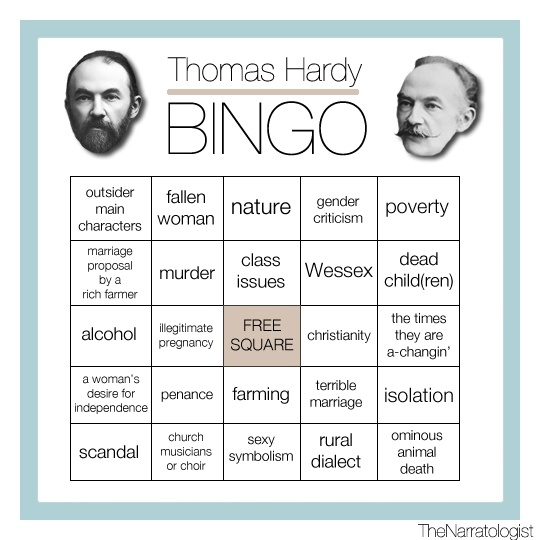
Rather than cowering in fear of Hardy's inevitable breaking of my heart I started to positively anticipate it! I want my BINGO gosh darn it! (Notice that there is no square for 'Death' - as that is simply a given).
And now comes the point in the review when I realise I haven't said a single word about the actual book. Whoops :-)
Okay, a couple of seriously whacky characters (even for Hardy) with Eutastica being the most gloriously comical. Or tragic. Depends on your point of view. She's an embodiment of the very heath and her yearning to be away from it is a tragic irony and her entrapment is full of pathos. Or, she's a spoilt brat who thinks that because she's beautiful she's too good for the world and she's too lazy to do anything to change her situation. Her situation is pathetic.
Throw in the usual collection of country hicks, stiff necked old women, men both moral and not so and you have a good working frame. Then add coincidences, paganism and scenic atmosphere galore and before you know it you have one pretty fantastic Hardy novel. Hang on a wall and admire it for the work of art it is. Don't worry overly much about the little bitty details - it's the overall impression that really matters :-)
4 stars
I was told once that I should read Far from the Madding Crowd because it was that rarest of rare beasts; a cheerful Hardy novel.
After having finished the aforementioned book I could only say that my definition of what constituted a cheerful novel was clearly wildly different to theirs. The most uplifting thing that could really be said about it was that not everybody died and some of the characters got what could considered a 'happy ending' if you could look past all of the tragic events which littered the bridal path.
There is no such thing as a cheerful Hardy novel.
Before reading one of his books I mentally brace myself, locking away all the tender emotions I have left after 40 years on this planet and entering 'life really sucks and is horribly unfair but just suck it up' robot mode.
You'd be forgiven for wondering why I read Hardy at all seeing as I obviously dislike all of this performance and it's purely because Hardy, though one of the gloomiest authors ever to lift pen, was also one of the most fantastically gifted prose writers in the English Literature scene (curses be upon the heads of those who abused his work so much he gave it up!). So, in short, he's worth every misery laden moment.
And now I've found a new way to tackle him...
Rather than cowering in fear of Hardy's inevitable breaking of my heart I started to positively anticipate it! I want my BINGO gosh darn it! (Notice that there is no square for 'Death' - as that is simply a given).
And now comes the point in the review when I realise I haven't said a single word about the actual book. Whoops :-)
Okay, a couple of seriously whacky characters (even for Hardy) with Eutastica being the most gloriously comical. Or tragic. Depends on your point of view. She's an embodiment of the very heath and her yearning to be away from it is a tragic irony and her entrapment is full of pathos. Or, she's a spoilt brat who thinks that because she's beautiful she's too good for the world and she's too lazy to do anything to change her situation. Her situation is pathetic.
Throw in the usual collection of country hicks, stiff necked old women, men both moral and not so and you have a good working frame. Then add coincidences, paganism and scenic atmosphere galore and before you know it you have one pretty fantastic Hardy novel. Hang on a wall and admire it for the work of art it is. Don't worry overly much about the little bitty details - it's the overall impression that really matters :-)
595gypsysmom
>594 M1nks: Oh, I wish I had known about that bingo card a few years ago when I was reading all of the Hardy fiction with an on-line group. I enjoyed the experience precisely because he was such a fantastic writer but he sure could find the doom and gloom.
596M1nks
Memoirs of Hadrian by Marguerite Yourcenar
2 1/2 stars
This is a dreamy sort of blend of fiction, philosophy, history, advice and acceptance of death and the passing of importance of everything that we currently think sturdy and strong. There is a great deal to recommend it, not the least the absolutely exquisite prose.
The Roman emperor Hadrian (he of Hadrian's Wall fame) is very near the end of his life and he knows it. He has no son but he has an acknowledge heir after the way of the Romans (Marcus Aurelius if you're interested) and as he hasn't ever really been able to talk to Marcus in any truly meaningful way (Romans - more emotionally stunted than the old image of the stereo typical Brit) he has hit upon the expedient of writing down his thoughts in the form of a letter. And his thoughts are many and varied.
The Romans have a curious relationship with education and learning. On the one hand they admire it greatly. On the other they think that it's only fit for the weak to practice it and it's not a suitable pastime for a proper Roman man who should be out there killing people in the name of the great Roman Empire. Possibly he could be building if the frontiers are quiet and the Emperor doesn't feel like waging war on anyone right now. And this applies x 10 if you are from one of the great patrician (noble) families. Hadrian almost had to hide his talents and great love of music and the arts until it was firmly established, by dint of him being an incredibly successful General, that he was a man's man and not a Greek poofter just because he liked Greek art. And Greek boys.
This is one of the things Hadrian thinks about in-between thought of his life before he became emperor, thoughts about past emperors and the weaknesses of the Empire which he has spent his life trying to strengthen and lessen it's vulnerabilities. He thinks of the great love of his life (not his wife) and of this favourites death at a young age. Marguerite Yourcenar imagines all of this and it's a fantastic achievement because you can almost put the knowledge that it is fiction to one side and hear the authentic voice of the emperor Hadrian echoing down through the ages. Quite amazing.
But, (and we could all hear the 'but' right?) it didn't really ring my bells. If you've been following my reviews at all you'll know that this is the sort of book that I can rather appreciate in detached, not quite clinical sort of way rather than with soul absorbing delight. In less high flown language I had a glass of wine and then politely left rather than I downed the entire bottle, played footsie under the table and invited it up to my place so we could 'really get to know one another'.
So there I'll leave it. Another excellent 1001 offering that I'm very glad to have read but that I doubt I'll ever revisit.
2 1/2 stars
This is a dreamy sort of blend of fiction, philosophy, history, advice and acceptance of death and the passing of importance of everything that we currently think sturdy and strong. There is a great deal to recommend it, not the least the absolutely exquisite prose.
The Roman emperor Hadrian (he of Hadrian's Wall fame) is very near the end of his life and he knows it. He has no son but he has an acknowledge heir after the way of the Romans (Marcus Aurelius if you're interested) and as he hasn't ever really been able to talk to Marcus in any truly meaningful way (Romans - more emotionally stunted than the old image of the stereo typical Brit) he has hit upon the expedient of writing down his thoughts in the form of a letter. And his thoughts are many and varied.
The Romans have a curious relationship with education and learning. On the one hand they admire it greatly. On the other they think that it's only fit for the weak to practice it and it's not a suitable pastime for a proper Roman man who should be out there killing people in the name of the great Roman Empire. Possibly he could be building if the frontiers are quiet and the Emperor doesn't feel like waging war on anyone right now. And this applies x 10 if you are from one of the great patrician (noble) families. Hadrian almost had to hide his talents and great love of music and the arts until it was firmly established, by dint of him being an incredibly successful General, that he was a man's man and not a Greek poofter just because he liked Greek art. And Greek boys.
This is one of the things Hadrian thinks about in-between thought of his life before he became emperor, thoughts about past emperors and the weaknesses of the Empire which he has spent his life trying to strengthen and lessen it's vulnerabilities. He thinks of the great love of his life (not his wife) and of this favourites death at a young age. Marguerite Yourcenar imagines all of this and it's a fantastic achievement because you can almost put the knowledge that it is fiction to one side and hear the authentic voice of the emperor Hadrian echoing down through the ages. Quite amazing.
But, (and we could all hear the 'but' right?) it didn't really ring my bells. If you've been following my reviews at all you'll know that this is the sort of book that I can rather appreciate in detached, not quite clinical sort of way rather than with soul absorbing delight. In less high flown language I had a glass of wine and then politely left rather than I downed the entire bottle, played footsie under the table and invited it up to my place so we could 'really get to know one another'.
So there I'll leave it. Another excellent 1001 offering that I'm very glad to have read but that I doubt I'll ever revisit.
597M1nks
Time's Arrow by Martin Amis
4 stars
Life never really makes a lot of sense at the best of times. All of the philosophical ponderings on the eternal question of 'Why are we here?' haven't been able to come up with anything more convincing than 'Because'. Some people may wave other explanations such as 'The ineffable plan of God', which obviously, being ineffable means that it's not going to cut it as an explanation – if it can't be explained then it might as well not exist. Even if it did, which is another eternal question to some people. Some chuck out Chaos Theory and who knows whatall (possibly someone does - there might be people out there who've made it their life’s work to see what every body on the planet thinks is the meaning for our existence and the existence of life itself if they can manage to pull their heads out of their egocentric/human-centric world view long enough to acknowledge the existence and even possible importance of, species other than their own.
I still don't think there's been a more convincing answer than 'Because.' Or perhaps 'Why not?'.
In Time's Arrow we see through the eyes of a man who is living backwards. We aren't him, we are a voice inside his head that he can't hear so we can only talk to ourselves and experience only that which applies to him. Which is a pain because this fellow was probably dead when we first arrived and we have a long, tedious journey back to any kind of exciting existence. 'We' are alive, but this guy is the next worst thing to a corpse. Being this old really sucks. Being this powerless is extremely frustrating. It's amazing that we don't go completely insane living inside this guys head and start hearing voices inside his head!
We also appear to be the only one aware of the extremely bizarre state of the world. Things really don't make any sense at all. Why are we the only ones who care? Why does Dr. Todd Friendly (the man in whose head we currently live) not seem to notice that something is wrong?
Who exactly are we again?
I've read a few things which deal with concept of living backwards - Backwards is the funniest and I remember a particularly poignant short story by Fritz Leiber I think where a man lived through many lifetimes watching the devolution of human civilization and the gradual disappearance of humanity itself. Each approaches the idea in ways both similar and individual. Time's Arrow stands alone and if you find the idea intriguing then I would advise you to read it without knowing anything more about it unless it is already too late. I, alas, had had the secret of the good doctor's past revealed to me prior to reading this and will say that it definitely impacted on my enjoyment. The story stands on its own but there is that thrill of discovery on an initial read, the delight of peeling back the layers to see what lies beneath. You only get to experience that the once (unless you have a very bad memory), and I do feel rather cheated. I would have enjoyed it.
Ah well.
4 stars
Life never really makes a lot of sense at the best of times. All of the philosophical ponderings on the eternal question of 'Why are we here?' haven't been able to come up with anything more convincing than 'Because'. Some people may wave other explanations such as 'The ineffable plan of God', which obviously, being ineffable means that it's not going to cut it as an explanation – if it can't be explained then it might as well not exist. Even if it did, which is another eternal question to some people. Some chuck out Chaos Theory and who knows whatall (possibly someone does - there might be people out there who've made it their life’s work to see what every body on the planet thinks is the meaning for our existence and the existence of life itself if they can manage to pull their heads out of their egocentric/human-centric world view long enough to acknowledge the existence and even possible importance of, species other than their own.
I still don't think there's been a more convincing answer than 'Because.' Or perhaps 'Why not?'.
In Time's Arrow we see through the eyes of a man who is living backwards. We aren't him, we are a voice inside his head that he can't hear so we can only talk to ourselves and experience only that which applies to him. Which is a pain because this fellow was probably dead when we first arrived and we have a long, tedious journey back to any kind of exciting existence. 'We' are alive, but this guy is the next worst thing to a corpse. Being this old really sucks. Being this powerless is extremely frustrating. It's amazing that we don't go completely insane living inside this guys head and start hearing voices inside his head!
We also appear to be the only one aware of the extremely bizarre state of the world. Things really don't make any sense at all. Why are we the only ones who care? Why does Dr. Todd Friendly (the man in whose head we currently live) not seem to notice that something is wrong?
Who exactly are we again?
I've read a few things which deal with concept of living backwards - Backwards is the funniest and I remember a particularly poignant short story by Fritz Leiber I think where a man lived through many lifetimes watching the devolution of human civilization and the gradual disappearance of humanity itself. Each approaches the idea in ways both similar and individual. Time's Arrow stands alone and if you find the idea intriguing then I would advise you to read it without knowing anything more about it unless it is already too late. I, alas, had had the secret of the good doctor's past revealed to me prior to reading this and will say that it definitely impacted on my enjoyment. The story stands on its own but there is that thrill of discovery on an initial read, the delight of peeling back the layers to see what lies beneath. You only get to experience that the once (unless you have a very bad memory), and I do feel rather cheated. I would have enjoyed it.
Ah well.
598M1nks
Humphrey Clinker by Tobias Smollett
3 1/2 stars
This is an epistolyary novel comprised of the letters of five very different comunicators. I found it more interesting than entertaining. Although a work of fiction it was still a fairly detailed traveloge, crammed full of the personalities and popular places of the time. The grumpy misanthropic uncle (Mathew Bramble) saw everything through a lens of distaste which no doubt highlighted everything more than a less critical observer would have done. Not much escaped his scathing pen and very little was deemed worthwhile - people were generally hypocritcal cheats and cities were positive sinks of inequity because of the corresponding increase in corrupt human souls pressing in on you from every side. Add to that poor food and disturbed sleep and you can see why Mr Bramble spent the whole trip complaining and wanting to be back in his peaceful country estate.
His nephew was a hot tempered younger version of the uncle himself only not so interesting. The niece, boringly virtuous and meekly pathetic, was even less interesting than her brother. The avaricious sister (and aunt) was mildly amusing in her desperate attempts to find a husband, any husband! So long as he wore trousers that was good enough! The best letters of the lot came from the aunts maidservant. Her poor spelling and gossip were more to my tastes anyway.
Humphrey Clinker himself came in partway through the book; a poor misbegotten wretch that the iscrasible but kind hearted Mr Bramble took on as a servant.
There really isn't any plot in this book and I'm sure that Smollett himself didn't intend anyone to take the ridiculous coincidences which abound inside the covers seriously. It's a light hearted read and I wouldn't go looking for anything more meaningful than that.
3 1/2 stars
This is an epistolyary novel comprised of the letters of five very different comunicators. I found it more interesting than entertaining. Although a work of fiction it was still a fairly detailed traveloge, crammed full of the personalities and popular places of the time. The grumpy misanthropic uncle (Mathew Bramble) saw everything through a lens of distaste which no doubt highlighted everything more than a less critical observer would have done. Not much escaped his scathing pen and very little was deemed worthwhile - people were generally hypocritcal cheats and cities were positive sinks of inequity because of the corresponding increase in corrupt human souls pressing in on you from every side. Add to that poor food and disturbed sleep and you can see why Mr Bramble spent the whole trip complaining and wanting to be back in his peaceful country estate.
His nephew was a hot tempered younger version of the uncle himself only not so interesting. The niece, boringly virtuous and meekly pathetic, was even less interesting than her brother. The avaricious sister (and aunt) was mildly amusing in her desperate attempts to find a husband, any husband! So long as he wore trousers that was good enough! The best letters of the lot came from the aunts maidservant. Her poor spelling and gossip were more to my tastes anyway.
Humphrey Clinker himself came in partway through the book; a poor misbegotten wretch that the iscrasible but kind hearted Mr Bramble took on as a servant.
There really isn't any plot in this book and I'm sure that Smollett himself didn't intend anyone to take the ridiculous coincidences which abound inside the covers seriously. It's a light hearted read and I wouldn't go looking for anything more meaningful than that.
599M1nks
Go Tell It On The Mountain by James Baldwin
3 1/2 stars
An African American family gives us their stories about what it means to live in their local communities of Harlem and down south and, also, what it means to them to be black in America. The stories aren't often heart warming but they are intense. I preferred the lives of the women as I identified more with them. Not so much because they were women but because their lives were less occupied with God and the infinite and more with life down here on earth.
We start the book centred on John Grimes, the bullied son of the preacher Gabriel. He hates his father and because of this has confused feelings about God. How can God be good if his father is respected? Gabriel is violent and abusive, both physically and mentally to his children and his wife. The only one who stands up to him and has no fear of him is his sister Florence; she knows more of his past and thinks him a phoney and a hypocrite, unworthy of any respect. At some point we get to see parts of her life as well; her frustration at being passed over by her mother in favour of Gabriel, a young man who disrespected her by running wild in the streets. We see her frustration at having her life waste away in favour of this worthless brother of hers. Finally she snaps and walks out, leaving her mother and her brother and heading for New York in her attempt to find her own life and make a success of it.
The mother, Elizabeth, has her time in the spotlight. We see the courtship by Gabriel, the lines he uses to convince her that their marriage is ordained by God (words which he's used before). And then we see his betrayal of her, the crushing of her spirit under the heel of this autocratic man.
Gabriel's section is probably the most unpleasant; in it we see the hypocrisy of the man laid bare, the vicious cruelty and self glorification. He hides his true character in robes of piety and stern devotion to the Word of God, but while he holds others to impossible standards he freely forgives himself for the same sins he loudly abhors in his family and congregation. In all trials introspection soon passes the blame onto the shoulders of other, less worthy specimens of Gods creatures, while the humble and penitent Gabriel is swiftly forgiven by The Lord.
It's not a particularly pleasant book but it's very interesting. Well, mostly. I didn't have any interest in John Grime's tales of being lead to the Lord and his personal revelations. So, as this was a fairly major part of the book, it lost a little of its appeal. Still, even with all of those passages, I still found it entertaining.
3 1/2 stars
An African American family gives us their stories about what it means to live in their local communities of Harlem and down south and, also, what it means to them to be black in America. The stories aren't often heart warming but they are intense. I preferred the lives of the women as I identified more with them. Not so much because they were women but because their lives were less occupied with God and the infinite and more with life down here on earth.
We start the book centred on John Grimes, the bullied son of the preacher Gabriel. He hates his father and because of this has confused feelings about God. How can God be good if his father is respected? Gabriel is violent and abusive, both physically and mentally to his children and his wife. The only one who stands up to him and has no fear of him is his sister Florence; she knows more of his past and thinks him a phoney and a hypocrite, unworthy of any respect. At some point we get to see parts of her life as well; her frustration at being passed over by her mother in favour of Gabriel, a young man who disrespected her by running wild in the streets. We see her frustration at having her life waste away in favour of this worthless brother of hers. Finally she snaps and walks out, leaving her mother and her brother and heading for New York in her attempt to find her own life and make a success of it.
The mother, Elizabeth, has her time in the spotlight. We see the courtship by Gabriel, the lines he uses to convince her that their marriage is ordained by God (words which he's used before). And then we see his betrayal of her, the crushing of her spirit under the heel of this autocratic man.
Gabriel's section is probably the most unpleasant; in it we see the hypocrisy of the man laid bare, the vicious cruelty and self glorification. He hides his true character in robes of piety and stern devotion to the Word of God, but while he holds others to impossible standards he freely forgives himself for the same sins he loudly abhors in his family and congregation. In all trials introspection soon passes the blame onto the shoulders of other, less worthy specimens of Gods creatures, while the humble and penitent Gabriel is swiftly forgiven by The Lord.
It's not a particularly pleasant book but it's very interesting. Well, mostly. I didn't have any interest in John Grime's tales of being lead to the Lord and his personal revelations. So, as this was a fairly major part of the book, it lost a little of its appeal. Still, even with all of those passages, I still found it entertaining.
600M1nks
The Vice-Consul by Marguerite Duras
2 1/2 stars
I liked this a little more than The Lover which is the only other Duras book I've read, but I didn't like it enough to rate it a full 3 stars in its own right.
There are a few distinct stories here, probably the most interesting is that of the mad Cambodian beggar woman who is being written about by one of the Embassy men in Calcutta (white of course). He doesn't know a thing about her and doesn't bother trying to learn he just invents this whole story and that 'fake' story is cut into the 'real' story lines of the other characters. But those story lines are also possibly not strictly 'real'. After all, no one really wants to talk about anything directly so perhaps the ideas of all of these 'stories' is some super clever commentary on how, in the end, we are all living inside a story of our own creation. Or something like that.
The eponymous former Vice-Consul of Lahore seems to be a seriously messed up individual whatever story you hear about him. He also seems to have some sort of unhealthy obsession with the French Ambassadors wife. I couldn't quite work out if there was anything going on between them. It's possible as it seems that she had 'something going on' with a whole lot of attractive young men with what seemed to be the full knowledge and consent of her husband. The French eh?
And what was the exact point of this story? Beats me. If you read it yourself and think you know then please let me in on it :-)
2 1/2 stars
I liked this a little more than The Lover which is the only other Duras book I've read, but I didn't like it enough to rate it a full 3 stars in its own right.
There are a few distinct stories here, probably the most interesting is that of the mad Cambodian beggar woman who is being written about by one of the Embassy men in Calcutta (white of course). He doesn't know a thing about her and doesn't bother trying to learn he just invents this whole story and that 'fake' story is cut into the 'real' story lines of the other characters. But those story lines are also possibly not strictly 'real'. After all, no one really wants to talk about anything directly so perhaps the ideas of all of these 'stories' is some super clever commentary on how, in the end, we are all living inside a story of our own creation. Or something like that.
The eponymous former Vice-Consul of Lahore seems to be a seriously messed up individual whatever story you hear about him. He also seems to have some sort of unhealthy obsession with the French Ambassadors wife. I couldn't quite work out if there was anything going on between them. It's possible as it seems that she had 'something going on' with a whole lot of attractive young men with what seemed to be the full knowledge and consent of her husband. The French eh?
And what was the exact point of this story? Beats me. If you read it yourself and think you know then please let me in on it :-)

