These Truths, by Jill Lepore - Part Two - February
Talk 75 Books Challenge for 2019
Join LibraryThing to post.
This topic is currently marked as "dormant"—the last message is more than 90 days old. You can revive it by posting a reply.

2Berly
Just to repeat myself: Each month, January - April, we will read one section. This thread is a chance to talk about lots of things: what you knew, what you learned, what surprised you, the pictures, the people, the places....
I am not sure spoilers are needed, but it would be nice to start off your comments with a page number or a year, so others can look up what you are talking about.
The Breakdown of Sections...
January--Part One, The Idea, pages 1-149 (1492-1799)
https://www.librarything.com/topic/301417#6718681
February--Part Two, The People, pages 153-310 (1800-1865)
March--Part Three, The State, pages 311-520 (1866-1945
https://www.librarything.com/topic/304319#
April--Part Four, The Machine, pages 521-789 (1946-2016)
I am not sure spoilers are needed, but it would be nice to start off your comments with a page number or a year, so others can look up what you are talking about.
The Breakdown of Sections...
January--Part One, The Idea, pages 1-149 (1492-1799)
https://www.librarything.com/topic/301417#6718681
February--Part Two, The People, pages 153-310 (1800-1865)
March--Part Three, The State, pages 311-520 (1866-1945
https://www.librarything.com/topic/304319#
April--Part Four, The Machine, pages 521-789 (1946-2016)


4Berly

Literary Arts' podcast of Jill Lepore's visit can be found on iTunes for free. You can also follow the link from here:
https://literary-arts.org/archives/
and then click on the green highlighted line in the main paragraph: "Click here to visit The Archive Project on iTunes".
6Berly
>5 drneutron: How DO you stay on top of things so well? Thank you! : )

9streamsong
I'm reading, too.
I just finished Chapter Six.
I thought that one of the interesting bits was the discussion of the evolution of the Supreme Court and the fact that there is no check-and-balance over them. What if they get it wrong? No way to overturn it.
I'm looking forward in historical time to the decisions with the Supreme Court upholding slavery issues.
In the current day, evangelical Christians think the Supreme Court erred with Roe vs Wade. As many people are afraid that it will be overturned by the current Supreme Court. Both decisions can't be right.
I know they are supposed to be interpreting current law and the Constitution. But the decisions are usually split. What is the recourse for decisions that may be wrong?
I just finished Chapter Six.
I thought that one of the interesting bits was the discussion of the evolution of the Supreme Court and the fact that there is no check-and-balance over them. What if they get it wrong? No way to overturn it.
I'm looking forward in historical time to the decisions with the Supreme Court upholding slavery issues.
In the current day, evangelical Christians think the Supreme Court erred with Roe vs Wade. As many people are afraid that it will be overturned by the current Supreme Court. Both decisions can't be right.
I know they are supposed to be interpreting current law and the Constitution. But the decisions are usually split. What is the recourse for decisions that may be wrong?
10ffortsa
Just started part 2 myself.
>9 streamsong: The Supreme Court has been proven wrong on numerous occasions. and while precedent is powerful, some decisions have been overturned by later case decisions. And of course, we've adopted some constitutional amendments to change or clarify the document as well. Not yet perfect, which is why the 'originalists' on the court make me a little crazy.
>9 streamsong: The Supreme Court has been proven wrong on numerous occasions. and while precedent is powerful, some decisions have been overturned by later case decisions. And of course, we've adopted some constitutional amendments to change or clarify the document as well. Not yet perfect, which is why the 'originalists' on the court make me a little crazy.
11lauralkeet
>9 streamsong:, >10 ffortsa: I took a short course in the autumn that covered Supreme Court rulings on gender, from the 1800s or so to the present day. I learned that while we tend to equate the court's decisions with very broad topics (e.g., Roe vs. Wade = a woman's right to choose), the cases brought to the court are typically about very specific issues, and the ruling becomes the precedent to interpret and rule on related matters. Sometimes subsequent cases will add to or detract from the previous decision.
The most recent decisions stand as law of the land, but they can be shaped over time.
The most recent decisions stand as law of the land, but they can be shaped over time.
12magicians_nephew
The way to overturn the Supreme Court is to pass a Constitutional Amendment.
It's one of the amazing things about our country that the Constitioan has been amended so few times.
If you count the Bill of Rights as one amendment there is only a handful.
Instead of amendments voted by the Congress (and the people) we have had interpretations by the courts - not really what the founders were going for.
It's one of the amazing things about our country that the Constitioan has been amended so few times.
If you count the Bill of Rights as one amendment there is only a handful.
Instead of amendments voted by the Congress (and the people) we have had interpretations by the courts - not really what the founders were going for.
13karenmarie
I just started reading Part 2 today and note the underlying economic conflict, then and now. I don't see how the logical dichotomy has changed, although over time one or the other faction has been in control.
Page 155
In 1800 John Adams was sixty-four and even more disputatious, vain, and learned than he'd been as a younger man. A founder of the American Academy of Arts and Sciences, he'd written a ponderous, three-volume Defense of the Constitutions of Government of the United States, explaining the fragile balance between an aristocracy of the rich and a democracy of the poor, a balance that could only be struck by a well-engineered constitution. "In every society where property exists, there will ever be a struggle between rich and poor, he wrote. "Mixed in one assembly, equal laws can never be expected. They will either be made by numbers, to plunder the few who are rich, or by influence, to fleece the many who are poor."
And, later on the same page
Adams believed in restraining the will of the majority, Jefferson in submitting to it.
Page 155
In 1800 John Adams was sixty-four and even more disputatious, vain, and learned than he'd been as a younger man. A founder of the American Academy of Arts and Sciences, he'd written a ponderous, three-volume Defense of the Constitutions of Government of the United States, explaining the fragile balance between an aristocracy of the rich and a democracy of the poor, a balance that could only be struck by a well-engineered constitution. "In every society where property exists, there will ever be a struggle between rich and poor, he wrote. "Mixed in one assembly, equal laws can never be expected. They will either be made by numbers, to plunder the few who are rich, or by influence, to fleece the many who are poor."
And, later on the same page
Adams believed in restraining the will of the majority, Jefferson in submitting to it.
14streamsong
>10 ffortsa: >11 lauralkeet: >12 magicians_nephew: Thank you all for the comments! I'm very weak in history and government, so I appreciate this book and the discussion.
>13 karenmarie: That's an interesting point, Karen, and so relevant to the political questions of the day.
>13 karenmarie: That's an interesting point, Karen, and so relevant to the political questions of the day.
15karenmarie
p 173-176 I knew that Sally Hemmings was a slave, but I did not realize that she was Jefferson's wife Martha Wayles's half sister, therefore his sister-in-law.
16Donna828
>16 Donna828: I read that last night, Karen, and was surprised as well. I thought it was interesting that 5 of their 6 offspring passed for white. Sounds like there should be a book from the son who chose to live as a black man. I was also surprised that Thomas Jefferson did not free Sally in his will as he did their children. (Pg. 186) I’m glad she took the initiative and left Monticello and lived in freedom after he died.
17katiekrug
Reading a bit on my lunch break and came across this (sorry, no page number but it's in section III of Chapter 5, "A Democracy of Numbers"):
"The argument of populism is that the best government is that most closely directed by a popular majority. Populism is an argument about the people, but, at heart, it is an argument about numbers."
Interesting because our current President is often referred to as a populist and his governing "philosophy" as populism, but if what Lepore argues is true, then it's a misnomer because he certainly isn't being directed by the majority of voters, having lost the popular vote, and few of his policies and goals are supported by a majority. Perhaps the meaning has changed, but the way she phrases it makes it seem not.
Ponder, ponder....
"The argument of populism is that the best government is that most closely directed by a popular majority. Populism is an argument about the people, but, at heart, it is an argument about numbers."
Interesting because our current President is often referred to as a populist and his governing "philosophy" as populism, but if what Lepore argues is true, then it's a misnomer because he certainly isn't being directed by the majority of voters, having lost the popular vote, and few of his policies and goals are supported by a majority. Perhaps the meaning has changed, but the way she phrases it makes it seem not.
Ponder, ponder....
18Berly
I also didn't realize that numbers played such a significant role in the elections. The Electoral college was "determined by the rule of representation--one member of Congress for every forty thousand people, with people who were enslaved counting as three-fifths of the other people." (Not that their opinion counted, just bodies.) "The Electoral College was a concession to slave owners, an affair of both mathematical and political calculation." (p.157)
And, regarding Katie's comment above, does the Electoral college really represent the people today? No, because the popular vote didn't elect T. Not sure what purpose it serves nowadays.
And, regarding Katie's comment above, does the Electoral college really represent the people today? No, because the popular vote didn't elect T. Not sure what purpose it serves nowadays.
19brenzi
The electoral college is an anachronism that the congress needs to do away with. So is the dichotomy between the House and the Senate. South Dakota has the same number of senators as California. It's ridiculous. I know the House was supposed to balance that inequity but since so many things do not go through the House ( cabinet appointments, Supreme Court appointments) it is not equitable at all.
20Berly
Just more stuff I found fascinating....

"...counting the votes...usually meant counting heads or, rather, counting polls. A "poll" meant the top of a person's head. (In Hamlet, Ophelia says of Polonus, 'His beard as white as snow: All flaxen was his poll.'" So there was no voting in secrecy. "Counting polls required assembling--all in favor of the Federalists stand here, all in favor of the Republicans over there..." (p. 162)
Or if by ballot, "From the Italian ballota, meaning a littel ball", Americans sometimes cast their votes using peas, "pebbles, or, not uncommonly, bullets." (p. 163)

"...counting the votes...usually meant counting heads or, rather, counting polls. A "poll" meant the top of a person's head. (In Hamlet, Ophelia says of Polonus, 'His beard as white as snow: All flaxen was his poll.'" So there was no voting in secrecy. "Counting polls required assembling--all in favor of the Federalists stand here, all in favor of the Republicans over there..." (p. 162)
Or if by ballot, "From the Italian ballota, meaning a littel ball", Americans sometimes cast their votes using peas, "pebbles, or, not uncommonly, bullets." (p. 163)
21Berly
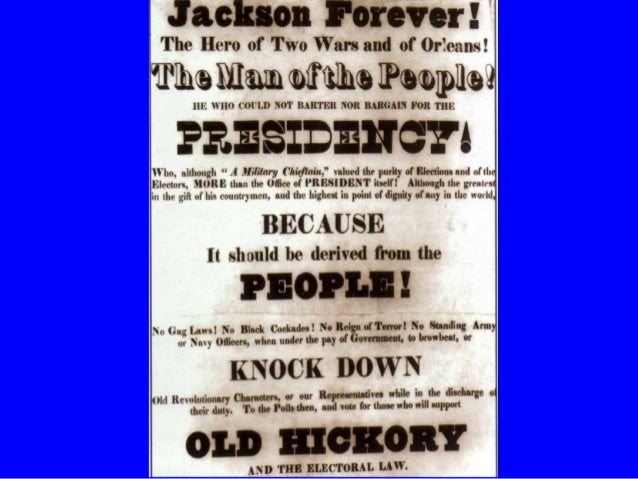
And we have Andrew Jackson to thank for idea of campaigning for the presidential office. Getting to know the candidates is, of course, vital, but I look to the debates rather than advertising and slogans to find their truth: the spin put on everything is amazing. Jackson's biographer Eaton knew this right away: "Eaton's Jackson wasn't uneducated, he was self-taught. He wasn't ill-bred; he was self-made." (p. 182) And as the common man's choice (land-owning was no longer a requirement to vote), Jackson played down his wealth and land.

The first campaign button? Andrew Jackson: An Exceedingly Rare Large ‘Pewter Rim.’ courtesy of Heritage Auctions.

The first campaign button? Andrew Jackson: An Exceedingly Rare Large ‘Pewter Rim.’ courtesy of Heritage Auctions.
22weird_O
I'm only a couple of chapters into Part Two, but the horizon is clear so I'll keep reading to the end of the part. I'm in league with so many of you, because just about every quote that's been quoted is something I highlighted myownself.
>13 karenmarie: Adams believed in restraining the will of the majority, Jefferson in submitting to it.
>17 katiekrug: The argument of populism is that the best government is that most closely directed by a popular majority. Populism is an argument about the people, but, at heart, it is an argument about numbers.
Two of the best statements, those are.
>13 karenmarie: Adams believed in restraining the will of the majority, Jefferson in submitting to it.
>17 katiekrug: The argument of populism is that the best government is that most closely directed by a popular majority. Populism is an argument about the people, but, at heart, it is an argument about numbers.
Two of the best statements, those are.
23banjo123
I am really enjoying. One can really see how gerrymandering, voter suppression and such have a long history in the US.
24karenmarie
P 216
"In the end, Jackson decided to ignore the Supreme Court. "John Marshall has made his decision," he is rumored to have said (the rumor appears to have been a wild one). "Now let him enforce it."
Oh so sad, oh so dangerous.
"In the end, Jackson decided to ignore the Supreme Court. "John Marshall has made his decision," he is rumored to have said (the rumor appears to have been a wild one). "Now let him enforce it."
Oh so sad, oh so dangerous.
25brenzi
>24 karenmarie: Oh so familiar.
26karenmarie
I wasn't going to bring current politics into it, but yeah, absolutely.
27lauralkeet
>26 karenmarie: I found today's parallels with the Jackson administration really enlightening and just a tiny bit comforting in the "we've been here before" category. These were my "aha" moments in Chapter 5:
Moving on from that, Chapter 6 was fascinating, laying out the evolution of machines, work, religion, etc. Lepore uses Thoreau to foreshadow modern times:
Jackson made a devilishly shrewd decision. He would make his lack of certain qualities—judiciousness, education, political experience—into strengths.
...
In 1824, when Jackson announced his bid for the presidency, Eaton, who ran Jackson’s campaign, shrewdly revised his Life of Andrew Jackson, deleting or dismissing everything in Jackson’s past that looked bad and lavishing attention on anything that looked good and turning into strengths what earlier had been considered weaknesses: Eaton’s Jackson wasn’t uneducated; he was self-taught. He wasn’t ill-bred; he was “self-made.”
Moving on from that, Chapter 6 was fascinating, laying out the evolution of machines, work, religion, etc. Lepore uses Thoreau to foreshadow modern times:
He had the gravest of doubts about what the machine was doing to the American soul, the American people, and the land itself.
28katiekrug
>27 lauralkeet: - I noted that first "aha" moment, too, Laura.
29weird_O
>27 lauralkeet: Prof. Lepore used campaign biographies to describe presidential candidates through part 2. Most of the candidates (and presidents) between Jackson and Lincoln were pretty lackluster, weren't they? I didn't recall that Harrison was extremely wealthy, so the bio invented for him had him reared in a log cabin and laboring as a humble farmer. Of course, like many of extraordinary wealth (up to this day), he didn't have the sense to come in out the rain.
30lauralkeet
>29 weird_O: Prof. Lepore used campaign biographies ... through part 2
Yes, and what struck me is how much those biographies tried to shape public opinion about the candidate. Prior to radio, television, and the internet, I guess it was the best alternative to seeing the candidate in person, and a way to reach a broader audience. But as Lepore noted, the biographies were biased propaganda pieces, not necessarily accurate representations.
Yes, and what struck me is how much those biographies tried to shape public opinion about the candidate. Prior to radio, television, and the internet, I guess it was the best alternative to seeing the candidate in person, and a way to reach a broader audience. But as Lepore noted, the biographies were biased propaganda pieces, not necessarily accurate representations.
31weird_O

Yeah, it's one of "These Truths".
>30 lauralkeet: I liked that William Dean Howells took it upon himself to write Lincoln's campaign bio.
32katiekrug
>29 weird_O: and >30 lauralkeet: - And the campaign biographies/memoirs is a tradition that continues to this day...
33weird_O
>32 katiekrug: These days, of course, the campaign bios are matched by opposition bios. Jerome Corsi has made a living inventing, fabricating, evil "bios" of Democratic candidates for high office. Lepore points out (p. 173) that James Callender wrote in support of Jefferson and as a result was jailed for sedition. Then he turned on Jefferson and exposed his relationship with Sally Hemings. Samo samo.
34katiekrug
I'm almost done with Part II. Ran across this passage which confused me: "In Norfolk, Virginia, four thousand slaves - who, living in a border state that was not part of the Confederacy, were not actually freed by the Emancipation Proclamation...."
Erm, huh? Virginia was a confederate state. In fact, Richmond was the capital of the Confederacy for a time, so I'm totally confused now. Help?
ETA: Found this question raised on Goodreads, and someone responded that it was an editing error, and instead of state, it should read "city," as Norfolk was held by the Union Army at the time, and the EP did not apply to slaves in territory held by the Union (as Lepore notes a bit earlier in the text).
Erm, huh? Virginia was a confederate state. In fact, Richmond was the capital of the Confederacy for a time, so I'm totally confused now. Help?
ETA: Found this question raised on Goodreads, and someone responded that it was an editing error, and instead of state, it should read "city," as Norfolk was held by the Union Army at the time, and the EP did not apply to slaves in territory held by the Union (as Lepore notes a bit earlier in the text).
35lauralkeet
>34 katiekrug: that's helpful and good to know! I remember that passage, but I only absorbed the fact that the EP didn't apply universally, and didn't think it through enough to get confused.
37karenmarie
I've just finished Part 2.
@weird_o made a very important point when he quoted Lepore in his personal thread (but not here) - revisionist history has it that The Civil War was fought for states' rights. It was not. It was fought over slavery. It's a self-evident truth to some of us, but I've never seen an actual quote that substantiates it. Here's the relevant quote from page 290:
@weird_o made a very important point when he quoted Lepore in his personal thread (but not here) - revisionist history has it that The Civil War was fought for states' rights. It was not. It was fought over slavery. It's a self-evident truth to some of us, but I've never seen an actual quote that substantiates it. Here's the relevant quote from page 290:
The truths of the Confederacy disavowed the truths of the Union. The Confederacy’s newly elected vice president, a frail Georgian named Alexander Stephens, delivered a speech in Savannah in which he made these differences starkly clear. The ideas that lie behind the Constitution “rested upon the assumption of the equality of races,” Stephens said, but “Our new government is founded upon exactly the opposite idea: its foundations are laid, its cornerstone rests, upon the great truth that the negro is not equal to the white man; that slavery… is his natural and moral condition. This, our new government, is the first, in the history of the world, based upon this great physical, philosophical, and moral truth.” It would become politically expedient, after the war, for ex-Confederates to insist that the Confederacy was founded on states' rights. But the Confederacy was founded on white supremacy."If you want to read the entire speech, here it is: Corner Stone Speech March 21, 1861
Alexander H. Stephens, “Cornerstone Address,” Savannah, Georgia, March 21, 1861, Macon Telegraph – Macon, Georgia, March 25, 1861.
38ronincats
Y'all picked out some of my favorite quotes and reactions to Part 2, which I finally finished 3 days ago. I'm plowing ahead on Part 3 now--more salient facts to consider in this age of corruption!
40magicians_nephew
who's got the link for part 3 of the discussion?
41katiekrug
Here you go, Jim: https://www.librarything.com/topic/304319#
43Donna828
I finished Part Two over the weekend. I must have slept through my American History classes because I did not realize that the Emancipation Proclamation of 1863 didn’t free all the slaves. That didn’t happen until the 13th Amendment was ratified in late 1865.
I liked this quote on Page 306. “But the unfinished work of a great nation remained undone: the struggle for equality had just begun.” And we’re still working on it.
I liked this quote on Page 306. “But the unfinished work of a great nation remained undone: the struggle for equality had just begun.” And we’re still working on it.

