1pamelad
I'm Pam, a retired chemistry and biology teacher, living in Melbourne. I've always been a dedicated reader, and now that I don't have to waste good reading time on going to work, I can read even more.
My main reading goal for 2022 is to read widely from a range of genres, eras and countries. The Category Challenge really helps with that. In 2021 I've read three times as many books as usual so in 2022 I'm going out more and choosing fewer, better books.
Because I've been missing the Cinematheque, I've chosen some classic films to illustrate this year's categories. I'm fatally attracted to subtitles, and to films that were made before I was born.
My main reading goal for 2022 is to read widely from a range of genres, eras and countries. The Category Challenge really helps with that. In 2021 I've read three times as many books as usual so in 2022 I'm going out more and choosing fewer, better books.
Because I've been missing the Cinematheque, I've chosen some classic films to illustrate this year's categories. I'm fatally attracted to subtitles, and to films that were made before I was born.
2pamelad
1. Non-fiction

A documentary classic from 1929.
A is for Arsenic by Kathryn Harkup
Kings of Georgian Britain by Catherine Curzon
An Appeal to the World: The Way to Peace in a Time of Division by the Dalai Lama
Factfulness: Ten Reasons We're Wrong About the World and Why Things Are Better Than You Think by Hans Rosling
The Most Good You can Do: How Effective Altruism Is Changing Ideas About Living Ethically by Peter Singer
Divided by a Common Language: A Guide to British and American English by Christopher Davies
A documentary classic from 1929.
A is for Arsenic by Kathryn Harkup
Kings of Georgian Britain by Catherine Curzon
An Appeal to the World: The Way to Peace in a Time of Division by the Dalai Lama
Factfulness: Ten Reasons We're Wrong About the World and Why Things Are Better Than You Think by Hans Rosling
The Most Good You can Do: How Effective Altruism Is Changing Ideas About Living Ethically by Peter Singer
Divided by a Common Language: A Guide to British and American English by Christopher Davies
3pamelad
2. Africa, Asia and the Americas

Asia
Mongolia: The Blue Sky by Galsang Tschinag
Japan: Secret Rendezvous by Kobo Abe
Japan: The Waiting Years by Fumiko Enchi
The Americas
Jamaica (setting) and Dominica (author's birth) : Wide Sargasso Sea by Jean Rhys
US: The Namesake by Jhumpa Lahiri
Africa
Rhodesia (Zimbabwe): Nervous Conditions by Tsitsi Dangarembga

Asia
Mongolia: The Blue Sky by Galsang Tschinag
Japan: Secret Rendezvous by Kobo Abe
Japan: The Waiting Years by Fumiko Enchi
The Americas
Jamaica (setting) and Dominica (author's birth) : Wide Sargasso Sea by Jean Rhys
US: The Namesake by Jhumpa Lahiri
Africa
Rhodesia (Zimbabwe): Nervous Conditions by Tsitsi Dangarembga
4pamelad
3. Australia and New Zealand

The Way It Is Now by Garry Disher
Not Meeting Mr Right by Anita Heiss
Black and Blue: a memoir of racism and resilience by Veronica Gorrie
The Labyrinth by Amanda Lohrey
Plumb by Maurice Gee
The Fallout by Garry Disher

The Way It Is Now by Garry Disher
Not Meeting Mr Right by Anita Heiss
Black and Blue: a memoir of racism and resilience by Veronica Gorrie
The Labyrinth by Amanda Lohrey
Plumb by Maurice Gee
The Fallout by Garry Disher
5pamelad
4. Europe
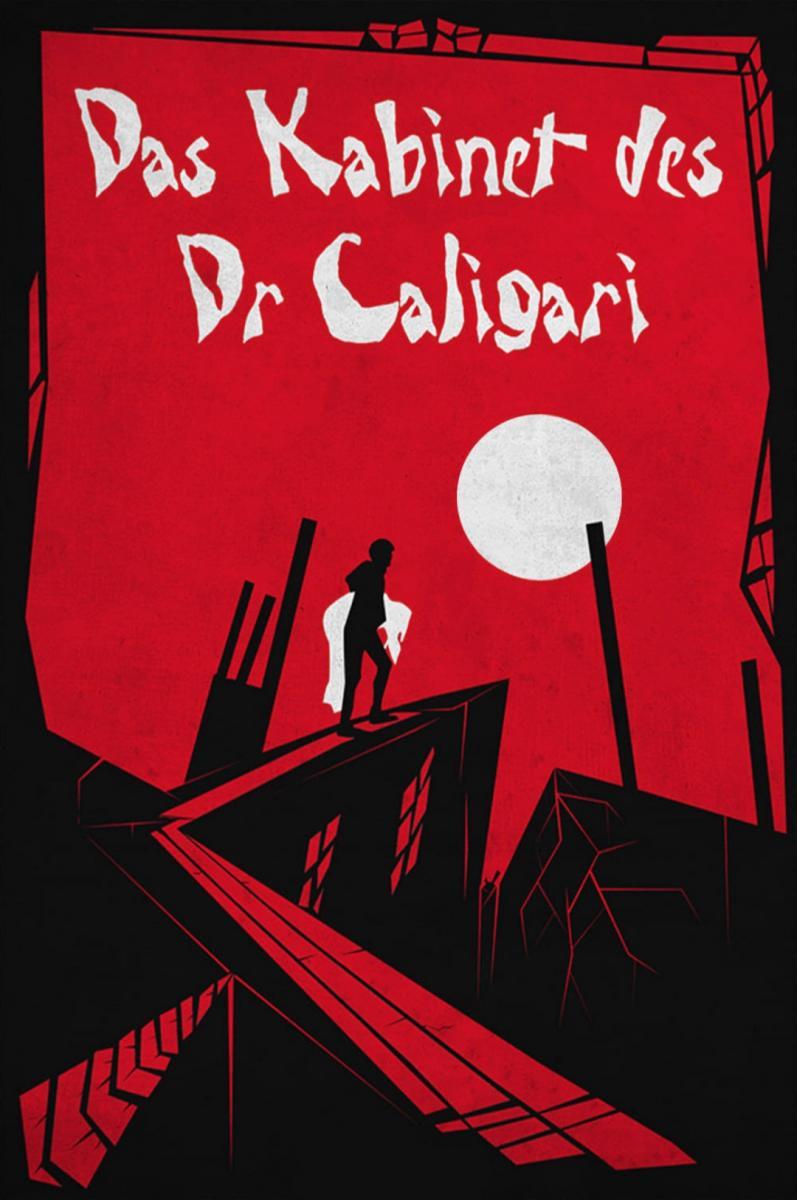
I've been doing the Europe Endless Challenge since 2010, and am down to the last few countries. I aim to finish in 2022.
CROATIA Veres by Neven Usumovic from Best European Fiction 2010 Completed
CYPRUS Exhibition by Nora Nadjarian from Best European Fiction 2011 Completed
LIECHTENSTEIN Deep in the Snow by Mathias Ospelt from Best European Fiction 2010 Completed
LITHUANIA The Allure of the Text y Giedra Radvilaviciute from Best European Fiction 2010 Completed
LUXEMB0URG The Luxembourg Run by Stanley Ellin Completed December, 2021 Completed
MALTA Death in Malta by Roseanne Dinglii
MONTENEGRO Raymond is No Longer with Us - Carver is Dead by Ognjen Spahic from Best European Fiction 2011 Completed
SAN MARINO Twilight in Italy by D. H. Lawrence
SERBIA The Basilica in Lyon by David Albahari from Best European Fiction 2010 Completed
VATICAN CITY The Popes by John Julius Norwich
The Rest of Europe
UK
England My Dog Tulip by J R Ackerley
England The Executor by Margaret Oliphant
England Palladian by Elizabeth Taylor
France We Always Treat Women Too Well by Raymond Queneau
France Claudine at School by Collette
France The Three Evangelists by Fred Vargas
Ireland Snow by John Banville
Portugal The Crime of Father Amaro by Jose Maria Eca de Queiros
Spain The House of Ulloa by Emilia Pardo Bazan
Sweden A Man Called Ove by Fredrik Backman
Sweden The Story of Gosta Berling by Selma Lagerloff
I've been doing the Europe Endless Challenge since 2010, and am down to the last few countries. I aim to finish in 2022.
CROATIA Veres by Neven Usumovic from Best European Fiction 2010 Completed
CYPRUS Exhibition by Nora Nadjarian from Best European Fiction 2011 Completed
LIECHTENSTEIN Deep in the Snow by Mathias Ospelt from Best European Fiction 2010 Completed
LITHUANIA The Allure of the Text y Giedra Radvilaviciute from Best European Fiction 2010 Completed
LUXEMB0URG The Luxembourg Run by Stanley Ellin Completed December, 2021 Completed
MALTA Death in Malta by Roseanne Dinglii
MONTENEGRO Raymond is No Longer with Us - Carver is Dead by Ognjen Spahic from Best European Fiction 2011 Completed
SAN MARINO Twilight in Italy by D. H. Lawrence
SERBIA The Basilica in Lyon by David Albahari from Best European Fiction 2010 Completed
VATICAN CITY The Popes by John Julius Norwich
The Rest of Europe
UK
England My Dog Tulip by J R Ackerley
England The Executor by Margaret Oliphant
England Palladian by Elizabeth Taylor
France We Always Treat Women Too Well by Raymond Queneau
France Claudine at School by Collette
France The Three Evangelists by Fred Vargas
Ireland Snow by John Banville
Portugal The Crime of Father Amaro by Jose Maria Eca de Queiros
Spain The House of Ulloa by Emilia Pardo Bazan
Sweden A Man Called Ove by Fredrik Backman
Sweden The Story of Gosta Berling by Selma Lagerloff
6pamelad
5. Decades

1851 - 1860
1861 - 1870
The Executor by Mrs Oliphant
1871 - 1880
Phoebe Junior by Mrs Oliphant
The Crime of Father Amaro by Jose Maria Eca de Queiros
1881 - 1890
Kidnapped by Robert Louis Stevenson
The House of Ulloa by Emilia Pardo Bazan
1891 - 1900
Claudine at School by Collette
The Story of Gosta Berling by Selma Lagerloff
1901-1910
1911-1920
1921-1930
Decline and Fall by Evelyn Waugh
A Young Doctor's Notebook by Mikhail Bulgakov
1931-1940
Mr Finchley Discovers His England by Victor Canning
Palladian by Elizabeth Taylor
Hamlet, Revenge! by Michael Innes
Strange Journey by Maud Cairnes
1941-1950
We Always Treat Women Too Well by Raymond Queneau
Pied Piper by Nevil Shute
1951-1960
My Dog Tulip by J R Ackerley
Dead Men Don't Ski by Patricia Moyes
The Waiting Years by Fumiko Enchi
The Lark Shall Sing by Elizabeth Cadell
The Blue Sky of Spring by Elizabeth Cadell
1961-1970
The Religious Body by Catherine Aird
Death on the Agenda by Patricia Moyes
Wide Sargasso Sea by Jean Rhys
Chocky by John Wyndham
Sweet Are the Ways by Essie Summers
The Corner Shop by Elizabeth Cadell
Six Impossible Things by Elizabeth Cadell
1971-1980
Secret Rendezvous by Kobo Abe
Plumb by Maurice Gee
1981-1990
Nervous Conditions by Tsitsi Dangarembga
1991-2000
The Blue Sky by Galsang Tschinag (first publication, in German)
The Three Evangelists by Fred Vargas
The Fallout by Garry Disher
2001 - 2010
Not Meeting Mr Right by Anita Heiss
The Crossing Places by Elly Griffiths
The Janus Stone by Elly Griffiths
The Namesake by Jhumpa Lahiri
2011 - 2020
The Labyrinth by Amanda Lohrey
The House at Sea's End by Elly Griffiths
The Outcast Dead by Elly Griffiths
The Ghost Fields by Elly Griffiths
The Woman in Blue by Elly Griffiths
The Scholar by Dervla McTiernan
A Man Called Ove by Fredrik Backman
Crooked Heart by Lissa Evans
Old Baggage by Lissa Evans
Man at the Helm by Nina Stibbe
The Flatshare by Beth O'Leary
Factfulness: Ten Reasons We're Wrong About the World and Why Things Are Better Than You Think by Hans Rosling
The Most Good You can Do: How Effective Altruism Is Changing Ideas About Living Ethically by Peter Singer
2021 - 2022
V for Victory by Lissa Evans
The Way It Is Now by Garry Disher
Black and Blue: a memoir of racism and resilience by Veronica Gorrie

1851 - 1860
1861 - 1870
The Executor by Mrs Oliphant
1871 - 1880
Phoebe Junior by Mrs Oliphant
The Crime of Father Amaro by Jose Maria Eca de Queiros
1881 - 1890
Kidnapped by Robert Louis Stevenson
The House of Ulloa by Emilia Pardo Bazan
1891 - 1900
Claudine at School by Collette
The Story of Gosta Berling by Selma Lagerloff
1901-1910
1911-1920
1921-1930
Decline and Fall by Evelyn Waugh
A Young Doctor's Notebook by Mikhail Bulgakov
1931-1940
Mr Finchley Discovers His England by Victor Canning
Palladian by Elizabeth Taylor
Hamlet, Revenge! by Michael Innes
Strange Journey by Maud Cairnes
1941-1950
We Always Treat Women Too Well by Raymond Queneau
Pied Piper by Nevil Shute
1951-1960
My Dog Tulip by J R Ackerley
Dead Men Don't Ski by Patricia Moyes
The Waiting Years by Fumiko Enchi
The Lark Shall Sing by Elizabeth Cadell
The Blue Sky of Spring by Elizabeth Cadell
1961-1970
The Religious Body by Catherine Aird
Death on the Agenda by Patricia Moyes
Wide Sargasso Sea by Jean Rhys
Chocky by John Wyndham
Sweet Are the Ways by Essie Summers
The Corner Shop by Elizabeth Cadell
Six Impossible Things by Elizabeth Cadell
1971-1980
Secret Rendezvous by Kobo Abe
Plumb by Maurice Gee
1981-1990
Nervous Conditions by Tsitsi Dangarembga
1991-2000
The Blue Sky by Galsang Tschinag (first publication, in German)
The Three Evangelists by Fred Vargas
The Fallout by Garry Disher
2001 - 2010
Not Meeting Mr Right by Anita Heiss
The Crossing Places by Elly Griffiths
The Janus Stone by Elly Griffiths
The Namesake by Jhumpa Lahiri
2011 - 2020
The Labyrinth by Amanda Lohrey
The House at Sea's End by Elly Griffiths
The Outcast Dead by Elly Griffiths
The Ghost Fields by Elly Griffiths
The Woman in Blue by Elly Griffiths
The Scholar by Dervla McTiernan
A Man Called Ove by Fredrik Backman
Crooked Heart by Lissa Evans
Old Baggage by Lissa Evans
Man at the Helm by Nina Stibbe
The Flatshare by Beth O'Leary
Factfulness: Ten Reasons We're Wrong About the World and Why Things Are Better Than You Think by Hans Rosling
The Most Good You can Do: How Effective Altruism Is Changing Ideas About Living Ethically by Peter Singer
2021 - 2022
V for Victory by Lissa Evans
The Way It Is Now by Garry Disher
Black and Blue: a memoir of racism and resilience by Veronica Gorrie
7pamelad
6. CATs and KITs

CATWoman
January: Black and Blue: a memoir of racism and resilience by Veronica Gorrie
February: The Waiting Years by Fumiko Enchi; The House of Ulloa by Emilia Pardo Bazan; The Crime of Father Amaro by Jose Maria Eca de Queiros
May: The Story of Gosta Berling by Selma Lagerloff; The Autobiography of Alice B Toklas by Gertrude Stein
AuthorCAT
January: Not Meeting Mr Right by Anita Heiss; The Blue Sky by Galsang Tschinag
February: Phoebe Junior by Mrs Oliphant; The House of Ulloa by Emilia Pardo Bazan; The Crime of Father Amaro by Jose Maria Eca de Queiros
April: Claudine at School by Collette
May: The Fallout by Garry Disher
ShakespeareCAT
April: Hamlet, Revenge! by Michael Innes

CATWoman
January: Black and Blue: a memoir of racism and resilience by Veronica Gorrie
February: The Waiting Years by Fumiko Enchi; The House of Ulloa by Emilia Pardo Bazan; The Crime of Father Amaro by Jose Maria Eca de Queiros
May: The Story of Gosta Berling by Selma Lagerloff; The Autobiography of Alice B Toklas by Gertrude Stein
AuthorCAT
January: Not Meeting Mr Right by Anita Heiss; The Blue Sky by Galsang Tschinag
February: Phoebe Junior by Mrs Oliphant; The House of Ulloa by Emilia Pardo Bazan; The Crime of Father Amaro by Jose Maria Eca de Queiros
April: Claudine at School by Collette
May: The Fallout by Garry Disher
ShakespeareCAT
April: Hamlet, Revenge! by Michael Innes
8pamelad
7. Book Lists

I'm working my way through the Guardian 1000 with side trips into 1001 Books and assorted lists of classic crime fiction.
Possible Reads
Scaramouche by Rafael Sabatini
Silence Shusaku Endo
Read
Kidnapped by Robert Louis Stevenson Guardian 1000
The House of Ulloa by Emilia Pardo Bazan 1001 Books
The Crime of Father Amaro by Jose Maria Eco de Queiros 1001 Books; Guardian 1000
Claudine at School by Collette Guardian 1000
The Namesake by Jhumpa Lahiri 1001 Books
Chocky by John Wyndham 1001 Books
The Story of Gosta Berling by Selma Lagerloff 1001 Books
Nervous Conditions by Tsitsi Dangarembga 1001 Books

I'm working my way through the Guardian 1000 with side trips into 1001 Books and assorted lists of classic crime fiction.
Possible Reads
Scaramouche by Rafael Sabatini
Silence Shusaku Endo
Read
Kidnapped by Robert Louis Stevenson Guardian 1000
The House of Ulloa by Emilia Pardo Bazan 1001 Books
The Crime of Father Amaro by Jose Maria Eco de Queiros 1001 Books; Guardian 1000
Claudine at School by Collette Guardian 1000
The Namesake by Jhumpa Lahiri 1001 Books
Chocky by John Wyndham 1001 Books
The Story of Gosta Berling by Selma Lagerloff 1001 Books
Nervous Conditions by Tsitsi Dangarembga 1001 Books
9pamelad
8. Crime

The Religious Body by Catherine Aird
The Way It Is Now by Garry Disher
Dead Men Don't Ski by Patricia Moyes
Death on the Agenda by Patricia Moyes
The Crossing Places by Elly Griffiths
The Janus Stone by Elly Griffiths
The House at Sea's End by Elly Griffiths
A Room Full of Bones by Elly Griffiths
Dying fall by Elly Griffiths
The Outcast Dead by Elly Griffiths
The Ghost Fields by Elly Griffiths
The Woman in Blue by Elly Griffiths
The Scholar by Dervla McTiernan
Hamlet, Revenge! by Michael Innes
Death Comes to Kurland Hall by Catherine Lloyd
Death Comes to the Fair by Catherine Lloyd
The Stranger Diaries by Elly Griffiths
The Three Evangelists by Fred Vargas
The Fallout by Garry Disher
The Man Who Died Twice by Richard Osman
The Religious Body by Catherine Aird
The Way It Is Now by Garry Disher
Dead Men Don't Ski by Patricia Moyes
Death on the Agenda by Patricia Moyes
The Crossing Places by Elly Griffiths
The Janus Stone by Elly Griffiths
The House at Sea's End by Elly Griffiths
A Room Full of Bones by Elly Griffiths
Dying fall by Elly Griffiths
The Outcast Dead by Elly Griffiths
The Ghost Fields by Elly Griffiths
The Woman in Blue by Elly Griffiths
The Scholar by Dervla McTiernan
Hamlet, Revenge! by Michael Innes
Death Comes to Kurland Hall by Catherine Lloyd
Death Comes to the Fair by Catherine Lloyd
The Stranger Diaries by Elly Griffiths
The Three Evangelists by Fred Vargas
The Fallout by Garry Disher
The Man Who Died Twice by Richard Osman
10pamelad
9. Books I Own

Most of these are on my Kindle and Kobo, and I keep buying more. Better read the ones I have.
Bought For Fifteenth LT Anniversary
We Always Treat Women Too Well by Raymond Queneau Completed
The Way It Is Now by Garry Disher Completed
The Waiting Years by Fumiko Enchi Completed
The House of Ulloa by Emilia Pardo Bazan Completed
A is for Arsenic by Kathryn Karkup Completed
Segu by Maryse Conde
Plumb by Maurice Gee Completed
The Books of Jacob by Olga Tokarczuk
Books I've Already Started
A Young Doctor's Notebook by Mikhail Bulkagov Completed
The Novel of Ferrara by Giorgio Bassani
The History of Philosophy by A. C. Grayling
The Popes by John Julius Norwich
The Art of Travel by Alain de Botton
Noise by Daniel Kahneman
The Rest
The Labyrinth by Amanda Lohrey
The Crime of Father Amaro by Jose Maria Eca de Queiros
Kings of Georgian Britain by Catherine Curzon
The Crossing Places by Elly Griffiths
The Scholar by Dervla McTiernan
A Man Called Ove by Fredrik Backman
The Stranger Diaries by Elly Griffiths
Chocky by John Wyndham
The Fallout by Garry Disher
The Flatshare by Beth O'Leary
Factfulness: Ten Reasons We're Wrong About the World and Why Things Are Better Than You Think by Hans Rosling

Most of these are on my Kindle and Kobo, and I keep buying more. Better read the ones I have.
Bought For Fifteenth LT Anniversary
We Always Treat Women Too Well by Raymond Queneau Completed
The Way It Is Now by Garry Disher Completed
The Waiting Years by Fumiko Enchi Completed
The House of Ulloa by Emilia Pardo Bazan Completed
A is for Arsenic by Kathryn Karkup Completed
Segu by Maryse Conde
Plumb by Maurice Gee Completed
The Books of Jacob by Olga Tokarczuk
Books I've Already Started
A Young Doctor's Notebook by Mikhail Bulkagov Completed
The Novel of Ferrara by Giorgio Bassani
The History of Philosophy by A. C. Grayling
The Popes by John Julius Norwich
The Art of Travel by Alain de Botton
Noise by Daniel Kahneman
The Rest
The Labyrinth by Amanda Lohrey
The Crime of Father Amaro by Jose Maria Eca de Queiros
Kings of Georgian Britain by Catherine Curzon
The Crossing Places by Elly Griffiths
The Scholar by Dervla McTiernan
A Man Called Ove by Fredrik Backman
The Stranger Diaries by Elly Griffiths
Chocky by John Wyndham
The Fallout by Garry Disher
The Flatshare by Beth O'Leary
Factfulness: Ten Reasons We're Wrong About the World and Why Things Are Better Than You Think by Hans Rosling
11pamelad
10. Prizes
.jpg?auto=compress,format&w=376&v=20210924)
Won the Golden Lion at the Venice Film Festival.
Aiming for 10 different prizes.
Possibilities:
6. Costa The Confessions of Frannie Langton by Sara Collins
9. PEN Translation Prize Autobiography of a Corpse by Sigizmund Krzhizhanovsky
10. Women's Prize for Fiction Half of a Yellow Sun by Chimamanda Ngozie Adichie
11. Desmond Elliot Prize Saraswati Park by Anjali Joseph
17. Melbourne Prize for Literature Axiomatic by Maria Tumarkin
Read
1. Black and Blue: a memoir of racism and resilience by Veronica Gorrie Victorian Prize for Literature
2. The Labyrinth by Amanda Lohrey Miles Franklin
3. An Unwilling Bride by Jo Beverley RITA
4. Plumb by Maurice Gee James Tait Black Memorial Prize
5. The Stranger Diaries by Elly Griffiths Edgar
6. The Story of Gosta Berling by Selma Lagerloff Nobel
7. Nervous Conditions by Tsitsi Dangarembga Commonwealth Writers Prize
.jpg?auto=compress,format&w=376&v=20210924)
Won the Golden Lion at the Venice Film Festival.
Aiming for 10 different prizes.
Possibilities:
6. Costa The Confessions of Frannie Langton by Sara Collins
9. PEN Translation Prize Autobiography of a Corpse by Sigizmund Krzhizhanovsky
10. Women's Prize for Fiction Half of a Yellow Sun by Chimamanda Ngozie Adichie
11. Desmond Elliot Prize Saraswati Park by Anjali Joseph
17. Melbourne Prize for Literature Axiomatic by Maria Tumarkin
Read
1. Black and Blue: a memoir of racism and resilience by Veronica Gorrie Victorian Prize for Literature
2. The Labyrinth by Amanda Lohrey Miles Franklin
3. An Unwilling Bride by Jo Beverley RITA
4. Plumb by Maurice Gee James Tait Black Memorial Prize
5. The Stranger Diaries by Elly Griffiths Edgar
6. The Story of Gosta Berling by Selma Lagerloff Nobel
7. Nervous Conditions by Tsitsi Dangarembga Commonwealth Writers Prize
12pamelad
11. Wish List
I have wish lists on LT, Open Library, Overdrive, Amazon, Kobo, The Book Depository and probably others that I've forgotten. I plan to use them as a source of inspiration rather than a black hole.
Palladian by Elizabeth Taylor
Pied Piper by Nevil Shute
The Crossing Places by Elly Griffiths
Hamlet, Revenge! by Michael Innes
The Story of Gosta Berling by Selma Lagerloff
Strange Journey by Maud Cairnes
Hope to Read Soon: a tribute to RebeccaNYC
The Blue Sky by Galsang Tschinag
Secret Rendezvous by Kobo Abe
Best European Fiction 2010 by Aleksander Hemon
I have wish lists on LT, Open Library, Overdrive, Amazon, Kobo, The Book Depository and probably others that I've forgotten. I plan to use them as a source of inspiration rather than a black hole.
Palladian by Elizabeth Taylor
Pied Piper by Nevil Shute
The Crossing Places by Elly Griffiths
Hamlet, Revenge! by Michael Innes
The Story of Gosta Berling by Selma Lagerloff
Strange Journey by Maud Cairnes
Hope to Read Soon: a tribute to RebeccaNYC
The Blue Sky by Galsang Tschinag
Secret Rendezvous by Kobo Abe
Best European Fiction 2010 by Aleksander Hemon
13pamelad
12. New Authors
One I haven't seen yet.
Secret Rendezvous by Kobo Abe
We Always Treat Women Too Well by Raymond Queneau
The Waiting Years by Fumiko Enchi
The House of Ulloa by Emilia Pardo Bazan
The Scholar by Dervla McTiernan
A Man Called Ove by Fredrik Backman
Plumb by Maurice Gee
The Story of Gosta Berling by Selma Lagerloff
Nervous Conditions by Tsitsi Dangarembga
Crooked Heart by Lissa Evans
Man at the Helm by Nina Stibbe
The Flatshare by Beth O'Leary
Sweet Are the Ways by Essie Summers
Strange Journey by Maud Cairnes
One I haven't seen yet.
Secret Rendezvous by Kobo Abe
We Always Treat Women Too Well by Raymond Queneau
The Waiting Years by Fumiko Enchi
The House of Ulloa by Emilia Pardo Bazan
The Scholar by Dervla McTiernan
A Man Called Ove by Fredrik Backman
Plumb by Maurice Gee
The Story of Gosta Berling by Selma Lagerloff
Nervous Conditions by Tsitsi Dangarembga
Crooked Heart by Lissa Evans
Man at the Helm by Nina Stibbe
The Flatshare by Beth O'Leary
Sweet Are the Ways by Essie Summers
Strange Journey by Maud Cairnes
14pamelad
13. BingoDOG
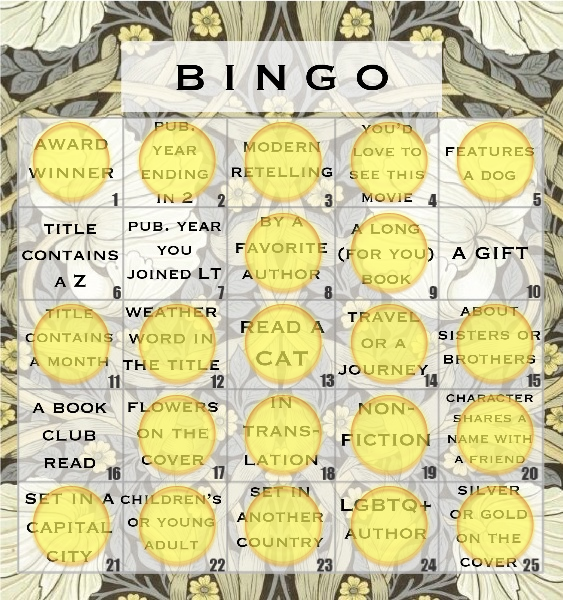
1. An Award Winning book Black and Blue: a memoir of racism and resilience by Veronica Gorrie Victorian Prize for Literature Completed
2. Published in a year ending 2 Death on the Agenda by Patricia Moyes 1962 Completed
3. A modern retelling of an older story Wide Sargasso Sea by Jean Rhys Completed
4. A book you'd love to see as a movie The Blue Sky by Galsang Tschinag Completed
5. A book that features a dog My Dog Tulip by J R Ackerley Completed
6. The title contains the letter Z The Zone by Sergei Dovlatov
7. Published the year you joined LT Half of a Yellow Sun 2006
8. A book by a favourite author Decline and Fall by Evelyn Waugh Completed
9. A long book (long for you) The Crime of Father Amaro by Jose Maria Eca de Queiros Completed
10. A book you received as a gift
11. The title contains a month The Merry Month of May by Joan Smith Completed
12. A weather word in the title Snow by John Banville Completed
13. Read a CAT Phoebe Junior by Mrs Oliphant Completed
14. Contains travel or a journey Mr Finchley Discovers His England by Victor Canning Completed
15. A book about sisters or brothers Love and Folly by Sheila Simonson Completed
16. A book club read (real or online)
17. A book with flowers on the cover Palladian by Elizabeth Taylor Completed
18. A book in translation Secret Rendezvous by Kobo Abe Completed
19. A work of non-fiction A is for Arsenic by Kathryn Harkup Completed
20. A book where a character shares a name of a friend Lady Elizabeth's Comet by Sheila Simonson Completed
21. A book set in a capital city The Three Evangelists by Fred Vargas Completed
22. A children's or YA book Kidnapped by Robert Louis Stevenson Completed
23. A book set in a country other than the one you live The Religious Body by Catherine Aird Completed
24. A book by an LGBTQ+ author Claudine at School by Colette Completed
25. A book with silver or gold on the cover The Way It Is Now by Garry Disher Completed
1. An Award Winning book Black and Blue: a memoir of racism and resilience by Veronica Gorrie Victorian Prize for Literature Completed
2. Published in a year ending 2 Death on the Agenda by Patricia Moyes 1962 Completed
3. A modern retelling of an older story Wide Sargasso Sea by Jean Rhys Completed
4. A book you'd love to see as a movie The Blue Sky by Galsang Tschinag Completed
5. A book that features a dog My Dog Tulip by J R Ackerley Completed
6. The title contains the letter Z The Zone by Sergei Dovlatov
7. Published the year you joined LT Half of a Yellow Sun 2006
8. A book by a favourite author Decline and Fall by Evelyn Waugh Completed
9. A long book (long for you) The Crime of Father Amaro by Jose Maria Eca de Queiros Completed
10. A book you received as a gift
11. The title contains a month The Merry Month of May by Joan Smith Completed
12. A weather word in the title Snow by John Banville Completed
13. Read a CAT Phoebe Junior by Mrs Oliphant Completed
14. Contains travel or a journey Mr Finchley Discovers His England by Victor Canning Completed
15. A book about sisters or brothers Love and Folly by Sheila Simonson Completed
16. A book club read (real or online)
17. A book with flowers on the cover Palladian by Elizabeth Taylor Completed
18. A book in translation Secret Rendezvous by Kobo Abe Completed
19. A work of non-fiction A is for Arsenic by Kathryn Harkup Completed
20. A book where a character shares a name of a friend Lady Elizabeth's Comet by Sheila Simonson Completed
21. A book set in a capital city The Three Evangelists by Fred Vargas Completed
22. A children's or YA book Kidnapped by Robert Louis Stevenson Completed
23. A book set in a country other than the one you live The Religious Body by Catherine Aird Completed
24. A book by an LGBTQ+ author Claudine at School by Colette Completed
25. A book with silver or gold on the cover The Way It Is Now by Garry Disher Completed
15pamelad
14. More Prizes

Nominated for Best Film of the Century.
Crooked Heart by Lissa Evans: Bailey's Women's Prize for Fiction longlist
V for Victory by Lissa Evans: HWA Gold Crown Shortlist
Farthing by Jo Walton: Sidewise Award Finalist
Old Baggage by Lissa Evans: Bollinger Everyman Wodehouse Prize Shortlist
Man at the Helm by Nina Stibbe: Bollinger Everyman Wodehouse Prize Shortlist

Nominated for Best Film of the Century.
Crooked Heart by Lissa Evans: Bailey's Women's Prize for Fiction longlist
V for Victory by Lissa Evans: HWA Gold Crown Shortlist
Farthing by Jo Walton: Sidewise Award Finalist
Old Baggage by Lissa Evans: Bollinger Everyman Wodehouse Prize Shortlist
Man at the Helm by Nina Stibbe: Bollinger Everyman Wodehouse Prize Shortlist
16pamelad
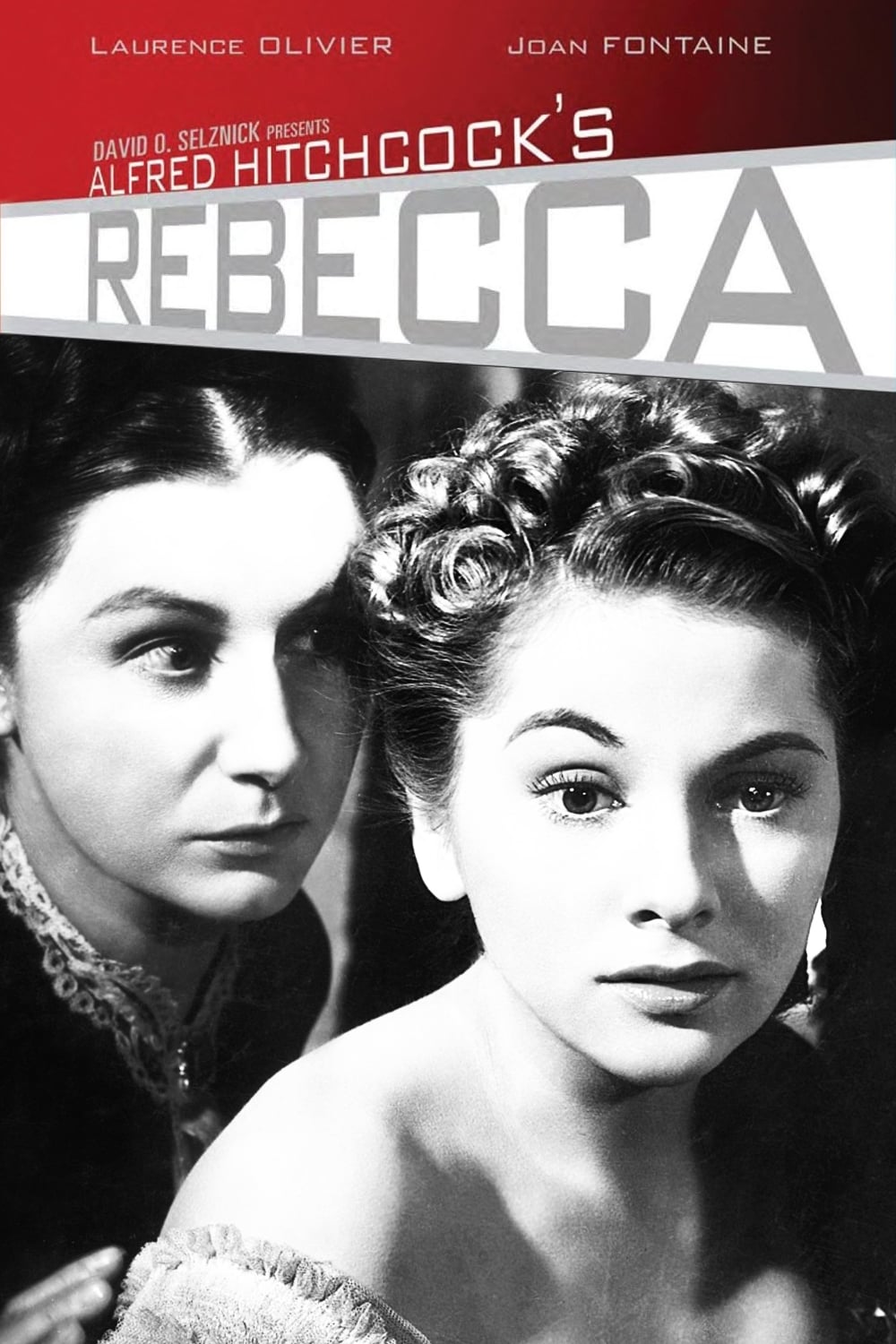
15. Hope to Read Soon: a tribute to RebeccaNYC
The Blue Sky by Galsang Tschinag Completed
Secret Rendezvous by Kobo Abe Completed
Best European Fiction 2010 by Aleksander Hemon Completed
16. Historical Fiction Challenge
1. Set in the country you're from
2. Set in a different country
3. Set in your favourite historical period
4. Set in period you're less familiar with
5. Historical fiction with a speculative element Farthing by Jo Walton
6. About a real historical figure or a specific event
7. A classic work of historical fiction
Bonus: a work of historical fiction of over 500 pages
17pamelad
Prizes and Lists
A place to store the prizes and lists I come across.
Prizes
1. Miles Franklin Award
2. Booker International/Independent Foreign Fiction Prize
3. Booker Prize
4. Stella Prize
5. Costa Award
7. Samuel Johnson/Baillie-Gifford Prize for Non-Fiction
8. Edgar Awards
9. PEN Translation Prize
10. Women's Prize for Fiction
11. Desmond Elliot Prize
12. Royal Society of Literature Ondaatje Prize
13. Betty Trask Award
14. Romance Writers of Australia Ruby Award
15. Prix du Meilleur Livre Etranger
16. Ngaio Marsh Award
17. Melbourne Prize for Literature
18. Tanizaki Prize
19. Barbara Jefferis Award
20. International Thriller Writers Awards
21. Historical Writers Association Awards
22. Gold Dagger Awards
23. Sidewise Award for Alternate History
24. Australian Literature Society Gold Medal
25. James Tait Black Memorial Prize
26. Bollinger Everyman Wodehouse Prize
27. Ned Kelly Award
A place to store the prizes and lists I come across.
Prizes
1. Miles Franklin Award
2. Booker International/Independent Foreign Fiction Prize
3. Booker Prize
4. Stella Prize
5. Costa Award
7. Samuel Johnson/Baillie-Gifford Prize for Non-Fiction
8. Edgar Awards
9. PEN Translation Prize
10. Women's Prize for Fiction
11. Desmond Elliot Prize
12. Royal Society of Literature Ondaatje Prize
13. Betty Trask Award
14. Romance Writers of Australia Ruby Award
15. Prix du Meilleur Livre Etranger
16. Ngaio Marsh Award
17. Melbourne Prize for Literature
18. Tanizaki Prize
19. Barbara Jefferis Award
20. International Thriller Writers Awards
21. Historical Writers Association Awards
22. Gold Dagger Awards
23. Sidewise Award for Alternate History
24. Australian Literature Society Gold Medal
25. James Tait Black Memorial Prize
26. Bollinger Everyman Wodehouse Prize
27. Ned Kelly Award
18rabbitprincess
Looking forward to following along with your reading in 2022! I love that poster for Man with a Movie Camera.
19NinieB
Great posters--looking forward to following along!
I do notice there's no historical romance category . . .
I do notice there's no historical romance category . . .
20DeltaQueen50
I love classic films and you've chosen some interesting ones to highlight your categories. Looking forward to following along with you next year.
21pamelad
Welcome, fellow readers!
>18 rabbitprincess: It's a great film, too. Well worth seeking out.
>19 NinieB: I don't want to encourage them. They just take over.
>20 DeltaQueen50: So many to choose from. Have you run across the film site Kanopy? It's free if your library subscribes.
>18 rabbitprincess: It's a great film, too. Well worth seeking out.
>19 NinieB: I don't want to encourage them. They just take over.
>20 DeltaQueen50: So many to choose from. Have you run across the film site Kanopy? It's free if your library subscribes.
24pamelad
>22 majkia:, >23 hailelib: Welcome!
25DeltaQueen50
>21 pamelad: I haven't seen Kanopy before - but now I will have to check into it!
26Tess_W
Great posters! Will probably "steal" some of your Australia reads (one of my CATS)
I don't know if this will help with San Marino or not, but Goodreads has a list of books set in San Marino: https://www.goodreads.com/topic/show/647483-san-marino
I don't know if this will help with San Marino or not, but Goodreads has a list of books set in San Marino: https://www.goodreads.com/topic/show/647483-san-marino
27VivienneR
Wonderful theme! I'll be getting film bullets as well as BBs.
When I did the Europe Endless challenge I downloaded a history of San Marino by Theodore Bent from Project Gutenberg. It was quite interesting and not too long as far as I remember. If you enjoy D.H. Lawrence he travels through Italy including San Marino in Twilight in Italy, probably a better choice than Bent.
When I did the Europe Endless challenge I downloaded a history of San Marino by Theodore Bent from Project Gutenberg. It was quite interesting and not too long as far as I remember. If you enjoy D.H. Lawrence he travels through Italy including San Marino in Twilight in Italy, probably a better choice than Bent.
30MissWatson
Great theme and some wonderful movies! Happy reading!
31pamelad
>26 Tess_W: Thanks Tess. I was tempted by Smoke into Flame, but it's only available as an elderly paperback from overseas. Very happy to push Australian authors and Australian films, too. Beneath Clouds is directed by the indigenous film maker, Ivan Sen, and has a largely aboriginal cast. I also recommend his films Toomelah, Mystery Road and Goldstone. Toomelah, in particular, is a real eye opener.
>27 VivienneR: Thank you for the San Marino suggestions. I'm going with Twilight in Italy, which saves pretending that San Marino doesn't exist.
>28 Jackie_K: An entertainingly over the top poster for an understated horror film, which is scarier because you have to imagine the things it doesn't show.
>29 dudes22: Welcome! My favourite Australian crime writer is unlikely to appear here because I've read nearly every book he's written, but I wouldn't want you to miss him. I highly recommend Garry Disher's Challis and Destry series, which begins with The Dragon Man, and the Paul Hirschhausen series, beginning with Bitter Wash Road.
>30 MissWatson: Thank you! I'm sort of looking forward to returning to the cinema, but it's going to take a lot of nerve.
>27 VivienneR: Thank you for the San Marino suggestions. I'm going with Twilight in Italy, which saves pretending that San Marino doesn't exist.
>28 Jackie_K: An entertainingly over the top poster for an understated horror film, which is scarier because you have to imagine the things it doesn't show.
>29 dudes22: Welcome! My favourite Australian crime writer is unlikely to appear here because I've read nearly every book he's written, but I wouldn't want you to miss him. I highly recommend Garry Disher's Challis and Destry series, which begins with The Dragon Man, and the Paul Hirschhausen series, beginning with Bitter Wash Road.
>30 MissWatson: Thank you! I'm sort of looking forward to returning to the cinema, but it's going to take a lot of nerve.
32dudes22
>31 pamelad: - I'll put him on the list although I really don't need any more series.
34pamelad
>33 japaul22: Welcome, and I yours.
35christina_reads
Just stopping by and leaving my star! Count me among those who love the "Cat People" poster. :)
36pamelad
>35 christina_reads: Subtlety is so overrated! Glad you like the poster. I also like this comment on the Pride and Prejudice poster: When pretty girls t-e-a-s-e-d men into marriage.
37pamelad
Fellow film fans, Mubi is having a sale this weekend. I watch on the TV using Chromecast, which isn't ideal, but it's an excellent source of classic films that are hard to find.
39VictoriaPL
>38 pamelad: ohhhhhh. Noirvember. I love it!
42thornton37814
Hope you enjoy your 2022 reads!
43pamelad
>42 thornton37814: Thank you.
44pamelad
It's good to have at least one big, ambitious read on the list, so I'm thinking of the 922 page The Books of Jacob by the Polish Nobel Prize winner, Olga Tokarczuk. The English translation has just been published.
45dudes22
>44 pamelad: - That is a chunkster! I read her book Drive Your Plow Over the Bones of the Dead last year and I just picked up Flights to read next year. I'll be looking forward to seeing what you think of it.
47pamelad
>45 dudes22: I really liked Drive Your Plow Over the Bones of the Dead, and will be interested to hear what you think of Flights. I reckon that if I could read Ulysses I can manage The Books of Jacob, but I am hoping to like it a great deal more than I did Ulysses!
48psutto
I also miss the cinema. Great theme. I watched Lagaan in India on Christmas day in 2001 in the house of someone who'd been driving us around for a few days - our host dressed as Santa (a thin Indian Santa) and cooked us a feast!
49pamelad
>48 psutto: A memorable experience! I also have wonderful memories of hospitable Indian people, and watching The Life of Brian in Haryana on New Year's Eve.
50Crazymamie
LOVE your theme! "I'm fatally attracted to subtitles, and to films that were made before I was born. Me, too! I can tell I am going to get both book and movie bullets from your thread - very happy making.
Kanopy - I miss this so much. I belonged to a library that offered it, but my current library system does not offer it. So sad. I watched a lot of older stuff that you can't find anywhere else on there. And Noirvember would be right up my alley.
Kanopy - I miss this so much. I belonged to a library that offered it, but my current library system does not offer it. So sad. I watched a lot of older stuff that you can't find anywhere else on there. And Noirvember would be right up my alley.
51pamelad
>50 Crazymamie: That's a pain about Kanopy. Have you come across Tubi? It doesn't have the range of Kanopy and there's the occasional ad, but it's free and has some classic films. Also some ancient TV series. Do you remember Topper, with Leo G. Carroll? I also belong to Mubi, which has a selection of foreign and arthouse films. It's a paid subscription, but you can get a free trial.
52Crazymamie
>51 pamelad: Thanks so much for that! I will investigate. I do remember Topper!
53mnleona
>51 pamelad: I loved the Topper movies.
54pamelad
>53 mnleona: The 1937 film with Constance Bennett and Cary Grant? Loved it! You can't beat a screwball comedy, or anything with Cary Grant in it.
55MissBrangwen
Great categories, and I'm especially looking forward to your Australian books!
56pamelad
>55 MissBrangwen: Welcome! I'm starting with Too Much Lip by Melissa Lucashenko, Australian Aboriginal author.
57pamelad
In the first chapter of Too Much Lip a couple of crows are having a conversation, so I've put the book aside for now and read Not Meeting Mr Right, by the Australian Aboriginal writer, Anita Heiss.
Alice is the head of the history department at a Catholic Girls' school. After attending a school reunion where all her classmates are married with children and can talk of nothing else, she makes a plan to marry before she's thirty, in two year's time. The book is about her search for her future husband. There's a lot of tedious drinking, shopping and waxing, interspersed with some interesting insights into life as a middle-class Aboriginal woman. Being Aboriginal certainly adds a degree of difficulty to the man search, and there are some amusingly scathing caricatures of hypocritical white people who want to be Kooris, and establishment bigots. The book is disjointed and sometimes didactic, unfortunately.
The first film for 2022 is Eric Rohmer's A Tale of Springtime, which features, as do most of his films, attractive French people having philosophical conversations in picturesque surroundings. Very pleasant.
Alice is the head of the history department at a Catholic Girls' school. After attending a school reunion where all her classmates are married with children and can talk of nothing else, she makes a plan to marry before she's thirty, in two year's time. The book is about her search for her future husband. There's a lot of tedious drinking, shopping and waxing, interspersed with some interesting insights into life as a middle-class Aboriginal woman. Being Aboriginal certainly adds a degree of difficulty to the man search, and there are some amusingly scathing caricatures of hypocritical white people who want to be Kooris, and establishment bigots. The book is disjointed and sometimes didactic, unfortunately.
The first film for 2022 is Eric Rohmer's A Tale of Springtime, which features, as do most of his films, attractive French people having philosophical conversations in picturesque surroundings. Very pleasant.
58pamelad
I've changed my categories (already!) to add Africa, Asia and the Americas. Removed Big Books because they can fit in other categories.
59Tess_W
>58 pamelad: I also have Asia & Africa as well as Australia this year. Next year I'm going for Europe and North and South America.
60pamelad
>59 Tess_W: One of my goals this year is to read from a wide range of countries, and I'm currently reading a book by a Mongolian writer, so I added the new category as encouragement to read around the world. I'll definitely be checking out your Asia & Africa category.
61pamelad
BingoDOG: Featuring a dog
My Dog Tulip by J R Ackerley is the story of the writer's great love for his dog, and hers for him. The writing is dry and witty in a very English way, which is a great part of its charm, so I was saddened to see that a tasteless, tin-eared editor had made pavements into sidewalks, which made me question how much else was changed. Did Ackerley really put Tulip in an elevator, not a lift? Did he really shout at a pack of dogs to scram?
I'd recommend this book anyway, despite the tragic editing. It's an oddity.
My Dog Tulip by J R Ackerley is the story of the writer's great love for his dog, and hers for him. The writing is dry and witty in a very English way, which is a great part of its charm, so I was saddened to see that a tasteless, tin-eared editor had made pavements into sidewalks, which made me question how much else was changed. Did Ackerley really put Tulip in an elevator, not a lift? Did he really shout at a pack of dogs to scram?
I'd recommend this book anyway, despite the tragic editing. It's an oddity.
62pamelad
AuthorCAT: Indigenous Writer; BingoDOG: make into a film
The Blue Sky by Galsang Tschinag is narrated by a young boy, the youngest of three children in a family of nomadic herders. They are Tuvans, indigenous people living in the High Altai mountains in the far north-west of Mongolia, sharing the land with the Kazakhs. Their way of life is dying as the Soviet system takes over. The two older children are removed to a boarding school in the city, and that will be the fate of this little boy too, but for now he's helping his family and managing his own herd of sheep with the help of his devoted dog Aryslan. The most important person in his life is his grandmother, an old woman cheated and left almost destitute by her own family and taken in by the boy's.
Why make it into a film?
Majestic snowcapped mountains, lush forests, endless steppes. Yaks! Yurts! I imagine a film that is mainly slow, meditative and elegiac, but with intervals of Tuvan celebrations and dramatic incidents.
The Blue Sky by Galsang Tschinag is narrated by a young boy, the youngest of three children in a family of nomadic herders. They are Tuvans, indigenous people living in the High Altai mountains in the far north-west of Mongolia, sharing the land with the Kazakhs. Their way of life is dying as the Soviet system takes over. The two older children are removed to a boarding school in the city, and that will be the fate of this little boy too, but for now he's helping his family and managing his own herd of sheep with the help of his devoted dog Aryslan. The most important person in his life is his grandmother, an old woman cheated and left almost destitute by her own family and taken in by the boy's.
Why make it into a film?
Majestic snowcapped mountains, lush forests, endless steppes. Yaks! Yurts! I imagine a film that is mainly slow, meditative and elegiac, but with intervals of Tuvan celebrations and dramatic incidents.
63Tess_W
>62 pamelad: been on my WL for sometime
64pamelad
>63 Tess_W: It’s available from the Open Library. Worth reading.
66pamelad
>65 hailelib: I can recommend it. It's short, and you don't come across Mongolian writers very often.
67MissBrangwen
>62 pamelad: That's a BB for me, too! I love watching documentaries about Mongolia and would definitely watch the film you have envisioned.
68ELiz_M
>62 pamelad: This sounds interesting and would be a nice addition to my global reading challenge. Bonus, my library has a copy!
69pamelad
>67 MissBrangwen: I am missing the Melbourne International Film Festival, where every year I'd watch slow, meditative films from exotic places. Maybe next year? In the meantime, enjoy The Blue Sky.
>68 ELiz_M: That's a good library. They don't always hang on to books that aren't borrowed very often.
>68 ELiz_M: That's a good library. They don't always hang on to books that aren't borrowed very often.
70pamelad
8. Crime
BingoDOG:23. A book set in a country other than your own
The Religious Body by Catherine Aird is the first book in the Calleshire Chronicles, which feature Inspector Sloan and Detective Constable Crosby. A nun is found dead at the bottom of the cellar stairs. It wasn't the fall that killed her; she'd been murdered. Sloan's investigation is complicated by the religious practices of the nuns, who aspire not to notice most of what's going on around them and to trample any signs of individuality. Interesting.
A competent, traditional mystery from the sixties. It's available, along with the rest of the series, with Kobo Plus.
BingoDOG:23. A book set in a country other than your own
The Religious Body by Catherine Aird is the first book in the Calleshire Chronicles, which feature Inspector Sloan and Detective Constable Crosby. A nun is found dead at the bottom of the cellar stairs. It wasn't the fall that killed her; she'd been murdered. Sloan's investigation is complicated by the religious practices of the nuns, who aspire not to notice most of what's going on around them and to trample any signs of individuality. Interesting.
A competent, traditional mystery from the sixties. It's available, along with the rest of the series, with Kobo Plus.
71pamelad
2. Africa, Asia and the Americas
12. New Authors
13. BingoDOG: a book in translation
15. Hope to Read Soon: a tribute to RebeccaNYC
Secret Rendezvous by Kobo Abe
A woman is taken away in the middle of the night by ambulance, although she is not ill. Her husband traces her to a huge, underground hospital and finds that she disappeared from reception before being officially admitted. No one is prepared to tell the man where his wife has gone. Is she lost or imprisoned in the labyrinths of the hospital? Is she dead? Has she escaped? Has she arranged her own disappearance? The man is employed by a bizarre individual, who seems to be half man, half horse, to find the woman. The man must report his investigation in a journal, which has to be written in the third person. The book consists of the man's three journals.
Secret Rendezvous seems to be operating on many levels. (I say "seems' because I'm not at all sure what I've just read.) There's the aspect of surveillance, with the hospital full of bugs and hidden cameras that send data to a central security system. There's an indictment of a hospital system where patients enter and cannot leave, doctors tout for business and recruit patients to specialties without reference to their symptoms, doctors and nurses use patients for their own entertainment and perform strange sexual experiments on them; the head of security sells the tapes for profit. There's a confusion of identities, an inability to know who people really are: a man who acts as though he is a horse, who is actually a doctor and the deputy director; doctors who are patients and patients who are doctors; a girl whose shape changes because of a bone disease; the man's wife, who might not be the woman he thought he knew. There's a thread about masculinity and erections, femininity and orgasms, and an awful lot of masturbation. Some reviews describe this as an erotic novel, but with all this sex being about violent experimentation and power machinations, it didn't seem that way to me.
Reading Secret Rendezvous was like being plunged into someone's nightmare. I felt the claustrophobia, the panic, the confusion and the powerlessness, but I didn't quite understand what was going on.
12. New Authors
13. BingoDOG: a book in translation
15. Hope to Read Soon: a tribute to RebeccaNYC
Secret Rendezvous by Kobo Abe
A woman is taken away in the middle of the night by ambulance, although she is not ill. Her husband traces her to a huge, underground hospital and finds that she disappeared from reception before being officially admitted. No one is prepared to tell the man where his wife has gone. Is she lost or imprisoned in the labyrinths of the hospital? Is she dead? Has she escaped? Has she arranged her own disappearance? The man is employed by a bizarre individual, who seems to be half man, half horse, to find the woman. The man must report his investigation in a journal, which has to be written in the third person. The book consists of the man's three journals.
Secret Rendezvous seems to be operating on many levels. (I say "seems' because I'm not at all sure what I've just read.) There's the aspect of surveillance, with the hospital full of bugs and hidden cameras that send data to a central security system. There's an indictment of a hospital system where patients enter and cannot leave, doctors tout for business and recruit patients to specialties without reference to their symptoms, doctors and nurses use patients for their own entertainment and perform strange sexual experiments on them; the head of security sells the tapes for profit. There's a confusion of identities, an inability to know who people really are: a man who acts as though he is a horse, who is actually a doctor and the deputy director; doctors who are patients and patients who are doctors; a girl whose shape changes because of a bone disease; the man's wife, who might not be the woman he thought he knew. There's a thread about masculinity and erections, femininity and orgasms, and an awful lot of masturbation. Some reviews describe this as an erotic novel, but with all this sex being about violent experimentation and power machinations, it didn't seem that way to me.
Reading Secret Rendezvous was like being plunged into someone's nightmare. I felt the claustrophobia, the panic, the confusion and the powerlessness, but I didn't quite understand what was going on.
72pamelad
Going well for variety so far. 5 books, 4 different countries, 5 different decades, 5 different genres. No historical romances.
73pamelad
9. Books I Own
12. New Writers
We Always Treat Women Too Well by Raymond Queneau is a parody of No Orchids for Miss Blandish, a best-selling 1939 crime novel in which a passive, drug-addicted, suicidal young woman is raped and degraded by the depraved gangster who has abducted her. Queneau is not alone in his disgust, as this article by George Orwell shows.
Queneau transposes the action to Dublin in 1916, the Easter Rising, where a group of amateurish rebels has occupied the Post Office. They've cleared out most of the British workers unharmed, have shot two, and are settled in to return fire with the British and die nobly for their cause - an Ireland free of British rule - when they discover Gertie Girdle, who'd been hiding in the lavatory. Some of the rebels want to kill Gertie, but their leader thinks that brutalising an innocent female postal worker would tarnish their reputations, and that Gertie must remain alive and unsullied. After she is raped by one of the rebels, Gertie manages to ensure her survival by seduction, and she is hard to resist. She's the antithesis of Miss Blandish.
We Always Treat Women Too Well shouldn't be funny. The Easter Rising isn't funny; the violence is gruesome; Gertie is raped many times; there's even an instance of necrophilia. Perhaps it's the exuberance of the violence that makes it impossible to take seriously, plus the awareness that the bad taste is the point. The absurdity piles on: the ineptitude of the rebels with their catch-cry of "Finnegan's Wake!"; the fact that the Irish names and places all came from Ulysses; the British officer named Mountcatten.
We Always Treat Women Too Well was an entertaining read. As an introduction to Raymond Queneau it probably wasn't the best choice, so I'm planning to read another. I can't find a copy of his most famous book, Zazie in the Metro, so will go with The Sunday of Life.
12. New Writers
We Always Treat Women Too Well by Raymond Queneau is a parody of No Orchids for Miss Blandish, a best-selling 1939 crime novel in which a passive, drug-addicted, suicidal young woman is raped and degraded by the depraved gangster who has abducted her. Queneau is not alone in his disgust, as this article by George Orwell shows.
Queneau transposes the action to Dublin in 1916, the Easter Rising, where a group of amateurish rebels has occupied the Post Office. They've cleared out most of the British workers unharmed, have shot two, and are settled in to return fire with the British and die nobly for their cause - an Ireland free of British rule - when they discover Gertie Girdle, who'd been hiding in the lavatory. Some of the rebels want to kill Gertie, but their leader thinks that brutalising an innocent female postal worker would tarnish their reputations, and that Gertie must remain alive and unsullied. After she is raped by one of the rebels, Gertie manages to ensure her survival by seduction, and she is hard to resist. She's the antithesis of Miss Blandish.
We Always Treat Women Too Well shouldn't be funny. The Easter Rising isn't funny; the violence is gruesome; Gertie is raped many times; there's even an instance of necrophilia. Perhaps it's the exuberance of the violence that makes it impossible to take seriously, plus the awareness that the bad taste is the point. The absurdity piles on: the ineptitude of the rebels with their catch-cry of "Finnegan's Wake!"; the fact that the Irish names and places all came from Ulysses; the British officer named Mountcatten.
We Always Treat Women Too Well was an entertaining read. As an introduction to Raymond Queneau it probably wasn't the best choice, so I'm planning to read another. I can't find a copy of his most famous book, Zazie in the Metro, so will go with The Sunday of Life.
74pamelad
9. Books I Own
13. BingoDOG Travel
Mr Finchley Discovers His England by Victor Canning
For decades Mr Finchley has worked as a solicitor's clerk, and has never had a holiday. When the firm is sold, Finchley's enlightened new boss demands that he take a holiday and gives him three weeks off. Plump, bald, forty-five year old Mr Finchley, a man intimidated by his landlady, decides to go to Margate, an unadventurous seaside resort, but on the way he is inadvertently kidnapped by gangsters, and his exciting holiday begins. Mr Finchley travels around England on foot, by bicycle, by train and bus, and even in a smuggler's boat. He makes friends with the people who take to the roads: gipsies, itinerant workers, a travelling vicar, an artist, an escaped lunatic. He sleeps by the side of the road, in barns, in tents and even in a mansion. The naive and trusting Mr Finchley gets along with everyone.
This cheerful, gently humorous, optimistic little book was a best seller in England in 1934.
13. BingoDOG Travel
Mr Finchley Discovers His England by Victor Canning
For decades Mr Finchley has worked as a solicitor's clerk, and has never had a holiday. When the firm is sold, Finchley's enlightened new boss demands that he take a holiday and gives him three weeks off. Plump, bald, forty-five year old Mr Finchley, a man intimidated by his landlady, decides to go to Margate, an unadventurous seaside resort, but on the way he is inadvertently kidnapped by gangsters, and his exciting holiday begins. Mr Finchley travels around England on foot, by bicycle, by train and bus, and even in a smuggler's boat. He makes friends with the people who take to the roads: gipsies, itinerant workers, a travelling vicar, an artist, an escaped lunatic. He sleeps by the side of the road, in barns, in tents and even in a mansion. The naive and trusting Mr Finchley gets along with everyone.
This cheerful, gently humorous, optimistic little book was a best seller in England in 1934.
75Tess_W
>74 pamelad: A BB for me!
76pamelad
>75 Tess_W: The Kindle version is only $1.43 US.
9. Books I Own
13. BingoDOG: Favorite author
The Way It Is Now by Garry Disher starts with a flashback to January 2000, when Charlie Devarin's mother was murdered. Charlie is back now in his childhood home, suspended from the police force for an altercation with an incompetent superior. His marriage broke down because he made no effort, spending his free time investigating his mother's murder and sparing too little attention for his wife and daughter. Now Charlie is in the early stages of a relationship with Anna, a juror on the rape case that led to his suspension, but he is still consumed by the investigation of his mother's murder. Charlie's father, Rhys, a retired policeman, is still suspected of killing his wife, and Charlie's brother Liam thinks he did it. Charlie wants to prove his dad is innocent of the murder, but he suspects that he is guilty of something else.
I've read better books by Garry Disher, but this was pretty good. It's as much to do with relationships as with crime. It's set mainly on the Mornington Peninsula, but is a stand-alone, not part of the Challis and Destry series. The Melbourne bits are set near to where I live, so the familiarity adds a layer of interest and enjoyment, and knowing the demographics of the suburbs Disher mentions tells me something about the characters.
Recommended.
9. Books I Own
13. BingoDOG: Favorite author
The Way It Is Now by Garry Disher starts with a flashback to January 2000, when Charlie Devarin's mother was murdered. Charlie is back now in his childhood home, suspended from the police force for an altercation with an incompetent superior. His marriage broke down because he made no effort, spending his free time investigating his mother's murder and sparing too little attention for his wife and daughter. Now Charlie is in the early stages of a relationship with Anna, a juror on the rape case that led to his suspension, but he is still consumed by the investigation of his mother's murder. Charlie's father, Rhys, a retired policeman, is still suspected of killing his wife, and Charlie's brother Liam thinks he did it. Charlie wants to prove his dad is innocent of the murder, but he suspects that he is guilty of something else.
I've read better books by Garry Disher, but this was pretty good. It's as much to do with relationships as with crime. It's set mainly on the Mornington Peninsula, but is a stand-alone, not part of the Challis and Destry series. The Melbourne bits are set near to where I live, so the familiarity adds a layer of interest and enjoyment, and knowing the demographics of the suburbs Disher mentions tells me something about the characters.
Recommended.
77Tess_W
>76 pamelad: LOL went to Kindle and they told me I had already purchased it in 2019--yep, already have the ebook. Now to just read it.
78pamelad
>77 Tess_W: Happy reading!
13. BingoDOG: Favourite author
Decline and Fall by Evelyn Waugh
Waugh's first novel, published in 1929, is an exuberant comic satire. Paul Pennyfeather is studying theology at Oxford in preparation for becoming an Anglican priest when he is caught up in the annual Bollinger celebration and expelled, through no fault of his own. In need of money he takes a job at a fourth-rate school in Wales where he meets Pendlebury, a former rector with religious doubts; Grimes, an old Harrovian whose public school background has saved him from jail, and worse; Philbrick, a butler with a shady past and a fabulously inflated present. These three reappear, singly and together, when least expected. One of Paul's students, Peter Beste-Chetwynde (pronounced Beast-Cheating) plays an important role because it is his mother, the beautiful, exciting Margot, who leads to Paul's decline and fall.
This is a very funny book. Paul is determined to behave as a gentleman, so he barely protests when ruthless people, many of them purportedly gentlemen, take advantage of him. The reader knows what is going on, but Paul has no idea.
This is a re-read. I gave Decline and Fall 5 stars on the first read, but have subtracted half a star this time because even though I enjoyed the book greatly and it made me laugh, I didn't remember having read it!
I read it again because I came across the television miniseries, which I liked, but on its own terms. Some characters are more exaggerated in the series than in the book, particularly Grimes; Pennyfeather is a simpering twerp; there's quite a lot of slapstick; characters are combined; Peter Beste-Chetwynde undergoes a personality change. I'd recommend the miniseries, but be sure to watch it before you read the book.
13. BingoDOG: Favourite author
Decline and Fall by Evelyn Waugh
Waugh's first novel, published in 1929, is an exuberant comic satire. Paul Pennyfeather is studying theology at Oxford in preparation for becoming an Anglican priest when he is caught up in the annual Bollinger celebration and expelled, through no fault of his own. In need of money he takes a job at a fourth-rate school in Wales where he meets Pendlebury, a former rector with religious doubts; Grimes, an old Harrovian whose public school background has saved him from jail, and worse; Philbrick, a butler with a shady past and a fabulously inflated present. These three reappear, singly and together, when least expected. One of Paul's students, Peter Beste-Chetwynde (pronounced Beast-Cheating) plays an important role because it is his mother, the beautiful, exciting Margot, who leads to Paul's decline and fall.
This is a very funny book. Paul is determined to behave as a gentleman, so he barely protests when ruthless people, many of them purportedly gentlemen, take advantage of him. The reader knows what is going on, but Paul has no idea.
This is a re-read. I gave Decline and Fall 5 stars on the first read, but have subtracted half a star this time because even though I enjoyed the book greatly and it made me laugh, I didn't remember having read it!
I read it again because I came across the television miniseries, which I liked, but on its own terms. Some characters are more exaggerated in the series than in the book, particularly Grimes; Pennyfeather is a simpering twerp; there's quite a lot of slapstick; characters are combined; Peter Beste-Chetwynde undergoes a personality change. I'd recommend the miniseries, but be sure to watch it before you read the book.
79rabbitprincess
>78 pamelad: I'm pretty sure I read this pre-LT but have no recollection of it. I'll take your advice to watch the miniseries first; it was originally on my radar because of David Suchet.
81pamelad
8. Crime
Dead Men Don't Ski by Patricia Moyes is the author's first book, so it's overly full of characters and plot, but a good start. It introduces Inspector Henry Tibbett and his wife Emmy who helps with the investigation. It's set in an Italian ski resort near the Austrian border, where Henry has come mainly for a holiday, but also to keep an eye out because something suspect is going on. It starts well, with a train trip from Victoria Station to Innsbruck, but once everyone has arrived at the resort, the book slows down and takes a while to get going again.
Pros
The ski resort is a classic setting, and I'm keen on trains.
The victim is an awful man. I hate it when the victim is someone I like. (The secret of High Eldersham is the worst ever example.)
Henry and Emmy are good hearted people.
It's a fair play mystery, with the author pointing out when all the clues have been provided.
No gore.
It was first published in 1959.
Cons
Too many characters and subplots.
Solving the crime depends on two enormously long timetables.
A melodramatic interlude that seemed to belong in a different book.
At 328 pages, the book was too long. It needed to lose some characters, subplots, and about 70 - 80 pages.
Overall, a good effort. I'll read another Patricia Moyes. There are lots of them, and many are on Kobo Plus.
Dead Men Don't Ski by Patricia Moyes is the author's first book, so it's overly full of characters and plot, but a good start. It introduces Inspector Henry Tibbett and his wife Emmy who helps with the investigation. It's set in an Italian ski resort near the Austrian border, where Henry has come mainly for a holiday, but also to keep an eye out because something suspect is going on. It starts well, with a train trip from Victoria Station to Innsbruck, but once everyone has arrived at the resort, the book slows down and takes a while to get going again.
Pros
The ski resort is a classic setting, and I'm keen on trains.
The victim is an awful man. I hate it when the victim is someone I like. (The secret of High Eldersham is the worst ever example.)
Henry and Emmy are good hearted people.
It's a fair play mystery, with the author pointing out when all the clues have been provided.
No gore.
It was first published in 1959.
Cons
Too many characters and subplots.
Solving the crime depends on two enormously long timetables.
A melodramatic interlude that seemed to belong in a different book.
At 328 pages, the book was too long. It needed to lose some characters, subplots, and about 70 - 80 pages.
Overall, a good effort. I'll read another Patricia Moyes. There are lots of them, and many are on Kobo Plus.
82hailelib
>81 pamelad: I actually didn't mind the timetables ...
83pamelad
>82 hailelib: Mysteries where the puzzle is the main point aren't my favourite, so I'm not mad on locked room mysteries either. If you liked the timetables you must have excellent concentration!
84RidgewayGirl
Just now getting around to your thread and I love the movie posters. Last Year at Marienbad was one weird movie.
85pamelad
>84 RidgewayGirl: Welcome. Weird? Absolument! Last Year at Marienbad is on Kanopy now, and so is Quai des Brumes, which I had been wanting to watch for a long time but hadn't been able to find.
At the moment I'm practising French comprehension by watching Erich Rohmer's films on Mubi.
At the moment I'm practising French comprehension by watching Erich Rohmer's films on Mubi.
86pamelad
8. Crime
13. BingoDOG Published in a year ending in 2 (1962)
Death on the Agenda by Patricia Moyes
Henry and Emmy Tibbett are in Geneva, where Henry is the chair of an international committee with the goal of stopping narcotics smuggling. There's a security leak, and a translator is suspected. When he is killed, Henry is framed for the murder. Compared to Dead Men Don't Ski, the timetable was much shorter and easier to follow, so I managed to use it to guess the murderer. Henry becomes infatuated with another woman in this story, which seems out of character but is necessary for the sake of the plot. There's a bit of melodrama at the end.
I liked this one enough to continue with Patricia Moyes and have chosen Who Saw Her Die? because it was nominated for an Edgar.
13. BingoDOG Published in a year ending in 2 (1962)
Death on the Agenda by Patricia Moyes
Henry and Emmy Tibbett are in Geneva, where Henry is the chair of an international committee with the goal of stopping narcotics smuggling. There's a security leak, and a translator is suspected. When he is killed, Henry is framed for the murder. Compared to Dead Men Don't Ski, the timetable was much shorter and easier to follow, so I managed to use it to guess the murderer. Henry becomes infatuated with another woman in this story, which seems out of character but is necessary for the sake of the plot. There's a bit of melodrama at the end.
I liked this one enough to continue with Patricia Moyes and have chosen Who Saw Her Die? because it was nominated for an Edgar.
87pamelad
The Executor by Margaret Oliphant is a short story, the first work in the Chronicles of Carlingford.
Nasty old Mrs Thompson has died and her closest relative, Mrs Christian, is expecting to inherit. The Christians desperately need the money: Mr Christian is an invalid, and the family's breadwinner is his young daughter, Bessie, who teaches music. Instead, the inheritance goes to Mrs Thompson's long lost daughter Phoebe. If John Brown, the executor of the will, does not find Phoebe within three years, he receives the inheritance. Brown is a bachelor of 46, rude, brusque and selfish, but he's not so cold that he doesn't worry about Bessie.
I should have read this story before I read the bulk of the Carlingfrod Chronicles because it has been 5 years and I remember very little. Did Phoebe turn up? I have no idea. But there is still one book I have left to read, Phoebe Junior, so I've started it and might find out.
I've enjoyed the whole Carlingford series, including The Executor. Miss Marjoribanks is my favourite.
I'll put this in the Europe category, and in its decade.
Nasty old Mrs Thompson has died and her closest relative, Mrs Christian, is expecting to inherit. The Christians desperately need the money: Mr Christian is an invalid, and the family's breadwinner is his young daughter, Bessie, who teaches music. Instead, the inheritance goes to Mrs Thompson's long lost daughter Phoebe. If John Brown, the executor of the will, does not find Phoebe within three years, he receives the inheritance. Brown is a bachelor of 46, rude, brusque and selfish, but he's not so cold that he doesn't worry about Bessie.
I should have read this story before I read the bulk of the Carlingfrod Chronicles because it has been 5 years and I remember very little. Did Phoebe turn up? I have no idea. But there is still one book I have left to read, Phoebe Junior, so I've started it and might find out.
I've enjoyed the whole Carlingford series, including The Executor. Miss Marjoribanks is my favourite.
I'll put this in the Europe category, and in its decade.
88majkia
I'm currently reading The Doctor's Family. I'm enjoying her series as well.
89Tess_W
>87 pamelad: I've got all the Chronicles on my Kindle....to find time in this lifetime!
90pamelad
>88 majkia: If Phoebe reappears, could you let me know?
>89 Tess_W: They're worth moving up the queue. Be wicked and discard something dull and worthy!
The Djokovic saga has ended for now. The Federal Government shouldn't have granted him a visa in the first place, then this whole humiliating mess could have been avoided. I hope some good comes of exposing Australia's border policies, and the plight of the asylum seekers, to the world.
I hope that's not too much politics!
>89 Tess_W: They're worth moving up the queue. Be wicked and discard something dull and worthy!
The Djokovic saga has ended for now. The Federal Government shouldn't have granted him a visa in the first place, then this whole humiliating mess could have been avoided. I hope some good comes of exposing Australia's border policies, and the plight of the asylum seekers, to the world.
I hope that's not too much politics!
91pamelad
13. BingoDOG: Retelling
Wide Sargasso Sea by Jean Rhys is the story of Bertha, Edward Rochester's mad wife in Jane Eyre. Now I've read Rhys's book, her Rochester has overcome Charlotte Bronte's and I am in complete agreement with the people on DeltaQueen's thread who thought Jane never should have married him.
Bertha is born Antoinette Cosway, the daughter of an ex-slave owner and his beautiful, much younger second wife, Annette, not long after an act of Parliament abolished slavery in Jamaica and the West Indian Colonies. Cosway dies, leaving his wife, daughter and crippled son almost destitute. A few loyal servants remain, including Christophine, from Martinique, who has been with Annette since her marriage and is the most important, trustworthy person in Antoinette's life, but the household is surrounded by hostile, dangerous people who hate the Cosways for their slave-holding history. When Annette marries the wealthy Mr Mason, he fails to take her fears and warnings seriously, and refuses to move away, so when their isolated home is deliberately set alight and the crippled boy dies, Annette refuses to forgive Mason. Treated without sympathy or care, she slips into insanity, a forewarning of what will happen to Antoinette.
Rochester, who is never named, is a younger son who has come to Jamaica to marry Antoinette for her money. The marriage was arranged by Antoinette's step brother, Mason's son, and Rochester's English family. Antoinette wants a man to love her and take care of her, but Rochester isn't he. He's a cold, cruel, selfish man who loathes Jamaica and its inhabitants, including Antoinette. He feels he's been trapped into marriage, and blames the open-hearted, trusting Antoinette.
Rhys describes a lush, beautiful place, permeated with danger and corruption. Her Antoinette has much in common with other Rhys heroines: their search for someone to take care of them; the febrile gaiety that dies to be replaced by a passive surface underlain with torment; taking solace in alcohol. But there's more to Antoinette, and even when she is locked in Rochester's attic it doesn't die. Rochester shares the thoughtless selfishness of the men in Rhys's other books, but he's worse, with a layer of viciousness the others don't have. Rhys's writing is masterly and devastating: she creates a person, a feeling, a scene, in just a few words.
This was a re-read. I'd forgotten just how good it is.
Wide Sargasso Sea by Jean Rhys is the story of Bertha, Edward Rochester's mad wife in Jane Eyre. Now I've read Rhys's book, her Rochester has overcome Charlotte Bronte's and I am in complete agreement with the people on DeltaQueen's thread who thought Jane never should have married him.
Bertha is born Antoinette Cosway, the daughter of an ex-slave owner and his beautiful, much younger second wife, Annette, not long after an act of Parliament abolished slavery in Jamaica and the West Indian Colonies. Cosway dies, leaving his wife, daughter and crippled son almost destitute. A few loyal servants remain, including Christophine, from Martinique, who has been with Annette since her marriage and is the most important, trustworthy person in Antoinette's life, but the household is surrounded by hostile, dangerous people who hate the Cosways for their slave-holding history. When Annette marries the wealthy Mr Mason, he fails to take her fears and warnings seriously, and refuses to move away, so when their isolated home is deliberately set alight and the crippled boy dies, Annette refuses to forgive Mason. Treated without sympathy or care, she slips into insanity, a forewarning of what will happen to Antoinette.
Rochester, who is never named, is a younger son who has come to Jamaica to marry Antoinette for her money. The marriage was arranged by Antoinette's step brother, Mason's son, and Rochester's English family. Antoinette wants a man to love her and take care of her, but Rochester isn't he. He's a cold, cruel, selfish man who loathes Jamaica and its inhabitants, including Antoinette. He feels he's been trapped into marriage, and blames the open-hearted, trusting Antoinette.
Rhys describes a lush, beautiful place, permeated with danger and corruption. Her Antoinette has much in common with other Rhys heroines: their search for someone to take care of them; the febrile gaiety that dies to be replaced by a passive surface underlain with torment; taking solace in alcohol. But there's more to Antoinette, and even when she is locked in Rochester's attic it doesn't die. Rochester shares the thoughtless selfishness of the men in Rhys's other books, but he's worse, with a layer of viciousness the others don't have. Rhys's writing is masterly and devastating: she creates a person, a feeling, a scene, in just a few words.
This was a re-read. I'd forgotten just how good it is.
92DeltaQueen50
>91 pamelad: I never liked Rochester before I read Wide Sargasso Sea but now I actively despise him! I didn't mention it in my review but Rhys certainly excels in setting the atmosphere.
93thornton37814
>81 pamelad: I wasn't familiar with that series, but I like the setting and premise of this first installment. The second one doesn't sound as enticing plot-wise to me. I've added the first to a list which might or might not see the light of day!
94pamelad
>92 DeltaQueen50: You wouldn't want to read Wide Sargasso Sea before Jane Eyre!
>93 thornton37814: You might like Catherine Aird's books too, the Sloan and Crosby series.
>93 thornton37814: You might like Catherine Aird's books too, the Sloan and Crosby series.
95pamelad
13. BingoDOG: Weather Word
Snow by John Banville is the first book in the St John Strafford series.
It is 1957, just eight years since Ireland was officially declared a republic and two years since it became a member of the United Nations. Dr John McQuaid, the Archbishop of Dublin, has enormous influence and power and the country, according to Banville, is effectively governed by the church. The Protestant Anglo-Irish, once the ruling class, are in decline. This is the class to which Detective Inspector Strafford belongs, which makes him an unlikely policeman and an outsider, and is why he is sent to investigate the death of a priest at Ballyglass House, the home of the Osborne family.
The writing is good, unsurprisingly, and the background is interesting, but the plot is tired and some of the incidents are revolting. The Strafford series is an offshoot of the Quirke series, which Banville wrote as Benjamin Black. Quirk is on his honeymoon and will reappear in the next Strafford book, April in Spain, which I have on hold, but am in two minds about reading it. I've read every book in the Quirke series, so perhaps that's enough Catholic Noir.
Snow by John Banville is the first book in the St John Strafford series.
It is 1957, just eight years since Ireland was officially declared a republic and two years since it became a member of the United Nations. Dr John McQuaid, the Archbishop of Dublin, has enormous influence and power and the country, according to Banville, is effectively governed by the church. The Protestant Anglo-Irish, once the ruling class, are in decline. This is the class to which Detective Inspector Strafford belongs, which makes him an unlikely policeman and an outsider, and is why he is sent to investigate the death of a priest at Ballyglass House, the home of the Osborne family.
The writing is good, unsurprisingly, and the background is interesting, but the plot is tired and some of the incidents are revolting. The Strafford series is an offshoot of the Quirke series, which Banville wrote as Benjamin Black. Quirk is on his honeymoon and will reappear in the next Strafford book, April in Spain, which I have on hold, but am in two minds about reading it. I've read every book in the Quirke series, so perhaps that's enough Catholic Noir.
96pamelad
After Snow I wanted something light, so have been on an historical romance binge. We're in the middle of a heatwave and an Omicron outbreak, so it's a good time to sit inside with the aircon going, reading undemanding books.
14. Everything Else
Three Weddings and a Kiss by Kathleen E. Woodiwiss consists of four novellas, each by a different writer. I read two of them. The Mad Earl's Bride by Loretta Chase is part of her Scoundrels series. The earl's mother died insane and he has been told her illness is hereditary and that his terrible headaches are a symptom. A distant relative persuades him to marry to sire an heir. His bride-to-be would be a doctor if women could be so the earl will provide her with an interesting case for study and treatment, and an inheritance that she will use for building a hospital. I enjoyed this one.
Promises by Lisa Kleypas is part of the Gamblers series. I quite enjoyed it, but have forgotten it already.
9. Books I Own
A Trick of Fate by Stella Riley is the first book in the Brandon Brothers trilogy, an off-shoot of the Rockliffe series. Max is the oldest Brandon brother. He first appeared in Cadenza in which his sister Belle married Julian, the virtuoso earl.
A stranger is pretending to be Max Brandon, purchasing all sorts of goods and services and sending the bills to Max. Frances Pendleton, Max's lost love, is caught up in the conspiracy. Can Max and Frances overcome the mistakes of the past and find love again? Who is the man masquerading as Max, and what does he want? This was a bit ordinary, not up to the standard of the best of the Rockliffe series, but quite readable. My favourite Stella Riley's so far have been The Wicked Cousin and Cadenza.
9. Books I Own
Under a Dark Moon by Stella Riley is the second book in the Brandon Brothers series. It features Adam, a man of few words who is known for carrying a sword. When Max resolves an embarrassing and potentially criminal situation for a friend, he comes to the attention of Goddard, who is some sort of spymaster. Goddard, who turns out to be an earl, recruits Adam and sends him off to Romney Marsh with the irritating Camilla Edgerton-Fox, Goddard's niece and a member of his spy team. There's a lot of plot in this one: smuggling, murder, kidnapping, spying, treachery and, of course, a slowly building romance between Camilla and Adam. Another ordinary but enjoyable read.
14. Everything Else
A True Lady by Edith Layton
I normally draw the line at pirates, but this isn't the time for realism. Christabel Stew is the legitimate daughter of a pirate captain and an English lady. Her mother is long gone, but Captain Stew has purchased governesses to educate his daughter so that she can go to England and become a lady. Stew kidnaps a young nobleman, Martin Snow, and forces him to marry Christabel, but he's the younger brother, not the older man Stew wants for his daughter. Christabel is happy to find the marriage isn't valid because from what she has seen, a wife's life is miserable so she'd much rather be independent. But when she gets to England, she can't avoid Martin's brother Magnus, who is determined to protect her.
This was entertaining and silly, I liked it.
14. Everything Else
Saved by Scandal by Barbara Metzger is a humorous Regency romance. The humour is a bit try-hard in places, but overall it works. The plot is ridiculous, but realism isn't what I'm looking for right now, so that's OK.
Galen Woodrow, Lord Woodbridge, is left standing at the altar by Lady Floria Cleary. The marriage was arranged by their parents when the two of them were children and, while neither Galen nor Floria is enthusiastic, they've acquiesced to their parents' wishes. But Floria's head has been turned by a fortune hunter, so she elopes with him on her wedding day, leaving Galen humiliated. He decides to turn the tables be marrying a notorious singer. She turns out to be not at all the woman Galen expected.
Another cheerful, silly and enjoyable read.
14. Everything Else
The Winter Bride by Anne Gracie is the second in the Chance sisters series.
In The Autumn Bride, Abby helped her sister Jane escape from a brothel with two other girls, Damaris and Daisy. The four girls have been unofficially adopted by the elderly Lady Beatrice and have become a family, the Chance sisters. This is Damaris's story. She escaped from China, where her father was a missionary, and was sold to a London brothel, but escaped before servicing any clients. There's a big secret in Damaris's past, so she never wants to marry. Instead, she is working to save enough money to buy a cottage so that she can live a peaceful, solitary life. When Freddy Monckton-Coombs offers to buy her the cottage if she will pretend to be betrothed to him, she accepts against her better judgment.
I liked kind, witty, charming Freddy and strong, honest, dependable Demaris. They really deserved a happy ending. I thought this book was an improvement on The Autumn Bride, and enjoyed it.
I'm bogged down in Phoebe Junior, so am having a break. The debt sub-plot put me off, but I'll skim those bits. Also bored by Palladian with its whiney characters, but I am half-way through and it's short, so I will finish it. Now reading Nevil Shute's Trustee from the Toolroom.
14. Everything Else
Three Weddings and a Kiss by Kathleen E. Woodiwiss consists of four novellas, each by a different writer. I read two of them. The Mad Earl's Bride by Loretta Chase is part of her Scoundrels series. The earl's mother died insane and he has been told her illness is hereditary and that his terrible headaches are a symptom. A distant relative persuades him to marry to sire an heir. His bride-to-be would be a doctor if women could be so the earl will provide her with an interesting case for study and treatment, and an inheritance that she will use for building a hospital. I enjoyed this one.
Promises by Lisa Kleypas is part of the Gamblers series. I quite enjoyed it, but have forgotten it already.
9. Books I Own
A Trick of Fate by Stella Riley is the first book in the Brandon Brothers trilogy, an off-shoot of the Rockliffe series. Max is the oldest Brandon brother. He first appeared in Cadenza in which his sister Belle married Julian, the virtuoso earl.
A stranger is pretending to be Max Brandon, purchasing all sorts of goods and services and sending the bills to Max. Frances Pendleton, Max's lost love, is caught up in the conspiracy. Can Max and Frances overcome the mistakes of the past and find love again? Who is the man masquerading as Max, and what does he want? This was a bit ordinary, not up to the standard of the best of the Rockliffe series, but quite readable. My favourite Stella Riley's so far have been The Wicked Cousin and Cadenza.
9. Books I Own
Under a Dark Moon by Stella Riley is the second book in the Brandon Brothers series. It features Adam, a man of few words who is known for carrying a sword. When Max resolves an embarrassing and potentially criminal situation for a friend, he comes to the attention of Goddard, who is some sort of spymaster. Goddard, who turns out to be an earl, recruits Adam and sends him off to Romney Marsh with the irritating Camilla Edgerton-Fox, Goddard's niece and a member of his spy team. There's a lot of plot in this one: smuggling, murder, kidnapping, spying, treachery and, of course, a slowly building romance between Camilla and Adam. Another ordinary but enjoyable read.
14. Everything Else
A True Lady by Edith Layton
I normally draw the line at pirates, but this isn't the time for realism. Christabel Stew is the legitimate daughter of a pirate captain and an English lady. Her mother is long gone, but Captain Stew has purchased governesses to educate his daughter so that she can go to England and become a lady. Stew kidnaps a young nobleman, Martin Snow, and forces him to marry Christabel, but he's the younger brother, not the older man Stew wants for his daughter. Christabel is happy to find the marriage isn't valid because from what she has seen, a wife's life is miserable so she'd much rather be independent. But when she gets to England, she can't avoid Martin's brother Magnus, who is determined to protect her.
This was entertaining and silly, I liked it.
14. Everything Else
Saved by Scandal by Barbara Metzger is a humorous Regency romance. The humour is a bit try-hard in places, but overall it works. The plot is ridiculous, but realism isn't what I'm looking for right now, so that's OK.
Galen Woodrow, Lord Woodbridge, is left standing at the altar by Lady Floria Cleary. The marriage was arranged by their parents when the two of them were children and, while neither Galen nor Floria is enthusiastic, they've acquiesced to their parents' wishes. But Floria's head has been turned by a fortune hunter, so she elopes with him on her wedding day, leaving Galen humiliated. He decides to turn the tables be marrying a notorious singer. She turns out to be not at all the woman Galen expected.
Another cheerful, silly and enjoyable read.
14. Everything Else
The Winter Bride by Anne Gracie is the second in the Chance sisters series.
In The Autumn Bride, Abby helped her sister Jane escape from a brothel with two other girls, Damaris and Daisy. The four girls have been unofficially adopted by the elderly Lady Beatrice and have become a family, the Chance sisters. This is Damaris's story. She escaped from China, where her father was a missionary, and was sold to a London brothel, but escaped before servicing any clients. There's a big secret in Damaris's past, so she never wants to marry. Instead, she is working to save enough money to buy a cottage so that she can live a peaceful, solitary life. When Freddy Monckton-Coombs offers to buy her the cottage if she will pretend to be betrothed to him, she accepts against her better judgment.
I liked kind, witty, charming Freddy and strong, honest, dependable Demaris. They really deserved a happy ending. I thought this book was an improvement on The Autumn Bride, and enjoyed it.
I'm bogged down in Phoebe Junior, so am having a break. The debt sub-plot put me off, but I'll skim those bits. Also bored by Palladian with its whiney characters, but I am half-way through and it's short, so I will finish it. Now reading Nevil Shute's Trustee from the Toolroom.
97christina_reads
>96 pamelad: Always a treat to read your historical romance reviews! Sounds like you've had pretty good luck with this batch. I'm excited you enjoyed The Winter Bride!
98pamelad
>97 christina_reads: Thank you! Edith Layton has been a good find because most of her books are pretty good, there are plenty of them and quite a few are available on Kobo Plus and Overdrive. So I read two more.
Everything Else.
The Cad by Edith Layton
Bridget is a poor relation, her cousin's downtrodden companion. She has a facial scar. One night at a ball, she sees a man staring at her and cannot look away. He is a notorious rake, but after a few stolen meetings he asks Bridget to marry him. When Ewen is called away to do some important spy work in London, Bridget is left alone. No one believes she is really married, but she has faith in Ewen. Dull.
Red Jack's Daughter by Edith Layton
Jessica Eastwood's soldier father never had much time for women, so Jessica tried to act like a boy. Now he's dead and Jessica is nineteen. She's come to London to claim the treasure her father left her. Her father's old military friend, now Sir Selby, has arranged for Jessica to stay with Lady Grantham, and through her she meets Lord Leith. Jessica ends up with three men interested in her: her urbane and charming Austrian cousin, another young man she has known since she was small, and Leith. The more we find out about Jessica's father, the worse he seems, so Jessica starts to realise that his views on women aren't necessarily to be trusted. Readable, but ordinary.
Everything Else.
The Cad by Edith Layton
Bridget is a poor relation, her cousin's downtrodden companion. She has a facial scar. One night at a ball, she sees a man staring at her and cannot look away. He is a notorious rake, but after a few stolen meetings he asks Bridget to marry him. When Ewen is called away to do some important spy work in London, Bridget is left alone. No one believes she is really married, but she has faith in Ewen. Dull.
Red Jack's Daughter by Edith Layton
Jessica Eastwood's soldier father never had much time for women, so Jessica tried to act like a boy. Now he's dead and Jessica is nineteen. She's come to London to claim the treasure her father left her. Her father's old military friend, now Sir Selby, has arranged for Jessica to stay with Lady Grantham, and through her she meets Lord Leith. Jessica ends up with three men interested in her: her urbane and charming Austrian cousin, another young man she has known since she was small, and Leith. The more we find out about Jessica's father, the worse he seems, so Jessica starts to realise that his views on women aren't necessarily to be trusted. Readable, but ordinary.
99pamelad
Wishlist, BingoDOG
Palladian by Elizabeth Taylor
After her father's death Charlotte the orphan takes a job as a governess for a young girl. Charlotte, reader of novels, is determined to fall in love with her employer, the effeminate and scholarly Marion. The crumbling manor also houses Tom, Marion's alcoholic cousin, Tom's pregnant sister Margaret, a brusque and competent doctor, and Tinty, mother of Tom and Margaret and Marion's incompetent, anxious housekeeper. An assortment of servants includes the malicious old Nanny, who wants a refrigerator. There's a mystery about Violet, Marion's beautiful, dead wife.
The author amuses herself by sneering at her unpleasant characters and making references to literary classics. I recognised Wuthering Heights, Northanger Abbey, Rebecca and Jane Eyre. and have forgotten a few more. Apparently the book is a literary pastiche. Many reviewers found it funny. I did not. It was lifeless and dreary.
Palladian by Elizabeth Taylor
After her father's death Charlotte the orphan takes a job as a governess for a young girl. Charlotte, reader of novels, is determined to fall in love with her employer, the effeminate and scholarly Marion. The crumbling manor also houses Tom, Marion's alcoholic cousin, Tom's pregnant sister Margaret, a brusque and competent doctor, and Tinty, mother of Tom and Margaret and Marion's incompetent, anxious housekeeper. An assortment of servants includes the malicious old Nanny, who wants a refrigerator. There's a mystery about Violet, Marion's beautiful, dead wife.
The author amuses herself by sneering at her unpleasant characters and making references to literary classics. I recognised Wuthering Heights, Northanger Abbey, Rebecca and Jane Eyre. and have forgotten a few more. Apparently the book is a literary pastiche. Many reviewers found it funny. I did not. It was lifeless and dreary.
100pamelad
Everything Else
Trustee from the Toolroom by Nevil Shute
Keith Stewart is doing a job he loves: making miniature machines and writing about them for a magazine. He doesn't make a lot of money, so his wife works full-time in a shop. Keith's sister and her husband die in a ship wreck in the South Pacific, leaving Keith as guardian to their daughter and making him the trustee of her inheritance. Unfortunately they took all their money with them on the boat, so for Keith to be able to give his niece the education her parents wanted, he has to recover her inheritance, and being strapped for cash, he has to go by the cheapest route.
I liked this book. Keith is an unassuming, modest man who has made a lot of friends through his articles for the magazine. People he has never met help him on his way. There's a lot of eye-glazing information about mechanical things, but skimming it just makes the book a bit shorter, and you don't have to understand the details to get the gist. There are no nasty people in this book! Everyone is kind and cooperative. (There's one iffy female character, but I decided to forgive Shute for her because he was an elderly engineer from an earlier generation, so essentially clueless.)
Recommended.
Trustee from the Toolroom by Nevil Shute
Keith Stewart is doing a job he loves: making miniature machines and writing about them for a magazine. He doesn't make a lot of money, so his wife works full-time in a shop. Keith's sister and her husband die in a ship wreck in the South Pacific, leaving Keith as guardian to their daughter and making him the trustee of her inheritance. Unfortunately they took all their money with them on the boat, so for Keith to be able to give his niece the education her parents wanted, he has to recover her inheritance, and being strapped for cash, he has to go by the cheapest route.
I liked this book. Keith is an unassuming, modest man who has made a lot of friends through his articles for the magazine. People he has never met help him on his way. There's a lot of eye-glazing information about mechanical things, but skimming it just makes the book a bit shorter, and you don't have to understand the details to get the gist. There are no nasty people in this book! Everyone is kind and cooperative. (There's one iffy female character, but I decided to forgive Shute for her because he was an elderly engineer from an earlier generation, so essentially clueless.)
Recommended.
101VivienneR
>91 pamelad: I'm planning to read Wide Sargasso Sea soon and I'm very glad to read your comments. I've re-read Jane Eyre more than any other book (but not for many years). It was a favourite when I was a pre-teen.
102pamelad
The Chance by Edith Layton
Still on the Layton binge because I've found a pile of hers on Freading, an ebook service used by one of the six libraries I belong to. It's also a good source of books by Laura Kinsale.
In The Chance, the honest soldier, Rafe, falls in love with the beautiful Annabelle, who is pining for a man whom she'd loved since childhood, but who had no romantic interest in her and married another. He doesn't realise that she's stringing him along. When Rafe inadvertantly compromises Brenna, the sister of a friend, he feels that, as a man of honour, he must marry her, despite his feelings for Annabelle. Will Rafe forget Annabelle and learn to love Brenna? Will Annabelle, who is a real piece of work, allow him to? There's a sub-plot about Rafe's awful family. (I don't think Edith Layton quite understood dominant/recessive inheritance.)
Another readable romance from a reliable writer.
The Return of the Earl by Edith Layton
Christian Sauvage returns from Botany Bay to claim an earldom. He and his father were transported for a crime they did not commit. While they've been away, quite a few earls have died, so being the heir to this earldom is a risky proposition. An childhood friend of Christian's, the sister of his oldest friend, has been tricked into meeting Christian in the hope that she will be able to prove that he is an impostor.
An old plot, competently delivered.
The Dreadful Duke by Barbara Hazard
Arrogant, widowed duke with five children, including troublesome twin daughters, is fascinated by a young woman who has given up on men because of something nasty in her past. Not very good.
Countess Confidential by Olivia Drake
No woman in her right mind would marry the hero of this romance. This book was a mess, with hordes of potential villains and a supposedly honourable hero and heroine who betrayed their principles at the drop of a hat.
I'm not going to put these in a category. Just recording them so I know I've read them, and as an aid to my fellow historical romance fans.
Still on the Layton binge because I've found a pile of hers on Freading, an ebook service used by one of the six libraries I belong to. It's also a good source of books by Laura Kinsale.
In The Chance, the honest soldier, Rafe, falls in love with the beautiful Annabelle, who is pining for a man whom she'd loved since childhood, but who had no romantic interest in her and married another. He doesn't realise that she's stringing him along. When Rafe inadvertantly compromises Brenna, the sister of a friend, he feels that, as a man of honour, he must marry her, despite his feelings for Annabelle. Will Rafe forget Annabelle and learn to love Brenna? Will Annabelle, who is a real piece of work, allow him to? There's a sub-plot about Rafe's awful family. (I don't think Edith Layton quite understood dominant/recessive inheritance.)
Another readable romance from a reliable writer.
The Return of the Earl by Edith Layton
Christian Sauvage returns from Botany Bay to claim an earldom. He and his father were transported for a crime they did not commit. While they've been away, quite a few earls have died, so being the heir to this earldom is a risky proposition. An childhood friend of Christian's, the sister of his oldest friend, has been tricked into meeting Christian in the hope that she will be able to prove that he is an impostor.
An old plot, competently delivered.
The Dreadful Duke by Barbara Hazard
Arrogant, widowed duke with five children, including troublesome twin daughters, is fascinated by a young woman who has given up on men because of something nasty in her past. Not very good.
Countess Confidential by Olivia Drake
No woman in her right mind would marry the hero of this romance. This book was a mess, with hordes of potential villains and a supposedly honourable hero and heroine who betrayed their principles at the drop of a hat.
I'm not going to put these in a category. Just recording them so I know I've read them, and as an aid to my fellow historical romance fans.
103pamelad
>101 VivienneR: I hope you like it. He's a different Rochester!
104thornton37814
>94 pamelad: I've read some in the series--out of order though!
>95 pamelad: I was underwhelmed by that one too.
>95 pamelad: I was underwhelmed by that one too.
105pamelad
There's a little literary critic sitting on my shoulder, sneering at romances and demanding that I read something worthy, so I do a daily penance of a few stories from Best European Fiction 2010 before I start the next piece of froth. Yesterday I actually read a story I liked, but mostly they're deeply philosophical and marginally comprehensible. Since it's a new month, and my goal is variety, for a week or two I'm postponing the next romance. Some of the books on my February list are: The Waiting Years by Fumiko Enchi; Phoebe Junior (I'm halfway through); April in Spain (a library loan. Banville's previous book, Snow, really put me off, but I'm hoping that this one is more readable); Best European Fiction 2010, which is turning into a life-long project.
Romances I've read in the last few days.
To Wed a Stranger by Edith Layton
Annabelle, from The Chance, is now nearly 27 and still unmarried. She's still the most beautiful woman on the marriage circuit, but time is running out so she agrees to marry Miles Pelham, despite barely knowing him. Miles needs an irreproachable bride because his mother has dragged the family name into the murk and he needs to be accepted by society so that his younger sister can make her debut. Just a day into the honeymoon, which hasn't been going well, Annabelle becomes extremely ill with influenza. She's lucky to survive, and loses her looks. Can Miles and Annabelle overcome this sorry start and fall in love? Does Miles's mother have it in for Annabelle?
I enjoyed this book and will look for others from the series.
The Wicked Guardian by Vanessa Gray was quite readable, but the love affair between the young ward (fifteen at the start of the book) and her guardian was cringeworthy.
The Scandalous Life of a True Lady by Barbara Metzger
Simone has lost yet another governess position. When her student's father tried to molest her she hit him with a poker and now she has neither job nor references, no money and a younger brother to support. In desperation she applies for work at the brothel across the street, but is fortunate to be offered work as an assistant to Harry, a spy. Her job is to accompany Harry, master of disguise, to a house party, pretend to be his doxy, and gather information. On the side she hopes to earn some cash by participating in a competition to find the best courtesan.
This story is ridiculous. Harry can tell when people are lying because he gets a bitter taste in his mouth. Simone, who is part gypsy, might have second sight. I didn't mind at all, because there's quite enough reality about.
Cupboard Kisses by Barbara Metzger
Cristabel is working as a music teacher in a school for young ladies, when her uncle dies. Believing that she will inherit a London townhouse, Cristabel quits her job and spends all her money removing herself and her harp to London. She finds there that her uncle lost everything in a card game to the irascible Captain Chase, who is temporarily blind after an operation to remove a metal shard from his head. Chase sends Cristabel off to manage a boarding house he owns, without realising it is a brothel. Cristabel manages to live there for weeks without realising, even though she feels uncomfortable with her rouged and raucous boarders, and with the charming, excessively familiar Major Lyle MacDermott who appears to be in charge of the place.
Light, cheerful, silly and entertaining.
Romances I've read in the last few days.
To Wed a Stranger by Edith Layton
Annabelle, from The Chance, is now nearly 27 and still unmarried. She's still the most beautiful woman on the marriage circuit, but time is running out so she agrees to marry Miles Pelham, despite barely knowing him. Miles needs an irreproachable bride because his mother has dragged the family name into the murk and he needs to be accepted by society so that his younger sister can make her debut. Just a day into the honeymoon, which hasn't been going well, Annabelle becomes extremely ill with influenza. She's lucky to survive, and loses her looks. Can Miles and Annabelle overcome this sorry start and fall in love? Does Miles's mother have it in for Annabelle?
I enjoyed this book and will look for others from the series.
The Wicked Guardian by Vanessa Gray was quite readable, but the love affair between the young ward (fifteen at the start of the book) and her guardian was cringeworthy.
The Scandalous Life of a True Lady by Barbara Metzger
Simone has lost yet another governess position. When her student's father tried to molest her she hit him with a poker and now she has neither job nor references, no money and a younger brother to support. In desperation she applies for work at the brothel across the street, but is fortunate to be offered work as an assistant to Harry, a spy. Her job is to accompany Harry, master of disguise, to a house party, pretend to be his doxy, and gather information. On the side she hopes to earn some cash by participating in a competition to find the best courtesan.
This story is ridiculous. Harry can tell when people are lying because he gets a bitter taste in his mouth. Simone, who is part gypsy, might have second sight. I didn't mind at all, because there's quite enough reality about.
Cupboard Kisses by Barbara Metzger
Cristabel is working as a music teacher in a school for young ladies, when her uncle dies. Believing that she will inherit a London townhouse, Cristabel quits her job and spends all her money removing herself and her harp to London. She finds there that her uncle lost everything in a card game to the irascible Captain Chase, who is temporarily blind after an operation to remove a metal shard from his head. Chase sends Cristabel off to manage a boarding house he owns, without realising it is a brothel. Cristabel manages to live there for weeks without realising, even though she feels uncomfortable with her rouged and raucous boarders, and with the charming, excessively familiar Major Lyle MacDermott who appears to be in charge of the place.
Light, cheerful, silly and entertaining.
106Tess_W
>105 pamelad: I have that very same European Fiction book.....bought it to try to get all those country reads accounted for....have only read 1 story from it. Will have to wait until next year as this year I'm focusing on Africa, Australia, and Asia.
107RidgewayGirl
>105 pamelad: I think you should banish that tiny literary critic and read exactly what you want.
108pamelad
>106 Tess_W: I've liked a few of the stories, but there's a lot of metafiction, which I never like, and dream-like stories that make no point I can comprehend, but perhaps the lack of point is the point. I just checked the contents pages and found that I'm more than half-way through because the last quarter is author biographies.
>107 RidgewayGirl: I've had a win and have read an intelligent book that I enjoyed, something that was starting to look like the Holy Grail. When I think, "If I read 50 pages a day I'll be able to finish this," there's not much point in continuing.
I've returned April in Spain to the library after one chapter. Banville's choice of villain in Snow really put me off. His writing is so good that scenes stay with you, so when he wants you to be revolted, you really are. But I don't.
>107 RidgewayGirl: I've had a win and have read an intelligent book that I enjoyed, something that was starting to look like the Holy Grail. When I think, "If I read 50 pages a day I'll be able to finish this," there's not much point in continuing.
I've returned April in Spain to the library after one chapter. Banville's choice of villain in Snow really put me off. His writing is so good that scenes stay with you, so when he wants you to be revolted, you really are. But I don't.
109pamelad
CATWoman: Women in Translation
The Waiting Years by Fumiko Enchi is set during the Meiji Restoration. During 250 years of Shogun rule Japan was closed to foreigners and society was feudal. A coup in 1868 restored the emperor, and Japan began opening to the west. The book covers 30 years, and focusses on the lives of women in a changing Japan.
Tomo Shirakawa is married to an important government functionary, Yukitomo. He is becoming notorious for his lecherous behaviour and his reputation is at risk, so he sends his wife to Tokyo to find him a concubine. Tomo buys fifteen-year-old Suga from her parents, who need money to restore their ailing business. Tomo makes a guarantee to Suga's guilty mother that she will look after Suga, should Yukimoto tire of her, but Tomo herself is at risk of being discarded because the rules that once protected wives and placed them above concubines are eroding. Tomo strives to maintain her family's reputation as her husband's behaviour becomes more and more unconscionable.
Excellent book, highly recommended. The translation is clumsy and lets the book down, but I became so engrossed in the lives of the characters that I stopped noticing.
The Waiting Years by Fumiko Enchi is set during the Meiji Restoration. During 250 years of Shogun rule Japan was closed to foreigners and society was feudal. A coup in 1868 restored the emperor, and Japan began opening to the west. The book covers 30 years, and focusses on the lives of women in a changing Japan.
Tomo Shirakawa is married to an important government functionary, Yukitomo. He is becoming notorious for his lecherous behaviour and his reputation is at risk, so he sends his wife to Tokyo to find him a concubine. Tomo buys fifteen-year-old Suga from her parents, who need money to restore their ailing business. Tomo makes a guarantee to Suga's guilty mother that she will look after Suga, should Yukimoto tire of her, but Tomo herself is at risk of being discarded because the rules that once protected wives and placed them above concubines are eroding. Tomo strives to maintain her family's reputation as her husband's behaviour becomes more and more unconscionable.
Excellent book, highly recommended. The translation is clumsy and lets the book down, but I became so engrossed in the lives of the characters that I stopped noticing.
110Tess_W
>108 pamelad: I don't like metafiction, either. I only bought the book because you told me there was something in there I needed for a European read! I will read what I need next year to whittle those European countries down and then probably donate.
111pamelad
>110 Tess_W: Yes, it has stories from countries that it's hard to find books from. I've filled in Croatia, Lichtenstein and Lithuania so far, with Serbia to go. I liked the Lichtenstein story, but the Latvian one was a disjointed dream. A few remaining gaps can be filled by Best European Fiction 2011, which is available on Kindle Plus (it's expensive to buy here), but I'll probably read just a few stories, not all of them.
Danilo Kis is a famous Serbian writer. I'd like to read A Tomb for Boris Davidovich but can't find a copy. And I have a Lithuanian book on my shelves, Breathing into Marble, which won the 2009 EU Prize for Literature, but a dark and poetic story of love, family, deception and death is not what I want to read right now!
Danilo Kis is a famous Serbian writer. I'd like to read A Tomb for Boris Davidovich but can't find a copy. And I have a Lithuanian book on my shelves, Breathing into Marble, which won the 2009 EU Prize for Literature, but a dark and poetic story of love, family, deception and death is not what I want to read right now!
112Tess_W
>111 pamelad: The book by Kis must be out of print. It is $155 on AmazonUS--with only 1 copy available.
113pamelad
A Worthy Wife by Barbara Metzger
Cheerful, undemanding Regency Romance. Total froth. Everyone who deserves a happy ending gets one.
Barbara Metzger and Edith Layton are good finds. I like these romances from the eighties and nineties, before sex scenes became ultra-graphic and went on for chapters. This book is from the early 2000s, but belongs to the same species as the earlier ones. They're nice and short, too. I don't think a romance needs to be 500 pages long, and sometimes skip the middle, the part where the heroine and hero are driven apart for ludicrous reasons and have to overcome their misunderstandings and find their way back to one another, to race to the end to make sure everything's OK.
Laura Kinsale was another good find. I'm looking for recommendations for other undiscovered gems.
Cheerful, undemanding Regency Romance. Total froth. Everyone who deserves a happy ending gets one.
Barbara Metzger and Edith Layton are good finds. I like these romances from the eighties and nineties, before sex scenes became ultra-graphic and went on for chapters. This book is from the early 2000s, but belongs to the same species as the earlier ones. They're nice and short, too. I don't think a romance needs to be 500 pages long, and sometimes skip the middle, the part where the heroine and hero are driven apart for ludicrous reasons and have to overcome their misunderstandings and find their way back to one another, to race to the end to make sure everything's OK.
Laura Kinsale was another good find. I'm looking for recommendations for other undiscovered gems.
114mathgirl40
>109 pamelad: I took a BB for The Waiting Years. It's too bad you found the translation weak, but I really like historical fiction and I've been wanting to learn more about Japan's history, so this looks like a good pick.
115pamelad
>114 mathgirl40: I can recommend The Makioka Sisters, an excellent book set in 1930s Kyoto Osaka, also about women in a changing Japan.
116pamelad
Lord Clayborne's Fancy by Laura Matthews and A Very Proper Widow by Laura Matthews
Two from the eighties. They both have strong, intelligent, independent heroines.
In LCF, a husband decides that the woman he loved and married can't have been a virgin, and can't forgive her. She can't persuade him to trust her because He Knows He Is Right.
In AVPW, the widow has been left to manage the estate left in trust for her son, and has been doing a good job. Her fellow trustee, who gave ehr no help when she asked for it, has descended on her with plans to take over. He finds that her home is overrun by her dead husband's relatives, who are battening on her generosity and good will. He decides to fix her life up without consulting her.
I quite enjoyed both of these, but a bit more humour would have been an improvement.
I am still reading Best European Fiction 2010 and have nothing good to say about Romanian short fiction, but was amused by the Portuguese story.
Two from the eighties. They both have strong, intelligent, independent heroines.
In LCF, a husband decides that the woman he loved and married can't have been a virgin, and can't forgive her. She can't persuade him to trust her because He Knows He Is Right.
In AVPW, the widow has been left to manage the estate left in trust for her son, and has been doing a good job. Her fellow trustee, who gave ehr no help when she asked for it, has descended on her with plans to take over. He finds that her home is overrun by her dead husband's relatives, who are battening on her generosity and good will. He decides to fix her life up without consulting her.
I quite enjoyed both of these, but a bit more humour would have been an improvement.
I am still reading Best European Fiction 2010 and have nothing good to say about Romanian short fiction, but was amused by the Portuguese story.
117pamelad
Alicia and The Lady Next Door by Laura Matthews
Alicia's awful husband is dead, killed in a duel by a wicked man who wants to make Alicia his mistress. Her husband drained the estate and, to add insult to injury, left half of it to his mistress. Alicia takes her meagre inheritance and buys a draper's shop so that she can support herself and sixteen-year-old daughter. Mother and daughter are still in danger, and the local earl makes himself responsible for their protection.
A young woman lives next door to an earl whose mother maliciously destroyed her reputation eight years ago. The young woman supports herself and her aunt by taking in boarders. She meets the earl through a chance acquaintanceship with his younger brother. There's an eccentric inventor, some malicious gossip, a potential mesalliance between the earl's sister and a man who works for a living, and a romance between the earl's secretary and a downtrodden poor relative. The ending tidies up multiple romances.
I'm using "earl" for all aristocratic heroes at the moment, because I can't remember their actual ranks. They're not dukes, which is a relief, but could be marquesses or viscounts.
That's enough Laura Matthews for now.
I've found another eighties romance writer: Sheila Simonson. A lot of her books are available on Kobo Plus.
Bar Sinister by Sheila Simonson
Emily's husband and young daughter died of an infectious disease, leaving her with a four-year-old son . Because she doesn't want him to be brought up alone, and to make some extra cash, she advertises for some young children to look after, and takes on the two-year-old daughter and baby son of a widowed army officer who is serving in France in the Napoleonic wars. There's a mystery about his birth, which puts him, his children and Emily in danger. Entertaining. Emily is an engaging heroine.
Alicia's awful husband is dead, killed in a duel by a wicked man who wants to make Alicia his mistress. Her husband drained the estate and, to add insult to injury, left half of it to his mistress. Alicia takes her meagre inheritance and buys a draper's shop so that she can support herself and sixteen-year-old daughter. Mother and daughter are still in danger, and the local earl makes himself responsible for their protection.
A young woman lives next door to an earl whose mother maliciously destroyed her reputation eight years ago. The young woman supports herself and her aunt by taking in boarders. She meets the earl through a chance acquaintanceship with his younger brother. There's an eccentric inventor, some malicious gossip, a potential mesalliance between the earl's sister and a man who works for a living, and a romance between the earl's secretary and a downtrodden poor relative. The ending tidies up multiple romances.
I'm using "earl" for all aristocratic heroes at the moment, because I can't remember their actual ranks. They're not dukes, which is a relief, but could be marquesses or viscounts.
That's enough Laura Matthews for now.
I've found another eighties romance writer: Sheila Simonson. A lot of her books are available on Kobo Plus.
Bar Sinister by Sheila Simonson
Emily's husband and young daughter died of an infectious disease, leaving her with a four-year-old son . Because she doesn't want him to be brought up alone, and to make some extra cash, she advertises for some young children to look after, and takes on the two-year-old daughter and baby son of a widowed army officer who is serving in France in the Napoleonic wars. There's a mystery about his birth, which puts him, his children and Emily in danger. Entertaining. Emily is an engaging heroine.
118pamelad
I've finally finished Best European Fiction 2010. It took a long time because I read it straight through, including the stories I disliked, which were the disjointed dreamlike stories and the metafiction. I enjoyed the political satires and some surreal oddities. I'd recommend it, but be prepared to pick and choose.
I've used some of these stories to fill gaps in my Europe Endless Challenge, >5 pamelad:, which I am determined to finish this year.
I've used some of these stories to fill gaps in my Europe Endless Challenge, >5 pamelad:, which I am determined to finish this year.
119Tess_W
>118 pamelad: Congrats!
120pamelad
>119 Tess_W: Thanks Tess! I read every story except one where people were being chopped up with axes. Also read a couple from Best European Fiction 2011 for Cyprus and Montenegro. Only San Marino and Vatican City to go. I have Twilight in Italy for San Marino (Thank you Vivienne!) and The Popes by John Julius Norwich for Vatican City.
121pamelad
AuthorCAT 19th century; BingoDOG Read a CAT
Phoebe Junior by Margaret Oliphant is the last book in the Carlingford series. Phoebe Junior is the daughter of a Dissenting minister and the former Phoebe Tozer, daughter of a grocer. Phoebe's mother went up in the world by marrying a minister, and her husband has continued to rise. He is now the minister of a well-off London congregation, one of whose members is the self-made millionaire, Mr Copperhead. At a ball hosted by Mr Copperhead and his genteel second wife Phoebe meets Ursula May, from Carlingford, and attracts the attention of Copperhead's thickheaded son, Clarence. Ursula, Clarence and Phoebe meet again in Carlingford, where Phoebe is staying with her ailing grandmother and Clarence is studying with Ursula's father, the Anglican minister. Other important characters in Carlingford are Reginald, Mr May's son, and Northcote, who is filling in for the pastor of Salem Chapel.
The book started well and ended well, but the middle dragged. There's an important but dreary forgery sub-plot, and many social evenings at Mr May's house which annoy Carlingford because Anglicans and Dissenters don't usually mix, partly because of religious enmity, and partly because Dissenters are lower on the social scale.
I enjoyed Phoebe Junior for the complex characters, whose motives are mixed. The good people don't always behave well, and the less admirable characters sometimes do. I also appreciated Oliphant's humour. Unfortunately I found the debt and forgery plot thread tedious (as I do with Trollope - the signing of notes, the drama of the notes becoming due) and could have done with fewer musical evenings at Mr May's house. Compared to Miss Marjoribanks, Phoebe Junior is a plod.
Phoebe Junior by Margaret Oliphant is the last book in the Carlingford series. Phoebe Junior is the daughter of a Dissenting minister and the former Phoebe Tozer, daughter of a grocer. Phoebe's mother went up in the world by marrying a minister, and her husband has continued to rise. He is now the minister of a well-off London congregation, one of whose members is the self-made millionaire, Mr Copperhead. At a ball hosted by Mr Copperhead and his genteel second wife Phoebe meets Ursula May, from Carlingford, and attracts the attention of Copperhead's thickheaded son, Clarence. Ursula, Clarence and Phoebe meet again in Carlingford, where Phoebe is staying with her ailing grandmother and Clarence is studying with Ursula's father, the Anglican minister. Other important characters in Carlingford are Reginald, Mr May's son, and Northcote, who is filling in for the pastor of Salem Chapel.
The book started well and ended well, but the middle dragged. There's an important but dreary forgery sub-plot, and many social evenings at Mr May's house which annoy Carlingford because Anglicans and Dissenters don't usually mix, partly because of religious enmity, and partly because Dissenters are lower on the social scale.
I enjoyed Phoebe Junior for the complex characters, whose motives are mixed. The good people don't always behave well, and the less admirable characters sometimes do. I also appreciated Oliphant's humour. Unfortunately I found the debt and forgery plot thread tedious (as I do with Trollope - the signing of notes, the drama of the notes becoming due) and could have done with fewer musical evenings at Mr May's house. Compared to Miss Marjoribanks, Phoebe Junior is a plod.
122pamelad
More romances.
BingoDOG Name of a friend
Lady Elizabeth's Comet by Sheila Simonson is the second book in the Conway trilogy. >117 pamelad: Bar sinister is the first.
This was a winner. I really enjoyed it. The first person narrator is Lady Elizabeth, an enormously talented and dedicated astronomer, who has reached the advanced age of 28 without marrying. She's the eldest of eight girls, and her father, the earl, has just died. His title and property have passed to the son of his black-sheep younger brother. The new earl, Thomas Conway, is a survivor of Waterloo, so severely wounded that he has only a few years to live. Surgeons have been unable to remove all the shrapnel from his body, and there is a piece lodged near his spine that will eventually kill him. You know what's going to happen!
I liked Elizabeth and Thomas very much, and enjoyed Elizabeth's witty narration. Lively, cheerful, funny and not too long. Recommended.
Love and Folly by Sheila Simonson
The third book in the Conway trilogy is another enjoyable read. Jean and Maggie, the twin sisters of Elizabeth, Lady Clanross, are on the verge of their come-out and are living with Elizabeth and Thomas. The earl employs two young men, the radical poet Owen, with whom Jean falls in love, and the secretary, Johnny Dyott, who thinks he loves Jean, but falls in love with Maggie. The selfish, impulsive Jean involves her sister in a risky, potentially seditious adventure at Owen's behest.
There's a lot of historical background, which is very interesting. George III has just died, and his son George, the former Prince Regent, is now George IV. He's trying to rid himself of his wife, Queen Charlotte, and is accusing her of adultery and trying to get Parliament to pass an act that will bring her to trial. The overtaxed poor are rioting in the streets. The new anti-sedition laws define any criticism of the king as sedition, and his critics are liable to be hanged or transported.
A good read. Recommended.
The Young Pretender by Sheila Simonson
The fourth book in the Conway trilogy! Yes, it's an afterthought. It's Jean's story, quite readable, but not up the the standard of the first three books. A potential romance between Jean, an earl's daughter, and the earl's land agent, son of tenant farmers.
A Cousinly Connection by Sheila Simonson
A stand-alone. Another wounded hero who unexpectedly becomes an earl. Another competent heroine. I liked the characters and enjoyed the book, but it's a bit same-same.
BingoDOG Name of a friend
Lady Elizabeth's Comet by Sheila Simonson is the second book in the Conway trilogy. >117 pamelad: Bar sinister is the first.
This was a winner. I really enjoyed it. The first person narrator is Lady Elizabeth, an enormously talented and dedicated astronomer, who has reached the advanced age of 28 without marrying. She's the eldest of eight girls, and her father, the earl, has just died. His title and property have passed to the son of his black-sheep younger brother. The new earl, Thomas Conway, is a survivor of Waterloo, so severely wounded that he has only a few years to live. Surgeons have been unable to remove all the shrapnel from his body, and there is a piece lodged near his spine that will eventually kill him. You know what's going to happen!
I liked Elizabeth and Thomas very much, and enjoyed Elizabeth's witty narration. Lively, cheerful, funny and not too long. Recommended.
Love and Folly by Sheila Simonson
The third book in the Conway trilogy is another enjoyable read. Jean and Maggie, the twin sisters of Elizabeth, Lady Clanross, are on the verge of their come-out and are living with Elizabeth and Thomas. The earl employs two young men, the radical poet Owen, with whom Jean falls in love, and the secretary, Johnny Dyott, who thinks he loves Jean, but falls in love with Maggie. The selfish, impulsive Jean involves her sister in a risky, potentially seditious adventure at Owen's behest.
There's a lot of historical background, which is very interesting. George III has just died, and his son George, the former Prince Regent, is now George IV. He's trying to rid himself of his wife, Queen Charlotte, and is accusing her of adultery and trying to get Parliament to pass an act that will bring her to trial. The overtaxed poor are rioting in the streets. The new anti-sedition laws define any criticism of the king as sedition, and his critics are liable to be hanged or transported.
A good read. Recommended.
The Young Pretender by Sheila Simonson
The fourth book in the Conway trilogy! Yes, it's an afterthought. It's Jean's story, quite readable, but not up the the standard of the first three books. A potential romance between Jean, an earl's daughter, and the earl's land agent, son of tenant farmers.
A Cousinly Connection by Sheila Simonson
A stand-alone. Another wounded hero who unexpectedly becomes an earl. Another competent heroine. I liked the characters and enjoyed the book, but it's a bit same-same.
123Tess_W
>122 pamelad: Gonna note these for when I need a dose o' romance!
124MissWatson
>122 pamelad: >123 Tess_W: I was just thinking the same!
126pamelad
10. Prizes; BingoDOG: Award winner
Black and Blue: a memoir of racism and resilience by Veronica Gorrie won the Victorian Prize for Literature and the Prize for Indigenous Writing.
Gorrie's book is divided into two parts, the first, Black, about growing up Aboriginal in Victoria. Gorrie's grandmother was stolen from her family, sent first to an orphanage in Melbourne, then to work as a servant. In turn her own son, Gorrie's father, was taken from her and it took for years for her to get him back. She lived on a mission, Lake Tyers, in East Gippsland, where public servants would make raids and take the children away. Gorrie sets down the facts, no drama, and her directness is devastating. It's the same style throughout the book: terrible, terrible things, plain on the page.
In the second part of the book, Blue, Gorrie is a police officer in Queensland. She thought she'd be able to help her people, but was a token, a victim of racism herself. After ten years she left, crippled by PTSD. This insider account of police culture in Queensland is shocking, but it's not a surprise, and not limited to Queensland.
This is a short, gripping book. Highly recommended.
Black and Blue: a memoir of racism and resilience by Veronica Gorrie won the Victorian Prize for Literature and the Prize for Indigenous Writing.
Gorrie's book is divided into two parts, the first, Black, about growing up Aboriginal in Victoria. Gorrie's grandmother was stolen from her family, sent first to an orphanage in Melbourne, then to work as a servant. In turn her own son, Gorrie's father, was taken from her and it took for years for her to get him back. She lived on a mission, Lake Tyers, in East Gippsland, where public servants would make raids and take the children away. Gorrie sets down the facts, no drama, and her directness is devastating. It's the same style throughout the book: terrible, terrible things, plain on the page.
In the second part of the book, Blue, Gorrie is a police officer in Queensland. She thought she'd be able to help her people, but was a token, a victim of racism herself. After ten years she left, crippled by PTSD. This insider account of police culture in Queensland is shocking, but it's not a surprise, and not limited to Queensland.
This is a short, gripping book. Highly recommended.
127MissBrangwen
>126 pamelad: Noted this one down. Thank you for the review!
128pamelad
>127 MissBrangwen: Definitely worth it. It's a big dose of reality, delivered with no self-pity.
129pamelad
Four so-so romances
Miss Treadwell's Talent and Lord Heartless by Barbara Metzger
Miss Treadwell's father, a baron, died leaving her and her mother impoverished. They support themselves by taking on commissions: Miss Treadwell finds things and her mother runs seances. They are combining their talents to find a duke's lost daughter, who is unofficially betrothed to an earl, and a missing heir. Miss Treadwell and the earl dislike one another but are attracted all the same.
Lord Heartless isn't really. When his illegitimate baby daughter is delivered to his house, he decides to keep her temporarily so as to fend off the hordes of women who want to marry him. He persuades the housekeeper across the street to help him care for the baby.
I've read too many Barbara Metzger's for now and they're seeming a bit colour by number.
Miscalculations by Elizabeth Mansfield
Mansfield gets good reviews, so although I didn't like the one book of hers I'd read I decided to give her another try. Same problem: dull characters and lifeless writing. Plus, the 31-year-old hero acts childishly, so the only reason I wanted him to end up with the heroine is that she needs the money.
The Redemption of Hellfire Harry aka The Bishop's Daughter by Susan Carroll
Before Harry joined the army he proposed to Kate, the bishop's daughter, but she refused him because her father disapproved. Harry arrives back from France just in time for his own memorial service: his family had been notified of his death. Kate's reaction proves she still loves him, so Harry determines to marry her. Kate's loyalty to the dead bishop prevents her from accepting Harry's proposal. Although this is a short book, I skimmed a lot of waffle and repetition to get to the end. Dull.
I was hoping to find another winner like Sheila Simonson, but not this time.
Miss Treadwell's Talent and Lord Heartless by Barbara Metzger
Miss Treadwell's father, a baron, died leaving her and her mother impoverished. They support themselves by taking on commissions: Miss Treadwell finds things and her mother runs seances. They are combining their talents to find a duke's lost daughter, who is unofficially betrothed to an earl, and a missing heir. Miss Treadwell and the earl dislike one another but are attracted all the same.
Lord Heartless isn't really. When his illegitimate baby daughter is delivered to his house, he decides to keep her temporarily so as to fend off the hordes of women who want to marry him. He persuades the housekeeper across the street to help him care for the baby.
I've read too many Barbara Metzger's for now and they're seeming a bit colour by number.
Miscalculations by Elizabeth Mansfield
Mansfield gets good reviews, so although I didn't like the one book of hers I'd read I decided to give her another try. Same problem: dull characters and lifeless writing. Plus, the 31-year-old hero acts childishly, so the only reason I wanted him to end up with the heroine is that she needs the money.
The Redemption of Hellfire Harry aka The Bishop's Daughter by Susan Carroll
Before Harry joined the army he proposed to Kate, the bishop's daughter, but she refused him because her father disapproved. Harry arrives back from France just in time for his own memorial service: his family had been notified of his death. Kate's reaction proves she still loves him, so Harry determines to marry her. Kate's loyalty to the dead bishop prevents her from accepting Harry's proposal. Although this is a short book, I skimmed a lot of waffle and repetition to get to the end. Dull.
I was hoping to find another winner like Sheila Simonson, but not this time.
130mathgirl40
>115 pamelad: Thanks for the recommendation. I've made a note of The Makioka Sisters.
131pamelad
7. Book Lists: Kidnapped by Robert Louis Stevenson Guardian 1000
Kidnapped is set in Scotland in the last days of the Jacobite Rebellion, after the Battle of Culloden. The father of seventeen year-old David Balfour has just died, leaving the boy an orphan. David sets off to find an uncle he's never met, a rich miser, who lives at the Balfour estate, Shaws. When it becomes clear that David is the rightful heir to Shaws, Uncle Ebenezer tricks David into visiting the docks and David wakes up on a ship bound for California, where he will be sold as a slave. On the ship he meets Alan Breck, a fugitive highlander. The pair survive a shipwreck and travel together across Scotland, becoming loyal companions despite their many differences. David is a Whig, a supporter of King George, a bit of a prig and determined to act honourably. Alan Breck is a Jacobite, none too honest and possibly a murderer. By travelling with Alan, David risks being caught by the British and hanged. There's no such thing as a fair trial in the Scottish highlands.
I enjoyed Kidnapped and learned some more about the aftermath of Culloden.
Kidnapped is set in Scotland in the last days of the Jacobite Rebellion, after the Battle of Culloden. The father of seventeen year-old David Balfour has just died, leaving the boy an orphan. David sets off to find an uncle he's never met, a rich miser, who lives at the Balfour estate, Shaws. When it becomes clear that David is the rightful heir to Shaws, Uncle Ebenezer tricks David into visiting the docks and David wakes up on a ship bound for California, where he will be sold as a slave. On the ship he meets Alan Breck, a fugitive highlander. The pair survive a shipwreck and travel together across Scotland, becoming loyal companions despite their many differences. David is a Whig, a supporter of King George, a bit of a prig and determined to act honourably. Alan Breck is a Jacobite, none too honest and possibly a murderer. By travelling with Alan, David risks being caught by the British and hanged. There's no such thing as a fair trial in the Scottish highlands.
I enjoyed Kidnapped and learned some more about the aftermath of Culloden.
132pamelad
The Nobody by Diane Farr
Two sisters from the country come to London for their first season. The older one falls in love with a man who is betrothed to a shrew who won't release him from his engagement.
Nothing outstanding, but well-written, entertaining and not too long. I'll try another Diane Farr.
Two sisters from the country come to London for their first season. The older one falls in love with a man who is betrothed to a shrew who won't release him from his engagement.
Nothing outstanding, but well-written, entertaining and not too long. I'll try another Diane Farr.
133pamelad
9. Books I own
A Young Doctor's Notebook by Mikhail Bulgakov
In 1916 the newly graduated Bulgakov was sent to a tiny isolated village hospital where he was the only doctor. These stories, based on his experience, were published during the twenties in medical journals. The last one, Morphine, describes a young doctor's morphine addiction.
Highly recommended.
A Young Doctor's Notebook by Mikhail Bulgakov
In 1916 the newly graduated Bulgakov was sent to a tiny isolated village hospital where he was the only doctor. These stories, based on his experience, were published during the twenties in medical journals. The last one, Morphine, describes a young doctor's morphine addiction.
Highly recommended.
134hailelib
>131 pamelad: Your description makes me think I should go ahead and read Kidnapped.
A Young Doctor's Notebook also sounds interesting but not to be found in my local library.
A Young Doctor's Notebook also sounds interesting but not to be found in my local library.
135pamelad
>134 hailelib: Kidnapped is worth a try and the ebook is free. I bought the Kobo ebook of A Young Doctor's Notebook, translated by Hugh Alpin, but there's another translation under a different title, A Country Doctor's Notebook, translated by Michael Glenny.
More Historical Romances
A Christmas Gone Perfectly Wrong by Cecilia Grant
This novella is a free ebook, recommended by Christina. I enjoyed it. Thanks Christina. It's a prequel to the Blackshear family series, of which I've read and would recommend A Lady Awakened. Not too serious.
Thief of Broken Hearts by Louisa Cornell is available on KindleUnlimited. A damaged duke reunites with his wife after seventeen years' estrangement. Lots of secrets are gradually revealed. I liked it enough to look for the next in the series, but it doesn't exist yet.
More Historical Romances
A Christmas Gone Perfectly Wrong by Cecilia Grant
This novella is a free ebook, recommended by Christina. I enjoyed it. Thanks Christina. It's a prequel to the Blackshear family series, of which I've read and would recommend A Lady Awakened. Not too serious.
Thief of Broken Hearts by Louisa Cornell is available on KindleUnlimited. A damaged duke reunites with his wife after seventeen years' estrangement. Lots of secrets are gradually revealed. I liked it enough to look for the next in the series, but it doesn't exist yet.
136christina_reads
>135 pamelad: Glad you liked A Christmas Gone Perfectly Wrong! You can't beat the price. :) I'll have to check out A Lady Awakened.
137pamelad
6. CATs: CATWoman; AuthorCAT
7. Booklists: 1001 Books
9. Books I Own
The House of Ulloa by Emilia Pardo Bazan was first published in Spain in 1886. It is set in 1868, the time of the Liberal Revolution that brought the vote for men over 25. The Carlists, backed by the aristocracy and the Catholic Church, opposed the Liberals. Towards the end of the book there's an election, wildly violent and blatantly corrupt, described in slapstick detail. An abbot and a priest are right in the thick of it. A great contrast to these hunting, drinking, fighting clerics is the newly ordained Father Julian, whom we meet in the first chapter, on his way to the House of Ulloa to provide guidance to the Marquis, the head of the House of Ulloa.
The pious, well-meaning, unworldly Father Julian is shocked by the unsavoury situation at the manor. His attempts to provide spiritual guidance to the marquis and to stem the corruption and disorder that surround him create new disasters. On his very first evening, Primitivo, the corrupt majordomo and the father of the serving girl who is the marquis's mistress, pours alcohol down the throat of his three-year-old grandchild. It's Gothic, and as you read on you're thinking, "Something terrible is going to happen," as though that's not terrible enough.
This is an extraordinary book, particularly considering that it was written in 1886. It's a gleeful satire of the corruption of society and the decline of the aristocracy in rural Spain. It's lively and funny, with characters a great deal larger than life. Highly recommended.
7. Booklists: 1001 Books
9. Books I Own
The House of Ulloa by Emilia Pardo Bazan was first published in Spain in 1886. It is set in 1868, the time of the Liberal Revolution that brought the vote for men over 25. The Carlists, backed by the aristocracy and the Catholic Church, opposed the Liberals. Towards the end of the book there's an election, wildly violent and blatantly corrupt, described in slapstick detail. An abbot and a priest are right in the thick of it. A great contrast to these hunting, drinking, fighting clerics is the newly ordained Father Julian, whom we meet in the first chapter, on his way to the House of Ulloa to provide guidance to the Marquis, the head of the House of Ulloa.
The pious, well-meaning, unworldly Father Julian is shocked by the unsavoury situation at the manor. His attempts to provide spiritual guidance to the marquis and to stem the corruption and disorder that surround him create new disasters. On his very first evening, Primitivo, the corrupt majordomo and the father of the serving girl who is the marquis's mistress, pours alcohol down the throat of his three-year-old grandchild. It's Gothic, and as you read on you're thinking, "Something terrible is going to happen," as though that's not terrible enough.
This is an extraordinary book, particularly considering that it was written in 1886. It's a gleeful satire of the corruption of society and the decline of the aristocracy in rural Spain. It's lively and funny, with characters a great deal larger than life. Highly recommended.
138pamelad
3. Australia and New Zealand
9. Books I Own
10. Prizes
The Labyrinth by Amanda Lohrey won the 2021 Miles Franklin Award.
Erica Marsden has moved to a tiny seaside town to be close to her son Daniel, who is in a nearby jail. Daniel's criminal irresponsibility caused innocent people to die, and since the crime Erica has entered a fugue state. She reminisces about a labyrinth in the grounds of the mental hospital once run by her father, and decides to build one in her yard. With the planning and construction of the labyrinth, Erica gets to know her neighbours and returns to the world.
Not a lot happens in this book: it's about Erica's state of mind, with lots of dreams and flashbacks. Not really my sort of thing, but it was short, and an easy read. Recommended for people who like contemplative, beautifully written fiction where not much happens.
9. Books I Own
10. Prizes
The Labyrinth by Amanda Lohrey won the 2021 Miles Franklin Award.
Erica Marsden has moved to a tiny seaside town to be close to her son Daniel, who is in a nearby jail. Daniel's criminal irresponsibility caused innocent people to die, and since the crime Erica has entered a fugue state. She reminisces about a labyrinth in the grounds of the mental hospital once run by her father, and decides to build one in her yard. With the planning and construction of the labyrinth, Erica gets to know her neighbours and returns to the world.
Not a lot happens in this book: it's about Erica's state of mind, with lots of dreams and flashbacks. Not really my sort of thing, but it was short, and an easy read. Recommended for people who like contemplative, beautifully written fiction where not much happens.
140marell
>133 pamelad: There was a 2-season TV show made of A Young Doctor’s Notebook starring Jon Hamm and Daniel Radcliff. Now I hope I can get a copy of the book after your review.
I’ve been meaning to read Kidnapped for years. So many books, etc. . . .
I’ve been meaning to read Kidnapped for years. So many books, etc. . . .
141pamelad
>140 marell: I'll look out for the TV series, and am wondering about the older doctor played by Jon Hamm. There's no obvious contender in the book.
AuthorCAT: 19th Century
The Wish list category contains one lonely book, so I've borrowed two books from my Overdrive wish list. Nevil Shute's Pied Piper is lined up to come after The Crime of Father Amaro. I've started Love Sex Death and Words by John Sutherland and Stephen Fender because it's a book to dip into. There's a literary snippet for each day of the year. On 15 January, The youngest novelist in English literature dies, aged 89. She's Daisy Ashford, who wrote The Young Visiters in 1890 when she was nine, found it in a drawer in 1919 and passed it on to a friend, from whom it travelled to the writer Frank Swinnerton, then on to publication. It's a delight, a comedy of manners with Daisy's original spelling. Daisy must have read many of books intended for adults, and listened to many adult conversations. She understood a lot, but it's the misunderstandings that make the story hilarious. It's only 42 pages long. Read it for a pick-me-up.
AuthorCAT: 19th Century
The Wish list category contains one lonely book, so I've borrowed two books from my Overdrive wish list. Nevil Shute's Pied Piper is lined up to come after The Crime of Father Amaro. I've started Love Sex Death and Words by John Sutherland and Stephen Fender because it's a book to dip into. There's a literary snippet for each day of the year. On 15 January, The youngest novelist in English literature dies, aged 89. She's Daisy Ashford, who wrote The Young Visiters in 1890 when she was nine, found it in a drawer in 1919 and passed it on to a friend, from whom it travelled to the writer Frank Swinnerton, then on to publication. It's a delight, a comedy of manners with Daisy's original spelling. Daisy must have read many of books intended for adults, and listened to many adult conversations. She understood a lot, but it's the misunderstandings that make the story hilarious. It's only 42 pages long. Read it for a pick-me-up.
142marell
>134 hailelib: I found the book here, under the title, “A Country Doctor’s Notebook,, translated by Michael Glenny: https://blisscasebook.files.wordpress.com/2014/09/a-country-doctors-notebook-197...
143pamelad
>142 marell: This version has an extra story, The Murderer, which I've just read. Thank you.
I've found the TV series and am in two minds about it, mainly because of Daniel Radcliffe, who does not fit my idea of the doctor in the book, the slapstick comedy and the gore. Jon Hamm is the young doctor twenty years on, who drops in to offer advice to his younger self. There are many additions and changes to the stories, so it would be best to read the book first. (It nearly always is, whatever the book.)
I've found the TV series and am in two minds about it, mainly because of Daniel Radcliffe, who does not fit my idea of the doctor in the book, the slapstick comedy and the gore. Jon Hamm is the young doctor twenty years on, who drops in to offer advice to his younger self. There are many additions and changes to the stories, so it would be best to read the book first. (It nearly always is, whatever the book.)
144hailelib
>142 marell: Thanks for the information. I'll take a look at it.
145marell
>143 pamelad: I’ve actually seen the TV show and had very mixed feelings about it. I agree about the slapstick comedy and gore, also the sex scenes were unnecessary and rather embarrassing. I’m going to read the book and try to forget I ever saw the thing on TV.
146pamelad
>145 marell: No sex scenes in the book! Thanks for the warning.
11. Wish List
Pied Piper by Nevil Shute
At the start of WWII, an elderly man, devastated by a family tragedy, leaves England to go fishing in the Jura, a region of France near the Swiss border, close to Geneva. He has underestimated the impact of the war and imagines that he will be safe there, but the Germans are advancing. A couple staying in the same hotel have made their home in Geneva, and intend to stay there, but there is a threat of invasion so they ask the old man to take their two children back to England. He agrees, foreseeing only minor inconveniences, but the war overtakes them, and the journey becomes perilous. Along the way the man picks up four more children who are in danger.
I enjoyed Pied Piper. It's an old-fashioned story about good people doing the right thing. It was published in 1942.
11. Wish List
Pied Piper by Nevil Shute
At the start of WWII, an elderly man, devastated by a family tragedy, leaves England to go fishing in the Jura, a region of France near the Swiss border, close to Geneva. He has underestimated the impact of the war and imagines that he will be safe there, but the Germans are advancing. A couple staying in the same hotel have made their home in Geneva, and intend to stay there, but there is a threat of invasion so they ask the old man to take their two children back to England. He agrees, foreseeing only minor inconveniences, but the war overtakes them, and the journey becomes perilous. Along the way the man picks up four more children who are in danger.
I enjoyed Pied Piper. It's an old-fashioned story about good people doing the right thing. It was published in 1942.
147Tess_W
>146 pamelad: Have Pied Piper on my shelf and hope to get to it this year. Shute is a favorite author.
148pamelad
>147 Tess_W: I've read Trustee from the Toolroom, A Town Like Alice and On the Beach as well. So far Pied Piper is my favourite. We read Shute's autobiography, Slide Rule in year 12, but that was a while ago.
9. Books I Own
7. Lists
13. BingoDOG: A long book
6. AuthorCAT; CATWoman
The Crime of Father Amaro by Jose Maria Eca de Queiros
I started Nan Flanagan's translation years ago and gave up, because the I thought the book was dull and confusing, but in Margaret Jull Costa's new translation it is witty, satirical and lively. A rich benefactress encouraged Father Amaro to enter the priesthood, and now he resents his vow of celibacy, which he deems a ridiculous demand of a young, strong man. On Amaro's transfer to the provincial town of Leira, the local Canon, for his own convenience, arranges for Amaro to board with a widow and her daughter, an arrangement Amaro accepts, despite his misgivings. Inevitably, an attraction develops between the daughter, Amelia, and the priest. Amelia has lived amongst a crowd of hysterically pious women, and has little experience of the world. Amaro is led astray by the corrupt clerics of Leira, the Canon in particular.
First published in 1875, The Crime of Father Amaro is an example of naturalism and realism, admired at the time by Zola who compares de Queiros favourably to Flaubert. De Queiros was a Liberal, opposed to the alliance of Church and the aristocracy that had led Portugal into decay.
Highly recommended.
9. Books I Own
7. Lists
13. BingoDOG: A long book
6. AuthorCAT; CATWoman
The Crime of Father Amaro by Jose Maria Eca de Queiros
I started Nan Flanagan's translation years ago and gave up, because the I thought the book was dull and confusing, but in Margaret Jull Costa's new translation it is witty, satirical and lively. A rich benefactress encouraged Father Amaro to enter the priesthood, and now he resents his vow of celibacy, which he deems a ridiculous demand of a young, strong man. On Amaro's transfer to the provincial town of Leira, the local Canon, for his own convenience, arranges for Amaro to board with a widow and her daughter, an arrangement Amaro accepts, despite his misgivings. Inevitably, an attraction develops between the daughter, Amelia, and the priest. Amelia has lived amongst a crowd of hysterically pious women, and has little experience of the world. Amaro is led astray by the corrupt clerics of Leira, the Canon in particular.
First published in 1875, The Crime of Father Amaro is an example of naturalism and realism, admired at the time by Zola who compares de Queiros favourably to Flaubert. De Queiros was a Liberal, opposed to the alliance of Church and the aristocracy that had led Portugal into decay.
Highly recommended.
149VivienneR
>133 pamelad: I loved Bulgakov's book. I often think of it and feel I should raise my rating (I gave it four stars) because it has stayed in my mind for so long.
150pamelad
>149 VivienneR: I'd forgotten to rate it, so have now given it 4.5*.
Two OK romances by Christi Caldwell: To Redeem a Rake and To Tempt a Scoundrel.
Available on KoboPlus. They're quite readable and gratifyingly short, but not memorable. The heroes are interchangeable.
Two OK romances by Christi Caldwell: To Redeem a Rake and To Tempt a Scoundrel.
Available on KoboPlus. They're quite readable and gratifyingly short, but not memorable. The heroes are interchangeable.
151pamelad
Forever Betrothed, Never a Bride by Christi Caldwell Sad Marquis avoids the young woman to whom he was betrothed in childhood. Foolish man.
Christi Caldwell churns out so many historical romances that it's no wonder they're hard to tell apart.
Minerva's Marquis by Sheila Walsh Angry debt-ridden Marquis marries a rich young woman who is a much better bet than the manipulative drip he fancies himself in love with. This one's from the eighties, so the characters go to bed then we meet them again in the morning. Good!
Christi Caldwell churns out so many historical romances that it's no wonder they're hard to tell apart.
Minerva's Marquis by Sheila Walsh Angry debt-ridden Marquis marries a rich young woman who is a much better bet than the manipulative drip he fancies himself in love with. This one's from the eighties, so the characters go to bed then we meet them again in the morning. Good!
152pamelad
Two very ordinary historical romances by writers I haven't read before.
Miss Lacey's Last Fling by Candice Hern
The heroine thinks she has a fatal illness, so spends her last months having a wild time in London. The hero, a notorious rake, is contemplating suicide because he's bored. Can't recommend this.
A Heart Revealed by Josi S Kilpack
Nasty, selfish heroine becomes a different person when her hair falls out.
Miss Lacey's Last Fling by Candice Hern
The heroine thinks she has a fatal illness, so spends her last months having a wild time in London. The hero, a notorious rake, is contemplating suicide because he's bored. Can't recommend this.
A Heart Revealed by Josi S Kilpack
Nasty, selfish heroine becomes a different person when her hair falls out.
153christina_reads
>152 pamelad: I LOLed at the Kilpack summary. I just finished reading another book of hers, Lord Fenton's Folly, which was fine. Sounds like I could probably skip A Heart Revealed, though!
154pamelad
>153 christina_reads: I try to avoid romances that teach the reader a lesson, so Josi S Kilpack is off my list! Glad Lord Fenton's Folly was OK.
9. Books I Own
1. Non-fiction
13. BingoDOG: Non-fiction
A is for Arsenic by Kathryn Harkup
A selection of the poisons Agatha Christie used in her novels and short stories. For each poison Harkup describes the biological action, the visible symptoms, how to test for it, where to obtain it (fortunately most poisons are not nearly as easy to find these days), and real-life crimes it has been used in. She refers to the stories and novels and, when there are spoilers, warns the reader and gives the option of moving past them. She comments on Christie's scientific accuracy, which turns out to be, within the limitations of the scientific knowledge of the times, mostly excellent. The account of thallium poisoning in The Pale Horse has even saved lives.
Some knowledge of biology and chemistry is an advantage because, even though the author's explanations are clear enough they make only superficial sense.
9. Books I Own
1. Non-fiction
13. BingoDOG: Non-fiction
A is for Arsenic by Kathryn Harkup
A selection of the poisons Agatha Christie used in her novels and short stories. For each poison Harkup describes the biological action, the visible symptoms, how to test for it, where to obtain it (fortunately most poisons are not nearly as easy to find these days), and real-life crimes it has been used in. She refers to the stories and novels and, when there are spoilers, warns the reader and gives the option of moving past them. She comments on Christie's scientific accuracy, which turns out to be, within the limitations of the scientific knowledge of the times, mostly excellent. The account of thallium poisoning in The Pale Horse has even saved lives.
Some knowledge of biology and chemistry is an advantage because, even though the author's explanations are clear enough they make only superficial sense.
155pamelad
13. BingoDOG: Title contains a month
Merry Month of May by Joan Smith
A short, cheerful, frothy, low-steam Regency romance, which has precipitated a Joan Smith binge.
Merry Month of May by Joan Smith
A short, cheerful, frothy, low-steam Regency romance, which has precipitated a Joan Smith binge.
156pamelad
Lady Hathaway's House Party by Joan Smith
A separated Duke and Duchess end up together at Lady Hathaway's house party. Can they resolve the differences that drove them apart? Short, entertaining froth.
An Infamous Proposal by Joan Smith
A young, beautiful widow proposes marriage to her neighbour, who is unflatteringly flabbergasted. He decides to find her a suitable husband. This one didn't quite work.
A separated Duke and Duchess end up together at Lady Hathaway's house party. Can they resolve the differences that drove them apart? Short, entertaining froth.
An Infamous Proposal by Joan Smith
A young, beautiful widow proposes marriage to her neighbour, who is unflatteringly flabbergasted. He decides to find her a suitable husband. This one didn't quite work.
157pamelad
Two twee romances from the eighties from a writer I've not read before.
A Season for the Heart by Elizabeth Chater
A Cinderella story. Pommy is banished into a stormy night by her evil aunt, and is rescued by a conveniently stranded earl. The big age gap is off-putting.
The Duke's Dilemma by Elizabeth Chater
Leslie's evil guardian, heir to her little brother's earldom, is trying to murder the boy, so Leslie escapes with her brother and two sisters to the unoccupied ducal estate of Drogo Trevelyan, who discovers them and, despite being a cynical rake, helps them find sanctuary in London. Drogo is an unfortunate name for the duke, because I kept thinking of him as Drongo.
Both books were short and sentimental. I'm not keen on the combination of naive young girl and world-weary rake.
A Season for the Heart by Elizabeth Chater
A Cinderella story. Pommy is banished into a stormy night by her evil aunt, and is rescued by a conveniently stranded earl. The big age gap is off-putting.
The Duke's Dilemma by Elizabeth Chater
Leslie's evil guardian, heir to her little brother's earldom, is trying to murder the boy, so Leslie escapes with her brother and two sisters to the unoccupied ducal estate of Drogo Trevelyan, who discovers them and, despite being a cynical rake, helps them find sanctuary in London. Drogo is an unfortunate name for the duke, because I kept thinking of him as Drongo.
Both books were short and sentimental. I'm not keen on the combination of naive young girl and world-weary rake.
158pamelad
A Bride for His Convenience by Edith Layton
A bankrupt marquis marries the daughter of a rich miller. He is disgusted with himself to be marrying for money. She has given up on love after being betrayed by a Mr Wrong. An evil stepmother makes a difficult situation worse. I enjoyed this except for the far too tidy ending.
Matched Pairs by Elizabeth Mansfield
Mansfield gets good reviews, so even though I didn't like the other book of hers that I'd read I decided to give her another try. Same problems: lifeless characters and dull writing.
A bankrupt marquis marries the daughter of a rich miller. He is disgusted with himself to be marrying for money. She has given up on love after being betrayed by a Mr Wrong. An evil stepmother makes a difficult situation worse. I enjoyed this except for the far too tidy ending.
Matched Pairs by Elizabeth Mansfield
Mansfield gets good reviews, so even though I didn't like the other book of hers that I'd read I decided to give her another try. Same problems: lifeless characters and dull writing.
159pamelad
9. Books I Own
1. Non-fiction
Kings of Georgian Britain by Catherine Curzon
This short, breezy biography of the four Georges is gossipy and sardonic. The writing is laden with contemporary clichés, of which my favourite is "the media." An easy read, but little depth.
1. Non-fiction
Kings of Georgian Britain by Catherine Curzon
This short, breezy biography of the four Georges is gossipy and sardonic. The writing is laden with contemporary clichés, of which my favourite is "the media." An easy read, but little depth.
160pamelad
The Heiress by Joan Wolf
This is the third and last book by Joan Wolf that I've started and been unable to finish. So bland, so dull. Written for people with the reading level of a seven year old. People praying and teaching bible school. Did they have bible schools in Regency England? A disgust of gay men, who are called sodomites. Joan Wolf's books are worse than even Elizabeth Mansfield's.
This is the third and last book by Joan Wolf that I've started and been unable to finish. So bland, so dull. Written for people with the reading level of a seven year old. People praying and teaching bible school. Did they have bible schools in Regency England?
161pamelad
11. Wishlist
9. Books I own
8. Crime
It was on the wish list, so I snapped it up when I saw it as a Kindle Daily Deal. A Kindle deal from my wish list is a rare gift.
The Crossing Places by Elly Griffiths is the first Ruth Galloway book, a series that has many fans on LT. Ruth is a forensic archaeologist, specialising in bones, so when the local police need an expert to determine the age of a skeleton unearthed during an archaeological dig, they call on Ruth. Two little girls have disappeared, ten years apart, and Ruth gets caught up in the investigation and with the detective in charge, Harry Nelson.
8. Crime
The Janus Stone by Elly Griffiths
I enjoyed The Crossing Places so much that I immediately started the next book in the series, The Janus Stone, which is available in the Open Library. It was only available for an hour at a time, and I was nearly at the end when the OL wouldn't let me have it for another hour! (Usually I only read OL books that can be borrowed for 2 weeks, because the hourly borrow is fraught with peril, but I was really keen.) Early this morning I checked again, found it was available, and finished it. Another enjoyable read. I like Ruth and Harry, the wry humour, and the archaeological settings. This time, the headless skeleton of a child is unearthed on a building site where a Victorian mansion is being demolished to be replaced by 75 "luxury" flats. The house was once a Catholic children's home, so people leap to conclusions about wicked nuns and paedophile priests, but Harry doesn't. (After John Banville's Snow this is a relief.)
9. Books I own
8. Crime
It was on the wish list, so I snapped it up when I saw it as a Kindle Daily Deal. A Kindle deal from my wish list is a rare gift.
The Crossing Places by Elly Griffiths is the first Ruth Galloway book, a series that has many fans on LT. Ruth is a forensic archaeologist, specialising in bones, so when the local police need an expert to determine the age of a skeleton unearthed during an archaeological dig, they call on Ruth. Two little girls have disappeared, ten years apart, and Ruth gets caught up in the investigation and with the detective in charge, Harry Nelson.
8. Crime
The Janus Stone by Elly Griffiths
I enjoyed The Crossing Places so much that I immediately started the next book in the series, The Janus Stone, which is available in the Open Library. It was only available for an hour at a time, and I was nearly at the end when the OL wouldn't let me have it for another hour! (Usually I only read OL books that can be borrowed for 2 weeks, because the hourly borrow is fraught with peril, but I was really keen.) Early this morning I checked again, found it was available, and finished it. Another enjoyable read. I like Ruth and Harry, the wry humour, and the archaeological settings. This time, the headless skeleton of a child is unearthed on a building site where a Victorian mansion is being demolished to be replaced by 75 "luxury" flats. The house was once a Catholic children's home, so people leap to conclusions about wicked nuns and paedophile priests, but Harry doesn't. (After John Banville's Snow this is a relief.)
162hailelib
At least those last two books were a hit.
I've been thinking I might give Elly Griffiths another chance.
I've been thinking I might give Elly Griffiths another chance.
164pamelad
>162 hailelib: When I find a good historical romance it really hits the spot, so I keep trying. The Elly Griffiths books aren't quite cosy, but neither are they dark and depressing. So far the plots have been a bit unrealistic, but that's not a problem because I'm looking for escapism. She's worth a try.
>163 Tess_W: I hope you like it.
8. Crime
The House at Sea's End by Elly Griffiths
The erosion of a cliff exposes a cache of skeletons which may have been buried during WWII. The investigation of the old crime leads to more deaths and puts Harry and Ruth in danger.
Another good read, but after three Ruth Galloway books in three days they're becoming same-same, so I'll have a break before number 4.
>163 Tess_W: I hope you like it.
8. Crime
The House at Sea's End by Elly Griffiths
The erosion of a cliff exposes a cache of skeletons which may have been buried during WWII. The investigation of the old crime leads to more deaths and puts Harry and Ruth in danger.
Another good read, but after three Ruth Galloway books in three days they're becoming same-same, so I'll have a break before number 4.
165pamelad
8. Crime
A Room Full of Bones by Elly Griffiths
I told myself to have a break before the fourth Ruth Galloway, but didn't listen. An archeological dig has unearthed the coffin of a medieval bishop, an ancestor of the wealthy Smith family that owns the museum where the ceremonial coffin opening is about to occur. Ruth arrives early and finds the museum curator dead next to the coffin. The museum also harbours a collection of bones that another Smith took from the graves of indigenous Australians over a century ago.
There are too many plot threads in A Room Full of Bones, and too much waffle about the Dreamingwhere a perilously ill Nelson gets lost, and is saved by Cathbad who dances around a bonfire and takes drugs so as to find Nelson and guide him home . An Aboriginal man, Bob, who plays the didgeridoo, has moved into the house next door to Ruth. (Perhaps his kangaroo is still in quarantine?) He and Cathbad are members of a group that has pledged to return the bones to their home. Are the multiple deaths and illnesses due to an aboriginal curse? Or are they linked to a drug smuggling ring? Or perhaps a radical animal welfare group?
This fourth book wasn't up to the standard of the previous three, but I enjoyed it anyway and have already started the fifth.
ETA Griffiths talks about aboriginal chiefs and tribes, as though she's confused indigenous Australians with Native Americans. Clans, Tribes and Mobs
A Room Full of Bones by Elly Griffiths
I told myself to have a break before the fourth Ruth Galloway, but didn't listen. An archeological dig has unearthed the coffin of a medieval bishop, an ancestor of the wealthy Smith family that owns the museum where the ceremonial coffin opening is about to occur. Ruth arrives early and finds the museum curator dead next to the coffin. The museum also harbours a collection of bones that another Smith took from the graves of indigenous Australians over a century ago.
There are too many plot threads in A Room Full of Bones, and too much waffle about the Dreaming
This fourth book wasn't up to the standard of the previous three, but I enjoyed it anyway and have already started the fifth.
ETA Griffiths talks about aboriginal chiefs and tribes, as though she's confused indigenous Australians with Native Americans. Clans, Tribes and Mobs
166pamelad
8. Crime
Dying fall by Elly Griffiths
The murder of an old university friend of Elly's is linked to the discovery of bones that might belong to King Arthur. Elly, Nelson and Cathbad all end up in Blackpool investigating the crime, which seems to be linked to a racist King Arthur cult. I'm still enjoying the series but think there are too many Druids and that it's time for Elly tostop pining for Nelson.
Dying fall by Elly Griffiths
The murder of an old university friend of Elly's is linked to the discovery of bones that might belong to King Arthur. Elly, Nelson and Cathbad all end up in Blackpool investigating the crime, which seems to be linked to a racist King Arthur cult. I'm still enjoying the series but think there are too many Druids and that it's time for Elly to
167pamelad
8. Crime
The Outcast Dead by Elly Griffiths
Ruth has uncovered the skeleton of a woman with a hook for a hand, notorious for killing children left in her care. But was she really guilty? Frank, an American historian who is keen on Elly, thinks not. The hook-handed woman stars in an episode of a TV show about women who kill, with Ruth providing the science, and Frank providing the history. Meanwhile, Nelson is investigating the death of a baby and suspects the child's mother, whose two other children also died as infants. Is she linked to the two child abductions carried out by the person who leaves notes signed by The Childminder?
I'm still enjoying the series, and have started the next book.
The Outcast Dead by Elly Griffiths
Ruth has uncovered the skeleton of a woman with a hook for a hand, notorious for killing children left in her care. But was she really guilty? Frank, an American historian who is keen on Elly, thinks not. The hook-handed woman stars in an episode of a TV show about women who kill, with Ruth providing the science, and Frank providing the history. Meanwhile, Nelson is investigating the death of a baby and suspects the child's mother, whose two other children also died as infants. Is she linked to the two child abductions carried out by the person who leaves notes signed by The Childminder?
I'm still enjoying the series, and have started the next book.
168MissBrangwen
I have read the first five Ruth Galloway books and like you, I thought that the fourth was a bit of a let down. The second one wasn't my favourite, either.
I love that series, but I need a few months between the books because they are a little similar. But the characters feel like friends to me!
I love that series, but I need a few months between the books because they are a little similar. But the characters feel like friends to me!
169pamelad
>168 MissBrangwen: Good to see you back! I've just read another two, and that will do me for a while because, as you say, they are a bit too similar.
8. Crime
The Ghost Fields and The Woman in Blue by Elly Griffiths
Ghost fields are fake air strips, built to mislead the Germans in WWII. Ruth is called in when a body is found in the cockpit of a wrecked plane, uncovered during excavations for a housing estate on land that once belonged to the Blackstock family. There's something evil hanging around the Blackstocks, and when another person dies, the Blackstocks are the main suspects. But which Blackstock? Ruth is about to find out.
The woman in blue appears like a vision to Cathbad, who is minding a friend's cat in a house that opens onto a graveyard. Cathbad, being a Druid, is predisposed to believe that he has seen the Virgin Mary, but the woman is only too mortal. She is found strangled. Ruth becomes involved with the case when an old university friend, who is now an Anglican priest, consults her about some threatening anonymous letters.
The Ruth and Harry non-romance continues. I'm fed up with it, and firmly on Michelle's side. How long can Griffiths drag this out?
8. Crime
The Ghost Fields and The Woman in Blue by Elly Griffiths
Ghost fields are fake air strips, built to mislead the Germans in WWII. Ruth is called in when a body is found in the cockpit of a wrecked plane, uncovered during excavations for a housing estate on land that once belonged to the Blackstock family. There's something evil hanging around the Blackstocks, and when another person dies, the Blackstocks are the main suspects. But which Blackstock? Ruth is about to find out.
The woman in blue appears like a vision to Cathbad, who is minding a friend's cat in a house that opens onto a graveyard. Cathbad, being a Druid, is predisposed to believe that he has seen the Virgin Mary, but the woman is only too mortal. She is found strangled. Ruth becomes involved with the case when an old university friend, who is now an Anglican priest, consults her about some threatening anonymous letters.
170pamelad
1. Non-fiction
An Appeal to the World: The Way to Peace in a Time of Division by the Dalai Lama
This short book is set out in the form of an interview with the questions asked by Franz Alt. I think the answers may be filtered too much through Alt's perspective, so will look for another book by the Dalai Lama. The main message of this book is that ethics come before religion. The Dalai Lama talks of shared ethics and values.
An Appeal to the World: The Way to Peace in a Time of Division by the Dalai Lama
This short book is set out in the form of an interview with the questions asked by Franz Alt. I think the answers may be filtered too much through Alt's perspective, so will look for another book by the Dalai Lama. The main message of this book is that ethics come before religion. The Dalai Lama talks of shared ethics and values.
171pamelad
8. Crime
9. Books I own
12. New Authors
The Scholar by Dervla McTiernan
McTiernan is Irish, settled in Western Australia since 2011. This police procedural, second in a series, takes place in Galway. A young woman is killed by a hit and run outside a private research institute on the grounds of a university. In her pocket is a swipe card belonging to the granddaughter of the biotech billionaire, whose company owns the institute. The woman who discovers the dead girl is the partner of Cormac Reilly, the detective sergeant who takes on the case, unwisely as it turns out. Reilly is also investigating another case, in which a passive woman seems unable to accept that her husband has attempted to murder her and their children.
There is a theme of terrible parents whose neglected, brow-beaten children grow up without support: two evil mothers, a vile grandfather and a murderous father. The biotech company, which is central to the plot, is riven with corruption. All in all, dark days in Galway. So while I thought this was a competent crime novel, and that Dervla McTiernan is worth looking out for, it's not what I want to read right now. Everyone's unhappy all the time.
9. Books I own
12. New Authors
The Scholar by Dervla McTiernan
McTiernan is Irish, settled in Western Australia since 2011. This police procedural, second in a series, takes place in Galway. A young woman is killed by a hit and run outside a private research institute on the grounds of a university. In her pocket is a swipe card belonging to the granddaughter of the biotech billionaire, whose company owns the institute. The woman who discovers the dead girl is the partner of Cormac Reilly, the detective sergeant who takes on the case, unwisely as it turns out. Reilly is also investigating another case, in which a passive woman seems unable to accept that her husband has attempted to murder her and their children.
There is a theme of terrible parents whose neglected, brow-beaten children grow up without support: two evil mothers, a vile grandfather and a murderous father. The biotech company, which is central to the plot, is riven with corruption. All in all, dark days in Galway. So while I thought this was a competent crime novel, and that Dervla McTiernan is worth looking out for, it's not what I want to read right now. Everyone's unhappy all the time.
172pamelad
Last Wednesday was my birthday, so a friend and I spent a few days in Port Fairy, a picturesque, historical town at the end of the Great Ocean Road. It's a spectacular drive and at its best right now because there are hardly any international tourists, so the viewing sites are peaceful and everyone is driving on the left side of the road. We had to postpone our planned trip to the Southern Highlands and Canberra because of the severe flooding in NSW, so Port Fairy was a happy alternative.
I'd been reading Nevil Shute's Requiem for a Wren, but put it down because it was just too sad (and what did I expect, with Requiem in the title?). I'm mentioning it now because it's partly set in the Western District, which we drove through to get home. Shute described the Western District as having rolling green hills and winter snow, which is absolutely farcical. He spent the last ten years of his life in Australia after fifty in England, so you have to take what he says about Australia with a grain of salt.
I'd been reading Nevil Shute's Requiem for a Wren, but put it down because it was just too sad (and what did I expect, with Requiem in the title?). I'm mentioning it now because it's partly set in the Western District, which we drove through to get home. Shute described the Western District as having rolling green hills and winter snow, which is absolutely farcical. He spent the last ten years of his life in Australia after fifty in England, so you have to take what he says about Australia with a grain of salt.
173pamelad
To escape the looming tragedy of Requiem for a Wren, I went on another Regency Romance binge. The library has acquired a clutch of Jane Ashford's books,. I've read five from The Duke's Sons series and am reading the last one now (the second in the series, because I've read them out of order.) I've enjoyed them all. The writing is lively; the characters are appealing; they're short and cheerful.
I liked two stand-alones, The Marriage Wager and The Impetuous Heiress, but gave up on Married to a Perfect Stranger and Rivals of Fortune. Gave The Proper way to Stop a Wedding (In Seven Days or Less), a novella by Victoria Alexander, a go, but thought it was mediocre.
I liked two stand-alones, The Marriage Wager and The Impetuous Heiress, but gave up on Married to a Perfect Stranger and Rivals of Fortune. Gave The Proper way to Stop a Wedding (In Seven Days or Less), a novella by Victoria Alexander, a go, but thought it was mediocre.
174Tess_W
>172 pamelad: Glad you could away for a few days! LOL to driving on the left side of the road. I love Shute and when I'm in a mood to feel sorry for myself, I will attempt a read!
175hailelib
>172 pamelad: I have that book under the title The Breaking Wave but it's been a long time since I read it and I don't remember it. Maybe time to reread some of his books.
176markon
>171 pamelad: Sorry you weren't in the mood for the McTiernan. They are dark - I enjoyed the first two, but got stopped cold in The good turn because of the alternating points of view.
I also enjoy the Ruth Galloway series.
I also enjoy the Ruth Galloway series.
177pamelad
>174 Tess_W:, >175 hailelib: If either of you read it, I'd really like to know how it ends! I wasn't expecting tragedy from Nevil Shute because the books of his that I've read recently are about well-meaning people doing the right thing, and quite comforting. This one starts with a suicide, and the narrator is tracing the history of the victim.
>176 markon: At the moment I'm absolutely off books about evil, corrupt people. The Elly Griffiths books aren't too dark because they're not realistic enough to take seriously and it's a long series, so you know that no matter how much at risk they are Ruth and Nelson will survive to the next book.
>176 markon: At the moment I'm absolutely off books about evil, corrupt people. The Elly Griffiths books aren't too dark because they're not realistic enough to take seriously and it's a long series, so you know that no matter how much at risk they are Ruth and Nelson will survive to the next book.
178mstrust
Happy belated birthday! I'm glad you had a good day out.
At the moment I'm absolutely off books about evil, corrupt people. Sometimes you gotta have a break.
At the moment I'm absolutely off books about evil, corrupt people. Sometimes you gotta have a break.
179pamelad
>178 mstrust: Thank you! It was a three day celebration because my friend's birthday is two days after mine. We've decided to go on trips instead of giving presents, because we have enough stuff.
180pamelad
Notorious Lady by Dawn Lindsay's isn't worth reading except for the author's amusing vocabulary errors. The hero's mother, who is pointing out his irrational assumptions about all women, whom he believes are manipulative, dishonest and mercenary, accuses him of xenophobia! I should have written down the others as they popped up. The heroine has luxurious hair, but I come across that one all the time, along with discrete instead of discreet, diffuse instead of defuse and villains who get their just desserts. Fair crack of the apple pie!
Freddie's First Love by Patricia Bray is ordinary.
On the topic of vocabulary, why do Americans say "tuna fish"? You don't say salmon fish, or flounder fish, so why not just tuna? (I stopped reading A Man called Ove, which is mainly translated into British English, or perhaps trans-Atlantic English, except for a tuna fish and an off of, to ponder.) Is there another tuna that's not a fish?
Freddie's First Love by Patricia Bray is ordinary.
On the topic of vocabulary, why do Americans say "tuna fish"? You don't say salmon fish, or flounder fish, so why not just tuna? (I stopped reading A Man called Ove, which is mainly translated into British English, or perhaps trans-Atlantic English, except for a tuna fish and an off of, to ponder.) Is there another tuna that's not a fish?
181pamelad
4. Europe: Sweden
12. New Authors
A Man Called Ove by Fredrik Backman started off well, with Ove reminding me of people I know, but his curmudgeonly character developed no further and he became a caricature. All the characters were caricatures with no lives of their own, in the sense that the author was obviously present, manipulating them. I was disappointed in A Man Called Ove, a best seller that has received excellent reviews, finding it inauthentic and sickeningly sentimental.
12. New Authors
A Man Called Ove by Fredrik Backman started off well, with Ove reminding me of people I know, but his curmudgeonly character developed no further and he became a caricature. All the characters were caricatures with no lives of their own, in the sense that the author was obviously present, manipulating them. I was disappointed in A Man Called Ove, a best seller that has received excellent reviews, finding it inauthentic and sickeningly sentimental.
183VivienneR
A belated Happy Birthday, Pam. Glad you got a little celebration getaway. I didn't drive much before coming to Canada and now I'd be terrified to drive on the left.
I love Elly Griffiths' books especially the Magic Men series, who are now a group of music hall performers in 1950s Brighton. There were one or two of the Ruth Galloway books that I didn't like as much but they haven't stopped me from reading more.
I love Elly Griffiths' books especially the Magic Men series, who are now a group of music hall performers in 1950s Brighton. There were one or two of the Ruth Galloway books that I didn't like as much but they haven't stopped me from reading more.
184DeltaQueen50
>180 pamelad: I don't know why we, North Americans, refer to tuna as tuna fish - but we do. I tried to ask my husband if he wanted tuna sandwiches for lunch but I just couldn't stop adding the "fish" onto the tuna!
185pamelad
>184 DeltaQueen50: Thank you for trying, Judy! In Australia we have our own language quirks. Shortening words is a common one e.g. servo for service station, sickie for a sick day, chippy, bricky, sparky...... and the people we love to hate, pollies.
186pamelad
>183 VivienneR: Thank you, Vivienne! I've bought another Elly Griffiths, The Stranger Diaries, because it won an Edgar award, and will look into the Magic Men series too.
187pamelad
The Haunted Miss Hampshire by Kasey Michaels
This Regency has humour (a little too forced) and a ghost. The ghost is a negative, and so are the references to God in the final chapters. The pluses are that it's short and cheerful, so I'm going to try another, ghost-free book in this Alphabet Regency Romance Series. Most of the series is available on Overdrive, another plus. A free book's a good book.
The Demon Rake by Gayle Buck is another readable but forgettable Regency.
This Regency has humour (a little too forced) and a ghost. The ghost is a negative, and so are the references to God in the final chapters. The pluses are that it's short and cheerful, so I'm going to try another, ghost-free book in this Alphabet Regency Romance Series. Most of the series is available on Overdrive, another plus. A free book's a good book.
The Demon Rake by Gayle Buck is another readable but forgettable Regency.
188pamelad
9. Books I Own
The Rector's Daughter by F M Mayor
Mary Jocelyn, a thirty-five year old spinster, spend her life looking after her elderly, academic father, Canon Jocelyn, a selfish old man unable to show affection or to appreciate his daughter's qualities. Mary's invalid sister has just died, and Mary is bereft, even less able than usual to deal with her father's irritability and dismissiveness. Her burgeoning friendship with Mr Herbert, also a clergyman, and the son of an old friend of her father's, gives her hope of a happier future.
Nothing much happens in The Rector's Daughter, which is a character-driven novel. Even the unsympathetic characters eventually reveal their complexity and their awareness of their limitations. It's all very sad.
The book was first published in 1924 and Mary has some interaction with the apparently callous and superficial "bright young things" of the Bloomsbury group, but her dutiful diffidence seems the product of an earlier time. She appears to forego her own wishes in order to punish herself.Why on earth did she move in with Aunt Lottie? I appreciated Mayor's writing and the depth of her characters, but ran out of patience with miserable Mary.
The Rector's Daughter by F M Mayor
Mary Jocelyn, a thirty-five year old spinster, spend her life looking after her elderly, academic father, Canon Jocelyn, a selfish old man unable to show affection or to appreciate his daughter's qualities. Mary's invalid sister has just died, and Mary is bereft, even less able than usual to deal with her father's irritability and dismissiveness. Her burgeoning friendship with Mr Herbert, also a clergyman, and the son of an old friend of her father's, gives her hope of a happier future.
Nothing much happens in The Rector's Daughter, which is a character-driven novel. Even the unsympathetic characters eventually reveal their complexity and their awareness of their limitations. It's all very sad.
The book was first published in 1924 and Mary has some interaction with the apparently callous and superficial "bright young things" of the Bloomsbury group, but her dutiful diffidence seems the product of an earlier time. She appears to forego her own wishes in order to punish herself.
189thornton37814
You have more tolerance for Elly Griffiths than I do. I got pretty upset with her antagonism toward religion in the first two or three books so even though I liked the mysteries, I quit reading the series. She was just too blatant in her disregard for it.
190pamelad
>189 thornton37814: Quite a lot of Elly Griffith's characters are lapsed Catholics, and since her real name is Domenica de Rosa, I'd guess that she is too. I've known many lapsed Catholics, and a few of them are angry at their upbringing and the Church, so the attitudes to religion that Griffiths is writing about strike me as authentic. She's made an attempt to be fair: not all her priests are paedophiles!
My attitude to religion in books might be the opposite to yours. I really dislike it when characters start waffling on about God!
ETA Elly Griffiths' attitude to religion is benign in comparison to John Banville's in the Quirke series, which is set in 1950s Ireland. https://www.theguardian.com/books/2014/may/23/john-banville-quirke-benjamin-blac...
My attitude to religion in books might be the opposite to yours. I really dislike it when characters start waffling on about God!
ETA Elly Griffiths' attitude to religion is benign in comparison to John Banville's in the Quirke series, which is set in 1950s Ireland. https://www.theguardian.com/books/2014/may/23/john-banville-quirke-benjamin-blac...
191pamelad
The Wagered Miss Winslow by Kasey Michaels
I wanted to know what happened to Fish, a character in The Haunted Miss Hampshire, and this is his book. Until he was twelve Fish believed he was an Irish peasant, Bobby Reilly, and on finding out his true identity he set off by boat to England. After capsizing in the Irish Sea he was saved by a British naval captain, and spent many years as a sailor in the Napoleonic wars, but now he is at leisure to take revenge on the man who has stolen his heritage.
I quite liked this one. Fish is honorable and charming, despite his lust for revenge, and Miss Winslow, sister of the villain, is a worthy companion. There were no ghosts. The drawbacks were: the jokes at the expense of the gay butler, which reminded me of Are You Being Served; the author's cluelessness about the value of money in the Regency (she tosses round enormous sums); the revenge plot.
I've borrowed the Alphabet Regency Romance Complete Box Set on Overdrive, so may well read more of these.
I wanted to know what happened to Fish, a character in The Haunted Miss Hampshire, and this is his book. Until he was twelve Fish believed he was an Irish peasant, Bobby Reilly, and on finding out his true identity he set off by boat to England. After capsizing in the Irish Sea he was saved by a British naval captain, and spent many years as a sailor in the Napoleonic wars, but now he is at leisure to take revenge on the man who has stolen his heritage.
I quite liked this one. Fish is honorable and charming, despite his lust for revenge, and Miss Winslow, sister of the villain, is a worthy companion. There were no ghosts. The drawbacks were: the jokes at the expense of the gay butler, which reminded me of Are You Being Served; the author's cluelessness about the value of money in the Regency (she tosses round enormous sums); the revenge plot.
I've borrowed the Alphabet Regency Romance Complete Box Set on Overdrive, so may well read more of these.
192pamelad
Gave up on The Belligerent Miss Boynton and The Rambunctious Lady Royston, both featuring hardened rakes and naive, feisty young women. Too colour by number.
193pamelad
An Arranged Marriage by Jo Beverley is the first book in the Company of Rogues series. There's a rape in the first chapter, so I read no further and started on the second book, An Unwilling Bride, which is a big improvement and won a RITA award for Best Regency Romance in 1993.
Lucien de Vaux is the heir to the Duke of Belcraven, but he's the result of his mother's unfortunate lapse with an old friend and is not the Duke's son. When the Duke finds that he has an illegitimate daughter, Beth, a blue-stocking school teacher and feminist who is heavily influenced by the writings of Mary Wollstonecraft, he uses his ducal power to compel Lucien and Beth to marry.
Beverly can't resist a bit of depravity, so there's an evil earl lurking in the background, a leftover from An Arranged Marriage, but he's part of a secondary plot thread, so the seaminess doesn't overwhelm the developing romance between the fractious Lucien and Beth.Lucien, overwhelmed by his feelings for Beth and believing that she has betrayed him with another man, punches her in the face. But he's very apologetic, and Beth had been expecting worse so it's OK. Noooo!(
Lucien de Vaux is the heir to the Duke of Belcraven, but he's the result of his mother's unfortunate lapse with an old friend and is not the Duke's son. When the Duke finds that he has an illegitimate daughter, Beth, a blue-stocking school teacher and feminist who is heavily influenced by the writings of Mary Wollstonecraft, he uses his ducal power to compel Lucien and Beth to marry.
Beverly can't resist a bit of depravity, so there's an evil earl lurking in the background, a leftover from An Arranged Marriage, but he's part of a secondary plot thread, so the seaminess doesn't overwhelm the developing romance between the fractious Lucien and Beth.
194pamelad
Tempting Fortune by Jo Beverley is the second book in the Malloren series.
When Bryght Malloren first meets Portia St Claire, she is threatening him with a pistol. Fascinated by the brave and reckless Portia, and aware of the risks she is prepared to take to help the selfish younger brother whose gambling has left his mother and sisters facing destitution, Bryght tries to watch out for her, and save her from the consequences of her rash efforts to save her brother from the consequences of his folly.
I enjoyed Tempting Fortune, except for the brothel interlude.
Earl on the Run by Jane Ashford
Jack has succeeded unexpectedly to an earldom and has travelled from Boston, where he was brought up, to England to meet his family. His termagant great-grandmother treats him with such disdain that he flees, incognito, and joins up with a band of travellers on his way to check out his estate. At the estate, where he is staying with the travellers, still incognito, he meets Harriet Finch, heiress to the over-bearing businessman next door. They fall in love, but tedious communication problems ensue, and push them apart.
A pleasant, innocuous, unmemorable read.
When Bryght Malloren first meets Portia St Claire, she is threatening him with a pistol. Fascinated by the brave and reckless Portia, and aware of the risks she is prepared to take to help the selfish younger brother whose gambling has left his mother and sisters facing destitution, Bryght tries to watch out for her, and save her from the consequences of her rash efforts to save her brother from the consequences of his folly.
I enjoyed Tempting Fortune, except for the brothel interlude.
Earl on the Run by Jane Ashford
Jack has succeeded unexpectedly to an earldom and has travelled from Boston, where he was brought up, to England to meet his family. His termagant great-grandmother treats him with such disdain that he flees, incognito, and joins up with a band of travellers on his way to check out his estate. At the estate, where he is staying with the travellers, still incognito, he meets Harriet Finch, heiress to the over-bearing businessman next door. They fall in love, but tedious communication problems ensue, and push them apart.
A pleasant, innocuous, unmemorable read.
195pamelad
A Chance Encounter is an early Mary Balogh, first published in 1985. A young woman, working as a governess, re-encounters the man she first loved. Pleasant but nothing special.
Lady Derring Takes a Lover by Julie Anne Long
Lady Derring has been left penniless by her debt-ridden husband. Her only inheritance is a building near the London docks. She joins forces with her husband's mistress to start a boarding house, where one of her first clients is the brave, driven, handsome, Captain Hardy. I enjoyed this light, cheerful, humorous book, but was distracted by Long's mistakes about money. She's still inflicting decimal currency on the Regency and has the mistaken idea that a sovereign is worth hundreds of pounds (it's worth one!).
The Demon's Mistress by Jo Beverley is a novella, loosely linked to the Company of Rogues series. A love affair between a suicidal young man and a rich widow. So-so.
Lady Derring Takes a Lover by Julie Anne Long
Lady Derring has been left penniless by her debt-ridden husband. Her only inheritance is a building near the London docks. She joins forces with her husband's mistress to start a boarding house, where one of her first clients is the brave, driven, handsome, Captain Hardy. I enjoyed this light, cheerful, humorous book, but was distracted by Long's mistakes about money. She's still inflicting decimal currency on the Regency and has the mistaken idea that a sovereign is worth hundreds of pounds (it's worth one!).
The Demon's Mistress by Jo Beverley is a novella, loosely linked to the Company of Rogues series. A love affair between a suicidal young man and a rich widow. So-so.
196pamelad
Secrets of the Night by Jo Beverley
The fourth book in the Mallorens series. Rosamunde Overton is married to a much older man who is unable to father a child, but her husband needs an heir so that his property won't pass to a cousin who belongs to the rigid puritan Cotterite cult that mistreats children. Rosamunde had planned to find an anonymous sire at a masquerade party, but couldn't manage the deed, so when she finds an unconscious man on the side of the road, while her first thought is to save his life, her second is to recruit him for stud duty. The man turns out to be Brand, a member of the noble and influential Malloren family. Both he and Rosamunde, as well as Rosamunde's kind, elderly husband, are at risk from the Cotterites.
I enjoyed this one. I like Jo Beverley's writing style and her attention to historical detail. I dislike the books in which she subjects her heroines to depravity and humiliation, but this isn't one of them.
The fourth book in the Mallorens series. Rosamunde Overton is married to a much older man who is unable to father a child, but her husband needs an heir so that his property won't pass to a cousin who belongs to the rigid puritan Cotterite cult that mistreats children. Rosamunde had planned to find an anonymous sire at a masquerade party, but couldn't manage the deed, so when she finds an unconscious man on the side of the road, while her first thought is to save his life, her second is to recruit him for stud duty. The man turns out to be Brand, a member of the noble and influential Malloren family. Both he and Rosamunde, as well as Rosamunde's kind, elderly husband, are at risk from the Cotterites.
I enjoyed this one. I like Jo Beverley's writing style and her attention to historical detail. I dislike the books in which she subjects her heroines to depravity and humiliation, but this isn't one of them.
197pamelad
An Unlikely Countess by Jo Beverley
I'm reading the Mallorens series in the order in which they become available on Overdrive. This is number 11 and features Catesby Burgoyne, second and unappreciated son of an earl, and Prudence Youlgrave, who has scrimped and saved to support her younger brother, whose miserliness has left her in dire poverty. Catesby and Prudence meet when he saves her from an assault, then again when he saves her from marriage to a brutal man by marrying her himself, a most unsuitable marriage because he has just succeeded to an earldom. Prudence has no idea of Catesby's aristocratic origins and believes him to be poor. The rejected fiance seeks revenge.
I liked this one. It seems that most of the books in the Mallorens series,apart from the first one which began with such vileness that I managed only a chapter (wrong series: Company of Rogues, not Mallorens), are low on the humiliation and degradation scale. Thank goodness for Overdrive, which makes it easy to give up on a book that doesn't suit. If I'd had to buy these Jo Beverley books I wouldn't have, because of not wanting to take the risk that they'd be violent and revolting.
I'm reading the Mallorens series in the order in which they become available on Overdrive. This is number 11 and features Catesby Burgoyne, second and unappreciated son of an earl, and Prudence Youlgrave, who has scrimped and saved to support her younger brother, whose miserliness has left her in dire poverty. Catesby and Prudence meet when he saves her from an assault, then again when he saves her from marriage to a brutal man by marrying her himself, a most unsuitable marriage because he has just succeeded to an earldom. Prudence has no idea of Catesby's aristocratic origins and believes him to be poor. The rejected fiance seeks revenge.
I liked this one. It seems that most of the books in the Mallorens series,
198pamelad
Angel in a Devil's Arms by Julie Anne Long is the second book in the Palace of Rogues series, and was very much like the first one but less engaging because there was nothing surprising. Talky and sentimental. Life in the boarding house is cosy and cheerful, so people with a higher cuteness tolerance than mine might really enjoy it.
199pamelad
The Virgin and the Viscount by Charis Michaels
Bryson Courtland, Viscount Ransleigh, meets Lady Elisabeth Hamilton-Baythes for the first time when he helps her to escape from a brothel, to which the highwaymen who killed her parents and servants have sold her. Fifteen years later they meet again at a dinner party. Elisabeth has never forgotten her rescuer, but the viscount does not know who she is. He is the soul of rectitude, in reaction to his cruel and dissolute parents, and is looking for a chaste woman to be his viscountess. Bryson is madly attracted to Elisabeth, and she to him, but what will happen when she reveals her past?
This is wildly unrealistic, but entertaining.
Bryson Courtland, Viscount Ransleigh, meets Lady Elisabeth Hamilton-Baythes for the first time when he helps her to escape from a brothel, to which the highwaymen who killed her parents and servants have sold her. Fifteen years later they meet again at a dinner party. Elisabeth has never forgotten her rescuer, but the viscount does not know who she is. He is the soul of rectitude, in reaction to his cruel and dissolute parents, and is looking for a chaste woman to be his viscountess. Bryson is madly attracted to Elisabeth, and she to him, but what will happen when she reveals her past?
This is wildly unrealistic, but entertaining.
200pamelad
The Ungrateful Governess by Mary Balogh was first published in 1988. It's not very good because the plot requires that the hero and heroine act like idiots. I had no sympathy for either of them. Also, there's a lot of repetition.
Christmas Angel by Jo Beverley is the third book in the Company of Rogues series. The hero is looking for a wife who doesn't love him, so he chooses the weeping widow, who is thought to be mourning her one true love. She marries him in order to provide for her children. There are a few murder attempts. Is the potential murderer someone from the hero's family who doesn't want him to move into the family mansion? Or is it a person who, from an excess of dimwittedness, the heroine never mentions?
I liked this one because Jo Beverley writes a good story as long as she keeps the sordidness under control, and in this one she did.
One for the Rogue by Charis Michaels is the third book in the Bachelor Lords of London series. The rakish, irresponsible hero is the brother of the Viscount in the Virgin and the Viscount. The heroine is a dowager duchess of 23 with a younger brother who appears to be autistic and almost non-verbal. The new duke is trying to get his hands on the young brother's money, so the dowager duchess and her brother are almost prisoners, and at great risk from the duke's manipulations. This book was directed to an American readershipbrave new world of America, land of opportunity, no corrupt aristocracy . I didn't like it.
Christmas Angel by Jo Beverley is the third book in the Company of Rogues series. The hero is looking for a wife who doesn't love him, so he chooses the weeping widow, who is thought to be mourning her one true love. She marries him in order to provide for her children. There are a few murder attempts. Is the potential murderer someone from the hero's family who doesn't want him to move into the family mansion? Or is it a person who, from an excess of dimwittedness, the heroine never mentions?
I liked this one because Jo Beverley writes a good story as long as she keeps the sordidness under control, and in this one she did.
One for the Rogue by Charis Michaels is the third book in the Bachelor Lords of London series. The rakish, irresponsible hero is the brother of the Viscount in the Virgin and the Viscount. The heroine is a dowager duchess of 23 with a younger brother who appears to be autistic and almost non-verbal. The new duke is trying to get his hands on the young brother's money, so the dowager duchess and her brother are almost prisoners, and at great risk from the duke's manipulations. This book was directed to an American readership
201pamelad
6. April AuthorCAT: Debut Authors
7. Lists: Guardian 1000
Claudine at School by Collette
Published in 1900 under her husband's name, this is Collette's first book. Claudine, a precocious and self-aware girl of fifteen, is in her last year at the local girls' school. She fancies herself as far superior to the daughters of farmers and shopkeepers who are her fellow students, and who need to pass their certificate in order to study at the teacher training college. Claudine will not need to work, and is already nostalgic about her last year in this provincial village before her departure for a new life in Paris.
Claudine is absolutely full of herself, a horrible child with a jaundiced eye and an ironic sense of humour. The school is a swamp of licentiousness, with the headmistress and the junior mistress carrying on their liaison in full view of the students, a school inspector who propositions the more attractive students and receives sexual favours from the schoolmistresses in exchange for promotion. Claudine herself is attracted to the junior mistress and to a fellow student. It all becomes a bit too much, but fortunately Claudine's sense of humour adds some leaven, and the descriptions of life in the village are fascinating. I was also very entertained by the scathing descriptions of the school curriculum, particularly the highly amusing arithmetic problems.
Claudine at School is an odd book, possibly because of Willy's demands for salacious additions to Collette's work. I enjoyed it for the picture of French provincial life, its humour and the writing itself. Antonia White, who wrote Frost in May has translated the book into British English which flows well, but the translation of colloquial French into British slang might annoy some readers. I didn't mind.
7. Lists: Guardian 1000
Claudine at School by Collette
Published in 1900 under her husband's name, this is Collette's first book. Claudine, a precocious and self-aware girl of fifteen, is in her last year at the local girls' school. She fancies herself as far superior to the daughters of farmers and shopkeepers who are her fellow students, and who need to pass their certificate in order to study at the teacher training college. Claudine will not need to work, and is already nostalgic about her last year in this provincial village before her departure for a new life in Paris.
Claudine is absolutely full of herself, a horrible child with a jaundiced eye and an ironic sense of humour. The school is a swamp of licentiousness, with the headmistress and the junior mistress carrying on their liaison in full view of the students, a school inspector who propositions the more attractive students and receives sexual favours from the schoolmistresses in exchange for promotion. Claudine herself is attracted to the junior mistress and to a fellow student. It all becomes a bit too much, but fortunately Claudine's sense of humour adds some leaven, and the descriptions of life in the village are fascinating. I was also very entertained by the scathing descriptions of the school curriculum, particularly the highly amusing arithmetic problems.
Claudine at School is an odd book, possibly because of Willy's demands for salacious additions to Collette's work. I enjoyed it for the picture of French provincial life, its humour and the writing itself. Antonia White, who wrote Frost in May has translated the book into British English which flows well, but the translation of colloquial French into British slang might annoy some readers. I didn't mind.
202pamelad
A Shocking Delight by Jo Beverley
The hero is a bastard earl, the heroine the daughter of a lady married to a foundling who is now a wealthy businessman. Smugglers, abductions, excise men, a remote castle. Another good story from Jo Beverley. I'm glad I gave her another try.
The hero is a bastard earl, the heroine the daughter of a lady married to a foundling who is now a wealthy businessman. Smugglers, abductions, excise men, a remote castle. Another good story from Jo Beverley. I'm glad I gave her another try.
203pamelad
Best Reads for the Quarter
Black and Blue by Veronica Gorrie
Wide Sargasso Sea by Jean Rhys
Decline and Fall by Evelyn Waugh
The Crime of Father Amaro by Jose Maria Eca de Queiros
The Waiting Years by Fumiko Enchi
A Young Doctor's Notebook by Mikhail Bulkagov
The House of Ulloa by Emilia Pardo Bazan
Best Romance
Lady Elizabeth's Comet by Sheila Simonson
Best Series
Ruth Galloway Series by Elly Griffiths
Black and Blue by Veronica Gorrie
Wide Sargasso Sea by Jean Rhys
Decline and Fall by Evelyn Waugh
The Crime of Father Amaro by Jose Maria Eca de Queiros
The Waiting Years by Fumiko Enchi
A Young Doctor's Notebook by Mikhail Bulkagov
The House of Ulloa by Emilia Pardo Bazan
Best Romance
Lady Elizabeth's Comet by Sheila Simonson
Best Series
Ruth Galloway Series by Elly Griffiths
204pamelad
Plans for April
The Saga of Gosta Berling by Selma Lagerlof March CATWoman
The Novel of Ferrara by Giorgio Bassani Started last year. I put it aside because it's thought-provoking and sad, about the Jewish community in a small Italian town in the lead up to and aftermath of WWII.
The Stranger Diaries by Elly Griffiths. It won an Edgar.
Half of a Yellow Sun by Chimamanda Ngozi Adichie. It won the Orange Prize, and was published in 2006 (Bingo Square).
The Saga of Gosta Berling by Selma Lagerlof March CATWoman
The Novel of Ferrara by Giorgio Bassani Started last year. I put it aside because it's thought-provoking and sad, about the Jewish community in a small Italian town in the lead up to and aftermath of WWII.
The Stranger Diaries by Elly Griffiths. It won an Edgar.
Half of a Yellow Sun by Chimamanda Ngozi Adichie. It won the Orange Prize, and was published in 2006 (Bingo Square).
205pamelad
A Scandalous Countess by Jo Beverley
A Most Unsuitable Man by Jo Beverley
Numbers 12 and 7 in the Mallorens series. I liked both of them. No orgies, no brothels, no brothers selling their sisters to syphilitic sadists.
St Raven by Jo Beverley is number 10 in the Company of Rogues series. I abandoned it because the hero and heroine were spending a long time at an orgy. I skipped a few chapters and found them in a bakery discussing their childhoods, but they had to be back at the orgy in 15 minutes.
A Most Unsuitable Man by Jo Beverley
Numbers 12 and 7 in the Mallorens series. I liked both of them. No orgies, no brothels, no brothers selling their sisters to syphilitic sadists.
St Raven by Jo Beverley is number 10 in the Company of Rogues series. I abandoned it because the hero and heroine were spending a long time at an orgy. I skipped a few chapters and found them in a bakery discussing their childhoods, but they had to be back at the orgy in 15 minutes.
206pamelad
Wishlist
ShakespeareCAT
Crime
Hamlet, Revenge! by Michael Innes
Giles Gott, some sort of Oxford academic, is putting on a performance of Hamlet at Scamnum Court, the seat of the Duke of Horton who is the head of the Crispin family. Gott is presenting the play in a form as close as possible to the way it would have been staged in Shakespeare's time, so the lengthy descriptions of the stage layout, while tedious and confusing, are relevant to the plot. Not much else is. There's a great deal of academic waffle, which confuses rather than elucidates, a large cast of potential murderers who are almost impossible to remember, and a complicated plot that hinges on a ludicrous motive. As a detective story this is a failure. Fortunately there is only one conversation in classical Greek, and it's short.
ShakespeareCAT
Crime
Hamlet, Revenge! by Michael Innes
Giles Gott, some sort of Oxford academic, is putting on a performance of Hamlet at Scamnum Court, the seat of the Duke of Horton who is the head of the Crispin family. Gott is presenting the play in a form as close as possible to the way it would have been staged in Shakespeare's time, so the lengthy descriptions of the stage layout, while tedious and confusing, are relevant to the plot. Not much else is. There's a great deal of academic waffle, which confuses rather than elucidates, a large cast of potential murderers who are almost impossible to remember, and a complicated plot that hinges on a ludicrous motive. As a detective story this is a failure. Fortunately there is only one conversation in classical Greek, and it's short.
207pamelad
I'm going away for a couple of days. Taking a second Ereader in case of emergency. I've packed marginally less for this two night trip than I would for a month in Europe, but have removed the fourth pair of shoes.
208Tess_W
>207 pamelad: Hope you had a blast! Just like a Girl Scout, always be prepared!;)
209christina_reads
>205 pamelad: I burst out laughing at the "gotta be back at the orgy in 15!" concept.
>206 pamelad: I agree about Hamlet, Revenge! -- a lot of it was tedious and ended up being irrelevant to the mystery. I remember liking the solution, though, so I may reread the book and see if I enjoy it more knowing what's relevant to the ending. But I've tried one other Innes book, Death at the President's Lodgings, and had similar problems with it. I don't think he's an author for me.
>206 pamelad: I agree about Hamlet, Revenge! -- a lot of it was tedious and ended up being irrelevant to the mystery. I remember liking the solution, though, so I may reread the book and see if I enjoy it more knowing what's relevant to the ending. But I've tried one other Innes book, Death at the President's Lodgings, and had similar problems with it. I don't think he's an author for me.
210pamelad
>208 Tess_W: Thanks Tess. It was a good trip. Rooms with balconies and views of the ocean, a Sunday market in a little town called Kongwak, walks along the beach, visits to galleries, excellent food. Only a two hour drive from Melbourne.
>209 christina_reads: Great to catch up, but I'd better be getting back to the orgy. Not an excuse I'm ever likely to use! Many years ago I read lots of Michael Innes's Appleby books, possibly all of them, and no longer understand why I liked them so much. I've abandoned re-reads of others because I found them pretentious and annoying, but persevered with this one because of the ShakespeareCAT. Innes is too concerned with rating the intelligence and upbringing of his characters.
>209 christina_reads: Great to catch up, but I'd better be getting back to the orgy. Not an excuse I'm ever likely to use! Many years ago I read lots of Michael Innes's Appleby books, possibly all of them, and no longer understand why I liked them so much. I've abandoned re-reads of others because I found them pretentious and annoying, but persevered with this one because of the ShakespeareCAT. Innes is too concerned with rating the intelligence and upbringing of his characters.
211Tess_W
>210 pamelad: Sounds lovely! In my 20's, I read possibly all the Danielle Steele books. Now, I'm not sure why!
212pamelad
2. Africa, Asia and the Americas
7. Book Lists: 1001 Books
The Namesake by Jhumpa Lahiri
Gogol Ganguli's parents emigrated to the US from Calcutta in the 1960s and settled in a Boston suburb. Over the years they create a Bengali network, a substitute for the families they have left behind in Calcutta. Gogol and his sister Sonia grow up between two cultures, the US culture of their school friends and the Bengali culture of their parents. Gogol's American friends, in particular his two serious girlfriends, accept him despite his Bengali upbringing, and fail to see that it is integral to him. Gogol himself spends years fitting in with his American friends and their families and aspiring to be like them.
This thoughtful and compassionate book is well worth reading. I liked the writing style, the descriptions of the Bengali community, and the insights into the difficulties of living between two cultures, not quite belonging to either.
7. Book Lists: 1001 Books
The Namesake by Jhumpa Lahiri
Gogol Ganguli's parents emigrated to the US from Calcutta in the 1960s and settled in a Boston suburb. Over the years they create a Bengali network, a substitute for the families they have left behind in Calcutta. Gogol and his sister Sonia grow up between two cultures, the US culture of their school friends and the Bengali culture of their parents. Gogol's American friends, in particular his two serious girlfriends, accept him despite his Bengali upbringing, and fail to see that it is integral to him. Gogol himself spends years fitting in with his American friends and their families and aspiring to be like them.
This thoughtful and compassionate book is well worth reading. I liked the writing style, the descriptions of the Bengali community, and the insights into the difficulties of living between two cultures, not quite belonging to either.
213NinieB
>210 pamelad: I kept reading Michael Innes because every once in a while he would create a delight. I think my favorite is The New Sonia Wayward.
214DeltaQueen50
>213 NinieB: I haven't read a lot of Michael Innes but my first was The New Sonia Wayward which I loved. Sounds like maybe I have already read his best!
215MissWatson
>212 pamelad: I've got this lined up for the AuthorCAT, glad to hear it's a good read.
216pamelad
>213 NinieB:, >214 DeltaQueen50: I've definitely read The New Sonia Wayward, but remember nothing. Unfortunately it's not available as an ebook, so I'll have to look look for another Michael Innes to give him another try. Any other recommendations?
>215 MissWatson: I hope you like it. I would have read it before now, but had Jhumpa Lahiri confused with Kiran Desai. I'd really liked The Interpreter of Maladies but hadn't been able to finish The Inheritance of Loss.
>215 MissWatson: I hope you like it. I would have read it before now, but had Jhumpa Lahiri confused with Kiran Desai. I'd really liked The Interpreter of Maladies but hadn't been able to finish The Inheritance of Loss.
217pamelad
The Secret Duke by Jo Beverley is the tenth book in the Malloren series. I quite liked it, but there's too much irrelevant waffle about Manx cats.
Too Dangerous for a Lady is the sixteenth book in the Company of Rogues series. Both the hero and the heroine are in disguise. Another enjoyable but forgettable read.
New Author
Crime
Death Comes to the Village by Catherine Lloyd
An undemanding historical mystery set in Regency England. The heroine is the twenty-six year-old daughter of an extraordinarily selfish rector, who relies on her to bring up his younger children and manage the household, but treats her with disregard. The hero is a wounded army major, confined to bed, who saw something suspicious through the window one night when he couldn't sleep. They work together to investigate. I enjoyed it, so read the next in the series, Death Comes to London.
Too Dangerous for a Lady is the sixteenth book in the Company of Rogues series. Both the hero and the heroine are in disguise. Another enjoyable but forgettable read.
New Author
Crime
Death Comes to the Village by Catherine Lloyd
An undemanding historical mystery set in Regency England. The heroine is the twenty-six year-old daughter of an extraordinarily selfish rector, who relies on her to bring up his younger children and manage the household, but treats her with disregard. The hero is a wounded army major, confined to bed, who saw something suspicious through the window one night when he couldn't sleep. They work together to investigate. I enjoyed it, so read the next in the series, Death Comes to London.
218NinieB
>216 pamelad: Of his last 20 or so books, I gave a higher rating to The Ampersand Papers, The Gay Phoenix, and Lord Mullion's Secret. It's been a long time but I also remember liking There Came Both Mist and Snow, The Journeying Boy, and The Paper Thunderbolt aka Operation Pax. And Howard Haycraft greatly admired Lament for a Maker, so I'd like to go back and reread it since I have no recollection of it.
219pamelad
>218 NinieB: Thanks Ninie. The Gay Phoenix and The Ampersand Papers are now on my Overdrive wish list.
Lament for a Maker is on Kindle Unlimited.
Lament for a Maker is on Kindle Unlimited.
220DeltaQueen50
I also thank Ninie and have added some of these books to my list. The only other Michael Innes I have read is A Change of Heir which I quite liked, but not as much as The New Sonia Wayward.
221pamelad
The Dragon's Bride and The Devil's Heiress by Jo Beverley are books 8 and 9 in The Company of Rogues series. Men named after devils and dragons abound in Regency romances, as do heroes and heroines with red hair and green eyes. I'm glad I gave this series another try. Beverley tells a good story, as long as you're not expecting anything too realistic.
The Dragon's Bride - smugglers, a fake gothic castle on a crag complete with dungeons and torture chambers populated with wax dummies, an illegitimate heir, a mad earl.
The Devil's Heiress. The devil is a depraved earl who was dispatched in book 7. A forged will leaves 100,000 pounds to Clarissa, who had been betrothed to him by her vile parents. She has no idea that the Rogues forged the will and the Rogues were unaware that there is a valid heir, the father of Hawk, a friend of Con, a Rogue. Hawk needs the money to pay off the mortgage on his much-loved home, so he plans to either marry Clarissa or prove that she is a murderess and the will a forgery.
To Rescue a Rogue - a hero with an addiction to laudanum. Not his fault! He was badly injured in the Battle of Waterloo, and kidnapped by an evil woman who deliberately gave him laudanum to subdue him. He was too weak to escape, and any defiance led to the two children who shared his imprisonment being severely punished. The feisty young heroine is determined to save the hero. She is aided by Mr Feng, a tai chi expert.
A Lady's Secret - the eighth book in the Mallorens series, and not quite up to scratch due to an extremely tiresome hero who won't take no for an answer. A bit creepy.
The Dragon's Bride - smugglers, a fake gothic castle on a crag complete with dungeons and torture chambers populated with wax dummies, an illegitimate heir, a mad earl.
The Devil's Heiress. The devil is a depraved earl who was dispatched in book 7. A forged will leaves 100,000 pounds to Clarissa, who had been betrothed to him by her vile parents. She has no idea that the Rogues forged the will and the Rogues were unaware that there is a valid heir, the father of Hawk, a friend of Con, a Rogue. Hawk needs the money to pay off the mortgage on his much-loved home, so he plans to either marry Clarissa or prove that she is a murderess and the will a forgery.
To Rescue a Rogue - a hero with an addiction to laudanum. Not his fault! He was badly injured in the Battle of Waterloo, and kidnapped by an evil woman who deliberately gave him laudanum to subdue him. He was too weak to escape, and any defiance led to the two children who shared his imprisonment being severely punished. The feisty young heroine is determined to save the hero. She is aided by Mr Feng, a tai chi expert.
A Lady's Secret - the eighth book in the Mallorens series, and not quite up to scratch due to an extremely tiresome hero who won't take no for an answer. A bit creepy.
222NinieB
>219 pamelad: >220 DeltaQueen50: My pleasure! Hope you both enjoy.
224pamelad
8. Crime
9. Books I Own
Death Comes to Kurland Hall by Catherine Lloyd
8. Crime
Death Comes to the Fair by Catherine Lloyd
Two more undemanding Regency mysteries. I like the main characters, the intrepid Lucy Harrington and the irascible Major Robert Kurland.
9. Books I Own
Death Comes to Kurland Hall by Catherine Lloyd
8. Crime
Death Comes to the Fair by Catherine Lloyd
Two more undemanding Regency mysteries. I like the main characters, the intrepid Lucy Harrington and the irascible Major Robert Kurland.
225pamelad
Winter Fire by Jo Beverley
The sixth book in the Mallorens series, and the only one I hadn't read. I've enjoyed the whole series. They're Georgian romances, pre-Regency, well-written and researched. I've been reading them in the order in which they become available on Overdrive, which isn't ideal, but I didn't mind knowing in advance that there was a happy ending for a book I hadn't yet read.
The sixth book in the Mallorens series, and the only one I hadn't read. I've enjoyed the whole series. They're Georgian romances, pre-Regency, well-written and researched. I've been reading them in the order in which they become available on Overdrive, which isn't ideal, but I didn't mind knowing in advance that there was a happy ending for a book I hadn't yet read.
226Tess_W
>225 pamelad: Will put this series on my WL!
227pamelad
Lady Beware by Jo Beverley is the 14th book in the Company of Rogues series. I liked it. I have two more on hold, and they're the last. Perhaps I'll have to go back and read the ones I abandoned for depravity, but not the boring one, Merely A Marriage, where the heroine is worried about the size of her feet.
228pamelad
3. Australia and New Zealand
9. Books I Own
10. Prizes: James Tait Black Memorial Prize
12. New Authors
Plumb by Maurice Gee
I have known much disappointment in my children, seeing so many of them disappoint themselves. although they have moved on the margins of my life, each has known his path to the centre, and all have come, all have taken comfort in their need. They have brought little comfort to me, but that is no proper complaint.......And the thorns that prick me now are the thorns of remembrance. Children, followers. Along that other way, where I found so few to accompany me, and for distances so short, I reached my goal.
George Plumb, a Presbyterian minister until he was sacked for heresy, jailed for sedition during the first world war, father of twelve, is reflecting on his life. He sees himself as an exceptional person, a man of integrity, determined to follow his own path no matter the consequences, but his story reveals a much smaller man. He surrounds himself with sycophants and believes that to associate with him is a privilege.
The story shifts back and forth between the past and the present. In the beginning, George and his wife Edie are united in their religious beliefs and goals, but they spend less and less time together. George spends his time talking at his acolytes, or isolating himself in his study, reading and thinking. Edie single-handedly looks after the children and the house, with no spare time, very little money, and not enough to eat. With every word George reveals himself to the reader as a monstrously selfish, ineffectual man.
I was impressed by Maurice Gee's writing, the depth of the characters and the multiple levels of the narrative, but I found the book hard to read because of the awfulness of George Plumb, who is based on the author's own grandfather.
9. Books I Own
10. Prizes: James Tait Black Memorial Prize
12. New Authors
Plumb by Maurice Gee
I have known much disappointment in my children, seeing so many of them disappoint themselves. although they have moved on the margins of my life, each has known his path to the centre, and all have come, all have taken comfort in their need. They have brought little comfort to me, but that is no proper complaint.......And the thorns that prick me now are the thorns of remembrance. Children, followers. Along that other way, where I found so few to accompany me, and for distances so short, I reached my goal.
George Plumb, a Presbyterian minister until he was sacked for heresy, jailed for sedition during the first world war, father of twelve, is reflecting on his life. He sees himself as an exceptional person, a man of integrity, determined to follow his own path no matter the consequences, but his story reveals a much smaller man. He surrounds himself with sycophants and believes that to associate with him is a privilege.
The story shifts back and forth between the past and the present. In the beginning, George and his wife Edie are united in their religious beliefs and goals, but they spend less and less time together. George spends his time talking at his acolytes, or isolating himself in his study, reading and thinking. Edie single-handedly looks after the children and the house, with no spare time, very little money, and not enough to eat. With every word George reveals himself to the reader as a monstrously selfish, ineffectual man.
I was impressed by Maurice Gee's writing, the depth of the characters and the multiple levels of the narrative, but I found the book hard to read because of the awfulness of George Plumb, who is based on the author's own grandfather.
229pamelad
Skylark by Jo Beverley is the 11th book in the Company of Rogues series. Not quite up to scratch but good enough to finish. The characters don't come alive.
A Perfect Gentleman by Barbara Metzger is light, frothy and short.
The Viscount Needs a Wife is the 17th and last book in the Company of Rogues series. A viscount marries a widow he doesn't know, but everything works out for the best.
A Perfect Gentleman by Barbara Metzger is light, frothy and short.
The Viscount Needs a Wife is the 17th and last book in the Company of Rogues series. A viscount marries a widow he doesn't know, but everything works out for the best.
230pamelad
I bought the 2009 Paul Norlen translation of The Saga of Gosta Berling, but have given up on it and reverted to the 1898 translation by Pauline Bancroft Flach. The original book was first published in Swedish in 1891, so the concept of the 1898 translation being dated is irrelevant. It's less confusing, less twee, and free from annoying contemporary quirks like "off of" and the overuse of "like". Clearly, newer is not necessarily better.
I skipped the Introduction in the Kindle version of the Norlen translation so missed the Prologue, which was included there and not mentioned in the Contents. I didn't realise until I read a review of the Norlen translation, which mentioned one of the most famous opening lines in Scandinavian literature: "At long last the minister stood in the pulpit." Having now read the prologue and found a better translation, I am enjoying he book.
I skipped the Introduction in the Kindle version of the Norlen translation so missed the Prologue, which was included there and not mentioned in the Contents. I didn't realise until I read a review of the Norlen translation, which mentioned one of the most famous opening lines in Scandinavian literature: "At long last the minister stood in the pulpit." Having now read the prologue and found a better translation, I am enjoying he book.
231pamelad
8. Crime
9. Books I Own
10. Prizes: Edgar Award for Best Novel, 2020
The Stranger Diaries by Elly Griffiths has an elaborate, artificial plot intertwined with a nineteenth century horror story, The Stranger . Its author, RM Holland, used to live in a house that has become part of a comprehensive school where the heroine, Clare Cassidy, teaches English. Clare is writing a biography of Holland, pursuing the mysteries of his wife's death and a potentially missing daughter. She teaches a creative writing class, in which she often talks about The Stranger, and has named her dog Herbert after the dog in the story. Clare keeps a diary, which is integral to a plot in which people close to Clare are murdered. The crimes are investigated by Harbinder Kaur and her stolid colleague, Neil.
I quite liked this ridiculous, overly literary crime novel. The characters are well-drawn and engaging, the narrative is leavened with humour, and the artificiality creates a distance from reality. At the moment I'm looking for escapism, not reality, so The Stranger Diaries filled the bill.
9. Books I Own
10. Prizes: Edgar Award for Best Novel, 2020
The Stranger Diaries by Elly Griffiths has an elaborate, artificial plot intertwined with a nineteenth century horror story, The Stranger . Its author, RM Holland, used to live in a house that has become part of a comprehensive school where the heroine, Clare Cassidy, teaches English. Clare is writing a biography of Holland, pursuing the mysteries of his wife's death and a potentially missing daughter. She teaches a creative writing class, in which she often talks about The Stranger, and has named her dog Herbert after the dog in the story. Clare keeps a diary, which is integral to a plot in which people close to Clare are murdered. The crimes are investigated by Harbinder Kaur and her stolid colleague, Neil.
I quite liked this ridiculous, overly literary crime novel. The characters are well-drawn and engaging, the narrative is leavened with humour, and the artificiality creates a distance from reality. At the moment I'm looking for escapism, not reality, so The Stranger Diaries filled the bill.
232pamelad
7. Book Lists: 1001 Books
9. Books I Own
Chocky by John Wyndham
Twelve year-old Matthew Gore has been carrying on intense conversations with someone or something that can't be seen. His parents are worried, with his mother concerned that Matthew is mentally ill. His father, however, realises that Matthew is inhabited by a benign alien and counsels acceptance, which is what I loved about this book: a sensible middle class man deals with alien possession as though it's just one of those things a parent needs to be able to manage.
Recommended.
A warning about the Kobo ebook. It's so full of typos, repetitions and missing sections that it's unreadable. I ended up finding a copy in the Open Library.
9. Books I Own
Chocky by John Wyndham
Twelve year-old Matthew Gore has been carrying on intense conversations with someone or something that can't be seen. His parents are worried, with his mother concerned that Matthew is mentally ill. His father, however, realises that Matthew is inhabited by a benign alien and counsels acceptance, which is what I loved about this book: a sensible middle class man deals with alien possession as though it's just one of those things a parent needs to be able to manage.
Recommended.
A warning about the Kobo ebook. It's so full of typos, repetitions and missing sections that it's unreadable. I ended up finding a copy in the Open Library.
233pamelad
I'm looking for cheerful, escapist reads that aren't romances and have added the following books to my wish list: Crooked Heart by Lissa Evans; The Unbearable Lightness of Being in Aberystwyth by Malcolm Pryce; Man at the Helm by Nina Stibbe; The Trouble with Goats and Sheep by Joanna Cannon.
We're having a federal election on May 21st and are in the third week of the campaign, so I am progressing towards peak loathing for all journalists and politicians, particularly but not exclusively those on the conservative side of politics. The pork barrelling! The cynicism! The hypocrisy!
We're having a federal election on May 21st and are in the third week of the campaign, so I am progressing towards peak loathing for all journalists and politicians, particularly but not exclusively those on the conservative side of politics. The pork barrelling! The cynicism! The hypocrisy!
234christina_reads
I quite liked Crooked Heart!
235pamelad
8. Crime
13. BingoDOG: Capital city (Paris)
The Three Evangelists by Fred Vargas
The three evangelists are historians, short of cash, who move into a dilapidated old house together because the rent is low. Matthias lives on the ground floor because his area of interest is pre-history; Marc, the medievaelist inhabits the ground floor and Lucian, whose interest is the Great War, lives on the top floor. Vandoosler, Marc's uncle and godfather, a disgraced police commissioner sacked for letting a murderer go free, lives in the attics. He's the one who has christened the historians the evangelists. So this is an artificial set-up, which is all to the good because a distance from reality is what I'm looking for right now. The plot is similarly unrealistic: it's the humour and the characters that make the book worth reading. . A tree appears unexpectedly in the garden of the house next door, and Sophia, the retired opera singer who lives there, asks the evangelists to dig a trench to find out what's under it. When Sophia disappears, the evangelists and Vandoosler investigate.
I liked The Three Evangelists so will read the next book in the series.
13. BingoDOG: Capital city (Paris)
The Three Evangelists by Fred Vargas
The three evangelists are historians, short of cash, who move into a dilapidated old house together because the rent is low. Matthias lives on the ground floor because his area of interest is pre-history; Marc, the medievaelist inhabits the ground floor and Lucian, whose interest is the Great War, lives on the top floor. Vandoosler, Marc's uncle and godfather, a disgraced police commissioner sacked for letting a murderer go free, lives in the attics. He's the one who has christened the historians the evangelists. So this is an artificial set-up, which is all to the good because a distance from reality is what I'm looking for right now. The plot is similarly unrealistic: it's the humour and the characters that make the book worth reading. . A tree appears unexpectedly in the garden of the house next door, and Sophia, the retired opera singer who lives there, asks the evangelists to dig a trench to find out what's under it. When Sophia disappears, the evangelists and Vandoosler investigate.
I liked The Three Evangelists so will read the next book in the series.
236pamelad
>234 christina_reads: I've started Crooked Heart and am really enjoying it.
I've also read Death comes to Bath and Death Comes to the School by Catherine Lloyd, which are bland, undemanding Regency mysteries. That's too many now, because I'm three-quarters of the way through another, Death Comes to the Nursery, and will have to skim to the end because I've lost interest and am mentally telling the characters to stop waffling and get on with it.
I've also read Death comes to Bath and Death Comes to the School by Catherine Lloyd, which are bland, undemanding Regency mysteries. That's too many now, because I'm three-quarters of the way through another, Death Comes to the Nursery, and will have to skim to the end because I've lost interest and am mentally telling the characters to stop waffling and get on with it.
237pamelad
6. CATS and KITs: May CATWoman
7. Book Lists: 1001 Books
10. Prizes: Nobel
The Story of Gosta Berling by Selma Lagerloff
Gosta Berling, a Protestant minister in 1820s Sweden, is defrocked for drunkenness and takes to the road as a beggar. Close to death, he is rescued by a rich woman known as the major's wife, and taken to her manor house, Ekersby, where he joins twelve more of the major's wife's pensioners. The pensioners do no work: they spend their lives drinking and carousing. Despite their dependence on the major's wife's generosity, the pensioners make an agreement with an evil man to banish their benefactor and take over the home, farms and tin mines that she has managed so well. A year of disaster follows.
Gosta Berling's Story is a collection of short stories, most of them linked to the charming, feckless, destructive Gosta Berling. The descriptions of the countryside through the changing seasons are dramatic and lyrical. Disastrous floods destroy farms and cottages, but in the short, lovely summer everyone celebrates. People behave with unselfish kindness and violent malice. The local pastor cheats his congregation of their land and possessions, then watches the peasants starve. Men beat their wives and daughters and women punish themselves. But every inhabitant searches the hills for days when a feeble-minded young woman is lost.
The stories are not realistic: they are legendary tales of divine reward and punishment written in declamatory, biblical language, with an underlying vein of irony and humour.
The Story of Gosta Berling is well worth reading, but I recommend small doses. I read the 1898 Pauline Bancroft Flach translation after giving up on the 2009 Paul Norlen version. The Norlen translation was much blander, with contemporary American expressions, and I had to keep re-reading sentences that didn't make sense the first time.
7. Book Lists: 1001 Books
10. Prizes: Nobel
The Story of Gosta Berling by Selma Lagerloff
Gosta Berling, a Protestant minister in 1820s Sweden, is defrocked for drunkenness and takes to the road as a beggar. Close to death, he is rescued by a rich woman known as the major's wife, and taken to her manor house, Ekersby, where he joins twelve more of the major's wife's pensioners. The pensioners do no work: they spend their lives drinking and carousing. Despite their dependence on the major's wife's generosity, the pensioners make an agreement with an evil man to banish their benefactor and take over the home, farms and tin mines that she has managed so well. A year of disaster follows.
Gosta Berling's Story is a collection of short stories, most of them linked to the charming, feckless, destructive Gosta Berling. The descriptions of the countryside through the changing seasons are dramatic and lyrical. Disastrous floods destroy farms and cottages, but in the short, lovely summer everyone celebrates. People behave with unselfish kindness and violent malice. The local pastor cheats his congregation of their land and possessions, then watches the peasants starve. Men beat their wives and daughters and women punish themselves. But every inhabitant searches the hills for days when a feeble-minded young woman is lost.
The stories are not realistic: they are legendary tales of divine reward and punishment written in declamatory, biblical language, with an underlying vein of irony and humour.
The Story of Gosta Berling is well worth reading, but I recommend small doses. I read the 1898 Pauline Bancroft Flach translation after giving up on the 2009 Paul Norlen version. The Norlen translation was much blander, with contemporary American expressions, and I had to keep re-reading sentences that didn't make sense the first time.
238pamelad
Plans for May and beyond.
Fill the holes in my categories
2. Africa, Asia and the Americas: read something African, maybe by Abdulrazak Gurnah.
4. Europe: San Marino Twilight in Italy; Vatican City The Popes; Malta.
5. Decades: 1851 - 1860, maybe The House of the Seven Gables; 1901-1910 and 1911 - 1920 should be easy.
11. BingoDOG: four to go. Z in title, The Zone by Sergei Dovlatov and Year of joining LT Half of a Yellow Sun are ready to go, but Gift and Book Club are harder because our book club only catches up for dinner these days, and it's a real effort to read hard copies because my eyesight isn't too good (I've made the appointment). Thinking of reading something from other people's book clubs, or maybe a group read, and buying myself an ebook gift.
14. Everything else: Unnecessary, so will use it to extend the 10 Different Prizes category e.g. shortlisted books, another book that won the same prize. You can never read too many Nobel Prize winners!
Currently reading Crooked Heart by Lissa Evans and The Autobiography of Alice B Toklas by Gertrude Stein.
Fill the holes in my categories
2. Africa, Asia and the Americas: read something African, maybe by Abdulrazak Gurnah.
4. Europe: San Marino Twilight in Italy; Vatican City The Popes; Malta.
5. Decades: 1851 - 1860, maybe The House of the Seven Gables; 1901-1910 and 1911 - 1920 should be easy.
11. BingoDOG: four to go. Z in title, The Zone by Sergei Dovlatov and Year of joining LT Half of a Yellow Sun are ready to go, but Gift and Book Club are harder because our book club only catches up for dinner these days, and it's a real effort to read hard copies because my eyesight isn't too good (I've made the appointment). Thinking of reading something from other people's book clubs, or maybe a group read, and buying myself an ebook gift.
14. Everything else: Unnecessary, so will use it to extend the 10 Different Prizes category e.g. shortlisted books, another book that won the same prize. You can never read too many Nobel Prize winners!
Currently reading Crooked Heart by Lissa Evans and The Autobiography of Alice B Toklas by Gertrude Stein.
239pamelad
Christening my new category, >15 pamelad: More Prizes with a book from the 2015 Bailey's Women's Prize for Fiction longlist.
12. New Authors
14. More Prizes
Crooked Heart by Lissa Evans
It's 1940. Ten year-old Noel Bostock has lived with his godmother Mattie since he was a baby, but now she's suffering from dementia and Noel is about to be set adrift. When he is forcibly evacuated from London he ends up with Vee, who does whatever she can to make ends meet, sometimes legally, sometimes not. Vee supports her lethargic nineteen-year-old son Donald, and her parasitical mother, who hasn't spoken since the fifteen-year-old Vee announced that she was pregnant. But it isn't bleak: it's very funny, and sharply observed. Vee and Noel become con-artists; Donald capitalises on his ill health to save young men from the call-up; Vee's mother writes complaining letters to politicians and Arthur Askey. And Noel is a delight, a precocious little professor with an idiosyncratic moral code learned from the eccentric old suffragette Mattie.
I really enjoyed Crooked Heart and have started the next in the Noel Bostock series, V for Victory. The first Noel Bostock book is Old Baggage, which none of the local libraries have, unfortunately, but I'll keep looking.
12. New Authors
14. More Prizes
Crooked Heart by Lissa Evans
It's 1940. Ten year-old Noel Bostock has lived with his godmother Mattie since he was a baby, but now she's suffering from dementia and Noel is about to be set adrift. When he is forcibly evacuated from London he ends up with Vee, who does whatever she can to make ends meet, sometimes legally, sometimes not. Vee supports her lethargic nineteen-year-old son Donald, and her parasitical mother, who hasn't spoken since the fifteen-year-old Vee announced that she was pregnant. But it isn't bleak: it's very funny, and sharply observed. Vee and Noel become con-artists; Donald capitalises on his ill health to save young men from the call-up; Vee's mother writes complaining letters to politicians and Arthur Askey. And Noel is a delight, a precocious little professor with an idiosyncratic moral code learned from the eccentric old suffragette Mattie.
I really enjoyed Crooked Heart and have started the next in the Noel Bostock series, V for Victory. The first Noel Bostock book is Old Baggage, which none of the local libraries have, unfortunately, but I'll keep looking.
240Tess_W
>239 pamelad: sounds delightful. Will see if my library has. If not, it goes on my WL!
241pamelad
14. More Prizes: HWA Gold Crown Shortlist
V for Victory by Lissa Evans
Another winner! It's 1944 and Noel and Vee are living in Mattie's house in London. Many Londoners have been bombed out and there is a shortage of accommodation so Noel and Vee are scraping a living by taking in boarders, whom Vee has chosen for their potential as tutors for Noel. The blitz is still going on, and we see the death and destruction through the experiences of an air raid warden, a young woman with a connection to Noel's godmother Mattie. Normally I don't read WWII books by contemporary authors because they are too often sentimental and exploitative, all cosy neighbourliness and "spirit of the blitz", but Evans' characters are a mixture of good and bad, and in her descriptions of the tragedy and devastation of the blitz she avoids being mawkish. The war is the background, and in the foreground is the story of Vee and Noel, two deserving people who are very fortunate to have found one another.
Recommended.
V for Victory by Lissa Evans
Another winner! It's 1944 and Noel and Vee are living in Mattie's house in London. Many Londoners have been bombed out and there is a shortage of accommodation so Noel and Vee are scraping a living by taking in boarders, whom Vee has chosen for their potential as tutors for Noel. The blitz is still going on, and we see the death and destruction through the experiences of an air raid warden, a young woman with a connection to Noel's godmother Mattie. Normally I don't read WWII books by contemporary authors because they are too often sentimental and exploitative, all cosy neighbourliness and "spirit of the blitz", but Evans' characters are a mixture of good and bad, and in her descriptions of the tragedy and devastation of the blitz she avoids being mawkish. The war is the background, and in the foreground is the story of Vee and Noel, two deserving people who are very fortunate to have found one another.
Recommended.
242Tess_W
>241 pamelad: A BB for me!
243pamelad
>242 Tess_W: I hope your library has them both, Tess. I'm going to have to read the first one, Old Baggage, and it looks as though I'll have to buy it. Perhaps I can count it as a gift to myself for the BingoDOG.
244pamelad
2. Africa, Asia and the Americas
7. Booklists: 1001 Books
9. Books I Own
10. Prizes: Commonwealth Writer's Prize
Nervous Conditions by Tsitsi Dangarembga
In the Rhodesia of the sixties life is hard for black people, particularly women. Tambu has to leave school when the crops fail, because her father is willing to find only enough money to educate her brother. It was her father's fault that the family was living in poverty: the crops failed because he did no work; he spent his money on drink. He relied for money on his older brother, called by the courtesy title Babamukuru, headmaster at a mission school, who had risen in the world through education and scholarships provided by white missionaries. When Tambu's brother dies, her uncle agrees to pay for her education and takes her into his household. The whole family worships Babamukuru and he accepts it as his due. It's genuine worship with dancing, bowing, ululating, and endless praise.
There are five main female characters in the book including Tambu. Her mother sleeps on a mat on the bedroom floor while her husband sleeps on the bed, and is bound to a miserable existence with her feckless, promiscuous husband by almost continuous pregnancies. Lucia, the sister of Tambu's mother, is a wicked woman who has no proper reverence for the men in her family and stands up for herself and her sister. Babamukuru's wife is a teacher who never sees her salary, which goes straight to her husband to be spend as he sees fit. She placates her husband with baby talk, obeys his commands and tries to prevent him beating her daughter. Babamukuru's daughter, Nyasha, lived in England with her parents while they were studying for Masters' degrees, and has not learned how to be subservient, enraging her father who expects that his every word is obeyed. In order to get an education Tambu has to please her uncle, please the missionaries, excel at her studies and not lose her identity: barely possible, but she is determined. Her cousin Nyasha cannot make the same compromises.
This excellent book about women's lives in the last days of Colonial Rhodesia is well worth reading.
7. Booklists: 1001 Books
9. Books I Own
10. Prizes: Commonwealth Writer's Prize
Nervous Conditions by Tsitsi Dangarembga
In the Rhodesia of the sixties life is hard for black people, particularly women. Tambu has to leave school when the crops fail, because her father is willing to find only enough money to educate her brother. It was her father's fault that the family was living in poverty: the crops failed because he did no work; he spent his money on drink. He relied for money on his older brother, called by the courtesy title Babamukuru, headmaster at a mission school, who had risen in the world through education and scholarships provided by white missionaries. When Tambu's brother dies, her uncle agrees to pay for her education and takes her into his household. The whole family worships Babamukuru and he accepts it as his due. It's genuine worship with dancing, bowing, ululating, and endless praise.
There are five main female characters in the book including Tambu. Her mother sleeps on a mat on the bedroom floor while her husband sleeps on the bed, and is bound to a miserable existence with her feckless, promiscuous husband by almost continuous pregnancies. Lucia, the sister of Tambu's mother, is a wicked woman who has no proper reverence for the men in her family and stands up for herself and her sister. Babamukuru's wife is a teacher who never sees her salary, which goes straight to her husband to be spend as he sees fit. She placates her husband with baby talk, obeys his commands and tries to prevent him beating her daughter. Babamukuru's daughter, Nyasha, lived in England with her parents while they were studying for Masters' degrees, and has not learned how to be subservient, enraging her father who expects that his every word is obeyed. In order to get an education Tambu has to please her uncle, please the missionaries, excel at her studies and not lose her identity: barely possible, but she is determined. Her cousin Nyasha cannot make the same compromises.
This excellent book about women's lives in the last days of Colonial Rhodesia is well worth reading.
245dudes22
>243 pamelad: - That's a good way to fill that block and an idea I might do also. I was wondering how I'd fill that block. (I didn't even get a gift card for books this year.)
>244 pamelad: - I've already taken a BB or two for this book. Guess I'll have to move it up the list.
>244 pamelad: - I've already taken a BB or two for this book. Guess I'll have to move it up the list.
246pamelad
>245 dudes22: Nervous Conditions is definitely worth moving up the list. It's full of life, gives an illuminating picture of another culture, and is easy to read.
Enjoy your book gift! I keep buying books I think I should read then putting them aside after a chapter or two, so I'm choosing something I really want to read right now. On those lines, I've accepted that I won't finish The Popes aka Absolute Monarchs: A History of the Papacy any time soon, so for the Vatican City slot in my Endless Europe challenge, I am reading The Fallen Angel by Daniel Silva. A corpse has been found in the Vatican!
Enjoy your book gift! I keep buying books I think I should read then putting them aside after a chapter or two, so I'm choosing something I really want to read right now. On those lines, I've accepted that I won't finish The Popes aka Absolute Monarchs: A History of the Papacy any time soon, so for the Vatican City slot in my Endless Europe challenge, I am reading The Fallen Angel by Daniel Silva. A corpse has been found in the Vatican!
247pamelad
I'm going to try the historical fiction challenge because a lot of books I've read recently would have fit: Crooked Heart and V for Victory; The Story of Gosta Berling; the Death Comes to .... series by Catherine Lloyd; Nervous Conditions; Plumb; assorted Regency, Victorian and Georgian romances. The only iffy category for me is "speculative".
1. Set in the country you're from
2. Set in a different country
3. Set in your favourite historical period
4. Set in period you're less familiar with
5. Historical fiction with a speculative element
6. About a real historical figure or a specific event
7. A classic work of historical fiction
Bonus: a work of historical fiction of over 500 pages
1. Set in the country you're from
2. Set in a different country
3. Set in your favourite historical period
4. Set in period you're less familiar with
5. Historical fiction with a speculative element
6. About a real historical figure or a specific event
7. A classic work of historical fiction
Bonus: a work of historical fiction of over 500 pages
248pamelad
Historical fiction I already own:
2. Elena Ferrante's Neapolitan novels
4. Segu 1797 in the Caribbean, The King's General 17th century
5. A Thousand Ships Greek myths qualify as speculative?
6. Strumpet City Dublin lockout of 1913, Hamnet
7. The Novel of Ferrara
Bonus: The Books of Jacob
The Ashes of Berlin: The Divided City
Daphne DuMaurier omnibus containing: Jamaica Inn; The Flight of the Falcon; The King's General; The Glass Blowers
Current library loans:
1. Morning Sacrifice and Come in Spinner by Dymphna Cusack; The Strays by Emily Bitto
Wishlist:
Old Baggage
Chromos
Seven Poor Men of Sydney
How the Soldier Repairs the Gramophone
The Queen's Necklace
2. Elena Ferrante's Neapolitan novels
4. Segu 1797 in the Caribbean, The King's General 17th century
5. A Thousand Ships Greek myths qualify as speculative?
6. Strumpet City Dublin lockout of 1913, Hamnet
7. The Novel of Ferrara
Bonus: The Books of Jacob
The Ashes of Berlin: The Divided City
Daphne DuMaurier omnibus containing: Jamaica Inn; The Flight of the Falcon; The King's General; The Glass Blowers
Current library loans:
1. Morning Sacrifice and Come in Spinner by Dymphna Cusack; The Strays by Emily Bitto
Wishlist:
Old Baggage
Chromos
Seven Poor Men of Sydney
How the Soldier Repairs the Gramophone
The Queen's Necklace
249NinieB
>247 pamelad: Excellent! Looking forward to seeing what you read.
250Tess_W
>248 pamelad: Will watch what you read for possible BB's. I read a couple of speculative historical fictions last year: The Plot Against America which is where Charles Lindbergh becomes president and Mexican Gothic, both just average reads. I did like I was Anastasia. I have this web page marked for future use: https://cassandrafarrin.com/2020/07/14/the-2020-speculative-historical-novels-me...
251VivienneR
I'm taking mulitple BBs for the Lissa Evans books!
252pamelad
>249 NinieB: Ditto. I've just been back to check your list.
>250 Tess_W: Thanks Tess. I'm thinking about Too Many Magicians by Reginald Garrett for speculative fiction. I've read something by Philip K Dick that might fit: The Man in the High Castle. It's alternative history, definitely speculative. I really liked it, despite not being a fan of science fiction.
>251 VivienneR: I hope you like them as much as I did.
Just had a look at books tagged alternate history. Some possibilities: The Yiddish Policeman's Union, which is on my wish list; Farthing by Jo Walton.
Here's an award for books of alternate history: Sidewise Award for Alternate History
Here's an LT list of speculative historical fiction, which the list maker insists is a different genre from alternative history.
>250 Tess_W: Thanks Tess. I'm thinking about Too Many Magicians by Reginald Garrett for speculative fiction. I've read something by Philip K Dick that might fit: The Man in the High Castle. It's alternative history, definitely speculative. I really liked it, despite not being a fan of science fiction.
>251 VivienneR: I hope you like them as much as I did.
Just had a look at books tagged alternate history. Some possibilities: The Yiddish Policeman's Union, which is on my wish list; Farthing by Jo Walton.
Here's an award for books of alternate history: Sidewise Award for Alternate History
Here's an LT list of speculative historical fiction, which the list maker insists is a different genre from alternative history.
253MissWatson
>247 pamelad: Yes, the speculative book is going to be a challenge, but I found some possibles on the various lists. Thanks for those!
254christina_reads
I would think that any type of historical fantasy would count too -- or time travel.
255pamelad
>253 MissWatson: I'm spending more time looking for books than I am reading! Going with Farthing from the alternate history list, at least for now. Interested to see what you choose.
>254 christina_reads: I agree. The looser the better. I'd considered a paranormal romance e.g. Uncertain Magic by Laura Kinsale, but am staying clear of romances for the moment. By the way, you can get 3 of her Regency romances in a bundle from Amazon for $2.99 at the moment, or read nearly all of them for free on Kobo Plus.
>254 christina_reads: I agree. The looser the better. I'd considered a paranormal romance e.g. Uncertain Magic by Laura Kinsale, but am staying clear of romances for the moment. By the way, you can get 3 of her Regency romances in a bundle from Amazon for $2.99 at the moment, or read nearly all of them for free on Kobo Plus.
256pamelad
The most recent plan
1. Set in the country you're from The Battlers by Kylie Tennant
2. Set in a different country
3. Set in your favourite historical period Old Baggage by Lissa Evans
4. Set in period you're less familiar with
5. Historical fiction with a speculative element: Farthing by Jo Walton Completed
6. About a real historical figure or a specific event
7. A classic work of historical fiction
Bonus: a work of historical fiction of over 500 pages
The Battlers for the quaddie! This challenge, May AuthorCAT, May CATWoman and a prize! Australian Literature Society Gold Medal
1. Set in the country you're from The Battlers by Kylie Tennant
2. Set in a different country
3. Set in your favourite historical period Old Baggage by Lissa Evans
4. Set in period you're less familiar with
5. Historical fiction with a speculative element: Farthing by Jo Walton Completed
6. About a real historical figure or a specific event
7. A classic work of historical fiction
Bonus: a work of historical fiction of over 500 pages
The Battlers for the quaddie! This challenge, May AuthorCAT, May CATWoman and a prize! Australian Literature Society Gold Medal
257pamelad
14. More Prizes: Sidewise Award Finalist
16. Historical Fiction Challenge: Speculative element
Farthing by Jo Walton
It's 1949. The war is still raging in Europe but England has been at peace since1949 1941, when a group of aristocrats negotiated a peace treaty with Hitler. Britain is rife with anti-Semitism, but as yet it is not official policy to kill Jews. A few days before an important government meeting, a last-minute house party is convened at Farthings, the country house belonging to the Eversley family. Lucy Khan is an Eversley. She has been virtually disowned by her mother for marrying a Jew, David Khan, so when she and David are invited to Farthing for the house party, David believes that a reconciliation is possible and urges Lucy to accept. A government minister is murdered, and the evidence points to David.
Fortunately for the Khans, Inspector Peter Carmichael, the policeman in charge of the case, keeps an open mind. If David is arrested, guilty or not, he will be convicted and hanged, so despite official pressure, Carmichael searches for the truth.
Farthing is part alternative history and part a traditional country house party detective story, told in alternating chapters from the perspectives of Lucy Khan and Inspector Carmichael. It was an interesting read and I almost liked it, but it's not not the sort of thing I want to read in the middle of an election campaign. It's all too plausible.
16. Historical Fiction Challenge: Speculative element
Farthing by Jo Walton
It's 1949. The war is still raging in Europe but England has been at peace since
Fortunately for the Khans, Inspector Peter Carmichael, the policeman in charge of the case, keeps an open mind. If David is arrested, guilty or not, he will be convicted and hanged, so despite official pressure, Carmichael searches for the truth.
Farthing is part alternative history and part a traditional country house party detective story, told in alternating chapters from the perspectives of Lucy Khan and Inspector Carmichael. It was an interesting read and I almost liked it, but it's not not the sort of thing I want to read in the middle of an election campaign. It's all too plausible.
258pamelad
3. Australia and New Zealand
6. CATs and KITs: May AuthorCAT
8. Crime
9. Books I Own
The Fallout by Garry Disher
The sixth book in the Wyatt series. A career criminal, Wyatt plans his jobs meticulously but if his instincts tell him that something is wrong he will ditch the job, no matter how far along. An ex-colleague believes that Wyatt set him up, and is seeking revenge. The story starts with the bush bandit, a young man who holds up bank branches, successfully so far. He turns out to be Raymond Wyatt, a nephew Wyatt last saw at his violent brother's funeral, when Raymond was ten. The impulsive, egotistical Raymond has a few different jobs on the go, and his carelessness could put Wyatt at risk.
There is a multi-threaded plot: a sunken treasure; a jail break; an art heist; a potential love affair; an investigation into police corruption; an insurance fraud. In the end the threads come together, but the resolution is neither expected nor tidy.
Disher is my favourite Australian crime writer but I prefer his other series to this Wyatt one, because Wyatt's a criminal. Even so, Wyatt engaged my sympathy, and I enjoyed this taut, well-written thriller.
The Fallout is the second book in The Wyatt Butterfly, which also contains Port Vila Blues, which I read years ago, before LT.
6. CATs and KITs: May AuthorCAT
8. Crime
9. Books I Own
The Fallout by Garry Disher
The sixth book in the Wyatt series. A career criminal, Wyatt plans his jobs meticulously but if his instincts tell him that something is wrong he will ditch the job, no matter how far along. An ex-colleague believes that Wyatt set him up, and is seeking revenge. The story starts with the bush bandit, a young man who holds up bank branches, successfully so far. He turns out to be Raymond Wyatt, a nephew Wyatt last saw at his violent brother's funeral, when Raymond was ten. The impulsive, egotistical Raymond has a few different jobs on the go, and his carelessness could put Wyatt at risk.
There is a multi-threaded plot: a sunken treasure; a jail break; an art heist; a potential love affair; an investigation into police corruption; an insurance fraud. In the end the threads come together, but the resolution is neither expected nor tidy.
Disher is my favourite Australian crime writer but I prefer his other series to this Wyatt one, because Wyatt's a criminal. Even so, Wyatt engaged my sympathy, and I enjoyed this taut, well-written thriller.
The Fallout is the second book in The Wyatt Butterfly, which also contains Port Vila Blues, which I read years ago, before LT.
259pamelad
14. More Prizes: Bollinger Everyman Wodehouse Prize Shortlist
16. Historical Fiction Challenge: Favourite historical period
Old Baggage by Lissa Evans
Crooked Heart, the second book in the Noel Bostock series, was published first. Noel, the main character is a ten year old boy cast adrift on the death his adoptive godmother Mattie, a strong-minded, enthusiastic, eccentric suffragette. Old Baggage is Mattie's story. It begins in 1928, fourteen years after the suffragettes suspended their campaign, with all women over 21, not just property owners, about to be given the vote. Mattie realises that she is marking time and needs to find another cause, She starts a girls' group, the Amazons, with the aim of helping the girls to become healthy, educated, intelligent, independent people who will use their votes wisely.
I enjoyed Old Baggage, but not as much as the other two books in the series.
Historical Fiction Challenge
My favourite historical period is Late Modern, mid 18th century to the end of WWII. That leaves anything earlier as less familiar. I'm thinking of reading Rose Tremain's Merivel: a Man of His Time, which is set in the 17th century, post Restoration. I read Restoration years ago and gave it 5 stars.
16. Historical Fiction Challenge: Favourite historical period
Old Baggage by Lissa Evans
Crooked Heart, the second book in the Noel Bostock series, was published first. Noel, the main character is a ten year old boy cast adrift on the death his adoptive godmother Mattie, a strong-minded, enthusiastic, eccentric suffragette. Old Baggage is Mattie's story. It begins in 1928, fourteen years after the suffragettes suspended their campaign, with all women over 21, not just property owners, about to be given the vote. Mattie realises that she is marking time and needs to find another cause, She starts a girls' group, the Amazons, with the aim of helping the girls to become healthy, educated, intelligent, independent people who will use their votes wisely.
I enjoyed Old Baggage, but not as much as the other two books in the series.
Historical Fiction Challenge
My favourite historical period is Late Modern, mid 18th century to the end of WWII. That leaves anything earlier as less familiar. I'm thinking of reading Rose Tremain's Merivel: a Man of His Time, which is set in the 17th century, post Restoration. I read Restoration years ago and gave it 5 stars.
260pamelad
Historical Fiction Challenge - latest plan
1. Set in the country you're from
2. Set in a different country
3. Set in your favourite historical period Old Baggage by Lissa Evans Completed
4. Set in period you're less familiar with Merivel: a Man of His Time by Rose Tremain
5. Historical fiction with a speculative element: Farthing by Jo Walton Completed
6. About a real historical figure or a specific event
7. A classic work of historical fiction Katherine by Anya Seton
Bonus: a work of historical fiction of over 500 pages
1. Set in the country you're from
2. Set in a different country
3. Set in your favourite historical period Old Baggage by Lissa Evans Completed
4. Set in period you're less familiar with Merivel: a Man of His Time by Rose Tremain
5. Historical fiction with a speculative element: Farthing by Jo Walton Completed
6. About a real historical figure or a specific event
7. A classic work of historical fiction Katherine by Anya Seton
Bonus: a work of historical fiction of over 500 pages
261Tess_W
>259 pamelad: Love Rose Tremain and specifically Restoration, which I read last year. I will await your review of Merivel, I have that on Mt. TBR.
262christina_reads
I really liked Katherine -- hope you enjoy it too!
263pamelad
>261 Tess_W: I was surprised to like Restoration so much, and hope Merivel is as good. Rose Tremain writes such varied books.
>262 christina_reads: It's been on my wish list for ages because it keeps popping up in the LT recommendations. It looks really promising.
I have too many unread ebooks, bought on impulse, many of them "bargains" (not if I don't read them!). Rather than a blanket ban, I've decided to limit purchases to books I want to read right now. Which to read first? Probably Merivel because it's shorter.
>262 christina_reads: It's been on my wish list for ages because it keeps popping up in the LT recommendations. It looks really promising.
I have too many unread ebooks, bought on impulse, many of them "bargains" (not if I don't read them!). Rather than a blanket ban, I've decided to limit purchases to books I want to read right now. Which to read first? Probably Merivel because it's shorter.
264pamelad
12. New Authors
14. More Prizes: Bollinger Everyman Wodehouse Prize Shortlist
Man at the Helm by Nina Stibbe is the first book in the Lizzie Vogel series. The last book won the Bollinger Everyman Wodehouse Prize, a British award for comic writing. Its shortlist had led me to Lissa Evans, whose Crooked Heart and V for Victory I really enjoyed, so I was cautiously optimistic about Nina Stibbes. Not in the same class, unfortunately, so I doubt I'll read the Bollinger winner, Reasons to be Cheerful.
At the start of the book, which is set in the late sixties, the Vogel family is leading a posh life with a housekeeper, chauffeur, and plenty of money, but things collapse when Mr Vogel falls in love with a male employee. Nine-year-old Lizzie, her unnamed older sister and her little bother Jack move with their mother to a big house in a village. Their neighbours dislike them because being divorced is not respectable, and because in the building of their new house long term tenants were evicted. Their housekeeper refuses to work for them because they are too far away and their mother is "temperamentally unsuited to housework" and is dealing with her unhappiness by drinking, spending a lot of time in bed, and writing plays. Lizzie and her sister decide that what she needs is a new "man at the helm", and make a list.
I didn't much like the idea of the book, had little sympathy for Lizzie's irresponsible mother and found the children's precociousness both irritating and implausible, so not a success!
14. More Prizes: Bollinger Everyman Wodehouse Prize Shortlist
Man at the Helm by Nina Stibbe is the first book in the Lizzie Vogel series. The last book won the Bollinger Everyman Wodehouse Prize, a British award for comic writing. Its shortlist had led me to Lissa Evans, whose Crooked Heart and V for Victory I really enjoyed, so I was cautiously optimistic about Nina Stibbes. Not in the same class, unfortunately, so I doubt I'll read the Bollinger winner, Reasons to be Cheerful.
At the start of the book, which is set in the late sixties, the Vogel family is leading a posh life with a housekeeper, chauffeur, and plenty of money, but things collapse when Mr Vogel falls in love with a male employee. Nine-year-old Lizzie, her unnamed older sister and her little bother Jack move with their mother to a big house in a village. Their neighbours dislike them because being divorced is not respectable, and because in the building of their new house long term tenants were evicted. Their housekeeper refuses to work for them because they are too far away and their mother is "temperamentally unsuited to housework" and is dealing with her unhappiness by drinking, spending a lot of time in bed, and writing plays. Lizzie and her sister decide that what she needs is a new "man at the helm", and make a list.
I didn't much like the idea of the book, had little sympathy for Lizzie's irresponsible mother and found the children's precociousness both irritating and implausible, so not a success!
265pammab
I liked Farthing but found it too queer for believability. I'd probably have recommended you Doomsday Book or Kindred (it's shorter), but I'm glad Farthing wasn't too strange for you.
I, too, adored Katherine, though I read it as teenager and I'm hesitant to return to it and possibly lose the magic. Looking forward to your thoughts!
I, too, adored Katherine, though I read it as teenager and I'm hesitant to return to it and possibly lose the magic. Looking forward to your thoughts!
266pamelad
>265 pammab: I've read a couple by Connie Willis - To Say Nothing of the Dog and Bellwether - which I liked, so Doomsday Book would have been a good choice. The other possibility on my list was Too Many Magicians by Reginald Garrett which I might still get to.
267pamelad
1. Non-fiction
6. CATs and KITs: May CATWoman
9. Books I Own
The Autobiography of Alice B Toklas by Gertrude Stein was my choice for the "a classic that scares you" category in last year's Classics Challenge, but I was too scared to read it. I was expecting impenetrable, repetitive, experimental prose, as punishing to read as Ulysses, but shorter. Fortunately, my fear was misplaced. I made my way through the book with minimal confusion, and was often amused.
Alice barely gets a mention because this is the autobiography of Gertrude Stein, a woman secure in her own superiority, who has met only two geniuses apart from herself: Alfred North Whitehead, the author of Principia Mathematica, and Picasso. The story begins in pre-WWI Paris, where Gertrude Stein (she always calls herself by her full name) is living with her brother and collecting art by unknown painters who include Picasso, Matisse, Braque and Juan Gris. This, to me, is the most interesting aspect of the book: reading about the people, yet to become famous, who pass through Gertrude Stein's salon. I was entertained by the gossip, including Sherwood Anderson's and Gertrude Stein's scathing assessment of Ernest Hemingway, and by Gertrude Stein's inflated self-praise, which surely isn't meant to be taken seriously? I was less entertained by sections that consisted of little more than the names of people whom Gertrude Stein had met, and bored by the discussions of Gertrude Stein's literary manifesto and the the publishing history of her works.
Overall an entertaining read and a slice of history.
6. CATs and KITs: May CATWoman
9. Books I Own
The Autobiography of Alice B Toklas by Gertrude Stein was my choice for the "a classic that scares you" category in last year's Classics Challenge, but I was too scared to read it. I was expecting impenetrable, repetitive, experimental prose, as punishing to read as Ulysses, but shorter. Fortunately, my fear was misplaced. I made my way through the book with minimal confusion, and was often amused.
Alice barely gets a mention because this is the autobiography of Gertrude Stein, a woman secure in her own superiority, who has met only two geniuses apart from herself: Alfred North Whitehead, the author of Principia Mathematica, and Picasso. The story begins in pre-WWI Paris, where Gertrude Stein (she always calls herself by her full name) is living with her brother and collecting art by unknown painters who include Picasso, Matisse, Braque and Juan Gris. This, to me, is the most interesting aspect of the book: reading about the people, yet to become famous, who pass through Gertrude Stein's salon. I was entertained by the gossip, including Sherwood Anderson's and Gertrude Stein's scathing assessment of Ernest Hemingway, and by Gertrude Stein's inflated self-praise, which surely isn't meant to be taken seriously? I was less entertained by sections that consisted of little more than the names of people whom Gertrude Stein had met, and bored by the discussions of Gertrude Stein's literary manifesto and the the publishing history of her works.
Overall an entertaining read and a slice of history.
268christina_reads
>266 pamelad: Just a note of caution that Doomsday Book is quite a bit sadder and heavier than Bellwether and To Say Nothing of the Dog -- definitely not a comedy like those two! Still fantastic, though.
269pamelad
>268 christina_reads: Thanks Christina. Since two out of two were comedies, I'd assumed they all were. The title should have been a big enough hint!
270pamelad
8. Crime
The Man Who Died Twice by Richard Osman
I liked this second book in the Thursday Murder Club series for its breezy humour, but it is even more tidily heart-warming than The Thursday Murder Club, despite the high death count. I'm just not a fan of light-hearted killing. The characters are becoming caricatures so it's easy to keep a distance, but still!
The Man Who Died Twice by Richard Osman
I liked this second book in the Thursday Murder Club series for its breezy humour, but it is even more tidily heart-warming than The Thursday Murder Club, despite the high death count. I'm just not a fan of light-hearted killing. The characters are becoming caricatures so it's easy to keep a distance, but still!
271pamelad
It's Election Day in Australia. The Liberal-National Coalition has been in power for ten years and has moved steadily to the right. The Liberals aren't at all liberal and the Nationals, in one of the most urbanised countries in the world, represent only country people. The biggest political issues in this election are climate change and political integrity, but the Coalition is pro-coal and anti-Integrity Commission, so Independents are standing in lots of affluent city electorates currently held by the Coalition. They're fiscally conservative but socially liberal, so they're giving wealthy people, who couldn't possibly vote Labor, an alternative to a Coalition that is much further to the right than the electorate. Voting is compulsory in Australia, and 96.8% of eligible people are registered to vote, so politics isn't an extreme sport here.
I'm hoping for a Labor Party win and will spend tonight glued to the TV watching the vote count.
I'm hoping for a Labor Party win and will spend tonight glued to the TV watching the vote count.
272Tess_W
>271 pamelad: If voting is compulsory, what happens if someone doesn't vote? And if compulsory, do you find the electorate to be educated about the candidates and issues or just vote because it's required?
273pamelad
>272 Tess_W: People who are registered but don't vote get a please explain letter. If they give an excuse (it doesn't have to be dramatic e.g. I had gastro) it goes no further. Otherwise they're fined $20. We've had compulsory voting for a century, and the majority of people support it. Most people are aware of the issues. An English person I met overseas asked me if people deliberately spoiled their ballot papers, but they don't. Compulsory voting is normal for us and has many advantages. The main one is that political parties have to appeal to the people in the middle who make up the majority, so policies from the major parties can't target the extremes. We have minor parties for extremists e.g. Pauline Hansen's One Nation has racist anti-immigration policies.
274VivienneR
>271 pamelad: That's a great explanation without going into too much detail. I hope the results are what you are hoping for. I certainly agree with compulsory voting.
275Tess_W
>273 pamelad: Thanks, Pam! I'm glad it works for Australians and it's a noble and novel idea. I'm sure it would not work in the US. Also, I read there is phone voting?
276VivienneR
>271 pamelad: Congratulations on the election results, Pam. Just as you wanted.
277pamelad
>275 Tess_W: In the past only blind people have been able to vote over the phone, but in this election people who tested Covid positive too late to receive a postal vote were also eligible. Covid positive people have to isolate for 7 days.
>276 VivienneR: Fabulous result! The Labor Party will definitely form government, either with a majority or as a minority government with the support of some of the cross bench (Greens and Independents). The Coalition has lost formerly safe seats to Independents (Melbourne and Sydney), the Greens (Brisbane) and the Labor Party (Western Australia). It's a win for action on climate change, a political integrity commission with bite, and gender equality. It's a loss for right-wing populism. The Coalition misread the electorate.
>276 VivienneR: Fabulous result! The Labor Party will definitely form government, either with a majority or as a minority government with the support of some of the cross bench (Greens and Independents). The Coalition has lost formerly safe seats to Independents (Melbourne and Sydney), the Greens (Brisbane) and the Labor Party (Western Australia). It's a win for action on climate change, a political integrity commission with bite, and gender equality. It's a loss for right-wing populism. The Coalition misread the electorate.
278pamelad
The vote counting continues. In some seats the candidates are so close, less than 100 votes, that we'll have to wait for all the postal votes to come in. This election really was a win for democracy. People voted on the issues, not for parties. It's so encouraging to see how united we really are.
The Murdoch press is carrying on in a bizarrely Trumpian way, exhorting people to resist, as though it's forgotten what country it's in and didn't notice that we voted against the culture wars.
The Murdoch press is carrying on in a bizarrely Trumpian way, exhorting people to resist, as though it's forgotten what country it's in and didn't notice that we voted against the culture wars.
279pamelad
9. Books I Own
12. New Authors
The Flatshare by Beth O'Leary
A while ago there were some enthusiastic reviews of The Flatshare in this group so when I saw it as a Kindle Daily Deal, I bought it. A light, enjoyable, contemporary romance, it features two nice people who deserve their happy ending.
12. New Authors
The Flatshare by Beth O'Leary
A while ago there were some enthusiastic reviews of The Flatshare in this group so when I saw it as a Kindle Daily Deal, I bought it. A light, enjoyable, contemporary romance, it features two nice people who deserve their happy ending.
280christina_reads
>279 pamelad: I really enjoyed The Flatshare! O'Leary's subsequent books have been fine but not as good, in my opinion.
281pamelad
Giving up on Grown Ups by Marian Keyes. Initially it reminded me of Liane Moriarty's books, but it's nowhere near as entertaining. It's never going to end, and I don't care what happens to any of the people. If I'd realised it was 656 pages long I wouldn't have started. Always check!
282pamelad
3. Australia and New Zealand
12. New Authors
Sweet Are the Ways by Essie Summers
Summers was New Zealand's Queen of Romance, selling 19 million copies around the world. This book, first published in 1965, has been reissued on Kindle. It is set in a small country town near Dunedin, a city proud of its Scottish heritage. The heroine, Elspeth, buys a cottage near the Presbyterian manse and leaves her job in Dunedin to write full-time. Her neighbour Dougal, the minister, is a youngish man who falls instantly in love with Elspeth, but she has had a bad experience with a minister and has given them up. Despite herself, she falls in love with Dougal, but won't agree to marry him because of a dreadful incident that destroyed her reputation. I had to keep reading to find out what it was.
There's a big dose of religion and morality in this book, and both Dougal and Elspeth are almost too good to be true. Lots of descriptions of beautiful scenery, which make me want to go to New Zealand again and spend more time in Central Otago. Sweet Are the Ways wasn't my cup of tea, but I'm wondering if it would appeal to fans of Amish romances.
12. New Authors
Sweet Are the Ways by Essie Summers
Summers was New Zealand's Queen of Romance, selling 19 million copies around the world. This book, first published in 1965, has been reissued on Kindle. It is set in a small country town near Dunedin, a city proud of its Scottish heritage. The heroine, Elspeth, buys a cottage near the Presbyterian manse and leaves her job in Dunedin to write full-time. Her neighbour Dougal, the minister, is a youngish man who falls instantly in love with Elspeth, but she has had a bad experience with a minister and has given them up. Despite herself, she falls in love with Dougal, but won't agree to marry him because of a dreadful incident that destroyed her reputation. I had to keep reading to find out what it was.
There's a big dose of religion and morality in this book, and both Dougal and Elspeth are almost too good to be true. Lots of descriptions of beautiful scenery, which make me want to go to New Zealand again and spend more time in Central Otago. Sweet Are the Ways wasn't my cup of tea, but I'm wondering if it would appeal to fans of Amish romances.
283pamelad
After reading Christina's review of Elizabeth Cadell's Any Two Can Play I decided to give Cadell another try. I'd written her off after Parson's House. So now I've read four in a row, all of them light, humorous, British romances, first published in the fifties and sixties.
The Corner Shop is a standalone, with a supremely competent heroine who runs her own secretarial agency. When she investigates a client so impossible that even her best staff can't last more than a day in his employment, she becomes involved in an art heist that turns out to have links to her own past, and a very unlikely love affair. I enjoyed it.
I followed up The Corner Shop with the Wayne Family series, which is available on Kindle Unlimited.
The Lark Shall Sing is the first and best. Lucille is the eldest Wayne sister and after the death of her parents she has become used to being in charge of her younger brothers and sisters. The family's house has been rented out for a year and the Wayne siblings separated, but when Lucille informs them that she is selling their family home, they all make their way home. Three of them manage to pick up helpers along the way: a famous actor; an Italian brush salesman; a retired girls' school matron. I enjoyed this cosy, cheerful, humorous, unrealistically tidy read.
The Blue Sky of Spring and Six Impossible Things are the second and third books in the Wayne Family series. I read them because they were there. Pleasant, undemanding. The Blue Sky is not quite as cheerful as the others because the heroine is a bit gloomy and confused and people are left disappointed, but things are tidied up in Six Impossible Things.
The Corner Shop is a standalone, with a supremely competent heroine who runs her own secretarial agency. When she investigates a client so impossible that even her best staff can't last more than a day in his employment, she becomes involved in an art heist that turns out to have links to her own past, and a very unlikely love affair. I enjoyed it.
I followed up The Corner Shop with the Wayne Family series, which is available on Kindle Unlimited.
The Lark Shall Sing is the first and best. Lucille is the eldest Wayne sister and after the death of her parents she has become used to being in charge of her younger brothers and sisters. The family's house has been rented out for a year and the Wayne siblings separated, but when Lucille informs them that she is selling their family home, they all make their way home. Three of them manage to pick up helpers along the way: a famous actor; an Italian brush salesman; a retired girls' school matron. I enjoyed this cosy, cheerful, humorous, unrealistically tidy read.
The Blue Sky of Spring and Six Impossible Things are the second and third books in the Wayne Family series. I read them because they were there. Pleasant, undemanding. The Blue Sky is not quite as cheerful as the others because the heroine is a bit gloomy and confused and people are left disappointed, but things are tidied up in Six Impossible Things.
284christina_reads
>283 pamelad: I'm glad you had better luck with some of these Cadell reads! You sold me on The Corner Shop with your mention of an art heist -- I'll have to try and find that one!
285pamelad
12. New Authors
Strange Journey by Maud Cairnes is from the series British Library Women Writers 1930s.
Polly, a middle-class housewife with two small children suddenly finds herself in the body and life of Lady Elizabeth, a childless, married woman much higher up the social scale. It's only temporary, and Polly returns to her life to find that Elizabeth has been in her place, playing with her children and puzzling her husband. From time to time, unpredictably, Elizabeth and Poly swap bodies, surprising friends and family with odd behaviour caused by the different rules they've been brought up with, and their unfamiliarity with the people and places surrounding them.
This was a charming, gently amusing, good-natured book. I enjoyed it.
Strange Journey by Maud Cairnes is from the series British Library Women Writers 1930s.
Polly, a middle-class housewife with two small children suddenly finds herself in the body and life of Lady Elizabeth, a childless, married woman much higher up the social scale. It's only temporary, and Polly returns to her life to find that Elizabeth has been in her place, playing with her children and puzzling her husband. From time to time, unpredictably, Elizabeth and Poly swap bodies, surprising friends and family with odd behaviour caused by the different rules they've been brought up with, and their unfamiliarity with the people and places surrounding them.
This was a charming, gently amusing, good-natured book. I enjoyed it.
286pamelad
Anna and Her daughters by D. E. Stevenson
After successfully re-trying Elizabeth Cadell I decided to give D. E. Stevenson another go. Like Cadell, Stevenson wrote a lot of books, and although I liked the Miss Buncle and Mrs Tim books, the others I read were dull. These days though, I like a book about nice people where not much happens, and that's what you get with D. E. Stevenson.
On the death of her husband, who left very little money, Anna moves back to the small Scottish town where she was born and buys a cottage. She has three daughters, the beautiful and selfish eldest, the less beautiful and easily led middle one, and the unbeautiful, intelligent youngest, from whose point of view the book is written. The eldest moves to Edinburgh, and everyone is happier when she is away. Her return for a visit causes lasting disruption and misery because she appropriates the young doctor who was he special friend of the middle daughter and the love interest of the youngest and messes up his life. Fortunately, as in a Victorian novel, she dies, possibly of galloping consumption. A harsh punishment! . But life goes on and everyone who deserves it find happiness.
I am now reading Gerald and Elizabeth.
After successfully re-trying Elizabeth Cadell I decided to give D. E. Stevenson another go. Like Cadell, Stevenson wrote a lot of books, and although I liked the Miss Buncle and Mrs Tim books, the others I read were dull. These days though, I like a book about nice people where not much happens, and that's what you get with D. E. Stevenson.
On the death of her husband, who left very little money, Anna moves back to the small Scottish town where she was born and buys a cottage. She has three daughters, the beautiful and selfish eldest, the less beautiful and easily led middle one, and the unbeautiful, intelligent youngest, from whose point of view the book is written. The eldest moves to Edinburgh, and everyone is happier when she is away. Her return for a visit causes lasting disruption and misery
I am now reading Gerald and Elizabeth.
287pamelad
Gerald and Elizabeth, The House of the Deer, Rochester's Wife by D. E. Stevenson
Gerald and Elizabeth are half siblings. Elizabeth is a famous stage actress and Gerald is an electrical engineer who has been sacked from his job in a South African diamond mind after being accused of stealing diamonds. Elizabeth's mother suffered from melancholia, and her mother's sister is in a mental institution so Elizabeth has decided never to marry. Walter, the man Elizabeth is never going to marry, sorts out Gerald's problems and helps Gerald sort out Elizabeth's.Walter is such a paragon that when he and Elizabeth decide to marry she says that she would be proud to obey him. I was horrified. I was jolted by an episode of anti-semitism, a piece of contemptuous stereotyping.
The House of the Deer is the sequel to Gerald and Elizabeth. Gerald is hanging around in Scotland shooting deer, an interlude that has little to do with the plot, (something to do with robberies organised by The Planner) but introduces him to the woman he falls in love with and crowds of endearing Scottish people. Jolted this time by contemptuous dismissal of Black people and use of word n.... Thinking by now that D. E. Stevenson is very iffy and should not read another book, but..
Rochester's Wife
Kit is a young doctor who has travelled the world and fears settling down, but takes a short-term position as an assistant to an elderly doctor. He falls instantly in love with a young woman, Mardie, who is married to a madman. Their love is doomed! Stevenson's depiction of mental illness is remarkably unsympathetic, which does not surprise me at all.
Because Stevenson's nice people share her prejudices, they're not as nice as she wants them to seem.
Gerald and Elizabeth are half siblings. Elizabeth is a famous stage actress and Gerald is an electrical engineer who has been sacked from his job in a South African diamond mind after being accused of stealing diamonds. Elizabeth's mother suffered from melancholia, and her mother's sister is in a mental institution so Elizabeth has decided never to marry. Walter, the man Elizabeth is never going to marry, sorts out Gerald's problems and helps Gerald sort out Elizabeth's.
The House of the Deer is the sequel to Gerald and Elizabeth. Gerald is hanging around in Scotland shooting deer, an interlude that has little to do with the plot, (something to do with robberies organised by The Planner) but introduces him to the woman he falls in love with and crowds of endearing Scottish people. Jolted this time by contemptuous dismissal of Black people and use of word n.... Thinking by now that D. E. Stevenson is very iffy and should not read another book, but..
Rochester's Wife
Kit is a young doctor who has travelled the world and fears settling down, but takes a short-term position as an assistant to an elderly doctor. He falls instantly in love with a young woman, Mardie, who is married to a madman. Their love is doomed! Stevenson's depiction of mental illness is remarkably unsympathetic, which does not surprise me at all.
Because Stevenson's nice people share her prejudices, they're not as nice as she wants them to seem.
288pamelad
1. Non-fiction
6. AuthorCAT, June
Factfulness: Ten Reasons We're Wrong About the World and Why Things Are Better Than You Think by Hans Rosling is a worthwhile read, despite its drawbacks. The ten reasons are all to do with looking at the data instead of forming opinions based on fear, prejudice, assumptions and outdated facts. The book begins with a quiz, with questions on topics including girls' education, the proportion of people living in extreme poverty, life expectancy, population growth and distribution, and vaccination rates. Rosling gave the test to many groups of people around the world, including bankers, scientists, doctors, journalists and students. Each question had three alternatives, and the results for every group were significantly lower than choosing answers at random. (Rosling persists in describing this as knowing less than chimpanzees, which is extremely irritating.)
Each chapter addresses a factor that skews our judgement. Some factors are statistical: comparing averages instead of looking at the data spread; looking at totals instead of rates; assuming a straight line relationship; looking at numbers out of context. Others are emotional: urgency, blame, negativity. At the end of each chapter he gives a factfulness summary: how to recognise when something is skewing your judgement and how to return to the data.
I found Factfulness to be positive, thought-provoking and worthwhile, and would recommend the book. There were quite a few minuses though, and I barely made it past the introduction, where Rosling is burbling on about circuses and sword swallowing and relentlessly big-noting himself. The big-noting continues and the tone is patronising, but in the end it was worth persevering.
6. AuthorCAT, June
Factfulness: Ten Reasons We're Wrong About the World and Why Things Are Better Than You Think by Hans Rosling is a worthwhile read, despite its drawbacks. The ten reasons are all to do with looking at the data instead of forming opinions based on fear, prejudice, assumptions and outdated facts. The book begins with a quiz, with questions on topics including girls' education, the proportion of people living in extreme poverty, life expectancy, population growth and distribution, and vaccination rates. Rosling gave the test to many groups of people around the world, including bankers, scientists, doctors, journalists and students. Each question had three alternatives, and the results for every group were significantly lower than choosing answers at random. (Rosling persists in describing this as knowing less than chimpanzees, which is extremely irritating.)
Each chapter addresses a factor that skews our judgement. Some factors are statistical: comparing averages instead of looking at the data spread; looking at totals instead of rates; assuming a straight line relationship; looking at numbers out of context. Others are emotional: urgency, blame, negativity. At the end of each chapter he gives a factfulness summary: how to recognise when something is skewing your judgement and how to return to the data.
I found Factfulness to be positive, thought-provoking and worthwhile, and would recommend the book. There were quite a few minuses though, and I barely made it past the introduction, where Rosling is burbling on about circuses and sword swallowing and relentlessly big-noting himself. The big-noting continues and the tone is patronising, but in the end it was worth persevering.
289Tess_W
>288 pamelad: I've been pondering reading this book! I think I will put it on my WL!
290pamelad
The Melbourne City Library uses Freading for its ebooks but is swapping to CloudLibrary in July, so I have a few weeks to read the books on my Freading wish list. I've just read two by Laura Kinsale: The Prince of Midnight and Uncertain Magic. Both of them were a bit dark, and Uncertain Magic had a character who could read minds, which is not a plus, but I like Kinsale's writing, so enjoyed them. Uncertain Magic was set during the 1790 Irish Rebellion, which was historically interesting.
While waiting for the rest of my Freading wish list to become eligible for borrowing, I've read a lot of Mary Balogh's re-released Signet romances on CloudLibrary. They're short and predictable, but sometimes predictable is good. I've read A Certain Magic, Snow Angel, Deceived, Red Rose, Courting Julia, Tempting Harriet and The Constant Heart and have The Wood Nymph and A Masked Deception still to go.
The whole of south eastern Australia is well on the way to its coldest start to winter since 1949. It's excellent reading weather.
While waiting for the rest of my Freading wish list to become eligible for borrowing, I've read a lot of Mary Balogh's re-released Signet romances on CloudLibrary. They're short and predictable, but sometimes predictable is good. I've read A Certain Magic, Snow Angel, Deceived, Red Rose, Courting Julia, Tempting Harriet and The Constant Heart and have The Wood Nymph and A Masked Deception still to go.
The whole of south eastern Australia is well on the way to its coldest start to winter since 1949. It's excellent reading weather.
291pamelad
Three by Edith Layton, books 2, 3 and 4 of the Botany Bay series. The first and best is The Return of the Earl, which I read earlier this year.
Geoffrey Sauvage has, with his son Christian, been unjustly accused of stealing a snuff box, which is a capital crime, but is sentenced to transportation instead. In Newgate Prison he meets two boys, Amyas and Daffyd, who have been imprisoned for picking pockets. Their familiarity with the prison system helps Geoff and Christian survive, and the boys benefit by having an adult to protect them. Once they have served their sentences and made their fortunes, all four return to England.
The first book is about Christian. The second, Alas My Love, is about Amyas. The third, Gypsy Lover, is about Dafydd, who is the illegitimate son of a gypsy and a viscountess. The fourth book, How to Seduce a Bride, is mainly about Daisy, transported at sixteen, married off to a brutal prison guard, and now back in England looking for a kind man to protect her.
I liked all of them, even though they're in no way special and the characters are paper-thin. They're nice and short. Not enough happens, but the main characters deserve happy endings and they get them.
Geoffrey Sauvage has, with his son Christian, been unjustly accused of stealing a snuff box, which is a capital crime, but is sentenced to transportation instead. In Newgate Prison he meets two boys, Amyas and Daffyd, who have been imprisoned for picking pockets. Their familiarity with the prison system helps Geoff and Christian survive, and the boys benefit by having an adult to protect them. Once they have served their sentences and made their fortunes, all four return to England.
The first book is about Christian. The second, Alas My Love, is about Amyas. The third, Gypsy Lover, is about Dafydd, who is the illegitimate son of a gypsy and a viscountess. The fourth book, How to Seduce a Bride, is mainly about Daisy, transported at sixteen, married off to a brutal prison guard, and now back in England looking for a kind man to protect her.
I liked all of them, even though they're in no way special and the characters are paper-thin. They're nice and short. Not enough happens, but the main characters deserve happy endings and they get them.
292pamelad
The Mrs Mackinnons by Jayne Davis
A long, leisurely Regency romance, available on Kindle Unlimited. The hero, an army Major who has inherited a Barony, was imprisoned in India when he was working for the East India company and hasn't recovered well. His half-brother had counted on the major's death and had drained funds from the estate. The heroine is a widow with a small son. She has been disowned by he father for refusing to marry the man of his choice, and he is still trying to control her life. The lives of the major and the widow intersect when he takes over his recently inherited estate, which is in the village where the widow lives.
I enjoyed most of this book. It was too long, and some of the plot threads went nowhere, but I liked the main characters and wanted them to have a happy ending. It is written in British English, which is a huge plus for a book set in Britain.
A long, leisurely Regency romance, available on Kindle Unlimited. The hero, an army Major who has inherited a Barony, was imprisoned in India when he was working for the East India company and hasn't recovered well. His half-brother had counted on the major's death and had drained funds from the estate. The heroine is a widow with a small son. She has been disowned by he father for refusing to marry the man of his choice, and he is still trying to control her life. The lives of the major and the widow intersect when he takes over his recently inherited estate, which is in the village where the widow lives.
I enjoyed most of this book. It was too long, and some of the plot threads went nowhere, but I liked the main characters and wanted them to have a happy ending. It is written in British English, which is a huge plus for a book set in Britain.
293pamelad
1. Non-fiction
The Most Good You can Do: How Effective Altruism Is Changing Ideas About Living Ethically by Peter Singer
This was a good follow-up to Factfulness: Ten Reasons We're Wrong About the World and Why Things Are Better Than You Think because it addresses ways in which people are trying to make the world better. It begins by describing and analysing the actions of some effective altruists in terms of what saving more people: to work in a low-paying job that helps people directly, or to work in a high-paying job that is less ethical but allows for large donations to effective charities; people who make altruistic kidney donations; choosing the charities that can do the most good. As in The Life You Can Save, Singer makes the case for donating to charities that help people living in extreme poverty. It costs $50,000 to train a guide dog for one blind person in the US, but $25 can save a person in a much poorer country from blindness. Effective altruists are guided by logic rather than sentiment.
For completeness, Singer even examines possible risks of human extinction and the likelihood of reducing them: asteroid strike; nuclear war; pandemic of natural origin; pandemic caused by bioterrorism; global warming; nanotech accident, tiny self-replicating robots multiplying until the entire planet is covered in them' physics research producing hyperdense matter; super-intelligent unfriendly artific1al intelligence. For some of these, it is difficult to estimate the risk, and even when the risk is able to be determined, the way to reduce it is not. As an illustration, Singer weighs up the possible cost of preventing an asteroid strike against estimates or the financial value of a human life. Personally I'm not planning to worry about human extinction, but logically, according to Singer's utilitarian goal of saving the greatest number of lives, it has to be considered.
Singer's prose is as utilitarian as his philosophy: clear, simple and direct. A useful and thought-provoking book.
The Most Good You can Do: How Effective Altruism Is Changing Ideas About Living Ethically by Peter Singer
This was a good follow-up to Factfulness: Ten Reasons We're Wrong About the World and Why Things Are Better Than You Think because it addresses ways in which people are trying to make the world better. It begins by describing and analysing the actions of some effective altruists in terms of what saving more people: to work in a low-paying job that helps people directly, or to work in a high-paying job that is less ethical but allows for large donations to effective charities; people who make altruistic kidney donations; choosing the charities that can do the most good. As in The Life You Can Save, Singer makes the case for donating to charities that help people living in extreme poverty. It costs $50,000 to train a guide dog for one blind person in the US, but $25 can save a person in a much poorer country from blindness. Effective altruists are guided by logic rather than sentiment.
For completeness, Singer even examines possible risks of human extinction and the likelihood of reducing them: asteroid strike; nuclear war; pandemic of natural origin; pandemic caused by bioterrorism; global warming; nanotech accident, tiny self-replicating robots multiplying until the entire planet is covered in them' physics research producing hyperdense matter; super-intelligent unfriendly artific1al intelligence. For some of these, it is difficult to estimate the risk, and even when the risk is able to be determined, the way to reduce it is not. As an illustration, Singer weighs up the possible cost of preventing an asteroid strike against estimates or the financial value of a human life. Personally I'm not planning to worry about human extinction, but logically, according to Singer's utilitarian goal of saving the greatest number of lives, it has to be considered.
Singer's prose is as utilitarian as his philosophy: clear, simple and direct. A useful and thought-provoking book.
294pamelad
A Study in Passion (The Marriage Maker) by Louisa Cornell won the 2021 Vivian Award for Mid-Length Historical Romance. The Vivians are awarded by Romance Writers of America, and replace the RITA awards which had only ever been awarded to heterosexual white writers.
It's short, charming and cheerful. Eden Turner is the daughter of a London doctor who was accused of murdering a duke's son. She needs a husband so that the property she inherited can't be confiscated. Theo is a botanist who chooses his mistresses for the size of their conservatories and has just been thrown out by the latest. He finds Eden's conservatory irresistible so, despite Eden's grumpiness, he marries her. The attraction between them grows and Theo realises that Eden is being threatened, apparently by the duke, so he investigates.
The story is ridiculous and I cannot understand why a duke is being called Sir Something, but I liked it. It's available in Kindle Unlimited.
Can I count it towards my ten different prizes category? Maybe not, because I've already counted a RITA and am still pretending that I'm not reading these historical romances. In my 100 Books in 2022 Challenge thread I'm up to book 76, but I've actually read 185!
It's short, charming and cheerful. Eden Turner is the daughter of a London doctor who was accused of murdering a duke's son. She needs a husband so that the property she inherited can't be confiscated. Theo is a botanist who chooses his mistresses for the size of their conservatories and has just been thrown out by the latest. He finds Eden's conservatory irresistible so, despite Eden's grumpiness, he marries her. The attraction between them grows and Theo realises that Eden is being threatened, apparently by the duke, so he investigates.
The story is ridiculous and I cannot understand why a duke is being called Sir Something, but I liked it. It's available in Kindle Unlimited.
Can I count it towards my ten different prizes category? Maybe not, because I've already counted a RITA and am still pretending that I'm not reading these historical romances. In my 100 Books in 2022 Challenge thread I'm up to book 76, but I've actually read 185!
295pamelad
The Earl Next door by Charis Michaels
I've read all the others in the two connected series, Bachelor Lords of London and The Brides of Belgravia, so I had to read this one. It's so long! Piety, an American heiress with an evil mother and five dreadful stepbrothers escapes to London where she buys the house next door to Trevor, an impoverished earl. He behaves like an idiot for the sake of the plot and really should have come to his senses a few chapters earlier because 480 pages is excessive. Piety's terrible family is trying to abduct her and take her money. A Greek criminal whose henchman the earl used to be (for reasons that really do not hold up) is lurking threateningly in the background. Piety's ancient Black maid who is adopted by the Marchioness across the road plays no useful part in the proceedings and neither does the Marchioness's former companion. Piety's relatives are too awful to be true and, as I have mentioned, the earl's behaviour is quite irrational.
I've liked some of Charis Michaels' books, but they're inconsistent. This one is a mess.
I've read all the others in the two connected series, Bachelor Lords of London and The Brides of Belgravia, so I had to read this one. It's so long! Piety, an American heiress with an evil mother and five dreadful stepbrothers escapes to London where she buys the house next door to Trevor, an impoverished earl. He behaves like an idiot for the sake of the plot and really should have come to his senses a few chapters earlier because 480 pages is excessive. Piety's terrible family is trying to abduct her and take her money. A Greek criminal whose henchman the earl used to be (for reasons that really do not hold up) is lurking threateningly in the background. Piety's ancient Black maid who is adopted by the Marchioness across the road plays no useful part in the proceedings and neither does the Marchioness's former companion. Piety's relatives are too awful to be true and, as I have mentioned, the earl's behaviour is quite irrational.
I've liked some of Charis Michaels' books, but they're inconsistent. This one is a mess.
296pamelad
1. Non-Fiction
Divided by a Common Language: A Guide to British and American English by Christopher Davies
Interesting topic, but the book is dated and humourless, with long lists of words that have taken the author's fancy and an odd diversion into the mechanics of toilet cisterns. It's useful to know that a teamster is a truck driver and that oatmeal and porridge are the same thing and I think the book would have been more interesting if the author had confined himself to words that are puzzling, confusing or ambiguous, rather than self-evident. Do British people still say et for eat? There are appendices of Canadian, Australian, New Zealand and South African words, and judging from the Australian one, they're generations out of date.
Divided by a Common Language: A Guide to British and American English by Christopher Davies
Interesting topic, but the book is dated and humourless, with long lists of words that have taken the author's fancy and an odd diversion into the mechanics of toilet cisterns. It's useful to know that a teamster is a truck driver and that oatmeal and porridge are the same thing and I think the book would have been more interesting if the author had confined himself to words that are puzzling, confusing or ambiguous, rather than self-evident. Do British people still say et for eat? There are appendices of Canadian, Australian, New Zealand and South African words, and judging from the Australian one, they're generations out of date.
297pamelad
A Woman Entangled by Cecilia Grant
Kate Westbrook is the grand daughter of an earl, but her father was disowned for marrying an actress and now works as a barrister to support his family's middle-class life. Kate wants to heal the breach in her father's family, take up what she sees as her rightful place in society, and make a good marriage. Nick Blackshear, a young colleague of her father's and a family friend, does not fit into her plans.
I enjoyed this third book in the Blackshear series, despite having no sympathy for Kate. I'd started on the second, A Gentleman Undone, but returned it to Kindle for a refund because of: a courtesan, detailed accounts of gambling, an emotionally damaged veteran of the Napoleonic wars and an atmosphere of gloom. But I'd read it if it were free!
I like Grant's character development, her lively writing, and that she strays outside the ton into the middle-class. I hope she writes more books.
Kate Westbrook is the grand daughter of an earl, but her father was disowned for marrying an actress and now works as a barrister to support his family's middle-class life. Kate wants to heal the breach in her father's family, take up what she sees as her rightful place in society, and make a good marriage. Nick Blackshear, a young colleague of her father's and a family friend, does not fit into her plans.
I enjoyed this third book in the Blackshear series, despite having no sympathy for Kate. I'd started on the second, A Gentleman Undone, but returned it to Kindle for a refund because of: a courtesan, detailed accounts of gambling, an emotionally damaged veteran of the Napoleonic wars and an atmosphere of gloom. But I'd read it if it were free!
I like Grant's character development, her lively writing, and that she strays outside the ton into the middle-class. I hope she writes more books.

