thorold’s ignoble lists of omitted nobellists
Talk Nobel Laureates in Literature Challenge
Join LibraryThing to post.
1thorold
Like everyone else, I have mixed feelings about the Nobel. All the obvious problems of regional, language and gender bias (if you want to win, be a male European, preferably Irish or Icelandic); the many deserving writers who missed out simply by dying before their turn came up; the cases where it seemed to be more about embarrassing an oppressive regime than rewarding a great writer; the people who got the literature prize because the committee wanted to give them something but their specific field of achievement wasn’t one of those there is a prize for (Churchill, Bob Dylan); the recent scandals in the committee itself; and all those winners who seemed “too obvious” or “too obscure”…
But “the Nobel” does still have a considerable mystique, and I almost always pay attention to who has won and what they write. I’ve had a few previous goes at filling in gaps, notably when we did the “female nobellists” theme in RG. From a quick count, I think I have read at least something by just over half the literature laureates. So there are still quite a few interesting writers to check out.
In the posts below I’ll list the winners by decade in reverse chronological order, as others have done, with the books I’ve read and latest reading dates where known. “Pre-LT” means before 2007. For anything since then, I will have written a review. I don’t think I will repost existing reviews here, I’ll see how it goes.
* indicates books read before the prize was announced.
italics indicate books read for this challenge
But “the Nobel” does still have a considerable mystique, and I almost always pay attention to who has won and what they write. I’ve had a few previous goes at filling in gaps, notably when we did the “female nobellists” theme in RG. From a quick count, I think I have read at least something by just over half the literature laureates. So there are still quite a few interesting writers to check out.
In the posts below I’ll list the winners by decade in reverse chronological order, as others have done, with the books I’ve read and latest reading dates where known. “Pre-LT” means before 2007. For anything since then, I will have written a review. I don’t think I will repost existing reviews here, I’ll see how it goes.
* indicates books read before the prize was announced.
italics indicate books read for this challenge
2thorold
2020s: 0/5 unread
2024 Han Kang (Korean)
—Human acts 2020-07-31 *
2023 Jon Fosse (Norwegian)
—Scenes from a childhood 2023-05-14
—Trilogie 2017-11-09 *
2022 Annie Ernaux (French)
—Les Années 2016-03-23*
—La place 2017-04-20*
—Mémoire de fille 2017-09-16*
—Journal du dehors 2017-10-23**
—Ce qu’ils disent ou rien 2017-11-19*
—La honte 2018-03-22*
—L’événement 2020-12-31*
2021 Abdulrazak Gurnah (Tanzanian)
—Paradise (pre-LT), 1990s*
—Afterlives 2022-01-23
—Gravel heart 2022-02-13
—Desertion 2022-03-24
2020 Louise Glück (American poet)
—Unread. I should probably have heard of her, but hadn’t, and haven’t yet got around to checking her out. Probably a candidate for the challenge.
—American originality: essays on poetry read 2023-01-23
2024 Han Kang (Korean)
—Human acts 2020-07-31 *
2023 Jon Fosse (Norwegian)
—Scenes from a childhood 2023-05-14
—Trilogie 2017-11-09 *
2022 Annie Ernaux (French)
—Les Années 2016-03-23*
—La place 2017-04-20*
—Mémoire de fille 2017-09-16*
—Journal du dehors 2017-10-23**
—Ce qu’ils disent ou rien 2017-11-19*
—La honte 2018-03-22*
—L’événement 2020-12-31*
2021 Abdulrazak Gurnah (Tanzanian)
—Paradise (pre-LT), 1990s*
—Afterlives 2022-01-23
—Gravel heart 2022-02-13
—Desertion 2022-03-24
2020 Louise Glück (American poet)
—Unread. I should probably have heard of her, but hadn’t, and haven’t yet got around to checking her out. Probably a candidate for the challenge.
—American originality: essays on poetry read 2023-01-23
3thorold
2010s: 3/10 unread
2019 Peter Handke (Austrian)
—Die Angst des Tormanns beim Elfmeter read 2014-10-13 *
2018 (given in 2019) - Olga Tokarczuk (Polish)
—Drive your plow over the bones of the dead read 2019-10-04
—Flights read 2019-11-13
—The books of Jacob read 2022-03-02
—House of day house of night TBR
2017 - Kazuo Ishiguro (British)
—The remains of the day read pre-LT *
— Never let me go read 2019-05-07
2016 - Bob Dylan (US, songwriter)
— have heard some songs
2015 - Svetlana Alexievich (Ukrainian/Belarussian)
— unread
2014 - Patrick Modiano (French)
— Villa triste 2014-11-02
—Rue des boutiques obscures 2014-11-06
—Dora Bruder 2015-01-07
—La petite bijou 2019-11-19
2013 - Alice Munro (Canadian, short stories)
—The moons of Jupiter 2015-06-21
—Friend of my youth 2016-11-02
—The view from Castle Rock 2017-01-22
—Runaway 2017-09-06
—The love of a good woman 2017-11-02
—Too much happiness 2019-02-28
2012 - Mo Yan (Chinese)
— unread, another obvious candidate
—Red Sorghum read January 2023
2011 - Tomas Tranströmer (Swedish poet)
—For the living and the dead : poems and a memoir, read 2023-03-26
2010 - Mario Vargas Llosa (Peruvian)
—Aunt Julia and the Scriptwriter 2011-02-08
—El hablador 2014-03-10
2019 Peter Handke (Austrian)
—Die Angst des Tormanns beim Elfmeter read 2014-10-13 *
2018 (given in 2019) - Olga Tokarczuk (Polish)
—Drive your plow over the bones of the dead read 2019-10-04
—Flights read 2019-11-13
—The books of Jacob read 2022-03-02
—House of day house of night TBR
2017 - Kazuo Ishiguro (British)
—The remains of the day read pre-LT *
— Never let me go read 2019-05-07
2016 - Bob Dylan (US, songwriter)
— have heard some songs
2015 - Svetlana Alexievich (Ukrainian/Belarussian)
— unread
2014 - Patrick Modiano (French)
— Villa triste 2014-11-02
—Rue des boutiques obscures 2014-11-06
—Dora Bruder 2015-01-07
—La petite bijou 2019-11-19
2013 - Alice Munro (Canadian, short stories)
—The moons of Jupiter 2015-06-21
—Friend of my youth 2016-11-02
—The view from Castle Rock 2017-01-22
—Runaway 2017-09-06
—The love of a good woman 2017-11-02
—Too much happiness 2019-02-28
2012 - Mo Yan (Chinese)
— unread, another obvious candidate
—Red Sorghum read January 2023
2011 - Tomas Tranströmer (Swedish poet)
—For the living and the dead : poems and a memoir, read 2023-03-26
2010 - Mario Vargas Llosa (Peruvian)
—Aunt Julia and the Scriptwriter 2011-02-08
—El hablador 2014-03-10
4thorold
2000s: 2 0/10 unread
2009 - Herta Müller (German Romanian)
—Herztier 2015-07-12
—Heute wär ich mir lieber nicht begegnet 2017-07-13
—Reisende auf einem Bein 2021-11-16
—Mein Vaterland war ein Apfelkern (interview) TBRread 2023-02-24
2008 - J. M. G. Le Clézio (French)
—Le procès-verbal 2020-08-15
—Le chercheur d’or 2020-11-04
2007 - Doris Lessing (UK, born in Persia, educated in Zimbabwe)
—The memoirs of a survivor (pre-LT)*
—The grass is singing (pre-LT)*
—The golden notebook 2012-11-29
—Adore 2013-10-24
—Martha Quest 2013-12-28
—A proper marriage 2014-01-07
—A ripple from the storm 2014-01-07
—Landlocked 2014-01-07
—The four-gated city 2014-01-29
—African laughter 2018-01-16
—Going home 2018-12-30
2006 - Orhan Pamuk (Turkish)
—The black book 2006
—My name is red 2006
—The new life 2024-02-03
—Istanbul: memories and the city 2025-04-04
2005 - Harold Pinter (English playwright)
—I’ve seen several plays over the years, including helping with a production of The dumb-waiter at school ca. 1975
—Betrayal 2023-02-25
2004 - Elfriede Jelinek (Austrian)
—Die Klavierspielerin 2014-10-30
—Lust 2015-07-09
2003 - J. M. Coetzee (South African)
—Disgrace pre-LT
—Foe 2012-08-18
—Scenes from provincial life 2018-10-18
—Dusklands 2020-04-24
—Elizabeth Costello 2022-05-05
2002 - Imre Kertész (Hungarian)
—Detective story read January 2023
2001 V. S. Naipaul (British, born in Trinidad)
—The mystic masseur*
—A house for Mr Biswas *
—Half a life*
—A bend in the river*
—A way in the world*
—In a free state (read for a course in the 90s)*
—A turn in the South *
—Among the believers*
—Mr Stone and the knights companion 2011-04-30
—A writer’s people 2021-12-04
—Letters between a father and son 2021-11-23
2000 - Gao Xingjian (Chinese)
—Soul mountain 2025-07-20
2009 - Herta Müller (German Romanian)
—Herztier 2015-07-12
—Heute wär ich mir lieber nicht begegnet 2017-07-13
—Reisende auf einem Bein 2021-11-16
—Mein Vaterland war ein Apfelkern (interview) TBRread 2023-02-24
2008 - J. M. G. Le Clézio (French)
—Le procès-verbal 2020-08-15
—Le chercheur d’or 2020-11-04
2007 - Doris Lessing (UK, born in Persia, educated in Zimbabwe)
—The memoirs of a survivor (pre-LT)*
—The grass is singing (pre-LT)*
—The golden notebook 2012-11-29
—Adore 2013-10-24
—Martha Quest 2013-12-28
—A proper marriage 2014-01-07
—A ripple from the storm 2014-01-07
—Landlocked 2014-01-07
—The four-gated city 2014-01-29
—African laughter 2018-01-16
—Going home 2018-12-30
2006 - Orhan Pamuk (Turkish)
—The black book 2006
—My name is red 2006
—The new life 2024-02-03
—Istanbul: memories and the city 2025-04-04
2005 - Harold Pinter (English playwright)
—I’ve seen several plays over the years, including helping with a production of The dumb-waiter at school ca. 1975
—Betrayal 2023-02-25
2004 - Elfriede Jelinek (Austrian)
—Die Klavierspielerin 2014-10-30
—Lust 2015-07-09
2003 - J. M. Coetzee (South African)
—Disgrace pre-LT
—Foe 2012-08-18
—Scenes from provincial life 2018-10-18
—Dusklands 2020-04-24
—Elizabeth Costello 2022-05-05
2002 - Imre Kertész (Hungarian)
—Detective story read January 2023
2001 V. S. Naipaul (British, born in Trinidad)
—The mystic masseur*
—A house for Mr Biswas *
—Half a life*
—A bend in the river*
—A way in the world*
—In a free state (read for a course in the 90s)*
—A turn in the South *
—Among the believers*
—Mr Stone and the knights companion 2011-04-30
—A writer’s people 2021-12-04
—Letters between a father and son 2021-11-23
2000 - Gao Xingjian (Chinese)
—Soul mountain 2025-07-20
5thorold
1990s: 1/10 unread
1999 - Günter Grass (German)
—Die Blechtrommel * 1970s
—Der Butt * 1980s
—Unkenrufe 1990s, reread January 2023
—Hundejahre 2011-07-15
—Mein Jahrhundert 2011-11-11
—Grimms Wörter 2019-09-11
—Kopfgeburten 2022-06-27
1998 - José Saramago (Portuguese)
—Baltasar and Blimunda 2011-04-03
—The gospel according to Jesus Christ 2011-04-12
—Blindness 2011-05-21
—The stone raft 2012-05-22
—The year of the death of Ricardo Reis 2012-05-22
—The history of the siege of Lisbon 2013-04-18
—All the names 2013-06-03
—The tale of the unknown island 2013-06-03
—The elephant's journey 2018-05-07
—Small memories 2021-10-21
—The lives of things 2021-11-16
1997 - Dario Fo (Italian playwright)
—I saw a student production of Accidental death of an anarchist in the early eighties, possibly others since
1996 - Wislawa Szymborska (Polish poet)
—How to start writing (and when to stop) : advice for writers, read 2023-03-23
1995 - Seamus Heaney (Irish poet)
—New Selected poems 1966-1987 1988 *
—Seeing things 1991 *
—Beowulf: a new translation 2019-01-08
1994 - Kenzaburo Oe (Japanese)
—De hoogmoedige doden (short stories — there doesn’t seem to be a direct equivalent to this collection in English) 1994
—Japan, the ambiguous and myself : the Nobel prize speech and other lectures 2023-01-26
1993 - Toni Morrison (American)
—Song of Solomon — read for a course in the 90s, reread 2021-02-10 *
—The bluest eye reread 2021-01-19
—Beloved 1990s, reread 2021-05-05 *
—Sula 2021-01-29
—Tar baby 2021-03-27
—Jazz 2012-11-24
1992 - Derek Walcott (St. Lucian poet and playwright)
—Omeros 1992
—The Arkansas testament 1990s
1991 - Nadine Gordimer (South African)
—The conservationist 1980s*
—Six feet of the country 1980s*
—Some Monday for sure 1990s
—None to accompany me 1990s
—Jump 2012-08-28
—Beethoven was one-sixteenth black 2020-06-15
—Livingstone’s companions 2020-07-24
1990 - Octavio Paz (Mexican poet)
—El laberinto de la soledad 2022-06-05
1999 - Günter Grass (German)
—Die Blechtrommel * 1970s
—Der Butt * 1980s
—Unkenrufe 1990s, reread January 2023
—Hundejahre 2011-07-15
—Mein Jahrhundert 2011-11-11
—Grimms Wörter 2019-09-11
—Kopfgeburten 2022-06-27
1998 - José Saramago (Portuguese)
—Baltasar and Blimunda 2011-04-03
—The gospel according to Jesus Christ 2011-04-12
—Blindness 2011-05-21
—The stone raft 2012-05-22
—The year of the death of Ricardo Reis 2012-05-22
—The history of the siege of Lisbon 2013-04-18
—All the names 2013-06-03
—The tale of the unknown island 2013-06-03
—The elephant's journey 2018-05-07
—Small memories 2021-10-21
—The lives of things 2021-11-16
1997 - Dario Fo (Italian playwright)
—I saw a student production of Accidental death of an anarchist in the early eighties, possibly others since
1996 - Wislawa Szymborska (Polish poet)
—How to start writing (and when to stop) : advice for writers, read 2023-03-23
1995 - Seamus Heaney (Irish poet)
—New Selected poems 1966-1987 1988 *
—Seeing things 1991 *
—Beowulf: a new translation 2019-01-08
1994 - Kenzaburo Oe (Japanese)
—De hoogmoedige doden (short stories — there doesn’t seem to be a direct equivalent to this collection in English) 1994
—Japan, the ambiguous and myself : the Nobel prize speech and other lectures 2023-01-26
1993 - Toni Morrison (American)
—Song of Solomon — read for a course in the 90s, reread 2021-02-10 *
—The bluest eye reread 2021-01-19
—Beloved 1990s, reread 2021-05-05 *
—Sula 2021-01-29
—Tar baby 2021-03-27
—Jazz 2012-11-24
1992 - Derek Walcott (St. Lucian poet and playwright)
—Omeros 1992
—The Arkansas testament 1990s
1991 - Nadine Gordimer (South African)
—The conservationist 1980s*
—Six feet of the country 1980s*
—Some Monday for sure 1990s
—None to accompany me 1990s
—Jump 2012-08-28
—Beethoven was one-sixteenth black 2020-06-15
—Livingstone’s companions 2020-07-24
1990 - Octavio Paz (Mexican poet)
—El laberinto de la soledad 2022-06-05
6thorold
1980s: 4/10 unread
1989 - Camilo José Cela (Spanish)
—Viaje a la Alcarria 2014-04-02
—La colmena 2020-07-22
1988 - Naguib Mahfouz (Egyptian)
—Unread, another glaring omission
—The coffeehouse read January 2023
1987 - Joseph Brodsky (Russian)
—Less than one: selected essays 1990s
—So forth: Poems 2023-01-27
1986 -Wole Soyinka (Nigerian)
—A Dance of the Forests 1990s
—Madmen and Specialists 1990s
—Aké the years of childhood 1990s
—The Interpreters 2018-02-04
—Ìsarà: a voyage around "Essay" 2018-03-02
—Chronicles from the Land of the Happiest People on Earth 2021-12-15
1985 - Claude Simon (French, b. Madagascar)
—Unread
1984 - Jaroslav Seifert (Czech poet)
—Unread
1983 - William Golding (English)
—Lord of the flies 1970s* (school)
—The spire 1970s *
—Rites of passage / Fire down below / Close quarters 1990s
1982 - Gabriel García Márquez (Columbian)
—One hundred years of solitude 1980s
—The autumn of the patriarch 1980s
—Love in the time of cholera 1990s
—The general in his labyrinth 1990s
1981 - Elias Canetti (Germany, Bulgaria, etc.)
—Die Blendung 2016-11-22
1980 - Czeslaw Milosz (Polish)
—Unread
—The captive mind read 2023-02-16
1989 - Camilo José Cela (Spanish)
—Viaje a la Alcarria 2014-04-02
—La colmena 2020-07-22
1988 - Naguib Mahfouz (Egyptian)
—Unread, another glaring omission
—The coffeehouse read January 2023
1987 - Joseph Brodsky (Russian)
—Less than one: selected essays 1990s
—So forth: Poems 2023-01-27
1986 -Wole Soyinka (Nigerian)
—A Dance of the Forests 1990s
—Madmen and Specialists 1990s
—Aké the years of childhood 1990s
—The Interpreters 2018-02-04
—Ìsarà: a voyage around "Essay" 2018-03-02
—Chronicles from the Land of the Happiest People on Earth 2021-12-15
1985 - Claude Simon (French, b. Madagascar)
—Unread
1984 - Jaroslav Seifert (Czech poet)
—Unread
1983 - William Golding (English)
—Lord of the flies 1970s* (school)
—The spire 1970s *
—Rites of passage / Fire down below / Close quarters 1990s
1982 - Gabriel García Márquez (Columbian)
—One hundred years of solitude 1980s
—The autumn of the patriarch 1980s
—Love in the time of cholera 1990s
—The general in his labyrinth 1990s
1981 - Elias Canetti (Germany, Bulgaria, etc.)
—Die Blendung 2016-11-22
1980 - Czeslaw Milosz (Polish)
—Unread
—The captive mind read 2023-02-16
7thorold
1970s 4/10 unread. This is where it starts to get muddy, because a lot of what I read was long before LT days and if it was a library book or otherwise borrowed I don’t have a record.
1979 - Odysseus Elytis (Greek poet)
—Unread
1978 - Isaac Bashevis Singer (Polish)
—I read quite a few of his books around the time he won the prize, but they were all borrowed and aren’t recorded here. Time for some rereading! The only one I have on my shelves is:
—Short Friday and other stories 1980s
1977 - Vicente Aleixandre (Spanish poet)
—I read but didn’t catalogue a parallel-text edition of some of his poems from the library in October 2019
1976 - Saul Bellow (American)
—Mr Sammler’s planet 1970s
—The Dean’s December 1990s
—Adventures of Augie March 1990s
—Herzog reread 2012-11-23
1975 - Eugenio Montale (Italian poet)
—Unread
1974 - Eyvind Johnson (Swedish)
—Unread
1974 - Harry Martinson (Swedish)
—Unread
1973 - Patrick White (Australian)
—Basically a full house: I got very interested in White after reading Voss in the early eighties, and read all the novels plus all the memoirs and biographies I could get hold of. I’ve got 14 of his books in my catalogue and I’ve read all the others at some point, too.
1972 - Heinrich Böll (German)
—I read most (?all) of his novels when I was younger, off my mother’s shelves. Long before LT days. The ones I actually own are these:
—Wo warst Du, Adam?
—Und Sagte Kein Einziges Wort
—Haus ohne Hüter
—Das Brot der frühen Jahre reread 2014-12-20
—Ansichten eines Clowns reread 2022-07-13
1971 - Pablo Neruda (Chilean poet)
—Confieso que he vivido : memorias TBR
—I’ve read various of his poems here and there over the years
1970 - Alexander Solzhenitsyn (Russian)
—One day in the life of Ivan Denisovich 1970s
—The Gulag archipelago 1 1970s
1979 - Odysseus Elytis (Greek poet)
—Unread
1978 - Isaac Bashevis Singer (Polish)
—I read quite a few of his books around the time he won the prize, but they were all borrowed and aren’t recorded here. Time for some rereading! The only one I have on my shelves is:
—Short Friday and other stories 1980s
1977 - Vicente Aleixandre (Spanish poet)
—I read but didn’t catalogue a parallel-text edition of some of his poems from the library in October 2019
1976 - Saul Bellow (American)
—Mr Sammler’s planet 1970s
—The Dean’s December 1990s
—Adventures of Augie March 1990s
—Herzog reread 2012-11-23
1975 - Eugenio Montale (Italian poet)
—Unread
1974 - Eyvind Johnson (Swedish)
—Unread
1974 - Harry Martinson (Swedish)
—Unread
1973 - Patrick White (Australian)
—Basically a full house: I got very interested in White after reading Voss in the early eighties, and read all the novels plus all the memoirs and biographies I could get hold of. I’ve got 14 of his books in my catalogue and I’ve read all the others at some point, too.
1972 - Heinrich Böll (German)
—I read most (?all) of his novels when I was younger, off my mother’s shelves. Long before LT days. The ones I actually own are these:
—Wo warst Du, Adam?
—Und Sagte Kein Einziges Wort
—Haus ohne Hüter
—Das Brot der frühen Jahre reread 2014-12-20
—Ansichten eines Clowns reread 2022-07-13
1971 - Pablo Neruda (Chilean poet)
—Confieso que he vivido : memorias TBR
—I’ve read various of his poems here and there over the years
1970 - Alexander Solzhenitsyn (Russian)
—One day in the life of Ivan Denisovich 1970s
—The Gulag archipelago 1 1970s
8thorold
1960s 5/10 unread
1969 - Samuel Beckett (Irish playwright)
—Endgame read for a course in the 90s
—various plays seen from time to time
—Molloy / Malone dies /The unnameable 2016-12
1968 - Yasunari Kawabata (Japanese)
—The sound of the mountain 2018-04-19
—Beauty and sadness 2018-05-17
—Snow country 2018-05-22
—Thousand cranes 2018-05-30
—Palm-of-the-hand stories 2020-05-20
1967 - Miguel Angel Asturias (Guatemalan)
—Unread
1966 - Shmuel Yosef Agnon (Israeli)
—unread
1966 - Nelly Sachs (German poet)
—Gedichte 2015-07-09
1965 - Mikhail Sholokhov (Russian)
—unread
1964 - Jean-Paul Sartre (French)
—La nausée read in the 70s, long before I knew how to make any sense of it
1963 - Giorgos Seferis (Greek poet)
—unread
1962 - John Steinbeck (American)
—all I’ve got catalogued is The long valley, but I’ve certainly read Of mice and men, Cannery Row and The grapes of wrath, probably in the 70s
1961 - Ivo Andric (Yugoslavia)
—The Bridge on the Drina 2021-01-07
1960 - Saint-John Perse (French poet)
—unread
1969 - Samuel Beckett (Irish playwright)
—Endgame read for a course in the 90s
—various plays seen from time to time
—Molloy / Malone dies /The unnameable 2016-12
1968 - Yasunari Kawabata (Japanese)
—The sound of the mountain 2018-04-19
—Beauty and sadness 2018-05-17
—Snow country 2018-05-22
—Thousand cranes 2018-05-30
—Palm-of-the-hand stories 2020-05-20
1967 - Miguel Angel Asturias (Guatemalan)
—Unread
1966 - Shmuel Yosef Agnon (Israeli)
—unread
1966 - Nelly Sachs (German poet)
—Gedichte 2015-07-09
1965 - Mikhail Sholokhov (Russian)
—unread
1964 - Jean-Paul Sartre (French)
—La nausée read in the 70s, long before I knew how to make any sense of it
1963 - Giorgos Seferis (Greek poet)
—unread
1962 - John Steinbeck (American)
—all I’ve got catalogued is The long valley, but I’ve certainly read Of mice and men, Cannery Row and The grapes of wrath, probably in the 70s
1961 - Ivo Andric (Yugoslavia)
—The Bridge on the Drina 2021-01-07
1960 - Saint-John Perse (French poet)
—unread
9thorold
1950s 5/10 unread.
1959 - Salvatore Quasimodo (Italian poet)
—De mooiste van Salvatore Quasimodo 2024-02-13
1958 - Boris Pasternak (Russian)
—Doctor Zhivago 1970s
1957 - Albert Camus (French Algerian)
—La peste 1980s
—L’étranger -last reread 2016-10-03 back to back with Kamel Daoud, previously read numerous times since the 70s for courses
1956 - Juan Ramón Jiménez (Spanish poet)
—unread
1955 - Halldór Laxness (Icelandic)
—Independent People 2010-11-28
—Under the glacier 2017-10-28
1954 - Ernest Hemingway (American)
—I read most of his books in the 70s, but I don’t have anything of his catalogued now, apart from odd stories in anthologies.
1953 - Winston Churchill (British politician/historian)
—unread. When I was growing up, absolutely everyone had his history books on their shelves, usually as the compulsory free gift on joining a book club, but I don’t remember anyone ever talking about reading them.
1952 - François Mauriac (French)
—unread. Should be an easy omission to correct.
—Le fleuve de feu read January 2023
1951 - Pär Lagerkvist (Swedish)
—Barabbas 1970s
1950 - Bertrand Russell (UK philosopher)
—I’m sure I must have read at least one or two essays, but no actual books catalogued
1959 - Salvatore Quasimodo (Italian poet)
—De mooiste van Salvatore Quasimodo 2024-02-13
1958 - Boris Pasternak (Russian)
—Doctor Zhivago 1970s
1957 - Albert Camus (French Algerian)
—La peste 1980s
—L’étranger -last reread 2016-10-03 back to back with Kamel Daoud, previously read numerous times since the 70s for courses
1956 - Juan Ramón Jiménez (Spanish poet)
—unread
1955 - Halldór Laxness (Icelandic)
—Independent People 2010-11-28
—Under the glacier 2017-10-28
1954 - Ernest Hemingway (American)
—I read most of his books in the 70s, but I don’t have anything of his catalogued now, apart from odd stories in anthologies.
1953 - Winston Churchill (British politician/historian)
—unread. When I was growing up, absolutely everyone had his history books on their shelves, usually as the compulsory free gift on joining a book club, but I don’t remember anyone ever talking about reading them.
1952 - François Mauriac (French)
—unread. Should be an easy omission to correct.
—Le fleuve de feu read January 2023
1951 - Pär Lagerkvist (Swedish)
—Barabbas 1970s
1950 - Bertrand Russell (UK philosopher)
—I’m sure I must have read at least one or two essays, but no actual books catalogued
10thorold
1940s 2/6 unread
1949 - William Faulkner (American)
—I’ve got two LoA volumes on the shelf, Novels 1930-1935 and Novels 1936-1940, but I don’t think I read more than one or two of the books in them. Probably time for a more thorough reading.
1948 - T.S. Eliot (American/British)
—frequently studied at school and since, and still often read for pleasure. On the shelf I have
—The waste land and other poems
—Collected poems 1909-1962
—Murder in the cathedral
—Selected poems
1947 - André Gide (French)
—Les caves du Vatican 1980s
—Les faux-monnayeurs 1980s
—L’immoraliste 1970s
—Symphonie pastorale 1970s
1946 - Hermann Hesse (Germany/Switzerland)
—Like everyone else I knew at university, i read all the main novels in my twenties, saving Das Glasperlenspiel for a rainy day
1945 - Gabriela Mistral (Chilean poet)
—unread, apart from a handful of lyrics
1944 - Johannes V. Jensen (Danish)
—unread
1940 - 1943 not awarded
1949 - William Faulkner (American)
—I’ve got two LoA volumes on the shelf, Novels 1930-1935 and Novels 1936-1940, but I don’t think I read more than one or two of the books in them. Probably time for a more thorough reading.
1948 - T.S. Eliot (American/British)
—frequently studied at school and since, and still often read for pleasure. On the shelf I have
—The waste land and other poems
—Collected poems 1909-1962
—Murder in the cathedral
—Selected poems
1947 - André Gide (French)
—Les caves du Vatican 1980s
—Les faux-monnayeurs 1980s
—L’immoraliste 1970s
—Symphonie pastorale 1970s
1946 - Hermann Hesse (Germany/Switzerland)
—Like everyone else I knew at university, i read all the main novels in my twenties, saving Das Glasperlenspiel for a rainy day
1945 - Gabriela Mistral (Chilean poet)
—unread, apart from a handful of lyrics
1944 - Johannes V. Jensen (Danish)
—unread
1940 - 1943 not awarded
11thorold
1930s - 6/10 unread
1939 - Frans Eemil Sillanpää (Finnish)
—unread
1938 - Pearl Buck (American)
—unread. Another obvious candidate, especially if I’m going to try to read Mo Yan as well
1937 - Roger Martin du Gard (French)
—unread
1936 - Eugene O’Neill (American playwright)
—saw one or two plays a long time ago
1934 - Luigi Pirandello (Italian)
—saw Six characters in search of an author and possibly other plays a long time ago
1933 - Ivan Bunin (Russian)
—unread
1932 - John Galsworthy (British)
—unread. Uncharacteristic, I would expect someone like me to have read him, but I think I was put off because the Forsyte Saga was constantly on TV
—The Forsyte Saga read January 2023
1931 - Erik Axel Karlfeldt (Swedish poet)
—unread
1930 - Sinclair Lewis (American)
—like any good socialist child I read a stack of Sinclair Lewis novels as soon as I was past the picture book stage, most of them in gloriously nasty 60s paperbacks with Misleading Naked Women on the cover. On my shelves are:
—It can’t happen here
—Gideon Planish
—Dodsworth (I used to have a German translation of this as well, bought by accident in a library sale)
—Cass Timberlane
—Ann Vickers
—The man from Main Street (essays)
1939 - Frans Eemil Sillanpää (Finnish)
—unread
1938 - Pearl Buck (American)
—unread. Another obvious candidate, especially if I’m going to try to read Mo Yan as well
1937 - Roger Martin du Gard (French)
—unread
1936 - Eugene O’Neill (American playwright)
—saw one or two plays a long time ago
1934 - Luigi Pirandello (Italian)
—saw Six characters in search of an author and possibly other plays a long time ago
1933 - Ivan Bunin (Russian)
—unread
1932 - John Galsworthy (British)
—unread. Uncharacteristic, I would expect someone like me to have read him, but I think I was put off because the Forsyte Saga was constantly on TV
—The Forsyte Saga read January 2023
1931 - Erik Axel Karlfeldt (Swedish poet)
—unread
1930 - Sinclair Lewis (American)
—like any good socialist child I read a stack of Sinclair Lewis novels as soon as I was past the picture book stage, most of them in gloriously nasty 60s paperbacks with Misleading Naked Women on the cover. On my shelves are:
—It can’t happen here
—Gideon Planish
—Dodsworth (I used to have a German translation of this as well, bought by accident in a library sale)
—Cass Timberlane
—Ann Vickers
—The man from Main Street (essays)
12thorold
1920s 5/10 unread
1929 - Thomas Mann (German)
—Der Tod in Venedig 1970s
—Die Geschichten Jaakobs 1970s
—Doktor Faustus; das Leben des deutschen Tonsetzers Adrian Leverkuhn 2012-04-22
—Buddenbrooks : Verfall einer Familie reread 2013-03-16
—Lotte in Weimar 2016-10-24
—Der Zauberberg 2016-12-29
—Tonio Kröger 2021-11-08
—Bekenntnisse des Hochstaplers Felix Krull 2022-03-06
1928 - Sigrid Undset (Norwegian)
—Kristin Lavransdatter I: The Wreath 2015-08-24
—Kristin Lavransdatter II: The Wife 2015-08-31
—Kristin Lavransdatter III: The Cross 2022-06-08
1927 - Henri Bergson (French philosopher)
—unread
1926 - Grazia Deledda (Italian, Sardinian)
—Elias Portolu 2015-07-02
1925 - George Bernard Shaw (Irish playwright)
—many plays essays and prefaces seen, read, studied at school in the 70s and since. On the shelf I have:
—The doctor's dilemma Getting married, and The shewing-up of Blanco Posnet
—Plays pleasant
—Everybody's political what's what?
1924 - Wladyslaw Reymont (Polish)
—unread
1923 - William Butler Yeats (Irish poet)
—I’m not a real Yeats fan, but of course I’ve had to study his poems at school. On the shelf is
—Selected poetry
1922 - Jacinto Benavente (Spanish playwright)
—unread
1921 - Anatole France (French)
—unread, should be a candidate
—Le mannequin d'osier, read 2023-04-04
1920 - Knut Hamsun (Norwegian)
—unread, candidate
1929 - Thomas Mann (German)
—Der Tod in Venedig 1970s
—Die Geschichten Jaakobs 1970s
—Doktor Faustus; das Leben des deutschen Tonsetzers Adrian Leverkuhn 2012-04-22
—Buddenbrooks : Verfall einer Familie reread 2013-03-16
—Lotte in Weimar 2016-10-24
—Der Zauberberg 2016-12-29
—Tonio Kröger 2021-11-08
—Bekenntnisse des Hochstaplers Felix Krull 2022-03-06
1928 - Sigrid Undset (Norwegian)
—Kristin Lavransdatter I: The Wreath 2015-08-24
—Kristin Lavransdatter II: The Wife 2015-08-31
—Kristin Lavransdatter III: The Cross 2022-06-08
1927 - Henri Bergson (French philosopher)
—unread
1926 - Grazia Deledda (Italian, Sardinian)
—Elias Portolu 2015-07-02
1925 - George Bernard Shaw (Irish playwright)
—many plays essays and prefaces seen, read, studied at school in the 70s and since. On the shelf I have:
—The doctor's dilemma Getting married, and The shewing-up of Blanco Posnet
—Plays pleasant
—Everybody's political what's what?
1924 - Wladyslaw Reymont (Polish)
—unread
1923 - William Butler Yeats (Irish poet)
—I’m not a real Yeats fan, but of course I’ve had to study his poems at school. On the shelf is
—Selected poetry
1922 - Jacinto Benavente (Spanish playwright)
—unread
1921 - Anatole France (French)
—unread, should be a candidate
—Le mannequin d'osier, read 2023-04-04
1920 - Knut Hamsun (Norwegian)
—unread, candidate
13thorold
1910s: 8/9 unread
1919 - Carl Spitteler (German)
—unread
1917 - Karl Gjellerup (Danish)
—unread
1917 - Henrik Pontoppidan (Danish)
—unread
—Lucky Per read 2023-02-06
1916 - Verner von Heidenstam (Swedish)
—unread
1915 - Romain Rolland (French)
—unread, candidate
1913 - Rabindranath Tagore (Indian)
—unread
1912 - Gerhart Hauptmann (German)
—Bahnwärter Thiel 2016-08-15
1911 - Maurice Maeterlinck (Belgian)
—unread
1910 - Paul Heyse (German)
—L’Arrabbiata / Das Mädchen von Treppi, read 2023-03-25
1919 - Carl Spitteler (German)
—unread
1917 - Karl Gjellerup (Danish)
—unread
1917 - Henrik Pontoppidan (Danish)
—unread
—Lucky Per read 2023-02-06
1916 - Verner von Heidenstam (Swedish)
—unread
1915 - Romain Rolland (French)
—unread, candidate
1913 - Rabindranath Tagore (Indian)
—unread
1912 - Gerhart Hauptmann (German)
—Bahnwärter Thiel 2016-08-15
1911 - Maurice Maeterlinck (Belgian)
—unread
1910 - Paul Heyse (German)
—L’Arrabbiata / Das Mädchen von Treppi, read 2023-03-25
14thorold
1900s: 7/9 unread
1909 - Selma Lagerlöf (Swedish)
—The saga of Gösta Berling 2015-07-05
1908 - Rudolf Eucken (German philosopher)
—unread
1907 - Rudyard Kipling (UK)
—I read all the usual things as a child in the sixties. Catalogued since then:
—A Choice of Kipling's Verse
—Plain Tales from the Hills
—Traffics and Discoveries
—Life's handicap. Being stories of mine own people
—Soldiers three ; The story of the Gadsbys ; In black & white
—Kim 2008-10-09
—Stalky and co. 2008-10-04
—Puck of Pook's Hill 2012-08-06 (read after visiting Kipling’s house)
—Abaft the funnel 2007-11-16
1906 - Giosuè Carducci (Italian poet)
—unread
1905 - Henryk Sienkiewicz (Polish)
—unread
1904 - Frédéric Mistral (French, Occitan)
—unread, candidate
1904 - José Echegaray (Spanish dramatist)
—unread
1903 - Bjørnstjerne Bjørnson (Norwegian)
—unread
1902 - Theodor Mommsen (German historian)
—unread
1901 - Sully Prudhomme (French poet)
—unread
1909 - Selma Lagerlöf (Swedish)
—The saga of Gösta Berling 2015-07-05
1908 - Rudolf Eucken (German philosopher)
—unread
1907 - Rudyard Kipling (UK)
—I read all the usual things as a child in the sixties. Catalogued since then:
—A Choice of Kipling's Verse
—Plain Tales from the Hills
—Traffics and Discoveries
—Life's handicap. Being stories of mine own people
—Soldiers three ; The story of the Gadsbys ; In black & white
—Kim 2008-10-09
—Stalky and co. 2008-10-04
—Puck of Pook's Hill 2012-08-06 (read after visiting Kipling’s house)
—Abaft the funnel 2007-11-16
1906 - Giosuè Carducci (Italian poet)
—unread
1905 - Henryk Sienkiewicz (Polish)
—unread
1904 - Frédéric Mistral (French, Occitan)
—unread, candidate
1904 - José Echegaray (Spanish dramatist)
—unread
1903 - Bjørnstjerne Bjørnson (Norwegian)
—unread
1902 - Theodor Mommsen (German historian)
—unread
1901 - Sully Prudhomme (French poet)
—unread
15labfs39
You've read an impressive amount by Nobel Laureates, Mark. I'm hoping to get a few more in this year as a byproduct of the African Novel Challenge.
16SassyLassy
>3 thorold: 2010s Looking forward to your thought on Mo Yan when you get there.
Also, as labfs says, impressive list.
Also, as labfs says, impressive list.
17thorold
>15 labfs39: >16 SassyLassy: Thanks! I’m starting to get an idea of the omissions I want to deal with first.
I found a post I’d written about reading Nobel laureates three years ago: apparently I have done all this research at least once before…
The most important thing to come out of that discussion was that I started reading Gerald Murnane, who hasn’t yet won the prize.
Earlier discussion: https://www.librarything.com/topic/311244#6922442
I found a post I’d written about reading Nobel laureates three years ago: apparently I have done all this research at least once before…
The most important thing to come out of that discussion was that I started reading Gerald Murnane, who hasn’t yet won the prize.
Earlier discussion: https://www.librarything.com/topic/311244#6922442
Borges was one of the writers famous for repeatedly not winning the Nobel. Apparently he was nominated in 1967.
I've often wished that Thomas Bernhard could have won - I'm sure it would have been a magnificently insulting acceptance speech... (which is probably why he never did).
Crude statistic: I've read at least something by 60 of the 122 winners, and I think I'd consider about half of those as writers who are (or have been) very important to me.
There about 1900 unique authors between the books I've catalogued on LT. Probably 1000 of those will be authors of poetry, drama, fiction or literary non-fiction, so laureates account for around 6%, possibly a bit more if you count books rather than people.
Hesse, Gide, Patrick White, GBS and Sinclair Lewis are writers I read a lot of when I was younger but haven't really felt the need to come back to in recent years. Yasunari Kawabata is someone I only discovered quite recently where I thought "I wish I'd known about him a long time ago".
Pre-WWI I've only read Kipling, Lagerlöf and Hauptmann. Kipling does matter to me despite his outdated politics - he's such a brilliant technician of short stories and light verse. From the little bit of Hauptmann I read, I had the opposite reaction, probably unfair...
Of the 21st century winners, Coetzee, Jelinek, Lessing, Müller and Munro all made a big impression on me, Vargas Llosa, Ishiguro and Modiano less so. Pamuk is a bit in the middle.
Laureates I feel I should perhaps read one day but haven't yet:
Frédéric Mistral, Henryk Sienkiewicz, Maurice Maeterlinck, Rabindranath Tagore, Romain Rolland, Knut Hamsun, Anatole France, Pearl S. Buck, Gabriela Mistral, Bertrand Russell, François Mauriac, Winston Churchill, Octavio Paz*, Imre Kertész, J. M. G. Le Clézio* (the two with stars are on the TBR shelf)
Laureates I know little or nothing about other than that they are laureates:
Sully Prudhomme, Theodor Mommsen, Bjørnstjerne Bjørnson, José Echegaray, Giosuè Carducci, Rudolf Christoph Eucken, Paul von Heyse, Verner von Heidenstam, Karl Adolph Gjellerup, Henrik Pontoppidan, Carl Spitteler, Jacinto Benavente, Władysław Reymont, Henri Bergson, Erik Axel Karlfeldt, Ivan Bunin, Roger Martin du Gard, Frans Eemil Sillanpää, Johannes Vilhelm Jensen, Juan Ramón Jiménez, Salvatore Quasimodo, Saint-John Perse, Giorgos Seferis, Shmuel Yosef Agnon, Miguel Ángel Asturias, Eyvind Johnson, Harry Martinson, Eugenio Montale, Vicente Aleixandre, Odysseas Elytis, Jaroslav Seifert, Claude Simon, Wisława Szymborska, Gao Xingjian, Tomas Tranströmer, Mo Yan, Svetlana Alexievich
18labfs39
>17 thorold: I read Kawabata for the first time last year and was impressed by his use of language. I think he is someone who would be even better in the original. I read Snow Country and have Palm of the Hand Stories on my shelves.
>18 labfs39: I read a couple of Müller's books but wasn't overwhelmed. Pamuk is hit or miss: I loved My Name is Red, but didn't care for Snow. Of the ones you are thinking of reading, I would recommend Sienkiewicz and Kertész. I've only read Hunger by Hamsun, and it was dark and depressing. Reminded me of Dostoevsky. In your unknowns list, which looks much like mine, I thought Mo Yan is head, shoulders, feet, and shoe leather above Gao Xingjian.
>18 labfs39: I read a couple of Müller's books but wasn't overwhelmed. Pamuk is hit or miss: I loved My Name is Red, but didn't care for Snow. Of the ones you are thinking of reading, I would recommend Sienkiewicz and Kertész. I've only read Hunger by Hamsun, and it was dark and depressing. Reminded me of Dostoevsky. In your unknowns list, which looks much like mine, I thought Mo Yan is head, shoulders, feet, and shoe leather above Gao Xingjian.
19thorold
Master list of ignobility
These are the laureates I haven’t touched, up to the end of 2022. I start the challenge with 58/119 unread.
Subjectively classified, “C” for those who currently seem likely candidates to read soon, “U” for unknowns. I won’t make a category for those I know about and don’t want to read, that would be petty.
I’ll cross names off when/if I get to them. Of course, I may also choose to read more of laureates covered inadequately before.
C 2020 - Louise Glück (American poet)
U 2015 - Svetlana Alexievich (Ukrainian/Belarussian)
C 2012 - Mo Yan (Chinese)
U 2011 - Tomas Tranströmer (Swedish poet)
C 2002 - Imre Kertész (Hungarian)
U 2000 - Gao Xingjian (Chinese)
U 1996 - Wislawa Szymborska (Polish poet)
C 1988 - Naguib Mahfouz (Egyptian)
C 1985 - Claude Simon (French, b. Madagascar)
U 1984 - Jaroslav Seifert (Czech poet)
C 1980 - Czeslaw Milosz (Polish)
U 1979 - Odysseus Elytis (Greek poet)
U 1975 - Eugenio Montale (Italian poet)
U 1974 - Eyvind Johnson (Swedish)
U 1974 - Harry Martinson (Swedish)
U 1967 - Miguel Angel Asturias (Guatemalan)
U 1966 - Shmuel Yosef Agnon (Israeli)
C 1965 - Mikhail Sholokhov (Russian)
U 1963 - Giorgos Seferis (Greek poet)
U 1960 - Saint-John Perse (French poet)
U 1959 - Salvatore Quasimodo (Italian poet)
U 1956 - Juan Ramón Jiménez (Spanish poet)
1953 - Winston Churchill (British politician/historian)
C 1952 - François Mauriac (French)
C 1945 - Gabriela Mistral (Chilean poet)
U 1944 - Johannes V. Jensen (Danish)
U 1939 - Frans Eemil Sillanpää (Finnish)
C 1938 - Pearl Buck (American)
U 1937 - Roger Martin du Gard (French)
U 1933 - Ivan Bunin (Russian)
C 1932 - John Galsworthy (British)
U 1931 - Erik Axel Karlfeldt (Swedish poet)
U 1927 - Henri Bergson (French philosopher)
U 1924 - Wladyslaw Reymont (Polish)
U 1922 - Jacinto Benavente (Spanish playwright)
C 1921 - Anatole France (French)
C 1920 - Knut Hamsun (Norwegian)
U 1919 - Carl Spitteler (German)
U 1917 - Karl Gjellerup (Danish)
U 1917 - Henrik Pontoppidan (Danish)
U 1916 - Verner von Heidenstam (Swedish)
C 1915 - Romain Rolland (French)
C 1913 - Rabindranath Tagore (Indian)
1911 - Maurice Maeterlinck (Belgian)
U 1910 - Paul Heyse (German)
U 1908 - Rudolf Eucken (German philosopher)
U 1906 - Giosuè Carducci (Italian poet)
C 1905 - Henryk Sienkiewicz (Polish)
C 1904 - Frédéric Mistral (French, Occitan)
U 1904 - José Echegaray (Spanish dramatist)
U 1903 - Bjørnstjerne Bjørnson (Norwegian)
1902 - Theodor Mommsen (German historian)
U 1901 - Sully Prudhomme (French poet)
These are the laureates I haven’t touched, up to the end of 2022. I start the challenge with 58/119 unread.
Subjectively classified, “C” for those who currently seem likely candidates to read soon, “U” for unknowns. I won’t make a category for those I know about and don’t want to read, that would be petty.
I’ll cross names off when/if I get to them. Of course, I may also choose to read more of laureates covered inadequately before.
U 2015 - Svetlana Alexievich (Ukrainian/Belarussian)
C 1985 - Claude Simon (French, b. Madagascar)
U 1984 - Jaroslav Seifert (Czech poet)
U 1979 - Odysseus Elytis (Greek poet)
U 1975 - Eugenio Montale (Italian poet)
U 1974 - Harry Martinson (Swedish)
U 1966 - Shmuel Yosef Agnon (Israeli)
C 1965 - Mikhail Sholokhov (Russian)
U 1963 - Giorgos Seferis (Greek poet)
U 1960 - Saint-John Perse (French poet)
U 1956 - Juan Ramón Jiménez (Spanish poet)
1953 - Winston Churchill (British politician/historian)
C 1945 - Gabriela Mistral (Chilean poet)
U 1944 - Johannes V. Jensen (Danish)
U 1939 - Frans Eemil Sillanpää (Finnish)
C 1938 - Pearl Buck (American)
U 1937 - Roger Martin du Gard (French)
U 1933 - Ivan Bunin (Russian)
U 1931 - Erik Axel Karlfeldt (Swedish poet)
U 1927 - Henri Bergson (French philosopher)
U 1924 - Wladyslaw Reymont (Polish)
U 1922 - Jacinto Benavente (Spanish playwright)
C 1920 - Knut Hamsun (Norwegian)
U 1919 - Carl Spitteler (German)
U 1917 - Karl Gjellerup (Danish)
U 1916 - Verner von Heidenstam (Swedish)
C 1915 - Romain Rolland (French)
C 1913 - Rabindranath Tagore (Indian)
1911 - Maurice Maeterlinck (Belgian)
U 1908 - Rudolf Eucken (German philosopher)
U 1906 - Giosuè Carducci (Italian poet)
C 1905 - Henryk Sienkiewicz (Polish)
C 1904 - Frédéric Mistral (French, Occitan)
U 1904 - José Echegaray (Spanish dramatist)
U 1903 - Bjørnstjerne Bjørnson (Norwegian)
1902 - Theodor Mommsen (German historian)
U 1901 - Sully Prudhomme (French poet)
20thorold
One down, 59 (or whatever) to go: here’s a writer I was surprised to realise I’d never got around to.
The Forsyte Saga (1922; parts 1906-1921) by John Galsworthy (UK, 1867-1933), 1932 laureate
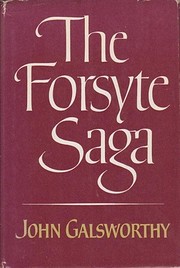
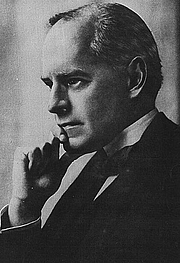
This was the first of the three trilogies Galsworthy wrote about the eponymous family of successful upper middle class lawyers and businessmen, whom he uses to stand for a certain Victorian, English set of attitudes and values focused on the primacy of money, social position, respectability and security.
The lawyer Soames Forsyte has a central position in all three novels: he’s an almost-perfect embodiment of Forsyteism, his idea of himself as a Man of Property invariably trumping any distant echoes of aesthetic sense or human feeling that get through to him. In the first novel we see his despotic possession of his wife Irene fall apart when she falls for the distinctly un-Forsyteish architect Philip; in the second we find him being pushed into a position where his desire for a child forces him into the ultimate sacrifice of respectability, a passage through the divorce court; and in the third he is pushed towards another major sacrifice of reputation for the sake of his daughter.
Galsworthy writes with a Trollope-like irony towards his characters (and a very Trollope-like fascination with legal quirks), but it’s informed by a 20th-century scepticism about Victorian values, written in the aftermath of the humiliation of South Africa and (in the last book) the horrors of the Great War. And a certain sense of nostalgia, too: when Timothy Forsyte, last of the Victorian generation, is interred in Highgate Cemetery, it’s a bit like the death of Emperor Franz-Joseph. Oddly, he doesn’t have anything to say about the Women’s Suffrage movement, but he does stress how Victorian law and custom were used to oppress women, and puts in his own plea for a long-overdue reform of divorce laws.
In hindsight, Galsworthy seems an unlikely choice for the Nobel. While he undoubtedly sold a lot of books and gave a lot of pleasure to his readers, he was really a Victorian novelist who happened to have most of his career in the 20th century. And it’s not as though the early thirties were a period of literary drought, even in Britain. DH Lawrence and Joseph Conrad might have died too early for the 1932 prize, but Virginia Woolf, H.G. Wells and T.S. Eliot would all seem like obvious candidates.
The Forsyte Saga (1922; parts 1906-1921) by John Galsworthy (UK, 1867-1933), 1932 laureate
This was the first of the three trilogies Galsworthy wrote about the eponymous family of successful upper middle class lawyers and businessmen, whom he uses to stand for a certain Victorian, English set of attitudes and values focused on the primacy of money, social position, respectability and security.
The lawyer Soames Forsyte has a central position in all three novels: he’s an almost-perfect embodiment of Forsyteism, his idea of himself as a Man of Property invariably trumping any distant echoes of aesthetic sense or human feeling that get through to him. In the first novel we see his despotic possession of his wife Irene fall apart when she falls for the distinctly un-Forsyteish architect Philip; in the second we find him being pushed into a position where his desire for a child forces him into the ultimate sacrifice of respectability, a passage through the divorce court; and in the third he is pushed towards another major sacrifice of reputation for the sake of his daughter.
Galsworthy writes with a Trollope-like irony towards his characters (and a very Trollope-like fascination with legal quirks), but it’s informed by a 20th-century scepticism about Victorian values, written in the aftermath of the humiliation of South Africa and (in the last book) the horrors of the Great War. And a certain sense of nostalgia, too: when Timothy Forsyte, last of the Victorian generation, is interred in Highgate Cemetery, it’s a bit like the death of Emperor Franz-Joseph. Oddly, he doesn’t have anything to say about the Women’s Suffrage movement, but he does stress how Victorian law and custom were used to oppress women, and puts in his own plea for a long-overdue reform of divorce laws.
In hindsight, Galsworthy seems an unlikely choice for the Nobel. While he undoubtedly sold a lot of books and gave a lot of pleasure to his readers, he was really a Victorian novelist who happened to have most of his career in the 20th century. And it’s not as though the early thirties were a period of literary drought, even in Britain. DH Lawrence and Joseph Conrad might have died too early for the 1932 prize, but Virginia Woolf, H.G. Wells and T.S. Eliot would all seem like obvious candidates.
21thorold
Red sorghum (1987; translation 1993) by Mo Yan (China, 1955- ), 2012 laureate, translated from Chinese by Howard Goldblatt


A family in rural China in the 1920s and 30s confronts banditry, civil war and the Japanese occupation. Mo Yan plays with the timeline to force us to read this as a novel about individual people, not abstract historical events, and there's a lot of local colour — most of it red and cereal-based — grim wit, and human resilience in the face of overwhelming odds.
Inevitably, given that it's dealing with times in which civil order had broken down in the face of barbarism and competing factions, there's a lot of violence. Mo Yan places at least one act of extreme violence at the centre of each chapter, and each one is described in loving and often grotesque detail. I'm guessing that the idea is that we are supposed to realise how the incessant piling up of shocking detail is desensitising us to what is going on, in something like the way it might if we were confronted with it in real life, but after a while it just started to feel vaguely pornographic.
I can see the importance of this book, and it probably goes a long way to explain how China works and why the current Chinese government is so authoritarian and so extremely allergic to any sign of disorder. But, from the perspective of my particular squeamish, western, liberal ivory tower, it's not really a book that I would ever want to read again or to recommend to anyone else.


A family in rural China in the 1920s and 30s confronts banditry, civil war and the Japanese occupation. Mo Yan plays with the timeline to force us to read this as a novel about individual people, not abstract historical events, and there's a lot of local colour — most of it red and cereal-based — grim wit, and human resilience in the face of overwhelming odds.
Inevitably, given that it's dealing with times in which civil order had broken down in the face of barbarism and competing factions, there's a lot of violence. Mo Yan places at least one act of extreme violence at the centre of each chapter, and each one is described in loving and often grotesque detail. I'm guessing that the idea is that we are supposed to realise how the incessant piling up of shocking detail is desensitising us to what is going on, in something like the way it might if we were confronted with it in real life, but after a while it just started to feel vaguely pornographic.
I can see the importance of this book, and it probably goes a long way to explain how China works and why the current Chinese government is so authoritarian and so extremely allergic to any sign of disorder. But, from the perspective of my particular squeamish, western, liberal ivory tower, it's not really a book that I would ever want to read again or to recommend to anyone else.
22labfs39
>21 thorold: I found it hard to appreciate The Garlic Ballads for similar reasons. I started my review: I felt I should have liked this novel more, if only because it is a well-structured and important work by a Nobel laureate. Perhaps I shouldn't have let the nonstop violence effected my appreciation. But there you have it. I couldn't get past the intentional and random violence that is the basis of the book. I think it was the hopeless inevitability of the outcomes that made it especially grim.
23SassyLassy
>21 thorold: >22 labfs39: Interesting about Mo Yan, making me think I am a definite outlier. He is one of my favourite authors, and The Garlic Ballads is one of my favourites by him. While I don't enjoy reading about the conditions, I do believe Mo writes realistically, based on the non fiction reading I have done on the era. There is also some sly humour among the peasants, in that sort of hopeless eastern European/Russian humour line.
>22 labfs39: I don't know which edition you read of The Garlic Ballads, but mine had a note saying parts of Chapter 19 and all of Chapter 20 had been "revised in conjunction with the author". These are the last two chapters, so it made me wonder how they had read originally, and for whose benefit they had been revised: the western reader's or the author's.
>21 thorold: there's a lot of local colour — most of it red and cereal-based — It made for a stunning film, which was my introduction to Mo Yan, so I immediately went out and got the book.
>22 labfs39: I don't know which edition you read of The Garlic Ballads, but mine had a note saying parts of Chapter 19 and all of Chapter 20 had been "revised in conjunction with the author". These are the last two chapters, so it made me wonder how they had read originally, and for whose benefit they had been revised: the western reader's or the author's.
>21 thorold: there's a lot of local colour — most of it red and cereal-based — It made for a stunning film, which was my introduction to Mo Yan, so I immediately went out and got the book.
24thorold
>23 SassyLassy: From the bits I've read about that and other wars in China, I'm sure you're right that Mo is not exaggerating the violence. I didn't respond well to his way of presenting it, but I'm sure a lot of that is due to my own cultural prejudices. A Chinese reader might well see that differently.
I haven't seen the film.
Goldblatt also notes in Red sorghum that Mo asked him to work from the Taipei edition, restoring "numerous excisions" that were made in the Mainland edition, so censorship is obviously an issue.
I haven't seen the film.
Goldblatt also notes in Red sorghum that Mo asked him to work from the Taipei edition, restoring "numerous excisions" that were made in the Mainland edition, so censorship is obviously an issue.
25thorold
I had a quick cast around in the library today for short works by the omitted Nobel laureates on my list. The first one on the pile I brought home was a waste of time — when I looked at it more closely I saw it was a very much abridged "Spanish for beginners" version of El señor Presidente, which I shall have to come back to in the full-length version.
The next novella in the pile was more useful, enabling me to cross off the 2002 laureate from my list at the cost of a mere 112 pages in English translation (of course I mean to come back to him and read some longer books!).
Detective story (1977; translation 2008) by Imre Kertész (Hungary, 1929-2016), translated to English by Tim Wilkinson
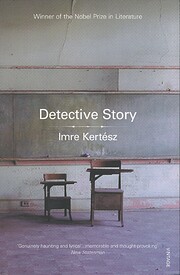

Imre Kertész, of course, spent his teenage years in Auschwitz and Buchenwald, and had more reason than most writers to know about the psychology of totalitarianism. In this novella he turns the tables and puts himself inside the head of a secret police officer in an imaginary Latin American dictatorship, who has become fascinated by the case of Enrique Salinas, the idealistic, dilettante student son of a wealthy businessman. Enrique is trying to find a way into opposition to the regime, while the police are trying to find useful evidence against him, and it's anybody's guess who will get there first. In the end, sadly, it doesn't seem to matter: there is a devastating logic that drives the process of Enrique's and the policeman's mutual destruction, seemingly independent of what anyone actually does.
Short, brutal and unanswerable in its dark analysis of how absolute power inevitably goes wrong.
---
55 unread laureates left
The next novella in the pile was more useful, enabling me to cross off the 2002 laureate from my list at the cost of a mere 112 pages in English translation (of course I mean to come back to him and read some longer books!).
Detective story (1977; translation 2008) by Imre Kertész (Hungary, 1929-2016), translated to English by Tim Wilkinson

Imre Kertész, of course, spent his teenage years in Auschwitz and Buchenwald, and had more reason than most writers to know about the psychology of totalitarianism. In this novella he turns the tables and puts himself inside the head of a secret police officer in an imaginary Latin American dictatorship, who has become fascinated by the case of Enrique Salinas, the idealistic, dilettante student son of a wealthy businessman. Enrique is trying to find a way into opposition to the regime, while the police are trying to find useful evidence against him, and it's anybody's guess who will get there first. In the end, sadly, it doesn't seem to matter: there is a devastating logic that drives the process of Enrique's and the policeman's mutual destruction, seemingly independent of what anyone actually does.
Short, brutal and unanswerable in its dark analysis of how absolute power inevitably goes wrong.
---
55 unread laureates left
26labfs39
>22 labfs39: After reading the comments on your Club Read thread, I feel I should amend my comments to include the fact that I did read both Red Sorghum and The Garlic Ballads and feel that they were both important books about and from China. They were just very hard and very depressing reads.
>25 thorold: I've read two works by Kertész: the novella, The Pathseeker, and the thought-provoking Fatelessness, which touches on his Holocaust experiences. I have two more on the shelves, and I look forward to reading them. Did you like Detective Story?
>25 thorold: I've read two works by Kertész: the novella, The Pathseeker, and the thought-provoking Fatelessness, which touches on his Holocaust experiences. I have two more on the shelves, and I look forward to reading them. Did you like Detective Story?
27thorold
>26 labfs39: Yes, I did like it. It’s fairly obvious where it’s going, but there’s a lot of subtlety in the way he works out what’s going on in the policeman’s mind.
28thorold
Another Nobella, this time a re-read (I must have read it the first time shortly after it came out), because it's a book that fits in perfectly with the Baltic theme as well.
Unkenrufe: Eine Erzählung (1992; The call of the toad) by Günter Grass (Germany, 1927-2015)


Alexander and Alexandra are strangers who get into conversation after they bump into each other at a flower stall in the Dominican market hall in Gdánsk on All Souls' Day 1989. One thing leads to another, a cemetery visit is followed by a mushroom (Steinpilz/porcini) supper, and the two of them also cook up, first, an interesting business idea, and second, what turns into a serious relationship. They are both widowed and around sixty, and they were both exiled in their teens by the border-changes of 1945, he as a German from Danzig/Gdánsk and she as a Pole from Wilno/Vilnius. Their sharing of family memories leads them to the grand scheme: a service to allow exiles like their parents and themselves to profit from the end of the Cold War and seek burial in the places where they came from.
The German-Polish-Lithuanian Funeral Company soon becomes a reality: they are clearly tapping into a serious demand, and the money starts rolling in. And of course it soon starts going wrong, the idealistic notions of reconciliation in death are overtaken by the demands of free-market capitalism, and Alexander and Alexandra find themselves repelled by the monster they have created.
Grass, of course, enjoys nothing more than being the lonely pessimistic toad raining on the West German parade of reunification and the end of the iron curtain. He had great fun in those days, when he was being attacked in editorials and political speeches practically non-stop. And it probably gave him a certain satisfaction to have been largely right about all the things that the free market was going to smash up in the former socialist states. He didn't quite manage to predict the rise of populist nationalism in places like Poland and Hungary, but he did put his finger on a lot of the external causes of that trend. And this is also a lively story, with a lot of detail about Gdánsk and the way its German and Polish sides come together, and some entertaining characters like the octogenarian Erna Brakup with her felt hat and antediluvian Danzig-German dialect, or the British-Bengali Mr Chatterjee, who is developing a pedal-rickshaw empire across Polish cities and takes over part of the Lenin Shipyard to build his own rickshaws.
---
Nobel-crossover trivia: interesting to see Grass using the same imagery here as Nadine Gordimer's Six feet of the country — he talks about 2.5 square meters, but it's the same idea, that's the piece of land that we are all entitled to. Sooner or later.
Unkenrufe: Eine Erzählung (1992; The call of the toad) by Günter Grass (Germany, 1927-2015)


Alexander and Alexandra are strangers who get into conversation after they bump into each other at a flower stall in the Dominican market hall in Gdánsk on All Souls' Day 1989. One thing leads to another, a cemetery visit is followed by a mushroom (Steinpilz/porcini) supper, and the two of them also cook up, first, an interesting business idea, and second, what turns into a serious relationship. They are both widowed and around sixty, and they were both exiled in their teens by the border-changes of 1945, he as a German from Danzig/Gdánsk and she as a Pole from Wilno/Vilnius. Their sharing of family memories leads them to the grand scheme: a service to allow exiles like their parents and themselves to profit from the end of the Cold War and seek burial in the places where they came from.
The German-Polish-Lithuanian Funeral Company soon becomes a reality: they are clearly tapping into a serious demand, and the money starts rolling in. And of course it soon starts going wrong, the idealistic notions of reconciliation in death are overtaken by the demands of free-market capitalism, and Alexander and Alexandra find themselves repelled by the monster they have created.
Grass, of course, enjoys nothing more than being the lonely pessimistic toad raining on the West German parade of reunification and the end of the iron curtain. He had great fun in those days, when he was being attacked in editorials and political speeches practically non-stop. And it probably gave him a certain satisfaction to have been largely right about all the things that the free market was going to smash up in the former socialist states. He didn't quite manage to predict the rise of populist nationalism in places like Poland and Hungary, but he did put his finger on a lot of the external causes of that trend. And this is also a lively story, with a lot of detail about Gdánsk and the way its German and Polish sides come together, and some entertaining characters like the octogenarian Erna Brakup with her felt hat and antediluvian Danzig-German dialect, or the British-Bengali Mr Chatterjee, who is developing a pedal-rickshaw empire across Polish cities and takes over part of the Lenin Shipyard to build his own rickshaws.
---
Nobel-crossover trivia: interesting to see Grass using the same imagery here as Nadine Gordimer's Six feet of the country — he talks about 2.5 square meters, but it's the same idea, that's the piece of land that we are all entitled to. Sooner or later.
29thorold
Another Nobella from my library pile, the last work of fiction by the 1988 laureate:
The coffeehouse (1989) by Naguib Mahfouz (Egypt, 1911-2006) translated from Arabic by Raymond Stock
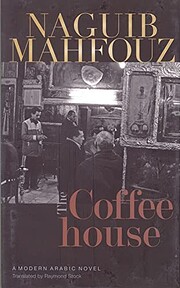

This 135-page novella manages to pack in most of Egypt's 20th century history as well as what feels like a lot of detail about the lives of the four main characters, from primary school to old age. They — and the elusive narrator, who doesn't tell us anything at all about himself — have been meeting regularly throughout that time in the Qushtumur coffee-house in the middle-class Cairo suburb of Abbasiya. Over the coffee, water-pipes and dominos they exchange gossip, discuss poems, books, politics and women, and offer each other advice, sympathy, mockery or ribaldry, as the case may be. It's a book with a relaxed, even tone, distancing itself a little from the dramas of life, but it's clearly also a kind of affectionate farewell to the (male) middle-class Cairo world in which Mahfouz spent most of his life, written from the perspective of old age. Very enjoyable.
54 laureates left...
The coffeehouse (1989) by Naguib Mahfouz (Egypt, 1911-2006) translated from Arabic by Raymond Stock

This 135-page novella manages to pack in most of Egypt's 20th century history as well as what feels like a lot of detail about the lives of the four main characters, from primary school to old age. They — and the elusive narrator, who doesn't tell us anything at all about himself — have been meeting regularly throughout that time in the Qushtumur coffee-house in the middle-class Cairo suburb of Abbasiya. Over the coffee, water-pipes and dominos they exchange gossip, discuss poems, books, politics and women, and offer each other advice, sympathy, mockery or ribaldry, as the case may be. It's a book with a relaxed, even tone, distancing itself a little from the dramas of life, but it's clearly also a kind of affectionate farewell to the (male) middle-class Cairo world in which Mahfouz spent most of his life, written from the perspective of old age. Very enjoyable.
54 laureates left...
30thorold
Something completely different, but still a Nobella, an early short work by the 1952 laureate:
Le Fleuve de feu (1923; The river of fire) by François Mauriac (France, 1885-1970)
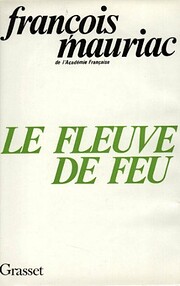

Mauriac looks at the conflict between Sexual Desire and the Soul as it plays out in the physically and morally battered France of the aftermath of the Great War. Gisèle is a nice young girl of good family, convent-educated and with an older friend, Lucile, who is of impeccable character and acts as a sort of spiritual director to her. What could possibly go wrong? Well, shocking as it must have been to Mauriac's readers at the time, it turns out that Gisèle actually rather likes the occasional sexual adventure. Fortunately, there's nothing as devious as the Catholic Church when it comes to rescuing souls in peril, and threads are twitched just in time to save her from perdition.
There were some quite enjoyable passages, but there's a limit to how much jazz-age Catholic moralising most of us are prepared to put up with these days, and this book, short as it is, goes way beyond that limit. Recommended for those who wish there was more Bossuet in F Scott Fitzgerald.
...53 left
Le Fleuve de feu (1923; The river of fire) by François Mauriac (France, 1885-1970)

Mauriac looks at the conflict between Sexual Desire and the Soul as it plays out in the physically and morally battered France of the aftermath of the Great War. Gisèle is a nice young girl of good family, convent-educated and with an older friend, Lucile, who is of impeccable character and acts as a sort of spiritual director to her. What could possibly go wrong? Well, shocking as it must have been to Mauriac's readers at the time, it turns out that Gisèle actually rather likes the occasional sexual adventure. Fortunately, there's nothing as devious as the Catholic Church when it comes to rescuing souls in peril, and threads are twitched just in time to save her from perdition.
There were some quite enjoyable passages, but there's a limit to how much jazz-age Catholic moralising most of us are prepared to put up with these days, and this book, short as it is, goes way beyond that limit. Recommended for those who wish there was more Bossuet in F Scott Fitzgerald.
...53 left
31thorold
This was all I could pick up by the 2020 laureate during my brief foray into the St Pancras Hatchards on my way home from England. But I've got her most recent Collected Poems on order as well.
It's just under the 200-page threshold, but I'm not sure if it counts as a Nobella...
American Originality: Essays on Poetry (2017) by Louise Glück (USA, 1943- )
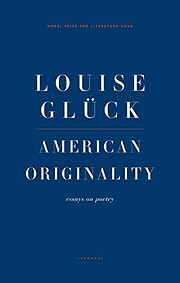

I was rather hoping that "American originality" would turn out to be one of those famous oxymorons, like "British cuisine" or "military intelligence", but apparently it's not: in the title essay of this collection of twenty years' worth of prose writings (mostly) about poetry, Glück suggests that originality in the arts in America has to tie into the American imperative of self-creation. Poets have "to break trails, to found dynasties ... to be capable of replication". Whitman, Pound and Dickinson can be revered as founding fathers of one sort or another, but someone like Seamus Heaney would never have done as an American, as Glück considers him inimitable.
The collection continues with a group of other essays on "big topics" in poetry (and a stray 500 words on Thomas Mann, which is all in the magnificently concrete first sentence: "Buddenbrooks ends when there are no men left"). Then there are ten introductions Glück wrote for the winners in "first book" competitions for new poets that she judged, fortunately all well-stuffed with examples so that they make sense as standalone pieces, and finally a small group of slightly more subjective essays on "Revenge", "Estrangement" and "Fear of happiness" in poets.
There's not much clue to Glück herself in these essays, though: a lot of fierce, clear thinking and very pared down prose full of abstract nouns. Blink and you'll have to go back a paragraph to make sense of what you're reading. She approves of poets who go all out in their work, she seems to prefer poems that use complete sentences to sterile grammatical experimentation, and she writes in defence of narrative and humour in lyric verse. She evidently has no time for cliché in her own writing or anyone else's, and she doesn't seem to care much for rhetoric. But the ten introductions cover a very wide range of types of writing, so she clearly values commitment, ability and originality more than conformance to any particular template.
Great critical writing, all about the work with the egos of both the critic and the author firmly relegated to the background.
52 left
It's just under the 200-page threshold, but I'm not sure if it counts as a Nobella...
American Originality: Essays on Poetry (2017) by Louise Glück (USA, 1943- )

I was rather hoping that "American originality" would turn out to be one of those famous oxymorons, like "British cuisine" or "military intelligence", but apparently it's not: in the title essay of this collection of twenty years' worth of prose writings (mostly) about poetry, Glück suggests that originality in the arts in America has to tie into the American imperative of self-creation. Poets have "to break trails, to found dynasties ... to be capable of replication". Whitman, Pound and Dickinson can be revered as founding fathers of one sort or another, but someone like Seamus Heaney would never have done as an American, as Glück considers him inimitable.
The collection continues with a group of other essays on "big topics" in poetry (and a stray 500 words on Thomas Mann, which is all in the magnificently concrete first sentence: "Buddenbrooks ends when there are no men left"). Then there are ten introductions Glück wrote for the winners in "first book" competitions for new poets that she judged, fortunately all well-stuffed with examples so that they make sense as standalone pieces, and finally a small group of slightly more subjective essays on "Revenge", "Estrangement" and "Fear of happiness" in poets.
There's not much clue to Glück herself in these essays, though: a lot of fierce, clear thinking and very pared down prose full of abstract nouns. Blink and you'll have to go back a paragraph to make sense of what you're reading. She approves of poets who go all out in their work, she seems to prefer poems that use complete sentences to sterile grammatical experimentation, and she writes in defence of narrative and humour in lyric verse. She evidently has no time for cliché in her own writing or anyone else's, and she doesn't seem to care much for rhetoric. But the ten introductions cover a very wide range of types of writing, so she clearly values commitment, ability and originality more than conformance to any particular template.
Great critical writing, all about the work with the egos of both the critic and the author firmly relegated to the background.
52 left
32thorold
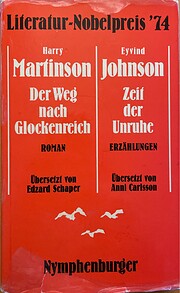
This was a book almost purpose-built for the Nobel Challenge, an unembarrassed 1974 grab at the attention of Nobel-chasers like us by a Munich publisher, reprinting German translations of works by both of that year's joint laureates between the same flaming red, Nobel-branded covers.
Martinson and Johnson were near contemporaries, both from rural, working-class backgrounds, and both were autodidacts who left home at a young age and came to writing after a wide variety of other jobs (Martinson was a seafarer and a vagrant, amongst other things; Johnson worked on farms, forests, on the railways and as a showman). In later life they both became members of the Swedish Academy, leading to some raising of eyebrows around the world when the Swedish Academy decided to award them the Nobel Prize...
Der Weg nach Glockenreich : Roman (1948; Vägen till Klockrike / The Road) by Harry Martinson (Sweden, 1904-1978) translated from Swedish to German by Edzard Schaper
Zeit der Unruhe (1960, 1974) by Eyvind Johnson (Sweden, 1900-1976) translated from Swedish to German by Anni Carlsson

Martinson's big picaresque novel of vagrant life follows the adventures of Bolle, a skilled worker — a cigar-maker — who loses his job to mechanisation in the 1890s, and goes on the road as a vagrant after he is unable to raise the fare to America. It's not so much a straight narrative as a collage of incidents and themes in vagrant life — obviously based to some extent on Martinson's own experiences as a vagrant the 1920s, but set back into the years before the First World War.
Martinson uses Bolle's experiences particularly to reflect on the fear and hostility people without a fixed home inspire in those who have one, and the way this affects the character and behaviour of homeless people. But he also has time to talk about the arbitrary injustices of the social care system and the criminalisation of vagrancy, about the joy of travelling on foot through the Swedish landscape and the way that style of vagrancy is becoming a thing of the past with the advent of trains and cars, about pleasant and unpleasant encounters with country people in different parts of Sweden and Norway, and a thousand other things. Through dream-sequences and a kind of magic realist finale in a brickworks he also (half-ironically) sets out what might be an existentialist philosophy (or an anti-religion) providing an intellectual framework for vagrancy.
A big, warm, compassionate book, and a very strongly-felt one, but also a firmly realistic view of the world and its troubles: not the place to go if you want the romance of the road.
---
Zeit der Unruhe is a publisher-specific selection of German translations of ten of Eyvind Johnson's short stories originally published between the 1920s and the 1940s, in several different Swedish collections.
The title-story, originally "En tid av oro för Eugenia" (in Än en gång, kapten!, 1934), is a lovely piece about a woman who has a slightly too colourful past for a small town, but is now trying to settle down, running a haberdashery shop and engaged to marry the house-painter and (almost) reformed drinker, Göransson. The town unsuccessfully tries to needle them both about her former boyfriends, but then the news comes through that Emil is coming back from America, presumably having made his fortune...
"Burell tappar kraftarna" and "Vallberg" are both stories about showmen trying to make a living in rural backwaters as progress — and younger competitors — catch up with them, the former featuring a young projectionist who must be a self-portrait. Then there are a couple of stories set in a remote railway-hamlet in the North, and a set of more reflective pieces dealing with social and technological change in 20th century Sweden, culminating in "I det Overkliga", a touching little sketch where the narrator and a friendly farmer go on a fishing trip to some mountain lakes, whilst discussing how we can deal with the contradiction of being out enjoying ourselves in beautiful scenery whilst knowing that elsewhere in Europe bombs are falling on civilians.
Probably not enough to get a full picture of what Johnson is about, but certainly enough to see that he must be a very interesting writer, with an unusual perspective on life.
---
Down to fifty unread laureates!
Martinson and Johnson were near contemporaries, both from rural, working-class backgrounds, and both were autodidacts who left home at a young age and came to writing after a wide variety of other jobs (Martinson was a seafarer and a vagrant, amongst other things; Johnson worked on farms, forests, on the railways and as a showman). In later life they both became members of the Swedish Academy, leading to some raising of eyebrows around the world when the Swedish Academy decided to award them the Nobel Prize...
Der Weg nach Glockenreich : Roman (1948; Vägen till Klockrike / The Road) by Harry Martinson (Sweden, 1904-1978) translated from Swedish to German by Edzard Schaper
Zeit der Unruhe (1960, 1974) by Eyvind Johnson (Sweden, 1900-1976) translated from Swedish to German by Anni Carlsson

Martinson's big picaresque novel of vagrant life follows the adventures of Bolle, a skilled worker — a cigar-maker — who loses his job to mechanisation in the 1890s, and goes on the road as a vagrant after he is unable to raise the fare to America. It's not so much a straight narrative as a collage of incidents and themes in vagrant life — obviously based to some extent on Martinson's own experiences as a vagrant the 1920s, but set back into the years before the First World War.
Martinson uses Bolle's experiences particularly to reflect on the fear and hostility people without a fixed home inspire in those who have one, and the way this affects the character and behaviour of homeless people. But he also has time to talk about the arbitrary injustices of the social care system and the criminalisation of vagrancy, about the joy of travelling on foot through the Swedish landscape and the way that style of vagrancy is becoming a thing of the past with the advent of trains and cars, about pleasant and unpleasant encounters with country people in different parts of Sweden and Norway, and a thousand other things. Through dream-sequences and a kind of magic realist finale in a brickworks he also (half-ironically) sets out what might be an existentialist philosophy (or an anti-religion) providing an intellectual framework for vagrancy.
A big, warm, compassionate book, and a very strongly-felt one, but also a firmly realistic view of the world and its troubles: not the place to go if you want the romance of the road.
---
Zeit der Unruhe is a publisher-specific selection of German translations of ten of Eyvind Johnson's short stories originally published between the 1920s and the 1940s, in several different Swedish collections.
The title-story, originally "En tid av oro för Eugenia" (in Än en gång, kapten!, 1934), is a lovely piece about a woman who has a slightly too colourful past for a small town, but is now trying to settle down, running a haberdashery shop and engaged to marry the house-painter and (almost) reformed drinker, Göransson. The town unsuccessfully tries to needle them both about her former boyfriends, but then the news comes through that Emil is coming back from America, presumably having made his fortune...
"Burell tappar kraftarna" and "Vallberg" are both stories about showmen trying to make a living in rural backwaters as progress — and younger competitors — catch up with them, the former featuring a young projectionist who must be a self-portrait. Then there are a couple of stories set in a remote railway-hamlet in the North, and a set of more reflective pieces dealing with social and technological change in 20th century Sweden, culminating in "I det Overkliga", a touching little sketch where the narrator and a friendly farmer go on a fishing trip to some mountain lakes, whilst discussing how we can deal with the contradiction of being out enjoying ourselves in beautiful scenery whilst knowing that elsewhere in Europe bombs are falling on civilians.
Probably not enough to get a full picture of what Johnson is about, but certainly enough to see that he must be a very interesting writer, with an unusual perspective on life.
---
Down to fifty unread laureates!
33labfs39
>32 thorold: Both of those authors sound surprisingly interesting. Nice book find.
34thorold
Things that happen when you search secondhand book sites using the keyword "Nobel", continued from >32 thorold: above...
This one looked like an interesting perspective on what it might be like to find yourself in the position of getting that invitation to Stockholm.
I knew nothing about Patrick Tudoret, but he seems to be a specialist in the sociology and anthropology of the media, and apart from this his best-known book is a prize-winning history of TV book programmes.
L'homme qui fuyait le Nobel : roman (2015) by Patrick Tudoret (France, 1961- )
(Author photo patricktudoret.net)
Tristan Talberg has been keeping out of the eyes of the literary media and hasn't written a word since the death of his wife some five years ago, and there's great excitement in France when the Swedish Academy announce him as the next Nobel laureate in literature. But Tristan seems to have disappeared off the face of the earth. Has he been kidnapped? Or is Philippe Sollers right in saying that the disappearance of the author is the logical consequence of the Nobel process...?
Well, if you've got the book with the promotional band from the publisher still on it, you won't have to guess for long: Tristan has grown a beard, put on hiking shoes, and set off on a very long walk. His initial plan is simply to revisit the Cévennes with a copy of Stevenson in his pocket and relive some of the early days of his life with Yseult(*). But one thing leads to another, he meets some pilgrims, and before long he's on his way to Spain, with ample time and space to find some resolution in the mourning process, to think about Stevenson, Giono, Bernanos, André Suarès and other favourite writers, and to realign his life.
This is somewhere between a serious, reflective novel about writing and bereavement and a romantic comedy starring Depardieu or Martin Sheen (No, not Martin Sheen, he's already done the Camino...). Quite enjoyable, but a bit rough around the edges sometimes: Tudoret hasn't taken quite enough time to establish the practicalities of the story in our minds.
--
(*) Yes, I groaned too, but Tudoret does redeem himself slightly by explaining that "Tristan" is a nom-de-plume he only adopted after meeting his future wife...
This one looked like an interesting perspective on what it might be like to find yourself in the position of getting that invitation to Stockholm.
I knew nothing about Patrick Tudoret, but he seems to be a specialist in the sociology and anthropology of the media, and apart from this his best-known book is a prize-winning history of TV book programmes.
L'homme qui fuyait le Nobel : roman (2015) by Patrick Tudoret (France, 1961- )
(Author photo patricktudoret.net)
Tristan Talberg has been keeping out of the eyes of the literary media and hasn't written a word since the death of his wife some five years ago, and there's great excitement in France when the Swedish Academy announce him as the next Nobel laureate in literature. But Tristan seems to have disappeared off the face of the earth. Has he been kidnapped? Or is Philippe Sollers right in saying that the disappearance of the author is the logical consequence of the Nobel process...?
Well, if you've got the book with the promotional band from the publisher still on it, you won't have to guess for long: Tristan has grown a beard, put on hiking shoes, and set off on a very long walk. His initial plan is simply to revisit the Cévennes with a copy of Stevenson in his pocket and relive some of the early days of his life with Yseult(*). But one thing leads to another, he meets some pilgrims, and before long he's on his way to Spain, with ample time and space to find some resolution in the mourning process, to think about Stevenson, Giono, Bernanos, André Suarès and other favourite writers, and to realign his life.
This is somewhere between a serious, reflective novel about writing and bereavement and a romantic comedy starring Depardieu or Martin Sheen (No, not Martin Sheen, he's already done the Camino...). Quite enjoyable, but a bit rough around the edges sometimes: Tudoret hasn't taken quite enough time to establish the practicalities of the story in our minds.
--
(*) Yes, I groaned too, but Tudoret does redeem himself slightly by explaining that "Tristan" is a nom-de-plume he only adopted after meeting his future wife...
35thorold
And another Nobella. I've read nothing by Ōe except one short story collection in the year he won the prize. It's about time to take on at least one of his major novels, but until I do, here's a slim volume of lectures:
Japan, the ambiguous and myself : the Nobel prize speech and other lectures (1995) by Kenzaburo Ōe (Japan, 1935- )
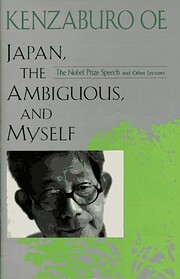
The text of Kenzaburo Ōe's acceptance speech for the Nobel Prize from 1994, as well as two lectures given at US universities in 1986 and 1990, and a short series of lectures on Japanese literature "before a Scandinavian audience" (whatever that means) from 1992.
The themes all overlap somewhat: Ōe talks about the romantic affection for Scandinavia he got from reading The marvellous adventures of Nils as a child, and about what he sees as the important moral thread in Japanese literature, from Murasaki Shikibu through Soseki Natsume to himself and the other socially-critical writers who came to prominence in the post-war years.
Ōe talks about the themes that have particularly concerned him: the memory of Japan's aggression in the war and the need for reconciliation and demilitarisation, the need to recognise the importance of peripheral cultures in Japan, especially that of Okinawa, and his own experience as the father of a mentally-handicapped child.
He identifies a similar moral imperative (but coupled with deeply-flawed politics) in Mishima, but he obviously doesn't have much time for the more aesthetic, mystical approach of Tanizaki and Kawabata, who hardly get a mention apart from an acknowledgment of the latter in the Nobel speech — whose title is a play on Kawabata's speech "Japan, the beautiful and myself". (He's also rather dismissive of the "consumer-culture literature" of manga, Banana Yoshimoto and Haruki Murakami — I wonder what he thinks about the way Murakami is regularly mentioned now as a Nobel candidate?)
It's notable that in Stockholm he draws his cultural references from Yeats, Auden, Orwell and his own teacher, Kazuo Watanabe, rather than from great Japanese writers. An interesting little collection, and it makes Ōe come across as a very sympathetic sort of character.
--
Still on fifty
Japan, the ambiguous and myself : the Nobel prize speech and other lectures (1995) by Kenzaburo Ōe (Japan, 1935- )
The text of Kenzaburo Ōe's acceptance speech for the Nobel Prize from 1994, as well as two lectures given at US universities in 1986 and 1990, and a short series of lectures on Japanese literature "before a Scandinavian audience" (whatever that means) from 1992.
The themes all overlap somewhat: Ōe talks about the romantic affection for Scandinavia he got from reading The marvellous adventures of Nils as a child, and about what he sees as the important moral thread in Japanese literature, from Murasaki Shikibu through Soseki Natsume to himself and the other socially-critical writers who came to prominence in the post-war years.
Ōe talks about the themes that have particularly concerned him: the memory of Japan's aggression in the war and the need for reconciliation and demilitarisation, the need to recognise the importance of peripheral cultures in Japan, especially that of Okinawa, and his own experience as the father of a mentally-handicapped child.
He identifies a similar moral imperative (but coupled with deeply-flawed politics) in Mishima, but he obviously doesn't have much time for the more aesthetic, mystical approach of Tanizaki and Kawabata, who hardly get a mention apart from an acknowledgment of the latter in the Nobel speech — whose title is a play on Kawabata's speech "Japan, the beautiful and myself". (He's also rather dismissive of the "consumer-culture literature" of manga, Banana Yoshimoto and Haruki Murakami — I wonder what he thinks about the way Murakami is regularly mentioned now as a Nobel candidate?)
It's notable that in Stockholm he draws his cultural references from Yeats, Auden, Orwell and his own teacher, Kazuo Watanabe, rather than from great Japanese writers. An interesting little collection, and it makes Ōe come across as a very sympathetic sort of character.
--
Still on fifty
36thorold
Another Nobelist I've read before, but inadequately.
So forth : poems (1996) by Joseph Brodsky (Russia, USA, 1940-1996)
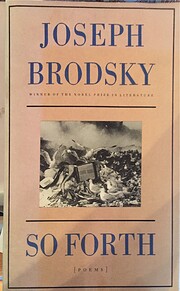

This was Brodsky's last poetry collection, published shortly after his death in 1996, and it contains poems written from about 1989 onwards, some in English and some in Russian (most of the Russian poems appear here in his own English translation, a few were translated by others). The themes are often quite dark, dealing with topics like war, exile and old age — although he was only in his fifties, he had been in poor health for a long time and seems to have known death was just round the corner. But there are also several of his famous nativity poems, a couple of longer poems on subjects from classical mythology, and some of the love poems and satires in the collection turn out to be surprisingly bouncy.
Brodsky obviously shared with his friend Auden a fondness for using jokey language about serious subjects, and it's wonderful to see the panache with which he misuses the English language to good effect. It's difficult to imagine a poet who was a native English speaker having the nerve to rhyme "Senegal" with "chemical" and "sketch pad" with "stupid" in the same quatrain, but Brodsky does so (and worse, far, far, worse...) and gets away with it every time.
He also loves clouds, and they lead to some of his most extravagant images: they "are scattered, like a bachelor's clothes" in one poem, or rear up their "huge lid like a Steinway" in another; in yet another "Clouds of patently absurd / But endearing shapes assert / the resemblance of their lot / to a cumulative thought," and in addition to all that there's a whole, very wonderful, poem about the summer clouds of the Baltic that everyone ought to read.
Good stuff!
So forth : poems (1996) by Joseph Brodsky (Russia, USA, 1940-1996)

This was Brodsky's last poetry collection, published shortly after his death in 1996, and it contains poems written from about 1989 onwards, some in English and some in Russian (most of the Russian poems appear here in his own English translation, a few were translated by others). The themes are often quite dark, dealing with topics like war, exile and old age — although he was only in his fifties, he had been in poor health for a long time and seems to have known death was just round the corner. But there are also several of his famous nativity poems, a couple of longer poems on subjects from classical mythology, and some of the love poems and satires in the collection turn out to be surprisingly bouncy.
Brodsky obviously shared with his friend Auden a fondness for using jokey language about serious subjects, and it's wonderful to see the panache with which he misuses the English language to good effect. It's difficult to imagine a poet who was a native English speaker having the nerve to rhyme "Senegal" with "chemical" and "sketch pad" with "stupid" in the same quatrain, but Brodsky does so (and worse, far, far, worse...) and gets away with it every time.
He also loves clouds, and they lead to some of his most extravagant images: they "are scattered, like a bachelor's clothes" in one poem, or rear up their "huge lid like a Steinway" in another; in yet another "Clouds of patently absurd / But endearing shapes assert / the resemblance of their lot / to a cumulative thought," and in addition to all that there's a whole, very wonderful, poem about the summer clouds of the Baltic that everyone ought to read.
Good stuff!
37thorold
An unaccustomed gap for me — ten days since I finished a book. There have been distractions, of course, although I don't think any of them was of major significance: the main thing was that I had hit on something really good and didn't want to rush it or read short stuff in between. Another Baltic Nobelist, and someone whose name meant absolutely nothing to me a couple of weeks ago:
Lucky Per (1905; translation 2010) by Henrik Pontoppidan (Denmark, 1857-1943) translated to English by Naomi Lebowitz


Henrik Pontoppidan was a star in his own time, who shared the 1917 Nobel prize with his (possibly even more forgotten) compatriot Karl Gjellerup. Introducing this translation, Garth Risk Hallberg lists Ernst Bloch, György Lukács and Thomas Mann among his more prominent fans. He fits into the "Modern Breakthrough", a Scandinavian modernist cultural and political movement centred around the critic George Brandes. But he's practically unknown in English: he seems to have been forgotten by translators after the second part of The promised land came out in the 1890s, and even his Nobel didn't revive interest: English-speaking readers had other things to think about in 1917. His best-known novel, Lykke-Per, which Danish readers count as one of the top Danish novels of all time, had to wait over 100 years to be translated (but there are now two translations: a new one by Paul Larkin appeared in 2018).
Lykke-Per starts out as a classic Bildungsroman, with a very Balzacian hero: Per is good-looking, attractive to both men and women, self-confident, ambitious, more than a little bit naive, and quite heartless. And everything in his life seems to be falling into place for him. But he's not the Lucien de Rubempré of 1880s Copenhagen: although he mixes with the intellectual and artistic disciples of Dr Nathan (an affectionate caricature of George Brandes), he's an engineer, with ambitions to develop canals and wind and wave energy (Pontoppidan didn't know quite how far ahead of his time he was here!). In Denmark in the decades after the Prussian invasion, technical innovation was controversial: the older, conservative generation were inclined to draw in their heads and keep Denmark small, backward and obscure, avoiding catching the eyes of anyone in Berlin.
More to the point, Per is a Lucien who has to live in a world that knows about Kierkegaard, Ibsen and Nietzsche. Like Pontoppidan, he is the son of a pastor from a small town in Jutland. He has broken off his connection to this pious Grundtvigian-Lutheran background and sees himself as a free agent and an agnostic, but of course it isn't as easy as that: the temptation to slip back into that cosy, secure world keeps stalking him, and he's never as confident as he seems. Eventually, things catch up with him, and he takes the Kierkegaard-like step of breaking an engagement for religious reasons, but of course even that is not the end of the story...
There's a wealth of very interesting local and period detail going on around the psychological story, of course, and there are a lot of very strong minor characters, especially Jakobe Salomon, the Jewish heiress who falls deeply in love with Per despite her strong misgivings about his character, and who is the one woman he has feelings for that go beyond the merely sentimental or sexual. She is educated, intelligent, resourceful and single-minded in achieving the things she wants to get done, a fierce critic of organised religion, and generally miles ahead of poor Per. It's the tragedy of the Bildungsroman format that we have to go on following him in the last part of the book whilst Jakobe gets on with her life-work mostly offstage.
Definitely one of those "why weren't we told about this?" books!
Naomi Lebowitz's translation reads very naturally, on the whole, although as in any translation there were occasional things I wanted to quibble with: a slightly too recent English idiom, perhaps, or a word used in a sense that felt more German than English.
---
Forty-nine to go
Lucky Per (1905; translation 2010) by Henrik Pontoppidan (Denmark, 1857-1943) translated to English by Naomi Lebowitz


Henrik Pontoppidan was a star in his own time, who shared the 1917 Nobel prize with his (possibly even more forgotten) compatriot Karl Gjellerup. Introducing this translation, Garth Risk Hallberg lists Ernst Bloch, György Lukács and Thomas Mann among his more prominent fans. He fits into the "Modern Breakthrough", a Scandinavian modernist cultural and political movement centred around the critic George Brandes. But he's practically unknown in English: he seems to have been forgotten by translators after the second part of The promised land came out in the 1890s, and even his Nobel didn't revive interest: English-speaking readers had other things to think about in 1917. His best-known novel, Lykke-Per, which Danish readers count as one of the top Danish novels of all time, had to wait over 100 years to be translated (but there are now two translations: a new one by Paul Larkin appeared in 2018).
Lykke-Per starts out as a classic Bildungsroman, with a very Balzacian hero: Per is good-looking, attractive to both men and women, self-confident, ambitious, more than a little bit naive, and quite heartless. And everything in his life seems to be falling into place for him. But he's not the Lucien de Rubempré of 1880s Copenhagen: although he mixes with the intellectual and artistic disciples of Dr Nathan (an affectionate caricature of George Brandes), he's an engineer, with ambitions to develop canals and wind and wave energy (Pontoppidan didn't know quite how far ahead of his time he was here!). In Denmark in the decades after the Prussian invasion, technical innovation was controversial: the older, conservative generation were inclined to draw in their heads and keep Denmark small, backward and obscure, avoiding catching the eyes of anyone in Berlin.
More to the point, Per is a Lucien who has to live in a world that knows about Kierkegaard, Ibsen and Nietzsche. Like Pontoppidan, he is the son of a pastor from a small town in Jutland. He has broken off his connection to this pious Grundtvigian-Lutheran background and sees himself as a free agent and an agnostic, but of course it isn't as easy as that: the temptation to slip back into that cosy, secure world keeps stalking him, and he's never as confident as he seems. Eventually, things catch up with him, and he takes the Kierkegaard-like step of breaking an engagement for religious reasons, but of course even that is not the end of the story...
There's a wealth of very interesting local and period detail going on around the psychological story, of course, and there are a lot of very strong minor characters, especially Jakobe Salomon, the Jewish heiress who falls deeply in love with Per despite her strong misgivings about his character, and who is the one woman he has feelings for that go beyond the merely sentimental or sexual. She is educated, intelligent, resourceful and single-minded in achieving the things she wants to get done, a fierce critic of organised religion, and generally miles ahead of poor Per. It's the tragedy of the Bildungsroman format that we have to go on following him in the last part of the book whilst Jakobe gets on with her life-work mostly offstage.
Definitely one of those "why weren't we told about this?" books!
Naomi Lebowitz's translation reads very naturally, on the whole, although as in any translation there were occasional things I wanted to quibble with: a slightly too recent English idiom, perhaps, or a word used in a sense that felt more German than English.
---
Forty-nine to go
38thorold
And another Baltic laureate, this time from 1980. The poet Czesław Miłosz grew up in a Polish-speaking family in what's now Lithuania, and studied in Wilno/Vilna/Vilnius. As well as this book, I've got his memoir Native realm on the shelf waiting to go.
The captive mind (1953) by Czesław Miłosz (Poland, USA, etc., 1911-2004), translated from Polish by Jane Zielonko


Published two years after his definitive break with the post-war Polish state, this is the book where Czesław Miłosz investigates in detail how Stalinism affected the minds of people living in the parts of Europe that fell under Soviet domination after World War II. He looks in the abstract at a number of mental strategies he has identified for coping with totalitarian rule, and in the light of these he considers his own experience as a left-wing writer who lived through the horrors of the Nazi occupation in Warsaw and also looks at four other Polish writers (coincidentally called Alpha, Beta, Gamma and Delta) who accommodated themselves, or tried not to, in various different ways.
In the final chapters, Miłosz looks at the way the unpredictable individuality of the human mind keeps on undermining the "scientific" assumptions of totalitarian ideologies, and he devotes some time to making sure that his readers are aware of the scale of the horrors inflicted on the people of the Baltic states after the Russian occupations of 1940 and 1945 and the Nazi occupation of 1941. If you're going to have a single political system based on a Russian Centre, you'd better be prepared to put up with mass deportations, he's telling us.
Obviously some of this is very specific to the situation Miłosz was in in the early 1950s, but there are also a lot of frighteningly clear insights into the way people behave under pressure in the real world. And some prescient moments when he talks about the likelihood that the countries of Eastern Europe will rise up against Stalin and be crushed one by one, and about Catholicism as the main threat to Stalinism in Poland. Interesting too how Miłosz, who had seen all this at first hand, praises the insight of George Orwell, who hadn't.
---
Forty-eight to go...
The captive mind (1953) by Czesław Miłosz (Poland, USA, etc., 1911-2004), translated from Polish by Jane Zielonko


Published two years after his definitive break with the post-war Polish state, this is the book where Czesław Miłosz investigates in detail how Stalinism affected the minds of people living in the parts of Europe that fell under Soviet domination after World War II. He looks in the abstract at a number of mental strategies he has identified for coping with totalitarian rule, and in the light of these he considers his own experience as a left-wing writer who lived through the horrors of the Nazi occupation in Warsaw and also looks at four other Polish writers (coincidentally called Alpha, Beta, Gamma and Delta) who accommodated themselves, or tried not to, in various different ways.
In the final chapters, Miłosz looks at the way the unpredictable individuality of the human mind keeps on undermining the "scientific" assumptions of totalitarian ideologies, and he devotes some time to making sure that his readers are aware of the scale of the horrors inflicted on the people of the Baltic states after the Russian occupations of 1940 and 1945 and the Nazi occupation of 1941. If you're going to have a single political system based on a Russian Centre, you'd better be prepared to put up with mass deportations, he's telling us.
Obviously some of this is very specific to the situation Miłosz was in in the early 1950s, but there are also a lot of frighteningly clear insights into the way people behave under pressure in the real world. And some prescient moments when he talks about the likelihood that the countries of Eastern Europe will rise up against Stalin and be crushed one by one, and about Catholicism as the main threat to Stalinism in Poland. Interesting too how Miłosz, who had seen all this at first hand, praises the insight of George Orwell, who hadn't.
---
Forty-eight to go...
39labfs39
>38 thorold: I'm still stuck in The Captive Mind, I really need to get back to it. If this was your first book by Miłosz, I might also recommend some of his poetry or the poetic autobiographical novel, The Issa Valley, about his childhood. That's my favorite.
40thorold
>39 labfs39: Yes, I really want to get to Milosz's poetry. I feel bad about reading prose works by poets I don't know as poets yet (cf. Louise Glück above)...
---
I've read several books by the 2009 Nobel laureate, Herta Müller, but this one has been sitting on my TBR since November 2016, which makes it the second-oldest resident there. Not for much longer, though:
Mein Vaterland war ein Apfelkern: ein Gespräch mit Angelika Klammer (2014) by Herta Müller (Germany, Romania, 1953- ), edited by Angelika Klammer (Austria, 1960- )
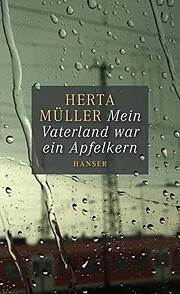

A book-length interview, based on discussions in 2013 and 2014, in which Angelika Klammer gets Müller to talk about her life, the context of her books, and her attitude to writing. Inevitably, there's a lot about her and her friends' experience of persecution by Ceaușescu's Securitate, but also about her mixed feelings about growing up as a member of Romania's German-speaking minority, with a father who had served voluntarily in the SS and a mother who survived a Soviet labour-camp.
She repeatedly emphasises that her conflict was with the corrupt, destructive and oppressive dictatorship of Ceaușescu, not with Romania, and several times she makes a point of digressing into talking about the beauties of the Romanian language and how much she enjoyed learning it properly when she left her Banat-Swabian village to study in Timișoara. The way she wrote about her village, especially in her first book Niederungen (Nadirs), got her into trouble with the exiled Banat-Swabian community organisations in Germany (which she characterises here as being led by ex-Nazis and heavily infiltrated by the Securitate, so the row was obviously still going on in 2014...).
In the last couple of chapters she describes how she worked together with poet and Gulag-veteran Oskar Pastior on her last major novel, Atemschaukel (The hunger angel) and the difficulties of going from his very personal testimony about the labour camp to a work of fiction, and she also gives us a lively account of her process for creating her collage-poems — she has a filing cabinet with over 100,000 cut-out words to play with. The title of this book, "My fatherland was an apple-core", comes from one of her absurd rhymes.
Herta Müller is always worth reading, but this is a book you will probably find most interesting if you've read at least some of the books she is talking about and can get some idea of how the novel relates to the lived experience she is describing here.
---
I've read several books by the 2009 Nobel laureate, Herta Müller, but this one has been sitting on my TBR since November 2016, which makes it the second-oldest resident there. Not for much longer, though:
Mein Vaterland war ein Apfelkern: ein Gespräch mit Angelika Klammer (2014) by Herta Müller (Germany, Romania, 1953- ), edited by Angelika Klammer (Austria, 1960- )

A book-length interview, based on discussions in 2013 and 2014, in which Angelika Klammer gets Müller to talk about her life, the context of her books, and her attitude to writing. Inevitably, there's a lot about her and her friends' experience of persecution by Ceaușescu's Securitate, but also about her mixed feelings about growing up as a member of Romania's German-speaking minority, with a father who had served voluntarily in the SS and a mother who survived a Soviet labour-camp.
She repeatedly emphasises that her conflict was with the corrupt, destructive and oppressive dictatorship of Ceaușescu, not with Romania, and several times she makes a point of digressing into talking about the beauties of the Romanian language and how much she enjoyed learning it properly when she left her Banat-Swabian village to study in Timișoara. The way she wrote about her village, especially in her first book Niederungen (Nadirs), got her into trouble with the exiled Banat-Swabian community organisations in Germany (which she characterises here as being led by ex-Nazis and heavily infiltrated by the Securitate, so the row was obviously still going on in 2014...).
In the last couple of chapters she describes how she worked together with poet and Gulag-veteran Oskar Pastior on her last major novel, Atemschaukel (The hunger angel) and the difficulties of going from his very personal testimony about the labour camp to a work of fiction, and she also gives us a lively account of her process for creating her collage-poems — she has a filing cabinet with over 100,000 cut-out words to play with. The title of this book, "My fatherland was an apple-core", comes from one of her absurd rhymes.
Herta Müller is always worth reading, but this is a book you will probably find most interesting if you've read at least some of the books she is talking about and can get some idea of how the novel relates to the lived experience she is describing here.
41thorold
I ought to make another list of "Inadequately-read-laureates", but if I did it would be much longer than the one in >19 thorold:. Anyway, here's a random Pinter play that turned up in the Little Library (complete with someone's acting notes in pencil...):
Betrayal (1978) by Harold Pinter (UK, 1930-2008)
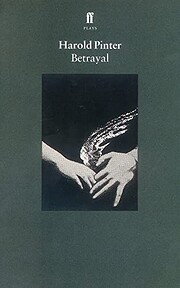

A three-hander first performed in 1978, with Penelope Wilton, Michael Gambon and Daniel Massey appearing in Peter Hall's original NT production. Jerry and Robert are best friends who studied together, play squash together, and both ended up working as publishers. They are both married and have children, but Jerry has had a seven-year-long affair with Robert's wife Emma. In a sequence of short, ambiguous scenes full of fragmented dialogue that never quite means what it says, Pinter digs back in time to explore different meanings of "betrayal", with each stage that we dig back into the characters' memories revealing another level of their dishonesty to each other and to themselves.
About as serious a take as it's possible to have on the banal topic of bourgeois adultery.

(Wikipedia)
Betrayal (1978) by Harold Pinter (UK, 1930-2008)

A three-hander first performed in 1978, with Penelope Wilton, Michael Gambon and Daniel Massey appearing in Peter Hall's original NT production. Jerry and Robert are best friends who studied together, play squash together, and both ended up working as publishers. They are both married and have children, but Jerry has had a seven-year-long affair with Robert's wife Emma. In a sequence of short, ambiguous scenes full of fragmented dialogue that never quite means what it says, Pinter digs back in time to explore different meanings of "betrayal", with each stage that we dig back into the characters' memories revealing another level of their dishonesty to each other and to themselves.
About as serious a take as it's possible to have on the banal topic of bourgeois adultery.

(Wikipedia)
42thorold
Another of my inadequately read Nobel poets:
Spain in our hearts : hymn to the glories of the people at war = España en el corazón : himno a las glorias del pueblo en guerra (1938; parallel text 1973) by Pablo Neruda (Chile, 1904-1973), parallel translation by Donald D Walsh
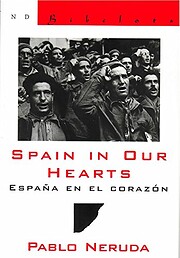
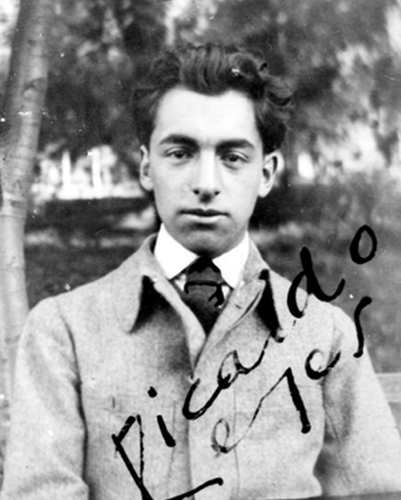
When the Spanish Civil War broke out, Pablo Neruda was in Madrid, working as Chilean consul (his predecessor in the post was another poet and future Nobel laureate, Gabriela Mistral). Through the influence of friends like Federico García Lorca, he became a communist and was soon involved in the struggle on the Republican side.
Neruda's most famous contribution to the Republican cause was this short collection of poems about the war, most of them originally published in the soldiers' newspaper El mono azul in 1936 and 1937. The collection appeared in book form in Chile and France in 1938, but the most famous version was the November 1938 pamphlet produced in a limited edition for the armed forces in the renaissance print-shop of the former monastery of Montserrat, which was under Republican control at the time. As Neruda describes it in his memoirs, it was a highly romantic affair of self-taught comrades acting as typographers and shredding any rags they could find to make improvised paper. Sadly, the truth seems to have been a little more prosaic than that, but the myth reflects the quality of the book very well.
These are poems that really need to be declaimed in the open air, preferably standing on a captured enemy tank, or perhaps at the graveside of a fallen comrade. The tone is very exalted: there are invocations to solidarity and resistance, elegies for fallen soldiers and civilian casualties, tributes to the Mothers of Madrid, condemnations of the brutality of the Nationalist rebels, visualisations of what it will be like for Franco and his generals when they arrive in Hell, and so forth. In the middle of the book there is a tribute to pre-war Spain which ends in a fifty-line list of place-names.
It's propaganda, of course, and occasionally it goes too far (Neruda doesn't hesitate to play the racist card by repeatedly mentioning Franco's reliance on North African troops, "Moros"), but it's also transparently full of passion and straight from the heart in a time of crisis, and it's often very moving indeed. It struck me that there's a lot that would still work just as effectively if you replaced "Madrid" by "Kyiv" and "Franco" by "Putin".
Spain in our hearts : hymn to the glories of the people at war = España en el corazón : himno a las glorias del pueblo en guerra (1938; parallel text 1973) by Pablo Neruda (Chile, 1904-1973), parallel translation by Donald D Walsh
When the Spanish Civil War broke out, Pablo Neruda was in Madrid, working as Chilean consul (his predecessor in the post was another poet and future Nobel laureate, Gabriela Mistral). Through the influence of friends like Federico García Lorca, he became a communist and was soon involved in the struggle on the Republican side.
Neruda's most famous contribution to the Republican cause was this short collection of poems about the war, most of them originally published in the soldiers' newspaper El mono azul in 1936 and 1937. The collection appeared in book form in Chile and France in 1938, but the most famous version was the November 1938 pamphlet produced in a limited edition for the armed forces in the renaissance print-shop of the former monastery of Montserrat, which was under Republican control at the time. As Neruda describes it in his memoirs, it was a highly romantic affair of self-taught comrades acting as typographers and shredding any rags they could find to make improvised paper. Sadly, the truth seems to have been a little more prosaic than that, but the myth reflects the quality of the book very well.
These are poems that really need to be declaimed in the open air, preferably standing on a captured enemy tank, or perhaps at the graveside of a fallen comrade. The tone is very exalted: there are invocations to solidarity and resistance, elegies for fallen soldiers and civilian casualties, tributes to the Mothers of Madrid, condemnations of the brutality of the Nationalist rebels, visualisations of what it will be like for Franco and his generals when they arrive in Hell, and so forth. In the middle of the book there is a tribute to pre-war Spain which ends in a fifty-line list of place-names.
It's propaganda, of course, and occasionally it goes too far (Neruda doesn't hesitate to play the racist card by repeatedly mentioning Franco's reliance on North African troops, "Moros"), but it's also transparently full of passion and straight from the heart in a time of crisis, and it's often very moving indeed. It struck me that there's a lot that would still work just as effectively if you replaced "Madrid" by "Kyiv" and "Franco" by "Putin".
43thorold
And another Nobella, this time by the 1967 laureate, and I think my first book from Guatemala. I have El Señor Presidente on my e-reader as well, I'll get to it eventually.
El espejo de Lida Sal (1967; The mirror of Lida Sal) by Miguel Ángel Asturias (Guatemala, 1899-1974)
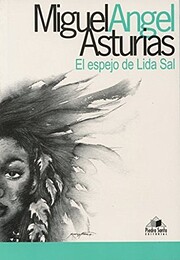

This collection of stories based on Mayan and Guatemalan traditions appeared in 1967, the same year that Asturias was awarded the Nobel. Although the underlying myths are pre-Columbian, most of the stories here are placed in a more contemporary context, the supernatural New World elements mingling with bits of Catholic, Spanish or African tradition: you can see why Asturias is often cited as a precursor of the "Latin American Boom".
The title story has a woman trying to capture the heart of the man she wants to marry by secretly putting on the costume that he is to wear at a coming festival. She comes to grief, Narcissus-style, when she goes to a river in the moonlight to look at her reflection in the splendid costume. The stories go on to look at heroes who challenge their prescribed destiny, origin myths, and myths about creative art, finishing with "Leyenda de la campana difunta", where Catholic/capitalist order comes into direct contact with American disturbing forces in a conflict about the founding of a bell, and the whirlwind duelling dance of "Leyenda de las Matachines", which is at one level a knife-fight between two gauchos over a woman and at another a complicated pattern of identity-shifting Mayan deities.
Not my usual sort of thing, and I don't know much about the background traditions, but all very interesting, and full of complicated, intense, poetic writing.
---
47 to go
El espejo de Lida Sal (1967; The mirror of Lida Sal) by Miguel Ángel Asturias (Guatemala, 1899-1974)

This collection of stories based on Mayan and Guatemalan traditions appeared in 1967, the same year that Asturias was awarded the Nobel. Although the underlying myths are pre-Columbian, most of the stories here are placed in a more contemporary context, the supernatural New World elements mingling with bits of Catholic, Spanish or African tradition: you can see why Asturias is often cited as a precursor of the "Latin American Boom".
The title story has a woman trying to capture the heart of the man she wants to marry by secretly putting on the costume that he is to wear at a coming festival. She comes to grief, Narcissus-style, when she goes to a river in the moonlight to look at her reflection in the splendid costume. The stories go on to look at heroes who challenge their prescribed destiny, origin myths, and myths about creative art, finishing with "Leyenda de la campana difunta", where Catholic/capitalist order comes into direct contact with American disturbing forces in a conflict about the founding of a bell, and the whirlwind duelling dance of "Leyenda de las Matachines", which is at one level a knife-fight between two gauchos over a woman and at another a complicated pattern of identity-shifting Mayan deities.
Not my usual sort of thing, and I don't know much about the background traditions, but all very interesting, and full of complicated, intense, poetic writing.
---
47 to go
44labfs39
You are whipping through your unread laureates, Mark. I wonder if you'll finish this year.
45thorold
>44 labfs39: Theoretically I might finish, if I go on crossing them off at the present rate, but I doubt if the momentum will continue as the list gets shorter. There have to be reasons why we never come across those writers, don't there? And there are so many of the ones I've already crossed off that I want to come back to. For example:
In dubious battle (1936) by John Steinbeck (USA, 1902-1968)
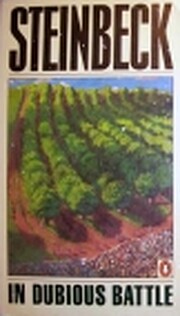

This was Steinbeck's first serious contemporary novel, published shortly after Tortilla Flat. It's the story of a strike by seasonal apple-pickers trying to reverse a pay-cut, and a painful analysis of the impossible task faced by ordinary workers taking on a well-organised (and unscrupulous) establishment, egged on by equally unscrupulous communists who know that glorious failure will have as powerful a propaganda effect as success.
It's perhaps all a bit too romantic, and there's a lot in the text, especially the dialogue, that feels unnecessarily didactic at this distance, but the storyline remains gripping, and we can't help being drawn into sympathy for all the people who get hurt in the course of the book. And any novel that draws on a Milton quotation must have something going for it...
In dubious battle (1936) by John Steinbeck (USA, 1902-1968)

This was Steinbeck's first serious contemporary novel, published shortly after Tortilla Flat. It's the story of a strike by seasonal apple-pickers trying to reverse a pay-cut, and a painful analysis of the impossible task faced by ordinary workers taking on a well-organised (and unscrupulous) establishment, egged on by equally unscrupulous communists who know that glorious failure will have as powerful a propaganda effect as success.
It's perhaps all a bit too romantic, and there's a lot in the text, especially the dialogue, that feels unnecessarily didactic at this distance, but the storyline remains gripping, and we can't help being drawn into sympathy for all the people who get hurt in the course of the book. And any novel that draws on a Milton quotation must have something going for it...
46thorold
Another little dipping of the feet into the work of a Nobel laureate who deserves rather more attention than this:
How to start writing (and when to stop) : advice for writers (2000; English 2021) by Wisława Szymborska (Poland, 1923-2012), edited by Teresa Walas, translated from Polish to English by Clare Cavanagh


Wisława Szymborska was on the editorial board of the Krakow-based Literary life magazine for nearly thirty years. For a large part of that time (1968-1981) she was writing a column in which the editors responded with "helpful" advice to poems and stories sent in by beginning writers: this book contains a selection of her pithy and often very funny replies. Some are quite constructive, drawing attention to the kind of basic errors almost everyone makes when starting out, like not submitting copy in legible form, trying to write in outdated styles, or getting tangled up in metaphors. But she can also be pretty merciless when she's riled by silly claims in covering letters, egregious errors of spelling and grammar, writers who haven't spent enough time reviewing and rewriting, or writers who take on subjects they haven't bothered to research properly. Those can expect to be demolished in a few witty sentences.
Her theory seems to be that any real writer will bounce back from this sort of treatment, perhaps having learnt something, and if she manages to divert a few dilettantes into a less demanding hobby, so much the better. Maybe not an approach that would go down well in a modern Creative Writing class, but it has its merits, and it must have been fun for spectators.
46 to go
How to start writing (and when to stop) : advice for writers (2000; English 2021) by Wisława Szymborska (Poland, 1923-2012), edited by Teresa Walas, translated from Polish to English by Clare Cavanagh


To Baska:
"My boyfriend says I'm too pretty to be a good poet. What do you think of the poems I sent?" We think you must be really pretty.
Wisława Szymborska was on the editorial board of the Krakow-based Literary life magazine for nearly thirty years. For a large part of that time (1968-1981) she was writing a column in which the editors responded with "helpful" advice to poems and stories sent in by beginning writers: this book contains a selection of her pithy and often very funny replies. Some are quite constructive, drawing attention to the kind of basic errors almost everyone makes when starting out, like not submitting copy in legible form, trying to write in outdated styles, or getting tangled up in metaphors. But she can also be pretty merciless when she's riled by silly claims in covering letters, egregious errors of spelling and grammar, writers who haven't spent enough time reviewing and rewriting, or writers who take on subjects they haven't bothered to research properly. Those can expect to be demolished in a few witty sentences.
Her theory seems to be that any real writer will bounce back from this sort of treatment, perhaps having learnt something, and if she manages to divert a few dilettantes into a less demanding hobby, so much the better. Maybe not an approach that would go down well in a modern Creative Writing class, but it has its merits, and it must have been fun for spectators.
46 to go
47thorold
And back quite a long way, to the 1910 laureate. Two short stories served up in a convenient Reclam Nobella format...
L'Arrabbiata / Das Mädchen von Treppi (1854/1858; this edition 1969) by Paul Heyse (Germany, 1830-1914)


Paul Heyse, who was awarded the Nobel in 1910 at the age of eighty, was a prolific writer of German short stories, also known for his work in collecting and translating Spanish and Italian lyrics (set by people like Robert Schumann and Hugo Wolf). He was associated with writers like Fontane and Storm in the "Tunnel" group in post-1848 Berlin.
"L'Arrabbiata" (1854) is one of Heyse's most famous early stories, the pared-down tale of a wilful girl from Sorrento who has sworn off men after seeing the disaster of her parents' marriage, but who is nonetheless courted by the lovely boatman Antonino, with predictable results. "The girl of Treppi" (1858) is another story about a couple who seem fated never both to be attracted to each other at the same moment: the activist lawyer Filippo, on the run from political oppression, finds himself hiding out in a country inn kept by a woman he had attempted to seduce seven years earlier. She has apparently been pining for him ever since, whilst he has forgotten all about her. Trouble ensues.
Both stories are set in an idealised, operatic kind of Italy, but they have interesting ways of exploring the conflict between our desire to lead independent, self-determined lives and our desire to tie ourselves up in another person's life. The Reclam student edition also comes with a couple of interesting excerpts from essays in which Heyse writes about the history and theory of the short story form.
45 to go...
L'Arrabbiata / Das Mädchen von Treppi (1854/1858; this edition 1969) by Paul Heyse (Germany, 1830-1914)


Paul Heyse, who was awarded the Nobel in 1910 at the age of eighty, was a prolific writer of German short stories, also known for his work in collecting and translating Spanish and Italian lyrics (set by people like Robert Schumann and Hugo Wolf). He was associated with writers like Fontane and Storm in the "Tunnel" group in post-1848 Berlin.
"L'Arrabbiata" (1854) is one of Heyse's most famous early stories, the pared-down tale of a wilful girl from Sorrento who has sworn off men after seeing the disaster of her parents' marriage, but who is nonetheless courted by the lovely boatman Antonino, with predictable results. "The girl of Treppi" (1858) is another story about a couple who seem fated never both to be attracted to each other at the same moment: the activist lawyer Filippo, on the run from political oppression, finds himself hiding out in a country inn kept by a woman he had attempted to seduce seven years earlier. She has apparently been pining for him ever since, whilst he has forgotten all about her. Trouble ensues.
Both stories are set in an idealised, operatic kind of Italy, but they have interesting ways of exploring the conflict between our desire to lead independent, self-determined lives and our desire to tie ourselves up in another person's life. The Reclam student edition also comes with a couple of interesting excerpts from essays in which Heyse writes about the history and theory of the short story form.
45 to go...
48thorold
Another "Nobella"...
For the living and the dead : poems and a memoir (1995) by Tomas Tranströmer (Sweden, 1931-2015), edited by Daniel Halpern and translated from Swedish by a whole bunch of poets

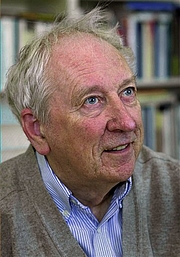
This is a small selection from Tranströmer's lyric verse, in translations selected by editor Daniel Halpern from among the numerous English versions available, sandwiching the poet's childhood memoir "Memories look at me".
I enjoyed the memoir, where Tranströmer writes about growing up in Stockholm before and during World War II and going to the Södra Latin Grammar School (which featured in an Ingmar Bergman film). But it was difficult to get a grasp of the poems, possibly because of the profusion of different translators involved.
One or two appealed to me at first reading — "Grief Gondola No.2", for instance, a poem about Liszt and Wagner in Venice (but it's weird seeing the title of Liszt's piece translated into English when it's normally left in Italian); "Motifs from the Middle Ages"; and the "Vermeer" poem that ends the selection. Others left me baffled with their incongruous or surreal images and leaps of subject. Perhaps he's a poet you need to read in the original, but I didn't really see anything in this selection that would have made me go out and learn a bit more Swedish. At best it seemed good, but not earth-shattering.
... Down to 44
For the living and the dead : poems and a memoir (1995) by Tomas Tranströmer (Sweden, 1931-2015), edited by Daniel Halpern and translated from Swedish by a whole bunch of poets

This is a small selection from Tranströmer's lyric verse, in translations selected by editor Daniel Halpern from among the numerous English versions available, sandwiching the poet's childhood memoir "Memories look at me".
I enjoyed the memoir, where Tranströmer writes about growing up in Stockholm before and during World War II and going to the Södra Latin Grammar School (which featured in an Ingmar Bergman film). But it was difficult to get a grasp of the poems, possibly because of the profusion of different translators involved.
One or two appealed to me at first reading — "Grief Gondola No.2", for instance, a poem about Liszt and Wagner in Venice (but it's weird seeing the title of Liszt's piece translated into English when it's normally left in Italian); "Motifs from the Middle Ages"; and the "Vermeer" poem that ends the selection. Others left me baffled with their incongruous or surreal images and leaps of subject. Perhaps he's a poet you need to read in the original, but I didn't really see anything in this selection that would have made me go out and learn a bit more Swedish. At best it seemed good, but not earth-shattering.
... Down to 44
49thorold
Another quick Nobella, the 1921 laureate...
Le mannequin d'osier (1897) by Anatole France (France, 1844-1924)


This is the second in a group of four short novels analysing the state of France at the end of the nineteenth century through the life of M. Bergeret, a mild-mannered professor of classics in a provincial university town.
Bergeret comes home unexpectedly early — because the bookshop happens to be closed — and surprises his wife in the arms of his former pupil Roux, leading to a somewhat awkward domestic situation. But France doesn't let this opportunity for a corny plot interfere with his intention of involving us in a string of calm, deliberate and ironically-weighted discussions between the members of the town's academic and clerical elite about the political scandals of the day, the role of the Church in French society, the claims of Catholic theology, the death penalty, and much more. It's a kind of anti-Bovary, with more light comedy going on than serious human suffering. More fun than I was expecting.
...43 to go
Le mannequin d'osier (1897) by Anatole France (France, 1844-1924)


This is the second in a group of four short novels analysing the state of France at the end of the nineteenth century through the life of M. Bergeret, a mild-mannered professor of classics in a provincial university town.
Bergeret comes home unexpectedly early — because the bookshop happens to be closed — and surprises his wife in the arms of his former pupil Roux, leading to a somewhat awkward domestic situation. But France doesn't let this opportunity for a corny plot interfere with his intention of involving us in a string of calm, deliberate and ironically-weighted discussions between the members of the town's academic and clerical elite about the political scandals of the day, the role of the Church in French society, the claims of Catholic theology, the death penalty, and much more. It's a kind of anti-Bovary, with more light comedy going on than serious human suffering. More fun than I was expecting.
...43 to go
50thorold
This is a Nobel laureate I have read before, but inadequately and long ago.
As I lay dying (1930) by William Faulkner (USA, 1897-1962)


The impoverished and somewhat mule-headed farmer Anse Bundren has promised his wife Addie that she can be buried in Jefferson, where her family comes from. But that's several days' wagon journey away, even when the rivers aren't in flood. Anse and his children set out nonetheless, coping with dangerous fords, burning barns, untreated injuries, and a whole host of other personal difficulties along the way.
The text switches around between the viewpoints of all the family members (including the deceased Addie) and a number of outsiders, each with their own distinctive style. It's often hard to follow what's going on and how people are connected to each other, and the language of some of the speakers is so deep in eccentricities of dialect that you have to read it three or four times, but despite that it's beautiful and strange and often deeply shocking.
Faulkner was obviously showing off when he wrote this (he later claimed — falsely — to have written it in six weeks without any revisions at all along the way), but you can't help being drawn in by most of his characters, appalling as they are, and sympathising with their problems. Good stuff, in small doses.
As I lay dying (1930) by William Faulkner (USA, 1897-1962)


The impoverished and somewhat mule-headed farmer Anse Bundren has promised his wife Addie that she can be buried in Jefferson, where her family comes from. But that's several days' wagon journey away, even when the rivers aren't in flood. Anse and his children set out nonetheless, coping with dangerous fords, burning barns, untreated injuries, and a whole host of other personal difficulties along the way.
The text switches around between the viewpoints of all the family members (including the deceased Addie) and a number of outsiders, each with their own distinctive style. It's often hard to follow what's going on and how people are connected to each other, and the language of some of the speakers is so deep in eccentricities of dialect that you have to read it three or four times, but despite that it's beautiful and strange and often deeply shocking.
Faulkner was obviously showing off when he wrote this (he later claimed — falsely — to have written it in six weeks without any revisions at all along the way), but you can't help being drawn in by most of his characters, appalling as they are, and sympathising with their problems. Good stuff, in small doses.
51thorold
Steinbeck again. This is a book where I have absolutely no idea why I never got to it before...
The wayward bus (1947) by John Steinbeck (USA, 1902-1968)

On the face of it, this is just a version of that rather hackneyed plot device — more popular on stage and screen than in novels — where you bring an apparently random bunch of strangers together and put them under pressure in some unexpected way to see what happens. In this case the driver and passengers on a bus making a cross-country journey in California at a moment when the rivers are up and the bridges liable to collapse at any moment.
Of course, Steinbeck uses the situation to dig into a whole range of social problems of the USA in the immediate aftermath of World War II. Slightly surprisingly, perhaps, he focusses in particular on the situation of his female characters. You could almost claim this as a feminist novel, in that it talks about the disconnect between women's aspirations and the roles actually available to them in forties society, and shows us something of what it must feel like to be on the receiving end of unwanted male sexual attention. But there's probably also a strong element of male fantasy in the way these things are worked out. And how does Steinbeck know what women talk about in the ladies' toilets, unless he was listening behind the door...?
I loved Steinbeck's close attention to the natural and man-made background of rural California: from the details of the mechanical work being done on Juan's old bus to the fabulous thumbnail survey of the ecology of a roadside verge, it all feels totally convincing and well-observed, and it cleverly plays into the mood and timing of the foreground story.
The wayward bus (1947) by John Steinbeck (USA, 1902-1968)

On the face of it, this is just a version of that rather hackneyed plot device — more popular on stage and screen than in novels — where you bring an apparently random bunch of strangers together and put them under pressure in some unexpected way to see what happens. In this case the driver and passengers on a bus making a cross-country journey in California at a moment when the rivers are up and the bridges liable to collapse at any moment.
Of course, Steinbeck uses the situation to dig into a whole range of social problems of the USA in the immediate aftermath of World War II. Slightly surprisingly, perhaps, he focusses in particular on the situation of his female characters. You could almost claim this as a feminist novel, in that it talks about the disconnect between women's aspirations and the roles actually available to them in forties society, and shows us something of what it must feel like to be on the receiving end of unwanted male sexual attention. But there's probably also a strong element of male fantasy in the way these things are worked out. And how does Steinbeck know what women talk about in the ladies' toilets, unless he was listening behind the door...?
I loved Steinbeck's close attention to the natural and man-made background of rural California: from the details of the mechanical work being done on Juan's old bus to the fabulous thumbnail survey of the ecology of a roadside verge, it all feels totally convincing and well-observed, and it cleverly plays into the mood and timing of the foreground story.
52labfs39
>51 thorold: This is a new-to-me title by Steinbeck. I read 8 or 9 of his novels and novellas when I was a teen, but haven't read anything since. I should read something now and see if my impressions hold up.
53edwinbcn
>52 labfs39: I read A wayward bus in 2012 when Steinbeck was chosen as author of the month or quarter.
54thorold
… And it’s that time of year again, the list has got one name longer, with Jon Fosse being announced as this year’s laureate. By some miracle they picked an author I’ve read and liked, most recently Scenes from a childhood earlier this year. So my list of ignobles remains the same length.
55labfs39
>54 thorold: I on the other hand have never read him, so my list gets ever longer. I liked the sound of Scenes from a Childhood, so I'll look for that one.
56thorold
A new book by last year's laureate (not an omitted one, though, I'd read plenty of her books before she received the prize).
Le jeune homme (2022) by Annie Ernaux (France, 1940- )


If you've just won the Nobel, your publishers are going to print pretty much anything you send them, it seems, even if it's only a 6000-word story you've had in the cupboard for a couple of decades and now want to issue as a standalone book. Definitely my shortest prose text of the year so far, coming in at 38 rather small pages...
... But it is Annie Ernaux, short books are part of what she does, and of course it's a book that's tied up in complicated ways with her own life and with at least two of her other books. And it's well worth reading just for itself, too.
The narrator describes how, in her mid-fifties, she has an affair with a man in his twenties, a student at the University of Rouen, where she had been an undergraduate herself, before he was even born. She tells us how the relationship gives both of them a great deal of pleasure, in bed and elsewhere, how it makes her feel younger, and how much she enjoys introducing him to social and cultural pleasures outside his normal range. She discusses the disapproving looks they get when they appear in public together, and how there seems to be a unique level of disapproval reserved for the older woman-younger man combination: they speculate about how no-one would have given them a second glance if the age difference had been the other way round, or even if they'd both been men. She also digresses a little bit into older woman-younger man relationships in books and films, but she doesn't allow herself to get too distracted by this (there are so many classic French novels where an ambitious young man arrives in Paris and has to serve his time as lover to a middle-aged society hostess before he can take up his true calling and desert her for a young heiress...).
So, it's all good fun and no-one is getting hurt, but we have already had a hint on the opening page that the narrator is at least to some extent exploiting her lover for literary ends: soon it becomes clear that what is really going on is that her weekend idylls on the mattress of her lover's student room are part of a mechanism for unlocking her memories of the clandestine abortion she had to undergo when she became pregnant as a student in 1963. Ernaux had already assigned that experience at arm's length to a fictional character in her novel Les armoires vides (1974), but it only seems to have been this relationship with the young man A. that brought her to the point where she was ready to deal with that horror in detail and in the first person in L'événement (2000).
Le jeune homme (2022) by Annie Ernaux (France, 1940- )


J'espérais que la fin de l'attente la plus violente qui soit, celle de jouir, me fasse éprouver la certitude qu'il n'y avait pas de jouissance supérieure à celle de l'écriture d'un livre. (I was hoping that the end of the most violent wait there is, that of orgasm, would make me experience the certainty that there is no pleasure superior to that of writing a book.)
If you've just won the Nobel, your publishers are going to print pretty much anything you send them, it seems, even if it's only a 6000-word story you've had in the cupboard for a couple of decades and now want to issue as a standalone book. Definitely my shortest prose text of the year so far, coming in at 38 rather small pages...
... But it is Annie Ernaux, short books are part of what she does, and of course it's a book that's tied up in complicated ways with her own life and with at least two of her other books. And it's well worth reading just for itself, too.
The narrator describes how, in her mid-fifties, she has an affair with a man in his twenties, a student at the University of Rouen, where she had been an undergraduate herself, before he was even born. She tells us how the relationship gives both of them a great deal of pleasure, in bed and elsewhere, how it makes her feel younger, and how much she enjoys introducing him to social and cultural pleasures outside his normal range. She discusses the disapproving looks they get when they appear in public together, and how there seems to be a unique level of disapproval reserved for the older woman-younger man combination: they speculate about how no-one would have given them a second glance if the age difference had been the other way round, or even if they'd both been men. She also digresses a little bit into older woman-younger man relationships in books and films, but she doesn't allow herself to get too distracted by this (there are so many classic French novels where an ambitious young man arrives in Paris and has to serve his time as lover to a middle-aged society hostess before he can take up his true calling and desert her for a young heiress...).
So, it's all good fun and no-one is getting hurt, but we have already had a hint on the opening page that the narrator is at least to some extent exploiting her lover for literary ends: soon it becomes clear that what is really going on is that her weekend idylls on the mattress of her lover's student room are part of a mechanism for unlocking her memories of the clandestine abortion she had to undergo when she became pregnant as a student in 1963. Ernaux had already assigned that experience at arm's length to a fictional character in her novel Les armoires vides (1974), but it only seems to have been this relationship with the young man A. that brought her to the point where she was ready to deal with that horror in detail and in the first person in L'événement (2000).
57edwinbcn
>56 thorold:
I think the story element of Le jeune homme appears as an episode in The years. I enjoyed reading this so much. It was the first work by Ernaux to me, and I have not yet read The Years, but I saw a theatre play at ITA based on The Years.
It was noy obvious to me, as you point out, that the story has so much to do with the traumatic experience of the abortion she had, but since the setting is also Rouen, and the young man has about her age then, such associations are perhaps inevitable.
After reading Simple Passion, I see this story much more as a further experiment in her desire for a man, while now she can control the situation, both the beginning and the end, much as a novelist would.
I also think the story of Le jeune homme has tremendous appeal, as, like with so much of her work it has simultaneously universal value and unique personal value to many readers who may recognize aspects of the story that may resemble similar relationships in their own lives, across the gender spectrum.
It seems to me many of her short works are elaborated versions of episodes from The Years. I still look forward to reading many more of her works.
I think the story element of Le jeune homme appears as an episode in The years. I enjoyed reading this so much. It was the first work by Ernaux to me, and I have not yet read The Years, but I saw a theatre play at ITA based on The Years.
It was noy obvious to me, as you point out, that the story has so much to do with the traumatic experience of the abortion she had, but since the setting is also Rouen, and the young man has about her age then, such associations are perhaps inevitable.
After reading Simple Passion, I see this story much more as a further experiment in her desire for a man, while now she can control the situation, both the beginning and the end, much as a novelist would.
I also think the story of Le jeune homme has tremendous appeal, as, like with so much of her work it has simultaneously universal value and unique personal value to many readers who may recognize aspects of the story that may resemble similar relationships in their own lives, across the gender spectrum.
It seems to me many of her short works are elaborated versions of episodes from The Years. I still look forward to reading many more of her works.
58thorold
It's a long time since I made any inroads on this Nobel challenge: the last completely new Nobelist on my list was Anatole France in April 2023 (>49 thorold: above).
Since >56 thorold: I've added a few more reads of already-ticked-off Nobelists that I didn't bother to post here:
- The Pole by J M Coetzee
- Der Butt by Günter Grass
- House of day, house of night by Olga Tokarczuk
But now — drum roll — the first new Nobelist for 2024:
De mooiste van Salvatore Quasimodo (2004) by Salvatore Quasimodo (Italy, 1901-1968), parallel translation from Italian to Dutch by Erik Derycke & Bart van den Bossche


Among the Nobel literature prizewinners most of us have never heard of, the Italian poet Salvatore Quasimodo, the 1959 laureate, must count as the one with the most memorable name. Not that that is in any way relevant to his achievement, but it does leave you wondering when you first see it whether it could be some kind of convenient made-up name for those years when the members of the awards committee can’t decide on a winner and decide to share the prize money between themselves instead.
Quasimodo was born in Sicily, the son of a railway worker, in 1901. As a small child, he experienced the aftermath of the terrible 1908 Messina earthquake: as he describes in a late poem dedicated to his father, the family lived in a freight car in the ruins of the station whilst his father helped to keep the trains moving.
As a young man, he worked as a surveyor in various parts of Italy: many of his early poems are semi-nostalgic evocations of the Sicilian landscape as recalled from exile in the north. They are often extremely beautiful lyrics, but very much in the style of that time, inward-looking and static. This all changes with the poems published after the end of World War II (but often written earlier), when Quasimodo starts to engage with the horrors of that part of Italian and European history. It seems likely that those poems were the ones that caught the mood of the times and the attention of the Nobel committee. And the very tangible anger, grief and sympathy expressed there still have a pretty powerful impact even now. There’s also some very appealing stuff in his later poems, particularly “Al padre” where he remembers his father, and “Nell’Isola”, where he imagines a craftsman building a house in Sicily.
This short Dutch anthology, with about seventy poems from across Quasimodo’s whole career, was probably a sufficient dose to get a good impression of what he was about. The parallel translations are rather plain and literal, but they stick closely to the structure of the Italian text and are thus very useful if you’re trying to make sense of the Italian. The introduction, summarising Quasimodo’s life and work in about 20 pages, is also very handy.
- - -
Loose translation:
And how could we sing with the foreign foot over our heart, among the dead abandoned in the squares on the ice-hard grass, to the lamb-like lament of the children, to the black scream of the mother coming to find her son crucified on a telegraph pole?
Even our lyres were hanging in the fronds of the willows, through a promise, swaying slightly in the sad wind.
Since >56 thorold: I've added a few more reads of already-ticked-off Nobelists that I didn't bother to post here:
- The Pole by J M Coetzee
- Der Butt by Günter Grass
- House of day, house of night by Olga Tokarczuk
But now — drum roll — the first new Nobelist for 2024:
De mooiste van Salvatore Quasimodo (2004) by Salvatore Quasimodo (Italy, 1901-1968), parallel translation from Italian to Dutch by Erik Derycke & Bart van den Bossche


Among the Nobel literature prizewinners most of us have never heard of, the Italian poet Salvatore Quasimodo, the 1959 laureate, must count as the one with the most memorable name. Not that that is in any way relevant to his achievement, but it does leave you wondering when you first see it whether it could be some kind of convenient made-up name for those years when the members of the awards committee can’t decide on a winner and decide to share the prize money between themselves instead.
Quasimodo was born in Sicily, the son of a railway worker, in 1901. As a small child, he experienced the aftermath of the terrible 1908 Messina earthquake: as he describes in a late poem dedicated to his father, the family lived in a freight car in the ruins of the station whilst his father helped to keep the trains moving.
As a young man, he worked as a surveyor in various parts of Italy: many of his early poems are semi-nostalgic evocations of the Sicilian landscape as recalled from exile in the north. They are often extremely beautiful lyrics, but very much in the style of that time, inward-looking and static. This all changes with the poems published after the end of World War II (but often written earlier), when Quasimodo starts to engage with the horrors of that part of Italian and European history. It seems likely that those poems were the ones that caught the mood of the times and the attention of the Nobel committee. And the very tangible anger, grief and sympathy expressed there still have a pretty powerful impact even now. There’s also some very appealing stuff in his later poems, particularly “Al padre” where he remembers his father, and “Nell’Isola”, where he imagines a craftsman building a house in Sicily.
This short Dutch anthology, with about seventy poems from across Quasimodo’s whole career, was probably a sufficient dose to get a good impression of what he was about. The parallel translations are rather plain and literal, but they stick closely to the structure of the Italian text and are thus very useful if you’re trying to make sense of the Italian. The introduction, summarising Quasimodo’s life and work in about 20 pages, is also very handy.
- - -
ALLE FRONDE DEI SALICI
E come potevamo noi cantare
con il piede straniero sopra il cuore,
fra i morti abbandonati nelle piazze
sull'erba dura di ghiaccio, al lamento
d'agnello dei fanciulli, all'urlo nero
della madre che andava incontro al figlio
crocifisso sul palo del telegrafo?
Alle fronde dei salici, per voto,
anche le nostre cetre erano appese,
oscillavano lievi al triste vento.
(From Giorno dopo giorno, 1947)
Loose translation:
And how could we sing with the foreign foot over our heart, among the dead abandoned in the squares on the ice-hard grass, to the lamb-like lament of the children, to the black scream of the mother coming to find her son crucified on a telegraph pole?
Even our lyres were hanging in the fronds of the willows, through a promise, swaying slightly in the sad wind.
59thorold
A revisit of the 2006 laureate: I read two or three of his books at the time he won the prize, then lost sight of him again.
The New Life (1994, 1998) by Orhan Pamuk (Turkey, 1952- ), translated from Turkish by Güneli Gün


Osman first comes across a book called The new life when he sees a pretty girl carrying it around in the university refectory. He spots a copy on a bookstall, reads it himself, and finds his life transformed in some weird way by what he reads. Osman and the lovely (but regrettably unavailable) Janan set out on a quest for Janan’s lost lover that involves criss-crossing Turkey on an apparently endless series of bus journeys, a considerable number of which end in deadly bus-collisions.
Repeatedly, Pamuk seems to side-step any straightforward interpretation of the book, allowing the plot to shift directions unpredictably whenever we seem to be getting close to some kind of resolution. It’s a sweetly-ironic account of young love, a study of how conspiracies and counter-conspiracies work and of how ready young people are to allow themselves to be influenced by ideas that promise to bring an escape from the everyday, a look at how the power of an idea can become detached from its originator’s intentions when it is put into a book, and it's often also a gently satirical look back at life in provincial Turkey a few decades ago. And a nostalgic homage to obsolete Turkish brand names, overnight buses, rail travel, bad films and the low-grade children’s literature of the author’s youth. But it also brings in Dante, Rilke, and a whole bunch of other apparently incongruent threads, so you need to keep your wits about you.
Puzzling, but often quite captivating. If you are looking for a book about how many angels can dance on a candy-wrapper, this is the one.
The New Life (1994, 1998) by Orhan Pamuk (Turkey, 1952- ), translated from Turkish by Güneli Gün


Osman first comes across a book called The new life when he sees a pretty girl carrying it around in the university refectory. He spots a copy on a bookstall, reads it himself, and finds his life transformed in some weird way by what he reads. Osman and the lovely (but regrettably unavailable) Janan set out on a quest for Janan’s lost lover that involves criss-crossing Turkey on an apparently endless series of bus journeys, a considerable number of which end in deadly bus-collisions.
Repeatedly, Pamuk seems to side-step any straightforward interpretation of the book, allowing the plot to shift directions unpredictably whenever we seem to be getting close to some kind of resolution. It’s a sweetly-ironic account of young love, a study of how conspiracies and counter-conspiracies work and of how ready young people are to allow themselves to be influenced by ideas that promise to bring an escape from the everyday, a look at how the power of an idea can become detached from its originator’s intentions when it is put into a book, and it's often also a gently satirical look back at life in provincial Turkey a few decades ago. And a nostalgic homage to obsolete Turkish brand names, overnight buses, rail travel, bad films and the low-grade children’s literature of the author’s youth. But it also brings in Dante, Rilke, and a whole bunch of other apparently incongruent threads, so you need to keep your wits about you.
Puzzling, but often quite captivating. If you are looking for a book about how many angels can dance on a candy-wrapper, this is the one.
60edwinbcn
>59 thorold:
Reading The New Life got me hooked on Orhan Pamuk. I have read several of his novels, but could not get through The Museum of Innocence which is one of the very few books I abandoned. Since then, I haven't read any of Pamuk's books, with the exception of a volume of essays, The naive and the sentimental novelist.
Reading The New Life got me hooked on Orhan Pamuk. I have read several of his novels, but could not get through The Museum of Innocence which is one of the very few books I abandoned. Since then, I haven't read any of Pamuk's books, with the exception of a volume of essays, The naive and the sentimental novelist.
61thorold
Progress gets slower and slower!
Existing Nobelists retouched since the last update:
— Elias Canetti - Die gerettete Zunge (The tongue set free, read 2024-08-13)
— Olga Tokarczuk - The Empusium (read 2025-02-17)
— William Golding - The inheritors (read 2025-02-22)
— Orhan Pamuk - Istanbul: memories and the city (read 2025-04-04)
But I’ve at last managed another new one, Chinese exile Gao Xingjiang with his best-known work, the experimental travel novel Soul mountain (1989).
Existing Nobelists retouched since the last update:
— Elias Canetti - Die gerettete Zunge (The tongue set free, read 2024-08-13)
— Olga Tokarczuk - The Empusium (read 2025-02-17)
— William Golding - The inheritors (read 2025-02-22)
— Orhan Pamuk - Istanbul: memories and the city (read 2025-04-04)
But I’ve at last managed another new one, Chinese exile Gao Xingjiang with his best-known work, the experimental travel novel Soul mountain (1989).

