rocketjk's 2025: I wanna read that!
This topic was continued by rocketjk's 2025 II: I still wanna read that!.
Talk Club Read 2025
Join LibraryThing to post.
1rocketjk
Here I am back for more reading and conversing fun in 2025.
To review: After a long project of investigation and exploration, my wife and I moved in mid-August last year from Mendocino County, northern California, USA, to Manhattan. More precisely, to the Upper West Side. We're both New Jersey natives, with family (my wife) and old friends (both of us) in the NY/NJ area, so really this is like coming home. As 2025 dawns, we mostly, but certainly not entirely, have the heavy lifting of setting up our new apartment behind us. We are both retired. As for me, my checkered work life included, in no particular order, public radio producer, teacher, freelance writer and used bookstore owner, busman, waiter, dishwasher and publications coordinator at the Federal Reserve Bank of San Francisco. My reading is an eclectic mix of fiction, history, memoirs, bios and more. In addition to the books I read straight through, I like to read anthologies, collections and other books of short entries one story/chapter at a time instead of plowing through them all at once. I have a couple of stacks of such books from which I read in this manner between the books I read from cover to cover (novels and histories, mostly). So I call these my "between books." When I finish a "between book," I add it to my yearly list. Last year was a relatively off reading year for me, at least book total-wise (I topped off at 41), due to the move and the number of doorstop-sized books I read. C'est la vie! Cheers and happy reading one and all!

Just for fun, here's a recent photo I took of the Riverside Park lower level promenade in the snow. I'm down here (just a few blocks
from our building) just about every day giving Rosie, the German shepherd, her walk.
As the new year begins, here are my two stacks of "between books," which I alternate between.
Stack 1
* Literature - Book Two edited by Thomas H. Briggs
* Selected Writings of Thomas De Quincey edited by Philip Van Doren Stern
* New Writing from the Middle East edited by Leo Hamalian and John D. Yohannan
* Annual Gathering Commemorating the Warsaw Ghetto Uprising, 75th Anniversary, April 19, 2018 edited by Irena Klepfisz (This is the booklet printed for the 50th anniversary event.)
* The Decameron by Giovanni Boccaccio (translated by Wayne A. Rebhorn)
Stack 2
* Best Sports Stories 1965 edited by Irving T. Marsh and Edward Ehre
* Old Truths and New Cliches: Essays by Isaac Bashevis Singer edited by David Stromberg
* The Public and Private Life of Daniel Webster by General S. P. Lyman
* Sweet Seasons: Recollections of the 1955-64 New York Yankees by Dom Forker
* The Decameron by Giovanni Boccaccio (translated by Wayne A. Rebhorn)
I also always have an old magazine on the go, which I read an article from during each between book session. I'm just about coming to the end of the March 1958 edition of Holiday Magazine.
Cheers, all! And thanks for checking in on my thread.
To review: After a long project of investigation and exploration, my wife and I moved in mid-August last year from Mendocino County, northern California, USA, to Manhattan. More precisely, to the Upper West Side. We're both New Jersey natives, with family (my wife) and old friends (both of us) in the NY/NJ area, so really this is like coming home. As 2025 dawns, we mostly, but certainly not entirely, have the heavy lifting of setting up our new apartment behind us. We are both retired. As for me, my checkered work life included, in no particular order, public radio producer, teacher, freelance writer and used bookstore owner, busman, waiter, dishwasher and publications coordinator at the Federal Reserve Bank of San Francisco. My reading is an eclectic mix of fiction, history, memoirs, bios and more. In addition to the books I read straight through, I like to read anthologies, collections and other books of short entries one story/chapter at a time instead of plowing through them all at once. I have a couple of stacks of such books from which I read in this manner between the books I read from cover to cover (novels and histories, mostly). So I call these my "between books." When I finish a "between book," I add it to my yearly list. Last year was a relatively off reading year for me, at least book total-wise (I topped off at 41), due to the move and the number of doorstop-sized books I read. C'est la vie! Cheers and happy reading one and all!

Just for fun, here's a recent photo I took of the Riverside Park lower level promenade in the snow. I'm down here (just a few blocks
from our building) just about every day giving Rosie, the German shepherd, her walk.
As the new year begins, here are my two stacks of "between books," which I alternate between.
Stack 1
* Literature - Book Two edited by Thomas H. Briggs
* Selected Writings of Thomas De Quincey edited by Philip Van Doren Stern
* New Writing from the Middle East edited by Leo Hamalian and John D. Yohannan
* Annual Gathering Commemorating the Warsaw Ghetto Uprising, 75th Anniversary, April 19, 2018 edited by Irena Klepfisz (This is the booklet printed for the 50th anniversary event.)
* The Decameron by Giovanni Boccaccio (translated by Wayne A. Rebhorn)
Stack 2
* Best Sports Stories 1965 edited by Irving T. Marsh and Edward Ehre
* Old Truths and New Cliches: Essays by Isaac Bashevis Singer edited by David Stromberg
* The Public and Private Life of Daniel Webster by General S. P. Lyman
* Sweet Seasons: Recollections of the 1955-64 New York Yankees by Dom Forker
* The Decameron by Giovanni Boccaccio (translated by Wayne A. Rebhorn)
I also always have an old magazine on the go, which I read an article from during each between book session. I'm just about coming to the end of the March 1958 edition of Holiday Magazine.
Cheers, all! And thanks for checking in on my thread.
2AlisonY
Dropping off my star, Jerry. Look forward to following your reading in 2025. Happy New Year!
3rocketjk
Keeping Track of 2025's Who/What/How/Where I Read
I've had fun charting my travels the last fifteen years, an endeavor I moved to my CR thread last year. 2024's reading brought me to 14 countries, including the U.S., and 9 states within the U.S. Although there were, as always, several "U.S. non-state specific" books, quite unusually there were no "Non-country specific" books on the 2024 list.
I don't select my reading to purposefully "travel" in any particular way. Rather, I just have fun seeing where my more random reading choices take me!
Who: Author/Editor
Female: 4
Male: 17
What
Novels: 14
Short Stories: 1
Histories: 1
Contemporary (when published) Events:
Biographies: 2
Memoirs: 1
Essays: 1
Periodicals: 1
How (Original Language)
Chinese: 1
English: 12
French: 2
Hebrew: 1
Japanese: 1
Yiddish: 2
Where
Non-Country Specific
The Dawn Watch: Joseph Conrad in a Global World by Maya Jasanoff
Holiday Magazine - March, 1958 edited by Ted Patrick
The Drowned World by J.G. Ballard
Old Truths and New Cliches: Essays by Isaac Bashevis Singer edited by David Stromberg
AFRICA
Algeria
The Sleep of the Just by Mouloud Mammeri
Bangalla (fictional)
The Story of the Phantom: The Ghost Who Walks by Lee Falk
ASIA
China
Soul Mountain by Gao Xingjian
Japan
First Person Singular by Haruki Murakami
Sri Lanka
The Seven Moons of Maali Almeida by Shehan Karunatilaka
EUROPE
Non-Country Specific
Postwar: A History of Europe Since 1945 by Tony Judt
England
Selected Writings of Thomas De Quincy edited by Philip Van Doren Stern
The Worshipful Lucia by E.F. Benson
Charlie's Good Tonight: The Life, the Times, and The Rolling Stones by Paul Sexton
Germany
Good People by Nir Baram (also listed in Russia)
Italy
Memoirs of Hadrian by Marguerite Yourcenar (Although the narrative takes place throughout the Roman Empire, I'm listing this in Italy as Rome was, obviously, the center of that empire.)
Russia
Good People by Nir Baram (also listed in Germany)
Turkey
The Towers of Trebizond by Rose Macaulay
NORTH AMERICA
Non-Country Specific
The Glass Hotel by Emily St. John Mandel
United States
Non-State Specific
Adventures of Huckleberry Finn by Mark Twain
James by Percival Everett
Alabama
Ill Wind by W.L. Heath
New York
Enemies, a Love Story by Isaac B. Singer
I've had fun charting my travels the last fifteen years, an endeavor I moved to my CR thread last year. 2024's reading brought me to 14 countries, including the U.S., and 9 states within the U.S. Although there were, as always, several "U.S. non-state specific" books, quite unusually there were no "Non-country specific" books on the 2024 list.
I don't select my reading to purposefully "travel" in any particular way. Rather, I just have fun seeing where my more random reading choices take me!
Who: Author/Editor
Female: 4
Male: 17
What
Novels: 14
Short Stories: 1
Histories: 1
Contemporary (when published) Events:
Biographies: 2
Memoirs: 1
Essays: 1
Periodicals: 1
How (Original Language)
Chinese: 1
English: 12
French: 2
Hebrew: 1
Japanese: 1
Yiddish: 2
Where
Non-Country Specific
The Dawn Watch: Joseph Conrad in a Global World by Maya Jasanoff
Holiday Magazine - March, 1958 edited by Ted Patrick
The Drowned World by J.G. Ballard
Old Truths and New Cliches: Essays by Isaac Bashevis Singer edited by David Stromberg
AFRICA
Algeria
The Sleep of the Just by Mouloud Mammeri
Bangalla (fictional)
The Story of the Phantom: The Ghost Who Walks by Lee Falk
ASIA
China
Soul Mountain by Gao Xingjian
Japan
First Person Singular by Haruki Murakami
Sri Lanka
The Seven Moons of Maali Almeida by Shehan Karunatilaka
EUROPE
Non-Country Specific
Postwar: A History of Europe Since 1945 by Tony Judt
England
Selected Writings of Thomas De Quincy edited by Philip Van Doren Stern
The Worshipful Lucia by E.F. Benson
Charlie's Good Tonight: The Life, the Times, and The Rolling Stones by Paul Sexton
Germany
Good People by Nir Baram (also listed in Russia)
Italy
Memoirs of Hadrian by Marguerite Yourcenar (Although the narrative takes place throughout the Roman Empire, I'm listing this in Italy as Rome was, obviously, the center of that empire.)
Russia
Good People by Nir Baram (also listed in Germany)
Turkey
The Towers of Trebizond by Rose Macaulay
NORTH AMERICA
Non-Country Specific
The Glass Hotel by Emily St. John Mandel
United States
Non-State Specific
Adventures of Huckleberry Finn by Mark Twain
James by Percival Everett
Alabama
Ill Wind by W.L. Heath
New York
Enemies, a Love Story by Isaac B. Singer
4rocketjk
>2 AlisonY: Thanks, Allison! Right back atcha. Happy New Year and wishing you, and everyone, a wonderful reading year. I'll be checking out everybody's 2025 CR threads over the next few days.
7Ameise1
I sincerely wish you a happy, healthy and fulfilling new year. May all your wishes come true. Happy reading 2025.


8labfs39
Happy New Year, Jerry! Ace would love frolicking in the snow on the promenade. I'm glad he got to see another winter. Looking forward to catching up to you and S. next time I'm in town.
10Nickelini
I'm looking forward to watching you fill in the slots in your categories. I enjoy tracking books in a similar way too
11rocketjk
Thanks to all you well wishers! I'm about a third of the way through my first book for 2025 (I started it on December 30), the biography The Dawn Watch: Joseph Conrad in a Global World by Maya Jasanoff. It's quite interesting.
12Ameise1
>11 rocketjk: Have fun with this biography. When I was 12, we had a poem by him at school (it was about a sea voyage, unfortunately I can't remember the title after more than 50 years), which we performed as the basis for a play we had written ourselves.
13rocketjk
>12 Ameise1: That sounds like a great class project. I'd love to know the name of that poem.
14Ameise1
>13 rocketjk: me too 🤔🫣
16rocketjk
>15 rasdhar: Good eye, yes. Given that there are 100 entries, and that they are mostly both short and light reading, I decided that in order to read through the volume in a reasonable amount of time, I'd read an entry with each "between book" session. And Happy New Year to you, as well. Cheers!
17mabith
Hope you'll enjoy The Dawn Watch as much as I did, and that it's an easier year for reading, post-move.
18Dilara86
Happy new year, Jerry!
>16 rocketjk: Given that there are 100 entries, and that they are mostly both short and light reading, I decided that in order to read through the volume in a reasonable amount of time, I'd read an entry with each "between book" session
This is often what I do too, with short story or essay collections. Looking forward to your thoughts on the Decameron.
>16 rocketjk: Given that there are 100 entries, and that they are mostly both short and light reading, I decided that in order to read through the volume in a reasonable amount of time, I'd read an entry with each "between book" session
This is often what I do too, with short story or essay collections. Looking forward to your thoughts on the Decameron.
20LolaWalser
Happy new year! That's a beautiful photo--it looks as if you got more snow than we did in Toronto! so far...
21rocketjk
Thanks, all, the kind words about that photo, all. And if I haven't been to your thread yet, I will be visiting soon!
>20 LolaWalser: So far we've only had the single significant snowfall. It's looking like there will be more snow soon, though. (ETA: Flurries have started while I've been writing this!) The snow doesn't bother us, in fact it's fun (as long as it's not of blizzard volume) and reminds us of our New Jersey childhoods and college days (Steph, Connecticut; me, Boston) but the ice that covers the sidewalks in places that don't get shoveled right away for the day or so afterwards can be treacherous. Since I'm going to be 70 in July, I'm getting to the "Don't Fall!!!" stage of life. Also, the rock salt that gets thrown around the sidewalks is really painful for dogs if a pellet gets stuck in between their toes, so we make sure to give her thorough cleanings when we get back from her walks. Hey! Do you know much about traveling in/visiting Albania? My wife and I will be there on vacation over the last week of April and first week of May. We have a few days booked in Tirana, and the family of a new acquaintance (the Albanian woman we met in an Italian restaurant near our apartment who encouraged us to visit the country) in Krujë. That's a fairly short shot from Tirana. After that, we're trying to decide whether to travel north or travel south. Obviously we're not going to see the whole country. Any suggestions welcomed and sincerely appreciated. Cheers!
>20 LolaWalser: So far we've only had the single significant snowfall. It's looking like there will be more snow soon, though. (ETA: Flurries have started while I've been writing this!) The snow doesn't bother us, in fact it's fun (as long as it's not of blizzard volume) and reminds us of our New Jersey childhoods and college days (Steph, Connecticut; me, Boston) but the ice that covers the sidewalks in places that don't get shoveled right away for the day or so afterwards can be treacherous. Since I'm going to be 70 in July, I'm getting to the "Don't Fall!!!" stage of life. Also, the rock salt that gets thrown around the sidewalks is really painful for dogs if a pellet gets stuck in between their toes, so we make sure to give her thorough cleanings when we get back from her walks. Hey! Do you know much about traveling in/visiting Albania? My wife and I will be there on vacation over the last week of April and first week of May. We have a few days booked in Tirana, and the family of a new acquaintance (the Albanian woman we met in an Italian restaurant near our apartment who encouraged us to visit the country) in Krujë. That's a fairly short shot from Tirana. After that, we're trying to decide whether to travel north or travel south. Obviously we're not going to see the whole country. Any suggestions welcomed and sincerely appreciated. Cheers!
22cindydavid4
>21 rocketjk: wow, I am familiar with their folk dance and music. wish i knew more. what a great trip
23LolaWalser
>21 rocketjk:
Sorry, I've never been! My brother did pass through Albania with his bike gang some years ago and he was pleasantly impressed overall. The countryside is pretty and they ate well. I take it you are not intent on a beach vacation? I think that would be my choice, if only to compare. But I wonder if April's a tad early for that... it's great you're having a local contact, they could probably find you a student guide or some such too. Looking forward to photos if you're willing to share.
Sorry, I've never been! My brother did pass through Albania with his bike gang some years ago and he was pleasantly impressed overall. The countryside is pretty and they ate well. I take it you are not intent on a beach vacation? I think that would be my choice, if only to compare. But I wonder if April's a tad early for that... it's great you're having a local contact, they could probably find you a student guide or some such too. Looking forward to photos if you're willing to share.
24rocketjk
>23 LolaWalser: Thanks! I am definitely willing to share photos when we get back. We are certainly intent on spending time along the coast, but more, I think, for the bird watching than for beach time in and of itself. Also, though, I'm hoping for some quality hiking time in some of those beautiful mountains, too!
25rocketjk
The Dawn Watch: Joseph Conrad in a Global World by Maya Jasanoff
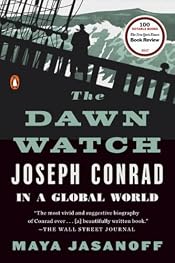
The Dawn Watch was first published in 2017. I learned of it when, looking for something else via an internet search a couple of years back, I came upon a positive review of the book in The Guardian. I found that review to be so well done that I considered simply posting a link here and leaving things at that. At any rate, I've included the link below. What Jasanoff has done is provide a biography of Conrad, revealing the important episodes/periods of his life that so strongly informed his writing. The most important of these include
* The dramatic events of his childhood in Poland, which was then ruled by Tsarist Russia in increasingly repressive fashion. Conrad's parents were Polish nobles, and his father was an important member of the resistance movement against Russian rule, also advocating the emancipation of Polish serfs. Eventually, the family was sent into exile, the harsh conditions of which ruined both parents' health, with Conrads' mother soon dying while Conrad was still a young boy, and his father following several years later.
* His time at sea, particularly throughout Asia
* His trip up the Nile captaining a riverboat through the Congo Free State
Jasanoff weaves these all skillfully with deep dives into four of Conrad's major works: The Secret Agent, Lord Jim, Heart of Darkness, and Nostromo. She also explores in depth the historical contexts of these works. So, for instance, the section on Heart of Darkness also includes a fairly detailed history of the Congo Free State as it came into being, as it existed when Conrad experienced it, and the ways in which it became even, horrifyingly, worse over the seven or eight years after Conrad's time there. She presents Lord Jim as a story about the ever-quickening and broadening of the reach of technology, as personified in the book by the inexorable shift in ocean-going trade from sailing ships to steam power, and the growing span and polluting effects of European encroachment into the remotest reaches of Asia. Heart of Darkness is presented as a look at the determined rapaciousness and cruelty of imperialism. And Jasanoff frames Nostromo as a story about the ever-growing influence of the international industrialists and, most alarmingly for Conrad, the growth of American power, both military and financial, specifically throughout Central and South America in the age of Theodore Roosevelt. The over-arching theme is of Conrad's serving as witness through his fiction of the world at a tipping point. From wind to steam is the simplest metaphor, but more importantly from a world of independent, multitudinous cultures to one ringed round and beginning to be squeezed dry by the debilitating nature of European/American technological and financial power.
In her introduction (and in the book's conclusion), Jasanoff describes China Achebe's famous, extremely critical essay about Heart of Darkness, which he called "an offensive and totally deplorable book" full of degrading stereotypes, labeling Conrad "a bloody racist." She also quotes a young Barak Obama, writing in his memoir Dreams from my Father, in which, challenged by college mates as to why he was reading such a racist book, says he replied "Because the book teaches me things . . . . About white people, I mean. See, the book's not really about Africa. Or black people. It's about the man who wrote it. The European. The American. A particular way of seeing the world."
Jasanoff then goes on the write:
"When I read {Heart of Darkness} and Achebe's essay with my own students at Harvard, I came to value Conrad's perspective for the same reasons Obama did: not just despite its blind spots but because of them. Conrad captured something about the way power operated across continents and races, something that seemed as important to engage with today as it had when he started to write."
Toward the end of that introductory chapter, Jasanoff has this to say:
"Often enough I've questioned my own attachment to this dead white man, perpetually depressed, incorrigibly cynical, alarmingly prejudiced by the standards of today. As a woman I balked at spending so much time with an author whose fiction was so short on plausible female characters it seemed like he barely realized that women were people too. As a half-Asian, I winced at Conrad's eroticized and often denigrating portrayals of Asians; as a half-Jew I bridled at his occasional but undeniable antiSemitism. . . . {But} whether I agreed with Conrad or not, I always found his company worthwhile. He brought to the page a more international and multiethnic assortment of voices than any other writer of his day that I knew. Like me, he was privileged to belong to the middle class of the leading world power of the age, and his books offered thoughtful engagements with the responsibilities and challenges that came with it. He was unafraid to reject truisms and call out exploitation, tyranny, and cant where he saw them. I remembered a phrase repeated mantra-like throughout Lord Jim: 'He was one of us.' For better and for worse, Joseph Conrad was one of us: a citizen of a global world."
Please understand that I am not here to claim that Jasanoff is "right." There are, of course, a lot of "right" ways to experience Conrad's work. My point in providing these too-long quotations is to make it clear where Jasanoff is coming from, as a way of creating, I hope, an accurate framework of what to expect from her book.
Whatever one might think of these opinions of hers, Jasanoff is an excellent writer, and her prose flows beautifully throughout this volume. As mentioned above, she seamlessly moves from straight bio, to her short descriptions of the books she covers, to engaging and sometimes fascinating historical expositions that provide greater context to the novels. Also, the book profits significantly from Jasanoff's frequent quoting from Conrad's letters, journals and memoirs that provide a greater depth of understanding of Conrad's own experiences, opinions and insights, both good and, from our perspective, frustrating and lamentable.
One important warning: in her descriptions of the four novels mentioned, and of others of Conrad's works, Jasanoff does not shy away from plot spoilers. Other than that, I highly recommend this book to anyone with an interest in Joseph Conrad and the world he lived in and wrote about.
Link to The Guardian review mentioned above:
https://www.theguardian.com/books/2018/jan/01/joseph-conrad-the-dawn-watch-maya-...
The Dawn Watch was first published in 2017. I learned of it when, looking for something else via an internet search a couple of years back, I came upon a positive review of the book in The Guardian. I found that review to be so well done that I considered simply posting a link here and leaving things at that. At any rate, I've included the link below. What Jasanoff has done is provide a biography of Conrad, revealing the important episodes/periods of his life that so strongly informed his writing. The most important of these include
* The dramatic events of his childhood in Poland, which was then ruled by Tsarist Russia in increasingly repressive fashion. Conrad's parents were Polish nobles, and his father was an important member of the resistance movement against Russian rule, also advocating the emancipation of Polish serfs. Eventually, the family was sent into exile, the harsh conditions of which ruined both parents' health, with Conrads' mother soon dying while Conrad was still a young boy, and his father following several years later.
* His time at sea, particularly throughout Asia
* His trip up the Nile captaining a riverboat through the Congo Free State
Jasanoff weaves these all skillfully with deep dives into four of Conrad's major works: The Secret Agent, Lord Jim, Heart of Darkness, and Nostromo. She also explores in depth the historical contexts of these works. So, for instance, the section on Heart of Darkness also includes a fairly detailed history of the Congo Free State as it came into being, as it existed when Conrad experienced it, and the ways in which it became even, horrifyingly, worse over the seven or eight years after Conrad's time there. She presents Lord Jim as a story about the ever-quickening and broadening of the reach of technology, as personified in the book by the inexorable shift in ocean-going trade from sailing ships to steam power, and the growing span and polluting effects of European encroachment into the remotest reaches of Asia. Heart of Darkness is presented as a look at the determined rapaciousness and cruelty of imperialism. And Jasanoff frames Nostromo as a story about the ever-growing influence of the international industrialists and, most alarmingly for Conrad, the growth of American power, both military and financial, specifically throughout Central and South America in the age of Theodore Roosevelt. The over-arching theme is of Conrad's serving as witness through his fiction of the world at a tipping point. From wind to steam is the simplest metaphor, but more importantly from a world of independent, multitudinous cultures to one ringed round and beginning to be squeezed dry by the debilitating nature of European/American technological and financial power.
In her introduction (and in the book's conclusion), Jasanoff describes China Achebe's famous, extremely critical essay about Heart of Darkness, which he called "an offensive and totally deplorable book" full of degrading stereotypes, labeling Conrad "a bloody racist." She also quotes a young Barak Obama, writing in his memoir Dreams from my Father, in which, challenged by college mates as to why he was reading such a racist book, says he replied "Because the book teaches me things . . . . About white people, I mean. See, the book's not really about Africa. Or black people. It's about the man who wrote it. The European. The American. A particular way of seeing the world."
Jasanoff then goes on the write:
"When I read {Heart of Darkness} and Achebe's essay with my own students at Harvard, I came to value Conrad's perspective for the same reasons Obama did: not just despite its blind spots but because of them. Conrad captured something about the way power operated across continents and races, something that seemed as important to engage with today as it had when he started to write."
Toward the end of that introductory chapter, Jasanoff has this to say:
"Often enough I've questioned my own attachment to this dead white man, perpetually depressed, incorrigibly cynical, alarmingly prejudiced by the standards of today. As a woman I balked at spending so much time with an author whose fiction was so short on plausible female characters it seemed like he barely realized that women were people too. As a half-Asian, I winced at Conrad's eroticized and often denigrating portrayals of Asians; as a half-Jew I bridled at his occasional but undeniable antiSemitism. . . . {But} whether I agreed with Conrad or not, I always found his company worthwhile. He brought to the page a more international and multiethnic assortment of voices than any other writer of his day that I knew. Like me, he was privileged to belong to the middle class of the leading world power of the age, and his books offered thoughtful engagements with the responsibilities and challenges that came with it. He was unafraid to reject truisms and call out exploitation, tyranny, and cant where he saw them. I remembered a phrase repeated mantra-like throughout Lord Jim: 'He was one of us.' For better and for worse, Joseph Conrad was one of us: a citizen of a global world."
Please understand that I am not here to claim that Jasanoff is "right." There are, of course, a lot of "right" ways to experience Conrad's work. My point in providing these too-long quotations is to make it clear where Jasanoff is coming from, as a way of creating, I hope, an accurate framework of what to expect from her book.
Whatever one might think of these opinions of hers, Jasanoff is an excellent writer, and her prose flows beautifully throughout this volume. As mentioned above, she seamlessly moves from straight bio, to her short descriptions of the books she covers, to engaging and sometimes fascinating historical expositions that provide greater context to the novels. Also, the book profits significantly from Jasanoff's frequent quoting from Conrad's letters, journals and memoirs that provide a greater depth of understanding of Conrad's own experiences, opinions and insights, both good and, from our perspective, frustrating and lamentable.
One important warning: in her descriptions of the four novels mentioned, and of others of Conrad's works, Jasanoff does not shy away from plot spoilers. Other than that, I highly recommend this book to anyone with an interest in Joseph Conrad and the world he lived in and wrote about.
Link to The Guardian review mentioned above:
https://www.theguardian.com/books/2018/jan/01/joseph-conrad-the-dawn-watch-maya-...
26dchaikin
Was looking forward to this particular post. Fascinating. And i agree with Obama completely. Great post, rocket.
27torontoc
>21 rocketjk: Hint- I use cat litter on my porch and it is really good and better than salt for ice ( in my opinion). The cat litter does look like mud sometimes but I haven't slipped!
28kidzdoc
>25 rocketjk: Great review of The Dawn Watch, Jerry.
29rocketjk
>27 torontoc: Thanks! But I live in an 8th-floor apartment, now. No porch! However, that's a great tip, and I will pass it along to my porch-possessing friends. :)
30rocketjk
On a personal note, I'm very happy to report that my clarinet is down from the top shelf for, for all practical purposes, the first time in almost 40 years. I took lessons for about a year and a half back in my New Orleans days (I left New Orleans in 1986). I've always idly thought I should take it up again, but I've never had a place where I could practice as a re-beginner and not thereby drive my wife insane. Now that we've traded in the greater space but much thinner walls of our house for the smaller space but much less sound-permeable walls of our New York apartment, I can now in good conscience practice, behind a couple of closed doors, of course. I've had the thing assembled and I've been blowing long tones into it, trying to begin to get my technique back. And today, in a couple of hours, I will have my first meeting with the fellow who's going to give me lessons. I hope this works out. I have no thoughts of ever being a particularly competent clarinet player at this point, but if I can make some progress to the extent that practicing is enjoyable, that will make me happy.
32Ameise1
>30 rocketjk: Yeh, a like-minded clarinettist. I played very actively for 10 years. But I also played in various orchestras. Now, it's been locked away in the cupboard for 30 years.
I hope you enjoy rediscovering this fantastic instrument.
I hope you enjoy rediscovering this fantastic instrument.
33kidzdoc
>30 rocketjk: Nice!
34WelshBookworm
>30 rocketjk: And here's to happiness!
35japaul22
>30 rocketjk: I love this!
How about a little Molly on the Shore for inspiration . . .
https://www.youtube.com/watch?v=P4q3oK8_BQ0
How about a little Molly on the Shore for inspiration . . .
https://www.youtube.com/watch?v=P4q3oK8_BQ0
36rocketjk
>35 japaul22: Thanks! That was great. Everybody looks like they're having fun, too. Got a clip of the first couple of minutes of Rhapsody in Blue? I love that clarinet at the beginning.
37rocketjk
I've completed my post-The Dawn Watch "between book" reading with another swing through Stack 2:
* “Pro Football’s Gashouse Gang” by Myron Cope (True) from Best Sports Stories 1965 edited by Irving T. Marsh and Edward Ehre
* “The Spirit of Judaism” from Old Truths and New Cliches: Essays by Isaac Bashevis Singer edited by David Stromberg
* “Mr. Webster as Secretary of State” by H. J. Raymond from The Public and Private Life of Daniel Webster by General S. P. Lyman
* “Luis Arroyo” from Sweet Seasons: Recollections of the 1955-64 New York Yankees by Dom Forker
* Day 7, Story 10 and Conclusion from The Decameron by Giovanni Boccaccio (translated by Wayne A. Rebhorn)
* “Kyoto and its Golden Pavilion” from Holiday Magazine, March, 1958 - Finished!
I've now started my next Isaac B. Singer novel, Enemies, a Love Story.
* “Pro Football’s Gashouse Gang” by Myron Cope (True) from Best Sports Stories 1965 edited by Irving T. Marsh and Edward Ehre
* “The Spirit of Judaism” from Old Truths and New Cliches: Essays by Isaac Bashevis Singer edited by David Stromberg
* “Mr. Webster as Secretary of State” by H. J. Raymond from The Public and Private Life of Daniel Webster by General S. P. Lyman
* “Luis Arroyo” from Sweet Seasons: Recollections of the 1955-64 New York Yankees by Dom Forker
* Day 7, Story 10 and Conclusion from The Decameron by Giovanni Boccaccio (translated by Wayne A. Rebhorn)
* “Kyoto and its Golden Pavilion” from Holiday Magazine, March, 1958 - Finished!
I've now started my next Isaac B. Singer novel, Enemies, a Love Story.
38LolaWalser
Hey, Jerry... we have a cleaner from Albania (he actually has a degree in something but never found an appropriate job) and I asked him about travelling there... I was a little surprised by how negative he was, (maybe he was afraid of painting too nice a picture and possible disappointment). As far as I can remember--he claims the scamming of tourists is widespread and that one should insist on settling on the prices beforehand. Contrary to my expectations, he says the seaside is "shit" except for a small stretch in the South (I didn't quite grasp if they have a problem with pollution or what, he was saying the sea is disgusting and "brown"--his English isn't the greatest...) Take care if you're driving because the roads are bad and the drivers terrible. Take care about your safety in the mountains, especially further North. Avoid "international" or "Italian" cuisine and try to eat as locals do (I guess my brother and friends profited from the freedom to zip along on bikes and eat in small roadside taverns and the like).
I doubt you have anything to worry about as long as you have your local friend to guide you but since I asked, so I report.
I doubt you have anything to worry about as long as you have your local friend to guide you but since I asked, so I report.
39kidzdoc
>37 rocketjk: I was tickled to see an article by Myron Cope amongst the stories you read. He was the longtime radio and television announcer of the Pittsburgh Steelers (or, in localese, the Pixburgh Stillers), and for my money he was the most colorful announcer in sports history. I first heard him when I was driving on the Pennsylvania Turnpike from Philadelphia to Pittsburgh in August 1993 to start my first year of medical school at Pitt, and picked up a Steelers preseason broadcast in the Allegheny Mountains. His description of the game was absolutely hilarious, as I was laughing out loud for at least an hour; he frequently referred to the Cincinnati NFL team as the Bungles, and the Cleveland team as the Brahnies during the broadcast. What I did not know until I read his Wikipedia page not long ago is that he was a highly respected journalist between the time he graduated from Pitt and began his announcing career. Here's a short obituary of Cope from WTAE, the ABC affiliate in Pittsburgh:
https://m.youtube.com/watch?v=fLR60L0I_5Y
https://m.youtube.com/watch?v=fLR60L0I_5Y
40rocketjk
>38 LolaWalser: & >39 kidzdoc: Son of a gun! I had paragraph long responses written here to both of you and just as I went to finish up I got thrown off of LibaryThing entirely and lost the whole thing! I will try to recreate:
>38 LolaWalser: Sincere thanks for taking the time to inquire on our behalf and report it back here, Lola. Much appreciated. We will take all of that information under advisement. Our friend will not be traveling with us, though. She is here in New York. She's setting up a visit for us with her family in Kruje, which we are very much looking forward to, but we'll be on our own otherwise. Your friend's comment about the roads and drivers made me laugh, I must admit. My first thought was, "Well, but I've driven in Trinidad. Nothing could be worse than that!" But of course then I was 59 or thereabouts, rather than my current 69. At least the Albanians drive on the same side of the road as us. Not so in Trinidad. But on the other hand: mountains road with narrow lanes and no guardrails, which I assume Albania has a lot of (the roads, not the guardrails), give me pause these days, anyway. Steph has no more fear of natural heights than a mountain goat has, but I have grown more nervous on such roads as the years go by. More generally, we're talking about curtailing our erstwhile practice of renting cars and driving everywhere when on vacation. We're probably going to be relying on busses more this time around. Regarding your friend's comments about the ocean, is it possible that he is trying to dissuade tourism in those regions? The relatively recent guidebook we've been studying mentions that the birding/wetland areas in at least one coastal region have come under "pressure from tourism," protected area though they are. We try to stay away from areas where are presence will contribute to particularly harmful outcomes. As to eating local food primarily, that's right up our alley anyway. Well, again, deep thanks for your research and your reportage!
>39 kidzdoc: Whenever I list a "between book" reading session, I look up the authors I wasn't familiar with beforehand. If they have an LT listing, I include that. If they don't, or if it's sparsely populated, I'll go online and look for an article (wikipedia or otherwise) or, often, an obituary to link to. Cope does have a fairly robust LT page, but I did some online checking as well. It's funny that we were coming to him from opposite directions. You knew of him as an announcer and learned from looking him up that he'd also been a journalist. I saw a piece of journalism he'd produced and learned via research that he'd also been an announcer. He certainly seems like he was a Runyonesque character. The piece I read, "Pro Football's Gashouse Gang," is about the 1964 Steelers and about Dante's, the bar and grill that a sizable chunk of the team frequented. Their theory was that they needed to be "relaxed" in order to play there best, and they even did their "relaxing" on the nights before their games. Evidently, Cope was a regular member of the Dante's crowd as well. More generally, oh for the days of the local broadcasters who were characters as well. In New York we had Marty Glickman announcing Giants games and important college games as well. I can still remember his call, in his heavy New York accent, on successful field goals. "It's through theah!" Glickman, you may well be aware, was a member of the U.S. Olympic sprinting relay team at the 1936 Munich Olympics. At the last minute, Glickman and another sprinter were told they weren't running. Jesse Owens and Ralph Metcalf took their places. Their crime was being Jewish in Nazi Germany. Here is a fascinating interview that Glickman gave in 2000 in which he goes into that situation in detail.
https://www.youtube.com/watch?v=14HeJUQb6xQ
In case anyone's really crazy, here's an almost 3-hour broadcast of Glickman and his partner Al DeRogatis announcing a Giants-Steelers game in 1963.
https://www.youtube.com/watch?v=TaVTREmD3mc
Here's a fun Myron Cope clip from 2002 of his color commentary on a Jerome Battis touchdown run. It turns out there is an "Official Myron Cope" YouTube channel!
https://www.youtube.com/watch?v=7POcyCeFDic
>38 LolaWalser: Sincere thanks for taking the time to inquire on our behalf and report it back here, Lola. Much appreciated. We will take all of that information under advisement. Our friend will not be traveling with us, though. She is here in New York. She's setting up a visit for us with her family in Kruje, which we are very much looking forward to, but we'll be on our own otherwise. Your friend's comment about the roads and drivers made me laugh, I must admit. My first thought was, "Well, but I've driven in Trinidad. Nothing could be worse than that!" But of course then I was 59 or thereabouts, rather than my current 69. At least the Albanians drive on the same side of the road as us. Not so in Trinidad. But on the other hand: mountains road with narrow lanes and no guardrails, which I assume Albania has a lot of (the roads, not the guardrails), give me pause these days, anyway. Steph has no more fear of natural heights than a mountain goat has, but I have grown more nervous on such roads as the years go by. More generally, we're talking about curtailing our erstwhile practice of renting cars and driving everywhere when on vacation. We're probably going to be relying on busses more this time around. Regarding your friend's comments about the ocean, is it possible that he is trying to dissuade tourism in those regions? The relatively recent guidebook we've been studying mentions that the birding/wetland areas in at least one coastal region have come under "pressure from tourism," protected area though they are. We try to stay away from areas where are presence will contribute to particularly harmful outcomes. As to eating local food primarily, that's right up our alley anyway. Well, again, deep thanks for your research and your reportage!
>39 kidzdoc: Whenever I list a "between book" reading session, I look up the authors I wasn't familiar with beforehand. If they have an LT listing, I include that. If they don't, or if it's sparsely populated, I'll go online and look for an article (wikipedia or otherwise) or, often, an obituary to link to. Cope does have a fairly robust LT page, but I did some online checking as well. It's funny that we were coming to him from opposite directions. You knew of him as an announcer and learned from looking him up that he'd also been a journalist. I saw a piece of journalism he'd produced and learned via research that he'd also been an announcer. He certainly seems like he was a Runyonesque character. The piece I read, "Pro Football's Gashouse Gang," is about the 1964 Steelers and about Dante's, the bar and grill that a sizable chunk of the team frequented. Their theory was that they needed to be "relaxed" in order to play there best, and they even did their "relaxing" on the nights before their games. Evidently, Cope was a regular member of the Dante's crowd as well. More generally, oh for the days of the local broadcasters who were characters as well. In New York we had Marty Glickman announcing Giants games and important college games as well. I can still remember his call, in his heavy New York accent, on successful field goals. "It's through theah!" Glickman, you may well be aware, was a member of the U.S. Olympic sprinting relay team at the 1936 Munich Olympics. At the last minute, Glickman and another sprinter were told they weren't running. Jesse Owens and Ralph Metcalf took their places. Their crime was being Jewish in Nazi Germany. Here is a fascinating interview that Glickman gave in 2000 in which he goes into that situation in detail.
https://www.youtube.com/watch?v=14HeJUQb6xQ
In case anyone's really crazy, here's an almost 3-hour broadcast of Glickman and his partner Al DeRogatis announcing a Giants-Steelers game in 1963.
https://www.youtube.com/watch?v=TaVTREmD3mc
Here's a fun Myron Cope clip from 2002 of his color commentary on a Jerome Battis touchdown run. It turns out there is an "Official Myron Cope" YouTube channel!
https://www.youtube.com/watch?v=7POcyCeFDic
41kidzdoc
>40 rocketjk: Nice! I see that Myron Cope's Sports Illustrated story about Howard Cosell, which was chosen as one of the 50 best stories ever published in the magazine, is available online, so I'll read it soon. I'll also look for "Pro Football's Gashouse Gang."
I remember Marty Glickman, probably from the years when he announced Knicks games, and I did know that story about him being replaced on the USA track team on the 1936 Munich Olympics because he was Jewish. I'll listen to his interview tonight. I did listen to a few minutes of the 1963 Steelers vs Giants game, and I remember his voice well. I can't remember if he broadcast Knicks games alongside or before Marv Albert, as Albert was the voice I was used to when Knicks games were broadcast on (I think) WOR TV in the 1970s, when we lived in Jersey City.
I also listened to Myron Cope's description of Jerome Bettis's touchdown run. Cope was the person who nicknamed Bettis "The Bus," which was a fitting description of his size, running style, and power. I also subscribed to the Official Myron Cope YouTube channel; who knew?
I remember Marty Glickman, probably from the years when he announced Knicks games, and I did know that story about him being replaced on the USA track team on the 1936 Munich Olympics because he was Jewish. I'll listen to his interview tonight. I did listen to a few minutes of the 1963 Steelers vs Giants game, and I remember his voice well. I can't remember if he broadcast Knicks games alongside or before Marv Albert, as Albert was the voice I was used to when Knicks games were broadcast on (I think) WOR TV in the 1970s, when we lived in Jersey City.
I also listened to Myron Cope's description of Jerome Bettis's touchdown run. Cope was the person who nicknamed Bettis "The Bus," which was a fitting description of his size, running style, and power. I also subscribed to the Official Myron Cope YouTube channel; who knew?
42rocketjk
>41 kidzdoc: Hey Darryl, glad you enjoyed my Glickman digression and the Cope video. Glickman was definitely before Marv Albert. I remember Albert as the Knick's radio voice, though, rather than TV. The Wikipedia page on Glickman says, "Glickman was a longtime mentor of broadcasters. His most famous protégé, Marv Albert, eventually called radio broadcasts of the Knicks, Giants and Rangers." So it's unclear whether they ever did them together. By the way, I was in Book Culture, a store I remember you speaking highly of, and which is very close to where I live now, perusing the Sports section, and happened to spy this book: Marty Glickman: The Life of an American Jewish Sports Legend by Jeffrey S. Gurock. Of course I couldn't resist buying it, though I haven't read it yet. Cheers!
43kidzdoc
>42 rocketjk: I checked Wikipedia's page on Marty Glickman, which states that he was an announcer for the New York Jets and the New York Nets during the 1970s. I followed both teams, especially the Nets, so that's probably how I remember him.
Yes, Book Culture is one of my two favorite NYC bookstores, along with Strand Books. It used to have a sale every New Year's Day, when everything in the store was discounted, IIRC, 20%. I met Rebecca (@rebeccanyc) for the only time one New Year's Day roughly 10-12 years ago, and bought several hundred dollars worth of books, which she kindly helped me carry to a nearby French restaurant on Cathedral Parkway and Amsterdam Avenue, where we had a nice long lunch before parting. I called Rebecca my "book sister," as she probably recommended more books to me than anyone else on LibraryThing while she was alive, and on that trip to Book Culture I basically bought every book she told me I should get.
Yes, Book Culture is one of my two favorite NYC bookstores, along with Strand Books. It used to have a sale every New Year's Day, when everything in the store was discounted, IIRC, 20%. I met Rebecca (@rebeccanyc) for the only time one New Year's Day roughly 10-12 years ago, and bought several hundred dollars worth of books, which she kindly helped me carry to a nearby French restaurant on Cathedral Parkway and Amsterdam Avenue, where we had a nice long lunch before parting. I called Rebecca my "book sister," as she probably recommended more books to me than anyone else on LibraryThing while she was alive, and on that trip to Book Culture I basically bought every book she told me I should get.
44rocketjk
>43 kidzdoc: Goodness, that Book Culture jaunt with Rebecca sounds like fun. I'm sorry I never got to meet her. There's still a French restaurant at Amsterdam and 110th (Cathedral Parkway), though whether it's the same one that was there when you visited the neighborhood of course I've no idea. The Hungarian Pastry place up the block on Amsterdam is still there, though, and still has lines out the door.
45rasdhar
>25 rocketjk: Such a great and nuanced review, and I am looking forward to reading this book. Added it to the list. Happy clarinet-ing.
46rocketjk
Holiday Magazine - March, 1958 edited by Ted Patrick

Read as a "between book" (see first post). Here is another off the stack of old magazines sitting (now, since our move) in my hallway closet. Holiday, as you'd imagine, was a magazine about travel, both actual and armchair. They must have had quite a budget, as this edition is stuffed with:
* A hilarious poem about life as a passenger on an ocean liner by Ogden Nash, "A Day on a Cruise"
* "The Worlds of Tangier" by Paul Bowles, an interesting walk through that city by one of its more famous Western denizens. Bowles takes the readers through an interesting and unsensationalized walk through the city's neighborhoods.
* "How Texas Won Her Freedom," a fascinating--though less than politically correct through modern eyes--piece by Robert Penn Warren, including descriptions of the battles and profiles of the adventurers who showed up in Texas to help wrest the territory from Mexico and gain the "freedom" to join the United States as a slave state. That last bit is my own editorializing. Warren doesn't mention slavery.
* A piece on how New Orleans upper crust society experiences Mardi Gras by Pulitzer Prize winning author Shirley Ann Grau (she won the Pulitzer for Literature in 1965 for her novel, The Keepers of the House.) If there is any sort of irony or satire going on here, it's very subtle. Given the fact that Grau's novels were often about race relations in the South, it's a little surprising she plays her description of the Upper Crust so straight. On the other hand, the editorial policies of the publication, and their knowledge of their target audience, may well have demanded a relatively uncritical piece, and a gig's a gig, after all.
* A very fine history and profile of the Basques by V.S. Pritchett.
* A funny opening piece, "Party of One -- Ah! The Literary Life!" by Clifton Fadiman
There is also a long, well-done profile of Billy Graham, including an in-depth look at all the logistics, planning and PR that went into his length and extremely well-attended preaching tours by Noel Houston and a description of a sailing and motor trip through Key West and (pre-Castro) Cuba by Bill Ballantine.
All in all an intriguing tour through some interesting places and history, as scene through the eyes of very good writers looking through late-50s eyes.

Read as a "between book" (see first post). Here is another off the stack of old magazines sitting (now, since our move) in my hallway closet. Holiday, as you'd imagine, was a magazine about travel, both actual and armchair. They must have had quite a budget, as this edition is stuffed with:
* A hilarious poem about life as a passenger on an ocean liner by Ogden Nash, "A Day on a Cruise"
* "The Worlds of Tangier" by Paul Bowles, an interesting walk through that city by one of its more famous Western denizens. Bowles takes the readers through an interesting and unsensationalized walk through the city's neighborhoods.
* "How Texas Won Her Freedom," a fascinating--though less than politically correct through modern eyes--piece by Robert Penn Warren, including descriptions of the battles and profiles of the adventurers who showed up in Texas to help wrest the territory from Mexico and gain the "freedom" to join the United States as a slave state. That last bit is my own editorializing. Warren doesn't mention slavery.
* A piece on how New Orleans upper crust society experiences Mardi Gras by Pulitzer Prize winning author Shirley Ann Grau (she won the Pulitzer for Literature in 1965 for her novel, The Keepers of the House.) If there is any sort of irony or satire going on here, it's very subtle. Given the fact that Grau's novels were often about race relations in the South, it's a little surprising she plays her description of the Upper Crust so straight. On the other hand, the editorial policies of the publication, and their knowledge of their target audience, may well have demanded a relatively uncritical piece, and a gig's a gig, after all.
* A very fine history and profile of the Basques by V.S. Pritchett.
* A funny opening piece, "Party of One -- Ah! The Literary Life!" by Clifton Fadiman
There is also a long, well-done profile of Billy Graham, including an in-depth look at all the logistics, planning and PR that went into his length and extremely well-attended preaching tours by Noel Houston and a description of a sailing and motor trip through Key West and (pre-Castro) Cuba by Bill Ballantine.
All in all an intriguing tour through some interesting places and history, as scene through the eyes of very good writers looking through late-50s eyes.
47rocketjk
>45 rasdhar: Thanks! I could add to the review that Mayanoff perhaps over-emphasizes the cultural/political elements of Conrad's works to the detriment of the elements that made me fall in love with Conrad back in grad school, his use of language and his insight into human nature and the human condition in general. Well, her overall thesis was more to the former points, so it's understandable. It's just not what I personally admire Conrad for the most, though knowledge of the global points certainly adds depth to an understanding of the work. The one person whose humanity she definitely delves into effectively, though, is Conrad himself.
48rachbxl
>32 Ameise1: Exactly the same here, I played the clarinet very actively for 10 or so years, orchestras, chamber groups, you name it, I did it all and loved it...and then for some reason I stopped, and my clarinet (or rather, my clarinets, as I have an A as well as a B flat) have been gathering dust for several decades. >30 rocketjk: Unlike Jerry, though, I haven't gone back as I thought that would be too frustrating. Instead a few years ago I took up the viola and now play with a local chamber orchestra - Jerry, I hope the clarinet brings you as much enjoyment as the viola now brings me. How did you get on with your new teacher?
49rocketjk
>48 rachbxl: "Jerry, I hope the clarinet brings you as much enjoyment as the viola now brings me. How did you get on with your new teacher?"
Thanks! I liked him a lot. The first session was just really just a meet-up, a chance for him to assess where I was at. I had told him via email about my long layoff and the fact that I was basically starting over from scratch, but I think he needed to see that for himself. Also, unfortunately, my clarinet needs some work done--a couple of the pads are missing it turns out--so there will be a hold up until that I get that handled. But, he's a super nice guy. I had just bought myself some new reeds, but he recommended different ones (2's instead of the 3's I'd purchased), and also a different mouthpiece. However, he is a professional musician (2nd clarinetist with the New York City Ballet Orchestra at Lincoln Center no less!) with an affiliation with Yamaha. He said he can get the reeds and mouthpiece free for me from them. So the appointment with the repair artisan is booked and in a couple of weeks I'll be up and running. It's frustrating to have to wait to get started, but I did know there'd be some work on the clarinet needed.
Thanks! I liked him a lot. The first session was just really just a meet-up, a chance for him to assess where I was at. I had told him via email about my long layoff and the fact that I was basically starting over from scratch, but I think he needed to see that for himself. Also, unfortunately, my clarinet needs some work done--a couple of the pads are missing it turns out--so there will be a hold up until that I get that handled. But, he's a super nice guy. I had just bought myself some new reeds, but he recommended different ones (2's instead of the 3's I'd purchased), and also a different mouthpiece. However, he is a professional musician (2nd clarinetist with the New York City Ballet Orchestra at Lincoln Center no less!) with an affiliation with Yamaha. He said he can get the reeds and mouthpiece free for me from them. So the appointment with the repair artisan is booked and in a couple of weeks I'll be up and running. It's frustrating to have to wait to get started, but I did know there'd be some work on the clarinet needed.
50dchaikin
>46 rocketjk: what an historical literary window. In 1958! Fascinating collection of authors (and unwoke) perspectives). Enjoy thinking about all that. Great post.
51rocketjk
>50 dchaikin: Thanks! The next magazine off the stack will be something much more recent, relatively speaking. Onto the "between book" stacks goes the November 1974 edition of the Saturday Evening Post. Many fewer famous authors in this one. Barry Goldwater (!) has a piece about the U.S. Air Force. Famous L.A. sportswriter Jim Murray has a story about L.A. Rams (NFL) coach Chuck Knox. There's also a piece by someone named Katherine Robinson called "The Best Jobs for Women." Wonder what they are? Anyway, my custom is to look up the authors I've never heard of as I go through my between books/magazines, so it's quite likely I'll learn about someone interesting.
52AlisonY
Albania sounds like a really interesting holiday. My friend went a few years ago (on one of those guided tour type holidays), and she found it fascinating. Be sure to give us the low down once you go.
And congrats on returning to the clarinet. When I was in my early thirties I decided to return to playing the piano and got some lessons 20 years on from my first attempt. I built up such a rapport with my music teacher, a dear, super intelligent lady who was recently widowed and lived with her quite difficult schizophrenic son. My half hour lesson ended up taking around an hour and a half each week, as she delighted in having an adult pupil and we'd get locked in wonderful conversations about music and life in general. Once my firstborn came along I didn't have time to continue with the lessons, but I still look back on those lessons so fondly.
And congrats on returning to the clarinet. When I was in my early thirties I decided to return to playing the piano and got some lessons 20 years on from my first attempt. I built up such a rapport with my music teacher, a dear, super intelligent lady who was recently widowed and lived with her quite difficult schizophrenic son. My half hour lesson ended up taking around an hour and a half each week, as she delighted in having an adult pupil and we'd get locked in wonderful conversations about music and life in general. Once my firstborn came along I didn't have time to continue with the lessons, but I still look back on those lessons so fondly.
53Nickelini
I have an Albanian friend and his pictures of the beaches and mountains were gorgeous. It sounds like a budget friendly place as well
54rocketjk
Enemies, a Love Story by Isaac B. Singer
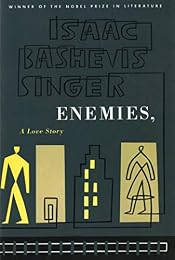
I read Enemies, a Love Story as part of my twice-per-year (the first book a start in January and the first book I start in July) read-through of the novels of Isaac B. Singer in order of their publication in English. Enemies, a Love Story was first published in Yiddish in The Jewish Forward in 1966 and had its English translation publication in 1972. This is the first of Singer's novels to be set in the U.S. (New York City, specifically). The story is set within the community of Jewish Holocaust survivors, mostly Polish, who have finally found their way to America after surviving Nazi Concentration camps and ghettos, displaced person camps, and perilous post-war journeys across Europe. Some had escaped from Germany into Soviet Russia, where they were greeted with suspicion and immediately sent off to work camps in places like Kazakhstan, only later being released to make their way to America. Confusion, fear, relief and survivor's guilt abound. Some cannot let loose of the memories of the horrors of their ordeals. Some try to cling to the comforts of the traditional old world ways and Jewish religious beliefs. Some try to get on with life as Americans.
Our protagonist is ne'er do well Herman Broder. When the Nazis invade Poland, Herman, a scholar of philosophy, is in the family home outside of Warsaw, while his wife and two children are off visiting relatives. As Jews are being rounded up to be sent off or murdered on the spot, Herman is hidden in a hayloft by Yadwiga, the family's young Polish servant. Soon he receives word that an eye-witness has seen his wife and children shot by Nazi soldiers. There, in the hayloft, Herman stays for three years, with Yadwiga tending to him and keeping his presence secret, even from her own family. At war's end, in gratitude and affection, Herman marries Yadwiga despite her not being Jewish. As the novel opens, the couple is living in a Coney Island apartment with Yadwiga's mother. Herman has a job ghost writing religious books and articles for a prominent rabbi who has no congregation and spends most of his time lecturing (giving speeches that Herman has written for him) and making real estate deals. But in the meantime, during the journey across Europe on the way to the U.S., Herman has spent time in post-war Germany, where he has met and fallen for the worldly, beautiful and Jewish Masha. Separated from her husband, Masha now lives in an apartment in Brooklyn with her mother. Yadwiga thinks that Herman, in addition to his work for the rabbit, is a traveling book salesman. He spends the time he's supposedly traveling on sales calls in Brooklyn with Masha. Masha, of course, knows about Yadwiga, while Herman, as carefully as he can, keeps knowledge of his affair from Yadwiga. Or so he thinks.
While my review to this point might make this seem like a simple story of a rake living in constant fear of his comeuppance, the ways in which Herman is (and all of the characters are) damaged, the ways in which they question God, religion, fate and the cruelty of the world add a depth and breadth to the narrative. We are told at the narrative's beginning that Herman is also considering where and how he would hide when the Nazis show up at his Coney Island flat, and he keeps an eye out for possible hiding places wherever he goes. Herman's knowledge of the great philosophical thinkers and writers, rather than helping him make sense of things, just add to his confusion and his self-loathing for his weaknesses and the muddle he's making of his new life in America. He cannot identify with the religious Jews around him, for his disgust with God's cruelty is comprehensive, though he cannot shake off his belief in God. But the Jews he meets who are anxious to assimilate and shave their Jewishness down to a thin veneer alienate him as well.
Just when we fear the novel is becoming static, with Herman living in his head while running back and forth to his two lovers, the complications in Herman's life begin to accumulate, and his world becomes ever more fraught. The second half of this novel, and particularly the final third, flew by for me, as I got caught up, not just in wondering how it would all turn out for Herman, Yadwiga and Masha, but how in the end they, and others, would all navigate their balancing acts of dealing with the horror of the past and the guilt and uncertainties of their new, bewildering, present.
The story is told with Singer's reliably consistent sense of humor, his keen eye and compassion for the human condition in general and for his characters in particular, and his grand capacity for description. I think it's to Singer's credit that Herman isn't a particularly likable character, and in some ways I think his weaknesses are a central part of Singer's point, here.
Lest we lean into the understandable tendency to ascribe some sort of symbolic values to each of the characters here, Singer tells us in his brief author's note at the front of the book, "I hasten to say that this novel is by no means the story of the typical refugee, his life, and struggle. Like most of my fictional works, this book presents an exceptional case with unique heroes and a unique combination of events. The characters are not only Nazi victims, but victims of their own personalities and fates. If they fit into the general picture, it is because the exception is rooted in the rule. As a matter of fact, in literature the exception is the rule."
Anyway, I highly recommend Enemies, a Love Story.
I read Enemies, a Love Story as part of my twice-per-year (the first book a start in January and the first book I start in July) read-through of the novels of Isaac B. Singer in order of their publication in English. Enemies, a Love Story was first published in Yiddish in The Jewish Forward in 1966 and had its English translation publication in 1972. This is the first of Singer's novels to be set in the U.S. (New York City, specifically). The story is set within the community of Jewish Holocaust survivors, mostly Polish, who have finally found their way to America after surviving Nazi Concentration camps and ghettos, displaced person camps, and perilous post-war journeys across Europe. Some had escaped from Germany into Soviet Russia, where they were greeted with suspicion and immediately sent off to work camps in places like Kazakhstan, only later being released to make their way to America. Confusion, fear, relief and survivor's guilt abound. Some cannot let loose of the memories of the horrors of their ordeals. Some try to cling to the comforts of the traditional old world ways and Jewish religious beliefs. Some try to get on with life as Americans.
Our protagonist is ne'er do well Herman Broder. When the Nazis invade Poland, Herman, a scholar of philosophy, is in the family home outside of Warsaw, while his wife and two children are off visiting relatives. As Jews are being rounded up to be sent off or murdered on the spot, Herman is hidden in a hayloft by Yadwiga, the family's young Polish servant. Soon he receives word that an eye-witness has seen his wife and children shot by Nazi soldiers. There, in the hayloft, Herman stays for three years, with Yadwiga tending to him and keeping his presence secret, even from her own family. At war's end, in gratitude and affection, Herman marries Yadwiga despite her not being Jewish. As the novel opens, the couple is living in a Coney Island apartment with Yadwiga's mother. Herman has a job ghost writing religious books and articles for a prominent rabbi who has no congregation and spends most of his time lecturing (giving speeches that Herman has written for him) and making real estate deals. But in the meantime, during the journey across Europe on the way to the U.S., Herman has spent time in post-war Germany, where he has met and fallen for the worldly, beautiful and Jewish Masha. Separated from her husband, Masha now lives in an apartment in Brooklyn with her mother. Yadwiga thinks that Herman, in addition to his work for the rabbit, is a traveling book salesman. He spends the time he's supposedly traveling on sales calls in Brooklyn with Masha. Masha, of course, knows about Yadwiga, while Herman, as carefully as he can, keeps knowledge of his affair from Yadwiga. Or so he thinks.
While my review to this point might make this seem like a simple story of a rake living in constant fear of his comeuppance, the ways in which Herman is (and all of the characters are) damaged, the ways in which they question God, religion, fate and the cruelty of the world add a depth and breadth to the narrative. We are told at the narrative's beginning that Herman is also considering where and how he would hide when the Nazis show up at his Coney Island flat, and he keeps an eye out for possible hiding places wherever he goes. Herman's knowledge of the great philosophical thinkers and writers, rather than helping him make sense of things, just add to his confusion and his self-loathing for his weaknesses and the muddle he's making of his new life in America. He cannot identify with the religious Jews around him, for his disgust with God's cruelty is comprehensive, though he cannot shake off his belief in God. But the Jews he meets who are anxious to assimilate and shave their Jewishness down to a thin veneer alienate him as well.
Just when we fear the novel is becoming static, with Herman living in his head while running back and forth to his two lovers, the complications in Herman's life begin to accumulate, and his world becomes ever more fraught. The second half of this novel, and particularly the final third, flew by for me, as I got caught up, not just in wondering how it would all turn out for Herman, Yadwiga and Masha, but how in the end they, and others, would all navigate their balancing acts of dealing with the horror of the past and the guilt and uncertainties of their new, bewildering, present.
The story is told with Singer's reliably consistent sense of humor, his keen eye and compassion for the human condition in general and for his characters in particular, and his grand capacity for description. I think it's to Singer's credit that Herman isn't a particularly likable character, and in some ways I think his weaknesses are a central part of Singer's point, here.
Lest we lean into the understandable tendency to ascribe some sort of symbolic values to each of the characters here, Singer tells us in his brief author's note at the front of the book, "I hasten to say that this novel is by no means the story of the typical refugee, his life, and struggle. Like most of my fictional works, this book presents an exceptional case with unique heroes and a unique combination of events. The characters are not only Nazi victims, but victims of their own personalities and fates. If they fit into the general picture, it is because the exception is rooted in the rule. As a matter of fact, in literature the exception is the rule."
Anyway, I highly recommend Enemies, a Love Story.
56kidzdoc
>54 rocketjk: Great review, Jerry!
57kjuliff
>54 rocketjk: I really enjoyed your review of this very enjoyable book. I like the way you dissected the story and managed covey the change in Herman’s life in the last third of the novel without giving away what happened to disrupt his life and the lives of others.
As to the character of the protagonist:
I think it's to Singer's credit that Herman isn't a particularly likable character, and in some ways I think his weaknesses are a central part of Singer's point
I didn’t see Herman as an unlikeable weak “rake”, and I interpreted his weaknesses” differently.
I found Herman to be eminently likable, and like the women in his life I fell for him. As to his “weaknesses” I didn’t see them as a central part of Singer’s point. To me they were all too human. He acted, made decisions on the fly as any man would in circumstances that were not of his own making.
Maybe the differences between our perception of Herman is due to our different genders and life experiences. But really, how could any woman not love Herman?
I too recommend this book.
As to the character of the protagonist:
I think it's to Singer's credit that Herman isn't a particularly likable character, and in some ways I think his weaknesses are a central part of Singer's point
I didn’t see Herman as an unlikeable weak “rake”, and I interpreted his weaknesses” differently.
I found Herman to be eminently likable, and like the women in his life I fell for him. As to his “weaknesses” I didn’t see them as a central part of Singer’s point. To me they were all too human. He acted, made decisions on the fly as any man would in circumstances that were not of his own making.
Maybe the differences between our perception of Herman is due to our different genders and life experiences. But really, how could any woman not love Herman?
I too recommend this book.
58arubabookwoman
I read Enemies, A Love Story many, many years ago, and remember nothing about it, other than that I didn't particularly like it, despite loving The Manor and The Estate, The Family Moskat and The Slave. Your excellent review convinces me I must reread it.
I'm also looking into reading something by I think his brother, The Brothers Ashkenazy and/or The Family Carnovsky, both of which are on my shelf. Have you read anything by Israel Joshua Singer?
I'm also looking into reading something by I think his brother, The Brothers Ashkenazy and/or The Family Carnovsky, both of which are on my shelf. Have you read anything by Israel Joshua Singer?
59dchaikin
>54 rocketjk: fantastic review. I’m thoroughly fascinated. Must add Singer into my reading in some way. Love this title itself, especially coming from Singer.
>57 kjuliff: noting your recommendation too
>57 kjuliff: noting your recommendation too
60rocketjk
>57 kjuliff: "As to his “weaknesses” I didn’t see them as a central part of Singer’s point. To me they were all too human. He acted, made decisions on the fly as any man would in circumstances that were not of his own making."
Well, yes. That's what I meant. I think it's a central part of Singer's point that Herman's weaknesses are all too human.
Though I don't agree that Herman's circumstances are not of his own making, or at least not wholly. He makes the decision, after all, to remain married to Yadwiga while having an affair with Masha. And at the same time we can say that the weakness that prevents him from changing that situation stems in some part from the damage done him during his three years in hiding, stripped of all power over his situation and all opportunity to make decisions. How much of that are we to see as having carried over into his new life in America? Or how much of that was just an amplification of who he was before the Nazi invasion, as certain things we learn about his behavior then strongly hints. As readers we can decide which of these factors seem the more relevant, or maybe they are all mixed up into one frail vessel of an "all too human" character.
"I didn’t see Herman as an unlikeable weak “rake”,"
Right. Me either, at least as per the "rake" part. I think you misunderstood what I was getting at, there, and/or I wasn't clear enough (probably the latter). I was trying to say that someone reading my review up to that point might have gotten that impression, an impression I then worked to dispel in the rest of the sentence in listing the factors I thought give "depth and breadth to the narrative." But I must say that while I think the reader is supposed to sympathize with Herman (I know I did), it's true that I didn't find him likable. Relatable, though, yes.
"But really, how could any woman not love Herman?"
Ha! I'll have to take your word for that one. :)
"I like the way you dissected the story and managed covey the change in Herman’s life in the last third of the novel without giving away what happened to disrupt his life and the lives of others."
Sincere thanks! But I should say that anyone reading the relatively recent Farrar, Straus and Giroux paperback edition I read (see my cover image above) should try to take care not to read the brief paragraph-long synopsis on the back cover, which does indeed include an egregious plot spoiler. Happily for me, I didn't even see it until after I'd finished the book.
Well, yes. That's what I meant. I think it's a central part of Singer's point that Herman's weaknesses are all too human.
Though I don't agree that Herman's circumstances are not of his own making, or at least not wholly. He makes the decision, after all, to remain married to Yadwiga while having an affair with Masha. And at the same time we can say that the weakness that prevents him from changing that situation stems in some part from the damage done him during his three years in hiding, stripped of all power over his situation and all opportunity to make decisions. How much of that are we to see as having carried over into his new life in America? Or how much of that was just an amplification of who he was before the Nazi invasion, as certain things we learn about his behavior then strongly hints. As readers we can decide which of these factors seem the more relevant, or maybe they are all mixed up into one frail vessel of an "all too human" character.
"I didn’t see Herman as an unlikeable weak “rake”,"
Right. Me either, at least as per the "rake" part. I think you misunderstood what I was getting at, there, and/or I wasn't clear enough (probably the latter). I was trying to say that someone reading my review up to that point might have gotten that impression, an impression I then worked to dispel in the rest of the sentence in listing the factors I thought give "depth and breadth to the narrative." But I must say that while I think the reader is supposed to sympathize with Herman (I know I did), it's true that I didn't find him likable. Relatable, though, yes.
"But really, how could any woman not love Herman?"
Ha! I'll have to take your word for that one. :)
"I like the way you dissected the story and managed covey the change in Herman’s life in the last third of the novel without giving away what happened to disrupt his life and the lives of others."
Sincere thanks! But I should say that anyone reading the relatively recent Farrar, Straus and Giroux paperback edition I read (see my cover image above) should try to take care not to read the brief paragraph-long synopsis on the back cover, which does indeed include an egregious plot spoiler. Happily for me, I didn't even see it until after I'd finished the book.
61kjuliff
>60 rocketjk: He makes the decision, after all, to remain married to Yadwiga while having an affair with Masha. And at the same time we can say that the weakness that prevents him from changing that situation stems in some part from the damage done him during his three years in hiding, stripped of all power over his situation and all opportunity to make decisions.
I don’t think it was possible for Herman to make a decision of choosing Yadwiga or Masha. He had a moral obligation to stay with Yadwiga, who had saved him from the Nazis. After he took her, as he should have, to America she was dependent. A uneducated servant until the end of the war, speaking very little English, a gentile living in a Jewish area, she relied on Herman.
And then Masha who he was in love with. Why not have his affaire with her? Why not a little bit of happiness?
I don’t think his experience in hiding stripped him from all opportunity of making decisions. I think being hidden and saved from the Nazis by a Polish peasant put him in the position of feeling he should repay her loyalty, thus depriving himself of the opportunity to to have a normal relationship with someone more culturally and intellectually aligned than his wife.
I don’t think he had much choice. The path he chose was to avoid making one. And it made Yadwiga happy for many years. I took all this a strength. Imagine how difficult it’d be riding NY subways from one woman to another. 😊
I don’t think it was possible for Herman to make a decision of choosing Yadwiga or Masha. He had a moral obligation to stay with Yadwiga, who had saved him from the Nazis. After he took her, as he should have, to America she was dependent. A uneducated servant until the end of the war, speaking very little English, a gentile living in a Jewish area, she relied on Herman.
And then Masha who he was in love with. Why not have his affaire with her? Why not a little bit of happiness?
I don’t think his experience in hiding stripped him from all opportunity of making decisions. I think being hidden and saved from the Nazis by a Polish peasant put him in the position of feeling he should repay her loyalty, thus depriving himself of the opportunity to to have a normal relationship with someone more culturally and intellectually aligned than his wife.
I don’t think he had much choice. The path he chose was to avoid making one. And it made Yadwiga happy for many years. I took all this a strength. Imagine how difficult it’d be riding NY subways from one woman to another. 😊
62rocketjk
>61 kjuliff: Let's just say we're reading the text differently. I think life is full of choices, some of them difficult. I think I give Yadwiga more credit for having agency than you do, with or without Herman, and Herman less credit for sincerity in his reasons for staying in the marriage, as fond of Yadwiga as he clearly is. He tells himself, and Masha, that he must stay with Yadwiga because she's saved his life, but are we to see that as the real reason? It's hard to say more on this topic without inserting spoilers, but I'll only say that if, by staying with Yadwiga out of a feeling of obligation when he wanted to be with someone else, Herman is, as you say (and quite fairly), "depriving himself of the opportunity to to have a normal relationship with someone more culturally and intellectually aligned" with him, isn't he, at the same time, depriving Yadwiga of the same thing? But, certainly, nothing about the situation is black and white, which is one reason I liked the book so well.
I certainly see where you're coming from, and I think it's one of the novel's many strengths that there are many ways to read the characters. The ground is moving under these characters' feet all the time. Why not the readers', too? Cheers!
I certainly see where you're coming from, and I think it's one of the novel's many strengths that there are many ways to read the characters. The ground is moving under these characters' feet all the time. Why not the readers', too? Cheers!
63labfs39
I finally got caught up on your thread, Jerry. Lots of interesting conversations going on here. I need to read more "adult" Singer. I am most familiar with his children's stories, although I did read Love and Exile. Although I liked the first book in LaE, by the end I wrote: "Singer simply revels in his erotic victories and his lazy attempts to find and keep a job. With an air of intellectual distain for everyone around him, Singer wallows in self-absorption and hypochondria. Although I understand the 1970s bohemian times in which Singer wrote his book, I wanted to shake him and say Get a life." Despite his personal proclivities, which make Herman's seem staid, I do want to read some of his novels.
I've never been to Albania, but I was in Skopje and Kosovo in 1988. The mountains made for some beautiful hikes, although I did get rocks thrown at me by some young boys because I was wearing ludicrous pink hiking pants.
I've never been to Albania, but I was in Skopje and Kosovo in 1988. The mountains made for some beautiful hikes, although I did get rocks thrown at me by some young boys because I was wearing ludicrous pink hiking pants.
64kjuliff
>63 labfs39: I’ve read several isaac Singer books and have liked them all except The Slave. I haven’t read Love and Exile but assume it must be one of his later works.
I read another of his later works - whose title I’ve forgotten - where the MC is a writer who travels around giving lectures at conferences, and always beds any female lecture-organiser, thinking it some sort of conquest I didn’t enjoy that book as much as I did his others. The MC in that book sounds a bit like the one in Love and Exile.
Interesting. We could extrapolate that I B Singer is a pleasure seeking misogynist. Perhaps there’s a dark side to the man. But I think not. I think he needs to be read with his background in mind.
It would be interested in having a book written from Yadwiga‘s pov. Was she a heroine or did she just have the hots for young Herman, hiding the young man in the hayloft as a captive for her own sexual needs?
As they say, there are two sides to every question, but more likely three or more.
I read another of his later works - whose title I’ve forgotten - where the MC is a writer who travels around giving lectures at conferences, and always beds any female lecture-organiser, thinking it some sort of conquest I didn’t enjoy that book as much as I did his others. The MC in that book sounds a bit like the one in Love and Exile.
Interesting. We could extrapolate that I B Singer is a pleasure seeking misogynist. Perhaps there’s a dark side to the man. But I think not. I think he needs to be read with his background in mind.
It would be interested in having a book written from Yadwiga‘s pov. Was she a heroine or did she just have the hots for young Herman, hiding the young man in the hayloft as a captive for her own sexual needs?
As they say, there are two sides to every question, but more likely three or more.
65rocketjk
>63 labfs39: Thanks for joining in! The only one of Singer's memoir volumes I've read is the first, In My Father's Court, about his childhood and adolescence in Warsaw. Given the little I do know, it does seem that Singer was far from a saint. Though I don't expect sainthood from artists, anyway. We know that when his brother, who was already in the U.S. managed to get him a visa to come to the U.S. (very tough for European Jews by that point), he had a common law wife that he left behind in Poland. But what the circumstances of that decision were (She didn't want to come? She couldn't get a visa? She wanted to come but Singer didn't want her along?) I have no clue. Possibly he discussed it in one of his subsequent memoir volumes. Also possibly, that situation informed his creation/handling of the Yadwiga/Herman relationship.
" I wanted to shake him and say Get a life."
Evidently, he did so. :)
" I wanted to shake him and say Get a life."
Evidently, he did so. :)
66AnnieMod
>54 rocketjk: Great review!
Unfortunately that was one of the very few books that I did not finish in the last few years. I gave up around 1/3rd into it last year when I realized that not only I do not enjoy coming back to it but I actively look for other things to do so I do not need to get back to it. Not sure why I bounced so hard off it - there is nothing I can put my finger on - it just felt more of a chore than anything else. Maybe the wrong time, maybe Singer is just not working for me.
Unfortunately that was one of the very few books that I did not finish in the last few years. I gave up around 1/3rd into it last year when I realized that not only I do not enjoy coming back to it but I actively look for other things to do so I do not need to get back to it. Not sure why I bounced so hard off it - there is nothing I can put my finger on - it just felt more of a chore than anything else. Maybe the wrong time, maybe Singer is just not working for me.
67rocketjk
>66 AnnieMod: I can definitely see how someone might "bounce off" Enemies, a Love Story after the first third of it. Plot-wise, I found that it settled into a bit of a repetitive cycle during that stage of the narrative. I was trusting Singer to be going somewhere or other, plus I'm in the midst of a "read all of Singer's novels" project. Even without those factors, I don't think I would have given up on the book, because I was enjoying Singer's powers of observation about the characters' physical surroundings in New York and his insights into human nature and the conditions of Holocaust survivorhood. But, like I said, I can see how someone else might decide not to stick with the book.
68dchaikin
>63 labfs39: >64 kjuliff: >65 rocketjk: In My Father’s Court was my favorite part of Love and Exile. The second part is also powerful as it goes into 1930’s Polish intellectual culture, full of bitter disagreement and lethal promises. And of misbehaving. The last part, on his immigration, is dreadfully depressing - dead, droll and hopeless (which is interesting in its own right, but uninspiring reading)
69kjuliff
>68 dchaikin: I don’t expect my books to be inspiring. What’s inspiring about the pre-1945 Poland of the last century.
I find I B Singer to be a great writer and I don’t understand why we are meant to “like” characters in books.
Singer is telling it like it is. His description of pre-WWII Poland is spot on. As for post-WWII lower Manhattan, he has it down pat. He brings these places to life. As for the sex and humor, how would people have survived without it?
I find I B Singer to be a great writer and I don’t understand why we are meant to “like” characters in books.
Singer is telling it like it is. His description of pre-WWII Poland is spot on. As for post-WWII lower Manhattan, he has it down pat. He brings these places to life. As for the sex and humor, how would people have survived without it?
70dchaikin
>69 kjuliff: sounds all reasonable to me
71rocketjk
>69 kjuliff: "I find I B Singer to be a great writer and I don’t understand why we are meant to “like” characters in books."
I find Singer to be a great writer, as well. Hence my happiness with my decision to read through all of his books in publication order. Sometimes we are meant to like characters and sometimes characters are portrayed in a way that would make you (or me, anyway) not particularly anxious to want to sit with them at a bar and share a beer. That's as it should be, I think. I don't think Herman Broder is a particularly likable character, but I do think he's understandable (though I understand him differently than you do, which of course is totally cool), and I also think he's a great literary invention. For me, if Herman were likable, it would take away some of the power of Enemies, a Love Story, because the degree to which he is less likable makes him, and again I speak only for myself, entirely believable. For me, Herman is in part a function of Singer's recognition that people were traumatized by the Holocaust, and that sometimes the damage done made them less likable, even if we understand and even sympathize with the reasons why. And as Singer himself tells us in the Author's Forward that I quoted in my review, "The characters are not only Nazi victims, but victims of their own personalities and fates."
One of my favorite characters in American fiction over the past 50 years is Mickey Sabbath. (Sabbath's Theater by Philip Roth) Certainly unlikable, often crude, but for me a magnificent, vibrant, recognizable character.
I find Singer to be a great writer, as well. Hence my happiness with my decision to read through all of his books in publication order. Sometimes we are meant to like characters and sometimes characters are portrayed in a way that would make you (or me, anyway) not particularly anxious to want to sit with them at a bar and share a beer. That's as it should be, I think. I don't think Herman Broder is a particularly likable character, but I do think he's understandable (though I understand him differently than you do, which of course is totally cool), and I also think he's a great literary invention. For me, if Herman were likable, it would take away some of the power of Enemies, a Love Story, because the degree to which he is less likable makes him, and again I speak only for myself, entirely believable. For me, Herman is in part a function of Singer's recognition that people were traumatized by the Holocaust, and that sometimes the damage done made them less likable, even if we understand and even sympathize with the reasons why. And as Singer himself tells us in the Author's Forward that I quoted in my review, "The characters are not only Nazi victims, but victims of their own personalities and fates."
One of my favorite characters in American fiction over the past 50 years is Mickey Sabbath. (Sabbath's Theater by Philip Roth) Certainly unlikable, often crude, but for me a magnificent, vibrant, recognizable character.
72kjuliff
>71 rocketjk: well we differ. I’d sit down with Herman Broder over a glass of wine any day. On the other hand Yadwiga would annoy the hell out of me.
Re Philip Roth - I’ve read several of his books, all of which I enjoyed. But I haven’t read Sabbath's Theater and will try to get hold of a copy.
Thanks for your comments. They made me rethink my views of the characters in Enemies a Love Story. And in doing so and looking over the lists of books I’ve read over the past two years, I B Singer is one of the few writers whose characters I remember. Which in itself says something about JBS and his writing.
Re Philip Roth - I’ve read several of his books, all of which I enjoyed. But I haven’t read Sabbath's Theater and will try to get hold of a copy.
Thanks for your comments. They made me rethink my views of the characters in Enemies a Love Story. And in doing so and looking over the lists of books I’ve read over the past two years, I B Singer is one of the few writers whose characters I remember. Which in itself says something about JBS and his writing.
73rocketjk
>72 kjuliff: "I B Singer is one of the few writers whose characters I remember. Which in itself says something about JBS and his writing."
There we agree. Thanks to you, as well, for the enjoyable conversation.
There we agree. Thanks to you, as well, for the enjoyable conversation.
74rocketjk
My post-Enemies, a Love Story "between book" reading was a lovely return to Stack 1:
* “The Deacon’s Masterpiece or, The Wonderful ‘One-Hoss Shay’” by Oliver Wendell Holmes in Literature - Book Two edited by Thomas H. Briggs
* "Revolt of the Tartars” from Selected Writings of Thomas De Quincey edited by Philip Van Doren Stern - Finished!
* Three poems by Sylva Gaboudikian from New Writing from the Middle East edited by Leo Hamalian and John D. Yohannan
* Excerpt from “Memories of the Warsaw Ghetto” by Hannah Krystal Fryshdorf from Annual Gathering Commemorating the Warsaw Ghetto Uprising, 75th Anniversary, April 19, 2018 edited by Irena Klepfisz
* Day 8, Introduction and Story 1 from The Decameron by Giovanni Boccaccio (translated by Wayne A. Rebhorn)
* “Vitamin C – Can it Prevent Thrombosis?” by Roger Lewin from The Saturday Evening Post, November, 1974 - Newly added
I've now started my wife's pick for me this year (our annual tradition - we each pick for the other to read our favorite book from the previous year), The Seven Moons of Maali Almeida by Shehan Karunatilaka.
* “The Deacon’s Masterpiece or, The Wonderful ‘One-Hoss Shay’” by Oliver Wendell Holmes in Literature - Book Two edited by Thomas H. Briggs
* "Revolt of the Tartars” from Selected Writings of Thomas De Quincey edited by Philip Van Doren Stern - Finished!
* Three poems by Sylva Gaboudikian from New Writing from the Middle East edited by Leo Hamalian and John D. Yohannan
* Excerpt from “Memories of the Warsaw Ghetto” by Hannah Krystal Fryshdorf from Annual Gathering Commemorating the Warsaw Ghetto Uprising, 75th Anniversary, April 19, 2018 edited by Irena Klepfisz
* Day 8, Introduction and Story 1 from The Decameron by Giovanni Boccaccio (translated by Wayne A. Rebhorn)
* “Vitamin C – Can it Prevent Thrombosis?” by Roger Lewin from The Saturday Evening Post, November, 1974 - Newly added
I've now started my wife's pick for me this year (our annual tradition - we each pick for the other to read our favorite book from the previous year), The Seven Moons of Maali Almeida by Shehan Karunatilaka.
75rocketjk
Selected Writings of Thomas De Quincey edited by Philip Van Doren Stern

Read as a "between book" (see first post). Thomas de Quincy (1785-1859) was an English memoirist and essayist, very widely published in England in his day. The opening essays in the collection were, for me, the most enjoyable, as de Quincy looked back on his upper-middle class childhood and family life. He became friends with Samuel Taylor Coleridge, William Wordsworth and Robert Southey, living near them, sometimes as a tenant of one or the other, in the Lakes District of England. and the next set of essays recount his relationships with and impressions of them. During this time, he began writing and publishing himself, chiefly in magazines like Blackwood's. Also around this time, de Quincy began the opium habit that led to his writing the work he is best known for, Confessions of an English Opium Eater. That work was originally a tidy 95-page affair, though de Quincy eventually went back to it and rewrote it to a bloated 240 pages. The editor of this volume, and even, evidently, de Quincy himself, both admit that the original version is the more effective. Stern writes in his introduction to the volume that he'd included the longer version because it included a lot of autobiographical material that de Quincy didn't write about elsewhere. I had no hesitation, however, in buying a Penguin Classics edition of the original and reading that, which was interesting reading but quite enough. The collection finishes up with a series of six of de Quincey's published essays that add to a readers sense of his feel for the macabre, including, especially, the 108-page essay, "On Murder Considered as One of the Fine Arts." De Quincey certainly wrote in what I guess was the style of his day, which is to say somewhat floridly. At his best, his writing flows along quite nicely nevertheless, but otherwise it's easy for a modern reader to get bogged down and have to consciously push through. So, unless one is very much interested in that period of English writing, I can't say I really recommend this big book particularly, other than for its possible historic interest. Reading it straight through would have been entirely impossible for me. As a "between book" it was more or less fine.
Book note: As you might notice from the cover image I used, my copy is a Modern Library Giant edition. In fact, my copy is a Modern Library First Edition, first published in 1949. On the first page inside the cover, I found this inscription:

Of course I ran an online search for Byron H. Knapp. The only link I could find for him is an obituary that is unfortunately behind a paywall, but we can discern that he was a professor at East Stroudsburg State College in Pennsylvania, and died in 1993 at the age of 66. So he was born in 1927, making him 31 when he bought the book I now own. However, I did find this obituary of his wife, Vertie, who outlived him by many years, in which we read that Byron was a biology professor, and also read about Vertie's quite interesting life:
https://www.dignitymemorial.com/obituaries/east-stroudsburg-pa/vertie-knapp-1002...

Read as a "between book" (see first post). Thomas de Quincy (1785-1859) was an English memoirist and essayist, very widely published in England in his day. The opening essays in the collection were, for me, the most enjoyable, as de Quincy looked back on his upper-middle class childhood and family life. He became friends with Samuel Taylor Coleridge, William Wordsworth and Robert Southey, living near them, sometimes as a tenant of one or the other, in the Lakes District of England. and the next set of essays recount his relationships with and impressions of them. During this time, he began writing and publishing himself, chiefly in magazines like Blackwood's. Also around this time, de Quincy began the opium habit that led to his writing the work he is best known for, Confessions of an English Opium Eater. That work was originally a tidy 95-page affair, though de Quincy eventually went back to it and rewrote it to a bloated 240 pages. The editor of this volume, and even, evidently, de Quincy himself, both admit that the original version is the more effective. Stern writes in his introduction to the volume that he'd included the longer version because it included a lot of autobiographical material that de Quincy didn't write about elsewhere. I had no hesitation, however, in buying a Penguin Classics edition of the original and reading that, which was interesting reading but quite enough. The collection finishes up with a series of six of de Quincey's published essays that add to a readers sense of his feel for the macabre, including, especially, the 108-page essay, "On Murder Considered as One of the Fine Arts." De Quincey certainly wrote in what I guess was the style of his day, which is to say somewhat floridly. At his best, his writing flows along quite nicely nevertheless, but otherwise it's easy for a modern reader to get bogged down and have to consciously push through. So, unless one is very much interested in that period of English writing, I can't say I really recommend this big book particularly, other than for its possible historic interest. Reading it straight through would have been entirely impossible for me. As a "between book" it was more or less fine.
Book note: As you might notice from the cover image I used, my copy is a Modern Library Giant edition. In fact, my copy is a Modern Library First Edition, first published in 1949. On the first page inside the cover, I found this inscription:

Of course I ran an online search for Byron H. Knapp. The only link I could find for him is an obituary that is unfortunately behind a paywall, but we can discern that he was a professor at East Stroudsburg State College in Pennsylvania, and died in 1993 at the age of 66. So he was born in 1927, making him 31 when he bought the book I now own. However, I did find this obituary of his wife, Vertie, who outlived him by many years, in which we read that Byron was a biology professor, and also read about Vertie's quite interesting life:
https://www.dignitymemorial.com/obituaries/east-stroudsburg-pa/vertie-knapp-1002...
76Jim53
Hi Jerry, just stopping in (finally) to wish you a great 2025. Love the picture in #1.
You never know what you're going to trip over in these journals. I hadn't thought of Al DeRogatis in many years, but for some reason my original roommate at Providence was a huge fan of his.
You never know what you're going to trip over in these journals. I hadn't thought of Al DeRogatis in many years, but for some reason my original roommate at Providence was a huge fan of his.
77rocketjk
Hey Jim, Thanks for stopping in! And, yes, the random nature of mentions and digressions are part of the fun of LT. Are you expecting much snow today out your way in Pennsylvania? We are expecting 3 to 4 inches starting mid-afternoon today here in NYC.
78kidzdoc
Nice review of Selected Writings of Thomas De Quincey, Jerry. I won't read it, although I have wanted to read Confessions of an English Opium-Eater from a medical standpoint for quite some time. Thanks for posting the obituary of Vertie Knapp; she did live an interesting and very full life!
79Jim53
>77 rocketjk: We had heard four-to-eight inches, then three-to-five. It snowed pretty steadily from late morning to about a half hour ago, and now it has stopped. Herself and I were laughing at the idea that the projected blizzard might come to no more than this. We are supposed to get some more, though.
80rocketjk
The Seven Moons of Maali Almeida by Shehan Karunatilaka
Maali Almeida, freelance war photographer in his native Sri Lanka, has just been killed. He has seven days to try to alert his two best friends to the presence of a cache of his photographs he's been keeping secret, but that he thinks would shock Sri Lankans and the world. He also has to decide who to trust in the place he finds himself, the "In Between" that exists between the world of the living and the Light. Sri Lanka, and the capitol city of Colombo where Maali roams, is a place of vicious cultural and religious wars, torture, the shellings of villages full of innocent non-combatants, bribery, frequent disappearances, NGOs with dubious agendas and arms dealers by the fistful, willing to do business with whomever has the cash. In life, Maali had a knack for getting himself to the right place at the right time, for avoiding the bullets and shrapnel, and for getting the right shot from the right angle. He does not shy away from photographing horrors, the dying and the dead, the horribly, heartrendingly mangled, as well as the clandestine meetings between supposed enemies. He is also hired by various individuals as a "fixer," the man who, through knowing everyone, can set up meetings between colonels and ministers and outsiders they might not otherwise trust, like the wire service reporter (so he says) who has been in Sri Lanka for 18 months but hasn't filed a story yet. The most damaging of those photos make up that cache he's so desperate for his friends to find and display. He would also like to know who killed him and why, but this is secondary. Given the people he often associated with, it could have been anybody. Every decision is fraught. There are In Between bureaucrats who want him to leave behind all this craziness and proceed immediately to The Light, where he will be cleansed, to return in a new life, but forgetting, apparently, everything about the old. And there is Sena, attempting, so he says, to set Maali straight about the rules of the In Between. But does he have Maali's interests at heart, or is he trying to groom him for servitude to a vicious demon? (I promise that in the telling, this element is a lot less hokey than I'm making it sound, here.) But as the narrative unfolds, we also learn more about Maali and his relationships with his two roommates, DD, who Maali describes as a "beautiful boy" and is his longtime lover, and Jaki, the smartass, self-reliant young woman that Maali loves like a sister. These take on an ever greater importance to our understanding of Maali and the life he has led.
While the novel starts a little slowly, as others have pointed out (Karunatilaka needing to do a lot of world building before we can proceed), once we get going we're easily swept up in all the mysteries, and the labyrinths of violence, cruelty and power that Maali, and by extension all Lankans, have had to try to work their ways through. But also, the battle is on for those trying to live not only by their wits but also by their hearts, throughout their lives and even afterward. If you are not turned off from the get-go by magical realism, ghosts and demons and the like, I will recommend The Seven Moons of Maali Almeida quite strongly. As the novel won the 2022 Booker Prize, obviously I'm not the first to so recommend.
Maali Almeida, freelance war photographer in his native Sri Lanka, has just been killed. He has seven days to try to alert his two best friends to the presence of a cache of his photographs he's been keeping secret, but that he thinks would shock Sri Lankans and the world. He also has to decide who to trust in the place he finds himself, the "In Between" that exists between the world of the living and the Light. Sri Lanka, and the capitol city of Colombo where Maali roams, is a place of vicious cultural and religious wars, torture, the shellings of villages full of innocent non-combatants, bribery, frequent disappearances, NGOs with dubious agendas and arms dealers by the fistful, willing to do business with whomever has the cash. In life, Maali had a knack for getting himself to the right place at the right time, for avoiding the bullets and shrapnel, and for getting the right shot from the right angle. He does not shy away from photographing horrors, the dying and the dead, the horribly, heartrendingly mangled, as well as the clandestine meetings between supposed enemies. He is also hired by various individuals as a "fixer," the man who, through knowing everyone, can set up meetings between colonels and ministers and outsiders they might not otherwise trust, like the wire service reporter (so he says) who has been in Sri Lanka for 18 months but hasn't filed a story yet. The most damaging of those photos make up that cache he's so desperate for his friends to find and display. He would also like to know who killed him and why, but this is secondary. Given the people he often associated with, it could have been anybody. Every decision is fraught. There are In Between bureaucrats who want him to leave behind all this craziness and proceed immediately to The Light, where he will be cleansed, to return in a new life, but forgetting, apparently, everything about the old. And there is Sena, attempting, so he says, to set Maali straight about the rules of the In Between. But does he have Maali's interests at heart, or is he trying to groom him for servitude to a vicious demon? (I promise that in the telling, this element is a lot less hokey than I'm making it sound, here.) But as the narrative unfolds, we also learn more about Maali and his relationships with his two roommates, DD, who Maali describes as a "beautiful boy" and is his longtime lover, and Jaki, the smartass, self-reliant young woman that Maali loves like a sister. These take on an ever greater importance to our understanding of Maali and the life he has led.
While the novel starts a little slowly, as others have pointed out (Karunatilaka needing to do a lot of world building before we can proceed), once we get going we're easily swept up in all the mysteries, and the labyrinths of violence, cruelty and power that Maali, and by extension all Lankans, have had to try to work their ways through. But also, the battle is on for those trying to live not only by their wits but also by their hearts, throughout their lives and even afterward. If you are not turned off from the get-go by magical realism, ghosts and demons and the like, I will recommend The Seven Moons of Maali Almeida quite strongly. As the novel won the 2022 Booker Prize, obviously I'm not the first to so recommend.
81kidzdoc
>80 rocketjk: Great review of Maali Almeida, Jerry. I thought as highly of it as you did.
82lisapeet
Hi Jerry, and happy not-so-new-at-this-point year! Love the photo of Riverside park… I bet it’s extra pretty and glittery today. I’ve had to revise my usual shovel-then-salt process today to scrape-then-salt-then-shovel-then-salt, because everything is frozen hard. I’m finally busting into the bags of rock salt I bought three years ago. How’s Rosie liking the snow?
The Conrad book looks really interesting—not that I have any particular interest in him, but I like books that look at literature through a lens of history and historicity. Maybe I got enough out of your review not to read the entire book, though.
The clarinet is such a fun (to my ears) instrument, so good for you for taking it back up. I generally think of the clarinet in the context of Big Band and Klezmer—“Molly on the Shore” is lovely.
Holiday looks neat. They really used to do magazines right in mid-century… we had a whole discussion about Horizon a while back, right?
I have a beautiful old Halcyon House copy of Confessions of an English Opium Eater that my dad gave me when I was 18 (gee, I wonder what his point could have been?)—there was a really nice dust jacket that disappeared in some move, but the illustrations, by Laurence W. Chaves, are great. (Actually I think that was my dad’s point—I loved weird 19th-century engravings in my teens and 20s.) You can see some of them online if you Google Chaves, like on this guy’s Tumblr.
I’ve got The Seven Moons of Maali Almeida on my pile—your review bumped it up a few notches for me.
The Conrad book looks really interesting—not that I have any particular interest in him, but I like books that look at literature through a lens of history and historicity. Maybe I got enough out of your review not to read the entire book, though.
The clarinet is such a fun (to my ears) instrument, so good for you for taking it back up. I generally think of the clarinet in the context of Big Band and Klezmer—“Molly on the Shore” is lovely.
Holiday looks neat. They really used to do magazines right in mid-century… we had a whole discussion about Horizon a while back, right?
I have a beautiful old Halcyon House copy of Confessions of an English Opium Eater that my dad gave me when I was 18 (gee, I wonder what his point could have been?)—there was a really nice dust jacket that disappeared in some move, but the illustrations, by Laurence W. Chaves, are great. (Actually I think that was my dad’s point—I loved weird 19th-century engravings in my teens and 20s.) You can see some of them online if you Google Chaves, like on this guy’s Tumblr.
I’ve got The Seven Moons of Maali Almeida on my pile—your review bumped it up a few notches for me.
83kjuliff
>80 rocketjk: Thanks for the review Jerry. I was waiting for your review as couldn’t manage to get trough The Seven Moons of Maali, despitite my interest in Sri Lanka and its writers.
Re your comment: If you are not turned off from the get-go by magical realism, ghosts and demons and the like, I will recommend The Seven Moons of Maali Almeida quite strongly. , I was one of the turned-of ones.
Re your comment: If you are not turned off from the get-go by magical realism, ghosts and demons and the like, I will recommend The Seven Moons of Maali Almeida quite strongly. , I was one of the turned-of ones.
84rocketjk
Oh, right. I need to let you know about my post-The Seven Moons of Maali Almeida "between book" reading, because of course you are all dying for this information! Twas Stack 1 this go-round:
* “The Glove and the Lions” by Leigh Hunt in Literature - Book Two edited by Thomas H. Briggs
* Four poems by Avedik Issahakian from New Writing from the Middle East edited by Leo Hamalian and John D. Yohannan
* Excerpt from Justyna’s Narrative by Gusta Davidson Draenger from Annual Gathering Commemorating the Warsaw Ghetto Uprising, 75th Anniversary, April 19, 2018 edited by Irena Klepfisz
* Day 8, Story 2 from The Decameron by Giovanni Boccaccio (translated by Wayne A. Rebhorn)
* “Pat Schroeder: Congresswoman from Colorado” by Patricia Matson from The Saturday Evening Post, November, 1974
Now I'm reading, and enjoying a ton, The Drowned World by J.B. Ballard, a cautionary tale of global warning from 1962.
* “The Glove and the Lions” by Leigh Hunt in Literature - Book Two edited by Thomas H. Briggs
* Four poems by Avedik Issahakian from New Writing from the Middle East edited by Leo Hamalian and John D. Yohannan
* Excerpt from Justyna’s Narrative by Gusta Davidson Draenger from Annual Gathering Commemorating the Warsaw Ghetto Uprising, 75th Anniversary, April 19, 2018 edited by Irena Klepfisz
* Day 8, Story 2 from The Decameron by Giovanni Boccaccio (translated by Wayne A. Rebhorn)
* “Pat Schroeder: Congresswoman from Colorado” by Patricia Matson from The Saturday Evening Post, November, 1974
Now I'm reading, and enjoying a ton, The Drowned World by J.B. Ballard, a cautionary tale of global warning from 1962.
86rocketjk
The Drowned World by J.G. Ballard
This novel, first published in 1962, gives a modern reader a sort of literary head fake. It is about an earth of rising waters and rising temperatures, and at first we think we're reading a prescient (a word used more than once on the cover blurbs of my relatively recent edition) cautionary tale about the negative effects of technology and industrialization on the planet. But soon we learn that the cataclysmic events have been caused by something unpreventable: a very long series of particularly gigantic solar flares that have pushed away the top layers of the earth's atmosphere and resulted in climatic carnage. At any rate, most of the world in 2145 is covered in water--oceans or swamps--and jungle. The abandoned cities lie dozens of feet below the waterline and what's left of humanity (around 5 million all told) is crowded into communities at both poles. Our protagonist is biologist Richard Kerans, who along with two other scientists and a small group of soldiers, is living at a research station floating on the waters above what we learn once was London. The job is to catalog the rapidly evolving (and growing!) flora and fauna, and to chart new coastlines where they can be found. What Ballard is most interested in is the effect that all of these biological and temperature changes have on the psyches of the humans living through the changes. The world is moving back to the Triassic Period, and many of the people on the station begin having powerful dreams that suggest the awakening of ancient memories built into humans' cellular and cerebral composition. As the world is being rolled back eons, the humans out and exposed to that world begin to be drawn back as well, not devolving into cavemen or any such, but instead gradually realizing a longing to wander off into the jungle and let the chips fall where they may. When the station is ordered to abandon their mission and return to the polar settlement, the soldiers prepare to go, but the scientists prepare to stay. Because Ballard was such a good writer, I found none of this hokey, and all of it intriguing. There's a major plot development about halfway through that I thought was more a distraction from Ballard's major theme than a progression of the story. Nevertheless, that part of the story moves along well. Readers familiar with Joseph Conrad's novel Victory will recognize what seems a clear influence to me. Martin Amis, in a short introduction in my edition written in 2011, says:
"When he turned away from hardcore science fiction in the 1950s, Ballard rejected 'outer space' in favor of its opposite: 'inner space.' Accordingly, he merges with his conjured furred, internalizing them in a ding of imaginative martyrdom. The fusion of mood and setting, the mapping a landscape of the troubled mind--this is what really matters in Ballard."
This seems a particularly apt description of The Drowned World to me. Ballard does a great job of describing the physical world the characters are wading through, and also describing the mental state that it all leads to for them. I should add that there are some less than savory racist elements.
I should note that it was only two years later, in 1964, that Ballard published The Drought, originally titled The Burning World, in which he does, indeed, forecast a global catastrophe brought on by unfettered industrialization.
This is only the second Ballard novel I've read. Years ago I read Crash, a much later book in the Ballard canon and of a much different tone. I recommend The Drowned World to any reader who finds the themes noted here to be of interest.
This novel, first published in 1962, gives a modern reader a sort of literary head fake. It is about an earth of rising waters and rising temperatures, and at first we think we're reading a prescient (a word used more than once on the cover blurbs of my relatively recent edition) cautionary tale about the negative effects of technology and industrialization on the planet. But soon we learn that the cataclysmic events have been caused by something unpreventable: a very long series of particularly gigantic solar flares that have pushed away the top layers of the earth's atmosphere and resulted in climatic carnage. At any rate, most of the world in 2145 is covered in water--oceans or swamps--and jungle. The abandoned cities lie dozens of feet below the waterline and what's left of humanity (around 5 million all told) is crowded into communities at both poles. Our protagonist is biologist Richard Kerans, who along with two other scientists and a small group of soldiers, is living at a research station floating on the waters above what we learn once was London. The job is to catalog the rapidly evolving (and growing!) flora and fauna, and to chart new coastlines where they can be found. What Ballard is most interested in is the effect that all of these biological and temperature changes have on the psyches of the humans living through the changes. The world is moving back to the Triassic Period, and many of the people on the station begin having powerful dreams that suggest the awakening of ancient memories built into humans' cellular and cerebral composition. As the world is being rolled back eons, the humans out and exposed to that world begin to be drawn back as well, not devolving into cavemen or any such, but instead gradually realizing a longing to wander off into the jungle and let the chips fall where they may. When the station is ordered to abandon their mission and return to the polar settlement, the soldiers prepare to go, but the scientists prepare to stay. Because Ballard was such a good writer, I found none of this hokey, and all of it intriguing. There's a major plot development about halfway through that I thought was more a distraction from Ballard's major theme than a progression of the story. Nevertheless, that part of the story moves along well. Readers familiar with Joseph Conrad's novel Victory will recognize what seems a clear influence to me. Martin Amis, in a short introduction in my edition written in 2011, says:
"When he turned away from hardcore science fiction in the 1950s, Ballard rejected 'outer space' in favor of its opposite: 'inner space.' Accordingly, he merges with his conjured furred, internalizing them in a ding of imaginative martyrdom. The fusion of mood and setting, the mapping a landscape of the troubled mind--this is what really matters in Ballard."
This seems a particularly apt description of The Drowned World to me. Ballard does a great job of describing the physical world the characters are wading through, and also describing the mental state that it all leads to for them. I should add that there are some less than savory racist elements.
I should note that it was only two years later, in 1964, that Ballard published The Drought, originally titled The Burning World, in which he does, indeed, forecast a global catastrophe brought on by unfettered industrialization.
This is only the second Ballard novel I've read. Years ago I read Crash, a much later book in the Ballard canon and of a much different tone. I recommend The Drowned World to any reader who finds the themes noted here to be of interest.
87kjuliff
Drought does indeed seem an appropriate book to read this week.
Thanks for your review of The Drowned World. I’ve not read any Ballard. I’ll be looking out for his books now.
Thanks for your review of The Drowned World. I’ve not read any Ballard. I’ll be looking out for his books now.
88AnnieMod
>86 rocketjk: Nice review :) I liked that one a lot when I read it back in 2014 (even wrote a review review) although I still think that a lot of modern readers will balk on it... Although who knows - the literary crowd may like it a lot more than I expected them to when I read it :)
89rocketjk
>88 AnnieMod: Thanks, and in looking at your review, and that of Arubabookwoman just below yours, I was reminded that I wanted to mention the off-putting racist elements that occur in the book's second half. I've gone back and added that sentence into my post above.
90ursula
I love Ballard more than can really be expressed, and The Drowned World is definitely a favorite.
91rocketjk
My post-The Drowned World "between book" reading was a Stack 2 adventure this time:
* “The Coach Who Thinks Like a Comic” by Ron Smith (True) from Best Sports Stories 1965 edited by Irving T. Marsh and Edward Ehre
* “Yiddish, the Language of Exile” from Old Truths and New Cliches: Essays by Isaac Bashevis Singer edited by David Stromberg
* “'Leader' from the New York Daily Times on the Death of Mr. Webster” from The Public and Private Life of Daniel Webster by General S. P. Lyman
* “Andy Carey” from Sweet Seasons: Recollections of the 1955-64 New York Yankees by Dom Forker
* Day 8, Story 3 from The Decameron by Giovanni Boccaccio (translated by Wayne A. Rebhorn)
* “Beware, Beware, the Birds of the Air!” by Patrick Ryan from The Saturday Evening Post, November, 1974
Tonight I'll be starting Ill Wind, a noir novel written in the 1950s about crime in a small Alabama town, written by Alabama writer W.L. Heath.
* “The Coach Who Thinks Like a Comic” by Ron Smith (True) from Best Sports Stories 1965 edited by Irving T. Marsh and Edward Ehre
* “Yiddish, the Language of Exile” from Old Truths and New Cliches: Essays by Isaac Bashevis Singer edited by David Stromberg
* “'Leader' from the New York Daily Times on the Death of Mr. Webster” from The Public and Private Life of Daniel Webster by General S. P. Lyman
* “Andy Carey” from Sweet Seasons: Recollections of the 1955-64 New York Yankees by Dom Forker
* Day 8, Story 3 from The Decameron by Giovanni Boccaccio (translated by Wayne A. Rebhorn)
* “Beware, Beware, the Birds of the Air!” by Patrick Ryan from The Saturday Evening Post, November, 1974
Tonight I'll be starting Ill Wind, a noir novel written in the 1950s about crime in a small Alabama town, written by Alabama writer W.L. Heath.
92Fourpawz2
I was very glad to read your excellent review of The Drowned World, Jerry. I've had it on my wish list for ages, but have not pulled the trigger. But I think I'm going to be waiting a bit longer to read it. (Or maybe a lot longer.) Don't think I can handle it right now.
93rocketjk
Ill Wind by W.L. Heath

Ill Wind is a novel first published in 1957 about politics and human nature in a small Alabama town. The town of Morgan, Alabama is shocked one day in April 1955 to wake and discover that one of their leading, most liked and most trusted citizens, tax collector Charlie Mott, has shot himself in his office. But was it suicide or an accident? All agree that Charlie Mott was not the kind of man to shoot himself. On the other hand, he was also not at all likely to fool enough to be cleaning a loaded gun. Charlie is rushed to the hospital, in critical condition. But the wound is not as serious as he might be. Charlie is in a coma, and he clearly might die, but then he might pull through, too. At first, everyone is simply appalled by the situation and rooting for Charley's recovery. But this is a small town, and elections are coming up. Charlie is due for a reelection campaign, soon. Morgan Walker, Kawana County commissioner and Morgan's political boss, wants to get his son-in-law, Fred Nixson, a man whose last significant accomplishment took place on a high school football field, elected into Charley's job. Paul Rushton, the circuit solicitor of Kawana County, has an election coming up, too, as well as a family to support. As Charley's coma continues, rumors about his possible suicide attempt, and speculation for the possible reasons for it, begin to circulate. People who at first seem like friends of Charley's, and more or less neutral bystanders, begin to take sides. Word gets around that Charley had received word that the state would be sending auditors to town to look at his books in two months' time. Rushton protests that this was a normally scheduled event, but the rumors continue to fester, much to Walker's satisfaction. This is the bare outline of the setup. I found the characterizations and interactions to be pretty good, here, as almost every person gets a decent backstory. Nobody is really a villain, except maybe for Nixson, and even he is portrayed more as being over his head than as evil. And there are no superheroes, either. I found this a relatively quick and nicely engaging reading experience. Unless you share my enthusiasm for relatively obscure novels that provide pictures of particular times and places, I don't suppose I'd recommend Ill Wind as being especially worth seeking out, but I did enjoy the portrait Heath drew of this small 1950s Southern American town.
Not surprisingly, the black population in Morgan is kept very much on the borders of this story. Mostly, any African Americans who appear are not even given names. One hotel porter who figures in a few scenes has the demeaning nickname of Sugarfoot. On the other hand, other than his relatively subservient role (and that name) he is not portrayed in an insulting manner, but rather as a clearheaded individual. And there are several references to the fact that the blacks of the town make up a voting block. I found that of interest, but don't know how realistic it would have been in a small Alabama town in 1955.
William L. Heath was a well-known Alabama author in his day, at least locally, as per his page here on the Encyclopedia of Alabama website:
https://encyclopediaofalabama.org/article/william-l-heath/
He wrote several novels, the first of which, Violent Saturday, was made into a movie with Victor Mature, Ernest Borgnine and Lee Marvin. My copy of Ill Wind is a 1985 reprint by Black Lizard Books, generally a noir imprint.

Ill Wind is a novel first published in 1957 about politics and human nature in a small Alabama town. The town of Morgan, Alabama is shocked one day in April 1955 to wake and discover that one of their leading, most liked and most trusted citizens, tax collector Charlie Mott, has shot himself in his office. But was it suicide or an accident? All agree that Charlie Mott was not the kind of man to shoot himself. On the other hand, he was also not at all likely to fool enough to be cleaning a loaded gun. Charlie is rushed to the hospital, in critical condition. But the wound is not as serious as he might be. Charlie is in a coma, and he clearly might die, but then he might pull through, too. At first, everyone is simply appalled by the situation and rooting for Charley's recovery. But this is a small town, and elections are coming up. Charlie is due for a reelection campaign, soon. Morgan Walker, Kawana County commissioner and Morgan's political boss, wants to get his son-in-law, Fred Nixson, a man whose last significant accomplishment took place on a high school football field, elected into Charley's job. Paul Rushton, the circuit solicitor of Kawana County, has an election coming up, too, as well as a family to support. As Charley's coma continues, rumors about his possible suicide attempt, and speculation for the possible reasons for it, begin to circulate. People who at first seem like friends of Charley's, and more or less neutral bystanders, begin to take sides. Word gets around that Charley had received word that the state would be sending auditors to town to look at his books in two months' time. Rushton protests that this was a normally scheduled event, but the rumors continue to fester, much to Walker's satisfaction. This is the bare outline of the setup. I found the characterizations and interactions to be pretty good, here, as almost every person gets a decent backstory. Nobody is really a villain, except maybe for Nixson, and even he is portrayed more as being over his head than as evil. And there are no superheroes, either. I found this a relatively quick and nicely engaging reading experience. Unless you share my enthusiasm for relatively obscure novels that provide pictures of particular times and places, I don't suppose I'd recommend Ill Wind as being especially worth seeking out, but I did enjoy the portrait Heath drew of this small 1950s Southern American town.
Not surprisingly, the black population in Morgan is kept very much on the borders of this story. Mostly, any African Americans who appear are not even given names. One hotel porter who figures in a few scenes has the demeaning nickname of Sugarfoot. On the other hand, other than his relatively subservient role (and that name) he is not portrayed in an insulting manner, but rather as a clearheaded individual. And there are several references to the fact that the blacks of the town make up a voting block. I found that of interest, but don't know how realistic it would have been in a small Alabama town in 1955.
William L. Heath was a well-known Alabama author in his day, at least locally, as per his page here on the Encyclopedia of Alabama website:
https://encyclopediaofalabama.org/article/william-l-heath/
He wrote several novels, the first of which, Violent Saturday, was made into a movie with Victor Mature, Ernest Borgnine and Lee Marvin. My copy of Ill Wind is a 1985 reprint by Black Lizard Books, generally a noir imprint.
94rocketjk
My post-Ill Wind "between books" foray was a read through Stack 1:
* “The Highwayman” by Alfred Noyes in Literature - Book Two edited by Thomas H. Briggs
* Three poems by Paruir Sevag from New Writing from the Middle East edited by Leo Hamalian and John D. Yohannan
* “Excerpt from Five Years in the Warsaw Ghetto: The Stars Bear Witness by Bernard Goldstein from Annual Gathering Commemorating the Warsaw Ghetto Uprising, 75th Anniversary, April 19, 2018 edited by Irena Klepfisz
* Day 8, Story 4 from The Decameron by Giovanni Boccaccio (translated by Wayne A. Rebhorn)
* “The Ten Best Jobs for Women” by Katherine Robinson from The Saturday Evening Post, November, 1974
I'm now almost halfway through Lucia's Progress, a.k.a. The Worshipful Lucia, the 5th in E.F. Benson's 6-book Mapp and Lucia series, enjoyable comedies of manners about small time life among the English privileged set between the World Wars.
* “The Highwayman” by Alfred Noyes in Literature - Book Two edited by Thomas H. Briggs
* Three poems by Paruir Sevag from New Writing from the Middle East edited by Leo Hamalian and John D. Yohannan
* “Excerpt from Five Years in the Warsaw Ghetto: The Stars Bear Witness by Bernard Goldstein from Annual Gathering Commemorating the Warsaw Ghetto Uprising, 75th Anniversary, April 19, 2018 edited by Irena Klepfisz
* Day 8, Story 4 from The Decameron by Giovanni Boccaccio (translated by Wayne A. Rebhorn)
* “The Ten Best Jobs for Women” by Katherine Robinson from The Saturday Evening Post, November, 1974
I'm now almost halfway through Lucia's Progress, a.k.a. The Worshipful Lucia, the 5th in E.F. Benson's 6-book Mapp and Lucia series, enjoyable comedies of manners about small time life among the English privileged set between the World Wars.
95cindydavid4
I read the first two of those and loved them not sure why I stopped .Should go back to those
96rasdhar
>80 rocketjk: Great review of The Seven Moons of Maali Almeida
>86 rocketjk: >93 rocketjk: Fascinating reviews of The Drowned World and Ill Wind - I haven't come across either before, but on the list they go.
>86 rocketjk: >93 rocketjk: Fascinating reviews of The Drowned World and Ill Wind - I haven't come across either before, but on the list they go.
97rocketjk
The Worshipful Lucia by E.F Benson

This is the fifth of E.F. Benson's 6-part Mapp and Lucia series of humorous novels about life among small-town British upper-middle class between the World Wars. Written in the late 1920s and into the 1930s the novels feature the always scheming busybody, Emmeline Lucas, a.k.a. Lucia, and her chief foil, Elizabeth Mapp. In the early novels, the two live in separate towns, and their stories come together but infrequently. But in the middle of the set, Lucia moves to Mapp's town of Tilling, where she quickly takes over the leadership of the town's social set from the ever-frustrated and jealous Mapp. The earlier books, as per my memory, have more coherent, longer, story arcs. The Worshipful Lucia, however, is more or less a series of skirmishes, as Lucia's star among the Tilling townfolk is ever in the ascendence, and Mapp is ever frustrated. Nevertheless, Lucia and Mapp, along with their many friends provide enjoyable escapades of gossip, innuendo, bridge games and parties, with Mapp even making her way into city government. The humor is sly and the writing sometimes quite good, such as this bit. When Lucia, now 50 years old and a widow, tells her best friend Georgie (a man who's clearly gay, though this is never specified in the books), "How I enjoy our little domestic evenings," Georgie gets a jolt:
"'Domestic.' Just the word 'domestic' stuck in Georgie's mind. . . . It nested in his head like a woodpecker, and gave notice of its presence there by a series of loud taps at frequent intervals."
Later, while the two are discussing Major Benjy's successful effort to sneak out of a recent party so that he might have a drink away from his wife, Mapp, who is trying to get him off the bottle, Lucia says,
"I always applaud neat execution, however alcoholic the motive."
Somehow, that line tickled me particularly.
While I didn't find this entry quite as good as some of the earlier ones, I still had fun with it, and I'll look forward to finishing off the series with Trouble for Lucia, probably sooner rather than later.

This is the fifth of E.F. Benson's 6-part Mapp and Lucia series of humorous novels about life among small-town British upper-middle class between the World Wars. Written in the late 1920s and into the 1930s the novels feature the always scheming busybody, Emmeline Lucas, a.k.a. Lucia, and her chief foil, Elizabeth Mapp. In the early novels, the two live in separate towns, and their stories come together but infrequently. But in the middle of the set, Lucia moves to Mapp's town of Tilling, where she quickly takes over the leadership of the town's social set from the ever-frustrated and jealous Mapp. The earlier books, as per my memory, have more coherent, longer, story arcs. The Worshipful Lucia, however, is more or less a series of skirmishes, as Lucia's star among the Tilling townfolk is ever in the ascendence, and Mapp is ever frustrated. Nevertheless, Lucia and Mapp, along with their many friends provide enjoyable escapades of gossip, innuendo, bridge games and parties, with Mapp even making her way into city government. The humor is sly and the writing sometimes quite good, such as this bit. When Lucia, now 50 years old and a widow, tells her best friend Georgie (a man who's clearly gay, though this is never specified in the books), "How I enjoy our little domestic evenings," Georgie gets a jolt:
"'Domestic.' Just the word 'domestic' stuck in Georgie's mind. . . . It nested in his head like a woodpecker, and gave notice of its presence there by a series of loud taps at frequent intervals."
Later, while the two are discussing Major Benjy's successful effort to sneak out of a recent party so that he might have a drink away from his wife, Mapp, who is trying to get him off the bottle, Lucia says,
"I always applaud neat execution, however alcoholic the motive."
Somehow, that line tickled me particularly.
While I didn't find this entry quite as good as some of the earlier ones, I still had fun with it, and I'll look forward to finishing off the series with Trouble for Lucia, probably sooner rather than later.
98labfs39
>97 rocketjk: The only E.F. Benson I've read is Mrs. Ames, and I didn't care for it at all. Unfortunately I didn't write a review, so I don't remember why I didn't like it. Have you read it? I'm wondering if it's similar to Mapp and Lucia or whether it's so different I might like M&L.
99rocketjk
>98 labfs39: I'm not familiar with Mrs. Ames. I took a look at the brief description on the book's work page, though. Just from that, I'd imagine that if you didn't like Mrs. Ames, you wouldn't particularly enjoy the Mapp & Lucia books. I'd have to look at the years of publication, though. Possibly Mrs. Ames was an early attempt and he got better at it all when he launched the Lucia series. But that's conjecture only.
100rocketjk
My post-The Worshipful Lucia "between book" action took me over to Stack 2:
* “The Loser” by Gay Talese (Esquire) from Best Sports Stories 1965 edited by Irving T. Marsh and Edward Ehre
* “Yiddish Theater Lives” from Old Truths and New Cliches: Essays by Isaac Bashevis Singer edited by David Stromberg
* “A Trip New Hampshire—Mr. Webster’s Farm on the Merrimack” from The Public and Private Life of Daniel Webster by General S. P. Lyman
* “Ryne Duren” from Sweet Seasons: Recollections of the 1955-64 New York Yankees by Dom Forker
* Day 8, Story 5 from The Decameron by Giovanni Boccaccio (translated by Wayne A. Rebhorn)
* “Stopover” by Betty Ren Wright from The Saturday Evening Post, November, 1974
Next up for me will be Postwar: A History of Europe Since 1945 by Tony Judt. The book was recommended to me by a friend who is, in fact, a history professor. We were talking about Europe right after World War Two while watching our dogs goof around in our local dog park. He told me about this book and said I'd really enjoy it. So the next day I ordered it on the NY Public Library website. It arrived a couple of days later. My friend hadn't told me this thing is 800+ pages! And here I was hoping to avoid doorstops this year. Oh well. The first 20 pages are very good, anyway. I was on the subway last night taking myself out to hear some jazz, and I decided to haul the book with me in case I had an opportunity to get going with it during the ride. A young woman, maybe in her mid-20s plopped down next to me. At one point we were both looking around trying to figure out what stop we were at. We caught each other at it and both laughed. Then she looked and saw the book. She said, "Oh, my father loves that book! While he was reading it he was always reading out passages to us." I told her that I'd just started it, that I'd taken it out of the library and that it was due in just a few more weeks. She looked at me rather dubiously. I laughed and said, "Yes, I may be renewing it once or twice." Anyway, I thought that was a fun coincidence.
* “The Loser” by Gay Talese (Esquire) from Best Sports Stories 1965 edited by Irving T. Marsh and Edward Ehre
* “Yiddish Theater Lives” from Old Truths and New Cliches: Essays by Isaac Bashevis Singer edited by David Stromberg
* “A Trip New Hampshire—Mr. Webster’s Farm on the Merrimack” from The Public and Private Life of Daniel Webster by General S. P. Lyman
* “Ryne Duren” from Sweet Seasons: Recollections of the 1955-64 New York Yankees by Dom Forker
* Day 8, Story 5 from The Decameron by Giovanni Boccaccio (translated by Wayne A. Rebhorn)
* “Stopover” by Betty Ren Wright from The Saturday Evening Post, November, 1974
Next up for me will be Postwar: A History of Europe Since 1945 by Tony Judt. The book was recommended to me by a friend who is, in fact, a history professor. We were talking about Europe right after World War Two while watching our dogs goof around in our local dog park. He told me about this book and said I'd really enjoy it. So the next day I ordered it on the NY Public Library website. It arrived a couple of days later. My friend hadn't told me this thing is 800+ pages! And here I was hoping to avoid doorstops this year. Oh well. The first 20 pages are very good, anyway. I was on the subway last night taking myself out to hear some jazz, and I decided to haul the book with me in case I had an opportunity to get going with it during the ride. A young woman, maybe in her mid-20s plopped down next to me. At one point we were both looking around trying to figure out what stop we were at. We caught each other at it and both laughed. Then she looked and saw the book. She said, "Oh, my father loves that book! While he was reading it he was always reading out passages to us." I told her that I'd just started it, that I'd taken it out of the library and that it was due in just a few more weeks. She looked at me rather dubiously. I laughed and said, "Yes, I may be renewing it once or twice." Anyway, I thought that was a fun coincidence.
101LolaWalser
>100 rocketjk:
I liked Judt's book. Although it's a general history covering an entire continent, he managed (for the first time in my layperson-reader's experience) to convey something of the variety of histories in Eastern Europe and even the sense that life in the East didn't consist endlessly of breadlines and secret police interrogations.
I liked Judt's book. Although it's a general history covering an entire continent, he managed (for the first time in my layperson-reader's experience) to convey something of the variety of histories in Eastern Europe and even the sense that life in the East didn't consist endlessly of breadlines and secret police interrogations.
102mabith
Hooray for picking up the clarinet again! I was a clarinetist myself, and greatly miss playing it. I still have mine, but chronic pain means it's now just a bit of decor.
Definitely putting The Seven Moons of Maali Almeida on my to-read list, and glad to have the reminder of the Mapp and Lucia books, as I enjoyed the first two and then slightly forgot about them.
Definitely putting The Seven Moons of Maali Almeida on my to-read list, and glad to have the reminder of the Mapp and Lucia books, as I enjoyed the first two and then slightly forgot about them.
103rocketjk
>101 LolaWalser: Sincere thanks for your comment about the Judt book. I was actually wondering whether you knew of it and had a take on it. Given your breadth of experience and knowledge about Eastern Europe in particular, I'm happy to learn that you found Postwar valuable.
>102 mabith: I'm sorry to read that your chronic pain keeps you away from the clarinet. I've just gotten mine back from the fellow who refurbished it for me, and I have my first real lesson next Tuesday. Fingers crossed that I still have the breath and at 69 can reestablish muscle strength in my mouth to make some headway. I'll be interested to learn what you think of Seven Moons. Have fun with Mapp and Lucia if you do get back to them.
>102 mabith: I'm sorry to read that your chronic pain keeps you away from the clarinet. I've just gotten mine back from the fellow who refurbished it for me, and I have my first real lesson next Tuesday. Fingers crossed that I still have the breath and at 69 can reestablish muscle strength in my mouth to make some headway. I'll be interested to learn what you think of Seven Moons. Have fun with Mapp and Lucia if you do get back to them.
104dchaikin
I checked my ignored posts this morning and was surprised and disappointed to find this thread there. (I don’t ignore any posts intentionally. It’s all too easy of a miss-click. There was one other thread there too)
So, my apologies, but I’m coming in many posts behind. Lots to discover. 🙂 Glad you enjoyed Maali. Very interesting especially about The Drowned World and De Quincy.
So, my apologies, but I’m coming in many posts behind. Lots to discover. 🙂 Glad you enjoyed Maali. Very interesting especially about The Drowned World and De Quincy.
105kjuliff
>104 dchaikin: I checked my ignored posts this morning and was surprised and disappointed to find this thread there. (I don’t ignore any posts intentionally. It’s all too easy of a miss-click. There was one other thread there too)
Hmmm
Hmmm
106TadAD
>25 rocketjk: This seems interesting. I'm ambivalent about Conrad. Perhaps knowing the backstory, as it were, will help.
107rocketjk
>106 TadAD: Yes, I think it very well could. I don't know how much Conrad you've already read, but if there are any of the core books Jasanoff explores that you would be reading for the first time, beware of those plot spoilers. But I think the bottom line about The Dawn Watch is that Conrad's life, and the issues he writes about, do make a very interesting story all on their own.
108rocketjk
I am absolutely loving reading Tony Judt's history, Postwar: A History of Europe Since 1945, but it is very long, over 800 pages of relatively small print. Since the book is broken up into four main sections, I've decided to break up my reading of the book in that manner, reading something else between each of those four segments. I've just finished Part One, "Post-War: 1945-1953." It is an excellent, detailed account of the devastation wrought by the war: death, dislocation and despair. And then the gradual rebuilding, the growing emnity between Western Europe and the USSR, Communism and democracy, and a million other factors, both political and cultural.
So, before I move on to Part Two: "Prosperity and Its Discontents: 1953-1971," I am going to read the novel Good People by Israeli author Nir Baram. Baram is the author of A Land Without Borders: My Journey Around East Jerusalem and the West Bank that I've noticed several folks reading recently. Good People was written about six years prior to A Land Without Borders.
So, before I move on to Part Two: "Prosperity and Its Discontents: 1953-1971," I am going to read the novel Good People by Israeli author Nir Baram. Baram is the author of A Land Without Borders: My Journey Around East Jerusalem and the West Bank that I've noticed several folks reading recently. Good People was written about six years prior to A Land Without Borders.
110LolaWalser
Opposing "communism" to "democracy" is false. As we have seen, "democracy" encompasses all sorts of discriminatory, oppressive oligarchies to full-blown slave societies. The identification of electionism and multi-party politics with "democracy" is a quirk of self-flattering image the Americans (in particular) have been selling within their anti-Communist jihad, brainwashing the populace into the patently false idea that "freedom" is something best secured and expressed by voting. But they don't dwell on the example of such as, say, the Tzarist Russia or royalist Britain.
Another view of "democracy" might be a society in which everything is geared in the interest of the people as a whole, the collective good, regardless of whether the political scene is organised through one body (party or monarch or committee or...) or mutiple.
You'd scoff at the notion that China or North Korea are "democracies", but in reality they are democracies no less than the US, where by far the largest bloc of eligible voters does not bother to vote. How many American elections have seen a voter turnout under 50%? So, how can anyone claim that the US is a democracy in any way except in name, "because I say so"?
The US is an oligarchy of plutocrats, discriminatory against a changing array of oppressed demographics, and certainly not a society in which "the demos" is served to the best of its interests.
Another view of "democracy" might be a society in which everything is geared in the interest of the people as a whole, the collective good, regardless of whether the political scene is organised through one body (party or monarch or committee or...) or mutiple.
You'd scoff at the notion that China or North Korea are "democracies", but in reality they are democracies no less than the US, where by far the largest bloc of eligible voters does not bother to vote. How many American elections have seen a voter turnout under 50%? So, how can anyone claim that the US is a democracy in any way except in name, "because I say so"?
The US is an oligarchy of plutocrats, discriminatory against a changing array of oppressed demographics, and certainly not a society in which "the demos" is served to the best of its interests.
111rocketjk
>110 LolaWalser: The section of Postwar I was referring to is not about the US, but about Europe circa 1947-1953. I was using the word in its more generic term to mean countries where people vote for their governments. Mostly that was Western Europe by 1953, not counting Spain and Portugal, I guess. But, certainly, if you don't like the word democracy and want to say capitalism, or use any other term, I surely don't mind.
112Nickelini
>110 LolaWalser: Interesting. I don't disagree.
114rocketjk
Well, I had some paragraphs here written in response to Kate's post, which I thought was quite good (Kate's post, not my paragraphs), but I see she's deleted it, so I guess it's only fair to also take down my response. And I guess I'll therefore just let my original response to Lola's comment stand as well.
115rocketjk
After my reading of Part One of Postwar, I spent some time in Stack 1 of my "between book" piles:
* “Traveling with a Beaver” excerpted from Waiting in the Wilderness by Enos A. Mills in Literature - Book Two edited by Thomas H. Briggs
* Five poems by Zahrad (Zarsh Yaldizciyan) from New Writing from the Middle East edited by Leo Hamalian and John D. Yohannan
* Excerpt from The Tree of Life: A Trilogy of Life in the Lodz Ghetto, Book Three: The Cattle Cars Are Waiting by Chava Rosenfarb from Annual Gathering Commemorating the Warsaw Ghetto Uprising, 75th Anniversary, April 19, 2018 edited by Irena Klepfisz
* Day 8, Story 6 from The Decameron by Giovanni Boccaccio (translated by Wayne A. Rebhorn)
* “The U.S. Air Force: Reading, Willing and Able” by Senator Barry Goldwater (!) from The Saturday Evening Post, November, 1974
I don't usually include excerpts from these readings, but I was particularly struck by one of the poems by Armenian poet Zahrad:
The Woman Cleaning Lentils
A lentil, a lentil, a lentil, a stone. A lentil, a lentil, a lentil, a stone.
A green one, a black one, a green one, a black one. A stone.
A lentil, a lentil, a stone, a lentil, a lentil, a word.
Suddenly a word. A lentil.
A lentil, a word, a word next to another word. A sentence.
A word, a word, a word, a nonsense speech. Then an old song.
Then an old dream.
A life, another life, a hard life. A lentil. A life.
An easy life. A hard life. Why easy? Why hard?
Lives next to each other. A life. A word. A lentil.
A green one, a black one, a green one, a black one, pain.
A green song, a green lentil, a black one, a stone.
A lentil, a stone, a stone, a lentil.
Tomorrow, as noted in a post above, I'll be starting the novel Good People by Israeli author Nir Baram. Baram is the author of A Land Without Borders: My Journey Around East Jerusalem and the West Bank. Then it will be back to Part Two of Postwar.
* “Traveling with a Beaver” excerpted from Waiting in the Wilderness by Enos A. Mills in Literature - Book Two edited by Thomas H. Briggs
* Five poems by Zahrad (Zarsh Yaldizciyan) from New Writing from the Middle East edited by Leo Hamalian and John D. Yohannan
* Excerpt from The Tree of Life: A Trilogy of Life in the Lodz Ghetto, Book Three: The Cattle Cars Are Waiting by Chava Rosenfarb from Annual Gathering Commemorating the Warsaw Ghetto Uprising, 75th Anniversary, April 19, 2018 edited by Irena Klepfisz
* Day 8, Story 6 from The Decameron by Giovanni Boccaccio (translated by Wayne A. Rebhorn)
* “The U.S. Air Force: Reading, Willing and Able” by Senator Barry Goldwater (!) from The Saturday Evening Post, November, 1974
I don't usually include excerpts from these readings, but I was particularly struck by one of the poems by Armenian poet Zahrad:
The Woman Cleaning Lentils
A lentil, a lentil, a lentil, a stone. A lentil, a lentil, a lentil, a stone.
A green one, a black one, a green one, a black one. A stone.
A lentil, a lentil, a stone, a lentil, a lentil, a word.
Suddenly a word. A lentil.
A lentil, a word, a word next to another word. A sentence.
A word, a word, a word, a nonsense speech. Then an old song.
Then an old dream.
A life, another life, a hard life. A lentil. A life.
An easy life. A hard life. Why easy? Why hard?
Lives next to each other. A life. A word. A lentil.
A green one, a black one, a green one, a black one, pain.
A green song, a green lentil, a black one, a stone.
A lentil, a stone, a stone, a lentil.
Tomorrow, as noted in a post above, I'll be starting the novel Good People by Israeli author Nir Baram. Baram is the author of A Land Without Borders: My Journey Around East Jerusalem and the West Bank. Then it will be back to Part Two of Postwar.
116TadAD
Apropos of nothing, your concept of "between" books makes me smile. I inadvertently do that sometimes when I have too many books going at the same time, but you've formalized it. 😀
117rocketjk
>116 TadAD: "but you've formalized it."
Thanks! And, yeah, I'm a systems guy. It's something I've done for many years, now, and I get a kick out of it. I enjoy moving through those books gradually, although sometimes there will be long and not exactly thrilling entries that just make me impatient to get to my next full book. Some of those de Quincey essays were like that. You'd think I could just decide to skip reading entries that don't interest me, but somehow I'm not built that way. I generally have two stacks that I alternate between, but I've had the number up to 18 total between books and had them in three stacks.
Thanks! And, yeah, I'm a systems guy. It's something I've done for many years, now, and I get a kick out of it. I enjoy moving through those books gradually, although sometimes there will be long and not exactly thrilling entries that just make me impatient to get to my next full book. Some of those de Quincey essays were like that. You'd think I could just decide to skip reading entries that don't interest me, but somehow I'm not built that way. I generally have two stacks that I alternate between, but I've had the number up to 18 total between books and had them in three stacks.
118cindydavid4
>115 rocketjk: love that poem!
119kjuliff
>114 rocketjk: Oh I’m am so sorry I took it down. A few hours after posting I was reading the thread. I didn’t see any replies - at the time my post was the last post and it was the early hours of the morning. I must have deleted it just as you replied. The reason I deleted it was that I felt it was not well written and sounded amateurish compared to other posts .
I am so glad you thought it was good Jerry that I clicked back on the tab that was still open and did a copy and post below, maybe you can find your reply the same way - unless you have only one LT CR tab opened at the same time.
Apologies again. I never knowingly delete a post that has replies.
I am so glad you thought it was good Jerry that I clicked back on the tab that was still open and did a copy and post below, maybe you can find your reply the same way - unless you have only one LT CR tab opened at the same time.
Apologies again. I never knowingly delete a post that has replies.
120kjuliff
>110 LolaWalser: So, how can anyone claim that the US is a democracy in any way except in name, "because I say so"?
I’ve always wondered why so many Americans have believed America is the greatest democracy on earth. It’s as if they have never looked at any other system of government. It’s the same with the concept of freedom - so many Americans seriously think theirs is the only country that is free.
I agree with you about democracy and communism not being opposites. They aren’t on the same continuum. Communism is about the people’s ownership of land and the means of production. Democracy is about the right to universal suffrage.
If certain sections of society cannot vote for their government, then it’s not a democracy . Unless people are required to vote by law we have the problem of some sections being scared off voting and the society being perceived as remote from elected politicians.
In countries with secret ballot and compulsory voting, people become more engaged in the voting process. They may just write rubbish on the ballot paper, but they can’t be scared off from turning up at the polling station.
The early suffragettes fought for the right to vote for a good reason. I’m refraining from looking up the definition of democracy but I cannot get that a government that strives for “collective good” , such as China, is democratic. Trump and Musk could claim they are democratic if we take that as a definition.
I’ve always wondered why so many Americans have believed America is the greatest democracy on earth. It’s as if they have never looked at any other system of government. It’s the same with the concept of freedom - so many Americans seriously think theirs is the only country that is free.
I agree with you about democracy and communism not being opposites. They aren’t on the same continuum. Communism is about the people’s ownership of land and the means of production. Democracy is about the right to universal suffrage.
If certain sections of society cannot vote for their government, then it’s not a democracy . Unless people are required to vote by law we have the problem of some sections being scared off voting and the society being perceived as remote from elected politicians.
In countries with secret ballot and compulsory voting, people become more engaged in the voting process. They may just write rubbish on the ballot paper, but they can’t be scared off from turning up at the polling station.
The early suffragettes fought for the right to vote for a good reason. I’m refraining from looking up the definition of democracy but I cannot get that a government that strives for “collective good” , such as China, is democratic. Trump and Musk could claim they are democratic if we take that as a definition.
121KeithChaffee
>120 kjuliff: "Unless people are required to vote by law..."
I've always hated the idea of compulsory voting. Yes, we have absolutely failed to make voting as easy as it should be, and the right has been very good at suppressing the vote; those are real problems that need desperately to be addressed.
But the right to do X is meaningless if it does not include the right not to do X, because it ceases to be a right and becomes an obligation. Rights should be encouraged whenever possible; burdening people with additional obligations should not.
I've always hated the idea of compulsory voting. Yes, we have absolutely failed to make voting as easy as it should be, and the right has been very good at suppressing the vote; those are real problems that need desperately to be addressed.
But the right to do X is meaningless if it does not include the right not to do X, because it ceases to be a right and becomes an obligation. Rights should be encouraged whenever possible; burdening people with additional obligations should not.
122rocketjk
>120 kjuliff: No worries, Kate, I had been writing away at this for a while and trying to decide what to actually post and what to leave off, so I actually cut and pasted everything onto a Word doc, which I still have. Let's see . . .
"Communism is about the people’s ownership of land and the means of production. Democracy is about the right to universal suffrage."
Sure, but, again, the section of "Postwar" I provided that short blurb on in my post was about Europe from 1945 - 1953. The Communist governments in Eastern Europe at that time, as dominated by the USSR and ruled by Stalin (as described by Judt in the book I was reporting on), had very little to do with people's ownership of land and the means of production. It featured such things as farmers being forced onto collectives against their will and being given impossibly high quotas to fill by the government.
At any rate, what I wrote was "It is an excellent, detailed account of the devastation wrought by the war: death, dislocation and despair. And then the gradual rebuilding, the growing emnity between Western Europe and the USSR, Communism and democracy, and a million other factors, both political and cultural." I dashed that off in about a minute because I was saving more in-depth writing about the book and its issues for when I finally complete the whole thing and I had other things to move onto in my day. I could just have easily written "the growing emnity between Western Europe and the USSR, the Communist countries and the democracies plus a million other factors, both political and cultural."
We can disagree about whether or not countries with parliamentary systems, or even a two-party system, can be called democracies, but either way I don't think that, within the context of the period and place I was talking about, what I wrote was a particularly egregious description.
"I’ve always wondered why so many Americans have believed America is the greatest democracy on earth. It’s as if they have never looked at any other system of government. "
You answered your own question, there, I'm afraid. Too many Americans are way too insular, and, worse, they're proud of it. But saying America is not the greatest democracy on earth (I agree that we're far from that), isn't the same thing as saying that America is not a democracy.
"The early suffragettes fought for the right to vote for a good reason."
Agreed, as well as the Civil Rights workers, local organizers and Freedom Riders who fought and sometimes died for the right to vote in the Jim Crow South.
And while I'm at it, here's the addendum I added to my response to >110 LolaWalser:
>110 LolaWalser: You'd scoff at the notion that China or North Korea are "democracies", but in reality they are democracies no less than the US, where by far the largest bloc of eligible voters does not bother to vote. How many American elections have seen a voter turnout under 50%? So, how can anyone claim that the US is a democracy in any way except in name, 'because I say so'"
In my view, the fact that not enough people vote doesn't mean there isn't a democratic system in place. A lot of Americans are too ignorant or too lazy to understand how important voting is. That's a tragedy for us, and, right now, for the whole world. Certainly the U.S. has a drastically imperfect democratic system. But we vote for mayors, judges, governors, school board members, state and federal congresspeople, DAs . . . it's not just about presidential politics. America is a deeply flawed democracy. Partly it's because not enough people vote. Mostly, in my view, it's because voting on a national scale, in particular, and even at the state level, is dominated by money. It's accepted as a given instead of an outrage that the candidate with the advantage is the one who can "outspend" his or her adversary. People vote based on what they see on TV commercials. That's a deeply depressing fact to me. And the fact that people think that Harris lost because she didn't campaign in this or that place just tells me that we take it for granted that people need a dog and pony show (she has to campaign in my state!) in order to vote for a particular candidate. Too many Americans are too lazy to take the time to actually understand issues in any depth, and voter suppression by people who don't want, especially, blacks to vote because they know which way those votes would go, is a criminal and maddening problem as well. You can put gerrymandering in the equation as well. And too many Americans just vote for the racist and/or misogynist. All that's true. Americans are infuriating.
So, yes, democracy in America is a constant battle between the people who care about it and those oligarchs and plutocrats you refer to who would like to smother it and are now seemingly positioned to do so. That's why my wife and I canvassed in Pennsylvania and two places in New York State in the lead up to this last horrifying election, and support, to the extant we can, an organization called MVP* that helps raise and allocate funds to grass roots organizations that are in action permanently, not just during election cycles, to try to fight that power, as well as Stacey Abrams' "Fair Fight Initiative." Obviously, the little bit we did was a drop in the bucket. There are people fighting tooth and nail full time to make American democracy what it's supposed to be, or at least to move it significantly in that direction. So I don't agree that America is not a democracy because the democracy is deeply flawed. But, sure, as I said to Darryl on his CR thread, check back with me in six months and we'll see what Trump and his vampires have accomplished along those lines.
If folks want to keep discussing this here that's fine, but I request it be done in a spirit of friendliness and respect. I'm just not interested in rancor.
* Movement Voter Project
"Communism is about the people’s ownership of land and the means of production. Democracy is about the right to universal suffrage."
Sure, but, again, the section of "Postwar" I provided that short blurb on in my post was about Europe from 1945 - 1953. The Communist governments in Eastern Europe at that time, as dominated by the USSR and ruled by Stalin (as described by Judt in the book I was reporting on), had very little to do with people's ownership of land and the means of production. It featured such things as farmers being forced onto collectives against their will and being given impossibly high quotas to fill by the government.
At any rate, what I wrote was "It is an excellent, detailed account of the devastation wrought by the war: death, dislocation and despair. And then the gradual rebuilding, the growing emnity between Western Europe and the USSR, Communism and democracy, and a million other factors, both political and cultural." I dashed that off in about a minute because I was saving more in-depth writing about the book and its issues for when I finally complete the whole thing and I had other things to move onto in my day. I could just have easily written "the growing emnity between Western Europe and the USSR, the Communist countries and the democracies plus a million other factors, both political and cultural."
We can disagree about whether or not countries with parliamentary systems, or even a two-party system, can be called democracies, but either way I don't think that, within the context of the period and place I was talking about, what I wrote was a particularly egregious description.
"I’ve always wondered why so many Americans have believed America is the greatest democracy on earth. It’s as if they have never looked at any other system of government. "
You answered your own question, there, I'm afraid. Too many Americans are way too insular, and, worse, they're proud of it. But saying America is not the greatest democracy on earth (I agree that we're far from that), isn't the same thing as saying that America is not a democracy.
"The early suffragettes fought for the right to vote for a good reason."
Agreed, as well as the Civil Rights workers, local organizers and Freedom Riders who fought and sometimes died for the right to vote in the Jim Crow South.
And while I'm at it, here's the addendum I added to my response to >110 LolaWalser:
>110 LolaWalser: You'd scoff at the notion that China or North Korea are "democracies", but in reality they are democracies no less than the US, where by far the largest bloc of eligible voters does not bother to vote. How many American elections have seen a voter turnout under 50%? So, how can anyone claim that the US is a democracy in any way except in name, 'because I say so'"
In my view, the fact that not enough people vote doesn't mean there isn't a democratic system in place. A lot of Americans are too ignorant or too lazy to understand how important voting is. That's a tragedy for us, and, right now, for the whole world. Certainly the U.S. has a drastically imperfect democratic system. But we vote for mayors, judges, governors, school board members, state and federal congresspeople, DAs . . . it's not just about presidential politics. America is a deeply flawed democracy. Partly it's because not enough people vote. Mostly, in my view, it's because voting on a national scale, in particular, and even at the state level, is dominated by money. It's accepted as a given instead of an outrage that the candidate with the advantage is the one who can "outspend" his or her adversary. People vote based on what they see on TV commercials. That's a deeply depressing fact to me. And the fact that people think that Harris lost because she didn't campaign in this or that place just tells me that we take it for granted that people need a dog and pony show (she has to campaign in my state!) in order to vote for a particular candidate. Too many Americans are too lazy to take the time to actually understand issues in any depth, and voter suppression by people who don't want, especially, blacks to vote because they know which way those votes would go, is a criminal and maddening problem as well. You can put gerrymandering in the equation as well. And too many Americans just vote for the racist and/or misogynist. All that's true. Americans are infuriating.
So, yes, democracy in America is a constant battle between the people who care about it and those oligarchs and plutocrats you refer to who would like to smother it and are now seemingly positioned to do so. That's why my wife and I canvassed in Pennsylvania and two places in New York State in the lead up to this last horrifying election, and support, to the extant we can, an organization called MVP* that helps raise and allocate funds to grass roots organizations that are in action permanently, not just during election cycles, to try to fight that power, as well as Stacey Abrams' "Fair Fight Initiative." Obviously, the little bit we did was a drop in the bucket. There are people fighting tooth and nail full time to make American democracy what it's supposed to be, or at least to move it significantly in that direction. So I don't agree that America is not a democracy because the democracy is deeply flawed. But, sure, as I said to Darryl on his CR thread, check back with me in six months and we'll see what Trump and his vampires have accomplished along those lines.
If folks want to keep discussing this here that's fine, but I request it be done in a spirit of friendliness and respect. I'm just not interested in rancor.
* Movement Voter Project
123kjuliff
>121 KeithChaffee: I think you misunderstood the so called “right to vote”. You don’t have to actually vote, you just have to turn up at the polling station and go to a both. You can write whatever on the paper.
It’s a civic duty. I sounder if you believe in jury duty. It’s not much to ask people to acknowledge their right. It protects them from being exploited by people who would prefer them not to vote.
It’s a civic duty. I sounder if you believe in jury duty. It’s not much to ask people to acknowledge their right. It protects them from being exploited by people who would prefer them not to vote.
124kjuliff
>122 rocketjk: I agree that the post WWII “communist” governments were not about communism. We have become used to calling them that because it’s easy. I prefer to think of them as fascist government as they involved government interference the private lives of individuals.
An anecdote: I used to work with a Romanian who had experienced Romania under Nicolae Ceaușescu. I asked him, in terms of daily living, how did his experience here in New York differ from Romania. I was expecting an answer about food queues or standard of living. To my surprise. He answered it was the freedom here. He didn’t have to worry about his neighbors spying on him and reporting him to the local authorities. Other than that he felt there was little difference and cited big business and corruption.
I haven’t lived in a non-democratic country and I’ve always felt free. So freedom is an important concept when discussing governments. Freedom and fascism are on the same continuum and I believe it was fascism that was the problem with what we erroneously label post WWIi communist countries.
Yes America is a flawed democracy and the degree to which this is so is only now shown to be so.
I’ve lived in the UK and Australia. In terms of voting I believe both are fairer than the American system. Both have limits on the amount of money that can be spent on political campaigns. I’m not sure of the UK, but I Australia citizens must show up at polling places for federal and state elections.
This is getting too long. So I’ll leave it here.
An anecdote: I used to work with a Romanian who had experienced Romania under Nicolae Ceaușescu. I asked him, in terms of daily living, how did his experience here in New York differ from Romania. I was expecting an answer about food queues or standard of living. To my surprise. He answered it was the freedom here. He didn’t have to worry about his neighbors spying on him and reporting him to the local authorities. Other than that he felt there was little difference and cited big business and corruption.
I haven’t lived in a non-democratic country and I’ve always felt free. So freedom is an important concept when discussing governments. Freedom and fascism are on the same continuum and I believe it was fascism that was the problem with what we erroneously label post WWIi communist countries.
Yes America is a flawed democracy and the degree to which this is so is only now shown to be so.
I’ve lived in the UK and Australia. In terms of voting I believe both are fairer than the American system. Both have limits on the amount of money that can be spent on political campaigns. I’m not sure of the UK, but I Australia citizens must show up at polling places for federal and state elections.
This is getting too long. So I’ll leave it here.
125rocketjk
>124 kjuliff: That's really interesting about your Romanian friend. It's also almost exactly what I recall feeling upon reading the novel The Appointment by Roumanian author Herta Müller.
"I haven’t lived in a non-democratic country and I’ve always felt free."
Same here, but I think it's more than fair for us both to bear in mind that, certainly in the U.S., there's more than a little bit of white privilege baked into that sentence.
I don't know much about the Australian voting system or form of government, I'm ashamed to say. As for the U.K., I really do think that the parliamentary system is for the most part superior and more fair than the American two-party system. I'm intrigued about Australian compulsory voting. I guess my question is, what is the penalty for not showing up and how is it enforced?
As far as the limit on the amount of money that can be spent on campaigns, yes, we badly need that here. And we also need to get rid of the idiotic idea that corporations are people.
"I haven’t lived in a non-democratic country and I’ve always felt free."
Same here, but I think it's more than fair for us both to bear in mind that, certainly in the U.S., there's more than a little bit of white privilege baked into that sentence.
I don't know much about the Australian voting system or form of government, I'm ashamed to say. As for the U.K., I really do think that the parliamentary system is for the most part superior and more fair than the American two-party system. I'm intrigued about Australian compulsory voting. I guess my question is, what is the penalty for not showing up and how is it enforced?
As far as the limit on the amount of money that can be spent on campaigns, yes, we badly need that here. And we also need to get rid of the idiotic idea that corporations are people.
126KeithChaffee
>123 kjuliff: I know exactly what is meant by mandatory voting, thank you very much, and I'd appreciate it if you didn't suggest that I was too stupid to comment on the subject.
The idea that "mandatory" "voting" doesn't actually require anyone to vote isn't really an argument in its favor. You're going to require people to take time out of their day to wait in line -- a lot of states still severely restrict vote-by-mail or absentee voting -- to cast a meaningless "ballot" when the system is (deliberately) barely well enough funded to handle the number of people who want to vote? People already wait in line fo hours to vote (and kudos to them for doing so); those lines will double in length if you add in all the people who are now required to show up for no reason. (You're also adding a lot of extra work for the -- again, deliberately -- understaffed vote counting offices.) If and when we reach the point where everyone who wants to vote can so, easily and quickly, then maybe we can talk about putting extra burdens on the system and on the citizens; until then, it's a silly idea, the benefits of which are minimal at best and vastly outweighed by the drawbacks.
As for jury duty, it's not a lot of fun -- duties tend not to be -- but it's essential. It is, however, a duty (right there in the name), not a right. Those are different things, and I wonder if you understand that distinction.
The idea that "mandatory" "voting" doesn't actually require anyone to vote isn't really an argument in its favor. You're going to require people to take time out of their day to wait in line -- a lot of states still severely restrict vote-by-mail or absentee voting -- to cast a meaningless "ballot" when the system is (deliberately) barely well enough funded to handle the number of people who want to vote? People already wait in line fo hours to vote (and kudos to them for doing so); those lines will double in length if you add in all the people who are now required to show up for no reason. (You're also adding a lot of extra work for the -- again, deliberately -- understaffed vote counting offices.) If and when we reach the point where everyone who wants to vote can so, easily and quickly, then maybe we can talk about putting extra burdens on the system and on the citizens; until then, it's a silly idea, the benefits of which are minimal at best and vastly outweighed by the drawbacks.
As for jury duty, it's not a lot of fun -- duties tend not to be -- but it's essential. It is, however, a duty (right there in the name), not a right. Those are different things, and I wonder if you understand that distinction.
127kjuliff
>125 rocketjk: Yes I agree there’s some white privileged in my feeling free statement but of course are you sure I am white? Oh yes. FB…
Re Australia -
When you turn up to vote it’s quite a different experience in Australia. Voting is on a Saturday with similar hours to the US. Local associations such as PCA.’s have sausage sizzles and free hot dogs. Political representatives are not involved but are allowed to hand out “How to vote cards”
Every citizen is required to be registered as a voter. This is enforced. We do not have national id cards like SS numbers as the people are against it. Most Australians register to vote when they turn 21.
When you turn up to vote you get your name ticked off the national register. You get given the ballot paper and go to a booth where you can fill it in, write obscenities on it or tear it up. You can’t take it away with you.
If you fail to turn up you get a letter later on informing you of a small fine. You can’t take give a reason such as saying you were ill with no documentation required.
My mother in her later years used to write a silly letter on a scrap of paper in spindly handwriting with deliberate misspellings saying she thought she didn’t have to because she had no money. She got away with it.
Most people accept having to vote though not all.
The parliamentary system is similar to the UK one but we have a Governor General instead of a monarch. He is required to sign off one any bill passed by both horses - reps and Senate and then they become Acts to be implemented by non political civil servants. We have ministers like your political heads of government departments but they can or hire or file civil servants.
Like the UK we have cabinets and shadow cabinets chosen my the elected MPs. The Prime Minister is the person who can command a majority in the House of Reps.
The Governor General GG is a non political person appointed by parliament. They act on the advice of the Prime Minister.
Once and only once did this not happen. We had a constitutional crisis where the GG (Kerr) acted on the advice of the Leader of the Opposition in 1974. Conspiracy theories abound. The new PM became known as Kerr’s Cur and was booed whenever seen his public until he died.
I should add that Australia is not a republic. The GG is a stand-in for the UK monarch though he/she does not have castles and all the trappings. It’s also not a life or hereditary position.
Every time a move to a republic comes up (the last referendum failed) the problem arises from the fear of a political president. I guess this fear will be stronger now.
Re Australia -
When you turn up to vote it’s quite a different experience in Australia. Voting is on a Saturday with similar hours to the US. Local associations such as PCA.’s have sausage sizzles and free hot dogs. Political representatives are not involved but are allowed to hand out “How to vote cards”
Every citizen is required to be registered as a voter. This is enforced. We do not have national id cards like SS numbers as the people are against it. Most Australians register to vote when they turn 21.
When you turn up to vote you get your name ticked off the national register. You get given the ballot paper and go to a booth where you can fill it in, write obscenities on it or tear it up. You can’t take it away with you.
If you fail to turn up you get a letter later on informing you of a small fine. You can’t take give a reason such as saying you were ill with no documentation required.
My mother in her later years used to write a silly letter on a scrap of paper in spindly handwriting with deliberate misspellings saying she thought she didn’t have to because she had no money. She got away with it.
Most people accept having to vote though not all.
The parliamentary system is similar to the UK one but we have a Governor General instead of a monarch. He is required to sign off one any bill passed by both horses - reps and Senate and then they become Acts to be implemented by non political civil servants. We have ministers like your political heads of government departments but they can or hire or file civil servants.
Like the UK we have cabinets and shadow cabinets chosen my the elected MPs. The Prime Minister is the person who can command a majority in the House of Reps.
The Governor General GG is a non political person appointed by parliament. They act on the advice of the Prime Minister.
Once and only once did this not happen. We had a constitutional crisis where the GG (Kerr) acted on the advice of the Leader of the Opposition in 1974. Conspiracy theories abound. The new PM became known as Kerr’s Cur and was booed whenever seen his public until he died.
I should add that Australia is not a republic. The GG is a stand-in for the UK monarch though he/she does not have castles and all the trappings. It’s also not a life or hereditary position.
Every time a move to a republic comes up (the last referendum failed) the problem arises from the fear of a political president. I guess this fear will be stronger now.
128rocketjk
The List of the Month Group's February topic is Books That Changed Our Perspective.* It's a lot of fun to put such a list together and to comment on each book, but of course it's hard for lifelong readers to narrow such a list down to just 10 books. I made my list kinda-sorta off the top of my head. Then, as soon as I was done, I scrolled down the page of books that others had included in their lists and right away I thought, "How did I leave Catch 22 out?" I was surprised by how many non-fiction works made my list, which is here: https://www.librarything.com/list/46264/rocketjk/Books-That-Changed-Our-Perspect...
* The copy editor in me would like to point out that, since we don't all have the same perspective, this title should be "Books That Changed Our Perspectives." OK, I got that off my chest. Carry on! :)
* The copy editor in me would like to point out that, since we don't all have the same perspective, this title should be "Books That Changed Our Perspectives." OK, I got that off my chest. Carry on! :)

130SassyLassy
>128 rocketjk: * The copy editor in me would like to point out that, since we don't all have the same perspective, this title should be "Books That Changed Our Perspectives." OK, I got that off my chest. Carry on! :)
Absolutely!
Absolutely!
131jjmcgaffey
@Diligent_Painter Why are you spamming unrelated threads with your demand for a video game cataloging system on this book cataloging site? Good way to get yourself banned.
132rocketjk
>131 jjmcgaffey: Don't feed the trolls! :)
133dchaikin
This was an appropriate thread to catch up after reading your comment on the political thread. Loved your post on the 1st part of PostWar. I’m tempted again
134rocketjk
>133 dchaikin: Thanks! It might help to do what I'm doing, which is to read the 800-page Postwar in sections. The book is broken up into four major parts. I'm reading them one at a time, with another book in between each. You may recall that this is more or less the same way I read my last Proust novel (and how I will read the subsequent ones).
136rocketjk
Good People by Nir Baram
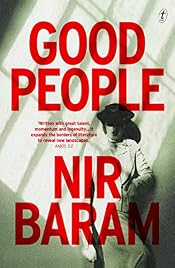
Good People is an early novel by Israeli author Nir Baram, who also wrote A Land Without Borders: My Journey Around East Jerusalem and the West Bank a memoir that I've seen reviewed well more than once here on LT. This is a novel about the ways in which people who think of themselves as "good" can easily get tripped up by their own illusions and entangled in compromises within evil systems. The book begins in 1938 and follows two characters. Thomas Heiselberg is a young businessman in Berlin. He a market researcher and rising quickly within an American-owned company. He has devised the company's business strategies for their branch offices in Berlin, Warsaw and Paris. He is not antiSemitic, and though he mostly goes along to get along, he does try to help his Jewish therapist escape Germany and makes other such gestures. He sees himself as a master persuader, able to put any face forward that he needs to accomplish any given agenda, and to get people to act accordingly, and to manage any situation. Sasha Weissberg is a young woman in Leningrad, the daughter of intellectuals, who begins reporting on the conversations of her parents circle of poets and philosophers to the NKVD, Stalin's secret police, imagining she is thereby somehow protecting her parents. Both characters become ever more firmly ensnared in the trap of their own self-regard and their confidence in their abilities to turn the power of the evil worlds they are navigating to their own ends.
We see the world very tightly through the perspectives of these two characters, and so the narrative takes on a somewhat hallucinatory character, and yet also maintains (or at least maintain for me) a certain thinness of scope that left me wanting a touch more, somehow. Also, I thought the book could have used some editing, shedding perhaps 20% of the 421 pages of my Australian edition. Nevertheless, Good People is an impressive achievement, I think, and overall I very much enjoyed the reading experience. Whether or not we're meant to experience the novel as any sort of allegory for contemporary (the book was first published in Hebrew in 2010) is unclear to me, though we know that Baram has been a voice for the left in Israel.
Good People is an early novel by Israeli author Nir Baram, who also wrote A Land Without Borders: My Journey Around East Jerusalem and the West Bank a memoir that I've seen reviewed well more than once here on LT. This is a novel about the ways in which people who think of themselves as "good" can easily get tripped up by their own illusions and entangled in compromises within evil systems. The book begins in 1938 and follows two characters. Thomas Heiselberg is a young businessman in Berlin. He a market researcher and rising quickly within an American-owned company. He has devised the company's business strategies for their branch offices in Berlin, Warsaw and Paris. He is not antiSemitic, and though he mostly goes along to get along, he does try to help his Jewish therapist escape Germany and makes other such gestures. He sees himself as a master persuader, able to put any face forward that he needs to accomplish any given agenda, and to get people to act accordingly, and to manage any situation. Sasha Weissberg is a young woman in Leningrad, the daughter of intellectuals, who begins reporting on the conversations of her parents circle of poets and philosophers to the NKVD, Stalin's secret police, imagining she is thereby somehow protecting her parents. Both characters become ever more firmly ensnared in the trap of their own self-regard and their confidence in their abilities to turn the power of the evil worlds they are navigating to their own ends.
We see the world very tightly through the perspectives of these two characters, and so the narrative takes on a somewhat hallucinatory character, and yet also maintains (or at least maintain for me) a certain thinness of scope that left me wanting a touch more, somehow. Also, I thought the book could have used some editing, shedding perhaps 20% of the 421 pages of my Australian edition. Nevertheless, Good People is an impressive achievement, I think, and overall I very much enjoyed the reading experience. Whether or not we're meant to experience the novel as any sort of allegory for contemporary (the book was first published in Hebrew in 2010) is unclear to me, though we know that Baram has been a voice for the left in Israel.
137rocketjk
And since I've already worked my way though my post-Good People "Between Book" reading, here's the list, with me still lingering in Stack 1:
* “The Story of a Salmon” excerpted from Science Sketches by David Starr Jordan in Literature - Book Two edited by Thomas H. Briggs
* Three poems by Antranik Zaroukian from New Writing from the Middle East edited by Leo Hamalian and John D. Yohannan
* Excerpt from Shielding the Flame: An Intimate Conversation with Dr. Marek Edelman, the Last Surviving Leader of the Warsaw Ghetto Uprising by Hanna Krall from Annual Gathering Commemorating the Warsaw Ghetto Uprising, 75th Anniversary, April 19, 2018 edited by Irena Klepfisz
* Day 8, Story 7 from The Decameron by Giovanni Boccaccio (translated by Wayne A. Rebhorn)
* “Spare Time Strikes it Rich” by Nora Scott Kinzer from The Saturday Evening Post, November, 1974
Now I've returned to Postwar: A History of Europe Since 1945 by Tony Judt, an 824-page book which is segmented into four major parts. I'm reading those one at a time. I've started "Part 2 - Prosperity and Its Discontents: 1953-1971."
On a personal note, since folks had such kinds comments about my taking up the clarinet again, I'll just mention that I'm enjoying myself quite a lot, when I'm not cursing. The lessons have now taken me up into the higher range of notes. Anyone who has ever been a beginning (or re-beginning) clarinet student will know: the high range is where the squeaks live. My poor wife is still soldiering on with a smile. With luck I'll get that high range under control sooner rather than later. As I've told my teacher a couple of times, "It is frustrating, but not discouraging." Oh, and he is a terrific teacher. All good on that end. Cheers, all!
* “The Story of a Salmon” excerpted from Science Sketches by David Starr Jordan in Literature - Book Two edited by Thomas H. Briggs
* Three poems by Antranik Zaroukian from New Writing from the Middle East edited by Leo Hamalian and John D. Yohannan
* Excerpt from Shielding the Flame: An Intimate Conversation with Dr. Marek Edelman, the Last Surviving Leader of the Warsaw Ghetto Uprising by Hanna Krall from Annual Gathering Commemorating the Warsaw Ghetto Uprising, 75th Anniversary, April 19, 2018 edited by Irena Klepfisz
* Day 8, Story 7 from The Decameron by Giovanni Boccaccio (translated by Wayne A. Rebhorn)
* “Spare Time Strikes it Rich” by Nora Scott Kinzer from The Saturday Evening Post, November, 1974
Now I've returned to Postwar: A History of Europe Since 1945 by Tony Judt, an 824-page book which is segmented into four major parts. I'm reading those one at a time. I've started "Part 2 - Prosperity and Its Discontents: 1953-1971."
On a personal note, since folks had such kinds comments about my taking up the clarinet again, I'll just mention that I'm enjoying myself quite a lot, when I'm not cursing. The lessons have now taken me up into the higher range of notes. Anyone who has ever been a beginning (or re-beginning) clarinet student will know: the high range is where the squeaks live. My poor wife is still soldiering on with a smile. With luck I'll get that high range under control sooner rather than later. As I've told my teacher a couple of times, "It is frustrating, but not discouraging." Oh, and he is a terrific teacher. All good on that end. Cheers, all!
138markon
Hi Jerry. Good people sounds interesting. It's not at my public library, so it has been lumped into the black hole that is my Mt. TBR.
139rocketjk
>138 markon: Hope you get to read it someday. I'll be interested to read your take on it.
140AnnieMod
>136 rocketjk: Interesting review.
Whether or not we're meant to experience the novel as any sort of allegory for contemporary
I like novels (and stories) which allow you to chose how to read them - do you want to go by the text on its own or look for an allegory or mapping into something else and work both ways (there are some which allow the double reading but one of the readings is extremely flat and trite). I need to look for this book (from the looks of it, it was only published in Australia in English which may explain why my library does not have it either)...
Whether or not we're meant to experience the novel as any sort of allegory for contemporary
I like novels (and stories) which allow you to chose how to read them - do you want to go by the text on its own or look for an allegory or mapping into something else and work both ways (there are some which allow the double reading but one of the readings is extremely flat and trite). I need to look for this book (from the looks of it, it was only published in Australia in English which may explain why my library does not have it either)...
141mabith
>137 rocketjk: At least clarinet squeaks are more bearable than beginner violin/viola screeching!
142RidgewayGirl
>136 rocketjk: Making note of this one. It sounds really interesting.
143rocketjk
>140 AnnieMod: "I like novels (and stories) which allow you to chose how to read them - do you want to go by the text on its own or look for an allegory or mapping into something else and work both ways "
Great comment. I absolutely agree.
"from the looks of it, it was only published in Australia in English "
How interesting! I actually had no idea that was the case. I bought my copy in the glorious Strand Books here in NYC but a few years back on a visit before we moved here.
>141 mabith: "At least clarinet squeaks are more bearable than beginner violin/viola screeching!"
For a nearby listener/spouse, perhaps, but when one is the squeaker, I think they're all pretty frustrating! (But not discouraging! :) )
>142 RidgewayGirl: Definitely an interesting novel. Hope you get to read it.
Cheers!
Great comment. I absolutely agree.
"from the looks of it, it was only published in Australia in English "
How interesting! I actually had no idea that was the case. I bought my copy in the glorious Strand Books here in NYC but a few years back on a visit before we moved here.
>141 mabith: "At least clarinet squeaks are more bearable than beginner violin/viola screeching!"
For a nearby listener/spouse, perhaps, but when one is the squeaker, I think they're all pretty frustrating! (But not discouraging! :) )
>142 RidgewayGirl: Definitely an interesting novel. Hope you get to read it.
Cheers!
144kjuliff
>140 AnnieMod: There are several of Nir Baram’s books available at my favorite Australian bookstore, Readings. I remember looking for his World Shadow a while back for a friend. Also I think Amazon.com.au has copies.
145rocketjk
Greetings! I'm reading Tony Judt's 800-page Postwar: A History of Europe Since 1945 in quarters, and I've just finished "Part 2 - Prosperity and Its Discontents: 1953-1971." The section covers the economic boom and growth of the welfare state in Western Europe, followed by the disaffection and alienation from what the emphasis on material comfort had wrought among the next generation of Western Europeans, and the slow and/or non-existent economic growth of the Eastern Bloc, accompanied by the continuously tight grip that the USSR exerted, up through the Soviet tanks rolling into Czechoslovakia in 1968. The book is very detailed, quite enlightening, and very well written.
Then I had a read through Stack 2 of my "between book" (see first post) piles:
* “A Tragic Case of Mistaken Identity” by Blackie Sherrod (The Dallas Times Herald) from Best Sports Stories 1965 edited by Irving T. Marsh and Edward Ehre
* “Yiddish and Jewishness” from Old Truths and New Cliches: Essays by Isaac Bashevis Singer edited by David Stromberg
* “Mr. Webster’s Father” from The Public and Private Life of Daniel Webster by General S. P. Lyman
* “Norm Siebern” from Sweet Seasons: Recollections of the 1955-64 New York Yankees by Dom Forker
* Day 8, Story 8 from The Decameron by Giovanni Boccaccio (translated by Wayne A. Rebhorn)
* Editorials from The Saturday Evening Post, November, 1974
Now I'm reading one from my pulp fiction/"they can't all be classics" shelves, The Story of the Phantom: The Ghost Who Walks by Lee Falk. In 1972, Falk began a series of novelizations based on the comic strip, The Phantom, which first appeared in newspapers in 1939, and that he was still writing at the time this book was published. This is the first book in what turned out to be a 15-book series. I'm eventually going to read at least the first three, and then see if I feel like reading any more of them.
Then I had a read through Stack 2 of my "between book" (see first post) piles:
* “A Tragic Case of Mistaken Identity” by Blackie Sherrod (The Dallas Times Herald) from Best Sports Stories 1965 edited by Irving T. Marsh and Edward Ehre
* “Yiddish and Jewishness” from Old Truths and New Cliches: Essays by Isaac Bashevis Singer edited by David Stromberg
* “Mr. Webster’s Father” from The Public and Private Life of Daniel Webster by General S. P. Lyman
* “Norm Siebern” from Sweet Seasons: Recollections of the 1955-64 New York Yankees by Dom Forker
* Day 8, Story 8 from The Decameron by Giovanni Boccaccio (translated by Wayne A. Rebhorn)
* Editorials from The Saturday Evening Post, November, 1974
Now I'm reading one from my pulp fiction/"they can't all be classics" shelves, The Story of the Phantom: The Ghost Who Walks by Lee Falk. In 1972, Falk began a series of novelizations based on the comic strip, The Phantom, which first appeared in newspapers in 1939, and that he was still writing at the time this book was published. This is the first book in what turned out to be a 15-book series. I'm eventually going to read at least the first three, and then see if I feel like reading any more of them.
146Ameise1
>145 rocketjk: This post-war book sounds interesting. I'm curious to see what you write about the next chapters and in what context you see it in relation to the present day, with trade tariffs and armament.
147rocketjk
>146 Ameise1: Yes, I'm also interested to see what kind of impression Postwar leaves along those lines. Judt took his account of Europe up to 2005. The differences between where he left things and where we are today, 20 years later, is likely to be a bit jarring, I think.
148Ameise1
>147 rocketjk: Yes, especially how far we will fall behind. 🫣
149rocketjk
The Story of the Phantom: The Ghost Who Walks by Lee Falk
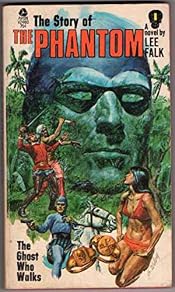
From the "They Can't All Be Classics" department . . . In 1939, Lee Falk's comic strip, The Phantom - The Ghost Who Walks, began running in newspapers and became extremely popular. In the early 1970s, Avon Books began publishing Falk's novelizations of the Phantom and his exploits. This book is the first of what eventually became a 15-book series. The concept of the character takes some very serious suspension of disbelief. In the early 1500s, a British merchant ship is attacked by pirates "off the remote shores of Bangalla" (in Africa). The captain of the merchant ship, "a famous seagoing man," is killed, and his son witnesses his father's death. The son, Kit, is washed ashore, the only survivor among the crew, and realizes that washed up next to him is the body of the pirate who had stabbed his father. Kit swears an oath upon the pirate's skull to spend his life fighting pirates and other evildoers, and protecting the innocent. He is taken in by a tribe of pygmies, known as the Bandar, who nurse him to health and take him to their secret territory, protected by their reputation as fierce though small warriors who furthermore know the secret of a deadly poison with which they coat the tips of their arrows and spears. Fast forward, and Kit has donned a skin-tight outfit and mask, and has set out to fulfill his oath, of course often fighting against incredible odds, almost superhumanly strong and skillful with weaponry, but wise in the ways of the jungle and the animals who live therein. This is pulp fiction/comic strip territory, after all. He becomes known as the Phantom due to his costume and secretive ways. When he has a son, he teaches his son the ways and mores of the Phantom so that the son may carry on after the father is gone. Each Phantom does the same with his own first born son. Because the locals (other than the Bandars) never see this passing of the torch, and because each Phantom wears the same outfit, the superstition is that they are all the same person, a Phantom who never dies, the Ghost Who Walks. When our story opens, the 20th Phantom has just had a son. This first book of the series, then, is more or less the story of the childhood of the 21st Phantom (all named Kit, by the way), as he grows to acquire the skills and knowledge he'll need to have and the lore he'll need to know to carry on when his turn comes. This includes a trip to the U.S. for a modern education. Along the way, our Kit's father reads to him from the journals that each Phantom has kept of his exploits over the long years. In this way, not only Kit, but us readers, get the picture.
Because this first book is to a large extent an exercise in exposition and world building, it can drag at times. I am eventually going to read books 2 and 3. I assume they will be more standard adventure yarns describing the exploits of Phantom the twenty-first. I guess if they're escapist fun, I might read further in the series. Although the African jungle dwellers are treated mostly with respect by both the many Phantoms and the author, and young Kit takes a stand against racial prejudice when he arrives in 1970s America, there is here, at the very least, a strong level of White Man paternalism--hence racism--inherent in the narrative.
From the "They Can't All Be Classics" department . . . In 1939, Lee Falk's comic strip, The Phantom - The Ghost Who Walks, began running in newspapers and became extremely popular. In the early 1970s, Avon Books began publishing Falk's novelizations of the Phantom and his exploits. This book is the first of what eventually became a 15-book series. The concept of the character takes some very serious suspension of disbelief. In the early 1500s, a British merchant ship is attacked by pirates "off the remote shores of Bangalla" (in Africa). The captain of the merchant ship, "a famous seagoing man," is killed, and his son witnesses his father's death. The son, Kit, is washed ashore, the only survivor among the crew, and realizes that washed up next to him is the body of the pirate who had stabbed his father. Kit swears an oath upon the pirate's skull to spend his life fighting pirates and other evildoers, and protecting the innocent. He is taken in by a tribe of pygmies, known as the Bandar, who nurse him to health and take him to their secret territory, protected by their reputation as fierce though small warriors who furthermore know the secret of a deadly poison with which they coat the tips of their arrows and spears. Fast forward, and Kit has donned a skin-tight outfit and mask, and has set out to fulfill his oath, of course often fighting against incredible odds, almost superhumanly strong and skillful with weaponry, but wise in the ways of the jungle and the animals who live therein. This is pulp fiction/comic strip territory, after all. He becomes known as the Phantom due to his costume and secretive ways. When he has a son, he teaches his son the ways and mores of the Phantom so that the son may carry on after the father is gone. Each Phantom does the same with his own first born son. Because the locals (other than the Bandars) never see this passing of the torch, and because each Phantom wears the same outfit, the superstition is that they are all the same person, a Phantom who never dies, the Ghost Who Walks. When our story opens, the 20th Phantom has just had a son. This first book of the series, then, is more or less the story of the childhood of the 21st Phantom (all named Kit, by the way), as he grows to acquire the skills and knowledge he'll need to have and the lore he'll need to know to carry on when his turn comes. This includes a trip to the U.S. for a modern education. Along the way, our Kit's father reads to him from the journals that each Phantom has kept of his exploits over the long years. In this way, not only Kit, but us readers, get the picture.
Because this first book is to a large extent an exercise in exposition and world building, it can drag at times. I am eventually going to read books 2 and 3. I assume they will be more standard adventure yarns describing the exploits of Phantom the twenty-first. I guess if they're escapist fun, I might read further in the series. Although the African jungle dwellers are treated mostly with respect by both the many Phantoms and the author, and young Kit takes a stand against racial prejudice when he arrives in 1970s America, there is here, at the very least, a strong level of White Man paternalism--hence racism--inherent in the narrative.
150TadAD
>149 rocketjk: As a kid, back when getting newspapers was a normal thing for a family to do, I used to devour the Sunday comic section, and I loved The Phantom with his twin .45s, living in the Skull Cave, Diana, Hero, and the dog whose name I can't remember. I haven't thought about them in years!
The only thing I used to wonder about was what happened to the elder Phantoms when their sons took over. I mean, it's unlikely they all died in battle at exactly the appropriate time for the next generation to take over.
The only thing I used to wonder about was what happened to the elder Phantoms when their sons took over. I mean, it's unlikely they all died in battle at exactly the appropriate time for the next generation to take over.
151rocketjk
>150 TadAD: "The only thing I used to wonder about was what happened to the elder Phantoms when their sons took over. I mean, it's unlikely they all died in battle at exactly the appropriate time for the next generation to take over."
Yeah, that's one of the "willing suspension of disbelief" factors I was referring to, all right. And every Phantom has to have a son, and what happens to the other kids if there's more than one? Etc. It's not worth thinking too hard about, to put it mildly. :)
Yeah, that's one of the "willing suspension of disbelief" factors I was referring to, all right. And every Phantom has to have a son, and what happens to the other kids if there's more than one? Etc. It's not worth thinking too hard about, to put it mildly. :)
152rocketjk
My post-The Ghost Who Walks "Between Book" reading brought me back for another wander through Stack 2:
* “A Piece of Paper Doesn’t Make You a Manager” by Jerry Izenberg (Sport) from Best Sports Stories 1965 edited by Irving T. Marsh and Edward Ehre
* “A Trip to the Circus” from Old Truths and New Cliches: Essays by Isaac Bashevis Singer edited by David Stromberg
* “Birthplace of Daniel Webster—His Brothers and Sisters” from The Public and Private Life of Daniel Webster by General S. P. Lyman
* “Jerry Lumpe” from Sweet Seasons: Recollections of the 1955-64 New York Yankees by Dom Forker
* Day 8, Story 9 from The Decameron by Giovanni Boccaccio (translated by Wayne A. Rebhorn)
* “The Grand Jury Vs. You” by David Rothman from The Saturday Evening Post, November, 1974
The book group I've just joined will be discussing James at the end of April, so I've now embarked on my third reading of The Adventures of Huckleberry Finn. I promised myself I'd read Huck again before reading James. I read Huckleberry Finn once in high school and then again in grad school. If I read it in an undergrad class, I don't remember that. Even the grad school reading would have been 40 years ago, however, so I'm looking forward to another go with it.
* “A Piece of Paper Doesn’t Make You a Manager” by Jerry Izenberg (Sport) from Best Sports Stories 1965 edited by Irving T. Marsh and Edward Ehre
* “A Trip to the Circus” from Old Truths and New Cliches: Essays by Isaac Bashevis Singer edited by David Stromberg
* “Birthplace of Daniel Webster—His Brothers and Sisters” from The Public and Private Life of Daniel Webster by General S. P. Lyman
* “Jerry Lumpe” from Sweet Seasons: Recollections of the 1955-64 New York Yankees by Dom Forker
* Day 8, Story 9 from The Decameron by Giovanni Boccaccio (translated by Wayne A. Rebhorn)
* “The Grand Jury Vs. You” by David Rothman from The Saturday Evening Post, November, 1974
The book group I've just joined will be discussing James at the end of April, so I've now embarked on my third reading of The Adventures of Huckleberry Finn. I promised myself I'd read Huck again before reading James. I read Huckleberry Finn once in high school and then again in grad school. If I read it in an undergrad class, I don't remember that. Even the grad school reading would have been 40 years ago, however, so I'm looking forward to another go with it.
153dchaikin
>150 TadAD: >151 rocketjk: i thought they covered this issue in The Princess Bride. 🙂
154TadAD
>153 dchaikin: OMG, The Phantom is really the Dread Pirate Roberts?!?!
155rocketjk
>153 dchaikin: Never read it. I'll take your word for it, though.
156dchaikin
>155 rocketjk: You haven’t seen The Princess Bride?!! (Fill in appropriate gawk face here). The book isn’t bad, but it’s the movie I’m thinking of. A cultural literacy must watch. 🙂
157RidgewayGirl
>155 rocketjk: Jerry, I'm forced to think of you differently now. You haven't seen The Princess Bride. That's like saying you've never watched a baseball game or tried apple pie.
158rocketjk
>156 dchaikin: & >157 RidgewayGirl: Neither read the book nor watched the movie. In the words of one of my favorite philosophers . . . I am what I am, and that's all what I am.
159TadAD
>156 dchaikin: The book isn’t bad, but it’s the movie I’m thinking of.
I loved the movie, but that said, I actually preferred the book because there were so many more asides that made me laugh.
I loved the movie, but that said, I actually preferred the book because there were so many more asides that made me laugh.
160Fourpawz2
The Princess Bride book disappointed me, but the movie was super! And I only saw it because I accidentally ordered it from some Movie of the Month club back in the days of VHS. "Accidentally" - meaning I did not return the little card to the company declining that month's movie selection. Paid some ridiculous amount of money for my failure to return, but I watched that movie about a thousand times.
161jjmcgaffey
>151 rocketjk: I love the Phantom - have most of the paperbacks, and have actually read most of what I have. I still read the comic strip daily, online. There are storylines and references to times when things didn't work out perfectly, but it still worked - ones where the Phantom died while his son was still young, and there was no Phantom for a bit while the son finished training and growing up. One pair of male/female twins - and when the young man got injured, his sister stepped in as the Phantom for a bit. Etc. The 21st Phantom also has male/female twins, and things get complicated...
I read a book of collected comic strips, from the first appearance of the Phantom - wow, he was really different then (basically, all the backstory got added later. He was just a masked hero in the beginning, slugfests abound).
You're making me want to reread my Story of the Phantom books!
I read a book of collected comic strips, from the first appearance of the Phantom - wow, he was really different then (basically, all the backstory got added later. He was just a masked hero in the beginning, slugfests abound).
You're making me want to reread my Story of the Phantom books!
162rocketjk
>161 jjmcgaffey: "One pair of male/female twins - and when the young man got injured, his sister stepped in as the Phantom for a bit."
Yes, as you may recall, some of these backstories are provided in the first Phantom book, as Phantom 20 is relating snippets of the family history via the Chronicles to his son. The one you mention in particular.
Yes, as you may recall, some of these backstories are provided in the first Phantom book, as Phantom 20 is relating snippets of the family history via the Chronicles to his son. The one you mention in particular.
163jjmcgaffey
I have no idea where I get the stories from - since I've read both the books and the comics over many many years, they're just part of my understanding. I think that story also appeared in the comic - at least, I have an image of the female Phantom ducking through a forest. But it might have been something on the cover of one of the books. I last read The Story of the Phantom in 2009, so my memories are pretty vague.
164rocketjk
Adventures of Huckleberry Finn by Mark Twain

The book group I've recently joined is discussing James at the end of the month, and I decided to reread Huckleberry Finn as a refresher before reading Everett's novel. I first read Adventures of Huckleberry Finn in high school, and then again in grad school. At least those are the two readings I can recall. At any rate, that grad school reading was around 35 years ago. Well, nobody needs lengthy review of Adventures of Huckleberry Finn from the likes of me at this late date. I enjoyed this reread thoroughly. For one thing, I had forgotten, if I'd ever appreciated, Twain's wonderful descriptions of the natural world that Huck and Jim move through. But also, I have more of a comprehension of the fraught nature of the reality that Huck and Jim are experiencing. The very real danger that Jim is in, as a runaway slave, and Huck is in as well, as Jim's enabler, is the subtext of the narrative, even if Huck expresses it all in less explicit terms, is an undercurrent throughout the story. {Spoilers commence here} When the Duke and the King arrive, two scam artists that Huck identifies immediately as frauds, not only do are Huck and Jim in danger from angry locals should any of the fraudsters scams be uncovered in the various towns they visit, but they are also in danger from the Duke and King themselves, should they take it into their heads to turn Jim in to local authorities and claim the offered reward. While the episodes entailing the Duke and the King become uncomfortable in the reading, in part due to their relative length in the narrative, they make sense in helping us understand the peril are heroes are enduring, and how hard it is for them to shake free of this peril. The casual cruelty that the newly arriving Tom Sawyer puts Jim through, turning a simple escape plan (once Jim has been discovered and locked up) into a long ordeal, due only to Tom's romantic ideals of what real heroes do when escaping imprisonment, also becomes difficult to read, but is also thematically relevant. In the notes of the Penguin Classics edition I read, the point is made that Twain despised the novels of Sir Walter Scott, believing their romanticism contributed strongly to the Southern culture and mythology that played a strong role in bringing about the Civil War. Tom's insistence on following his warped romantic agenda, and Huck's reluctant accedence to Tom's demands, make sense when viewed in this light. (Toni Morrison referred, approvingly, to these elements of the book as "the hell Twain puts the reader through.") And even though Huck in particular has a very strong regard and affection for Jim, the two boys' offhand disregard for the discomfort and danger they are putting Jim through is also very telling of their built-in belief system of black inferiority. Huck has to wrestle with his conscience, which tells him throughout that he is committing a despicable act in helping Jim escape, despite the fact that he never really considers doing anything else. Huck's optimism and sense of morality (even when the values he's been taught tells him that that morality is evil) put him at odds with his world. The Duke, the King and, in the book's final chapters, Tom Sawyer himself, show us the kind of minefield that a person with Huck's attributes, innocence notwithstanding, would have had to navigate--in the satirical eyes of Mark Twain--in the pre-Civil War South.
Book note: The cover shown here is of my grad school copy of Huck Finn. It even has my name written on the inside front cover. However, by the time I was ready to start reading, my darling wife, who's in the same book group, had already grabbed that one off our shelves. However, I found the Penguin Classics edition I referred to above on a sidewalk book sale table just a couple of blocks from our building, so that's the one I actually read.

The book group I've recently joined is discussing James at the end of the month, and I decided to reread Huckleberry Finn as a refresher before reading Everett's novel. I first read Adventures of Huckleberry Finn in high school, and then again in grad school. At least those are the two readings I can recall. At any rate, that grad school reading was around 35 years ago. Well, nobody needs lengthy review of Adventures of Huckleberry Finn from the likes of me at this late date. I enjoyed this reread thoroughly. For one thing, I had forgotten, if I'd ever appreciated, Twain's wonderful descriptions of the natural world that Huck and Jim move through. But also, I have more of a comprehension of the fraught nature of the reality that Huck and Jim are experiencing. The very real danger that Jim is in, as a runaway slave, and Huck is in as well, as Jim's enabler, is the subtext of the narrative, even if Huck expresses it all in less explicit terms, is an undercurrent throughout the story. {Spoilers commence here} When the Duke and the King arrive, two scam artists that Huck identifies immediately as frauds, not only do are Huck and Jim in danger from angry locals should any of the fraudsters scams be uncovered in the various towns they visit, but they are also in danger from the Duke and King themselves, should they take it into their heads to turn Jim in to local authorities and claim the offered reward. While the episodes entailing the Duke and the King become uncomfortable in the reading, in part due to their relative length in the narrative, they make sense in helping us understand the peril are heroes are enduring, and how hard it is for them to shake free of this peril. The casual cruelty that the newly arriving Tom Sawyer puts Jim through, turning a simple escape plan (once Jim has been discovered and locked up) into a long ordeal, due only to Tom's romantic ideals of what real heroes do when escaping imprisonment, also becomes difficult to read, but is also thematically relevant. In the notes of the Penguin Classics edition I read, the point is made that Twain despised the novels of Sir Walter Scott, believing their romanticism contributed strongly to the Southern culture and mythology that played a strong role in bringing about the Civil War. Tom's insistence on following his warped romantic agenda, and Huck's reluctant accedence to Tom's demands, make sense when viewed in this light. (Toni Morrison referred, approvingly, to these elements of the book as "the hell Twain puts the reader through.") And even though Huck in particular has a very strong regard and affection for Jim, the two boys' offhand disregard for the discomfort and danger they are putting Jim through is also very telling of their built-in belief system of black inferiority. Huck has to wrestle with his conscience, which tells him throughout that he is committing a despicable act in helping Jim escape, despite the fact that he never really considers doing anything else. Huck's optimism and sense of morality (even when the values he's been taught tells him that that morality is evil) put him at odds with his world. The Duke, the King and, in the book's final chapters, Tom Sawyer himself, show us the kind of minefield that a person with Huck's attributes, innocence notwithstanding, would have had to navigate--in the satirical eyes of Mark Twain--in the pre-Civil War South.
Book note: The cover shown here is of my grad school copy of Huck Finn. It even has my name written on the inside front cover. However, by the time I was ready to start reading, my darling wife, who's in the same book group, had already grabbed that one off our shelves. However, I found the Penguin Classics edition I referred to above on a sidewalk book sale table just a couple of blocks from our building, so that's the one I actually read.
165rocketjk
My post-Huck Finn "between book" reading brought me back once more to Stack 2, like so:
* “Too Stupid to Be Scared” by Leonard Shecter (The New York Post) from Best Sports Stories 1965 edited by Irving T. Marsh and Edward Ehre
* “Why I Write as I Do: The Philosophy and Definition of a Jewish Writer” from Old Truths and New Cliches: Essays by Isaac Bashevis Singer edited by David Stromberg
* “His Infancy and Boyhood” from The Public and Private Life of Daniel Webster by General S. P. Lyman
* “Al Downing” from Sweet Seasons: Recollections of the 1955-64 New York Yankees by Dom Forker
* Day 8, Story 10 and Conclusion from The Decameron by Giovanni Boccaccio (translated by Wayne A. Rebhorn)
* “Not Just Another Pretty Face” by Jim Murray from The Saturday Evening Post, November, 1974
I've now returned to Postwar: A History of Europe Since 1945 by Tony Judt to read the third of the book's four sections, "Recessional: 1971-1989." After that I'll be reading James.
* “Too Stupid to Be Scared” by Leonard Shecter (The New York Post) from Best Sports Stories 1965 edited by Irving T. Marsh and Edward Ehre
* “Why I Write as I Do: The Philosophy and Definition of a Jewish Writer” from Old Truths and New Cliches: Essays by Isaac Bashevis Singer edited by David Stromberg
* “His Infancy and Boyhood” from The Public and Private Life of Daniel Webster by General S. P. Lyman
* “Al Downing” from Sweet Seasons: Recollections of the 1955-64 New York Yankees by Dom Forker
* Day 8, Story 10 and Conclusion from The Decameron by Giovanni Boccaccio (translated by Wayne A. Rebhorn)
* “Not Just Another Pretty Face” by Jim Murray from The Saturday Evening Post, November, 1974
I've now returned to Postwar: A History of Europe Since 1945 by Tony Judt to read the third of the book's four sections, "Recessional: 1971-1989." After that I'll be reading James.
166kidzdoc
Great comments about Huckleberry Finn, Jerry.
Although he had a long and modestly successful career, Al Downing shall be forever best known as the pitcher who surrendered home run #715 to Hank Aaron in Atlanta-Fulton County Stadium in April 1974. I watched that game live with my parents, along with millions of other Americans.
Although he had a long and modestly successful career, Al Downing shall be forever best known as the pitcher who surrendered home run #715 to Hank Aaron in Atlanta-Fulton County Stadium in April 1974. I watched that game live with my parents, along with millions of other Americans.
167rocketjk
>166 kidzdoc: Yes, Downing mentions the attention that one home run pitch always got. He made the point that a lot of people gave up home runs to Hank Aaron. C'est la vie. He had a lifetime W-L record of 123-107 (.535 winning pct), went 20-9 for the Dodgers in 1971 (throwing five shutouts that year on his way to 24 shutouts over his career) and had a lifetime ERA of 3.22 and a Wins Against Replacement (WAR) of 22.5. He had some down years, of course, but all in all he may have been better than many people remember (among those who remember him at all). At any rate, the short chapter on him in Sweet Seasons is one of the most interesting I've read in that book so far. He is (according to Baseball-Reference.com, he is still alive at age 83) a very thoughtful fellow.
168kidzdoc
>167 rocketjk: Those are interesting stats about Al Downing. Although I wasn't completely unfamiliar with him I don't think I would remember him if I didn't have Hammerin' Hank's famous home run as a reference. Given his comment I would imagine that there were many dozens if not a hundred or more who gave up home runs to Aaron, and that he wasn't at the top of that list.
169rocketjk
>168 kidzdoc: Here's a fun list of pitchers who gave up HRs to Hank Aaron. There are 310 names on the list:
http://www.755homeruns.com/aaronvs_pitchers.shtml
Don Drysdale leads the list with 17. Others in double digits are Claude Osteen, 14; Bob Friend, 12; Larry Jackson, 10; Don Cardwell, 10; Roger Craig, 10. Aaron victimized Downing three times.
Although many remember Downing for that Aaron HR, Yankee fans of a "certain age" remember him more, and more fondly, as one of the young pitching stars, along with Jim Bouton, of the early 1960s Yankees, the last iteration of that long-lasting Yankee dynasty that crumbled after the 1964 season. Interestingly, Downing, in the oral history in Sweet Seasons, says that he realized the Yankees were going to crater soon as early as 1961. He saw that there were no longer any potential stars in the Yankee farm system, and that the Yankees were trading away any promising young players they did have with, seemingly, no plan for the future. I was 9 during the Yankees final World Series of that era in 1964, and the Yanks didn't see the post-season again until 1976, my junior year in college, when they got swept by the Reds in the World Series.
http://www.755homeruns.com/aaronvs_pitchers.shtml
Don Drysdale leads the list with 17. Others in double digits are Claude Osteen, 14; Bob Friend, 12; Larry Jackson, 10; Don Cardwell, 10; Roger Craig, 10. Aaron victimized Downing three times.
Although many remember Downing for that Aaron HR, Yankee fans of a "certain age" remember him more, and more fondly, as one of the young pitching stars, along with Jim Bouton, of the early 1960s Yankees, the last iteration of that long-lasting Yankee dynasty that crumbled after the 1964 season. Interestingly, Downing, in the oral history in Sweet Seasons, says that he realized the Yankees were going to crater soon as early as 1961. He saw that there were no longer any potential stars in the Yankee farm system, and that the Yankees were trading away any promising young players they did have with, seemingly, no plan for the future. I was 9 during the Yankees final World Series of that era in 1964, and the Yanks didn't see the post-season again until 1976, my junior year in college, when they got swept by the Reds in the World Series.
170kidzdoc
>169 rocketjk: That makes complete sense. I would have predicted that the pitchers who gave up the most home runs to Aaron were fireballers like Drysdale who had long careers that overlapped with his and pitched plenty of innings each season. I would have expected to see Sandy Koufax, Juan Marichal, Bob Gibson, Ferguson Jenkins, Tom Seaver and other top notch pitchers in the multiple home run list, though. (Actually Gibson probably would have tried to take off Aaron's head if he was too successful.)
I was born in 1961 in Jersey City so I went to several Yankees and Mets games each season on field trips from school, church, and especially church summer school. By the mid 1960s Mets games were exciting, as they were lovable losers, but the Yankees were stale and irrelevant, as you undoubtedly know. My classmates, friends and I became diehard Mets fans in 1969, if not before, and after we moved to suburban Philadelphia in 1974 my loyalty gradually shifted to the Phillies, as they started to become competitive for the first time in decades in the mid 1970s, although we were still close enough to pick up WOR on television. I've never been a Yankees fan even when they finally became successful in the late 1970s. (I've also never supported the Braves despite living in Atlanta for nearly a quarter of a century; the only team I support there is Atlanta United FC.)
That's an interesting analysis by Downing.
I was born in 1961 in Jersey City so I went to several Yankees and Mets games each season on field trips from school, church, and especially church summer school. By the mid 1960s Mets games were exciting, as they were lovable losers, but the Yankees were stale and irrelevant, as you undoubtedly know. My classmates, friends and I became diehard Mets fans in 1969, if not before, and after we moved to suburban Philadelphia in 1974 my loyalty gradually shifted to the Phillies, as they started to become competitive for the first time in decades in the mid 1970s, although we were still close enough to pick up WOR on television. I've never been a Yankees fan even when they finally became successful in the late 1970s. (I've also never supported the Braves despite living in Atlanta for nearly a quarter of a century; the only team I support there is Atlanta United FC.)
That's an interesting analysis by Downing.
171qebo
>164 rocketjk: long ordeal, due only to Tom's romantic ideals of what real heroes do when escaping imprisonment
I'd dutifully trudged through the Duke and King, but this episode had me fuming. I was unaware of the context.
I'd dutifully trudged through the Duke and King, but this episode had me fuming. I was unaware of the context.
172dchaikin
Enjoyed your comments on Huck
In Aarons day there were less teams and, of course, no interleague play. And less use of relievers. So he would have faced the same pitchers much more often than happens today
In Aarons day there were less teams and, of course, no interleague play. And less use of relievers. So he would have faced the same pitchers much more often than happens today
173rocketjk
>172 dchaikin: "In Aarons day there were less teams and, of course, no interleague play. And less use of relievers. So he would have faced the same pitchers much more often than happens today"
Correct, plus most starters pitched every fourth day instead of today's every fifth day, so, again, more starts against fewer teams.
Correct, plus most starters pitched every fourth day instead of today's every fifth day, so, again, more starts against fewer teams.
174rocketjk
I finished up Part Three of the fascinating Postwar: A History of Europe Since 1945 by Tony Judt, which, due to its length (800+ pages), I'm reading in quarters. Part Three is titled "Recessional: 1971-1989" and covers the end of Western Europe's economic boom years of the 50s and 60s as well as the activities of the several reform movements within various countries within the Soviet Bloc, and concludes with the fracturing of the Soviet Bloc itself, which Judt describes as mostly the work of Soviet Russian lead Mikhail Gorbachev himself. That's an extremely surface description of a very complicated dynamic that Judt describes extremely cogently (a characteristic of the entire book) and which I will go into a little more deeply when I finish the book. In the meantime, here is my post-Postwar Part Three "between book" reading, a ramble through Stack 1:
* “Solving the Riddles of the Sea” excerpted from Uncle Sam, Wonder Worker by William Atherton Du Puy in Literature - Book Two edited by Thomas H. Briggs
* “76 Armenian Proverbs and Sayings” by Garig Basmadjian from New Writing from the Middle East edited by Leo Hamalian and John D. Yohannan
* “Delayed” by Irit Amiel from Annual Gathering Commemorating the Warsaw Ghetto Uprising, 75th Anniversary, April 19, 2018 edited by Irena Klepfisz
* “Joey Votto” from Smart, Wrong and Lucky: The Origin Stories of Baseball’s Unexpected Stars by Jonathan Mayo - Newly added
* Day 9, Introduction and Story 1 from The Decameron by Giovanni Boccaccio (translated by Wayne A. Rebhorn)
* “Churchill: The Glowworm at 100” by Frank Gannon from The Saturday Evening Post, November, 1974
I've now finally begun James by Percival Everett for my book group meeting at the end of this month. After James, I'll finish Postwar with a reading of "Part Four: After the Fall - 1989-2005."
* “Solving the Riddles of the Sea” excerpted from Uncle Sam, Wonder Worker by William Atherton Du Puy in Literature - Book Two edited by Thomas H. Briggs
* “76 Armenian Proverbs and Sayings” by Garig Basmadjian from New Writing from the Middle East edited by Leo Hamalian and John D. Yohannan
* “Delayed” by Irit Amiel from Annual Gathering Commemorating the Warsaw Ghetto Uprising, 75th Anniversary, April 19, 2018 edited by Irena Klepfisz
* “Joey Votto” from Smart, Wrong and Lucky: The Origin Stories of Baseball’s Unexpected Stars by Jonathan Mayo - Newly added
* Day 9, Introduction and Story 1 from The Decameron by Giovanni Boccaccio (translated by Wayne A. Rebhorn)
* “Churchill: The Glowworm at 100” by Frank Gannon from The Saturday Evening Post, November, 1974
I've now finally begun James by Percival Everett for my book group meeting at the end of this month. After James, I'll finish Postwar with a reading of "Part Four: After the Fall - 1989-2005."
175rocketjk
James by Percival Everett

While I had every intention of reading James sooner rather than later, my book group's selection of the book for our April discussion hastened my attention to this excellent novel. I'm sure everyone on LT by now is aware that James is Percival Everett's retelling of Mark Twain's classic Adventures of Huckleberry Finn from the point of view of Jim, the runaway slave who accompanies Huck on his trip down the Mississippi and plays such a major role in the story. It's also well known by now that Everett presents Jim, and all the slaves encountered during the story, as able to speak perfect English, only switching into "slave lingo" when whites are around. As technically unbelievable as this story device may be, it is certainly philosophically apt for emphasizing a) the fact that the enslaved population are equal to their enslavers in terms of their humanity as well as, b) pointing out the many strategies that slaves did indeed use to communicate in ways that were entirely disguised to slave holders and held bodies of knowledge that the white population would have been almost entirely blind to. (I should note that I purposefully did not read any of Everett's comments about his storytelling strategies and intentions, nor have I read much at all in the way of literary criticism about the book, so all of the suppositions here are, to a significant extent, my own. I will sometime soon go find Everett's comments to see what he has to say on these matters.)
I made a point of rereading Huck Finn just before delving into James so that I'd have that older novel fresher in mind as I read James, and I'm very glad I did. It was interesting indeed to consider some of the earliest incidents in Huck Finn through Jim's eyes, and also to get Everett's imaginings of what was happening to Jim during the times when he is offstage in Twain's book. I don't think it's a particularly egregious plot spoiler to mention that Everett's plot diverges from Twain's somewhere around the halfway point (or maybe the two-third's mark) of James. Even in that first half of the book, though, we necessarily see all the events of the book as much more fraught than they are presented through Huck's eyes. The malevolence of the King and the Duke is brought to the fore. The consequences of Jim being caught are only vaguely alluded to in Huck Finn, but in James we're made quite aware that what's waiting for Jim is a tree limb and the end of a rope, following a severe whipping, or even possibly the agony of being burned alive. As the book progresses, the horrors of slavery, and the cruelty of enslavers, become ever more clearly the point of the story. I've been remiss, however, in waiting so long to say that the writing is so good here, the storytelling so compelling, that I was wholly absorbed from the opening pages, and I flew through James in only two days' time. There is one plot point toward the end that I didn't care for, and which is more or less solely responsible for bringing my rating down from five stars to four and a half. Overall, though, I can't recommend James strongly enough, and if you can read (or reread) Huck Finn shortly before reading James, I heartily endorse that program as well.

While I had every intention of reading James sooner rather than later, my book group's selection of the book for our April discussion hastened my attention to this excellent novel. I'm sure everyone on LT by now is aware that James is Percival Everett's retelling of Mark Twain's classic Adventures of Huckleberry Finn from the point of view of Jim, the runaway slave who accompanies Huck on his trip down the Mississippi and plays such a major role in the story. It's also well known by now that Everett presents Jim, and all the slaves encountered during the story, as able to speak perfect English, only switching into "slave lingo" when whites are around. As technically unbelievable as this story device may be, it is certainly philosophically apt for emphasizing a) the fact that the enslaved population are equal to their enslavers in terms of their humanity as well as, b) pointing out the many strategies that slaves did indeed use to communicate in ways that were entirely disguised to slave holders and held bodies of knowledge that the white population would have been almost entirely blind to. (I should note that I purposefully did not read any of Everett's comments about his storytelling strategies and intentions, nor have I read much at all in the way of literary criticism about the book, so all of the suppositions here are, to a significant extent, my own. I will sometime soon go find Everett's comments to see what he has to say on these matters.)
I made a point of rereading Huck Finn just before delving into James so that I'd have that older novel fresher in mind as I read James, and I'm very glad I did. It was interesting indeed to consider some of the earliest incidents in Huck Finn through Jim's eyes, and also to get Everett's imaginings of what was happening to Jim during the times when he is offstage in Twain's book. I don't think it's a particularly egregious plot spoiler to mention that Everett's plot diverges from Twain's somewhere around the halfway point (or maybe the two-third's mark) of James. Even in that first half of the book, though, we necessarily see all the events of the book as much more fraught than they are presented through Huck's eyes. The malevolence of the King and the Duke is brought to the fore. The consequences of Jim being caught are only vaguely alluded to in Huck Finn, but in James we're made quite aware that what's waiting for Jim is a tree limb and the end of a rope, following a severe whipping, or even possibly the agony of being burned alive. As the book progresses, the horrors of slavery, and the cruelty of enslavers, become ever more clearly the point of the story. I've been remiss, however, in waiting so long to say that the writing is so good here, the storytelling so compelling, that I was wholly absorbed from the opening pages, and I flew through James in only two days' time. There is one plot point toward the end that I didn't care for, and which is more or less solely responsible for bringing my rating down from five stars to four and a half. Overall, though, I can't recommend James strongly enough, and if you can read (or reread) Huck Finn shortly before reading James, I heartily endorse that program as well.
176rocketjk
I forgot, when posting my last round of "between books," that I meant to include Irit Amiel's poem "Delayed," which was the entry I read from the program of the 75th Annual Gathering of the Warsaw Ghetto Uprising. Amiel, a child during the Holocaust, was the only member of her family not to be murdered at Treblinka:
Delayed
I did not get to Treblinka on time
arriving some fifty years too late,
its streets standing bare in autumn.
I wanted to escape at once, because
the rustic relic of a train carriage
was still there waiting for me,
the forest around it whispering quietly.
It was beautiful, grey calm, barren
and only the wind stroked the earth, trees,
stones and us,
extinguishing the candle we had lit
time and time again.
Then Dita said—you see, it is good you did not get here on time,
and are now my old mother and she hugged me tight
and laughed sadly.
Delayed
I did not get to Treblinka on time
arriving some fifty years too late,
its streets standing bare in autumn.
I wanted to escape at once, because
the rustic relic of a train carriage
was still there waiting for me,
the forest around it whispering quietly.
It was beautiful, grey calm, barren
and only the wind stroked the earth, trees,
stones and us,
extinguishing the candle we had lit
time and time again.
Then Dita said—you see, it is good you did not get here on time,
and are now my old mother and she hugged me tight
and laughed sadly.
178rocketjk
>177 kidzdoc: Thanks and . . . you're welcome.
179SassyLassy
>164 rocketjk: In the notes of the Penguin Classics edition I read, the point is made that Twain despised the novels of Sir Walter Scott, believing their romanticism contributed strongly to the Southern culture and mythology that played a strong role in bringing about the Civil War. Tom's insistence on following his warped romantic agenda, and Huck's reluctant accedence to Tom's demands, make sense when viewed in this light.
Well I'll certainly have to reread The Adventures of Huckleberry Finn after reading that. It's a whole new perspective! Also wondering why the northerners were immune to this influence. Scott has been criticized on many levels, but that's a new one to me!
>176 rocketjk: Incredible poem.
Well I'll certainly have to reread The Adventures of Huckleberry Finn after reading that. It's a whole new perspective! Also wondering why the northerners were immune to this influence. Scott has been criticized on many levels, but that's a new one to me!
>176 rocketjk: Incredible poem.
180mabith
My bookclub is tackling James this year as well. I was also planning to re-read The Adventures of Huckleberry Finn ahead of it, but you've definitely firmed up that decision with your review.
181rocketjk
>179 SassyLassy: "Well I'll certainly have to reread The Adventures of Huckleberry Finn after reading that."
Please note, though, that the footnote I was referring to is actually in reference to something else in Huck Finn, specifically the naming of one of the riverboats the Walter Scott. The connection between Twain's Walter Scott aversion and Tom Sawyer's determination to follow the rules he imagines to have been followed by heroes of yore is mine. That connection seemed obvious enough to me to make note of it in my review, but I should be clear that I've not seen that specific connection made anywhere else. On the other hand, I've read precious little literary criticism of Huck Finn over the last 40 years. So, anyway, my point here is to take that observation of mine with a grain of salt, unless you see it made elsewhere by someone more authoritative than I am (a very low bar, that).
>180 mabith: "My bookclub is tackling James this year as well. I was also planning to re-read The Adventures of Huckleberry Finn ahead of it, but you've definitely firmed up that decision with your review."
I highly recommend the Huck Finn reread appetizer before the James course. On the other hand, my wife read them in the opposite order. We're in the same book group now. She'd read James when it was first published. She recently reread it and then reread Huck Finn afterwards. She said that worked well, also, though I am personally glad I read Huck then James.
Please note, though, that the footnote I was referring to is actually in reference to something else in Huck Finn, specifically the naming of one of the riverboats the Walter Scott. The connection between Twain's Walter Scott aversion and Tom Sawyer's determination to follow the rules he imagines to have been followed by heroes of yore is mine. That connection seemed obvious enough to me to make note of it in my review, but I should be clear that I've not seen that specific connection made anywhere else. On the other hand, I've read precious little literary criticism of Huck Finn over the last 40 years. So, anyway, my point here is to take that observation of mine with a grain of salt, unless you see it made elsewhere by someone more authoritative than I am (a very low bar, that).
>180 mabith: "My bookclub is tackling James this year as well. I was also planning to re-read The Adventures of Huckleberry Finn ahead of it, but you've definitely firmed up that decision with your review."
I highly recommend the Huck Finn reread appetizer before the James course. On the other hand, my wife read them in the opposite order. We're in the same book group now. She'd read James when it was first published. She recently reread it and then reread Huck Finn afterwards. She said that worked well, also, though I am personally glad I read Huck then James.
183SassyLassy
>181 rocketjk: Noted - that makes sense.
184FlorenceArt
About the language thing in James, there is something like in East of Eden, where at some point the Chinese servitor gets tired of speaking the pidgin that is expected of him and starts speaking proper English. I think there is even a scene where he can’t make himself understood when speaking normal English. But I might have made that part up.
186FlorenceArt
>185 lilisin: Thanks! I read the book more than once, but it was a long time ago.
187dchaikin
>176 rocketjk: terrific!
Also i’m glad you enjoyed James so much. It’s such a terrific book. I was struck how he challenges his reader about who we are and by asking us what we can and can’t accept in his version, and why.
Also i’m glad you enjoyed James so much. It’s such a terrific book. I was struck how he challenges his reader about who we are and by asking us what we can and can’t accept in his version, and why.
188dchaikin
>179 SassyLassy: Twain is mocking this southern obsession with SWS (and everything romantically Scottish). The original southern colonialists were heavily “borderlanders” and it impacted southern culture, and does so today. But in Twain you have to know the Scottish obsession was there to get it. He doesn’t explain it.
189rocketjk
>187 dchaikin: "I was struck how he challenges his reader about who we are and by asking us what we can and can’t accept in his version, and why."
Thanks for the excellent comment! I'm curious about what you mean by "what we can and can't accept in his version." We all come to the work differently, of course, but for me, James is a work of fiction in which Everett uses the well-known and in many cases beloved text of Huck Finn as a jumping off point, so to speak. So for me, any deviations from the original text Everett wanted to make were fair game. That's the nature of fiction. So if by "accept" you mean "what fits comfortably or even plausibly within the framework of Twain's story," that would not be a standard that I would personally dwell on much.* For me, Everett's version only has to have its own internal structural integrity, if you will. At any rate, the one important plot point in Everett's telling that I really didn't care for wasthe fact that he had Jim turning out to be Huck's father, as well as the fact that he waits so long in the novel to reveal this. I thought it was much too tidy.
On the other hand, you and I might be talking about the exact same thing, and I might just be splitting hairs semantically.
* Within reason, of course. I would not have cared for space aliens or werwolves, for example.
Thanks for the excellent comment! I'm curious about what you mean by "what we can and can't accept in his version." We all come to the work differently, of course, but for me, James is a work of fiction in which Everett uses the well-known and in many cases beloved text of Huck Finn as a jumping off point, so to speak. So for me, any deviations from the original text Everett wanted to make were fair game. That's the nature of fiction. So if by "accept" you mean "what fits comfortably or even plausibly within the framework of Twain's story," that would not be a standard that I would personally dwell on much.* For me, Everett's version only has to have its own internal structural integrity, if you will. At any rate, the one important plot point in Everett's telling that I really didn't care for was
On the other hand, you and I might be talking about the exact same thing, and I might just be splitting hairs semantically.
* Within reason, of course. I would not have cared for space aliens or werwolves, for example.
190rocketjk
Hey, gang! Well, my wife and I are leaving tomorrow for our long planned for two-plus weeks in Albania. We will spend four days in the capitol city, Tirana, a couple of days in the nearby smaller city of Kruje (where the cousin of a friend of our here has a restaurant!), and then go towards the south of the country to a couple of towns we've identified, with four days in each with side & day trips on our (changeable) plans as well. One big change from previous vacations for us is that we've decided not to rent a car, but to rely on busses instead. For one thing, three quarters of the country is mountainous, and as I get older my tolerance for narrow mountain roads that have no guard rails has waned, to put it mildly. We'll also be able to interact with folks more easily. Anyway, all in all more relaxing, we hope, a factor which we're conjecturing will make up for whatever we're giving up in the ability to improvise along the way.
Reading-wise, I'm about 60 pages, still, from finishing Postwar. Whatever doesn't get read tonight will have to wait upon our return. What I bring along on the trip will be determined somewhat by my reading group. We meet this evening to discuss James. If the book chosen for next month is something we already own and is relatively slim, that will be one book to bring. Also, my wife is taking our paperback copy of A Girl in Exile: Requiem for Linda B., which is the only Ismail Kadare work we have in the house, although the reviews and ratings on LT are rather mixed. Anyway, if I don't check in before tomorrow, have a great couple of weeks, one and all, and I'll catch you on the flip side.
Reading-wise, I'm about 60 pages, still, from finishing Postwar. Whatever doesn't get read tonight will have to wait upon our return. What I bring along on the trip will be determined somewhat by my reading group. We meet this evening to discuss James. If the book chosen for next month is something we already own and is relatively slim, that will be one book to bring. Also, my wife is taking our paperback copy of A Girl in Exile: Requiem for Linda B., which is the only Ismail Kadare work we have in the house, although the reviews and ratings on LT are rather mixed. Anyway, if I don't check in before tomorrow, have a great couple of weeks, one and all, and I'll catch you on the flip side.
191Ameise1
>190 rocketjk: Have fun on your trip to Albania. Enjoy it and come home with lots of new impressions.
I look forward to many photos and reports.
I look forward to many photos and reports.
192SassyLassy
>190 rocketjk: Albania - I am so envious!!
Good idea about taking busses. Along with trains, they are the best way to see countries and how the people who actually live there get around and interact. I think there is still room to improvise... just jump off at the next stop and go in another direction.
Good idea about taking busses. Along with trains, they are the best way to see countries and how the people who actually live there get around and interact. I think there is still room to improvise... just jump off at the next stop and go in another direction.
194dchaikin
>189 rocketjk: I think you’re splitting hairs. 🙂 I was not thinking of story integrity, but authorial things designed to make the reader potentially uncomfortable.
>190 rocketjk: Will you leave 25 pages of Postwar waiting? The anticipation! Have a great trip
>190 rocketjk: Will you leave 25 pages of Postwar waiting? The anticipation! Have a great trip
195Dilara86
Enjoy your holiday in Albania! I hope you'll tell us about your trip and post photos when you come back :-)
196ursula
Enjoy your trip to Albania! I've never rented a car in any country I've visited. Well okay, when we were living in Italy we rented a car for a weekend to visit a couple of cities. But that's slightly different, I think. Anyway, I hope the buses work out for you!
197rocketjk
>187 dchaikin: "I was struck how he challenges his reader about who we are and by asking us what we can and can’t accept in his version, and why."
>194 dchaikin: "I was not thinking of story integrity, but authorial things designed to make the reader potentially uncomfortable."
Ah, I see. I would express it differently. I feel like I can always accept being made to feel uncomfortable by a novel, so I personally wouldn't put it in those terms. Hence my confusion. But, yes, James does a great job of challenging our notions of what is actually going on in Twain's novel, especially, for me, in terms of the constant state of menace that Jim would have been experiencing every step of the way and the true barbarity of the slave system.
"Will you leave 25 pages of Postwar waiting? The anticipation! Have a great trip"
Right now I've got 40 pages to go, including a final essay that Judt included in the volume. It rankles a bit to leave it unread, but I will survive! And thanks!
>194 dchaikin: "I was not thinking of story integrity, but authorial things designed to make the reader potentially uncomfortable."
Ah, I see. I would express it differently. I feel like I can always accept being made to feel uncomfortable by a novel, so I personally wouldn't put it in those terms. Hence my confusion. But, yes, James does a great job of challenging our notions of what is actually going on in Twain's novel, especially, for me, in terms of the constant state of menace that Jim would have been experiencing every step of the way and the true barbarity of the slave system.
"Will you leave 25 pages of Postwar waiting? The anticipation! Have a great trip"
Right now I've got 40 pages to go, including a final essay that Judt included in the volume. It rankles a bit to leave it unread, but I will survive! And thanks!
198labfs39
How exciting! Can't wait to hear about your trip. The nearest I got to Albania was hiking around Tetovo. Beautiful mountains and friendly people.
199rocketjk
Greetings, all! We're just back from our Albania vacation. We had a great time, and I will be posting photos and adding some travelogue commentary over the next few days. We just got home last night, and at this point dealing with jet lag and unpacking, etc. I can see that I've got a lot of threads and posts to catch up on as well. Reading-wise, during the trip I finished The Towers of Trebizond by Rose Macaulay, which is a great novel to read while rambling around Eastern Europe, although the Macaulay book takes place mostly in Turkey. I'll be back soon with travel reports and a review of Towers. Cheers!
200rocketjk
Before my wife and I left for our 2-week+ holiday in Albania, I was asked by several folks here to post photos upon my return. I'll start with a few pictures from Tirana, Albania's capital city, where we stayed for our first four days. Tirana is not an ancient city. According to our guidebook, it was only a small town until Albanian independence after WWI (the country had been part of the Ottoman Empire until then). At that point, due to its central location, it was chosen to be the capital and the buildup began. Italian investors began to infiltrate the economy in the late 1920s through the mid-30s and Italian companies did a lot of infrastructure work and construction during that time. Then in 1939, Italy invaded and occupied the country, a condition that continued until 1943, when Italy capitulated to the Allies. At that point, the German Army arrived and conditions worsened for the Albanians. After the war came a brutal Communist regime under the leadership of Enver Hoxha, who maintained control until his death in 1985. Anyway, the point being that precious little in the way of grand palaces or large, centuries-old cathedrals or mosques. (There are some Roman ruins, though.) According to our reading, almost all of what remained of pre-1920s was pulled down and replaced in the 1930s and then in the 1950s. There are some older houses (the hotel we stayed in was a refurbished old town house) and a few still to be found from the Ottoman era, though we saw more of these in the smaller cities/towns we visited. And then there are a lot of boxy cement apartment dwellings put up during the Communist era, now seemingly mostly crumbling. Even a lot of the houses that seem to date from the relatively early post-Communist era are of cement and cinderblock construction. Finally, there are now recently constructed (or currently under construction) new high-rises going up. To my untrained eye, these seemed to me not to be the kind of high-priced condo buildings we'd be used to seeing in the U.S. (I'm talking to you, Jersey City), but instead attractively and imaginatively designed housing (see photo below), though who these places are designed for, price/rent-wise, I couldn't say.
At any rate, Tirana is not a "lovely" city, in the way that tourists are generally looking for. But we found it an absolutely delightful place to be, nevertheless. This starts with the people, who seemed to us to be relaxed and at peace, and who were definitely friendly and accepting to visitors. We never managed to master much Albanian, and there's a lot of English spoken in Tirana, but just being able to say, "please," "thank you," "good morning," "good afternoon," and "check please" in Albanian, which is essentially as far as we got, would almost always elicit smiles. Whether that was because our attempts to speak in our hosts' language were appreciated or because of our idiotic-sounding mis-pronunciations we were never sure. Anyhow, we had lots of fun just walking around and going to the history museums, grim though their subject matter often was, and eating. For one thing, Albania is yogurt and feta cheese heaven. We went to a couple of tourist-oriented restaurants, but also delved into the neighborhoods where we sampled all kinds of local dishes: grilled and roasted lamb and beef, chicken dishes, delicious soups, grilled pepper and eggplant dishes. We held off on eating much seafood, since we thought we were going to spend time at a seaside (Adriatic) town (more on the "we thought we were" aspect of that sentence later). I got to musing about live music at one point, and Steph went online to have a look. Mostly she found clubs with music geared toward the younger crowd, but we did discover the Hemingway Bar, an America/1930s, jazz-themed club that was a lot of fun. There was no live music but a very enthusiastic DJ with whom I earned my street cred when I asked him if a track he was spinning was the Dirty Dozen Brass Band and was correct. Well, I didn't take very many photographs in Tirana, but here are a few. More on other aspects of our trip in later posts.

The minarets of a fairly modern mosque near the city center (and our hotel). As per the 2023 census, Albania is just over 50% Moslem, about 18% Christian with a variety of non-affiliated and/or atheist making up the rest. We saw no signs of any religious tensions, but of course we were outsiders and only there for a few days. The Romany population seems definitely to be an underclass.

The same minarets at night.

Steph took this photo. It's an example of some of the new architecture as seen across the city's main civic urban space, Skanderbeg Square.

Twilight across Skanderbeg Square. Skanderbeg was a 15th century feudal lord and military commander who led an ultimately futile but still inspirational uprising against Ottoman rule. The building in the background with the grand mural is the national art museum which, alas, we never made it to.

This is us, standing in front of the "I Love Triana" sign in the square, which is in front of the national music/performance theater. Also, yes, as you can see they have a sense of humor with their new architecture, as that apartment building in the background does, indeed, look like a human head and face when viewed from the proper angle.

Excavation began for a new apartment building in a residential section of the city but had to be halted when these Roman ruins appeared. The wife of the display's caretaker came out to chat with us, and we ended up getting a fascinating and detailed talk about the horrors of the Hoxha years. At any rate, the mosaic was beautiful and entrance to the display is free.

We spent a happy afternoon walking around atop the mountain under which sits Tirana. This photo is from the rather long cable car ride (they claim it's the longest such in the Balkans) that brings you to the top.
OK, more from other parts of the journey over the next few days. Cheers!
At any rate, Tirana is not a "lovely" city, in the way that tourists are generally looking for. But we found it an absolutely delightful place to be, nevertheless. This starts with the people, who seemed to us to be relaxed and at peace, and who were definitely friendly and accepting to visitors. We never managed to master much Albanian, and there's a lot of English spoken in Tirana, but just being able to say, "please," "thank you," "good morning," "good afternoon," and "check please" in Albanian, which is essentially as far as we got, would almost always elicit smiles. Whether that was because our attempts to speak in our hosts' language were appreciated or because of our idiotic-sounding mis-pronunciations we were never sure. Anyhow, we had lots of fun just walking around and going to the history museums, grim though their subject matter often was, and eating. For one thing, Albania is yogurt and feta cheese heaven. We went to a couple of tourist-oriented restaurants, but also delved into the neighborhoods where we sampled all kinds of local dishes: grilled and roasted lamb and beef, chicken dishes, delicious soups, grilled pepper and eggplant dishes. We held off on eating much seafood, since we thought we were going to spend time at a seaside (Adriatic) town (more on the "we thought we were" aspect of that sentence later). I got to musing about live music at one point, and Steph went online to have a look. Mostly she found clubs with music geared toward the younger crowd, but we did discover the Hemingway Bar, an America/1930s, jazz-themed club that was a lot of fun. There was no live music but a very enthusiastic DJ with whom I earned my street cred when I asked him if a track he was spinning was the Dirty Dozen Brass Band and was correct. Well, I didn't take very many photographs in Tirana, but here are a few. More on other aspects of our trip in later posts.

The minarets of a fairly modern mosque near the city center (and our hotel). As per the 2023 census, Albania is just over 50% Moslem, about 18% Christian with a variety of non-affiliated and/or atheist making up the rest. We saw no signs of any religious tensions, but of course we were outsiders and only there for a few days. The Romany population seems definitely to be an underclass.

The same minarets at night.

Steph took this photo. It's an example of some of the new architecture as seen across the city's main civic urban space, Skanderbeg Square.

Twilight across Skanderbeg Square. Skanderbeg was a 15th century feudal lord and military commander who led an ultimately futile but still inspirational uprising against Ottoman rule. The building in the background with the grand mural is the national art museum which, alas, we never made it to.

This is us, standing in front of the "I Love Triana" sign in the square, which is in front of the national music/performance theater. Also, yes, as you can see they have a sense of humor with their new architecture, as that apartment building in the background does, indeed, look like a human head and face when viewed from the proper angle.

Excavation began for a new apartment building in a residential section of the city but had to be halted when these Roman ruins appeared. The wife of the display's caretaker came out to chat with us, and we ended up getting a fascinating and detailed talk about the horrors of the Hoxha years. At any rate, the mosaic was beautiful and entrance to the display is free.

We spent a happy afternoon walking around atop the mountain under which sits Tirana. This photo is from the rather long cable car ride (they claim it's the longest such in the Balkans) that brings you to the top.
OK, more from other parts of the journey over the next few days. Cheers!
201Nickelini
>200 rocketjk: Thanks for sharing. Definitely on my bucket list since I made an Albanian friend, and he raves about the mountains and beaches there
204rocketjk
OK, more on Albania in the next few days, but for today my LT activity turns to a review of the book I read there:
The Towers of Trebizond by Rose Macaulay

The Towers of Trebizond is a delightful novel about trio of privileged Englanders traveling around Turkey in the mid-1950s (the book was published in 1956). The narrator is a relatively young woman (early 30s perhaps) named Laurie traveling essentially in support of her aunt Dot. Also on the journey is their friend a High Anglican priest named Father Hugh Chantry-Pigg. Father Hugh's goal is to proselytize for the Anglican Church among the Moslems of Turkey. Aunt Dot is alarmed at the social condition of the women of the Turkish countryside, who are still weighed by the rules governing Moslem women despite Kemal Ataturk's secularization efforts in the 1920s and 30s, and imagines she can wage an educational campaign to encourage oppressed Turkish women to demand their rights. She also want to write a book about her travels and efforts. Laurie is on hand to be a helper to her aunt, and also to contribute to Dot's book with short descriptive passages and artwork. They gain several co-travelers along the way. Also, Dot has brought along her camel, which Dot and sometimes the Father ride during a good part of the journey. ("'Take my camel, dear,' said my aunt Dot, as she climbed down from this animal on her return from High Mass," is the book's marvelous opening line, a line that, according to writer Jan Morris in her introduction in my NYRB edition, was much quoted when the novel was new and in the public consciousness.) The first half of the book in particular is a satire on both these upper class English folks rolling around Turkey expecting to impress the locals with their sincerity on matters both social and religious. The Turks come in for some satirizing, as well. Since these are upper class English people, they are classically educated, and their interest in, and over-romanticizing of, the ancient artifacts and remains of churches, mosques, castles and cities they search out, and the civilizations that produced them, are described as essentially a matter of course. Or as Laurie puts it about 60 pages in:
They went on telling us about Ankara, but the only thing I wanted to see there was the Seljuk citadel in which the old town lies, and the Roman Temple of Augustus, and the view from the acropolis, and perhaps the Hittite things in the museum, though I do not care for Hittities. Mondern Ankara was obviously a bore.
Turks, like Russians and Israelites, seem to want you to see the things that show how they have got on since Ataturk, or since the Bolshevik revolution, or since they took over Palestine. but how people have got on is actually only interesting to the country which has got on. What foreign visitors care about are the things that were there before they began to get on. I dare say foreigners in England really only want to see Stonehenge, and Roman walls and villas, and the field under which Silchester lies buried, and Norman castles and churches, and ruins of medieval abbeys, and don't care a bit about Sheffield and Birmingham, or our model farms and new towns and universities and schools and dams and aerodromes and things. For that matter, we don't care a bit about them ourselves. But foreigners in their own countries (Russians are the worst, but Turks are bad too) like to show off these dreadful objects, and it is hard not to let them see how very vile and common we think them, compared to what was in the country before they got there. We did not like to tell the Turkish students, whom we liked very much, that the most interesting things in Turkey were put there before it was Turkey at all, when Turks were roaming about the mountains and plains in the East (which perhaps they should not really have left, but this was another thing we did not like to tell the students, who did not know where they truly belonged, and perhaps actually few of us do).
The characters' preoccupations and prejudices are there to chuckle at, and yet the romance of those histories and ancient empires is often described quite movingly.
Laurie has other preoccupations, though. One is religion and faith. She speaks movingly and in depth, several times, about her love for the Christian church as standing for a precious ideal, despite all of its past errors, crimes, ferocities and prejudices. The High Anglican Church she was raised in is her preferred entrance into this idea. But she forlornly sees herself as probably irredeemably outside the Church, due to her crisis of faith and her life of sin: she is unapologetically and irrevocably in love with a married man with whom she's been intwined in an adulterous affair for years. The tone of the novel shifts in the book's second half, not entirely away from the satire of the earlier sections, but perceptibly in the direction of these more grounded issues. Though there is certainly humor and whimsey, and a bit of fantasy, throughout. For example, I'm not entirely sure that a single English woman could really have traversed Turkey and Syria on her own and on camelback, as Laurie does as the journey winds down.
The Towers of Trebizond is both a funny and a thought-provoking novel. It is certainly of its day, though if a reader is prepared to see events through a 1950s lens, there is also much insight into human nature to be gleaned, or at least I found it so. Macaulay (1881-1958) was a well-known writer for decades. Towers was her final of (as per Wikipedia) 23 novels and is generally considered her masterpiece. I very much enjoyed the book.
The Towers of Trebizond by Rose Macaulay

The Towers of Trebizond is a delightful novel about trio of privileged Englanders traveling around Turkey in the mid-1950s (the book was published in 1956). The narrator is a relatively young woman (early 30s perhaps) named Laurie traveling essentially in support of her aunt Dot. Also on the journey is their friend a High Anglican priest named Father Hugh Chantry-Pigg. Father Hugh's goal is to proselytize for the Anglican Church among the Moslems of Turkey. Aunt Dot is alarmed at the social condition of the women of the Turkish countryside, who are still weighed by the rules governing Moslem women despite Kemal Ataturk's secularization efforts in the 1920s and 30s, and imagines she can wage an educational campaign to encourage oppressed Turkish women to demand their rights. She also want to write a book about her travels and efforts. Laurie is on hand to be a helper to her aunt, and also to contribute to Dot's book with short descriptive passages and artwork. They gain several co-travelers along the way. Also, Dot has brought along her camel, which Dot and sometimes the Father ride during a good part of the journey. ("'Take my camel, dear,' said my aunt Dot, as she climbed down from this animal on her return from High Mass," is the book's marvelous opening line, a line that, according to writer Jan Morris in her introduction in my NYRB edition, was much quoted when the novel was new and in the public consciousness.) The first half of the book in particular is a satire on both these upper class English folks rolling around Turkey expecting to impress the locals with their sincerity on matters both social and religious. The Turks come in for some satirizing, as well. Since these are upper class English people, they are classically educated, and their interest in, and over-romanticizing of, the ancient artifacts and remains of churches, mosques, castles and cities they search out, and the civilizations that produced them, are described as essentially a matter of course. Or as Laurie puts it about 60 pages in:
They went on telling us about Ankara, but the only thing I wanted to see there was the Seljuk citadel in which the old town lies, and the Roman Temple of Augustus, and the view from the acropolis, and perhaps the Hittite things in the museum, though I do not care for Hittities. Mondern Ankara was obviously a bore.
Turks, like Russians and Israelites, seem to want you to see the things that show how they have got on since Ataturk, or since the Bolshevik revolution, or since they took over Palestine. but how people have got on is actually only interesting to the country which has got on. What foreign visitors care about are the things that were there before they began to get on. I dare say foreigners in England really only want to see Stonehenge, and Roman walls and villas, and the field under which Silchester lies buried, and Norman castles and churches, and ruins of medieval abbeys, and don't care a bit about Sheffield and Birmingham, or our model farms and new towns and universities and schools and dams and aerodromes and things. For that matter, we don't care a bit about them ourselves. But foreigners in their own countries (Russians are the worst, but Turks are bad too) like to show off these dreadful objects, and it is hard not to let them see how very vile and common we think them, compared to what was in the country before they got there. We did not like to tell the Turkish students, whom we liked very much, that the most interesting things in Turkey were put there before it was Turkey at all, when Turks were roaming about the mountains and plains in the East (which perhaps they should not really have left, but this was another thing we did not like to tell the students, who did not know where they truly belonged, and perhaps actually few of us do).
The characters' preoccupations and prejudices are there to chuckle at, and yet the romance of those histories and ancient empires is often described quite movingly.
Laurie has other preoccupations, though. One is religion and faith. She speaks movingly and in depth, several times, about her love for the Christian church as standing for a precious ideal, despite all of its past errors, crimes, ferocities and prejudices. The High Anglican Church she was raised in is her preferred entrance into this idea. But she forlornly sees herself as probably irredeemably outside the Church, due to her crisis of faith and her life of sin: she is unapologetically and irrevocably in love with a married man with whom she's been intwined in an adulterous affair for years. The tone of the novel shifts in the book's second half, not entirely away from the satire of the earlier sections, but perceptibly in the direction of these more grounded issues. Though there is certainly humor and whimsey, and a bit of fantasy, throughout. For example, I'm not entirely sure that a single English woman could really have traversed Turkey and Syria on her own and on camelback, as Laurie does as the journey winds down.
The Towers of Trebizond is both a funny and a thought-provoking novel. It is certainly of its day, though if a reader is prepared to see events through a 1950s lens, there is also much insight into human nature to be gleaned, or at least I found it so. Macaulay (1881-1958) was a well-known writer for decades. Towers was her final of (as per Wikipedia) 23 novels and is generally considered her masterpiece. I very much enjoyed the book.
205labfs39
>204 rocketjk: I think you liked this book more than I, although I don't seem to have written a review, so I only have hazy memories to go by.
206rocketjk
Albania Part 2: Kruje
Kruje is small city/big town only a short bus ride from Tirana. To tell you why we went there, I have to tell you why we chose Albania as a vacation spot in the first place, although I alluded to this briefly a while back. My wife and I have a neighborhood Italian restaurant that we like a lot. The first few times we ate there, we had the same young woman waiting on us. One day I made mention of the fact that I really like wine from the Piedmont region of Italy. She laughed and said, "Well, I don't really know. I'm from Albania. I've only been in America for about a year." So then I asked whether Albania is a good place to visit these days. She answered extremely enthusiastically in the positive. So we went home and did some research and, voila! A vacation spot was chosen. When we told our friend about our decision she told us she had to visit Kruje (the "j" is pronounced like an English "y"), her home town. Also, there is a castle. Also, her cousin is the head chef at a well known restaurant there and she was going to contact him and let him know we were coming. Who's going to say no? Not us. We planned a 2-day stay, but in the end only stayed one night, because we weren't nuts about our hotel (despite it's being right next to the castle) and because we decided to give ourselves one additional day elsewhere. But mainly because we wanted to travel a bit further from Tirana and spend more time in other parts of the country. OK, photos

Here's a shot of the castle complex. The complex also includes a large, Ottoman-era villa, which has been repurposed into an ethnography museum. The castle proper has been made into an excellent history museum. We opted for the history rather than the ethnography.

Usually castles are at the very top of the mountains, but in this case, not so!
The restaurant where our friend's cousin works is in the aptly named Panorama Hotel, as you'll see below. We communicated with him to let him know when we'd be there. We were given a marvelous table with terrific views, and the staff really made us feel like VIPs, putting out a huge spread with lots of traditional dishes, and our friend's cousin came out to present it all. To our relief, they did not try to comp us on this excellent meal. We would have found that embarrassing. Anyway, while the photos below are all from the same vantage point, I couldn't decide amongst them, so here are three showing different aspects of the same view.


Kruje is small city/big town only a short bus ride from Tirana. To tell you why we went there, I have to tell you why we chose Albania as a vacation spot in the first place, although I alluded to this briefly a while back. My wife and I have a neighborhood Italian restaurant that we like a lot. The first few times we ate there, we had the same young woman waiting on us. One day I made mention of the fact that I really like wine from the Piedmont region of Italy. She laughed and said, "Well, I don't really know. I'm from Albania. I've only been in America for about a year." So then I asked whether Albania is a good place to visit these days. She answered extremely enthusiastically in the positive. So we went home and did some research and, voila! A vacation spot was chosen. When we told our friend about our decision she told us she had to visit Kruje (the "j" is pronounced like an English "y"), her home town. Also, there is a castle. Also, her cousin is the head chef at a well known restaurant there and she was going to contact him and let him know we were coming. Who's going to say no? Not us. We planned a 2-day stay, but in the end only stayed one night, because we weren't nuts about our hotel (despite it's being right next to the castle) and because we decided to give ourselves one additional day elsewhere. But mainly because we wanted to travel a bit further from Tirana and spend more time in other parts of the country. OK, photos

Here's a shot of the castle complex. The complex also includes a large, Ottoman-era villa, which has been repurposed into an ethnography museum. The castle proper has been made into an excellent history museum. We opted for the history rather than the ethnography.

Usually castles are at the very top of the mountains, but in this case, not so!
The restaurant where our friend's cousin works is in the aptly named Panorama Hotel, as you'll see below. We communicated with him to let him know when we'd be there. We were given a marvelous table with terrific views, and the staff really made us feel like VIPs, putting out a huge spread with lots of traditional dishes, and our friend's cousin came out to present it all. To our relief, they did not try to comp us on this excellent meal. We would have found that embarrassing. Anyway, while the photos below are all from the same vantage point, I couldn't decide amongst them, so here are three showing different aspects of the same view.


207ursula
Enjoying the photos and stories from Albania. And that human head apartment building is ... interesting!
208cindydavid4
>204 rocketjk: I liked it as well but like you had questions of how she survived the trip but still glad I read it
209rocketjk
>208 cindydavid4: Well, I idly speculated whether it would have been actually possible but mostly I just took it as part of the fantasy/satire/willing suspension of disbelief aspect of the proceedings.
210dchaikin
Welcome back. Such an interesting place to visit. Love the pictures from Kruje. Very interesting about The Towers of Trebizond.
211rocketjk
The Glass Hotel by Emily St. John Mandel
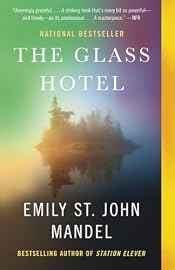
This is a novel that took me a while to warm up to. A young, beautiful woman named Vincent is working behind the bar in the remote hotel of the title, set away on the shores of Vancouver Island. She can't seem to get her life together and feels she is going nowhere. One evening a hotel guest, investment advisor Jonathan Alkaitis, much older than Vincent, sits himself down at the bar and before he leaves offers her a proposition. He will usher her into a life of untold wealth and ease. All she has to do is accompany him to New York City, pretend to be his wife, and be available to him at all times, for needs both social and sexual. She agrees, and off she goes. We are told that Alkaitis is actually a criminal, the perpetrator of a giant Ponzi scheme. Also woven into the story are Vincent's perpetually fraying at the edges half-brother Paul and several other people involved in the Ponzi scheme, either as employees of Alkaitis' company or as victims of the fraud. At first, although I thought the writing was very good, I couldn't connect to the narrative. Almost all of the characters seemed wholly self-absorbed, and over the years I have come to lose patience with fictional characters, men or women, whose progress is significantly abetted or even entirely created by their physical beauty. Eventually, though, I made my peace with all that, as the characters began to come alive more and I became better able to empathize with their situations. Woven throughout the various perspectives we're given here are serious questions of motivation, guilt, the degree to which people are, or aren't, responsible for the situations and lives of those around them, and the struggle to carve some sense of meaning out of difficult circumstances, whether that difficulty is self-imposed or otherwise. By the time I finished The Glass Hotel, I had the feeling I'd read a singularly impressive novel.
This is a novel that took me a while to warm up to. A young, beautiful woman named Vincent is working behind the bar in the remote hotel of the title, set away on the shores of Vancouver Island. She can't seem to get her life together and feels she is going nowhere. One evening a hotel guest, investment advisor Jonathan Alkaitis, much older than Vincent, sits himself down at the bar and before he leaves offers her a proposition. He will usher her into a life of untold wealth and ease. All she has to do is accompany him to New York City, pretend to be his wife, and be available to him at all times, for needs both social and sexual. She agrees, and off she goes. We are told that Alkaitis is actually a criminal, the perpetrator of a giant Ponzi scheme. Also woven into the story are Vincent's perpetually fraying at the edges half-brother Paul and several other people involved in the Ponzi scheme, either as employees of Alkaitis' company or as victims of the fraud. At first, although I thought the writing was very good, I couldn't connect to the narrative. Almost all of the characters seemed wholly self-absorbed, and over the years I have come to lose patience with fictional characters, men or women, whose progress is significantly abetted or even entirely created by their physical beauty. Eventually, though, I made my peace with all that, as the characters began to come alive more and I became better able to empathize with their situations. Woven throughout the various perspectives we're given here are serious questions of motivation, guilt, the degree to which people are, or aren't, responsible for the situations and lives of those around them, and the struggle to carve some sense of meaning out of difficult circumstances, whether that difficulty is self-imposed or otherwise. By the time I finished The Glass Hotel, I had the feeling I'd read a singularly impressive novel.
212kidzdoc
>211 rocketjk: Thanks for your great photos and travelogue, Jerry! Those new buildings remind me somewhat of similar high rise towers in Rotterdam, which were quirky, playful, and utterly unique.
213RidgewayGirl
I'm glad your vacation was a success. The photos are spectacular.
214dchaikin
>211 rocketjk: I’m trying to decide if this appeals or not. Very interesting review
215rocketjk
>214 dchaikin: Well, it's 300 pages and I found it pretty swift reading. It was at around the 100-page mark that it began to click in for me, so maybe you'd find it worth a try.
216lilisin
>211 rocketjk:
This was swift reading for me but I couldn't understand why I was reading it as I was reading it. The story just felt nonexistant for me even though it was right in front of my face. Years later I only remembered reading this book because I saw you mentioning it in the 'what are you reading' thread. It's amusing how differently we all react to books.
This was swift reading for me but I couldn't understand why I was reading it as I was reading it. The story just felt nonexistant for me even though it was right in front of my face. Years later I only remembered reading this book because I saw you mentioning it in the 'what are you reading' thread. It's amusing how differently we all react to books.
217rocketjk
>216 lilisin: "This was swift reading for me but I couldn't understand why I was reading it as I was reading it."
This was me for about the first third to first half of the book. Eventually the themes of self-delusion, each person's threshold for corruption, responsibility and guilt began to coalesce for me and make the story more coherent. And the writing was good. Nevertheless, I can certainly empathize with your reaction.
This was me for about the first third to first half of the book. Eventually the themes of self-delusion, each person's threshold for corruption, responsibility and guilt began to coalesce for me and make the story more coherent. And the writing was good. Nevertheless, I can certainly empathize with your reaction.
218ursula
>211 rocketjk: I think I read this one after The Sea of Tranquility, in which several of the characters also appear. I think that's the "wrong" order, although it probably doesn't really make that much difference since they're related, not book-sequel.
219SassyLassy
>211 rocketjk: This was a book I really liked, read for my RL book club. In addition to everything you've said, I think it captured rural life really well.
>214 dchaikin: I say give it a try!
>214 dchaikin: I say give it a try!
220qebo
>200 rocketjk: Albania
>206 rocketjk: why we chose Albania
Your posts appeared the same week as https://www.lawyersgunsmoneyblog.com/2025/05/election-of-the-day-albania, probably more about Albania than I've encountered in the prior decade.
>206 rocketjk: why we chose Albania
Your posts appeared the same week as https://www.lawyersgunsmoneyblog.com/2025/05/election-of-the-day-albania, probably more about Albania than I've encountered in the prior decade.
221rocketjk
>220 qebo: Funny, two nights ago at dinner a friend was telling us about the memoir that the article you linked to discusses. Our friend made it sound the author was basically longing for the good old days of Communism. Anyway, as to the article itself, the writer seems to be considering Albania's election almost entirely through the prism of the candidates' relationships with the U.S. I don't think that's a prescription for significant understanding in terms of what the two candidates might have to offer their own voters and to the future of their country. We actually got to see the current PM give a campaign talk in the small town we were staying in, as he was speaking in an open-air arena near the center of town when we happened to pass by. Of course we understood nary a word. Turns out Albanian campaign speeches are given in Albanian!
Nevertheless, the article you linked to is certainly interesting, so thanks for posting it!
Nevertheless, the article you linked to is certainly interesting, so thanks for posting it!
222rocketjk
OK, back to the travelog. I thought it might be handy to provide a link to a relatively readable map of the country for anyone following along here, so here you go:
https://www.ezilon.com/maps/images/europe/Albania-physical-map.gif
To review, we started out in Tirana, the capital city, which is pretty much centrally located. One thing I didn't mention in my Tirana post is that one day we hopped on a westbound bus to spend an afternoon in the coastal city of Durres. We had been told that the beaches there were very beautiful (this turned out to be true), but that the town, especially along the beach, had been overbuilt with tourist hotels (sadly, also true). But still, we wanted to see for ourselves. We did have a good time strolling along the beach, and we also had an absolutely fabulous seafood dinner, but we were happy we hadn't planned a longer stay there.
Then is was a short bus ride north to Kruje, also reported above. The plan as originally sketched out was for us to go to the southern part of the country, staying in the town of Gjirokaster, which in our guidebook looked beautiful and of historical interest, and then to move to Berat, which also looked interesting and which, according to our guidebook had the only significant remnants of Albanian Jewish history still viewable. It made sense to us to go to the relatively far southern reaches first (Gjirokaster) and then started making out way back toward the north, so that the final run towards the airport at the end of our vacation would be a shorter one. (Berat is about halfway between Gjirokaster and Tirana.) So, anyway, we hopped on the bus from Kruje to Tirana, and then into another from Tirana to Gjyrokaster. OK, caught up. Whew!
So, Gjirokaster was indeed a very interesting and lovely town, originally built on a mountain with . . . you guessed it! . . . a castle atop. The newer town is arrayed on the flatlands below the mountain. We showed up not knowing where we were going to stay. Our guidebook spoke of a lovely guesthouse about 2/3 of the way up the mountian. I should say that once the road starts going up, the streets become because cobblestone, lovely to look at but relatively difficult to drag a wheeled suitcase along. When we thought we were near the guesthouse, Steph took a seat to watch the bags and I headed around the corner, off the primary street, to see what I could do. Well, the former guest house was now a private home, but the fellow I spoke to through the metal gate pointed me back around the corner and further up the side road to a small, absolutely lovely hotel that had a room we could rent, not for that night but for the rest of our planned stay. I stumbled down the hill, to get Steph, who was delighted and suddenly revived, and we booked the room. The question of what to do that night. Well, Steph took a turn and followed a small sign to another nearby guest house, and soon we were set up and ready for dinner. Here are some photos of our time in Gjyrokaster:

I didn't get any postable photos of the hotel itself, but here is a shot looking out across the valley from the hotel's front porch.
 **
** 
Not counting the castle itself, the oldest buildings still standing seemed to be those from the Ottoman era. These houses had been owned by relatively wealthy Turkish families. (Another review: Albania was part of the Ottoman Empire for several centuries.) You could tell these houses by the tiles at the top of the entrance arches.

One more archway tile, just for good measure.

Here's a somewhat fuzzy photo of the castle from the outside. They had quite a commanding view of the surrounding mountains and valley.

Here's an artsy shot taken inside the castle grounds. We had a fun afternoon wandering around, but somehow this is the best picture I took.
I'll have a few more up from Gjirokaster tomorrow. We took a couple of gorgeous hikes.
https://www.ezilon.com/maps/images/europe/Albania-physical-map.gif
To review, we started out in Tirana, the capital city, which is pretty much centrally located. One thing I didn't mention in my Tirana post is that one day we hopped on a westbound bus to spend an afternoon in the coastal city of Durres. We had been told that the beaches there were very beautiful (this turned out to be true), but that the town, especially along the beach, had been overbuilt with tourist hotels (sadly, also true). But still, we wanted to see for ourselves. We did have a good time strolling along the beach, and we also had an absolutely fabulous seafood dinner, but we were happy we hadn't planned a longer stay there.
Then is was a short bus ride north to Kruje, also reported above. The plan as originally sketched out was for us to go to the southern part of the country, staying in the town of Gjirokaster, which in our guidebook looked beautiful and of historical interest, and then to move to Berat, which also looked interesting and which, according to our guidebook had the only significant remnants of Albanian Jewish history still viewable. It made sense to us to go to the relatively far southern reaches first (Gjirokaster) and then started making out way back toward the north, so that the final run towards the airport at the end of our vacation would be a shorter one. (Berat is about halfway between Gjirokaster and Tirana.) So, anyway, we hopped on the bus from Kruje to Tirana, and then into another from Tirana to Gjyrokaster. OK, caught up. Whew!
So, Gjirokaster was indeed a very interesting and lovely town, originally built on a mountain with . . . you guessed it! . . . a castle atop. The newer town is arrayed on the flatlands below the mountain. We showed up not knowing where we were going to stay. Our guidebook spoke of a lovely guesthouse about 2/3 of the way up the mountian. I should say that once the road starts going up, the streets become because cobblestone, lovely to look at but relatively difficult to drag a wheeled suitcase along. When we thought we were near the guesthouse, Steph took a seat to watch the bags and I headed around the corner, off the primary street, to see what I could do. Well, the former guest house was now a private home, but the fellow I spoke to through the metal gate pointed me back around the corner and further up the side road to a small, absolutely lovely hotel that had a room we could rent, not for that night but for the rest of our planned stay. I stumbled down the hill, to get Steph, who was delighted and suddenly revived, and we booked the room. The question of what to do that night. Well, Steph took a turn and followed a small sign to another nearby guest house, and soon we were set up and ready for dinner. Here are some photos of our time in Gjyrokaster:

I didn't get any postable photos of the hotel itself, but here is a shot looking out across the valley from the hotel's front porch.
 **
** 
Not counting the castle itself, the oldest buildings still standing seemed to be those from the Ottoman era. These houses had been owned by relatively wealthy Turkish families. (Another review: Albania was part of the Ottoman Empire for several centuries.) You could tell these houses by the tiles at the top of the entrance arches.

One more archway tile, just for good measure.

Here's a somewhat fuzzy photo of the castle from the outside. They had quite a commanding view of the surrounding mountains and valley.

Here's an artsy shot taken inside the castle grounds. We had a fun afternoon wandering around, but somehow this is the best picture I took.
I'll have a few more up from Gjirokaster tomorrow. We took a couple of gorgeous hikes.
223rocketjk
A few more Gjirokaster photos:
A bit outside the town there is a stone bridge called Ali Pasha's Bridge. It is the only remnant of an aqueduct system built in the early 1800s by Ali Pasha of Tepelen. It's about a 45 minute hike to get there. We took that hike one afternoon, although we didn't quite make it all the way to the bridge.

Here's a view of the bridge in the distance from the trail.

Turning around on that trail to look in the other direction, this is the view.

A closer look at the Ali Pasha Bridge.

The mountains through the trailside trees on the way up.
 **
** 
Two more photos from the castle: the new city, the agricultural plains and the mountains from the top of the castle walls.

The castle at night from an Old Town street

A glass of delicious Albanian white wine on the main square at the edge of the old town.

Cheesy moon and star photo: good night from Gyirokaster
A bit outside the town there is a stone bridge called Ali Pasha's Bridge. It is the only remnant of an aqueduct system built in the early 1800s by Ali Pasha of Tepelen. It's about a 45 minute hike to get there. We took that hike one afternoon, although we didn't quite make it all the way to the bridge.

Here's a view of the bridge in the distance from the trail.

Turning around on that trail to look in the other direction, this is the view.

A closer look at the Ali Pasha Bridge.

The mountains through the trailside trees on the way up.
 **
** 
Two more photos from the castle: the new city, the agricultural plains and the mountains from the top of the castle walls.

The castle at night from an Old Town street

A glass of delicious Albanian white wine on the main square at the edge of the old town.

Cheesy moon and star photo: good night from Gyirokaster
224rocketjk
Taking another break from the Albania photos and descriptions (I think I have one more such post to come), here at last is another review:
Postwar: A History of Europe Since 1945 by Tony Judt
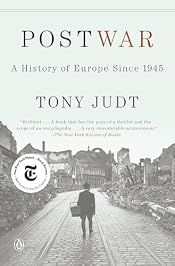
I finally finished Postwar, an astonishingly comprehensive and extremely well-written history of 60 years of European history, from 1945 through 2005, when the book was published. I was turned on to this book by a friend who is a history professor at Colgate University. Judt was a very well known historian and essayist (well known to everyone interested in history but me, evidently) who died a very difficult death in 2010 from ALS. I read the book in quarters, not because it was a difficult read, but solely because of its length, 831 pages including the epilogue, an essay about how postwar Europe has dealt with and discussed (or not discussed) the Holocaust over the various intervening generations.
The book opens with a comprehensive and fascinating exploration of the ways in which Europe had become a total shambles by World War Two's close. Judt moved his lens around slowly and determinedly, looking into conditions from Western Europe (a quick note: from now on any reference by me to "the West" means Western Europe specifically) through the Balkans and Scandinavia and into what would soon become the Soviet Bloc. He looks into both the Western Europeans' decisions that led to the relatively quick rebuilding of what became West Germany's economy and also the rearming of the country, over the strong objections of some of the allies. Rather than just treating the countries that would become the Soviet Bloc as, well, a block, Judt examines the conditions and events of each of them separately, and frequently returns to the area to report on the various countries' attempts to loosen the restrictive nature of their Communist governments. He also describes in detail the complicated political economic considerations of the Western countries--looking at them one country at a time--that eventually coalesced into NATO, the European Common Market, the European Court of Human Rights and finally, the European Union. Judt's description of the negotiations around the formation of the EU, and the adoption of the Euro, including the countries that either declined to enter at all (such as Norway) or to adopt the Euro (England), was very helpful to me in putting Brexit in a more comprehensible context. Judt delved into cultural and philosophical developments as the timeline moves along, on both side of the continent, providing detailed descriptions of the ways in which economics affects popular movements and vice versa. Judt hasn't much good to say about the Soviet rule over the Soviet Bloc countries. He also notes the European skepticism of the U.S. in terms of American cultural attitudes and even the individualist, highly capitalist nature of American culture and economics. Just describes the Marshall Plan as a great accomplishment that nevertheless led to resentment in countries like France, do didn't much care for the American savior attitude (my term, not Judt's). This also led to many French political philosophers to stick to an empathy for Soviet Russia that didn't match actual conditions behind the so-called Iron Curtain. One French philosopher who went against that grain was Raymond Aron, one of the few defenders of liberal democracy among the French pundit class. Aron was a friend but philosophical adversary of Jean-Paul Sartre, one of the most visible defenders of the Soviet Union among French intellectuals. In response to criticisms of the U.S. and capitalism in general, Judt quotes Aron as saying, "In politics the choice is never between good and evil, but between the preferable and the detestable." I highlight this relatively minor aspect of the book because that quote has really stuck with me. (According to Wikipedia, quoting an article from The Paris Review, "The saying 'Better {to} be wrong with Sartre than right with Aron' became popular among French intellectuals.")
At any rate, Judt shined his light on what seems like more or less every historical moment in every country in Europe across those 60 years. Since he left off in 2005, we can see the ways in which his examinations turned out to be right and sometimes missed the mark. For example, in 2005 he didn't expect Putin to be able to gather the economic or political strength to allow him to pose a threat to the peace of Europe. Of course I touched only on a slim minimum of the events and individuals Judt describes here. This is an extremely readable history that I recommend highly. If its length is daunting, it is easily broken up, as Judt organized the book into four separate sections, and I read these one at a time with another book in between each.
Postwar: A History of Europe Since 1945 by Tony Judt
I finally finished Postwar, an astonishingly comprehensive and extremely well-written history of 60 years of European history, from 1945 through 2005, when the book was published. I was turned on to this book by a friend who is a history professor at Colgate University. Judt was a very well known historian and essayist (well known to everyone interested in history but me, evidently) who died a very difficult death in 2010 from ALS. I read the book in quarters, not because it was a difficult read, but solely because of its length, 831 pages including the epilogue, an essay about how postwar Europe has dealt with and discussed (or not discussed) the Holocaust over the various intervening generations.
The book opens with a comprehensive and fascinating exploration of the ways in which Europe had become a total shambles by World War Two's close. Judt moved his lens around slowly and determinedly, looking into conditions from Western Europe (a quick note: from now on any reference by me to "the West" means Western Europe specifically) through the Balkans and Scandinavia and into what would soon become the Soviet Bloc. He looks into both the Western Europeans' decisions that led to the relatively quick rebuilding of what became West Germany's economy and also the rearming of the country, over the strong objections of some of the allies. Rather than just treating the countries that would become the Soviet Bloc as, well, a block, Judt examines the conditions and events of each of them separately, and frequently returns to the area to report on the various countries' attempts to loosen the restrictive nature of their Communist governments. He also describes in detail the complicated political economic considerations of the Western countries--looking at them one country at a time--that eventually coalesced into NATO, the European Common Market, the European Court of Human Rights and finally, the European Union. Judt's description of the negotiations around the formation of the EU, and the adoption of the Euro, including the countries that either declined to enter at all (such as Norway) or to adopt the Euro (England), was very helpful to me in putting Brexit in a more comprehensible context. Judt delved into cultural and philosophical developments as the timeline moves along, on both side of the continent, providing detailed descriptions of the ways in which economics affects popular movements and vice versa. Judt hasn't much good to say about the Soviet rule over the Soviet Bloc countries. He also notes the European skepticism of the U.S. in terms of American cultural attitudes and even the individualist, highly capitalist nature of American culture and economics. Just describes the Marshall Plan as a great accomplishment that nevertheless led to resentment in countries like France, do didn't much care for the American savior attitude (my term, not Judt's). This also led to many French political philosophers to stick to an empathy for Soviet Russia that didn't match actual conditions behind the so-called Iron Curtain. One French philosopher who went against that grain was Raymond Aron, one of the few defenders of liberal democracy among the French pundit class. Aron was a friend but philosophical adversary of Jean-Paul Sartre, one of the most visible defenders of the Soviet Union among French intellectuals. In response to criticisms of the U.S. and capitalism in general, Judt quotes Aron as saying, "In politics the choice is never between good and evil, but between the preferable and the detestable." I highlight this relatively minor aspect of the book because that quote has really stuck with me. (According to Wikipedia, quoting an article from The Paris Review, "The saying 'Better {to} be wrong with Sartre than right with Aron' became popular among French intellectuals.")
At any rate, Judt shined his light on what seems like more or less every historical moment in every country in Europe across those 60 years. Since he left off in 2005, we can see the ways in which his examinations turned out to be right and sometimes missed the mark. For example, in 2005 he didn't expect Putin to be able to gather the economic or political strength to allow him to pose a threat to the peace of Europe. Of course I touched only on a slim minimum of the events and individuals Judt describes here. This is an extremely readable history that I recommend highly. If its length is daunting, it is easily broken up, as Judt organized the book into four separate sections, and I read these one at a time with another book in between each.
225bell7
What amazing photos of your trip, thanks for sharing! I especially like the one you call artsy with all the photographs, and the way the reflection shows up in the wine glass. But truly all of them look great, and it sounds like you had a memorable time.
226rocketjk
A quick Albania story with three photos:
When last we left our intrepid travelers . . . Anyway, we had enjoyed our days in Gjirokaster and were figuring out our next jump. We had originally planned to head north to the town of Berat, reportedly quite beautiful and featuring some sites pertaining to Jewish history in the country. But as we did a bit of last minute research and talked to some locals, we became convinced, rightly or wrongly I'll probably never know, that the town had become very tourist-heavy. We'd also been planning to use Berat as a staging area for some day trips to the Albanian coast. Alas, we also learned that the more substantially sized beach towns had all been built up considerably with beachfront hotels, and that the more pristine beaches had no towns connected to them at all. You could spend a happy afternoon there but you couldn't stay overnight. Again, I'll never know whether this was accurate unless one of you all goes and reports back. Anyway, we decided instead to head east to a town called Pogradec, located on a very large lake (Lake Ohrid), which is one third in Albania and two thirds in Macedonia. This town, we thought, would be less tourist heavy and more relaxing, though beautiful in and of itself. And so it turned out. Here's the story of how we got there:
From Gyirokaster, we need to take a bus to the town of Korce (pronounced Kortcha) where we would overnight, and then catch another bus to Pogradec. Our Albanian bus schedule app assured us such a bus left the Gyirokaster bus station at 9:00 am. When we got to the station, sure enough, the posted schedule clearly listed a 9 am Korce bus. However, as we entered the bus yard, we realized we'd been followed into the yard by a gentleman we didn't know. As we looked around for the Korce bus, he asked us where we were going. When we told him, he said, "No bus to Korce. Taxi." Well how could that be? So Steph went into the ticket office while I watched the luggage. She came out quickly and said, "They no longer run a bus to Korce. They just haven't changed the sign." "No bus," said our new friend. "Taxi." So OK, we had to find a taxi, never a problem in Albania. "I am your driver," said our man. Well, of course he was. So, OK, we let this gentleman commandeer us. He walked us out and, to our relief, his car was actually lined up in the taxi queue. He was a legit cab driver. He wasn't first in line, but the heck with it, he was the one who'd had the get up and go to follow us into the bus station. So we settled on a price and got in the car. After driving for a few blocks, though, he pulled over to the curb. Would this be a shake down for more money? Well, no. This was him stopping so his wife, a school teacher with a day off due to a local holiday, could take the ride with us. The drive was long enough that the round trip was going to constitute a full work day, so why not have his wife along? So off we went. Very quickly the road turned beautiful indeed. Due to the mountains, and the fact that the country is still rebuilding its road system, there was no straight line. Instead we went almost due east, until we were within sight of the Greek border, in fact, and then north. When we took a rest stop for a bathroom break and, or course, an espresso, our driver's wife insisted that I get in front, and she would get in back with Steph. (On a subsequent break, I offered to switch and let Steph sit in front, but she declined, just so you know I'm not a total blockhead.) The driver chatted away to me, mostly in Albanian I didn't understand, though as we went over mountains he communicated that the new 2-lane road we were on was only two years old, and that before that we could have been shaking over very uneven pavement. Unfortunately for Steph, her friend in the backseat wanted to use her Google translate to play tour guide for her but also to chat about families and backgrounds and such. This was a delightful person, to be clear, but really all Steph wanted to do was look at the scenery. Well, anyway, she still had fun. Here are a couple of photos of the mountains along the journey, plus the selfie we took when we got to Korce.


I'll have one more Albania post about our time in Pogradec (or maybe two). Probably sometime next week.
When last we left our intrepid travelers . . . Anyway, we had enjoyed our days in Gjirokaster and were figuring out our next jump. We had originally planned to head north to the town of Berat, reportedly quite beautiful and featuring some sites pertaining to Jewish history in the country. But as we did a bit of last minute research and talked to some locals, we became convinced, rightly or wrongly I'll probably never know, that the town had become very tourist-heavy. We'd also been planning to use Berat as a staging area for some day trips to the Albanian coast. Alas, we also learned that the more substantially sized beach towns had all been built up considerably with beachfront hotels, and that the more pristine beaches had no towns connected to them at all. You could spend a happy afternoon there but you couldn't stay overnight. Again, I'll never know whether this was accurate unless one of you all goes and reports back. Anyway, we decided instead to head east to a town called Pogradec, located on a very large lake (Lake Ohrid), which is one third in Albania and two thirds in Macedonia. This town, we thought, would be less tourist heavy and more relaxing, though beautiful in and of itself. And so it turned out. Here's the story of how we got there:
From Gyirokaster, we need to take a bus to the town of Korce (pronounced Kortcha) where we would overnight, and then catch another bus to Pogradec. Our Albanian bus schedule app assured us such a bus left the Gyirokaster bus station at 9:00 am. When we got to the station, sure enough, the posted schedule clearly listed a 9 am Korce bus. However, as we entered the bus yard, we realized we'd been followed into the yard by a gentleman we didn't know. As we looked around for the Korce bus, he asked us where we were going. When we told him, he said, "No bus to Korce. Taxi." Well how could that be? So Steph went into the ticket office while I watched the luggage. She came out quickly and said, "They no longer run a bus to Korce. They just haven't changed the sign." "No bus," said our new friend. "Taxi." So OK, we had to find a taxi, never a problem in Albania. "I am your driver," said our man. Well, of course he was. So, OK, we let this gentleman commandeer us. He walked us out and, to our relief, his car was actually lined up in the taxi queue. He was a legit cab driver. He wasn't first in line, but the heck with it, he was the one who'd had the get up and go to follow us into the bus station. So we settled on a price and got in the car. After driving for a few blocks, though, he pulled over to the curb. Would this be a shake down for more money? Well, no. This was him stopping so his wife, a school teacher with a day off due to a local holiday, could take the ride with us. The drive was long enough that the round trip was going to constitute a full work day, so why not have his wife along? So off we went. Very quickly the road turned beautiful indeed. Due to the mountains, and the fact that the country is still rebuilding its road system, there was no straight line. Instead we went almost due east, until we were within sight of the Greek border, in fact, and then north. When we took a rest stop for a bathroom break and, or course, an espresso, our driver's wife insisted that I get in front, and she would get in back with Steph. (On a subsequent break, I offered to switch and let Steph sit in front, but she declined, just so you know I'm not a total blockhead.) The driver chatted away to me, mostly in Albanian I didn't understand, though as we went over mountains he communicated that the new 2-lane road we were on was only two years old, and that before that we could have been shaking over very uneven pavement. Unfortunately for Steph, her friend in the backseat wanted to use her Google translate to play tour guide for her but also to chat about families and backgrounds and such. This was a delightful person, to be clear, but really all Steph wanted to do was look at the scenery. Well, anyway, she still had fun. Here are a couple of photos of the mountains along the journey, plus the selfie we took when we got to Korce.


I'll have one more Albania post about our time in Pogradec (or maybe two). Probably sometime next week.
227rocketjk
Here are my post-Postwar "Between Book" selections via Stack 2:
* “The Biggest Little Team in Basketball” by Roy Damer (Chicago Tribune) from Best Sports Stories 1965 edited by Irving T. Marsh and Edward Ehre
* “A Story about a Collection of Stories” from Old Truths and New Cliches: Essays by Isaac Bashevis Singer edited by David Stromberg
* “Thomas W. Thompson—Law-Offce—Latin Grammar—Reasons for Going to an Academy—Goes to Exeter—Dr. Abbott” from The Public and Private Life of Daniel Webster by General S. P. Lyman
* “Johnny Kucks” from Sweet Seasons: Recollections of the 1955-64 New York Yankees by Dom Forker
* “Children of the Sea” from We’re Alone by Edwidge Danticat - Newly added
* Day 9, Story 3 from The Decameron by Giovanni Boccaccio (translated by Wayne A. Rebhorn)
* “Give Us This Day Our Daily Bread” by Alan Kimbell from The Saturday Evening Post, November, 1974
I'm now almost all the way through The Sleep of the Just, a novel first published in 1956 by Algerian author Mouloud Mammeri.
* “The Biggest Little Team in Basketball” by Roy Damer (Chicago Tribune) from Best Sports Stories 1965 edited by Irving T. Marsh and Edward Ehre
* “A Story about a Collection of Stories” from Old Truths and New Cliches: Essays by Isaac Bashevis Singer edited by David Stromberg
* “Thomas W. Thompson—Law-Offce—Latin Grammar—Reasons for Going to an Academy—Goes to Exeter—Dr. Abbott” from The Public and Private Life of Daniel Webster by General S. P. Lyman
* “Johnny Kucks” from Sweet Seasons: Recollections of the 1955-64 New York Yankees by Dom Forker
* “Children of the Sea” from We’re Alone by Edwidge Danticat - Newly added
* Day 9, Story 3 from The Decameron by Giovanni Boccaccio (translated by Wayne A. Rebhorn)
* “Give Us This Day Our Daily Bread” by Alan Kimbell from The Saturday Evening Post, November, 1974
I'm now almost all the way through The Sleep of the Just, a novel first published in 1956 by Algerian author Mouloud Mammeri.
228rocketjk
The Sleep of the Just by Mouloud Mammeri

Mouloud Mammeri (1917-1989) was an Algerian writer and professor, a scholar and teacher of Berber, his native language. The Sleep of the Just, a novel about a Berber family from a small village in Algeria, was first published in its original French in 1956 and in the U.S, in English translation in 1958. My copy seems to be a first American edition, published by Beacon Press. The description on the inside flyleaf begins with the claim that "This is the first book by an Algerian Arab to appear in translation in America." Whether this is accurate, I've no idea.
At any rate, I found this novel to be mostly fascinating. 1956, when the book was published, was two years after the beginning of the Algerian War of Independence from French colonial rule, but Mammeri begins his tale at the beginning of World War Two, just as the shooting has begun. Young Arezki feels smothered by life in his family's small village. The village's culture is a mix of Islam, and ancient Berber customs, including a generations-long blood feud involving his family, and the injustices of French colonial rule, in the person of a local administrator entirely contemptuous of the town's inhabitants. In addition is the presence of Toudert, Arezki's cousin, effectively rapacious and, with the administrator's blessing, gradually buying up all the agricultural land of the village. They speak Berber, not Arabic, which they do not even understand. As the tale begins, Arezki's younger brother Sliman is exclaiming that the war is going to be good for the poor of Algeria, sweeping the country clean. "The whole business will start afresh," he says. "It'll be like a game of dominos; there'll be a new deal." This is referred to as "Sliman's dominos theory" for the rest of the book. In the book's opening pages, Arezki makes a statement in the town square doubting the existence of God. Soon his father had dragged him home to explain himself. Arezki elaborates, and his father, enraged, goes for his rifle. Arezki dives out a window and tumbles into a creek bed, with his father's rifle shot missing him by inches. The novel, for the most part, follows Arezki and Sliman in turn as both leave the village and have their separate experiences, which add up to Mammeri's descriptions of the various pressures and lures of life for these young Berber men, reared and expected to live out their lives in subservient poverty: subservient to their religious leaders, to the stifling (to them) ancient customs of their village, and to their French colonial rulers. Mammeri moves his lens around frequently, from Arezki to Sliman, as well as to some of the book's supporting characters, showing us the various pressures, temptation and cultural influences that combine to sculpt their lives. This is a very interesting timepiece of a very interesting historical moment, and we come to care about both brothers as they try to make their separate ways.
The Wikipedia page on Mammeri (https://en.wikipedia.org/wiki/Mouloud_Mammeri) tells us that he fought with the French Army in World War Two and that after the war, "He was forced to leave Algiers in 1957 because of the Algerian War. Mammeri came back to Algeria shortly after its independence in 1962." It's unclear whether it was the French authorities or the Algerian revolutionaries who forced him to leave. I have no idea where I got this book. It's been on my shelves since before my LT "big bang" in 2008.

Mouloud Mammeri (1917-1989) was an Algerian writer and professor, a scholar and teacher of Berber, his native language. The Sleep of the Just, a novel about a Berber family from a small village in Algeria, was first published in its original French in 1956 and in the U.S, in English translation in 1958. My copy seems to be a first American edition, published by Beacon Press. The description on the inside flyleaf begins with the claim that "This is the first book by an Algerian Arab to appear in translation in America." Whether this is accurate, I've no idea.
At any rate, I found this novel to be mostly fascinating. 1956, when the book was published, was two years after the beginning of the Algerian War of Independence from French colonial rule, but Mammeri begins his tale at the beginning of World War Two, just as the shooting has begun. Young Arezki feels smothered by life in his family's small village. The village's culture is a mix of Islam, and ancient Berber customs, including a generations-long blood feud involving his family, and the injustices of French colonial rule, in the person of a local administrator entirely contemptuous of the town's inhabitants. In addition is the presence of Toudert, Arezki's cousin, effectively rapacious and, with the administrator's blessing, gradually buying up all the agricultural land of the village. They speak Berber, not Arabic, which they do not even understand. As the tale begins, Arezki's younger brother Sliman is exclaiming that the war is going to be good for the poor of Algeria, sweeping the country clean. "The whole business will start afresh," he says. "It'll be like a game of dominos; there'll be a new deal." This is referred to as "Sliman's dominos theory" for the rest of the book. In the book's opening pages, Arezki makes a statement in the town square doubting the existence of God. Soon his father had dragged him home to explain himself. Arezki elaborates, and his father, enraged, goes for his rifle. Arezki dives out a window and tumbles into a creek bed, with his father's rifle shot missing him by inches. The novel, for the most part, follows Arezki and Sliman in turn as both leave the village and have their separate experiences, which add up to Mammeri's descriptions of the various pressures and lures of life for these young Berber men, reared and expected to live out their lives in subservient poverty: subservient to their religious leaders, to the stifling (to them) ancient customs of their village, and to their French colonial rulers. Mammeri moves his lens around frequently, from Arezki to Sliman, as well as to some of the book's supporting characters, showing us the various pressures, temptation and cultural influences that combine to sculpt their lives. This is a very interesting timepiece of a very interesting historical moment, and we come to care about both brothers as they try to make their separate ways.
The Wikipedia page on Mammeri (https://en.wikipedia.org/wiki/Mouloud_Mammeri) tells us that he fought with the French Army in World War Two and that after the war, "He was forced to leave Algiers in 1957 because of the Algerian War. Mammeri came back to Algeria shortly after its independence in 1962." It's unclear whether it was the French authorities or the Algerian revolutionaries who forced him to leave. I have no idea where I got this book. It's been on my shelves since before my LT "big bang" in 2008.
229kjuliff
>228 rocketjk: I would love to read this book because I have an interest in Algeria. Have you seen the French film “The Battle of Algiers”? I must have seen it at least three times.
230rocketjk
>229 kjuliff: I'm sure I saw that movie long ago though I have very little memory of it.
231labfs39
I love the photos, Jerry. Thank you for posting! Also two excellent reviews, inspiring me to add two more titles to my wishlist.
232rocketjk
My post-The Sleep of the Just "Between Book" reading consisted of an intentional wander through Stack 1:
* “Pasha, Son of Selim,” excerpted from Horses Nine: Stories of Harness and Saddle by Sewell Ford in Literature - Book Two edited by Thomas H. Briggs
* “Leah Berlin,” excerpted from The Richter Files by Aharon Megged from New Writing from the Middle East edited by Leo Hamalian and John D. Yohannan
* “about my father” by Irena Klepfisz from Annual Gathering Commemorating the Warsaw Ghetto Uprising, 75th Anniversary, April 19, 2018 edited by Irena Klepfisz
* “Shane Bieber” from Smart, Wrong and Lucky: The Origin Stories of Baseball’s Unexpected Stars by Jonathan Mayo
* Day 9, Story 4 from The Decameron by Giovanni Boccaccio (translated by Wayne A. Rebhorn)
* “Simplissimus” by Eve Davis from The Saturday Evening Post, November, 1974
As eager as I am to read Charlie's Good Tonight, a biography of Rolling Stones drummer Charlie Watts, as reported above, I've set it aside for the moment to attend to First Person Singular, a short story collection by Haruki Murakami for my reading group. I'm more than a bit chagrined to have to admit that I've never read any of Murkami's works, so this is a welcomed diversion.
* “Pasha, Son of Selim,” excerpted from Horses Nine: Stories of Harness and Saddle by Sewell Ford in Literature - Book Two edited by Thomas H. Briggs
* “Leah Berlin,” excerpted from The Richter Files by Aharon Megged from New Writing from the Middle East edited by Leo Hamalian and John D. Yohannan
* “about my father” by Irena Klepfisz from Annual Gathering Commemorating the Warsaw Ghetto Uprising, 75th Anniversary, April 19, 2018 edited by Irena Klepfisz
* “Shane Bieber” from Smart, Wrong and Lucky: The Origin Stories of Baseball’s Unexpected Stars by Jonathan Mayo
* Day 9, Story 4 from The Decameron by Giovanni Boccaccio (translated by Wayne A. Rebhorn)
* “Simplissimus” by Eve Davis from The Saturday Evening Post, November, 1974
As eager as I am to read Charlie's Good Tonight, a biography of Rolling Stones drummer Charlie Watts, as reported above, I've set it aside for the moment to attend to First Person Singular, a short story collection by Haruki Murakami for my reading group. I'm more than a bit chagrined to have to admit that I've never read any of Murkami's works, so this is a welcomed diversion.
233rocketjk
Back to the Albania photos!

Although there had been no bus from Gjirokaster to Korce, there was, indeed, a bus for the much shorter journey from Korce to Pogradec, on the banks of Lake Ohrid. Some of the busses that traverse the country are full-sized carriages, but most are more like large vans. This was our ride to Pogradec.
When we got to Pogradec, and the lake, we found that both were exactly as we'd hoped they would be. One third of Lake Ohrid is in Albania, and two-thirds are in Macedonia, so in some of the photos I'm posting here, the mountains on view are in Macedonia. Steph had read in somebody's online travel blog that getting across the border into Macedonia was a hassle, so we didn't try it. Late into our time there, however, we chatted with a Danish couple who'd crossed over with no problem. Possibly the difference between the EU passport and an American passport was the issue, or possibly the blog Steph had seen was out of date, or just wrong. Anyway, the following are various photos of the lake from a variety of vantage points:


This picture was taken while we were on a hike up to the site of an ancient church that sits at the top of the hill above the town. There were many of these small produce gardens through the country, actually. We did get to see the church ruins. Photo forthcoming. A short anecdote of the walk, though: We had brought sandwiches along for the walk back down the hill. As we sat by the side of the road eating, a fellow came by with a small bag. As he saw us with our cheese sandwiches (I've already mentioned that the cheese in Albania is heavenly, right?) he reached into his bag and out came a freshly harvested scallion, which he handed to us with a smile. We took it with thanks. As he walked down the hill, he turned and looked at us and called out in Albanian (we had to look up the word), "Eat it!" So we tore it in half and each the pieces on our sandwiches. Flavorful and delicious!

Every set of lake photos needs at least one with a lone rowboat on the shore.

This gives a somewhat better context of what the lakeshore is like. Families and couples and groups of friends stroll the promenade you see here from mid-afternoon into the late evening. It's quite a lovely scene. And as we were hoping, there were very few tourists around. (As I like to joke, every tourist wants to be the only tourist.)

The lakefront at night. There's that rowboat again.

A second view, again presenting better context. The lights to the left of the photo are a small amusement park with simple rides, all designed for kids from around two to five years old, always bustling in the evenings. There were a couple of bars, cafes, and food booths along the promenade as well.

In the meantime, we received this photo via text of our German shepherd, Rosie, from the place in upstate NY where we'd boarded her for the duration of our trip. It was the first time we'd used this place, and we were very happy to see her lovely surroundings. She looked OK, which was a great relief to know.
More Pogradec/Lake Ohrid photos coming soon.

Although there had been no bus from Gjirokaster to Korce, there was, indeed, a bus for the much shorter journey from Korce to Pogradec, on the banks of Lake Ohrid. Some of the busses that traverse the country are full-sized carriages, but most are more like large vans. This was our ride to Pogradec.
When we got to Pogradec, and the lake, we found that both were exactly as we'd hoped they would be. One third of Lake Ohrid is in Albania, and two-thirds are in Macedonia, so in some of the photos I'm posting here, the mountains on view are in Macedonia. Steph had read in somebody's online travel blog that getting across the border into Macedonia was a hassle, so we didn't try it. Late into our time there, however, we chatted with a Danish couple who'd crossed over with no problem. Possibly the difference between the EU passport and an American passport was the issue, or possibly the blog Steph had seen was out of date, or just wrong. Anyway, the following are various photos of the lake from a variety of vantage points:


This picture was taken while we were on a hike up to the site of an ancient church that sits at the top of the hill above the town. There were many of these small produce gardens through the country, actually. We did get to see the church ruins. Photo forthcoming. A short anecdote of the walk, though: We had brought sandwiches along for the walk back down the hill. As we sat by the side of the road eating, a fellow came by with a small bag. As he saw us with our cheese sandwiches (I've already mentioned that the cheese in Albania is heavenly, right?) he reached into his bag and out came a freshly harvested scallion, which he handed to us with a smile. We took it with thanks. As he walked down the hill, he turned and looked at us and called out in Albanian (we had to look up the word), "Eat it!" So we tore it in half and each the pieces on our sandwiches. Flavorful and delicious!

Every set of lake photos needs at least one with a lone rowboat on the shore.

This gives a somewhat better context of what the lakeshore is like. Families and couples and groups of friends stroll the promenade you see here from mid-afternoon into the late evening. It's quite a lovely scene. And as we were hoping, there were very few tourists around. (As I like to joke, every tourist wants to be the only tourist.)

The lakefront at night. There's that rowboat again.

A second view, again presenting better context. The lights to the left of the photo are a small amusement park with simple rides, all designed for kids from around two to five years old, always bustling in the evenings. There were a couple of bars, cafes, and food booths along the promenade as well.

In the meantime, we received this photo via text of our German shepherd, Rosie, from the place in upstate NY where we'd boarded her for the duration of our trip. It was the first time we'd used this place, and we were very happy to see her lovely surroundings. She looked OK, which was a great relief to know.
More Pogradec/Lake Ohrid photos coming soon.
234mabith
It's so wonderful seeing your pictures from Albania and hearing about the trip. Thanks for posting about it!
235jjmcgaffey
My parents taught in Macedonia for a couple years and visited Lake Ohrid several times. Nice to see it again, from a different angle... (from their photos. I haven't been myself).
236Nickelini
Thank you for sharing your Albania photos and trip notes. One day! I have an Albanian friend who has shared gorgeous photos with me so I was already convinced. Another friend is there on holiday now. Seems like the place to be
237rocketjk
A bit more Albania. I'll start with a few photos of some hikes we took in the hills above and around Pogradec. In truth, most of these photos look like hiking trails you could find in California or New Jersey. Nevertheless, they're special to me, anyway, because they will always remind me of our final days in Albania.


On this hike we passed several of these fellows coming down the hill with freshly cut firewood on their donkey's backs.


These cement bunkers are all over Albania. Enver Hoxha, the Communist autocrat who ruled Albania for over 40 years, was paranoid about invasion. He built 140,000 of these bunker through the country (Albania is approximately the size of Maryland). His unfulfilled goal was to build 700,000 of them. We were told by people old enough to remember his rule (which didn't end until his death in 1985) that the country's economic problems were, if not caused, then at least greatly exacerbated, by the money wasted on these structures. We saw a couple of them on this hike, way up a lonely mountain trail.

The goal of one of our day hikes was an ancient church ruin with stone mosaic floors dating back to the 6th Century. When we got there, the fence surrounding the compound was locked, and nobody answered the phone number listed on the sign. We spent some time enjoying the view from the top of the mountain, then went back into the town. We happened upon a fellow who guessed somehow that we'd been trying to see the church ruins. He told us that the person in charge of letting people in was in Korca for a memorial for his brother, but that he'd be back in the afternoon. Long, story short, in the afternoon this same fellow helped us make contact with the caretaker. We were told to go back up the hill and wait, which we did. After about half an hour he showed up on a small motorcycle. He showed us around the stone ruins, telling us the age of the different sections. Because it was off-season, though, the floors were covered by a layer of dirt over which was plastic sheeting to protect the mosaics from the elements. However, he went to work pulling back a corner of the covering, and then used a shovel to scrape away the dirt, allowing us to see this small but breathtaking section of the 1,500-year-old mosaic floor.

Wandering the back residential streets of Pogradec.

OK. This one takes some explaining. On our way back through town after one of our rambles, we noticed a building that, upon further inspection, looked like a theater. Steph went up the short set of steps and pushed on the front door, which was unlocked. So we went in to see what sort of theater it was and whether there were any events coming up we might want to attend. There were two people inside who greeted us warmly. One was a fellow whose English was pretty good. He showed us the lobby photos that made it clear we were in a puppet theater. Then he insisted on bringing us back into the storeroom where all the puppets were housed. Some of them were quite old (as was this theater). Nothing would do put that we each had to be handed a puppet to try. Then he brought us into the theater proper, where we were sent up onto the stage and Steph's camera was commandeered so that our friend could take several photos of us, puppets in hand, with the eery stage lights aglow. You never know what you're going to get when you push on a door to see if it will open.

The front of our hotel in Pogradec.


On this hike we passed several of these fellows coming down the hill with freshly cut firewood on their donkey's backs.


These cement bunkers are all over Albania. Enver Hoxha, the Communist autocrat who ruled Albania for over 40 years, was paranoid about invasion. He built 140,000 of these bunker through the country (Albania is approximately the size of Maryland). His unfulfilled goal was to build 700,000 of them. We were told by people old enough to remember his rule (which didn't end until his death in 1985) that the country's economic problems were, if not caused, then at least greatly exacerbated, by the money wasted on these structures. We saw a couple of them on this hike, way up a lonely mountain trail.

The goal of one of our day hikes was an ancient church ruin with stone mosaic floors dating back to the 6th Century. When we got there, the fence surrounding the compound was locked, and nobody answered the phone number listed on the sign. We spent some time enjoying the view from the top of the mountain, then went back into the town. We happened upon a fellow who guessed somehow that we'd been trying to see the church ruins. He told us that the person in charge of letting people in was in Korca for a memorial for his brother, but that he'd be back in the afternoon. Long, story short, in the afternoon this same fellow helped us make contact with the caretaker. We were told to go back up the hill and wait, which we did. After about half an hour he showed up on a small motorcycle. He showed us around the stone ruins, telling us the age of the different sections. Because it was off-season, though, the floors were covered by a layer of dirt over which was plastic sheeting to protect the mosaics from the elements. However, he went to work pulling back a corner of the covering, and then used a shovel to scrape away the dirt, allowing us to see this small but breathtaking section of the 1,500-year-old mosaic floor.

Wandering the back residential streets of Pogradec.

OK. This one takes some explaining. On our way back through town after one of our rambles, we noticed a building that, upon further inspection, looked like a theater. Steph went up the short set of steps and pushed on the front door, which was unlocked. So we went in to see what sort of theater it was and whether there were any events coming up we might want to attend. There were two people inside who greeted us warmly. One was a fellow whose English was pretty good. He showed us the lobby photos that made it clear we were in a puppet theater. Then he insisted on bringing us back into the storeroom where all the puppets were housed. Some of them were quite old (as was this theater). Nothing would do put that we each had to be handed a puppet to try. Then he brought us into the theater proper, where we were sent up onto the stage and Steph's camera was commandeered so that our friend could take several photos of us, puppets in hand, with the eery stage lights aglow. You never know what you're going to get when you push on a door to see if it will open.

The front of our hotel in Pogradec.
239cindydavid4
>237 rocketjk: However, he went to work pulling back a corner of the covering, and then used a shovel to scrape away the dirt, allowing us to see this small but breathtaking section of the 1,500-year-old mosaic floor.
oh what a wonderful happenstanch! weve connected with a few of those folk in the right time and place to show us treasures. never forget the Roman elderly woman who helped us find such as we went down the steps of a cathedral leading us to a pagan temple . Another was in York where we were looking for miseicords (carvings under medival pews) he was so happy to show them to us even turning on lights for us to get a better look. one of the highlights of our trip
oh what a wonderful happenstanch! weve connected with a few of those folk in the right time and place to show us treasures. never forget the Roman elderly woman who helped us find such as we went down the steps of a cathedral leading us to a pagan temple . Another was in York where we were looking for miseicords (carvings under medival pews) he was so happy to show them to us even turning on lights for us to get a better look. one of the highlights of our trip
240RidgewayGirl
What a wonderful trip and a good reminder to go off the beaten path.
243rocketjk
A final night in Albania.
It was time to head home to be reunited with Rosie, the German shepherd, and resume our regular lives. Since the town of Kruje is actually closer to the airport than the capital city, Tirana, we'd booked a hotel for one final evening there. So it was back to Kruje for our last evening.

Here's an overview from the plaza where the old part of the city meets the modern town. As you can see, even here the town is pretty high up, and if you look closely at the horizon to the right, you can actually see the Adriatic.

Our last sunset in Albania!
It was time to head home to be reunited with Rosie, the German shepherd, and resume our regular lives. Since the town of Kruje is actually closer to the airport than the capital city, Tirana, we'd booked a hotel for one final evening there. So it was back to Kruje for our last evening.

Here's an overview from the plaza where the old part of the city meets the modern town. As you can see, even here the town is pretty high up, and if you look closely at the horizon to the right, you can actually see the Adriatic.

Our last sunset in Albania!
244rocketjk
>239 cindydavid4: "oh what a wonderful happenstance! weve connected with a few of those folk in the right time and place to show us treasures."
>240 RidgewayGirl: "What a wonderful trip and a good reminder to go off the beaten path."
Absolutely. Go off the beaten path and also make yourself open to meeting people and letting them lead you places and welcome you into their worlds. It's one reason Steph and I prefer to avoid tours whenever possible. We'd rather risk missing something "famous" and instead open ourselves up to experiencing something singular. It doesn't always happen, of course, but it happens just enough to make the tradeoff worthwhile to us. We've created many more great memories in places like that puppet theater than in museums and cathedrals (although museums and cathedrals are often terrific, too).
>242 Dilara86: "So many stunning photos! I'm envious..."
Thanks! But of course I'm only showing you the best photos! But also, like anyplace of course, Albania is not uniformly "lovely." For example, the main road between Tirana and Kruje is essentially lined with very unattractive commercial buildings. Everywhere the preponderance of structures are made of cement and stone. There are a lot of old, now crumbling 30 or 40 years on, cement and plaster buildings left over from the Communist era. Throughout the country, both in the cities and even the small towns, you will find abandoned shells of cement buildings, just sitting there. It's sometimes hard to tell whether they were walked away from mid-construction or whether they were stripped down for parts after being given up on as dilapidated.


This structure was right next door to the lovely Pogradec hotel we stayed at, pictured a few posts above.
There was a national election campaign going on when we were there, and one important difference between the two main candidates was that one wanted to apply for EU membership immediately and the other thought the country's economy needed more time to strengthen before applying to join the EU. But from that I take it that they're only debating timing rather than whether they think eventually being in the EU would be a good thing for the country. I bring that up because my guess is that these old wrecks have been left standing because their owners lack the money to take them down properly and replace them. Or maybe people are waiting for land values to go up before selling. I'm just conjecturing, now. Anyway, another guess is that once the country does attain EU membership, there will be grants forthcoming aimed at "beautifying" the landscape by getting rid of these eyesores, both for the benefit of Albanians and as a way to enhance the tourism industry.
Anyway, cement skeletons notwithstanding, Albania is a great place to visit, with beauty galore, and absolutely wonderful and welcoming people to meet. I think I might be tempted to say that Albania's greatest attraction is its people.
>240 RidgewayGirl: "What a wonderful trip and a good reminder to go off the beaten path."
Absolutely. Go off the beaten path and also make yourself open to meeting people and letting them lead you places and welcome you into their worlds. It's one reason Steph and I prefer to avoid tours whenever possible. We'd rather risk missing something "famous" and instead open ourselves up to experiencing something singular. It doesn't always happen, of course, but it happens just enough to make the tradeoff worthwhile to us. We've created many more great memories in places like that puppet theater than in museums and cathedrals (although museums and cathedrals are often terrific, too).
>242 Dilara86: "So many stunning photos! I'm envious..."
Thanks! But of course I'm only showing you the best photos! But also, like anyplace of course, Albania is not uniformly "lovely." For example, the main road between Tirana and Kruje is essentially lined with very unattractive commercial buildings. Everywhere the preponderance of structures are made of cement and stone. There are a lot of old, now crumbling 30 or 40 years on, cement and plaster buildings left over from the Communist era. Throughout the country, both in the cities and even the small towns, you will find abandoned shells of cement buildings, just sitting there. It's sometimes hard to tell whether they were walked away from mid-construction or whether they were stripped down for parts after being given up on as dilapidated.


This structure was right next door to the lovely Pogradec hotel we stayed at, pictured a few posts above.
There was a national election campaign going on when we were there, and one important difference between the two main candidates was that one wanted to apply for EU membership immediately and the other thought the country's economy needed more time to strengthen before applying to join the EU. But from that I take it that they're only debating timing rather than whether they think eventually being in the EU would be a good thing for the country. I bring that up because my guess is that these old wrecks have been left standing because their owners lack the money to take them down properly and replace them. Or maybe people are waiting for land values to go up before selling. I'm just conjecturing, now. Anyway, another guess is that once the country does attain EU membership, there will be grants forthcoming aimed at "beautifying" the landscape by getting rid of these eyesores, both for the benefit of Albanians and as a way to enhance the tourism industry.
Anyway, cement skeletons notwithstanding, Albania is a great place to visit, with beauty galore, and absolutely wonderful and welcoming people to meet. I think I might be tempted to say that Albania's greatest attraction is its people.
245Nickelini
>244 rocketjk: I think I might be tempted to say that Albania's greatest attraction is its people.
I have to say that my Albanian friend is one of the very nicest people I've ever known. Impeccable manners too.
I have to say that my Albanian friend is one of the very nicest people I've ever known. Impeccable manners too.
246rocketjk
First Person Singular by Haruki Murakami
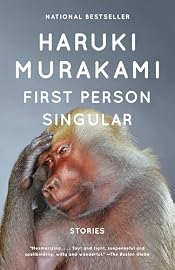
I very much enjoyed this quick collection of short stories by Murakami, an author I'm chagrined to say I was reading for the first time, here. I think the collection is particularly apt for folks in my time of life (I'll turn 70 in about five weeks), as I think all of the eight stories are narrated by a man in his 60s or 70s looking back at his life. They each revolve around a memory, and most of those memories seem unlikely or uncertain. In the first story, the narrator is remembering being invited to a piano recital by someone he knew in school but hasn't been in contact with for some years, and whom he'd thought didn't particularly like him. Why the invitation now? But when he gets to the concert hall, it's locked and there's no one around, though his invitation says he's in the right place on the correct evening. The narrator looks back at this event, and another odd event that's taken place right after, now decades in the past, never having solved the mystery of the phantom invitation. Obviously, a story like this wouldn't work without an author with the ability to use language with a superb adroitness, subtly dreamlike and yet straightforward. As I mentioned, these stories delve into the nature of memory, especially over the passage of time, and the ability to accept the memories of unlikely events intact, as memories, without dwelling overmuch on their "reality" or lack thereof. All in all I loved these, and will now have to make a point of reading more Murakami, just like the rest of the literate world has already done.
I very much enjoyed this quick collection of short stories by Murakami, an author I'm chagrined to say I was reading for the first time, here. I think the collection is particularly apt for folks in my time of life (I'll turn 70 in about five weeks), as I think all of the eight stories are narrated by a man in his 60s or 70s looking back at his life. They each revolve around a memory, and most of those memories seem unlikely or uncertain. In the first story, the narrator is remembering being invited to a piano recital by someone he knew in school but hasn't been in contact with for some years, and whom he'd thought didn't particularly like him. Why the invitation now? But when he gets to the concert hall, it's locked and there's no one around, though his invitation says he's in the right place on the correct evening. The narrator looks back at this event, and another odd event that's taken place right after, now decades in the past, never having solved the mystery of the phantom invitation. Obviously, a story like this wouldn't work without an author with the ability to use language with a superb adroitness, subtly dreamlike and yet straightforward. As I mentioned, these stories delve into the nature of memory, especially over the passage of time, and the ability to accept the memories of unlikely events intact, as memories, without dwelling overmuch on their "reality" or lack thereof. All in all I loved these, and will now have to make a point of reading more Murakami, just like the rest of the literate world has already done.
247kidzdoc
Wow, what an incredible and unforgettable journey, Jerry! Thank you for sharing it with us.
248rocketjk
>247 kidzdoc: Thanks, Darryl! And thanks to all who have (or will) comment(ed) on my Albania posts!
Now on to my post-First Person Singular "Between Book" report, a Stack 2 journey:
* “While Los Angeles Slept” by Morton Moss (Los Angleles Herald) from Best Sports Stories 1965 edited by Irving T. Marsh and Edward Ehre
* “The Making of a First Book” from Old Truths and New Cliches: Essays by Isaac Bashevis Singer edited by David Stromberg
* “Mr. Webster Teaches a Select School—A Frolic—Rev. Samuel Wood—Prepares for College—Enters Dartmouth” from The Public and Private Life of Daniel Webster by General S. P. Lyman
* “Hector Lopez” from Sweet Seasons: Recollections of the 1955-64 New York Yankees by Dom Forker
* “A Rainbow in the Sky” from We’re Alone by Edwidge Danticat
* Day 9, Story 5 from The Decameron by Giovanni Boccaccio (translated by Wayne A. Rebhorn)
* “Russia: 1974 Style” by Beurt SerVaas from The Saturday Evening Post, November, 1974
I'll now be reading Soul Mountain by Gao Xingjian.
Now on to my post-First Person Singular "Between Book" report, a Stack 2 journey:
* “While Los Angeles Slept” by Morton Moss (Los Angleles Herald) from Best Sports Stories 1965 edited by Irving T. Marsh and Edward Ehre
* “The Making of a First Book” from Old Truths and New Cliches: Essays by Isaac Bashevis Singer edited by David Stromberg
* “Mr. Webster Teaches a Select School—A Frolic—Rev. Samuel Wood—Prepares for College—Enters Dartmouth” from The Public and Private Life of Daniel Webster by General S. P. Lyman
* “Hector Lopez” from Sweet Seasons: Recollections of the 1955-64 New York Yankees by Dom Forker
* “A Rainbow in the Sky” from We’re Alone by Edwidge Danticat
* Day 9, Story 5 from The Decameron by Giovanni Boccaccio (translated by Wayne A. Rebhorn)
* “Russia: 1974 Style” by Beurt SerVaas from The Saturday Evening Post, November, 1974
I'll now be reading Soul Mountain by Gao Xingjian.
249labfs39
>246 rocketjk: I've read three of Murakami's works, and my favorite was Colorless Tsukuru Tazaki and His Years of Pilgrimage. In my review I wrote:
I loved this novel: the writing, the characters, the tone, and even the book design (the cover overlays a map of Japanese train stations). The other two books that I have read by Murakami were representative of his magical-surrealist style, and while I enjoyed them, I found them difficult reading. This one is completely different. There are no talking cats or parallel universes, just characters that I could relate to and empathize with, dealing with problems of belonging, self-awareness, and the unfathomable nature of relationships.
I believe Darryl liked it as well.
I loved this novel: the writing, the characters, the tone, and even the book design (the cover overlays a map of Japanese train stations). The other two books that I have read by Murakami were representative of his magical-surrealist style, and while I enjoyed them, I found them difficult reading. This one is completely different. There are no talking cats or parallel universes, just characters that I could relate to and empathize with, dealing with problems of belonging, self-awareness, and the unfathomable nature of relationships.
I believe Darryl liked it as well.
250SassyLassy
Really enjoyed your Albanian adventure. So many of the places you went are familiar to me through Kadare's novels, so definitely of another time, but it's good to know they're still there and that I can visit them.
251kjuliff
>250 SassyLassy: Ito have enjoyed the photos of your Albanian trip. Sadly, I missed Albania when I was traveling in the Balkans. So many different countries in such a small area it’s amazing how they’re also culturally different. Where are you going next?
252rocketjk
>251 kjuliff: "Where are you going next?"
Assuming you were addressing me, we're not sure, yet. Steph wants to go to Poland because she wants to search out some of the spots she knows some grandparents and great grandparents came from, and she wants to make a pilgrimage to Auschwitz. I have some family origins in Poland as well, on my mother's side, but unfortunately I have no specifics and there's nobody left I could ask. I have been planning on giving both Poland and Auschwitz a miss in this life, but I will willingly go to support her. I'm sure once I'm there I'll find it all extremely moving, and upsetting, which is essentially the point. That's more a history expedition than a relaxing vacation, but that may be it for next year. I've got an idea to have a secondary vacation somewhere closer. I've always wanted to see Montreal but never have, for example.
Assuming you were addressing me, we're not sure, yet. Steph wants to go to Poland because she wants to search out some of the spots she knows some grandparents and great grandparents came from, and she wants to make a pilgrimage to Auschwitz. I have some family origins in Poland as well, on my mother's side, but unfortunately I have no specifics and there's nobody left I could ask. I have been planning on giving both Poland and Auschwitz a miss in this life, but I will willingly go to support her. I'm sure once I'm there I'll find it all extremely moving, and upsetting, which is essentially the point. That's more a history expedition than a relaxing vacation, but that may be it for next year. I've got an idea to have a secondary vacation somewhere closer. I've always wanted to see Montreal but never have, for example.
253SassyLassy
>252 rocketjk: You absolutely cannot miss Montréal! Plus, it's so close.
254kjuliff
>252 rocketjk: Montreal would be a good choice I after Poland, which I imagine will be very emotional experience. When I traveled around Europe when I was much younger, I went to most countries, but avoided Germany and Poland. I just didn’t want to be in those places where such horror had occurred.
Much later in my life, I went to Germany, but I felt uneasy there. Many of my friends have been to Auschwitz and other camp locations, including the labor camps in Germany where many non Jewish Ukrainians were sent. They all say it was important for them .
I won’t say I hope you enjoy Poland, but I think it will be important. Montreal has that French joie de vivre so I think it’s an excellent choice to end your vacation with.
Much later in my life, I went to Germany, but I felt uneasy there. Many of my friends have been to Auschwitz and other camp locations, including the labor camps in Germany where many non Jewish Ukrainians were sent. They all say it was important for them .
I won’t say I hope you enjoy Poland, but I think it will be important. Montreal has that French joie de vivre so I think it’s an excellent choice to end your vacation with.
255rocketjk
>254 kjuliff: " . . . but avoided Germany and Poland. I just didn’t want to be in those places where such horror had occurred."
That's always been my feeling, too. Too many ghosts. But everybody tells me what a great city Berlin is, and I do believe it, so maybe I do need to see it for myself. Anyway, I certainly don't have any grudges against the people living in those places now. People are not responsible for what their grandparents did. (I know you weren't saying they are.)
"Montreal has that French joie de vivre so I think it’s an excellent choice to end your vacation with."
I think Montreal would be an entirely separate trip rather than tacked on at the end of a Poland journey. But we'll have to see. Neither would happen until next year. We do have a trip to New Orleans booked for next spring. I want to go to one more Mardi Gras and Steph has never been to one. Laissez le bon temps rouler!
That's always been my feeling, too. Too many ghosts. But everybody tells me what a great city Berlin is, and I do believe it, so maybe I do need to see it for myself. Anyway, I certainly don't have any grudges against the people living in those places now. People are not responsible for what their grandparents did. (I know you weren't saying they are.)
"Montreal has that French joie de vivre so I think it’s an excellent choice to end your vacation with."
I think Montreal would be an entirely separate trip rather than tacked on at the end of a Poland journey. But we'll have to see. Neither would happen until next year. We do have a trip to New Orleans booked for next spring. I want to go to one more Mardi Gras and Steph has never been to one. Laissez le bon temps rouler!
256jessibud2
Hello. Delurking to join the conversation about your thoughts about visiting Montreal, my hometown. By the way, I love your photos and travelogue from Albania.
I am originally from Montreal but have lived in Toronto since 1980. I used to visit once or twice a year until my mum got sick and then it was every month, or more frequently, until she passed away last year. Last month, I decided to go back for a visit with a friend. I hadn't been back since my mum died and this time, I told no one, just so I could play tourist. I really am a tourist when there, truth be told, as I grew up in a northern suburb and never really lived *in* Montreal so don't know it very well. We had a great time and if you are interested in seeing photos, I started posting some at post#42 on my thread: https://www.librarything.com/topic/369783#n8872781
I know there is a way to link directly to the post but I forget how.
Anyhow, thought you might be interested.
I am originally from Montreal but have lived in Toronto since 1980. I used to visit once or twice a year until my mum got sick and then it was every month, or more frequently, until she passed away last year. Last month, I decided to go back for a visit with a friend. I hadn't been back since my mum died and this time, I told no one, just so I could play tourist. I really am a tourist when there, truth be told, as I grew up in a northern suburb and never really lived *in* Montreal so don't know it very well. We had a great time and if you are interested in seeing photos, I started posting some at post#42 on my thread: https://www.librarything.com/topic/369783#n8872781
I know there is a way to link directly to the post but I forget how.
Anyhow, thought you might be interested.
257jjmcgaffey
Hit the More at the bottom of the post, right-click and copy the Link from there. Post #42 is https://www.librarything.com/topic/369783#8816901
258TadAD
>252 rocketjk: I visiting Dachau and found it incredibly moving. I wonder if I visited Auschwitz, would I find the same experience, or more since Auschwitz was more than Dachau, or less since Dachau already exposed me? Poland and the Baltics are on the list of places to see someday, but that list is long, so I don't know if I'll find out.
259jessibud2
>257 jjmcgaffey: - Thanks! Duly copied and noted, so I remember!
260rocketjk
Soul Mountain by Gao Xingjian
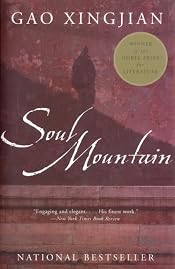
Readers looking for anything like a standard plot, or even standard character development, should look elsewhere than this long (506 pages in my Perennial paperback edition), often intriguingly written, reverie on memory, history, and the mysteries, beauty, cruelty and absurdities of human nature. As the description on my copy's back cover tells us, Soul Mountain is semi-autobiographical. In 1983, Gao Xingjiam was diagnosed with lung cancer and given only months to live. Six weeks later he found out the diagnosis had been wrong. He had no cancer. In the meantime, the prolific playwright, novelist, painter and critic was under scrutiny from the Chinese regime. Says the book's description, "Faced with a repressive cultural environment and the threat of a spell in a prison farm, Gao fled Beijing and began a journey of 15,000 kilometers into the remote mountains and ancient forests of Sichuan in southeast China." Soul Mountain is the result of that journey, but this is much more than a fictionalized travelogue. Gao presents his work in a series of 81 short chapters, each anywhere from three to eight pages, alternating perspectives, time periods, modes of narrative and physical locations seemingly at random. The first half of the book alternates chapters between a first person narrator and weirdly disjointed second person storytelling. Many of these latter entail a man telling stories about history and mythology--but sometimes about much more recent events as well, to a woman he has met along his travels. These sections became problematic for me, as the woman is portrayed as a bundle of frailties and insecurities and the couples interactions grew tiresome to me. After a while, though, and I guess this is a bit of a spoiler, these interactions fade away.
The stories the fictional Gao relates have to do with his searches for remnants of the many layers of Chinese history, giving him a several thousand year deep territory to explore. He tells tales ranging from ancient history right up through the Cultural Revolution. He runs into very old Daoist priests and young archeologists, all of whom have stories to tell him and places to show him, or at least to point him towards. He tells tales of wars and famines, but also of love, friendship, devotion and courage. He adds in stories about his own life and family history as well, all the while exploring the importance of the natural world (as well as the environmental degradation he finds, mostly portrayed by the clearcutting of ancient forests). As one would expect from the book's title, mountains, and the climbing of mountains, fuel a recurring theme, as does the beauty of music, and especially singing and chanting, heard indistinctly and from a distance.
At one point, the narrator wonders why many of the small, crumbling villages he visits make him homesick for his childhood, despite the fact that his actual childhood was spent in a city:
The tomb of Lu Guimeng of the Tang Dynasty, probably containing nothing but his clothes and headwear, is a grave covered with creepers and wild hemp in the back courtyard of some anonymous old school next to fields and a few old trees, yet the slanting rays of the afternoon sun are stained with your inexplicable grief. The lonely compounds in the Yi districts and the wooden houses on pylons of the remote Mao stockades halfway up mountains, which you had never dreamed about, are telling you something. You can't help wondering whether you have another life, that you have retained some memories of a previous existence, or that these places will be your refuge in a future existence. Could it be that these memories are like liquor and after fermentation will produce a pure and fragrant concoction which will intoxicate you again?
What in fact are childhood memories? How can they be verified? Just keep them in your heart, why do you insist on verifying them?
You realize that the childhood you have been searching for doesn't necessarily have a definite location. And isn't it the same with one's so-called hometown? It's no wonder that blue chimney smoke drifting over roof-tiles of houses in little towns, bellows groaning in front of wood stoves, those translucent rice-colored little insects with short forelegs and long hind-legs, the campfires and the mud-sealed woodpile beehives hanging on the walls of the houses of mountain people, all evoke this homesickness of yours and have become the hometown of your dreams.
Although you were born in the city, grew up in cities and spent the larger part of your life in some huge urban metropolis, you can't make that huge urban metropolis the hometown of your heart. . . . You should know that there is little you can seek in this world, that there is no need for you to be so greedy, in the end all you can achieve are memories, hazy, intangible, dreamlike memories which are impossible to articulate. When you try to relate them, there are only sentences, the dregs left from the filter of linguistic structures.
From time to time Gao also pokes a stick at the nature of fiction and storytelling. There is a hilarious short chapter in which an imaginary critic snarls at Gao about the muddle and chaos he is creating and passing off as a novel:
You've slapped together travel notes, moralistic ramblings, feelings, notes, jottings, untheoretical discussions, unfable-like fables, copied out some folk songs, added some legend-like nonsense of your own invention and are calling it fiction!
Other than the previously mentioned reservation about the nature of the relationship between the "You" and "She" characters in the second-person chapters, I quite enjoyed Soul Mountain, though it sometimes was a slow journey. The trip through the rural backroads of China and the drifting up and down through historical eras, their histories and folktales, fanciful as a lot of it may well be, was an engaging one for me, and it's sometimes fun to just sink into a long book and float along with its pace. I will say, though, that by the end, and maybe over the final 75 pages or so, I was ready to be finished. I felt that the point had been made, the ideas had been expressed, and that I was not gaining anything new. Even the personality and observations of the narrator had become somewhat repetitive, so that I ended up wishing that the novel had ended, say, 100 pages sooner. It was this extra length that brought the rating down for me to 3 1/2 stars. I would recommend Soul Mountain, though, to any readers who enjoy this sort of novel. It's really a tour de force of reflective, descriptive storytelling and narrative, and the beauty of it is that you can really stop any time you like once things begin to grind for you, assuming they ever do.
Readers looking for anything like a standard plot, or even standard character development, should look elsewhere than this long (506 pages in my Perennial paperback edition), often intriguingly written, reverie on memory, history, and the mysteries, beauty, cruelty and absurdities of human nature. As the description on my copy's back cover tells us, Soul Mountain is semi-autobiographical. In 1983, Gao Xingjiam was diagnosed with lung cancer and given only months to live. Six weeks later he found out the diagnosis had been wrong. He had no cancer. In the meantime, the prolific playwright, novelist, painter and critic was under scrutiny from the Chinese regime. Says the book's description, "Faced with a repressive cultural environment and the threat of a spell in a prison farm, Gao fled Beijing and began a journey of 15,000 kilometers into the remote mountains and ancient forests of Sichuan in southeast China." Soul Mountain is the result of that journey, but this is much more than a fictionalized travelogue. Gao presents his work in a series of 81 short chapters, each anywhere from three to eight pages, alternating perspectives, time periods, modes of narrative and physical locations seemingly at random. The first half of the book alternates chapters between a first person narrator and weirdly disjointed second person storytelling. Many of these latter entail a man telling stories about history and mythology--but sometimes about much more recent events as well, to a woman he has met along his travels. These sections became problematic for me, as the woman is portrayed as a bundle of frailties and insecurities and the couples interactions grew tiresome to me. After a while, though, and I guess this is a bit of a spoiler, these interactions fade away.
The stories the fictional Gao relates have to do with his searches for remnants of the many layers of Chinese history, giving him a several thousand year deep territory to explore. He tells tales ranging from ancient history right up through the Cultural Revolution. He runs into very old Daoist priests and young archeologists, all of whom have stories to tell him and places to show him, or at least to point him towards. He tells tales of wars and famines, but also of love, friendship, devotion and courage. He adds in stories about his own life and family history as well, all the while exploring the importance of the natural world (as well as the environmental degradation he finds, mostly portrayed by the clearcutting of ancient forests). As one would expect from the book's title, mountains, and the climbing of mountains, fuel a recurring theme, as does the beauty of music, and especially singing and chanting, heard indistinctly and from a distance.
At one point, the narrator wonders why many of the small, crumbling villages he visits make him homesick for his childhood, despite the fact that his actual childhood was spent in a city:
The tomb of Lu Guimeng of the Tang Dynasty, probably containing nothing but his clothes and headwear, is a grave covered with creepers and wild hemp in the back courtyard of some anonymous old school next to fields and a few old trees, yet the slanting rays of the afternoon sun are stained with your inexplicable grief. The lonely compounds in the Yi districts and the wooden houses on pylons of the remote Mao stockades halfway up mountains, which you had never dreamed about, are telling you something. You can't help wondering whether you have another life, that you have retained some memories of a previous existence, or that these places will be your refuge in a future existence. Could it be that these memories are like liquor and after fermentation will produce a pure and fragrant concoction which will intoxicate you again?
What in fact are childhood memories? How can they be verified? Just keep them in your heart, why do you insist on verifying them?
You realize that the childhood you have been searching for doesn't necessarily have a definite location. And isn't it the same with one's so-called hometown? It's no wonder that blue chimney smoke drifting over roof-tiles of houses in little towns, bellows groaning in front of wood stoves, those translucent rice-colored little insects with short forelegs and long hind-legs, the campfires and the mud-sealed woodpile beehives hanging on the walls of the houses of mountain people, all evoke this homesickness of yours and have become the hometown of your dreams.
Although you were born in the city, grew up in cities and spent the larger part of your life in some huge urban metropolis, you can't make that huge urban metropolis the hometown of your heart. . . . You should know that there is little you can seek in this world, that there is no need for you to be so greedy, in the end all you can achieve are memories, hazy, intangible, dreamlike memories which are impossible to articulate. When you try to relate them, there are only sentences, the dregs left from the filter of linguistic structures.
From time to time Gao also pokes a stick at the nature of fiction and storytelling. There is a hilarious short chapter in which an imaginary critic snarls at Gao about the muddle and chaos he is creating and passing off as a novel:
You've slapped together travel notes, moralistic ramblings, feelings, notes, jottings, untheoretical discussions, unfable-like fables, copied out some folk songs, added some legend-like nonsense of your own invention and are calling it fiction!
Other than the previously mentioned reservation about the nature of the relationship between the "You" and "She" characters in the second-person chapters, I quite enjoyed Soul Mountain, though it sometimes was a slow journey. The trip through the rural backroads of China and the drifting up and down through historical eras, their histories and folktales, fanciful as a lot of it may well be, was an engaging one for me, and it's sometimes fun to just sink into a long book and float along with its pace. I will say, though, that by the end, and maybe over the final 75 pages or so, I was ready to be finished. I felt that the point had been made, the ideas had been expressed, and that I was not gaining anything new. Even the personality and observations of the narrator had become somewhat repetitive, so that I ended up wishing that the novel had ended, say, 100 pages sooner. It was this extra length that brought the rating down for me to 3 1/2 stars. I would recommend Soul Mountain, though, to any readers who enjoy this sort of novel. It's really a tour de force of reflective, descriptive storytelling and narrative, and the beauty of it is that you can really stop any time you like once things begin to grind for you, assuming they ever do.
261labfs39
>260 rocketjk: Fantastic review, Jerry. As I mentioned above, I have owned this book for a long time, but was put off after reading a collection of short stories by Gao Xingjian. Your review both confirms this decision and paradoxically entices me. I'm not sure when I will get to it, but I now know what to expect when/if I do.
262FlorenceArt
>260 rocketjk: I read this book and I have absolutely no recollection of it, even after reading your review. Well, except that I found it disappointing. I feel slightly guilty ☺️
263rocketjk
My post-Soul Mountain "between book" reading brought me wandering through Stack 1:
* “The Taming of Don Fulano,” excerpted from John Brent by Theodore Winthrop in Literature - Book Two edited by Thomas H. Briggs
* “If There is Justice,” from Elsewhere, Perhaps by Amos Oz from New Writing from the Middle East edited by Leo Hamalian and John D. Yohannan
* “Autumn 1943 on Warsaw’s Aryan Side,” excerpted from On Both Sides of the Wall: Memoirs from the Warsaw Ghetto by Vladka Meed from Annual Gathering Commemorating the Warsaw Ghetto Uprising, 75th Anniversary, April 19, 2018 edited by Irena Klepfisz
* “Jacob deGrom” from Smart, Wrong and Lucky: The Origin Stories of Baseball’s Unexpected Stars by Jonathan Mayo
* Day 9, Story 6 from The Decameron by Giovanni Boccaccio (translated by Wayne A. Rebhorn)
* “Baba Yaga and the Peddler” by Katherine Kurtz from The Saturday Evening Post, November, 1974
Next up for me is Charlie's Good Tonight, a biography of Rolling Stones drummer Charlie Watts by English music journalist Paul Sexton.
* “The Taming of Don Fulano,” excerpted from John Brent by Theodore Winthrop in Literature - Book Two edited by Thomas H. Briggs
* “If There is Justice,” from Elsewhere, Perhaps by Amos Oz from New Writing from the Middle East edited by Leo Hamalian and John D. Yohannan
* “Autumn 1943 on Warsaw’s Aryan Side,” excerpted from On Both Sides of the Wall: Memoirs from the Warsaw Ghetto by Vladka Meed from Annual Gathering Commemorating the Warsaw Ghetto Uprising, 75th Anniversary, April 19, 2018 edited by Irena Klepfisz
* “Jacob deGrom” from Smart, Wrong and Lucky: The Origin Stories of Baseball’s Unexpected Stars by Jonathan Mayo
* Day 9, Story 6 from The Decameron by Giovanni Boccaccio (translated by Wayne A. Rebhorn)
* “Baba Yaga and the Peddler” by Katherine Kurtz from The Saturday Evening Post, November, 1974
Next up for me is Charlie's Good Tonight, a biography of Rolling Stones drummer Charlie Watts by English music journalist Paul Sexton.
264rocketjk
>262 FlorenceArt: Ha! Are you feeling guilty about not remembering anything about Soul Mountain or about having found it disappointing? I don't think either is necessary, for whatever ice that might cut with you. It's not really a book you'd remember details about, I don't think, and I could easily see how a reader might be disappointed, given the book's reputation and what it actually delivers.
265rocketjk
Charlie's Good Tonight: The Life, the Times, and The Rolling Stones by Paul Sexton
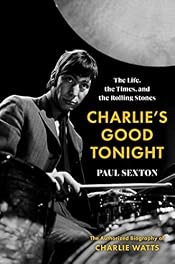
Charlie's Good Tonight is a biography of Charlie Watts, the legendary drummer for The Rolling Stones from their beginnings in 1962 through his death at the age of 80 in 2021. The author, Paul Sexton, is an English music journalist, documentary maker and radio producer who has interviewed the Stones musicians since the 1990s. He started working with Watts on this book several years before Watts' passing (from squamous-cell carcinoma). As the biography, then, was authorized by Watts, Watts' bandmates, family members and friends were willing to sit with Sexton for interviews as well.
This is a chatty and relatively well-written narrative about the life of a great musician. We learn a lot about who Charlie Watts was as a person, which is nice, as he was evidently a very nice guy for the most part. Watts' first musical love, and a love which lasted throughout his life, was jazz. Especially over the latter part of his life, Watts led several jazz bands, which he took on tour during lulls in the Stones' touring schedules. From the very beginning, Watts had nothing but boredom and disdain when it came to the trappings of rock and roll stardom. When his mates were partying, especially during the heady days of the 60s and 70s, Watts was generally in his hotel room on the phone with his wife, Shirley. Unusually for a rock and roll marriage, Watts' marriage to Shirley lasted from 1964 through their entire lives (Shirley died in 2022). They had one daughter and one grand-daughter, and a very strong family unit.
The drawback of the biography, as I experienced it anyway, is that there is precious little detail, especially little musical information, about the group's most famous period, those 60s and 70s albums when the Rolling Stones were breaking all sorts of musical ground and attaining a breathtaking level of musical excellence. We spend no time, via interviews, in the studio with the band during the creation of early hits like "Satisfaction," "Paint it Black" and "Get Off of My Cloud." The period that many fans consider the band's creative acme, when excellent lead guitarist Mick Taylor joined the group and they produced "Beggars' Banquet," "Sticky Fingers" and "Exile on Main Street," is described but rushed through. It isn't until later in the band's life, when their albums stayed good but were no longer groundbreaking, that we begin to get blow-by-blow details about the albums' writing and production and learn about the experience of touring in support of those albums. I suspect one issue here is the fact that Sexton doesn't really begin digging in until he gets to (or at least close to chronologically) the period of the band's life that he experienced personally. Another hurdle for Sexton was probably the fact that Watts claimed never to listen back to Rolling Stones albums once they were released. Still, questions about what it was like to be in the studio during the recording of "Satisfaction," or about how he came up with the iconic drum beat for "Paint it Black," for example, might have gotten some sort of interesting answers. We also don't learn, until about the book's 3/4 point, what it was about Watts' drumming, from a musician's point of view, that set him apart, and even then we get precious little. When I read a musician's biography, I do want to learn about what makes that person special as a musician. I'm not a musician myself, but I have spent quite a bit of time interviewing musicians, so I know that this can be done without descending into the kind of technical musical jargon that won't help most readers. Sexton seemed to think his readers would care more about dozens of pages about Watts' mania for antique collecting than about what made him a unique rock and roll percussion stylist. Even if Watts himself was reticent about such things, fellow Stones Mick Jagger, Keith Richards and Bill Wyman might have had much more to say on the topic. They are quoted fairly extensively, but mostly about what a great guy Watts was.
There is plenty that Sexton leaves out and/or that he assumes his readers already know, about the history of the band and even about Watts. The mid-career falling out between Jagger and Richards is alluded to but never explained. Why were they mad at each other? I guess the point is that anyone who'd read Richards' autobiography, or any number of Stones tell-all histories, would already know. I haven't read any of those and I'm unlikely to. Give us a hint, couldn't ya, Paul? Similarly, Watts' relatively late in life (his 40s) 5-year plunge into drug addiction is rushed through in three or four pages. What drugs was he on? How did it start? How did it all affect his family life? A mention and a couple of whispers is about all we get. It's not like I need to know gory details, but this is a biography after all.
Well, as I said up top, we do get a pretty good idea of what Charlie Watts was like as a person here. Basically, however, never, really, is heard a discouraging word on that score. So do we trust Sexton about this? The preponderance of evidence here, anyway, suggests we can. We also get, I think, a fairly good picture of what being a Rolling Stone was like for Watts. There are few "juicy" stories, but then I'd conjecture that writing a biography about the retiring, self-effacing, family man Rolling Stone was a relatively tough task. One thing it's nice to learn is, that Richards/Jagger squabble aside, what a close knit crew the Stones have remained with each other over the years. And also, not having read any other Rolling Stones-related bios or histories, what intelligent, thoughtful people Jagger, Richards and Wyman are.
Charlie's Good Tonight is a biography of Charlie Watts, the legendary drummer for The Rolling Stones from their beginnings in 1962 through his death at the age of 80 in 2021. The author, Paul Sexton, is an English music journalist, documentary maker and radio producer who has interviewed the Stones musicians since the 1990s. He started working with Watts on this book several years before Watts' passing (from squamous-cell carcinoma). As the biography, then, was authorized by Watts, Watts' bandmates, family members and friends were willing to sit with Sexton for interviews as well.
This is a chatty and relatively well-written narrative about the life of a great musician. We learn a lot about who Charlie Watts was as a person, which is nice, as he was evidently a very nice guy for the most part. Watts' first musical love, and a love which lasted throughout his life, was jazz. Especially over the latter part of his life, Watts led several jazz bands, which he took on tour during lulls in the Stones' touring schedules. From the very beginning, Watts had nothing but boredom and disdain when it came to the trappings of rock and roll stardom. When his mates were partying, especially during the heady days of the 60s and 70s, Watts was generally in his hotel room on the phone with his wife, Shirley. Unusually for a rock and roll marriage, Watts' marriage to Shirley lasted from 1964 through their entire lives (Shirley died in 2022). They had one daughter and one grand-daughter, and a very strong family unit.
The drawback of the biography, as I experienced it anyway, is that there is precious little detail, especially little musical information, about the group's most famous period, those 60s and 70s albums when the Rolling Stones were breaking all sorts of musical ground and attaining a breathtaking level of musical excellence. We spend no time, via interviews, in the studio with the band during the creation of early hits like "Satisfaction," "Paint it Black" and "Get Off of My Cloud." The period that many fans consider the band's creative acme, when excellent lead guitarist Mick Taylor joined the group and they produced "Beggars' Banquet," "Sticky Fingers" and "Exile on Main Street," is described but rushed through. It isn't until later in the band's life, when their albums stayed good but were no longer groundbreaking, that we begin to get blow-by-blow details about the albums' writing and production and learn about the experience of touring in support of those albums. I suspect one issue here is the fact that Sexton doesn't really begin digging in until he gets to (or at least close to chronologically) the period of the band's life that he experienced personally. Another hurdle for Sexton was probably the fact that Watts claimed never to listen back to Rolling Stones albums once they were released. Still, questions about what it was like to be in the studio during the recording of "Satisfaction," or about how he came up with the iconic drum beat for "Paint it Black," for example, might have gotten some sort of interesting answers. We also don't learn, until about the book's 3/4 point, what it was about Watts' drumming, from a musician's point of view, that set him apart, and even then we get precious little. When I read a musician's biography, I do want to learn about what makes that person special as a musician. I'm not a musician myself, but I have spent quite a bit of time interviewing musicians, so I know that this can be done without descending into the kind of technical musical jargon that won't help most readers. Sexton seemed to think his readers would care more about dozens of pages about Watts' mania for antique collecting than about what made him a unique rock and roll percussion stylist. Even if Watts himself was reticent about such things, fellow Stones Mick Jagger, Keith Richards and Bill Wyman might have had much more to say on the topic. They are quoted fairly extensively, but mostly about what a great guy Watts was.
There is plenty that Sexton leaves out and/or that he assumes his readers already know, about the history of the band and even about Watts. The mid-career falling out between Jagger and Richards is alluded to but never explained. Why were they mad at each other? I guess the point is that anyone who'd read Richards' autobiography, or any number of Stones tell-all histories, would already know. I haven't read any of those and I'm unlikely to. Give us a hint, couldn't ya, Paul? Similarly, Watts' relatively late in life (his 40s) 5-year plunge into drug addiction is rushed through in three or four pages. What drugs was he on? How did it start? How did it all affect his family life? A mention and a couple of whispers is about all we get. It's not like I need to know gory details, but this is a biography after all.
Well, as I said up top, we do get a pretty good idea of what Charlie Watts was like as a person here. Basically, however, never, really, is heard a discouraging word on that score. So do we trust Sexton about this? The preponderance of evidence here, anyway, suggests we can. We also get, I think, a fairly good picture of what being a Rolling Stone was like for Watts. There are few "juicy" stories, but then I'd conjecture that writing a biography about the retiring, self-effacing, family man Rolling Stone was a relatively tough task. One thing it's nice to learn is, that Richards/Jagger squabble aside, what a close knit crew the Stones have remained with each other over the years. And also, not having read any other Rolling Stones-related bios or histories, what intelligent, thoughtful people Jagger, Richards and Wyman are.
266rocketjk
My post-Charlie's Good Tonight "between book" reading was a stroll through Stack 2:
* “He Refused to Quit” by Lincoln A. Werden (New York Times) from Best Sports Stories 1965 edited by Irving T. Marsh and Edward Ehre
* “To the True Protester” (poem) and “Singer the Editor: an Afterward on the Editorial Process” by David Stromberg from Old Truths and New Cliches: Essays by Isaac Bashevis Singer edited by David Stromberg - Finished!
* “An Oration – Pronounced at Hanover, the 4th of July, 1800”+ from The Public and Private Life of Daniel Webster by General S. P. Lyman
* “Billy Hunter” from Sweet Seasons: Recollections of the 1955-64 New York Yankees by Dom Forker
* “They Are Waiting in the Hills” from We’re Alone: Essays by Edwidge Danticat
* Day 9, Story 7 from The Decameron by Giovanni Boccaccio (translated by Wayne A. Rebhorn)
* “Books”++ from The Saturday Evening Post, November, 1974
+ Webster was a junior at Dartmouth
++ Reviews of: The Decay of the Angel by Yukio Mishima reviewed by Ben Stein and Future Without Shock by Louis B. Lundborg reviewed by Arthur Hansen
Today I'll be starting Memoirs of Hadrian by Marguerite Yourcenar, this month's selection for my reading group.
* “He Refused to Quit” by Lincoln A. Werden (New York Times) from Best Sports Stories 1965 edited by Irving T. Marsh and Edward Ehre
* “To the True Protester” (poem) and “Singer the Editor: an Afterward on the Editorial Process” by David Stromberg from Old Truths and New Cliches: Essays by Isaac Bashevis Singer edited by David Stromberg - Finished!
* “An Oration – Pronounced at Hanover, the 4th of July, 1800”+ from The Public and Private Life of Daniel Webster by General S. P. Lyman
* “Billy Hunter” from Sweet Seasons: Recollections of the 1955-64 New York Yankees by Dom Forker
* “They Are Waiting in the Hills” from We’re Alone: Essays by Edwidge Danticat
* Day 9, Story 7 from The Decameron by Giovanni Boccaccio (translated by Wayne A. Rebhorn)
* “Books”++ from The Saturday Evening Post, November, 1974
+ Webster was a junior at Dartmouth
++ Reviews of: The Decay of the Angel by Yukio Mishima reviewed by Ben Stein and Future Without Shock by Louis B. Lundborg reviewed by Arthur Hansen
Today I'll be starting Memoirs of Hadrian by Marguerite Yourcenar, this month's selection for my reading group.
267rocketjk
Old Truths and New Cliches: Essays by Isaac Bashevis Singer edited by David Stromberg

Read as a "Between Book" (see first post). I picked up this collection of Isaac B. Singer's essays, published in 2022, as an adjunct to my current project of reading through all of Singer's novels in order of their publication in English at a rate of two novels per year, and also because I was very interested in seeing what Singer had to say about writing, literature and religion, the topics these essays generally cover. What we learn in the collection's first section is that Singer, when it came to literature, was mostly a traditionalist. Published in English in the 1960s & 70s, Singer calls on writers of fiction to focus on plot and character, scorning avant garde, self-referential writing of the "new school" of authors. He's quite erudite in these opinions, of course, but a modern reader may begin to feel Singer overly prescriptive in his opinions and demands. It is when the subject matter of the essays opens up into Singer's writings about the role that religious faith--his ideas of Judaism, the Yiddish tradition, God and mysticism in particular--plays in his writing, and in writing and the creative process in general, that the essays became, for me, quite beautiful and fascinating.
For example, here, from the essay "Literature for Children and Adults," may be the best, most passionate plea for "show don't tell" that I've ever read:
Singer always wrote in Yiddish first, and then had his work translated into English. Many of the essays in this collection were first published in Yiddish in the American Yiddish language newspaper, The Forward. Both Yiddish and Judaism, separately and in wholistic conjunction with each other, are the themes of the section of essays entitled "Yiddish and Jewish Life." Here is an excerpt from the essay "Yiddish and Jewishness."
Although today, sixty years or so on from the writing of this essay, the idea of a Yiddish literature that might "awaken and bind together the Jews of the world" seems wholly illusory, as a Jew I find Singer's impassioned and articulate longing for such a development to be moving in and of itself.
Singer describes in one of the essays here his belief that modern writers of fiction are handicapped by their lack of religious faith, a lack which, for Singer, drains depth and dimension out of one's understanding of the world, human kind, and especially the dilemmas and perplexities baked into the concept of free will. One doesn't {or maybe here I should only speak for myself} need to agree with the specifics of Singer's philosophy to appreciate his conception and his way of describing it. The essay, "Why I Write as I Do: The Philosophy and Definition of a Jewish Writer," is a particular tour de force, as Singer provides a roadmap of his philosophical evolution from a young Jewish religious school student in 1910s Warsaw, balancing the impressions of his parents' deep Jewish religious faith and his older brother's (the author I.J. Singer) growingly strident rationalism, through his disenchantment with the ideas of rationalism in the face of the horrors of World War I and the pogroms throughout Eastern Europe. He reads the great philosophers but can't gain any traction there, either.
In this essay, Singer goes on to describe the philosophy he eventually built ("strictly" he says) for himself. God exists but is unknowable. He writes,
I feel here that I have at once committed two transgressions as a reviewer. I have relied too heavily on quotes, and at far too much length, while at the same time failed to express adequately the reasons why I found so many of these essays, especially in the book's latter half, to be so moving. Anyway, I highly recommend this collection to folks with an interest in the creative process, particularly in the creative writing process, whether or not one has an especial interest in considering these questions within a Jewish context. I think the points Singer makes here are certainly of general enough interest to be thought provoking, though at least a modicum intellectual curiosity about the intersections of Jewish philosophy and history, the Yiddish language and the writing of modern fiction would be a help. Of course, an interest in Isaac B. Singer himself wouldn't go amiss, but I don't think it's crucial to enjoying this collection.
Read as a "Between Book" (see first post). I picked up this collection of Isaac B. Singer's essays, published in 2022, as an adjunct to my current project of reading through all of Singer's novels in order of their publication in English at a rate of two novels per year, and also because I was very interested in seeing what Singer had to say about writing, literature and religion, the topics these essays generally cover. What we learn in the collection's first section is that Singer, when it came to literature, was mostly a traditionalist. Published in English in the 1960s & 70s, Singer calls on writers of fiction to focus on plot and character, scorning avant garde, self-referential writing of the "new school" of authors. He's quite erudite in these opinions, of course, but a modern reader may begin to feel Singer overly prescriptive in his opinions and demands. It is when the subject matter of the essays opens up into Singer's writings about the role that religious faith--his ideas of Judaism, the Yiddish tradition, God and mysticism in particular--plays in his writing, and in writing and the creative process in general, that the essays became, for me, quite beautiful and fascinating.
For example, here, from the essay "Literature for Children and Adults," may be the best, most passionate plea for "show don't tell" that I've ever read:
"It's remarkable how poor language is, particularly in words able to convey emotions. Even the restricted number of such words that do exist--such as joy, anxiety, happiness, satisfaction, peace of mind, unrest, ambition, love, hate, and so on--are so vague, ambiguous, and unspecific that they are practically meaningless. When we say about people that they are chopping wood, drinking water, eating bread, studying geometry, or that they are letter carriers, tailors, or farmers, we know much more about them than if we were to say that they are pleased, happy, unhappy, in love, astounded, insulted, impatient, loyal, proud, cheerful, or sad. We have to use many words--often hundreds or thousands--to describe a state of mind, and this often requires artistic talent.
Those that take an interest in literature and its methods know that the greatest masters refrained from calling emotions by name and instead described the circumstances that evoked these emotions in their countless variations. What's more, no words grow so stale and cliche-ridden with time as those that express emotions. 'I regret,' 'I am pleased,' 'I am happy,' . . . When we say a certain man is suffering, he might as easily have cancer as have not received enough votes to become the president of a synagogue. . . .
Why aren't there more words to convey our emotions? . . . The reason is that the emotions are so specific--so dependent upon the individual character, personality, time, place and circumstance--that no generalization can describe them, and words are generalizations. Emotion is a phantom that doesn't let itself be weighed, measured, counted or photographed. . . . Emotions, like the molecules of a protoplasm, come in complete sets, chains, or clusters. Most of them aren't expressed but suppressed.
Anyone who wants to write for children must remember that children are frequently no poorer in emotions than adults. Often, a child's emotions are stronger and even more complex, but the child is less inclined to let itself be duped by imprecise words and abstractions. You can speak to grownups about love in general and they will form the illusion that they know what you're talking about, but the child insists on immediately knowing who loves whom. Children want to hear stories because they instinctively know that life is made up of stories. Children know that every love is different and that each encounter between people represents a kind of truth that has never occurred before, nor will ever occur again."
Singer always wrote in Yiddish first, and then had his work translated into English. Many of the essays in this collection were first published in Yiddish in the American Yiddish language newspaper, The Forward. Both Yiddish and Judaism, separately and in wholistic conjunction with each other, are the themes of the section of essays entitled "Yiddish and Jewish Life." Here is an excerpt from the essay "Yiddish and Jewishness."
"Instead of mourning our fate and brooding about who reads our books, we should concentrate all our energies upon the spiritual value of our writing. First let there be a book, and then we can search for a reader. Yiddish must orient itself in two directions, both of which it has avoided until now. Yiddish must orient itself in two directions, both of which it has avoided until now. First, it must become what it was intended to be, an instrument of Jewishness. Second, it must, in the name of Jewishness, encounter the world and all its vanities, illusions, temptations, and adventures. The prophet who wanted to save Nineveh could not remain in the bowels of the whale. He had to come to Nineveh and face it and its inhabitants. A literature that aspires nowadays to awaken and bind together the Jews of the world should not remain restricted to little towns and should not cultivate a primitivist attitude. If a revitalized Jewishness is destine to come into existence with meaning for modern Jews, it must be I'm the form of a great spiritual vision and awakening.
We do not have to be anxious about our voice being heard. Our worry should be whether our voice deserves to be heard. Do we really have something to say and to reveal? We do not have to doubt that there will be ears. The question is rather whether there will be music." (Emphasis mine)
Although today, sixty years or so on from the writing of this essay, the idea of a Yiddish literature that might "awaken and bind together the Jews of the world" seems wholly illusory, as a Jew I find Singer's impassioned and articulate longing for such a development to be moving in and of itself.
Singer describes in one of the essays here his belief that modern writers of fiction are handicapped by their lack of religious faith, a lack which, for Singer, drains depth and dimension out of one's understanding of the world, human kind, and especially the dilemmas and perplexities baked into the concept of free will. One doesn't {or maybe here I should only speak for myself} need to agree with the specifics of Singer's philosophy to appreciate his conception and his way of describing it. The essay, "Why I Write as I Do: The Philosophy and Definition of a Jewish Writer," is a particular tour de force, as Singer provides a roadmap of his philosophical evolution from a young Jewish religious school student in 1910s Warsaw, balancing the impressions of his parents' deep Jewish religious faith and his older brother's (the author I.J. Singer) growingly strident rationalism, through his disenchantment with the ideas of rationalism in the face of the horrors of World War I and the pogroms throughout Eastern Europe. He reads the great philosophers but can't gain any traction there, either.
"Finally my conclusion was that the power of philosophy lay in its attack upon reason, not in the building of systems. None of the systems could be taken seriously. They did not help one manage one's life. The human intellect confronted existence, and existence stubbornly refused to be systematized."
In this essay, Singer goes on to describe the philosophy he eventually built ("strictly" he says) for himself. God exists but is unknowable. He writes,
"God was for me an eternal belle-lettrist. His main attribute was creativity. God was creativity and what he created was made of the same stuff as he. It shared his desire: to create again. I quoted to myself that passage from the Midrash which says that God created and destroyed many worlds before creating this one. Like my brother and myself, God threw his unsuccessful works into the waste basket. . . . Yes, God was a creator, and that which he created had a passion to create. Each atom, each molecule had creative needs and possibilities. The sun, the planets, the fixed stars, the whole cosmos seethed with creativity and creative fantasies. I could feel this turmoil within myself."
I feel here that I have at once committed two transgressions as a reviewer. I have relied too heavily on quotes, and at far too much length, while at the same time failed to express adequately the reasons why I found so many of these essays, especially in the book's latter half, to be so moving. Anyway, I highly recommend this collection to folks with an interest in the creative process, particularly in the creative writing process, whether or not one has an especial interest in considering these questions within a Jewish context. I think the points Singer makes here are certainly of general enough interest to be thought provoking, though at least a modicum intellectual curiosity about the intersections of Jewish philosophy and history, the Yiddish language and the writing of modern fiction would be a help. Of course, an interest in Isaac B. Singer himself wouldn't go amiss, but I don't think it's crucial to enjoying this collection.
268cindydavid4
>267 rocketjk: thanks for that, I was especially interested in his comments about reading to children and adults interesting that even back then the show dont tell was paramont . "He's quite erudite in these opinions, of course, but a modern reader may begin to feel Singer overly prescriptive in his opinions and demands" that was my main complaint, but I then remember what the world was like back then and how it worked for him.
269lisapeet
Jerry, what a wonderful travelogue of your time in Albania! Thanks for sharing it all—that sounds like just the kind of trip I like, with enough serendipities to make it really special. That's how I like to travel as well, ideally.
And speaking of travel, I read Soul Mountain on a trip to Ireland, of all things. I didn't love it—parts were quite beautiful, but the whole thing felt very meandery, and I usually have a good tolerance for that kind of thing. Part of the issue, as I recall, was that it was the only book I had with me on the flight out, so I was a bit of an unhappily captive audience—this was 2003, before the days of traveling with an e-reader to avoid that exact scenario of being stuck with a book that wasn't working for me.
And speaking of travel, I read Soul Mountain on a trip to Ireland, of all things. I didn't love it—parts were quite beautiful, but the whole thing felt very meandery, and I usually have a good tolerance for that kind of thing. Part of the issue, as I recall, was that it was the only book I had with me on the flight out, so I was a bit of an unhappily captive audience—this was 2003, before the days of traveling with an e-reader to avoid that exact scenario of being stuck with a book that wasn't working for me.
270rocketjk
>269 lisapeet: Ouch! Being stuck with Soul Mountain in that way would definitely be a drag if you were only enjoying it in patches. Kind of like being stuck on a long busride next to some garrulous old coot who is only interesting in short, too-far-apart bursts. "Meandery" is a good word to use. The saving grace for me was that each episode was relatively brief, and if I was not enjoying what I was reading in the moment, I could read in hope that the next story would be better for me, which often turned out to be the case.
271rasdhar
>260 rocketjk: I read Soul Mountain a long time ago and it made a tremendous impression on *me. I enjoyed your thoughtful review, a great chance to revisit it. There's a great depth to it but I also felt, as you did, that the book could have ended a bit sooner.
272rocketjk
Memoirs of Hadrian by Marguerite Yourcenar
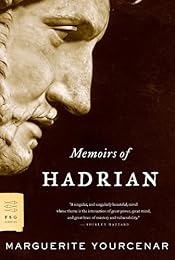
Originally published in French in 1953, Marguerite Yourcenar's Memoirs of Hadrian has reached modern classic status, included, for example on Peter Boxall's well-known list of 1001 Books to Read Before You Die. The novel is, indeed, at least to me, a tour de force. Yourcenar created a fictionalized memoir of the Roman emperor Hadrian, describing through his own eyes his life, from boyhood through death bed. Or, really, this is a very long letter to the then young Marcus Aurelius, already named to be Hadrian's eventually successor as emperor. In describing his long life in intimate detail, Hadrian endeavors to get across his life lessons, hardships and tragedies, and ruling precepts. He attempts to provide a primer on the proper use of power and of dealing with pride and with personal tragedy. As described by Yourcenar, Hadrian has spent most of his time (when not engaged in military campaigns to thwart incursions into Rome's far-flung holdings, or put down rebellions within those holdings) trying to strengthen the empire's economy and trade practices and make life better for the people of the empire, including those in the provinces and even the slave population. He counsels patience and forbearance when it comes to dealing with political enemies, even those who would attempt to usurp power through his assassination, though he is not above ordering executions when he feels them necessary. The nature of love and loss is described mostly through Hadrian's descriptions of the much younger man he falls passionately in love with but who commits suicide out of, Hadrian assumes, a fear of growing older and losing his beauty and strength. These passages are quite beautiful and the ongoing sense of loss Hadrian feels throughout the rest of the narrative is very lovingly and effectively rendered.
Yourcenar clearly did a lot of extremely detailed historical research for the writing of this novel. The details are quite believable and the amount of historical information presented is impressive and often fascinating. As importantly (or maybe more importantly to many readers), the book overflows with beautiful language, as well. Toward the very end of his life, and contemplating his death, Hadrian writes thusly:
I recommend Memoirs of Hadrian highly to readers who enjoy novels that don't have a lot of narrative drive, that deal with character and language much more than plot. The writing is compelling and pulls you along in any places, but slows down and becomes a bit harder to get through in others, or at least that was the case for me. One problem for my reading of the book at this time as that I have very recently read a book that was quite similar, in terms of these characteristics, in Soul Mountain (although, happily, Hadrian, at 296 pages, is considerably shorter than Soul Mountain's 523). Another book of the same type, narratively speaking, so soon wasn't really what I was in the mood for. However, Memoirs of Hadrian was this month's selection for my book group, and the person who had selected it is a good friend of ours, so there was no putting off the reading to a later date. All in all, though, I'm very happy to have read the book.
Originally published in French in 1953, Marguerite Yourcenar's Memoirs of Hadrian has reached modern classic status, included, for example on Peter Boxall's well-known list of 1001 Books to Read Before You Die. The novel is, indeed, at least to me, a tour de force. Yourcenar created a fictionalized memoir of the Roman emperor Hadrian, describing through his own eyes his life, from boyhood through death bed. Or, really, this is a very long letter to the then young Marcus Aurelius, already named to be Hadrian's eventually successor as emperor. In describing his long life in intimate detail, Hadrian endeavors to get across his life lessons, hardships and tragedies, and ruling precepts. He attempts to provide a primer on the proper use of power and of dealing with pride and with personal tragedy. As described by Yourcenar, Hadrian has spent most of his time (when not engaged in military campaigns to thwart incursions into Rome's far-flung holdings, or put down rebellions within those holdings) trying to strengthen the empire's economy and trade practices and make life better for the people of the empire, including those in the provinces and even the slave population. He counsels patience and forbearance when it comes to dealing with political enemies, even those who would attempt to usurp power through his assassination, though he is not above ordering executions when he feels them necessary. The nature of love and loss is described mostly through Hadrian's descriptions of the much younger man he falls passionately in love with but who commits suicide out of, Hadrian assumes, a fear of growing older and losing his beauty and strength. These passages are quite beautiful and the ongoing sense of loss Hadrian feels throughout the rest of the narrative is very lovingly and effectively rendered.
Yourcenar clearly did a lot of extremely detailed historical research for the writing of this novel. The details are quite believable and the amount of historical information presented is impressive and often fascinating. As importantly (or maybe more importantly to many readers), the book overflows with beautiful language, as well. Toward the very end of his life, and contemplating his death, Hadrian writes thusly:
To believe the priests, I have left you at the place where the separate elements of a person tear apart like a worn garment under strain, at that sinister crossroads between what was and what will be, and what exists eternally. It is conceivable, after all, that such notions are right, and that death is made up of the same confused, shifting matter as life. But none of these theories of immortality inspire me with any confidence; the system of retributions and punishments makes little impression upon a judge well aware of the difficulties of judging. . . .
I try now to observe my own ending: this series of experiments conducted upon myself continues the long study begun in Satyrus' clinic. So far the modifications are as external as those to which time and inclement weather subject any edifice, leaving its architecture and basic material unaltered; I sometimes think that through the crevices I see and touch upon the indestructible foundation, the rock eternal. I am what I always was; I am dying without essential change. At first view the robust child of the gardens in Spain and the ambitious officer regaining his tent and shaking the snowflakes from his shoulders seem both as thoroughly obliterated as I shall be when I shall have gone through the funeral fire; but they are still there; I am inseparable from these parts of myself. The man who howled his grief upon a dead body has not ceased to wail in some corner of my being, in spite of the superhuman, or perhaps subhuman calm into which I am entering already; the voyager immured within the ever sedentary invalid is curious about death because it spells departure. That force which once was I seems still capable of actuating several more lives, or of raising up whole worlds. If by miracle some centuries were suddenly to be added to the few days now left to me I would do the same things over again, even to committing the same errors; I would frequent the same Olympian heights and even the same Infernos. Such a conclusion is an excellent argument in favor of the utility of death, but at the same time it inspires certain doubts as to death's total efficacity.
I recommend Memoirs of Hadrian highly to readers who enjoy novels that don't have a lot of narrative drive, that deal with character and language much more than plot. The writing is compelling and pulls you along in any places, but slows down and becomes a bit harder to get through in others, or at least that was the case for me. One problem for my reading of the book at this time as that I have very recently read a book that was quite similar, in terms of these characteristics, in Soul Mountain (although, happily, Hadrian, at 296 pages, is considerably shorter than Soul Mountain's 523). Another book of the same type, narratively speaking, so soon wasn't really what I was in the mood for. However, Memoirs of Hadrian was this month's selection for my book group, and the person who had selected it is a good friend of ours, so there was no putting off the reading to a later date. All in all, though, I'm very happy to have read the book.
273FlorenceArt
I read Mémoires d’Hadrien when I was much too young to appreciate it as you do, or at least that’s my excuse ☺️
274lisapeet
Now-married friends of mine cemented their relationship long ago when each of them gave Memoirs of Hadrian to the other for Christmas one year.
275wandering_star
>274 lisapeet: What a great story! That would definitely be when you knew it was meant to be.
It's an intriguing review Jerry - I think I've seen this book on the shelves at my mum's house, I will definitely look it out next time I am there.
It's an intriguing review Jerry - I think I've seen this book on the shelves at my mum's house, I will definitely look it out next time I am there.
276rocketjk
>274 lisapeet: Great story! Did they both enjoy the reading, though? Imagine the awkwardness if one of them loved the book and the other was bored.
Oh, by the way, on a personal note, I turned 70 last Friday! I'm healthy and active and have a great marriage, so I'm one of the lucky ones, all right.
Oh, by the way, on a personal note, I turned 70 last Friday! I'm healthy and active and have a great marriage, so I'm one of the lucky ones, all right.
277RidgewayGirl
>276 rocketjk: Happy Birthday, Jerry! We share a birthday, although I was born thirteen years after you. I hope your birthday was as lovely as mine.
278cindydavid4
happy birthday! I hope is was a splendid day and you found many books to read!
279Robertgreaves
>274 lisapeet: Coincidentally, Memoirs of Hadrian was translated into English by Grace Frick, Marguerite Yourcenar's life partner, obviously with lots of input from Marguerite herself. So love is definitely in the air.
>276 rocketjk: A belated Happy Birthday, Jerry.
>276 rocketjk: A belated Happy Birthday, Jerry.
280rocketjk
Thanks for the birthday greetings. We had a lovely day wandering around the section of Harlem we used to live in, then meeting up with one of my oldest friends (7th grade) and his wife (also a longtime friend) who drove in from northwest Jersey. We went down to Greenwich Village and splurged on a glorious dinner at the venerable and magnificent Minetta Tavern. We got a good chuckle over the fact that the hostess informed us we'd been seated at the Cindy Crawford Table.
OK, back to business. My post-Memoirs of Hadrian "between book" reading was a happy journey through Stack 1, with two new books added in:
* “Are Ants Civilized?” by Louis I. Dublin in Literature - Book Two edited by Thomas H. Briggs
* “Lunch,” by Rebecca Rass from New Writing from the Middle East edited by Leo Hamalian and John D. Yohannan
* Excerpt from The Book Smugglers: Partisans, Poets and the Race to Save Jewish Treasures from the Nazis by David E. Fishman from Annual Gathering Commemorating the Warsaw Ghetto Uprising, 75th Anniversary, April 19, 2018 edited by Irena Klepfisz
* “Mookie Betts” from Smart, Wrong and Lucky: The Origin Stories of Baseball’s Unexpected Stars by Jonathan Mayo
* “Tom Kotchman, a Baseball Lifer” from Baseball in Pinellas County by Dan Hirshberg** - Newly added
* “My Ears Are Bent” from My Ears Are Bent by Joseph Mitchell - Newly added
* Day 9, Story 8 from The Decameron by Giovanni Boccaccio (translated by Wayne A. Rebhorn)
* “Atlanta: Manageable, Many-sided, Magnificent” by Celestine Sibley from The Saturday Evening Post, November, 1974
I'm now on to my first book started during July, which means I'm back to my twice-per-year read-through of the novels of Isaac B. Singer in order of their publishing in English. So I've started Shosha, set in pre-WW2 (Hi, Kate!) Warsaw. The novel was originally published in 1974 in installments in the Jewish Daily Forward under the title Soul Expeditions, then published in English in novel form in 1978.
** This is the friend who, with his wife, Su, joined us for my birthday dinner. I'm even mentioned in the acknowledgments, as I helped with a few editing suggestions for Dan's introduction.
OK, back to business. My post-Memoirs of Hadrian "between book" reading was a happy journey through Stack 1, with two new books added in:
* “Are Ants Civilized?” by Louis I. Dublin in Literature - Book Two edited by Thomas H. Briggs
* “Lunch,” by Rebecca Rass from New Writing from the Middle East edited by Leo Hamalian and John D. Yohannan
* Excerpt from The Book Smugglers: Partisans, Poets and the Race to Save Jewish Treasures from the Nazis by David E. Fishman from Annual Gathering Commemorating the Warsaw Ghetto Uprising, 75th Anniversary, April 19, 2018 edited by Irena Klepfisz
* “Mookie Betts” from Smart, Wrong and Lucky: The Origin Stories of Baseball’s Unexpected Stars by Jonathan Mayo
* “Tom Kotchman, a Baseball Lifer” from Baseball in Pinellas County by Dan Hirshberg** - Newly added
* “My Ears Are Bent” from My Ears Are Bent by Joseph Mitchell - Newly added
* Day 9, Story 8 from The Decameron by Giovanni Boccaccio (translated by Wayne A. Rebhorn)
* “Atlanta: Manageable, Many-sided, Magnificent” by Celestine Sibley from The Saturday Evening Post, November, 1974
I'm now on to my first book started during July, which means I'm back to my twice-per-year read-through of the novels of Isaac B. Singer in order of their publishing in English. So I've started Shosha, set in pre-WW2 (Hi, Kate!) Warsaw. The novel was originally published in 1974 in installments in the Jewish Daily Forward under the title Soul Expeditions, then published in English in novel form in 1978.
** This is the friend who, with his wife, Su, joined us for my birthday dinner. I'm even mentioned in the acknowledgments, as I helped with a few editing suggestions for Dan's introduction.
281lisapeet
>276 rocketjk: I think they were Yourcenar fans already, maybe—it wasn't completely random. This past summer they went on a Yourcenar pilgrimage, or sorts, to her house in Maine.
>279 Robertgreaves: I've had that on my shelves for ages... just one of those books I never get to, but maybe this is the year.
And happy birthday, Jerry! Sounds like a good time. I haven't been down to the Minetta Tavern in ages... didn't know they had a Cindy Crawford table.
>279 Robertgreaves: I've had that on my shelves for ages... just one of those books I never get to, but maybe this is the year.
And happy birthday, Jerry! Sounds like a good time. I haven't been down to the Minetta Tavern in ages... didn't know they had a Cindy Crawford table.
282rocketjk
>281 lisapeet: " . . . didn't know they had a Cindy Crawford table."
I think maybe it's kind of like Brigadoon. The Cindy Crawford table only appears if you go to the restaurant on your 70th birthday. I'm just conjecturing, of course. They seem to have a cute name for every table, though. We were given our choice of two tables. The one we didn't choose was, I was told, the Owner's Table. Boring!
I had this momentary thought at the time that the hostess was making the names up on the spot. I had a brief image of her going back to her station at the front and saying to her assistant, amid gales of laughter, " . . . so I told them it was the Cindy Crawford table! And they bought it! Can you imagine?" "Oh, my god, Cindy Crawford? The Cindy Crawford table? Where did you come up with that?" "I was scrolling through the channel guide last night and noticed her QVC makeup show. Anyway, it just popped out! And, oh, they were so happy to be sitting at the Cindy Crawford table!"
My wife says I'm just paranoid, though.
I think maybe it's kind of like Brigadoon. The Cindy Crawford table only appears if you go to the restaurant on your 70th birthday. I'm just conjecturing, of course. They seem to have a cute name for every table, though. We were given our choice of two tables. The one we didn't choose was, I was told, the Owner's Table. Boring!
I had this momentary thought at the time that the hostess was making the names up on the spot. I had a brief image of her going back to her station at the front and saying to her assistant, amid gales of laughter, " . . . so I told them it was the Cindy Crawford table! And they bought it! Can you imagine?" "Oh, my god, Cindy Crawford? The Cindy Crawford table? Where did you come up with that?" "I was scrolling through the channel guide last night and noticed her QVC makeup show. Anyway, it just popped out! And, oh, they were so happy to be sitting at the Cindy Crawford table!"
My wife says I'm just paranoid, though.
286rocketjk
Well, here we are halfway through July and I'm finally going to start a 2025 thread the second. C'mon over!
287mabith
Memoirs of Hadrian has been on to my to-read list for some time, so I'm glad of the reminder!
This topic was continued by rocketjk's 2025 II: I still wanna read that!.

