rocketjk's 2025 II: I still wanna read that!
This is a continuation of the topic rocketjk's 2025: I wanna read that!.
Talk Club Read 2025
Join LibraryThing to post.
1rocketjk
Here I am back for more reading and conversing fun in the second half of 2025.
To review: After a long project of investigation and exploration, my wife and I moved in mid-August last year from Mendocino County, northern California, USA, to Manhattan. More precisely, to the Upper West Side. We're both New Jersey natives, with family (my wife) and old friends (both of us) in the NY/NJ area, so really this is like coming home. As 2025 dawns, we mostly, but certainly not entirely, have the heavy lifting of setting up our new apartment behind us. We are both retired. As for me, my checkered work life included, in no particular order, public radio producer, teacher, freelance writer and used bookstore owner, busman, waiter, dishwasher and publications coordinator at the Federal Reserve Bank of San Francisco. My reading is an eclectic mix of fiction, history, memoirs, bios and more. In addition to the books I read straight through, I like to read anthologies, collections and other books of short entries one story/chapter at a time instead of plowing through them all at once. I have a couple of stacks of such books from which I read in this manner between the books I read from cover to cover (novels and histories, mostly). So I call these my "between books." When I finish a "between book," I add it to my yearly list. Last year was a relatively off reading year for me, at least book total-wise (I topped off at 41), due to the move and the number of doorstop-sized books I read. C'est la vie! Cheers and happy continued reading one and all!
Due to some repairs being done to the masonry of our building, the rooftop deck has been closed for some time. It was finally reopened on July 1. Just for fun, here are a few amateur photos:

Sundown spreads across the sky over the Hudson River and the banks of New Jersey

Looking northeast over the Cathedral of St. John the Divine

A southeast view of the buildings of New York
To review: After a long project of investigation and exploration, my wife and I moved in mid-August last year from Mendocino County, northern California, USA, to Manhattan. More precisely, to the Upper West Side. We're both New Jersey natives, with family (my wife) and old friends (both of us) in the NY/NJ area, so really this is like coming home. As 2025 dawns, we mostly, but certainly not entirely, have the heavy lifting of setting up our new apartment behind us. We are both retired. As for me, my checkered work life included, in no particular order, public radio producer, teacher, freelance writer and used bookstore owner, busman, waiter, dishwasher and publications coordinator at the Federal Reserve Bank of San Francisco. My reading is an eclectic mix of fiction, history, memoirs, bios and more. In addition to the books I read straight through, I like to read anthologies, collections and other books of short entries one story/chapter at a time instead of plowing through them all at once. I have a couple of stacks of such books from which I read in this manner between the books I read from cover to cover (novels and histories, mostly). So I call these my "between books." When I finish a "between book," I add it to my yearly list. Last year was a relatively off reading year for me, at least book total-wise (I topped off at 41), due to the move and the number of doorstop-sized books I read. C'est la vie! Cheers and happy continued reading one and all!
Due to some repairs being done to the masonry of our building, the rooftop deck has been closed for some time. It was finally reopened on July 1. Just for fun, here are a few amateur photos:

Sundown spreads across the sky over the Hudson River and the banks of New Jersey

Looking northeast over the Cathedral of St. John the Divine

A southeast view of the buildings of New York
2rocketjk
Keeping Track of 2025's Who/What/How/Where I Read
I've had fun charting my travels the last fifteen years, an endeavor I moved to my CR thread last year. 2024's reading brought me to 14 countries, including the U.S., and 9 states within the U.S. Although there were, as always, several "U.S. non-state specific" books, quite unusually there were no "Non-country specific" books on the 2024 list.
I don't select my reading to purposefully "travel" in any particular way. Rather, I just have fun seeing where my more random reading choices take me!
Who: Author/Editor
Female: 12
Male: 34
What
Novels: 29
Short Stories: 2
Histories: 3
Contemporary (when published) Events: 1
Biographies: 3
Memoirs: 4
Essays: 2
Periodicals: 2
How (Original Language)
Chinese: 1
English: 31
French: 2
Hebrew: 1
Italian: 2
Japanese: 1
Yiddish: 4
Where
Non-Country Specific
The Dawn Watch: Joseph Conrad in a Global World by Maya Jasanoff
Holiday Magazine - March, 1958 edited by Ted Patrick
The Drowned World by J.G. Ballard
Old Truths and New Cliches: Essays by Isaac Bashevis Singer edited by David Stromberg
AFRICA
Algeria
The Sleep of the Just by Mouloud Mammeri
Bangalla (fictional)
The Story of the Phantom: The Ghost Who Walks by Lee Falk
The Phantom #2: The Slave Market of Mucar by Lee Falk
Congo
Heart of Darkness by Joseph Conrad
ASIA
China
Soul Mountain by Gao Xingjian
Japan
First Person Singular by Haruki Murakami
Sri Lanka
The Seven Moons of Maali Almeida by Shehan Karunatilaka
CARIBBEAN
Haiti
We're Alone by Edwidge Danticat
EUROPE
Non-Country Specific
Postwar: A History of Europe Since 1945 by Tony Judt
England
Selected Writings of Thomas De Quincy edited by Philip Van Doren Stern
The Worshipful Lucia by E.F. Benson
Charlie's Good Tonight: The Life, the Times, and The Rolling Stones by Paul Sexton
Silas Marner by George Eliot
Living by Henry Green
Straight White Male by John Niven (also listed in California)
Emma by Jane Austen
Party Going by Henry Green
Germany
Good People by Nir Baram (also listed in Russia)
Ireland
Loving by Henry Green
Italy
Memoirs of Hadrian by Marguerite Yourcenar (Although the narrative takes place throughout the Roman Empire, I'm listing this in Italy as Rome was, obviously, the center of that empire.)
The Little World of Don Camillo by Giovanni Guareschi
The Decameron by Giovanni Boccaccio
Poland
Shosa by Isaac B. Singer
Annual Gathering Commemorating the Warsaw Ghetto Uprising, 75th Anniversary, April 19, 2018 edited by Irena Klepfisz
Russia
Good People by Nir Baram (also listed in Germany)
Turkey
The Towers of Trebizond by Rose Macaulay
Ukraine
The Betrayers by David Bezmozgis
Wales
The Betrothed by Sir Walter Scott
NORTH AMERICA
Non-Country Specific
The Glass Hotel by Emily St. John Mandel
Canada
Quietly My Captain Waits by Evelyn Eaton
United States
Non-State Specific
Adventures of Huckleberry Finn by Mark Twain
James by Percival Everett
The Saturday Evening Post, November, 1974 edited by Beurt SerVaas
T.J.: My 26 Years in Baseball by Tommy John with Dan Valenti
Smart, Wrong, and Lucky: The Origin Stories of Baseball's Unexpected Stars by Jonathan Mayo
We Called it Music: A Generation of Jazz by Eddie Condon
Alabama
Ill Wind by W.L. Heath
California
Releasing Jenna by Alice E. Bonner
Straight White Male by John Niven (also listed in England)
New York
Enemies, a Love Story by Isaac B. Singer
Vaclav & Lena by Haley Tanner
The New York Game: Baseball and the Rise of a New City by Kevin Baker
Plunkitt of Tammany Hall by William L. Riordon
West Virginia
Machine Dreams by Jayne Anne Phillips
I've had fun charting my travels the last fifteen years, an endeavor I moved to my CR thread last year. 2024's reading brought me to 14 countries, including the U.S., and 9 states within the U.S. Although there were, as always, several "U.S. non-state specific" books, quite unusually there were no "Non-country specific" books on the 2024 list.
I don't select my reading to purposefully "travel" in any particular way. Rather, I just have fun seeing where my more random reading choices take me!
Who: Author/Editor
Female: 12
Male: 34
What
Novels: 29
Short Stories: 2
Histories: 3
Contemporary (when published) Events: 1
Biographies: 3
Memoirs: 4
Essays: 2
Periodicals: 2
How (Original Language)
Chinese: 1
English: 31
French: 2
Hebrew: 1
Italian: 2
Japanese: 1
Yiddish: 4
Where
Non-Country Specific
The Dawn Watch: Joseph Conrad in a Global World by Maya Jasanoff
Holiday Magazine - March, 1958 edited by Ted Patrick
The Drowned World by J.G. Ballard
Old Truths and New Cliches: Essays by Isaac Bashevis Singer edited by David Stromberg
AFRICA
Algeria
The Sleep of the Just by Mouloud Mammeri
Bangalla (fictional)
The Story of the Phantom: The Ghost Who Walks by Lee Falk
The Phantom #2: The Slave Market of Mucar by Lee Falk
Congo
Heart of Darkness by Joseph Conrad
ASIA
China
Soul Mountain by Gao Xingjian
Japan
First Person Singular by Haruki Murakami
Sri Lanka
The Seven Moons of Maali Almeida by Shehan Karunatilaka
CARIBBEAN
Haiti
We're Alone by Edwidge Danticat
EUROPE
Non-Country Specific
Postwar: A History of Europe Since 1945 by Tony Judt
England
Selected Writings of Thomas De Quincy edited by Philip Van Doren Stern
The Worshipful Lucia by E.F. Benson
Charlie's Good Tonight: The Life, the Times, and The Rolling Stones by Paul Sexton
Silas Marner by George Eliot
Living by Henry Green
Straight White Male by John Niven (also listed in California)
Emma by Jane Austen
Party Going by Henry Green
Germany
Good People by Nir Baram (also listed in Russia)
Ireland
Loving by Henry Green
Italy
Memoirs of Hadrian by Marguerite Yourcenar (Although the narrative takes place throughout the Roman Empire, I'm listing this in Italy as Rome was, obviously, the center of that empire.)
The Little World of Don Camillo by Giovanni Guareschi
The Decameron by Giovanni Boccaccio
Poland
Shosa by Isaac B. Singer
Annual Gathering Commemorating the Warsaw Ghetto Uprising, 75th Anniversary, April 19, 2018 edited by Irena Klepfisz
Russia
Good People by Nir Baram (also listed in Germany)
Turkey
The Towers of Trebizond by Rose Macaulay
Ukraine
The Betrayers by David Bezmozgis
Wales
The Betrothed by Sir Walter Scott
NORTH AMERICA
Non-Country Specific
The Glass Hotel by Emily St. John Mandel
Canada
Quietly My Captain Waits by Evelyn Eaton
United States
Non-State Specific
Adventures of Huckleberry Finn by Mark Twain
James by Percival Everett
The Saturday Evening Post, November, 1974 edited by Beurt SerVaas
T.J.: My 26 Years in Baseball by Tommy John with Dan Valenti
Smart, Wrong, and Lucky: The Origin Stories of Baseball's Unexpected Stars by Jonathan Mayo
We Called it Music: A Generation of Jazz by Eddie Condon
Alabama
Ill Wind by W.L. Heath
California
Releasing Jenna by Alice E. Bonner
Straight White Male by John Niven (also listed in England)
New York
Enemies, a Love Story by Isaac B. Singer
Vaclav & Lena by Haley Tanner
The New York Game: Baseball and the Rise of a New City by Kevin Baker
Plunkitt of Tammany Hall by William L. Riordon
West Virginia
Machine Dreams by Jayne Anne Phillips
3rocketjk
Shosha by Isaac Bashevis Singer

I read Shosha as a continuation of my project of reading all of Singer's novels in order of their publication in English, two novels per year, the first book I start in January and the first book I start in July.
Shosha, was originally published in English in 1978, after having been published in serialized form in 1974 in the Yiddish language publication Jewish Daily Forward. In Shosha, Singer brings us back into the Jewish community in Warsaw in the mid-1930s. The community is fractured into Bundists (the Jewish Socialist Labor Movement), Communists, Zionists, assimilationists, and, of course, traditional religious Jews and Hasids intent on sticking to the old ways. But everyone can discern the growing twin shadows of Hitler and Stalin. These people are expecting a Nazi invasion and know what their fate is likely to be. Our narrator is Aaron Griedinger, known to his friends as Tsutsik, a young struggling writer trying to find his way amid these philosophies and his possible futures. There are several women in Tsutsik's life, each, perhaps (or so it seemed to me, at any rate) representing a possible route for him. Celia, somewhat older and married, is assimilated and, along with her husband, more than a little hedonist. Dora, Tsutsik's on again, off again lover, is a Communist, preparing to leave for Soviet Russia until one of her former comrades comes staggering back from that country with tales of the arrests, torture, banishment and even executions awaiting Polish Jews who, professed Communists though they may be, cross the border hoping to join the workers' paradise. Betty Slonim is an American/Jewish actress who comes to Warsaw with her rich lover, Sam Dreiman. Sam and Betty represent a way out. They want Tsutsik to write a play for Betty and come with them to America, where Sam will produce it. But, almost by chance, Tsutsik returns one day to the old Jewish neighborhood of his youth, reconnects with a childhood friend, Shosha, and is immediately smitten. On the surface naive and trusting, her physical growth stunted by long years of malnutrition, Shosha, as Tsutsik soon comes to know, and for all her innocence, understands much more of the world than she lets on. A union with Shosha, however, most likely means death, for she will never leave Warsaw and the Nazis won't hold off their invasion forever.
Throughout this novel we receive Singer's deft, often humorous, touch describing human nature. In addition, the neighborhoods and streets of 1930s Warsaw and of Jewish life there (Singer himself grew up in Warsaw and left in the '30s, the lucky recipient of an extremely rare (for Jews at that time) U.S. visa) are delightfully and lovingly rendered, as the Jews of Warsaw continue their daily lives within the shadow of calamity. In addition to narrative beauty, humor, and the strength of Singer's character portrayals is the tension surrounding the fates of each of Tsutsik's friends. Who will stay and who will go? And for those who chose to stay, why are they staying? And of course in the center of it all there is Tsutsik and Shosha, and the drama of their fates. I found the last 50 or 75 pages of Shosha to be among the most moving and memorable of anything I've read by Singer. That, for me, is saying a lot.
Weaved throughout this narrative are many wonderful conversations about philosophy, religion and fate. One of Tsutsik's friends says to him, as they sit over coffee, "I remember your words. 'The world is a slaughterhouse and a brothel.' . . . Still, everything is forced upon us, even hope. The dictator on high, the celestial Stalin, says, 'You must hope!' And if he says you must, you hope. But what can I hope for any more? Only for death. Where is the sugar?"
Book note: My hardcopy edition of Shosha has been in my collection since before my LT "big bang" in 2008. My copy is a first edition, sixth printing.

I read Shosha as a continuation of my project of reading all of Singer's novels in order of their publication in English, two novels per year, the first book I start in January and the first book I start in July.
Shosha, was originally published in English in 1978, after having been published in serialized form in 1974 in the Yiddish language publication Jewish Daily Forward. In Shosha, Singer brings us back into the Jewish community in Warsaw in the mid-1930s. The community is fractured into Bundists (the Jewish Socialist Labor Movement), Communists, Zionists, assimilationists, and, of course, traditional religious Jews and Hasids intent on sticking to the old ways. But everyone can discern the growing twin shadows of Hitler and Stalin. These people are expecting a Nazi invasion and know what their fate is likely to be. Our narrator is Aaron Griedinger, known to his friends as Tsutsik, a young struggling writer trying to find his way amid these philosophies and his possible futures. There are several women in Tsutsik's life, each, perhaps (or so it seemed to me, at any rate) representing a possible route for him. Celia, somewhat older and married, is assimilated and, along with her husband, more than a little hedonist. Dora, Tsutsik's on again, off again lover, is a Communist, preparing to leave for Soviet Russia until one of her former comrades comes staggering back from that country with tales of the arrests, torture, banishment and even executions awaiting Polish Jews who, professed Communists though they may be, cross the border hoping to join the workers' paradise. Betty Slonim is an American/Jewish actress who comes to Warsaw with her rich lover, Sam Dreiman. Sam and Betty represent a way out. They want Tsutsik to write a play for Betty and come with them to America, where Sam will produce it. But, almost by chance, Tsutsik returns one day to the old Jewish neighborhood of his youth, reconnects with a childhood friend, Shosha, and is immediately smitten. On the surface naive and trusting, her physical growth stunted by long years of malnutrition, Shosha, as Tsutsik soon comes to know, and for all her innocence, understands much more of the world than she lets on. A union with Shosha, however, most likely means death, for she will never leave Warsaw and the Nazis won't hold off their invasion forever.
Throughout this novel we receive Singer's deft, often humorous, touch describing human nature. In addition, the neighborhoods and streets of 1930s Warsaw and of Jewish life there (Singer himself grew up in Warsaw and left in the '30s, the lucky recipient of an extremely rare (for Jews at that time) U.S. visa) are delightfully and lovingly rendered, as the Jews of Warsaw continue their daily lives within the shadow of calamity. In addition to narrative beauty, humor, and the strength of Singer's character portrayals is the tension surrounding the fates of each of Tsutsik's friends. Who will stay and who will go? And for those who chose to stay, why are they staying? And of course in the center of it all there is Tsutsik and Shosha, and the drama of their fates. I found the last 50 or 75 pages of Shosha to be among the most moving and memorable of anything I've read by Singer. That, for me, is saying a lot.
Weaved throughout this narrative are many wonderful conversations about philosophy, religion and fate. One of Tsutsik's friends says to him, as they sit over coffee, "I remember your words. 'The world is a slaughterhouse and a brothel.' . . . Still, everything is forced upon us, even hope. The dictator on high, the celestial Stalin, says, 'You must hope!' And if he says you must, you hope. But what can I hope for any more? Only for death. Where is the sugar?"
Book note: My hardcopy edition of Shosha has been in my collection since before my LT "big bang" in 2008. My copy is a first edition, sixth printing.
4dchaikin
>3 rocketjk: nice. Terrific review. I adored Shosha. I looked it up and was surprised to find that I read it in 2001.
Happy new thread. Love the photos. They’re fantastic
Happy new thread. Love the photos. They’re fantastic
5RidgewayGirl
What a great space you have with that rooftop terrace. I'd spend all my time reading there and enjoying the view. How many people share it with you?
6Robertgreaves
>1 rocketjk: Can you read in these languages or are you reading in translation?
7kjuliff
>1 rocketjk: Due to some repairs being done to the masonry of our building, the rooftop deck has been closed for some time. It was finally reopened on July 1>
My balcony has been closed off due to making repairs to the building, from pre-Covid on. After Covid, they had to find another contractor because the other one had gone bust. So I still can’t use my balcony. It’s been nearly 6 years and now they’re saying maybe September. I’ve got a lovely garden that belongs to the condo that I can see from my windows. I will post a pic on my own thread
My balcony has been closed off due to making repairs to the building, from pre-Covid on. After Covid, they had to find another contractor because the other one had gone bust. So I still can’t use my balcony. It’s been nearly 6 years and now they’re saying maybe September. I’ve got a lovely garden that belongs to the condo that I can see from my windows. I will post a pic on my own thread
8FlorenceArt
>1 rocketjk: Thank you for the wonderful photos! What a nice rooftop deck you have.
11rocketjk
>5 RidgewayGirl: "How many people share it with you?"
Well, there are 16 floors with 8 apartments per floor, so that's a pretty good group. Because it's only been open for a couple of weeks, my wife and I are still kind of working spending time up there into our routines. It's a lovely place to relax with a glass of wine in the early evenings and sometimes a nice way to meet people in the building, too. We've been here a year, now, but we're still the "new couple." For about six months we'd get, "Oh, you're living in Chris and Layla's apartment!"* That's OK. Just human nature. The building converted from rental to coop in the mid-80s and there is a relatively large group of folks who have been living in the building together since then, some who have adult children who grew up in the building. (The people we bought the apartment from brought up their kids here, in fact.) We've learned of some younger folks with kids who actually grew up in the building and inherited their apartments from their parents. Steph is already on the rooftop garden committee, I am on the committee that tends to the "leave a book, take a book" library in the basement, she and I have joined a monthly building book group as well. Sorry, what was the question?
>6 Robertgreaves: English translation only, I'm afraid.
>7 kjuliff: Kate, I hope you do get to enjoy your balcony soon.
Otherwise, thanks, all, for the kind comments.
* We finally sold our house in Mendocino County, CA, where we lived for 15 years, closing about three weeks ago. We were joking with each other about how long our buyers were going to be hearing, "Oh, you're living in Stephanie and Jerry's house!"
Well, there are 16 floors with 8 apartments per floor, so that's a pretty good group. Because it's only been open for a couple of weeks, my wife and I are still kind of working spending time up there into our routines. It's a lovely place to relax with a glass of wine in the early evenings and sometimes a nice way to meet people in the building, too. We've been here a year, now, but we're still the "new couple." For about six months we'd get, "Oh, you're living in Chris and Layla's apartment!"* That's OK. Just human nature. The building converted from rental to coop in the mid-80s and there is a relatively large group of folks who have been living in the building together since then, some who have adult children who grew up in the building. (The people we bought the apartment from brought up their kids here, in fact.) We've learned of some younger folks with kids who actually grew up in the building and inherited their apartments from their parents. Steph is already on the rooftop garden committee, I am on the committee that tends to the "leave a book, take a book" library in the basement, she and I have joined a monthly building book group as well. Sorry, what was the question?
>6 Robertgreaves: English translation only, I'm afraid.
>7 kjuliff: Kate, I hope you do get to enjoy your balcony soon.
Otherwise, thanks, all, for the kind comments.
* We finally sold our house in Mendocino County, CA, where we lived for 15 years, closing about three weeks ago. We were joking with each other about how long our buyers were going to be hearing, "Oh, you're living in Stephanie and Jerry's house!"
12RidgewayGirl
>11 rocketjk: I love hearing about small communities. It's hard to meet neighbors once the kids are out of school and the standing-around-with-other-parents days are done. I love how friendly and busy my neighborhood here in central Illinois is and it's a big part of why I love where I am. There are three book clubs within easy walking distance of my house.
13kjuliff
>11 rocketjk: I like the idea of “leave book take a book quote. I might suggest it to our Building group. My building is much bigger than yours-32 floors by 10 condos. The more well off people have joined to con together on some of the floors. The communal garden is good and the kids have their birthday parties there. The mix of people seems to be similar to your co-ops.
ETA - I’ve posted a photo of a view from my apartment on my thread here.
ETA - I’ve posted a photo of a view from my apartment on my thread here.
14rocketjk
My post-Shosha "Between Book" reading afforded another wander through Stack 1
* “The Battle of the Ants,” excerpted from Walden by Henry David Thoreau in Literature - Book Two edited by Thomas H. Briggs
* “Facing the Forests,” by Abraham Yehoshua from New Writing from the Middle East edited by Leo Hamalian and John D. Yohannan
* Excerpt from The Last Days of the Jerusalem of Lithuania: Chronicles from the Vilna Ghetto and the Camps, 1939-1944 by Herman Kruk from Annual Gathering Commemorating the Warsaw Ghetto Uprising, 75th Anniversary, April 19, 2018 edited by Irena Klepfisz
* “Charlie Blackmon” from Smart, Wrong and Lucky: The Origin Stories of Baseball’s Unexpected Stars by Jonathan Mayo
* “Sadaharu Oh Strikes Out” from Baseball in Pinellas County by Dan Hirshberg
* “Drunks” from My Ears Are Bent by Joseph Mitchell
* Day 9, Story 9 from The Decameron by Giovanni Boccaccio (translated by Wayne A. Rebhorn)
* “Thanksgiving Dinner with the Laguna Pueblo Indians” by Kathryn Klassen from The Saturday Evening Post, November, 1974 - Finished!
Now I'm on to T.J.: My 26 Years in Baseball, a memoir by pitcher Tommy John.
* “The Battle of the Ants,” excerpted from Walden by Henry David Thoreau in Literature - Book Two edited by Thomas H. Briggs
* “Facing the Forests,” by Abraham Yehoshua from New Writing from the Middle East edited by Leo Hamalian and John D. Yohannan
* Excerpt from The Last Days of the Jerusalem of Lithuania: Chronicles from the Vilna Ghetto and the Camps, 1939-1944 by Herman Kruk from Annual Gathering Commemorating the Warsaw Ghetto Uprising, 75th Anniversary, April 19, 2018 edited by Irena Klepfisz
* “Charlie Blackmon” from Smart, Wrong and Lucky: The Origin Stories of Baseball’s Unexpected Stars by Jonathan Mayo
* “Sadaharu Oh Strikes Out” from Baseball in Pinellas County by Dan Hirshberg
* “Drunks” from My Ears Are Bent by Joseph Mitchell
* Day 9, Story 9 from The Decameron by Giovanni Boccaccio (translated by Wayne A. Rebhorn)
* “Thanksgiving Dinner with the Laguna Pueblo Indians” by Kathryn Klassen from The Saturday Evening Post, November, 1974 - Finished!
Now I'm on to T.J.: My 26 Years in Baseball, a memoir by pitcher Tommy John.
16Nickelini
>2 rocketjk: interesting that you deem the Glass Hotel by Emily St John Mandel as “non-country specific”. Is that because there were scenes in various locations? Because the title and main setting of the hotel is exceptionally specific. Not just country (Canada), but province (British Columbia), region (Vancouver Island), and area (North Island). “Non-specific” seems like an odd and somewhat useless category choice.
17Nickelini
>11 rocketjk: that sounds amazing! How fun. I can picture it as a novel or movie
18rocketjk
>16 Nickelini: " interesting that you deem the Glass Hotel by Emily St John Mandel as “non-country specific”. Is that because there were scenes in various locations? Because the title and main setting of the hotel is exceptionally specific. Not just country (Canada), but province (British Columbia), region (Vancouver Island), and area (North Island)."
Yes, I'm well aware of where the hotel in the title is located. However, I classify books' locales based on where each book takes me, where I have made a "reading visit" to. Glass Hotel takes a reader to many locales. The characters and the storyline move all over the place. Therefore, the narrative is not specific to a single place. Far from it.
"'Non-specific' seems like an odd and somewhat useless category choice."
Not to me.
Yes, I'm well aware of where the hotel in the title is located. However, I classify books' locales based on where each book takes me, where I have made a "reading visit" to. Glass Hotel takes a reader to many locales. The characters and the storyline move all over the place. Therefore, the narrative is not specific to a single place. Far from it.
"'Non-specific' seems like an odd and somewhat useless category choice."
Not to me.
19SassyLassy
>16 Nickelini: While I was definitely seeing Vancouver Island while reading The Glass Hotel, I was also having definite images of the Fogo Island Inn in my mind. Still Canada, and Fogo Island doesn't have the forests behind the Inn that The Glass Hotel had, but I can't imagine the hotel /inn in the book anywhere else but in a Canadian setting.
Do you still think of Mandel as a Canadian writer? I am having difficulty with this, as while her writing feels very Canadian, pulling up roots and moving to NYC seems a definite statement otherwise.
Do you still think of Mandel as a Canadian writer? I am having difficulty with this, as while her writing feels very Canadian, pulling up roots and moving to NYC seems a definite statement otherwise.
20rocketjk
>19 SassyLassy: "I can't imagine the hotel /inn in the book anywhere else but in a Canadian setting."
Perhaps, but a significant amount, possibly even a majority, of the book's action takes place elsewhere, which is how I judge where to "place" a book on my locale list. That's assuming you were even referring to Joyce's comment on my locale decision. But maybe you are just meaning to chat about the hotel itself. I've never even heard of Fogo Island, so that's interesting information for me.
Perhaps, but a significant amount, possibly even a majority, of the book's action takes place elsewhere, which is how I judge where to "place" a book on my locale list. That's assuming you were even referring to Joyce's comment on my locale decision. But maybe you are just meaning to chat about the hotel itself. I've never even heard of Fogo Island, so that's interesting information for me.
21kjuliff
>19 SassyLassy: Do you still think of Mandel as a Canadian writer? I am having difficulty with this, as while her writing feels very Canadian, pulling up roots and moving to NYC seems a definite statement otherwise.>
I think of NYC as a universal sort of place, and that a Canadian writer who moved to New York would always be Canadian. Just as I have lived for many years in NYC, I’ll always be Australian..
I think of NYC as a universal sort of place, and that a Canadian writer who moved to New York would always be Canadian. Just as I have lived for many years in NYC, I’ll always be Australian..
22SassyLassy
>20 rocketjk: I was talking about the hotel in the book and the images it created for me. Here it is:
https://fogoislandinn.ca/our-inn/our-radical-approach/

image from wikipedia
https://fogoislandinn.ca/our-inn/our-radical-approach/

image from wikipedia
23rocketjk
The Saturday Evening Post, November, 1974 edited by Beurt SerVaas
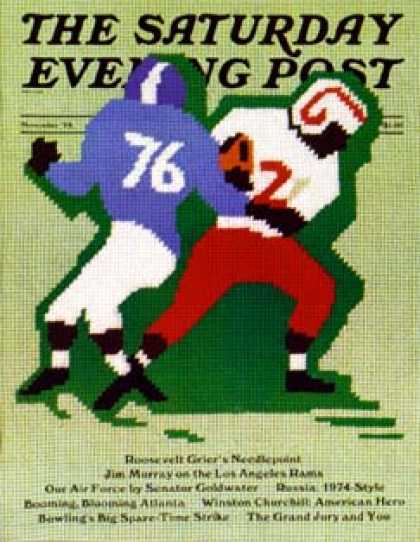
Read as a "Between Book" (see first post). This is another off the stack of old magazines sitting in my hallway closet. This magazine is not quite as old as some of the other magazines I've read through over the past few years, and not quite as interesting. Also, The Saturday Evening Post by editorial policy was aimed at a mainstream readership rather than an audience interested in more in-depth articles on politics, history or science. At any rate, this edition of the SEP did offer some interesting fare. There was a good profile of Pat Schroeder. A Democrat, Schroeder was first female U.S. Representative elected from Colorado and served in Congress from 1973 through 1997. In 1974 she was still something of a novelty in national politics, or at least in Colorado politics. I do remember Schroeder but was happy to read a contemporary profile. None other than Barry Goldwater contributed a long essay on the state of the U.S. Air Force as of '74. Other articles of note are:
* an interesting article on life in Russia in 1974 by Beurt SerVaas, the magazine's editor;
* an approving piece on the history and "current" state of things in Atlanta by Celestine Sibley;
* a profile of the Los Angles Rams' "new" coach Jim Knox by esteemed sports writer Jim Murray;
* a profile of Winston Churchill ("The Glowworm at 100") by Frank Gannon
The magazine also includes an investigation of the state of America's food supply, an indictment of the grand jury system, and several other articles. There are two rather mediocre short stories and one good story, "Stopover" by Betty Ren Wright.
The next magazine off the top of the stack to be added to the "Between Book" rotation, is the November 7, 1955 edition of Life Magazine. That four months and three days after the day I was born!
Read as a "Between Book" (see first post). This is another off the stack of old magazines sitting in my hallway closet. This magazine is not quite as old as some of the other magazines I've read through over the past few years, and not quite as interesting. Also, The Saturday Evening Post by editorial policy was aimed at a mainstream readership rather than an audience interested in more in-depth articles on politics, history or science. At any rate, this edition of the SEP did offer some interesting fare. There was a good profile of Pat Schroeder. A Democrat, Schroeder was first female U.S. Representative elected from Colorado and served in Congress from 1973 through 1997. In 1974 she was still something of a novelty in national politics, or at least in Colorado politics. I do remember Schroeder but was happy to read a contemporary profile. None other than Barry Goldwater contributed a long essay on the state of the U.S. Air Force as of '74. Other articles of note are:
* an interesting article on life in Russia in 1974 by Beurt SerVaas, the magazine's editor;
* an approving piece on the history and "current" state of things in Atlanta by Celestine Sibley;
* a profile of the Los Angles Rams' "new" coach Jim Knox by esteemed sports writer Jim Murray;
* a profile of Winston Churchill ("The Glowworm at 100") by Frank Gannon
The magazine also includes an investigation of the state of America's food supply, an indictment of the grand jury system, and several other articles. There are two rather mediocre short stories and one good story, "Stopover" by Betty Ren Wright.
The next magazine off the top of the stack to be added to the "Between Book" rotation, is the November 7, 1955 edition of Life Magazine. That four months and three days after the day I was born!
24Nickelini
>18 rocketjk: "'Non-specific' seems like an odd and somewhat useless category choice."
Not to me.
Fair enough! It's your thread, your categories. No LT police here :)
Not to me.
Fair enough! It's your thread, your categories. No LT police here :)
25Nickelini
>22 SassyLassy: I see an academic study here . . . that hotel looks nothing like any hotel in the setting of the book (said as someone who has been to the area in the book), but it's the setting in a reader's mind (in this case, you).
I see some trips to eastern Canada in my future, and this hotel is definitely on my list. I love destination hotels.
I see some trips to eastern Canada in my future, and this hotel is definitely on my list. I love destination hotels.
26SassyLassy
>25 Nickelini: Academic study ahoy! I agree the hotel in the book had walls of glass and didn't sound like this one. However, it was the feeling of luxury isolation and privilege combined with the uncontrollable elements outside that brought the two together in my mind.
Photos of the inn from the ocean side are difficult to find, but there is more glass there.
Hope you get there sometime!
>20 rocketjk: I'll stop now - your thread.
ET correct know to now
Photos of the inn from the ocean side are difficult to find, but there is more glass there.
Hope you get there sometime!
>20 rocketjk: I'll stop now - your thread.
ET correct know to now
27rocketjk
>26 SassyLassy: "I'll stop know - your thread."
Oh, don't worry. By all means, feel free to discuss hotels to your heart's content here.
Oh, don't worry. By all means, feel free to discuss hotels to your heart's content here.
28labfs39
>25 Nickelini: but it's the setting in a reader's mind
Reminds me of the book What We See When We Read by Peter Mendelsund.
Reminds me of the book What We See When We Read by Peter Mendelsund.
29kjuliff
>28 labfs39: i’ve started seeing the printed words writing across the page when listening to an audiobook. I’m still thinking about the book, but it’s like I’m reading print. Weird.
30cindydavid4
no, I find that fascinating!
31Nickelini
>28 labfs39: That sounds interesting. Thanks for pointing it out.
32jjmcgaffey
>28 labfs39: BB for me, too.
I always see words when I'm trying to write them. If I saw the words while audio was going on, I could probably consume audio books a lot more easily!
I always see words when I'm trying to write them. If I saw the words while audio was going on, I could probably consume audio books a lot more easily!
33kjuliff
>3 rocketjk: I read Shosha a few weeks ago and really liked it. Tsutsik semed to me a more gentle version of Herman Broder in Enemies a Love Story, and I saw several similarities between the books though they are set years apart.
I read it in audio and I think I’ve lost my bookmarks. I definitely remember marking that quote that ends with “Where is the sugar?”. I love Isaac Singer’s Yiddish humor.
Great review Jerry, and a hard act to follow. I’ve yet to review the book and I think you’ve said it all.
I read it in audio and I think I’ve lost my bookmarks. I definitely remember marking that quote that ends with “Where is the sugar?”. I love Isaac Singer’s Yiddish humor.
Great review Jerry, and a hard act to follow. I’ve yet to review the book and I think you’ve said it all.
34rocketjk
T.J.: My 26 Years in Baseball by Tommy John with Dan Valenti

For baseball fans only. Some folks may remember Tommy John mainly as the player who gave his name to the shoulder surgery that he was the first to undergo, but John was in fact a very effective pitcher for a long time, pitching, as the book title lets us know, in 26 Major League seasons. He was particularly successful in the late 1970s, winning 20 games three times over a four-year span. In the end, John won 288 games and lost 231, for a winning percentage of .555, which is considered quite good. He played in three World Series, but was never on the winning side, as he pitched twice for the Dodgers when they lost to the Yankees and once for the Yankees when they lost to the Dodgers.
At any rate, T.J. is a very nice written memoir, interesting in particular for baseball fans of a certain age who recall the seasons John describes here. We get a full (but, happily) not too long accounting of John's childhood and early career. We get some anecdotes about some of John's teammates over the years, a decent feeling for what it's like to be part of a ball club over a long major league season, and a lot of recollections about the managers and pitching coaches John played for: those that helped him and those that hindered his progress and/or success. John talks a lot about his relationship with George Steinbrenner, which, for John, was mostly positive.
The memoir has an interesting framing. As the teams prepared to assemble for the 1989 season, John, then 46 years old, wanted to pitch one more season. The Yankees had a new manager, Dallas Green, who had already announced that 46 was too old for anyone to pitch in the major leagues and that there'd be no place for John on the team. But Steinbrenner, who was always loyal to the people he thought had helped him in the past, invited John to spring training anyway, over his new manager's objection. That was typical Steinbrenner. The memoir is constructed so that chapters chronicling John's career over the many seasons are interspersed with short chapters describing that 1989 spring training and John's attempts to win over Green and make the team. I thought that was a nice way to frame the narrative.
We also get, of course, a detailed account of the injury that led to the now-famous (and now relatively common) surgery that bears John's name. At the time the process was just a theory. Nobody had tried it before and the surgeon didn't know if it would work. Also detailed was the year-long rehabilitation process.
John does spend some time occasionally describing his methodologies for pitching, and the very small adjustments to his windup and his grip that could set him right when things were going poorly for him. John lasted so long because he was never a hard thrower, depending instead on a sinking fastball and a curveball that kept batters from making hard contact but produced relatively little wear on his arm. But also, especially towards the end of his career, John has some run-ins with managers and baseball executives who he describes unflatteringly. I began to wonder whether there might be more than one side to some of these stories.
At any rate, I give T.J. a B+ as a baseball memoir.

For baseball fans only. Some folks may remember Tommy John mainly as the player who gave his name to the shoulder surgery that he was the first to undergo, but John was in fact a very effective pitcher for a long time, pitching, as the book title lets us know, in 26 Major League seasons. He was particularly successful in the late 1970s, winning 20 games three times over a four-year span. In the end, John won 288 games and lost 231, for a winning percentage of .555, which is considered quite good. He played in three World Series, but was never on the winning side, as he pitched twice for the Dodgers when they lost to the Yankees and once for the Yankees when they lost to the Dodgers.
At any rate, T.J. is a very nice written memoir, interesting in particular for baseball fans of a certain age who recall the seasons John describes here. We get a full (but, happily) not too long accounting of John's childhood and early career. We get some anecdotes about some of John's teammates over the years, a decent feeling for what it's like to be part of a ball club over a long major league season, and a lot of recollections about the managers and pitching coaches John played for: those that helped him and those that hindered his progress and/or success. John talks a lot about his relationship with George Steinbrenner, which, for John, was mostly positive.
The memoir has an interesting framing. As the teams prepared to assemble for the 1989 season, John, then 46 years old, wanted to pitch one more season. The Yankees had a new manager, Dallas Green, who had already announced that 46 was too old for anyone to pitch in the major leagues and that there'd be no place for John on the team. But Steinbrenner, who was always loyal to the people he thought had helped him in the past, invited John to spring training anyway, over his new manager's objection. That was typical Steinbrenner. The memoir is constructed so that chapters chronicling John's career over the many seasons are interspersed with short chapters describing that 1989 spring training and John's attempts to win over Green and make the team. I thought that was a nice way to frame the narrative.
We also get, of course, a detailed account of the injury that led to the now-famous (and now relatively common) surgery that bears John's name. At the time the process was just a theory. Nobody had tried it before and the surgeon didn't know if it would work. Also detailed was the year-long rehabilitation process.
John does spend some time occasionally describing his methodologies for pitching, and the very small adjustments to his windup and his grip that could set him right when things were going poorly for him. John lasted so long because he was never a hard thrower, depending instead on a sinking fastball and a curveball that kept batters from making hard contact but produced relatively little wear on his arm. But also, especially towards the end of his career, John has some run-ins with managers and baseball executives who he describes unflatteringly. I began to wonder whether there might be more than one side to some of these stories.
At any rate, I give T.J. a B+ as a baseball memoir.
35rocketjk
My post-T.J.: My 26 Years in Baseball "between book" reading was a Stack 1 rendezvous:
* “A Collie in the Desert,” excerpted from Waiting in the Wilderness by Enos A. Mills in Literature - Book Two edited by Thomas H. Briggs
* Three poems by Yehuda Amichai from New Writing from the Middle East edited by Leo Hamalian and John D. Yohannan
* Excerpt from Jewish Bundist songs of resistance from Annual Gathering Commemorating the Warsaw Ghetto Uprising, 75th Anniversary, April 19, 2018 edited by Irena Klepfisz - Finished!
* “Ian Kinsler” from Smart, Wrong and Lucky: The Origin Stories of Baseball’s Unexpected Stars by Jonathan Mayo
* “Toby Hall Was a Steal” from Baseball in Pinellas County by Dan Hirshberg
* “Some Virgins, No Professionals” from My Ears Are Bent by Joseph Mitchell
* Day 9, Story 10 and Conclusion from The Decameron by Giovanni Boccaccio (translated by Wayne A. Rebhorn)
* “Football Takes Over All Over” from Life, November, 7, 1955 edited by Edward K. Thompson - Newly added
Tonight I'll be starting Quietly My Captain Waits by Evelyn Eaton. This is an historical novel of New France, the area of Newfoundland, Novia Scotia and parts of Maine that was colonized by France in the late 17th Century before the English forced them out. Published in 1940, this novel was evidently very popular at that time before being forgotten over time.
* “A Collie in the Desert,” excerpted from Waiting in the Wilderness by Enos A. Mills in Literature - Book Two edited by Thomas H. Briggs
* Three poems by Yehuda Amichai from New Writing from the Middle East edited by Leo Hamalian and John D. Yohannan
* Excerpt from Jewish Bundist songs of resistance from Annual Gathering Commemorating the Warsaw Ghetto Uprising, 75th Anniversary, April 19, 2018 edited by Irena Klepfisz - Finished!
* “Ian Kinsler” from Smart, Wrong and Lucky: The Origin Stories of Baseball’s Unexpected Stars by Jonathan Mayo
* “Toby Hall Was a Steal” from Baseball in Pinellas County by Dan Hirshberg
* “Some Virgins, No Professionals” from My Ears Are Bent by Joseph Mitchell
* Day 9, Story 10 and Conclusion from The Decameron by Giovanni Boccaccio (translated by Wayne A. Rebhorn)
* “Football Takes Over All Over” from Life, November, 7, 1955 edited by Edward K. Thompson - Newly added
Tonight I'll be starting Quietly My Captain Waits by Evelyn Eaton. This is an historical novel of New France, the area of Newfoundland, Novia Scotia and parts of Maine that was colonized by France in the late 17th Century before the English forced them out. Published in 1940, this novel was evidently very popular at that time before being forgotten over time.
36kidzdoc
>34 rocketjk: Nice review of T.J., Jerry. He immediately comes to mind when I think of a quintessential modern day crafty left handed pitcher; neither of us is old enough to have seen Whitey Ford during his prime years.
37rocketjk
Annual Gathering Commemorating the Warsaw Ghetto Uprising, 75th Anniversary, April 19, 2018 edited by Irena Klepfisz

Read as a "between book" (see first post). In New York City's Riverside Park, there is a small plaque, known to the city's Jews as Der Shteyn (Yiddish for The Stone) honoring the 1943 Warsaw Ghetto Uprising. Each year on April 19, the anniversary of the beginning of the uprising, a memorial gathering takes place that includes speeches and songs. Many (perhaps most) of the leaders of the doomed uprising were members of the Jewish Bund, the Jewish Socialist Workers organization that had become relatively strong in Eastern Europe during the 1930s. At these annual gatherings, then, it's not surprising that Bundist anthems are prominent among the songs that are sung. I did not get to go to that gathering this year, but my wife and I, along with my wife's sister, went in 2024. It was in fact quite moving. Many of the speakers were the children of participants in the uprising, or more generally survivors of the Warsaw Ghetto. At that gathering copies of the booklet produced as the program of the 2018 gathering, the 75th anniversary of the uprising, were given out. The booklet contains excerpts of the talks given that day, many of which are excerpts of memoirs written by some of the uprising's participants or of diaries and poems written by participants who were killed in the fighting. As a reader, I wish some of those excerpts were longer, though I can see that when one is in the audience of an event that has multiple speakers lined up, shorter speeches are the better choice. At any rate, this booklet is a fascinating and moving artifact that helps to bring some of the brave young people who stood up to, essentially, certain death in the name of dignity and freedom.

Read as a "between book" (see first post). In New York City's Riverside Park, there is a small plaque, known to the city's Jews as Der Shteyn (Yiddish for The Stone) honoring the 1943 Warsaw Ghetto Uprising. Each year on April 19, the anniversary of the beginning of the uprising, a memorial gathering takes place that includes speeches and songs. Many (perhaps most) of the leaders of the doomed uprising were members of the Jewish Bund, the Jewish Socialist Workers organization that had become relatively strong in Eastern Europe during the 1930s. At these annual gatherings, then, it's not surprising that Bundist anthems are prominent among the songs that are sung. I did not get to go to that gathering this year, but my wife and I, along with my wife's sister, went in 2024. It was in fact quite moving. Many of the speakers were the children of participants in the uprising, or more generally survivors of the Warsaw Ghetto. At that gathering copies of the booklet produced as the program of the 2018 gathering, the 75th anniversary of the uprising, were given out. The booklet contains excerpts of the talks given that day, many of which are excerpts of memoirs written by some of the uprising's participants or of diaries and poems written by participants who were killed in the fighting. As a reader, I wish some of those excerpts were longer, though I can see that when one is in the audience of an event that has multiple speakers lined up, shorter speeches are the better choice. At any rate, this booklet is a fascinating and moving artifact that helps to bring some of the brave young people who stood up to, essentially, certain death in the name of dignity and freedom.
38rocketjk
Quietly My Captain Waits by Evelyn Eaton
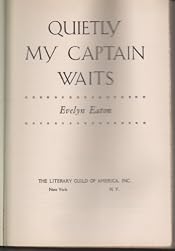
Quietly My Captain Waits is an historical novel of Acadia (described by Eaton as "modern Nova Scotia, New Brunswick, and a portion of Maine"), part of New France, at the end of the 17th century and the beginning of the 18th, in the French colony's final years, before the English pushed the French out of the territory during what became known as Queen Anne's War. The book, published in 1940, was Evelyn Eaton's third, but the first to bring her commercial success. Eaton went on to have a fascinating career as a poet, novelist and journalist. Always interested in spirituality and Native American culture, Eaton connected later in life (beginning in the early 1960s) with the Shoshone and Washoe tribes of California and became a Medicine Woman in their culture.
To write Quietly My Captain Waits, Eaton combed through the archives of the public archives of Halifax, Nova Scotia, and Annapolis Royal to uncover the story of real life, and very romantic, figures, especially Madame Louise de Freneuse and naval captain Pierre de Bonaventure, whose public love affair became a scandal in the New France stronghold of Port Royal because de Bonaventure had a wife and children in France. Eaton used this romance, which had begun when the two were quite young (in the novel, the young Louise's father refuses to allow the pair to marry the then lowly ensign Pierre) as the framework for her entirely engaging novel. It's an historical romantic novel of the old school, but the book rises above the ordinary through her rewarding storytelling skills, including excellent plotting that often takes unexpected, non-formulaic turns, the fact that we know she's created the story from real events and real people. For example, several of the letters sent from Port Royal's governors to the authorities in France are direct reproductions of the letters Eaton found in those archives. In addition, there is the doom that we know awaits the colony, which was finally taken by the British in an overwhelming assault in 1711. We only wait to learn the individual fates of our heroes. Members of several Native American tribes become major players in the events (and the story), and though the sort of paternalism we might expect from a 1940s novel does come into play, still the Native Americans are described what I suppose is basically realistic fashion. As noted above, Eaton felt a lifelong connection to Native American culture, so we would not expect her to be significantly patronizing. In Louise we have a strong, self-reliant and self-possessed heroine who does not bow to any man, be they military governors or even Pierre, the object of her lifelong romantic passion and a strong character himself.
I don't want to overstate what one will find in Quietly My Captain Waits. I wouldn't call it great literature, but within the genre of the old school historic novel, I'd say it stands strongly above the average offering. Eaton had a very good facility for describing the natural surroundings of the area in summer and winter. She, herself, grew up in Halifax, and her interest in the area and its history is clearly genuine. It's always interesting to me to read one of these old novels that were popular in their day but eventually sank entirely out of the public consciousness. And for me it's fascinating to know that the story and characters, if not, certainly, all of the plot points, come directly out of those obscure Halifax archives.
Here's a short biography of Eaton and also her daughter: https://www.winddaughter.com/evelyn-terry-eaton
Quietly My Captain Waits is an historical novel of Acadia (described by Eaton as "modern Nova Scotia, New Brunswick, and a portion of Maine"), part of New France, at the end of the 17th century and the beginning of the 18th, in the French colony's final years, before the English pushed the French out of the territory during what became known as Queen Anne's War. The book, published in 1940, was Evelyn Eaton's third, but the first to bring her commercial success. Eaton went on to have a fascinating career as a poet, novelist and journalist. Always interested in spirituality and Native American culture, Eaton connected later in life (beginning in the early 1960s) with the Shoshone and Washoe tribes of California and became a Medicine Woman in their culture.
To write Quietly My Captain Waits, Eaton combed through the archives of the public archives of Halifax, Nova Scotia, and Annapolis Royal to uncover the story of real life, and very romantic, figures, especially Madame Louise de Freneuse and naval captain Pierre de Bonaventure, whose public love affair became a scandal in the New France stronghold of Port Royal because de Bonaventure had a wife and children in France. Eaton used this romance, which had begun when the two were quite young (in the novel, the young Louise's father refuses to allow the pair to marry the then lowly ensign Pierre) as the framework for her entirely engaging novel. It's an historical romantic novel of the old school, but the book rises above the ordinary through her rewarding storytelling skills, including excellent plotting that often takes unexpected, non-formulaic turns, the fact that we know she's created the story from real events and real people. For example, several of the letters sent from Port Royal's governors to the authorities in France are direct reproductions of the letters Eaton found in those archives. In addition, there is the doom that we know awaits the colony, which was finally taken by the British in an overwhelming assault in 1711. We only wait to learn the individual fates of our heroes. Members of several Native American tribes become major players in the events (and the story), and though the sort of paternalism we might expect from a 1940s novel does come into play, still the Native Americans are described what I suppose is basically realistic fashion. As noted above, Eaton felt a lifelong connection to Native American culture, so we would not expect her to be significantly patronizing. In Louise we have a strong, self-reliant and self-possessed heroine who does not bow to any man, be they military governors or even Pierre, the object of her lifelong romantic passion and a strong character himself.
I don't want to overstate what one will find in Quietly My Captain Waits. I wouldn't call it great literature, but within the genre of the old school historic novel, I'd say it stands strongly above the average offering. Eaton had a very good facility for describing the natural surroundings of the area in summer and winter. She, herself, grew up in Halifax, and her interest in the area and its history is clearly genuine. It's always interesting to me to read one of these old novels that were popular in their day but eventually sank entirely out of the public consciousness. And for me it's fascinating to know that the story and characters, if not, certainly, all of the plot points, come directly out of those obscure Halifax archives.
Here's a short biography of Eaton and also her daughter: https://www.winddaughter.com/evelyn-terry-eaton
39rocketjk
A couple of photos regarding Quietly My Captain Waits:
At the top of the inside cover page, which consists of a wonderful map of New France, I find this signature. Can anybody read this?

Inside the book, folded up neatly, I found this sheet. It seems to be a donation form that a member of an individual Presbyterian congregation would make to the New York (or national) Presbyterian Church through his/her own local church. The small print at the bottom right ends with the numerals 9-47, which I guess is a date: September 1947. Since the novel was published in 1940, this would align. Can anyone enlighten us more fully about this form? (Evidently no such contribution was forthcoming from this particular parishioner.)

At the top of the inside cover page, which consists of a wonderful map of New France, I find this signature. Can anybody read this?

Inside the book, folded up neatly, I found this sheet. It seems to be a donation form that a member of an individual Presbyterian congregation would make to the New York (or national) Presbyterian Church through his/her own local church. The small print at the bottom right ends with the numerals 9-47, which I guess is a date: September 1947. Since the novel was published in 1940, this would align. Can anyone enlighten us more fully about this form? (Evidently no such contribution was forthcoming from this particular parishioner.)

40rocketjk
It was on to Stack 2 for my post-Quietly My Captain Waits "between book" reading:
* ““The Secret Life of Juan Rodriguez” by Gary Cartwright (Golf Digest) from Best Sports Stories 1965 edited by Irving T. Marsh and Edward Ehre
* “Mr. Webster Still at College—His Studies the Fourth Year—Personal Appearance—His Eulogy o the Death of a. lassmAte—Commencement—His Classmates—Performance—His Oration—He Is Made a Bchelor of Arts—Takes Leave” from The Public and Private Life of Daniel Webster by General S. P. Lyman
* “Enos Slaughter” from Sweet Seasons: Recollections of the 1955-64 New York Yankees by Dom Forker
* “This Is My Body” from We’re Alone by Edwidge Danticat (no touchstone at this time)
* “Introduction: In Good Faith”* and “Downhill All the Way” from When the Facts Change: Essays 1995-2010 by Tony Judt - Newly added
* Day 10 Introduction and Story 1 from The Decameron by Giovanni Boccaccio (translated by Wayne A. Rebhorn)
* “A Look at the World’s Week” from Life, November, 7, 1955 edited by Edward K. Thompson
*The Introduction was written by Jennifer Homans, Tony Judt’s widow and the editor of this essay collection.
Now I've started The Little World of Don Camillo by Giovannino Guareschi, a comedy that takes place (and was written) in early 1950s rural Italy.
* ““The Secret Life of Juan Rodriguez” by Gary Cartwright (Golf Digest) from Best Sports Stories 1965 edited by Irving T. Marsh and Edward Ehre
* “Mr. Webster Still at College—His Studies the Fourth Year—Personal Appearance—His Eulogy o the Death of a. lassmAte—Commencement—His Classmates—Performance—His Oration—He Is Made a Bchelor of Arts—Takes Leave” from The Public and Private Life of Daniel Webster by General S. P. Lyman
* “Enos Slaughter” from Sweet Seasons: Recollections of the 1955-64 New York Yankees by Dom Forker
* “This Is My Body” from We’re Alone by Edwidge Danticat (no touchstone at this time)
* “Introduction: In Good Faith”* and “Downhill All the Way” from When the Facts Change: Essays 1995-2010 by Tony Judt - Newly added
* Day 10 Introduction and Story 1 from The Decameron by Giovanni Boccaccio (translated by Wayne A. Rebhorn)
* “A Look at the World’s Week” from Life, November, 7, 1955 edited by Edward K. Thompson
*The Introduction was written by Jennifer Homans, Tony Judt’s widow and the editor of this essay collection.
Now I've started The Little World of Don Camillo by Giovannino Guareschi, a comedy that takes place (and was written) in early 1950s rural Italy.
41FlorenceArt
>40 rocketjk: Don Camillo is a celebrity in France, due to the movies series from the 50s and 60s starring Fernandel.
42rocketjk
>42 rocketjk: Interesting! I didn't know that. I just remember that my father enjoyed the book a lot.
43KeithChaffee
>39 rocketjk: "Can anyone enlighten us more fully about this form?"
Seminary Sunday is an annual tradition within the Presbyterian Church; this year's is coming up on September 21. It is, according to the McCormick Theological Seminary, "a dedicated time for congregations to engage with and support theological education."
So this form would have been submitted with a parishioner's contribution, which would have been colllected by the local church and sent off to the national church to be distributed to seminaries or seminarians. That allows the national church to track the contributions of each church, and allows the local church to track its own parishioners' contributions. I would assume from the "please credit this as a benevolence contribution" that parishioners were expected to donate a certain amount to charity each year, and that this donation for Seminary Sunday would be credited toward that amount.
Seminary Sunday is an annual tradition within the Presbyterian Church; this year's is coming up on September 21. It is, according to the McCormick Theological Seminary, "a dedicated time for congregations to engage with and support theological education."
So this form would have been submitted with a parishioner's contribution, which would have been colllected by the local church and sent off to the national church to be distributed to seminaries or seminarians. That allows the national church to track the contributions of each church, and allows the local church to track its own parishioners' contributions. I would assume from the "please credit this as a benevolence contribution" that parishioners were expected to donate a certain amount to charity each year, and that this donation for Seminary Sunday would be credited toward that amount.
44rocketjk
>43 KeithChaffee: Thanks! So my supposition, "It seems to be a donation form that a member of an individual Presbyterian congregation would make to the New York (or national) Presbyterian Church through his/her own local church," was basically correct! What I was missing was that it was a project specifically for the benefit of seminaries. Cheers!
45SassyLassy
>39 rocketjk: Looks like Floyd J Feaull. There is an old abandoned place on Skye by that name, so given that the book originated in Nova Scotia, it's not out of the question.
Got a chuckle out of obscure Halifax archives They were indeed the old musty ones in Eaton's day, but today's building is much newer with big windows and solar panels. If you were in Halifax, you would probably go by it almost daily.
I'll have to look for this book in the second hand bookstores around and about.
Got a chuckle out of obscure Halifax archives They were indeed the old musty ones in Eaton's day, but today's building is much newer with big windows and solar panels. If you were in Halifax, you would probably go by it almost daily.
I'll have to look for this book in the second hand bookstores around and about.
46rocketjk
>45 SassyLassy: "Got a chuckle out of obscure Halifax archives "
Ha! That's how they're described in the online articles/reviews about Eaton and the book (written at the time of publication in 1940). Evidently Eaton did quite a lot of digging to come up with the letters and other information she found and incorporated into the novel.
I've only been in the Halifax airport on my way to and from Newfoundland, where my wife and I had quite a lovely vacation somewhere around 20 years ago. With luck I'll get to spend more time in Halifax someday.
Ha! That's how they're described in the online articles/reviews about Eaton and the book (written at the time of publication in 1940). Evidently Eaton did quite a lot of digging to come up with the letters and other information she found and incorporated into the novel.
I've only been in the Halifax airport on my way to and from Newfoundland, where my wife and I had quite a lovely vacation somewhere around 20 years ago. With luck I'll get to spend more time in Halifax someday.
47labfs39
I was delighted to see that the Franco-American Library in Maine has Quietly My Captain Waits. I have too many books checked out at the moment, but I have added it to my online list.
48SassyLassy
>47 labfs39: You know I had to check out that library - what a wonderful resource! This past Friday (Aug 15) was the annual National Acadian Day / la Fête nationale de l’Acadie, so a nice tie-in.
49labfs39
>48 SassyLassy: As I may have mentioned to you before, my grandfather was Quebecois. His family moved to Maine when he was six. He always spoke French with his sisters, but I had a hard time understanding his accent. I wish he had lived longer, as there are so many things I would like to ask him about his life, especially his childhood and serving in the Middle East in WWII. I didn't even know about the latter until long after his death, when a distant relative gave me some letters he had written to his mother.
50rocketjk
The Little World of Don Camillo by Giovanni Guareschi

"My parents had decided that I should become a naval engineer and so I ended up studying law and thus, in a short time, I became famous as a signboard artist and caricaturist."
So writes Giovanni Guareschi (1908-1968) in his humorous autobiographical introduction, "How I Got This Way," to The Little World of Don Camillo, the first collection of the satirical short stories he wrote in the late 1940s and early 50s about the rivalry between a village priest, Don Camillo, and the village's Communist mayor, Peppone. The stories were originally published individually in a periodical called Candido. (Guareschi says, " . . . {A} new magazine called Candido* was established in Milan and, in working for it, I found myself up to my eyes in politics although I was then, and still am, an independent. Nevertheless the magazine values my contributions very highly--perhaps because I am editor-in-chief.") Guareschi tells us that "The background of these stories is my home, Parma, the Emilian Plain along the Po where political passion often reaches a disturbing intensity, and yet these people are attractive and hospitable and generous and have a highly developed sense of humor."
Both Don Camillo and Perrone have considerable brute strength and large fists, and not infrequently the two come to blows, though Don Camillo is portrayed as the stronger and almost always the victor in these tussles. But they also have strong personal ties significantly strengthened by the fact that, during World War Two, both were members of resistance militias that took to the hills to fight the Nazis after the German occupation following Italy's armistice with the Allies in 1943. So when push comes to shove, they look out for each other and have each others' backs.
Don Camillo has one other major advantage over Perrone. In the village church that Don Camillo oversees hangs a large crucifix, and the Chirst hanging on that crucifix often speaks to the Don, advising him toward patience and compassion, talking him down from impulsive actions, all with fond smiles and understanding towards the all-too-human priest.
The opening stories in the collection are relatively light in subject matter, and lines are frequently blurred. For as resolved as Perrone and his party followers are in the advancement of Communism, they are still often to be found in church on Sunday morning. In the second story, when Don Camillo refuses to baptize Perrone's infant son because Perrone is intent in naming him Lenin, he finds both Perrone and Christ arrayed against him. In another tale, Don Camillo attempts to convince Mayor Perrone to use village funds to fix a crack in the church bell tower. In a third, Perrone plays a joke on Don Camillo by having firecrackers tied to the church bells. Later, after Don Camillo has prevented Perrone from committing a crime of political passion by stealing Perrone's bicycle, Perrone shows up at the church looking for his bike after a long walk in the nighttime fog.
Towards the end, though, the stories become a bit more serious, though never losing their satirical edge entirely. These work particularly well because the rivalry and bonds between the two antagonists has already been well established. One of the final stories is entitled, "The Fear Spreads."
Overall, these stories are fun and insightful for all their humor, and provide a very interesting look at the post-war period in Italy when the country's future political system was in doubt, with rivalries between those vying for Communist control, the solidification of a democratic parliamentary republic or the return of the monarchy.
One final note: Guareschi occasionally provides writing like this . . .
Book note: My copy of The Little World of Don Camillo seems, from the online photos I've found, to be a first edition. It has been in my book collection since 2010. Also, I remember that my father loved this book.
* fwiw, Wikipedia describes Candido as a monarchist publication.

"My parents had decided that I should become a naval engineer and so I ended up studying law and thus, in a short time, I became famous as a signboard artist and caricaturist."
So writes Giovanni Guareschi (1908-1968) in his humorous autobiographical introduction, "How I Got This Way," to The Little World of Don Camillo, the first collection of the satirical short stories he wrote in the late 1940s and early 50s about the rivalry between a village priest, Don Camillo, and the village's Communist mayor, Peppone. The stories were originally published individually in a periodical called Candido. (Guareschi says, " . . . {A} new magazine called Candido* was established in Milan and, in working for it, I found myself up to my eyes in politics although I was then, and still am, an independent. Nevertheless the magazine values my contributions very highly--perhaps because I am editor-in-chief.") Guareschi tells us that "The background of these stories is my home, Parma, the Emilian Plain along the Po where political passion often reaches a disturbing intensity, and yet these people are attractive and hospitable and generous and have a highly developed sense of humor."
Both Don Camillo and Perrone have considerable brute strength and large fists, and not infrequently the two come to blows, though Don Camillo is portrayed as the stronger and almost always the victor in these tussles. But they also have strong personal ties significantly strengthened by the fact that, during World War Two, both were members of resistance militias that took to the hills to fight the Nazis after the German occupation following Italy's armistice with the Allies in 1943. So when push comes to shove, they look out for each other and have each others' backs.
Don Camillo has one other major advantage over Perrone. In the village church that Don Camillo oversees hangs a large crucifix, and the Chirst hanging on that crucifix often speaks to the Don, advising him toward patience and compassion, talking him down from impulsive actions, all with fond smiles and understanding towards the all-too-human priest.
The opening stories in the collection are relatively light in subject matter, and lines are frequently blurred. For as resolved as Perrone and his party followers are in the advancement of Communism, they are still often to be found in church on Sunday morning. In the second story, when Don Camillo refuses to baptize Perrone's infant son because Perrone is intent in naming him Lenin, he finds both Perrone and Christ arrayed against him. In another tale, Don Camillo attempts to convince Mayor Perrone to use village funds to fix a crack in the church bell tower. In a third, Perrone plays a joke on Don Camillo by having firecrackers tied to the church bells. Later, after Don Camillo has prevented Perrone from committing a crime of political passion by stealing Perrone's bicycle, Perrone shows up at the church looking for his bike after a long walk in the nighttime fog.
"As he turned from the door Peppone said, 'I have made one mistake in my life. I tied firecrackers to your bells. It should have been half a ton of dynamite.'
'Errare humanum est,' remarked Don Camillo"
Towards the end, though, the stories become a bit more serious, though never losing their satirical edge entirely. These work particularly well because the rivalry and bonds between the two antagonists has already been well established. One of the final stories is entitled, "The Fear Spreads."
Overall, these stories are fun and insightful for all their humor, and provide a very interesting look at the post-war period in Italy when the country's future political system was in doubt, with rivalries between those vying for Communist control, the solidification of a democratic parliamentary republic or the return of the monarchy.
One final note: Guareschi occasionally provides writing like this . . .
Between one and three o'clock of an August afternoon, the heat in those fields of hemp and buckwheat can be both seen and felt. It is almost as though a great curtain of boiling glass hung a few inches from your nose. If you cross a bridge and look down into the canal, you find its bed dry and cracked, with here and there a dead fish, and when you look at a cemetery from the road along the river bank you almost seem to hear the bones rattling beneath the boiling sun. Along the main road you will meet an occasional wagon piled high with sand, with the driver sound asleep lying face downwards on top of his load, his stomach cool ad his spine incandescent, or he will be sitting on the shaft fishing out pieces from half a watermelon that he holds on his knees like a bowl.
Then when you come to the big bank, there lies the great river, deserted, motionless and silent, like a cemetery of dead waters.
Book note: My copy of The Little World of Don Camillo seems, from the online photos I've found, to be a first edition. It has been in my book collection since 2010. Also, I remember that my father loved this book.
* fwiw, Wikipedia describes Candido as a monarchist publication.
51rocketjk
My post-The Little World of Don Camillo "Between Book" reading was another sojourn through Stack 2:
* “Thunderbolt from the North” by Bob Barnet (The Muncie Star) from Best Sports Stories 1965 edited by Irving T. Marsh and Edward Ehre
* “Mr. Webster Is the Principal of the Freyburg Academy—He Studies Law with Thomas W. Thompson” from The Public and Private Life of Daniel Webster by General S. P. Lyman
* “Bobby Shantz” from Sweet Seasons: Recollections of the 1955-64 New York Yankees by Dom Forker
* “By the Time You Read This” from We’re Alone by Edwidge Danticat
* “Europe: The Grand Illusion” from When the Facts Change: Essays 1995-2010 by Tony Judt
* Day 10, Story 2 from The Decameron by Giovanni Boccaccio (translated by Wayne A. Rebhorn)
* “Spirit Flickers Amidst Splendor: The Big Four meet in Geneva to fllow up summit session” a portfolio of sketches by Ronald Searle from Life, November, 7, 1955 edited by Edward K. Thompson
I've now begun a baseball history, The New York Game: Baseball and the Rise of a New City by Kevin Baker, a 70th birthday present from my wonderful wife.
* “Thunderbolt from the North” by Bob Barnet (The Muncie Star) from Best Sports Stories 1965 edited by Irving T. Marsh and Edward Ehre
* “Mr. Webster Is the Principal of the Freyburg Academy—He Studies Law with Thomas W. Thompson” from The Public and Private Life of Daniel Webster by General S. P. Lyman
* “Bobby Shantz” from Sweet Seasons: Recollections of the 1955-64 New York Yankees by Dom Forker
* “By the Time You Read This” from We’re Alone by Edwidge Danticat
* “Europe: The Grand Illusion” from When the Facts Change: Essays 1995-2010 by Tony Judt
* Day 10, Story 2 from The Decameron by Giovanni Boccaccio (translated by Wayne A. Rebhorn)
* “Spirit Flickers Amidst Splendor: The Big Four meet in Geneva to fllow up summit session” a portfolio of sketches by Ronald Searle from Life, November, 7, 1955 edited by Edward K. Thompson
I've now begun a baseball history, The New York Game: Baseball and the Rise of a New City by Kevin Baker, a 70th birthday present from my wonderful wife.
52labfs39
>50 rocketjk: Sounds wonderful. Adding it to my wish list.
53rocketjk
Well, I have to set aside the entirely delightful history, The New York Game: Baseball and the Rise of a New City by Kevin Baker. I'm about 3/5 through this 475-page book that admirably puts the history of baseball in New York City into the context of the history of the city itself. The only reason I'm setting it aside is that I'm leaving on a 2-week trip and don't want to haul the book around to my three stops on the journey. So I'm going to be bringing along The Betrayers by David Bezmozgis, which I'll be reading for my book group meeting taking place soon after my return home. For backup I'm bringing Vaclav & Lena by Haley Tanner, an intriguing-looking novel that I picked up yesterday in a thrift store, not realizing that the book is, I guess, considered a YA novel. Well, it looks intriguing, so I'm going to give it a go.
My wife and I are leaving tomorrow for Mendocino County to visit Anderson Valley, where we lived for 15 years, and see old friends. After that my wife will be returning home while I head to Los Angeles to meet up with a couple of buddies for our annual baseball weekend, a tradition that dates back to 2000, broken only by the two years of the pandemic. Then I'll go to Las Vegas for a few days to see my sister and brother-in-law, my niece and nephew and their spouses, and their kids. (I have three grandnephews and one grandniece!)
My wife and I are leaving tomorrow for Mendocino County to visit Anderson Valley, where we lived for 15 years, and see old friends. After that my wife will be returning home while I head to Los Angeles to meet up with a couple of buddies for our annual baseball weekend, a tradition that dates back to 2000, broken only by the two years of the pandemic. Then I'll go to Las Vegas for a few days to see my sister and brother-in-law, my niece and nephew and their spouses, and their kids. (I have three grandnephews and one grandniece!)
54cindydavid4
safe travels!enjoy!
55rocketjk
The Betrayers by David Bezmozgis
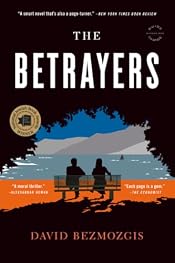
I found The Betrayers to be a very readable and thought-provoking novel, and it engendered a good, positive, discussion in my monthly reading group this week. Baruch Kotler was a Refusenik activist in Soviet Russian. (The Refuseniks were Soviet Jews who applied to emigrate to Israel during the 1970s and into the 1980s. Just applying to leave the Soviet Union was enough to get you into trouble with the authorities, and many were put into mental hospitals or jails, or sent into exile.) Kotler was betrayed to the authorities by someone he thought was a friend, and his principled refusal to testify against others had earned him a long prison sentence. Eventually, international pressure had brought about Kotler's release and allowed him to finally get to Israel, where he had been praised as a hero and become a member of the Knesset with a significant following. As the novel begins, Kotler has taken another principled (to him) stand, refusing to go along with the government's plan to dismantle some Israeli settlements in the occupied territories, for reasons that are not made entirely clear. It's one thing to disagree, but Kotler has announced not just his and his party's vote against the plan, but his resignation from the government if the plan is carried out, thereby threatening the Prime Minister's ruling coalition. The government tries to blackmail him, threatening to expose his affair with a much younger woman. But Kotler is still the principled Kotler, and he refuses to comply. The action of the novel begins, then, with Kotler and his mistress, Leora, arriving in the Crimea, where they have come to escaped, at least for a while, the uproar of their public exposure. But, it turns out, in attempting to get away for the moment from the tumult of politics and scandal, Kotler has inadvertently walked into something powerful and much more personal.
The Betrayers, then, is a novel about personal standards and principles, about redemption and forgiveness. When should forgiveness be forthcoming? When, on the subject of guilt and resentment, is enough finally enough? To whom dues one owe one's loyalties? Family? Country? When does adherence to one's own sense of right and wrong above all else become selfish rather than admirable? There are many well drawn characters in this novel, and some very well conceived plot developments that I don't want to divulge here. (On that note, if you end up with the Back Bay Books edition of the novel pictured in this post, please beware of the paragraph-long blurb on the back cover that talks about plot developments that occur much too far into the narrative for my tastes.) I will say that the reading group my wife and I are in is comprised mostly of women, with the only other fellow in the group absent at this month's meeting. I mention that only to say that several of the group members mentioned their appreciation of the portrayals of the female characters in the book. I will say that the novel offers an affecting picture of the remnants of the Jewish community in the small town Kotler and Leora have landed in, the Jews who did not emigrate when the Soviet Union collapsed and most of the country's Jews had left for Israel.
The Betrayers is an absorbing, quick (219 pages) read. As an American Jew who, during high school days, took part in many "Free Soviet Jews" protests in front of the Russian embassy in New York, I found the subject matter particularly interesting. But also, I was interested in the fact that, written only ten years ago, this book portrays with sympathy a public figure who doesn't not support the dismantling of an Israeli settlement. At this point, for me and for most of the American Jews I know, the idea of dismantling those settlements seems like a very good idea, indeed, if one whose likelihood is disappearing ever more quickly, and tragically, into the past.
I found The Betrayers to be a very readable and thought-provoking novel, and it engendered a good, positive, discussion in my monthly reading group this week. Baruch Kotler was a Refusenik activist in Soviet Russian. (The Refuseniks were Soviet Jews who applied to emigrate to Israel during the 1970s and into the 1980s. Just applying to leave the Soviet Union was enough to get you into trouble with the authorities, and many were put into mental hospitals or jails, or sent into exile.) Kotler was betrayed to the authorities by someone he thought was a friend, and his principled refusal to testify against others had earned him a long prison sentence. Eventually, international pressure had brought about Kotler's release and allowed him to finally get to Israel, where he had been praised as a hero and become a member of the Knesset with a significant following. As the novel begins, Kotler has taken another principled (to him) stand, refusing to go along with the government's plan to dismantle some Israeli settlements in the occupied territories, for reasons that are not made entirely clear. It's one thing to disagree, but Kotler has announced not just his and his party's vote against the plan, but his resignation from the government if the plan is carried out, thereby threatening the Prime Minister's ruling coalition. The government tries to blackmail him, threatening to expose his affair with a much younger woman. But Kotler is still the principled Kotler, and he refuses to comply. The action of the novel begins, then, with Kotler and his mistress, Leora, arriving in the Crimea, where they have come to escaped, at least for a while, the uproar of their public exposure. But, it turns out, in attempting to get away for the moment from the tumult of politics and scandal, Kotler has inadvertently walked into something powerful and much more personal.
The Betrayers, then, is a novel about personal standards and principles, about redemption and forgiveness. When should forgiveness be forthcoming? When, on the subject of guilt and resentment, is enough finally enough? To whom dues one owe one's loyalties? Family? Country? When does adherence to one's own sense of right and wrong above all else become selfish rather than admirable? There are many well drawn characters in this novel, and some very well conceived plot developments that I don't want to divulge here. (On that note, if you end up with the Back Bay Books edition of the novel pictured in this post, please beware of the paragraph-long blurb on the back cover that talks about plot developments that occur much too far into the narrative for my tastes.) I will say that the reading group my wife and I are in is comprised mostly of women, with the only other fellow in the group absent at this month's meeting. I mention that only to say that several of the group members mentioned their appreciation of the portrayals of the female characters in the book. I will say that the novel offers an affecting picture of the remnants of the Jewish community in the small town Kotler and Leora have landed in, the Jews who did not emigrate when the Soviet Union collapsed and most of the country's Jews had left for Israel.
The Betrayers is an absorbing, quick (219 pages) read. As an American Jew who, during high school days, took part in many "Free Soviet Jews" protests in front of the Russian embassy in New York, I found the subject matter particularly interesting. But also, I was interested in the fact that, written only ten years ago, this book portrays with sympathy a public figure who doesn't not support the dismantling of an Israeli settlement. At this point, for me and for most of the American Jews I know, the idea of dismantling those settlements seems like a very good idea, indeed, if one whose likelihood is disappearing ever more quickly, and tragically, into the past.
56Dilara86
>50 rocketjk: Don Camillo is delightful (well, for a given value of - the series is about a village feud and grown men behaving disgracefully, after all!) and as mentioned in >41 FlorenceArt:, the films based on Giovanni Guareschi's books are part of popular culture in France and Italy. I read The Little World of Don Camillo a couple of years ago, and your review made me want to read the next one in the series...
57cindydavid4
>55 rocketjk: I remember his story from that time. our bnai brith youth chapter also was involed in the free the jews protests i didnt understand back then what was happening once they got to Isreal. I was a volunteer at a Kibbutz in that time and remember there was lots of discrimation of the russian jews. migt be interesting to read it now
58rocketjk
Vaclav & Lena by Haley Tanner
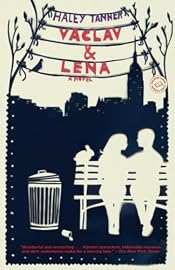
Vaclav and Lena are two young children, both recent Russian immigrés, growing up in Brooklyn. Vaclav has a stable family life. Lena is essentially on her own, though she lives with her aunt, who seems to ignore almost entirely. They meet and bond in ESL class in their public school. The one thing they are sure of is that Vaclav is going to grow up to become the world's greatest magician, and Lena will be his lovely assistant. After school in Vaclav's bedroom, they are hard at work practicing for their first public performance, which they plan to present on the Coney Island boardwalk. Vaclav & Lena works best as a character study of three intriguing individuals: the two children and Vaclav's mother, Rasia. Vaclav's father is on hand as well, but the move from Russia to the U.S. has gone hard on him, and he is mostly a background character here. The story is most effective showing us the tough road for children (and adults) trying to accustom themselves to a strange new land, as well as the power and enduring connections provided by early (and familial) friendships and love. The book is quite engaging and the characters well enough drawn that I felt connected throughout. Rasia in particular was a character I could identify with.
This is a first novel, and there are some plot holes (one particularly glaring to me), and some pacing issues. But overall I enjoyed the novel quite a bit and recommend it. It served very well as a vacation read.
I got curious and went looking to see what else Tanner had written, and it turned out Vaclav & Lena is her only novel, which is too bad. The introduction to an interview with her that appeared in The Forward says, "Tanner intimately knows the love and struggle that Vaclav and Lena share: She wrote this book while living with the man who would become her husband and, soon after, die of melanoma. Tanner says that the loveliness and lightness in the novel is his." She is now married to the musician and writer Josh Ritter, with whom she has two daughters.
Vaclav and Lena are two young children, both recent Russian immigrés, growing up in Brooklyn. Vaclav has a stable family life. Lena is essentially on her own, though she lives with her aunt, who seems to ignore almost entirely. They meet and bond in ESL class in their public school. The one thing they are sure of is that Vaclav is going to grow up to become the world's greatest magician, and Lena will be his lovely assistant. After school in Vaclav's bedroom, they are hard at work practicing for their first public performance, which they plan to present on the Coney Island boardwalk. Vaclav & Lena works best as a character study of three intriguing individuals: the two children and Vaclav's mother, Rasia. Vaclav's father is on hand as well, but the move from Russia to the U.S. has gone hard on him, and he is mostly a background character here. The story is most effective showing us the tough road for children (and adults) trying to accustom themselves to a strange new land, as well as the power and enduring connections provided by early (and familial) friendships and love. The book is quite engaging and the characters well enough drawn that I felt connected throughout. Rasia in particular was a character I could identify with.
This is a first novel, and there are some plot holes (one particularly glaring to me), and some pacing issues. But overall I enjoyed the novel quite a bit and recommend it. It served very well as a vacation read.
I got curious and went looking to see what else Tanner had written, and it turned out Vaclav & Lena is her only novel, which is too bad. The introduction to an interview with her that appeared in The Forward says, "Tanner intimately knows the love and struggle that Vaclav and Lena share: She wrote this book while living with the man who would become her husband and, soon after, die of melanoma. Tanner says that the loveliness and lightness in the novel is his." She is now married to the musician and writer Josh Ritter, with whom she has two daughters.
59rocketjk
The New York Game: Baseball and the Rise of a New City by Kevin Baker
This excellent history basically brand new, published just this year. I'd looked it over several times in bookstores but ended up being very happy I didn't buy it, as my lovely wife took care of that for me by giving it to me as a 70th birthday present. The book is a bit of a doorstop, checking in a 475 pages, but I soon found that I didn't care much about that at all, as this history is extremely well written and quite interesting. Baker, who has written extensively--novels as well as histories--about New York City, does a great job here of not just writing about the history of baseball in New York, but skillfully weaving that history with the story of the city itself. In so doing, Baker puts baseball in its proper social context through the various city eras, letting us know what the game and its stars meant to the city's baseball fans, and why. The book covers the period from the Civil War through the end of World War 2, stopping just short of Jackie Robinson's breaking of the color line in 1947. We get pocket biographies of the New York game's great stars and managers, of course, including Christy Mathewson, Joe McCarthy, Lou Gehrig, Babe Ruth, Casey Stengel, John McGraw, Joe Dimaggio, Carl Hubbell and many others. Also we read about the owners: how they came to own their teams, who they had to deal with to do business in the city, and how they succeeded or failed as owners, and why. Baker also give us entertaining chronologies of some of the great seasons, pennant races and World Series. Descriptions of the rise of the Negro Leagues, and the Major League owners consistent refusal over many decades to integrate their league, are also well done.
But somewhat unusually (and admirably) for a baseball history, he also places the game within a firm political context, often turning away from baseball itself for long stretches to explain some of the city's (and country's) most important political/economic eras. For example:
Baker does a great job exploring the confluence of baseball and organized crime in the city, including the game's early problems with gambling, the mobsters who had so much influence over every facet of city life, and the fact that the early 20th Century baseball owners had to play ball with corrupt city officials in order to find places to build their ballparks. In the days when Manhattan and the other boroughs were still being built up, owners found that city officials on the take often had to be put on their teams' boards of directors, for example, in order to keep the city government from running streets through the lots the owners had purchased for ballfields. Of course, when one thinks of corruption in New York City, one thinks of the infamous political machine, Tammany Hall. Baker devotes an entire chapter to the corruption, rot and violence that the Tammany machine represented through the 1920s in particular. Pointing out that because of the rampant avarice inherent in the machine, the needs of the city itself began to be ignored. The docks were rotting, the hospitals in fetid disrepair and so forth. This was all taking place during the Roaring 20s, when New York City was ostensibly enjoying high times. But when the Depression hit, the veil was ripped away, the city administration revealed to be almost entirely hollow, with essentially no infrastructure able to provide a safety net for the widespread poverty that ensued. Interestingly, as Baker observes, in future New Yorkers' sense of nostalgia would focus much more on these hard times than on the high living of the 20s that had preceded them. Fiorelo LaGuardia's reformist mayoralty gets a detailed description, as well. And, of course, the role that baseball served in helping people enjoy the high times and get through the tough times, and the ways in which particular players and teams fit in with the tenor of their times (or failed to) is prominently baked into the narrative.
Baker concludes his history with a full chapter on the ever-increasing oppression experienced by New York's African American population, especially within Harlem, including the many anti-Black pogroms that took place, and the riots that ran through Harlem based on rumors of violence or actual violence, on the part of the police.
Normally in the case of a baseball history or biography, I include the phrase somewhere: "For baseball fans only." In this case, I'd say that anyone with an interest in the history of New York City as well as at least a passing interest in baseball history might enjoy this excellent work.
This excellent history basically brand new, published just this year. I'd looked it over several times in bookstores but ended up being very happy I didn't buy it, as my lovely wife took care of that for me by giving it to me as a 70th birthday present. The book is a bit of a doorstop, checking in a 475 pages, but I soon found that I didn't care much about that at all, as this history is extremely well written and quite interesting. Baker, who has written extensively--novels as well as histories--about New York City, does a great job here of not just writing about the history of baseball in New York, but skillfully weaving that history with the story of the city itself. In so doing, Baker puts baseball in its proper social context through the various city eras, letting us know what the game and its stars meant to the city's baseball fans, and why. The book covers the period from the Civil War through the end of World War 2, stopping just short of Jackie Robinson's breaking of the color line in 1947. We get pocket biographies of the New York game's great stars and managers, of course, including Christy Mathewson, Joe McCarthy, Lou Gehrig, Babe Ruth, Casey Stengel, John McGraw, Joe Dimaggio, Carl Hubbell and many others. Also we read about the owners: how they came to own their teams, who they had to deal with to do business in the city, and how they succeeded or failed as owners, and why. Baker also give us entertaining chronologies of some of the great seasons, pennant races and World Series. Descriptions of the rise of the Negro Leagues, and the Major League owners consistent refusal over many decades to integrate their league, are also well done.
But somewhat unusually (and admirably) for a baseball history, he also places the game within a firm political context, often turning away from baseball itself for long stretches to explain some of the city's (and country's) most important political/economic eras. For example:
Baker does a great job exploring the confluence of baseball and organized crime in the city, including the game's early problems with gambling, the mobsters who had so much influence over every facet of city life, and the fact that the early 20th Century baseball owners had to play ball with corrupt city officials in order to find places to build their ballparks. In the days when Manhattan and the other boroughs were still being built up, owners found that city officials on the take often had to be put on their teams' boards of directors, for example, in order to keep the city government from running streets through the lots the owners had purchased for ballfields. Of course, when one thinks of corruption in New York City, one thinks of the infamous political machine, Tammany Hall. Baker devotes an entire chapter to the corruption, rot and violence that the Tammany machine represented through the 1920s in particular. Pointing out that because of the rampant avarice inherent in the machine, the needs of the city itself began to be ignored. The docks were rotting, the hospitals in fetid disrepair and so forth. This was all taking place during the Roaring 20s, when New York City was ostensibly enjoying high times. But when the Depression hit, the veil was ripped away, the city administration revealed to be almost entirely hollow, with essentially no infrastructure able to provide a safety net for the widespread poverty that ensued. Interestingly, as Baker observes, in future New Yorkers' sense of nostalgia would focus much more on these hard times than on the high living of the 20s that had preceded them. Fiorelo LaGuardia's reformist mayoralty gets a detailed description, as well. And, of course, the role that baseball served in helping people enjoy the high times and get through the tough times, and the ways in which particular players and teams fit in with the tenor of their times (or failed to) is prominently baked into the narrative.
Baker concludes his history with a full chapter on the ever-increasing oppression experienced by New York's African American population, especially within Harlem, including the many anti-Black pogroms that took place, and the riots that ran through Harlem based on rumors of violence or actual violence, on the part of the police.
Normally in the case of a baseball history or biography, I include the phrase somewhere: "For baseball fans only." In this case, I'd say that anyone with an interest in the history of New York City as well as at least a passing interest in baseball history might enjoy this excellent work.
60rocketjk
A couple of notes about my recent two weeks away from home. It didn't occur to me until I returned home that the trip overall was noteworthy because it encompassed three different but very consequential parts of my life, one section at a time:
* First, my wife and I went back to Boonville, the small town (about 1,000 people) where we lived for 15 years before moving to New York City a couple of years ago. We hadn't been there for almost exactly a year, at which time we had spent two months packing up our house there and saying goodbye to friends. Now I would be there for about five days and Steph for seven days. We didn't know what to expect, exactly. We knew people would be happy to see us, but would things be strained? The community there is very tight, as you'd imagine for a place so small. Would we be held at arms length, even inadvertently, because we had pulled up stakes and left? That would have been to be expected, except what actually happened was quite marvelous. We were treated by our friends as if we were still part of the community, and in the experience of that, it seemed the most natural thing in the world. The months we'd been away--as well as the future months we'd be away again--melted away, as if we'd just stepped back into another room of our lives. Well, it all made Steph and I agree that we had to find a way to retain this feeling by making a point of visiting at least once a year and probably staying for at least a week each time. We'll see how it all works out, though.
* Next, I flew down the Los Angeles for this year's "baseball trip." I have two buddies who I've been best friends with since 6th and 7th grade (that's over 50 years). One lives in San Francisco and the other in northwest New Jersey. Starting during the year 2000 (before I met my wife!) we began meeting once a year in different cities, the goal being to see baseball at all 30 major league parks, and to explore those cities in other ways (art museums, taverns, music venues, etc.). We have done this every year since then, save for the interruption of the two Covid years. This year in LA, by seeing a Dodgers game and an Angels game, we completed the circuit of all 30 teams. This will not mean the end of the baseball trip, but negotiations are ongoing for how to pick cities moving forward. At any rate, my five days with these characters (we've added one additional fellow to the group as well), friends for around 86% of our lives, was the second segment.
* Finally, I went to Las Vegas for five days with my family. When my older sister graduated law school in 1977, she and her boyfriend (soon to be her husband), moved to Las Vegas under the theory that there had to be work for lawyers there. At that time, in fact, Vegas was something of a boom town, with somewhere around 300,000 people moving there a year for a while. (Low housing prices; no state income tax.) Although I do enjoy visiting the town, I wouldn't live there for all the tea in China. However, my sister and brother-in-law have been quite happy there. Their kids, my niece and nephew obviously, went away to college but came back for post graduate work: my nephew Stephen went to law school at UNLV and my niece Meredith went to dental school at the same institution. Both stayed to practice there. Now my niece has twin boys who've just turned 12, and my nephew has a 3-year old son and a 1-year old daughter. So that's three grand nephews and one grand niece for me! So as you can imagine, I very much enjoy my time among this crew.
I got home and thought, "Wow! That was a whirlwind journey through my life!"
* First, my wife and I went back to Boonville, the small town (about 1,000 people) where we lived for 15 years before moving to New York City a couple of years ago. We hadn't been there for almost exactly a year, at which time we had spent two months packing up our house there and saying goodbye to friends. Now I would be there for about five days and Steph for seven days. We didn't know what to expect, exactly. We knew people would be happy to see us, but would things be strained? The community there is very tight, as you'd imagine for a place so small. Would we be held at arms length, even inadvertently, because we had pulled up stakes and left? That would have been to be expected, except what actually happened was quite marvelous. We were treated by our friends as if we were still part of the community, and in the experience of that, it seemed the most natural thing in the world. The months we'd been away--as well as the future months we'd be away again--melted away, as if we'd just stepped back into another room of our lives. Well, it all made Steph and I agree that we had to find a way to retain this feeling by making a point of visiting at least once a year and probably staying for at least a week each time. We'll see how it all works out, though.
* Next, I flew down the Los Angeles for this year's "baseball trip." I have two buddies who I've been best friends with since 6th and 7th grade (that's over 50 years). One lives in San Francisco and the other in northwest New Jersey. Starting during the year 2000 (before I met my wife!) we began meeting once a year in different cities, the goal being to see baseball at all 30 major league parks, and to explore those cities in other ways (art museums, taverns, music venues, etc.). We have done this every year since then, save for the interruption of the two Covid years. This year in LA, by seeing a Dodgers game and an Angels game, we completed the circuit of all 30 teams. This will not mean the end of the baseball trip, but negotiations are ongoing for how to pick cities moving forward. At any rate, my five days with these characters (we've added one additional fellow to the group as well), friends for around 86% of our lives, was the second segment.
* Finally, I went to Las Vegas for five days with my family. When my older sister graduated law school in 1977, she and her boyfriend (soon to be her husband), moved to Las Vegas under the theory that there had to be work for lawyers there. At that time, in fact, Vegas was something of a boom town, with somewhere around 300,000 people moving there a year for a while. (Low housing prices; no state income tax.) Although I do enjoy visiting the town, I wouldn't live there for all the tea in China. However, my sister and brother-in-law have been quite happy there. Their kids, my niece and nephew obviously, went away to college but came back for post graduate work: my nephew Stephen went to law school at UNLV and my niece Meredith went to dental school at the same institution. Both stayed to practice there. Now my niece has twin boys who've just turned 12, and my nephew has a 3-year old son and a 1-year old daughter. So that's three grand nephews and one grand niece for me! So as you can imagine, I very much enjoy my time among this crew.
I got home and thought, "Wow! That was a whirlwind journey through my life!"
61rocketjk
And now that I'm back home, I've returned to my "Between Book" tradition, with my post-The New York Game reading coming from Stack 2:
* “A Tropical Paradise Lost” by Edwin Pope (The Miami Herald) from Best Sports Stories 1965 edited by Irving T. Marsh and Edward Ehre
* “Office in Which Mr. Webster Studied Law—What Books He Read—Acquires a Knowledge of the Practice—Anecdote on His Firmness and Tact” from The Public and Private Life of Daniel Webster by General S. P. Lyman
* “Phil Linz” from Sweet Seasons: Recollections of the 1955-64 New York Yankees by Dom Forker
* “Chronicles of a Death Foretold” from We’re Alone by Edwidge Danticat
* “Crimes and Misdemeanors” from When the Facts Change: Essays 1995-2010 by Tony Judt
* Day 10, Story 3 from The Decameron by Giovanni Boccaccio (translated by Wayne A. Rebhorn)
* Editorials: “Magyar Memories of Freedom” and “Adam and Eve” from Life, November, 7, 1955 edited by Edward K. Thompson
Next I'll be reading the short but apparently quite enjoyable Plunkitt of Tammany Hall: a Series of Very Plain Talks on Very Practical Politics, written by journalist William Riordan, based on talks by George Washington Plunkitt, a Tammany Hall politician in the late 1800s and early 1900s. This ties in nicely with The New York Game, which describes the workings of Tammany Hall in some detail.
* “A Tropical Paradise Lost” by Edwin Pope (The Miami Herald) from Best Sports Stories 1965 edited by Irving T. Marsh and Edward Ehre
* “Office in Which Mr. Webster Studied Law—What Books He Read—Acquires a Knowledge of the Practice—Anecdote on His Firmness and Tact” from The Public and Private Life of Daniel Webster by General S. P. Lyman
* “Phil Linz” from Sweet Seasons: Recollections of the 1955-64 New York Yankees by Dom Forker
* “Chronicles of a Death Foretold” from We’re Alone by Edwidge Danticat
* “Crimes and Misdemeanors” from When the Facts Change: Essays 1995-2010 by Tony Judt
* Day 10, Story 3 from The Decameron by Giovanni Boccaccio (translated by Wayne A. Rebhorn)
* Editorials: “Magyar Memories of Freedom” and “Adam and Eve” from Life, November, 7, 1955 edited by Edward K. Thompson
Next I'll be reading the short but apparently quite enjoyable Plunkitt of Tammany Hall: a Series of Very Plain Talks on Very Practical Politics, written by journalist William Riordan, based on talks by George Washington Plunkitt, a Tammany Hall politician in the late 1800s and early 1900s. This ties in nicely with The New York Game, which describes the workings of Tammany Hall in some detail.
62markon
Sounds like you've had some very good reading and traveling Jerry Kudos to you for staying in touch with friends from middle school/junior high years too.
63rocketjk
Plunkitt of Tamany Hall: A Series of Very Plain Talks on Very Practical Politics by William L. Riordon
George Washington Plunkitt was a very successful politician operating within New York City's infamous Tammany Hall machine that ran the city for good and ill from the late 1800s through the Depression years, when the rot that the machine's inattention to anything but their own bank accounts finally became apparent. Plunkett served in the New York State Assembly and then the New York State Senate, and evidently was instrumental in voting in many important civil projects for the city. But he is most remembered for his patronage work within his New York City district. In 1904, he indulged his desire to speak his mind (evidently quite unusual for a Tammany bigwig), sitting on a shoeshine chair outside a NYC courthouse and expounding about the benefits of Tammany politics to journalist William L. Riordon. The series of talks were published one at a time in several NY newspapers, and in 1905 they were gathered and published in Plunkitt of Tammany Hall.
In these talks, Plunkitt's main points were the differences between "honest graft" and "dishonest graft." "Dishonest graft" meant, to him, things like blackmailing prostitutes, street vendors and even store owners for protection payments. This to Plunkitt was abhorrent. "Honest graft," though, was what we'd essentially today call insider trading. For example, he would, via his position in state government, learn of a new bridge in the works, buy up the land around where the entrances to the bridge was to be built, and then sell those lots back to the city at a handsome profit. "I seen my chance, and I took it," is how Plunkitt describes such maneuverings. The Tammany Hall district leaders would, famously, take care of the working people in their districts. Plunkitt describes his penchant for showing up at fires in working class neighborhoods and handing out cash for new furniture and clothing and even rent for people who'd been burned out. And always, of course, there were patronage jobs to be arranged. Anything to earn some votes.
Plunkitt describes with horror and disdain the reformist program to provide a trained and worthy civil service and saves his particular contempt for the "worthlessness" of the civil service exam. In his view, city jobs should be handed out the old fashioned way, to the people in his district who vote the right way and can bring along some other votes to make their cases stronger and so deserve to be rewarded. Competence or knowledge of the work the job entails is way down the priority list. Plunkitt's criticisms of the civil service exams are often quite humorous.
As New York City historian Peter Quinn points out in his contemporary introduction to my Signet Classics edition of the book, it is sometimes difficult to know where in the quoting and composition of these talks, Plunkitt leaves off and Riordon comes in. But I think we can assume that while the wording of some passages may be Riordon's, but content overall is Plunkitt's. Tammany could get things done. As Riordon tells us at the end of his original introduction to this book,
"Plunkitt has been one of the great powers in Tammany Hall for over a quarter of a century. While he was in the Assembly and the State Senate he was one of the most influential members and introduced the bills that provided for the outlying pairs of New York city, the Harlem River Speedway {now the Harlem River Drive, I think}, the Washington Bridge, the 155th Street Viaduct, the grading of Eighth Avenue north of Fifty-seventh Street, additions to the Museum of Natural History, the West Side Court, and many other important improvements."
On the other hand, I think we can safely assume that Plunkitt made money for himself on just about all of these projects. I read this book because I did one of my periodical random selections from my home library using the LT "Go to a random book of yours" function. Interestingly, it tied in very closely to my last book, The New York Game: Baseball and the Rise of a New City, with it's detailed descriptions of the Tammany machine and the ruins it left the city in when the Depression hit. (See my review of that book, just above.) Overall, for me, although the individual talks did eventually become somewhat tedious, I found Plunkitt of Tammany Hall to be an interesting look inside that famous political machine from the point of view of one of its practitioners. Chapter titles like "New York City Is Pie for the Hayseeds" and "Tammany Leaders Not Bookworms" will give you an idea of the tone of the proceedings.
George Washington Plunkitt was a very successful politician operating within New York City's infamous Tammany Hall machine that ran the city for good and ill from the late 1800s through the Depression years, when the rot that the machine's inattention to anything but their own bank accounts finally became apparent. Plunkett served in the New York State Assembly and then the New York State Senate, and evidently was instrumental in voting in many important civil projects for the city. But he is most remembered for his patronage work within his New York City district. In 1904, he indulged his desire to speak his mind (evidently quite unusual for a Tammany bigwig), sitting on a shoeshine chair outside a NYC courthouse and expounding about the benefits of Tammany politics to journalist William L. Riordon. The series of talks were published one at a time in several NY newspapers, and in 1905 they were gathered and published in Plunkitt of Tammany Hall.
In these talks, Plunkitt's main points were the differences between "honest graft" and "dishonest graft." "Dishonest graft" meant, to him, things like blackmailing prostitutes, street vendors and even store owners for protection payments. This to Plunkitt was abhorrent. "Honest graft," though, was what we'd essentially today call insider trading. For example, he would, via his position in state government, learn of a new bridge in the works, buy up the land around where the entrances to the bridge was to be built, and then sell those lots back to the city at a handsome profit. "I seen my chance, and I took it," is how Plunkitt describes such maneuverings. The Tammany Hall district leaders would, famously, take care of the working people in their districts. Plunkitt describes his penchant for showing up at fires in working class neighborhoods and handing out cash for new furniture and clothing and even rent for people who'd been burned out. And always, of course, there were patronage jobs to be arranged. Anything to earn some votes.
Plunkitt describes with horror and disdain the reformist program to provide a trained and worthy civil service and saves his particular contempt for the "worthlessness" of the civil service exam. In his view, city jobs should be handed out the old fashioned way, to the people in his district who vote the right way and can bring along some other votes to make their cases stronger and so deserve to be rewarded. Competence or knowledge of the work the job entails is way down the priority list. Plunkitt's criticisms of the civil service exams are often quite humorous.
As New York City historian Peter Quinn points out in his contemporary introduction to my Signet Classics edition of the book, it is sometimes difficult to know where in the quoting and composition of these talks, Plunkitt leaves off and Riordon comes in. But I think we can assume that while the wording of some passages may be Riordon's, but content overall is Plunkitt's. Tammany could get things done. As Riordon tells us at the end of his original introduction to this book,
"Plunkitt has been one of the great powers in Tammany Hall for over a quarter of a century. While he was in the Assembly and the State Senate he was one of the most influential members and introduced the bills that provided for the outlying pairs of New York city, the Harlem River Speedway {now the Harlem River Drive, I think}, the Washington Bridge, the 155th Street Viaduct, the grading of Eighth Avenue north of Fifty-seventh Street, additions to the Museum of Natural History, the West Side Court, and many other important improvements."
On the other hand, I think we can safely assume that Plunkitt made money for himself on just about all of these projects. I read this book because I did one of my periodical random selections from my home library using the LT "Go to a random book of yours" function. Interestingly, it tied in very closely to my last book, The New York Game: Baseball and the Rise of a New City, with it's detailed descriptions of the Tammany machine and the ruins it left the city in when the Depression hit. (See my review of that book, just above.) Overall, for me, although the individual talks did eventually become somewhat tedious, I found Plunkitt of Tammany Hall to be an interesting look inside that famous political machine from the point of view of one of its practitioners. Chapter titles like "New York City Is Pie for the Hayseeds" and "Tammany Leaders Not Bookworms" will give you an idea of the tone of the proceedings.
64rocketjk
My post-Plunkitt of Tammany Hall "between-book" reading brought me back to Stack 2, thusly:
* “An Oriental Waltz” by Al Cartwright (The Wilmington Evening Journal) from Best Sports Stories 1965 edited by Irving T. Marsh and Edward Ehre
* “Mr. Webster Studies Law in Boston—Christopher Gore—He is Admitted to Practice—His First Case” from The Public and Private Life of Daniel Webster by General S. P. Lyman
* “Art Ditmar” from Sweet Seasons: Recollections of the 1955-64 New York Yankees by Dom Forker
* “Wozo, Not Mowozo” from We’re Alone by Edwidge Danticat
* “Why the Cold War Worked” from When the Facts Change: Essays 1995-2010 by Tony Judt
* Day 10, Story 4 from The Decameron by Giovanni Boccaccio (translated by Wayne A. Rebhorn)
* “Figurehead’s Fall: South Vietnam sacks Bao Dai and backs Diem” from Life, November, 7, 1955 edited by Edward K. Thompson
I've now started Silas Marner by George Eliot for my monthly book group. I've liked the Eliot novels I've read previously. This constitutes one more "drop in the bucket" filling of the vast number of holes in my classics reading.
* “An Oriental Waltz” by Al Cartwright (The Wilmington Evening Journal) from Best Sports Stories 1965 edited by Irving T. Marsh and Edward Ehre
* “Mr. Webster Studies Law in Boston—Christopher Gore—He is Admitted to Practice—His First Case” from The Public and Private Life of Daniel Webster by General S. P. Lyman
* “Art Ditmar” from Sweet Seasons: Recollections of the 1955-64 New York Yankees by Dom Forker
* “Wozo, Not Mowozo” from We’re Alone by Edwidge Danticat
* “Why the Cold War Worked” from When the Facts Change: Essays 1995-2010 by Tony Judt
* Day 10, Story 4 from The Decameron by Giovanni Boccaccio (translated by Wayne A. Rebhorn)
* “Figurehead’s Fall: South Vietnam sacks Bao Dai and backs Diem” from Life, November, 7, 1955 edited by Edward K. Thompson
I've now started Silas Marner by George Eliot for my monthly book group. I've liked the Eliot novels I've read previously. This constitutes one more "drop in the bucket" filling of the vast number of holes in my classics reading.
65rocketjk
Silas Marner by George Eliot

I read Silas Marner for my monthly book group. It was nice to fill in more hole in my vast array of unread classics, but I can't say I enjoyed the book as much as the other Eliot novels I've read, Adam Bede and The Mill on the Floss, both of which I liked immensely. Too many of the characters were not only unpleasant, but people I couldn't bring myself to care about. C'est la vie. I can, on the other hand, appreciate the fact that some of these folks were true to human nature in their flaws and weaknesses. And the depiction of the moral bankruptcy of the gentry class hit home for me. I just didn't particularly care to read about these things. The most interesting and vivid figure here is the title character, Silas Marner. I could easily sympathize with Marner as he battled through years of loneliness and his almost maniacal fixture on something more or less useless to him. Eliot provides us here with an actual character, and actual character development. There is, of course, a large amount of very good writing, in particular Eliot's observations about human nature. I know lots of people have loved this book, and I can surely see why. I certainly don't regret the time I spent reading it. And it is, as Kathryn Hughes points out in her Afterword to my (or, I should say, the NY Public Library's) Signet Classics edition, Eliot provides a "delicately wrought portrayal of the Midlands countryside in the earlier part of the nineteenth century." And also the life, and class structure, therein.

I read Silas Marner for my monthly book group. It was nice to fill in more hole in my vast array of unread classics, but I can't say I enjoyed the book as much as the other Eliot novels I've read, Adam Bede and The Mill on the Floss, both of which I liked immensely. Too many of the characters were not only unpleasant, but people I couldn't bring myself to care about. C'est la vie. I can, on the other hand, appreciate the fact that some of these folks were true to human nature in their flaws and weaknesses. And the depiction of the moral bankruptcy of the gentry class hit home for me. I just didn't particularly care to read about these things. The most interesting and vivid figure here is the title character, Silas Marner. I could easily sympathize with Marner as he battled through years of loneliness and his almost maniacal fixture on something more or less useless to him. Eliot provides us here with an actual character, and actual character development. There is, of course, a large amount of very good writing, in particular Eliot's observations about human nature. I know lots of people have loved this book, and I can surely see why. I certainly don't regret the time I spent reading it. And it is, as Kathryn Hughes points out in her Afterword to my (or, I should say, the NY Public Library's) Signet Classics edition, Eliot provides a "delicately wrought portrayal of the Midlands countryside in the earlier part of the nineteenth century." And also the life, and class structure, therein.
66kjuliff
I know this is not about books but I don’t know who else to ask. I have my mail in ballot, but I can’t read the instructions. I want to vote for Mamdani but I can see a lot of other people on the ballot. Do I have to fill in all the other places to make it a valid vote?
I didn’t vote last election because I couldn’t read the instructions and I called the Democrats to see if they could help me but they just said read the instructions or go to the polling place. So I won’t bother calling them again.. I just want you to know can I just fill in the Mamdani oval and leave everything else blank?
I didn’t vote last election because I couldn’t read the instructions and I called the Democrats to see if they could help me but they just said read the instructions or go to the polling place. So I won’t bother calling them again.. I just want you to know can I just fill in the Mamdani oval and leave everything else blank?
67rocketjk
>66 kjuliff: "Can I just fill in the Mamdani oval and leave everything else blank?"
Yes. You're free to vote in as many or as few of the offices/propositions as you want to. You can just cast a vote in the mayoral election and leave it at that. Hope that helps.
Yes. You're free to vote in as many or as few of the offices/propositions as you want to. You can just cast a vote in the mayoral election and leave it at that. Hope that helps.
68kjuliff
>67 rocketjk: It does. Thank you. Wish there were “how to vote cards” like there are inAustralia. I think the introduction of proportional voting might encourage this.
69rocketjk
My post-Silas Marner "between book" reading led me back to Stack 1:
* “A Dog Fight,” excerpted from Rab and His Friends by Dr. John Brown in Literature - Book Two edited by Thomas H. Briggs
* Two poems by Raquel Chalfi from New Writing from the Middle East edited by Leo Hamalian and John D. Yohannan
* “Lorenzo Cain” from Smart, Wrong and Lucky: The Origin Stories of Baseball’s Unexpected Stars by Jonathan Mayo
* “His Bat Was the Ticket” from Baseball in Pinellas County by Dan Hirshberg
* “Nude, Definitely Nude” from My Ears Are Bent by Joseph Mitchell
* Day 10, Story 5 from The Decameron by Giovanni Boccaccio (translated by Wayne A. Rebhorn)
* “Author Enacts Own Plot: Michener Marries a Nisei Girl” from Life, November, 7, 1955 edited by Edward K. Thompson
I'm now already past the halfway point of Releasing Jenna, the self-published memoir of Alice Bonner, a friend of my wife's and mine in Mendocino County, CA, where we lived for 15 years, about her and her husband's trials raising their niece, who had been severely abused every which way as a young child.
* “A Dog Fight,” excerpted from Rab and His Friends by Dr. John Brown in Literature - Book Two edited by Thomas H. Briggs
* Two poems by Raquel Chalfi from New Writing from the Middle East edited by Leo Hamalian and John D. Yohannan
* “Lorenzo Cain” from Smart, Wrong and Lucky: The Origin Stories of Baseball’s Unexpected Stars by Jonathan Mayo
* “His Bat Was the Ticket” from Baseball in Pinellas County by Dan Hirshberg
* “Nude, Definitely Nude” from My Ears Are Bent by Joseph Mitchell
* Day 10, Story 5 from The Decameron by Giovanni Boccaccio (translated by Wayne A. Rebhorn)
* “Author Enacts Own Plot: Michener Marries a Nisei Girl” from Life, November, 7, 1955 edited by Edward K. Thompson
I'm now already past the halfway point of Releasing Jenna, the self-published memoir of Alice Bonner, a friend of my wife's and mine in Mendocino County, CA, where we lived for 15 years, about her and her husband's trials raising their niece, who had been severely abused every which way as a young child.
70mabith
Silas Marner is by far my least favorite Eliot novel, and I adore most of her work (Felix Holt, the Radical was also a bit weak but much more interesting than Silas Marner, in my opinion). My dad's last few years I was always trying to get him to read some Eliot, as he'd been soured on her due to having to read Marner in high school and hating it. I remain sad that I've now finished all her novels.
71SassyLassy
I remember not being swept up by Silas Marner when I was going through a huge George Eliot phase, however when I reread it a couple of years ago, I was really taken by it. I've always thought it was an odd book for school and university as there hasn't yet been that opportunity for most to discover the kind of quiet desperation which looked as if it would consume Marner's life until the child arrived.
72mabith
>71 SassyLassy: Sadly the classics chosen for high school reading tended to just go with the short ones regardless of appeal to teenagers. I hope that's changed to some extent.
73rocketjk
>71 SassyLassy: >72 mabith: Yes, some of the books that were traditionally given to middle school and high school kids to read are head scratchers in retrospect.
74rocketjk
Releasing Jenna by Alice E. Bonner
Releasing Jenna is a self-published memoir, the sort of book I'd normally avoid. However, this particular memoir was written by a friend of my wife's and mine. Also, my wife has already read it and said it was well written, so I decided to read it as well. We know Alice and her husband Ric from our 15 years living in Boonville, in Mendocino County, CA. They are delightful, extremely accomplished and super smart people who we have been proud to call friends. Alice's book is about a portion of their lives that we had known nothing about. Ric's brother was a ne'er do well who for a while got together with a woman named Crystal. The two had a daughter, one of three children Crystal had with three different men. The oldest of these, Ric and Alice's niece, was Jenna, severely abused in myriad ways as a young child. Eventually, Jenna came to live with Alice and Ric. The two were confident that they could give Jenna a loving home, and that the child would be able to rebound into a healthy girl and, eventually, young woman. Alice's memoir is an account of their 10-year struggle to accomplish these things, and their eventual resignation to the fact that this 10-year campaign of love and resolve had ended in failure. Jenna came to them shut down emotionally, and left them basically unchanged. This is a hard memoir to read, though the writing, in fact, is quite good. Alice relates episode after episode of Jenna's deceptive behavior and lack of remorse. It was also an eye-opener for me because the whole time we knew Alice and Ric (Jenna was out of their lives when we met them), as far as I can recall they never alluded to this chapter in their lives at all. It's a life lesson for me that you can know people, like them and spend time with them, while having whole sections of their lives be unknown to you.
Releasing Jenna is a self-published memoir, the sort of book I'd normally avoid. However, this particular memoir was written by a friend of my wife's and mine. Also, my wife has already read it and said it was well written, so I decided to read it as well. We know Alice and her husband Ric from our 15 years living in Boonville, in Mendocino County, CA. They are delightful, extremely accomplished and super smart people who we have been proud to call friends. Alice's book is about a portion of their lives that we had known nothing about. Ric's brother was a ne'er do well who for a while got together with a woman named Crystal. The two had a daughter, one of three children Crystal had with three different men. The oldest of these, Ric and Alice's niece, was Jenna, severely abused in myriad ways as a young child. Eventually, Jenna came to live with Alice and Ric. The two were confident that they could give Jenna a loving home, and that the child would be able to rebound into a healthy girl and, eventually, young woman. Alice's memoir is an account of their 10-year struggle to accomplish these things, and their eventual resignation to the fact that this 10-year campaign of love and resolve had ended in failure. Jenna came to them shut down emotionally, and left them basically unchanged. This is a hard memoir to read, though the writing, in fact, is quite good. Alice relates episode after episode of Jenna's deceptive behavior and lack of remorse. It was also an eye-opener for me because the whole time we knew Alice and Ric (Jenna was out of their lives when we met them), as far as I can recall they never alluded to this chapter in their lives at all. It's a life lesson for me that you can know people, like them and spend time with them, while having whole sections of their lives be unknown to you.
75baswood
as far as I can recall they never alluded to this chapter in their lives at all. It's a life lesson for me that you can know people, like them and spend time with them, while having whole sections of their lives be unknown to you.
That must be a strange experience - it might make one relive conversations and events in one's head for clues to their past that one was unaware of at the time.
That must be a strange experience - it might make one relive conversations and events in one's head for clues to their past that one was unaware of at the time.
76rocketjk
>75 baswood: Yes, it was a strange experience. We always admired them, and now we admire them all the more.
77RidgewayGirl
>74 rocketjk: We have neighbors with a similar story, although they were very open about sharing their struggles. I think being able to share the struggle makes it bearable somehow (either by talking about it, or writing about it).
78labfs39
>77 RidgewayGirl: When my daughter was sick, I found that it depended on who I told. Many erstwhile friends had well-intended but judgmental things to say. And it can be draining to try and explain it over and over again. I was also sensitive to my daughter's privacy. It can be hard to balance all of that.
79rocketjk
My post-Releasing Jenna "between book" reading, via another toss of the coin, brought me back to Stack 1 one more time:
* “Koyo, the Singer,” by Kenneth Gilbert in Literature - Book Two edited by Thomas H. Briggs
* Six poems by David Avidan from New Writing from the Middle East edited by Leo Hamalian and John D. Yohannan
* “Albert Pujols” from Smart, Wrong and Lucky: The Origin Stories of Baseball’s Unexpected Stars by Jonathan Mayo - Finished!
* “Fastballs to Submarines” from Baseball in Pinellas County by Dan Hirshberg
* “Tanya” from My Ears Are Bent by Joseph Mitchell
* Day 10, Story 6 from The Decameron by Giovanni Boccaccio (translated by Wayne A. Rebhorn)
* “An Industrial Region Rebuffs the French” from Life, November, 7, 1955 edited by Edward K. Thompson
Tonight I'll start Living by Henry Green.
* “Koyo, the Singer,” by Kenneth Gilbert in Literature - Book Two edited by Thomas H. Briggs
* Six poems by David Avidan from New Writing from the Middle East edited by Leo Hamalian and John D. Yohannan
* “Albert Pujols” from Smart, Wrong and Lucky: The Origin Stories of Baseball’s Unexpected Stars by Jonathan Mayo - Finished!
* “Fastballs to Submarines” from Baseball in Pinellas County by Dan Hirshberg
* “Tanya” from My Ears Are Bent by Joseph Mitchell
* Day 10, Story 6 from The Decameron by Giovanni Boccaccio (translated by Wayne A. Rebhorn)
* “An Industrial Region Rebuffs the French” from Life, November, 7, 1955 edited by Edward K. Thompson
Tonight I'll start Living by Henry Green.
80rocketjk
Smart, Wrong, and Lucky: The Origin Stories of Baseball's Unexpected Stars by Jonathan Mayo
Read as a "between book" (see first post). For baseball fans, only. Author Jonathan Mayo profiles the stories of eight baseball players who were not seen as prospects and were largely ignored by scouts, but became stars nevertheless. Some of the stories are more interesting than others, and even the more interesting, and about the better known players, unfortunately become repetitive. Mostly the stories are about players who were physically less developed as teenagers and/or whose skills were not readily apparent, or who were growing up in small, out of the way places where they were less likely to attract national attention. In all cases there were one or two scouts who were able to correctly identify the potential. For me the two most interesting cases were those of:
* Jacob deGrom, a light-hitting shortstop in college who pitched a few occasional innings in relief, switched to pitching full time reluctantly, and went on to become a great major league pitcher until injuries slowed him down and
* Albert Pujols, who moved to the U.S. from the Dominican Republic as a teenager, speaking no English, but ultimately went on to become a major star, hitting over 700 home runs in the Major Leagues.
Other players profiled whose names will be familiar today to even casual baseball fans are Mookie Betts, Joey Votto and Shane Bieber.
Unfortunately, the narratives suffer from some very mediocre writing, with cliches abounding and an ill-conceived attempt at a conversational writing style that, for me at least, was simply jarring. The book does provide an interesting window into how scouting is carried out in the modern day, even in the face of analytics and other fancy-schmancy modern methodology. I can't say, though, that I particularly recommend this book unless one has an interest in how baseball scouts operate or has a specific interest in one or more of the players profiled.
Read as a "between book" (see first post). For baseball fans, only. Author Jonathan Mayo profiles the stories of eight baseball players who were not seen as prospects and were largely ignored by scouts, but became stars nevertheless. Some of the stories are more interesting than others, and even the more interesting, and about the better known players, unfortunately become repetitive. Mostly the stories are about players who were physically less developed as teenagers and/or whose skills were not readily apparent, or who were growing up in small, out of the way places where they were less likely to attract national attention. In all cases there were one or two scouts who were able to correctly identify the potential. For me the two most interesting cases were those of:
* Jacob deGrom, a light-hitting shortstop in college who pitched a few occasional innings in relief, switched to pitching full time reluctantly, and went on to become a great major league pitcher until injuries slowed him down and
* Albert Pujols, who moved to the U.S. from the Dominican Republic as a teenager, speaking no English, but ultimately went on to become a major star, hitting over 700 home runs in the Major Leagues.
Other players profiled whose names will be familiar today to even casual baseball fans are Mookie Betts, Joey Votto and Shane Bieber.
Unfortunately, the narratives suffer from some very mediocre writing, with cliches abounding and an ill-conceived attempt at a conversational writing style that, for me at least, was simply jarring. The book does provide an interesting window into how scouting is carried out in the modern day, even in the face of analytics and other fancy-schmancy modern methodology. I can't say, though, that I particularly recommend this book unless one has an interest in how baseball scouts operate or has a specific interest in one or more of the players profiled.
81SassyLassy
>80 rocketjk: Following up on baseball fans - are you going to Toronto?!
82rocketjk
>81 SassyLassy: You mean for the World Series, I take it. The answer is no for that. Last year we went to a few Yankees playoff games but when it came to the World Series, well, tickets were over $1,000 each. Maybe in Toronto the tickets would somewhat less exorbitant, but then there's still travel expenses, dog care and putting life on hold in all sorts of other ways. I do love Toronto, though. I've been there twice and enjoyed myself immensely both times. We have a train trip scheduled for mid-November up into the midst of New York State. With a few days booked at a nice rural inn.
83rocketjk
Living by Henry Green

Henry Green was the non de plume of Henry Vincent Yorke, a wealthy British industrialist (1905-1973) who nevertheless in his fiction writing displayed a strong understanding of and sympathy for all strata of English society, most definitely including the industrial working class. He has never gained much general recognition in the U.S., but his writing has been adored by other writers, including W.H. Auden and John Updike. In fact, Updike wrote the introduction to the volume I have that collects three of Green short(ish) novels, Loving, Living, and Party Going. That's the order they're presented in the volume, though that puts them out of chronological order. I assume Updike explains the reason for this in his introduction, but I'm not reading that essay until I've read all three of those novels, which I've decided to read in publication order. So that means reading Living, published in 1929, first. OK, that's out of the way.
Living takes us through an indeterminate number of months in the lives of a group of workers at a Birmingham iron works in the 1920s. We see the lives of both older and younger workers, with a range not just of ages but also of work status, from managers to the most menial of workers (and with the most dangerous jobs). We even reach up into the concerns of the foundry's owner and his family. Another major and sympathetically rendered character is Lily, who keeps house for three men, each of a different generation, and tries to see her way through a choices between sticking with the safe, familiar life laid out for her and striking out and away in hopes of something better.
There's not much plot, really, in this novel. Just the incrementally slow advances of daily lives, the minor dramas between personalities and power levels at the workplace, and the fears and frustrations that advancing age bring to the older characters. At first it was a little difficult for me to remember the situations and stations of the characters as Green moved rather quickly amongst them. Eventually, though, they each came clear to me. The language of the writing, and the way in which Green slowly fills his characters out through small details and observations, eventually pulled me into the narrative quite effectively.
Green does employ one quirk of language that took me a bit to get used to. He often leaves out articles and sometimes possessive pronouns to create sentences such as "The man got on train." Whether this was designed to recreate a Birmingham lexicon of the time or maybe to create a particular atmosphere I don't know. Again, I assume Updike addresses this in his introduction, but again, that knowledge will have to wait until I've read the full volume. Introductions, I find, often contain spoilers, a phenomenon I've never understood, but there you are.
Anyway, if character is your thing and plot is something that, wonderful as it is, is not essential to reading enjoyment, you might well get on with this novel as much as I did. I'll leave you with two longish examples of the writing here:
and
I'll be reading the other two novels in this omnibus in relatively short order.

Henry Green was the non de plume of Henry Vincent Yorke, a wealthy British industrialist (1905-1973) who nevertheless in his fiction writing displayed a strong understanding of and sympathy for all strata of English society, most definitely including the industrial working class. He has never gained much general recognition in the U.S., but his writing has been adored by other writers, including W.H. Auden and John Updike. In fact, Updike wrote the introduction to the volume I have that collects three of Green short(ish) novels, Loving, Living, and Party Going. That's the order they're presented in the volume, though that puts them out of chronological order. I assume Updike explains the reason for this in his introduction, but I'm not reading that essay until I've read all three of those novels, which I've decided to read in publication order. So that means reading Living, published in 1929, first. OK, that's out of the way.
Living takes us through an indeterminate number of months in the lives of a group of workers at a Birmingham iron works in the 1920s. We see the lives of both older and younger workers, with a range not just of ages but also of work status, from managers to the most menial of workers (and with the most dangerous jobs). We even reach up into the concerns of the foundry's owner and his family. Another major and sympathetically rendered character is Lily, who keeps house for three men, each of a different generation, and tries to see her way through a choices between sticking with the safe, familiar life laid out for her and striking out and away in hopes of something better.
There's not much plot, really, in this novel. Just the incrementally slow advances of daily lives, the minor dramas between personalities and power levels at the workplace, and the fears and frustrations that advancing age bring to the older characters. At first it was a little difficult for me to remember the situations and stations of the characters as Green moved rather quickly amongst them. Eventually, though, they each came clear to me. The language of the writing, and the way in which Green slowly fills his characters out through small details and observations, eventually pulled me into the narrative quite effectively.
Green does employ one quirk of language that took me a bit to get used to. He often leaves out articles and sometimes possessive pronouns to create sentences such as "The man got on train." Whether this was designed to recreate a Birmingham lexicon of the time or maybe to create a particular atmosphere I don't know. Again, I assume Updike addresses this in his introduction, but again, that knowledge will have to wait until I've read the full volume. Introductions, I find, often contain spoilers, a phenomenon I've never understood, but there you are.
Anyway, if character is your thing and plot is something that, wonderful as it is, is not essential to reading enjoyment, you might well get on with this novel as much as I did. I'll leave you with two longish examples of the writing here:
Mr. Craigan had gone to work when he was nine and every daytime he had worked through most of daylight till now, when he was going to get old age pension. So you will hear men who have worked like this talk of monotony of their lives, but when they grow to be old they are more glad to have work and this monotony has grown so great that they have forgotten it. Like on a train which goes through night smoothly and at an even pace -- so monotony of noise made by the wheels bumping over joints between the rails becomes rhythm -- so this monotony of hours grows to be the habit and regulation on which we grow old. . . . so when men who have worked these regular hours are now deprived of work, so, often their lives come to be like puddles on the beach where tide no longer reaches.
and
Lily stood in hat and coat by kitchen window quickly cutting stairs of bread. When she had stack of these by her she reached to tin of beef that was by the loaf and in stretching she raised head and saw man in garden next theirs digging in his garden. Behind him was line of chimney pots, for next street to theirs in that direction was beneath, hidden by swell of gardens back of their street. This man, then, leant on his spade and was like another chimney pot, dark against dark, low clouds in the sky. Here pigeon quickly turned rising in spirals, grey, when clock In the church tower struck the quarter and away, away the pigeon fell from this noise in a diagonal from where church was built and that man who leant on his spade. Like hatchets they came towards Lily, down at her till when they were close to window they stopped, each clapped his wings then flew away slowly all of them to the left. She had drawn back to full height. Then again she looked at that man and he also had been watching the pigeon. He again began to dig but the clock striking had told her she had time yet and she wondered at him digging in that unfruitful earth and that he was out of work and most likely would be for most of the rest of his days. There he was digging land which was worn out.
I'll be reading the other two novels in this omnibus in relatively short order.
84FlorenceArt
>83 rocketjk: That’s a lot of missing articles! Must take some getting used to. I’ve had this on my wishlist for ages.

86rocketjk
>84 FlorenceArt: It took me about 30 or 40 pages to stop seeing the missing words as speed bumps and to just start going with the flow of the altered language. Would love it if you'd read the book. I'd love to see your response.
87SassyLassy
>83 rocketjk: I thought Living was really skillfully written, balancing the worlds of workers and owners, so that the reader sees both, while using the words of the actual people involved.
>82 rocketjk: I opt for Montréal as a destination over Toronto any day. Have you been there?
Sounds like a lovely fall trip you have planned. I'm missing my usual Vermont trip this year.
>82 rocketjk: I opt for Montréal as a destination over Toronto any day. Have you been there?
Sounds like a lovely fall trip you have planned. I'm missing my usual Vermont trip this year.
88rocketjk
>87 SassyLassy: "I thought Living was really skillfully written, balancing the worlds of workers and owners, so that the reader sees both, while using the words of the actual people involved."
Yes, very well said. I'm curious to see whether I enjoy the other two novels in my 3-novel edition as well.
"I opt for Montréal as a destination over Toronto any day. Have you been there?"
No, I haven't been to Montreal, but I've always wanted to. I'm really sorry I never got myself to the town to see an Expos game. One of these days my wife and I will make it up there. Nevertheless, as I said above, I've been to Toronto twice and had a great time on both occasions. Once was with a couple of buddies to see some Blue Jays games, and once was for a family wedding. I found the city to be friendly, interesting and a lot of fun. I assumed you were asking whether I would be going there to see a World Series game. Sadly not, although now I have a real reason to root for them, which is to see them beat the hated Dodgers. My Dodger hatred stems from my 40 years living in SF Giants country, both in San Francisco itself and then up in Mendocino County 100 miles north of the Bay.
Yes, very well said. I'm curious to see whether I enjoy the other two novels in my 3-novel edition as well.
"I opt for Montréal as a destination over Toronto any day. Have you been there?"
No, I haven't been to Montreal, but I've always wanted to. I'm really sorry I never got myself to the town to see an Expos game. One of these days my wife and I will make it up there. Nevertheless, as I said above, I've been to Toronto twice and had a great time on both occasions. Once was with a couple of buddies to see some Blue Jays games, and once was for a family wedding. I found the city to be friendly, interesting and a lot of fun. I assumed you were asking whether I would be going there to see a World Series game. Sadly not, although now I have a real reason to root for them, which is to see them beat the hated Dodgers. My Dodger hatred stems from my 40 years living in SF Giants country, both in San Francisco itself and then up in Mendocino County 100 miles north of the Bay.
89rocketjk
My post-Living "between book" reading returned me to Stack 1:
* “Tom and Maggie Tolliver,” an excerpt from The Mill on the Floss by George Eliot in Literature - Book Two edited by Thomas H. Briggs
* Three poems by T. Carmi from New Writing from the Middle East edited by Leo Hamalian and John D. Yohannan
* “No Surprise, Garcia’s First Ejection Was Martin” from Baseball in Pinellas County by Dan Hirshberg
* “It Is Almost Sacred” from My Ears Are Bent by Joseph Mitchell
* “To Build a Nose: the Dawn of Replacement Body Parts” from Replaceable You by Mary Roach - Newly added!
* Day 10, Story 7 from The Decameron by Giovanni Boccaccio (translated by Wayne A. Rebhorn)
* “Precipitation of Pickles” from Life, November, 7, 1955 edited by Edward K. Thompson
I'm now reading Straight White Male, a satire by Scottish writer John Niven.
* “Tom and Maggie Tolliver,” an excerpt from The Mill on the Floss by George Eliot in Literature - Book Two edited by Thomas H. Briggs
* Three poems by T. Carmi from New Writing from the Middle East edited by Leo Hamalian and John D. Yohannan
* “No Surprise, Garcia’s First Ejection Was Martin” from Baseball in Pinellas County by Dan Hirshberg
* “It Is Almost Sacred” from My Ears Are Bent by Joseph Mitchell
* “To Build a Nose: the Dawn of Replacement Body Parts” from Replaceable You by Mary Roach - Newly added!
* Day 10, Story 7 from The Decameron by Giovanni Boccaccio (translated by Wayne A. Rebhorn)
* “Precipitation of Pickles” from Life, November, 7, 1955 edited by Edward K. Thompson
I'm now reading Straight White Male, a satire by Scottish writer John Niven.
90rocketjk
Straight White Male by John Niven
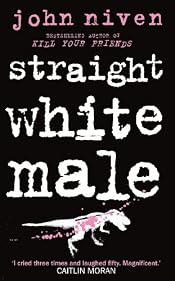
Kennedy Marr is a best-selling author with three popular and critically well regarded novels in the bookstores. But he has a writer's block of five years duration going, and he's been making his living as a highly paid script doctor in Hollywood. He is, also, a completely self-absorbed hedonist, at 44 still trying to live up to the image of the ne'er-do-well, womanizing, hard-drinking rebel who will not suffer fools and disdains the shallowness of the movie business actors and directors that he has to mingle with. He has already kicked away two marriages through his seemingly frantic philandering, and though he's remained in touch with his now 16-year-old daughter, as his ex-wife says to him when he questions how his daughter has managed to become so grown up, "What can I tell you, Kennedy? You missed it all." The novel is meant, I guess, as a satire, a making fun of the trope of the grown-up straight white male child. But the incidents of bad behavior, desperate drinking, expensive restaurants and sleeping around go on at too great length. Eventually we begin to get details about his regrets and his difficult childhood. The degree to which a reader will consider these to be redeeming details will vary be reader, I suppose. There are a lot of fun literary references and the writing is breezy. I laughed aloud several times. But in the end I didn't feel there was enough weight to the story (nor was it funny enough) for the reading experience to feel especially relevant or satisfying.
Kennedy Marr is a best-selling author with three popular and critically well regarded novels in the bookstores. But he has a writer's block of five years duration going, and he's been making his living as a highly paid script doctor in Hollywood. He is, also, a completely self-absorbed hedonist, at 44 still trying to live up to the image of the ne'er-do-well, womanizing, hard-drinking rebel who will not suffer fools and disdains the shallowness of the movie business actors and directors that he has to mingle with. He has already kicked away two marriages through his seemingly frantic philandering, and though he's remained in touch with his now 16-year-old daughter, as his ex-wife says to him when he questions how his daughter has managed to become so grown up, "What can I tell you, Kennedy? You missed it all." The novel is meant, I guess, as a satire, a making fun of the trope of the grown-up straight white male child. But the incidents of bad behavior, desperate drinking, expensive restaurants and sleeping around go on at too great length. Eventually we begin to get details about his regrets and his difficult childhood. The degree to which a reader will consider these to be redeeming details will vary be reader, I suppose. There are a lot of fun literary references and the writing is breezy. I laughed aloud several times. But in the end I didn't feel there was enough weight to the story (nor was it funny enough) for the reading experience to feel especially relevant or satisfying.
91rocketjk
My post-Straight White Male "between book" reading brought still another coin flip for Stack 1:
* “A Fight with a Cannon,” by Victor Hugo in Literature - Book Two edited by Thomas H. Briggs
* Five poems by Dahlia Ravikovitch from New Writing from the Middle East edited by Leo Hamalian and John D. Yohannan
* “A Major Leaguer in Another Way” from Baseball in Pinellas County by Dan Hirshberg
* “Sally Rand and a Suckling Pig” from My Ears Are Bent by Joseph Mitchell
* “Gimme Some Skin: Replacing the Human Exterior” from Replaceable You: Adventures in Human Anatomy by Mary Roach
* Day 10, Story 8 from The Decameron by Giovanni Boccaccio (translated by Wayne A. Rebhorn)
* “The Epic of Man: Part 1 – Man Inherits the Earth” from Life, November, 7, 1955 edited by Edward K. Thompson
I've now started Machine Dreams by Jayne Anne Phillips. It was hugely popular back in the 1980s and I finally took it down from my shelves.
* “A Fight with a Cannon,” by Victor Hugo in Literature - Book Two edited by Thomas H. Briggs
* Five poems by Dahlia Ravikovitch from New Writing from the Middle East edited by Leo Hamalian and John D. Yohannan
* “A Major Leaguer in Another Way” from Baseball in Pinellas County by Dan Hirshberg
* “Sally Rand and a Suckling Pig” from My Ears Are Bent by Joseph Mitchell
* “Gimme Some Skin: Replacing the Human Exterior” from Replaceable You: Adventures in Human Anatomy by Mary Roach
* Day 10, Story 8 from The Decameron by Giovanni Boccaccio (translated by Wayne A. Rebhorn)
* “The Epic of Man: Part 1 – Man Inherits the Earth” from Life, November, 7, 1955 edited by Edward K. Thompson
I've now started Machine Dreams by Jayne Anne Phillips. It was hugely popular back in the 1980s and I finally took it down from my shelves.
92baswood
>83 rocketjk: yes from the examples he does look difficult to get used to reading. An author I have never heard of - its a shame he didn't publish anything in 1951.
93kjuliff
>92 baswood: Ha! So @baswood :)
94rocketjk
>92 baswood: "An author I have never heard of - it's a shame he didn't publish anything in 1951."
Well, he published a novel called Nothing in 1950 and one called Doting in 1952, so on average they were both published in 1951.
Well, he published a novel called Nothing in 1950 and one called Doting in 1952, so on average they were both published in 1951.
95kjuliff
>94 rocketjk: that’s just not the same thing. Bazza needs it to be exactly 1951. He has an orderly mind..
96baswood
>95 kjuliff: Exactly
98rocketjk
Machine Dreams by Jayne Anne Phillips

I remember when Machine Dreams, Jayne Anne Phillips' debut novel, was first published in 1984 and was immediately hailed as a wonderful book. I was 29 at the time. For awhile it was everywhere. I never had any particular aversion to reading it. I just never got around to it. So now, finally, I have done so, and I'm glad I did. Machine Dreams shows us three generations of a working class West Virginia family, running from the 1920s through the 1960s. There's not too much in the way of plot, I guess, but there are some very vivid character studies, and some very good descriptive writing of personalities and environment, both natural and man-made. The central theme to me seems to be disappointment and the ways in which the workaday demands of small town life in a disconnected area of the U.S. press life down into the constant tasks of daily requirements. I know I've made the book sound grim, but it really isn't. The nature of the character depictions of brings life and even sometimes courage into the tapestry quite believably. So, as I said, I'm happy to have finally read the novel, and I can certainly see myself reading further into Phillips' work to see how her writing progressed over the intervening years.
Machine Dreams has been in my library since before my LT "big boom" in 2008.

I remember when Machine Dreams, Jayne Anne Phillips' debut novel, was first published in 1984 and was immediately hailed as a wonderful book. I was 29 at the time. For awhile it was everywhere. I never had any particular aversion to reading it. I just never got around to it. So now, finally, I have done so, and I'm glad I did. Machine Dreams shows us three generations of a working class West Virginia family, running from the 1920s through the 1960s. There's not too much in the way of plot, I guess, but there are some very vivid character studies, and some very good descriptive writing of personalities and environment, both natural and man-made. The central theme to me seems to be disappointment and the ways in which the workaday demands of small town life in a disconnected area of the U.S. press life down into the constant tasks of daily requirements. I know I've made the book sound grim, but it really isn't. The nature of the character depictions of brings life and even sometimes courage into the tapestry quite believably. So, as I said, I'm happy to have finally read the novel, and I can certainly see myself reading further into Phillips' work to see how her writing progressed over the intervening years.
Machine Dreams has been in my library since before my LT "big boom" in 2008.
99RidgewayGirl
>98 rocketjk: I was a teenager working in a bookstore when this came out and it became somehow entwined with Zen and the Art of Motorcycle Maintenance in my mind, which was still selling steadily through the 1980s. This does sound like a book I'd really like.
100rocketjk
My post-Machine Dreams "Between Book" reading was a bounce back to Stack 1 and went a little something like this:
* “An Exuberant Finish in Tokyo” by John Underwood (Sports Illustrated) from Best Sports Stories 1965 edited by Irving T. Marsh and Edward Ehre
* “Mr. Webster Opens a Law Office—Boscawen—His First Criminal Case—His Opponents” from The Public and Private Life of Daniel Webster by General S. P. Lyman
* “Tom Sturdivant” from Sweet Seasons: Recollections of the 1955-64 New York Yankees by Dom Forker
* “Writing the Self and Others” from We’re Alone by Edwidge Danticat - Finished!
* “Freedom and Freedonia” from When the Facts Change: Essays 1995-2010 by Tony Judt
* Day 10, Story 9 from The Decameron by Giovanni Boccaccio (translated by Wayne A. Rebhorn)
* “Little M.D.’s Big Lift: A 90-Year-Old Doctor is Honored” from Life, November, 7, 1955 edited by Edward K. Thompson
I've now on to reading Jane Austen's Emma for my monthly book group. I remember loving this when I read it many years ago, but this time I've been struggling with the first 80 pages. My wife is in the same group and is a bit ahead of me in the reading. She says things pick up at around page 125 or so. The edition we both have, the Penguin Classics, is about 450 pages.
* “An Exuberant Finish in Tokyo” by John Underwood (Sports Illustrated) from Best Sports Stories 1965 edited by Irving T. Marsh and Edward Ehre
* “Mr. Webster Opens a Law Office—Boscawen—His First Criminal Case—His Opponents” from The Public and Private Life of Daniel Webster by General S. P. Lyman
* “Tom Sturdivant” from Sweet Seasons: Recollections of the 1955-64 New York Yankees by Dom Forker
* “Writing the Self and Others” from We’re Alone by Edwidge Danticat - Finished!
* “Freedom and Freedonia” from When the Facts Change: Essays 1995-2010 by Tony Judt
* Day 10, Story 9 from The Decameron by Giovanni Boccaccio (translated by Wayne A. Rebhorn)
* “Little M.D.’s Big Lift: A 90-Year-Old Doctor is Honored” from Life, November, 7, 1955 edited by Edward K. Thompson
I've now on to reading Jane Austen's Emma for my monthly book group. I remember loving this when I read it many years ago, but this time I've been struggling with the first 80 pages. My wife is in the same group and is a bit ahead of me in the reading. She says things pick up at around page 125 or so. The edition we both have, the Penguin Classics, is about 450 pages.
101mabith
I just read a later book by Phillips (Quiet Dell), but reading up it sounds like her earlier work is stronger in some ways. Definitely putting Machine Dreams on my to-read list.
102rocketjk
>101 mabith: Cool! I hope you read Machine Dreams relatively soon. I would love to learn how you like it.
103rocketjk
We're Alone by Edwidge Danticat

Read as a "between book" (see first post). I had never read any of Edwidge Danticat's works, which I considered to be a grave omission, so when I saw a stack of her recent essay collection, We're Alone in a bookstore in Brooklyn early this year, I made the purchase and started gradually working my way through the volume right away. The first matter of interest is the collection's title. At first reading it would seem to be a rather bleak message. Each of us is alone. But, no, as Danticat explains in her introduction, she is referring to something much more comforting, the individual relationship that a writer has with each reader. No matter how many people may read these essays, at each reading, the writer and reader are alone with each other. We're alone, only you and I are here. We can say (and think) what we want to each other.
Most of the essays here center on, or at least spring from Danticat's concerns about, Haiti, the country of her birth and early upbringing, or more generally about the insecurities and injustices experienced by immigrants in the U.S. We live through a hurricane in Haiti with her, learn the details of the violent coup that overturned the administration of Haiti's elected president, and, in the essay "By the Time You Read This . . . " share Danticat's terror in the midst of a loose shooter incident in Florida that she spins out into a discussion of the current administration's sudden disappearances of immigrants and those deemed "illegal." Everywhere, Danticat's writing is clear and powerful. Always the more global issues she deals with are brought compellingly, sometimes devastatingly, to the level of personal experience and observation.
I highly recommend this slim volume of powerful and very accessible essays.
Read as a "between book" (see first post). I had never read any of Edwidge Danticat's works, which I considered to be a grave omission, so when I saw a stack of her recent essay collection, We're Alone in a bookstore in Brooklyn early this year, I made the purchase and started gradually working my way through the volume right away. The first matter of interest is the collection's title. At first reading it would seem to be a rather bleak message. Each of us is alone. But, no, as Danticat explains in her introduction, she is referring to something much more comforting, the individual relationship that a writer has with each reader. No matter how many people may read these essays, at each reading, the writer and reader are alone with each other. We're alone, only you and I are here. We can say (and think) what we want to each other.
Most of the essays here center on, or at least spring from Danticat's concerns about, Haiti, the country of her birth and early upbringing, or more generally about the insecurities and injustices experienced by immigrants in the U.S. We live through a hurricane in Haiti with her, learn the details of the violent coup that overturned the administration of Haiti's elected president, and, in the essay "By the Time You Read This . . . " share Danticat's terror in the midst of a loose shooter incident in Florida that she spins out into a discussion of the current administration's sudden disappearances of immigrants and those deemed "illegal." Everywhere, Danticat's writing is clear and powerful. Always the more global issues she deals with are brought compellingly, sometimes devastatingly, to the level of personal experience and observation.
I highly recommend this slim volume of powerful and very accessible essays.
104japaul22
>103 rocketjk: I liked these essays too. I highly recommend her novel The Farming of Bones.
105rocketjk
>104 japaul22: Noted!
106kjuliff
>104 japaul22: I might try to get this one as I know so many people from the DR. I’ve been looking for a novel set there for awhile..
107RidgewayGirl
>103 rocketjk: I just finished a book by a Haitian author and I really need to read more from. Dandicat sounds like a good continuation.
108thorold
>83 rocketjk: Going way back in your thread to Henry Green and the missing articles — a lot of English dialects, especially as you go north, tend to unstress or completely elide articles. You often see this represented on the page by writing “the” as “th’”, but in real life it might just disappear completely before a consonant.
Green was probably looking for a way to flag that his working-class characters were living in a world where everyone spoke Black Country dialect without making it look like a bad Victorian novel by trying to represent it phonetically.
Sample of actual Black Country dialect from someone who might have grown up around the time Green was writing:
https://youtu.be/wJHa5aN1Uus
Green was probably looking for a way to flag that his working-class characters were living in a world where everyone spoke Black Country dialect without making it look like a bad Victorian novel by trying to represent it phonetically.
Sample of actual Black Country dialect from someone who might have grown up around the time Green was writing:
https://youtu.be/wJHa5aN1Uus
109kjuliff
>108 thorold: a lot of English dialects, especially as you go north, tend to unstress or completely elide articles. You often see this represented on the page by writing “the” as “th’”, but in real life it might just disappear completely before a consonant.
Years ago I was traveling somewhere in Yorkshire driving down a country road needing directions. When we stopped to ask a local farmer he proceeded to explain using phrases like “past iron gate” and “near yellow house”. It sort of gave an anthropomorphic vibe to the various landmarks that he pointed out. When we came to iron gate, I feel quite fondly toward it.
Years ago I was traveling somewhere in Yorkshire driving down a country road needing directions. When we stopped to ask a local farmer he proceeded to explain using phrases like “past iron gate” and “near yellow house”. It sort of gave an anthropomorphic vibe to the various landmarks that he pointed out. When we came to iron gate, I feel quite fondly toward it.
110rocketjk
>108 thorold: Thanks for all that. I had guessed that such was the case, but didn't want to presume knowledge when I was only just guessing. I'm sure the information is in the book's introduction, but as I noted above I have my reasons for not reading that until after I've read all three novels in the volume. Once again, the explanation you've provided is much appreciated. Have you read any of Green's work?
>109 kjuliff: Love that story!
>109 kjuliff: Love that story!
111thorold
>110 rocketjk: I’ve read a few over the years, mostly too long ago to be sure which. Loving and Concluding are the ones I’ve read relatively recently, although Loving seems to have been in pre-LibraryThing days. He is one of those writers who gets favourable write-ups from all sorts of other writers but is still somehow easy to overlook. So much else going on between the twenties and the forties…
112baswood
>108 thorold: oup north its a different world
113kidzdoc
>103 rocketjk: Great review of We're Alone, Jerry. I haven't read anything by Edwidge Danticat in a while, so I'll add this to my wish list.
114rocketjk
Emma by Jane Austen
 *
* 
The cover on the left represents the edition of Emma that I first read and that was in my home library for 35 years or so but that got purged when my wife and I moved from our Mendocino County (CA) house to our NYC apartment. The cover on the right represents the library copy I read this time.
This was a reread for my monthly book group. My memory of my first reading of Emma was very affectionate, indeed, and I have for years been telling people that I held the novel to be among the five funniest books I've ever read.* I thought the way Austen skewered the British landed gentry of her day (early 19th century) was delightful. Emma's attempts to guide the lives and loves of her friends, around which the novel revolves, quietly hilarious. So I was very much in favor of the group's selection and looking forward to revisiting an old favorite. I'm sorry to say, though, that in this reading, the book fell mostly flat for me. Perhaps the issue was that I had too much foreknowledge of the crucial characteristic of both the title character and of the narrative. Also, while I fully realize that the claustrophobia of the women's lives in this society was a major part of the point Austen was making (and satirizing), in the rereading I found the whole exercise more than a little tedious. Things finally picked up for me over the last 100 pages (of the 445-pages in the Penguin Classics edition I was reading). Finally, I guess my intellectual curiosity about the lives of the people in that class in that time and place has considerably waned. Anyway, this is all just one grump's reaction. I'm leaving the five-star rating I included for Emma when I originally posted the book on LT, probably 20 years after I'd first read it. I'd take the opinion of 30-year-old me over word of 70-year-old me any day.
* The other four (I know you're dying to know!):
Catch 22
A Confederacy of Dunces
Don Quixote
Portnoy's Complaint
 *
* 
The cover on the left represents the edition of Emma that I first read and that was in my home library for 35 years or so but that got purged when my wife and I moved from our Mendocino County (CA) house to our NYC apartment. The cover on the right represents the library copy I read this time.
This was a reread for my monthly book group. My memory of my first reading of Emma was very affectionate, indeed, and I have for years been telling people that I held the novel to be among the five funniest books I've ever read.* I thought the way Austen skewered the British landed gentry of her day (early 19th century) was delightful. Emma's attempts to guide the lives and loves of her friends, around which the novel revolves, quietly hilarious. So I was very much in favor of the group's selection and looking forward to revisiting an old favorite. I'm sorry to say, though, that in this reading, the book fell mostly flat for me. Perhaps the issue was that I had too much foreknowledge of the crucial characteristic of both the title character and of the narrative. Also, while I fully realize that the claustrophobia of the women's lives in this society was a major part of the point Austen was making (and satirizing), in the rereading I found the whole exercise more than a little tedious. Things finally picked up for me over the last 100 pages (of the 445-pages in the Penguin Classics edition I was reading). Finally, I guess my intellectual curiosity about the lives of the people in that class in that time and place has considerably waned. Anyway, this is all just one grump's reaction. I'm leaving the five-star rating I included for Emma when I originally posted the book on LT, probably 20 years after I'd first read it. I'd take the opinion of 30-year-old me over word of 70-year-old me any day.
* The other four (I know you're dying to know!):
Catch 22
A Confederacy of Dunces
Don Quixote
Portnoy's Complaint
115Nickelini
>114 rocketjk: Also, while I fully realize that the claustrophobia of the women's lives in this society was a major part of the point Austen was making (and satirizing), in the rereading I found the whole exercise more than a little tedious.
That's a good way to describe Emma. I read it about 25 years ago, it was my first Austen, and I did not like it at all. Now that I'm a big Jane Austen fan, I feel like I need to give it another chance. Someday. Maybe I'll be the opposite of you -- first reading was 2 stars, second rating 5.
I'm never sure what to do with my ratings when I reread a 5 star book and don't love it as much the second time around.
That's a good way to describe Emma. I read it about 25 years ago, it was my first Austen, and I did not like it at all. Now that I'm a big Jane Austen fan, I feel like I need to give it another chance. Someday. Maybe I'll be the opposite of you -- first reading was 2 stars, second rating 5.
I'm never sure what to do with my ratings when I reread a 5 star book and don't love it as much the second time around.
116rocketjk
>115 Nickelini: For what it's worth, my wife and I are in the same book group, so she was reading Emma just a bit ahead of me. She thought the book picked up sooner than I did. Also, after she had finished the novel, she went back and read, or at least skimmed, the introduction, written by the Penguin Classic edition's editor, Fiona Stafford. She learned that Sir Walter Scott had reviewed Emma and said something along the lines of that he found it almost entirely devoid of plot but that Austen's grasp of human nature was impeccable. Coincidentally, I'm now just past the halfway point of one of Scott's "Waverly" novels, The Betrothed.
117rocketjk
My post-Emma "Between Book" reading was a foray through Stack 2:
* “Today’s Hero” by Maxwell Stiles (Hollywood Citizen-News) from Best Sports Stories 1965 edited by Irving T. Marsh and Edward Ehre
* “His Preparation for His Cases—Attends to General Literature—Oration at Concord—One of His Professors at Dartmouth—Some Account of Him” from The Public and Private Life of Daniel Webster by General S. P. Lyman
* “Steve Hamilton” from Sweet Seasons: Recollections of the 1955-64 New York Yankees by Dom Forker
* “Road to Nowhere” from When the Facts Change: Essays 1995-2010 by Tony Judt
* Day 10, Story 10, Conclusion, and The Author’s Conclusion from The Decameron by Giovanni Boccaccio (translated by Wayne A. Rebhorn) - Finished
* “Theater: The Kindest Boy in Georgia Vs. the U.S. Armed Forces” from Life, November, 7, 1955 edited by Edward K. Thompson
I'm now already just past the halfway point of, as I mentioned in the post above, one of Sir Walter Scott's "Waverly Novels," The Betrothed.
* “Today’s Hero” by Maxwell Stiles (Hollywood Citizen-News) from Best Sports Stories 1965 edited by Irving T. Marsh and Edward Ehre
* “His Preparation for His Cases—Attends to General Literature—Oration at Concord—One of His Professors at Dartmouth—Some Account of Him” from The Public and Private Life of Daniel Webster by General S. P. Lyman
* “Steve Hamilton” from Sweet Seasons: Recollections of the 1955-64 New York Yankees by Dom Forker
* “Road to Nowhere” from When the Facts Change: Essays 1995-2010 by Tony Judt
* Day 10, Story 10, Conclusion, and The Author’s Conclusion from The Decameron by Giovanni Boccaccio (translated by Wayne A. Rebhorn) - Finished
* “Theater: The Kindest Boy in Georgia Vs. the U.S. Armed Forces” from Life, November, 7, 1955 edited by Edward K. Thompson
I'm now already just past the halfway point of, as I mentioned in the post above, one of Sir Walter Scott's "Waverly Novels," The Betrothed.
118kjuliff
>115 Nickelini: I didn’t like the character Emma and although I love Jane Austen as a writer, the concept that was accepted in the early 19th century of condescension to the lower classes as a virtue annoys hell out of me.
Badly done, early 19th century England, badly done!
Badly done, early 19th century England, badly done!
119japaul22
Emma is the first book I read by Austen, when I was 17 years old, and it has a soft place in my heart. I've reread in 2009, 2013, 2015, and 2018, so I'm due a rereading! The two in the middle were annotated editions, which I really enjoyed.
The interesting thing to me about my Austen reading (I've read all of her novels about 5 times over the years) is that the one that started as my least favorite, Mansfield Park, is now my most favorite. I believe it casts the widest net to exploring beyond the landed gentry. But it has the least appealing heroine, for sure, which many people can't get past.
Anyway, I always love seeing Austen read, even if Emma didn't appeal the way it did earlier in your life. I love rereading.
The interesting thing to me about my Austen reading (I've read all of her novels about 5 times over the years) is that the one that started as my least favorite, Mansfield Park, is now my most favorite. I believe it casts the widest net to exploring beyond the landed gentry. But it has the least appealing heroine, for sure, which many people can't get past.
Anyway, I always love seeing Austen read, even if Emma didn't appeal the way it did earlier in your life. I love rereading.
120rocketjk
The Decameron by Giovanni Boccaccio (translated by Wayne A, Rebhorn)

Read as a "Between Book" (see first post). I started out thinking I was going to read these 100 stories straight through, in order to really get the flavor of the work and the times. That lasted for about 5 or 6 stories, and then I switched the Decameron to my "Between Books" stack. According to translator Wayne A. Rebhorn, in his very interesting introduction to my Norton edition, Boccaccio wrote the Decameron in Florence in the mid-1300s, only a few years after the Plague first struck the city. In the book, 10 wealthy young people, 7 women and 3 men, decide to head out into the countryside for several days in hopes of avoiding the disease, and also to amuse themselves and each other. Each day for 10 days, they gather together for some storytelling. Each day they must each tell a tale to amuse the others, and each day they have a different topic to spin a yarn about. The stories are for the most part short, from four to eight or ten pages, and often they are irreverent. And especially in the first half of the book, they are often, famously, quite bawdy. The stories are fun, all right, and they do open a window into the time they were written, and that Boccaccio is satirizing. But, other than the historical perspective they provide about the attitudes of the day, they are not particularly compelling or enlightening. So my own personal reaction is that only a scholar of mid-15th century Italian literature and/or culture would be likely find plowing through all of these stories from cover to cover a particularly entertaining or rewarding reading experience. However, I did quite enjoy reading the tales one at a time, one tale between each of the novels/histories/etc. that I read straight through during the past couple of years.

Read as a "Between Book" (see first post). I started out thinking I was going to read these 100 stories straight through, in order to really get the flavor of the work and the times. That lasted for about 5 or 6 stories, and then I switched the Decameron to my "Between Books" stack. According to translator Wayne A. Rebhorn, in his very interesting introduction to my Norton edition, Boccaccio wrote the Decameron in Florence in the mid-1300s, only a few years after the Plague first struck the city. In the book, 10 wealthy young people, 7 women and 3 men, decide to head out into the countryside for several days in hopes of avoiding the disease, and also to amuse themselves and each other. Each day for 10 days, they gather together for some storytelling. Each day they must each tell a tale to amuse the others, and each day they have a different topic to spin a yarn about. The stories are for the most part short, from four to eight or ten pages, and often they are irreverent. And especially in the first half of the book, they are often, famously, quite bawdy. The stories are fun, all right, and they do open a window into the time they were written, and that Boccaccio is satirizing. But, other than the historical perspective they provide about the attitudes of the day, they are not particularly compelling or enlightening. So my own personal reaction is that only a scholar of mid-15th century Italian literature and/or culture would be likely find plowing through all of these stories from cover to cover a particularly entertaining or rewarding reading experience. However, I did quite enjoy reading the tales one at a time, one tale between each of the novels/histories/etc. that I read straight through during the past couple of years.
121baswood
>120 rocketjk: Did you finish it Jerry?
I have read the Norton Critical edition and yes I did read it straight through, but it was before I joined LibraryThing.
I have read the Norton Critical edition and yes I did read it straight through, but it was before I joined LibraryThing.
122rocketjk
>122 rocketjk: Yes, I finished it. I thought it was fun, all in all. Kudos to you and to anyone who reads the Decameron straight through for pleasure (rather than academic purposes). I assumed you enjoyed it if you completed the reading.
123Dilara86
>83 rocketjk: Add me to the list of people who'd never heard of Henry Green! I've wishlisted the omnibus.
>120 rocketjk: Ooh, I'm supposed to read Italian books in December and somehow, I did not think of the Decameron, even though I've been meaning to get to it for years!
>120 rocketjk: Ooh, I'm supposed to read Italian books in December and somehow, I did not think of the Decameron, even though I've been meaning to get to it for years!
124rocketjk
>123 Dilara86: Re: The Decameron, just be aware for your December reading plans that my Norton unabridged edition is 860 pages, not including the notes. There are, however, quite a few abridged "greatest hits" editions out there, I think.
125Dilara86
>124 rocketjk: Thank you for the heads up! I think I'd rather go for the unabridged version, even though I might get diminishing returns from it. I'll probably read a few pages "between books" (just like you did!) over several months: it doesn't matter if I don't finish it in December...
126rocketjk
>125 Dilara86: I hope you enjoy it, then. The "between book" method worked well for me.
127Ameise1
>120 rocketjk: I read it 40 years ago and enjoyed it.
128kjuliff
>127 Ameise1: I read it 40 years ago and didn’t understand it.
129rocketjk
The Betrothed by Sir Walter Scott

Staying in the early 19th Century, I read and enjoyed The Betrothed, one of Sir Walter Scott's many "Waverly Novels." (Emma was published in 1815 and The Betrothed in 1825). These Waverly Novels are not particularly deep, but they are fun, if one has a taste for historical adventure story/romances that glorify the age of chivalry, with all its attendant prescribed gender roles. It is the 12th Century. The Normans have completed their invasion of England and solidified their hold over the country. But there are still the Welsh to deal with, or rather to try to deal with. The Normans have been pushing their castles deeper into Wales land, and the Welsh, understandably, are not pleased. Welsh prince Gwenwyn* and Norman knight Raymond Berenger, who rules the castle Garde Doloureuse, have attempted to make peace with each other. But when Gwenwyn asks for Berenger's daughter Eveline's hand in marriage, Berenger replies that she is already promised to another Norman noble, Sir Hugo de Lacy, the Constable of Chester. The Welsh take this as an affront, and attack the castle. To the rescue comes de Lacy and his army. All this takes place within the context of the imminent Crusades, which Baldwin,* the Archbishop of Canterbury, is urging all British nobility to take part in. Eveline and de Lacy, he being around 30 years her elder, are married, but due to the meddling of Baldwin, de Lacy is forced to ride off to the Crusades before the marriage can be consummated. He leaves his young, handsome nephew, Damian, to look after Eveline and be her protector during the three years de Lacy is to be away. What could go wrong? This is just a bare outline of the very beginning of the action. The story proceeds apace, often hurtling along, although sometimes a bit slow. Scott provides plenty of side characters for our entertainment, some amusing, some upright, some dastardly. And there is lots of wonderful natural description of the beauty of Wales. I enjoyed reading The Betrothed, as I found it to be fun in the reading, the stereotypes of the genre, and of Scott's time (including antisemitism), notwithstanding.
* Based, according to Wikipedia, on historical figures, as are several other characters in the narrative.
I'd be remiss if I didn't mention Scott's 27-page introduction to this novel. It begins with a description of some of the historical antecedents of the book's story (including one tale that is straight out of the Decameron (!), although Scott provides a different origin). But then Scott switches to a hilarious fantasy. Responding to what was evidently a frequent claim at the time that one person couldn't be writing all of these Waverly Books, Scott imagines a meeting of the committee that has been collaborating on them. The president of the committee first tries to advance the idea that they should incorporate to protect their interests. But then he moves on:
So here is Sir Walter Scott, circa 1825, imagining in most fanciful and satirical terms, the appearance of AI!
Book note: As you can see from the image of the title page I've posted, my copy of the book comes from the Rand McNally "Alpha Library." As best I can determine online, books in the "Alpha Library" published from 1897 through 1903, though I'm not sure what I'm looking at is meant to be a comprehensive chronology. Anyway, somewhere in there. I've had the book on my shelves since before my LT "Big Bang" in 2008. The volume also includes both The Highland Widow which is noted on the title page, and The Chronicles of the Cannongate, which is not. I'll be reading those other two works in the relatively near future.
Finally, as you can see on the title page image, Scotts name is given as Sir Walter Scott, Bart. Does anyone here know what that "Bart." means?

Staying in the early 19th Century, I read and enjoyed The Betrothed, one of Sir Walter Scott's many "Waverly Novels." (Emma was published in 1815 and The Betrothed in 1825). These Waverly Novels are not particularly deep, but they are fun, if one has a taste for historical adventure story/romances that glorify the age of chivalry, with all its attendant prescribed gender roles. It is the 12th Century. The Normans have completed their invasion of England and solidified their hold over the country. But there are still the Welsh to deal with, or rather to try to deal with. The Normans have been pushing their castles deeper into Wales land, and the Welsh, understandably, are not pleased. Welsh prince Gwenwyn* and Norman knight Raymond Berenger, who rules the castle Garde Doloureuse, have attempted to make peace with each other. But when Gwenwyn asks for Berenger's daughter Eveline's hand in marriage, Berenger replies that she is already promised to another Norman noble, Sir Hugo de Lacy, the Constable of Chester. The Welsh take this as an affront, and attack the castle. To the rescue comes de Lacy and his army. All this takes place within the context of the imminent Crusades, which Baldwin,* the Archbishop of Canterbury, is urging all British nobility to take part in. Eveline and de Lacy, he being around 30 years her elder, are married, but due to the meddling of Baldwin, de Lacy is forced to ride off to the Crusades before the marriage can be consummated. He leaves his young, handsome nephew, Damian, to look after Eveline and be her protector during the three years de Lacy is to be away. What could go wrong? This is just a bare outline of the very beginning of the action. The story proceeds apace, often hurtling along, although sometimes a bit slow. Scott provides plenty of side characters for our entertainment, some amusing, some upright, some dastardly. And there is lots of wonderful natural description of the beauty of Wales. I enjoyed reading The Betrothed, as I found it to be fun in the reading, the stereotypes of the genre, and of Scott's time (including antisemitism), notwithstanding.
* Based, according to Wikipedia, on historical figures, as are several other characters in the narrative.
I'd be remiss if I didn't mention Scott's 27-page introduction to this novel. It begins with a description of some of the historical antecedents of the book's story (including one tale that is straight out of the Decameron (!), although Scott provides a different origin). But then Scott switches to a hilarious fantasy. Responding to what was evidently a frequent claim at the time that one person couldn't be writing all of these Waverly Books, Scott imagines a meeting of the committee that has been collaborating on them. The president of the committee first tries to advance the idea that they should incorporate to protect their interests. But then he moves on:
"In a letter from the ingenious Mr. Dousterswivel which I have received---"
Oldbuck (warmly), "I object to that fellow's name being mentioned; he is a common swindler."
"For shame, Mr. Oldbuck," said the President, "To use such terms repeating the ingenious inventor of the great patent machine erected at Groningen, where they put in raw hemp at one end and take out ruffled shirts at the other, without the aid of hackle or rippling-comb, loom, shuttle, or weaver, scores, needle, or seamstress.. He had just completed it, by the addition of a piece of machinery to perform the work of the laundress; but when it was exhibited before his honor the burgomaster, it had the inconvenience of heating the smoothing-irons red-hot; excepting which, the experiment was entirely satisfactory.
"Well," added Mr. Oldbuck, "If the scoundrel----"
"Scoundrel, Mr.Oldbuck," said the President, "Is a most unseemly expression, and I must call you to order. Mr. Dousterswivel is only an eccentric genius."
"Pretty much the same in the Greek," muttered Mr. Oldbuck; and then said aloud: "And if this eccentric genius has work enough in singeing the Dutchman's linen, what the devil has he to do here?"
"Why he is of the opinion that, at the expense of a little mechanism, some part of the labour of composing these novels might be saved by the use of steam."
There was a murmur of disapprobation at this proposal, and the words "Blown up," and "Bread taken out of our mouths," and "They might as well construct a steam parson" were whispered. And it was not without repeated calls to order that the President optained an opportunity of resuming his address.
"Gentlemen, it is to be premised that this mechanical operation can only apply to those parts of the narrative which are at present composed out of commonplaces, such as the love-speaches of the hero, the description of the heroines' person, the moral observations of all sorts, and the distribution of happiness at the conclusion of the piece. Mr. Dousterseivel has sent me some drawings, which go far to show that, by placing the words and phrases technically employed on these subjects in a sort of framework, like that of the sage of Laputa, and changing them by such mechanical process as that by which weavers of damask alter their patterns, many new and happy combinations cannot fail to occur, while the author, tired of pumping his own brains, may have an agreeable relaxation in the use of his fingers."
So here is Sir Walter Scott, circa 1825, imagining in most fanciful and satirical terms, the appearance of AI!
Book note: As you can see from the image of the title page I've posted, my copy of the book comes from the Rand McNally "Alpha Library." As best I can determine online, books in the "Alpha Library" published from 1897 through 1903, though I'm not sure what I'm looking at is meant to be a comprehensive chronology. Anyway, somewhere in there. I've had the book on my shelves since before my LT "Big Bang" in 2008. The volume also includes both The Highland Widow which is noted on the title page, and The Chronicles of the Cannongate, which is not. I'll be reading those other two works in the relatively near future.
Finally, as you can see on the title page image, Scotts name is given as Sir Walter Scott, Bart. Does anyone here know what that "Bart." means?
130jjmcgaffey
Baronet. I'm not sure if that means he was both a knight (the Sir) and a baronet (a slightly higher rank, I believe), or if a baronet gets a Sir too.
131cindydavid4
>129 rocketjk: oh i must read those I fell in love reading here be dragons and ending up a few years later taking a several week long journey there.
132SassyLassy
>129 rocketjk: That sounds like one worth chasing down. Enjoyed your excerpt.
133rocketjk
>130 jjmcgaffey: Thanks! Wikipedia has this to say:
A baronet or the female equivalent, a baronetess, is the holder of a baronetcy, a hereditary title awarded by the British Crown. The title of baronet is mentioned as early as the 14th century; however, in its current usage it was created by James I of England in 1611 as a means of raising funds for the crown. Baronets rank below barons and knights of the Garter and the Thistle, but above all other knights. Like all British knights, baronets are addressed as "Sir" and baronetesses as "Dame".
>131 cindydavid4: I hope you do. I'd love to know how you enjoy it.
>132 SassyLassy: It was fun. As you probably noted in my review, that excerpt is from the book's introduction, written by Scott. Hilarious whimsey, but not the novel proper. Different in subject matter and tone. Anyway, I hope you read it if you think you'd like it.
A baronet or the female equivalent, a baronetess, is the holder of a baronetcy, a hereditary title awarded by the British Crown. The title of baronet is mentioned as early as the 14th century; however, in its current usage it was created by James I of England in 1611 as a means of raising funds for the crown. Baronets rank below barons and knights of the Garter and the Thistle, but above all other knights. Like all British knights, baronets are addressed as "Sir" and baronetesses as "Dame".
>131 cindydavid4: I hope you do. I'd love to know how you enjoy it.
>132 SassyLassy: It was fun. As you probably noted in my review, that excerpt is from the book's introduction, written by Scott. Hilarious whimsey, but not the novel proper. Different in subject matter and tone. Anyway, I hope you read it if you think you'd like it.
134rocketjk
My post-The Betrothed "Between Book" reading was bunch of fun with Stack 1:
* “Diamond Cut Diamond,” by Florence Crannell Means in Literature - Book Two edited by Thomas H. Briggs
* “The Remarkable Mr. Shabetai” by Ephraim Kishon from New Writing from the Middle East edited by Leo Hamalian and John D. Yohannan
* “Dewayne Staats Deserves a Day Off” from Baseball in Pinellas County by Dan Hirshberg
* “The Influence of Mr. L. Sittenberg on the Fan Dance” from My Ears Are Bent by Joseph Mitchell
* “Mixed Meats: Humans with Pig Organs, and Pigs with Human Organs” from Replaceable You: Adventures in Human Anatomy by Mary Roach
* “A Vivid Moment in Time by Degas” by Daniel Catton Rich from Life, November, 7, 1955 edited by Edward K. Thompson
I'm now well into the some light pulp fiction reading, The Slave Market of Mucar, Book 2 in the series, The Story of the Phantom: The Ghost Who Walks by Lee Falk, based on his comic strip adventure hero.
* “Diamond Cut Diamond,” by Florence Crannell Means in Literature - Book Two edited by Thomas H. Briggs
* “The Remarkable Mr. Shabetai” by Ephraim Kishon from New Writing from the Middle East edited by Leo Hamalian and John D. Yohannan
* “Dewayne Staats Deserves a Day Off” from Baseball in Pinellas County by Dan Hirshberg
* “The Influence of Mr. L. Sittenberg on the Fan Dance” from My Ears Are Bent by Joseph Mitchell
* “Mixed Meats: Humans with Pig Organs, and Pigs with Human Organs” from Replaceable You: Adventures in Human Anatomy by Mary Roach
* “A Vivid Moment in Time by Degas” by Daniel Catton Rich from Life, November, 7, 1955 edited by Edward K. Thompson
I'm now well into the some light pulp fiction reading, The Slave Market of Mucar, Book 2 in the series, The Story of the Phantom: The Ghost Who Walks by Lee Falk, based on his comic strip adventure hero.
135labfs39
Finally got caught up, Jerry. Enjoyed your thoughts on rereading Emma and on The Betrothed. I've appreciated the two Dandicat novels that I've read and am looking forward to her memoir, Brother, I'm Dying, which sits on my shelves.
136rocketjk
The Slave Market of Mucar by Lee Falk

While the rest of you guys are busy reading serious stuff and prize list finalists and such . . . :)
This is the second entry in Lee Falk's series of novels about The Phantom, a.k.a. The Ghost Who Walks, based on his comic strip series that was popular for decades. (My father was a fan.) The Phantom is a crusader for justice who patrols the jungles and deserts of the fictional African country of Bangala, fighting evil doers of all stripes. In fact, this has been going on for generations, as the mantle has been passed down from father to son (in the first novel it was pointed out that there had also been one or two female Phantoms over the years) for centuries. As the Phantom always wears an identity-obscuring costume and mask, the superstition has grown up that there's always only been one Phantom, who never dies or who is a supernatural being. Hence the moniker, The Ghost Who Walks. Book Two in the series takes place in the "modern day" (the 1970s) and by now the Phantom is aided by a police force called the Jungle Patrol. At any rate, it has been discovered that in the remote and ancient city of Mucar, a monthly slave market is still taking place. The Phantom sets to work discovering who is behind this evil and sets to work ending the practice and punishing the evildoers, aided by two members of the Jungle Patrol. The action moves along at a nice clip. The Phantom is super-competent and super-strong physically. The evildoers are, you know, evil: greedy and ruthless. They are all, quite literally, cartoon characters. The whole thing takes a whole lot of willing suspension of disbelief, and also the overlooking of the white man's burden paternalism and the objectionably stereotypical descriptions of the bad guys, who are mostly Arab. Given that no European (or otherwise) colonial power is named, there sure are a lot of white men running around speaking English. The people we find being transported for sale as slaves seem mostly to be white. Oddly, given that we're in Africa, blacks are rarely mentioned. Some of the people being readied for the auction block are women, but the mention is essentially only in passing. Along those lines, though, there is nothing described as luridly as the cover image (which has something to offend everyone) portrays. Well, I've already spent way too much time and column inches describing a book that can at best be described only as "of its time," guilty pleasure (if pleasure at all it might be for you) throwback reading. Anyway, it's short. There are 15 books in this series. I own three and will eventually get around to reading the third.

While the rest of you guys are busy reading serious stuff and prize list finalists and such . . . :)
This is the second entry in Lee Falk's series of novels about The Phantom, a.k.a. The Ghost Who Walks, based on his comic strip series that was popular for decades. (My father was a fan.) The Phantom is a crusader for justice who patrols the jungles and deserts of the fictional African country of Bangala, fighting evil doers of all stripes. In fact, this has been going on for generations, as the mantle has been passed down from father to son (in the first novel it was pointed out that there had also been one or two female Phantoms over the years) for centuries. As the Phantom always wears an identity-obscuring costume and mask, the superstition has grown up that there's always only been one Phantom, who never dies or who is a supernatural being. Hence the moniker, The Ghost Who Walks. Book Two in the series takes place in the "modern day" (the 1970s) and by now the Phantom is aided by a police force called the Jungle Patrol. At any rate, it has been discovered that in the remote and ancient city of Mucar, a monthly slave market is still taking place. The Phantom sets to work discovering who is behind this evil and sets to work ending the practice and punishing the evildoers, aided by two members of the Jungle Patrol. The action moves along at a nice clip. The Phantom is super-competent and super-strong physically. The evildoers are, you know, evil: greedy and ruthless. They are all, quite literally, cartoon characters. The whole thing takes a whole lot of willing suspension of disbelief, and also the overlooking of the white man's burden paternalism and the objectionably stereotypical descriptions of the bad guys, who are mostly Arab. Given that no European (or otherwise) colonial power is named, there sure are a lot of white men running around speaking English. The people we find being transported for sale as slaves seem mostly to be white. Oddly, given that we're in Africa, blacks are rarely mentioned. Some of the people being readied for the auction block are women, but the mention is essentially only in passing. Along those lines, though, there is nothing described as luridly as the cover image (which has something to offend everyone) portrays. Well, I've already spent way too much time and column inches describing a book that can at best be described only as "of its time," guilty pleasure (if pleasure at all it might be for you) throwback reading. Anyway, it's short. There are 15 books in this series. I own three and will eventually get around to reading the third.
137FlorenceArt
>136 rocketjk: Sounds like fun! Your review made me laugh at least.
138rocketjk
I've been remiss in providing my post-The Slave Market of Mucar "between book" reading, another interesting wander down Stack 1:
* “Louis Pasteur, Lifesaver,” excerpted from More than Conquerors by Ariadne Gilbert in Literature - Book Two edited by Thomas H. Briggs
* “The Lead Soldier” by Bozorg Alavi from New Writing from the Middle East edited by Leo Hamalian and John D. Yohannan
* “Wheeler’s Got Good Timing” from Baseball in Pinellas County by Dan Hirshberg
* “The Enemy of Rum, Rowdy Women, Slot Machnes and Big Talk, or Where Will You Spend Eternity?” from My Ears Are Bent by Joseph Mitchell
* “Heart in a Box: Creating Ultra-Long Life Organs” from Replaceable You: Adventures in Human Anatomy by Mary Roach
* “Going for the $2,250,000 Questions” from Life, November, 7, 1955 edited by Edward K. Thompson
By now I'm already almost finished reading Party Going, one of the three novels in the 3-work omnibus volume I own of novels by English author Henry Green.
* “Louis Pasteur, Lifesaver,” excerpted from More than Conquerors by Ariadne Gilbert in Literature - Book Two edited by Thomas H. Briggs
* “The Lead Soldier” by Bozorg Alavi from New Writing from the Middle East edited by Leo Hamalian and John D. Yohannan
* “Wheeler’s Got Good Timing” from Baseball in Pinellas County by Dan Hirshberg
* “The Enemy of Rum, Rowdy Women, Slot Machnes and Big Talk, or Where Will You Spend Eternity?” from My Ears Are Bent by Joseph Mitchell
* “Heart in a Box: Creating Ultra-Long Life Organs” from Replaceable You: Adventures in Human Anatomy by Mary Roach
* “Going for the $2,250,000 Questions” from Life, November, 7, 1955 edited by Edward K. Thompson
By now I'm already almost finished reading Party Going, one of the three novels in the 3-work omnibus volume I own of novels by English author Henry Green.
139rocketjk
Party Going by Henry Green

The following is the first paragraph of my review of Living by Henry Green, which I read earlier this year:
Henry Green was the non de plume of Henry Vincent Yorke, a wealthy British industrialist (1905-1973) who nevertheless in his fiction writing displayed a strong understanding of and sympathy for all strata of English society, most definitely including the industrial working class. He has never gained much general recognition in the U.S., but his writing has been adored by other writers, including W.H. Auden and John Updike. In fact, Updike wrote the introduction to the volume I have that collects three of Green short(ish) novels, Loving, Living, and Party Going. That's the order they're presented in the volume, though that puts them out of chronological order. I assume Updike explains the reason for this in his introduction, but I'm not reading that essay until I've read all three of those novels, which I've decided to read in publication order. So that means reading Living, published in 1929, first, and now Party Going, published in 1939. Still remaining for me to read is Loving, first published in 1945. OK, that's out of the way.
While Living takes place almost entirely within the world of the workers in a Birmingham iron foundry, Party Going brings us into the rather dubious company of a group of rich and privileged young socialites. They are all off to a holiday in the south of France, but they are held up by an extraordinarily dense fog which enshrouds London and the surrounding areas to the extent that no trains are going in and out of the city's main station. The station fills up with workers of all classes who are, mostly, trying to get home from work. (Personally, never having spent time in London, I kept picturing the main concourse of Grand Central Station.) The crowd is eventually elbow to elbow, though our rich friends are soon conducted to rooms in an adjoining hotel to wait out the crush, with the rooms paid for by Max, the most handsome and richest of the group, while their servants are left within the human sea to watch over the rich folks' luggage. And so we are ushered into a stultifying world of boredom, jealousy, flirting and ennui as our privileged young gang endures together. The relationships between the men and women seem mostly to be metaphorical wrestling matches for momentary advantage, one over the other. I will say that the female characters come in for particular scorn, in terms of shallowness and cravenness, in Green's narrative. Occasionally we get a breath of fresh air, so to speak, as Green shifts us down to the main floor to bring us for conversations between a pair of the long-suffering servants on luggage guard duty.
So what we have here, more or less, is a 1939 version of Emma, but without the somewhat ameliorating presence of Mr. Knightly or the wrong-headed but good-hearted influence of Emma herself. The first half of this short novel's 143 pages I found more than a little exasperating, but in the second half I found that either the narrative had picked up some in terms of liveliness or that I had simply started to roll with the book's tempo better. And then, occasionally, as in Living, we get some really excellent (at least in my view) and/or funny passages. Here are a few:
Before they have been brought to their hotel suite . . .
Once they are in their hotel suite . . .
All in all I would say I enjoyed Living, with its examination of working class life and concerns, more than Party Going, though I did find my way eventually to the charms of the latter. I will be reading the third novel in the omnibus, Loving, sooner rather than later.

The following is the first paragraph of my review of Living by Henry Green, which I read earlier this year:
Henry Green was the non de plume of Henry Vincent Yorke, a wealthy British industrialist (1905-1973) who nevertheless in his fiction writing displayed a strong understanding of and sympathy for all strata of English society, most definitely including the industrial working class. He has never gained much general recognition in the U.S., but his writing has been adored by other writers, including W.H. Auden and John Updike. In fact, Updike wrote the introduction to the volume I have that collects three of Green short(ish) novels, Loving, Living, and Party Going. That's the order they're presented in the volume, though that puts them out of chronological order. I assume Updike explains the reason for this in his introduction, but I'm not reading that essay until I've read all three of those novels, which I've decided to read in publication order. So that means reading Living, published in 1929, first, and now Party Going, published in 1939. Still remaining for me to read is Loving, first published in 1945. OK, that's out of the way.
While Living takes place almost entirely within the world of the workers in a Birmingham iron foundry, Party Going brings us into the rather dubious company of a group of rich and privileged young socialites. They are all off to a holiday in the south of France, but they are held up by an extraordinarily dense fog which enshrouds London and the surrounding areas to the extent that no trains are going in and out of the city's main station. The station fills up with workers of all classes who are, mostly, trying to get home from work. (Personally, never having spent time in London, I kept picturing the main concourse of Grand Central Station.) The crowd is eventually elbow to elbow, though our rich friends are soon conducted to rooms in an adjoining hotel to wait out the crush, with the rooms paid for by Max, the most handsome and richest of the group, while their servants are left within the human sea to watch over the rich folks' luggage. And so we are ushered into a stultifying world of boredom, jealousy, flirting and ennui as our privileged young gang endures together. The relationships between the men and women seem mostly to be metaphorical wrestling matches for momentary advantage, one over the other. I will say that the female characters come in for particular scorn, in terms of shallowness and cravenness, in Green's narrative. Occasionally we get a breath of fresh air, so to speak, as Green shifts us down to the main floor to bring us for conversations between a pair of the long-suffering servants on luggage guard duty.
So what we have here, more or less, is a 1939 version of Emma, but without the somewhat ameliorating presence of Mr. Knightly or the wrong-headed but good-hearted influence of Emma herself. The first half of this short novel's 143 pages I found more than a little exasperating, but in the second half I found that either the narrative had picked up some in terms of liveliness or that I had simply started to roll with the book's tempo better. And then, occasionally, as in Living, we get some really excellent (at least in my view) and/or funny passages. Here are a few:
Before they have been brought to their hotel suite . . .
"Anyone who found herself alone with Julia could not help feeling they had been left in charge. Again there was so much luggage round in piles like an exaggerated grave yard, with the owners of it and their porters like mourners with the undertakers' men, and so much agitation on one hand with subdued respectful indifference on the other . . . "
and
"Miss Chevy and her young man were standing in the main crowd. She was very pretty and dressed well, her hands were ridiculously white and her face had an expression so bland, so magnificently untouched and calm she might never have been more than amused and as though nothing had ever been more than tiresome. His expression was of intolerance."
Once they are in their hotel suite . . .
"'Will anyone have a drink?' said Alex. 'I fancy it would do us all some good,' but no one answered and now that Max was no longer with them Angela and Julia had nothing to say, nor had Amabel. He wondered how often his had happened to him before and marvelled again that anyone should be so run after as Max, though never so run after in such an awful room before. Places alter circumstances, he thought, and there was little amusing in being ignored in these surroundings, armchairs that were too deep with too narrow backs and covered in modified plush, that is plush with the pile shaved off so that those chairs were to him like so many clean-shaven port drinkers."
All in all I would say I enjoyed Living, with its examination of working class life and concerns, more than Party Going, though I did find my way eventually to the charms of the latter. I will be reading the third novel in the omnibus, Loving, sooner rather than later.
140cindydavid4
>139 rocketjk: and another BB from mr rocket thank you very mucb
141baswood
>139 rocketjk: enjoyed your review of the novels by an author who is new to me.
142rocketjk
>140 cindydavid4: You're welcome! Anyway, Green's novels are relatively short.
>141 baswood: Thanks!
For my post-Party Going "Between Book" reading, I hopped over to Stack 2 for the following:
* “The Cup Never Quivered” by Bill Robinson (Yachting) from Best Sports Stories 1965 edited by Irving T. Marsh and Edward Ehre
* “Health Bad—Removes to Portsmith—Often Meets Mr. Mason—Married—Takes Part in Politics—Great Meeting in Rockingham—Upholds the Union—His Popularity in Portsmith” from The Public and Private Life of Daniel Webster by General S. P. Lyman
* “Pedro Ramos” from Sweet Seasons: Recollections of the 1955-64 New York Yankees by Dom Forker
* “Israel—The Alternative” from When the Facts Change: Essays 1995-2010 by Tony Judt
* “TV Girl Gets Sleep-Ins” from Life, November, 7, 1955 edited by Edward K. Thompson
I'm now enjoying my don't-know-how-many-th reread of Heart of Darkness..
>141 baswood: Thanks!
For my post-Party Going "Between Book" reading, I hopped over to Stack 2 for the following:
* “The Cup Never Quivered” by Bill Robinson (Yachting) from Best Sports Stories 1965 edited by Irving T. Marsh and Edward Ehre
* “Health Bad—Removes to Portsmith—Often Meets Mr. Mason—Married—Takes Part in Politics—Great Meeting in Rockingham—Upholds the Union—His Popularity in Portsmith” from The Public and Private Life of Daniel Webster by General S. P. Lyman
* “Pedro Ramos” from Sweet Seasons: Recollections of the 1955-64 New York Yankees by Dom Forker
* “Israel—The Alternative” from When the Facts Change: Essays 1995-2010 by Tony Judt
* “TV Girl Gets Sleep-Ins” from Life, November, 7, 1955 edited by Edward K. Thompson
I'm now enjoying my don't-know-how-many-th reread of Heart of Darkness..
143rocketjk
Heart of Darkness by Joseph Conrad

Coincidentally, I'm in the midst of three different volumes that each of three novellas/short novels apiece, each volume by a different author. So I have now read two of the three short novels by Henry Green in the first volume, two of the three short novels/novellas by Joseph Conrad in the second volume, and I'll soon be starting on the second of three novels/novellas by Sir Walter Scott in the third volume. The volume to be discussed here is as seen in the image above, containing Youth, Heart of Darkness and The End of the Tether by Conrad. I knew you were desperate to understand those logistics. :)
This is my 8th or 9th (I'm only guessing) reread of Heart of Darkness. By now, here on LT, I've reviewed it, discussed it, and even, very much against my better judgement, argued about it. And still, upon this umpteenth reread, I admire it, while recognizing its, and Conrad's, flaws. Yes, Conrad was of his age, and his racism does rise to the surface fairly frequently. And yet Charles Marlow, our first person narrator here, in recounting his experiences captaining a river boat heading up the Congo River during the height of the holocaust of greed, cruelty, incompetence and absurdity that the Belgian colonial powers of the day are visiting on the region, describes, and wonders at, not his differences from the indigenous people he comes across and sometimes works with, but the commonalities of their shared humanity. A more subtly ferocious--and effective--fictional take down of the evils and rapacity of colonialism written in that era (The novella was first published in 1899) I think would be very hard to find, certainly such a visible one.
Also, we have Conrad's writing style, which I understand is not for everyone, and his insights into human nature, both of which I still find thrilling. Here are a few excerpts that I noted in particular this time around. In this first quote, Marlow, after a long trek, has arrived at the colonial station where he is to take command of his river boat so he can head up river to find out what's become of Kurtz, the formerly excellent procurer and exporter of ivory who has now been silent for months. But when Marlow arrives at the station, he finds that the station manager, in trying to get upriver himself, had torn a hole in the boat's hull. So Marlow is stuck for what turns out to be three months as he waits for the supplies he needs and then makes repairs. Here he speaks of the other Europeans who haunt the station, seemingly entirely aimlessly.
For the rest of the story, Marlow refers to these people, some of whom join him on his river journey once it gets started, as "the pilgrims," leaving it to his readers to fill in the word "faithless" with each mention.
Here's one excerpt. As Marlow prepares to head upriver to find Kurtz, Kurtz's name comes to his ears often, described as a larger than life figure, with each teller adding his own imaginative spin on the character of this enigmatic individual, enough so that Marlow becomes intrigued. In the meantime, Marlow speaks to one of the European station functionaries, a young man who believes that Marlow's importance with the colonial officials in Brussels (referred to in the narrative only as "the Sepulcher City.") is much greater than it actually is.
This sort of description, as I noted above, may or may not be of interest to folks. For me Conrad at his best is mesmerizing. Because I know the story and its messages pretty well by now, and have been to the mat more than once regarding the book's (and Conrad's) flaws, what I concentrated on this time was the writing itself, while at the same time keeping an eye out for imagery I hadn't noted before.

Coincidentally, I'm in the midst of three different volumes that each of three novellas/short novels apiece, each volume by a different author. So I have now read two of the three short novels by Henry Green in the first volume, two of the three short novels/novellas by Joseph Conrad in the second volume, and I'll soon be starting on the second of three novels/novellas by Sir Walter Scott in the third volume. The volume to be discussed here is as seen in the image above, containing Youth, Heart of Darkness and The End of the Tether by Conrad. I knew you were desperate to understand those logistics. :)
This is my 8th or 9th (I'm only guessing) reread of Heart of Darkness. By now, here on LT, I've reviewed it, discussed it, and even, very much against my better judgement, argued about it. And still, upon this umpteenth reread, I admire it, while recognizing its, and Conrad's, flaws. Yes, Conrad was of his age, and his racism does rise to the surface fairly frequently. And yet Charles Marlow, our first person narrator here, in recounting his experiences captaining a river boat heading up the Congo River during the height of the holocaust of greed, cruelty, incompetence and absurdity that the Belgian colonial powers of the day are visiting on the region, describes, and wonders at, not his differences from the indigenous people he comes across and sometimes works with, but the commonalities of their shared humanity. A more subtly ferocious--and effective--fictional take down of the evils and rapacity of colonialism written in that era (The novella was first published in 1899) I think would be very hard to find, certainly such a visible one.
Also, we have Conrad's writing style, which I understand is not for everyone, and his insights into human nature, both of which I still find thrilling. Here are a few excerpts that I noted in particular this time around. In this first quote, Marlow, after a long trek, has arrived at the colonial station where he is to take command of his river boat so he can head up river to find out what's become of Kurtz, the formerly excellent procurer and exporter of ivory who has now been silent for months. But when Marlow arrives at the station, he finds that the station manager, in trying to get upriver himself, had torn a hole in the boat's hull. So Marlow is stuck for what turns out to be three months as he waits for the supplies he needs and then makes repairs. Here he speaks of the other Europeans who haunt the station, seemingly entirely aimlessly.
"I went to work the next day, turning, so to speak, my back on that station. In that way only it seemed to me I could keep my hold on the redeeming facts of life. Still, one must look about sometimes; and then I saw this station, these men strolling aimlessly about in the sunshine of the yard. I asked myself sometimes what it all meant. They wandered here and there with their absurd long staves in their hands, like a lot of faithless pilgrims bewitched inside a rotten fence. The word 'ivory' rang in the air, was whispered, was sighed. You would think they were praying to it. A taint of imbecile rapacity blew through it all, like a whiff from some corpse. By Jove! I've never seen anything so unreal in my life. And outside, the silent wilderness surrounding this cleared speck on the earth struck me as something great and invincible, like evil or truth, waiting patiently for the passing away of this fantastic invasion."
For the rest of the story, Marlow refers to these people, some of whom join him on his river journey once it gets started, as "the pilgrims," leaving it to his readers to fill in the word "faithless" with each mention.
Here's one excerpt. As Marlow prepares to head upriver to find Kurtz, Kurtz's name comes to his ears often, described as a larger than life figure, with each teller adding his own imaginative spin on the character of this enigmatic individual, enough so that Marlow becomes intrigued. In the meantime, Marlow speaks to one of the European station functionaries, a young man who believes that Marlow's importance with the colonial officials in Brussels (referred to in the narrative only as "the Sepulcher City.") is much greater than it actually is.
"What was in {the jungle wilderness}? I could see a little ivory coming out from here, and I had heard Mr. Kurtz was in there. I had heard enough about it, too--God knows! Yet somehow it didn't bring any image with it--no more than if I had been told an angel or a fiend was in there. I believed it in the same way one of you might believe there are inhabitants in the planet Mars. I knew once a Scotch sailmaker who was certain, dead sure, there were people in Mars. If you asked him for some idea how they looked and behaved, he would get shy and mutter something about 'walking on all-fours.' If you as much as smiled, he would--though a man of sixty--offer to fight you. I would not have gone so far as to fight for Kurtz, but I went for him near enough to a lie. You know I hate, detest, and can't bear a lie, not because I am straighter than the rest of us, but simply because it appalls me. There is a taint of death, a flavor of mortality in lies--which is exactly what I hate and detest in the world--what I want to forget. It makes me miserable and sick, like biting something rotten would do. Temperament, I suppose. Well, I went near enough to it by letting the young fool there believe anything he liked to imagine as to my influence in Europe. I became in an instant as much of a pretense as the rest of the bewitched pilgrims. This simply because I had a notion it somehow would be of help to that Kurtz whom at the time I did not see--you understand. He was just a word for me. . . It seems to me I am trying to tell you a dream--making a vain attempt, because no relation of a dream can convey the dream-sensation, that commingling of absurdity, surprise, and bewilderment in a tremor of struggling revolt, that notion of being captured by the incredible which is the very essence of dreams."
This sort of description, as I noted above, may or may not be of interest to folks. For me Conrad at his best is mesmerizing. Because I know the story and its messages pretty well by now, and have been to the mat more than once regarding the book's (and Conrad's) flaws, what I concentrated on this time was the writing itself, while at the same time keeping an eye out for imagery I hadn't noted before.
144baswood
>143 rocketjk: It was a five star read for me. Your second quote ends with 'the very essence of dreams' which sums up the feeling when reading this great book.
145rocketjk
Here is my post-Heart of Darkness "between-book" reading, via our good friend, Stack 2:
* “The Unkillable Legend of Eddie Sachs” by Bill Libby (Saga) from Best Sports Stories 1965 edited by Irving T. Marsh and Edward Ehre
* “Mr. Webster Elected to Congress—Results of the Election—First Speech and Resolutions” from The Public and Private Life of Daniel Webster by General S. P. Lyman
* “Hal Reniff” from Sweet Seasons: Recollections of the 1955-64 New York Yankees by Dom Forker
* “A Lobby, Not a Conspiracy” from When the Facts Change: Essays 1995-2010 by Tony Judt
* “Suiting Up as a Suburbanite: Few Recognize Peck as a Commutor” from Life, November, 7, 1955 edited by Edward K. Thompson
I'm now back to my three-story collection of Sir Walter Scott tales, reading the second in the collection, The Chronicles of Cannongate.
* “The Unkillable Legend of Eddie Sachs” by Bill Libby (Saga) from Best Sports Stories 1965 edited by Irving T. Marsh and Edward Ehre
* “Mr. Webster Elected to Congress—Results of the Election—First Speech and Resolutions” from The Public and Private Life of Daniel Webster by General S. P. Lyman
* “Hal Reniff” from Sweet Seasons: Recollections of the 1955-64 New York Yankees by Dom Forker
* “A Lobby, Not a Conspiracy” from When the Facts Change: Essays 1995-2010 by Tony Judt
* “Suiting Up as a Suburbanite: Few Recognize Peck as a Commutor” from Life, November, 7, 1955 edited by Edward K. Thompson
I'm now back to my three-story collection of Sir Walter Scott tales, reading the second in the collection, The Chronicles of Cannongate.
146rocketjk
>144 baswood: I would say "dreams and nightmares," but otherwise, yes indeed.
147FlorenceArt
>143 rocketjk: I have to admit I struggled to follow even these short quotes. I guess I should read Heart of Darkness, but I’m not in much of a hurry.
148rocketjk
>147 FlorenceArt: "I guess I should read Heart of Darkness, but I’m not in much of a hurry."
"Not in much of a hurry" is the best way to read Heart of Darkness for the first time! Ha! I crack myself up. I know that's not what you meant. Anyway, I don't know that there's any "should" about it, at least not in my view. Conrad is an acquired taste for most, and I remember more or less struggling through Heart of Darkness the first time, myself. There's a lot to be gleaned from the book, I think, though for others what there is to be repulsed by overwhelms whatever value they acknowledge. To each his/her/their own, sez I.
"Not in much of a hurry" is the best way to read Heart of Darkness for the first time! Ha! I crack myself up. I know that's not what you meant. Anyway, I don't know that there's any "should" about it, at least not in my view. Conrad is an acquired taste for most, and I remember more or less struggling through Heart of Darkness the first time, myself. There's a lot to be gleaned from the book, I think, though for others what there is to be repulsed by overwhelms whatever value they acknowledge. To each his/her/their own, sez I.
149rocketjk
Loving by Henry Green
Loving, chronologically by publishing date, is the third novel by Henry Green found in the three-novel compendium I've been gradually reading through. Here's the first paragraph, slightly amended, of my review of the first I read, Living:
Henry Green was the non de plume of Henry Vincent Yorke, a wealthy British industrialist (1905-1973) who nevertheless in his fiction writing displayed a strong understanding of and sympathy for all strata of English society, most definitely including the industrial working class. He has never gained much general recognition in the U.S., but his writing has been adored by other writers, including W.H. Auden and John Updike. In fact, Updike wrote the introduction to the volume I have that collects three of Green short(ish) novels, Loving, Living, and Party Going. That's the order they're presented in the volume, though that puts them out of chronological order. I assume Updike explains the reason for this in his introduction, but I'm not reading that essay until I've read all three of those novels, which I've decided to read in publication order. So that means reading Living, published in 1929, first, and then Party Going, published in 1939. Now I've read Loving, first published in 1945. OK, that's out of the way.
While Living took us into the homes and lives of, predominantly, the working class employees of an English steel mill, and Party Going showed us a group of spoiled, young members of the British privileged class as they waited together for their delayed train, Loving takes us inside a castle in Ireland during World War 2, where we mostly spend our time among the servant staff. The concerns of the staff, their conversations and relationships are all affectionately rendered. Almost all of the staff, and the castle's upper class owners as well, are English. There is a significant amount of discussion amongst the staff about whether they are right to be hiding away in neutral Ireland instead of going home to share the perils of the blitz with their families and country, or, in the case of the men, whether they should be heading home to enlist. There is also concern that the German invasion is imminent and doubts about whose side the Irish will be on. And are they, as English men and women, in danger from the I.R.A.? But most of our time is spent with the more mundane aspects of daily life and work. How much minor embezzlement on the part of the head butler when ordering (or not ordering and only reporting) supplies is doable and how much is too much. The trouble caused by the flock of peacocks, pets of the estate's mistress, that are loose on the grounds. The whereabouts of the mistress' expensive sapphire ring, which has gone missing. Thoughout the work, the narrator's eye roves around among the employees in particular, spending time also with the castle's mistress (evidently a widow) and her daughter-in-law, whose husband is off in the army. Charley Raunce, the new head butler, comes closest to being our protagonist. He is a schemer, but only in terms of petty larceny. Mostly he's honest and more or less proud of his trade of being "in service," and takes his job more or less seriously. He can anger and occasionally threaten those under him, but generally is back to his genial, understanding self, sometimes within the same sentence. As always, Green's facility with dialogue and human nature create an enjoyable and sometimes moving reading experience. John Updike, in his brief introduction to this volume, refers to Green's sentences with "their bold phrases roped together by a slack and flexible grammar . . . "
Updike, extremely accurately in my opinion, continues to describe:
". . . Green's style, with its mix of perception and reflection, and its increasingly minor component of interior monologue. Amid his human scenes he hovers more than dives, yet conveys quite well a sense of depth and spaces, and dares bursts of poetic exclaiming that, far from quaint, deliver us exactly into the rub of things."
and
"Unlike Waugh, whose set he shared, {Green} never asks us to side with him against a character."
Updike did not, as I had hoped, explain why the three novels in this volume are presented out of chronological order in terms of publishing date. C'est la vie. But he does supply this sentiment that every writer of introduction, foreword, and preface writer would do well, indeed, to take to heart: "These novels must be left all their exquisite surprises and unfoldings." Yes!
At any rate, I found two of these three novels, Living and the one I've just read, Loving, to be very rewarding and enjoyable. Party Going is more static, with much less sympathetic characters. But even there, I eventually found myself looking forward to getting back to the book.
I have one more book I'm pretty sure I will finish before 2025 is out, jazz guitarist Eddie Condon's hilarious memoir, We Called it Music: a Generation of Jazz, published in 1947. When I've finished it I'll review it here and then start my 2026 thread. In order to get that done, I've written myself a hall pass from the "between book" stacks, just for the moment. Cheers, all!
Loving, chronologically by publishing date, is the third novel by Henry Green found in the three-novel compendium I've been gradually reading through. Here's the first paragraph, slightly amended, of my review of the first I read, Living:
Henry Green was the non de plume of Henry Vincent Yorke, a wealthy British industrialist (1905-1973) who nevertheless in his fiction writing displayed a strong understanding of and sympathy for all strata of English society, most definitely including the industrial working class. He has never gained much general recognition in the U.S., but his writing has been adored by other writers, including W.H. Auden and John Updike. In fact, Updike wrote the introduction to the volume I have that collects three of Green short(ish) novels, Loving, Living, and Party Going. That's the order they're presented in the volume, though that puts them out of chronological order. I assume Updike explains the reason for this in his introduction, but I'm not reading that essay until I've read all three of those novels, which I've decided to read in publication order. So that means reading Living, published in 1929, first, and then Party Going, published in 1939. Now I've read Loving, first published in 1945. OK, that's out of the way.
While Living took us into the homes and lives of, predominantly, the working class employees of an English steel mill, and Party Going showed us a group of spoiled, young members of the British privileged class as they waited together for their delayed train, Loving takes us inside a castle in Ireland during World War 2, where we mostly spend our time among the servant staff. The concerns of the staff, their conversations and relationships are all affectionately rendered. Almost all of the staff, and the castle's upper class owners as well, are English. There is a significant amount of discussion amongst the staff about whether they are right to be hiding away in neutral Ireland instead of going home to share the perils of the blitz with their families and country, or, in the case of the men, whether they should be heading home to enlist. There is also concern that the German invasion is imminent and doubts about whose side the Irish will be on. And are they, as English men and women, in danger from the I.R.A.? But most of our time is spent with the more mundane aspects of daily life and work. How much minor embezzlement on the part of the head butler when ordering (or not ordering and only reporting) supplies is doable and how much is too much. The trouble caused by the flock of peacocks, pets of the estate's mistress, that are loose on the grounds. The whereabouts of the mistress' expensive sapphire ring, which has gone missing. Thoughout the work, the narrator's eye roves around among the employees in particular, spending time also with the castle's mistress (evidently a widow) and her daughter-in-law, whose husband is off in the army. Charley Raunce, the new head butler, comes closest to being our protagonist. He is a schemer, but only in terms of petty larceny. Mostly he's honest and more or less proud of his trade of being "in service," and takes his job more or less seriously. He can anger and occasionally threaten those under him, but generally is back to his genial, understanding self, sometimes within the same sentence. As always, Green's facility with dialogue and human nature create an enjoyable and sometimes moving reading experience. John Updike, in his brief introduction to this volume, refers to Green's sentences with "their bold phrases roped together by a slack and flexible grammar . . . "
Updike, extremely accurately in my opinion, continues to describe:
". . . Green's style, with its mix of perception and reflection, and its increasingly minor component of interior monologue. Amid his human scenes he hovers more than dives, yet conveys quite well a sense of depth and spaces, and dares bursts of poetic exclaiming that, far from quaint, deliver us exactly into the rub of things."
and
"Unlike Waugh, whose set he shared, {Green} never asks us to side with him against a character."
Updike did not, as I had hoped, explain why the three novels in this volume are presented out of chronological order in terms of publishing date. C'est la vie. But he does supply this sentiment that every writer of introduction, foreword, and preface writer would do well, indeed, to take to heart: "These novels must be left all their exquisite surprises and unfoldings." Yes!
At any rate, I found two of these three novels, Living and the one I've just read, Loving, to be very rewarding and enjoyable. Party Going is more static, with much less sympathetic characters. But even there, I eventually found myself looking forward to getting back to the book.
I have one more book I'm pretty sure I will finish before 2025 is out, jazz guitarist Eddie Condon's hilarious memoir, We Called it Music: a Generation of Jazz, published in 1947. When I've finished it I'll review it here and then start my 2026 thread. In order to get that done, I've written myself a hall pass from the "between book" stacks, just for the moment. Cheers, all!
150Nickelini
>149 rocketjk: That is one I own but haven’t any plans to read. You make it sound like I should bump it up my TBR pile
151baswood
Enjoyed your review of Loving by Henry Green: for you the author seems to have been a real 'find'. Onwards and upwards to 2026
152lisapeet
Hi Jerry! Poking my head in (and reading back on your thread)—I always like reading about your main events and the in-between titles. I've had Back on the shelf for a while, acquired at random—not sure if it would suffer as a stand-alone.
Maybe this will be the year we get together, neighbor! Glad things are good in your new(ish) digs.
Maybe this will be the year we get together, neighbor! Glad things are good in your new(ish) digs.
153rocketjk
>150 Nickelini: "That is one I own but haven’t any plans to read. You make it sound like I should bump it up my TBR pile"
I hope you do. I'd love to read what you have to say about these novels once you've read any of them.
>151 baswood: "Enjoyed your review of Loving by Henry Green: for you the author seems to have been a real 'find'. Onwards and upwards to 2026"
In order of your comments . . . Thanks! . . . Yes, absolutely. It's amazing (and sad) to me that Green is so little known, at least in the U.S. . . . Amen!
>152 lisapeet: "I've had Back on the shelf for a while, acquired at random—not sure if it would suffer as a stand-alone."
All of the three Green novels I read this year were stand-alones. I'm sorry if I gave the impression that they were part of a series. I'm pretty sure all of his novels are meant to stand on their own. He seems to have moved around in terms of settings and situations. Other than that, thanks for the kinds words about my thread. And, yes, let's make that get together happen!
I hope you do. I'd love to read what you have to say about these novels once you've read any of them.
>151 baswood: "Enjoyed your review of Loving by Henry Green: for you the author seems to have been a real 'find'. Onwards and upwards to 2026"
In order of your comments . . . Thanks! . . . Yes, absolutely. It's amazing (and sad) to me that Green is so little known, at least in the U.S. . . . Amen!
>152 lisapeet: "I've had Back on the shelf for a while, acquired at random—not sure if it would suffer as a stand-alone."
All of the three Green novels I read this year were stand-alones. I'm sorry if I gave the impression that they were part of a series. I'm pretty sure all of his novels are meant to stand on their own. He seems to have moved around in terms of settings and situations. Other than that, thanks for the kinds words about my thread. And, yes, let's make that get together happen!
154rocketjk
We Called it Music: A Generation of Jazz by Eddie Condon

Eddie Condon was a among the first generation of white Chicago musicians who, enraptured by the black jazz players who'd come north to perform in the South Side clubs in the 1920s, endeavored to learn the music and perform it themselves. Published in 1947, We Called it Music is Condon's breezy, often hilarious, memoir of his childhood and the first couple of decades of his career. Condon first played banjo, in early jazz essentially a rhythm instrument, before switching first to ukulele, and then eventually to guitar, for which he's mostly known. But Condon wasn't only a musician, he was also a respected band leader and, as the 20s passed into the 30s, became one of jazz's great supporters and proselytizers, determined, along with his closest musician friends, to gain jazz -- and jazz musicians -- a place of respect in the American music world. Condon was no respecter of race boundaries in music. Once he and his musician friends got to New York City, they would play their own gigs and then race up to Harlem to sit at the feet, learn from and befriend the great African American artists, including King Oliver, Louis Armstrong, Fats Waller and Earl Hines. In fact, Condon reports here that, as far as he knew, he was the first musician to organize and execute a recording session for and the release of a record played by an integrated jazz band.
There is this description of a trip to see King Oliver's band for the first time during a stretch in Chicago:
Earlier on in the book, Condon had supplied this description of himself, still a young and learning musician, listening to a band called Tony's Iowans on a Mississippi River boat.
As mentioned, the tone here is breezy throughout. Condon is always self-deprecating, never describing his own importance in the music's history, and reports in great detail the wild nights of drinking and carousing, often until long after the sun's come up, that the young, carefree musicians indulged in, Prohibition notwithstanding. The combos were ever changing, the firings and hirings came fast and furious, with traveling from town to town, mostly via jammed-to-the-roof automobiles, a constant.
Here's an example of the devil-may-care tone of the memoir:
I wouldn't take everything in Condon's memoir at face value. I'm sure there are some tall tales related here, especially given how much drinking was going on. It seems clear, however, that Condon had been keeping a diary, as the level of specificity about individual ensembles, performance dates, hotel lodgings and even numbers performed is considerable. Still, all in all, as a primer about what the early generations of white Chicago jazz players experienced, and their campaign to move jazz from the margins to recognition as a legitimate American music art form, We Called it Music is quite valuable, I think. And although, especially in the second half of the volume, the recitations of the many performances, band leaders good and bad, and drinking sessions, get a bit repetitive, overall the book is very entertaining, given a reader's even passing interest in the subject matter.
Book note: I bought my copy of We Called it Music earlier this year in a Midtown used furniture store called Furnished Greens that also sells LPs, old magazines and, obviously, used books. The book was clearly a library discard, and in 1985 was purchased by one John D. Mills, who lists a West 96th Street address, Penthouse A, no less. I tried a couple of quick online searches, but didn't come up with anything. C'est la vie.

Eddie Condon was a among the first generation of white Chicago musicians who, enraptured by the black jazz players who'd come north to perform in the South Side clubs in the 1920s, endeavored to learn the music and perform it themselves. Published in 1947, We Called it Music is Condon's breezy, often hilarious, memoir of his childhood and the first couple of decades of his career. Condon first played banjo, in early jazz essentially a rhythm instrument, before switching first to ukulele, and then eventually to guitar, for which he's mostly known. But Condon wasn't only a musician, he was also a respected band leader and, as the 20s passed into the 30s, became one of jazz's great supporters and proselytizers, determined, along with his closest musician friends, to gain jazz -- and jazz musicians -- a place of respect in the American music world. Condon was no respecter of race boundaries in music. Once he and his musician friends got to New York City, they would play their own gigs and then race up to Harlem to sit at the feet, learn from and befriend the great African American artists, including King Oliver, Louis Armstrong, Fats Waller and Earl Hines. In fact, Condon reports here that, as far as he knew, he was the first musician to organize and execute a recording session for and the release of a record played by an integrated jazz band.
There is this description of a trip to see King Oliver's band for the first time during a stretch in Chicago:
We arrived in time for the last set; the musicians were reassembling as we pushed our way to the stand. "That's Oliver," MacParland said, pointing to a big, amiable looking man with a scar over one eye who stood in front of the band holding a cornet. Near him was a slightly smaller and much younger man, also holding a cornet. "That's Louis Armstrong." . . . Oliver lifted his horn and the first blast of Canal Street Blues hit me. It was hypnosis at first hearing. Everyone was playing what he wanted to play and it was all mixed together as if someone had planned it with a set of micrometer calipers; notes I never heard were peeling off the edges and dropping through the middle; there was a tone from the trumpets like warm rain on a cold day. Freeman and MacPartland and I were immobilized; the music poured into us like daylight running down a dark hole. The choruses rolled on like high tide, getting wilder and more wonderful. Armstrong seemed able to hear what Oliver was improvising and reproduce it himself at the same time. It seemed impossible, so I dismissed it; but it was true. Then the two circled over around each other like suspicious women talking about the same man.
Earlier on in the book, Condon had supplied this description of himself, still a young and learning musician, listening to a band called Tony's Iowans on a Mississippi River boat.
We piled aboard for the afternoon excursion up the river; . . . This is it, I thought--you know what the melody is but you don't hear it. The cornet and the clarinet, and sometimes the trombone . . . hang around it, doing handsprings and all sorts of other tricks, always keeping an eye on it and trying to make an impression. The rhythm section provides transportation, everything floats on its beat. This was what we've been trying to play all summer. This is jazz.
As mentioned, the tone here is breezy throughout. Condon is always self-deprecating, never describing his own importance in the music's history, and reports in great detail the wild nights of drinking and carousing, often until long after the sun's come up, that the young, carefree musicians indulged in, Prohibition notwithstanding. The combos were ever changing, the firings and hirings came fast and furious, with traveling from town to town, mostly via jammed-to-the-roof automobiles, a constant.
Here's an example of the devil-may-care tone of the memoir:
There were a lot of canals in Syracuse. One night {bandmate Wayne} Hostetter and Bix {the great cornetist Bix Beiderbecke} stopped us as we were crossing one of them on a bridge. "Let's throw Eddie in," Bix said. "Sure," Hostetter said. "We can always get another banjo player. Besides, his spine has too few vertebrae in the cervical area and too many in the lumbar. He'll never grow and will live to be past ninety and become a burden to his family" The grabbed me--I was five feet six and weighed a hundred and ten--and held me over the bridge.
"Will there be any punishment for this?" Bix said.
"Not unless it can be proved that he is a human being." Hostetter said.
"He sings," Bix suggested.
"Irrelevant, inconsequential, and incompetent as evidence," Hostetter said.
"He still has two dollars in his pocket," Bix said.
"A point for the defense," Hostetter said.
"He makes forty-five dollars a week and we can borrow all but his room rent," Bix said.
"Reprieve granted," Hostetter said.
They lifted me back on the bridge and set me on my feet. "Give us the two dollars," Hostetter said. I handed it over then we went back to the ten-for-a-dollar beer place and split twenty beers between us.
I wouldn't take everything in Condon's memoir at face value. I'm sure there are some tall tales related here, especially given how much drinking was going on. It seems clear, however, that Condon had been keeping a diary, as the level of specificity about individual ensembles, performance dates, hotel lodgings and even numbers performed is considerable. Still, all in all, as a primer about what the early generations of white Chicago jazz players experienced, and their campaign to move jazz from the margins to recognition as a legitimate American music art form, We Called it Music is quite valuable, I think. And although, especially in the second half of the volume, the recitations of the many performances, band leaders good and bad, and drinking sessions, get a bit repetitive, overall the book is very entertaining, given a reader's even passing interest in the subject matter.
Book note: I bought my copy of We Called it Music earlier this year in a Midtown used furniture store called Furnished Greens that also sells LPs, old magazines and, obviously, used books. The book was clearly a library discard, and in 1985 was purchased by one John D. Mills, who lists a West 96th Street address, Penthouse A, no less. I tried a couple of quick online searches, but didn't come up with anything. C'est la vie.
155rocketjk
And that's a wrap for 2025. I ended up with 46 books read. I'd been meaning to try to split more or less evenly between male and female authors, but ended up failing that, coming in with just a bit over a quarter of my books written or edited by women. The general breakdown is here, with a book-by-book geographic breakdown up at >2 rocketjk:.
Who: Author/Editor
Female: 12
Male: 34
What
Novels: 29
Short Stories: 2
Histories: 3
Contemporary (when published) Events: 1
Biographies: 3
Memoirs: 4
Essays: 2
Periodicals: 2
How (Original Language)
Chinese: 1
English: 31
French: 2
Hebrew: 1
Italian: 2
Japanese: 1
Yiddish: 4
I'll have a 2026 thread up in a day or two. Cheers, and Happy New Year!
Who: Author/Editor
Female: 12
Male: 34
What
Novels: 29
Short Stories: 2
Histories: 3
Contemporary (when published) Events: 1
Biographies: 3
Memoirs: 4
Essays: 2
Periodicals: 2
How (Original Language)
Chinese: 1
English: 31
French: 2
Hebrew: 1
Italian: 2
Japanese: 1
Yiddish: 4
I'll have a 2026 thread up in a day or two. Cheers, and Happy New Year!
156baswood
>154 rocketjk: Some great extracts from We called It Music
157rocketjk
For anyone interested, here are my top 5 of the year for fiction and for nonfiction. Both lists are in no particular order:
Nonfiction
The Dawn Watch: Joseph Conrad in a Global World by Maya Jasanoff
Postwar: A History of Europe Since 1945 by Tony Judt
Old Truths and New Cliches: Essays by Isaac Bashevis Singer edited by David Stromberg
We're Alone: Essays by Edwidge Danticat
The New York Game: Baseball and the Rise of a New City by Kevin Baker
Fiction
The Seven Moons of Maali Almeida by Shehan Karunatilaka
Living by Henry Green
The Towers of Trebizond by Rose Macaulay
Shosha by Isaac Bashevis Singer
The Little World of Don Camillo by Giovanni Guareschi
Nonfiction
The Dawn Watch: Joseph Conrad in a Global World by Maya Jasanoff
Postwar: A History of Europe Since 1945 by Tony Judt
Old Truths and New Cliches: Essays by Isaac Bashevis Singer edited by David Stromberg
We're Alone: Essays by Edwidge Danticat
The New York Game: Baseball and the Rise of a New City by Kevin Baker
Fiction
The Seven Moons of Maali Almeida by Shehan Karunatilaka
Living by Henry Green
The Towers of Trebizond by Rose Macaulay
Shosha by Isaac Bashevis Singer
The Little World of Don Camillo by Giovanni Guareschi
158kidzdoc
I would definitely like to read Postwar and We're Alone, so I'm glad that they made your list of favorite books of 2025.
159rocketjk
>158 kidzdoc: I know you will love We're Alone. Postwar is excellent, as well, though massive, somewhere around 880 pages. It is broken up into four main sections. As you may or may not recall, I did the reading in four parts. Reading a section at a time with some other book in between. Still, it's fascinating in its detail and for me, obviously, it was well worth the time.
160kidzdoc
>159 rocketjk: I read Judt's memoir The Memory Chalet, a description of the end of his life after developing ALS, which was outstanding but heartbreaking, and that book made me want to explore his earlier works, especially Postwar. Given its length I'll probably borrow rather than buy it, though.

