This topic is currently marked as "dormant"—the last message is more than 90 days old. You can revive it by posting a reply.
1QuentinTom
oh lordy lordy.
As last year's readers will know, I am supposed to be devoting myself, chastely and humbly, to the spirit of Dostoevsky. However, I am but a poor, weak, kitten, and I am easily distracted by the countless glories of Russian literature and culture glinting on either side of the straight and narrow. I have been hijacked this time by:
Pushkin. His life and times. His circle. His works, poetry, prose and personal writings, diaries, letters and unpublished articles. His strange relationship with Tsar Nicholas 1st. His self willed death at the age of 37.
All will be revealed when I finally have the time to write up me ruminations and readings, lordy, lordy.
In the meantime I leave you with this to ponder and reflect upon:
The Prophet
With fainting soul athirst for Grace,
I wandered in a desert place,
And at the crossing of the ways
I saw a sixfold Seraph blaze;
He touched mine eyes with fingers light
As sleep that cometh in the night:
And like a frightened eagle's eyes,
They opened wide with prophecies.
He touched mine ears, and they were drowned
With tumult and a roaring sound:
I heard convulsion in the sky,
And flight of angel hosts on high,
And beasts that move beneath the sea,
And the sap creeping in the tree.
And bending to my mouth he wrung
From out of it my sinful tongue,
And all its lies and idle rust,
And 'twixt my lips a-perishing
A subtle serpent's forkèd sting
With right hand wet with blood he thrust.
And with his sword my breast he cleft,
My quaking heart thereout he reft,
And in the yawning of my breast
A coal of living fire he pressed.
Then in the desert I lay dead,
And God called unto me and said:
"Arise, and let My voice be heard,
Charged with My will go forth and span
The land and sea, and let My word
Lay waste with fire the heart of man."
Dated September 8 1826, the date of his first meeting with the Tsar.
Here is Vrubles's painting based on the poem:

As last year's readers will know, I am supposed to be devoting myself, chastely and humbly, to the spirit of Dostoevsky. However, I am but a poor, weak, kitten, and I am easily distracted by the countless glories of Russian literature and culture glinting on either side of the straight and narrow. I have been hijacked this time by:
Pushkin. His life and times. His circle. His works, poetry, prose and personal writings, diaries, letters and unpublished articles. His strange relationship with Tsar Nicholas 1st. His self willed death at the age of 37.
All will be revealed when I finally have the time to write up me ruminations and readings, lordy, lordy.
In the meantime I leave you with this to ponder and reflect upon:
The Prophet
With fainting soul athirst for Grace,
I wandered in a desert place,
And at the crossing of the ways
I saw a sixfold Seraph blaze;
He touched mine eyes with fingers light
As sleep that cometh in the night:
And like a frightened eagle's eyes,
They opened wide with prophecies.
He touched mine ears, and they were drowned
With tumult and a roaring sound:
I heard convulsion in the sky,
And flight of angel hosts on high,
And beasts that move beneath the sea,
And the sap creeping in the tree.
And bending to my mouth he wrung
From out of it my sinful tongue,
And all its lies and idle rust,
And 'twixt my lips a-perishing
A subtle serpent's forkèd sting
With right hand wet with blood he thrust.
And with his sword my breast he cleft,
My quaking heart thereout he reft,
And in the yawning of my breast
A coal of living fire he pressed.
Then in the desert I lay dead,
And God called unto me and said:
"Arise, and let My voice be heard,
Charged with My will go forth and span
The land and sea, and let My word
Lay waste with fire the heart of man."
Dated September 8 1826, the date of his first meeting with the Tsar.
Here is Vrubles's painting based on the poem:

2charbutton
Looking forward to reading your thread and only understanding one literary reference in 50, as per last year!
3rainpebble
>#2:
Oh, charbutton, I am soooooo happy that I am not the only one.
tcMurr;
That is so lovely. I love the sharing of beautiful things. One of these days I am going to figure out how to put pictures on here. I love the poem and the pic.
And I am staying even though I do understand very little of what you, urania, kidzdoc, Talbin, Enrique, theaelizabet, SqueakyChu, jane, Medellia, & others too many to name, talk about. I figure if I lurk on here and Le Salon long enough I might grasp some of it and I refuse to acknowledge that I am too old to learn or that my brain will no longer grasp.
You have all encouraged me to push myself and I just told my husband last night that I am going back to college to take literary classes. He was more excited than I was with my decision.
hugs,
belva
Oh, charbutton, I am soooooo happy that I am not the only one.
tcMurr;
That is so lovely. I love the sharing of beautiful things. One of these days I am going to figure out how to put pictures on here. I love the poem and the pic.
And I am staying even though I do understand very little of what you, urania, kidzdoc, Talbin, Enrique, theaelizabet, SqueakyChu, jane, Medellia, & others too many to name, talk about. I figure if I lurk on here and Le Salon long enough I might grasp some of it and I refuse to acknowledge that I am too old to learn or that my brain will no longer grasp.
You have all encouraged me to push myself and I just told my husband last night that I am going back to college to take literary classes. He was more excited than I was with my decision.
hugs,
belva
4nobooksnolife
新年快樂!
Eagerly *starred*, but I'll probably be 'auditing', just sitting in the back row trying to figure out what you all are talking about...and slowly venturing to read the works themselves.
Magnificent poem and painting!
Julia
Eagerly *starred*, but I'll probably be 'auditing', just sitting in the back row trying to figure out what you all are talking about...and slowly venturing to read the works themselves.
Magnificent poem and painting!
Julia
5kidzdoc
Thanks for the compliment, belva. However, I am not anywhere close to the intellectual level of Murr, urania and several others on Club Read. And Murr's reviews are way beyond anything I can write at this time.
Good to see you back here, Murr!
Good to see you back here, Murr!
6QuentinTom
Dear Ladies and the good doctor,
Thank you all for your kind words and new year's wishes. I am looking forward to sharing my reading and conversing with you all this year.
Belva, you are never too old to learn, and I am so excited that you are going to take some literature courses this year! Do be sure to keep us updated as to what you are learning and reading, and how your teachers are etc.
Now, Char and Julia, what's all this about lurking and not venturing to ask when you don't understand something? Please don't be shy. I rely on you to help me make my thread more accessible to non-Russian-culture-anal-and-oral-obsessives. Part of the joy of my reading and researches (informal as they are) is sharing with others what I am learning. That is very important, right Belva?
So no more lurking ok?
:)
Thank you all for your kind words and new year's wishes. I am looking forward to sharing my reading and conversing with you all this year.
Belva, you are never too old to learn, and I am so excited that you are going to take some literature courses this year! Do be sure to keep us updated as to what you are learning and reading, and how your teachers are etc.
Now, Char and Julia, what's all this about lurking and not venturing to ask when you don't understand something? Please don't be shy. I rely on you to help me make my thread more accessible to non-Russian-culture-anal-and-oral-obsessives. Part of the joy of my reading and researches (informal as they are) is sharing with others what I am learning. That is very important, right Belva?
So no more lurking ok?
:)
8avaland
Hey, Murr, just read in the current issue of Publishers Weekly an author profile of Elif Batuman whose debut book - a graphic memoir - "The Possessed: Adventures with Russian Books and the People Who Read Them" - I thought of you...
http://www.publishersweekly.com/article/CA6711301.html
http://www.publishersweekly.com/article/CA6711301.html
9charbutton
Murr, my New Year's resolution is to ask you lots of questions. You may live to regret this!
11QuentinTom
>8 avaland: Avaland, how intriguing!
I hasten to mention, that as a member of the feline species, I do not wear underwear. Were I to do so, however, it would be spotlessly clean.
Thanks for the link.
:)
I hasten to mention, that as a member of the feline species, I do not wear underwear. Were I to do so, however, it would be spotlessly clean.
Thanks for the link.
:)
12LisaCurcio
>10 QuentinTom: Murr: oooh, Edith Piaf. Thanks. I might have to download some of those to the i-tunes.
Now, being a bit lazy here since I know you have talked about this, and probably on numerous occasions, but which Karamazov translation do you recommend? I have two--one is the Garnett and the other is Pevear. I read the Pevear years ago. Sicne I plan to reread with the salon, which translation I read will probably depend on your recommendation.
thanks!
Now, being a bit lazy here since I know you have talked about this, and probably on numerous occasions, but which Karamazov translation do you recommend? I have two--one is the Garnett and the other is Pevear. I read the Pevear years ago. Sicne I plan to reread with the salon, which translation I read will probably depend on your recommendation.
thanks!
13atimco
I've heard Pevear is better, but I have the Garnett version so I'm hoping Mr. Murr will say they are both good, or something of the kind :)
14rebeccanyc
I am not a Dostoevsky fan (as I have confessed here before), but I love Pevear-Volokhonsky for translations of other Russian authors.
15QuentinTom
Lisa, have you seen the French movie about her life? La Vie en Rose? C'est Magnifique!
Now, regarding translations of Dostoevsky:
I don't think it matters. * gasps of shock and horror all around*
For a novel of this length, it's hardly likely that we are going to get involved in close reading/comparison of translations and original. Every translation has its merits and demerits; some readers will always swear by X and others will swear by Y. Far more important for me in choosing a version is the introductory material and the notes, and the binding (it's a long heavy book and I don't want the damn thing to fall apart when I'm on page 300.)
I will be reading the Ignat Avesy translation published by Oxford. I read his translation of Humiliated and Insulted and it was readable, with some of the flavour of Dostoevsky's idiosyncratic style.
Hope that helps!
Now, regarding translations of Dostoevsky:
I don't think it matters. * gasps of shock and horror all around*
For a novel of this length, it's hardly likely that we are going to get involved in close reading/comparison of translations and original. Every translation has its merits and demerits; some readers will always swear by X and others will swear by Y. Far more important for me in choosing a version is the introductory material and the notes, and the binding (it's a long heavy book and I don't want the damn thing to fall apart when I'm on page 300.)
I will be reading the Ignat Avesy translation published by Oxford. I read his translation of Humiliated and Insulted and it was readable, with some of the flavour of Dostoevsky's idiosyncratic style.
Hope that helps!
16LisaCurcio
No, dear Murr, I am not much of a movie goer or watcher. I see I can get it on Netflix, so perhaps I will.
A translation with some of the flavour of Dostoevsky's idiosyncratic style is the thing for me, as you might have been able to glean from my meager contributions to les amateurs. I want the translation to "feel" the same as the original. Other than that, I most certainly am not going to be comparing the translation to the original. The only word of Russian that I remember is pecTopaH. When I was there it was still the Soviet Union and finding edible food was difficult. There were just a few good pecTopaHs that had opened in Moscow, and the word was indelibly etched in my brain.
A translation with some of the flavour of Dostoevsky's idiosyncratic style is the thing for me, as you might have been able to glean from my meager contributions to les amateurs. I want the translation to "feel" the same as the original. Other than that, I most certainly am not going to be comparing the translation to the original. The only word of Russian that I remember is pecTopaH. When I was there it was still the Soviet Union and finding edible food was difficult. There were just a few good pecTopaHs that had opened in Moscow, and the word was indelibly etched in my brain.
17QuentinTom
aha! Necessity is the mother of language retention! *Murr intones*
18QuentinTom
I have been reading Pushkin's letters and criticism. I found this to share: (He is talking about obscurity in poetry)
There are two kinds of obscurity; one arises from a lack of feelings and thoughts, which have been replaced by words; the other from an abundance of feelings and thoughts, and the inadequacy of words to express them.
Very true, I think.
There are two kinds of obscurity; one arises from a lack of feelings and thoughts, which have been replaced by words; the other from an abundance of feelings and thoughts, and the inadequacy of words to express them.
Very true, I think.
19zenomax
My problem is that I appear to suffer from both of those types of obscurity in my everyday life.
21atimco
*gasps on cue at the notion that translation doesn't matter*
Actually yes, that's very helpful. It helps me not to worry about finding the "right" translation for Karamazov for the salon read. And it makes sense. If there was a truly terrible translation out there (like Denny for Les Mis) I am sure Mr. Murr would warn us!
Actually yes, that's very helpful. It helps me not to worry about finding the "right" translation for Karamazov for the salon read. And it makes sense. If there was a truly terrible translation out there (like Denny for Les Mis) I am sure Mr. Murr would warn us!
22QuentinTom
>20 zenomax:, yes. Pushkin fought a duel on the afternoon of 27 January 1837. He was mortally wounded in the groin. He was brought home by his seconds and put up on a couch in his study -at his own wish. As he settled down on the couch, in agony and bleeding from the abdomen, he looked round at his books and was heard to say: "Goodbye my dear friends."
As news of his wounding spread throughout St Petersburg, a crowd began to form outside his house. By the time he died- in excruciating pain- two days later at 2.45 pm on 29 January 1837, ten thousand people had gathered- ordinary people, shopkeepers, peasants, the urban poor and middle classes. 20,000 people are believed to have attended his funeral, despite the fact that it's location was changed and kept secret by the authorities.
His last words were: "Life is finished. I can't breathe, I'm suffocating."
He died in his study surrounded by his friends and his books.
I am writing about Pushkin's death and its mysterious connection with Eugene Onegin at the moment, and hope to have something posted in a few days.

As news of his wounding spread throughout St Petersburg, a crowd began to form outside his house. By the time he died- in excruciating pain- two days later at 2.45 pm on 29 January 1837, ten thousand people had gathered- ordinary people, shopkeepers, peasants, the urban poor and middle classes. 20,000 people are believed to have attended his funeral, despite the fact that it's location was changed and kept secret by the authorities.
His last words were: "Life is finished. I can't breathe, I'm suffocating."
He died in his study surrounded by his friends and his books.
I am writing about Pushkin's death and its mysterious connection with Eugene Onegin at the moment, and hope to have something posted in a few days.

23polutropos
Looking forward to your comments, Murr. My Nabokov translation of Onegin is now ordered and we will no doubt have much fun with it. Is that his study above?
24QuentinTom
yes, the couch is on the right
25RidgewayGirl
Hmm, well except for the days of agonizing pain, that would be a pleasant place to die. And the carpet would be forgiving of stains.
27nobooksnolife
>25 RidgewayGirl: Ridgeway Girl, that was exactly what I thought when I saw the picture.
Murr, why did he fight a duel?
Murr, why did he fight a duel?
28polutropos
27
Pushkin and his wife Natalya Goncharova, whom he married in 1831, later became regulars of court society. In 1837, while falling into greater and greater debt amidst rumors that his wife had started conducting a scandalous affair, Pushkin challenged her alleged lover, Georges d'Anthès, to a duel. Pushkin was mortally wounded and died two days later.
Pushkin and his wife Natalya Goncharova, whom he married in 1831, later became regulars of court society. In 1837, while falling into greater and greater debt amidst rumors that his wife had started conducting a scandalous affair, Pushkin challenged her alleged lover, Georges d'Anthès, to a duel. Pushkin was mortally wounded and died two days later.
29nobooksnolife
> 28 Thank you, Polutropos. What a waste of young genius! (Sadly, it seems things haven't changed much in 170 years). I hope I live long enough to read the great Russian writers...
30QuentinTom
Julia, you mean you haven't already? What are you waiting for?!
31nobooksnolife
*hanging head in embarrassment* "Procrastination week is NEXT week"...
After the long side-journeys to become immersed in China and Japan, I am working my way around the globe...it's good to know that great treasures await.
After the long side-journeys to become immersed in China and Japan, I am working my way around the globe...it's good to know that great treasures await.
32QuentinTom
Procrastination week is NEXT week.
lololol I like that!
Yes, I know what you mean. I have had to neglect Chinese and Japanese lit rather in order to focus on Russian lit. Although I know I am missing lots of glories, I still do not regret my focus on Russia. The deeper I go into it, the more lustful I become to learn more.
You have so many wonderful treasures waiting for you. I'm envious!
Anyway, for more on Pushkin's life, work and death, I humbly submit my essais on Eugene Onegin. I have decided not to call it a review. This word has been troubling me for some time, as I do not feel I am able to 'review' such a masterpiece by such a genius, I mean, who am I to 'review' Pushkin? So, in homage to Montaigne, I have decided to call my feeble writings on what I am reading: essais.
I apologise in advance for my extreme long windedness.
http://thelectern.blogspot.com/2010/01/eugene-onegin-alexander-pushkin.html
lololol I like that!
Yes, I know what you mean. I have had to neglect Chinese and Japanese lit rather in order to focus on Russian lit. Although I know I am missing lots of glories, I still do not regret my focus on Russia. The deeper I go into it, the more lustful I become to learn more.
You have so many wonderful treasures waiting for you. I'm envious!
Anyway, for more on Pushkin's life, work and death, I humbly submit my essais on Eugene Onegin. I have decided not to call it a review. This word has been troubling me for some time, as I do not feel I am able to 'review' such a masterpiece by such a genius, I mean, who am I to 'review' Pushkin? So, in homage to Montaigne, I have decided to call my feeble writings on what I am reading: essais.
I apologise in advance for my extreme long windedness.
http://thelectern.blogspot.com/2010/01/eugene-onegin-alexander-pushkin.html
33atimco
This word has been troubling me for some time, as I do not feel I am able to 'review' such a masterpiece by such a genius, I mean, who am I to 'review' Pushkin?
I know exactly how you feel.
*skips off to read the essay*
I know exactly how you feel.
*skips off to read the essay*
34QuentinTom
(copied from le Salon)
Macumbeira
Tomcat, it seems that Lermontov anticipates his own "death - in - a duel" too in an eery poem written some time before it actually happened.
tomcatMurr
yes, do you have the reference there, Mac?
Macumbeira
at your service
The Dream
By Mikhail Yurevich Lermontov;
translated from Russian by Vladimir Nabokov
In noon's heat, in a dale of Dagestan
With lead inside my breast, stirless I lay;
The deep wound still smoked on; my blood
Kept trickling drop by drop away.
On the dale's sand alone I lay. The cliffs
Crowded around in ledges steep,
And the sun scorched their tawny tops
And scorched me -- but I slept death's sleep.
And in a dream I saw an evening feast
That in my native land with bright lights shone;
Among young women crowned with flowers,
A merry talk concerning me went on.
But in the merry talk not joining,
One of them sat there lost in thought,
And in a melancholy dream
Her young soul was immersed --
God knows by what.
And of a dale in Dagestan she dreamt;
In that dale lay the corpse of one she knew;
Within his breast a smoking wound showed black,
And blood ran in a stream that colder grew.
EnriqueFreeque
You really outdid yourself in that Eugene Onegin piece. I keep thinking there's no way you can surpass your previous work, only to witness that you've upped the ante once again. How doooo you do it? And I don't mind broadcasting my ignorance in learning from your review that Eugene Onegin is considered the work from which all modern Russian Lit. sprung. I'll need to read it. Maybe we'll all need to read it in '11, eh?
I'm curious, tomcat, if perhaps a thread here or over in the Amateurs might be appropriate for discussing how and where in the subsequent Russian works of literature Eugene Onegin displayed it's influence, particularly with Dostoyevski of course. Just a thought, an idea....
richardderus
Onegin as literature, yeah maybe, but it was one lousy opera.
Macumbeira
In any case, Tomcat has brought to light what I usually consider a minor disconfort : the problem of bad translation !
I have been struggling with that Johnston translation while it becomes evident that the Falen translation which Tomcat supports is way better.
I'll order more carefully in the future
tomcatMurr
Thank you everyone for your comments.
I will be happy to expand further on EO's connection with Russian lit any place you think fit Enriiiique. I have a nasty bout of stomach flu at the moment, and can't really think straight about how to organise my threads. (My customary annality has been somewhat... disturbed....)
I love that Lermontov poem, Mac, thanks for posting it. Another spooky coincidence: Pushkin's opponent D'Anthes also brought a pair of pistols to the duel -as was the custom- but they were not used. This set of pistols -made by Ulbrich of Dresden- were subsequently used by Lermontov in a duel in February 1840. No one was hurt in that duel, however.
Richard, it would amuse to you to hear how Nabakov in his commentary to EO lambasts Tchaikovsky's opera. He is very scathing about it, and consistently spells the composers name Chaykovsky, I think to remove some of the Romantic grandeur associated with the more conventional spelling of the name.
re translations: I have read:
Johnston
Hofstadter
Nabakov
Falen
Deutsch
and have still a new one by Mitchell to read. The Falen is by far, by far the best. It has moments of real beauty in it. I thoroughly recommend that one for new readers of EO.
PimPhilipse
"Eugene Onegin is considered the work from which all modern Russian Lit. sprung"
Dostoevsky appears to reserve some of the honour for Gogol', when he says: "We all come out from Gogol's 'Overcoat'" (“Все мы вышли из “Шинели” Гоголя”). But that is, of course, just an opinion.
Macumbeira
Tomcat, it seems that Lermontov anticipates his own "death - in - a duel" too in an eery poem written some time before it actually happened.
tomcatMurr
yes, do you have the reference there, Mac?
Macumbeira
at your service
The Dream
By Mikhail Yurevich Lermontov;
translated from Russian by Vladimir Nabokov
In noon's heat, in a dale of Dagestan
With lead inside my breast, stirless I lay;
The deep wound still smoked on; my blood
Kept trickling drop by drop away.
On the dale's sand alone I lay. The cliffs
Crowded around in ledges steep,
And the sun scorched their tawny tops
And scorched me -- but I slept death's sleep.
And in a dream I saw an evening feast
That in my native land with bright lights shone;
Among young women crowned with flowers,
A merry talk concerning me went on.
But in the merry talk not joining,
One of them sat there lost in thought,
And in a melancholy dream
Her young soul was immersed --
God knows by what.
And of a dale in Dagestan she dreamt;
In that dale lay the corpse of one she knew;
Within his breast a smoking wound showed black,
And blood ran in a stream that colder grew.
EnriqueFreeque
You really outdid yourself in that Eugene Onegin piece. I keep thinking there's no way you can surpass your previous work, only to witness that you've upped the ante once again. How doooo you do it? And I don't mind broadcasting my ignorance in learning from your review that Eugene Onegin is considered the work from which all modern Russian Lit. sprung. I'll need to read it. Maybe we'll all need to read it in '11, eh?
I'm curious, tomcat, if perhaps a thread here or over in the Amateurs might be appropriate for discussing how and where in the subsequent Russian works of literature Eugene Onegin displayed it's influence, particularly with Dostoyevski of course. Just a thought, an idea....
richardderus
Onegin as literature, yeah maybe, but it was one lousy opera.
Macumbeira
In any case, Tomcat has brought to light what I usually consider a minor disconfort : the problem of bad translation !
I have been struggling with that Johnston translation while it becomes evident that the Falen translation which Tomcat supports is way better.
I'll order more carefully in the future
tomcatMurr
Thank you everyone for your comments.
I will be happy to expand further on EO's connection with Russian lit any place you think fit Enriiiique. I have a nasty bout of stomach flu at the moment, and can't really think straight about how to organise my threads. (My customary annality has been somewhat... disturbed....)
I love that Lermontov poem, Mac, thanks for posting it. Another spooky coincidence: Pushkin's opponent D'Anthes also brought a pair of pistols to the duel -as was the custom- but they were not used. This set of pistols -made by Ulbrich of Dresden- were subsequently used by Lermontov in a duel in February 1840. No one was hurt in that duel, however.
Richard, it would amuse to you to hear how Nabakov in his commentary to EO lambasts Tchaikovsky's opera. He is very scathing about it, and consistently spells the composers name Chaykovsky, I think to remove some of the Romantic grandeur associated with the more conventional spelling of the name.
re translations: I have read:
Johnston
Hofstadter
Nabakov
Falen
Deutsch
and have still a new one by Mitchell to read. The Falen is by far, by far the best. It has moments of real beauty in it. I thoroughly recommend that one for new readers of EO.
PimPhilipse
"Eugene Onegin is considered the work from which all modern Russian Lit. sprung"
Dostoevsky appears to reserve some of the honour for Gogol', when he says: "We all come out from Gogol's 'Overcoat'" (“Все мы вышли из “Шинели” Гоголя”). But that is, of course, just an opinion.
35QuentinTom
I've posted the above here, coz I thought Enreeque's question was worth looking at in more detail.
Pim, you are right, Dostoevsky did say that, but it must be remembered that he was talking more specifically about the school of Russian realists, or what was known as the school of Belinsky. Gogol was of course a huge influence on them, especially in the way he focussed on the urban poor, the little man, who became such a central feature of Dostoevsky's writing. Pushkin and Gogol are the two springs of Russian literature (with Karamzin as a third, perhaps, for non-fiction expository prose).
Eugene Onegin influenced Russian literature for the following reasons:
It introduced the theme of ennui or spleen, which became such a feature of Russian literature (Turgenev's Diary of a superfluous man and Fathers and Sons is a good example, as is Oblomov and The Golovievs).
It was intensely realist: readers could recognise their own reality in the descriptions of Petersburg, Moscow and the provinces. Up till then, poetry had been rather divorced from reality, lofty, exotic etc but here was Pushkin describing sleepovers and long boring Russian winter nights.
It was the first long fictional/poetic work in Russian. Most of the upper classes' reading was in French: English, German and other European literature was read in French translation in the Russia of the time, but here was Pushkin offering something in Russian that aspired to achieve something akin to the greatest works of European literature, but in the native language, which the aristocratic elite rather looked down on. This was hugely influential and inspired many others -including of course Gogol, to start writing in Russian rather than in French.
The portrait of Tatyana influenced the portrayal of heroines in Russian literature: her ghost can be seen in Tolstoy's Anna Karenina, Resurrection, Natasha in War and Peace and countless other novels. In fact most of the court scenes in W&P are heavily influenced by EO.
mmm.
Pim, you are right, Dostoevsky did say that, but it must be remembered that he was talking more specifically about the school of Russian realists, or what was known as the school of Belinsky. Gogol was of course a huge influence on them, especially in the way he focussed on the urban poor, the little man, who became such a central feature of Dostoevsky's writing. Pushkin and Gogol are the two springs of Russian literature (with Karamzin as a third, perhaps, for non-fiction expository prose).
Eugene Onegin influenced Russian literature for the following reasons:
It introduced the theme of ennui or spleen, which became such a feature of Russian literature (Turgenev's Diary of a superfluous man and Fathers and Sons is a good example, as is Oblomov and The Golovievs).
It was intensely realist: readers could recognise their own reality in the descriptions of Petersburg, Moscow and the provinces. Up till then, poetry had been rather divorced from reality, lofty, exotic etc but here was Pushkin describing sleepovers and long boring Russian winter nights.
It was the first long fictional/poetic work in Russian. Most of the upper classes' reading was in French: English, German and other European literature was read in French translation in the Russia of the time, but here was Pushkin offering something in Russian that aspired to achieve something akin to the greatest works of European literature, but in the native language, which the aristocratic elite rather looked down on. This was hugely influential and inspired many others -including of course Gogol, to start writing in Russian rather than in French.
The portrait of Tatyana influenced the portrayal of heroines in Russian literature: her ghost can be seen in Tolstoy's Anna Karenina, Resurrection, Natasha in War and Peace and countless other novels. In fact most of the court scenes in W&P are heavily influenced by EO.
mmm.
36zenomax
tcM - I am speaking here from a position of ignorance, and you may have already done this, but could you expand the definitions of spleen and ennui??
To me they sound like they should be two different concepts.
To me they sound like they should be two different concepts.
37QuentinTom
yes, I think they are as well, but they shade into each other, as well as including hypochondria and melancholy, no?
Nabakov provides a list of adjectives used throughout EO to describe Onegin's ennui/spleen:
sullen
gloomy
somber
clouded
bemisted
fretting
pining
yearning
pensive
daydreaming
musing
given to reverie
distrait
abstracted
absent-minded
melancholy
sad
glum
dejected
He identifies spleen as coming from England and ennui from France, citing Boswell for the former and Voltaire for the latter. The word used most frequently in Russian is handra which he translates as hypochondria, spleen, ennui or melancholy. I think the term may have a wider use in Russian than in English. Perhaps Pim can tell us more about this word.
Nabakov goes on to add: the four main outlets or cures for ennui found by the characters suffering from it were: 1) making a nuisance of oneself 2) committing suicide 3) joining some well organized religious group 4) quietly submitting to the situation
Of these four, I think option 1 sounds like the most effective lol
For more on EO and subsequent Russian lit, BTW, I was reading the introduction to Falen's translation last night, and he goes into this in some depth.
Nabakov provides a list of adjectives used throughout EO to describe Onegin's ennui/spleen:
sullen
gloomy
somber
clouded
bemisted
fretting
pining
yearning
pensive
daydreaming
musing
given to reverie
distrait
abstracted
absent-minded
melancholy
sad
glum
dejected
He identifies spleen as coming from England and ennui from France, citing Boswell for the former and Voltaire for the latter. The word used most frequently in Russian is handra which he translates as hypochondria, spleen, ennui or melancholy. I think the term may have a wider use in Russian than in English. Perhaps Pim can tell us more about this word.
Nabakov goes on to add: the four main outlets or cures for ennui found by the characters suffering from it were: 1) making a nuisance of oneself 2) committing suicide 3) joining some well organized religious group 4) quietly submitting to the situation
Of these four, I think option 1 sounds like the most effective lol
For more on EO and subsequent Russian lit, BTW, I was reading the introduction to Falen's translation last night, and he goes into this in some depth.
38polutropos
Total aside here, Murr, but I have just "discovered" a little-known Slovak poet and contacted him about translating his work into English and he agreed. The reason for my mentioning that is that the work of his that I will start with is called in Slovak "Chandra" and I was going to ask him to talk to me about that word. I am sure that the Russian word above is the same, and Nabokov's translations of it are relevant to me as well.
40dchaikin
Murr, finally caught up in your thread, for the moment. Brilliant "essai" on EO, it was a pleasure to read. From it I'm led to believe Pushkin essentially committed suicide. Is that the accepted theory?
41QuentinTom
Thanks Dan! Nice to see you here!
I don't know, it's a tough one. I haven't seen any serious commentators calling it suicide, but that might be something to do with the fact that no Russian (Orthodox) wants to have it mentioned that their national poet and greatest Russian committed such a grevious sin as suicide. However, I think Pushkin did have suicidal tendencies; he was very depressed and felt increasingly trapped in the web of his appalling finances and less and less in control of his life. Fighting the duel might have been his way of trying to assert some sort of control over his life, of taking action, instead of being acted upon, an act of recklessness born of frustration, perhaps.
The other mystery, is why D'Anthes shot to kill. It would have been commensurate with the demands of honour (and quite usual) for both of them to have fired their pistols into the air, but D'Anthes shot to kill, and Pushkin, mortally wounded, also then shot to kill, but only wounded his opponent in the arm.
There is also the conspricay theory that the duel was engineerd by Tsar Nicholas 1st so he could get access to Pushkin's wife, a famous court beauty. After Pushkin's death, she did in fact become the Tsar's mistress.
What a great movie that would make, eh?
I don't know, it's a tough one. I haven't seen any serious commentators calling it suicide, but that might be something to do with the fact that no Russian (Orthodox) wants to have it mentioned that their national poet and greatest Russian committed such a grevious sin as suicide. However, I think Pushkin did have suicidal tendencies; he was very depressed and felt increasingly trapped in the web of his appalling finances and less and less in control of his life. Fighting the duel might have been his way of trying to assert some sort of control over his life, of taking action, instead of being acted upon, an act of recklessness born of frustration, perhaps.
The other mystery, is why D'Anthes shot to kill. It would have been commensurate with the demands of honour (and quite usual) for both of them to have fired their pistols into the air, but D'Anthes shot to kill, and Pushkin, mortally wounded, also then shot to kill, but only wounded his opponent in the arm.
There is also the conspricay theory that the duel was engineerd by Tsar Nicholas 1st so he could get access to Pushkin's wife, a famous court beauty. After Pushkin's death, she did in fact become the Tsar's mistress.
What a great movie that would make, eh?
42QuentinTom
I have been doing some thinking and writing about translation this weekend. Here are my feeble efforts, humbly presented.
http://thelectern.blogspot.com/2010/01/primary-aim-for-sake-of-which-all.html
http://thelectern.blogspot.com/2010/01/primary-aim-for-sake-of-which-all.html
43polutropos
Eugene Onegin for you.
http://www.youtube.com/watch?v=6ZCOVFjPbZA
I hope to get to the translation thoughts later tonight. I am looking forward to them.
http://www.youtube.com/watch?v=6ZCOVFjPbZA
I hope to get to the translation thoughts later tonight. I am looking forward to them.
44QuentinTom
I have finally come to the end of my long study of Nabokov's monumental commentary and translation of Pushkin's Eugene Onegin. it's taken me four months! Longest time it's ever taken me to read anything. I will be blogging about it over the next week.
I have one more translation of EO to finish, and Pushkin's letters and criticism, and then I think I will need a break from Russia. I think I might tackle some more narrative poetry, (Byron,Chaucer, Walcott) as my mother is going to be staying with me during February, so perhaps not much time for reading.
Meanwhile for those enduring a long and bitter mid-continental winter, here are some verses from Pushkin:
Winter Morning
Cold frost and sunshine: day of wonder!
But you, my friend, are still in slumber--
Wake up, my beauty, time belies:
You dormant eyes, I beg you, broaden
Toward the northerly Aurora,
As though a northern star arise!
Recall last night, the snow was whirling,
Across the sky, the haze was twirling,
The moon, as though a pale dye,
Emerged with yellow through faint clouds.
And there you sat, immersed in doubts,
And now, -- just take a look outside:
The snow below the bluish skies,
Like a majestic carpet lies,
And in the light of day it shimmers.
The woods are dusky. Through the frost
The greenish fir-trees are exposed;
And under ice, a river glitters.
The room is lit with amber light.
And bursting, popping in delight
Hot stove still rattles in a fray.
While it is nice to hear its clatter,
Perhaps, we should command to saddle
A fervent mare into the sleigh?
And sliding on the morning snow
Dear friend, we'll let our worries go,
And with the zealous mare we'll flee.
We'll visit empty ranges, thence,
The woods, which used to be so dense
And then the shore, so dear to me.
and a painting by Glazunov, a 20th century Russian artist who specialises in illustrating Russian classics:

I have one more translation of EO to finish, and Pushkin's letters and criticism, and then I think I will need a break from Russia. I think I might tackle some more narrative poetry, (Byron,Chaucer, Walcott) as my mother is going to be staying with me during February, so perhaps not much time for reading.
Meanwhile for those enduring a long and bitter mid-continental winter, here are some verses from Pushkin:
Winter Morning
Cold frost and sunshine: day of wonder!
But you, my friend, are still in slumber--
Wake up, my beauty, time belies:
You dormant eyes, I beg you, broaden
Toward the northerly Aurora,
As though a northern star arise!
Recall last night, the snow was whirling,
Across the sky, the haze was twirling,
The moon, as though a pale dye,
Emerged with yellow through faint clouds.
And there you sat, immersed in doubts,
And now, -- just take a look outside:
The snow below the bluish skies,
Like a majestic carpet lies,
And in the light of day it shimmers.
The woods are dusky. Through the frost
The greenish fir-trees are exposed;
And under ice, a river glitters.
The room is lit with amber light.
And bursting, popping in delight
Hot stove still rattles in a fray.
While it is nice to hear its clatter,
Perhaps, we should command to saddle
A fervent mare into the sleigh?
And sliding on the morning snow
Dear friend, we'll let our worries go,
And with the zealous mare we'll flee.
We'll visit empty ranges, thence,
The woods, which used to be so dense
And then the shore, so dear to me.
and a painting by Glazunov, a 20th century Russian artist who specialises in illustrating Russian classics:

45dchaikin
I was just pondering the possible epitaphs for Pushkin's wife...
Anyway, catching up, that's a great post on translation over at the lectern. And thanks for posting the Pushkin poem here.
Anyway, catching up, that's a great post on translation over at the lectern. And thanks for posting the Pushkin poem here.
46urania1
I am quite sure that the lady above is urania1. If so, her likeness has been posted without her express permission.
P.S. I know I will eventually get to EO, but I cannot seem to make it through the slough of books and snow surrounding me.
P.S. I know I will eventually get to EO, but I cannot seem to make it through the slough of books and snow surrounding me.

48QuentinTom
lol! Yes, I can see the resemblance!
49QuentinTom
I love Pushkin. Here he is on choosing books for a journey, something I"m sure everyone here will relate to.
I wanted to arm myself with a book rather than with pies and cold veal, as I feared the conversation of my fellow passengers in the coach. In prison, or on a journey, any book is like a gift from God, and one which you could not bring yourself to open on returning from the club, or when dressing for a ball will seem as enchanting as an Arabian tale, if it falls into your hands in prison or in an express coach. I will go further: in such cases the more boring the book the better. You will gulp an interesting book down too quickly, and it will cut too deeply into your memory and imagination; it will be impossible to reread it. On the other hand, when you read a dull book you pause and and rest - it gives you the opportunity of nodding and day dreaming; recollecting yourself you take it up again, reread passages which you missed through inattention etc. A dull book is more diverting.
I wanted to arm myself with a book rather than with pies and cold veal, as I feared the conversation of my fellow passengers in the coach. In prison, or on a journey, any book is like a gift from God, and one which you could not bring yourself to open on returning from the club, or when dressing for a ball will seem as enchanting as an Arabian tale, if it falls into your hands in prison or in an express coach. I will go further: in such cases the more boring the book the better. You will gulp an interesting book down too quickly, and it will cut too deeply into your memory and imagination; it will be impossible to reread it. On the other hand, when you read a dull book you pause and and rest - it gives you the opportunity of nodding and day dreaming; recollecting yourself you take it up again, reread passages which you missed through inattention etc. A dull book is more diverting.
51QuentinTom
lol, the example he gives, is Clarissa, which he says most readers find very boring and overlong, but is nonetheless a very important and worthy book.
(I'm paraphrasing, as I left the book at my friend's house last night. AAAAARRRGHHH!!!!)
(I'm paraphrasing, as I left the book at my friend's house last night. AAAAARRRGHHH!!!!)
52QuentinTom
I have finally found the time to post up my essais on Nabokov's translation and commentary on Pushkin's Eugene Onegin. I have decided to break it into two parts, as it's ....rather... lengthy....
Part one compares Nabokov's translation with four others, in a close and detailed comparison of one stanza from the poem. Now please don't run.
Here is the link:
http://www.thelectern.blogspot.com/
Humbly submitted for your perusal.
Murr
Part one compares Nabokov's translation with four others, in a close and detailed comparison of one stanza from the poem. Now please don't run.
Here is the link:
http://www.thelectern.blogspot.com/
Humbly submitted for your perusal.
Murr
53QuentinTom
Pushkin died January 29th 1837.
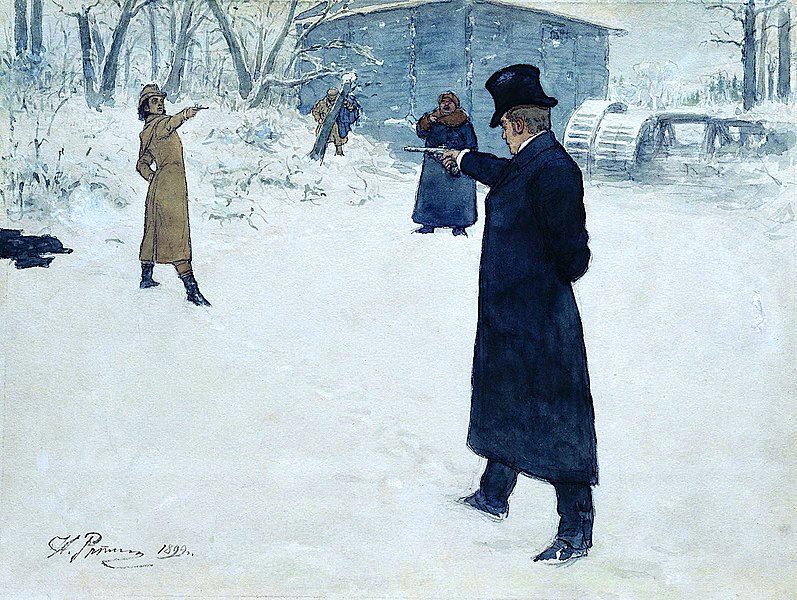
Here is a watercolour of the duel scene from canto six of EO, made in 1899, by Repin.
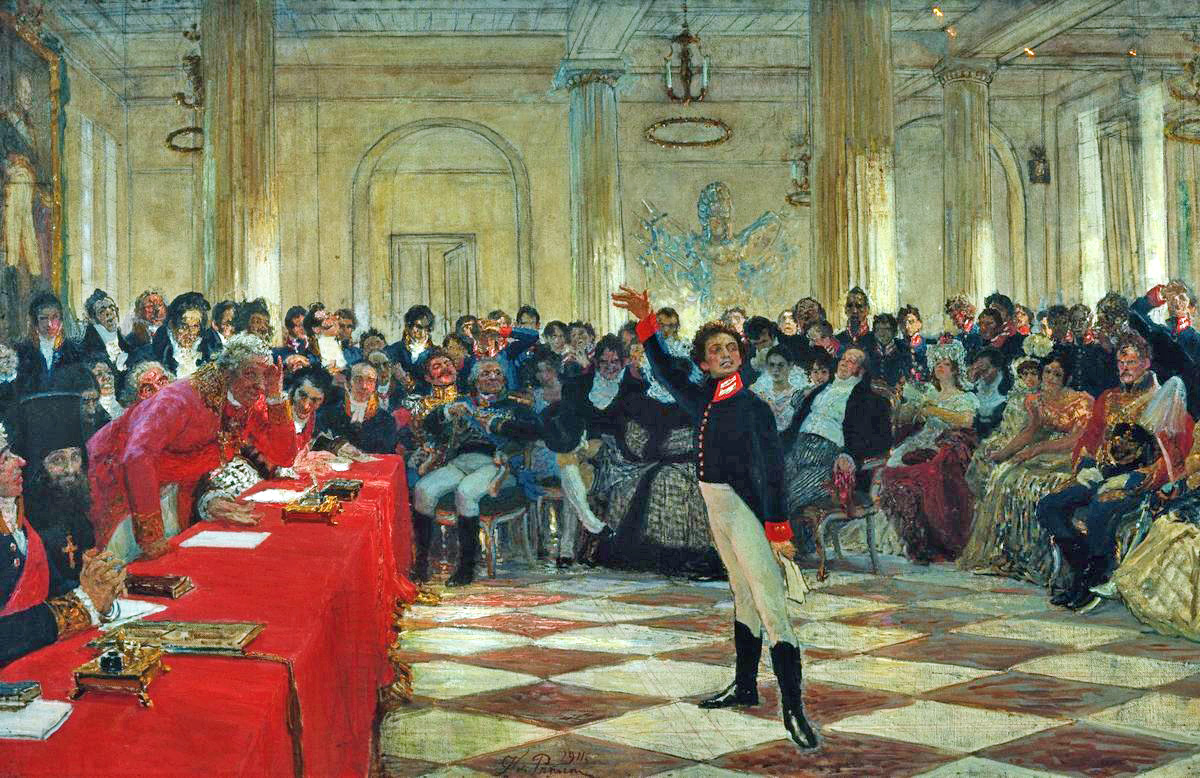
And here is a painting of Pushkin reciting his verse to the aged Father of Russian poetry, Derzhavin, at his examination at the Lycee in 1815, also by Repin 1911. Notice the poses of Lensky in the first and Pushkin in the second.
Friends, let's drink to the immortal spirit of Alexander Sergeivich.
Here is a watercolour of the duel scene from canto six of EO, made in 1899, by Repin.
And here is a painting of Pushkin reciting his verse to the aged Father of Russian poetry, Derzhavin, at his examination at the Lycee in 1815, also by Repin 1911. Notice the poses of Lensky in the first and Pushkin in the second.
Friends, let's drink to the immortal spirit of Alexander Sergeivich.
54QuentinTom
Have just finished Lermontov's A Hero of our Time. I hope to be reviewing it soon.
I am also reading Pushkin on Literature, and now Pushkin's novel The Captain's Daughter. I am trying to get my Pushkin read completed by next week, as my mother is then coming to stay and no doubt we will have other things to read. My mother is a great reader as well.
Trying to clear the decks for Infinite Jest in March.
I am also reading Pushkin on Literature, and now Pushkin's novel The Captain's Daughter. I am trying to get my Pushkin read completed by next week, as my mother is then coming to stay and no doubt we will have other things to read. My mother is a great reader as well.
Trying to clear the decks for Infinite Jest in March.
55QuentinTom
So, I have closed the final pages of Pushkin on Literature and thus my Pushkin studies.
This is a fabulous book, and a format that I would love to see used for other writers. Instead of publishing all his letters, or all his articles, Tatiana Wolff chooses a theme - Pushkin on literature - and compiles an anthology of excerpts from his letters memos drafts articles introductions and so on which illuminate this theme, and how Pushkin felt about his reading and literature. The book is divided into sections reflecting the main periods of his life, with a biographical commentary preceding each section to give background.
Each excerpt is copiously annotated with footnotes, given at the end of each piece, not at the end of the book, so instead of the footnotes being a mere supplement to the piece, they become an integral part of it, setting up a dialogue between Pushkin's words, and Wolff's, and making reference easier. The result is a fascinating look at the Russian literary scene from 1815 to 1837, a biography of Pushkin, and a long conversation with the poet, in which he gets to speak for himself.
Pushkin comes across as the man we would all love to have met: passionate about books and reading, erudite and witty and wise. There are long essays on Voltaire, Chateaubriand, Shakespeare, Walter Scott, Byron, Russian contemporaries such as his friends Vyazemsky, Zhukovsky, and Gogol and Karamzin. The book is littered with quotable lines:
Grammar does not dictate rules to the language, but clarifies and confirms its usages.
I write for myself and publish for money, and certainly not for the smile of the fair sex.
Where the sword of justice does not reach, the whiplash of satire scourges.
Boredom is inherent to a rational being.
It is impossible to defy the judgement of one's own conscience.
etc
etc
Here, the Chinese New Year holiday is coming up, so I wish you all a happy Chinese New year:
新年快樂!
This is a fabulous book, and a format that I would love to see used for other writers. Instead of publishing all his letters, or all his articles, Tatiana Wolff chooses a theme - Pushkin on literature - and compiles an anthology of excerpts from his letters memos drafts articles introductions and so on which illuminate this theme, and how Pushkin felt about his reading and literature. The book is divided into sections reflecting the main periods of his life, with a biographical commentary preceding each section to give background.
Each excerpt is copiously annotated with footnotes, given at the end of each piece, not at the end of the book, so instead of the footnotes being a mere supplement to the piece, they become an integral part of it, setting up a dialogue between Pushkin's words, and Wolff's, and making reference easier. The result is a fascinating look at the Russian literary scene from 1815 to 1837, a biography of Pushkin, and a long conversation with the poet, in which he gets to speak for himself.
Pushkin comes across as the man we would all love to have met: passionate about books and reading, erudite and witty and wise. There are long essays on Voltaire, Chateaubriand, Shakespeare, Walter Scott, Byron, Russian contemporaries such as his friends Vyazemsky, Zhukovsky, and Gogol and Karamzin. The book is littered with quotable lines:
Grammar does not dictate rules to the language, but clarifies and confirms its usages.
I write for myself and publish for money, and certainly not for the smile of the fair sex.
Where the sword of justice does not reach, the whiplash of satire scourges.
Boredom is inherent to a rational being.
It is impossible to defy the judgement of one's own conscience.
etc
etc
Here, the Chinese New Year holiday is coming up, so I wish you all a happy Chinese New year:
新年快樂!

57absurdeist
Happy Chinese New Year tomcat!
Eagerly anticipating your Lermontov review.
Quick question: recently grabbed And Quiet Flows the Don - and rather than click on "conversations" about the book, thought I'd be lazy and listen instead to you and your thoughts on it, once your celebrating is completed, of course.
Eagerly anticipating your Lermontov review.
Quick question: recently grabbed And Quiet Flows the Don - and rather than click on "conversations" about the book, thought I'd be lazy and listen instead to you and your thoughts on it, once your celebrating is completed, of course.
58QuentinTom
>56 janeajones: Thanks Jane! How lovely!
>57 absurdeist: and thanks Freeeeeky. Coincidence! I got And Quiet Flows the Don off the shelf last night, thinking of reading it (am bookless at the moment after having completed my Pushkin read, taking things off the shelf deciding firmly that I will read them, changing my mind and putting them back 5 minutes later. Anyone else do that? Current candidates are Nijinsky's Diaries, AQFTD, or We)
A quick glance at my trusty Cambridge Companion to the Classic Russian Novel reveals that:
Sholokov produced a many sided comprehensive picture of a peasant society in turmoil, thoroughly ambiguous in its political implications.
Set during the civil war of the twenties, it is regarded as one of the major works of the Soviet period. Of the three Russian Nobel laureates of the Soviet period, Pasternak wrote about how the Revolution effected the intelligentsia and upper classes; Solzhenitsyn wrote about the terror years; and Sholokov documented the lives of the Cossacks, an important element in Russian history and culture. Reading it in comparison with Tolstoy's The Cossacks would be very interesting, I reckon.
Tell me, has Russian literature ever let anyone down?
>57 absurdeist: and thanks Freeeeeky. Coincidence! I got And Quiet Flows the Don off the shelf last night, thinking of reading it (am bookless at the moment after having completed my Pushkin read, taking things off the shelf deciding firmly that I will read them, changing my mind and putting them back 5 minutes later. Anyone else do that? Current candidates are Nijinsky's Diaries, AQFTD, or We)
A quick glance at my trusty Cambridge Companion to the Classic Russian Novel reveals that:
Sholokov produced a many sided comprehensive picture of a peasant society in turmoil, thoroughly ambiguous in its political implications.
Set during the civil war of the twenties, it is regarded as one of the major works of the Soviet period. Of the three Russian Nobel laureates of the Soviet period, Pasternak wrote about how the Revolution effected the intelligentsia and upper classes; Solzhenitsyn wrote about the terror years; and Sholokov documented the lives of the Cossacks, an important element in Russian history and culture. Reading it in comparison with Tolstoy's The Cossacks would be very interesting, I reckon.
Tell me, has Russian literature ever let anyone down?
59dchaikin
#52 - Murr, Great lectern post, brilliant as usual with you. I found myself partial to the Mitchell version, which just flows nicely for me. (although he has the least interesting opening quote - and Falen the best there).
PS - Also enjoyed your Atlas Shrugged review (and all the other reviews that have suddenly popped up there). Your comment on speed reading especially made me laugh as my father recently read the book and has been raving about it (it fits with his life philosophy). I've been looking for an antidote. He mentioned he was speed-reading it.
PPS - Wish you a Happy Year of the Tiger, although we're not quite there yet, no? Wikipedia tells me Feb 14.
PS - Also enjoyed your Atlas Shrugged review (and all the other reviews that have suddenly popped up there). Your comment on speed reading especially made me laugh as my father recently read the book and has been raving about it (it fits with his life philosophy). I've been looking for an antidote. He mentioned he was speed-reading it.
PPS - Wish you a Happy Year of the Tiger, although we're not quite there yet, no? Wikipedia tells me Feb 14.
60theaelizabet
"... taking things off the shelf deciding firmly that I will read them, changing my mind and putting them back 5 minutes later. Anyone else do that?" Almost every time I try and choose a book! Some year I should keep a list of those books of which I've read the first five pages then put back on the shelf because, for whatever reason, I've decided it's not the time to experience it.
"Tell me, has Russian literature ever let anyone down?" 'Murr, I love your passion for the Russians, though I don't, as of yet, share it. My experience with Russian literature is limited to readings of Chekov's short stories and plays and a few of Turgenev's plays some years ago. In other words, I haven't much experience at all. But I do enjoy reading about your love of it.
"Tell me, has Russian literature ever let anyone down?" 'Murr, I love your passion for the Russians, though I don't, as of yet, share it. My experience with Russian literature is limited to readings of Chekov's short stories and plays and a few of Turgenev's plays some years ago. In other words, I haven't much experience at all. But I do enjoy reading about your love of it.
61ChocolateMuse
Murr, just say a hypothetical person *koff* had never read any Russian lit before (to his/her great shame). Say this person is largely unread and inexperienced in many things, great literature included. With what would you recommend him/her to begin?
62QuentinTom
Chocomuse, it would depend on whether this hypothetical person
* splutter choke retch cough cough cough hurrrrph hrrrrrrrupmh KKKKKKKKKKK ar whew*
(Sorry, hairball there)
was interested in 20th century lit or 19th century, poetry, prose, drama, had a more serious bent, or preferred comedy and romance, whether long pieces of short ones are preferred.
Perhaps this hypothetical person could be more clearly defined for me to answer more fully? So many variables, you know?
* splutter choke retch cough cough cough hurrrrph hrrrrrrrupmh KKKKKKKKKKK ar whew*
(Sorry, hairball there)
was interested in 20th century lit or 19th century, poetry, prose, drama, had a more serious bent, or preferred comedy and romance, whether long pieces of short ones are preferred.
Perhaps this hypothetical person could be more clearly defined for me to answer more fully? So many variables, you know?
63QuentinTom
Thea, I love that idea!!! At the end of the year you must remind us to post our lists of what we ALMOST read in 2010!!!
Thanks for your kind words about my Russian obsession. Chekov's tales are sublime. Which Turgenev plays, can you remember?
Thanks for your kind words about my Russian obsession. Chekov's tales are sublime. Which Turgenev plays, can you remember?
64Medellia
(Sorry, hairball there)
*cleans up after the Cat*
preferred comedy and romance
Did I hear comedy & romance? (I did.) Do tell, please. I like both of those things, whether separately or in combination.
*cleans up after the Cat*
preferred comedy and romance
Did I hear comedy & romance? (I did.) Do tell, please. I like both of those things, whether separately or in combination.
65QuentinTom
Thanks Dan for your kind words as well. The Mitchell version grew on me as I was reading it. I started off not liking it very much, as I was under the sway of Falen's wonderful vowels, I think, but as I went on with it, I found it to be quite gripping. Mitchell did an especially fine job of Canto 7, which is my favourite canto in the poem, and one of the most difficult for translators coz of its wide swings in tone and mood.
yes, 13.4 is new year's eve, and 14 is new year's day. It's our main festival here, like Christmas and NY in US. I have three days work only this week, and then everything shuts down for 9 days on Friday night. Yeah!
yes, 13.4 is new year's eve, and 14 is new year's day. It's our main festival here, like Christmas and NY in US. I have three days work only this week, and then everything shuts down for 9 days on Friday night. Yeah!
66QuentinTom
Mmmmm, Thanks Meddy for cleaning up that hairball.
Shall I post a Russian Lit syllabus on this thread, for an introduction to Russian lit?
Shall I post a Russian Lit syllabus on this thread, for an introduction to Russian lit?
68ChocolateMuse
>66 QuentinTom: are you serious about that? Because I'm sure that many hypothetical people in hypothetical situations (someone get Murr a drink of water) would LOVE to see a Murr-made (see what I did there?) Russian lit syllabus.
Okay, let me make a confession: that hypothetical person was ME! *waits for exclamations to cease* And I would like to say that 19th century, shorter prose works of a serious, comic or romantic nature sound awesome. But a handmade syllabus for Club Read in general sounds even more awesome, though probably a lot of work - an excellent way to spend your 9 days off, in fact.
Okay, let me make a confession: that hypothetical person was ME! *waits for exclamations to cease* And I would like to say that 19th century, shorter prose works of a serious, comic or romantic nature sound awesome. But a handmade syllabus for Club Read in general sounds even more awesome, though probably a lot of work - an excellent way to spend your 9 days off, in fact.
69theaelizabet
>63 QuentinTom: I remember well "A Month in the Country," of course, but there were others and them I do not remember so well.
I agree that a syllabus would be ever so appreciated, even by those of us who might now file it away for future reference.
Finally, GONG XI FA CAI! This is a huge holiday where I live. The kids even get out of school for a day. Enjoy it 'Murr!
I agree that a syllabus would be ever so appreciated, even by those of us who might now file it away for future reference.
Finally, GONG XI FA CAI! This is a huge holiday where I live. The kids even get out of school for a day. Enjoy it 'Murr!
70LisaCurcio
Momentarily popping in to say YES--a syllabus would be just lovely.
73janeajones
I LOVE syllabi -- go for it, Murr!
74QuentinTom
Golly, what have I let myself in for? Ok, give me a couple days to get my thoughts together.
75detailmuse
Oh thank you, this sounds great!
76Kirconnell
Another vote here. I'd love to see and use that syllabus too, TomcatMurr. I'm hopelessly lost when it comes to the Russians, but I'd like to try them again.
Do you think that we could start a thread for it too?
Do you think that we could start a thread for it too?
77QuentinTom
Probly need to ask avaland about that, velma. It's her group. what would we use such a thread for?
78QuentinTom
I'm excited by the excited response, really. My wicked feline mind has been working overtime on this idea.
However, my mother arrives tonight for a three week stay, so I don't know how quickly I can get this up. If I disappear for a bit, it's not because I have succumbed to the wiles of the Proctologist and the bottle, or because I have forgotten or am ignoring the universal clamour for a Murr-Made Syllabus of Russian Literature, but because my mother and I are galivanting around Taipei on the scooter ( my mum -70 years old- is a total speed freak).
Meanwhile I have just completed a Hoffmann tale The Choosing of the Bride. (Thea in >60 theaelizabet:: If in doubt, read Hoffmann. Never fails.)
However, my mother arrives tonight for a three week stay, so I don't know how quickly I can get this up. If I disappear for a bit, it's not because I have succumbed to the wiles of the Proctologist and the bottle, or because I have forgotten or am ignoring the universal clamour for a Murr-Made Syllabus of Russian Literature, but because my mother and I are galivanting around Taipei on the scooter ( my mum -70 years old- is a total speed freak).
Meanwhile I have just completed a Hoffmann tale The Choosing of the Bride. (Thea in >60 theaelizabet:: If in doubt, read Hoffmann. Never fails.)
79nobooksnolife
Oh, Dear Murr, I am beside myself with jealously and besotted with nostalgia, the first because you are in Taipei for the New Year holidays and the second because the last (perhaps the only) time I was gallivanting on a scooter was in Taipei (pardon me while I drift off into a memory of a sultry night in the mountains)...sounds like you and your mum will enjoy yourselves!
副您新年快樂! Light a string of firecrackers for me.
(and I will continue lurking here to learn your eventual reading selections for those of us who are complete novices, and a bit intimidated, by the great Russian Writers)
副您新年快樂! Light a string of firecrackers for me.
(and I will continue lurking here to learn your eventual reading selections for those of us who are complete novices, and a bit intimidated, by the great Russian Writers)
80polutropos
I have the most enormous admiration for Murr and his vast incomparable knowledge of Russian literature. I, too, look forward to his syllabus.
May I, he asked very timidly, make a suggestion to the group waiting with bated breath for Murr, while he is gallivanting around Taipei on a scooter?
Regardless of how Murr organizes his syllabus, chronologically, by genre, by some other method, at some point he will have Chekhov on the list and some of his stories. My suggestion for anyone wanting to start now is to start with Chekhov short stories, and perhaps with "The Lady with the Pet Dog" specifically. Great introduction to Russian lit.
(I hope you are OK with this, Murr.)
May I, he asked very timidly, make a suggestion to the group waiting with bated breath for Murr, while he is gallivanting around Taipei on a scooter?
Regardless of how Murr organizes his syllabus, chronologically, by genre, by some other method, at some point he will have Chekhov on the list and some of his stories. My suggestion for anyone wanting to start now is to start with Chekhov short stories, and perhaps with "The Lady with the Pet Dog" specifically. Great introduction to Russian lit.
(I hope you are OK with this, Murr.)
81theaelizabet
>78 QuentinTom: Hoffman. Thanks, I'm on it. And do enjoy the time with your Mum!
82janemarieprice
I too look forward to your (post-gallivanting) syllabi.
83ChocolateMuse
Murrrrr, when you return from your mad scooterings, I wonder if you'd be so kind as to write if you agree with the ideas presented in the introduction of this book of Russian short stories: http://www.gutenberg.org/etext/13437 ? I'm looking for something gentle to help me prepare for the Russian Lit I am yet to meet.
I perceive that my approach to Russian Lit will always have a Murr-ish slant... who kneweth how much effect on my life a chance-met Cat would have...
I can't make out who the translator is of the above - Thomas Seltzer is listed as 'editor'. I gather, as much from your Lectern writings as from anywhere else that translators are of paramount importance. I hope your syllabus includes translation suggestions.
And thanks for your suggestion, polutropos!
I perceive that my approach to Russian Lit will always have a Murr-ish slant... who kneweth how much effect on my life a chance-met Cat would have...
I can't make out who the translator is of the above - Thomas Seltzer is listed as 'editor'. I gather, as much from your Lectern writings as from anywhere else that translators are of paramount importance. I hope your syllabus includes translation suggestions.
And thanks for your suggestion, polutropos!
84QuentinTom
Julia, thank you: 新年快樂!!! I send you a virtual hong bau and some dumplings!
Polu: thanks for the Chekhov pimping. Pimp away, and thanks for your kind words.
Jane and ChocolateM, I will try to do my best in getting this up asap. Choco: I think the introduction you posted is rather dated. I would not describe Russian lit as simple. It sometimes gives the impression of simplicity, but this is as much the result of careful craftsmanship and artifice as it is of naivety. Seltzer sems to be implying that due to its relatively late devlopement, Russian lit is naive in the way that peasant productions are naive. Nothing could be further from the truth. All the great Russian writers were exceptionally well read in a number of European languages and without exception all were very sophisticated craftsmen.
Seltzer is right about one thing, though, and that's the importance given to literature in Russian life. Again and again in commentators of all kinds and periods, we hear how important literature was to people of all classes. 20,000 people turned up for Pushkin's funeral. One old man, when asked why he had come, said: "I never met Pushkin, but I read his words, and with his death I mourn for the glory of Russia."
Personally, this is what attracts me to Russian Lit: it's like life's blood.
Anyway, ChocoM, I hope that helps.
Question: many of you have spoken about being 'intimidated' by Russian lit. It might help me to fit my syllabus together if I can understand a bit more about what exactly intimidates you.
(Mother is dozing from jet lag)
Polu: thanks for the Chekhov pimping. Pimp away, and thanks for your kind words.
Jane and ChocolateM, I will try to do my best in getting this up asap. Choco: I think the introduction you posted is rather dated. I would not describe Russian lit as simple. It sometimes gives the impression of simplicity, but this is as much the result of careful craftsmanship and artifice as it is of naivety. Seltzer sems to be implying that due to its relatively late devlopement, Russian lit is naive in the way that peasant productions are naive. Nothing could be further from the truth. All the great Russian writers were exceptionally well read in a number of European languages and without exception all were very sophisticated craftsmen.
Seltzer is right about one thing, though, and that's the importance given to literature in Russian life. Again and again in commentators of all kinds and periods, we hear how important literature was to people of all classes. 20,000 people turned up for Pushkin's funeral. One old man, when asked why he had come, said: "I never met Pushkin, but I read his words, and with his death I mourn for the glory of Russia."
Personally, this is what attracts me to Russian Lit: it's like life's blood.
Anyway, ChocoM, I hope that helps.
Question: many of you have spoken about being 'intimidated' by Russian lit. It might help me to fit my syllabus together if I can understand a bit more about what exactly intimidates you.
(Mother is dozing from jet lag)
86absurdeist
Russian patronymics intimidates me. All those names and father's names and diminuatives of names and nicknames all related to a single character, when there's already, oftentimes, like 100+ character's names to keep track of in a Russian novel.
Being unfamiliar with the sociopolitico history of the time: the economic conditions of the classes (who's who, and why); understanding the hierarchy of pre-Bolshevik governments; variances in religion and the philosophical trends of the time in that culture; even etiquette and the observance of proper Russian decorum in the grand ballrooms and salons and such, can be an intimidating endeavor when it comes to reading those works - reading between the lines, that is - to the meat of what's really going on, has been intimidating to comprehend at times, for me.
But it's extremely rewarding to take the time and figure it all out, I might add (not that I've ever once figured it all out) but I've tried dang hard.
Glad your dear Mum is safely on land. And I hope IJ is safely in on land in your hands too!
Hurry up with the syllabus will ya? We don't have all day around here.
Being unfamiliar with the sociopolitico history of the time: the economic conditions of the classes (who's who, and why); understanding the hierarchy of pre-Bolshevik governments; variances in religion and the philosophical trends of the time in that culture; even etiquette and the observance of proper Russian decorum in the grand ballrooms and salons and such, can be an intimidating endeavor when it comes to reading those works - reading between the lines, that is - to the meat of what's really going on, has been intimidating to comprehend at times, for me.
But it's extremely rewarding to take the time and figure it all out, I might add (not that I've ever once figured it all out) but I've tried dang hard.
Glad your dear Mum is safely on land. And I hope IJ is safely in on land in your hands too!
Hurry up with the syllabus will ya? We don't have all day around here.
87ChocolateMuse
Thank you for taking to the time to read and comment on that, Murr! Here is my grateful gift to you:
ETA: I did originally embed the pic, but you can now access it here: http://www.russianvodka.com/how-to-drink-vodka/how-to-drink-vodka-23.jpg
When I read that linked intro more closely, I thought it sounded a bit simplistic and didactic, but couldn't have known for sure without having read any of the things it's talking about. And it is quite insulting to your beloved Pushkin, I thought. I love what you say about literature being like life's blood to the Russian people.
And please don't feel immediate pressure from me... I'm all impatient to see your syllabus, but won't be able to begin on it until I finish *argharghargh* Les Miserables. And even then I'll follow it slowly, with other things in between.
I am intimidated by the mere idea of Russian lit: its reputation for that sophistication you speak of above; its depth and intelligence which I fear is all beyond me. (But I tell myself what you and other kind LTers have comforted me with in the past - I must not expect to understand everything at this point in my life, so this shouldn't really be an issue).
I'm also intimidated by the things Rique talks about above; all the complicated convoluted bits of assumed knowledge that belong to a culture I know next to nothing about. Also, I tried to start War and Peace a long time ago and gave up because I discovered a couple of chapters in that I had no idea what was going on.
But I am not hoping for a Russian Literature for Dummies kind of syllabus, for all that. :)
ETA: I can't make the pic smaller, it won't let me. I'll edit it out later to save download troubles for LTers.
ETA: I did originally embed the pic, but you can now access it here: http://www.russianvodka.com/how-to-drink-vodka/how-to-drink-vodka-23.jpg
When I read that linked intro more closely, I thought it sounded a bit simplistic and didactic, but couldn't have known for sure without having read any of the things it's talking about. And it is quite insulting to your beloved Pushkin, I thought. I love what you say about literature being like life's blood to the Russian people.
And please don't feel immediate pressure from me... I'm all impatient to see your syllabus, but won't be able to begin on it until I finish *argharghargh* Les Miserables. And even then I'll follow it slowly, with other things in between.
I am intimidated by the mere idea of Russian lit: its reputation for that sophistication you speak of above; its depth and intelligence which I fear is all beyond me. (But I tell myself what you and other kind LTers have comforted me with in the past - I must not expect to understand everything at this point in my life, so this shouldn't really be an issue).
I'm also intimidated by the things Rique talks about above; all the complicated convoluted bits of assumed knowledge that belong to a culture I know next to nothing about. Also, I tried to start War and Peace a long time ago and gave up because I discovered a couple of chapters in that I had no idea what was going on.
But I am not hoping for a Russian Literature for Dummies kind of syllabus, for all that. :)
ETA: I can't make the pic smaller, it won't let me. I'll edit it out later to save download troubles for LTers.
88QuentinTom
>85 Mr.Durick: CASH!!!!!!!!!
>86 absurdeist: ok, well that's helpful. I'll put some pointers in the syllabus to help with those issues. (IJ arrived yesterday and I have started it. I know I know, it's early and all that but I am a bit of a premature ejaculator. I CAN'T STOP!!!!!! It's brilliant. How come no one told me about this book before? I blame you Freeeeky, yes, I do.)
>87 ChocolateMuse: Love the picture LOVE IT!!!!!!!! I hear what you're saying about the sophistication and intelligence, but it's also possible on another level to just simply enjoy the books. One can literally live in a long Russian novel. ANd maybe, now that you've LT you should give War and Peace another go? I hope you will join the group read of Karamazov in November.
ok, back to my syllabus
* Murr buries himself in a mountain of books*
>86 absurdeist: ok, well that's helpful. I'll put some pointers in the syllabus to help with those issues. (IJ arrived yesterday and I have started it. I know I know, it's early and all that but I am a bit of a premature ejaculator. I CAN'T STOP!!!!!! It's brilliant. How come no one told me about this book before? I blame you Freeeeky, yes, I do.)
>87 ChocolateMuse: Love the picture LOVE IT!!!!!!!! I hear what you're saying about the sophistication and intelligence, but it's also possible on another level to just simply enjoy the books. One can literally live in a long Russian novel. ANd maybe, now that you've LT you should give War and Peace another go? I hope you will join the group read of Karamazov in November.
ok, back to my syllabus
* Murr buries himself in a mountain of books*
89nobooksnolife
Dear Murr, (accepting your celebrational hong bau with many thanks) I return to you an even LARGER hong bau, since I probably have a few years on you and Older Folks are supposed to give hong bau to the Younger Ones, are they not? Anyway, it's "virtual" so I can be super generous even though I don't have a yuan to my name right now. I'd like to send you enough to treat your mum to a very fancy outing.
(as for the dumplings, they were out of this world! smack smack).
(as for the dumplings, they were out of this world! smack smack).
90Mr.Durick
Ah, ha! Generalizing from char siu bao and in the context of dumplings, I suspected hong bau would be edible, a bun with hong inside. Silly me. Silliest me.
Robert
Robert
91QuentinTom
well, Robert. You were almost right. 'Bao' means 'package', said package can be dough or paper.
92lilisin
tomcat -
I've been reading through these various posts and have been enjoying myself. For example, I found your review in post 55 very interesting (I particularly liked the quotes) even knowing that I'll never read that particular book.
As for the Russians, I've never really gotten into them. I've read Nina Berberova but honestly can't remember what her books were about anymore. And I read Dostoevsky's C&P but didn't get much out of it. I'm not intimidated by the Russians but they just don't intrigue me. I think it's mostly due to a lack of knowing about the country.
Now, if we started talking about the Japanese, well there I can start writing my own syllabus!
Perhaps I'll read the Brothers when the group reads it. It might make me more interested in it. Till then, I look forward to reading your posts and seeing what this syllabus of yours looks like.
I've been reading through these various posts and have been enjoying myself. For example, I found your review in post 55 very interesting (I particularly liked the quotes) even knowing that I'll never read that particular book.
As for the Russians, I've never really gotten into them. I've read Nina Berberova but honestly can't remember what her books were about anymore. And I read Dostoevsky's C&P but didn't get much out of it. I'm not intimidated by the Russians but they just don't intrigue me. I think it's mostly due to a lack of knowing about the country.
Now, if we started talking about the Japanese, well there I can start writing my own syllabus!
Perhaps I'll read the Brothers when the group reads it. It might make me more interested in it. Till then, I look forward to reading your posts and seeing what this syllabus of yours looks like.
93QuentinTom
Lilisin, it's nice to see you here! A Japanese syllabus? oh, now I am moist! I hope you will find something on the Russian syllabus to whet your appetite for more Russians.
94QuentinTom
oh lordy lordy lordy, here is my syllabus at last. I know it is inadequate as I have had to leave so much out. There are very few women writers, for instance, and I have not touched on the whole rich vein of political or philosophical writing. but, as the emperor said in that movie "Amadeus" - 'There it is.'
95QuentinTom
A Murr-Made Syllabus of Russian Literature (in media res gallivantia scooterium)
I’m dividing this into two broad periods: 19th Century and 20th Century. (18th century Russian lit is mainly of interest to the specialist and is largely philosophy. Of course, if this grabs you, then just ask, I am happy to provide.)
We will focus mainly on poetry and prose fiction, but I will also add some other genres at the end.
I will include links to Amazon so that interested readers can check out the books in more detail and check availability, and for single works I will try to get the touchstones to match up as much as possible, but we all know how temperamental they can be.
* next to a book means I have written about it on my blog, so you can check that out to see if you might be interested in reading the book before you invest time and money on it. For more in depth reading on Russia, click the ‘Russia’ category on my blog, or ‘Dostoevsky’ (shameless plug: apologies).
19th Century
Poetry
Russia had a Golden Age of poetry (1820 to 1835 roughly) and a Silver Age (1895-1920 roughly).
The greatest poet of the Golden Age is of course Pushkin. His work is readily available in English.
Eugene Onegin *
Falen's translation
Mitchell's translation
Other great poets from this period include Derzhavin, Zhukovsky, Lermontov, Baratynsky, Tyutchev and Batyushkov, all contemporaries and members of Pushkin’s circle. Unfortunately for the English reader, not a lot of this fabulous material is available in English. Future publishers and translators please note: We need this stuff. I recommend the following anthologies which include verse from this period and these poets.
Russian Poets: Everyman edition
An Age Ago
Prose Fiction
I have thought long and hard about how to divvy up the huge wealth of material here. Rather than going chronological, I’ve decided to go for a thematic approach as this might help people to find something to read that fits their interests better. Titles include short stories and long novels. I’ll put some references for short story collections at the end.
Humour
The Nose Gogol
A lowly government clerk chases his own nose all over Petersburg.
Dead Souls* Gogol
Chichikov travels around Russia with his servant Stinky Petrushka buying up the names of dead peasants for a scam
Oblomov* Goncharov
A theory of laziness. Takes the whole of chapter 1 for the main character just to get out of bed.
A Nasty Story* Dostoevsky
Toe curling social embarrasments when a government clerk gatecrashes a wedding.
The Crocodile Dostoevsky
Man gets swallowed by a crocodile and gives interviews on his experience from inside croc
Romance and Lurve
Anna Karenina Tolstoy
The greatest love story in the world.
A Family History* Tolstoy
Short early version of the same material as Anna Karenina.
First Love Turgenev
First love in the Russian countryside
Home of the Gentry Turgenev
First love in the Russian countryside
Poor Folk* Dostoevsky
Love letters between two of Petersburg’s lowly denizens
White Nights Dostoevsky
More unsuitable and doomed love in Petersburg.
Psychology
Notes from Underground* Dostoevsky
Existentialist psychology.
The Idiot Dostoevsky
Dostoevsky tries to create a character that embodies pure goodness. Does he succeed?
Crime and Punishment Dostoevsky
A psychological study of the effects of guilt.
Oblomov* Goncharov
Psychology of the loafer
The Gambler Dostoevsky
Psychological study of gambling, a key theme in Russian life and lit
The Double* Dostoevsky
A lowly government clerk encounters his own double, who drives him crazy.
History and Society
War and Peace Tolstoy
Napoleon in Moscow
Fathers and Sons* Turgenev
Generation battles and the birth of nihilism
The Demons Dostoevsky
Early revolutionaries plan a terrorist attack
Humiliated and Insulted* Dostoevsky
The little people of Petersburg
Mr Prokharchin Dostoevsky
The little people of Petersburg
Notes from the House of the Dead* Dostoevsky
Thinly fictionalised account of Dostoevsky’s prison experience
The Overcoat Gogol
A lowly government clerk looses his most treasured possession. First appearance in lit of the little man, a common Russian theme.
On the Eve Turgenev
Portrait of the powerlessness of intellectuals under tsarist oppression
The Countryside
Sketches from a Hunter’s Album Turgenev
Blissful and lyrical sketches of rural life
The Cossacks Tolstoy
A picture of an important element in Russian culture: the cossacks
A Hero of Our Time* Lermontov
Russia’s imperial adventures in the Caucasus
Hadji Murad Tolstoy
Russia’s imperial adventures in the Caucasus and Chechnya
The Steppe Chekhov
An endless journey across the steppe
Religion
The Brothers Karamazov
Christ returns and is burnt at the stake as a heretic
Resurrection Tolstoy
Redemption of a prostitute
The Death of Ivan Illych Tolstoy
Family and death
Master and Man Tolstoy
Class relationships and religion
Short story collections:
Gogol
Dostoevsky
Tolstoy
Chekhov
Pushkin
20th Century
Poetry
Thankfully, many of the poets of the Silver Age and Soviet periods are readily available in English. Outstanding names with links to Amazon for collections are:
Boris Pasternak
Alexander Blok
Anna Akhmatova
Marina Tsvetaeva
Osip Mandelstahm
Sergei Esenin
Yevgeny Yevtushenko
Joseph Brodsky
In addition there are also these anthologies:
The Stray Dog Cabaret
20th Century Russian Poetry
Prose Fiction
Russia produced three Nobel Laureates in the 20th century. Focussing on them is a good way of introducing yourself to 20th century Russian novels.
Boris Pasternak: More famous in Russia as poet, Pasternak was also the foremost translator of Shakespeare into Russian
Dr Zhivago
Love amid the Revolution
Alexander Solzhenitsyn: regarded by many as the conscience of Soviet Russia
The Gulag Archipelago
An explosive expose of Stalin’s death camps
Cancer Ward
A cancer ward as an allegory of the soviet system, as well as a personal account of cancer
The First Circle
Scientists in a labour camp, an allegory of Dante’s Inferno
One Day in the Life of Ivan Denisovich.
One day in a forced labour camp in Siberia
The Red Wheel
A huge multivolume reconstruction of the events leading up to and including the Revolution
The Oak and the Calf
Memoir of Soviet literary life
Mikhail Sholokov: had a complicated relationship with the Soviet authorities and was plagued by accusations of plagiarism
The Quiet Don
A huge multivolume epic of revolution and civil war among the Don cossacks.
An addition, the following works are important:
Master and Margarita Mikhail Bulgakov
The devil plays havoc in Moscow
Petersburg Andrei Beily
Occultism and terrorism in Petersburg
Grey is the Colour of Hope Irina Ratushinskaya
Prison memoir by woman poet and dissident
We Yevgeny Zamyatin
The dystopia to beat all dystopias, inspiration for Orwell and Huxley
The Red Cavalry Isaac Babel
Stories about the Russian Polish war of the 1920s by the greatest short story writer of the Silver Age
Life and Fate Vassily Grossman
Huge novel of WW2
Forever Flowing Vassily Grossman
Ex convict tries to reintegrate himself into civilian life
The Case of Comrade Tularev Victor Serge
Murder mystery set during Stalin’s purges of the 1930s
Summer in Baden Baden Leonid Tsypkin
Fictional account of Dostoevsky’s journey to Baden Baden
The Foundation Pit Andrei Platonov
Totalitarian state sets the people to work digging a pit to keep everyone busy: Sisyphus in reverse
Mother Maxim Gorky
Classic novel of the Revolution told from the point of view of the proletariat
On the Golden Porch Tatyana Tolstaya
Collection of stories from one of the best post-Soviet writers writing today
Homo Zapiens Victor Pelevin
Major post-Soviet writer alive today: Murakami on vodka. Lots, I mean lots, of vodka.
Autobiographies and confessionals
This is a strong genre in Russian lit and there are some incredible human documents from both centuries. I particularly recommend the following:
Confession Tolstoy
His struggles with his faith (brilliantly reviewed by Enreeeeeeque Freeeeky here)
The Diary of Vaslav Nijinsky
The great dancer descends into madness in front of you. Searing. Moving. Incredible.
Hope against Hope Nadezhda (her name means ‘hope’ in Russian) Mandelstem
Osip Mandelstam’s widow recounts how she kept her husband’s flame alive during the Stalin years
Safe Conduct Boris Pasternak
Autobiographical fragment describing his youth before the revolution
My life in Art Konstantin Stanislavski
Autobiography of the great director, father of method acting, and friend of Chekhov
Testimony Solomon Volkov
A highly controversial but indispensable memoir of Shostakovich
A Captive of Time Olga Ivinskaya
Memoir of Pasternak’s mistress, the woman who was the inspiration for Lara in Dr. Zhivago
Essays and criticism:
Less than One Joseph Brodsky
Collection of essays contains fabulous sketches of his youth and of St Petersburg
Pushkin’s Children Tatyana Tolstaya
Collection of essays on Russian culture and its importance, both personal and historical
Books about Russia
Culture:
The Icon and the Axe James Billington
Natasha’s Dance Orlando Figes
The Magical Chorus Solomon Volkov
History and Revolution:
The People’s Revolution Orlando Figes
The Russian Revolution Robert Service
The Romanovs: The Final Chapter Robert K Massie
A short history of Russia in the 19th century
Three key events and their importance
1. 1812 Napoleon invades Russia, gets as far as Moscow, which the Russians burn rather than surrender, leaves, and has his army decimated by the Russian winter and by partisans
Important because: upsurge in Russian nationalism with consequent interest in Russian peasant culture from the Intelligentsia (instead of French culture); greater intercourse between the nobility and the peasantry –they ‘discover’ each other as they fight side by side against the French. More enlightened members of the nobility realise that the way the peasants are treated is unfair, in view of the way they fought to defend Russia.
2. December 1825 aborted coup against the new Tsar Nicholas 1 by the younger generation of the nobility, who want more participation in government. The ring leaders are hung, and other prominent members of the nobility involved in the coup are exiled for life to Siberia.
Important because: sets the tone for most of Nicholas 1st reign (1825 -1855): highly repressive and paranoid about other possible conspiracies; political, military and religious censorship imposed. ‘Silent war’ between government and intelligentsia with frequent arrests (eg Dostoevsky) and exiles. Relationship between government and intelligentsia deteriorates further after Russia loses the Crimean War (1854) due to bungling and mismanagement.
3. 1888 assassination of Tsar Alexander II (son of Nicholas). Ironically one of the most liberal of tsars, during whose reign (1855 – 1888) the serfs were finally liberated.
Important because: Alexander’s two successors vow that this fate will not befall them. Period of extreme oppression, during which dissidents and revolutionaries become more extreme in their acts and attitudes. This radicalisation of attitudes on both sides eventually results in the Revolution.
Further: During the 19th century there is a gradual change in the character of the intelligentsia, a special class of literary practitioners found only in Russia. At the start of the century, most of the intelligentsia are sons of the nobility, aristocrats (Pushkin and his circle). As the century progresses, especially around the 1830s, a middle class intelligentsia (raznochintsy) begins to emerge in Russia, especially in Moscow. Belinsky and Dostoevsky are the main figures of this new class, and with them ‘the little man’ and social concerns begin to enter the literature.
Note on Translations
For verse, translation is more important and vexing than for prose. For the former, the links I have provided are for translations officially approved by Murr, or the best available. For the latter, I prefer to sidestep the whole issue of translations, as different versions have their own strengths and weaknesses and appeal to different people for different reasons. In choosing which translation to read, I think it’s more important to choose an edition that has good notes, good introductions and other apparatus. This will help to increase your understanding of the work and the contexts from which it arose. An edition of a translated classic with no notes or introduction is like herring with no vodka.
I’m dividing this into two broad periods: 19th Century and 20th Century. (18th century Russian lit is mainly of interest to the specialist and is largely philosophy. Of course, if this grabs you, then just ask, I am happy to provide.)
We will focus mainly on poetry and prose fiction, but I will also add some other genres at the end.
I will include links to Amazon so that interested readers can check out the books in more detail and check availability, and for single works I will try to get the touchstones to match up as much as possible, but we all know how temperamental they can be.
* next to a book means I have written about it on my blog, so you can check that out to see if you might be interested in reading the book before you invest time and money on it. For more in depth reading on Russia, click the ‘Russia’ category on my blog, or ‘Dostoevsky’ (shameless plug: apologies).
19th Century
Poetry
Russia had a Golden Age of poetry (1820 to 1835 roughly) and a Silver Age (1895-1920 roughly).
The greatest poet of the Golden Age is of course Pushkin. His work is readily available in English.
Eugene Onegin *
Falen's translation
Mitchell's translation
Other great poets from this period include Derzhavin, Zhukovsky, Lermontov, Baratynsky, Tyutchev and Batyushkov, all contemporaries and members of Pushkin’s circle. Unfortunately for the English reader, not a lot of this fabulous material is available in English. Future publishers and translators please note: We need this stuff. I recommend the following anthologies which include verse from this period and these poets.
Russian Poets: Everyman edition
An Age Ago
Prose Fiction
I have thought long and hard about how to divvy up the huge wealth of material here. Rather than going chronological, I’ve decided to go for a thematic approach as this might help people to find something to read that fits their interests better. Titles include short stories and long novels. I’ll put some references for short story collections at the end.
Humour
The Nose Gogol
A lowly government clerk chases his own nose all over Petersburg.
Dead Souls* Gogol
Chichikov travels around Russia with his servant Stinky Petrushka buying up the names of dead peasants for a scam
Oblomov* Goncharov
A theory of laziness. Takes the whole of chapter 1 for the main character just to get out of bed.
A Nasty Story* Dostoevsky
Toe curling social embarrasments when a government clerk gatecrashes a wedding.
The Crocodile Dostoevsky
Man gets swallowed by a crocodile and gives interviews on his experience from inside croc
Romance and Lurve
Anna Karenina Tolstoy
The greatest love story in the world.
A Family History* Tolstoy
Short early version of the same material as Anna Karenina.
First Love Turgenev
First love in the Russian countryside
Home of the Gentry Turgenev
First love in the Russian countryside
Poor Folk* Dostoevsky
Love letters between two of Petersburg’s lowly denizens
White Nights Dostoevsky
More unsuitable and doomed love in Petersburg.
Psychology
Notes from Underground* Dostoevsky
Existentialist psychology.
The Idiot Dostoevsky
Dostoevsky tries to create a character that embodies pure goodness. Does he succeed?
Crime and Punishment Dostoevsky
A psychological study of the effects of guilt.
Oblomov* Goncharov
Psychology of the loafer
The Gambler Dostoevsky
Psychological study of gambling, a key theme in Russian life and lit
The Double* Dostoevsky
A lowly government clerk encounters his own double, who drives him crazy.
History and Society
War and Peace Tolstoy
Napoleon in Moscow
Fathers and Sons* Turgenev
Generation battles and the birth of nihilism
The Demons Dostoevsky
Early revolutionaries plan a terrorist attack
Humiliated and Insulted* Dostoevsky
The little people of Petersburg
Mr Prokharchin Dostoevsky
The little people of Petersburg
Notes from the House of the Dead* Dostoevsky
Thinly fictionalised account of Dostoevsky’s prison experience
The Overcoat Gogol
A lowly government clerk looses his most treasured possession. First appearance in lit of the little man, a common Russian theme.
On the Eve Turgenev
Portrait of the powerlessness of intellectuals under tsarist oppression
The Countryside
Sketches from a Hunter’s Album Turgenev
Blissful and lyrical sketches of rural life
The Cossacks Tolstoy
A picture of an important element in Russian culture: the cossacks
A Hero of Our Time* Lermontov
Russia’s imperial adventures in the Caucasus
Hadji Murad Tolstoy
Russia’s imperial adventures in the Caucasus and Chechnya
The Steppe Chekhov
An endless journey across the steppe
Religion
The Brothers Karamazov
Christ returns and is burnt at the stake as a heretic
Resurrection Tolstoy
Redemption of a prostitute
The Death of Ivan Illych Tolstoy
Family and death
Master and Man Tolstoy
Class relationships and religion
Short story collections:
Gogol
Dostoevsky
Tolstoy
Chekhov
Pushkin
20th Century
Poetry
Thankfully, many of the poets of the Silver Age and Soviet periods are readily available in English. Outstanding names with links to Amazon for collections are:
Boris Pasternak
Alexander Blok
Anna Akhmatova
Marina Tsvetaeva
Osip Mandelstahm
Sergei Esenin
Yevgeny Yevtushenko
Joseph Brodsky
In addition there are also these anthologies:
The Stray Dog Cabaret
20th Century Russian Poetry
Prose Fiction
Russia produced three Nobel Laureates in the 20th century. Focussing on them is a good way of introducing yourself to 20th century Russian novels.
Boris Pasternak: More famous in Russia as poet, Pasternak was also the foremost translator of Shakespeare into Russian
Dr Zhivago
Love amid the Revolution
Alexander Solzhenitsyn: regarded by many as the conscience of Soviet Russia
The Gulag Archipelago
An explosive expose of Stalin’s death camps
Cancer Ward
A cancer ward as an allegory of the soviet system, as well as a personal account of cancer
The First Circle
Scientists in a labour camp, an allegory of Dante’s Inferno
One Day in the Life of Ivan Denisovich.
One day in a forced labour camp in Siberia
The Red Wheel
A huge multivolume reconstruction of the events leading up to and including the Revolution
The Oak and the Calf
Memoir of Soviet literary life
Mikhail Sholokov: had a complicated relationship with the Soviet authorities and was plagued by accusations of plagiarism
The Quiet Don
A huge multivolume epic of revolution and civil war among the Don cossacks.
An addition, the following works are important:
Master and Margarita Mikhail Bulgakov
The devil plays havoc in Moscow
Petersburg Andrei Beily
Occultism and terrorism in Petersburg
Grey is the Colour of Hope Irina Ratushinskaya
Prison memoir by woman poet and dissident
We Yevgeny Zamyatin
The dystopia to beat all dystopias, inspiration for Orwell and Huxley
The Red Cavalry Isaac Babel
Stories about the Russian Polish war of the 1920s by the greatest short story writer of the Silver Age
Life and Fate Vassily Grossman
Huge novel of WW2
Forever Flowing Vassily Grossman
Ex convict tries to reintegrate himself into civilian life
The Case of Comrade Tularev Victor Serge
Murder mystery set during Stalin’s purges of the 1930s
Summer in Baden Baden Leonid Tsypkin
Fictional account of Dostoevsky’s journey to Baden Baden
The Foundation Pit Andrei Platonov
Totalitarian state sets the people to work digging a pit to keep everyone busy: Sisyphus in reverse
Mother Maxim Gorky
Classic novel of the Revolution told from the point of view of the proletariat
On the Golden Porch Tatyana Tolstaya
Collection of stories from one of the best post-Soviet writers writing today
Homo Zapiens Victor Pelevin
Major post-Soviet writer alive today: Murakami on vodka. Lots, I mean lots, of vodka.
Autobiographies and confessionals
This is a strong genre in Russian lit and there are some incredible human documents from both centuries. I particularly recommend the following:
Confession Tolstoy
His struggles with his faith (brilliantly reviewed by Enreeeeeeque Freeeeky here)
The Diary of Vaslav Nijinsky
The great dancer descends into madness in front of you. Searing. Moving. Incredible.
Hope against Hope Nadezhda (her name means ‘hope’ in Russian) Mandelstem
Osip Mandelstam’s widow recounts how she kept her husband’s flame alive during the Stalin years
Safe Conduct Boris Pasternak
Autobiographical fragment describing his youth before the revolution
My life in Art Konstantin Stanislavski
Autobiography of the great director, father of method acting, and friend of Chekhov
Testimony Solomon Volkov
A highly controversial but indispensable memoir of Shostakovich
A Captive of Time Olga Ivinskaya
Memoir of Pasternak’s mistress, the woman who was the inspiration for Lara in Dr. Zhivago
Essays and criticism:
Less than One Joseph Brodsky
Collection of essays contains fabulous sketches of his youth and of St Petersburg
Pushkin’s Children Tatyana Tolstaya
Collection of essays on Russian culture and its importance, both personal and historical
Books about Russia
Culture:
The Icon and the Axe James Billington
Natasha’s Dance Orlando Figes
The Magical Chorus Solomon Volkov
History and Revolution:
The People’s Revolution Orlando Figes
The Russian Revolution Robert Service
The Romanovs: The Final Chapter Robert K Massie
A short history of Russia in the 19th century
Three key events and their importance
1. 1812 Napoleon invades Russia, gets as far as Moscow, which the Russians burn rather than surrender, leaves, and has his army decimated by the Russian winter and by partisans
Important because: upsurge in Russian nationalism with consequent interest in Russian peasant culture from the Intelligentsia (instead of French culture); greater intercourse between the nobility and the peasantry –they ‘discover’ each other as they fight side by side against the French. More enlightened members of the nobility realise that the way the peasants are treated is unfair, in view of the way they fought to defend Russia.
2. December 1825 aborted coup against the new Tsar Nicholas 1 by the younger generation of the nobility, who want more participation in government. The ring leaders are hung, and other prominent members of the nobility involved in the coup are exiled for life to Siberia.
Important because: sets the tone for most of Nicholas 1st reign (1825 -1855): highly repressive and paranoid about other possible conspiracies; political, military and religious censorship imposed. ‘Silent war’ between government and intelligentsia with frequent arrests (eg Dostoevsky) and exiles. Relationship between government and intelligentsia deteriorates further after Russia loses the Crimean War (1854) due to bungling and mismanagement.
3. 1888 assassination of Tsar Alexander II (son of Nicholas). Ironically one of the most liberal of tsars, during whose reign (1855 – 1888) the serfs were finally liberated.
Important because: Alexander’s two successors vow that this fate will not befall them. Period of extreme oppression, during which dissidents and revolutionaries become more extreme in their acts and attitudes. This radicalisation of attitudes on both sides eventually results in the Revolution.
Further: During the 19th century there is a gradual change in the character of the intelligentsia, a special class of literary practitioners found only in Russia. At the start of the century, most of the intelligentsia are sons of the nobility, aristocrats (Pushkin and his circle). As the century progresses, especially around the 1830s, a middle class intelligentsia (raznochintsy) begins to emerge in Russia, especially in Moscow. Belinsky and Dostoevsky are the main figures of this new class, and with them ‘the little man’ and social concerns begin to enter the literature.
Note on Translations
For verse, translation is more important and vexing than for prose. For the former, the links I have provided are for translations officially approved by Murr, or the best available. For the latter, I prefer to sidestep the whole issue of translations, as different versions have their own strengths and weaknesses and appeal to different people for different reasons. In choosing which translation to read, I think it’s more important to choose an edition that has good notes, good introductions and other apparatus. This will help to increase your understanding of the work and the contexts from which it arose. An edition of a translated classic with no notes or introduction is like herring with no vodka.
96nobooksnolife
Murr, you are amazing. Thank you for this.
97kidzdoc
Wow. I'm impressed, and very grateful for your effort. I'm saving this for future reference. Thanks Murr!
98rebeccanyc
Wow! Thanks!
99LisaCurcio
Thank you! I do hope Mum has not been out riding on that scooter alone while you were slaving away for us!
100detailmuse
Wow!
*favorited and printed*
I've only read Turgenev's First Love (liked it) and have a volume of Chekhov's stories. The humor suggestions appeal immediately.
Thank you!
*favorited and printed*
I've only read Turgenev's First Love (liked it) and have a volume of Chekhov's stories. The humor suggestions appeal immediately.
Thank you!
101theaelizabet
I am amazed at your generosity in posting this. And grateful. Thank you.
102polutropos
Spectacular! Beyond words! All celebrate Murr!
103absurdeist
Well I sure hope you weren't neglecting your dear Mum, the time it must've taken you to compile and organize this! Did you slip her a mickey with the hong bau and vodka, to knock her out? Er, you prob'ly didn't need to knock her out since this is likely the equivalent of reciting the alphabet for you isn't it - something you could knock out in your sleep, eh?
Amazing! Effing AWESOME.
When does class begin, Professor Tomcat?
Amazing! Effing AWESOME.
When does class begin, Professor Tomcat?
105absurdeist
and I am moist.
106janeajones
This is a decade's worth of reading...brilliant and exhaustive (not to say exhausting). Thanks, Murr.
107janemarieprice
Wonderful!
108RidgewayGirl
Thanks for the syllabus, especially the 20th century stuff. I think I'll start with a little Chekov and Gogol and see where that gets me.
I toast you with a glass of the finest potato vodka, complete with a frozen anchovy as a swizzle stick.
I toast you with a glass of the finest potato vodka, complete with a frozen anchovy as a swizzle stick.
109Talbin
This is amazing.
And thanks to Tim for introducing the new ability to mark/save favorite posts so I can return again and again.
And thanks to Tim for introducing the new ability to mark/save favorite posts so I can return again and again.
111absurdeist
Mine too. Now if I could just figure out how to access it! Heading over to that thread for info.
112Medellia
(If you look on the left hand side, along with "Your posts" and "Your starred" and all that, there's now "Your favorite messages.")
113absurdeist
Thanks Medellia! Happy Valentines :)
114Medellia
Awwww, you're even a day early. :)
(Tomorrow the Cat is going to get double hugs 'cause it's Chinese New Year and Valentine's Day both. But sshhhh. Don't tell.)
(Tomorrow the Cat is going to get double hugs 'cause it's Chinese New Year and Valentine's Day both. But sshhhh. Don't tell.)
115janemarieprice
109/110 - My first too!
116Kirconnell
It's awesome. Thanks so much for your hard work and on your vacation too.
Velma
Velma
117ChocolateMuse
Thank you Murrushka! Thankyouthankyouthankyouthankyou.
*hugs, vodka, herring, and Muse's undying gratitude for you*
*hugs, vodka, herring, and Muse's undying gratitude for you*
118QuentinTom
Thank you everyone for all your kind words and showers of herring and vodka. I'm glad that the syllabus is going to be useful.
121QuentinTom
Snatching a few moments to catch up. We took mother to the National Palace Museum, the greatest repository of Chinese art in the world. I found this wonderful book on Chinese art in the book shop there. Here are some images from it which caught my eye.


122urania1
Oh happiness. Your syllabus matches my reading. A brilliant syllabus. When do you plan to teach the course? And where? The underground?
124zenomax
~95, appropos of Chekov's appearance (quite rightly) on your syllabus:
'I heartily recommend taking as often as possible Chekhov's books...and dreaming through them as they are intended to be dreamed through.'
Nabokov, quoted in a flyer received in the mail today from the Folio Society.
That, for me, is all I could hope for in a recommendation.
'I heartily recommend taking as often as possible Chekhov's books...and dreaming through them as they are intended to be dreamed through.'
Nabokov, quoted in a flyer received in the mail today from the Folio Society.
That, for me, is all I could hope for in a recommendation.
125Medellia
#124: STOP STOP STOP. LALALA I AM NOT LIS-TEN-ING. I have been trying to avoid thinking about that new Folio Chekhov set.
... ARGH.
... ARGH.
126theaelizabet
And I've been trying not think of FOLIO at all! Folio, Folio, Folio, Folio...
127zenomax
Medellia, I feel this is only just, given that you forced me to search out and buy the Folio set of ISOLT (by casually dropping into conversation that they included Atget photography)....
theaelizabet - I am holding out well ... I've thrown out the last 2 mails from Folio. Admittedly I fell for the one before that (the 2 volume Shorter Oxford Dictionary was going for a song - what else could I do?)
theaelizabet - I am holding out well ... I've thrown out the last 2 mails from Folio. Admittedly I fell for the one before that (the 2 volume Shorter Oxford Dictionary was going for a song - what else could I do?)
128QuentinTom
Lordy Lordy lordy. Mother has now gone home and I can see I have an enormous amount of catching up to do. I hope to be able to catch up with people's threads over the weekend.
Not much reading going on. We watched together the BBC version of Lark Rise to Candleford which was thoroughly enjoyable, full of sly humour, perhaps even inadvertent. For example:
My wife has decided that I know best, and I agree with her.
I can't hold him in the cell sir. It will interfere with police work.
I'm going to look out for the book.
Also, I have been reading Infinite Jest, which my mother brought with her. More on that later.
Not much reading going on. We watched together the BBC version of Lark Rise to Candleford which was thoroughly enjoyable, full of sly humour, perhaps even inadvertent. For example:
My wife has decided that I know best, and I agree with her.
I can't hold him in the cell sir. It will interfere with police work.
I'm going to look out for the book.
Also, I have been reading Infinite Jest, which my mother brought with her. More on that later.
129urania1
Meddi and zeno,
I too am resisting the blandishments of Folio right now, although I must say that the final Christmas offering was sooo tempting.
Murrushka,
Lovely to see you again. I started Infinite Jest but have been side-tracked by goats and decadent literature. Now if I could only find decadent literature about goats . . . .
I too am resisting the blandishments of Folio right now, although I must say that the final Christmas offering was sooo tempting.
Murrushka,
Lovely to see you again. I started Infinite Jest but have been side-tracked by goats and decadent literature. Now if I could only find decadent literature about goats . . . .
130janeajones
Love the prints -- they're gorgeous. Someday I'll get to the syllabus -- next week I get to The Cherry Orchard -- I do love Chekhov's plays, particularly when they're not taken too seriously.
131Talbin
I love those prints, too, especially the first - it's so different from the way natural subjects are traditionally treated. Is it contemporary, or is it older?
Also, on the second print, I find the "halos" around each person's head quite interesting. I don't recall having seen that in Chinese art before. Does it have a meaning? Because I have no idea, it's striking me as commentary on Western paintings of the holy family, but I'm sure I'm completely wrong on this and there is no connection whatsoever.
Also, on the second print, I find the "halos" around each person's head quite interesting. I don't recall having seen that in Chinese art before. Does it have a meaning? Because I have no idea, it's striking me as commentary on Western paintings of the holy family, but I'm sure I'm completely wrong on this and there is no connection whatsoever.
132QuentinTom
Talbin, you are most observant. I had not noticed the halos. I know halos appear in Buddhist art to show the awakening of the buddha or boddhistva, but I don't know more than that. It seems to be a painting of the holy family, doesn't it? More than that, I cannot say.
133QuentinTom
oh dear oh dear oh dear I am so behind on my reading and following everyone's threads. Mother has finally gone, and life is returning back to normal. Although my reading time has been severely curtailed by another Big Project (two actually, running concurrently), I will try to catch up on everyone's threads ASAP. I miss my LT life and all my friends here.
In addition to creeping slowly through IJ, I have been reading more stuff on the internet, including this fascinating article on a Russian journal, which brought to mind the thriving journal scene of the 19th Century.
http://www.vanityfair.com/culture/features/2010/02/exile-201002
In addition to creeping slowly through IJ, I have been reading more stuff on the internet, including this fascinating article on a Russian journal, which brought to mind the thriving journal scene of the 19th Century.
http://www.vanityfair.com/culture/features/2010/02/exile-201002
134QuentinTom
I have posted the second half of my Nabokov/Pushkin review here. In this half I focus on the Commentary, my favourite read of last year.
http://www.librarything.com/work/9095485/reviews
I am still reading Infinite Jest, with nothing new to report except it's brilliance.
http://www.librarything.com/work/9095485/reviews
I am still reading Infinite Jest, with nothing new to report except it's brilliance.
135QuentinTom
Oh dear I have fallen behind. I spent last week in Thailand where I got caught up in the red shirt demonstrations. Back in Taiwan now, where everything is peaceful.
I have finished Infinite Jest and posted my review of it here. Best read of the year so far. Totally original book, in execution and vision. Remarkable achievement, really.
I then read Taras Bulba, to help me get back into my Russians. a group read of Brothers Karamazov is coming up in November, and I want to be ready for it. Taras Bulba is a short novella by Gogol focusing on the Zaporozhian Cossacks in the 16th century. heavily influenced by Scott, the novel is full of derring do and has epic Illiadic qualities. A cracking good read. Here is a picture (by Repin) of the Zaparozhian Cossacks writing a letter to the Turkish Sultan who had demanded their submission.

and here is the text of the letter they wrote:
"THou Turkish Devil:
Brother and Companion to the devil accursed DEvil, and secretary to lucifer himself, GREETINGS!
What the hell kind of noble knight art thou? Satan voids and they army devours. Never wilt thou be fit to have the Sons of christ under thee. Thy army we fear not, and by land and by sea in our chaikas will we do battle against thee.
Thou scullion of Babylon, thou beer brewer of Jerusalem, thou goat thief of Alexandria, thou swineherd of Egypt, both the greater and the lesser, thou Armenian pig and Tartar goat. Thou hangman of Kemyanets, thou evildoer of Podolia, thou grandson of the devil himself, thou great silly oaf of all the world, and of the Netherworld, and before our god, a blockhead, a swine's snout, a mare's ass, and a clown of Hades. May the devil take thee!
That is what the cossacks have to say to thee, thou basest born of runts. unfit art thou to lord it over christians.
The date we know not, for no calender have we got. The moon (month) is in the sky, the year is in a book, and the day is the same here as with thee over there - and thou canst kiss us thou knowest where!"
I then read The Real Life of Sebastian Knight which Andrew sent me a while ago. I am not very familiar with Nabokov's fiction, but this was hugely enjoyable. I am now on a quest to read more of Nabokov's fiction.
I then started What is to be done? by Chernyeshevsky. but I got waylaid by Jonathon Littell's The Kindly Ones whcih I am reading now. Crikey, what a book.
I have finished Infinite Jest and posted my review of it here. Best read of the year so far. Totally original book, in execution and vision. Remarkable achievement, really.
I then read Taras Bulba, to help me get back into my Russians. a group read of Brothers Karamazov is coming up in November, and I want to be ready for it. Taras Bulba is a short novella by Gogol focusing on the Zaporozhian Cossacks in the 16th century. heavily influenced by Scott, the novel is full of derring do and has epic Illiadic qualities. A cracking good read. Here is a picture (by Repin) of the Zaparozhian Cossacks writing a letter to the Turkish Sultan who had demanded their submission.

and here is the text of the letter they wrote:
"THou Turkish Devil:
Brother and Companion to the devil accursed DEvil, and secretary to lucifer himself, GREETINGS!
What the hell kind of noble knight art thou? Satan voids and they army devours. Never wilt thou be fit to have the Sons of christ under thee. Thy army we fear not, and by land and by sea in our chaikas will we do battle against thee.
Thou scullion of Babylon, thou beer brewer of Jerusalem, thou goat thief of Alexandria, thou swineherd of Egypt, both the greater and the lesser, thou Armenian pig and Tartar goat. Thou hangman of Kemyanets, thou evildoer of Podolia, thou grandson of the devil himself, thou great silly oaf of all the world, and of the Netherworld, and before our god, a blockhead, a swine's snout, a mare's ass, and a clown of Hades. May the devil take thee!
That is what the cossacks have to say to thee, thou basest born of runts. unfit art thou to lord it over christians.
The date we know not, for no calender have we got. The moon (month) is in the sky, the year is in a book, and the day is the same here as with thee over there - and thou canst kiss us thou knowest where!"
I then read The Real Life of Sebastian Knight which Andrew sent me a while ago. I am not very familiar with Nabokov's fiction, but this was hugely enjoyable. I am now on a quest to read more of Nabokov's fiction.
I then started What is to be done? by Chernyeshevsky. but I got waylaid by Jonathon Littell's The Kindly Ones whcih I am reading now. Crikey, what a book.
136Mr.Durick
Best of luck with The Kindly Ones, and how did you get the touchstone to work?
I finished it a couple of weeks ago, and it is only now that I am beginning to grasp it.
Robert
I finished it a couple of weeks ago, and it is only now that I am beginning to grasp it.
Robert
138QuentinTom
yeah that touchstone is pretty weird. it's a harrowing read, though, isn't it.
139Mr.Durick
More and more as it goes on. There's one section towards the end the necessity of which some folks have questioned, but in my reflection I'm beginning to see how it might have been necessary or nearly necessary. I think once you read it you will know which section I am talking about.
But while I was reading it I sometimes wondered whether I really should continue.
Oh, we of ordinary good virtue, what are we to make of this world, and what will we do in extraordinary circumstances?
Robert
But while I was reading it I sometimes wondered whether I really should continue.
Oh, we of ordinary good virtue, what are we to make of this world, and what will we do in extraordinary circumstances?
Robert
140solla
#135 Sounds like a good read, and I'll especially keep it in mind if I'm in need of a really good list of insults.
141QuentinTom
lol, yes Solla, there are some good ones there.
Well, I finished The Kindly Ones and will be writing about this incredible book this week. Robert, were you talking about the section called 'Air'?
Well, I finished The Kindly Ones and will be writing about this incredible book this week. Robert, were you talking about the section called 'Air'?
144QuentinTom
Here is my review of Lermontov's A Hero of our Time.
http://thelectern.blogspot.com/2010/04/hero-of-our-time-mikhail-lermontov.html
In looking around for an illustration for the blog post, I found that Lermontov was no mean artist himself. Here are some of his paintings:

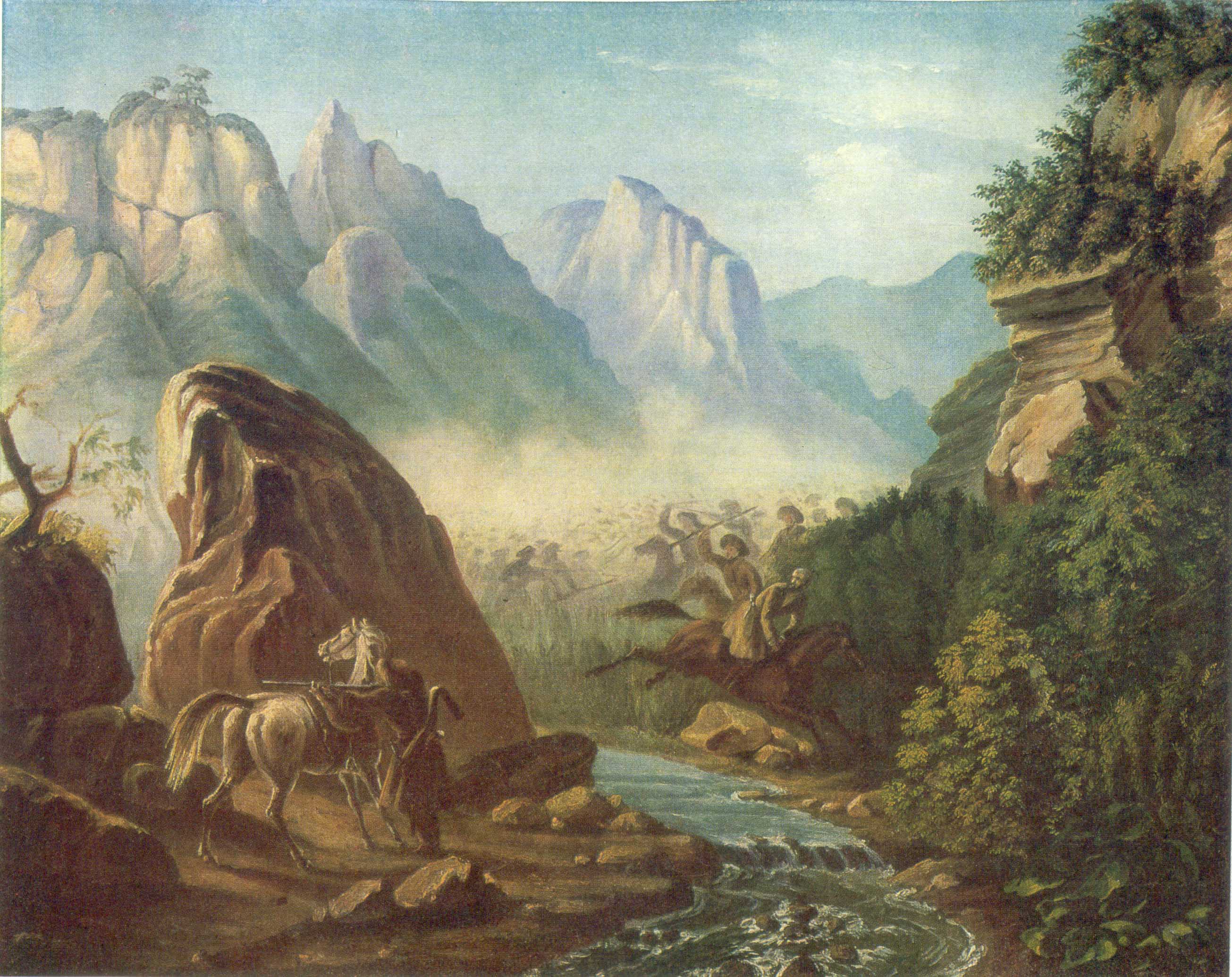
http://thelectern.blogspot.com/2010/04/hero-of-our-time-mikhail-lermontov.html
In looking around for an illustration for the blog post, I found that Lermontov was no mean artist himself. Here are some of his paintings:

146QuentinTom
Thanks Dan, glad you enjoyed it!
